
Air Sampling Approaches for Engineered

Description: Air Sampling Approaches for Engineered Nanoparticles used in the Semiconductor Industry Michele N. Shepard, PhD, MS, CIH QEEN II: 2nd Quantifying Exposure to Engineered Nanomaterials from Manufactured Products Workshop, Washington, D.C.
Related Topics
Download Presentation
"Air Sampling Approaches for Engineered" is the property of its rightful owner. Permission is granted to download and print the materials on this website for personal, non-commercial use only, and to display it on your personal computer provided you do not modify the materials and that you retain all copyright notices contained in the materials. By downloading content from our website, you accept the terms of this agreement.
Presentation Transcript
slide1. Air Sampling Approaches for
Engineered Nanoparticles
used in the Semiconductor Industry Michele N. Shepard, PhD, MS, CIH
QEEN II: 2nd Quantifying Exposure to Engineered Nanomaterials from Manufactured Products Workshop, Washington, D.C.
October 9, 2018<br>
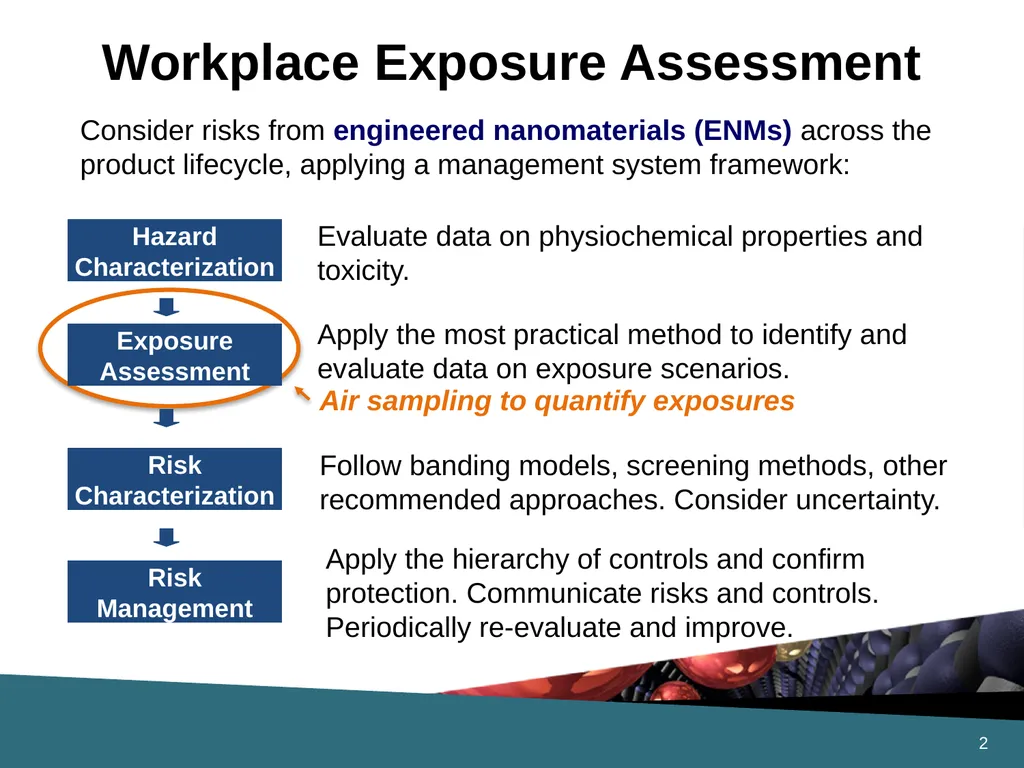
slide2. Risk Characterization Hazard Characterization Exposure Assessment Risk Management Evaluate data on physiochemical properties and toxicity. Apply the most practical method to identify and evaluate data on exposure scenarios. Follow banding models, screening methods, other recommended approaches. Consider uncertainty. Apply the hierarchy of controls and confirm protection. Communicate risks and controls. Periodically re-evaluate and improve. Consider risks from engineered nanomaterials (ENMs) across the product lifecycle, applying a management system framework: Workplace Exposure Assessment Air sampling to quantify exposures<br>
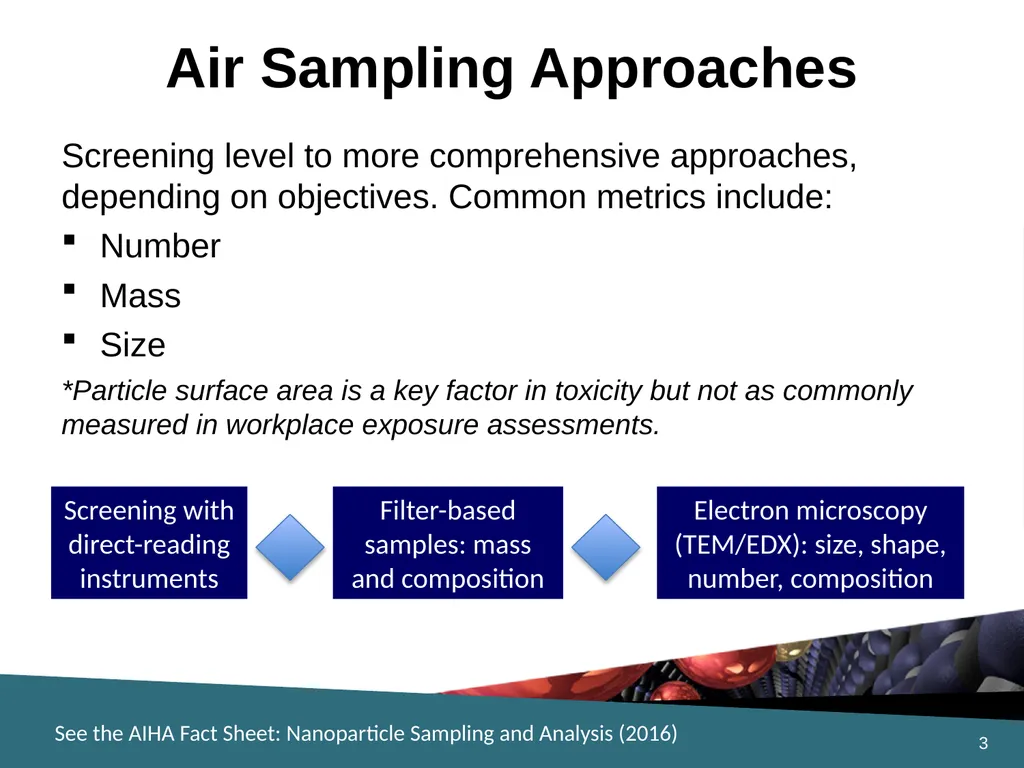
slide3. Air Sampling Approaches Screening level to more comprehensive approaches, depending on objectives. Common metrics include:
Number
Mass
Size
*Particle surface area is a key factor in toxicity but not as commonly measured in workplace exposure assessments. See the AIHA Fact Sheet: Nanoparticle Sampling and Analysis (2016)<br>
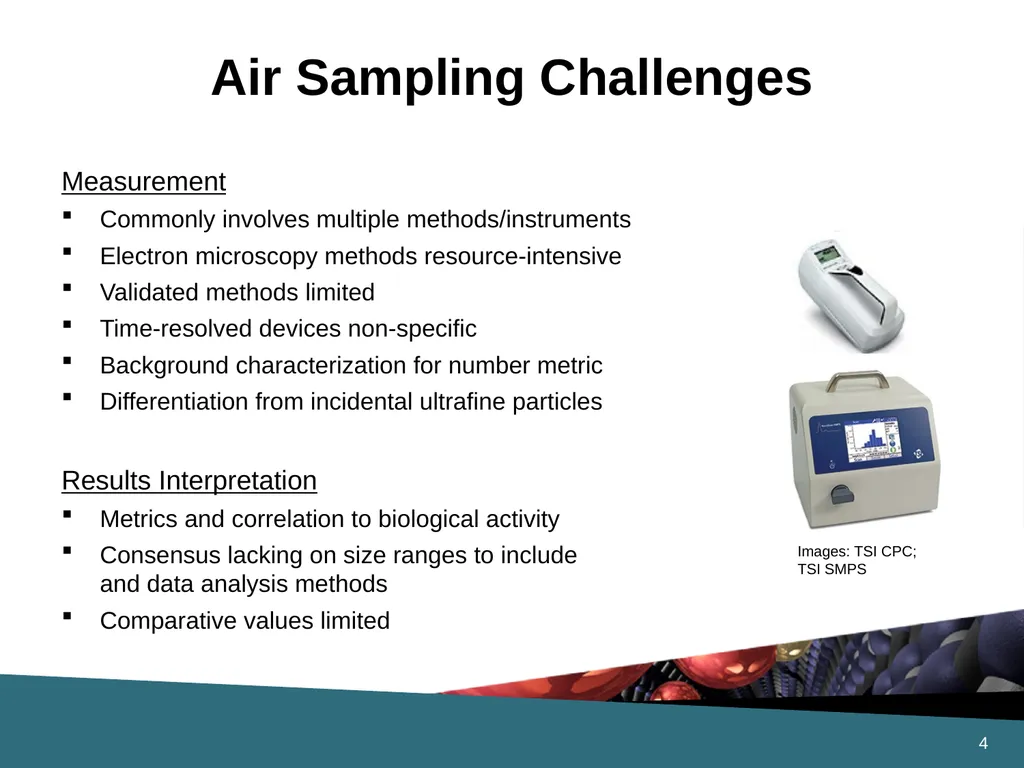
slide4. Air Sampling Challenges Measurement
Commonly involves multiple methods/instruments
Electron microscopy methods resource-intensive
Validated methods limited
Time-resolved devices non-specific
Background characterization for number metric
Differentiation from incidental ultrafine particles
Results Interpretation
Metrics and correlation to biological activity
Consensus lacking on size ranges to include and data analysis methods
Comparative values limited Images: TSI CPC; TSI SMPS<br>
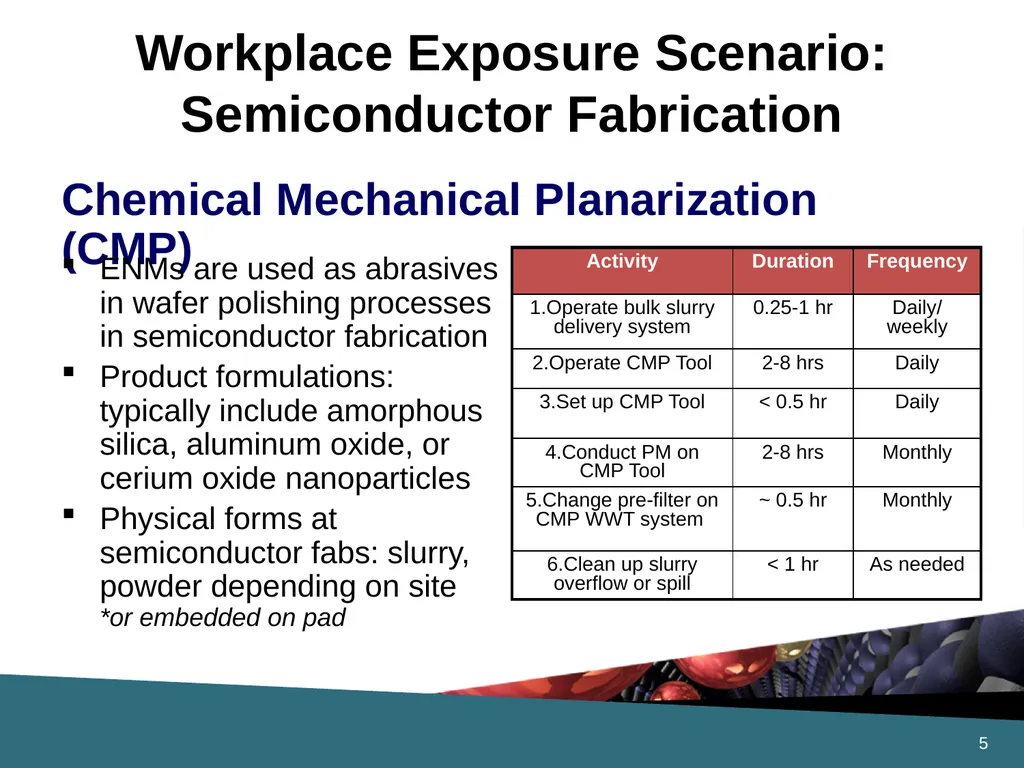
slide5. Workplace Exposure Scenario: Semiconductor Fabrication Chemical Mechanical Planarization (CMP) ENMs are used as abrasives in wafer polishing processes in semiconductor fabrication
Product formulations: typically include amorphous silica, aluminum oxide, or cerium oxide nanoparticles
Physical forms at semiconductor fabs: slurry, powder depending on site *or embedded on pad<br>
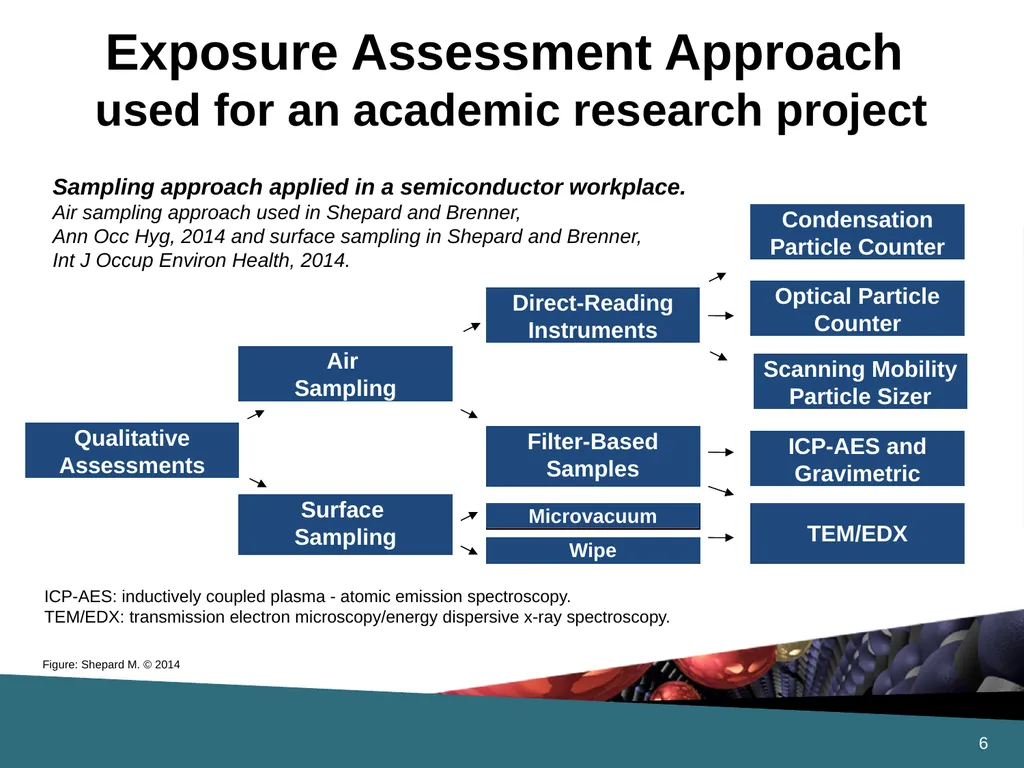
slide6. Qualitative Assessments Surface Sampling Air Sampling Direct-Reading Instruments Filter-Based Samples TEM/EDX ICP-AES and Gravimetric Optical Particle Counter Condensation Particle Counter Optical Particle Counter Scanning Mobility Particle Sizer ICP-AES: inductively coupled plasma - atomic emission spectroscopy. TEM/EDX: transmission electron microscopy/energy dispersive x-ray spectroscopy. Wipe Microvacuum Exposure Assessment Approach used for an academic research project Figure: Shepard M. © 2014 Sampling approach applied in a semiconductor workplace. Air sampling approach used in Shepard and Brenner, Ann Occ Hyg, 2014 and surface sampling in Shepard and Brenner, Int J Occup Environ Health, 2014.<br>
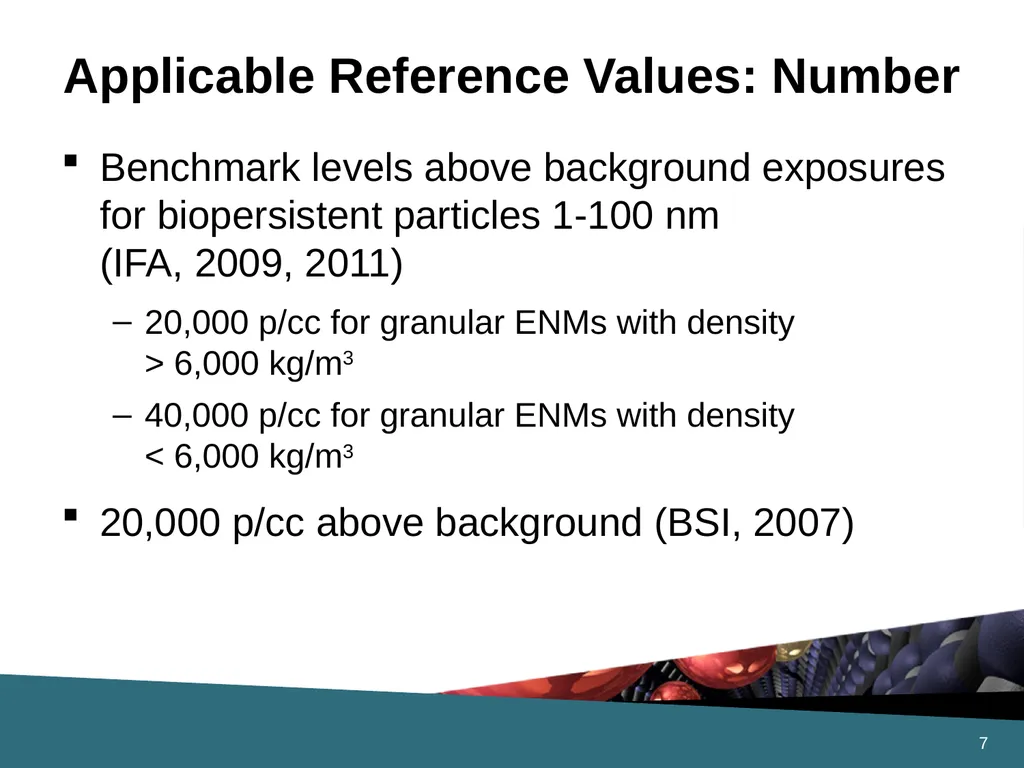
slide7. Applicable Reference Values: Number Benchmark levels above background exposures for biopersistent particles 1-100 nm (IFA, 2009, 2011)
20,000 p/cc for granular ENMs with density > 6,000 kg/m3
40,000 p/cc for granular ENMs with density < 6,000 kg/m3
20,000 p/cc above background (BSI, 2007)<br>
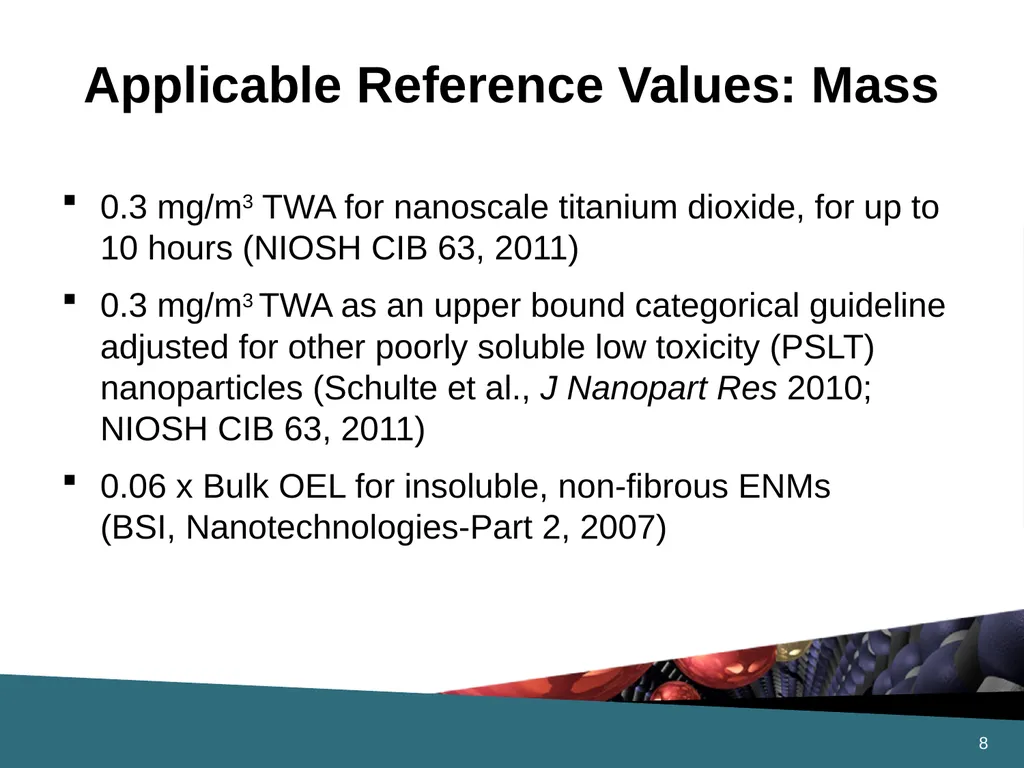
slide8. Applicable Reference Values: Mass 0.3 mg/m3 TWA for nanoscale titanium dioxide, for up to 10 hours (NIOSH CIB 63, 2011)
0.3 mg/m3 TWA as an upper bound categorical guideline adjusted for other poorly soluble low toxicity (PSLT) nanoparticles (Schulte et al., J Nanopart Res 2010; NIOSH CIB 63, 2011)
0.06 x Bulk OEL for insoluble, non-fibrous ENMs (BSI, Nanotechnologies-Part 2, 2007)<br>
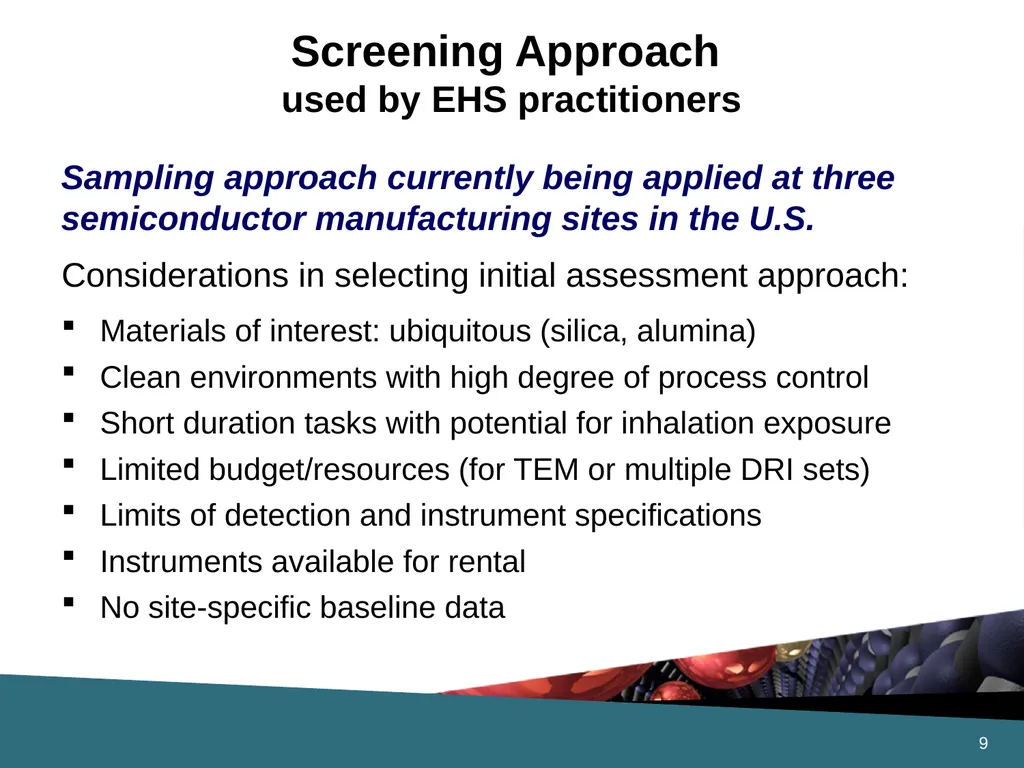
slide9. Screening Approach used by EHS practitioners Sampling approach currently being applied at three semiconductor manufacturing sites in the U.S. Considerations in selecting initial assessment approach:
Materials of interest: ubiquitous (silica, alumina)
Clean environments with high degree of process control
Short duration tasks with potential for inhalation exposure
Limited budget/resources (for TEM or multiple DRI sets)
Limits of detection and instrument specifications
Instruments available for rental
No site-specific baseline data<br>
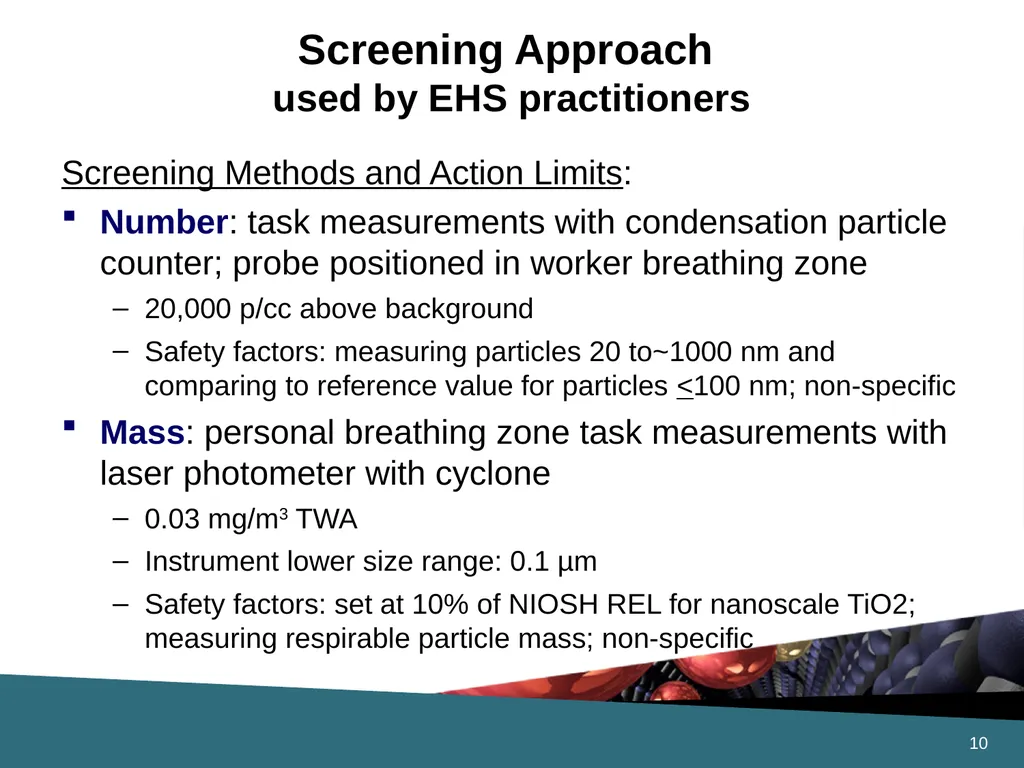
slide10. Screening Approach used by EHS practitioners Screening Methods and Action Limits:
Number: task measurements with condensation particle counter; probe positioned in worker breathing zone
20,000 p/cc above background
Safety factors: measuring particles 20 to~1000 nm and comparing to reference value for particles <100 nm; non-specific
Mass: personal breathing zone task measurements with laser photometer with cyclone
0.03 mg/m3 TWA
Instrument lower size range: 0.1 µm
Safety factors: set at 10% of NIOSH REL for nanoscale TiO2; measuring respirable particle mass; non-specific<br>
slide11. Progress and Future Directions General increase in amount and quality of data from toxicology studies
Improved capability to collect, evaluate and interpret air sampling data with advances in:
Occupational exposure limits (OELs) or banding approaches
Method for setting OELs
Instrumentation/sampling devices
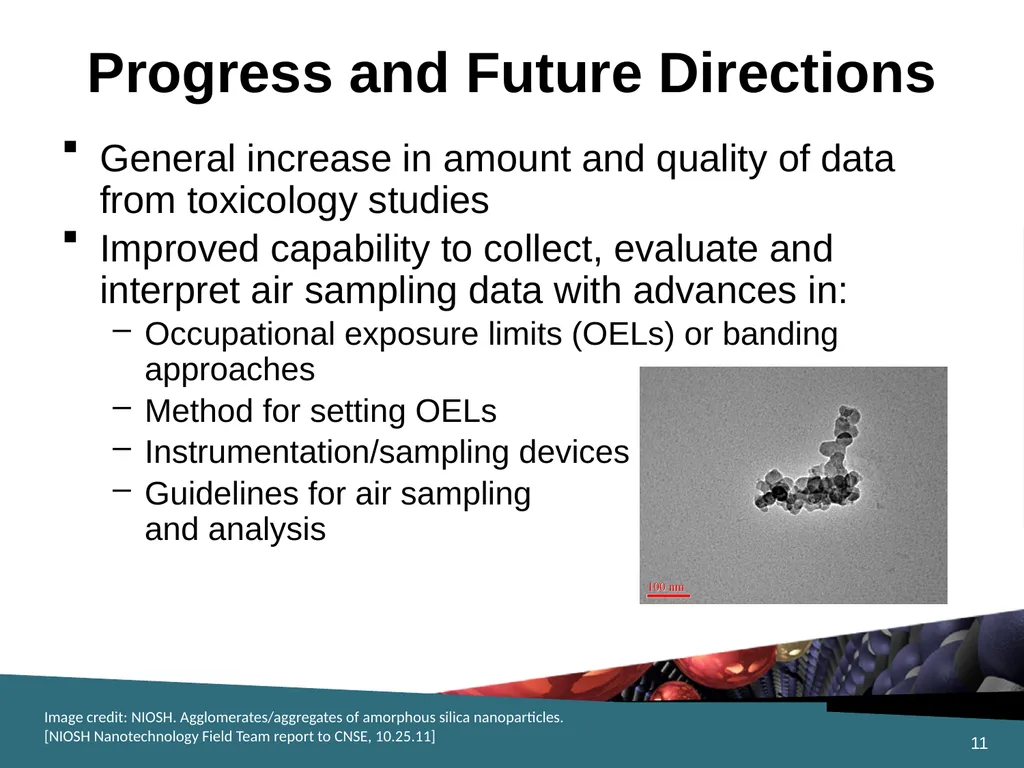
Guidelines for air sampling and analysis Image credit: NIOSH. Agglomerates/aggregates of amorphous silica nanoparticles. [NIOSH Nanotechnology Field Team report to CNSE, 10.25.11]<br>
slide12. Acknowledgements and Disclaimers For previous research in this area:
Funding provided by the US EPA STAR Fellowship FP-91730701 (2011-2014). The views expressed in this presentation are my own and have not been reviewed or endorsed by the EPA.
Exposure assessments of semiconductor applications conducted at SUNY Albany CNSE (2010-2014), with acknowledgements to Dr. Sara Brenner and group members. Funding for air and surface sampling equipment and laboratory analysis provided by the NanoHealth and Safety Center and SEMATECH.
No information presented is intended to provide consulting advice on specific scenarios or applications; any use or adaptation of this information is at the risk of the user.
This presentation is intended to share experiences and observations on air sampling methods used to assess and quantify airborne concentrations and potential workplace exposures to engineered nanoparticles, and references current guidelines and standards.<br>
slide13. Questions or comments:
Michele N. Shepard, PhD, MS, CIH
shepard@colden.com
518-490-2261<br>
QEEN II: 2nd Quantifying Exposure to Engineered Nanomaterials from Manufactured Products Workshop, Washington, D.C.
October 9, 2018<br>
slide2. Risk Characterization Hazard Characterization Exposure Assessment Risk Management Evaluate data on physiochemical properties and toxicity. Apply the most practical method to identify and evaluate data on exposure scenarios. Follow banding models, screening methods, other recommended approaches. Consider uncertainty. Apply the hierarchy of controls and confirm protection. Communicate risks and controls. Periodically re-evaluate and improve. Consider risks from engineered nanomaterials (ENMs) across the product lifecycle, applying a management system framework: Workplace Exposure Assessment Air sampling to quantify exposures<br>
slide3. Air Sampling Approaches Screening level to more comprehensive approaches, depending on objectives. Common metrics include:
Number
Mass
Size
*Particle surface area is a key factor in toxicity but not as commonly measured in workplace exposure assessments. See the AIHA Fact Sheet: Nanoparticle Sampling and Analysis (2016)<br>
slide4. Air Sampling Challenges Measurement
Commonly involves multiple methods/instruments
Electron microscopy methods resource-intensive
Validated methods limited
Time-resolved devices non-specific
Background characterization for number metric
Differentiation from incidental ultrafine particles
Results Interpretation
Metrics and correlation to biological activity
Consensus lacking on size ranges to include and data analysis methods
Comparative values limited Images: TSI CPC; TSI SMPS<br>
slide5. Workplace Exposure Scenario: Semiconductor Fabrication Chemical Mechanical Planarization (CMP) ENMs are used as abrasives in wafer polishing processes in semiconductor fabrication
Product formulations: typically include amorphous silica, aluminum oxide, or cerium oxide nanoparticles
Physical forms at semiconductor fabs: slurry, powder depending on site *or embedded on pad<br>
slide6. Qualitative Assessments Surface Sampling Air Sampling Direct-Reading Instruments Filter-Based Samples TEM/EDX ICP-AES and Gravimetric Optical Particle Counter Condensation Particle Counter Optical Particle Counter Scanning Mobility Particle Sizer ICP-AES: inductively coupled plasma - atomic emission spectroscopy. TEM/EDX: transmission electron microscopy/energy dispersive x-ray spectroscopy. Wipe Microvacuum Exposure Assessment Approach used for an academic research project Figure: Shepard M. © 2014 Sampling approach applied in a semiconductor workplace. Air sampling approach used in Shepard and Brenner, Ann Occ Hyg, 2014 and surface sampling in Shepard and Brenner, Int J Occup Environ Health, 2014.<br>
slide7. Applicable Reference Values: Number Benchmark levels above background exposures for biopersistent particles 1-100 nm (IFA, 2009, 2011)
20,000 p/cc for granular ENMs with density > 6,000 kg/m3
40,000 p/cc for granular ENMs with density < 6,000 kg/m3
20,000 p/cc above background (BSI, 2007)<br>
slide8. Applicable Reference Values: Mass 0.3 mg/m3 TWA for nanoscale titanium dioxide, for up to 10 hours (NIOSH CIB 63, 2011)
0.3 mg/m3 TWA as an upper bound categorical guideline adjusted for other poorly soluble low toxicity (PSLT) nanoparticles (Schulte et al., J Nanopart Res 2010; NIOSH CIB 63, 2011)
0.06 x Bulk OEL for insoluble, non-fibrous ENMs (BSI, Nanotechnologies-Part 2, 2007)<br>
slide9. Screening Approach used by EHS practitioners Sampling approach currently being applied at three semiconductor manufacturing sites in the U.S. Considerations in selecting initial assessment approach:
Materials of interest: ubiquitous (silica, alumina)
Clean environments with high degree of process control
Short duration tasks with potential for inhalation exposure
Limited budget/resources (for TEM or multiple DRI sets)
Limits of detection and instrument specifications
Instruments available for rental
No site-specific baseline data<br>
slide10. Screening Approach used by EHS practitioners Screening Methods and Action Limits:
Number: task measurements with condensation particle counter; probe positioned in worker breathing zone
20,000 p/cc above background
Safety factors: measuring particles 20 to~1000 nm and comparing to reference value for particles <100 nm; non-specific
Mass: personal breathing zone task measurements with laser photometer with cyclone
0.03 mg/m3 TWA
Instrument lower size range: 0.1 µm
Safety factors: set at 10% of NIOSH REL for nanoscale TiO2; measuring respirable particle mass; non-specific<br>
slide11. Progress and Future Directions General increase in amount and quality of data from toxicology studies
Improved capability to collect, evaluate and interpret air sampling data with advances in:
Occupational exposure limits (OELs) or banding approaches
Method for setting OELs
Instrumentation/sampling devices
Guidelines for air sampling and analysis Image credit: NIOSH. Agglomerates/aggregates of amorphous silica nanoparticles. [NIOSH Nanotechnology Field Team report to CNSE, 10.25.11]<br>
slide12. Acknowledgements and Disclaimers For previous research in this area:
Funding provided by the US EPA STAR Fellowship FP-91730701 (2011-2014). The views expressed in this presentation are my own and have not been reviewed or endorsed by the EPA.
Exposure assessments of semiconductor applications conducted at SUNY Albany CNSE (2010-2014), with acknowledgements to Dr. Sara Brenner and group members. Funding for air and surface sampling equipment and laboratory analysis provided by the NanoHealth and Safety Center and SEMATECH.
No information presented is intended to provide consulting advice on specific scenarios or applications; any use or adaptation of this information is at the risk of the user.
This presentation is intended to share experiences and observations on air sampling methods used to assess and quantify airborne concentrations and potential workplace exposures to engineered nanoparticles, and references current guidelines and standards.<br>
slide13. Questions or comments:
Michele N. Shepard, PhD, MS, CIH
shepard@colden.com
518-490-2261<br>