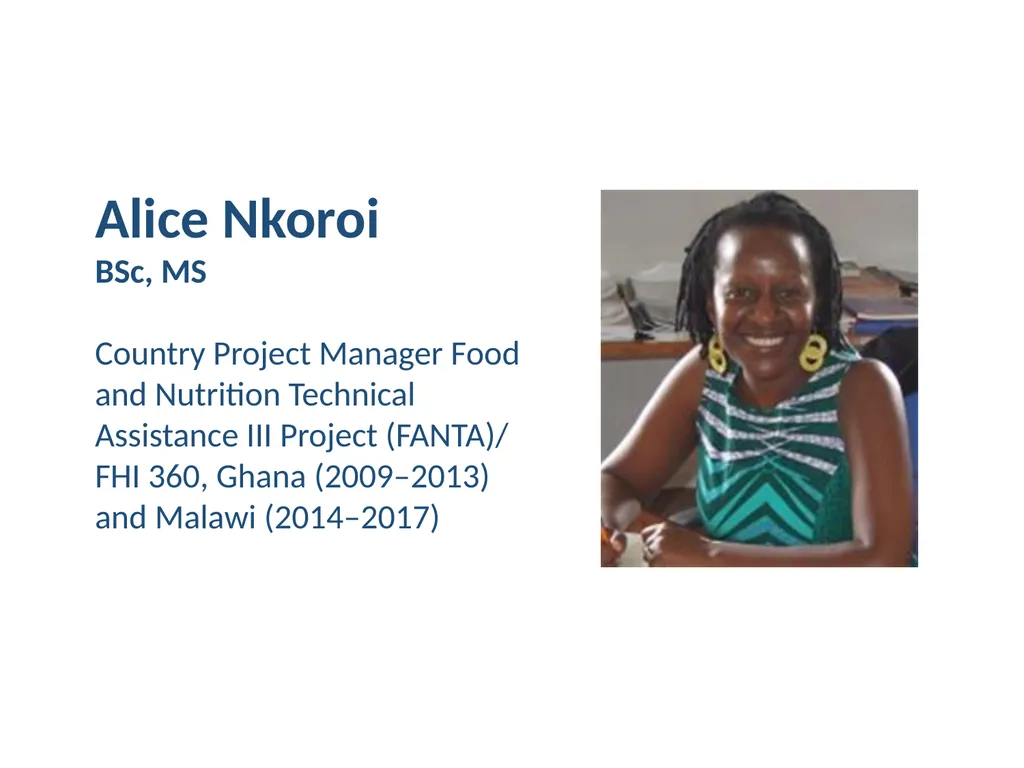
Alice Nkoroi BSc, MS Country Project Manager Food

Published  . 0 views
↓ Download
Alice Nkoroi BSc, MS Country Project Manager Food
1 / 1
Alice Nkoroi BSc, MS Country Project Manager Food - slide 1 of 16 Alice Nkoroi BSc, MS Country Project Manager Food - slide 2 of 16 Alice Nkoroi BSc, MS Country Project Manager Food - slide 3 of 16 Alice Nkoroi BSc, MS Country Project Manager Food - slide 4 of 16 Alice Nkoroi BSc, MS Country Project Manager Food - slide 5 of 16 Alice Nkoroi BSc, MS Country Project Manager Food - slide 6 of 16 Alice Nkoroi BSc, MS Country Project Manager Food - slide 7 of 16 Alice Nkoroi BSc, MS Country Project Manager Food - slide 8 of 16 Alice Nkoroi BSc, MS Country Project Manager Food - slide 9 of 16 Alice Nkoroi BSc, MS Country Project Manager Food - slide 10 of 16 Alice Nkoroi BSc, MS Country Project Manager Food - slide 11 of 16 Alice Nkoroi BSc, MS Country Project Manager Food - slide 12 of 16 Alice Nkoroi BSc, MS Country Project Manager Food - slide 13 of 16 Alice Nkoroi BSc, MS Country Project Manager Food - slide 14 of 16 Alice Nkoroi BSc, MS Country Project Manager Food - slide 15 of 16 Alice Nkoroi BSc, MS Country Project Manager Food - slide 16 of 16
Description: Alice Nkoroi BSc, MS Country Project Manager Food and Nutrition Technical Assistance III Project (FANTA) FHI 360, Ghana (20092013) and Malawi (20142017) Improving Pre-service Nutrition Education of Frontline Workers: Nurses and Midwives

Related Topics

Download Presentation

"Alice Nkoroi BSc, MS Country Project Manager Food" is the property of its rightful owner. Permission is granted to download and print the materials on this website for personal, non-commercial use only, and to display it on your personal computer provided you do not modify the materials and that you retain all copyright notices contained in the materials. By downloading content from our website, you accept the terms of this agreement.

Presentation Transcript

slide1. Alice Nkoroi
BSc, MS
Country Project Manager Food and Nutrition Technical Assistance III Project (FANTA)/ FHI 360, Ghana (2009–2013) and Malawi (2014–2017)<br>
slide2. Improving Pre-service Nutrition Education of Frontline Workers: Nurses and Midwives in Ghana and Malawi

Alice Nkoroi, FANTA/FHI 360<br>
slide3. Presentation Outline Context
Approach and Process
Impact
Lessons Learned
Acknowledgments<br>
slide4. 1. Context In both Ghana and Malawi, FANTA worked to improve access and quality of nutrition services. This included support to the governments to develop policies, strategies and guidelines; and build competence of health care providers and managers.
Lancet Series (2013) emphasis on capacity development of variety of human resource needed to scale-up priority nutrition interventions.
With the limited number of nutritionist and dieticians working at the forefront, nurses and midwives play a vital role in delivering nutrition services.
WHO and International council of nurses highlight on the need for competence based pre-service nutrition education.<br>
slide5. 2. Approach and Process<br>
slide6. Plan and Define the Scope (2)<br>
slide7. Example of Nutrition Competency (2)<br>
slide8. Conduct Situational Analysis (2)<br>
slide9. Example from Ghana: Assessment of Tutors Competence in Nutrition (2)<br>
slide10. Intervene (2)<br>
slide11. Example from Malawi: Standardized Nutrition Teaching Aids and Resources for Nursing and Midwifery Institutions<br>
slide12. Review and Evaluate the Interventions (2)<br>
slide13. 3. Impact The core competencies requirements for service delivery were aligned with pre-service training and job descriptions.
Curricula for nurses and midwives included nutrition clinical practice sessions that were previously not covered.
Pre-service training on nutrition was standardized and evidence based.
Tutors had a solid understanding of and skills in teaching nutrition theory and practice.<br>
slide14. 4. Lessons Learned Defining core competencies provided scope for including the national policy priorities in the pre-service training curricula.
Updating pre-service training should be continuous process. This should be done alongside continuous professional development while in-service.
For sustainability of interventions, partnerships and collaboration should include the MOH at all levels, teaching institutions and the regulatory bodies.
More online training and resources are needed to help mitigate problems related the teacher-student ratio and time needed to cover the course material.<br>
slide15. 5. Acknowledgements<br>
slide16. This presentation is made possible by the generous support of the American people through the support of the Office of Maternal and Child Health and Nutrition, Bureau for Global Health, U.S. Agency for International Development (USAID), under terms of Cooperative Agreement No. AID-OAA-A-12-00005, through the Food and Nutrition Technical Assistance III Project (FANTA), managed by FHI 360. The contents are the responsibility of FHI 360 and do not necessarily reflect the views of USAID or the United States Government.<br>