ALLOSTERIC ENZYMES REGULATION By- Shubhani singh
Description: ALLOSTERIC ENZYMES REGULATION By- Shubhani singh thakur department of biochemistry Contents Introduction History Properties Modulators Types of Allosteric Regulation Models of Allosteric Regulation Allosteric Inhibition Applications
Related Topics
Download Presentation
"ALLOSTERIC ENZYMES REGULATION By- Shubhani singh" is the property of its rightful owner. Permission is granted to download and print the materials on this website for personal, non-commercial use only, and to display it on your personal computer provided you do not modify the materials and that you retain all copyright notices contained in the materials. By downloading content from our website, you accept the terms of this agreement.
Presentation Transcript
slide1. ALLOSTERIC ENZYMES REGULATIONBy- Shubhani singh thakurdepartment of biochemistry<br>
slide2. Contents Introduction
History
Properties
Modulators
Types of Allosteric Regulation
Models of Allosteric Regulation
Allosteric Inhibition
Applications
References<br>
slide3. HISTORY Allostery a biological phenomenon commonly referring to regulation at distant sites
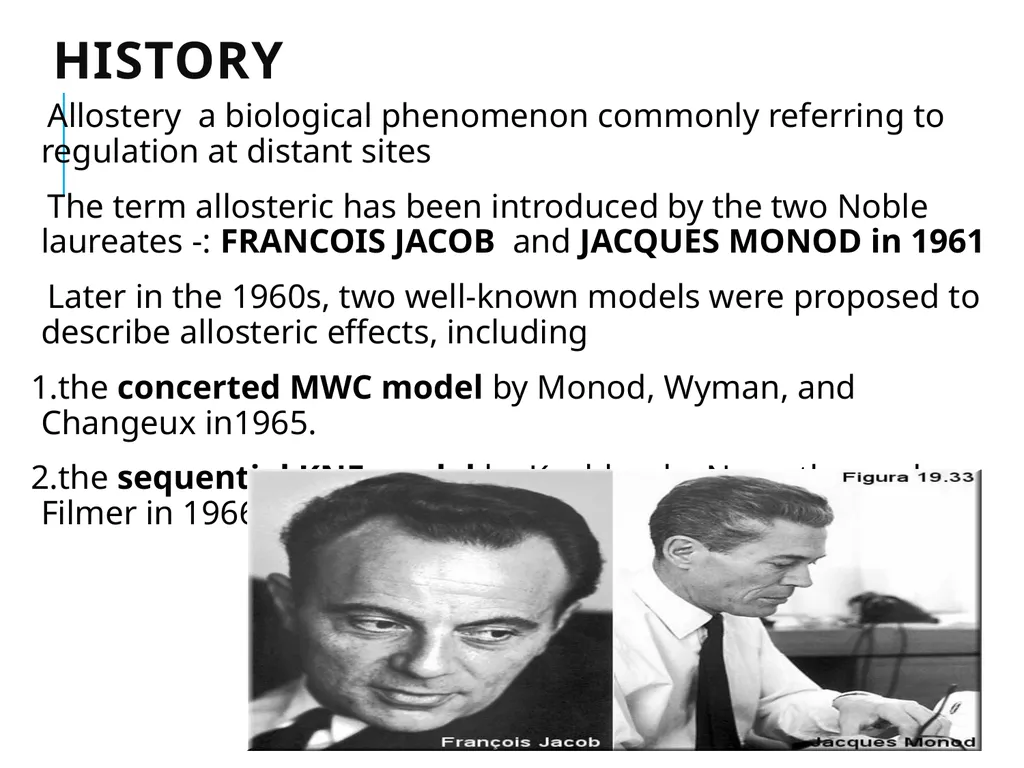
The term allosteric has been introduced by the two Noble laureates -: FRANCOIS JACOB and JACQUES MONOD in 1961
Later in the 1960s, two well-known models were proposed to describe allosteric effects, including
1.the concerted MWC model by Monod, Wyman, and Changeux in1965.
2.the sequential KNF model by Koshland, Nemethy, and Filmer in 1966.<br>
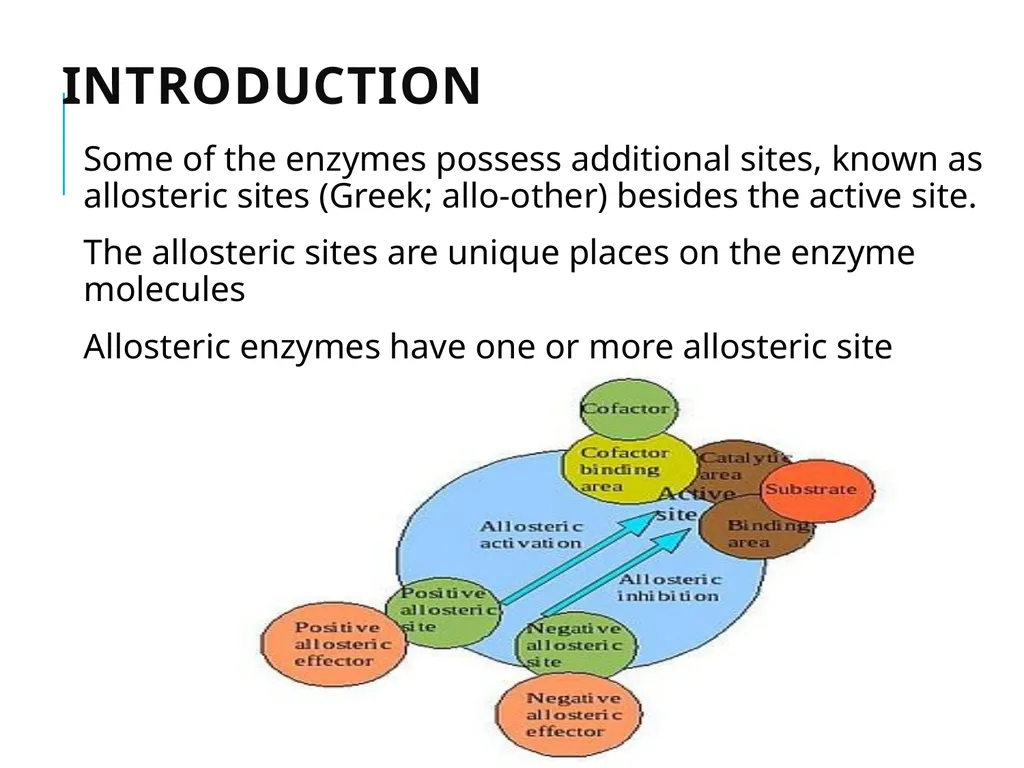
slide4. INTRODUCTION Some of the enzymes possess additional sites, known as allosteric sites (Greek; allo-other) besides the active site.
The allosteric sites are unique places on the enzyme molecules
Allosteric enzymes have one or more allosteric site<br>
slide5. PROPERTIES Allosteric enzymes are multisubunit protiens and have one or more allosteric sites
Allosteric sites are binding sites distinct from an enzyme active site or substrate binding site
Modulator binds with regulatory or allosteric site by reversibly non covalent bond .
Effector may be positive or negative, this effector regulate the enzyme activity.
The enzyme activity is increased when a positive allosteric effector binds at the allosteric site known as activator site.
negative allosteric effector bind at the allosteric site called inhibitor site and inhibit the enzyme activity by changing enzymes confirmation.<br>
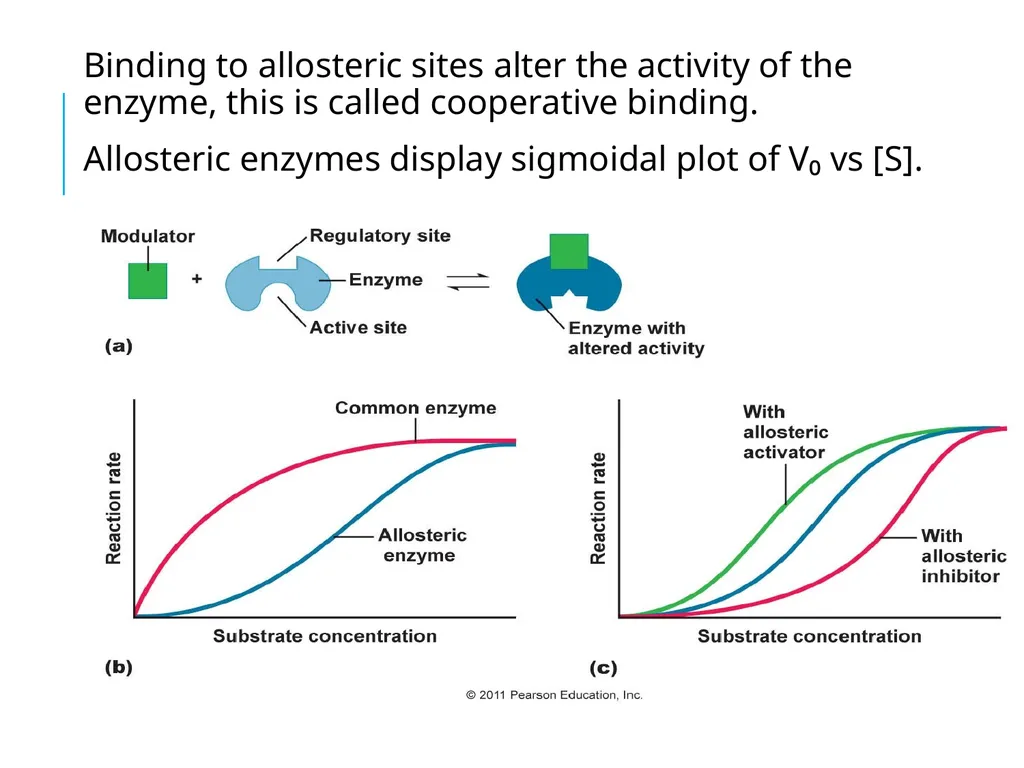
slide6. Binding to allosteric sites alter the activity of the enzyme, this is called cooperative binding.
Allosteric enzymes display sigmoidal plot of V₀ vs [S].<br>
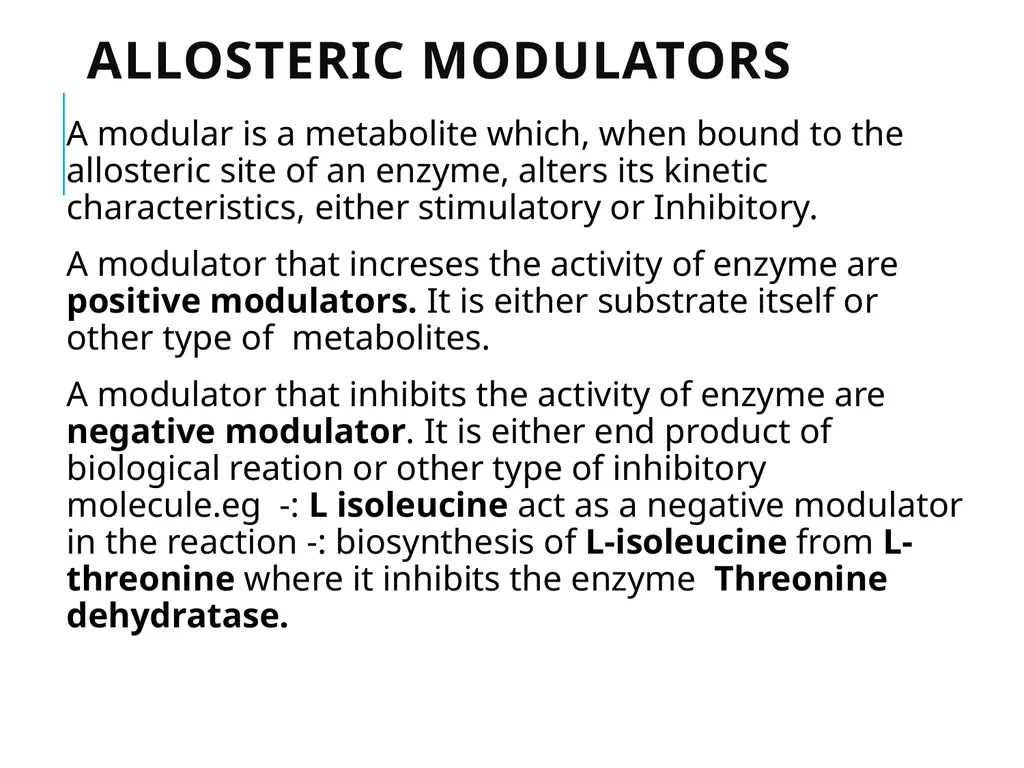
slide7. Allosteric Modulators A modular is a metabolite which, when bound to the allosteric site of an enzyme, alters its kinetic characteristics, either stimulatory or Inhibitory.
A modulator that increses the activity of enzyme are positive modulators. It is either substrate itself or other type of metabolites.
A modulator that inhibits the activity of enzyme are negative modulator. It is either end product of biological reation or other type of inhibitory molecule.eg -: L isoleucine act as a negative modulator in the reaction -: biosynthesis of L-isoleucine from L-threonine where it inhibits the enzyme Threonine dehydratase.<br>
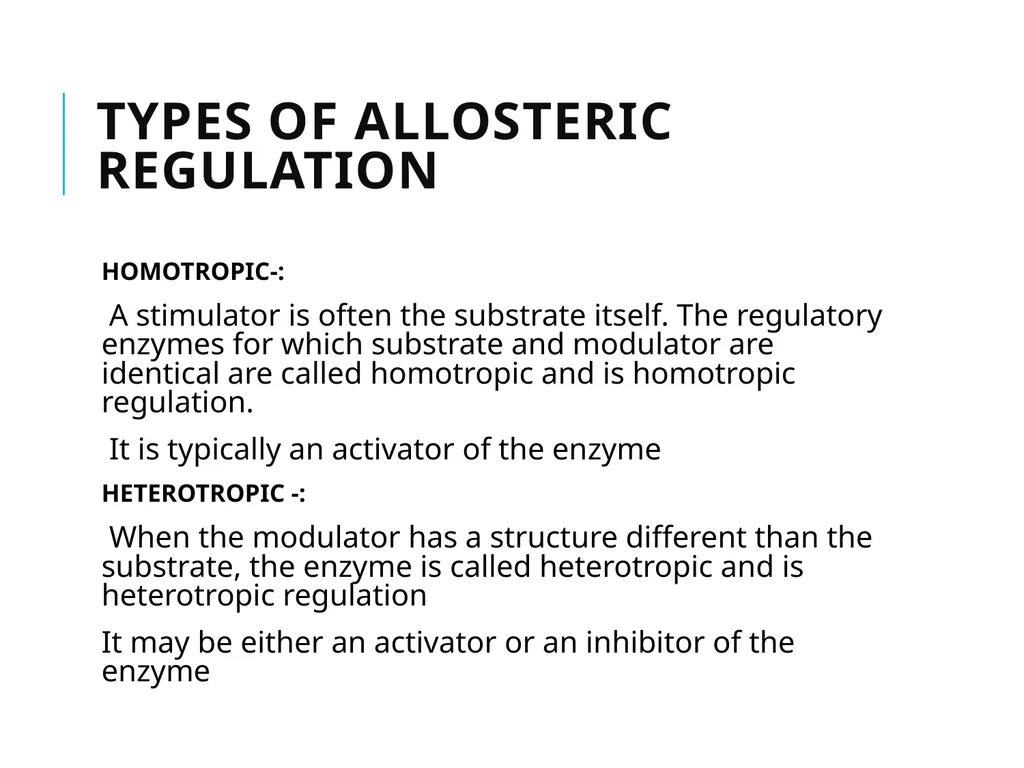
slide8. TYPES OF ALLOSTERIC REGULATION HOMOTROPIC-:
A stimulator is often the substrate itself. The regulatory enzymes for which substrate and modulator are identical are called homotropic and is homotropic regulation.
It is typically an activator of the enzyme
HETEROTROPIC -:
When the modulator has a structure different than the substrate, the enzyme is called heterotropic and is heterotropic regulation
It may be either an activator or an inhibitor of the enzyme<br>
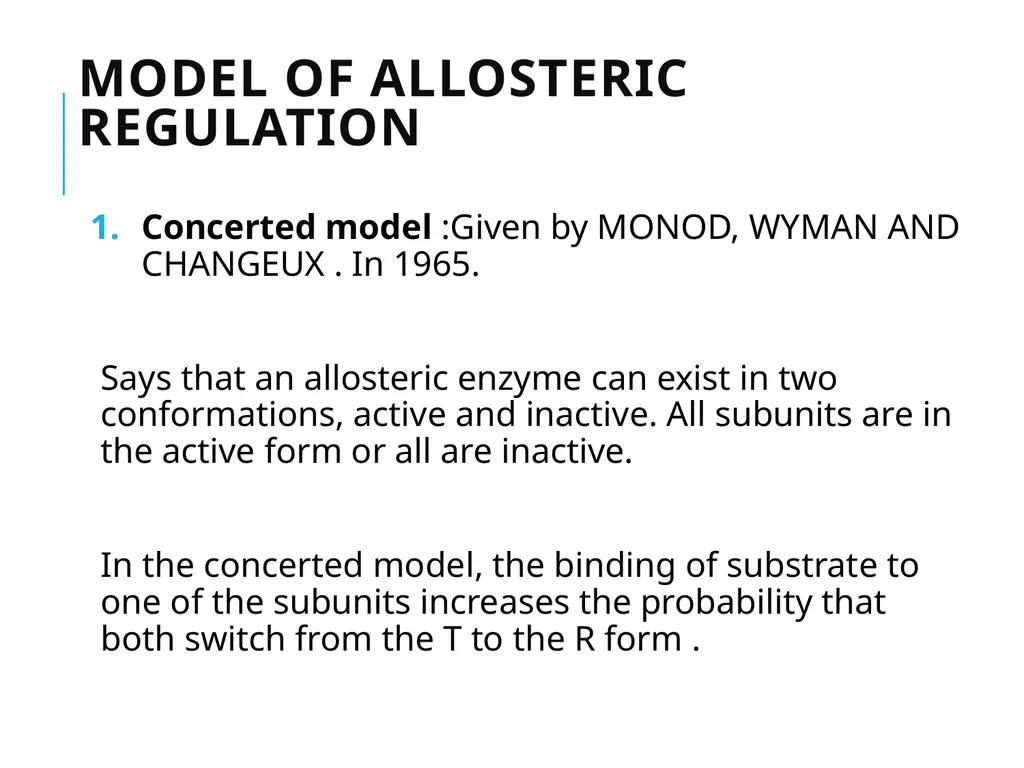
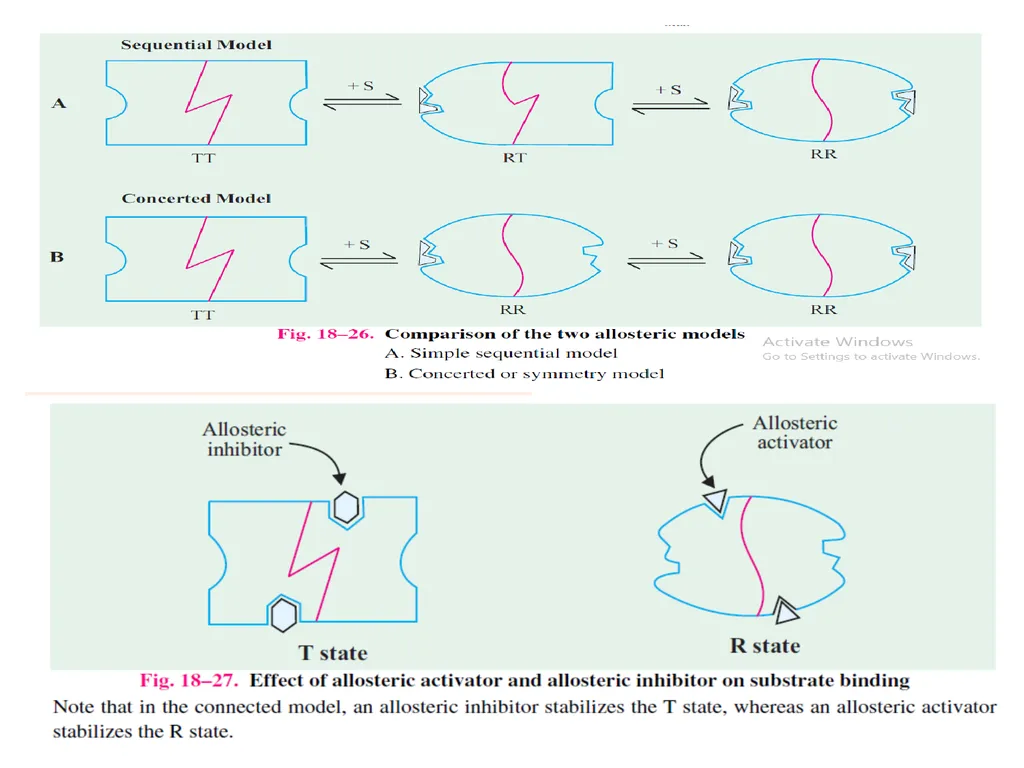
slide9. MODEL OF ALLOSTERIC REGULATION Concerted model :Given by MONOD, WYMAN AND CHANGEUX . In 1965.
Says that an allosteric enzyme can exist in two conformations, active and inactive. All subunits are in the active form or all are inactive.
In the concerted model, the binding of substrate to one of the subunits increases the probability that both switch from the T to the R form .<br>
slide10. 2. Simple Sequential model: Given by KOSHLAND, NEMETHY AND FILMER. In 1966
Says that the allosteric enzyme can exist in only two conformational change individually. Binding of substrate increases the probability of the conformational change.
A conformational change in one subunit makes a similar change in an adjacent subunit.
The T (tense) form has low affinity and the R (relaxed) form has high affinity for Substrate.<br>
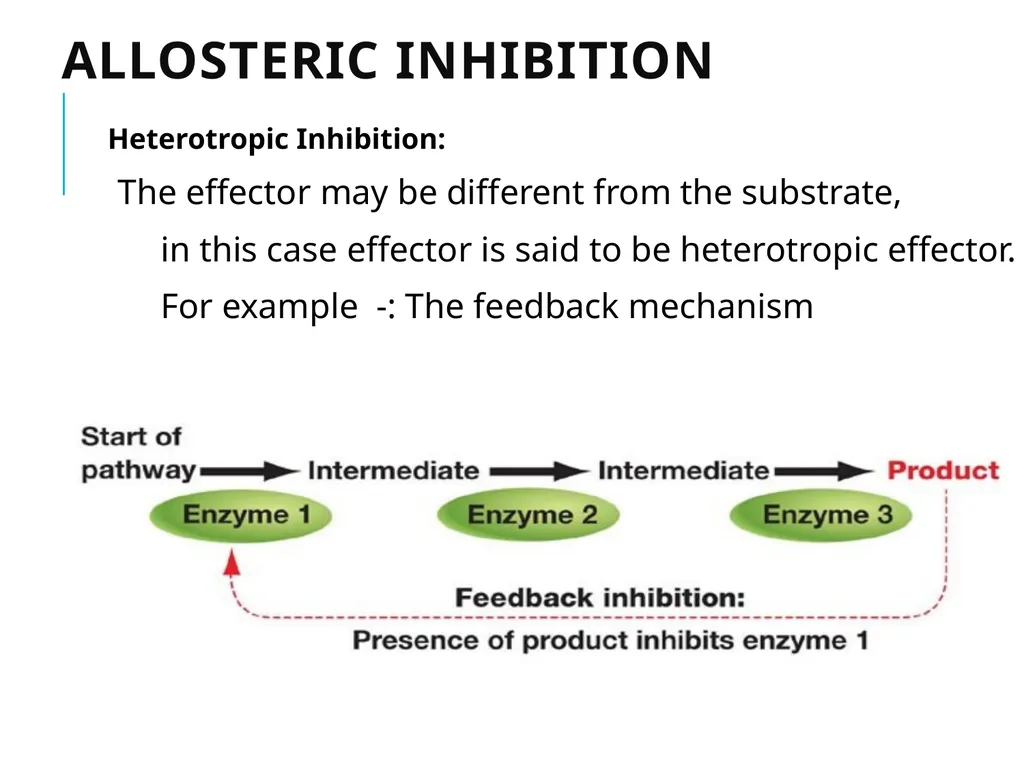
slide12. ALLOSTERIC INHIBITION Heterotropic Inhibition:
The effector may be different from the substrate,
in this case effector is said to be heterotropic effector.
For example -: The feedback mechanism<br>
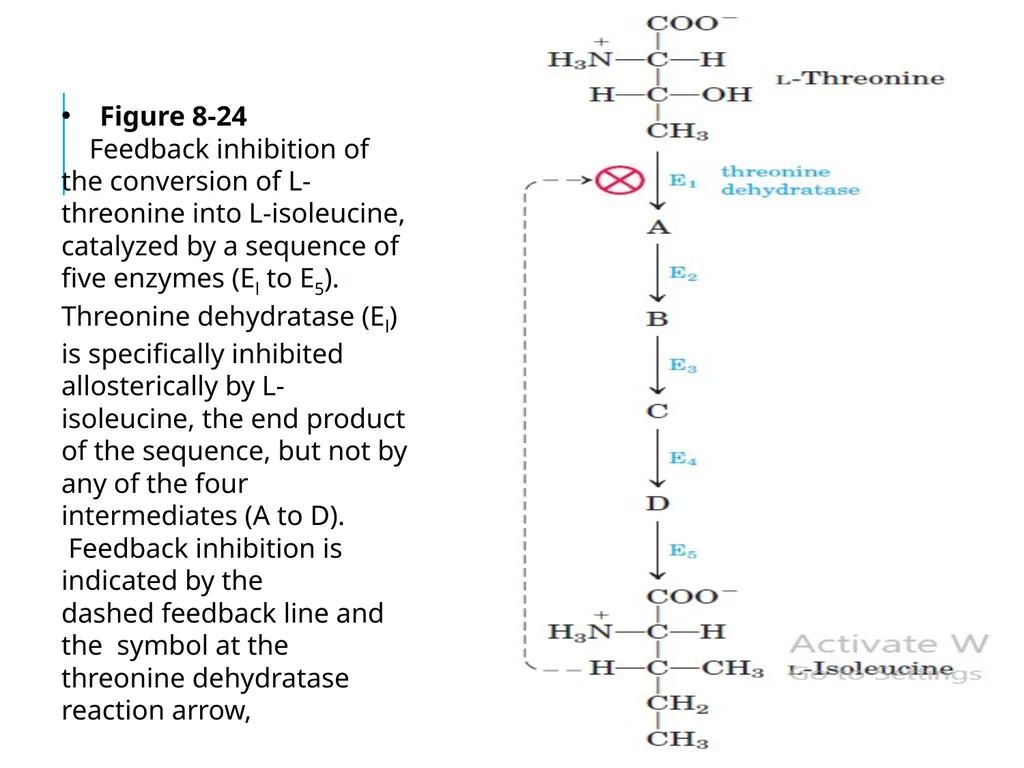
slide13. Figure 8-24
Feedback inhibition of the conversion of L-threonine into L-isoleucine, catalyzed by a sequence of five enzymes (El to E5). Threonine dehydratase (El) is specifically inhibited allosterically by L-isoleucine, the end product of the sequence, but not by any of the four intermediates (A to D).
Feedback inhibition is indicated by the
dashed feedback line and the symbol at the threonine dehydratase
reaction arrow,<br>
slide14. APPLICATIONS Understanding allostery is essential to understand complex biological systems under physiological conditions and in disease and greatly benefit to -
Development of more selective, potent, and effective allosteric drugs.
Understanding disease and allosteric drug discovery

Used as biosensor for molecular diagnosis<br>
slide15. REFERENCES Enzymes – Palmer page – 230- 279
Enzyme Kinetics - Principles and Methods (Wiley, 2008)
Fundamentals of Biochemistry -: J.L. Jain page 397 -400
Lehninger – Principle of Biochemistry 6th edition page 225 -231
Websites -: http://journals.plos.org/ploscompbiol/article?id=10.1371/journal.pcbi.1004966<br>
slide2. Contents Introduction
History
Properties
Modulators
Types of Allosteric Regulation
Models of Allosteric Regulation
Allosteric Inhibition
Applications
References<br>
slide3. HISTORY Allostery a biological phenomenon commonly referring to regulation at distant sites
The term allosteric has been introduced by the two Noble laureates -: FRANCOIS JACOB and JACQUES MONOD in 1961
Later in the 1960s, two well-known models were proposed to describe allosteric effects, including
1.the concerted MWC model by Monod, Wyman, and Changeux in1965.
2.the sequential KNF model by Koshland, Nemethy, and Filmer in 1966.<br>
slide4. INTRODUCTION Some of the enzymes possess additional sites, known as allosteric sites (Greek; allo-other) besides the active site.
The allosteric sites are unique places on the enzyme molecules
Allosteric enzymes have one or more allosteric site<br>
slide5. PROPERTIES Allosteric enzymes are multisubunit protiens and have one or more allosteric sites
Allosteric sites are binding sites distinct from an enzyme active site or substrate binding site
Modulator binds with regulatory or allosteric site by reversibly non covalent bond .
Effector may be positive or negative, this effector regulate the enzyme activity.
The enzyme activity is increased when a positive allosteric effector binds at the allosteric site known as activator site.
negative allosteric effector bind at the allosteric site called inhibitor site and inhibit the enzyme activity by changing enzymes confirmation.<br>
slide6. Binding to allosteric sites alter the activity of the enzyme, this is called cooperative binding.
Allosteric enzymes display sigmoidal plot of V₀ vs [S].<br>
slide7. Allosteric Modulators A modular is a metabolite which, when bound to the allosteric site of an enzyme, alters its kinetic characteristics, either stimulatory or Inhibitory.
A modulator that increses the activity of enzyme are positive modulators. It is either substrate itself or other type of metabolites.
A modulator that inhibits the activity of enzyme are negative modulator. It is either end product of biological reation or other type of inhibitory molecule.eg -: L isoleucine act as a negative modulator in the reaction -: biosynthesis of L-isoleucine from L-threonine where it inhibits the enzyme Threonine dehydratase.<br>
slide8. TYPES OF ALLOSTERIC REGULATION HOMOTROPIC-:
A stimulator is often the substrate itself. The regulatory enzymes for which substrate and modulator are identical are called homotropic and is homotropic regulation.
It is typically an activator of the enzyme
HETEROTROPIC -:
When the modulator has a structure different than the substrate, the enzyme is called heterotropic and is heterotropic regulation
It may be either an activator or an inhibitor of the enzyme<br>
slide9. MODEL OF ALLOSTERIC REGULATION Concerted model :Given by MONOD, WYMAN AND CHANGEUX . In 1965.
Says that an allosteric enzyme can exist in two conformations, active and inactive. All subunits are in the active form or all are inactive.
In the concerted model, the binding of substrate to one of the subunits increases the probability that both switch from the T to the R form .<br>
slide10. 2. Simple Sequential model: Given by KOSHLAND, NEMETHY AND FILMER. In 1966
Says that the allosteric enzyme can exist in only two conformational change individually. Binding of substrate increases the probability of the conformational change.
A conformational change in one subunit makes a similar change in an adjacent subunit.
The T (tense) form has low affinity and the R (relaxed) form has high affinity for Substrate.<br>
slide12. ALLOSTERIC INHIBITION Heterotropic Inhibition:
The effector may be different from the substrate,
in this case effector is said to be heterotropic effector.
For example -: The feedback mechanism<br>
slide13. Figure 8-24
Feedback inhibition of the conversion of L-threonine into L-isoleucine, catalyzed by a sequence of five enzymes (El to E5). Threonine dehydratase (El) is specifically inhibited allosterically by L-isoleucine, the end product of the sequence, but not by any of the four intermediates (A to D).
Feedback inhibition is indicated by the
dashed feedback line and the symbol at the threonine dehydratase
reaction arrow,<br>
slide14. APPLICATIONS Understanding allostery is essential to understand complex biological systems under physiological conditions and in disease and greatly benefit to -
Development of more selective, potent, and effective allosteric drugs.
Understanding disease and allosteric drug discovery
Used as biosensor for molecular diagnosis<br>
slide15. REFERENCES Enzymes – Palmer page – 230- 279
Enzyme Kinetics - Principles and Methods (Wiley, 2008)
Fundamentals of Biochemistry -: J.L. Jain page 397 -400
Lehninger – Principle of Biochemistry 6th edition page 225 -231
Websites -: http://journals.plos.org/ploscompbiol/article?id=10.1371/journal.pcbi.1004966<br>