
ALTERNATIVE INSTITUTIONAL TRAJECTORIES AND THEIR
T
Published · 19 slides · 0 views

1 / 1



Description
ALTERNATIVE INSTITUTIONAL TRAJECTORIES AND THEIR RELATIONSHIP WITH ECONOMIC PERFORMANCE prepared by Hemphi Terangpi Protection of property rights, effective law enforcement, and efficient bureaucracies, together with a broad range of norms
Related Topics
Share
Embed code
Download this presentation From Below
"ALTERNATIVE INSTITUTIONAL TRAJECTORIES AND THEIR" is the property of its rightful owner. Permission is granted to download and print the materials on this website for personal, non-commercial use only, and to display it on your personal computer provided you do not modify the materials and that you retain all copyright notices contained in the materials. By downloading content from our website, you accept the terms of this agreement.
Presentation Transcript
01
ALTERNATIVE INSTITUTIONAL TRAJECTORIES AND THEIR RELATIONSHIP WITH ECONOMIC PERFORMANCE prepared by
Hemphi Terangpi<br>
Hemphi Terangpi<br>
02
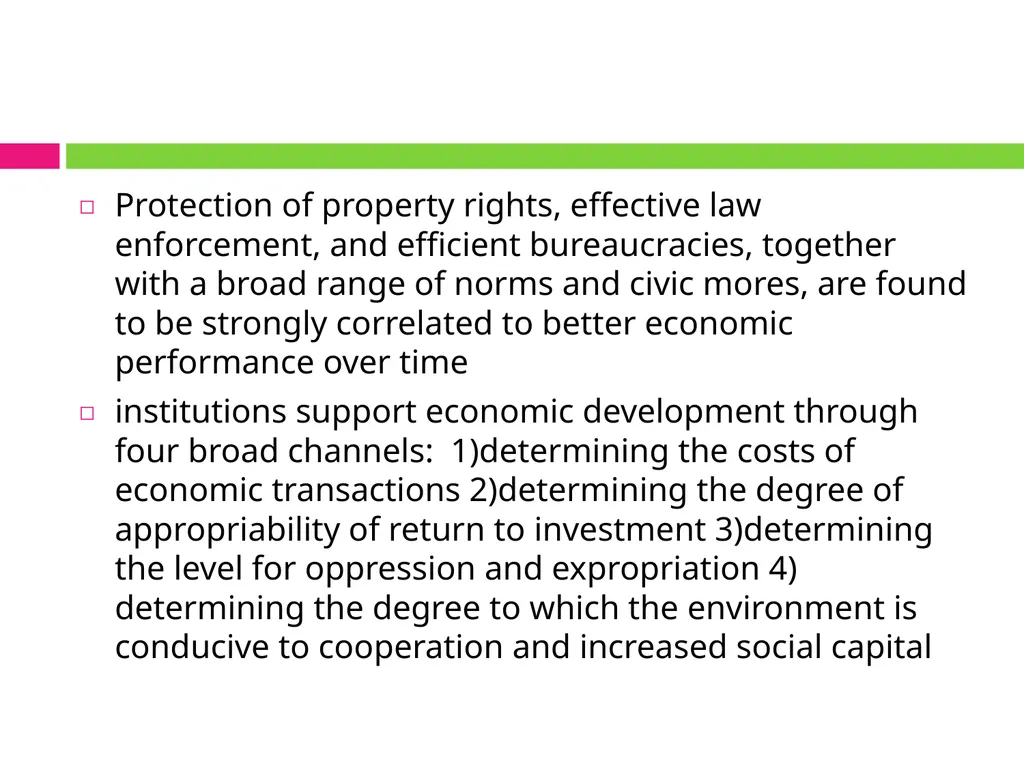
Protection of property rights, effective law enforcement, and efficient bureaucracies, together with a broad range of norms and civic mores, are found to be strongly correlated to better economic performance over time
institutions support economic development through four broad channels: 1)determining the costs of economic transactions 2)determining the degree of appropriability of return to investment 3)determining the level for oppression and expropriation 4) determining the degree to which the environment is conducive to cooperation and increased social capital<br>
institutions support economic development through four broad channels: 1)determining the costs of economic transactions 2)determining the degree of appropriability of return to investment 3)determining the level for oppression and expropriation 4) determining the degree to which the environment is conducive to cooperation and increased social capital<br>
03
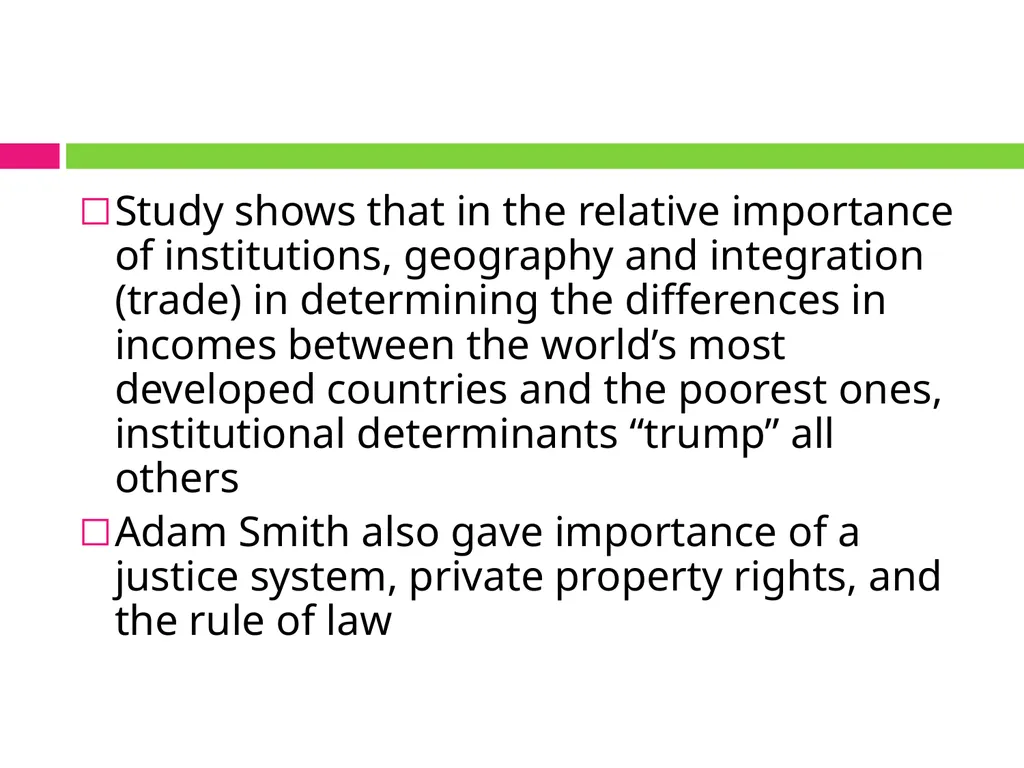
Study shows that in the relative importance of institutions, geography and integration (trade) in determining the differences in incomes between the world’s most developed countries and the poorest ones, institutional determinants “trump” all others
Adam Smith also gave importance of a justice system, private property rights, and the rule of law<br>
Adam Smith also gave importance of a justice system, private property rights, and the rule of law<br>
04
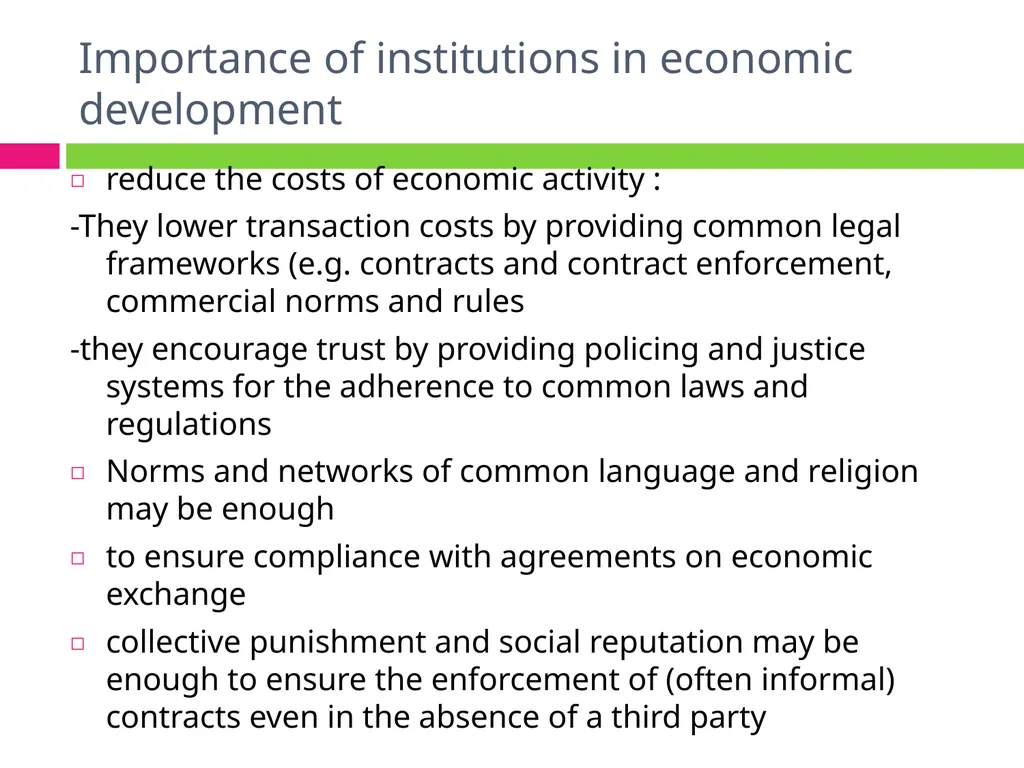
Importance of institutions in economic development reduce the costs of economic activity :
-They lower transaction costs by providing common legal frameworks (e.g. contracts and contract enforcement, commercial norms and rules
-they encourage trust by providing policing and justice systems for the adherence to common laws and regulations
Norms and networks of common language and religion may be enough
to ensure compliance with agreements on economic exchange
collective punishment and social reputation may be enough to ensure the enforcement of (often informal) contracts even in the absence of a third party<br>
-They lower transaction costs by providing common legal frameworks (e.g. contracts and contract enforcement, commercial norms and rules
-they encourage trust by providing policing and justice systems for the adherence to common laws and regulations
Norms and networks of common language and religion may be enough
to ensure compliance with agreements on economic exchange
collective punishment and social reputation may be enough to ensure the enforcement of (often informal) contracts even in the absence of a third party<br>
05
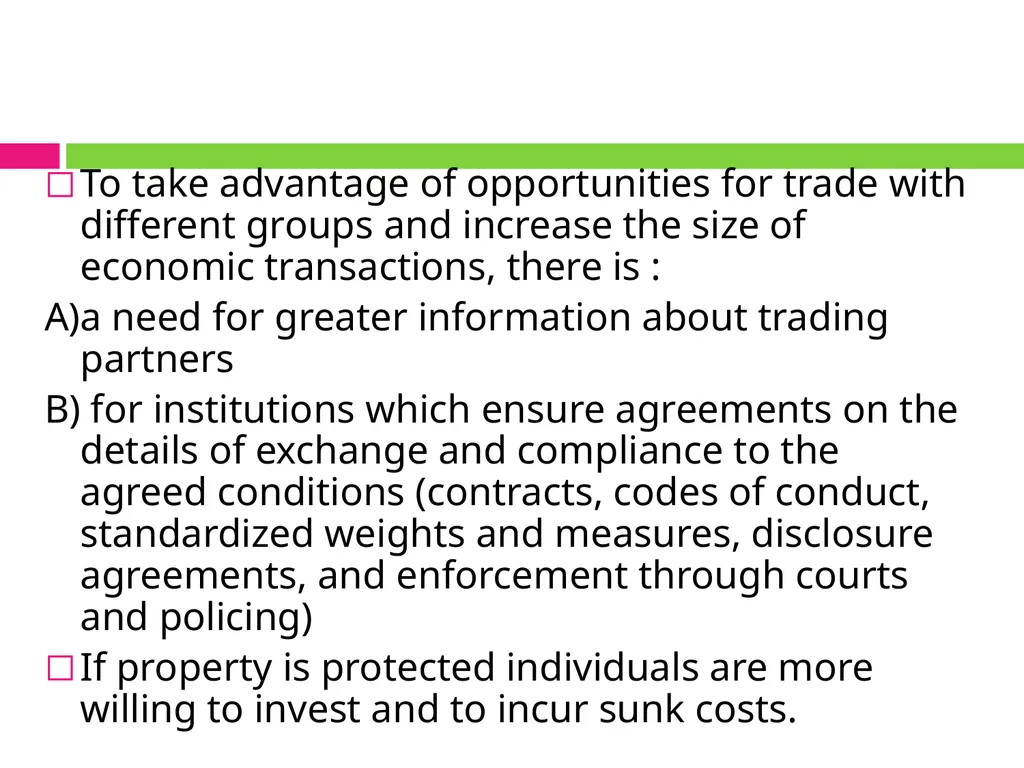
To take advantage of opportunities for trade with different groups and increase the size of economic transactions, there is :
A)a need for greater information about trading partners
B) for institutions which ensure agreements on the details of exchange and compliance to the agreed conditions (contracts, codes of conduct, standardized weights and measures, disclosure agreements, and enforcement through courts and policing)
If property is protected individuals are more willing to invest and to incur sunk costs.<br>
A)a need for greater information about trading partners
B) for institutions which ensure agreements on the details of exchange and compliance to the agreed conditions (contracts, codes of conduct, standardized weights and measures, disclosure agreements, and enforcement through courts and policing)
If property is protected individuals are more willing to invest and to incur sunk costs.<br>
06
Individuals and groups sacrifice a degree of freedom in order to ensure state protection; they accept levies and taxes to cover policing expenses, and state monopoly over the use of force for common security
property rights are by no means sufficient to spur economic growth, and must be balanced by institutions which limit the extractive capacity of state power (independent parliaments and judiciaries) – democratic institutions
institutions determine the extent to which those in power --Unequal institutions strongly limit development<br>
property rights are by no means sufficient to spur economic growth, and must be balanced by institutions which limit the extractive capacity of state power (independent parliaments and judiciaries) – democratic institutions
institutions determine the extent to which those in power --Unequal institutions strongly limit development<br>
07
institutional trajectories and their relationship with economic performance A comparative analysis of development trajectories of countries indicates that institutions which benefit elites and allow their appropriation of resources and products have perpetuated underdevelopment.
Countries with colonial histories tend to be plagued by such extractive institutions -- their control has largely been taken over by local elites after the independence
Eg : The unequal landownership system in Latin America (latifundios) has been indicated a fundamental cause of its underdevelopment.<br>
Countries with colonial histories tend to be plagued by such extractive institutions -- their control has largely been taken over by local elites after the independence
Eg : The unequal landownership system in Latin America (latifundios) has been indicated a fundamental cause of its underdevelopment.<br>
08
Cross country evidences Greater equality and functional economic institutions are also seen as the cause for the successful development of Vietnam
Nicaragua, where high inequality has concentrated power in the hands of a restricted elite, and governments have failed to adequately invest in infrastructure and public welfare.
institutional capacity to exploit domestic primary resources is indicated as the key to the success of Botswana and Mauritius in comparison to other developing countries for which primary resources have turned into a curse, i.e. Sierra Leone (diamonds), Angola, Equatorial Guinea and Nigeria
In India the coexistence of two systems of land-revenue collection under the British colonization caused very different outcomes : under one system, the landlord was responsible for collecting taxes --strengthened his role, other- under the other farmers themselves were responsible for the taxes<br>
Nicaragua, where high inequality has concentrated power in the hands of a restricted elite, and governments have failed to adequately invest in infrastructure and public welfare.
institutional capacity to exploit domestic primary resources is indicated as the key to the success of Botswana and Mauritius in comparison to other developing countries for which primary resources have turned into a curse, i.e. Sierra Leone (diamonds), Angola, Equatorial Guinea and Nigeria
In India the coexistence of two systems of land-revenue collection under the British colonization caused very different outcomes : under one system, the landlord was responsible for collecting taxes --strengthened his role, other- under the other farmers themselves were responsible for the taxes<br>
09
Institutions which are conducive to development
1)ensure greater self-expression
2)allow the free flow of information
3)encourage the formation of associations and clubs
4)allow greater sharing of resources through democratic institutions and the use of the state to reduce the risk attached to economic activity
5) pool resources to provide the investments in education, health and infrastructure which lie at the basis of economic interaction and are necessary and complementary to private investment<br>
1)ensure greater self-expression
2)allow the free flow of information
3)encourage the formation of associations and clubs
4)allow greater sharing of resources through democratic institutions and the use of the state to reduce the risk attached to economic activity
5) pool resources to provide the investments in education, health and infrastructure which lie at the basis of economic interaction and are necessary and complementary to private investment<br>
10
Institutions and economic development ‘The rules of the game: The humanly devised constraints that structure human interaction’ – Douglas North
in studying the impact of institutions on economic development, we should use what she calls the ‘performance or quality measures’ for institutions<br>
in studying the impact of institutions on economic development, we should use what she calls the ‘performance or quality measures’ for institutions<br>
11
Functions of institutions in promoting economic development one institution could be serving more than one function. Eg: budgetary institutions typically serve multiple functions, such as investment in productive assets (e.g., physical infrastructure, R&D facilities), social protection (the welfare state), and macroeconomic stability (e.g., through the ‘automatic stabilizer’ function)
there are many institutions that serve the same function, although they would all serve other functions as well, which may or may not overlap. macroeconomic stability is achieved not simply by an independent central bank solely focused on inflation (as the current orthodoxy goes) but also by a host of other institutions, including the budgetary institutions, institutions of financial regulation, and wage- and price-setting institutions.<br>
there are many institutions that serve the same function, although they would all serve other functions as well, which may or may not overlap. macroeconomic stability is achieved not simply by an independent central bank solely focused on inflation (as the current orthodoxy goes) but also by a host of other institutions, including the budgetary institutions, institutions of financial regulation, and wage- and price-setting institutions.<br>
12
the same function could be served by different institutions in different societies (or in the same society at different times) . For eg : social welfare is typically achieved by the welfare state in most European countries. The same is provided by a combination of a (weaker) welfare state, company welfare schemes, family provision, and other means in East Asia
“it is impossible to come up with a single list of functions and forms of institutions that are desirable, not to speak of essential, for economic development”<br>
“it is impossible to come up with a single list of functions and forms of institutions that are desirable, not to speak of essential, for economic development”<br>
13
No one denies the centrality of traditional determinants of growth, such as investment or technological progress, but institutional analysis is considered fundamental to understanding the levels and effects of these traditional variables
the extent to which a given level of investment or a particular innovation actually results in a sustained increase in output is viewed as depending on the institutional context<br>
the extent to which a given level of investment or a particular innovation actually results in a sustained increase in output is viewed as depending on the institutional context<br>
14
“Differences in economic institutions are the fundamental cause of differences in economic development” In their contribution to the Handbook of Economic Growth, Acemoglu, Johnson, and Robinson
More recent work, by economists and other social scientists, has extended the institutional turn in ways that show promise of substantially enhancing our understanding of development with more sophisticated theorizing and consideration of a broader range of historical and contemporary data.<br>
More recent work, by economists and other social scientists, has extended the institutional turn in ways that show promise of substantially enhancing our understanding of development with more sophisticated theorizing and consideration of a broader range of historical and contemporary data.<br>
15
traditional measure of ‘good institutions’ - Countries with better ‘institutions’, more secure property rights, and less distortionary policies will invest more in physical and human capital, and will use these factors more efficiently to achieve a greater level of income<br>
16
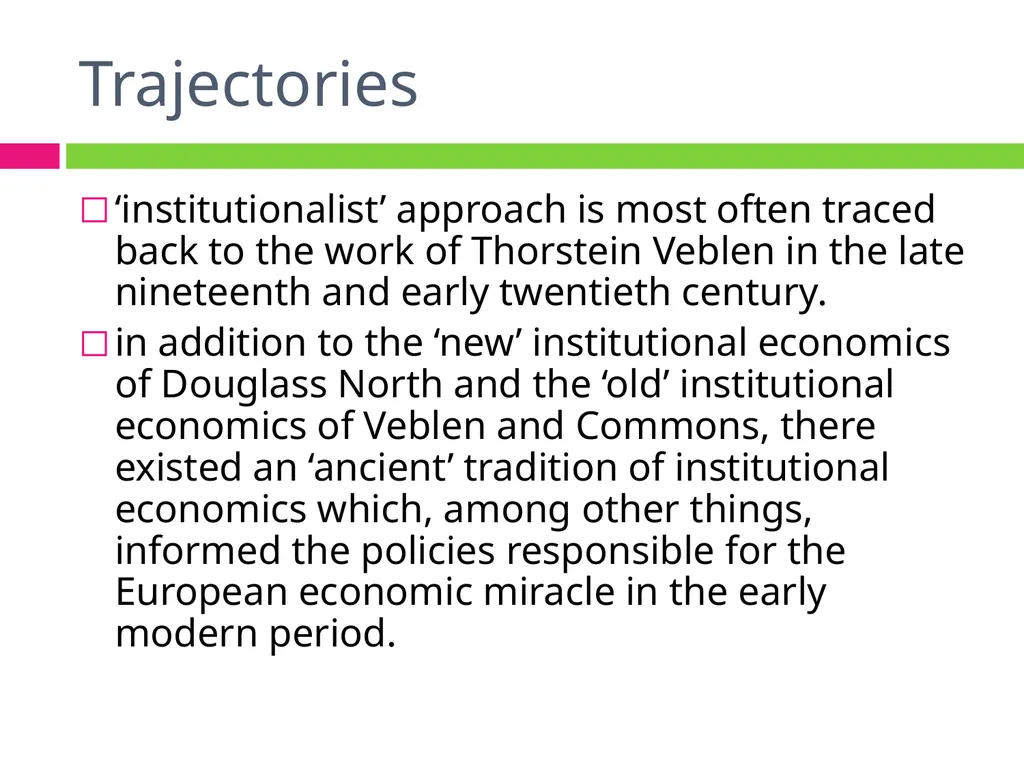
Trajectories ‘institutionalist’ approach is most often traced back to the work of Thorstein Veblen in the late nineteenth and early twentieth century.
in addition to the ‘new’ institutional economics of Douglass North and the ‘old’ institutional economics of Veblen and Commons, there existed an ‘ancient’ tradition of institutional economics which, among other things, informed the policies responsible for the European economic miracle in the early modern period.<br>
in addition to the ‘new’ institutional economics of Douglass North and the ‘old’ institutional economics of Veblen and Commons, there existed an ‘ancient’ tradition of institutional economics which, among other things, informed the policies responsible for the European economic miracle in the early modern period.<br>
17
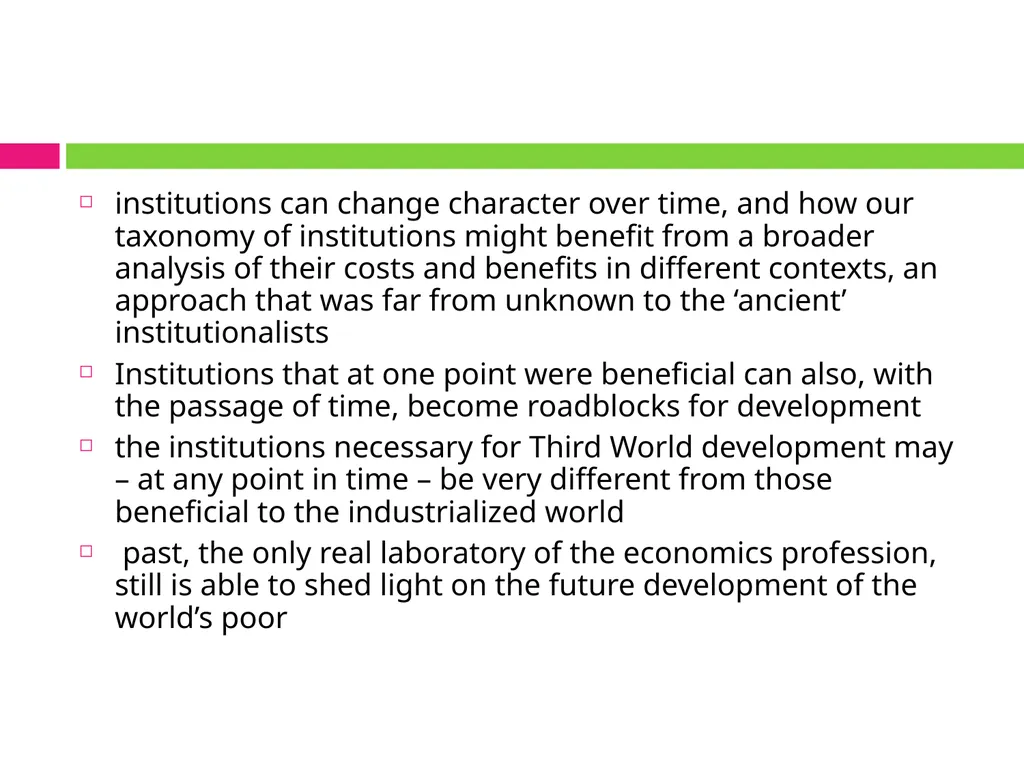
institutions can change character over time, and how our taxonomy of institutions might benefit from a broader analysis of their costs and benefits in different contexts, an approach that was far from unknown to the ‘ancient’ institutionalists
Institutions that at one point were beneficial can also, with the passage of time, become roadblocks for development
the institutions necessary for Third World development may – at any point in time – be very different from those beneficial to the industrialized world
past, the only real laboratory of the economics profession, still is able to shed light on the future development of the world’s poor<br>
Institutions that at one point were beneficial can also, with the passage of time, become roadblocks for development
the institutions necessary for Third World development may – at any point in time – be very different from those beneficial to the industrialized world
past, the only real laboratory of the economics profession, still is able to shed light on the future development of the world’s poor<br>
18
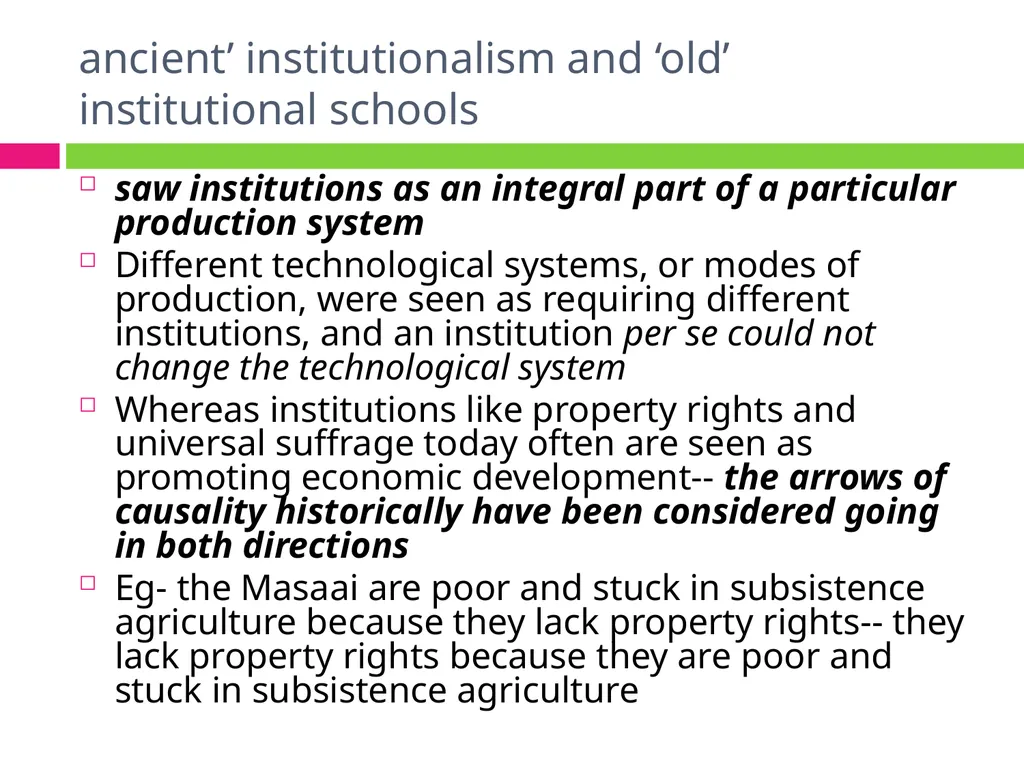
ancient’ institutionalism and ‘old’ institutional schools saw institutions as an integral part of a particular production system
Different technological systems, or modes of production, were seen as requiring different institutions, and an institution per se could not change the technological system
Whereas institutions like property rights and universal suffrage today often are seen as promoting economic development-- the arrows of causality historically have been considered going in both directions
Eg- the Masaai are poor and stuck in subsistence agriculture because they lack property rights-- they lack property rights because they are poor and stuck in subsistence agriculture<br>
Different technological systems, or modes of production, were seen as requiring different institutions, and an institution per se could not change the technological system
Whereas institutions like property rights and universal suffrage today often are seen as promoting economic development-- the arrows of causality historically have been considered going in both directions
Eg- the Masaai are poor and stuck in subsistence agriculture because they lack property rights-- they lack property rights because they are poor and stuck in subsistence agriculture<br>
19
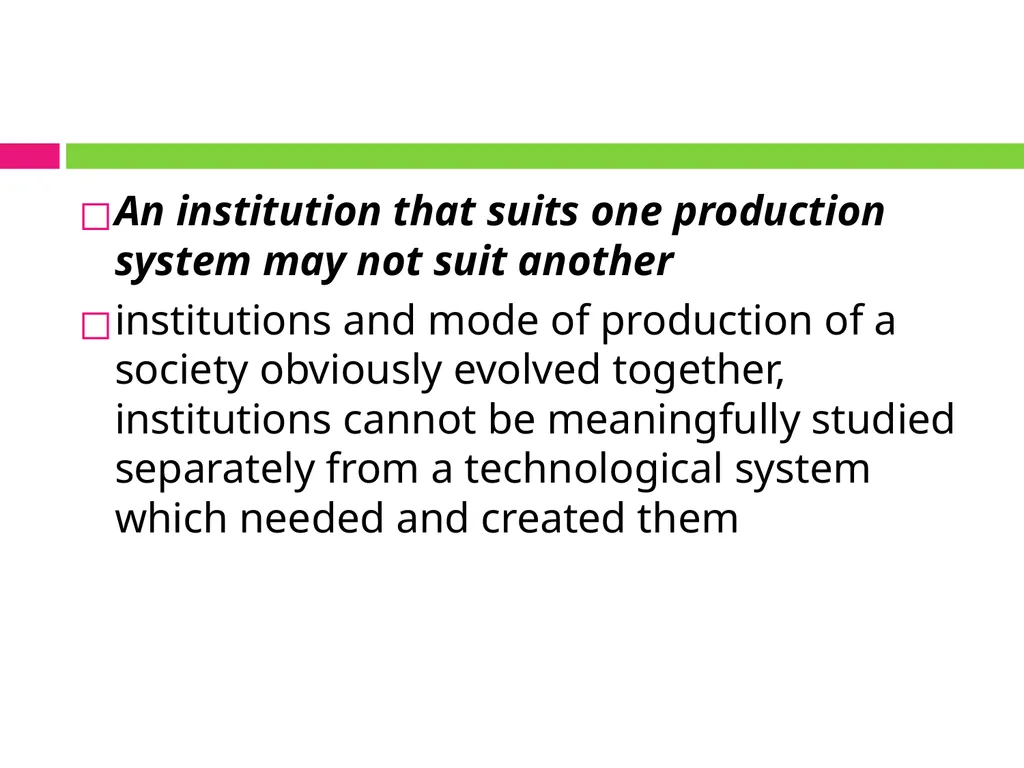
An institution that suits one production system may not suit another
institutions and mode of production of a society obviously evolved together, institutions cannot be meaningfully studied separately from a technological system which needed and created them<br>
institutions and mode of production of a society obviously evolved together, institutions cannot be meaningfully studied separately from a technological system which needed and created them<br>