
AN EXPERIENCE IN OPERATIONALISING AN INTEGRATED





Description: AN EXPERIENCE IN OPERATIONALISING AN INTEGRATED OCCUPATIONAL HEALTH SERVICE IN INDIAN RAILWAYS DR V K RAMTEKE MS FRCS Edin ADJUNCT PROFESSOR IIHMR DELHI FORMER DIRECTOR GENERAL, RAILWAY HEALTH SERVICES, INDIAN RAILWAYS FORMER EXECUTIVE
Related Topics
Download Presentation
"AN EXPERIENCE IN OPERATIONALISING AN INTEGRATED" is the property of its rightful owner. Permission is granted to download and print the materials on this website for personal, non-commercial use only, and to display it on your personal computer provided you do not modify the materials and that you retain all copyright notices contained in the materials. By downloading content from our website, you accept the terms of this agreement.
Presentation Transcript
slide1. AN EXPERIENCE
IN OPERATIONALISING
AN INTEGRATED OCCUPATIONAL HEALTH SERVICE IN
INDIAN RAILWAYS DR V K RAMTEKE MS FRCS Edin
ADJUNCT PROFESSOR IIHMR DELHI
FORMER DIRECTOR GENERAL, RAILWAY HEALTH SERVICES, INDIAN RAILWAYS
FORMER EXECUTIVE MEMBER,MANAGEMENT COMMITTEE
INTERNATIONAL UNION OF RAILWAY MEDIACAL SERVICES (UIMC)
PARIS FRANCE
MEMBER , INTERNATIONAL COMMISSION OF OCCUPATIONAL HEALTH, ICOH
MEMBER EDITORIAL BOARD, JOURNAL RAILWAY MEDICINE, RUSSIAN RAILWAYS, MOSCOW
PRESIDENT, FORUM OF INDUSTRY MEDICINE,DELHI
PRESIDENT, INDIAN ASSOCIATION OF PUBLIC HEALTH ,DELHI BRANCH
PRESIDENT, INDIAN ASSOCIATION OF OCCUPATIONAL HEALTH – DELHI BRANCH<br>
slide2. Workers’ health: global plan of action Sixtieth World Health Assembly SIXTIETH WORLD HEALTH ASSEMBLY WHA60.26,Agenda item 12.13, 23 May 2007. In its introduction mentions .....
“All components of health systems should be
involved in an integrated response to the
specific health needs of working populations.”
OCCUCON- DELHI 2012<br>
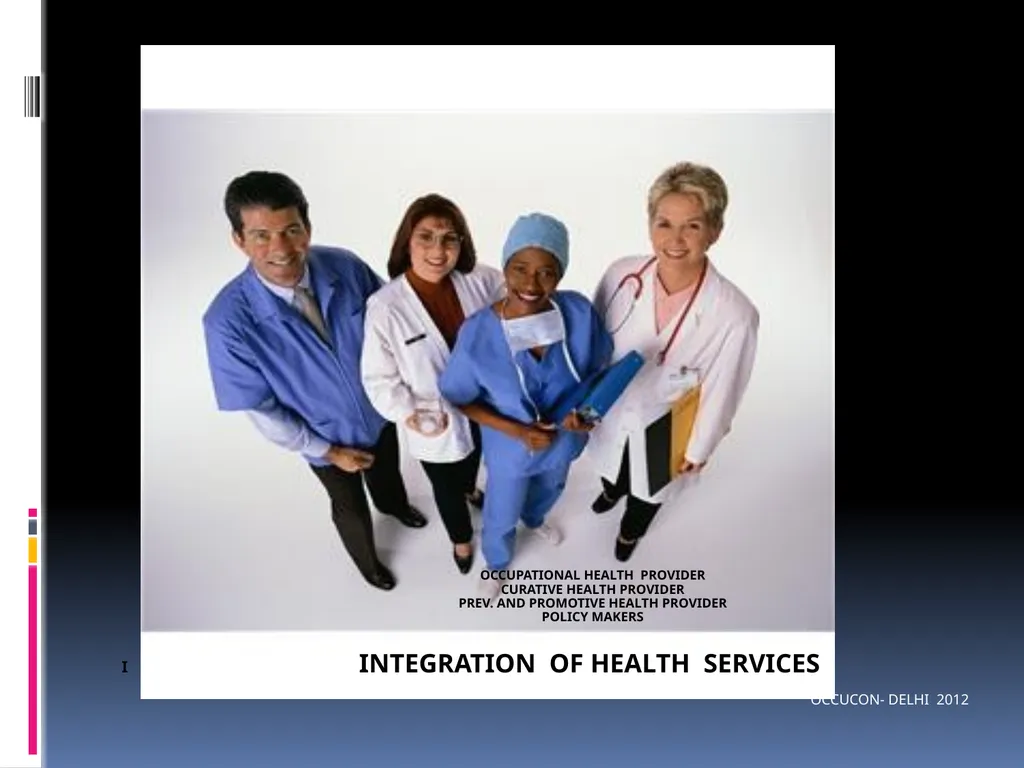
slide3. OCCUPATIONAL HEALTH PROVIDER
CURATIVE HEALTH PROVIDER
PREV. AND PROMOTIVE HEALTH PROVIDER
POLICY MAKERS
I INTEGRATION OF HEALTH SERVICES
OCCUCON- DELHI 2012<br>
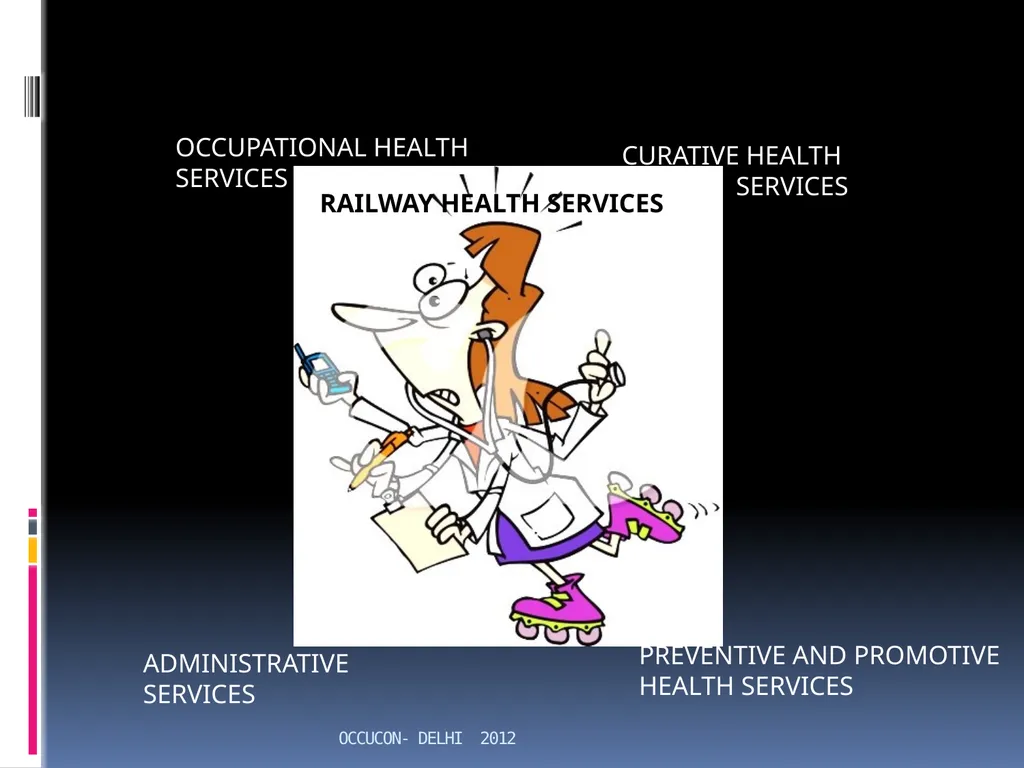
slide4. OCCUCON- DELHI 2012 OCCUPATIONAL HEALTH SERVICES CURATIVE HEALTH SERVICES PREVENTIVE AND PROMOTIVE HEALTH SERVICES ADMINISTRATIVE SERVICES RAILWAY HEALTH SERVICES<br>
slide5. Can Med Assoc J. 1964 Dec 19;91:1307-9. THE PHYSICIAN AND INDUSTRY. NELSON AJ. Many employers are interested in helping their employees improve and maintain health through a program of preventive medicine designed to supplement health services which already exist in the community. The objectives of such a health program can be attained only through team work between physicians, both within and outside industry. Such specific objectives as the development of measures for the maintenance and improvement of health and the prevention of disease; the provision of readily available diagnostic, treatment and counselling services; the rehabilitation of disabled employees; and the effective administration of sick-benefit plans require the closest communication and co-operation among the occupational health service, the private physician, and other health and welfare agencies. Only by such liaison can the maximum benefits of both preventive and curative medicine be extended to the employee-in his best interest as well as that of the community and the employer.
OCCUCON- DELHI 2012<br>
slide6. J Occup Med. 1992 Sep;34(9):893-901. Workers' attitude toward the occupational physician. Plomp HN. Institute of Social Medicine, Vrije Universiteit, Amsterdam, The Netherlands. We conclude that workers see clear differences in the tasks and functions of the occupational physician compared with those of the curative physician. Relations with and dependence on management is considered to be self-evident. A negative evaluation of the OHS is mainly because of unclarity and uncertainty as to how the occupational physician combines his/her responsibility toward individual workers with his/her responsibility toward the company.
OCCUCON- DELHI 2012<br>
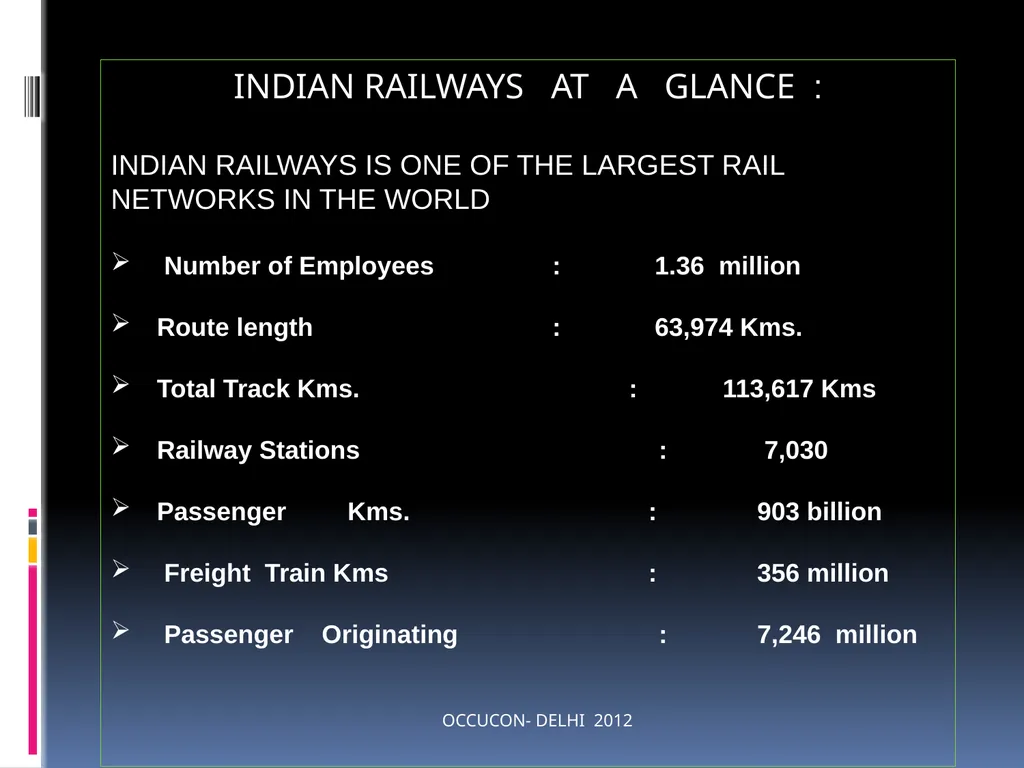
slide7. INDIAN RAILWAYS AT A GLANCE :
INDIAN RAILWAYS IS ONE OF THE LARGEST RAIL NETWORKS IN THE WORLD
Number of Employees : 1.36 million
Route length : 63,974 Kms.
Total Track Kms. : 113,617 Kms
Railway Stations : 7,030
Passenger Kms. : 903 billion
Freight Train Kms : 356 million
Passenger Originating : 7,246 million
OCCUCON- DELHI 2012<br>
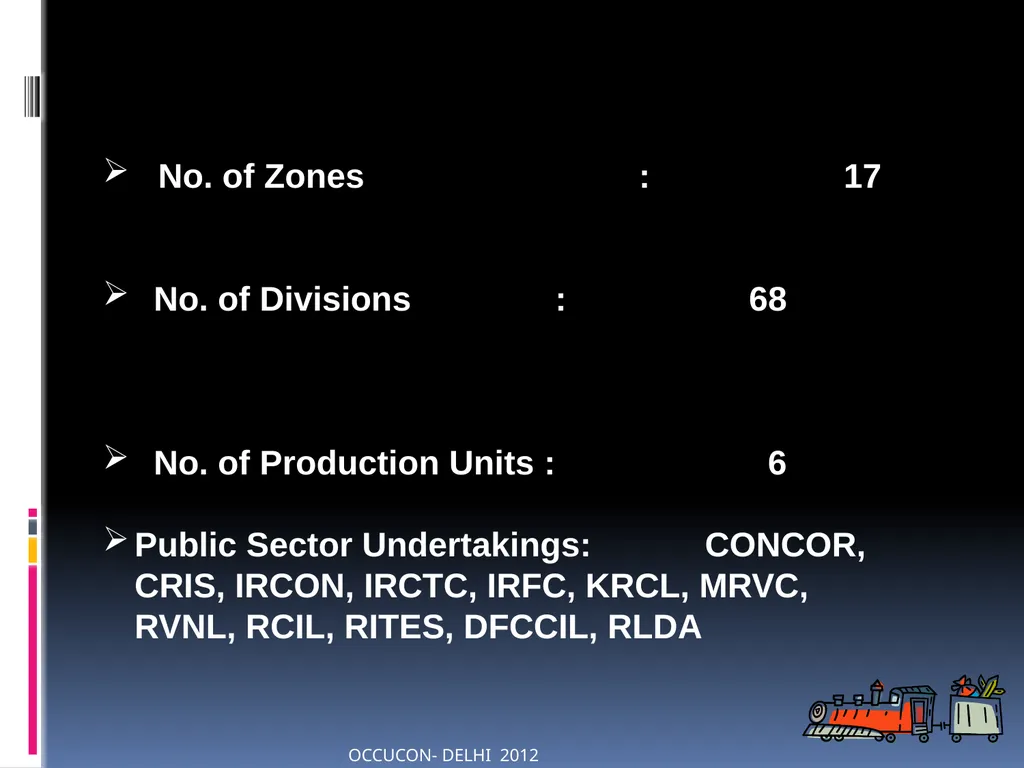
slide8. No. of Zones : 17
No. of Divisions : 68
No. of Production Units : 6
Public Sector Undertakings: CONCOR, CRIS, IRCON, IRCTC, IRFC, KRCL, MRVC, RVNL, RCIL, RITES, DFCCIL, RLDA
OCCUCON- DELHI 2012<br>
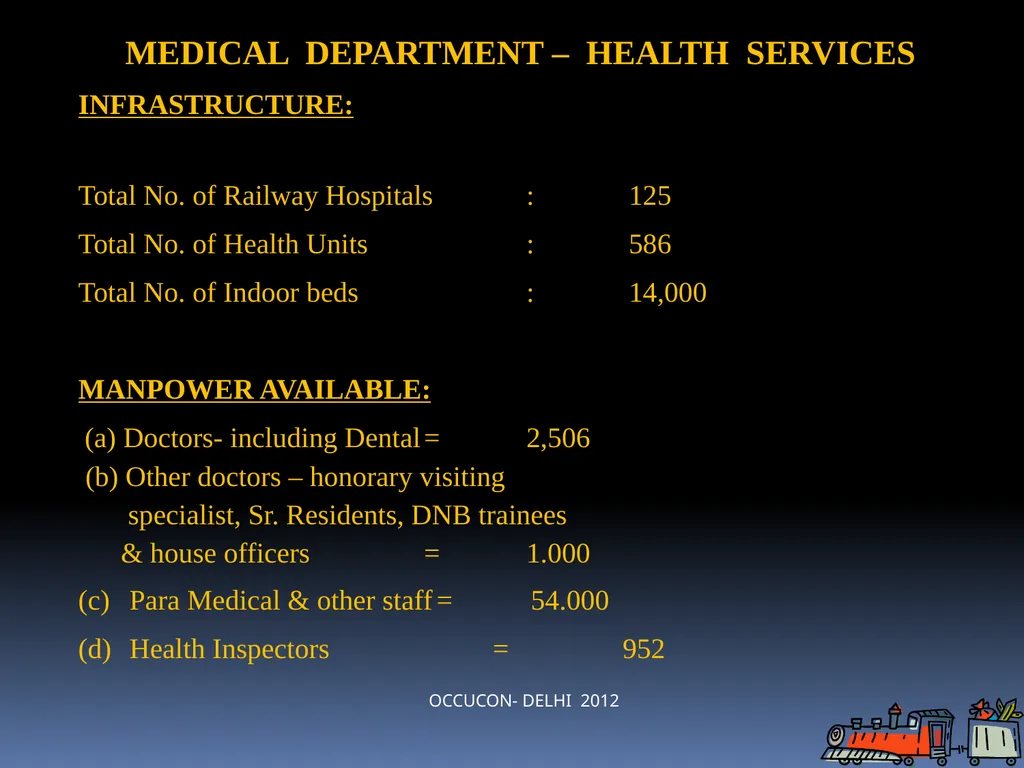
slide9. MEDICAL DEPARTMENT – HEALTH SERVICES
INFRASTRUCTURE:
Total No. of Railway Hospitals : 125
Total No. of Health Units : 586
Total No. of Indoor beds : 14,000
MANPOWER AVAILABLE:
(a) Doctors- including Dental = 2,506
(b) Other doctors – honorary visiting
specialist, Sr. Residents, DNB trainees
& house officers = 1.000
Para Medical & other staff = 54.000
Health Inspectors = 952
OCCUCON- DELHI 2012<br>
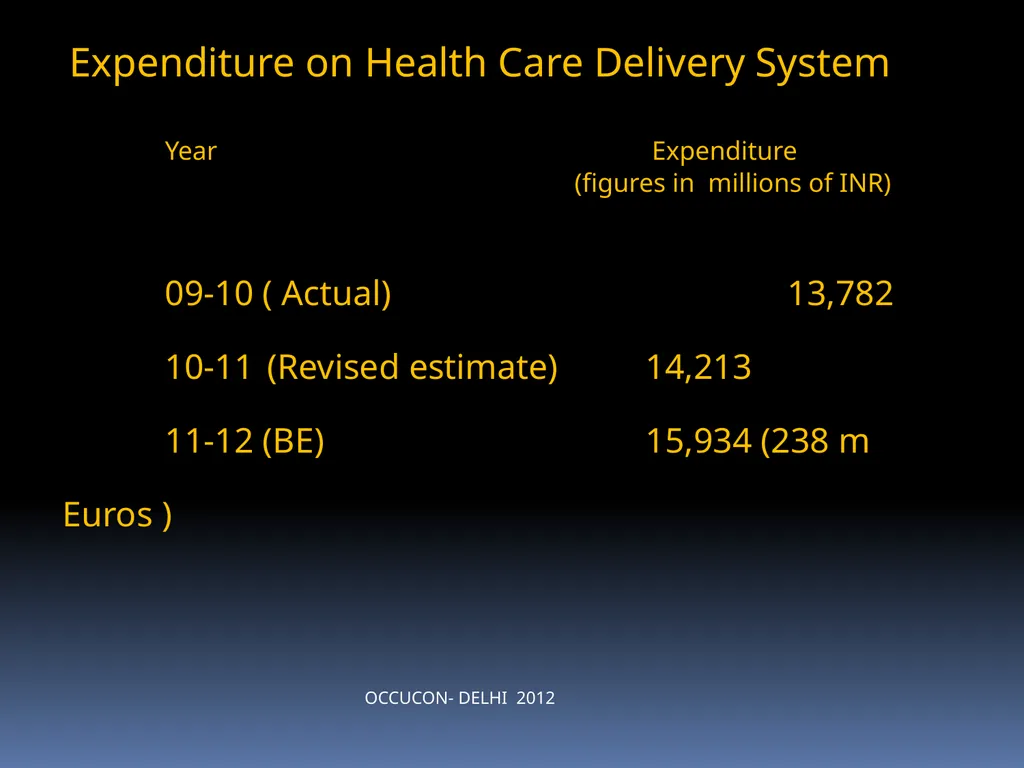
slide10. Expenditure on Health Care Delivery System
Year Expenditure
(figures in millions of INR)
09-10 ( Actual) 13,782
10-11 (Revised estimate) 14,213
11-12 (BE) 15,934 (238 m Euros ) OCCUCON- DELHI 2012<br>
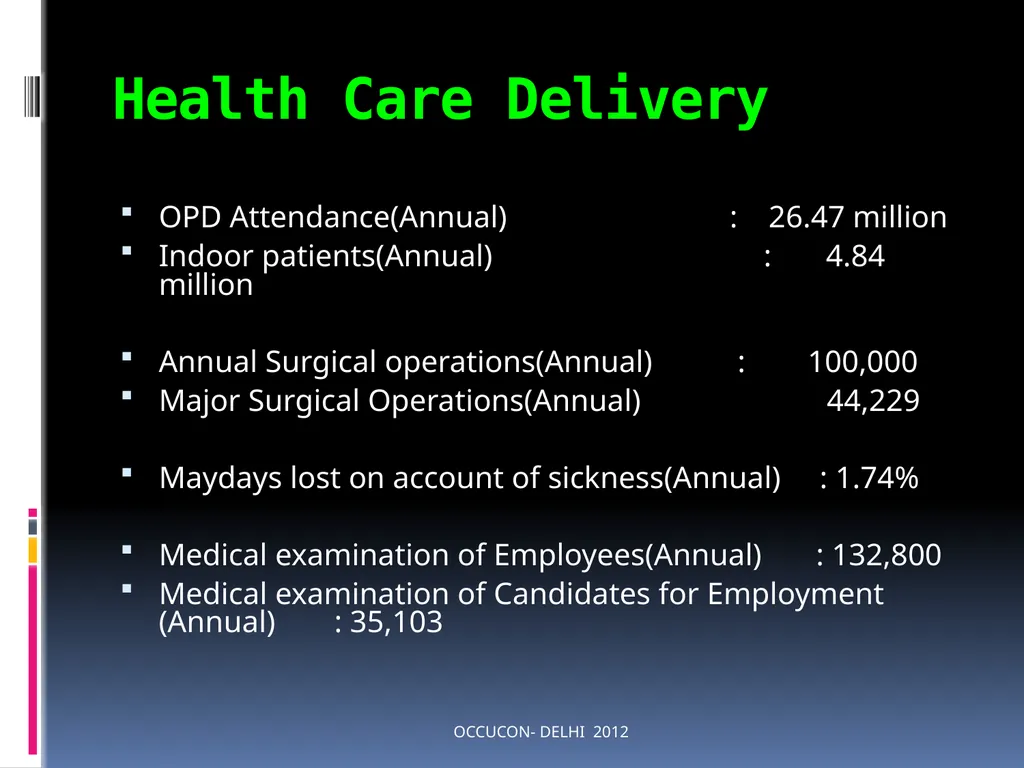
slide11. Health Care Delivery OPD Attendance(Annual) : 26.47 million
Indoor patients(Annual) : 4.84 million
Annual Surgical operations(Annual) : 100,000
Major Surgical Operations(Annual) 44,229
Maydays lost on account of sickness(Annual) : 1.74%
Medical examination of Employees(Annual) : 132,800
Medical examination of Candidates for Employment (Annual) : 35,103
OCCUCON- DELHI 2012<br>
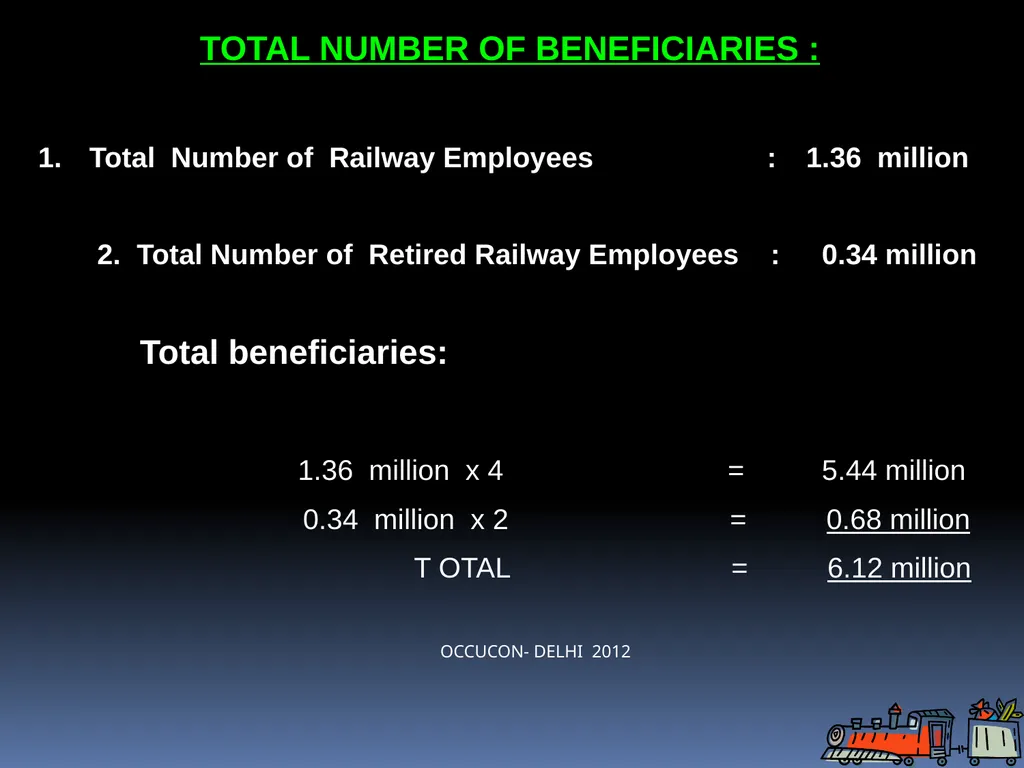
slide12. TOTAL NUMBER OF BENEFICIARIES :
Total Number of Railway Employees : 1.36 million
2. Total Number of Retired Railway Employees : 0.34 million
Total beneficiaries:
1.36 million x 4 = 5.44 million
0.34 million x 2 = 0.68 million
T OTAL = 6.12 million
OCCUCON- DELHI 2012<br>
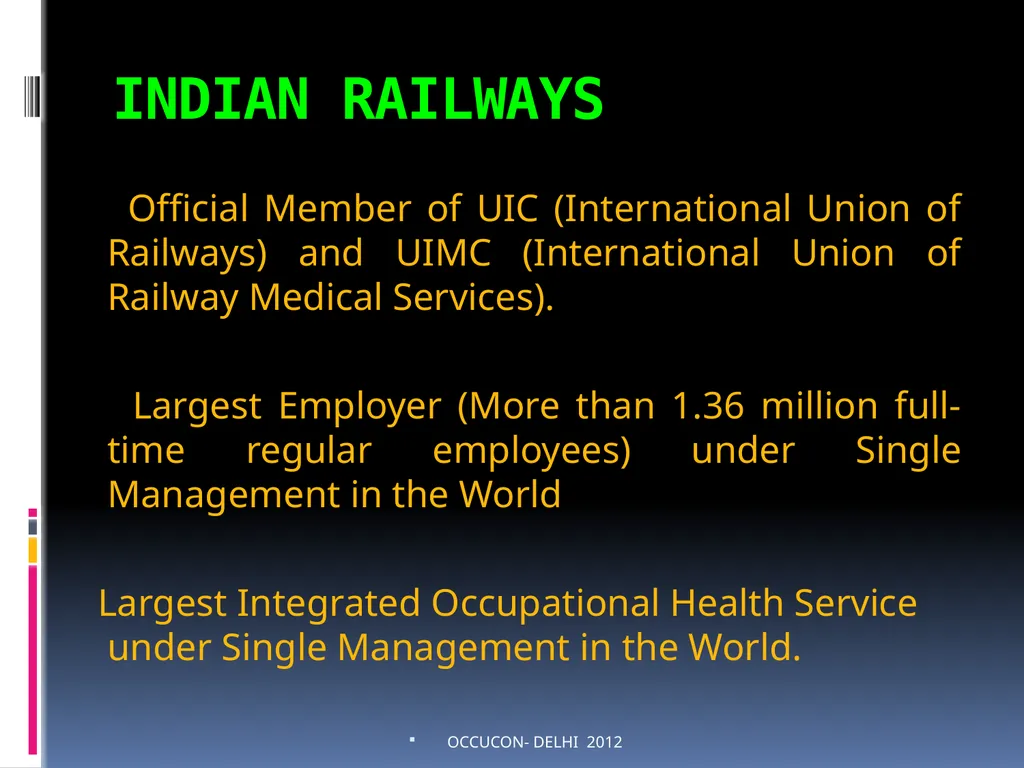
slide13. INDIAN RAILWAYS Official Member of UIC (International Union of Railways) and UIMC (International Union of Railway Medical Services).
Largest Employer (More than 1.36 million full-time regular employees) under Single Management in the World
Largest Integrated Occupational Health Service under Single Management in the World.
OCCUCON- DELHI 2012<br>
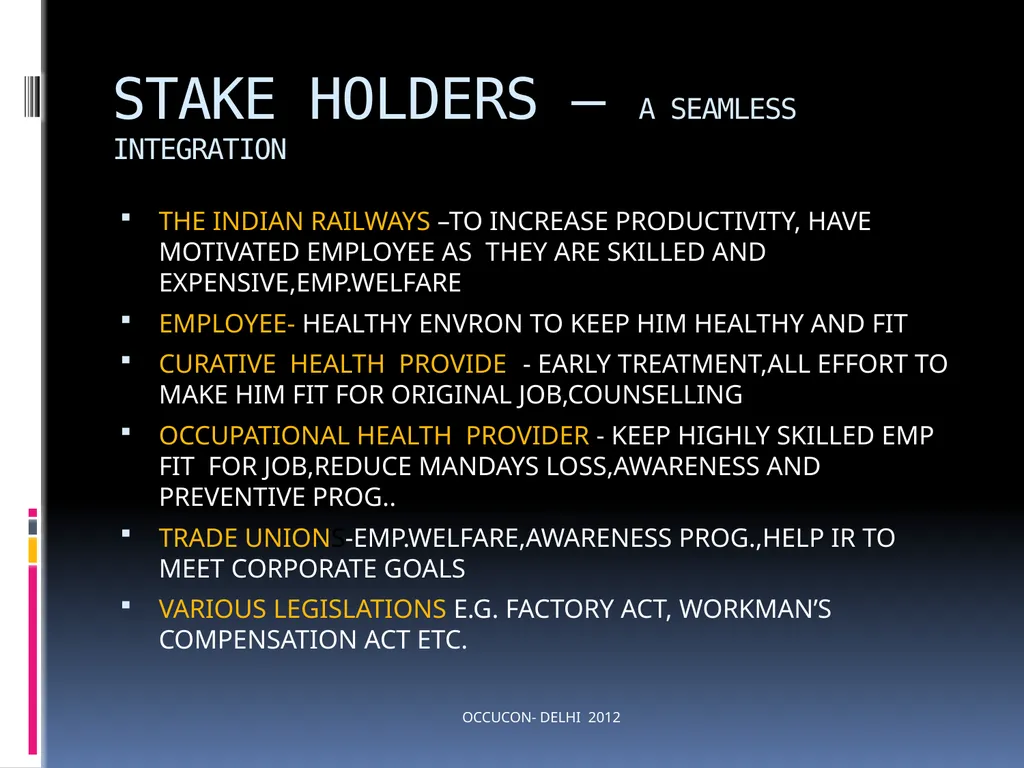
slide14. STAKE HOLDERS – A SEAMLESS INTEGRATION THE INDIAN RAILWAYS –TO INCREASE PRODUCTIVITY, HAVE MOTIVATED EMPLOYEE AS THEY ARE SKILLED AND EXPENSIVE,EMP.WELFARE
EMPLOYEE- HEALTHY ENVRON TO KEEP HIM HEALTHY AND FIT
CURATIVE HEALTH PROVIDER- EARLY TREATMENT,ALL EFFORT TO MAKE HIM FIT FOR ORIGINAL JOB,COUNSELLING
OCCUPATIONAL HEALTH PROVIDER - KEEP HIGHLY SKILLED EMP FIT FOR JOB,REDUCE MANDAYS LOSS,AWARENESS AND PREVENTIVE PROG..
TRADE UNIONS-EMP.WELFARE,AWARENESS PROG.,HELP IR TO MEET CORPORATE GOALS
VARIOUS LEGISLATIONS E.G. FACTORY ACT, WORKMAN’S COMPENSATION ACT ETC.
OCCUCON- DELHI 2012<br>
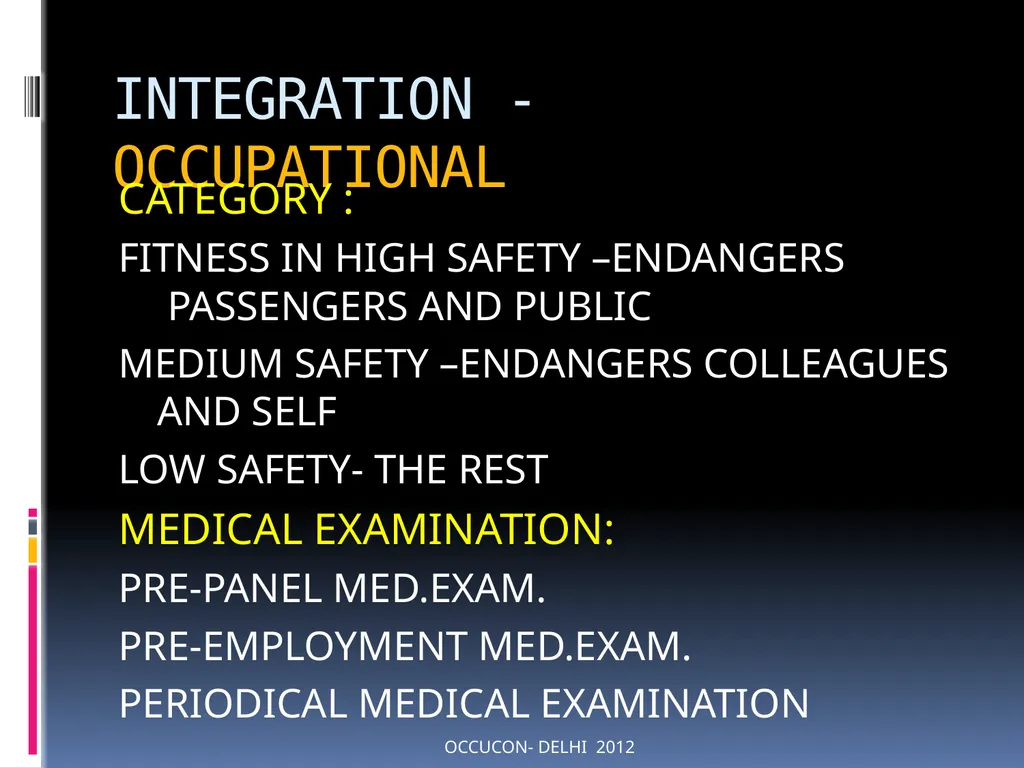
slide15. INTEGRATION - OCCUPATIONAL CATEGORY :
FITNESS IN HIGH SAFETY –ENDANGERS PASSENGERS AND PUBLIC
MEDIUM SAFETY –ENDANGERS COLLEAGUES AND SELF
LOW SAFETY- THE REST
MEDICAL EXAMINATION:
PRE-PANEL MED.EXAM.
PRE-EMPLOYMENT MED.EXAM.
PERIODICAL MEDICAL EXAMINATION
OCCUCON- DELHI 2012<br>
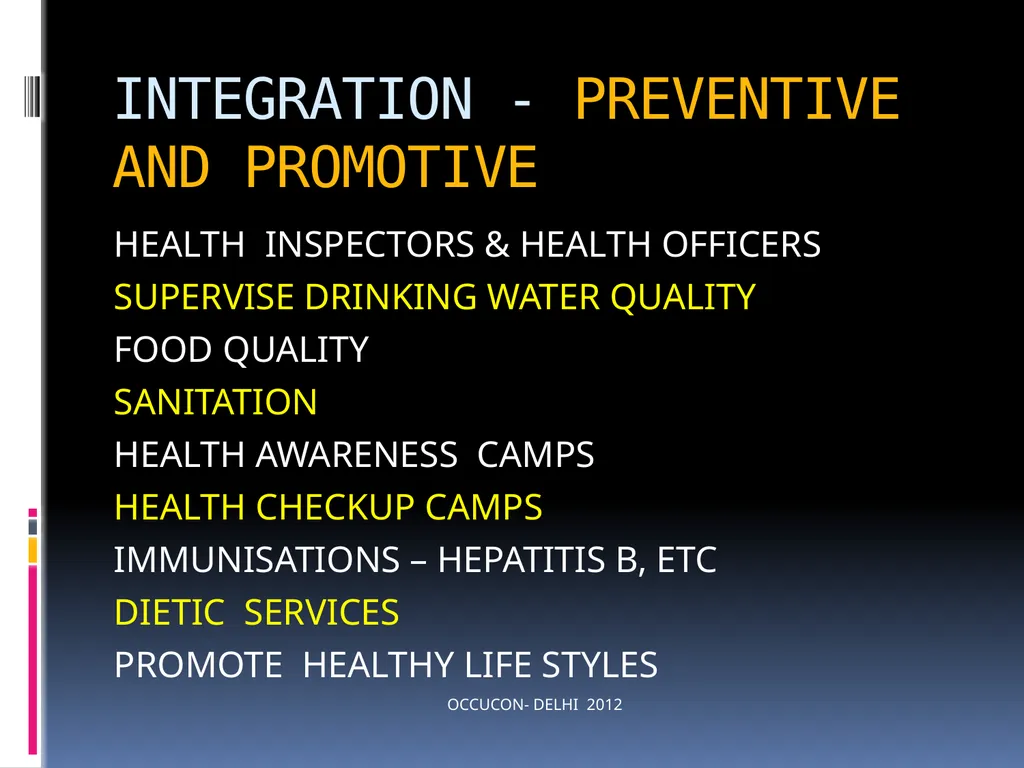
slide16. INTEGRATION - PREVENTIVE AND PROMOTIVE HEALTH INSPECTORS & HEALTH OFFICERS
SUPERVISE DRINKING WATER QUALITY
FOOD QUALITY
SANITATION
HEALTH AWARENESS CAMPS
HEALTH CHECKUP CAMPS
IMMUNISATIONS – HEPATITIS B, ETC
DIETIC SERVICES
PROMOTE HEALTHY LIFE STYLES
OCCUCON- DELHI 2012<br>
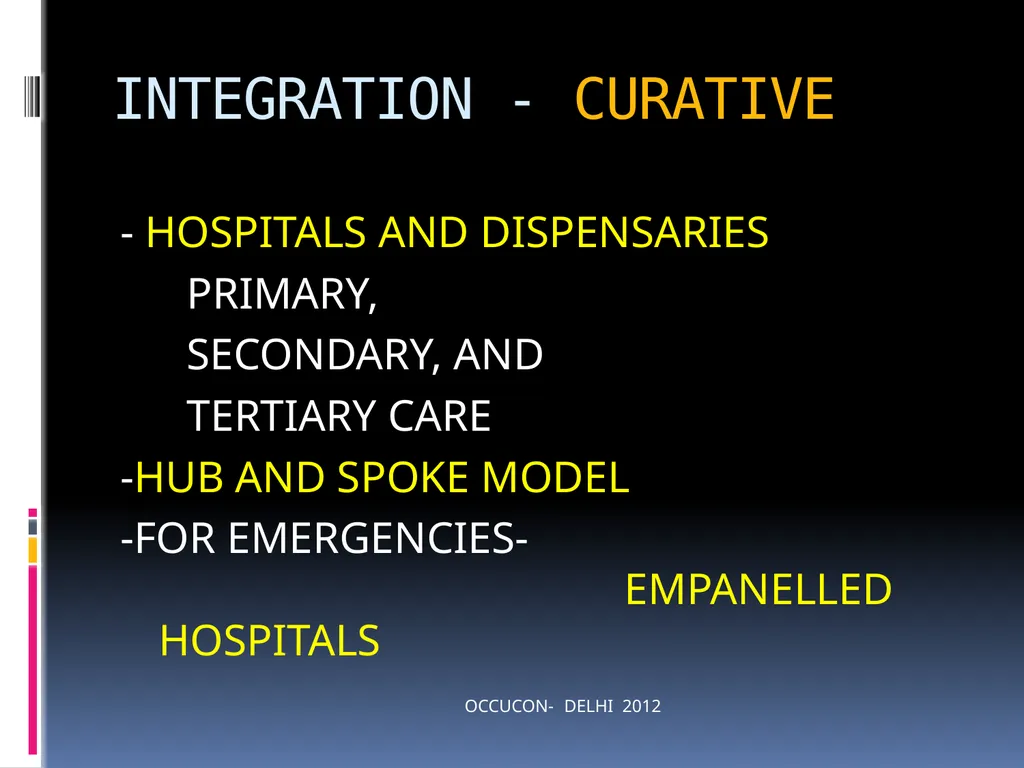
slide17. INTEGRATION - CURATIVE - HOSPITALS AND DISPENSARIES
PRIMARY,
SECONDARY, AND
TERTIARY CARE
-HUB AND SPOKE MODEL
-FOR EMERGENCIES- EMPANELLED HOSPITALS
OCCUCON- DELHI 2012<br>
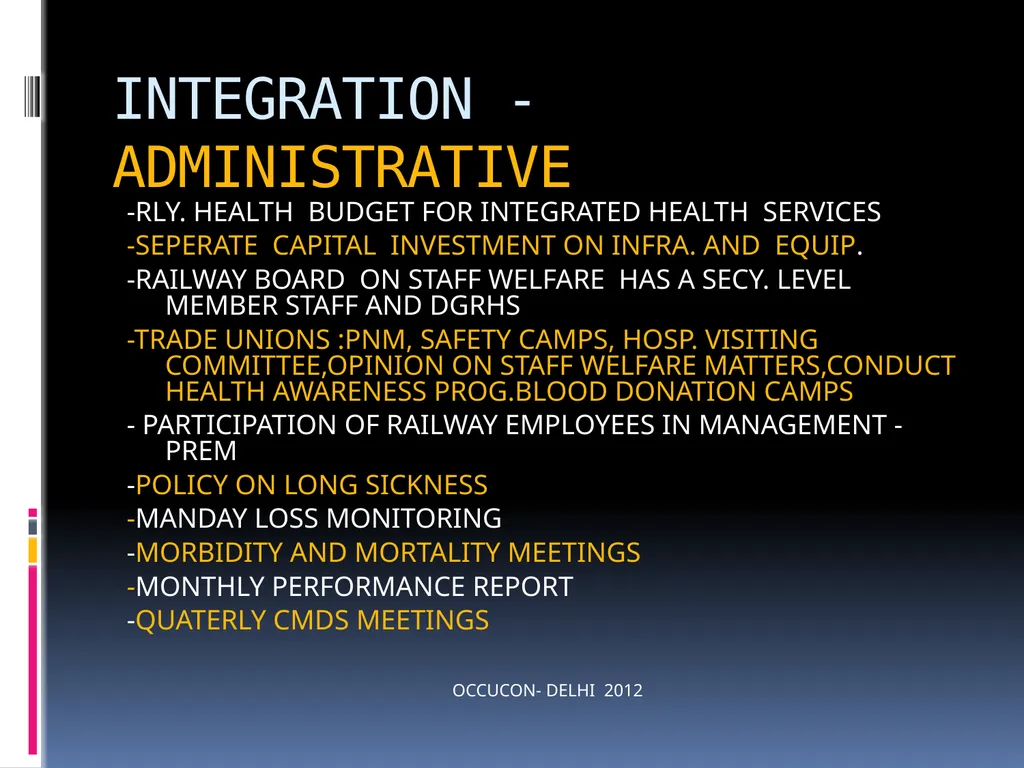
slide18. INTEGRATION - ADMINISTRATIVE -RLY. HEALTH BUDGET FOR INTEGRATED HEALTH SERVICES
-SEPERATE CAPITAL INVESTMENT ON INFRA. AND EQUIP.
-RAILWAY BOARD ON STAFF WELFARE HAS A SECY. LEVEL MEMBER STAFF AND DGRHS
-TRADE UNIONS :PNM, SAFETY CAMPS, HOSP. VISITING COMMITTEE,OPINION ON STAFF WELFARE MATTERS,CONDUCT HEALTH AWARENESS PROG.BLOOD DONATION CAMPS
- PARTICIPATION OF RAILWAY EMPLOYEES IN MANAGEMENT - PREM
-POLICY ON LONG SICKNESS
-MANDAY LOSS MONITORING
-MORBIDITY AND MORTALITY MEETINGS
-MONTHLY PERFORMANCE REPORT
-QUATERLY CMDS MEETINGS
OCCUCON- DELHI 2012<br>
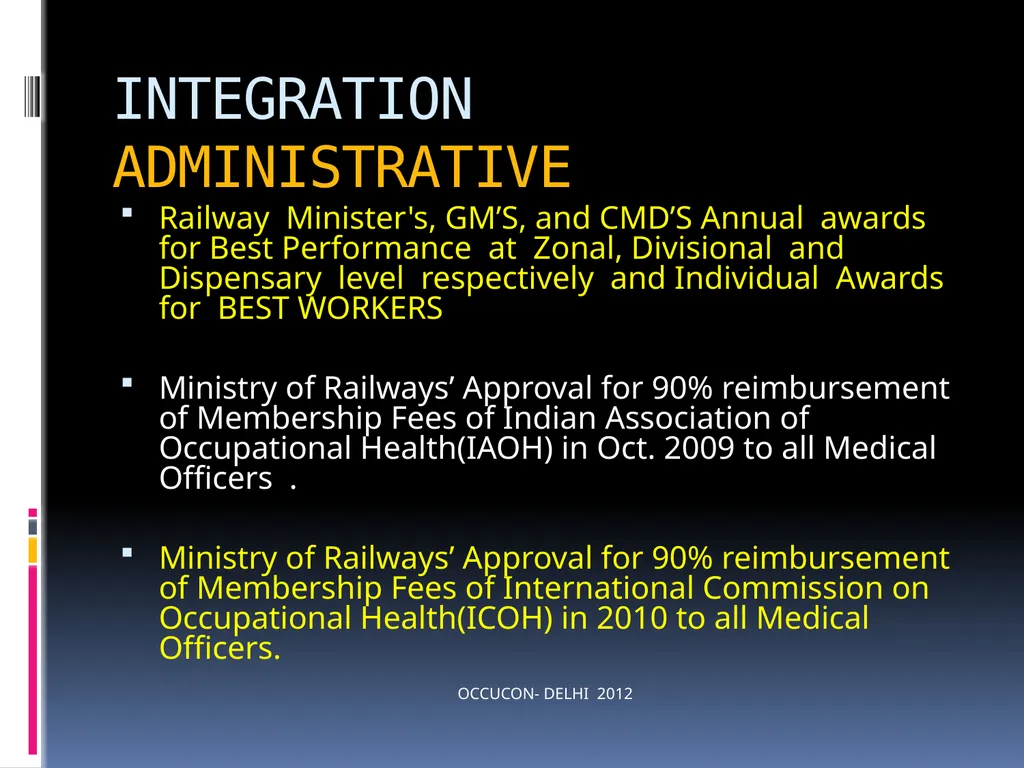
slide19. INTEGRATION ADMINISTRATIVE Railway Minister's, GM’S, and CMD’S Annual awards for Best Performance at Zonal, Divisional and Dispensary level respectively and Individual Awards for BEST WORKERS
Ministry of Railways’ Approval for 90% reimbursement of Membership Fees of Indian Association of Occupational Health(IAOH) in Oct. 2009 to all Medical Officers .
Ministry of Railways’ Approval for 90% reimbursement of Membership Fees of International Commission on Occupational Health(ICOH) in 2010 to all Medical Officers.
OCCUCON- DELHI 2012<br>
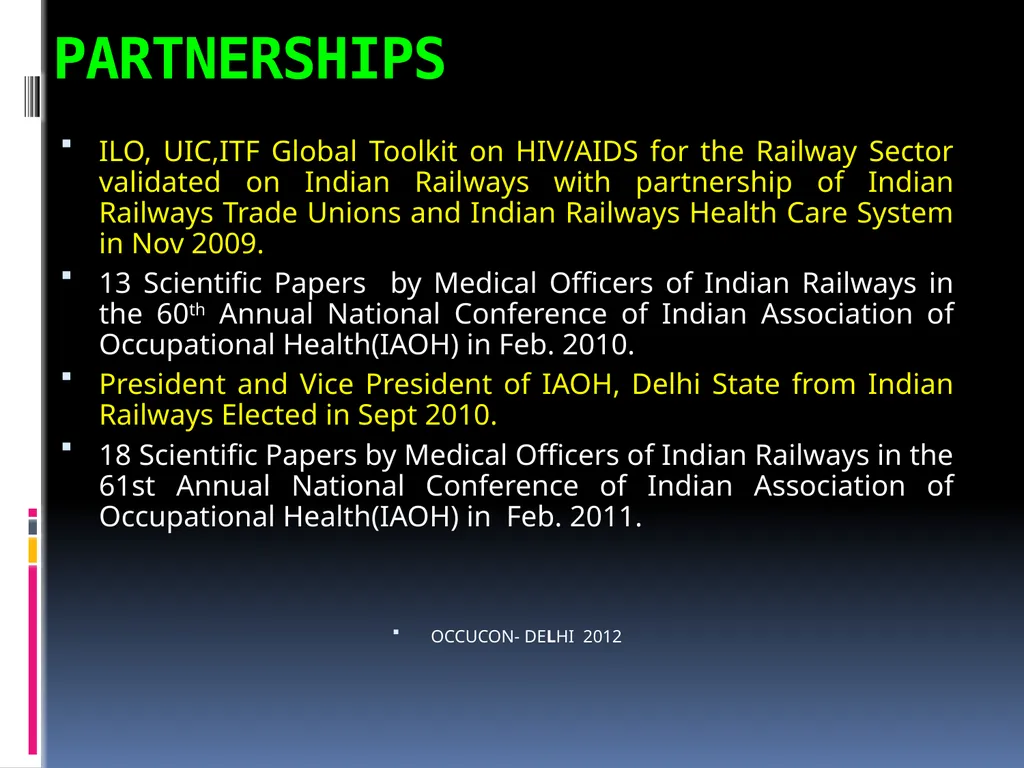
slide20. PARTNERSHIPS ILO, UIC,ITF Global Toolkit on HIV/AIDS for the Railway Sector validated on Indian Railways with partnership of Indian Railways Trade Unions and Indian Railways Health Care System in Nov 2009.
13 Scientific Papers by Medical Officers of Indian Railways in the 60th Annual National Conference of Indian Association of Occupational Health(IAOH) in Feb. 2010.
President and Vice President of IAOH, Delhi State from Indian Railways Elected in Sept 2010.
18 Scientific Papers by Medical Officers of Indian Railways in the 61st Annual National Conference of Indian Association of Occupational Health(IAOH) in Feb. 2011.
OCCUCON- DELHI 2012<br>
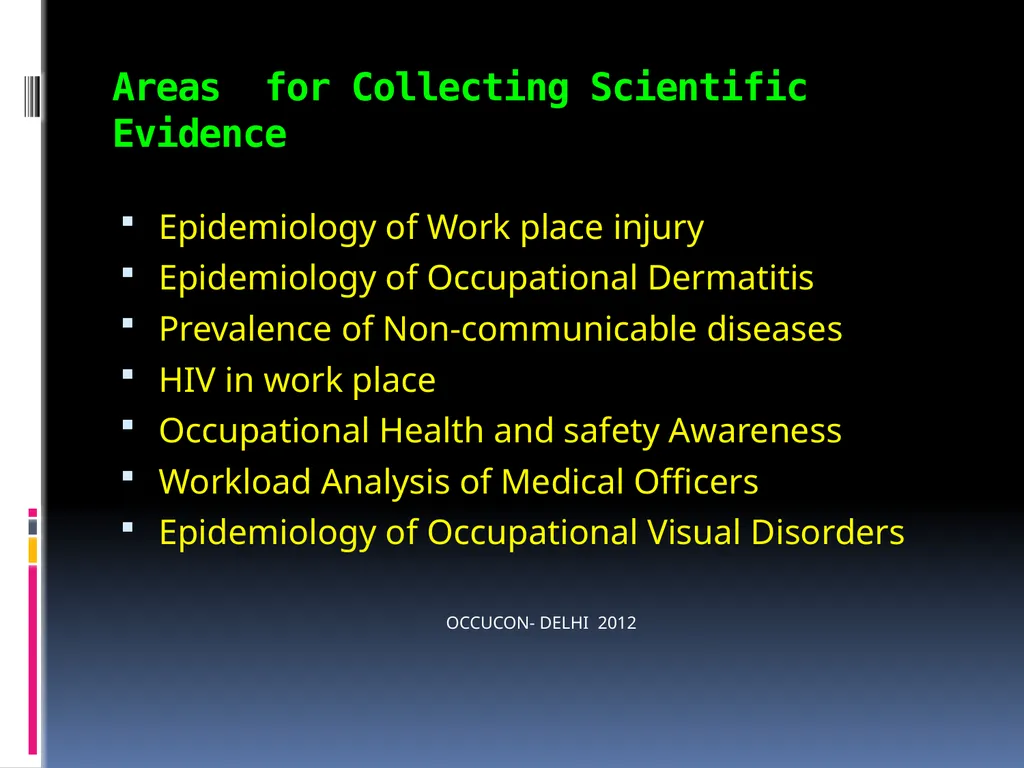
slide21. Areas for Collecting Scientific Evidence Epidemiology of Work place injury
Epidemiology of Occupational Dermatitis
Prevalence of Non-communicable diseases
HIV in work place
Occupational Health and safety Awareness
Workload Analysis of Medical Officers
Epidemiology of Occupational Visual Disorders
OCCUCON- DELHI 2012<br>
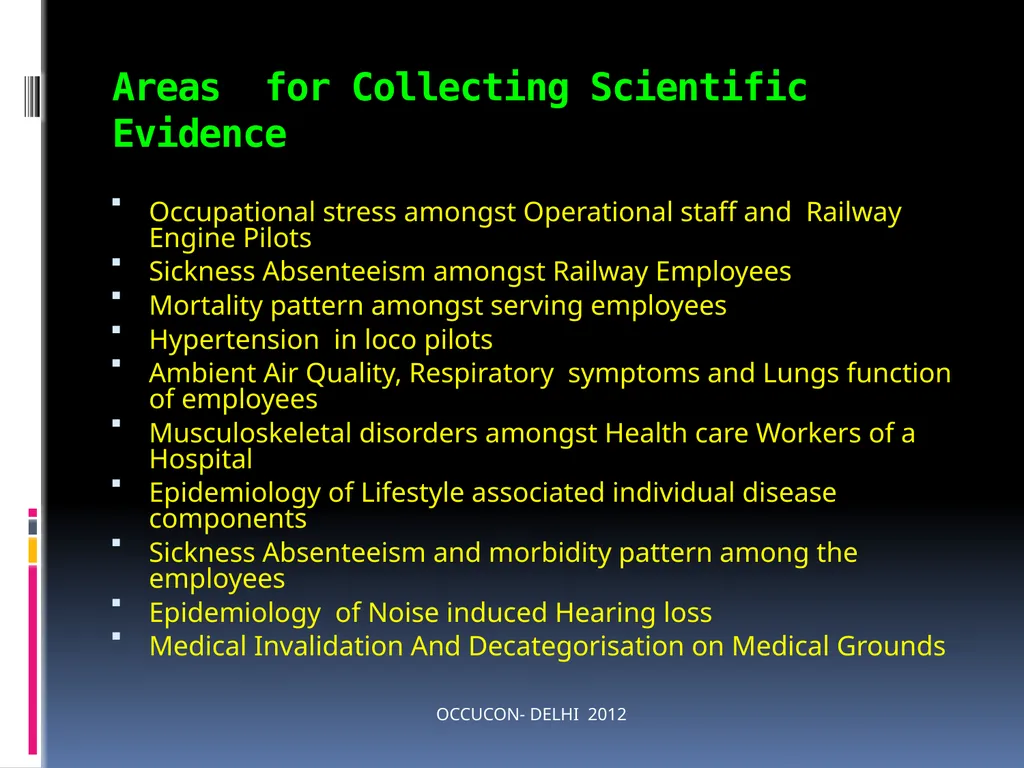
slide22. Areas for Collecting Scientific Evidence Occupational stress amongst Operational staff and Railway Engine Pilots
Sickness Absenteeism amongst Railway Employees
Mortality pattern amongst serving employees
Hypertension in loco pilots
Ambient Air Quality, Respiratory symptoms and Lungs function of employees
Musculoskeletal disorders amongst Health care Workers of a Hospital
Epidemiology of Lifestyle associated individual disease components
Sickness Absenteeism and morbidity pattern among the employees
Epidemiology of Noise induced Hearing loss
Medical Invalidation And Decategorisation on Medical Grounds
OCCUCON- DELHI 2012<br>
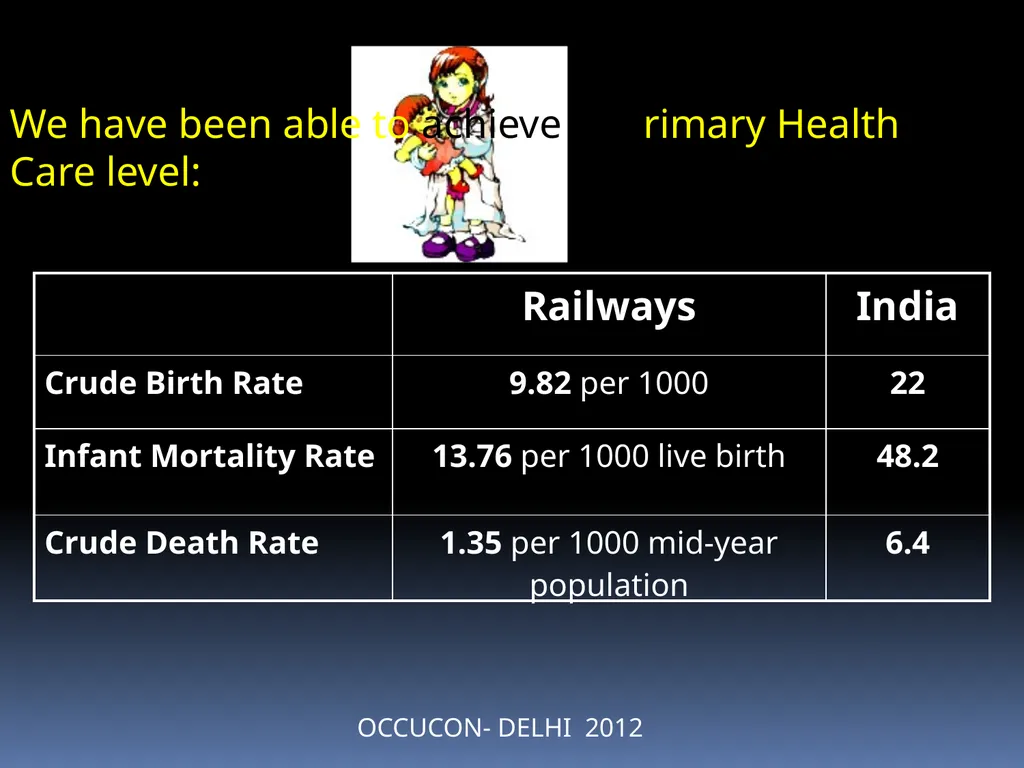
slide23. We have been able to achieve at Primary Health Care level: OCCUCON- DELHI 2012<br>
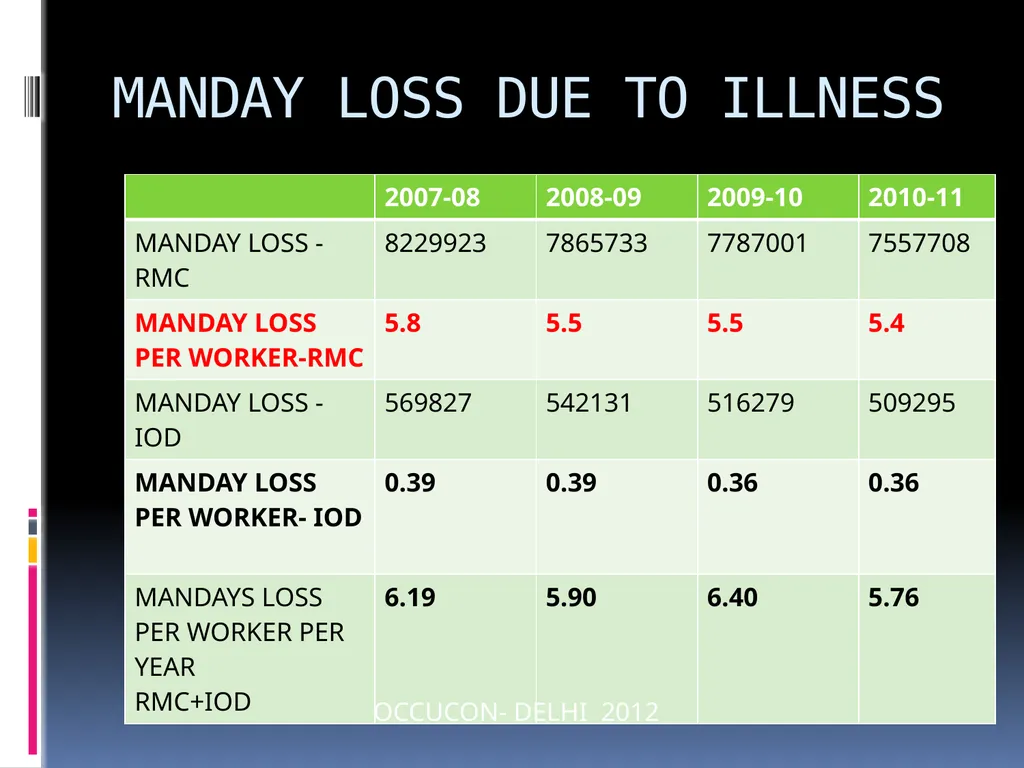
slide24. MANDAY LOSS DUE TO ILLNESS OCCUCON- DELHI 2012<br>
slide25. Preventive Health Care Seminar 25 Impact of Preventive Health Care on Indian Industry and Economy Dr. Alka Chadha
National University of Singapore
September 12, 2007
New Delhi OCCUCON- DELHI 2012<br>
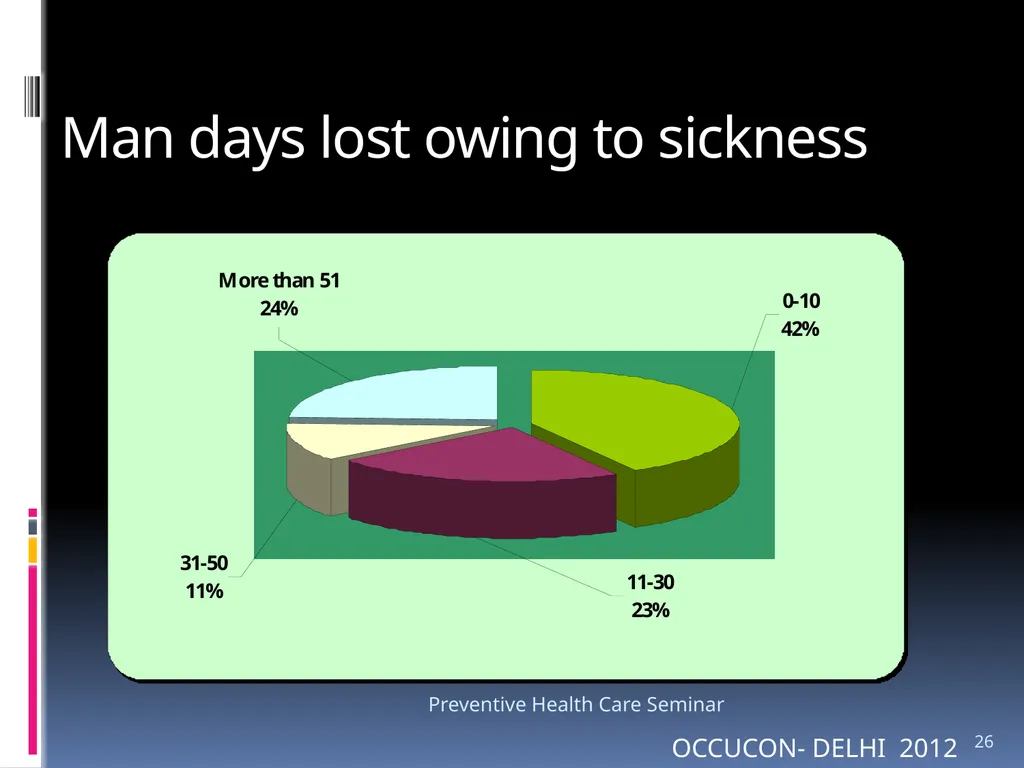
slide26. Man days lost owing to sickness Preventive Health Care Seminar 26 OCCUCON- DELHI 2012<br>
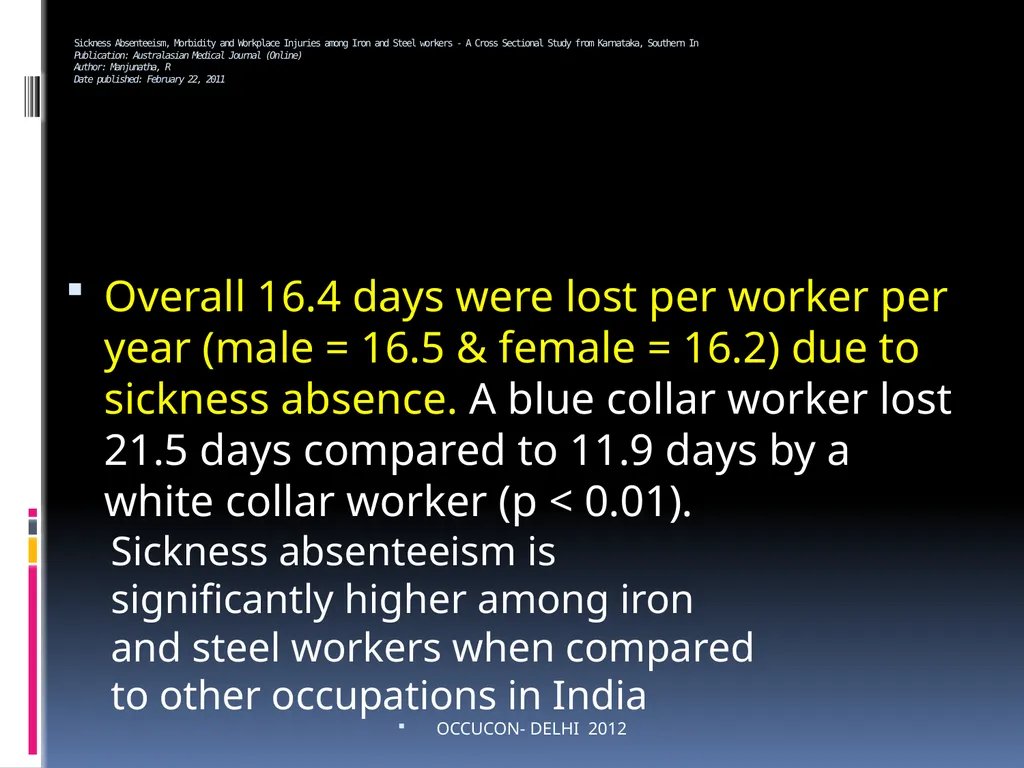
slide27. Sickness Absenteeism, Morbidity and Workplace Injuries among Iron and Steel workers - A Cross Sectional Study from Karnataka, Southern In Publication: Australasian Medical Journal (Online) Author: Manjunatha, R Date published: February 22, 2011 Overall 16.4 days were lost per worker per year (male = 16.5 & female = 16.2) due to sickness absence. A blue collar worker lost 21.5 days compared to 11.9 days by a white collar worker (p < 0.01).
OCCUCON- DELHI 2012 Sickness absenteeism is significantly higher among iron and steel workers when compared to other occupations in India<br>
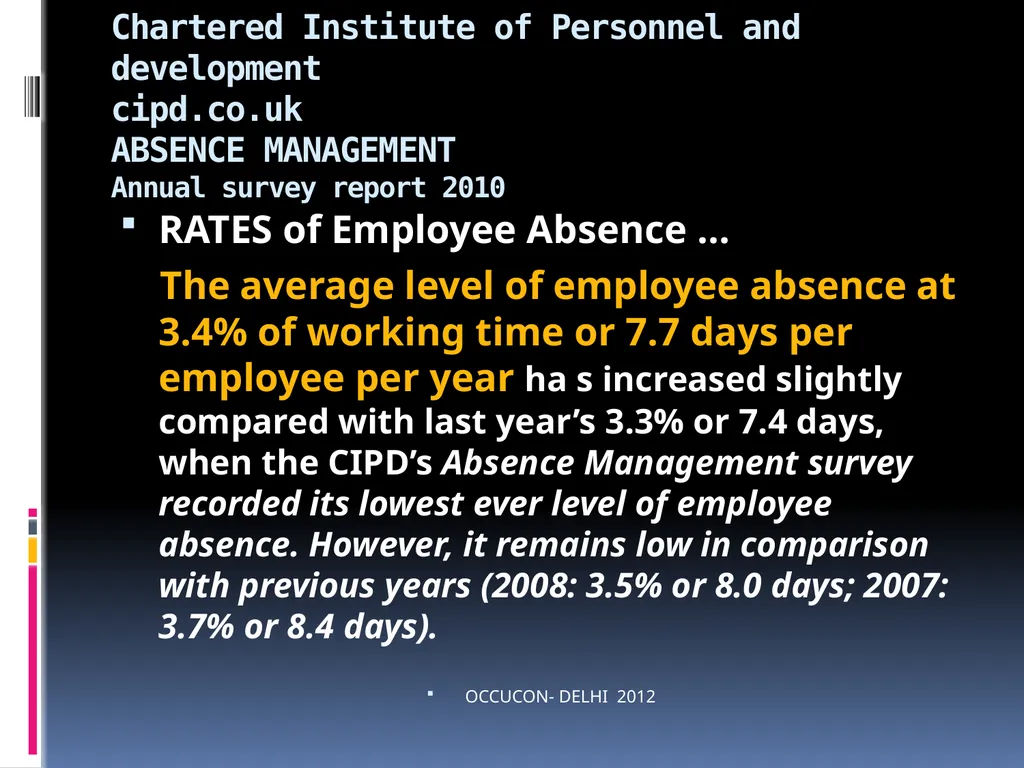
slide28. Chartered Institute of Personnel and development cipd.co.uk ABSENCE MANAGEMENT Annual survey report 2010 RATES of Employee Absence …
The average level of employee absence at 3.4% of working time or 7.7 days per employee per year ha s increased slightly compared with last year’s 3.3% or 7.4 days, when the CIPD’s Absence Management survey recorded its lowest ever level of employee absence. However, it remains low in comparison with previous years (2008: 3.5% or 8.0 days; 2007: 3.7% or 8.4 days).
OCCUCON- DELHI 2012<br>
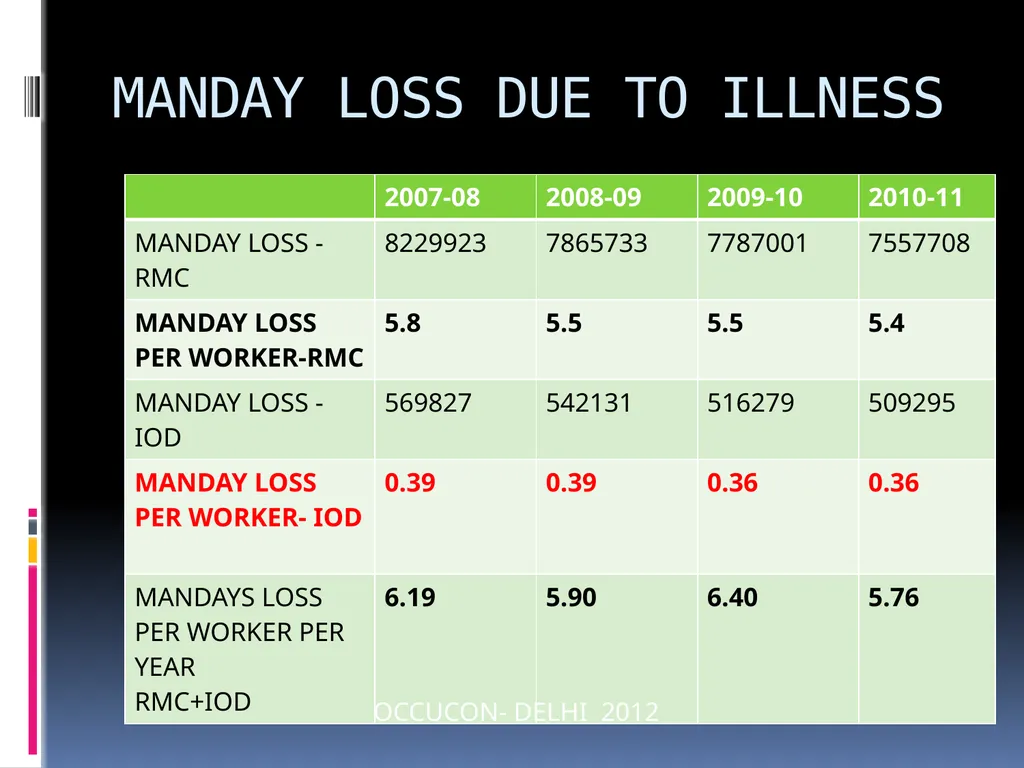
slide29. MANDAY LOSS DUE TO ILLNESS OCCUCON- DELHI 2012<br>
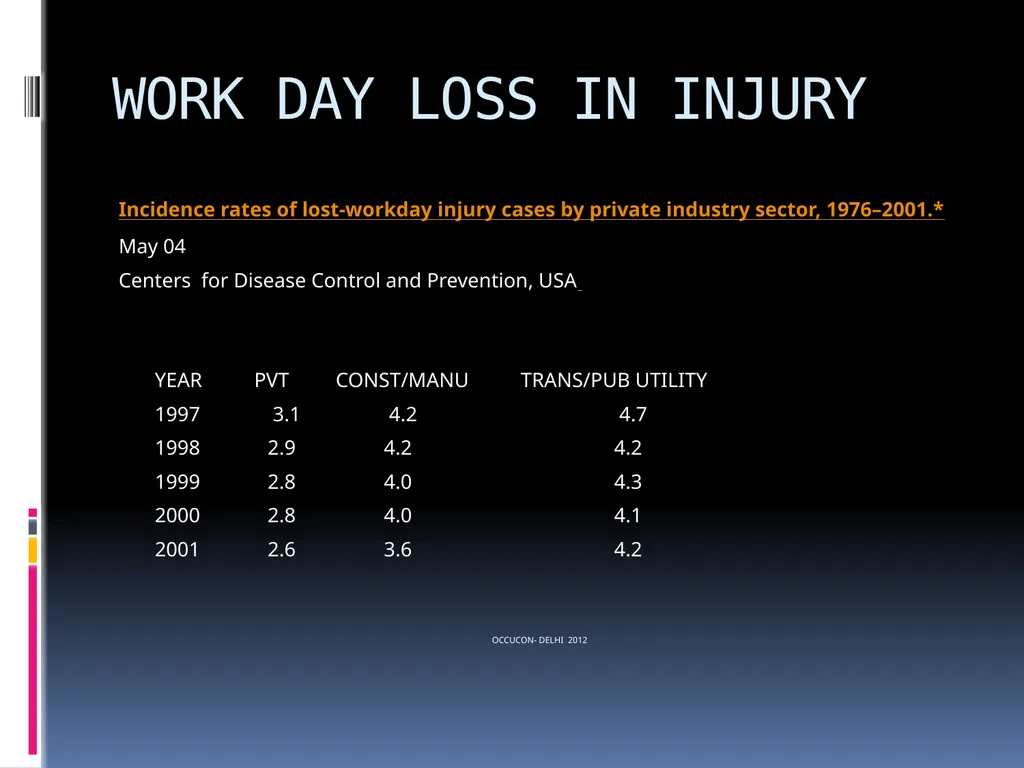
slide30. WORK DAY LOSS IN INJURY Incidence rates of lost-workday injury cases by private industry sector, 1976–2001.*
May 04
Centers for Disease Control and Prevention, USA
YEAR PVT CONST/MANU TRANS/PUB UTILITY
1997 3.1 4.2 4.7
1998 2.9 4.2 4.2
1999 2.8 4.0 4.3
2000 2.8 4.0 4.1
2001 2.6 3.6 4.2
OCCUCON- DELHI 2012<br>
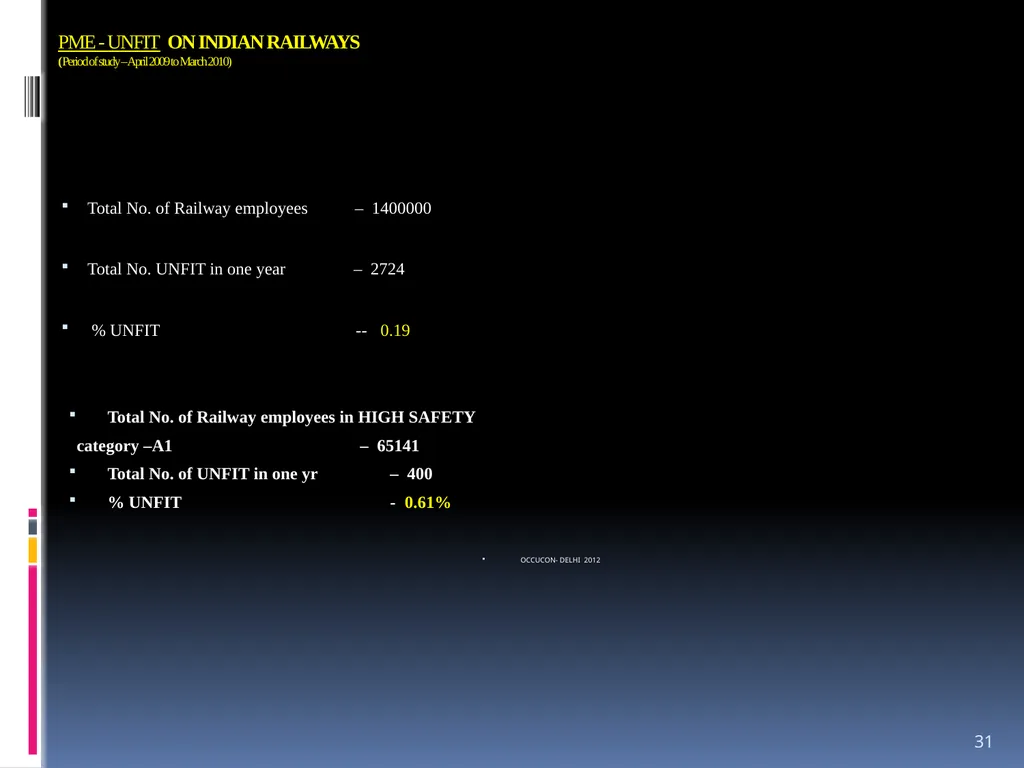
slide31. PME - UNFIT ON INDIAN RAILWAYS (Period of study – April 2009 to March 2010) Total No. of Railway employees – 1400000
Total No. UNFIT in one year – 2724
% UNFIT -- 0.19
Total No. of Railway employees in HIGH SAFETY
category –A1 – 65141
Total No. of UNFIT in one yr – 400
% UNFIT - 0.61%
OCCUCON- DELHI 2012 31<br>
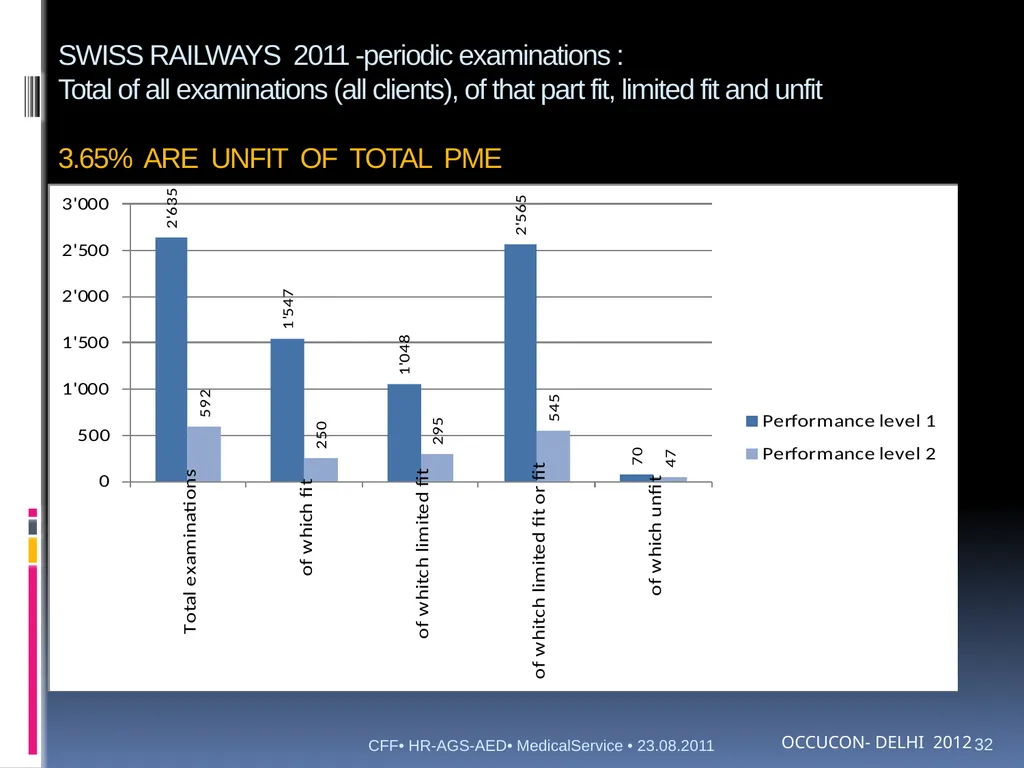
slide32. SWISS RAILWAYS 2011 -periodic examinations : Total of all examinations (all clients), of that part fit, limited fit and unfit 3.65% ARE UNFIT OF TOTAL PME CFF• HR-AGS-AED• MedicalService • 23.08.2011 32 OCCUCON- DELHI 2012<br>
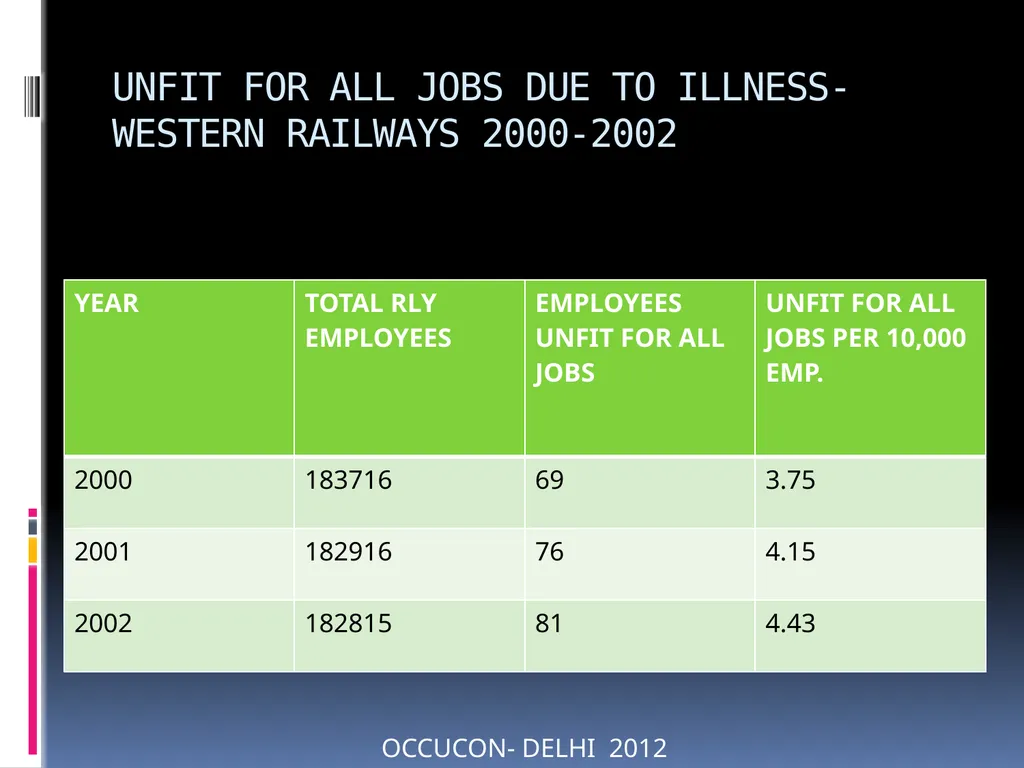
slide34. UNFIT FOR ALL JOBS DUE TO ILLNESS- WESTERN RAILWAYS 2000-2002 OCCUCON- DELHI 2012<br>
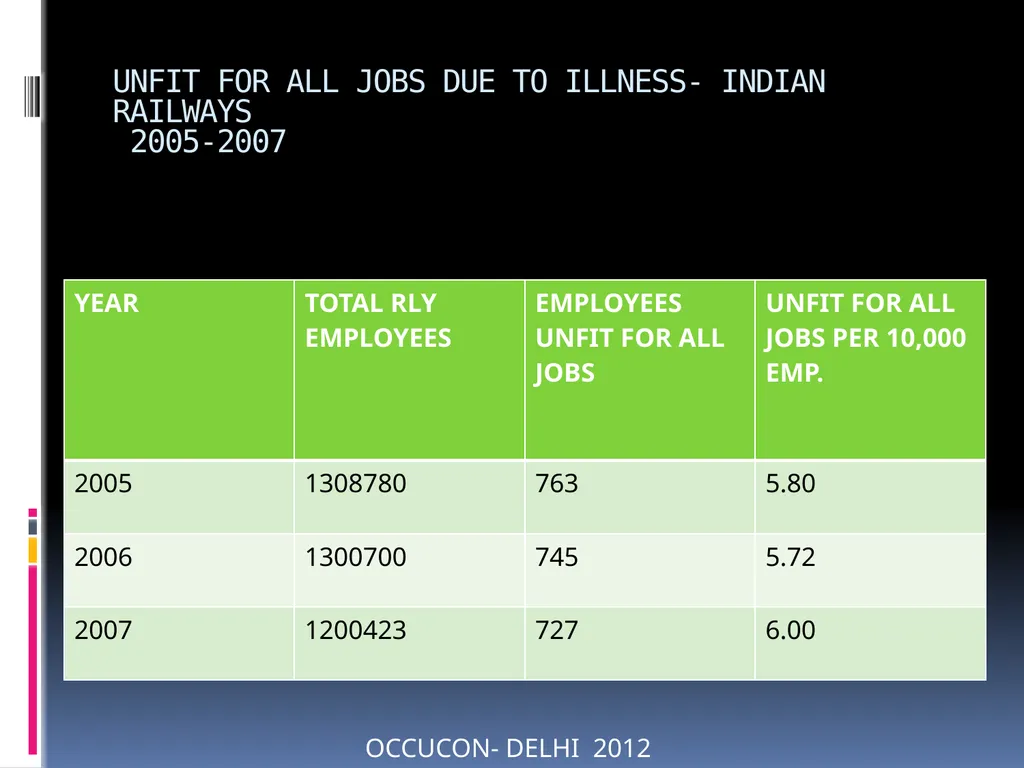
slide35. UNFIT FOR ALL JOBS DUE TO ILLNESS- INDIAN RAILWAYS 2005-2007 OCCUCON- DELHI 2012<br>
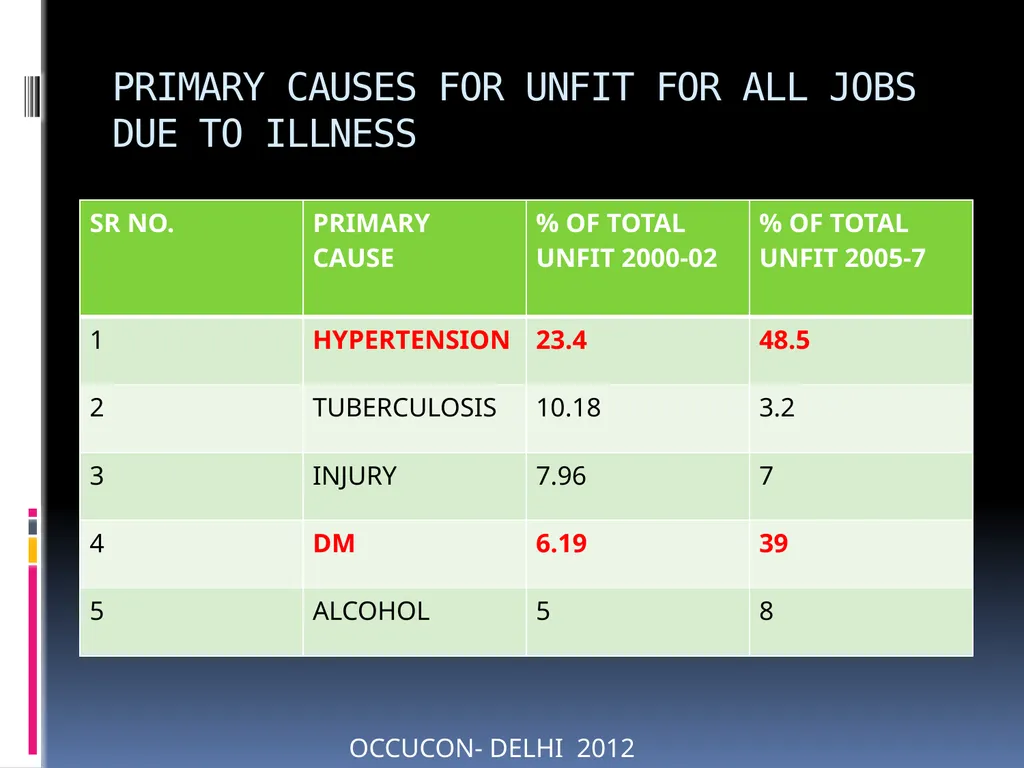
slide36. PRIMARY CAUSES FOR UNFIT FOR ALL JOBS DUE TO ILLNESS OCCUCON- DELHI 2012<br>
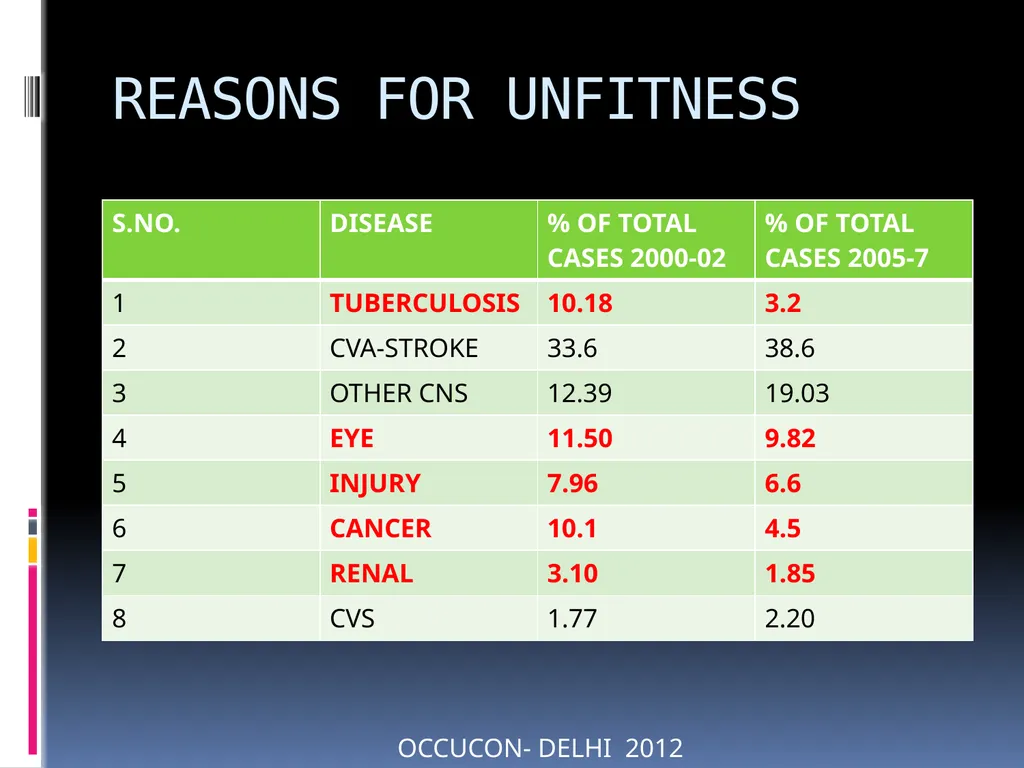
slide37. REASONS FOR UNFITNESS OCCUCON- DELHI 2012<br>
slide38. INJURED ON DUTY OCCUCON- DELHI 2012<br>
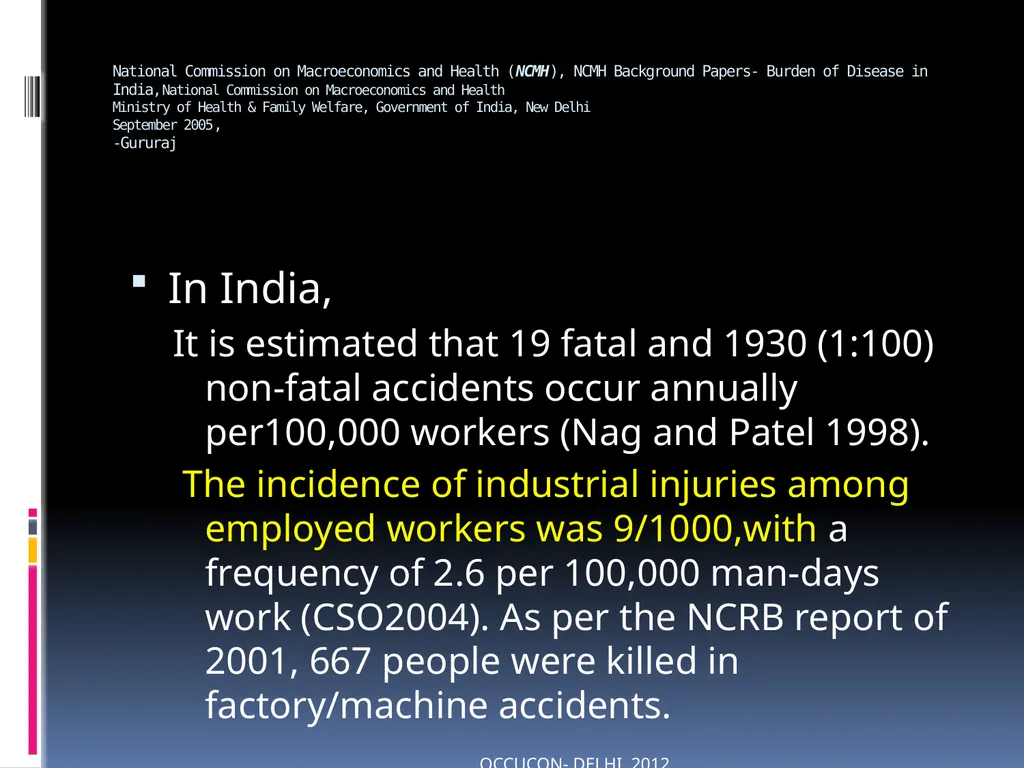
slide39. National Commission on Macroeconomics and Health (NCMH), NCMH Background Papers- Burden of Disease in India,National Commission on Macroeconomics and Health Ministry of Health & Family Welfare, Government of India, New Delhi September 2005, -Gururaj In India,
It is estimated that 19 fatal and 1930 (1:100) non-fatal accidents occur annually per100,000 workers (Nag and Patel 1998).
The incidence of industrial injuries among employed workers was 9/1000,with a frequency of 2.6 per 100,000 man-days work (CSO2004). As per the NCRB report of 2001, 667 people were killed in factory/machine accidents.
OCCUCON- DELHI 2012<br>
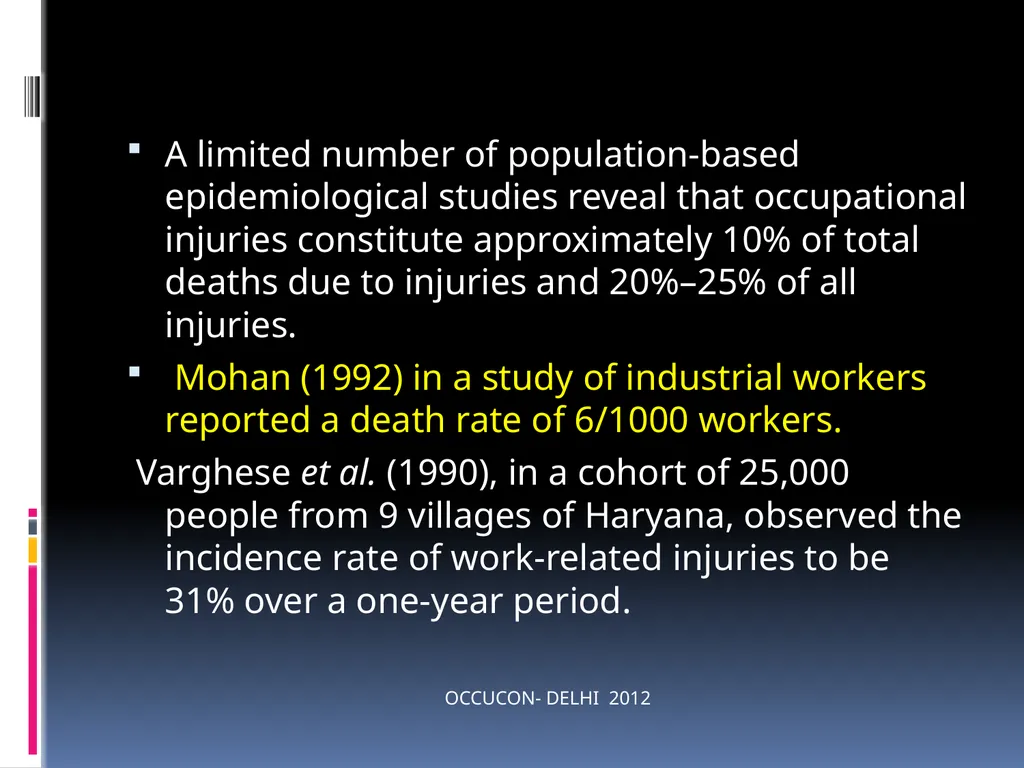
slide40. A limited number of population-based epidemiological studies reveal that occupational injuries constitute approximately 10% of total deaths due to injuries and 20%–25% of all injuries.
Mohan (1992) in a study of industrial workers reported a death rate of 6/1000 workers.
Varghese et al. (1990), in a cohort of 25,000 people from 9 villages of Haryana, observed the incidence rate of work-related injuries to be 31% over a one-year period.
OCCUCON- DELHI 2012<br>
slide41. Workers’ health: global plan of action Sixtieth World Health Assembly SIXTIETH WORLD HEALTH ASSEMBLY WHA60.26,Agenda item 12.13, 23 May 2007.
In the preamble mentions…..
“Considering that the health of workers is determined not only by occupational hazards, but also by social and individual factors, and access to health services;”
OCCUCON- DELHI 2012<br>
slide42. Workers’ health: global plan of action Sixtieth World Health Assembly Urges Member States:
(5) to ensure collaboration and concerted action by all national health programmes relevant to workers 'health, such as those dealing with prevention of occupational diseases and injuries, communicable and chronic diseases, health promotion, mental health, environmental health, and health systems development;
OCCUCON- DELHI 2012<br>
slide43. Ned Tijdschr Geneeskd. 2011;155(48):A3880. [Patients on the collaboration between occupational and curative physicians]. [Article in Dutch] Plomp HN, Wisse A, Anema JK. Source VU Medisch Centrum, afd. Sociale Geneeskunde, Amsterdam, the Netherlands. hn.plomp@vumc.nl CONCLUSION:
A physician's predominant perspective of the cooperation between occupational and curative physicians is a clinical one; the emphasis being on the establishment of adequate diagnoses and their treatments. Patients, however, view the cooperation between their occupational and curative physicians from a strategic perspective in which their own interests are the key decisive factors. In daily practice, this might explain the reason behind patients being more reserved about occupational-curative cooperation, in comparison with physicians. It is advisable that patients not only be asked their consent, but that they are also granted a consciously active role in the collaboration between their occupational and curative physicians as well as in their own occupational reintegration process.
OCCUCON- DELHI 2012<br>
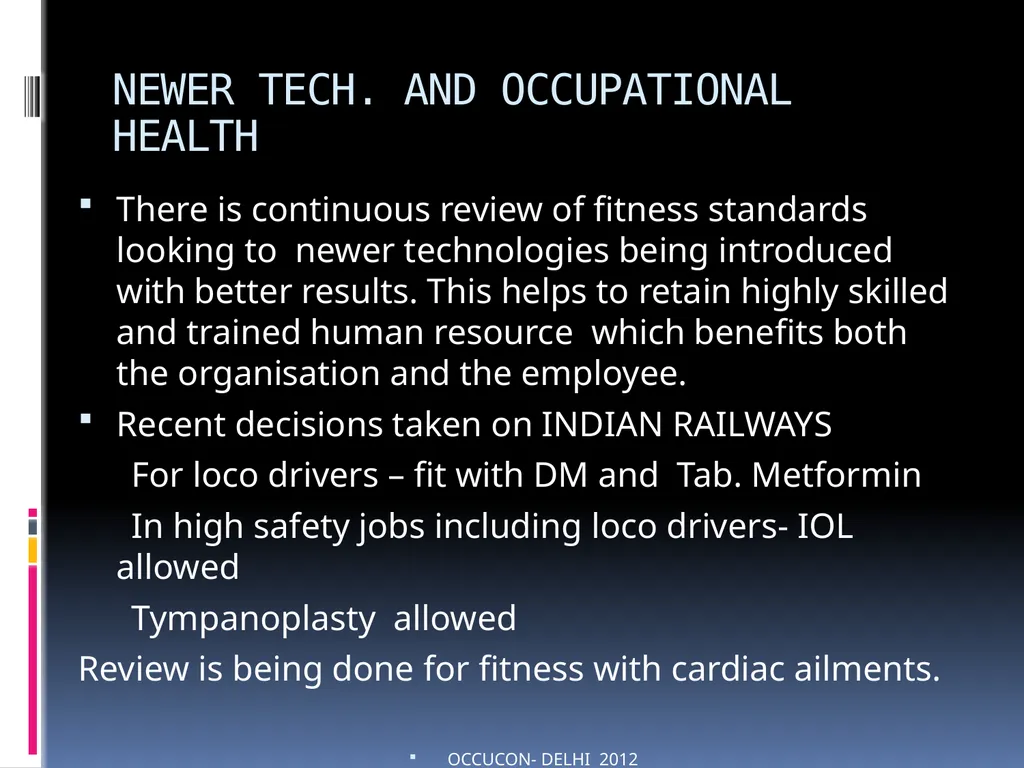
slide44. NEWER TECH. AND OCCUPATIONAL HEALTH There is continuous review of fitness standards looking to newer technologies being introduced with better results. This helps to retain highly skilled and trained human resource which benefits both the organisation and the employee.
Recent decisions taken on INDIAN RAILWAYS
For loco drivers – fit with DM and Tab. Metformin
In high safety jobs including loco drivers- IOL allowed
Tympanoplasty allowed
Review is being done for fitness with cardiac ailments.
OCCUCON- DELHI 2012<br>
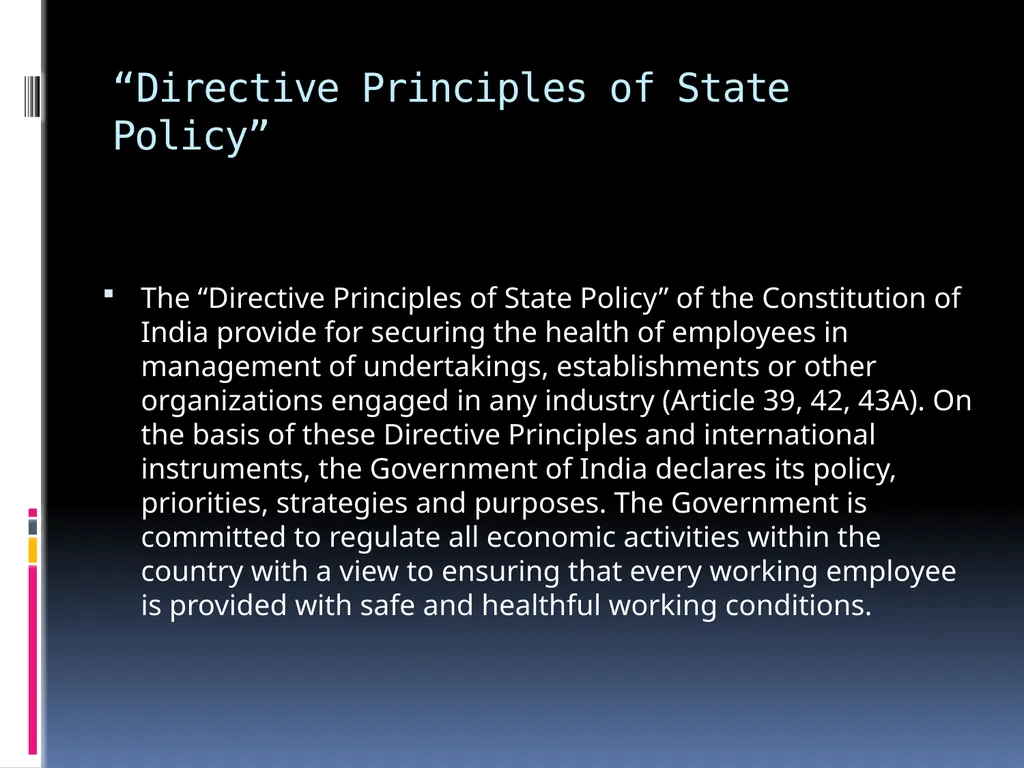
slide45. “Directive Principles of State Policy” The “Directive Principles of State Policy” of the Constitution of India provide for securing the health of employees in management of undertakings, establishments or other organizations engaged in any industry (Article 39, 42, 43A). On the basis of these Directive Principles and international instruments, the Government of India declares its policy, priorities, strategies and purposes. The Government is committed to regulate all economic activities within the country with a view to ensuring that every working employee is provided with safe and healthful working conditions.<br>
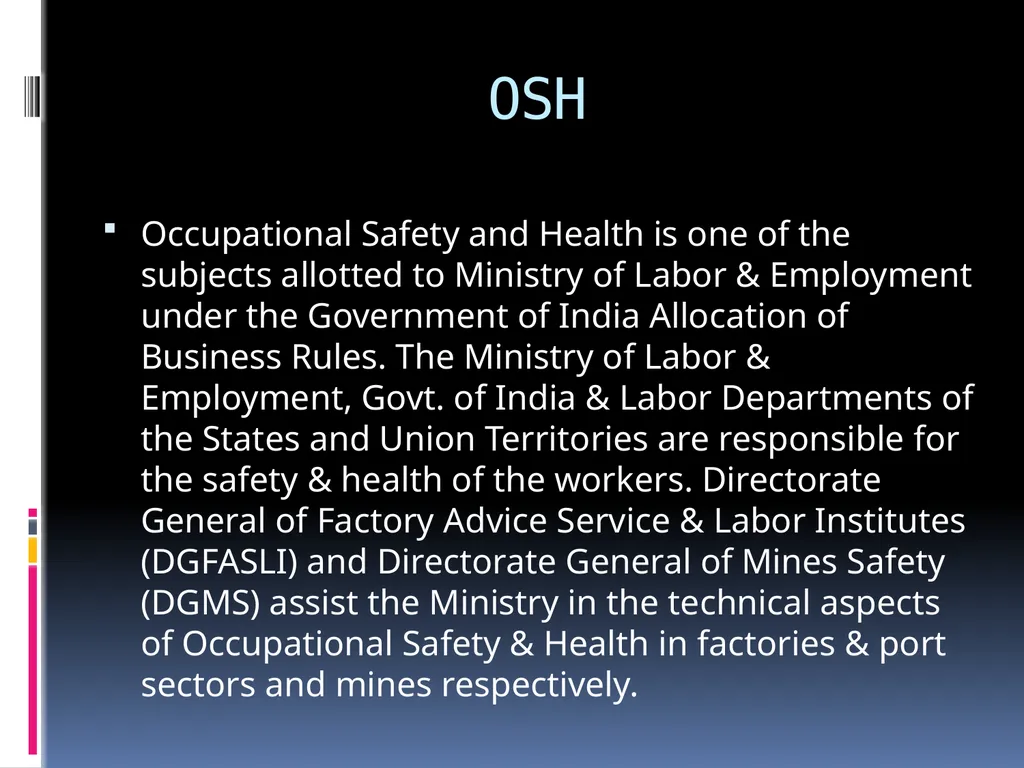
slide46. OSH Occupational Safety and Health is one of the subjects allotted to Ministry of Labor & Employment under the Government of India Allocation of Business Rules. The Ministry of Labor & Employment, Govt. of India & Labor Departments of the States and Union Territories are responsible for the safety & health of the workers. Directorate General of Factory Advice Service & Labor Institutes (DGFASLI) and Directorate General of Mines Safety (DGMS) assist the Ministry in the technical aspects of Occupational Safety & Health in factories & port sectors and mines respectively.<br>
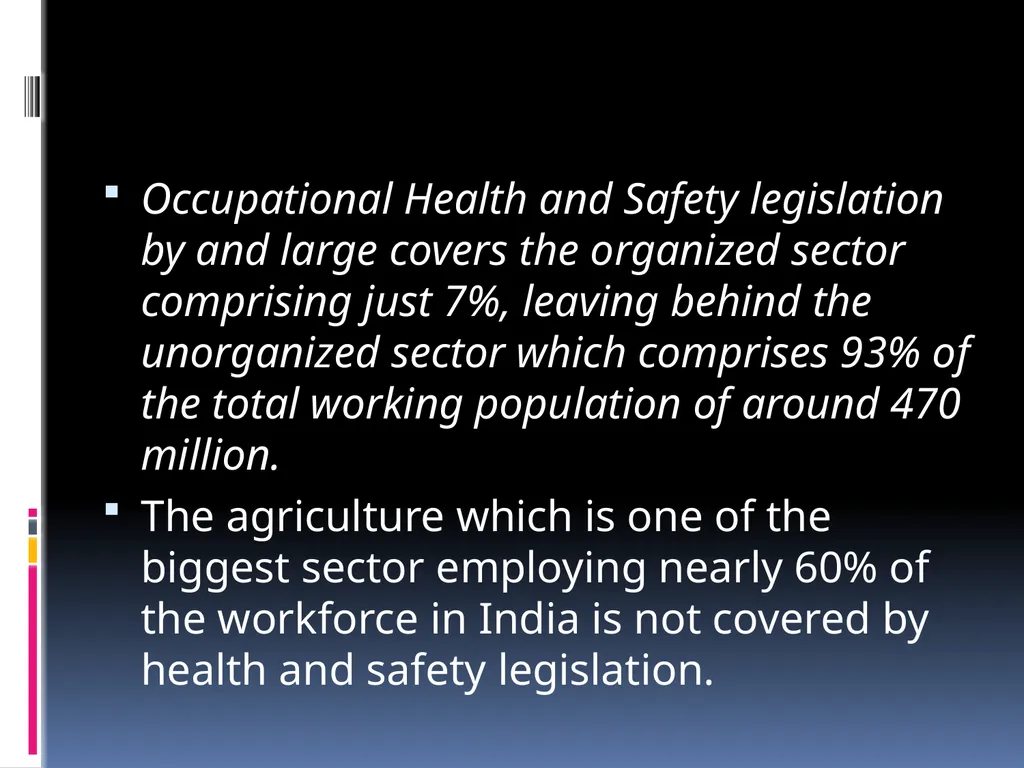
slide47. Occupational Health and Safety legislation by and large covers the organized sector comprising just 7%, leaving behind the unorganized sector which comprises 93% of the total working population of around 470 million.
The agriculture which is one of the biggest sector employing nearly 60% of the workforce in India is not covered by health and safety legislation.<br>
slide48. With such a limited coverage of workforce and rather weak state of occupational health and safety, India may be having a GNP loss to the tune of several hundreds of billions of dollars every year. Serious efforts are needed to address this issue so as to prevent human and material losses. India may be experiencing almost 10% of GNP loss due to occupational illness and injuries.<br>
slide49. The major occupational diseases/morbidity of concern in India are: silicosis, musculoskeletal injuries, coal workers’ pneumoconiosis, chronic obstructive lung diseases, asbestosis, byssinosis, pesticide poisoning and noise-induced hearing loss. Census figures (2011) have revealed that there is an increase of female workers leading to certain concerns, such as adverse effects on reproductive health, exposure to toxic chemicals in the workplace<br>
slide50. In India, occupational health is not integrated with primary health care. Occupational Safety and Health till date remains under the mandate of the Ministry of Labor and not the Ministry of Health. Many large industries / public sector enterprises provide medical services but concentrate on curative set-up neglecting occupational health.<br>
slide51. There are around 1125 qualified occupational health professionals in India and only around 100 qualified Industrial hygienists as against a requirement of over 8000 qualified occupational health doctors
As a result there is under diagnosis and under-reporting of occupational diseases.<br>
slide52. WHO in its sixtieth World Health Assembly has also expressed concerns over major gaps between and within countries in the exposure of workers and local communities to occupational hazards and in their access to occupational health services. The occupational health training is carried out in a few medical colleges for graduate and postgraduate diplomas and degrees.<br>
slide53. There are many factors, which are changing the industrial environment in India, such as globalization, outsourcing, transfer of technologies, newer type of jobs (IT, Call Centre), change in employment patterns, etc. Additionally, factors like increasing literacy / education are also ensuring worker awareness and more and more “Right to Know” demands from workers.<br>
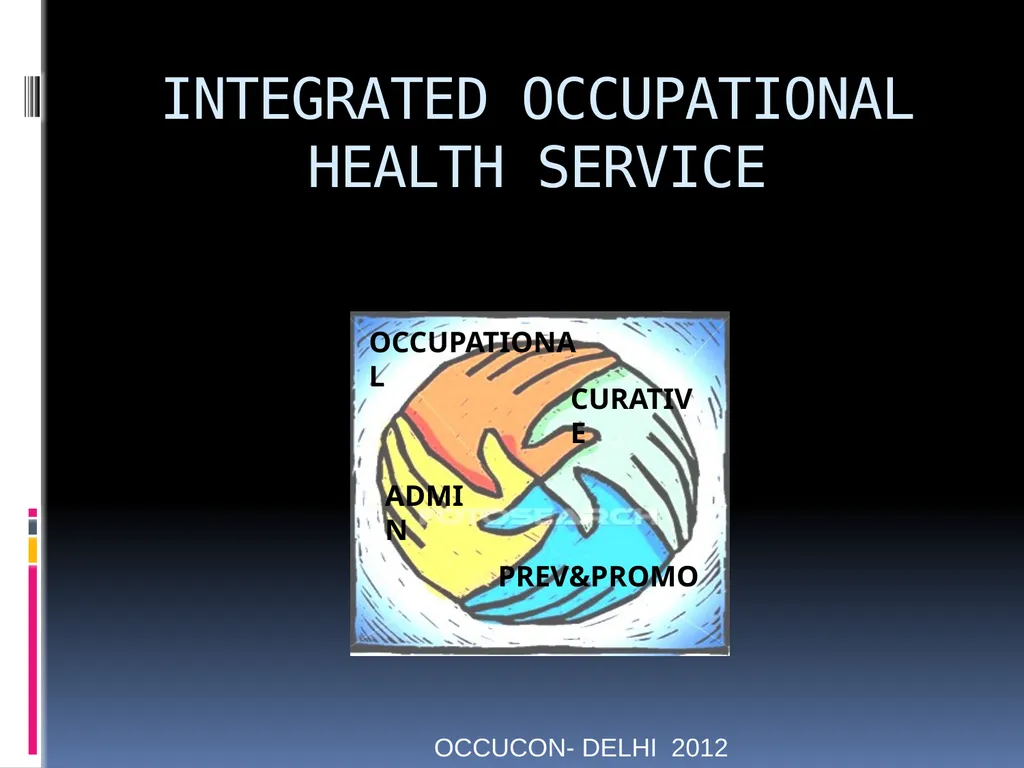
slide54. INTEGRATED OCCUPATIONAL HEALTH SERVICE OCCUPATIONAL CURATIVE PREV&PROMO ADMIN OCCUCON- DELHI 2012<br>
slide55. THANKS FOR YOUR ATTENTION<br>
ADJUNCT PROFESSOR IIHMR DELHI
FORMER DIRECTOR GENERAL, RAILWAY HEALTH SERVICES, INDIAN RAILWAYS
FORMER EXECUTIVE MEMBER,MANAGEMENT COMMITTEE
INTERNATIONAL UNION OF RAILWAY MEDIACAL SERVICES (UIMC)
PARIS FRANCE
MEMBER , INTERNATIONAL COMMISSION OF OCCUPATIONAL HEALTH, ICOH
MEMBER EDITORIAL BOARD, JOURNAL RAILWAY MEDICINE, RUSSIAN RAILWAYS, MOSCOW
PRESIDENT, FORUM OF INDUSTRY MEDICINE,DELHI
PRESIDENT, INDIAN ASSOCIATION OF PUBLIC HEALTH ,DELHI BRANCH
PRESIDENT, INDIAN ASSOCIATION OF OCCUPATIONAL HEALTH – DELHI BRANCH<br>
slide2. Workers’ health: global plan of action Sixtieth World Health Assembly SIXTIETH WORLD HEALTH ASSEMBLY WHA60.26,Agenda item 12.13, 23 May 2007. In its introduction mentions .....
“All components of health systems should be
involved in an integrated response to the
specific health needs of working populations.”
OCCUCON- DELHI 2012<br>
slide3. OCCUPATIONAL HEALTH PROVIDER
CURATIVE HEALTH PROVIDER
PREV. AND PROMOTIVE HEALTH PROVIDER
POLICY MAKERS
I INTEGRATION OF HEALTH SERVICES
OCCUCON- DELHI 2012<br>
slide4. OCCUCON- DELHI 2012 OCCUPATIONAL HEALTH SERVICES CURATIVE HEALTH SERVICES PREVENTIVE AND PROMOTIVE HEALTH SERVICES ADMINISTRATIVE SERVICES RAILWAY HEALTH SERVICES<br>
slide5. Can Med Assoc J. 1964 Dec 19;91:1307-9. THE PHYSICIAN AND INDUSTRY. NELSON AJ. Many employers are interested in helping their employees improve and maintain health through a program of preventive medicine designed to supplement health services which already exist in the community. The objectives of such a health program can be attained only through team work between physicians, both within and outside industry. Such specific objectives as the development of measures for the maintenance and improvement of health and the prevention of disease; the provision of readily available diagnostic, treatment and counselling services; the rehabilitation of disabled employees; and the effective administration of sick-benefit plans require the closest communication and co-operation among the occupational health service, the private physician, and other health and welfare agencies. Only by such liaison can the maximum benefits of both preventive and curative medicine be extended to the employee-in his best interest as well as that of the community and the employer.
OCCUCON- DELHI 2012<br>
slide6. J Occup Med. 1992 Sep;34(9):893-901. Workers' attitude toward the occupational physician. Plomp HN. Institute of Social Medicine, Vrije Universiteit, Amsterdam, The Netherlands. We conclude that workers see clear differences in the tasks and functions of the occupational physician compared with those of the curative physician. Relations with and dependence on management is considered to be self-evident. A negative evaluation of the OHS is mainly because of unclarity and uncertainty as to how the occupational physician combines his/her responsibility toward individual workers with his/her responsibility toward the company.
OCCUCON- DELHI 2012<br>
slide7. INDIAN RAILWAYS AT A GLANCE :
INDIAN RAILWAYS IS ONE OF THE LARGEST RAIL NETWORKS IN THE WORLD
Number of Employees : 1.36 million
Route length : 63,974 Kms.
Total Track Kms. : 113,617 Kms
Railway Stations : 7,030
Passenger Kms. : 903 billion
Freight Train Kms : 356 million
Passenger Originating : 7,246 million
OCCUCON- DELHI 2012<br>
slide8. No. of Zones : 17
No. of Divisions : 68
No. of Production Units : 6
Public Sector Undertakings: CONCOR, CRIS, IRCON, IRCTC, IRFC, KRCL, MRVC, RVNL, RCIL, RITES, DFCCIL, RLDA
OCCUCON- DELHI 2012<br>
slide9. MEDICAL DEPARTMENT – HEALTH SERVICES
INFRASTRUCTURE:
Total No. of Railway Hospitals : 125
Total No. of Health Units : 586
Total No. of Indoor beds : 14,000
MANPOWER AVAILABLE:
(a) Doctors- including Dental = 2,506
(b) Other doctors – honorary visiting
specialist, Sr. Residents, DNB trainees
& house officers = 1.000
Para Medical & other staff = 54.000
Health Inspectors = 952
OCCUCON- DELHI 2012<br>
slide10. Expenditure on Health Care Delivery System
Year Expenditure
(figures in millions of INR)
09-10 ( Actual) 13,782
10-11 (Revised estimate) 14,213
11-12 (BE) 15,934 (238 m Euros ) OCCUCON- DELHI 2012<br>
slide11. Health Care Delivery OPD Attendance(Annual) : 26.47 million
Indoor patients(Annual) : 4.84 million
Annual Surgical operations(Annual) : 100,000
Major Surgical Operations(Annual) 44,229
Maydays lost on account of sickness(Annual) : 1.74%
Medical examination of Employees(Annual) : 132,800
Medical examination of Candidates for Employment (Annual) : 35,103
OCCUCON- DELHI 2012<br>
slide12. TOTAL NUMBER OF BENEFICIARIES :
Total Number of Railway Employees : 1.36 million
2. Total Number of Retired Railway Employees : 0.34 million
Total beneficiaries:
1.36 million x 4 = 5.44 million
0.34 million x 2 = 0.68 million
T OTAL = 6.12 million
OCCUCON- DELHI 2012<br>
slide13. INDIAN RAILWAYS Official Member of UIC (International Union of Railways) and UIMC (International Union of Railway Medical Services).
Largest Employer (More than 1.36 million full-time regular employees) under Single Management in the World
Largest Integrated Occupational Health Service under Single Management in the World.
OCCUCON- DELHI 2012<br>
slide14. STAKE HOLDERS – A SEAMLESS INTEGRATION THE INDIAN RAILWAYS –TO INCREASE PRODUCTIVITY, HAVE MOTIVATED EMPLOYEE AS THEY ARE SKILLED AND EXPENSIVE,EMP.WELFARE
EMPLOYEE- HEALTHY ENVRON TO KEEP HIM HEALTHY AND FIT
CURATIVE HEALTH PROVIDER- EARLY TREATMENT,ALL EFFORT TO MAKE HIM FIT FOR ORIGINAL JOB,COUNSELLING
OCCUPATIONAL HEALTH PROVIDER - KEEP HIGHLY SKILLED EMP FIT FOR JOB,REDUCE MANDAYS LOSS,AWARENESS AND PREVENTIVE PROG..
TRADE UNIONS-EMP.WELFARE,AWARENESS PROG.,HELP IR TO MEET CORPORATE GOALS
VARIOUS LEGISLATIONS E.G. FACTORY ACT, WORKMAN’S COMPENSATION ACT ETC.
OCCUCON- DELHI 2012<br>
slide15. INTEGRATION - OCCUPATIONAL CATEGORY :
FITNESS IN HIGH SAFETY –ENDANGERS PASSENGERS AND PUBLIC
MEDIUM SAFETY –ENDANGERS COLLEAGUES AND SELF
LOW SAFETY- THE REST
MEDICAL EXAMINATION:
PRE-PANEL MED.EXAM.
PRE-EMPLOYMENT MED.EXAM.
PERIODICAL MEDICAL EXAMINATION
OCCUCON- DELHI 2012<br>
slide16. INTEGRATION - PREVENTIVE AND PROMOTIVE HEALTH INSPECTORS & HEALTH OFFICERS
SUPERVISE DRINKING WATER QUALITY
FOOD QUALITY
SANITATION
HEALTH AWARENESS CAMPS
HEALTH CHECKUP CAMPS
IMMUNISATIONS – HEPATITIS B, ETC
DIETIC SERVICES
PROMOTE HEALTHY LIFE STYLES
OCCUCON- DELHI 2012<br>
slide17. INTEGRATION - CURATIVE - HOSPITALS AND DISPENSARIES
PRIMARY,
SECONDARY, AND
TERTIARY CARE
-HUB AND SPOKE MODEL
-FOR EMERGENCIES- EMPANELLED HOSPITALS
OCCUCON- DELHI 2012<br>
slide18. INTEGRATION - ADMINISTRATIVE -RLY. HEALTH BUDGET FOR INTEGRATED HEALTH SERVICES
-SEPERATE CAPITAL INVESTMENT ON INFRA. AND EQUIP.
-RAILWAY BOARD ON STAFF WELFARE HAS A SECY. LEVEL MEMBER STAFF AND DGRHS
-TRADE UNIONS :PNM, SAFETY CAMPS, HOSP. VISITING COMMITTEE,OPINION ON STAFF WELFARE MATTERS,CONDUCT HEALTH AWARENESS PROG.BLOOD DONATION CAMPS
- PARTICIPATION OF RAILWAY EMPLOYEES IN MANAGEMENT - PREM
-POLICY ON LONG SICKNESS
-MANDAY LOSS MONITORING
-MORBIDITY AND MORTALITY MEETINGS
-MONTHLY PERFORMANCE REPORT
-QUATERLY CMDS MEETINGS
OCCUCON- DELHI 2012<br>
slide19. INTEGRATION ADMINISTRATIVE Railway Minister's, GM’S, and CMD’S Annual awards for Best Performance at Zonal, Divisional and Dispensary level respectively and Individual Awards for BEST WORKERS
Ministry of Railways’ Approval for 90% reimbursement of Membership Fees of Indian Association of Occupational Health(IAOH) in Oct. 2009 to all Medical Officers .
Ministry of Railways’ Approval for 90% reimbursement of Membership Fees of International Commission on Occupational Health(ICOH) in 2010 to all Medical Officers.
OCCUCON- DELHI 2012<br>
slide20. PARTNERSHIPS ILO, UIC,ITF Global Toolkit on HIV/AIDS for the Railway Sector validated on Indian Railways with partnership of Indian Railways Trade Unions and Indian Railways Health Care System in Nov 2009.
13 Scientific Papers by Medical Officers of Indian Railways in the 60th Annual National Conference of Indian Association of Occupational Health(IAOH) in Feb. 2010.
President and Vice President of IAOH, Delhi State from Indian Railways Elected in Sept 2010.
18 Scientific Papers by Medical Officers of Indian Railways in the 61st Annual National Conference of Indian Association of Occupational Health(IAOH) in Feb. 2011.
OCCUCON- DELHI 2012<br>
slide21. Areas for Collecting Scientific Evidence Epidemiology of Work place injury
Epidemiology of Occupational Dermatitis
Prevalence of Non-communicable diseases
HIV in work place
Occupational Health and safety Awareness
Workload Analysis of Medical Officers
Epidemiology of Occupational Visual Disorders
OCCUCON- DELHI 2012<br>
slide22. Areas for Collecting Scientific Evidence Occupational stress amongst Operational staff and Railway Engine Pilots
Sickness Absenteeism amongst Railway Employees
Mortality pattern amongst serving employees
Hypertension in loco pilots
Ambient Air Quality, Respiratory symptoms and Lungs function of employees
Musculoskeletal disorders amongst Health care Workers of a Hospital
Epidemiology of Lifestyle associated individual disease components
Sickness Absenteeism and morbidity pattern among the employees
Epidemiology of Noise induced Hearing loss
Medical Invalidation And Decategorisation on Medical Grounds
OCCUCON- DELHI 2012<br>
slide23. We have been able to achieve at Primary Health Care level: OCCUCON- DELHI 2012<br>
slide24. MANDAY LOSS DUE TO ILLNESS OCCUCON- DELHI 2012<br>
slide25. Preventive Health Care Seminar 25 Impact of Preventive Health Care on Indian Industry and Economy Dr. Alka Chadha
National University of Singapore
September 12, 2007
New Delhi OCCUCON- DELHI 2012<br>
slide26. Man days lost owing to sickness Preventive Health Care Seminar 26 OCCUCON- DELHI 2012<br>
slide27. Sickness Absenteeism, Morbidity and Workplace Injuries among Iron and Steel workers - A Cross Sectional Study from Karnataka, Southern In Publication: Australasian Medical Journal (Online) Author: Manjunatha, R Date published: February 22, 2011 Overall 16.4 days were lost per worker per year (male = 16.5 & female = 16.2) due to sickness absence. A blue collar worker lost 21.5 days compared to 11.9 days by a white collar worker (p < 0.01).
OCCUCON- DELHI 2012 Sickness absenteeism is significantly higher among iron and steel workers when compared to other occupations in India<br>
slide28. Chartered Institute of Personnel and development cipd.co.uk ABSENCE MANAGEMENT Annual survey report 2010 RATES of Employee Absence …
The average level of employee absence at 3.4% of working time or 7.7 days per employee per year ha s increased slightly compared with last year’s 3.3% or 7.4 days, when the CIPD’s Absence Management survey recorded its lowest ever level of employee absence. However, it remains low in comparison with previous years (2008: 3.5% or 8.0 days; 2007: 3.7% or 8.4 days).
OCCUCON- DELHI 2012<br>
slide29. MANDAY LOSS DUE TO ILLNESS OCCUCON- DELHI 2012<br>
slide30. WORK DAY LOSS IN INJURY Incidence rates of lost-workday injury cases by private industry sector, 1976–2001.*
May 04
Centers for Disease Control and Prevention, USA
YEAR PVT CONST/MANU TRANS/PUB UTILITY
1997 3.1 4.2 4.7
1998 2.9 4.2 4.2
1999 2.8 4.0 4.3
2000 2.8 4.0 4.1
2001 2.6 3.6 4.2
OCCUCON- DELHI 2012<br>
slide31. PME - UNFIT ON INDIAN RAILWAYS (Period of study – April 2009 to March 2010) Total No. of Railway employees – 1400000
Total No. UNFIT in one year – 2724
% UNFIT -- 0.19
Total No. of Railway employees in HIGH SAFETY
category –A1 – 65141
Total No. of UNFIT in one yr – 400
% UNFIT - 0.61%
OCCUCON- DELHI 2012 31<br>
slide32. SWISS RAILWAYS 2011 -periodic examinations : Total of all examinations (all clients), of that part fit, limited fit and unfit 3.65% ARE UNFIT OF TOTAL PME CFF• HR-AGS-AED• MedicalService • 23.08.2011 32 OCCUCON- DELHI 2012<br>
slide34. UNFIT FOR ALL JOBS DUE TO ILLNESS- WESTERN RAILWAYS 2000-2002 OCCUCON- DELHI 2012<br>
slide35. UNFIT FOR ALL JOBS DUE TO ILLNESS- INDIAN RAILWAYS 2005-2007 OCCUCON- DELHI 2012<br>
slide36. PRIMARY CAUSES FOR UNFIT FOR ALL JOBS DUE TO ILLNESS OCCUCON- DELHI 2012<br>
slide37. REASONS FOR UNFITNESS OCCUCON- DELHI 2012<br>
slide38. INJURED ON DUTY OCCUCON- DELHI 2012<br>
slide39. National Commission on Macroeconomics and Health (NCMH), NCMH Background Papers- Burden of Disease in India,National Commission on Macroeconomics and Health Ministry of Health & Family Welfare, Government of India, New Delhi September 2005, -Gururaj In India,
It is estimated that 19 fatal and 1930 (1:100) non-fatal accidents occur annually per100,000 workers (Nag and Patel 1998).
The incidence of industrial injuries among employed workers was 9/1000,with a frequency of 2.6 per 100,000 man-days work (CSO2004). As per the NCRB report of 2001, 667 people were killed in factory/machine accidents.
OCCUCON- DELHI 2012<br>
slide40. A limited number of population-based epidemiological studies reveal that occupational injuries constitute approximately 10% of total deaths due to injuries and 20%–25% of all injuries.
Mohan (1992) in a study of industrial workers reported a death rate of 6/1000 workers.
Varghese et al. (1990), in a cohort of 25,000 people from 9 villages of Haryana, observed the incidence rate of work-related injuries to be 31% over a one-year period.
OCCUCON- DELHI 2012<br>
slide41. Workers’ health: global plan of action Sixtieth World Health Assembly SIXTIETH WORLD HEALTH ASSEMBLY WHA60.26,Agenda item 12.13, 23 May 2007.
In the preamble mentions…..
“Considering that the health of workers is determined not only by occupational hazards, but also by social and individual factors, and access to health services;”
OCCUCON- DELHI 2012<br>
slide42. Workers’ health: global plan of action Sixtieth World Health Assembly Urges Member States:
(5) to ensure collaboration and concerted action by all national health programmes relevant to workers 'health, such as those dealing with prevention of occupational diseases and injuries, communicable and chronic diseases, health promotion, mental health, environmental health, and health systems development;
OCCUCON- DELHI 2012<br>
slide43. Ned Tijdschr Geneeskd. 2011;155(48):A3880. [Patients on the collaboration between occupational and curative physicians]. [Article in Dutch] Plomp HN, Wisse A, Anema JK. Source VU Medisch Centrum, afd. Sociale Geneeskunde, Amsterdam, the Netherlands. hn.plomp@vumc.nl CONCLUSION:
A physician's predominant perspective of the cooperation between occupational and curative physicians is a clinical one; the emphasis being on the establishment of adequate diagnoses and their treatments. Patients, however, view the cooperation between their occupational and curative physicians from a strategic perspective in which their own interests are the key decisive factors. In daily practice, this might explain the reason behind patients being more reserved about occupational-curative cooperation, in comparison with physicians. It is advisable that patients not only be asked their consent, but that they are also granted a consciously active role in the collaboration between their occupational and curative physicians as well as in their own occupational reintegration process.
OCCUCON- DELHI 2012<br>
slide44. NEWER TECH. AND OCCUPATIONAL HEALTH There is continuous review of fitness standards looking to newer technologies being introduced with better results. This helps to retain highly skilled and trained human resource which benefits both the organisation and the employee.
Recent decisions taken on INDIAN RAILWAYS
For loco drivers – fit with DM and Tab. Metformin
In high safety jobs including loco drivers- IOL allowed
Tympanoplasty allowed
Review is being done for fitness with cardiac ailments.
OCCUCON- DELHI 2012<br>
slide45. “Directive Principles of State Policy” The “Directive Principles of State Policy” of the Constitution of India provide for securing the health of employees in management of undertakings, establishments or other organizations engaged in any industry (Article 39, 42, 43A). On the basis of these Directive Principles and international instruments, the Government of India declares its policy, priorities, strategies and purposes. The Government is committed to regulate all economic activities within the country with a view to ensuring that every working employee is provided with safe and healthful working conditions.<br>
slide46. OSH Occupational Safety and Health is one of the subjects allotted to Ministry of Labor & Employment under the Government of India Allocation of Business Rules. The Ministry of Labor & Employment, Govt. of India & Labor Departments of the States and Union Territories are responsible for the safety & health of the workers. Directorate General of Factory Advice Service & Labor Institutes (DGFASLI) and Directorate General of Mines Safety (DGMS) assist the Ministry in the technical aspects of Occupational Safety & Health in factories & port sectors and mines respectively.<br>
slide47. Occupational Health and Safety legislation by and large covers the organized sector comprising just 7%, leaving behind the unorganized sector which comprises 93% of the total working population of around 470 million.
The agriculture which is one of the biggest sector employing nearly 60% of the workforce in India is not covered by health and safety legislation.<br>
slide48. With such a limited coverage of workforce and rather weak state of occupational health and safety, India may be having a GNP loss to the tune of several hundreds of billions of dollars every year. Serious efforts are needed to address this issue so as to prevent human and material losses. India may be experiencing almost 10% of GNP loss due to occupational illness and injuries.<br>
slide49. The major occupational diseases/morbidity of concern in India are: silicosis, musculoskeletal injuries, coal workers’ pneumoconiosis, chronic obstructive lung diseases, asbestosis, byssinosis, pesticide poisoning and noise-induced hearing loss. Census figures (2011) have revealed that there is an increase of female workers leading to certain concerns, such as adverse effects on reproductive health, exposure to toxic chemicals in the workplace<br>
slide50. In India, occupational health is not integrated with primary health care. Occupational Safety and Health till date remains under the mandate of the Ministry of Labor and not the Ministry of Health. Many large industries / public sector enterprises provide medical services but concentrate on curative set-up neglecting occupational health.<br>
slide51. There are around 1125 qualified occupational health professionals in India and only around 100 qualified Industrial hygienists as against a requirement of over 8000 qualified occupational health doctors
As a result there is under diagnosis and under-reporting of occupational diseases.<br>
slide52. WHO in its sixtieth World Health Assembly has also expressed concerns over major gaps between and within countries in the exposure of workers and local communities to occupational hazards and in their access to occupational health services. The occupational health training is carried out in a few medical colleges for graduate and postgraduate diplomas and degrees.<br>
slide53. There are many factors, which are changing the industrial environment in India, such as globalization, outsourcing, transfer of technologies, newer type of jobs (IT, Call Centre), change in employment patterns, etc. Additionally, factors like increasing literacy / education are also ensuring worker awareness and more and more “Right to Know” demands from workers.<br>
slide54. INTEGRATED OCCUPATIONAL HEALTH SERVICE OCCUPATIONAL CURATIVE PREV&PROMO ADMIN OCCUCON- DELHI 2012<br>
slide55. THANKS FOR YOUR ATTENTION<br>