
An Introduction to Behavioral Health
CP
Published · 113 slides · 0 views

1 / 1

Description
An Introduction to Behavioral Health Pharmacotherapy for Non-Prescribing Clinicians December 11, 2019 Krista Rice, PharmD Amanda Dresser, PharmD, BCPS Objectives Outline Introduction Introduction Definitions Drug a natural product,
Related Topics
Share
Embed code
Download this presentation From Below
"An Introduction to Behavioral Health" is the property of its rightful owner. Permission is granted to download and print the materials on this website for personal, non-commercial use only, and to display it on your personal computer provided you do not modify the materials and that you retain all copyright notices contained in the materials. By downloading content from our website, you accept the terms of this agreement.
Presentation Transcript
01
An Introduction to Behavioral Health Pharmacotherapy for
Non-Prescribing Clinicians December 11, 2019 Krista Rice, PharmD | Amanda Dresser, PharmD, BCPS<br>
02
Objectives<br>
03
Outline<br>
04
Introduction<br>
05
Introduction Definitions
Drug
a natural product, chemical substance, or pharmaceutical preparation intended for administration to a human or animal to diagnose or treat a disease
Pharmacology
the study of drugs and their effects on life processes
Pharmacotherapeutics
medical science concerned with the use of drugs in the treatment of disease Stevens, Craig W., and George M. Brenner. Brenner and Stevens' Pharmacology. Elsevier, 2018.<br>
Drug
a natural product, chemical substance, or pharmaceutical preparation intended for administration to a human or animal to diagnose or treat a disease
Pharmacology
the study of drugs and their effects on life processes
Pharmacotherapeutics
medical science concerned with the use of drugs in the treatment of disease Stevens, Craig W., and George M. Brenner. Brenner and Stevens' Pharmacology. Elsevier, 2018.<br>
06
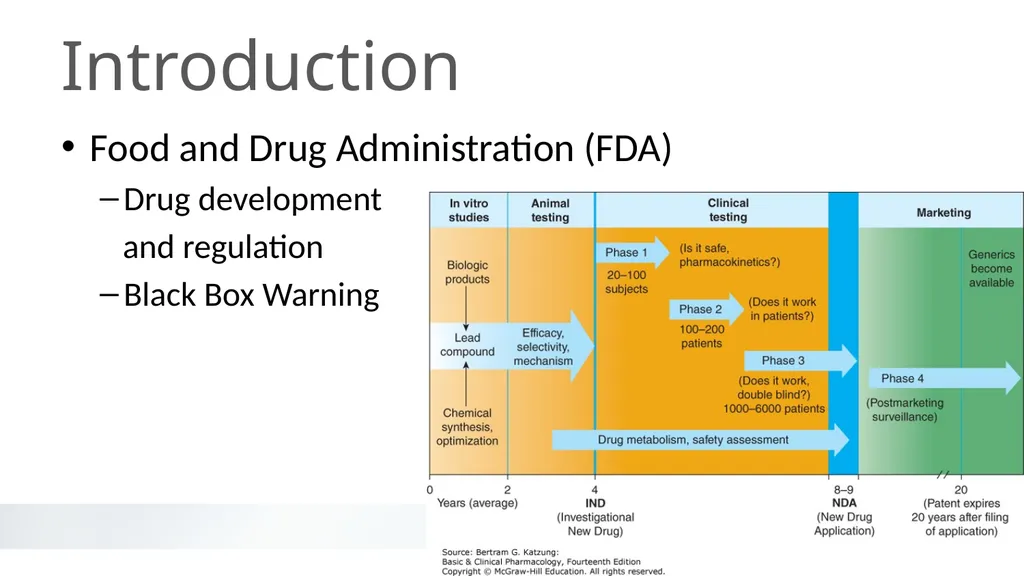
Introduction Food and Drug Administration (FDA)
Drug development
and regulation
Black Box Warning<br>
Drug development
and regulation
Black Box Warning<br>
07
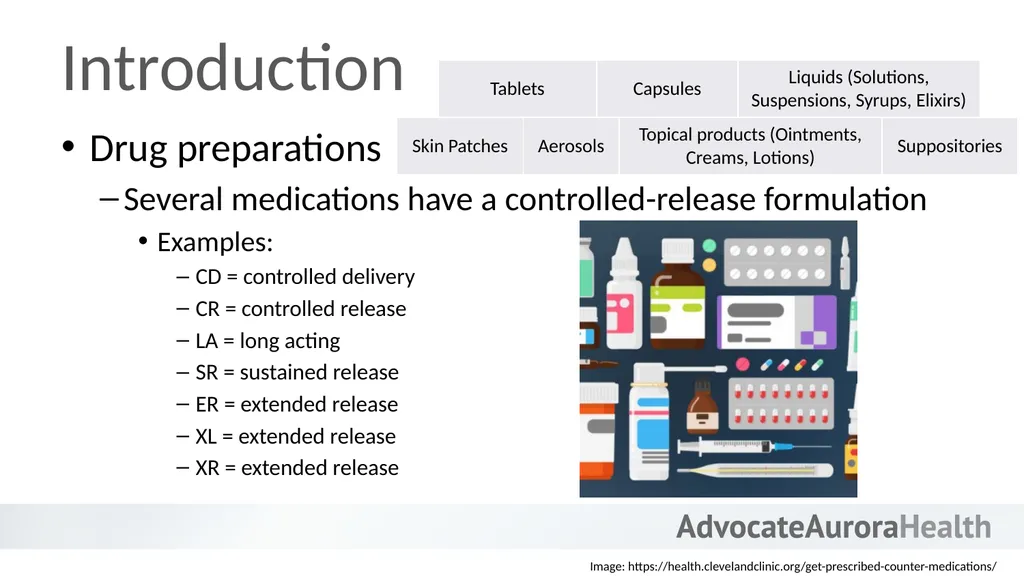
Introduction Drug preparations
Several medications have a controlled-release formulation
Examples:
CD = controlled delivery
CR = controlled release
LA = long acting
SR = sustained release
ER = extended release
XL = extended release
XR = extended release Image: https://health.clevelandclinic.org/get-prescribed-counter-medications/<br>
Several medications have a controlled-release formulation
Examples:
CD = controlled delivery
CR = controlled release
LA = long acting
SR = sustained release
ER = extended release
XL = extended release
XR = extended release Image: https://health.clevelandclinic.org/get-prescribed-counter-medications/<br>
08
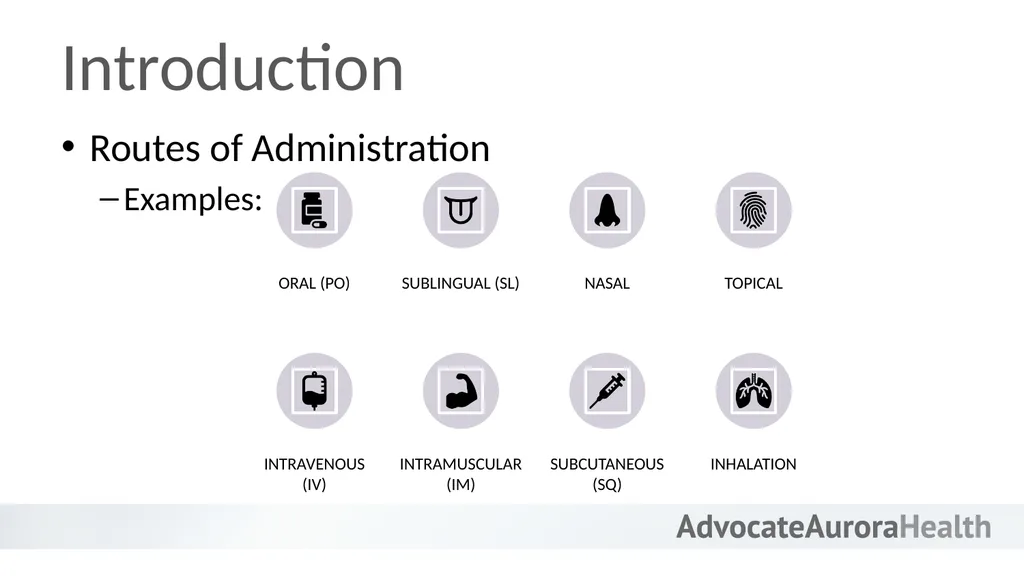
Introduction Routes of Administration
Examples:<br>
Examples:<br>
09
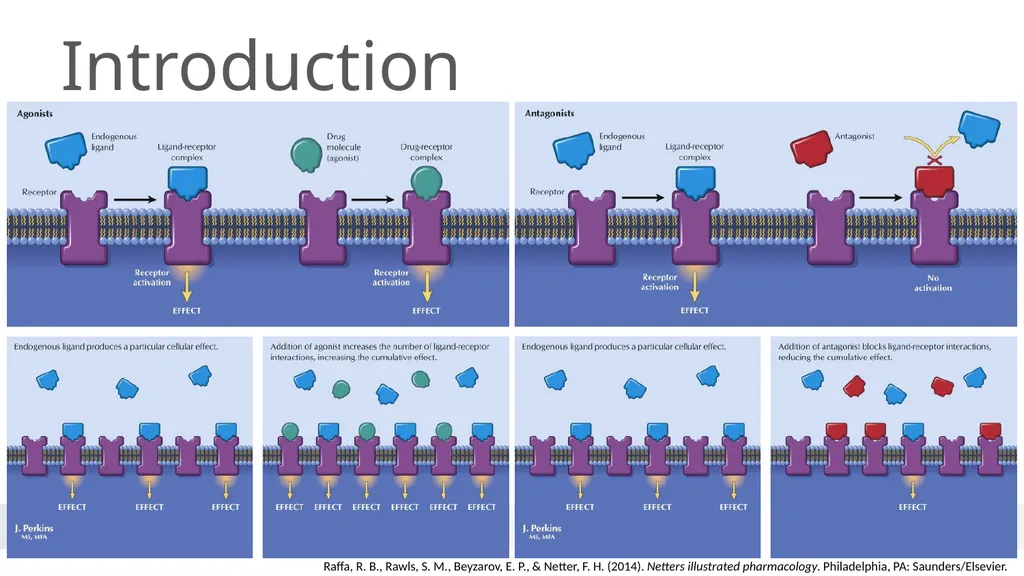
Introduction Raffa, R. B., Rawls, S. M., Beyzarov, E. P., & Netter, F. H. (2014). Netters illustrated pharmacology. Philadelphia, PA: Saunders/Elsevier.<br>
10
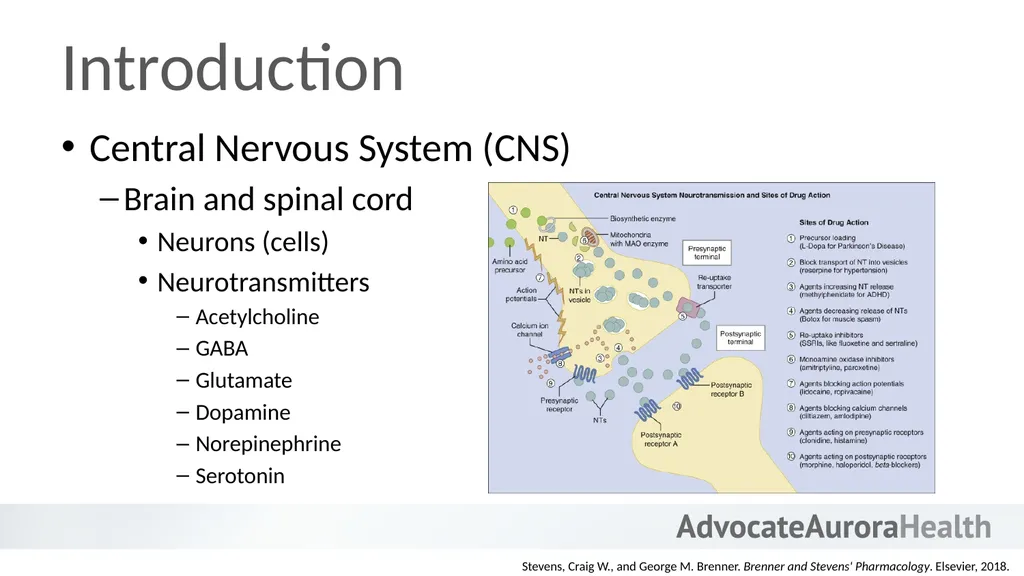
Introduction Central Nervous System (CNS)
Brain and spinal cord
Neurons (cells)
Neurotransmitters
Acetylcholine
GABA
Glutamate
Dopamine
Norepinephrine
Serotonin Stevens, Craig W., and George M. Brenner. Brenner and Stevens' Pharmacology. Elsevier, 2018.<br>
Brain and spinal cord
Neurons (cells)
Neurotransmitters
Acetylcholine
GABA
Glutamate
Dopamine
Norepinephrine
Serotonin Stevens, Craig W., and George M. Brenner. Brenner and Stevens' Pharmacology. Elsevier, 2018.<br>
11
Introduction Drug Interactions
Defined as a change in the pharmacologic effect of a drug that results when it is given concurrently with another drug or with food
Examples:
Altered absorption/excretion
Additive or antagonistic effects Stevens, Craig W., and George M. Brenner. Brenner and Stevens' Pharmacology. Elsevier, 2018.<br>
Defined as a change in the pharmacologic effect of a drug that results when it is given concurrently with another drug or with food
Examples:
Altered absorption/excretion
Additive or antagonistic effects Stevens, Craig W., and George M. Brenner. Brenner and Stevens' Pharmacology. Elsevier, 2018.<br>
12
Introduction This presentation will not discuss:
Child and adolescent dosing of medications
Use of medications during pregnancy or breastfeeding
Non FDA-approved uses for medications<br>
Child and adolescent dosing of medications
Use of medications during pregnancy or breastfeeding
Non FDA-approved uses for medications<br>
13
Anxiolytics<br>
14
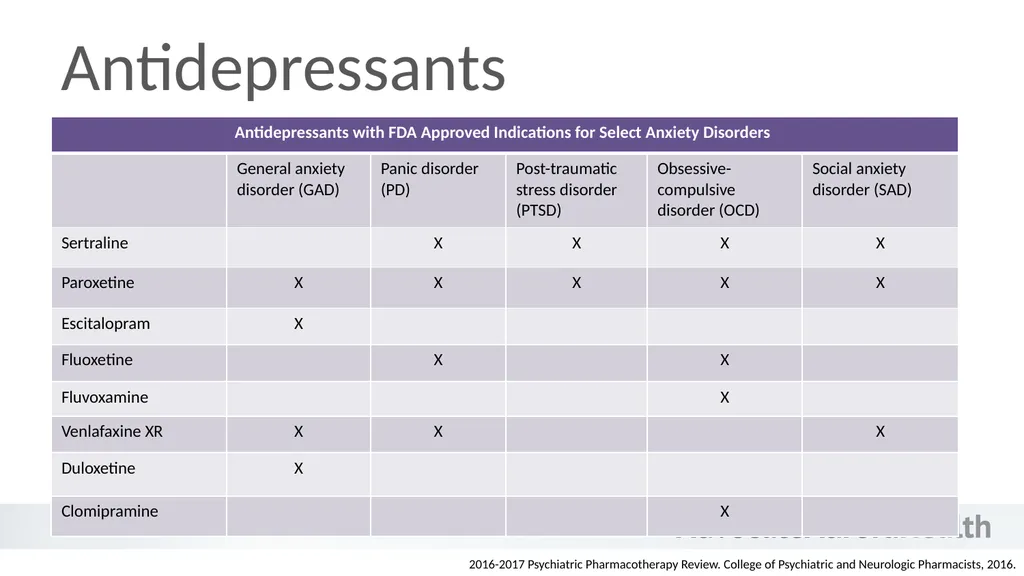
Antidepressants 2016-2017 Psychiatric Pharmacotherapy Review. College of Psychiatric and Neurologic Pharmacists, 2016.<br>
15
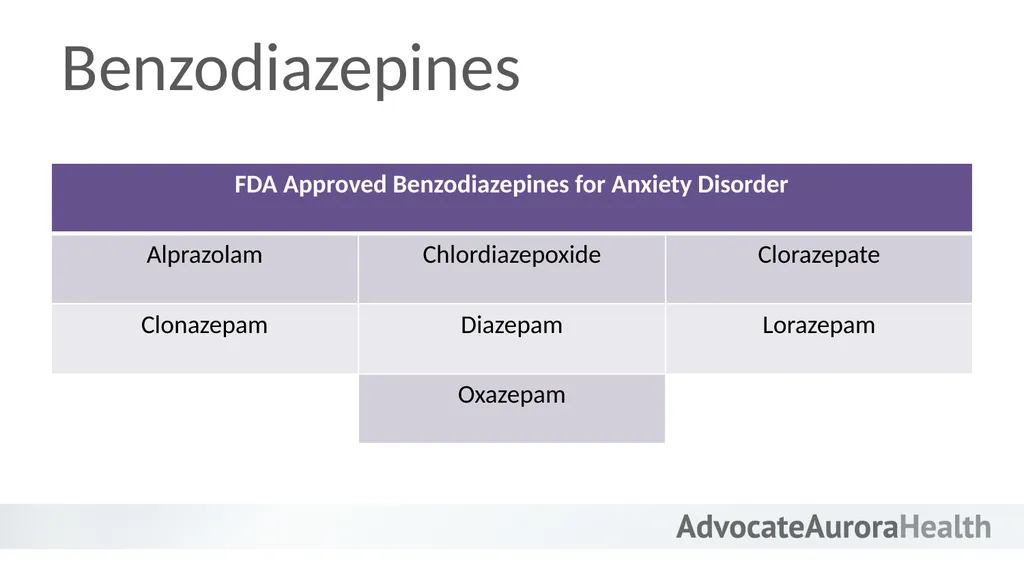
Benzodiazepines<br>
16
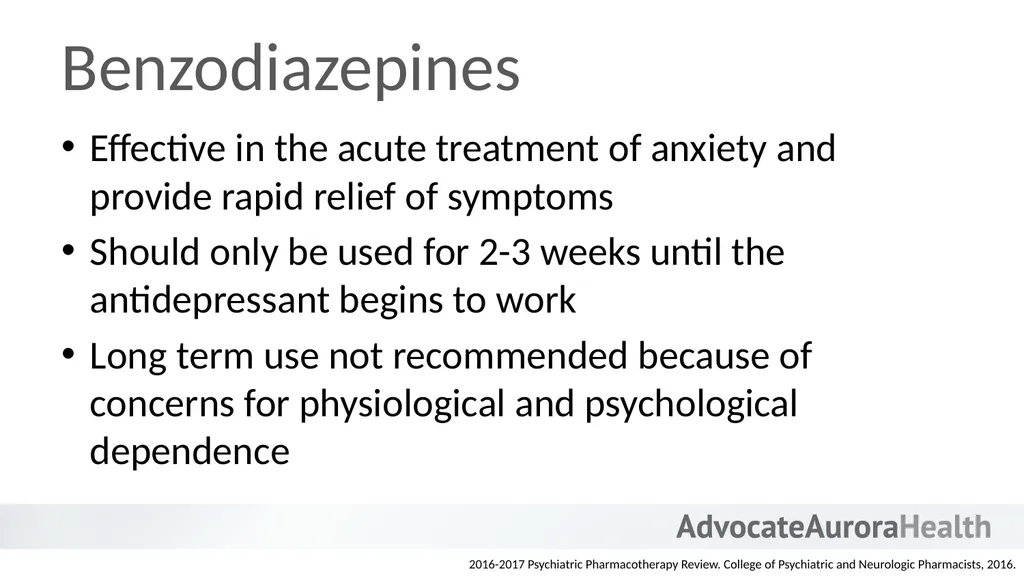
Benzodiazepines Effective in the acute treatment of anxiety and provide rapid relief of symptoms
Should only be used for 2-3 weeks until the antidepressant begins to work
Long term use not recommended because of concerns for physiological and psychological dependence 2016-2017 Psychiatric Pharmacotherapy Review. College of Psychiatric and Neurologic Pharmacists, 2016.<br>
Should only be used for 2-3 weeks until the antidepressant begins to work
Long term use not recommended because of concerns for physiological and psychological dependence 2016-2017 Psychiatric Pharmacotherapy Review. College of Psychiatric and Neurologic Pharmacists, 2016.<br>
17
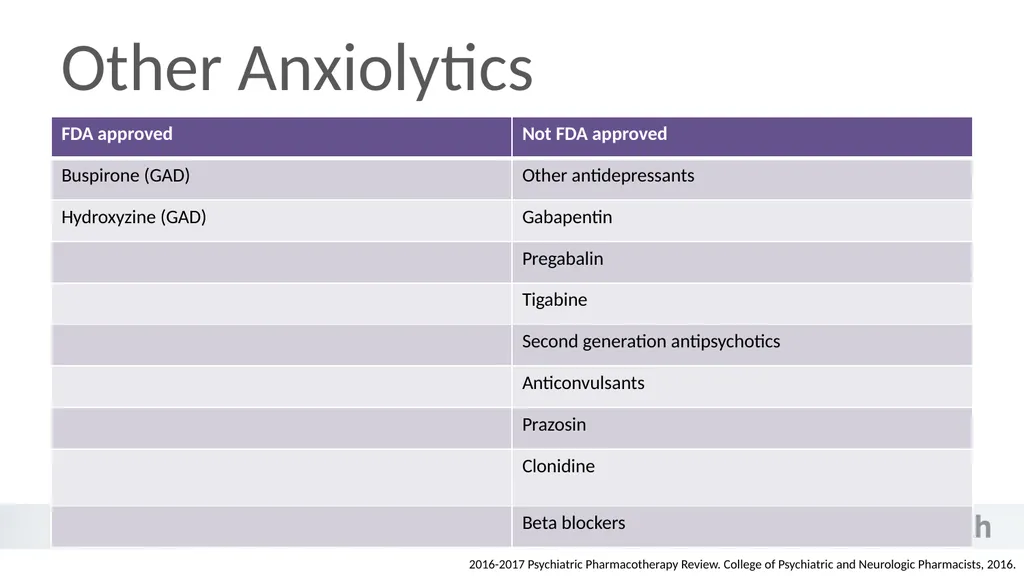
Other Anxiolytics 2016-2017 Psychiatric Pharmacotherapy Review. College of Psychiatric and Neurologic Pharmacists, 2016.<br>
18
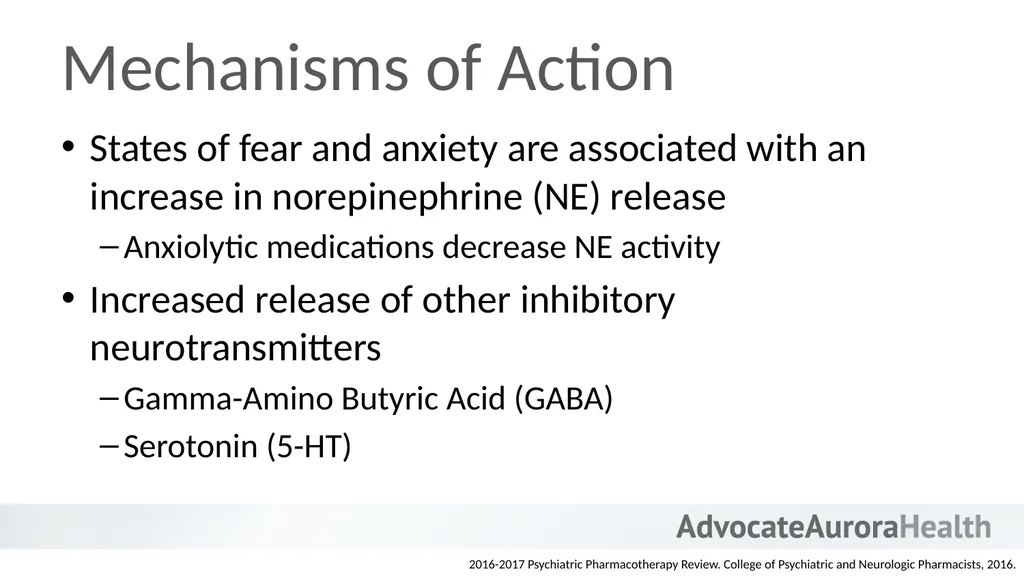
Mechanisms of Action States of fear and anxiety are associated with an increase in norepinephrine (NE) release
Anxiolytic medications decrease NE activity
Increased release of other inhibitory neurotransmitters
Gamma-Amino Butyric Acid (GABA)
Serotonin (5-HT) 2016-2017 Psychiatric Pharmacotherapy Review. College of Psychiatric and Neurologic Pharmacists, 2016.<br>
Anxiolytic medications decrease NE activity
Increased release of other inhibitory neurotransmitters
Gamma-Amino Butyric Acid (GABA)
Serotonin (5-HT) 2016-2017 Psychiatric Pharmacotherapy Review. College of Psychiatric and Neurologic Pharmacists, 2016.<br>
19
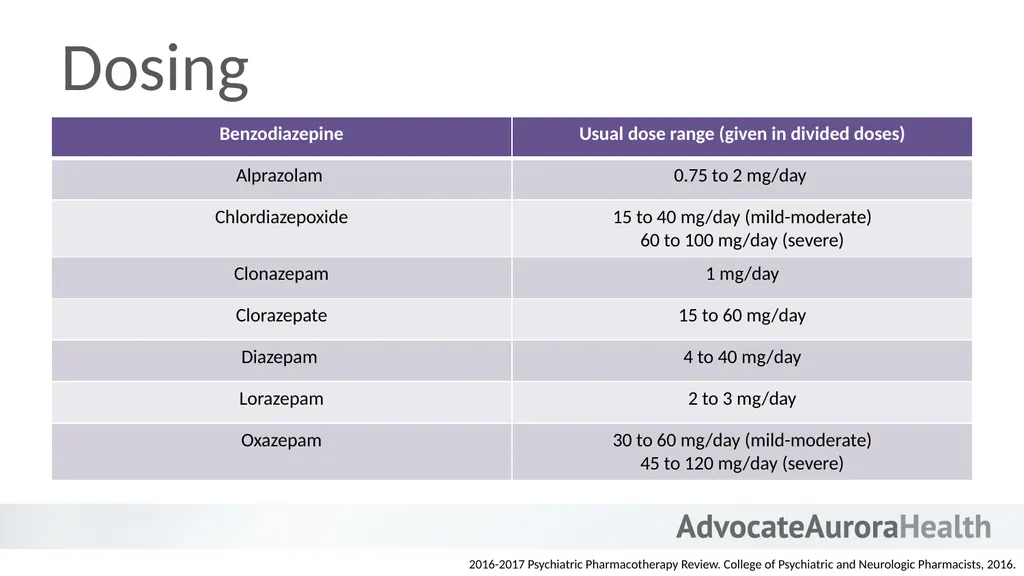
Dosing 2016-2017 Psychiatric Pharmacotherapy Review. College of Psychiatric and Neurologic Pharmacists, 2016.<br>
20
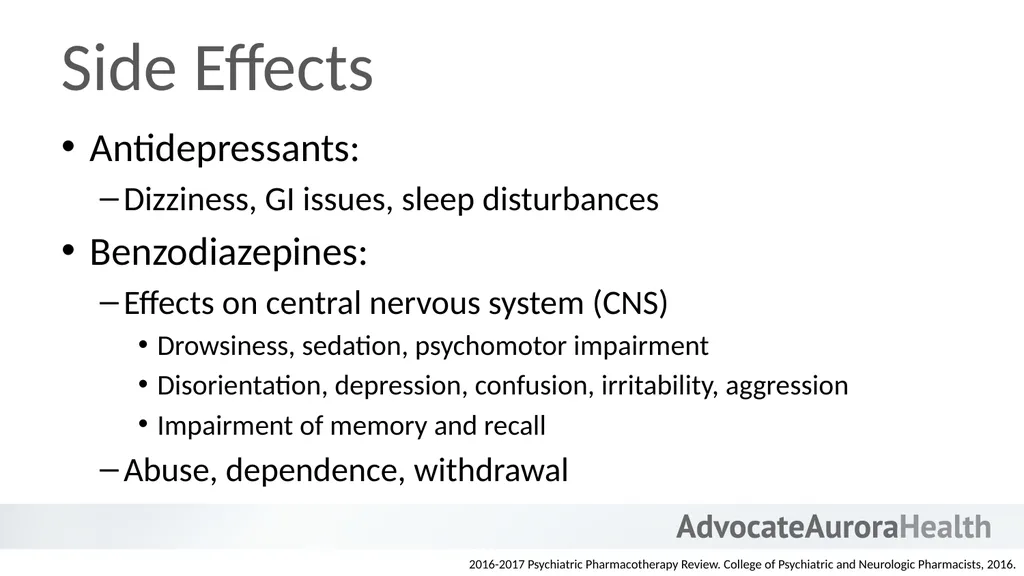
Side Effects Antidepressants:
Dizziness, GI issues, sleep disturbances
Benzodiazepines:
Effects on central nervous system (CNS)
Drowsiness, sedation, psychomotor impairment
Disorientation, depression, confusion, irritability, aggression
Impairment of memory and recall
Abuse, dependence, withdrawal 2016-2017 Psychiatric Pharmacotherapy Review. College of Psychiatric and Neurologic Pharmacists, 2016.<br>
Dizziness, GI issues, sleep disturbances
Benzodiazepines:
Effects on central nervous system (CNS)
Drowsiness, sedation, psychomotor impairment
Disorientation, depression, confusion, irritability, aggression
Impairment of memory and recall
Abuse, dependence, withdrawal 2016-2017 Psychiatric Pharmacotherapy Review. College of Psychiatric and Neurologic Pharmacists, 2016.<br>
21
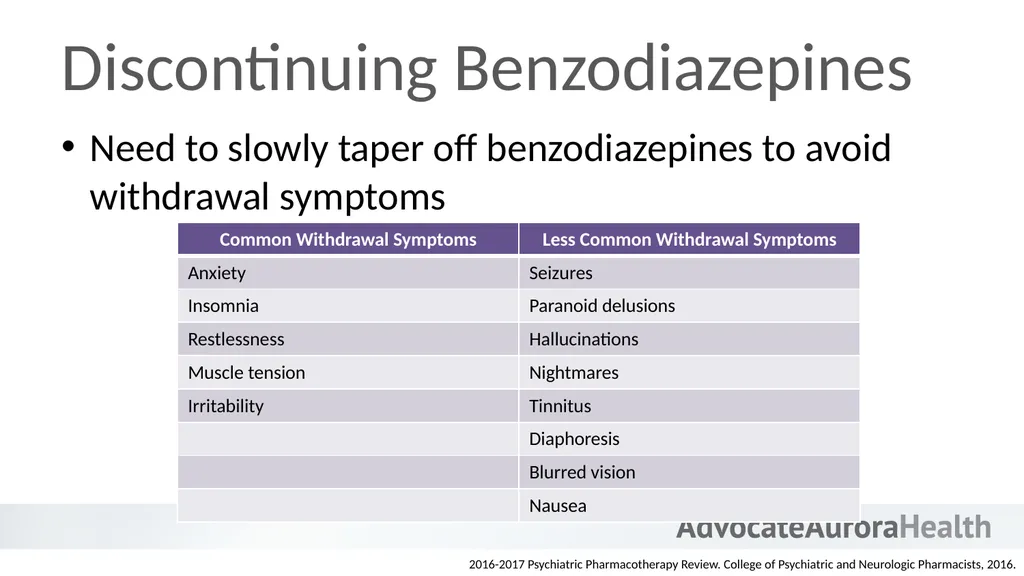
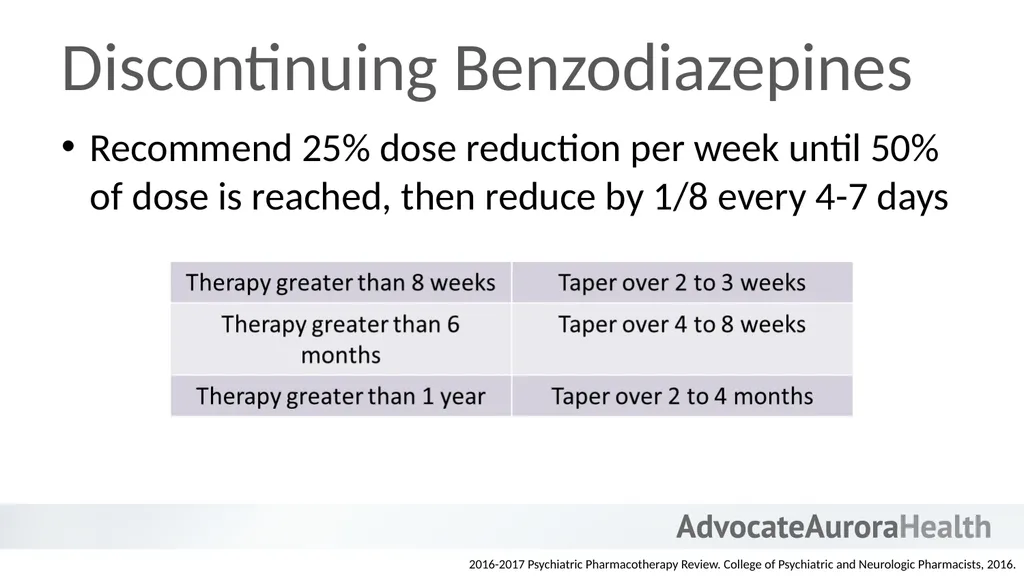
Discontinuing Benzodiazepines Need to slowly taper off benzodiazepines to avoid withdrawal symptoms 2016-2017 Psychiatric Pharmacotherapy Review. College of Psychiatric and Neurologic Pharmacists, 2016.<br>
22
Discontinuing Benzodiazepines Recommend 25% dose reduction per week until 50% of dose is reached, then reduce by 1/8 every 4-7 days 2016-2017 Psychiatric Pharmacotherapy Review. College of Psychiatric and Neurologic Pharmacists, 2016.<br>
23
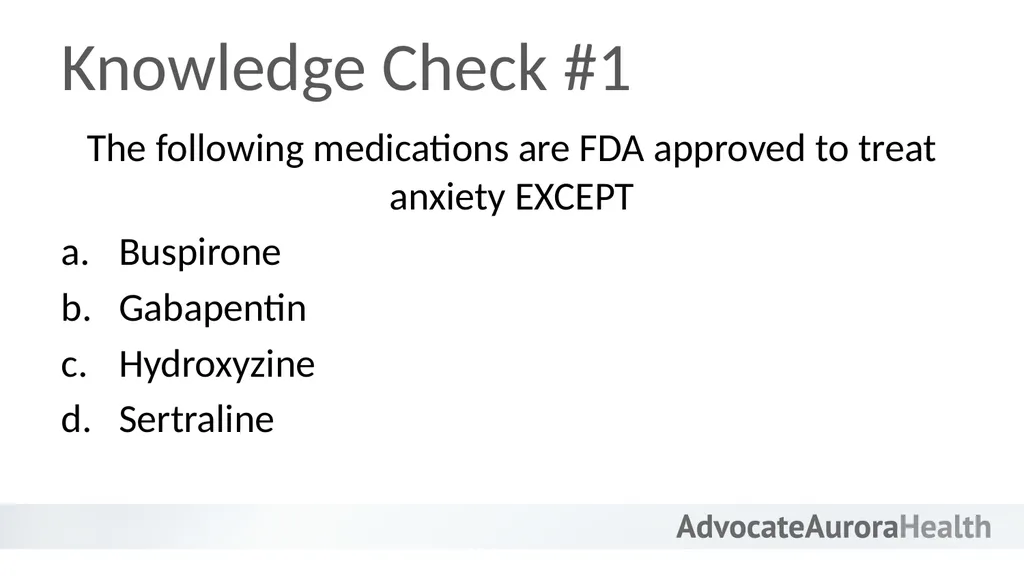
Knowledge Check #1 The following medications are FDA approved to treat anxiety EXCEPT
Buspirone
Gabapentin
Hydroxyzine
Sertraline<br>
Buspirone
Gabapentin
Hydroxyzine
Sertraline<br>
24
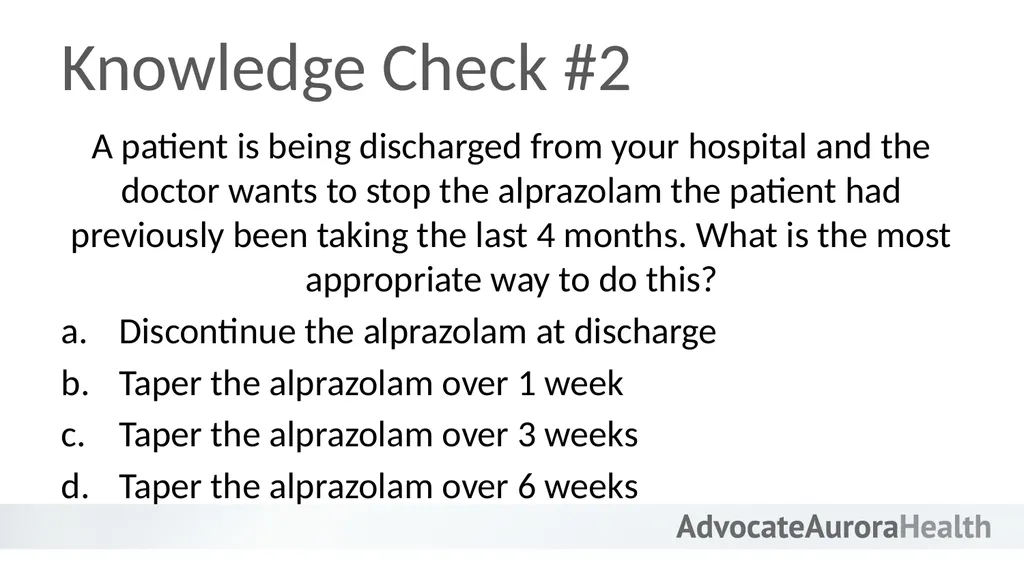
Knowledge Check #2 A patient is being discharged from your hospital and the doctor wants to stop the alprazolam the patient had previously been taking the last 4 months. What is the most appropriate way to do this?
Discontinue the alprazolam at discharge
Taper the alprazolam over 1 week
Taper the alprazolam over 3 weeks
Taper the alprazolam over 6 weeks<br>
Discontinue the alprazolam at discharge
Taper the alprazolam over 1 week
Taper the alprazolam over 3 weeks
Taper the alprazolam over 6 weeks<br>
25
Antidepressants<br>
26
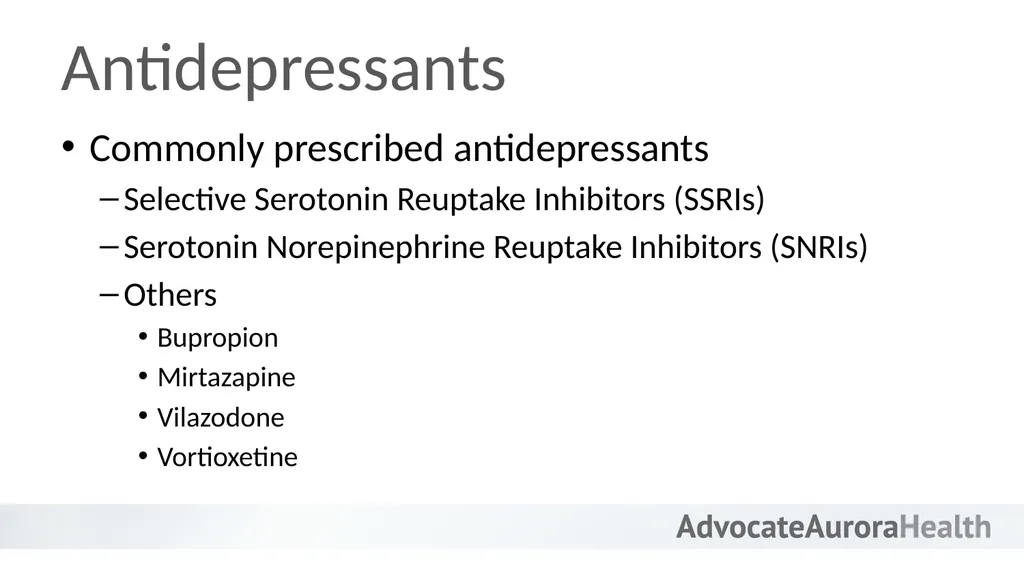
Antidepressants Commonly prescribed antidepressants
Selective Serotonin Reuptake Inhibitors (SSRIs)
Serotonin Norepinephrine Reuptake Inhibitors (SNRIs)
Others
Bupropion
Mirtazapine
Vilazodone
Vortioxetine<br>
Selective Serotonin Reuptake Inhibitors (SSRIs)
Serotonin Norepinephrine Reuptake Inhibitors (SNRIs)
Others
Bupropion
Mirtazapine
Vilazodone
Vortioxetine<br>
27
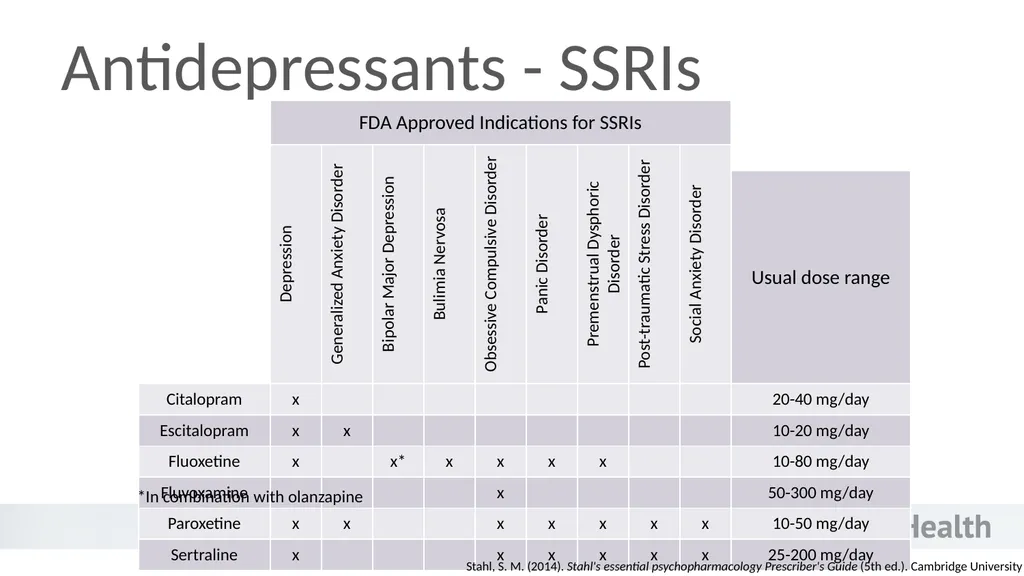
Antidepressants - SSRIs *In combination with olanzapine Stahl, S. M. (2014). Stahl's essential psychopharmacology Prescriber's Guide (5th ed.). Cambridge University Press.<br>
28
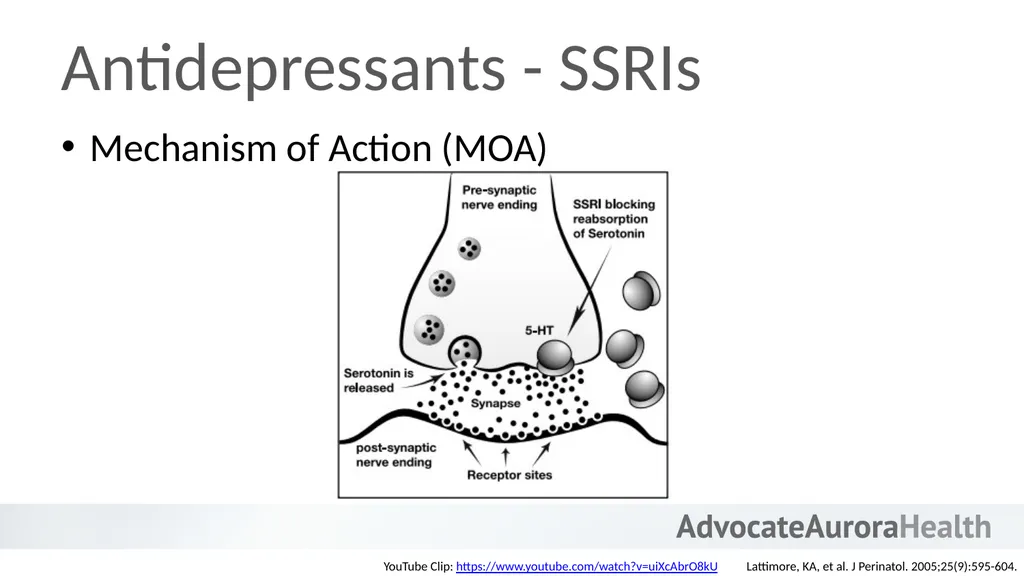
Antidepressants - SSRIs Mechanism of Action (MOA) Lattimore, KA, et al. J Perinatol. 2005;25(9):595-604. YouTube Clip: https://www.youtube.com/watch?v=uiXcAbrO8kU<br>
29
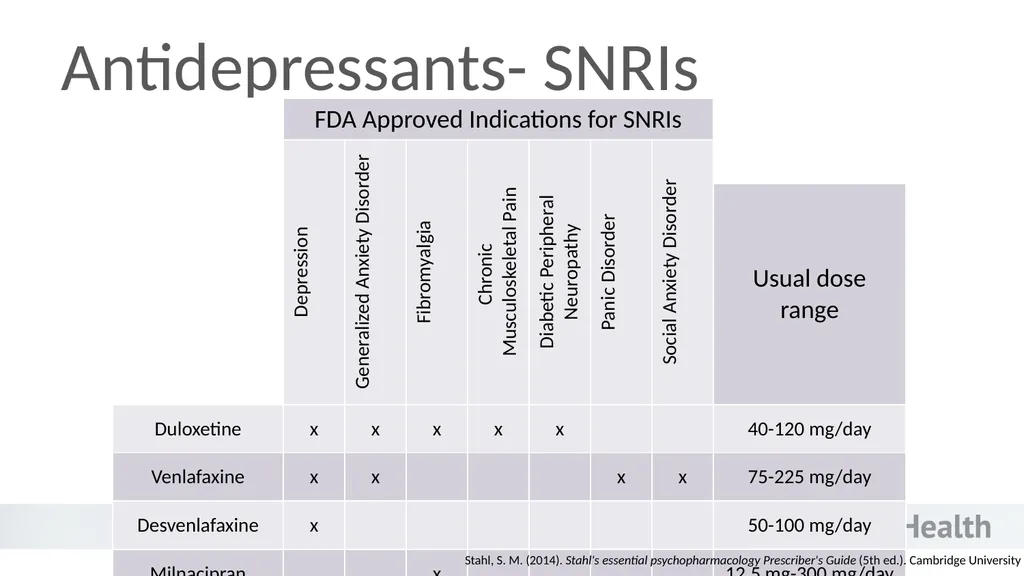
Antidepressants- SNRIs Stahl, S. M. (2014). Stahl's essential psychopharmacology Prescriber's Guide (5th ed.). Cambridge University Press.<br>
30
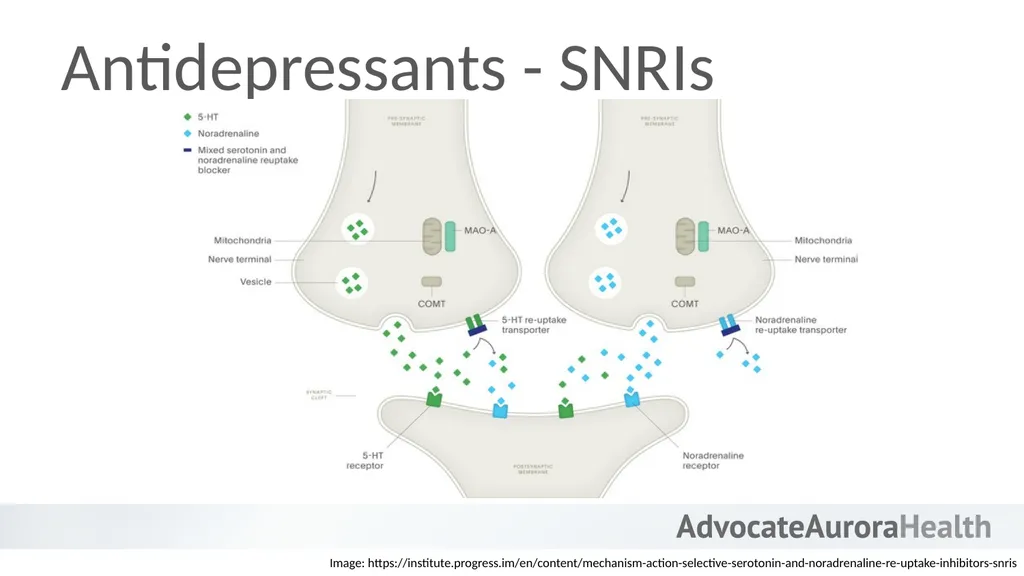
Antidepressants - SNRIs Image: https://institute.progress.im/en/content/mechanism-action-selective-serotonin-and-noradrenaline-re-uptake-inhibitors-snris<br>
31
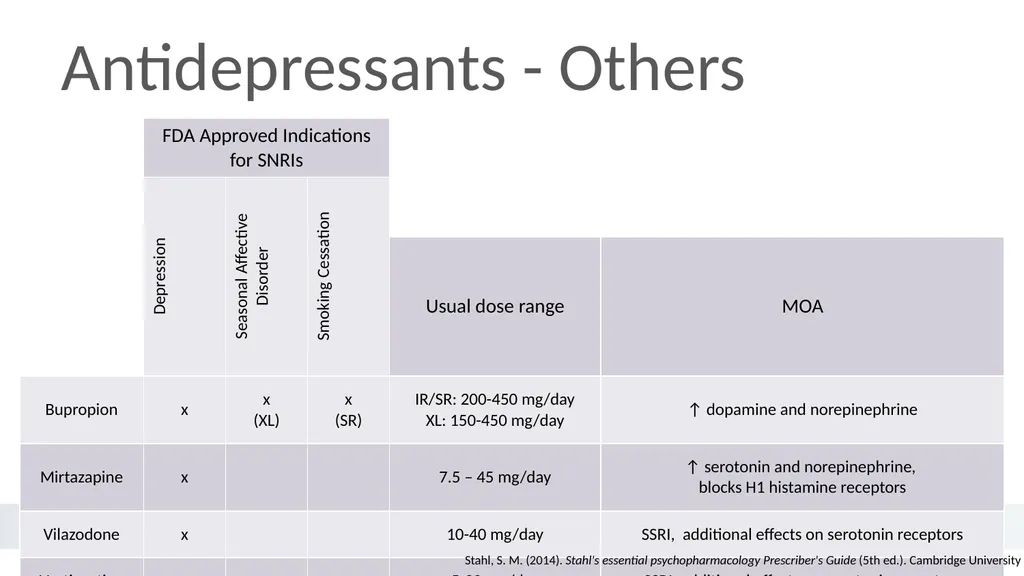
Antidepressants - Others Stahl, S. M. (2014). Stahl's essential psychopharmacology Prescriber's Guide (5th ed.). Cambridge University Press.<br>
32
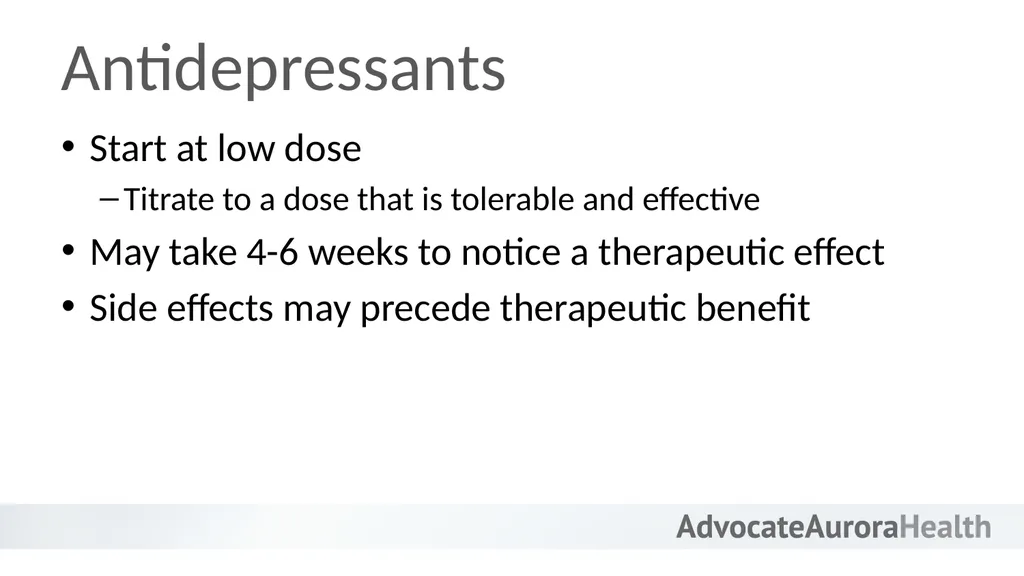
Antidepressants Start at low dose
Titrate to a dose that is tolerable and effective
May take 4-6 weeks to notice a therapeutic effect
Side effects may precede therapeutic benefit<br>
Titrate to a dose that is tolerable and effective
May take 4-6 weeks to notice a therapeutic effect
Side effects may precede therapeutic benefit<br>
33
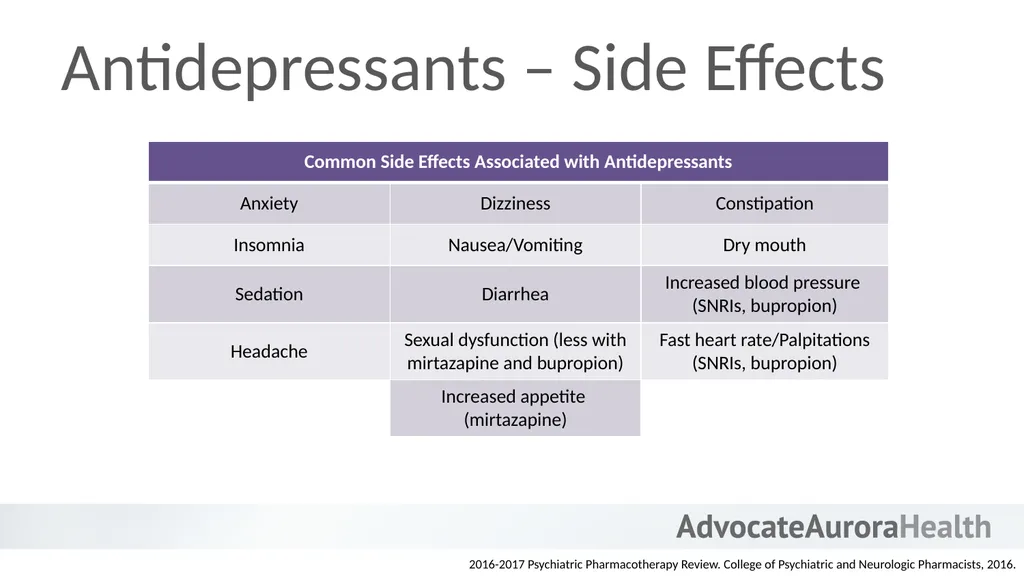
Antidepressants – Side Effects 2016-2017 Psychiatric Pharmacotherapy Review. College of Psychiatric and Neurologic Pharmacists, 2016.<br>
34
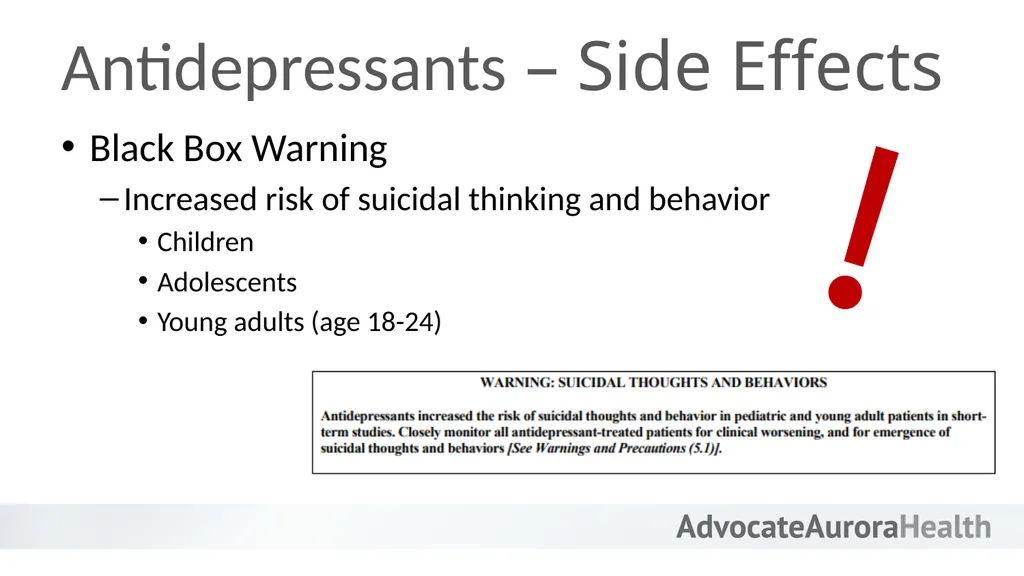
Antidepressants – Side Effects Black Box Warning
Increased risk of suicidal thinking and behavior
Children
Adolescents
Young adults (age 18-24)<br>
Increased risk of suicidal thinking and behavior
Children
Adolescents
Young adults (age 18-24)<br>
35
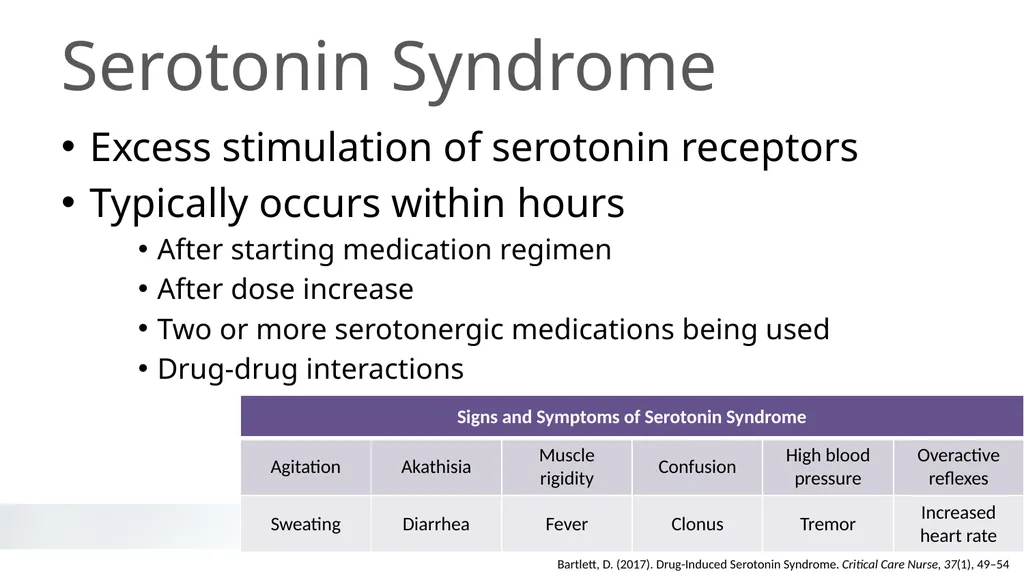
Serotonin Syndrome Excess stimulation of serotonin receptors
Typically occurs within hours
After starting medication regimen
After dose increase
Two or more serotonergic medications being used
Drug-drug interactions Bartlett, D. (2017). Drug-Induced Serotonin Syndrome. Critical Care Nurse, 37(1), 49–54<br>
Typically occurs within hours
After starting medication regimen
After dose increase
Two or more serotonergic medications being used
Drug-drug interactions Bartlett, D. (2017). Drug-Induced Serotonin Syndrome. Critical Care Nurse, 37(1), 49–54<br>
36
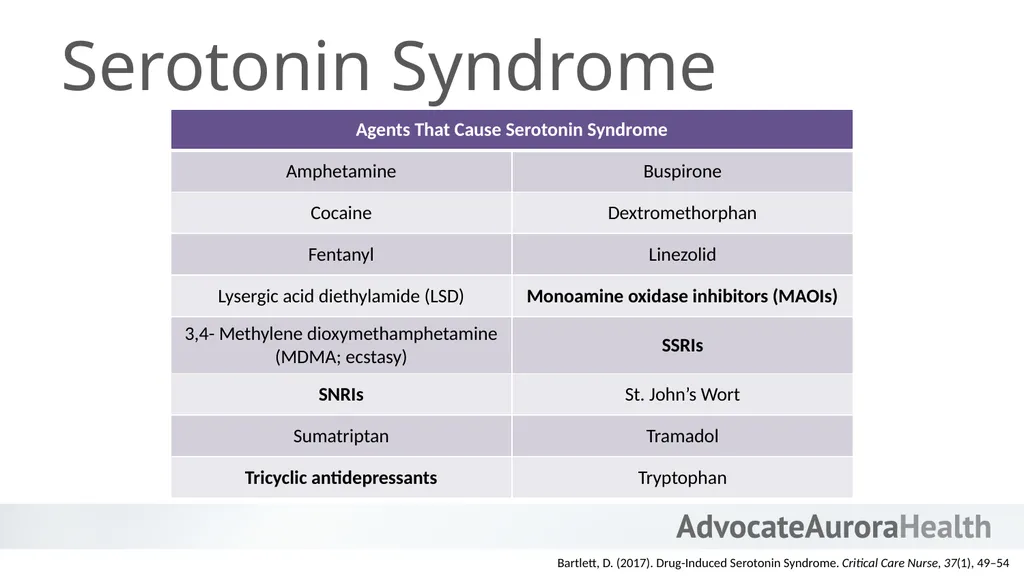
Serotonin Syndrome Bartlett, D. (2017). Drug-Induced Serotonin Syndrome. Critical Care Nurse, 37(1), 49–54<br>
37
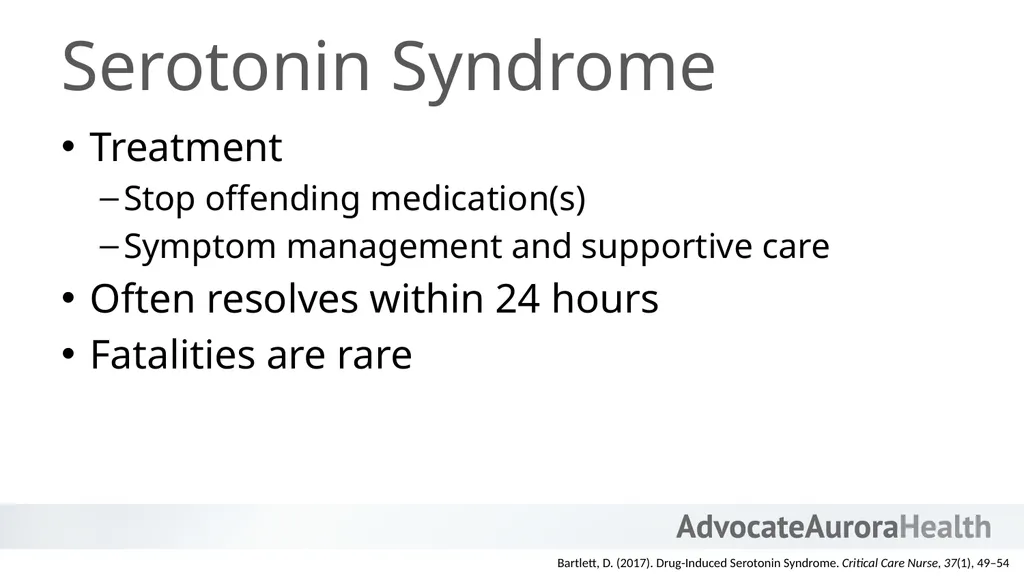
Serotonin Syndrome Treatment
Stop offending medication(s)
Symptom management and supportive care
Often resolves within 24 hours
Fatalities are rare Bartlett, D. (2017). Drug-Induced Serotonin Syndrome. Critical Care Nurse, 37(1), 49–54<br>
Stop offending medication(s)
Symptom management and supportive care
Often resolves within 24 hours
Fatalities are rare Bartlett, D. (2017). Drug-Induced Serotonin Syndrome. Critical Care Nurse, 37(1), 49–54<br>
38
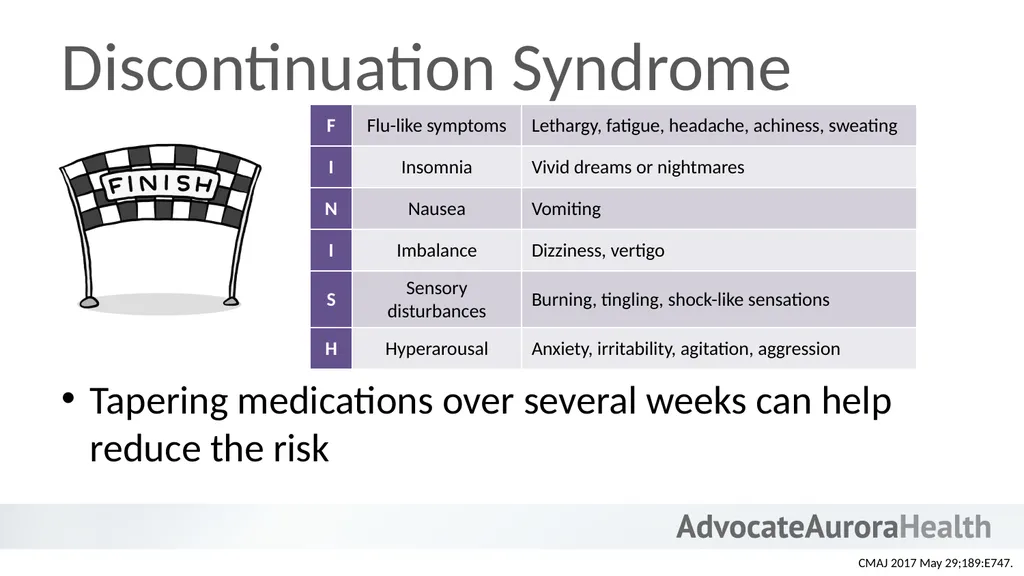
Discontinuation Syndrome Tapering medications over several weeks can help reduce the risk CMAJ 2017 May 29;189:E747.<br>
39
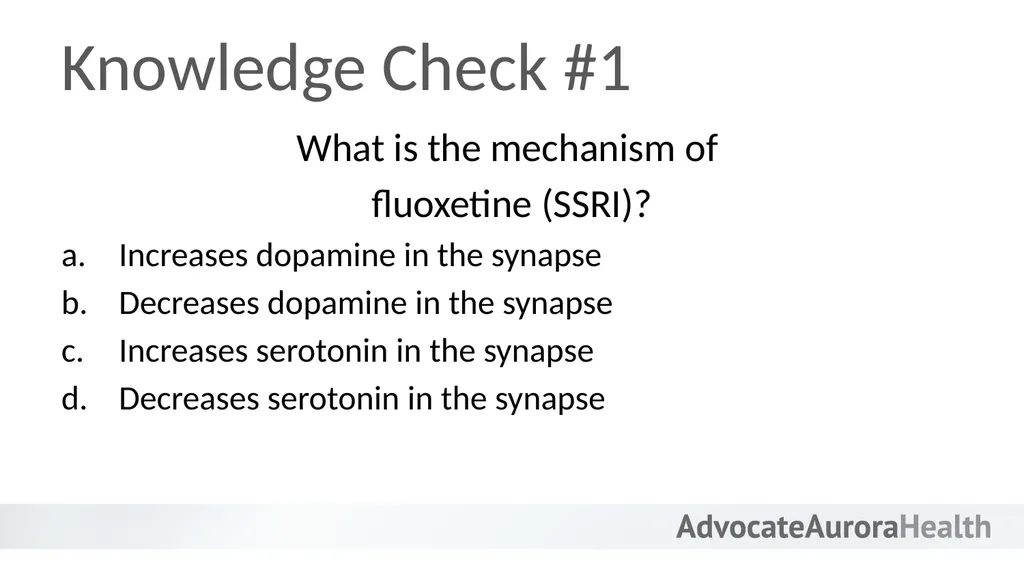
Knowledge Check #1 What is the mechanism of
fluoxetine (SSRI)?
Increases dopamine in the synapse
Decreases dopamine in the synapse
Increases serotonin in the synapse
Decreases serotonin in the synapse<br>
fluoxetine (SSRI)?
Increases dopamine in the synapse
Decreases dopamine in the synapse
Increases serotonin in the synapse
Decreases serotonin in the synapse<br>
40
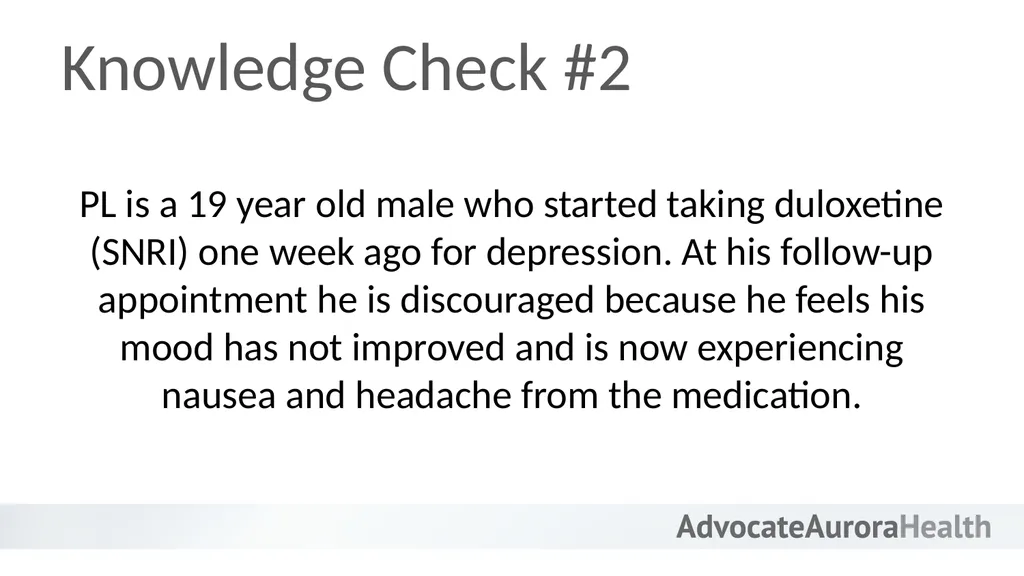
Knowledge Check #2 PL is a 19 year old male who started taking duloxetine (SNRI) one week ago for depression. At his follow-up appointment he is discouraged because he feels his mood has not improved and is now experiencing nausea and headache from the medication.<br>
41
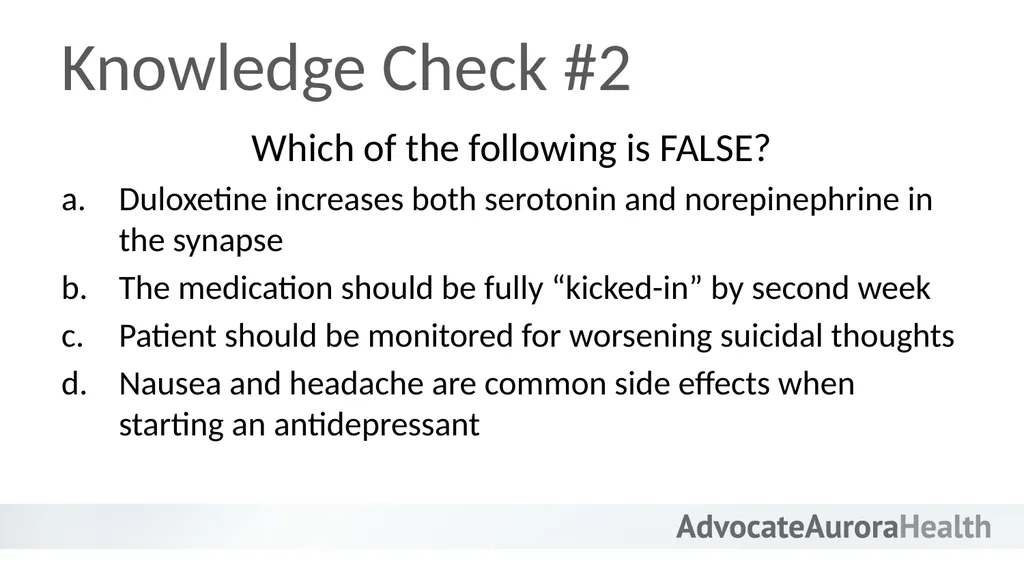
Knowledge Check #2 Which of the following is FALSE?
Duloxetine increases both serotonin and norepinephrine in the synapse
The medication should be fully “kicked-in” by second week
Patient should be monitored for worsening suicidal thoughts
Nausea and headache are common side effects when starting an antidepressant<br>
Duloxetine increases both serotonin and norepinephrine in the synapse
The medication should be fully “kicked-in” by second week
Patient should be monitored for worsening suicidal thoughts
Nausea and headache are common side effects when starting an antidepressant<br>
42
Antipsychotics<br>
43
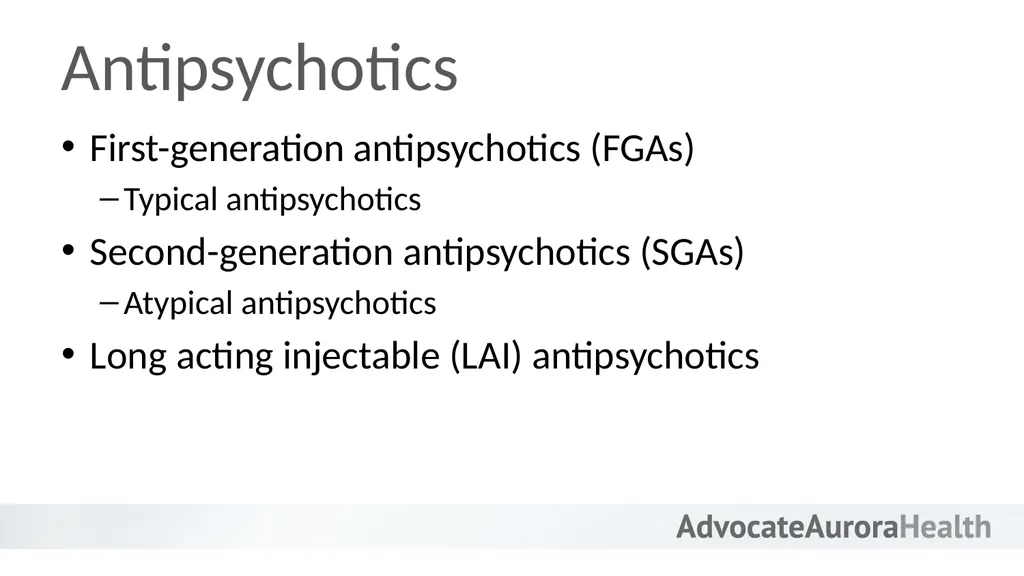
Antipsychotics First-generation antipsychotics (FGAs)
Typical antipsychotics
Second-generation antipsychotics (SGAs)
Atypical antipsychotics
Long acting injectable (LAI) antipsychotics<br>
Typical antipsychotics
Second-generation antipsychotics (SGAs)
Atypical antipsychotics
Long acting injectable (LAI) antipsychotics<br>
44
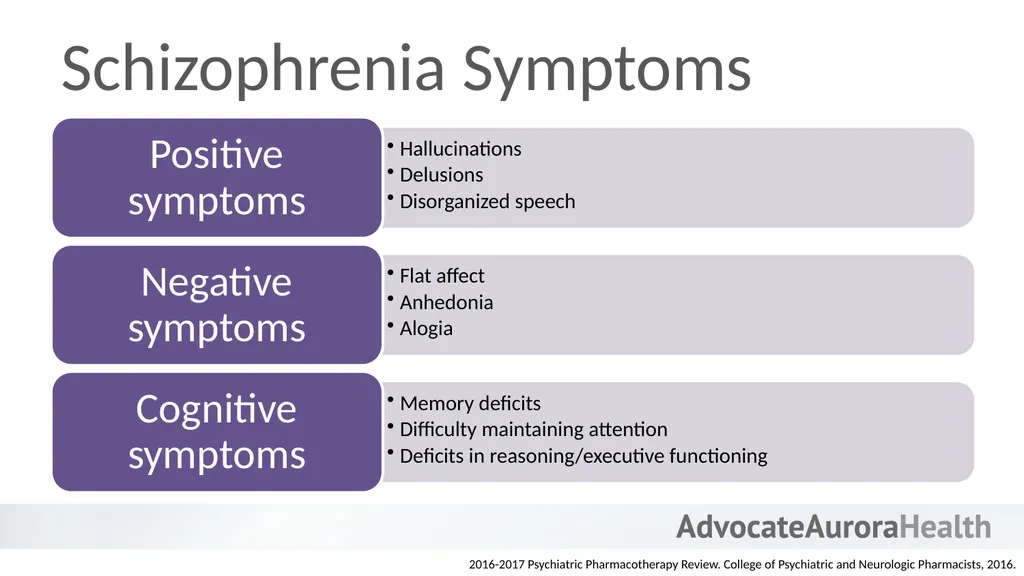
Schizophrenia Symptoms 2016-2017 Psychiatric Pharmacotherapy Review. College of Psychiatric and Neurologic Pharmacists, 2016.<br>
45
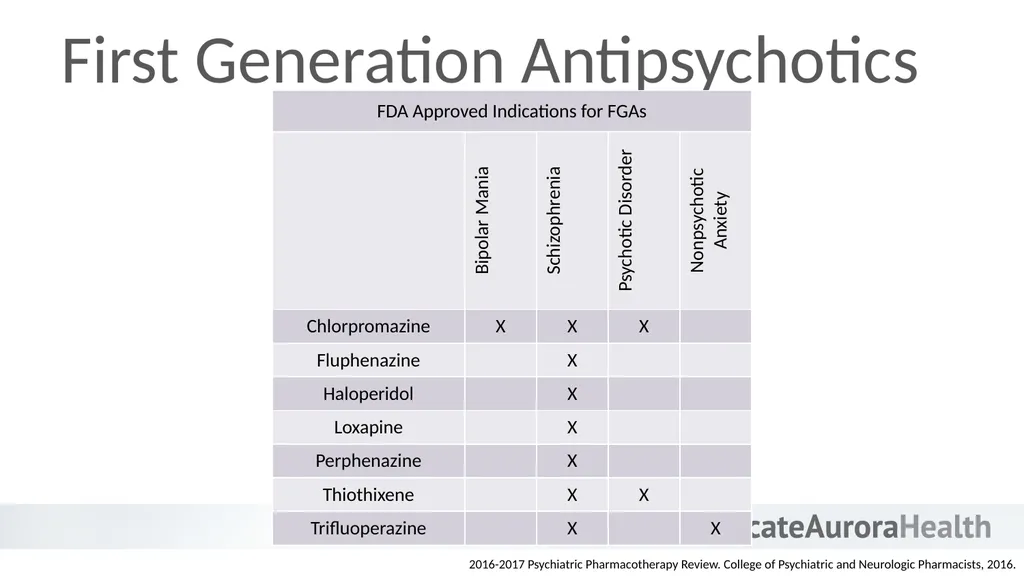
First Generation Antipsychotics 2016-2017 Psychiatric Pharmacotherapy Review. College of Psychiatric and Neurologic Pharmacists, 2016.<br>
46
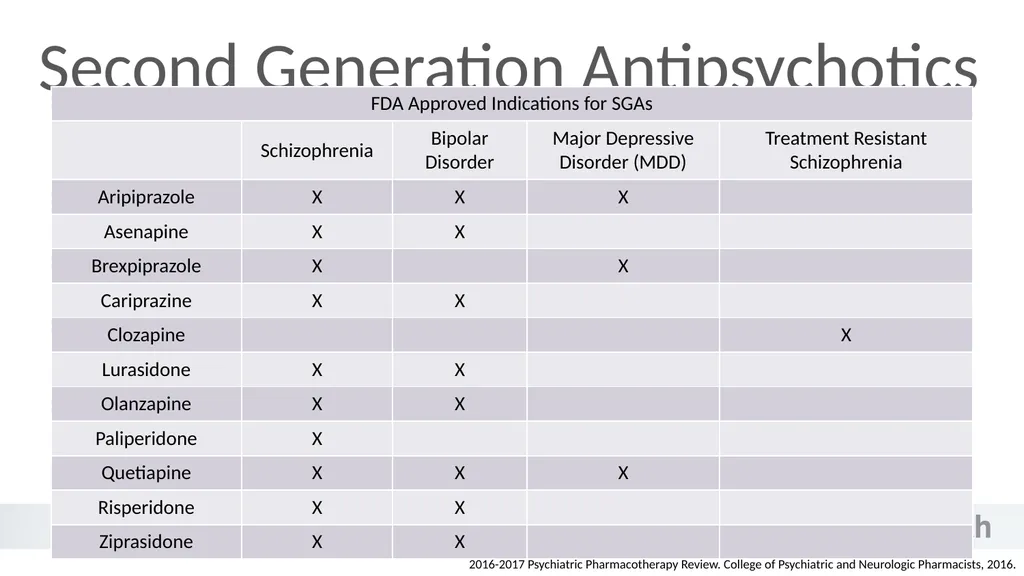
Second Generation Antipsychotics 2016-2017 Psychiatric Pharmacotherapy Review. College of Psychiatric and Neurologic Pharmacists, 2016.<br>
47
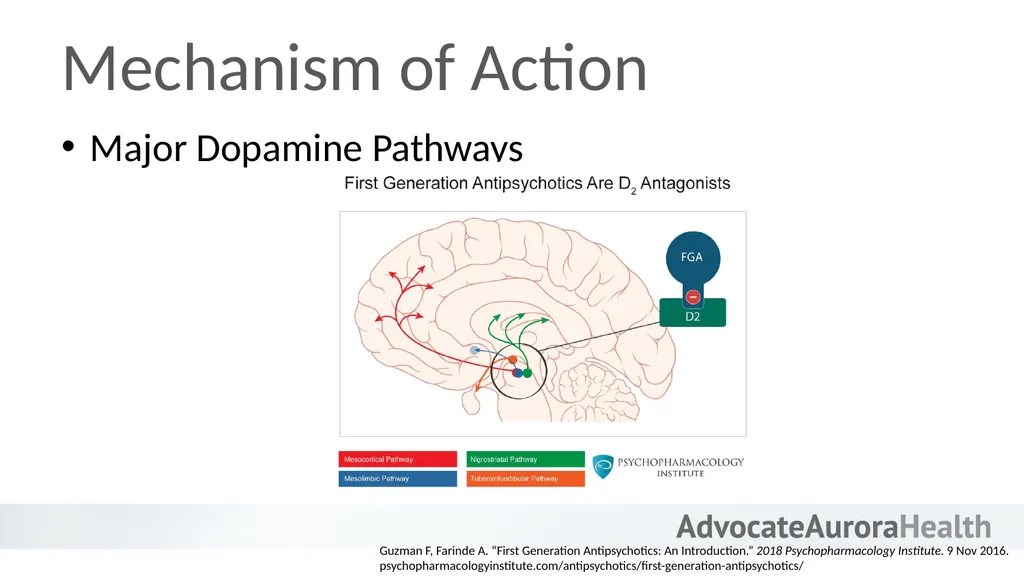
Mechanism of Action Major Dopamine Pathways Guzman F, Farinde A. “First Generation Antipsychotics: An Introduction.” 2018 Psychopharmacology Institute. 9 Nov 2016. psychopharmacologyinstitute.com/antipsychotics/first-generation-antipsychotics/<br>
48
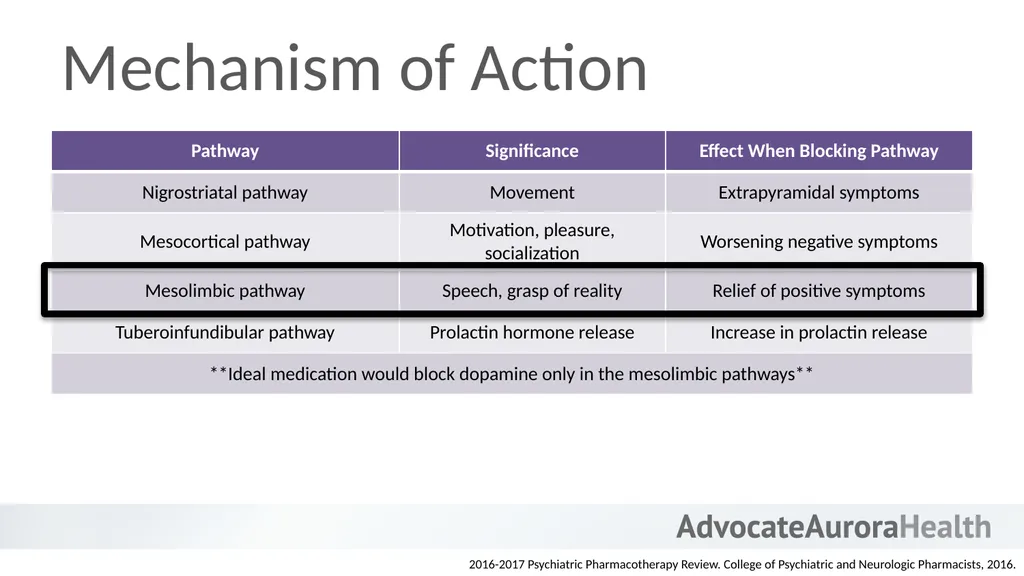
Mechanism of Action 2016-2017 Psychiatric Pharmacotherapy Review. College of Psychiatric and Neurologic Pharmacists, 2016.<br>
49
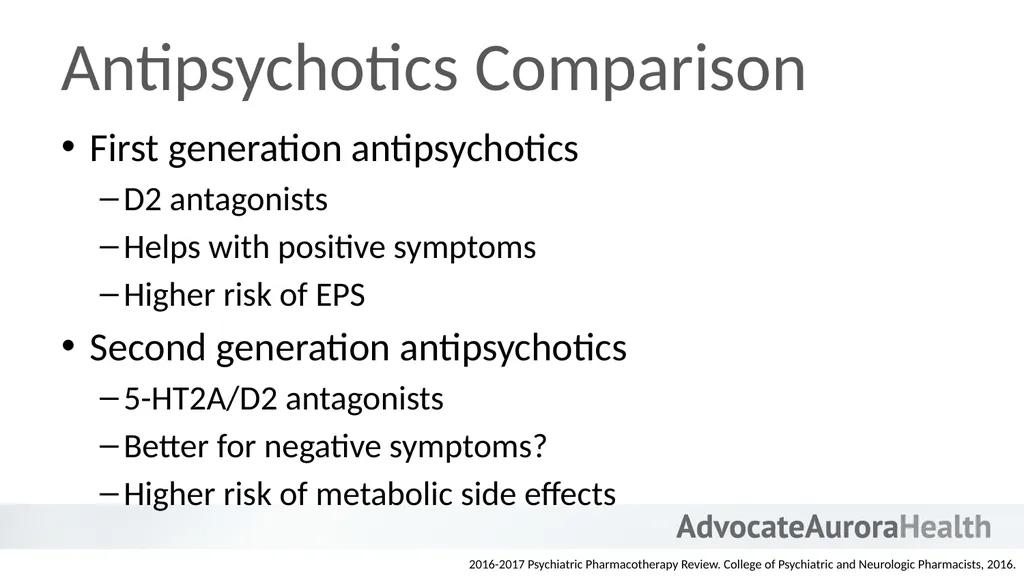
Antipsychotics Comparison First generation antipsychotics
D2 antagonists
Helps with positive symptoms
Higher risk of EPS
Second generation antipsychotics
5-HT2A/D2 antagonists
Better for negative symptoms?
Higher risk of metabolic side effects 2016-2017 Psychiatric Pharmacotherapy Review. College of Psychiatric and Neurologic Pharmacists, 2016.<br>
D2 antagonists
Helps with positive symptoms
Higher risk of EPS
Second generation antipsychotics
5-HT2A/D2 antagonists
Better for negative symptoms?
Higher risk of metabolic side effects 2016-2017 Psychiatric Pharmacotherapy Review. College of Psychiatric and Neurologic Pharmacists, 2016.<br>
50
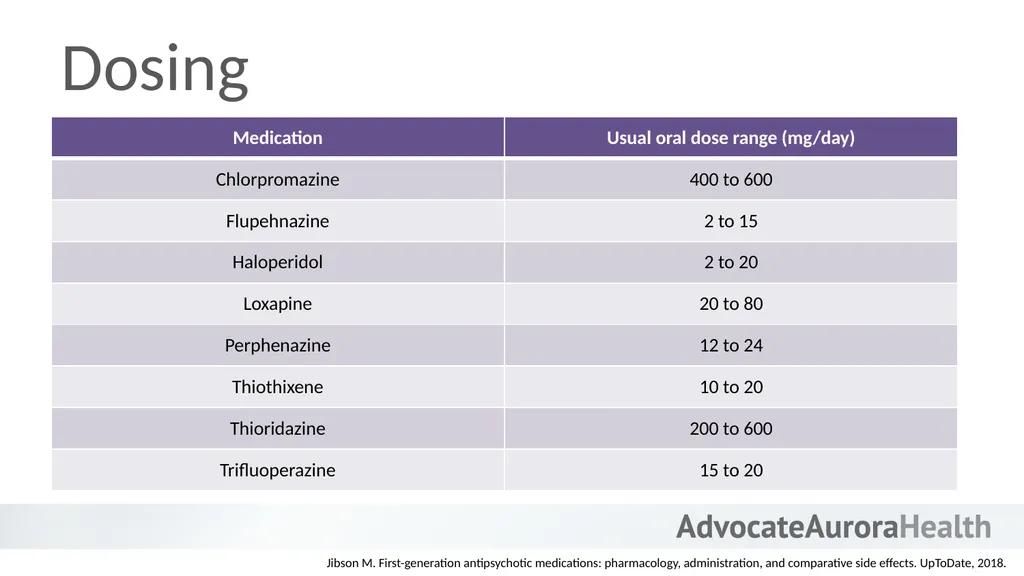
Dosing Jibson M. First-generation antipsychotic medications: pharmacology, administration, and comparative side effects. UpToDate, 2018.<br>
51
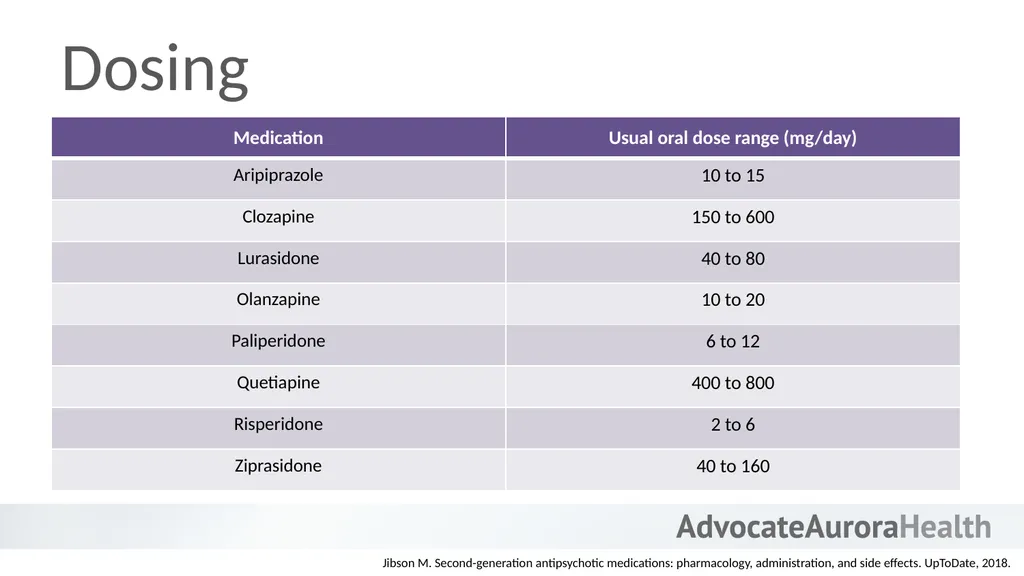
Dosing Jibson M. Second-generation antipsychotic medications: pharmacology, administration, and side effects. UpToDate, 2018.<br>
52
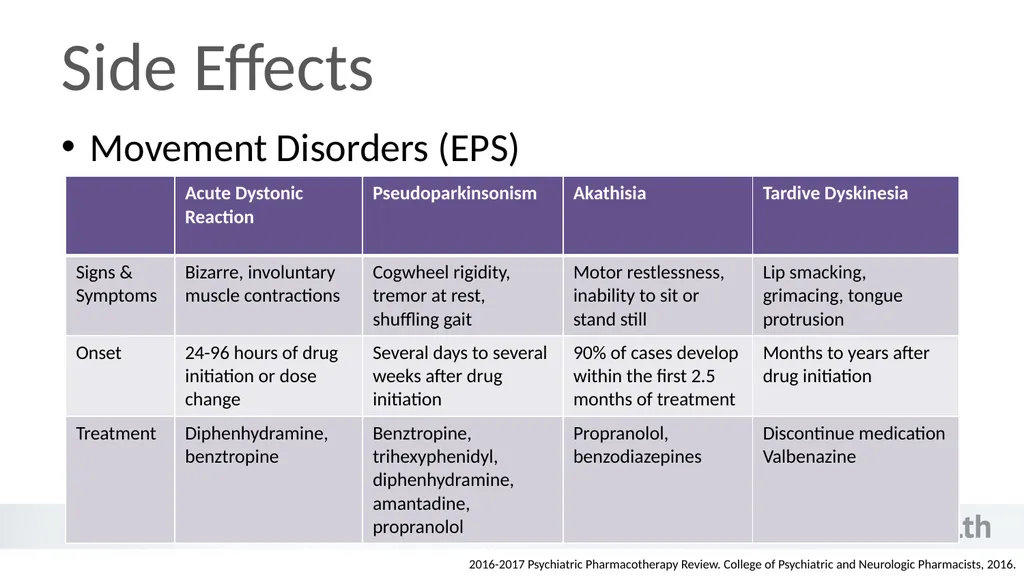
Side Effects Movement Disorders (EPS) 2016-2017 Psychiatric Pharmacotherapy Review. College of Psychiatric and Neurologic Pharmacists, 2016.<br>
53
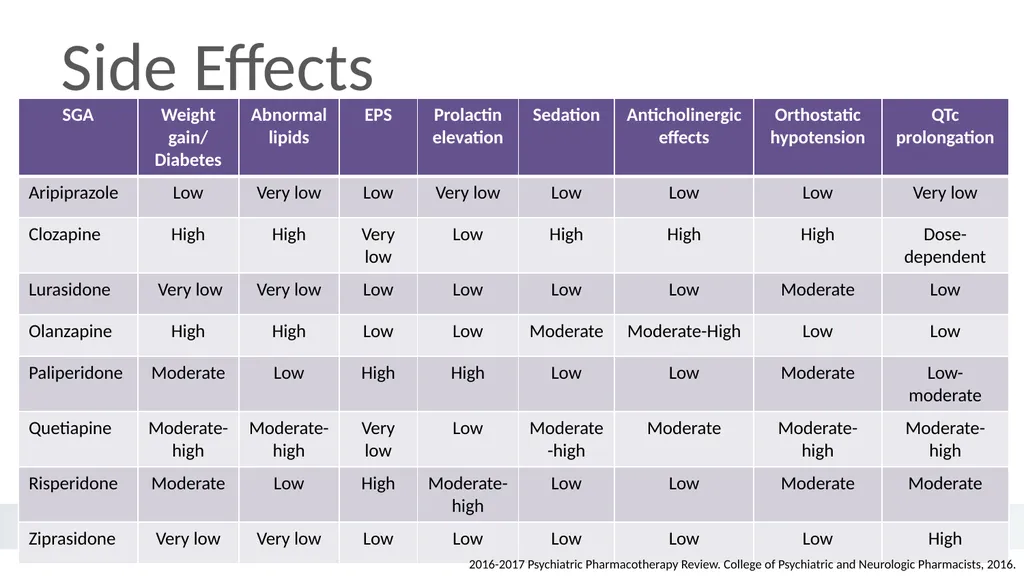
Side Effects 2016-2017 Psychiatric Pharmacotherapy Review. College of Psychiatric and Neurologic Pharmacists, 2016.<br>
54
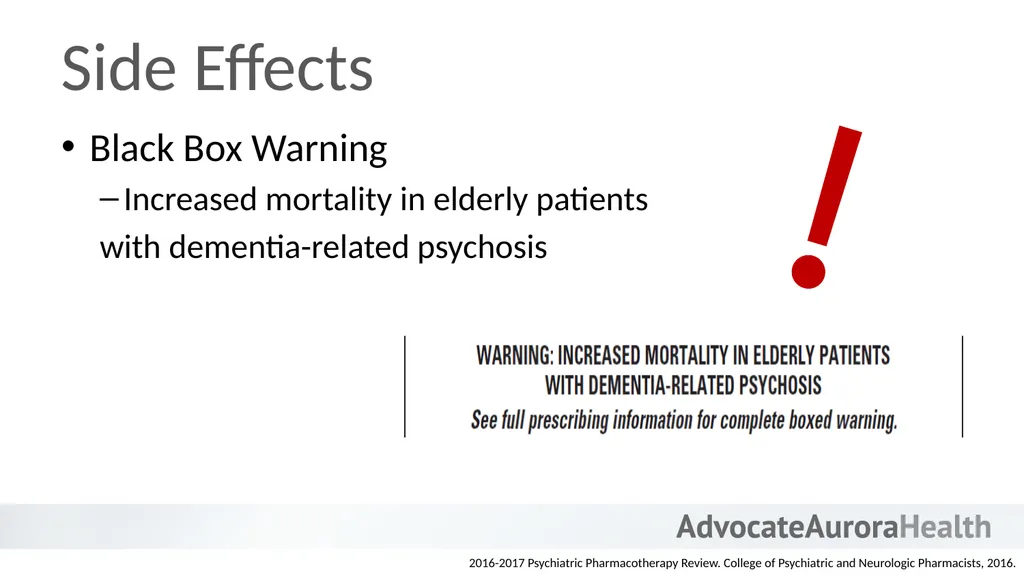
Side Effects Black Box Warning
Increased mortality in elderly patients
with dementia-related psychosis 2016-2017 Psychiatric Pharmacotherapy Review. College of Psychiatric and Neurologic Pharmacists, 2016.<br>
Increased mortality in elderly patients
with dementia-related psychosis 2016-2017 Psychiatric Pharmacotherapy Review. College of Psychiatric and Neurologic Pharmacists, 2016.<br>
55
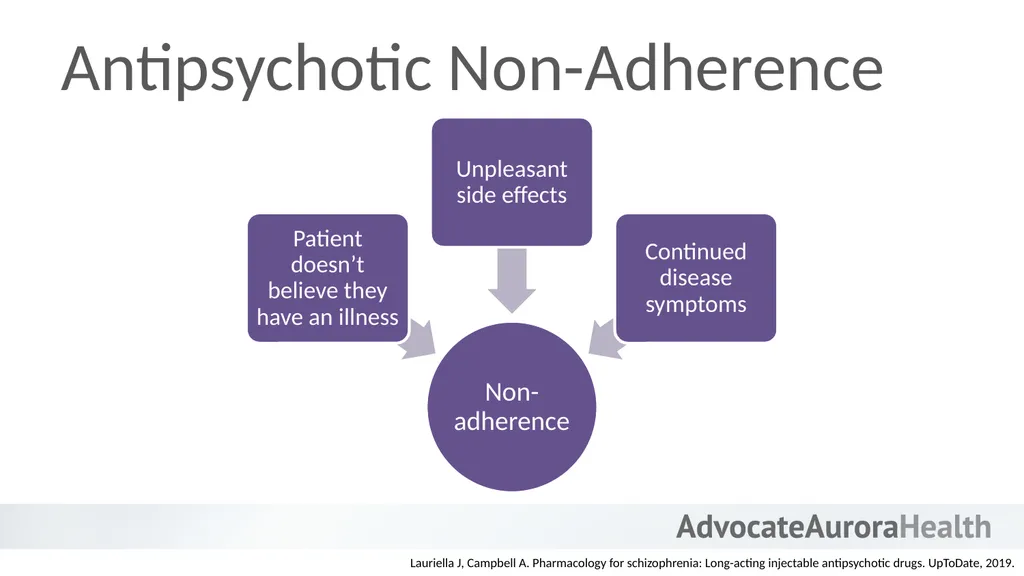
Antipsychotic Non-Adherence Lauriella J, Campbell A. Pharmacology for schizophrenia: Long-acting injectable antipsychotic drugs. UpToDate, 2019.<br>
56
Long-Acting Injectables (LAI) Indications for LAI antipsychotics:
Good response to an oral antipsychotic
Poor medication adherence, leading to relapse<br>
Good response to an oral antipsychotic
Poor medication adherence, leading to relapse<br>
57
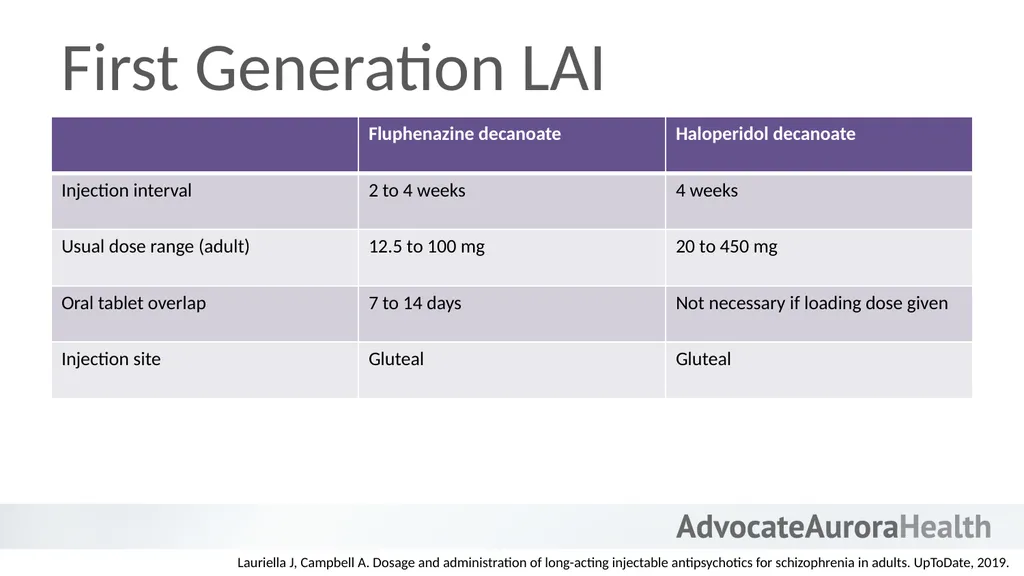
First Generation LAI Lauriella J, Campbell A. Dosage and administration of long-acting injectable antipsychotics for schizophrenia in adults. UpToDate, 2019.<br>
58
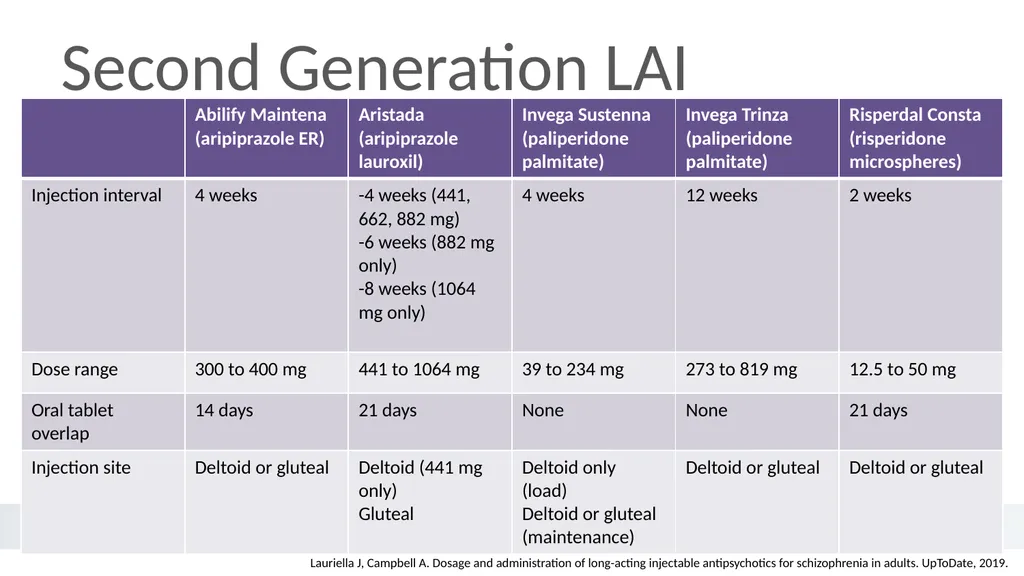
Second Generation LAI Lauriella J, Campbell A. Dosage and administration of long-acting injectable antipsychotics for schizophrenia in adults. UpToDate, 2019.<br>
59
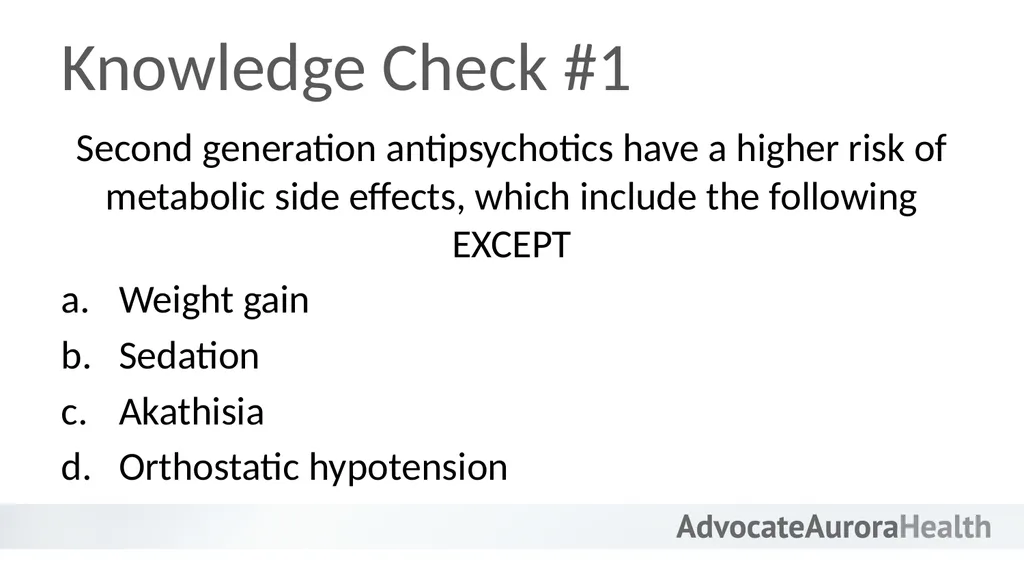
Knowledge Check #1 Second generation antipsychotics have a higher risk of metabolic side effects, which include the following EXCEPT
Weight gain
Sedation
Akathisia
Orthostatic hypotension<br>
Weight gain
Sedation
Akathisia
Orthostatic hypotension<br>
60
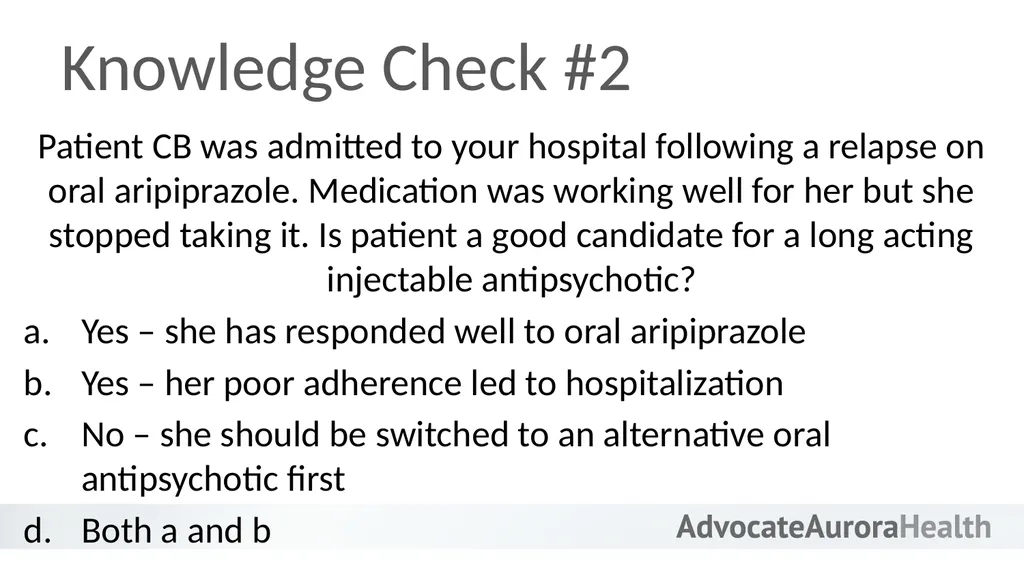
Knowledge Check #2 Patient CB was admitted to your hospital following a relapse on oral aripiprazole. Medication was working well for her but she stopped taking it. Is patient a good candidate for a long acting injectable antipsychotic?
Yes – she has responded well to oral aripiprazole
Yes – her poor adherence led to hospitalization
No – she should be switched to an alternative oral antipsychotic first
Both a and b<br>
Yes – she has responded well to oral aripiprazole
Yes – her poor adherence led to hospitalization
No – she should be switched to an alternative oral antipsychotic first
Both a and b<br>
61
Mood Stabilizers<br>
62
Lamotrigine FDA Approved Indications
Psychiatric
Bipolar 1 Disorder (maintenance treatment)
Certain seizure disorders
MOA
Exact mechanism is unknown 2016-2017 Psychiatric Pharmacotherapy Review. College of Psychiatric and Neurologic Pharmacists, 2016<br>
Psychiatric
Bipolar 1 Disorder (maintenance treatment)
Certain seizure disorders
MOA
Exact mechanism is unknown 2016-2017 Psychiatric Pharmacotherapy Review. College of Psychiatric and Neurologic Pharmacists, 2016<br>
63
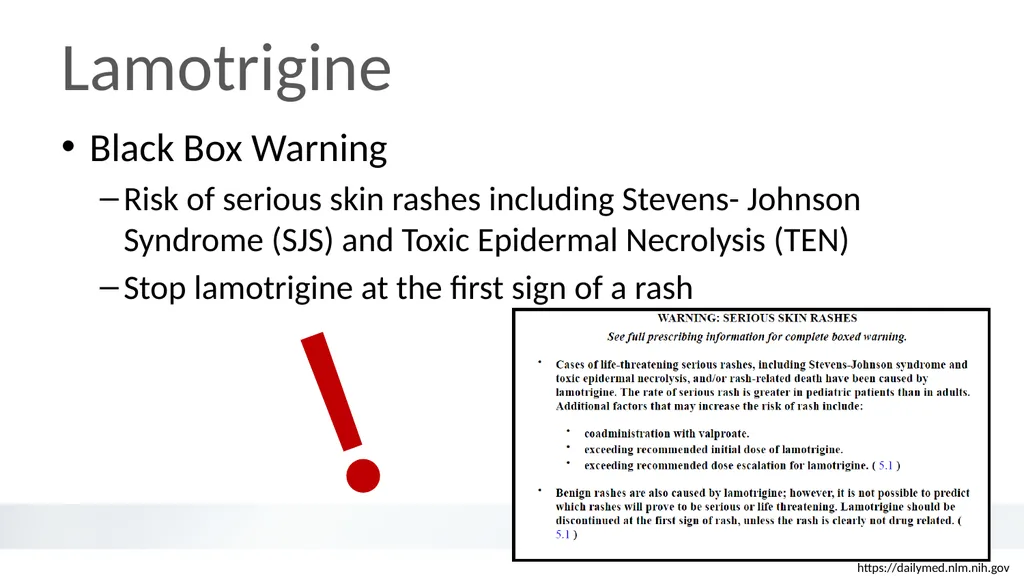
Lamotrigine Black Box Warning
Risk of serious skin rashes including Stevens- Johnson Syndrome (SJS) and Toxic Epidermal Necrolysis (TEN)
Stop lamotrigine at the first sign of a rash https://dailymed.nlm.nih.gov<br>
Risk of serious skin rashes including Stevens- Johnson Syndrome (SJS) and Toxic Epidermal Necrolysis (TEN)
Stop lamotrigine at the first sign of a rash https://dailymed.nlm.nih.gov<br>
64
SJS/TEN Life-threatening reaction
Mortality rates up to 30%
Most often is drug-induced
Onset
Typically 4-28 days Am J Clin Dermatol. 2015 Dec;16(6):475-93.<br>
Mortality rates up to 30%
Most often is drug-induced
Onset
Typically 4-28 days Am J Clin Dermatol. 2015 Dec;16(6):475-93.<br>
65
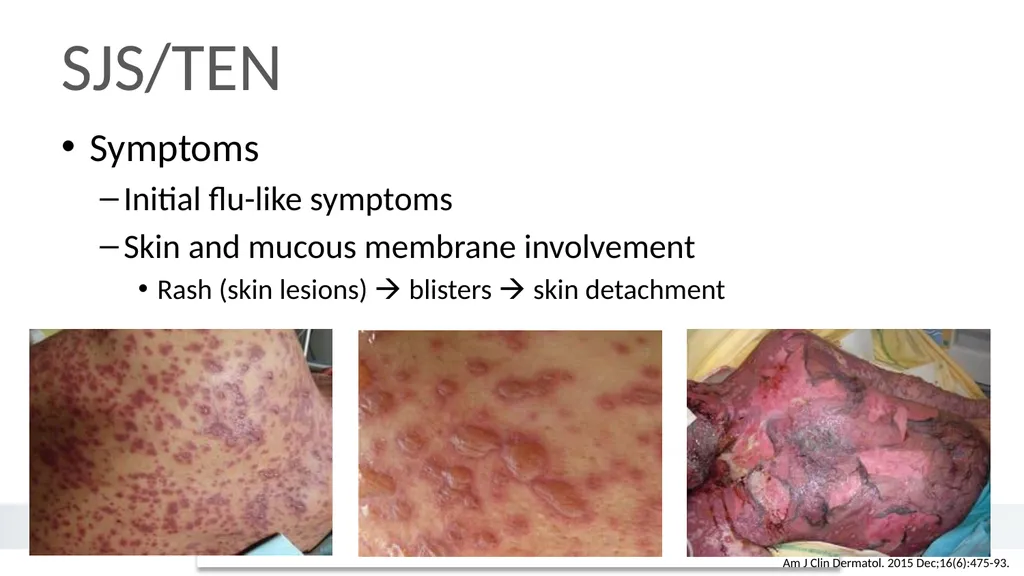
SJS/TEN Symptoms
Initial flu-like symptoms
Skin and mucous membrane involvement
Rash (skin lesions) blisters skin detachment Am J Clin Dermatol. 2015 Dec;16(6):475-93.<br>
Initial flu-like symptoms
Skin and mucous membrane involvement
Rash (skin lesions) blisters skin detachment Am J Clin Dermatol. 2015 Dec;16(6):475-93.<br>
66
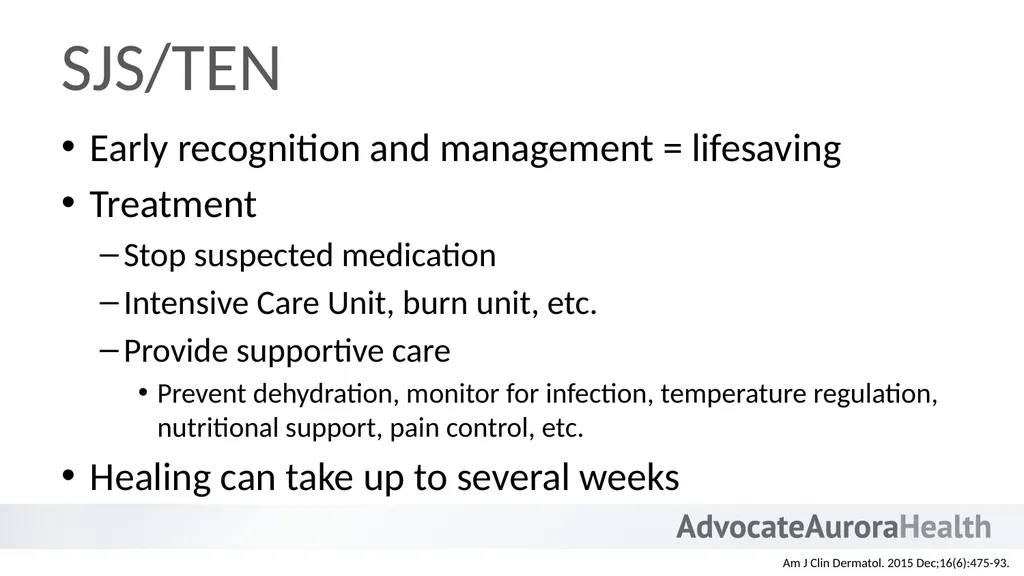
SJS/TEN Early recognition and management = lifesaving
Treatment
Stop suspected medication
Intensive Care Unit, burn unit, etc.
Provide supportive care
Prevent dehydration, monitor for infection, temperature regulation, nutritional support, pain control, etc.
Healing can take up to several weeks Am J Clin Dermatol. 2015 Dec;16(6):475-93.<br>
Treatment
Stop suspected medication
Intensive Care Unit, burn unit, etc.
Provide supportive care
Prevent dehydration, monitor for infection, temperature regulation, nutritional support, pain control, etc.
Healing can take up to several weeks Am J Clin Dermatol. 2015 Dec;16(6):475-93.<br>
67
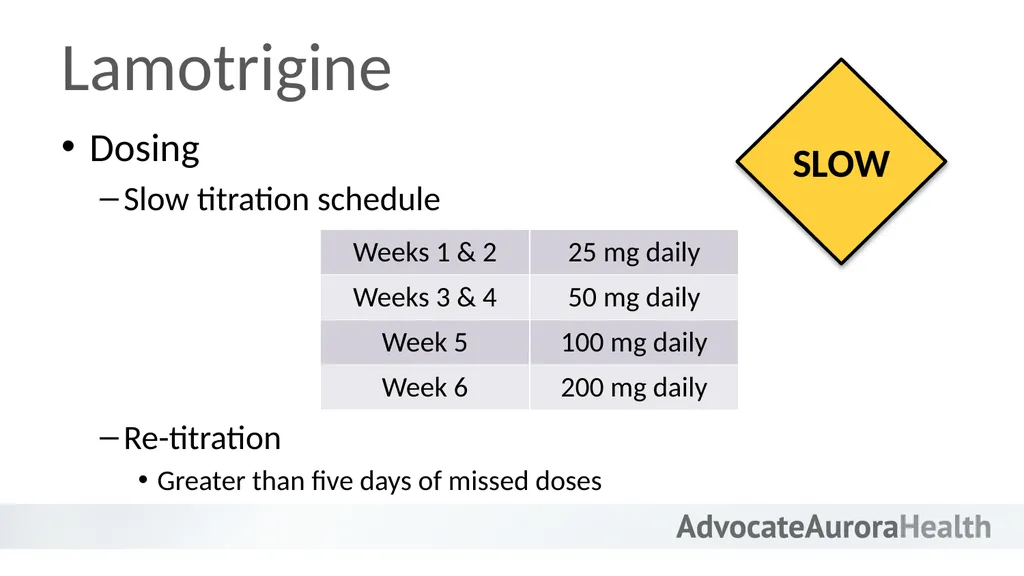
Lamotrigine Dosing
Slow titration schedule
Re-titration
Greater than five days of missed doses<br>
Slow titration schedule
Re-titration
Greater than five days of missed doses<br>
68
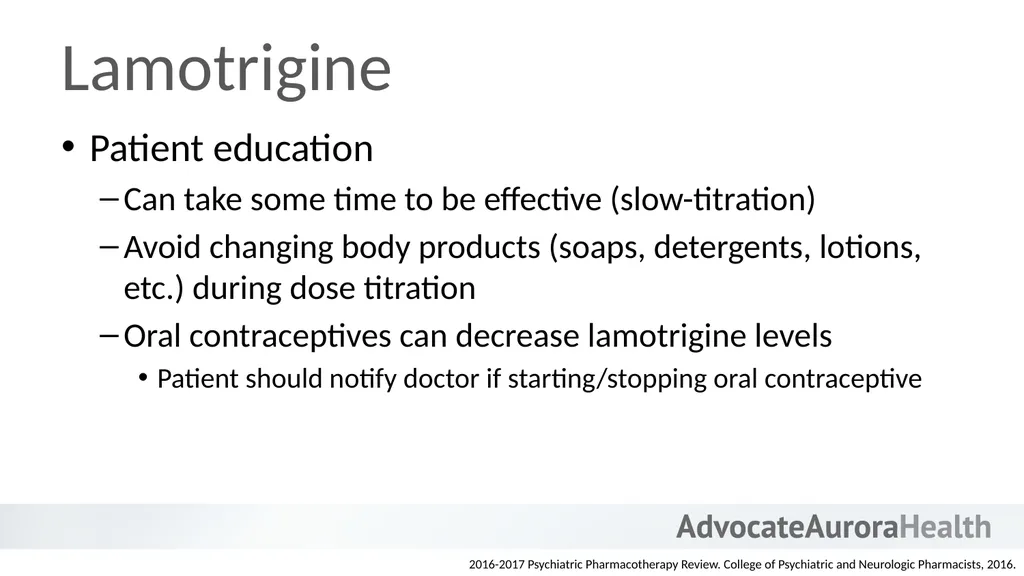
Lamotrigine Patient education
Can take some time to be effective (slow-titration)
Avoid changing body products (soaps, detergents, lotions, etc.) during dose titration
Oral contraceptives can decrease lamotrigine levels
Patient should notify doctor if starting/stopping oral contraceptive 2016-2017 Psychiatric Pharmacotherapy Review. College of Psychiatric and Neurologic Pharmacists, 2016.<br>
Can take some time to be effective (slow-titration)
Avoid changing body products (soaps, detergents, lotions, etc.) during dose titration
Oral contraceptives can decrease lamotrigine levels
Patient should notify doctor if starting/stopping oral contraceptive 2016-2017 Psychiatric Pharmacotherapy Review. College of Psychiatric and Neurologic Pharmacists, 2016.<br>
69
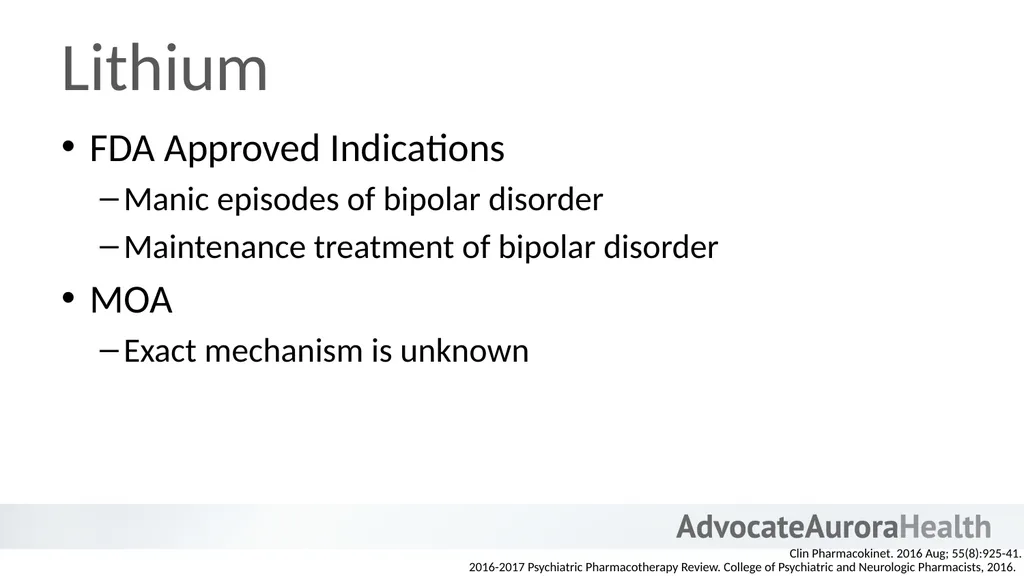
Lithium FDA Approved Indications
Manic episodes of bipolar disorder
Maintenance treatment of bipolar disorder
MOA
Exact mechanism is unknown 2016-2017 Psychiatric Pharmacotherapy Review. College of Psychiatric and Neurologic Pharmacists, 2016. Clin Pharmacokinet. 2016 Aug; 55(8):925-41.<br>
Manic episodes of bipolar disorder
Maintenance treatment of bipolar disorder
MOA
Exact mechanism is unknown 2016-2017 Psychiatric Pharmacotherapy Review. College of Psychiatric and Neurologic Pharmacists, 2016. Clin Pharmacokinet. 2016 Aug; 55(8):925-41.<br>
70
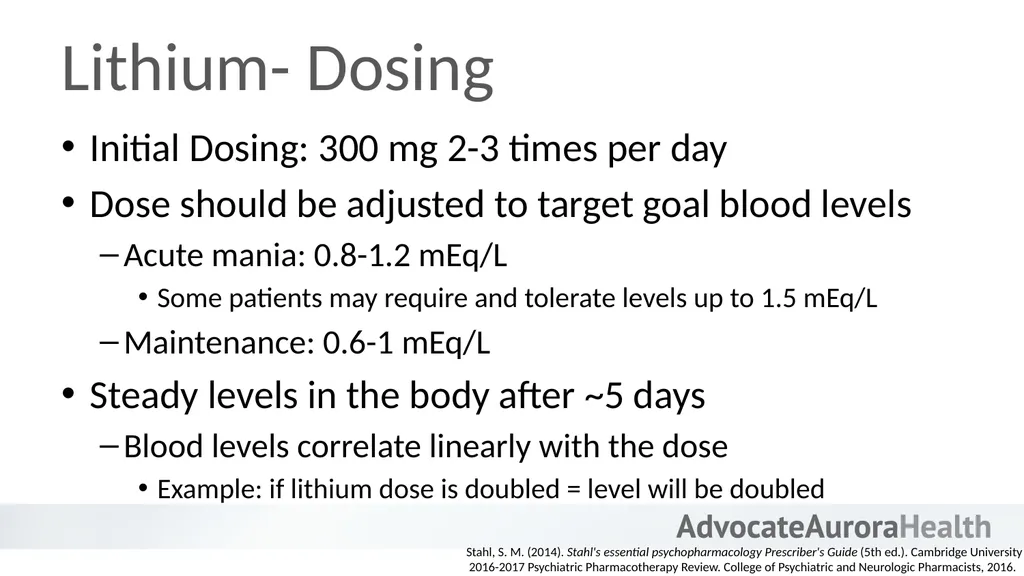
Lithium- Dosing Initial Dosing: 300 mg 2-3 times per day
Dose should be adjusted to target goal blood levels
Acute mania: 0.8-1.2 mEq/L
Some patients may require and tolerate levels up to 1.5 mEq/L
Maintenance: 0.6-1 mEq/L
Steady levels in the body after ~5 days
Blood levels correlate linearly with the dose
Example: if lithium dose is doubled = level will be doubled 2016-2017 Psychiatric Pharmacotherapy Review. College of Psychiatric and Neurologic Pharmacists, 2016. Stahl, S. M. (2014). Stahl's essential psychopharmacology Prescriber's Guide (5th ed.). Cambridge University Press.<br>
Dose should be adjusted to target goal blood levels
Acute mania: 0.8-1.2 mEq/L
Some patients may require and tolerate levels up to 1.5 mEq/L
Maintenance: 0.6-1 mEq/L
Steady levels in the body after ~5 days
Blood levels correlate linearly with the dose
Example: if lithium dose is doubled = level will be doubled 2016-2017 Psychiatric Pharmacotherapy Review. College of Psychiatric and Neurologic Pharmacists, 2016. Stahl, S. M. (2014). Stahl's essential psychopharmacology Prescriber's Guide (5th ed.). Cambridge University Press.<br>
71
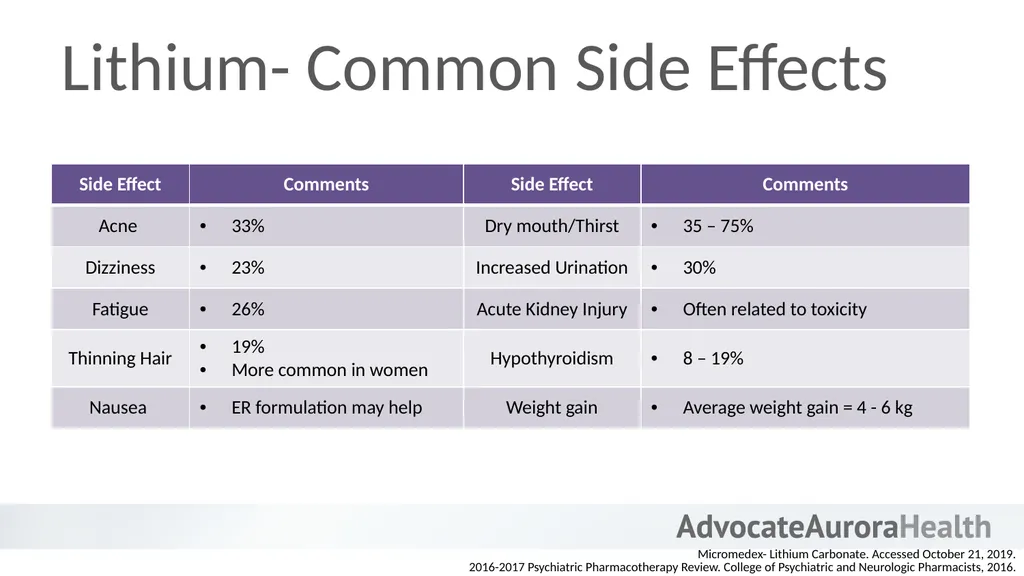
Lithium- Common Side Effects 2016-2017 Psychiatric Pharmacotherapy Review. College of Psychiatric and Neurologic Pharmacists, 2016. Micromedex- Lithium Carbonate. Accessed October 21, 2019.<br>
72
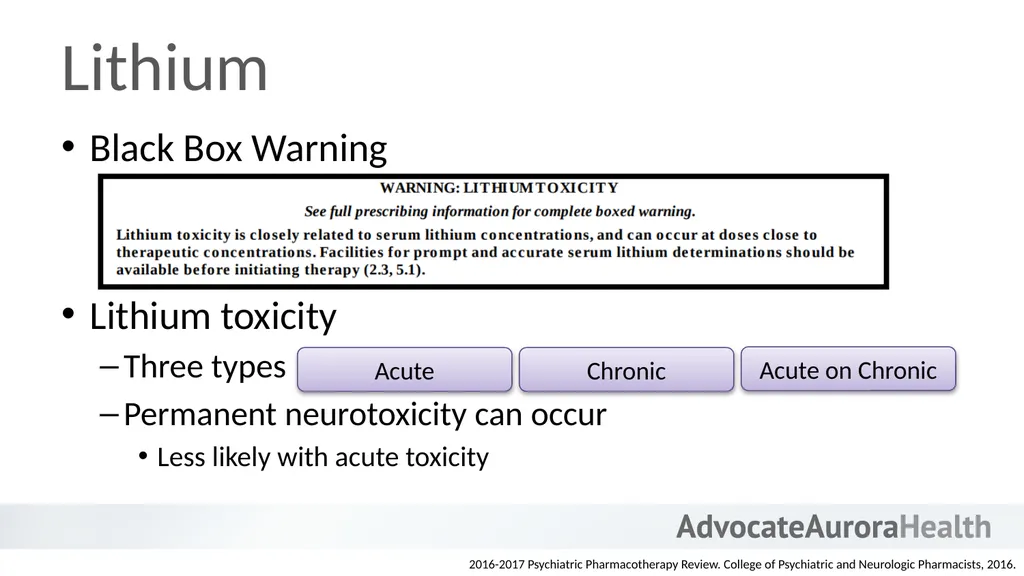
Lithium Black Box Warning
Lithium toxicity
Three types
Permanent neurotoxicity can occur
Less likely with acute toxicity Acute Chronic Acute on Chronic 2016-2017 Psychiatric Pharmacotherapy Review. College of Psychiatric and Neurologic Pharmacists, 2016.<br>
Lithium toxicity
Three types
Permanent neurotoxicity can occur
Less likely with acute toxicity Acute Chronic Acute on Chronic 2016-2017 Psychiatric Pharmacotherapy Review. College of Psychiatric and Neurologic Pharmacists, 2016.<br>
73
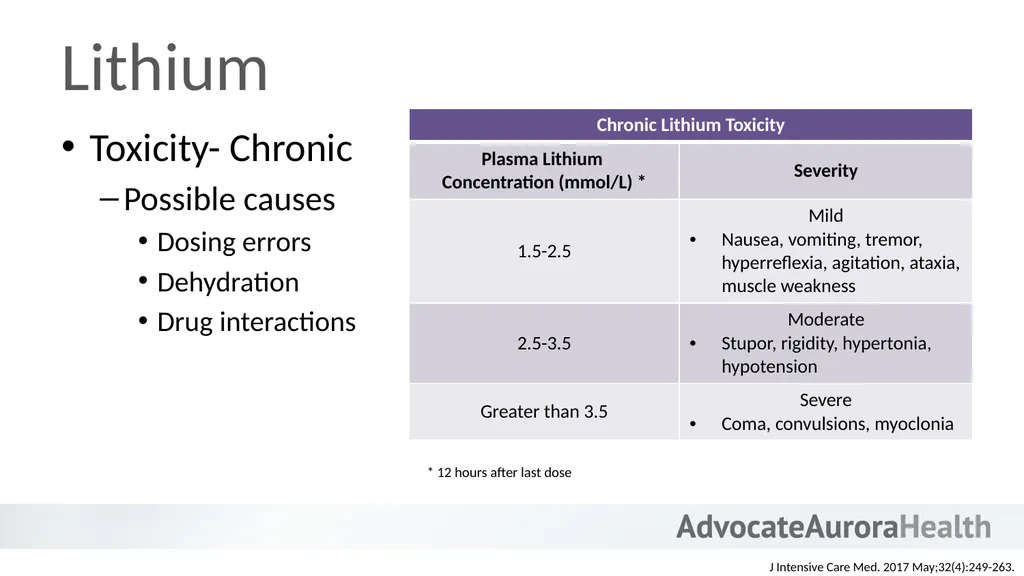
Lithium Toxicity- Chronic
Possible causes
Dosing errors
Dehydration
Drug interactions * 12 hours after last dose J Intensive Care Med. 2017 May;32(4):249-263.<br>
Possible causes
Dosing errors
Dehydration
Drug interactions * 12 hours after last dose J Intensive Care Med. 2017 May;32(4):249-263.<br>
74
Lithium Drug Interactions
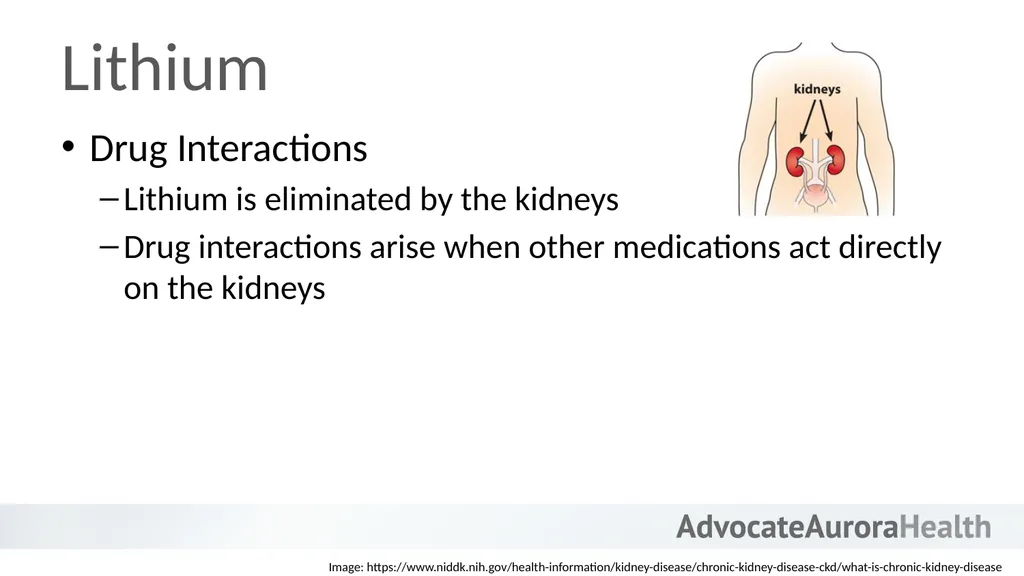
Lithium is eliminated by the kidneys
Drug interactions arise when other medications act directly on the kidneys Image: https://www.niddk.nih.gov/health-information/kidney-disease/chronic-kidney-disease-ckd/what-is-chronic-kidney-disease<br>
Lithium is eliminated by the kidneys
Drug interactions arise when other medications act directly on the kidneys Image: https://www.niddk.nih.gov/health-information/kidney-disease/chronic-kidney-disease-ckd/what-is-chronic-kidney-disease<br>
75
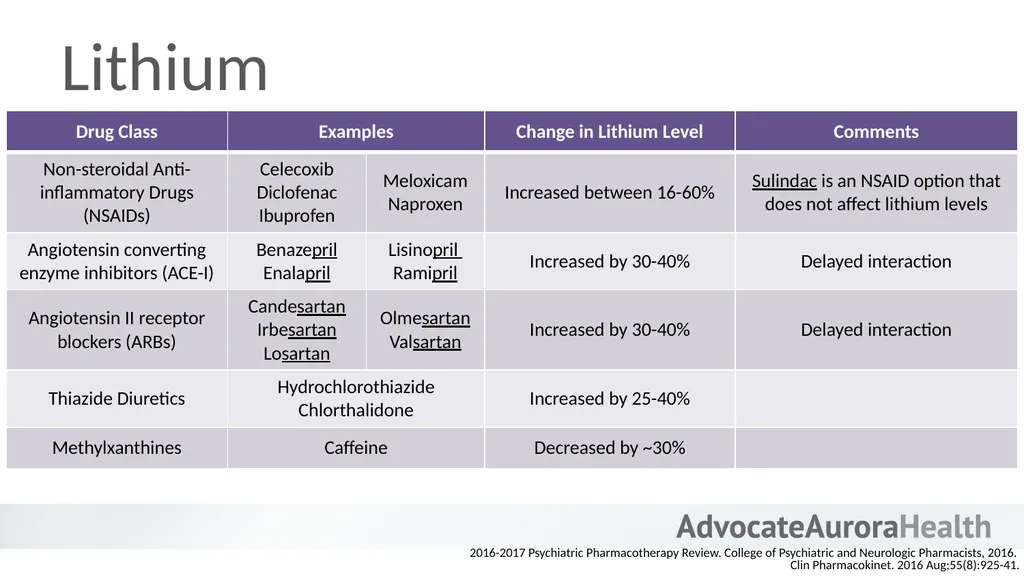
Lithium Clin Pharmacokinet. 2016 Aug;55(8):925-41. 2016-2017 Psychiatric Pharmacotherapy Review. College of Psychiatric and Neurologic Pharmacists, 2016.<br>
76
Lithium Patient Education
Can take 1-3 weeks to be effective
Try to keep salt, water, and caffeine intake consistent
Avoid OTC NSAIDs
Signs and symptoms of lithium toxicity
Lithium should be slowly tapered off to avoid relapse Stahl, S. M. (2014). Stahl's essential psychopharmacology Prescriber's Guide (5th ed.). Cambridge University Press.<br>
Can take 1-3 weeks to be effective
Try to keep salt, water, and caffeine intake consistent
Avoid OTC NSAIDs
Signs and symptoms of lithium toxicity
Lithium should be slowly tapered off to avoid relapse Stahl, S. M. (2014). Stahl's essential psychopharmacology Prescriber's Guide (5th ed.). Cambridge University Press.<br>
77
Valproic Acid/Divalproex Sodium FDA Approved Indications
Bipolar disorder: acute mania and mixed episodes
Certain seizure disorders
Migraine prevention
MOA
Complex
Involves increasing GABA (neurotransmitter) in the brain and blocking sodium channels Stahl, S. M. (2014). Stahl's essential psychopharmacology Prescriber's Guide (5th ed.). Cambridge University Press.<br>
Bipolar disorder: acute mania and mixed episodes
Certain seizure disorders
Migraine prevention
MOA
Complex
Involves increasing GABA (neurotransmitter) in the brain and blocking sodium channels Stahl, S. M. (2014). Stahl's essential psychopharmacology Prescriber's Guide (5th ed.). Cambridge University Press.<br>
78
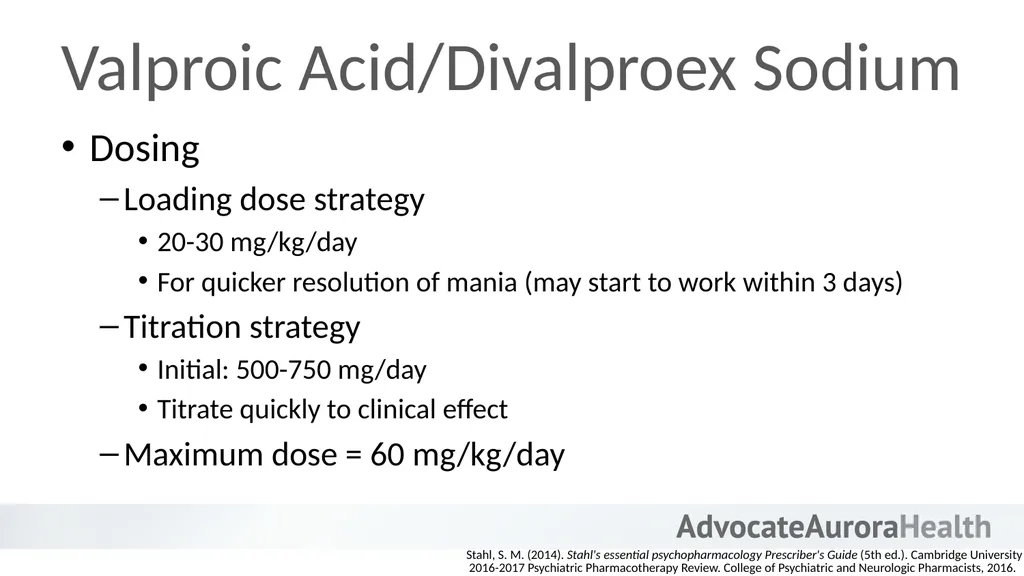
Valproic Acid/Divalproex Sodium Dosing
Loading dose strategy
20-30 mg/kg/day
For quicker resolution of mania (may start to work within 3 days)
Titration strategy
Initial: 500-750 mg/day
Titrate quickly to clinical effect
Maximum dose = 60 mg/kg/day Stahl, S. M. (2014). Stahl's essential psychopharmacology Prescriber's Guide (5th ed.). Cambridge University Press. 2016-2017 Psychiatric Pharmacotherapy Review. College of Psychiatric and Neurologic Pharmacists, 2016.<br>
Loading dose strategy
20-30 mg/kg/day
For quicker resolution of mania (may start to work within 3 days)
Titration strategy
Initial: 500-750 mg/day
Titrate quickly to clinical effect
Maximum dose = 60 mg/kg/day Stahl, S. M. (2014). Stahl's essential psychopharmacology Prescriber's Guide (5th ed.). Cambridge University Press. 2016-2017 Psychiatric Pharmacotherapy Review. College of Psychiatric and Neurologic Pharmacists, 2016.<br>
79
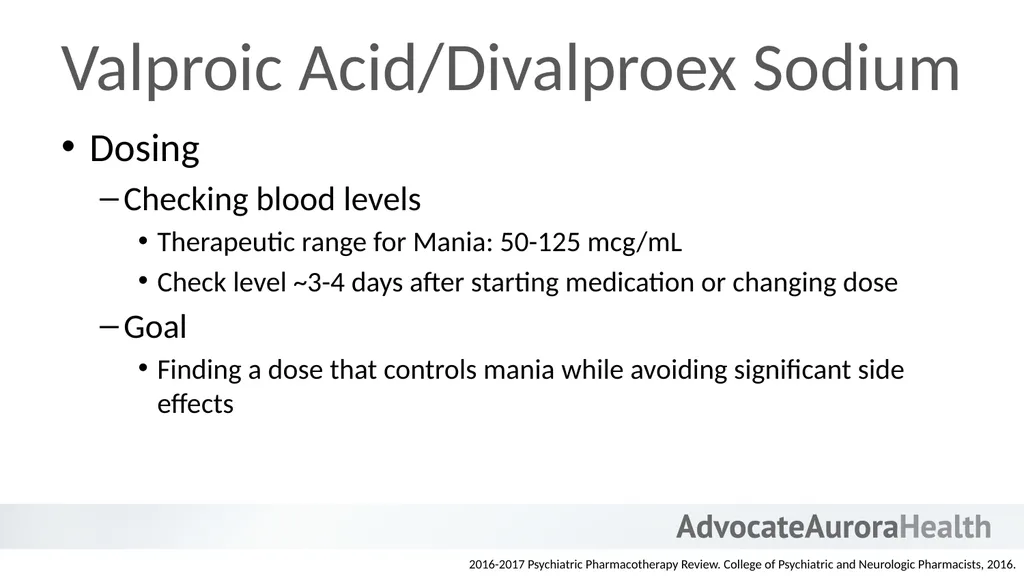
Valproic Acid/Divalproex Sodium Dosing
Checking blood levels
Therapeutic range for Mania: 50-125 mcg/mL
Check level ~3-4 days after starting medication or changing dose
Goal
Finding a dose that controls mania while avoiding significant side effects 2016-2017 Psychiatric Pharmacotherapy Review. College of Psychiatric and Neurologic Pharmacists, 2016.<br>
Checking blood levels
Therapeutic range for Mania: 50-125 mcg/mL
Check level ~3-4 days after starting medication or changing dose
Goal
Finding a dose that controls mania while avoiding significant side effects 2016-2017 Psychiatric Pharmacotherapy Review. College of Psychiatric and Neurologic Pharmacists, 2016.<br>
80
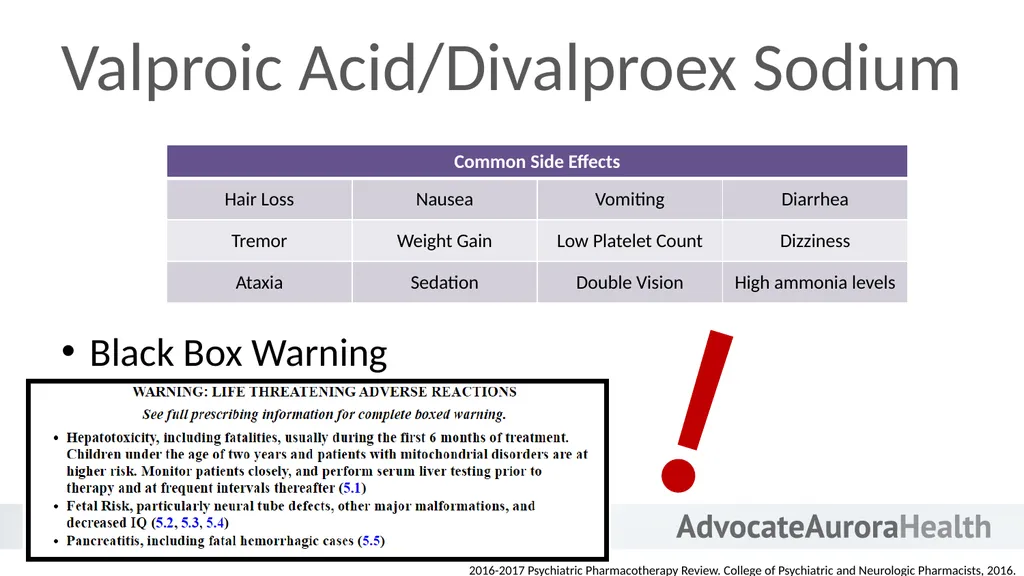
Valproic Acid/Divalproex Sodium Black Box Warning 2016-2017 Psychiatric Pharmacotherapy Review. College of Psychiatric and Neurologic Pharmacists, 2016.<br>
81
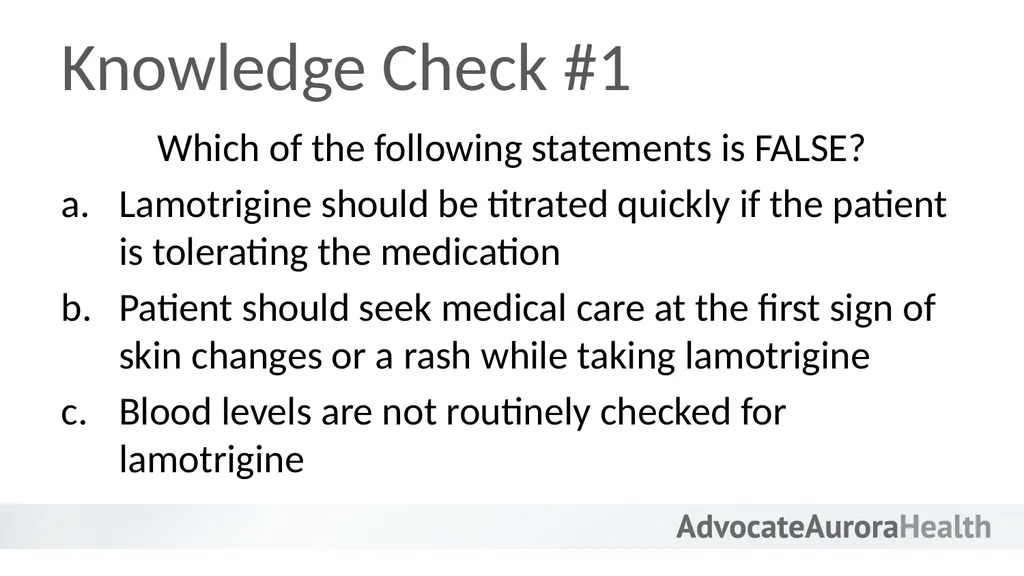
Knowledge Check #1 Which of the following statements is FALSE?
Lamotrigine should be titrated quickly if the patient is tolerating the medication
Patient should seek medical care at the first sign of skin changes or a rash while taking lamotrigine
Blood levels are not routinely checked for lamotrigine<br>
Lamotrigine should be titrated quickly if the patient is tolerating the medication
Patient should seek medical care at the first sign of skin changes or a rash while taking lamotrigine
Blood levels are not routinely checked for lamotrigine<br>
82
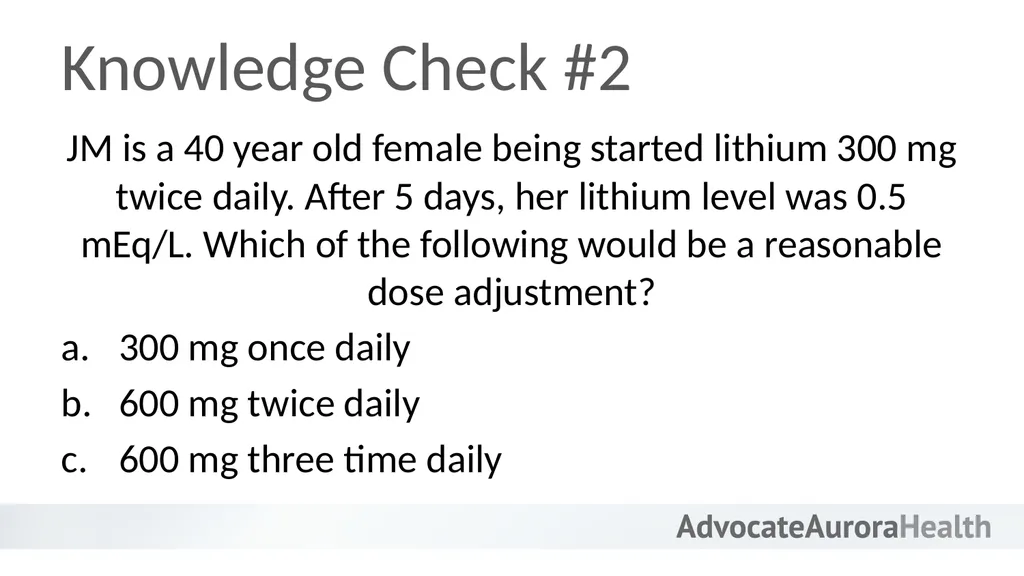
Knowledge Check #2 JM is a 40 year old female being started lithium 300 mg twice daily. After 5 days, her lithium level was 0.5 mEq/L. Which of the following would be a reasonable dose adjustment?
300 mg once daily
600 mg twice daily
600 mg three time daily<br>
300 mg once daily
600 mg twice daily
600 mg three time daily<br>
83
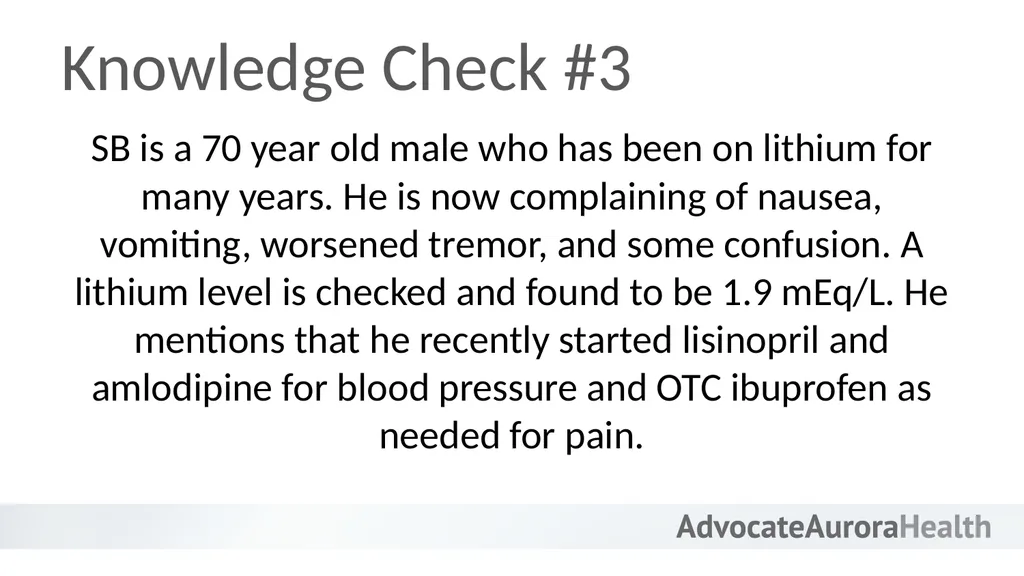
Knowledge Check #3 SB is a 70 year old male who has been on lithium for many years. He is now complaining of nausea, vomiting, worsened tremor, and some confusion. A lithium level is checked and found to be 1.9 mEq/L. He mentions that he recently started lisinopril and amlodipine for blood pressure and OTC ibuprofen as needed for pain.<br>
84
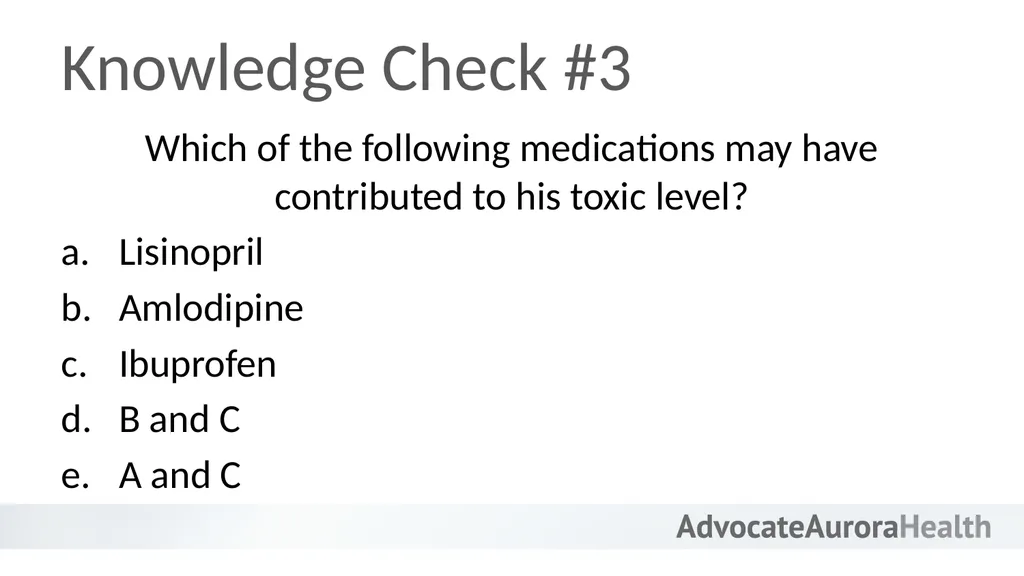
Knowledge Check #3 Which of the following medications may have contributed to his toxic level?
Lisinopril
Amlodipine
Ibuprofen
B and C
A and C<br>
Lisinopril
Amlodipine
Ibuprofen
B and C
A and C<br>
85
Medications for Substance-Related Disorders<br>
86
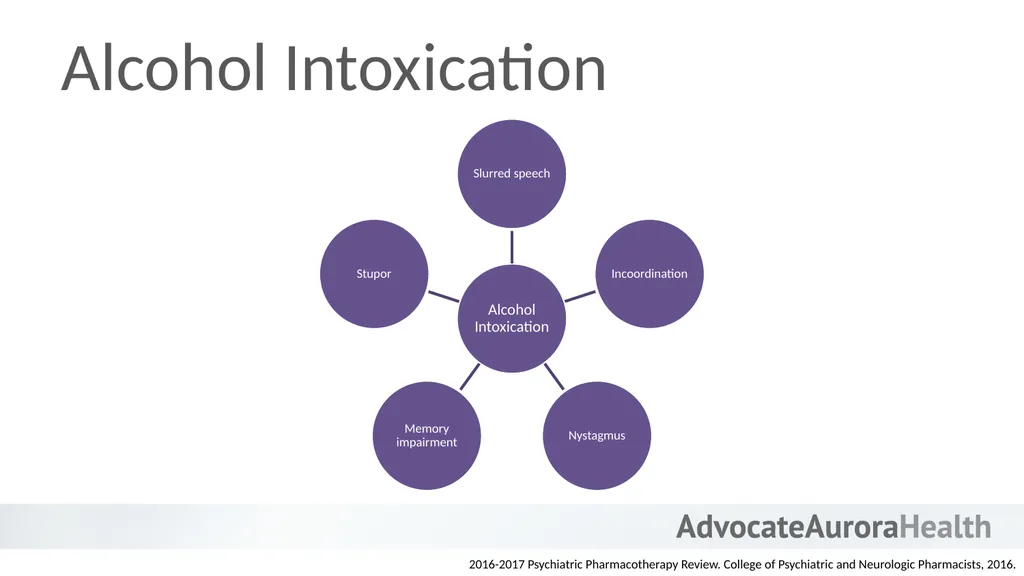
Alcohol Intoxication 2016-2017 Psychiatric Pharmacotherapy Review. College of Psychiatric and Neurologic Pharmacists, 2016.<br>
87
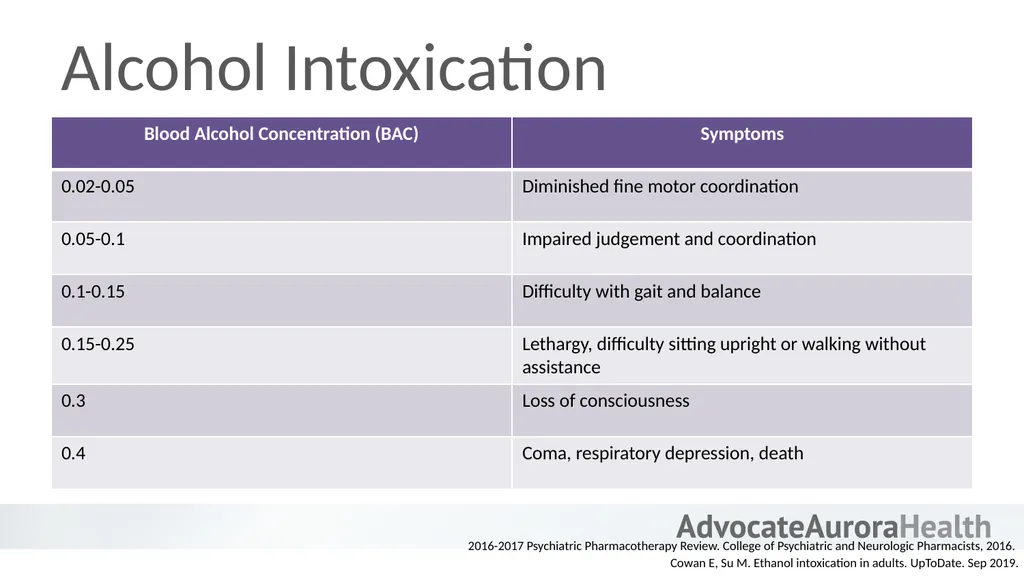
Alcohol Intoxication Cowan E, Su M. Ethanol intoxication in adults. UpToDate. Sep 2019. 2016-2017 Psychiatric Pharmacotherapy Review. College of Psychiatric and Neurologic Pharmacists, 2016.<br>
88
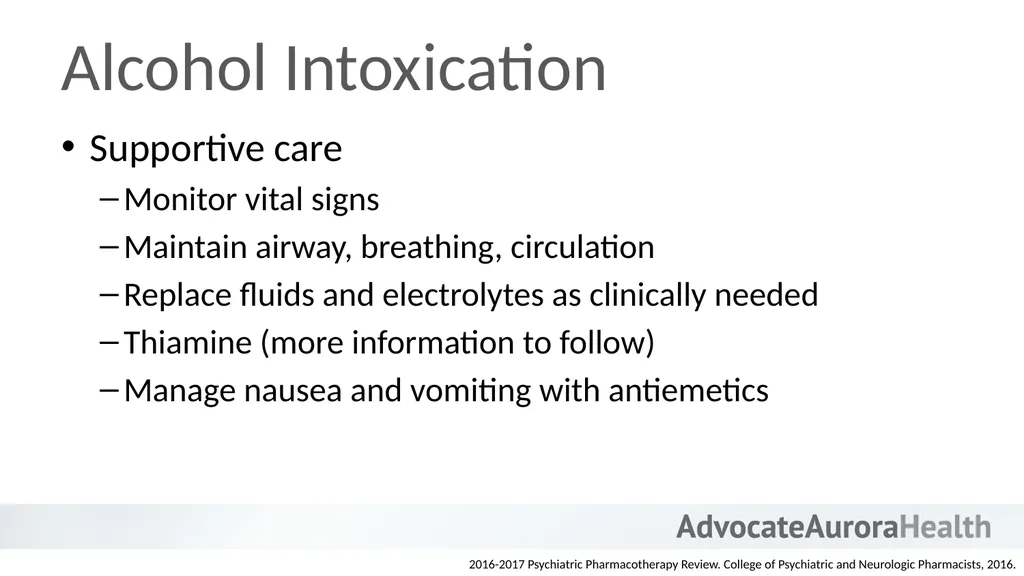
Alcohol Intoxication Supportive care
Monitor vital signs
Maintain airway, breathing, circulation
Replace fluids and electrolytes as clinically needed
Thiamine (more information to follow)
Manage nausea and vomiting with antiemetics 2016-2017 Psychiatric Pharmacotherapy Review. College of Psychiatric and Neurologic Pharmacists, 2016.<br>
Monitor vital signs
Maintain airway, breathing, circulation
Replace fluids and electrolytes as clinically needed
Thiamine (more information to follow)
Manage nausea and vomiting with antiemetics 2016-2017 Psychiatric Pharmacotherapy Review. College of Psychiatric and Neurologic Pharmacists, 2016.<br>
89
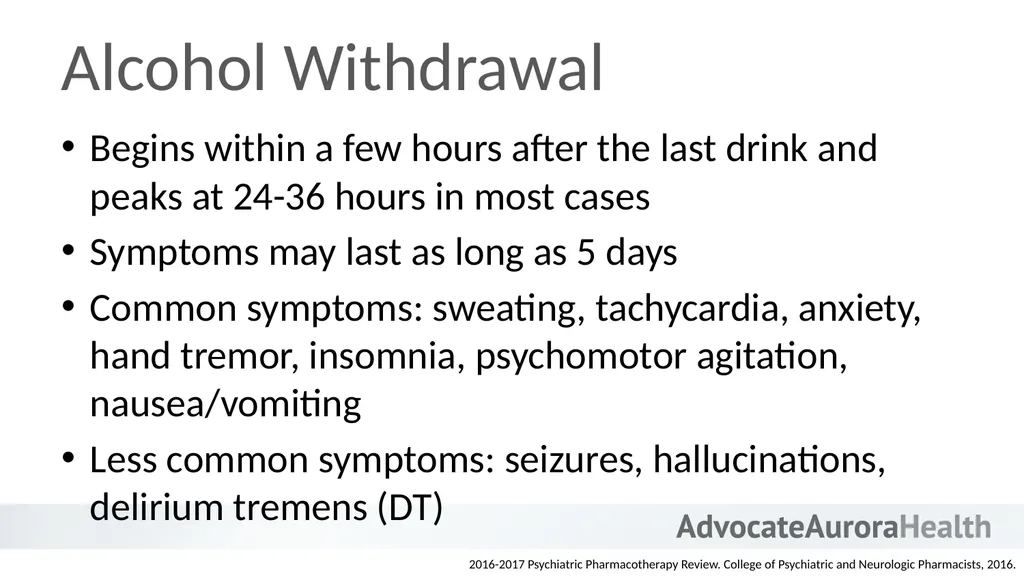
Alcohol Withdrawal Begins within a few hours after the last drink and peaks at 24-36 hours in most cases
Symptoms may last as long as 5 days
Common symptoms: sweating, tachycardia, anxiety, hand tremor, insomnia, psychomotor agitation, nausea/vomiting
Less common symptoms: seizures, hallucinations, delirium tremens (DT) 2016-2017 Psychiatric Pharmacotherapy Review. College of Psychiatric and Neurologic Pharmacists, 2016.<br>
Symptoms may last as long as 5 days
Common symptoms: sweating, tachycardia, anxiety, hand tremor, insomnia, psychomotor agitation, nausea/vomiting
Less common symptoms: seizures, hallucinations, delirium tremens (DT) 2016-2017 Psychiatric Pharmacotherapy Review. College of Psychiatric and Neurologic Pharmacists, 2016.<br>
90
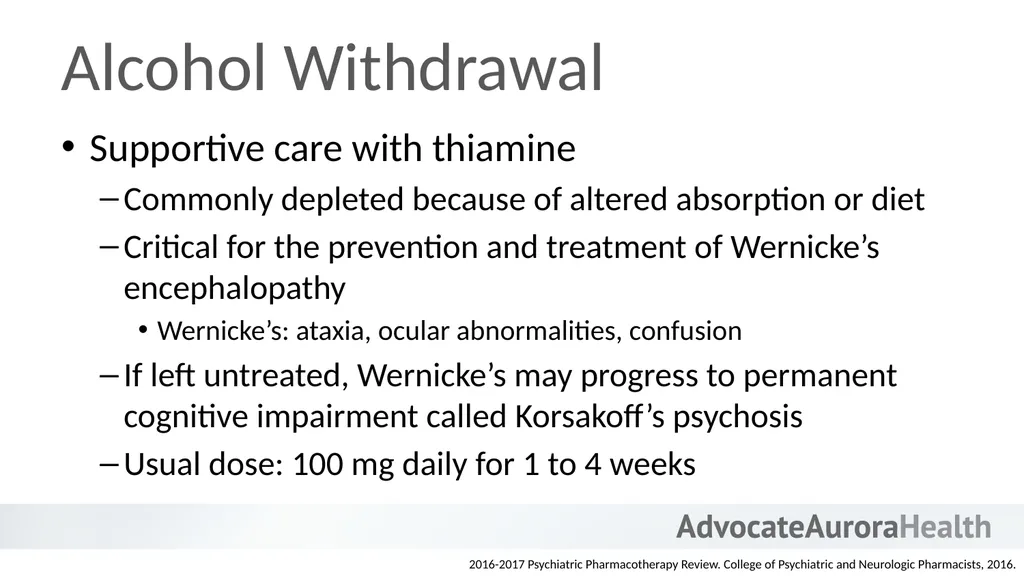
Alcohol Withdrawal Supportive care with thiamine
Commonly depleted because of altered absorption or diet
Critical for the prevention and treatment of Wernicke’s encephalopathy
Wernicke’s: ataxia, ocular abnormalities, confusion
If left untreated, Wernicke’s may progress to permanent cognitive impairment called Korsakoff’s psychosis
Usual dose: 100 mg daily for 1 to 4 weeks 2016-2017 Psychiatric Pharmacotherapy Review. College of Psychiatric and Neurologic Pharmacists, 2016.<br>
Commonly depleted because of altered absorption or diet
Critical for the prevention and treatment of Wernicke’s encephalopathy
Wernicke’s: ataxia, ocular abnormalities, confusion
If left untreated, Wernicke’s may progress to permanent cognitive impairment called Korsakoff’s psychosis
Usual dose: 100 mg daily for 1 to 4 weeks 2016-2017 Psychiatric Pharmacotherapy Review. College of Psychiatric and Neurologic Pharmacists, 2016.<br>
91
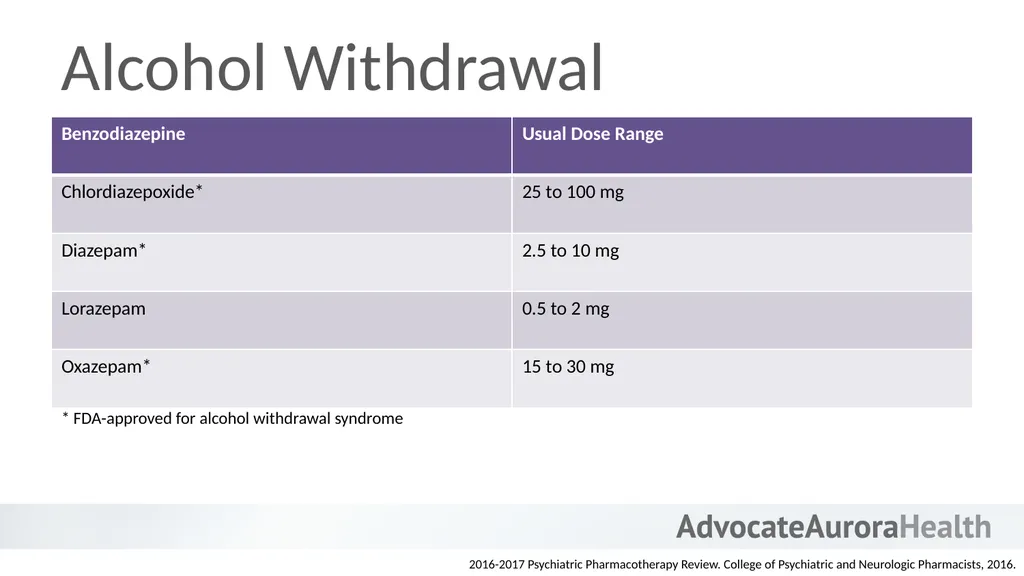
Alcohol Withdrawal 2016-2017 Psychiatric Pharmacotherapy Review. College of Psychiatric and Neurologic Pharmacists, 2016. * FDA-approved for alcohol withdrawal syndrome<br>
92
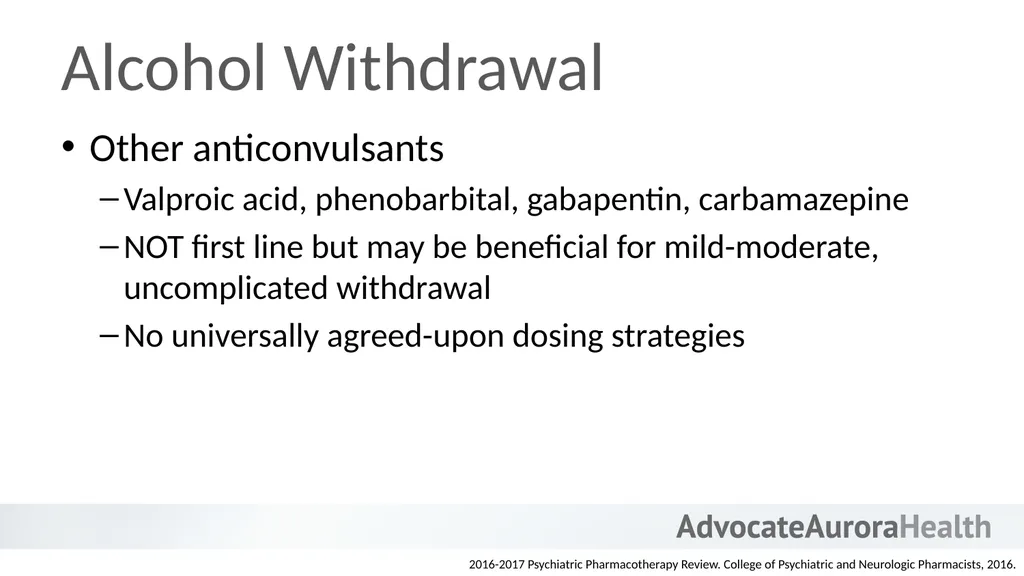
Alcohol Withdrawal Other anticonvulsants
Valproic acid, phenobarbital, gabapentin, carbamazepine
NOT first line but may be beneficial for mild-moderate, uncomplicated withdrawal
No universally agreed-upon dosing strategies 2016-2017 Psychiatric Pharmacotherapy Review. College of Psychiatric and Neurologic Pharmacists, 2016.<br>
Valproic acid, phenobarbital, gabapentin, carbamazepine
NOT first line but may be beneficial for mild-moderate, uncomplicated withdrawal
No universally agreed-upon dosing strategies 2016-2017 Psychiatric Pharmacotherapy Review. College of Psychiatric and Neurologic Pharmacists, 2016.<br>
93
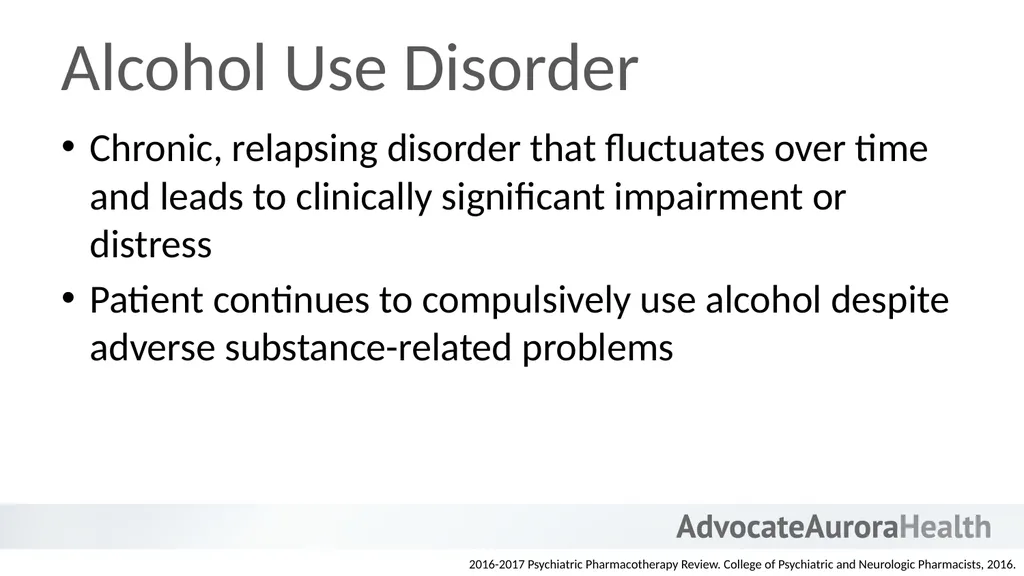
Alcohol Use Disorder Chronic, relapsing disorder that fluctuates over time and leads to clinically significant impairment or distress
Patient continues to compulsively use alcohol despite adverse substance-related problems 2016-2017 Psychiatric Pharmacotherapy Review. College of Psychiatric and Neurologic Pharmacists, 2016.<br>
Patient continues to compulsively use alcohol despite adverse substance-related problems 2016-2017 Psychiatric Pharmacotherapy Review. College of Psychiatric and Neurologic Pharmacists, 2016.<br>
94
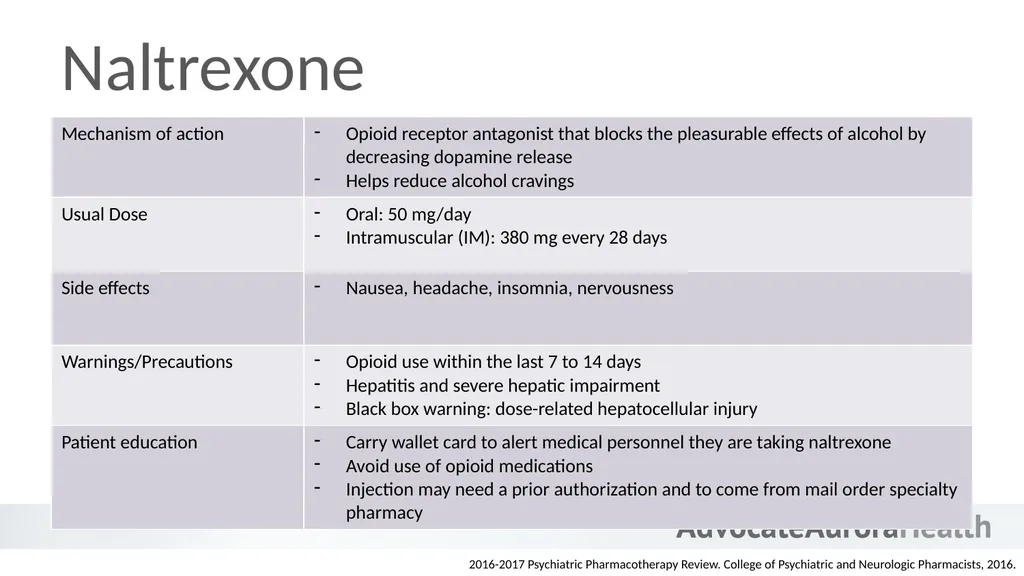
Naltrexone 2016-2017 Psychiatric Pharmacotherapy Review. College of Psychiatric and Neurologic Pharmacists, 2016.<br>
95
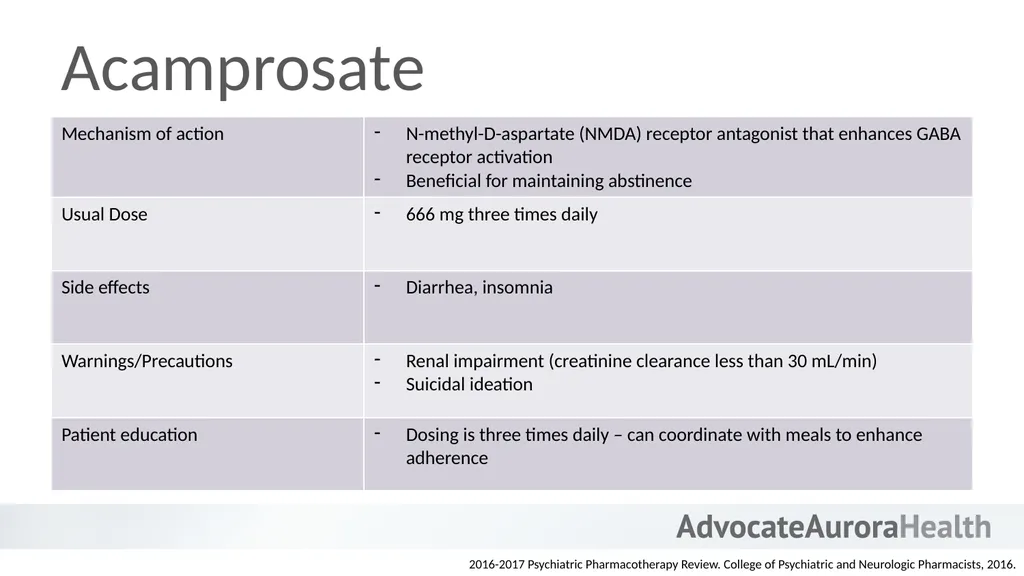
Acamprosate 2016-2017 Psychiatric Pharmacotherapy Review. College of Psychiatric and Neurologic Pharmacists, 2016.<br>
96
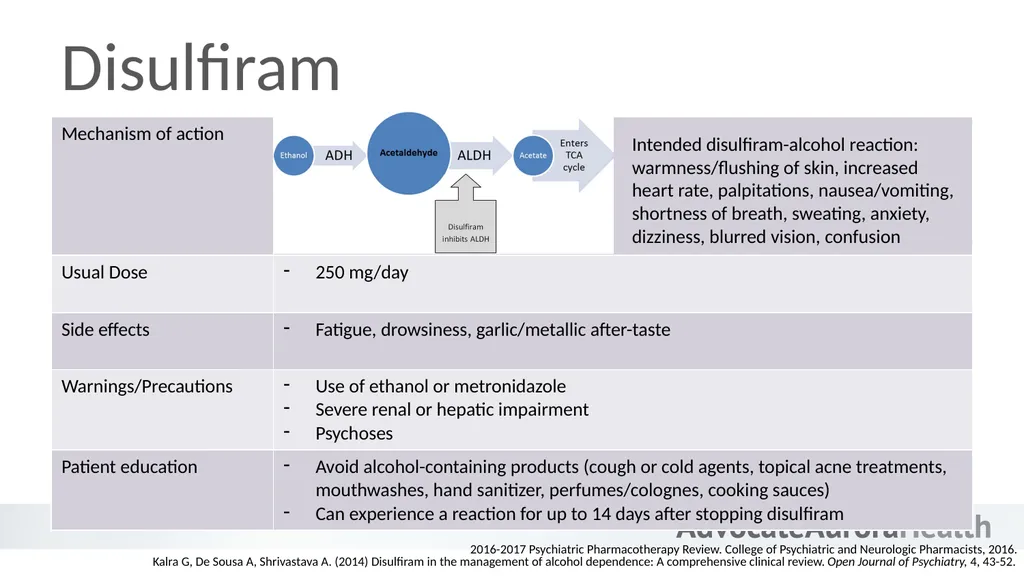
Disulfiram Intended disulfiram-alcohol reaction: warmness/flushing of skin, increased heart rate, palpitations, nausea/vomiting, shortness of breath, sweating, anxiety, dizziness, blurred vision, confusion Kalra G, De Sousa A, Shrivastava A. (2014) Disulfiram in the management of alcohol dependence: A comprehensive clinical review. Open Journal of Psychiatry, 4, 43-52. 2016-2017 Psychiatric Pharmacotherapy Review. College of Psychiatric and Neurologic Pharmacists, 2016.<br>
97
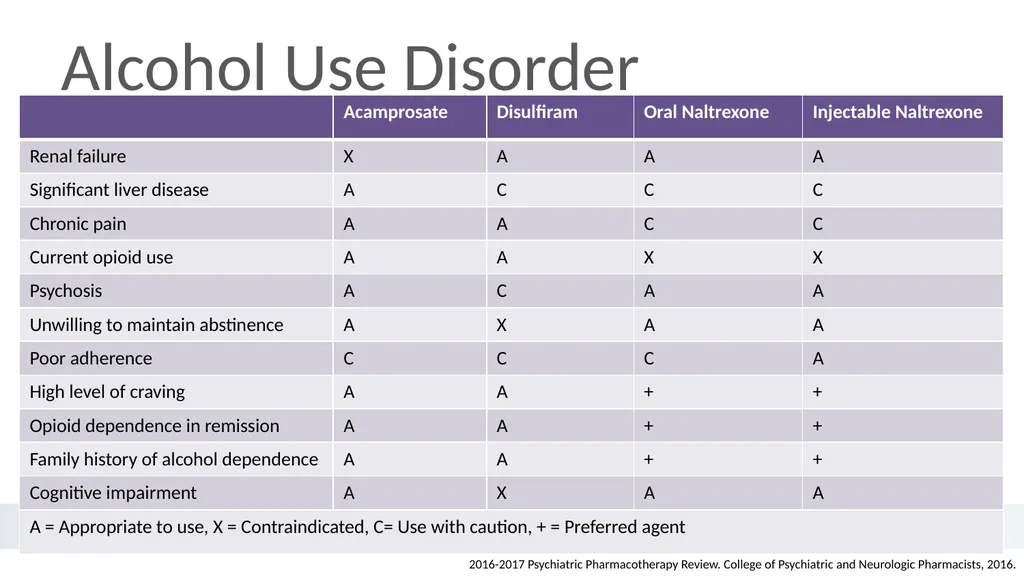
Alcohol Use Disorder 2016-2017 Psychiatric Pharmacotherapy Review. College of Psychiatric and Neurologic Pharmacists, 2016.<br>
98
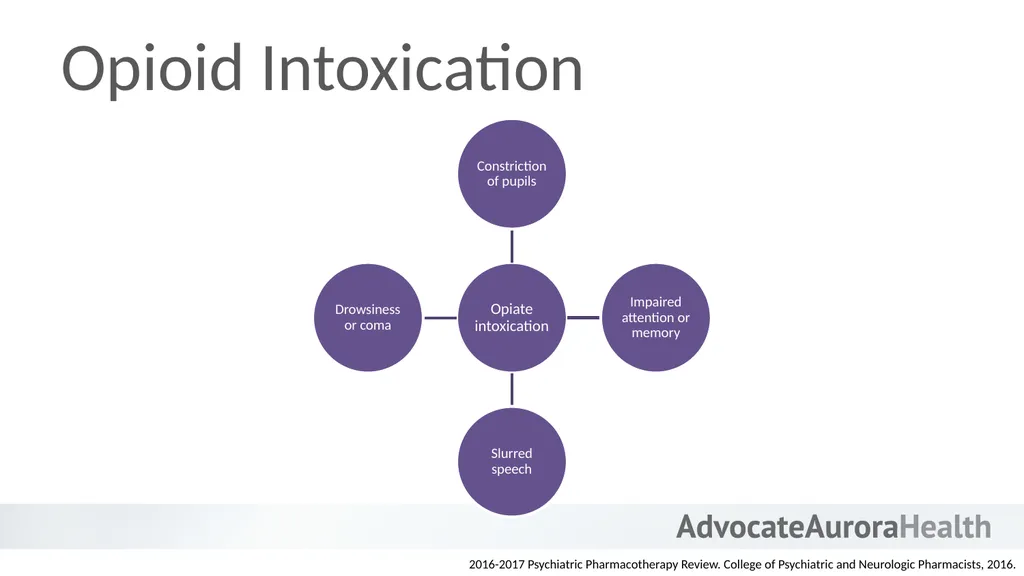
Opioid Intoxication 2016-2017 Psychiatric Pharmacotherapy Review. College of Psychiatric and Neurologic Pharmacists, 2016.<br>
99
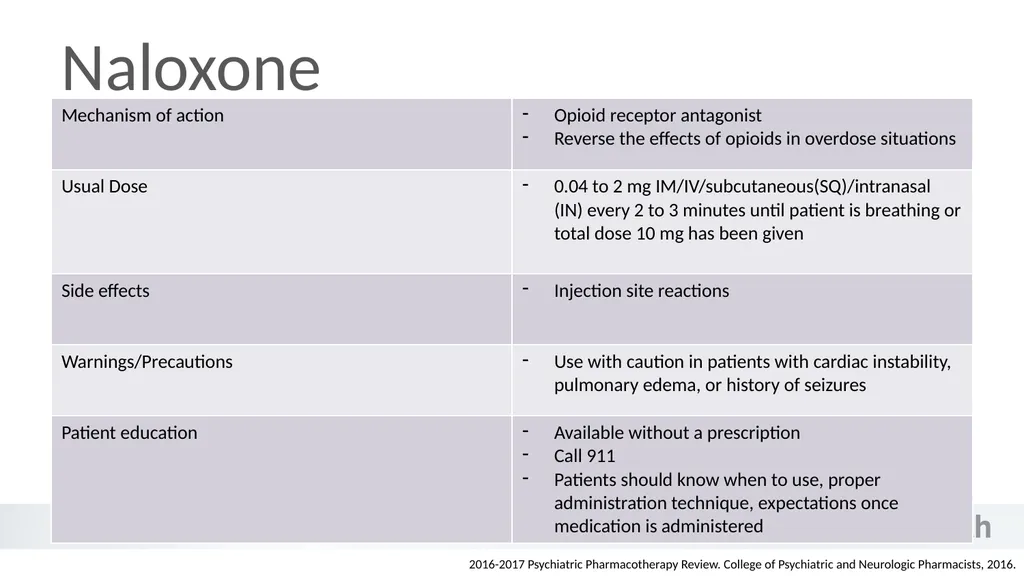
Naloxone 2016-2017 Psychiatric Pharmacotherapy Review. College of Psychiatric and Neurologic Pharmacists, 2016.<br>
100
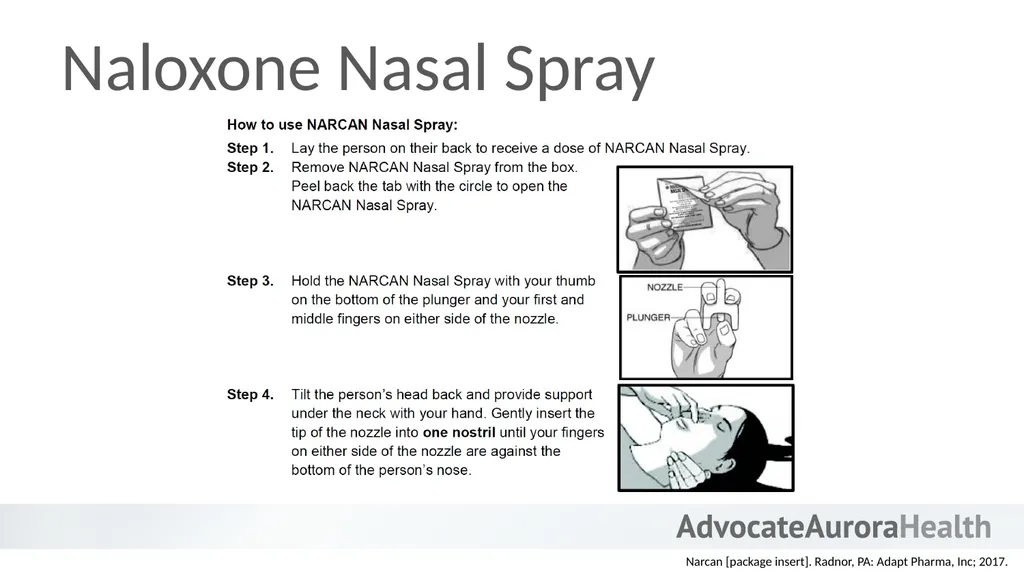
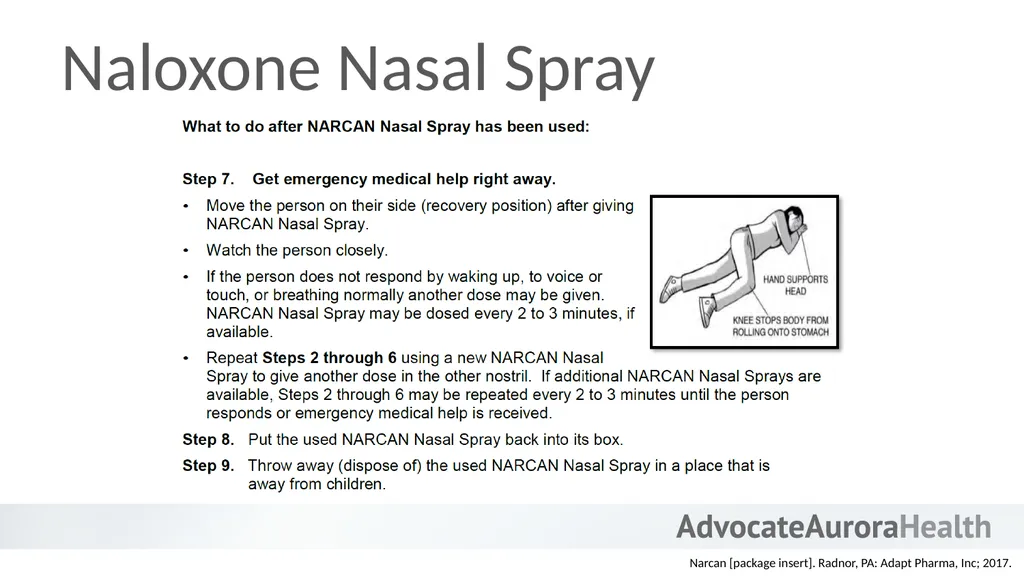
Naloxone Nasal Spray Narcan [package insert]. Radnor, PA: Adapt Pharma, Inc; 2017.<br>
101
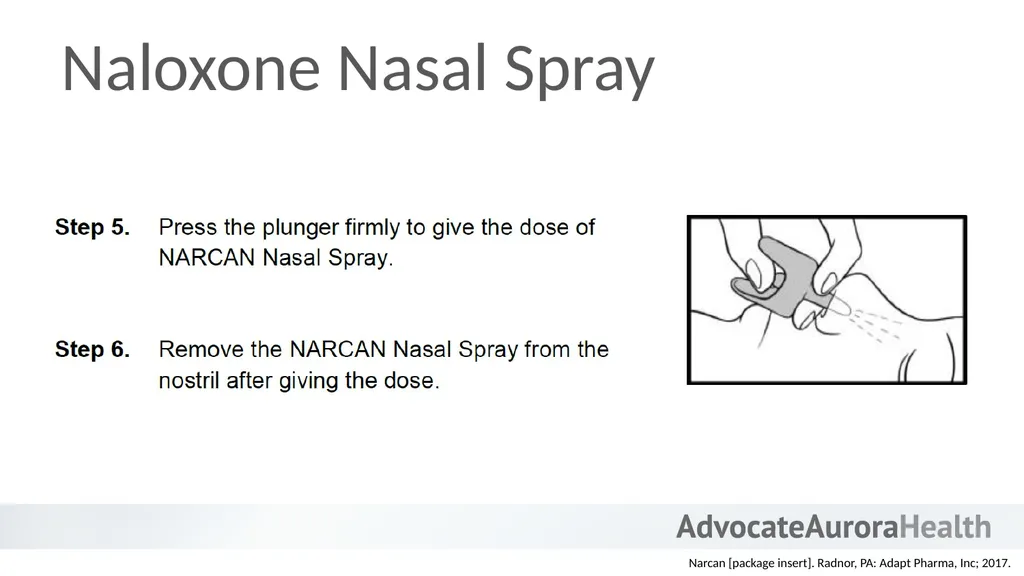
Naloxone Nasal Spray Narcan [package insert]. Radnor, PA: Adapt Pharma, Inc; 2017.<br>
102
Naloxone Nasal Spray Narcan [package insert]. Radnor, PA: Adapt Pharma, Inc; 2017.<br>
103
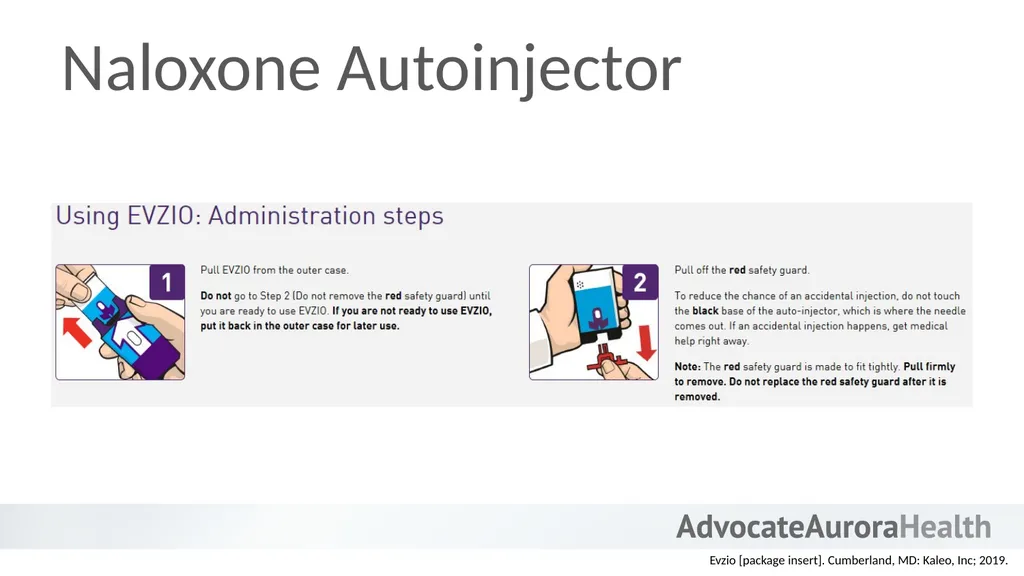
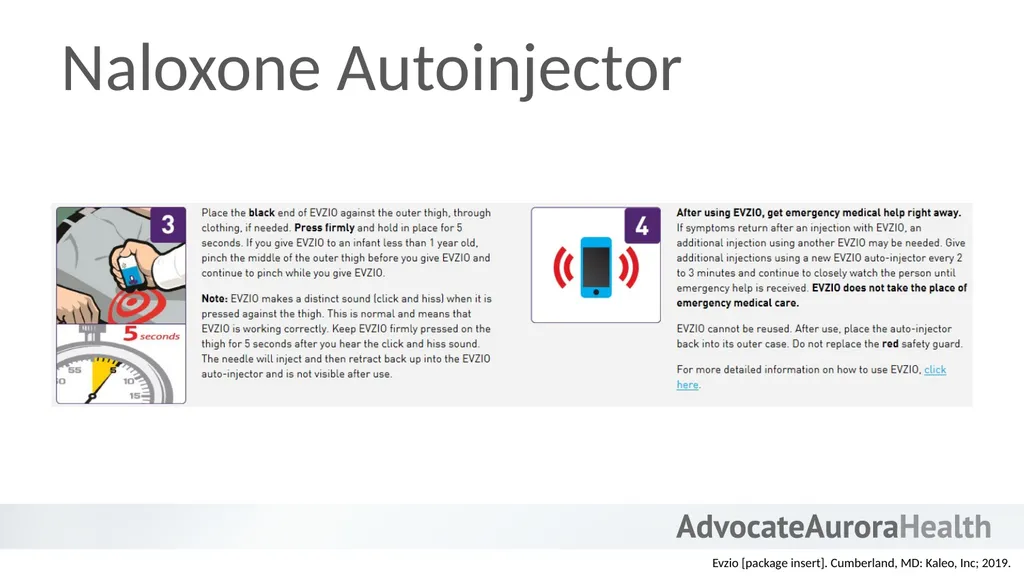
Naloxone Autoinjector Evzio [package insert]. Cumberland, MD: Kaleo, Inc; 2019.<br>
104
Naloxone Autoinjector Evzio [package insert]. Cumberland, MD: Kaleo, Inc; 2019.<br>
105
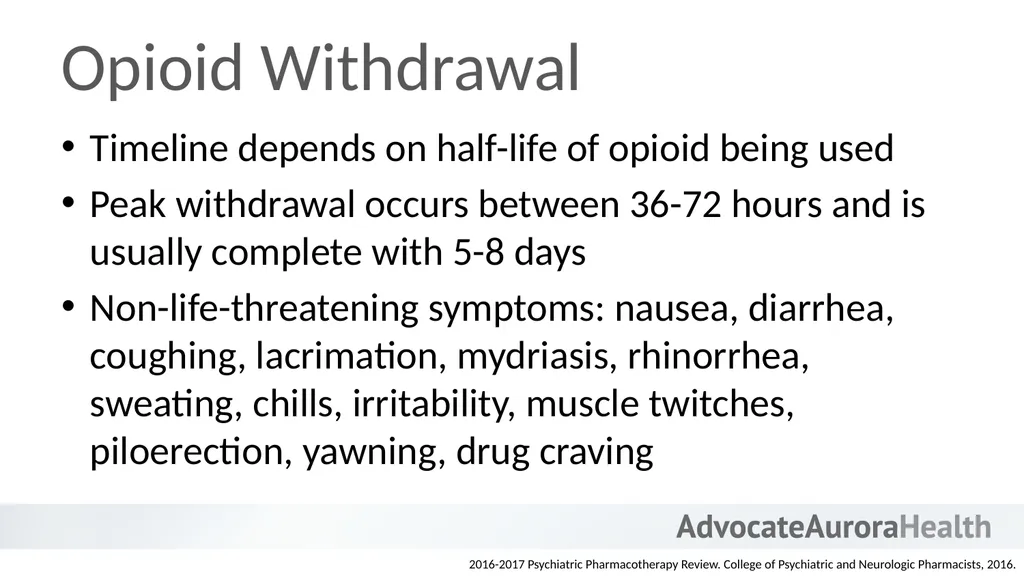
Opioid Withdrawal Timeline depends on half-life of opioid being used
Peak withdrawal occurs between 36-72 hours and is usually complete with 5-8 days
Non-life-threatening symptoms: nausea, diarrhea, coughing, lacrimation, mydriasis, rhinorrhea, sweating, chills, irritability, muscle twitches, piloerection, yawning, drug craving 2016-2017 Psychiatric Pharmacotherapy Review. College of Psychiatric and Neurologic Pharmacists, 2016.<br>
Peak withdrawal occurs between 36-72 hours and is usually complete with 5-8 days
Non-life-threatening symptoms: nausea, diarrhea, coughing, lacrimation, mydriasis, rhinorrhea, sweating, chills, irritability, muscle twitches, piloerection, yawning, drug craving 2016-2017 Psychiatric Pharmacotherapy Review. College of Psychiatric and Neurologic Pharmacists, 2016.<br>
106
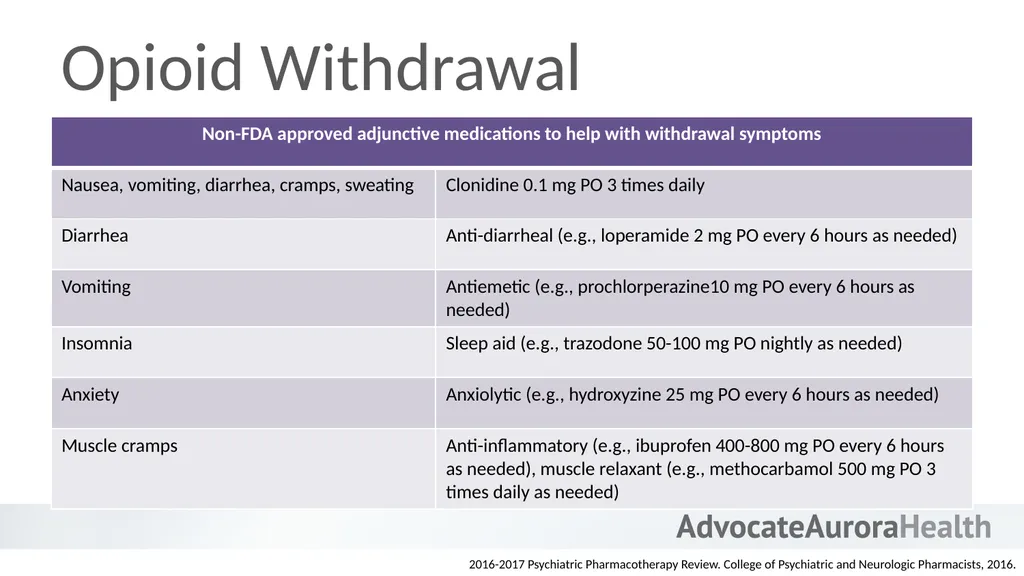
Opioid Withdrawal 2016-2017 Psychiatric Pharmacotherapy Review. College of Psychiatric and Neurologic Pharmacists, 2016.<br>
107
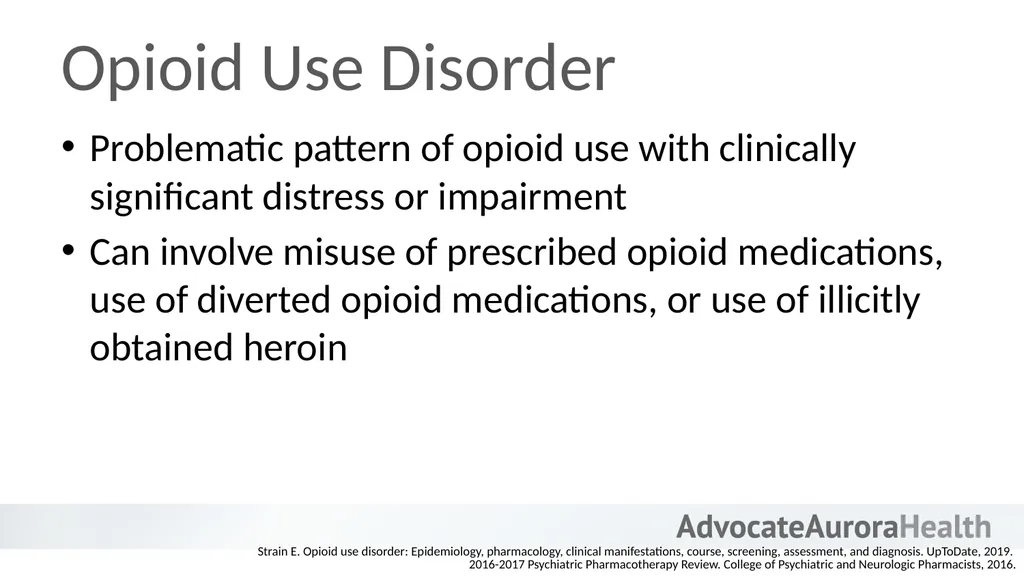
Opioid Use Disorder Problematic pattern of opioid use with clinically significant distress or impairment
Can involve misuse of prescribed opioid medications, use of diverted opioid medications, or use of illicitly obtained heroin 2016-2017 Psychiatric Pharmacotherapy Review. College of Psychiatric and Neurologic Pharmacists, 2016. Strain E. Opioid use disorder: Epidemiology, pharmacology, clinical manifestations, course, screening, assessment, and diagnosis. UpToDate, 2019.<br>
Can involve misuse of prescribed opioid medications, use of diverted opioid medications, or use of illicitly obtained heroin 2016-2017 Psychiatric Pharmacotherapy Review. College of Psychiatric and Neurologic Pharmacists, 2016. Strain E. Opioid use disorder: Epidemiology, pharmacology, clinical manifestations, course, screening, assessment, and diagnosis. UpToDate, 2019.<br>
108
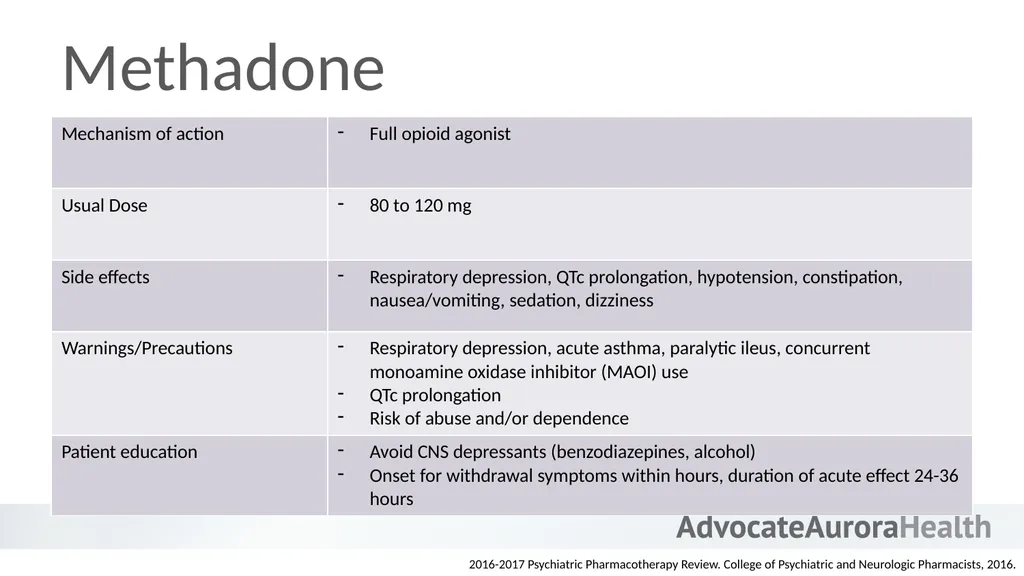
Methadone 2016-2017 Psychiatric Pharmacotherapy Review. College of Psychiatric and Neurologic Pharmacists, 2016.<br>
109
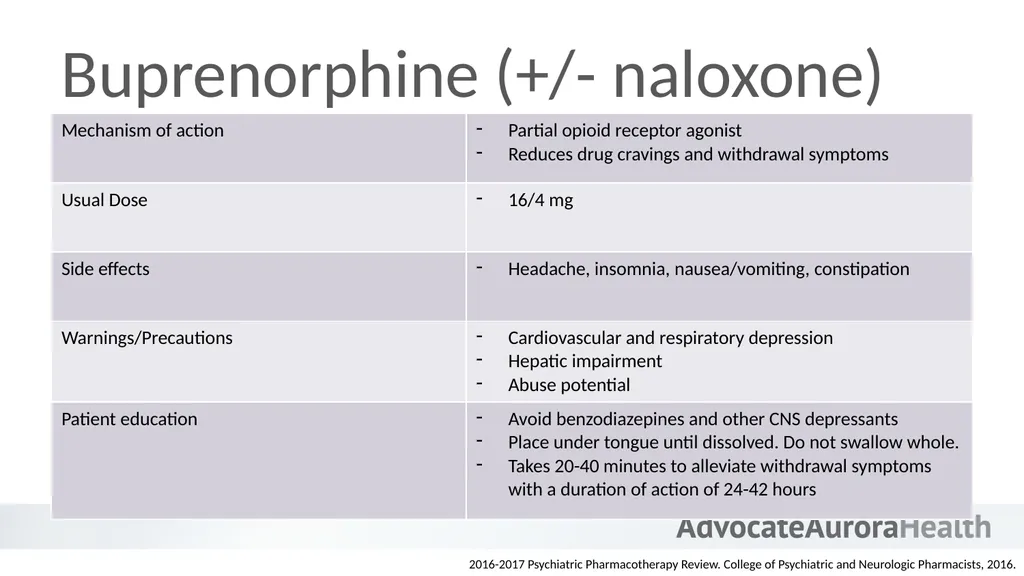
Buprenorphine (+/- naloxone) 2016-2017 Psychiatric Pharmacotherapy Review. College of Psychiatric and Neurologic Pharmacists, 2016.<br>
110
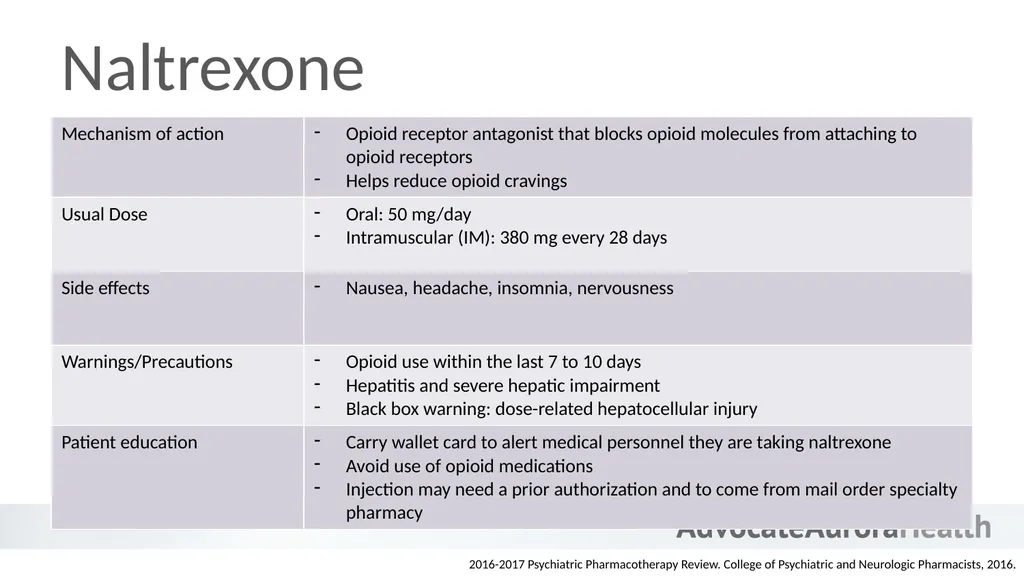
Naltrexone 2016-2017 Psychiatric Pharmacotherapy Review. College of Psychiatric and Neurologic Pharmacists, 2016.<br>
111
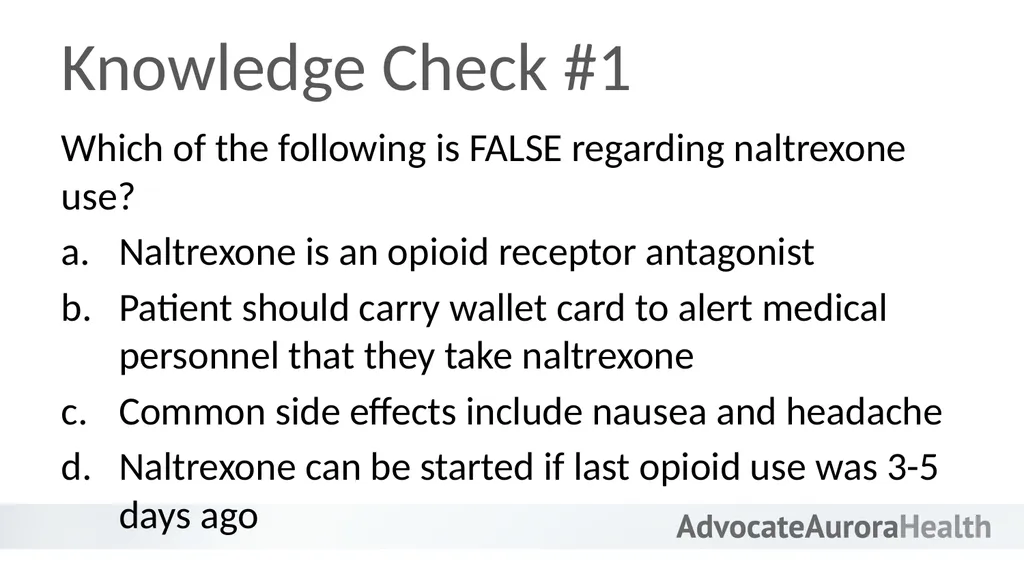
Knowledge Check #1 Which of the following is FALSE regarding naltrexone use?
Naltrexone is an opioid receptor antagonist
Patient should carry wallet card to alert medical personnel that they take naltrexone
Common side effects include nausea and headache
Naltrexone can be started if last opioid use was 3-5 days ago<br>
Naltrexone is an opioid receptor antagonist
Patient should carry wallet card to alert medical personnel that they take naltrexone
Common side effects include nausea and headache
Naltrexone can be started if last opioid use was 3-5 days ago<br>
112
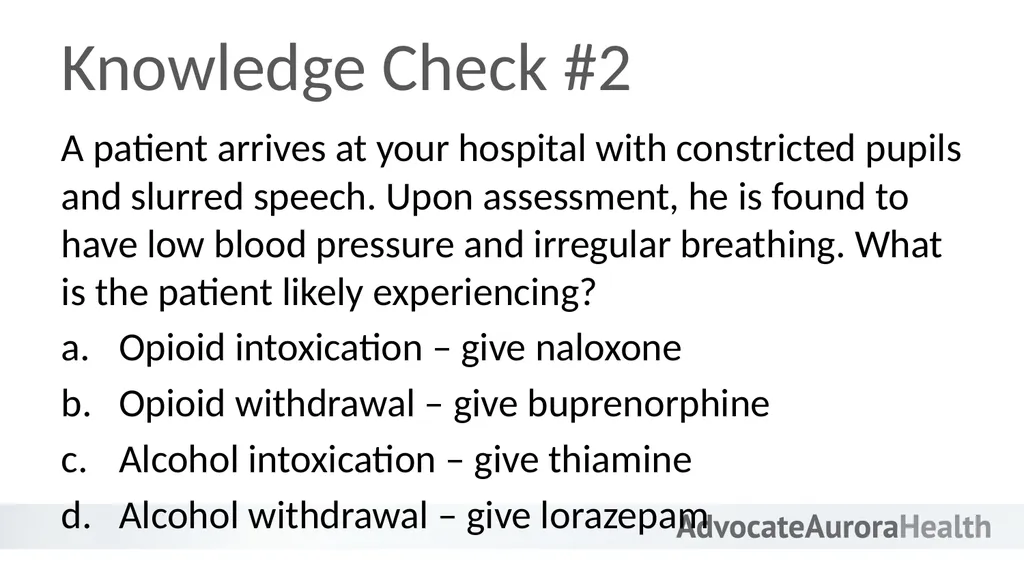
Knowledge Check #2 A patient arrives at your hospital with constricted pupils and slurred speech. Upon assessment, he is found to have low blood pressure and irregular breathing. What is the patient likely experiencing?
Opioid intoxication – give naloxone
Opioid withdrawal – give buprenorphine
Alcohol intoxication – give thiamine
Alcohol withdrawal – give lorazepam<br>
Opioid intoxication – give naloxone
Opioid withdrawal – give buprenorphine
Alcohol intoxication – give thiamine
Alcohol withdrawal – give lorazepam<br>
113
Questions?<br>