04
Conceptual introduction to �latent class analysis (LCA)<br>
05
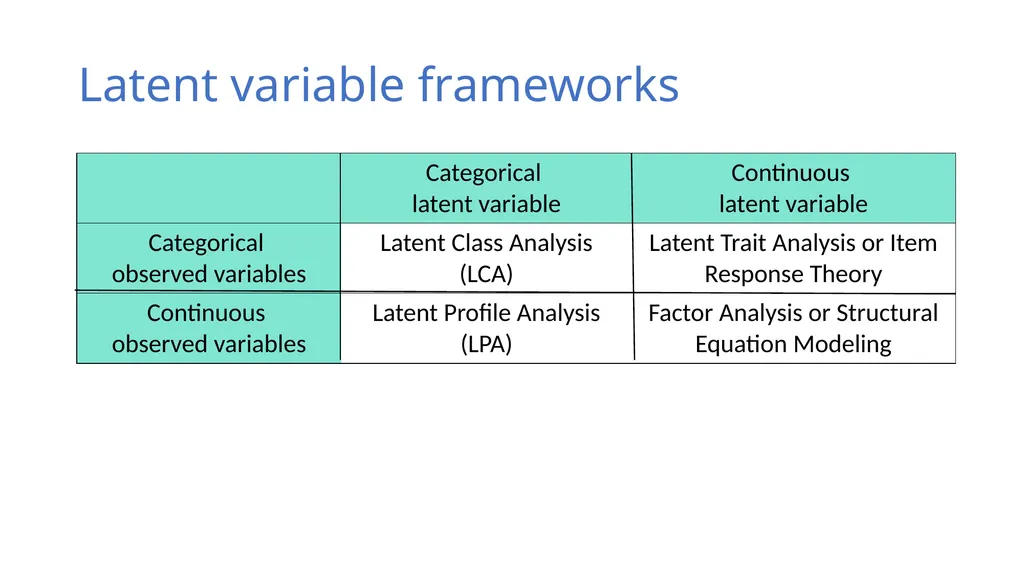
Latent variable frameworks<br>
06
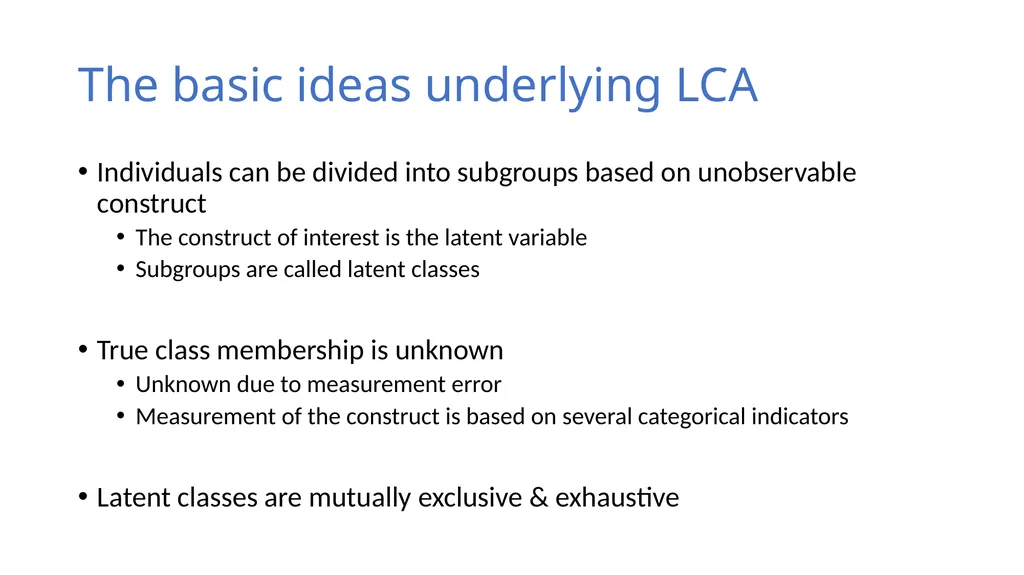
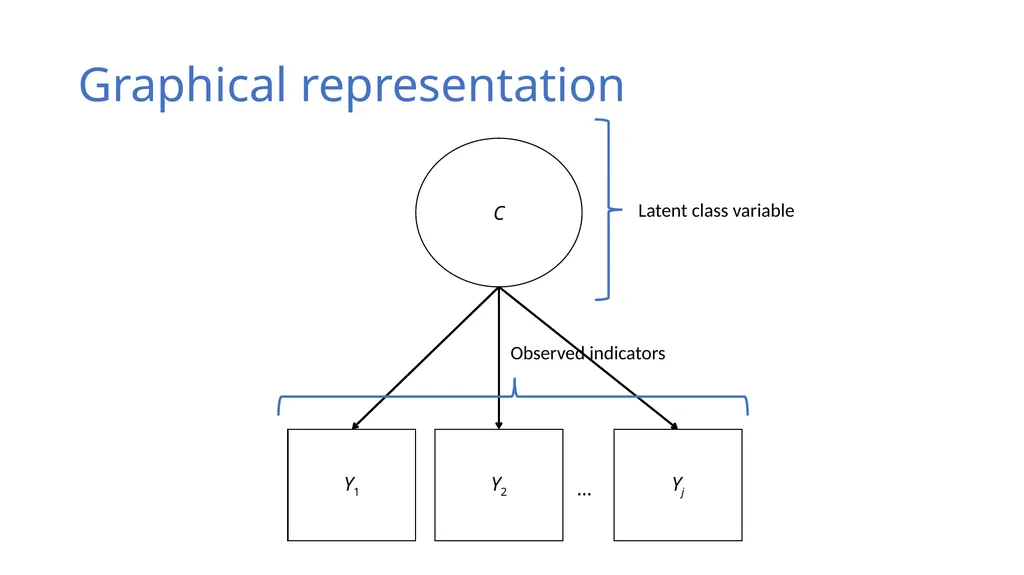
The basic ideas underlying LCA Individuals can be divided into subgroups based on unobservable construct
The construct of interest is the latent variable
Subgroups are called latent classes
True class membership is unknown
Unknown due to measurement error
Measurement of the construct is based on several categorical indicators
Latent classes are mutually exclusive & exhaustive<br>
07
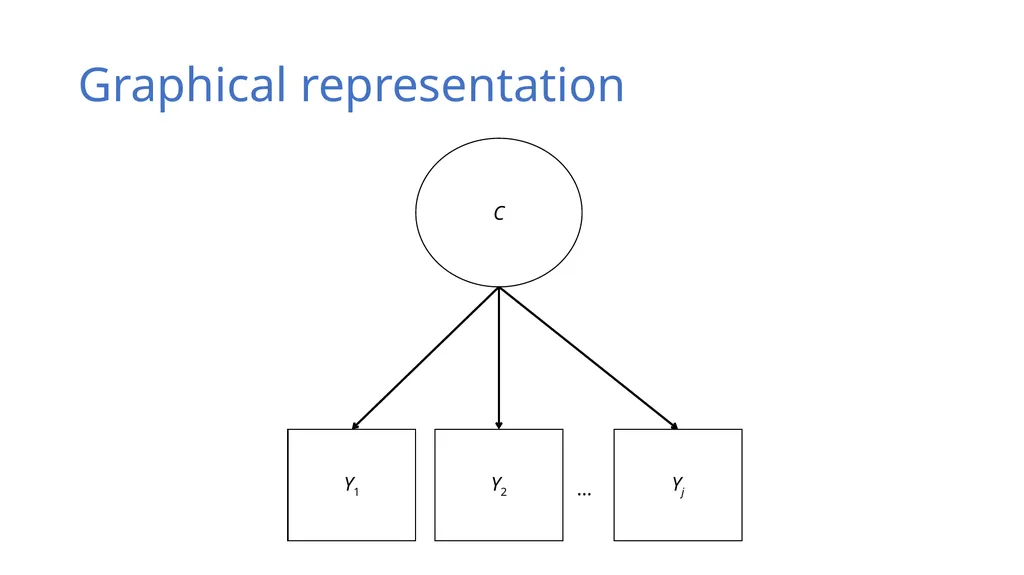
Graphical representation<br>
08
Graphical representation Latent class variable Observed indicators<br>
09
An example:�Latent classes of�adolescent drinking behavior<br>
10
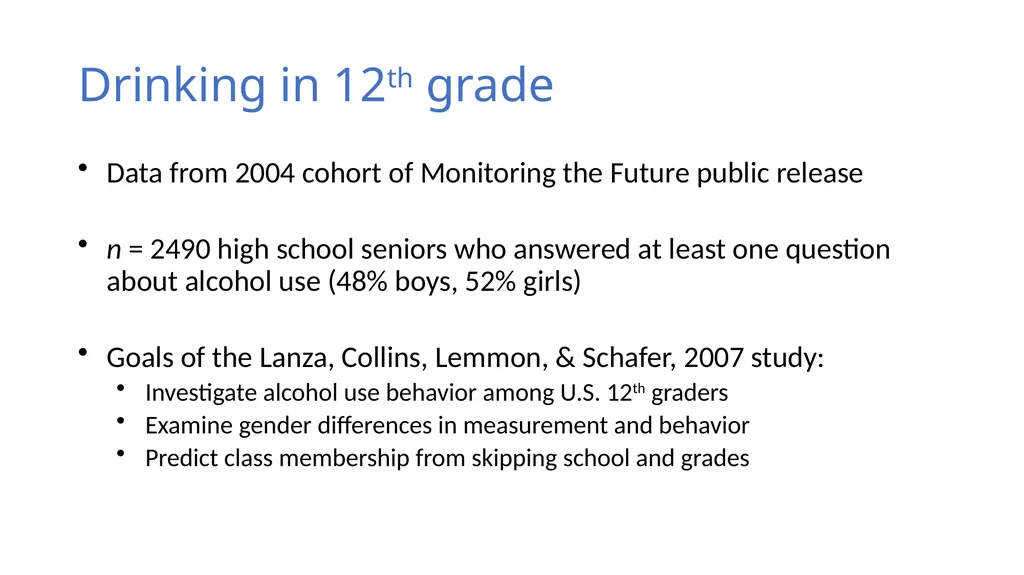
Drinking in 12th grade Data from 2004 cohort of Monitoring the Future public release
n = 2490 high school seniors who answered at least one question about alcohol use (48% boys, 52% girls)
Goals of the Lanza, Collins, Lemmon, & Schafer, 2007 study:
Investigate alcohol use behavior among U.S. 12th graders
Examine gender differences in measurement and behavior
Predict class membership from skipping school and grades<br>
11
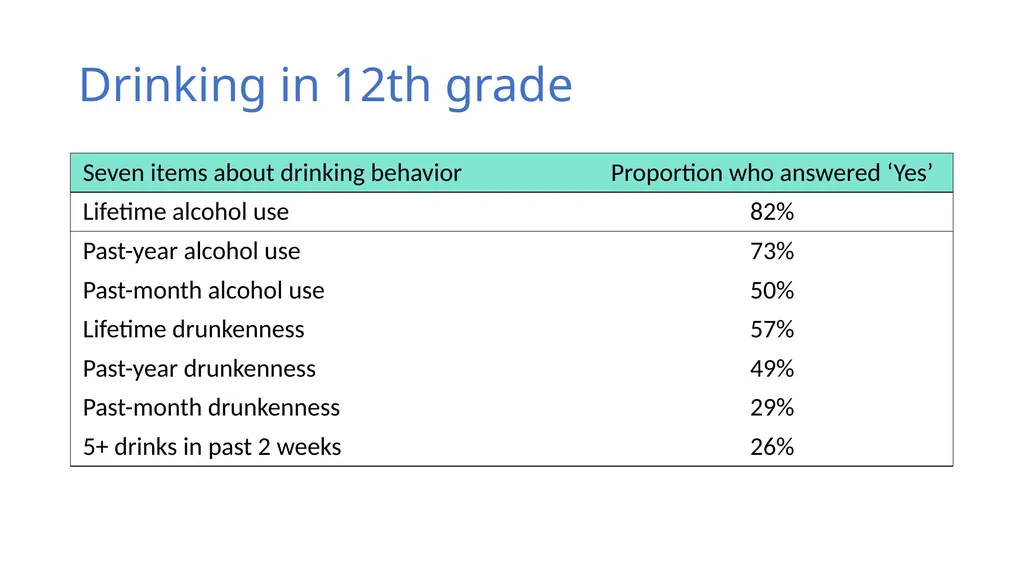
Drinking in 12th grade<br>
12
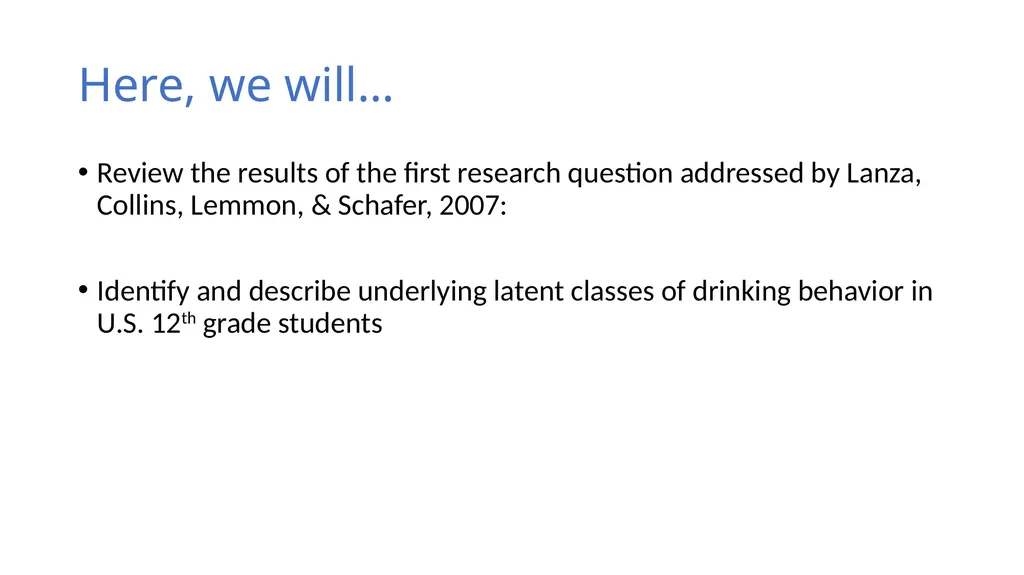
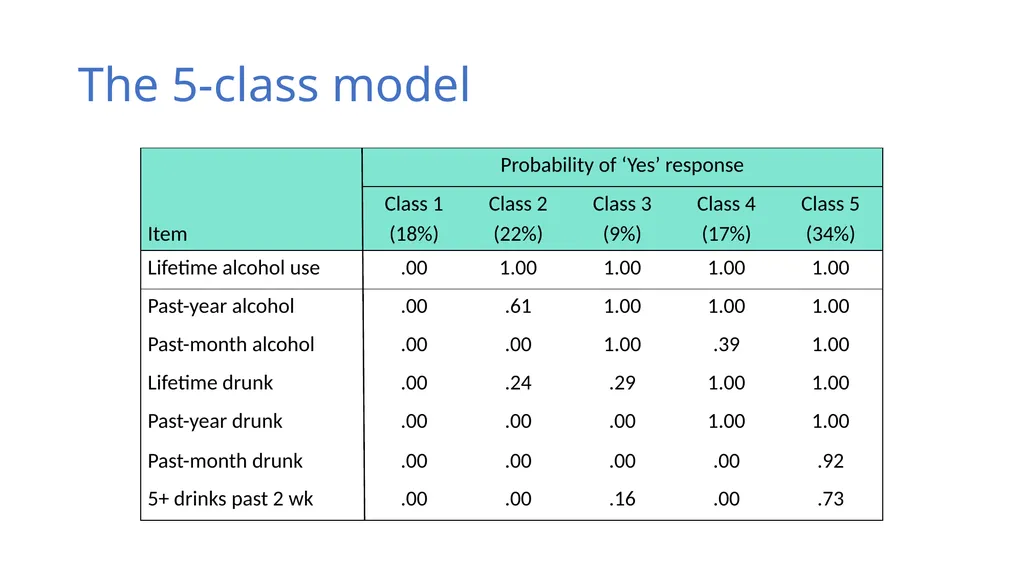
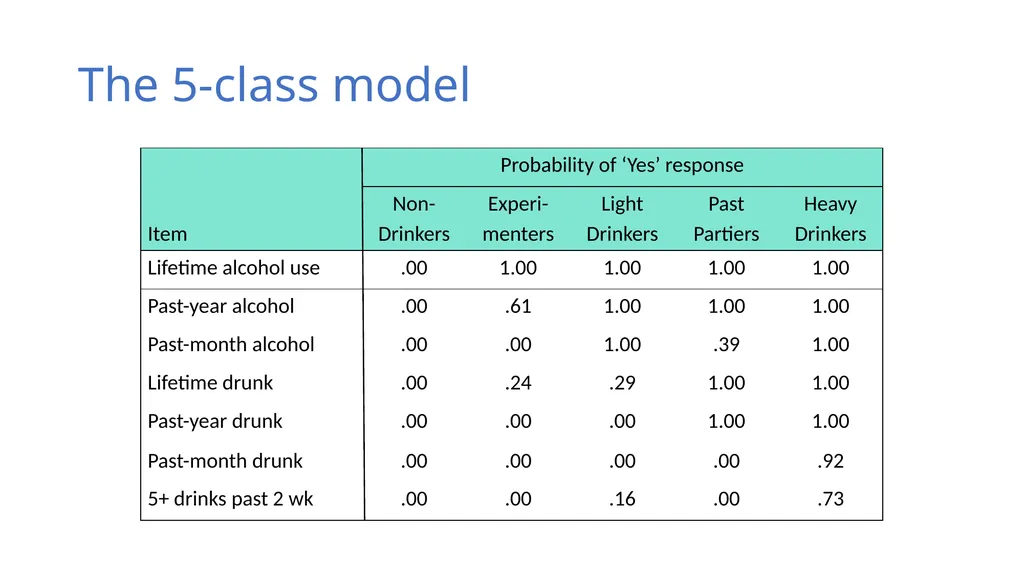
Here, we will… Review the results of the first research question addressed by Lanza, Collins, Lemmon, & Schafer, 2007:
Identify and describe underlying latent classes of drinking behavior in U.S. 12th grade students<br>
15
Types of research questions �LCA can address<br>
16
Weight control strategies (Lanza, Savage, & Birch, 2010) What types of weight-loss strategies are used by women?
Identified classes:�No Weight Loss Strategy (10%)�Dietary Guidelines (27%)�Guidelines + Macronutrients (39%)�Guidelines + Macronutrients + Restrictive (24%)<br>
17
Substance use behaviors (Lanza, Patrick, & Maggs, 2010) What are the substance use behavior profiles among first-year college students?
Identified classes:�Non-users (58%)�Cigarette Smokers (5%)�Binge Drinkers (29%)�Bingers + Marijuana Users (8%)<br>
18
Risky sexual behavior (Lanza & Collins, 2008) What are the profiles of dating and sexual risk-taking behaviors among adolescents and young adults?
Identified classes:�Non-Daters (19%)�Daters (29%)�Monogamous (12%)�Multi-partner Safe Sex (23%)�Multi-Partner STI-Exposed Sex (18%)<br>
19
Ecological risk profiles (Lanza & Rhoades, 2013) What are the patterns of ecological risk factors experienced by adolescents that may help explain �differential response to intervention?
Identified classes:�Low Risk (31%)�Peer Risk (28%)�Economic Risk (20%)�Household + Peer Risk (12%)�Multi-context Risk (8%)<br>
20
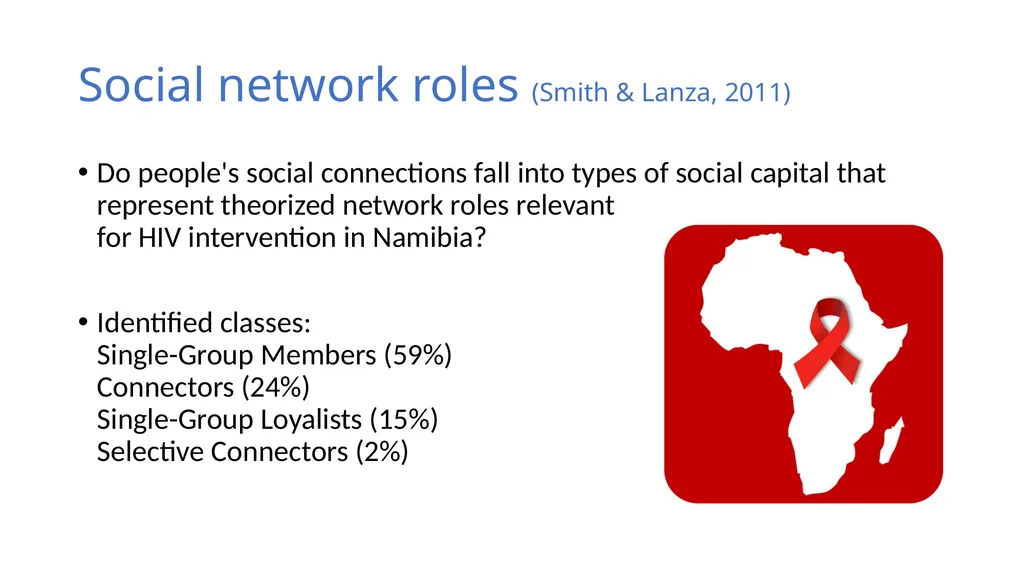
Social network roles (Smith & Lanza, 2011) Do people's social connections fall into types of social capital that �represent theorized network roles relevant�for HIV intervention in Namibia?
Identified classes:�Single-Group Members (59%)�Connectors (24%)�Single-Group Loyalists (15%)�Selective Connectors (2%)<br>
21
Types of data that can be used with LCA<br>
22
Individuals’ responses to multiple items… Using all categorical indicators usually called LCA
Interested in latent class prevalences and item-response probabilities
Using all continuous indicators usually called LPA
Interested in latent profile prevalences and item-response means (and variances)<br>
23
How many indicators can be used? When many indicators with many response options are used, it can be difficult to identify reliably the maximum likelihood estimates
When few indicators with few response options are used, only a very small number of latent classes can be identified
Practically speaking, it is often a good idea to start with 5-12 binary indicators<br>
24
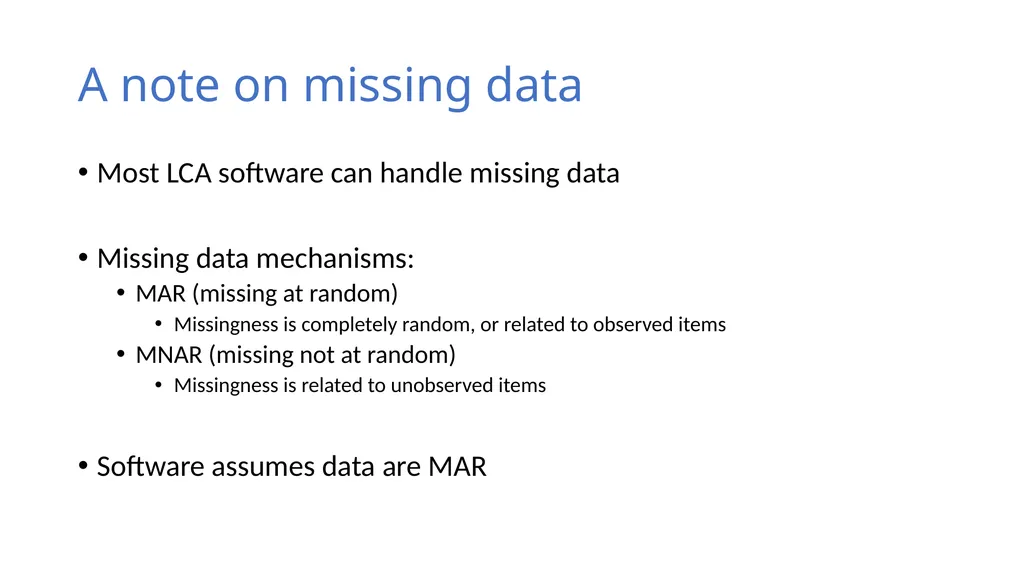
A note on missing data Most LCA software can handle missing data
Missing data mechanisms:
MAR (missing at random)
Missingness is completely random, or related to observed items
MNAR (missing not at random)
Missingness is related to unobserved items
Software assumes data are MAR<br>
25
Parameters estimated in LCA and the LCA mathematical model<br>
26
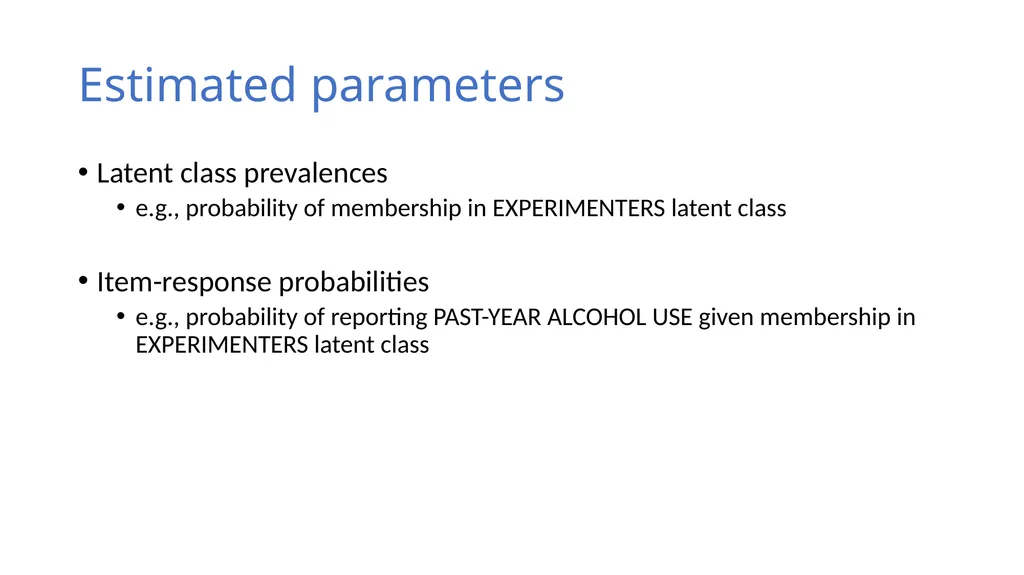
Estimated parameters Latent class prevalences
e.g., probability of membership in EXPERIMENTERS latent class
Item-response probabilities
e.g., probability of reporting PAST-YEAR ALCOHOL USE given membership in EXPERIMENTERS latent class<br>
27
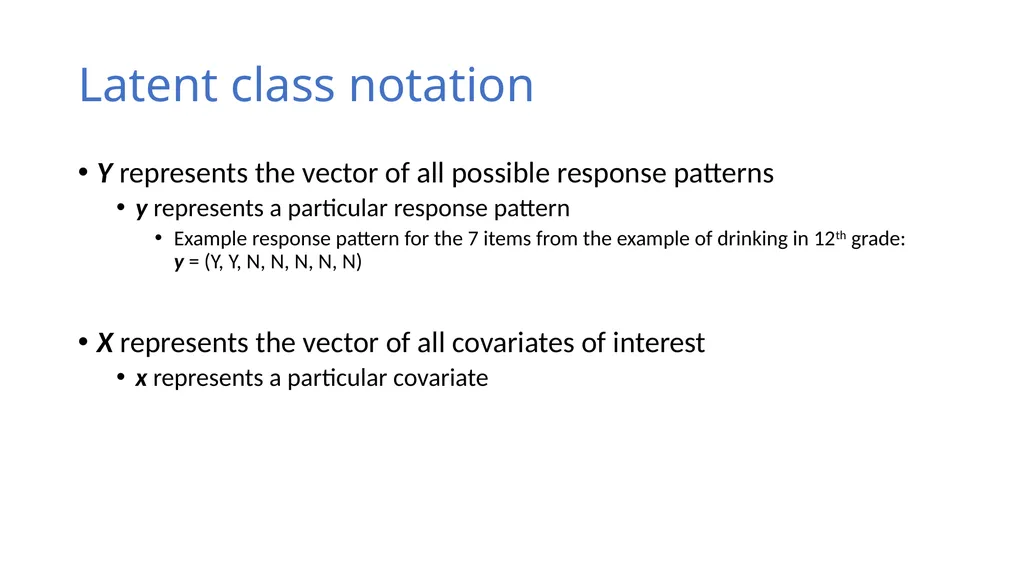
Latent class notation Y represents the vector of all possible response patterns
y represents a particular response pattern
Example response pattern for the 7 items from the example of drinking in 12th grade: �y = (Y, Y, N, N, N, N, N)
X represents the vector of all covariates of interest
x represents a particular covariate<br>
28
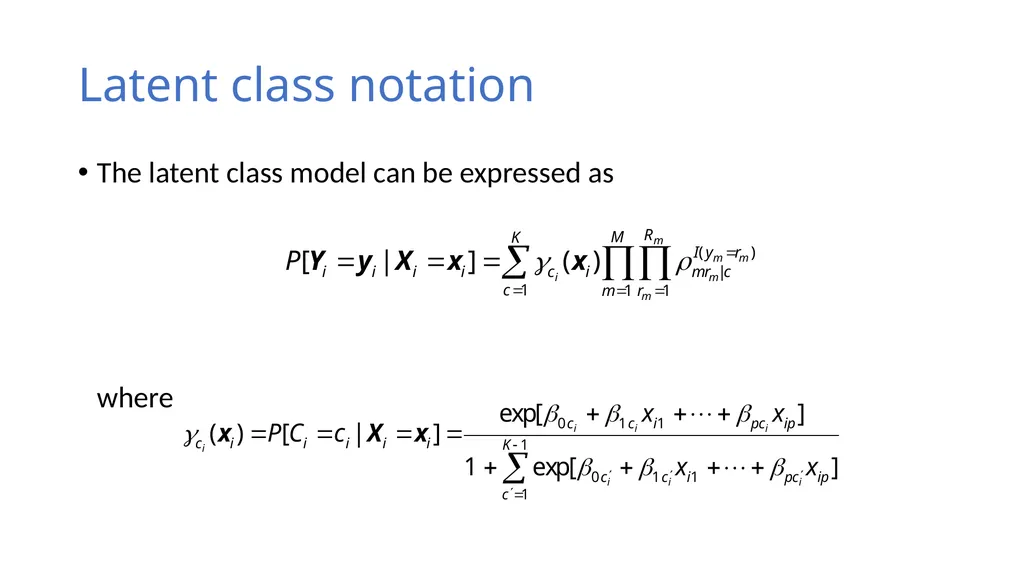
Latent class notation The latent class model can be expressed as�������where<br>
29
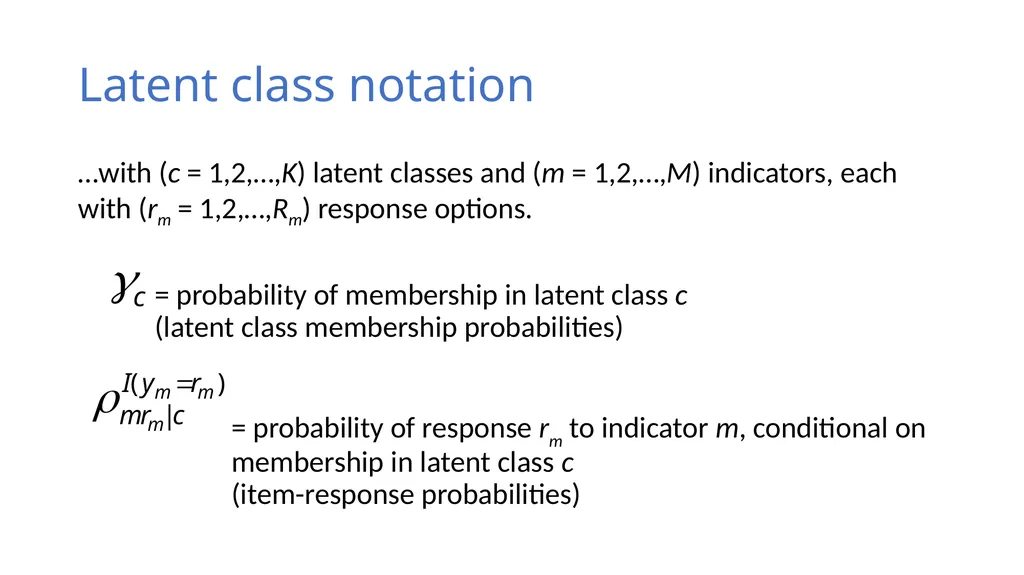
Latent class notation …with (c = 1,2,…,K) latent classes and (m = 1,2,…,M) indicators, each with (rm = 1,2,…,Rm) response options.
= probability of membership in latent class c� (latent class membership probabilities)��� = probability of response rm to indicator m, conditional on� membership in latent class c� (item-response probabilities)<br>
30
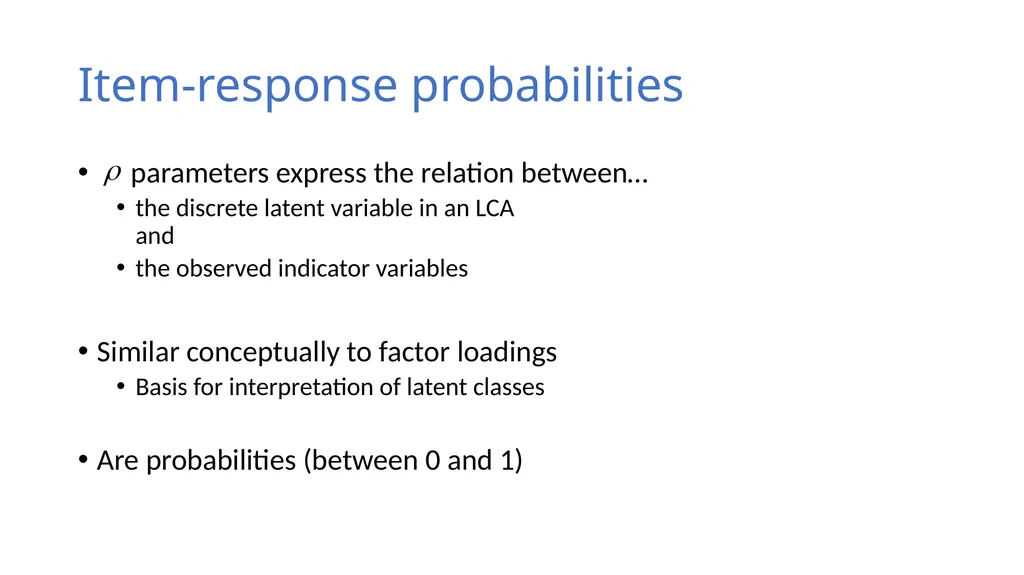
Item-response probabilities parameters express the relation between…
the discrete latent variable in an LCA �and
the observed indicator variables
Similar conceptually to factor loadings
Basis for interpretation of latent classes
Are probabilities (between 0 and 1)<br>
31
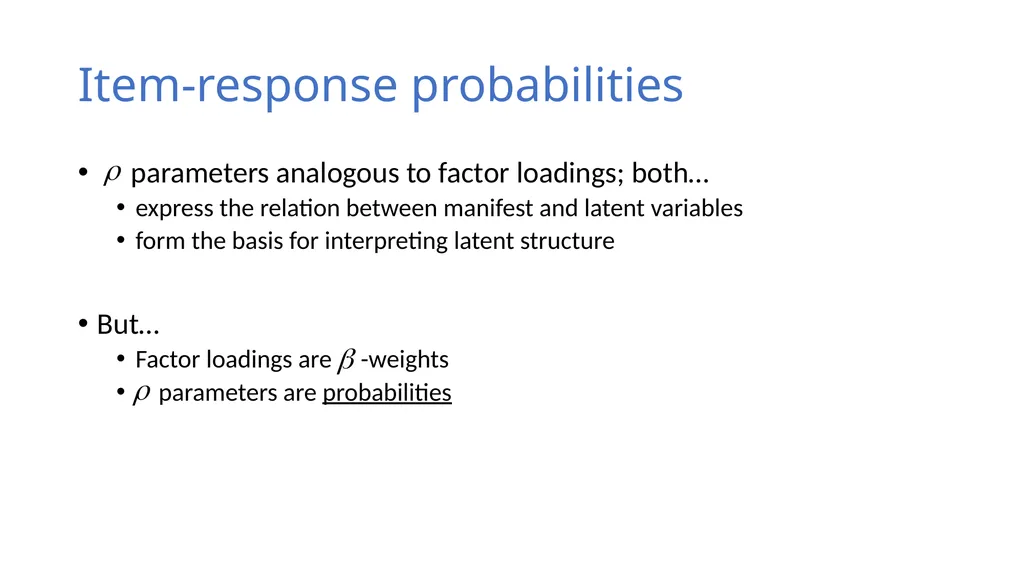
Item-response probabilities parameters analogous to factor loadings; both…
express the relation between manifest and latent variables
form the basis for interpreting latent structure
But…
Factor loadings are -weights
parameters are probabilities<br>
32
Exercise 1 Fitting a latent class model
Interpreting the parameters<br>
33
References Lanza, S. T., & Collins, L. M. (2008). A new SAS procedure for latent transition analysis: Transitions in dating and sexual risk behavior. Developmental Psychology, 44(2), 446.
Lanza, S. T., Collins, L. M., Lemmon, D. R., & Schafer, J. L. (2007). PROC LCA: A SAS procedure for latent class analysis. Structural Equation Modeling, 14(4), 671-694.
Lanza, S. T., Patrick, M. E., & Maggs, J. L. (2010). Latent transition analysis: benefits of a latent variable approach to modeling transitions in substance use. Journal of Drug Issues, 40(1), 93-120.
Lanza, S. T., & Rhoades, B. L. (2013). Latent class analysis: An alternative perspective on subgroup analysis in prevention and treatment. Prevention Science, 14(2), 157-168.
Lanza, S. T., Savage, J. S., & Birch, L. L. (2010). Identification and prediction of latent classes of weight‐loss strategies among women. Obesity, 18(4), 833-840.
Smith, R. A., & Lanza, S. T. (2011). Testing theoretical network classes and HIV-related correlates with latent class analysis. AIDS Care, 23(10), 1274-1281.<br>