
An Introduction to Obstetrical Emergencies Charles
MT
Published · 49 slides · 0 views

1 / 1


Description
An Introduction to Obstetrical Emergencies Charles D Giordano CRNA, MSN My Background One of the first few cadres of CRNAs trained at University of Pittsburgh Nurse Anesthesia Program to be allowed to perform anesthetics on parturient
Related Topics
Share
Embed code
Download this presentation From Below
"An Introduction to Obstetrical Emergencies Charles" is the property of its rightful owner. Permission is granted to download and print the materials on this website for personal, non-commercial use only, and to display it on your personal computer provided you do not modify the materials and that you retain all copyright notices contained in the materials. By downloading content from our website, you accept the terms of this agreement.
Presentation Transcript
01
An Introduction to Obstetrical Emergencies Charles D Giordano CRNA, MSN<br>
02
My Background One of the first few cadre’s of CRNA’s trained at University of Pittsburgh Nurse Anesthesia Program to be “allowed” to perform anesthetics on parturient patients beginning in 2006
2+ years of independent practice as a CRNA
-The Birthplace at Faxton St. Lukes Hospital in Utica NY
-2000+ deliveries a year 24 hr in house call 2011-current
4+ years as the only full time OB/CRNA at Magee Womens Hospital of UPMC
-10,000+ deliveries a year
-Involved in hands on and didactic instruction for the UOPNAP and clinical reorientation to OB for seasoned CRNA’s in the system<br>
2+ years of independent practice as a CRNA
-The Birthplace at Faxton St. Lukes Hospital in Utica NY
-2000+ deliveries a year 24 hr in house call 2011-current
4+ years as the only full time OB/CRNA at Magee Womens Hospital of UPMC
-10,000+ deliveries a year
-Involved in hands on and didactic instruction for the UOPNAP and clinical reorientation to OB for seasoned CRNA’s in the system<br>
03
My Background 2nd Generation OB/CRNA
Following in the footsteps of Charles A Giordano
40+ years of experience
Overall good guy
Management of Emergencies
14 combined years of Active Duty and Reserve Military experience
STICU, C4, TNCC, SAMMC
Deployed FST Philippines 2010 sole anesthesia provider for area
Philippine casualties
Austere environment
UPMC
Call team, OB
Cultivation of “6th Sense” follow your gut!<br>
Following in the footsteps of Charles A Giordano
40+ years of experience
Overall good guy
Management of Emergencies
14 combined years of Active Duty and Reserve Military experience
STICU, C4, TNCC, SAMMC
Deployed FST Philippines 2010 sole anesthesia provider for area
Philippine casualties
Austere environment
UPMC
Call team, OB
Cultivation of “6th Sense” follow your gut!<br>
04
Giuliana S. Giordano 8/9/2010 31 weeks
Partial Abruption
Missed her birth by 1.5hrs
Mom had a PPH
30 Days in the NICU Emmeline J. Giordano 10/25/2015
Full Term
C/S semi-scheduled
I MADE IT!!!!<br>
Partial Abruption
Missed her birth by 1.5hrs
Mom had a PPH
30 Days in the NICU Emmeline J. Giordano 10/25/2015
Full Term
C/S semi-scheduled
I MADE IT!!!!<br>
05
Objectives Understanding of Common OB emergencies and Anesthetic Implications for each
Ante-partum (before)
Intra-partum (during)
Post-partum (after)<br>
Ante-partum (before)
Intra-partum (during)
Post-partum (after)<br>
06
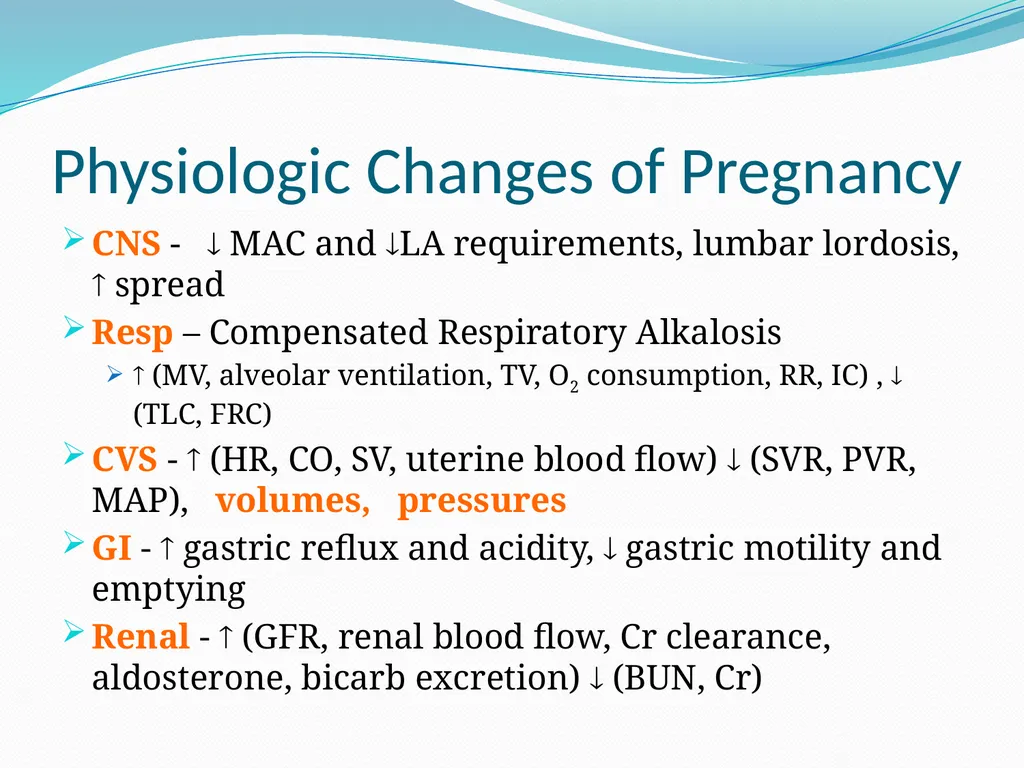
Physiologic Changes of Pregnancy CNS - MAC and LA requirements, lumbar lordosis, spread
Resp – Compensated Respiratory Alkalosis
(MV, alveolar ventilation, TV, O2 consumption, RR, IC) , (TLC, FRC)
CVS - (HR, CO, SV, uterine blood flow) (SVR, PVR, MAP), volumes, pressures
GI - gastric reflux and acidity, gastric motility and emptying
Renal - (GFR, renal blood flow, Cr clearance, aldosterone, bicarb excretion) (BUN, Cr)<br>
Resp – Compensated Respiratory Alkalosis
(MV, alveolar ventilation, TV, O2 consumption, RR, IC) , (TLC, FRC)
CVS - (HR, CO, SV, uterine blood flow) (SVR, PVR, MAP), volumes, pressures
GI - gastric reflux and acidity, gastric motility and emptying
Renal - (GFR, renal blood flow, Cr clearance, aldosterone, bicarb excretion) (BUN, Cr)<br>
07
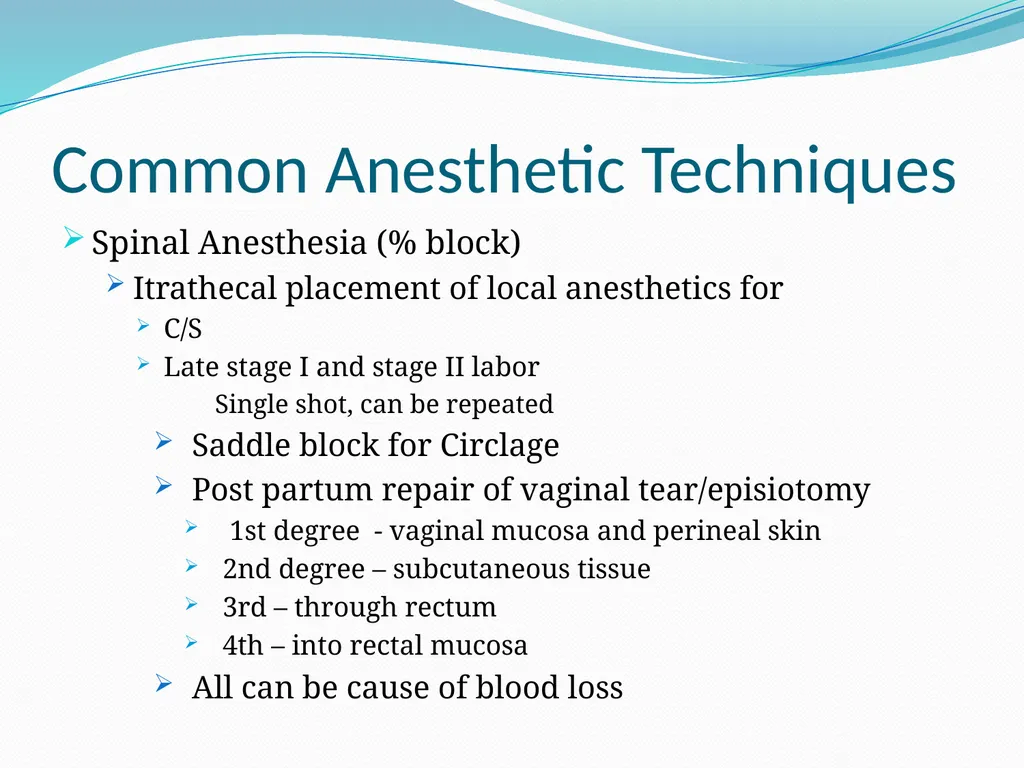
Common Anesthetic Techniques Spinal Anesthesia (% block)
Itrathecal placement of local anesthetics for
C/S
Late stage I and stage II labor
Single shot, can be repeated
Saddle block for Circlage
Post partum repair of vaginal tear/episiotomy
1st degree - vaginal mucosa and perineal skin
2nd degree – subcutaneous tissue
3rd – through rectum
4th – into rectal mucosa
All can be cause of blood loss<br>
Itrathecal placement of local anesthetics for
C/S
Late stage I and stage II labor
Single shot, can be repeated
Saddle block for Circlage
Post partum repair of vaginal tear/episiotomy
1st degree - vaginal mucosa and perineal skin
2nd degree – subcutaneous tissue
3rd – through rectum
4th – into rectal mucosa
All can be cause of blood loss<br>
08
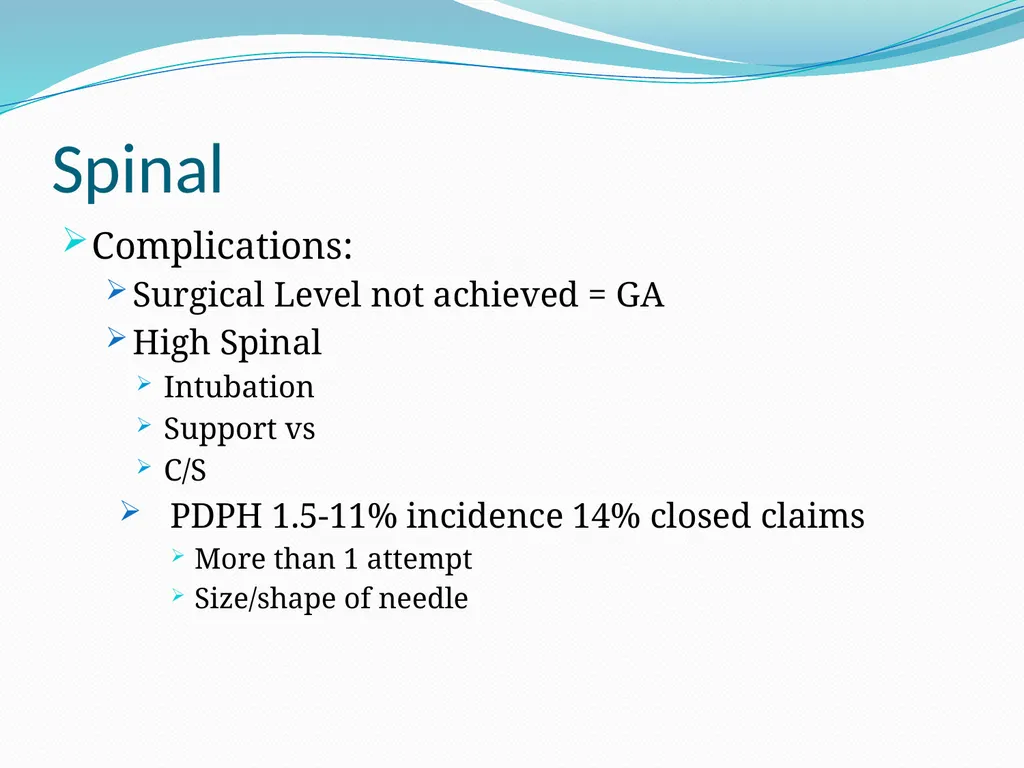
Spinal Complications:
Surgical Level not achieved = GA
High Spinal
Intubation
Support vs
C/S
PDPH 1.5-11% incidence 14% closed claims
More than 1 attempt
Size/shape of needle<br>
Surgical Level not achieved = GA
High Spinal
Intubation
Support vs
C/S
PDPH 1.5-11% incidence 14% closed claims
More than 1 attempt
Size/shape of needle<br>
09
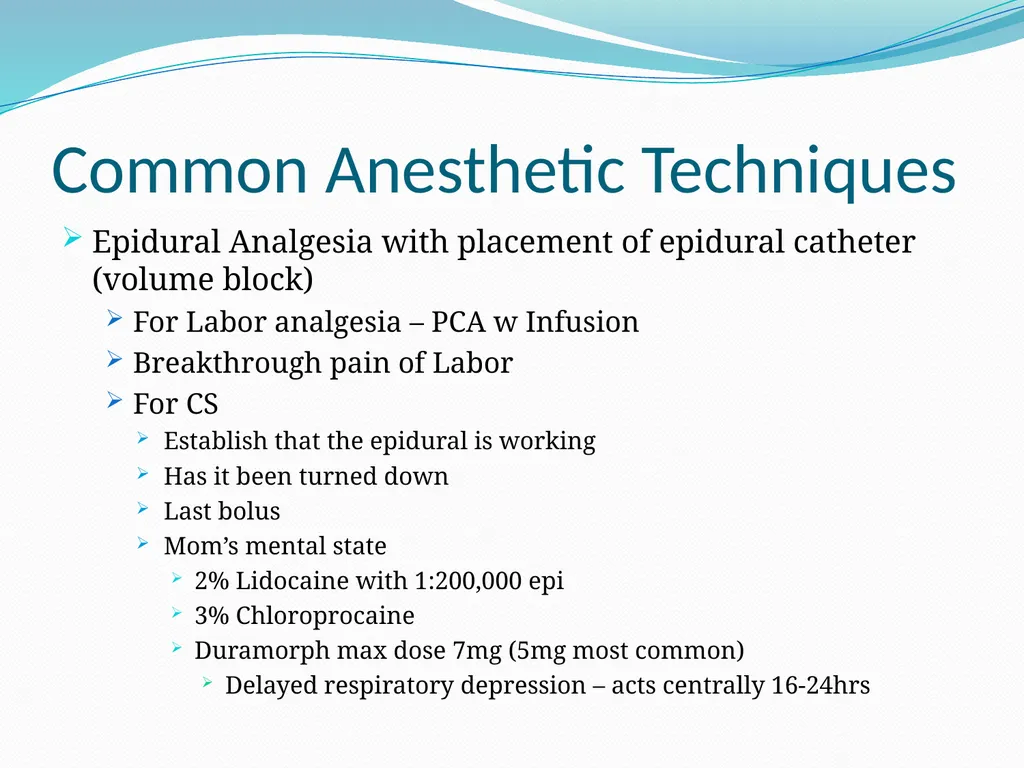
Common Anesthetic Techniques Epidural Analgesia with placement of epidural catheter (volume block)
For Labor analgesia – PCA w Infusion
Breakthrough pain of Labor
For CS
Establish that the epidural is working
Has it been turned down
Last bolus
Mom’s mental state
2% Lidocaine with 1:200,000 epi
3% Chloroprocaine
Duramorph max dose 7mg (5mg most common)
Delayed respiratory depression – acts centrally 16-24hrs<br>
For Labor analgesia – PCA w Infusion
Breakthrough pain of Labor
For CS
Establish that the epidural is working
Has it been turned down
Last bolus
Mom’s mental state
2% Lidocaine with 1:200,000 epi
3% Chloroprocaine
Duramorph max dose 7mg (5mg most common)
Delayed respiratory depression – acts centrally 16-24hrs<br>
10
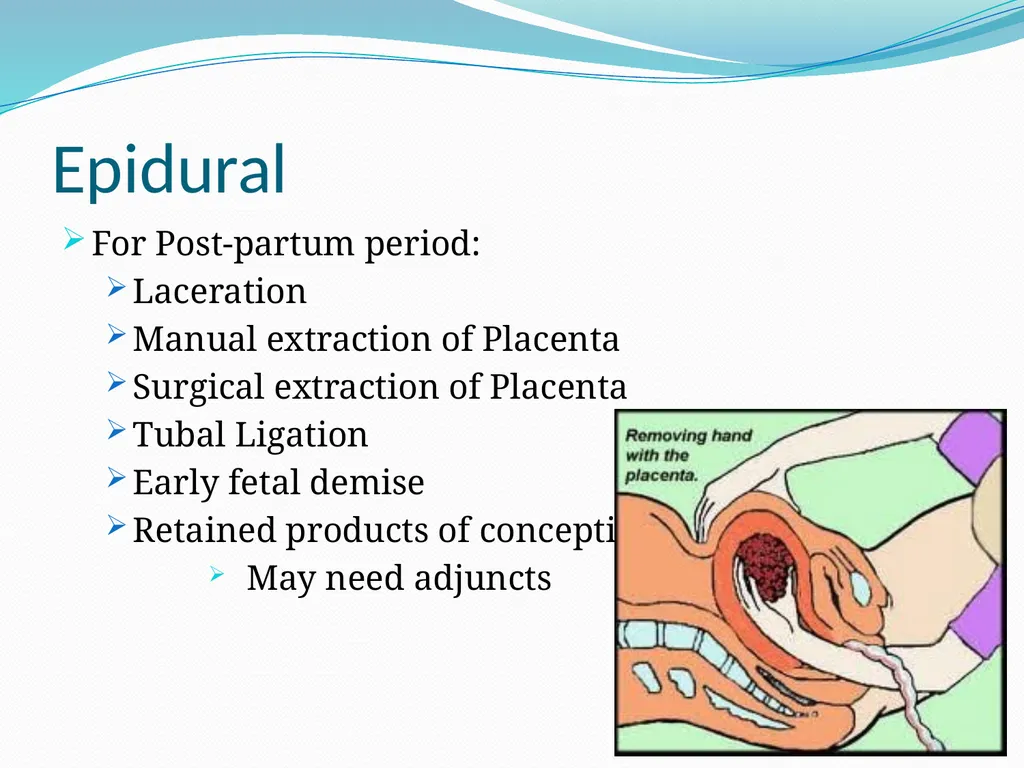
Epidural For Post-partum period:
Laceration
Manual extraction of Placenta
Surgical extraction of Placenta
Tubal Ligation
Early fetal demise
Retained products of conception
May need adjuncts<br>
Laceration
Manual extraction of Placenta
Surgical extraction of Placenta
Tubal Ligation
Early fetal demise
Retained products of conception
May need adjuncts<br>
11
Epidural Complications
Failed regional
Spinal vs GA
Vascular insertion
SA insertion
High Block
Epidural PDPH – 52% after “Wet Tap” 1-2% W/O
Epidural Hematoma<br>
Failed regional
Spinal vs GA
Vascular insertion
SA insertion
High Block
Epidural PDPH – 52% after “Wet Tap” 1-2% W/O
Epidural Hematoma<br>
12
Epidural Blood Patch 10-20 cc autologous blood inserted into the epidural space to decrease PDPH
Epidural space found
Blood drawn in a sterile fashion
Inject in epidural space until patient is uncomfortable or 20cc
May be done up to three times
Consider neurology consult with second attempt
Conservative measures until 48-72 hours post-puncture
Caffeine
Hydration
Immobility
Smokers
NSAIDS and tylenol<br>
Epidural space found
Blood drawn in a sterile fashion
Inject in epidural space until patient is uncomfortable or 20cc
May be done up to three times
Consider neurology consult with second attempt
Conservative measures until 48-72 hours post-puncture
Caffeine
Hydration
Immobility
Smokers
NSAIDS and tylenol<br>
13
Back Pain A 9lb fetus having been forcibly expelled into the world through a 8lb pelvis has been known to cause back pain and transient neuropathy
That being said:
S/S of infection?
Persistent pain and neuropathy?
Any question of epidural hematoma?
Co-morbidities = bleeding
Check it out!<br>
That being said:
S/S of infection?
Persistent pain and neuropathy?
Any question of epidural hematoma?
Co-morbidities = bleeding
Check it out!<br>
14
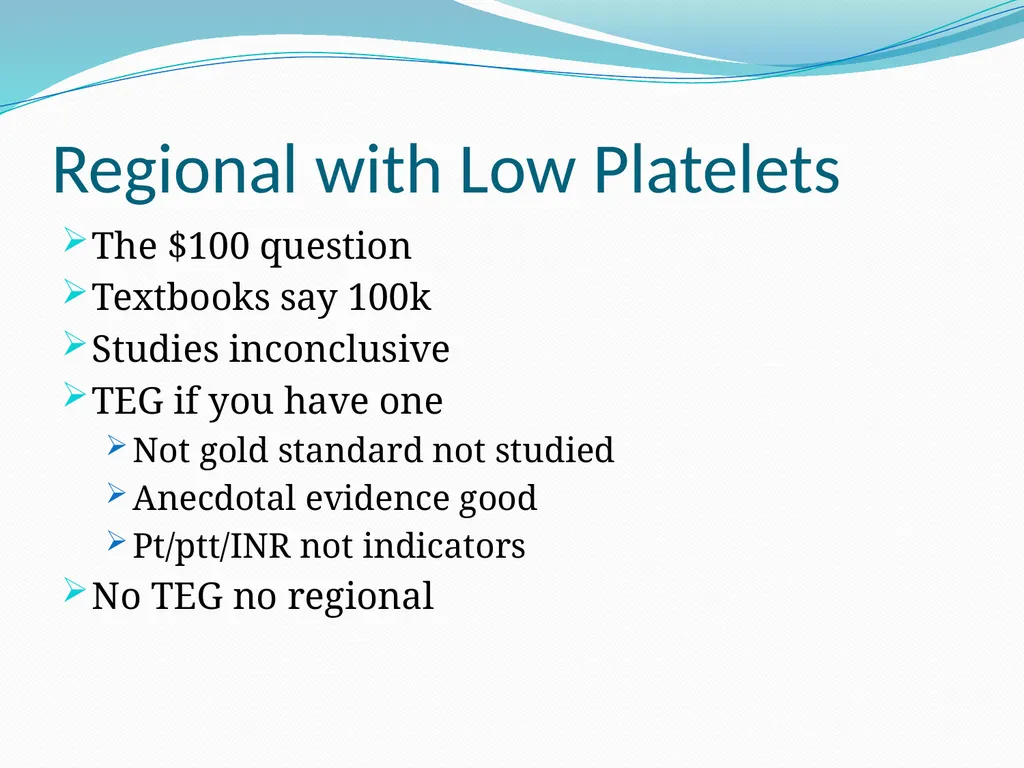
Regional with Low Platelets The $100 question
Textbooks say 100k
Studies inconclusive
TEG if you have one
Not gold standard not studied
Anecdotal evidence good
Pt/ptt/INR not indicators
No TEG no regional<br>
Textbooks say 100k
Studies inconclusive
TEG if you have one
Not gold standard not studied
Anecdotal evidence good
Pt/ptt/INR not indicators
No TEG no regional<br>
15
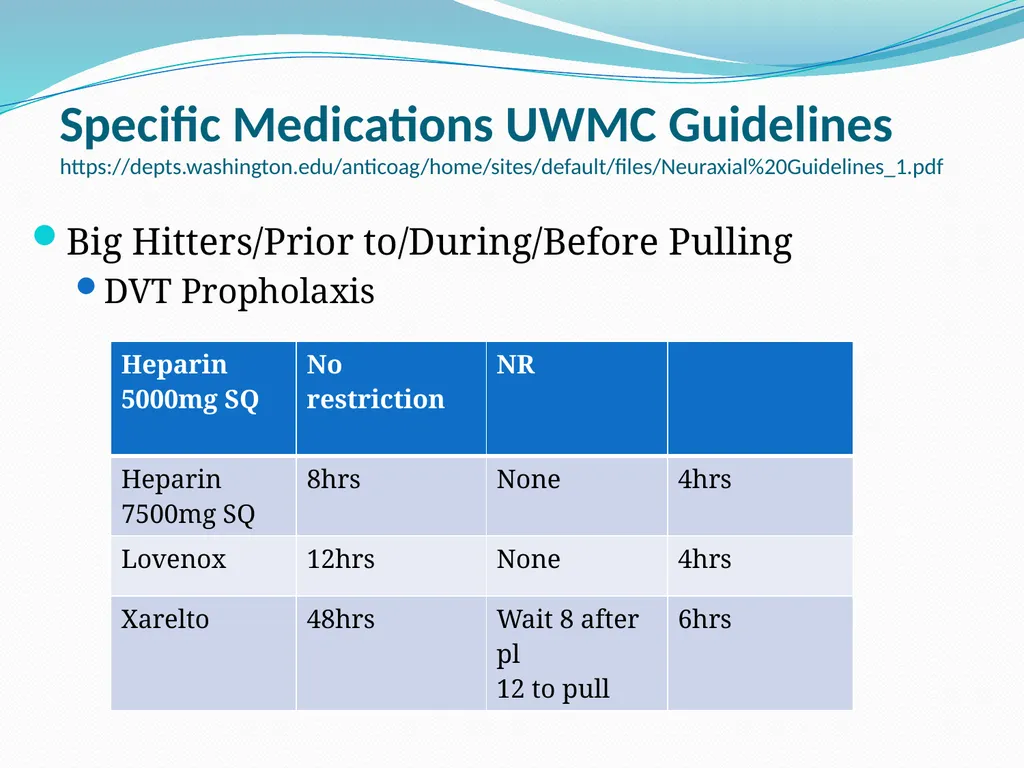
Specific Medications UWMC Guidelines
https://depts.washington.edu/anticoag/home/sites/default/files/Neuraxial%20Guidelines_1.pdf Big Hitters/Prior to/During/Before Pulling
DVT Propholaxis<br>
DVT Propholaxis<br>
16
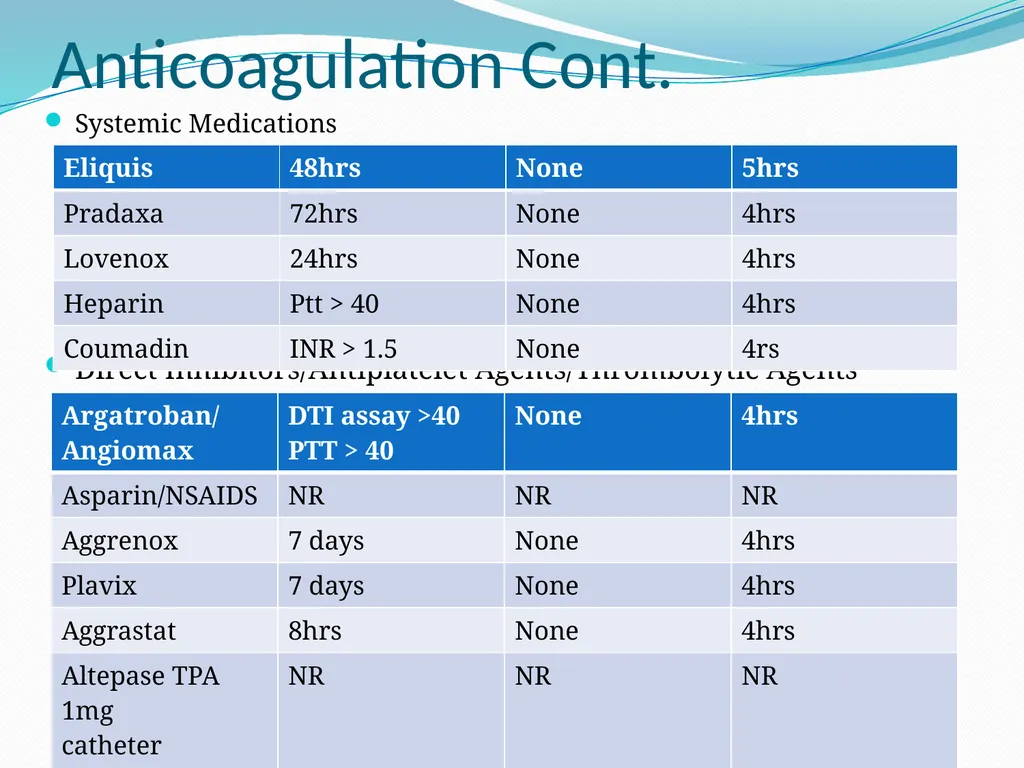
Anticoagulation Cont. Systemic Medications
Direct Inhibitors/Antiplatelet Agents/Thrombolytic Agents<br>
Direct Inhibitors/Antiplatelet Agents/Thrombolytic Agents<br>
17
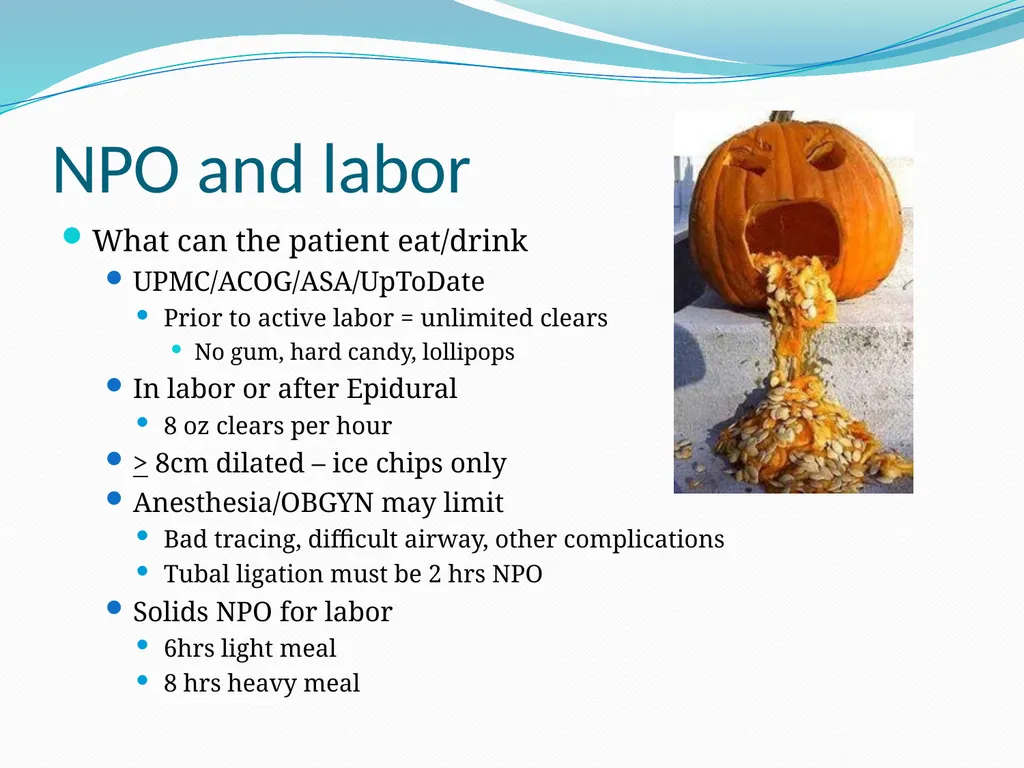
NPO and labor What can the patient eat/drink
UPMC/ACOG/ASA/UpToDate
Prior to active labor = unlimited clears
No gum, hard candy, lollipops
In labor or after Epidural
8 oz clears per hour
> 8cm dilated – ice chips only
Anesthesia/OBGYN may limit
Bad tracing, difficult airway, other complications
Tubal ligation must be 2 hrs NPO
Solids NPO for labor
6hrs light meal
8 hrs heavy meal<br>
UPMC/ACOG/ASA/UpToDate
Prior to active labor = unlimited clears
No gum, hard candy, lollipops
In labor or after Epidural
8 oz clears per hour
> 8cm dilated – ice chips only
Anesthesia/OBGYN may limit
Bad tracing, difficult airway, other complications
Tubal ligation must be 2 hrs NPO
Solids NPO for labor
6hrs light meal
8 hrs heavy meal<br>
18
S & S of Local Toxicity Circumoral numbness
Ringing in the ears
Seizures
Cardiac arrythmias
Hypotention
www.lipidrescue.com<br>
Ringing in the ears
Seizures
Cardiac arrythmias
Hypotention
www.lipidrescue.com<br>
19
Lipid Rescue for Local Toxicity Get Help !
Initial Focus
Airway management: ventilate with 100% oxygen (BLS/ACLS and ABC’s)
Seizure suppression: benzodiazepines are preferred
Basic and Advanced Cardiac Life Support (BLS/ACLS) may require prolonged effort
Infuse 20% Lipid Emulsion (values in parenthesis are for a 70 kg patient)
Bolus 1.5 mL/kg (lean body mass) intravenously over 1 min (~100 mL)
Continuous infusion at 0.25 mL/kg/min (~18 mL/min; adjust by roller clamp)
Repeat bolus once or twice for persistent cardiovascular collapse
Double the infusion rate to 0.5 mL/kg per minute if blood pressure remains low
Continue infusion for at least 10 mins after attaining circulatory stability
Recommended upper limit: approximately 10-12 mL/kg lipid emulsion over the first 30 mins<br>
Initial Focus
Airway management: ventilate with 100% oxygen (BLS/ACLS and ABC’s)
Seizure suppression: benzodiazepines are preferred
Basic and Advanced Cardiac Life Support (BLS/ACLS) may require prolonged effort
Infuse 20% Lipid Emulsion (values in parenthesis are for a 70 kg patient)
Bolus 1.5 mL/kg (lean body mass) intravenously over 1 min (~100 mL)
Continuous infusion at 0.25 mL/kg/min (~18 mL/min; adjust by roller clamp)
Repeat bolus once or twice for persistent cardiovascular collapse
Double the infusion rate to 0.5 mL/kg per minute if blood pressure remains low
Continue infusion for at least 10 mins after attaining circulatory stability
Recommended upper limit: approximately 10-12 mL/kg lipid emulsion over the first 30 mins<br>
20
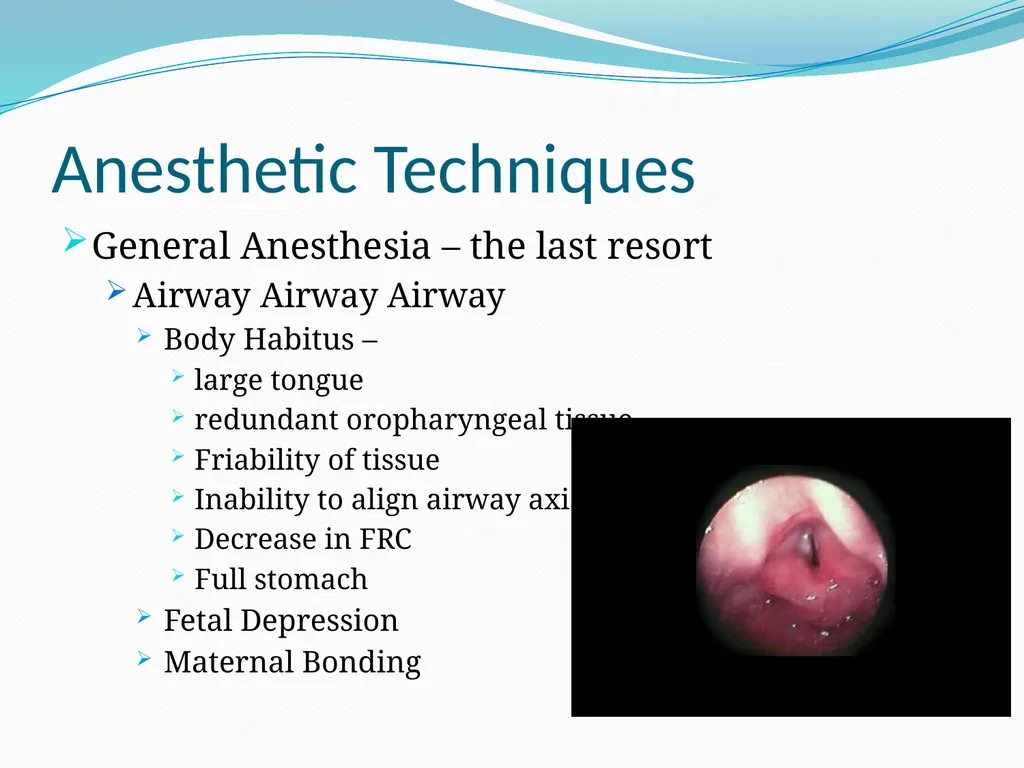
Anesthetic Techniques General Anesthesia – the last resort
Airway Airway Airway
Body Habitus –
large tongue
redundant oropharyngeal tissue
Friability of tissue
Inability to align airway axis
Decrease in FRC
Full stomach
Fetal Depression
Maternal Bonding<br>
Airway Airway Airway
Body Habitus –
large tongue
redundant oropharyngeal tissue
Friability of tissue
Inability to align airway axis
Decrease in FRC
Full stomach
Fetal Depression
Maternal Bonding<br>
21
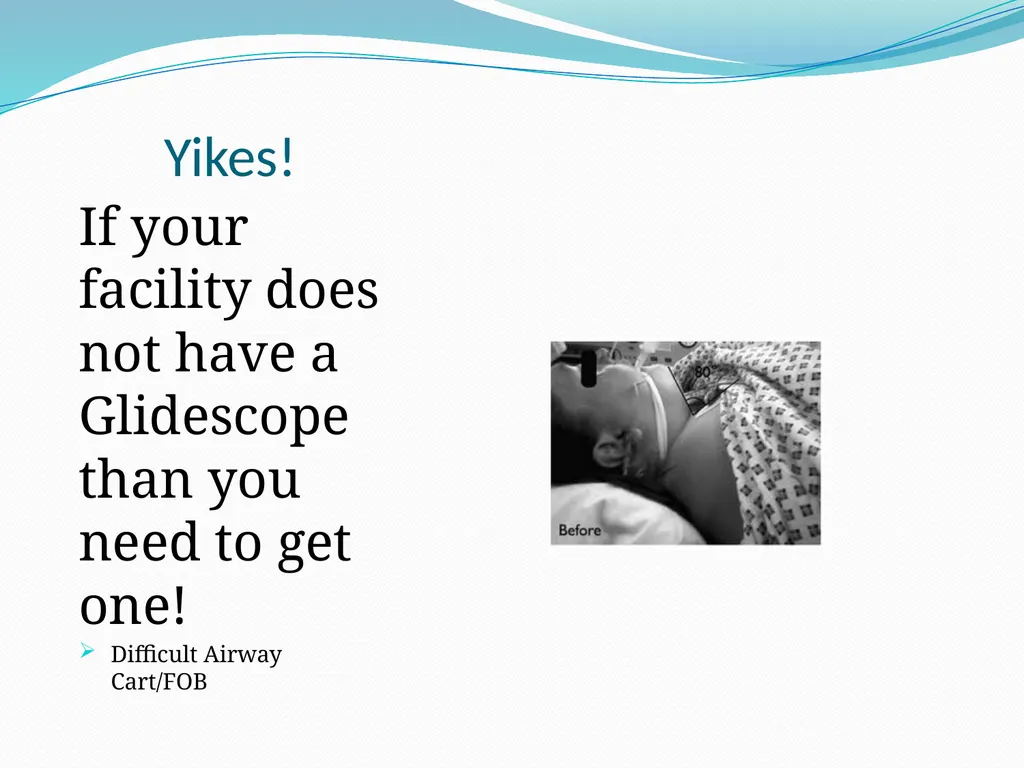
Yikes! If your facility does not have a Glidescope than you need to get one!
Difficult Airway Cart/FOB<br>
Difficult Airway Cart/FOB<br>
22
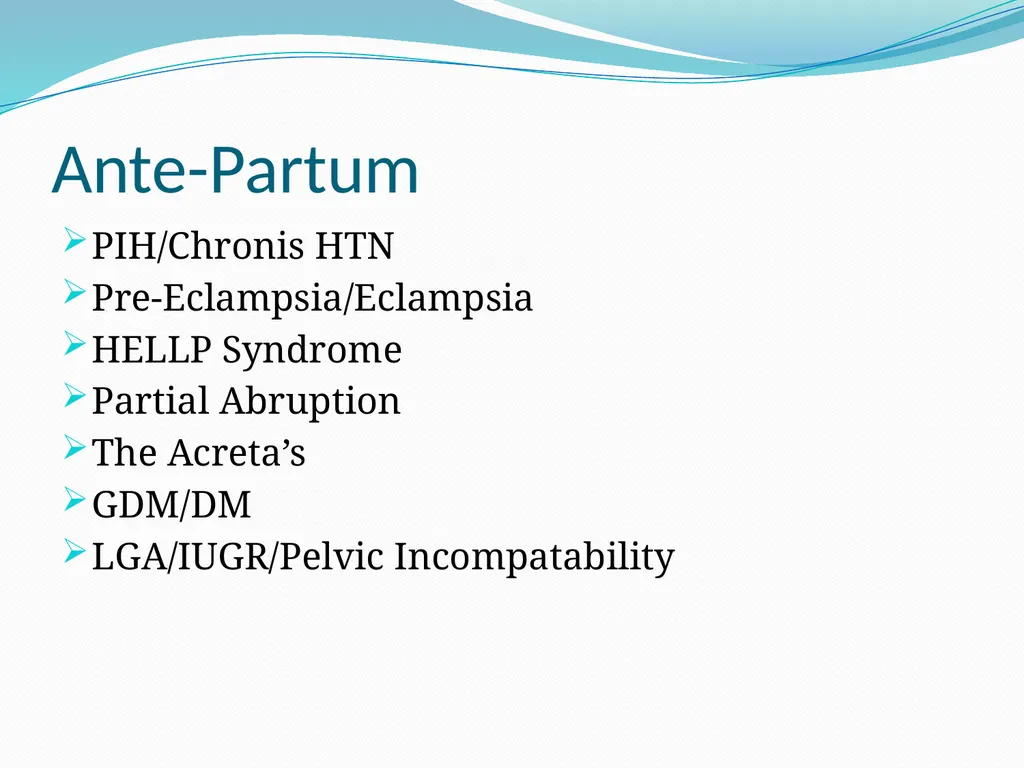
Ante-Partum PIH/Chronis HTN
Pre-Eclampsia/Eclampsia
HELLP Syndrome
Partial Abruption
The Acreta’s
GDM/DM
LGA/IUGR/Pelvic Incompatability<br>
Pre-Eclampsia/Eclampsia
HELLP Syndrome
Partial Abruption
The Acreta’s
GDM/DM
LGA/IUGR/Pelvic Incompatability<br>
23
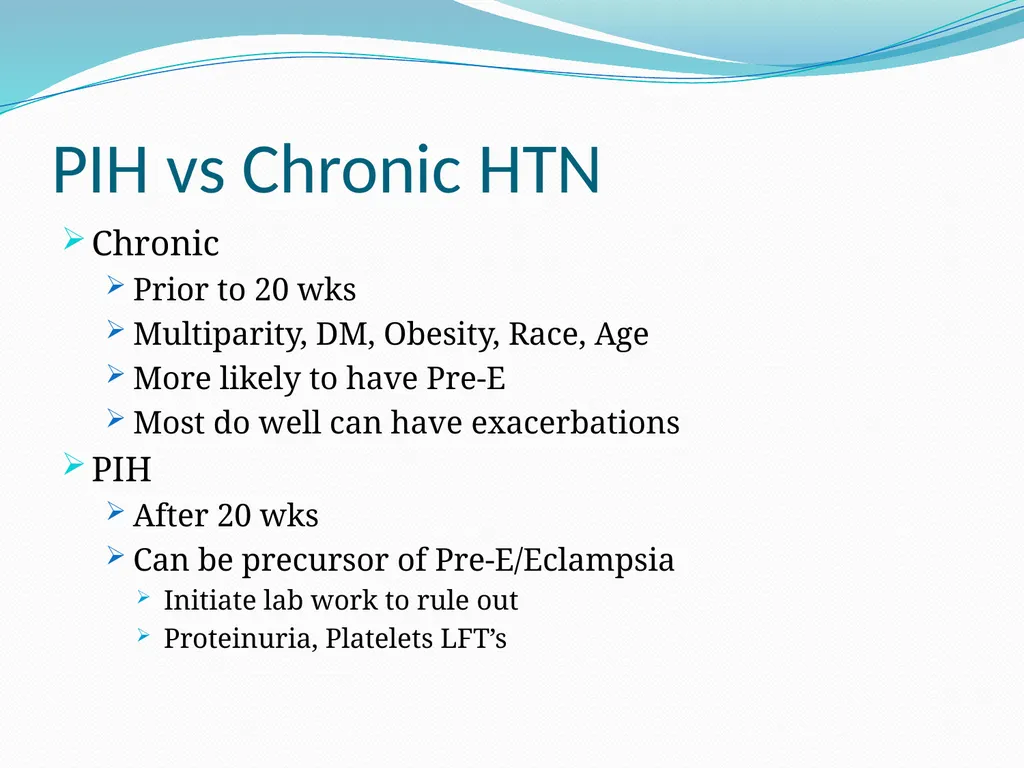
PIH vs Chronic HTN Chronic
Prior to 20 wks
Multiparity, DM, Obesity, Race, Age
More likely to have Pre-E
Most do well can have exacerbations
PIH
After 20 wks
Can be precursor of Pre-E/Eclampsia
Initiate lab work to rule out
Proteinuria, Platelets LFT’s<br>
Prior to 20 wks
Multiparity, DM, Obesity, Race, Age
More likely to have Pre-E
Most do well can have exacerbations
PIH
After 20 wks
Can be precursor of Pre-E/Eclampsia
Initiate lab work to rule out
Proteinuria, Platelets LFT’s<br>
24
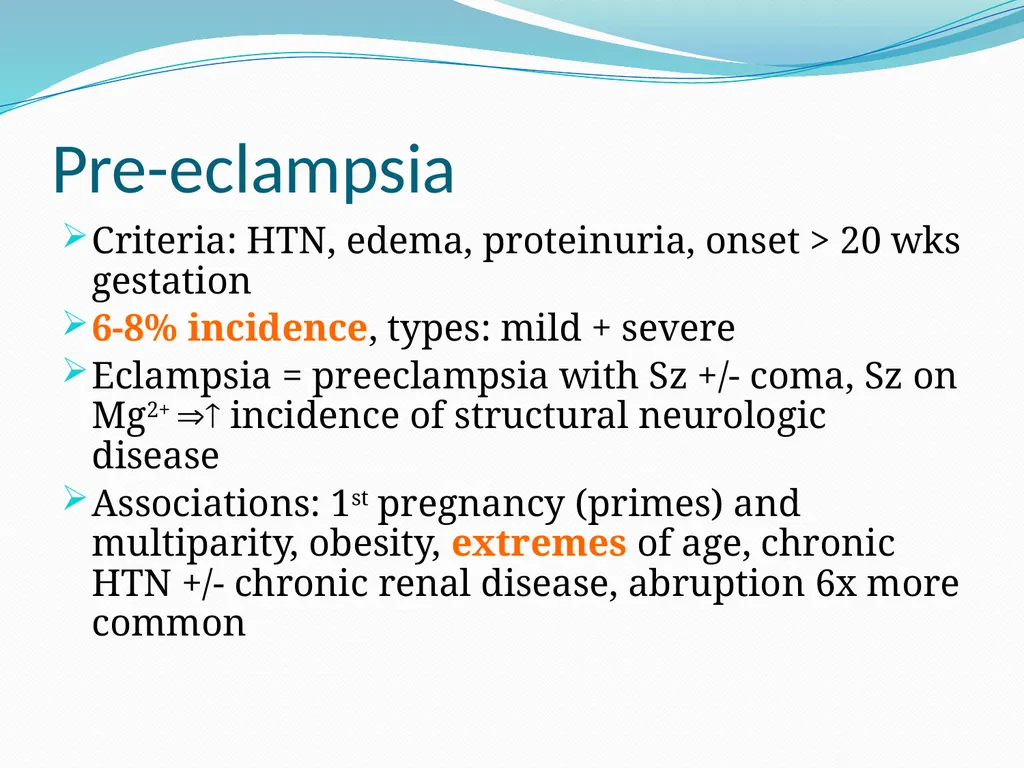
Pre-eclampsia Criteria: HTN, edema, proteinuria, onset > 20 wks gestation
6-8% incidence, types: mild + severe
Eclampsia = preeclampsia with Sz +/- coma, Sz on Mg2+ incidence of structural neurologic disease
Associations: 1st pregnancy (primes) and multiparity, obesity, extremes of age, chronic HTN +/- chronic renal disease, abruption 6x more common<br>
6-8% incidence, types: mild + severe
Eclampsia = preeclampsia with Sz +/- coma, Sz on Mg2+ incidence of structural neurologic disease
Associations: 1st pregnancy (primes) and multiparity, obesity, extremes of age, chronic HTN +/- chronic renal disease, abruption 6x more common<br>
25
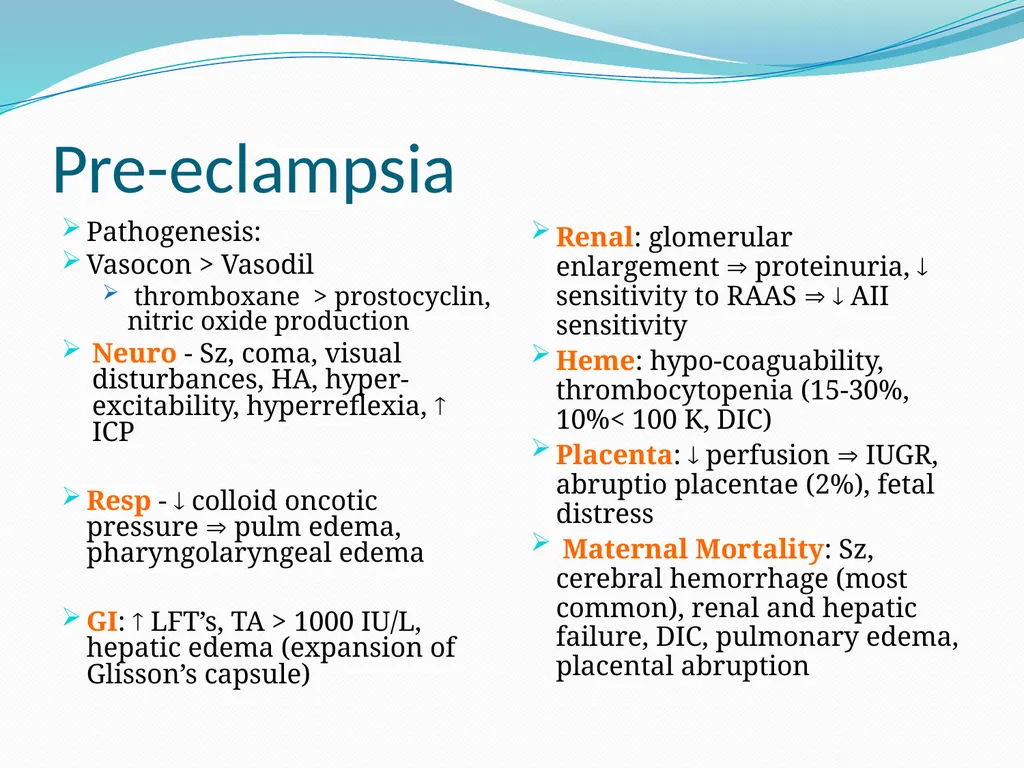
Pre-eclampsia Pathogenesis:
Vasocon > Vasodil
thromboxane > prostocyclin, nitric oxide production
Neuro - Sz, coma, visual disturbances, HA, hyper-excitability, hyperreflexia, ICP
Resp - colloid oncotic pressure pulm edema, pharyngolaryngeal edema
GI: LFT’s, TA > 1000 IU/L, hepatic edema (expansion of Glisson’s capsule) Renal: glomerular enlargement proteinuria, sensitivity to RAAS AII sensitivity
Heme: hypo-coaguability, thrombocytopenia (15-30%, 10%< 100 K, DIC)
Placenta: perfusion IUGR, abruptio placentae (2%), fetal distress
Maternal Mortality: Sz, cerebral hemorrhage (most common), renal and hepatic failure, DIC, pulmonary edema, placental abruption<br>
Vasocon > Vasodil
thromboxane > prostocyclin, nitric oxide production
Neuro - Sz, coma, visual disturbances, HA, hyper-excitability, hyperreflexia, ICP
Resp - colloid oncotic pressure pulm edema, pharyngolaryngeal edema
GI: LFT’s, TA > 1000 IU/L, hepatic edema (expansion of Glisson’s capsule) Renal: glomerular enlargement proteinuria, sensitivity to RAAS AII sensitivity
Heme: hypo-coaguability, thrombocytopenia (15-30%, 10%< 100 K, DIC)
Placenta: perfusion IUGR, abruptio placentae (2%), fetal distress
Maternal Mortality: Sz, cerebral hemorrhage (most common), renal and hepatic failure, DIC, pulmonary edema, placental abruption<br>
26
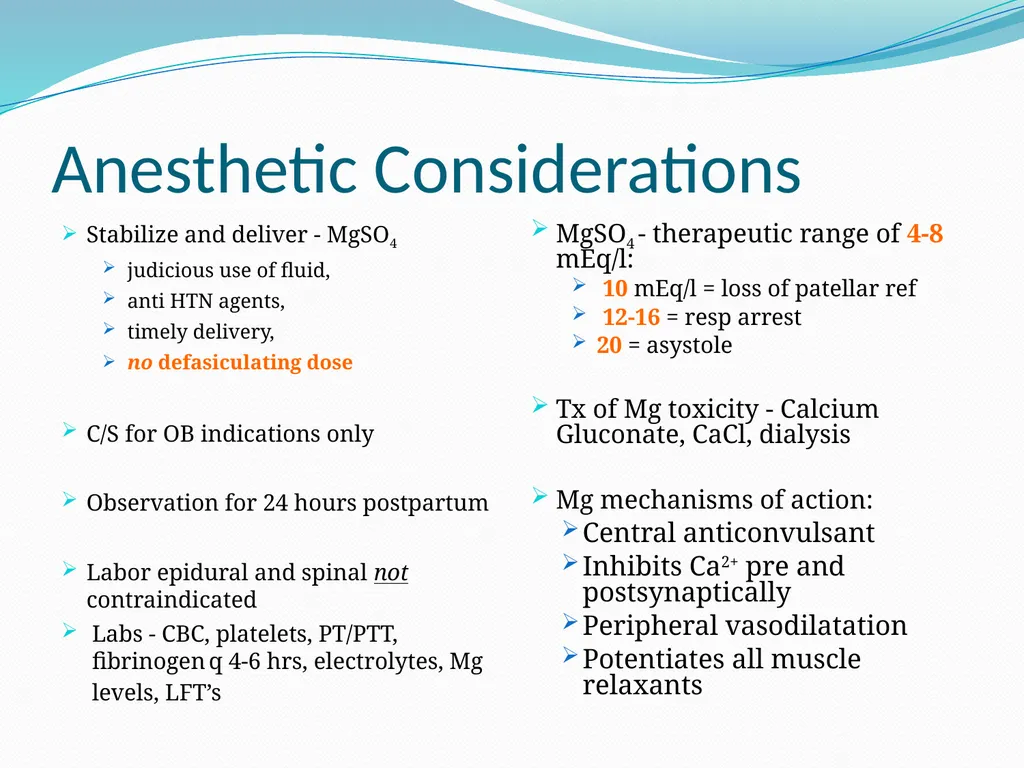
Anesthetic Considerations Stabilize and deliver - MgSO4
judicious use of fluid,
anti HTN agents,
timely delivery,
no defasiculating dose
C/S for OB indications only
Observation for 24 hours postpartum
Labor epidural and spinal not contraindicated
Labs - CBC, platelets, PT/PTT, fibrinogen q 4-6 hrs, electrolytes, Mg levels, LFT’s MgSO4 - therapeutic range of 4-8 mEq/l:
10 mEq/l = loss of patellar ref
12-16 = resp arrest
20 = asystole
Tx of Mg toxicity - Calcium Gluconate, CaCl, dialysis
Mg mechanisms of action:
Central anticonvulsant
Inhibits Ca2+ pre and postsynaptically
Peripheral vasodilatation
Potentiates all muscle relaxants<br>
judicious use of fluid,
anti HTN agents,
timely delivery,
no defasiculating dose
C/S for OB indications only
Observation for 24 hours postpartum
Labor epidural and spinal not contraindicated
Labs - CBC, platelets, PT/PTT, fibrinogen q 4-6 hrs, electrolytes, Mg levels, LFT’s MgSO4 - therapeutic range of 4-8 mEq/l:
10 mEq/l = loss of patellar ref
12-16 = resp arrest
20 = asystole
Tx of Mg toxicity - Calcium Gluconate, CaCl, dialysis
Mg mechanisms of action:
Central anticonvulsant
Inhibits Ca2+ pre and postsynaptically
Peripheral vasodilatation
Potentiates all muscle relaxants<br>
27
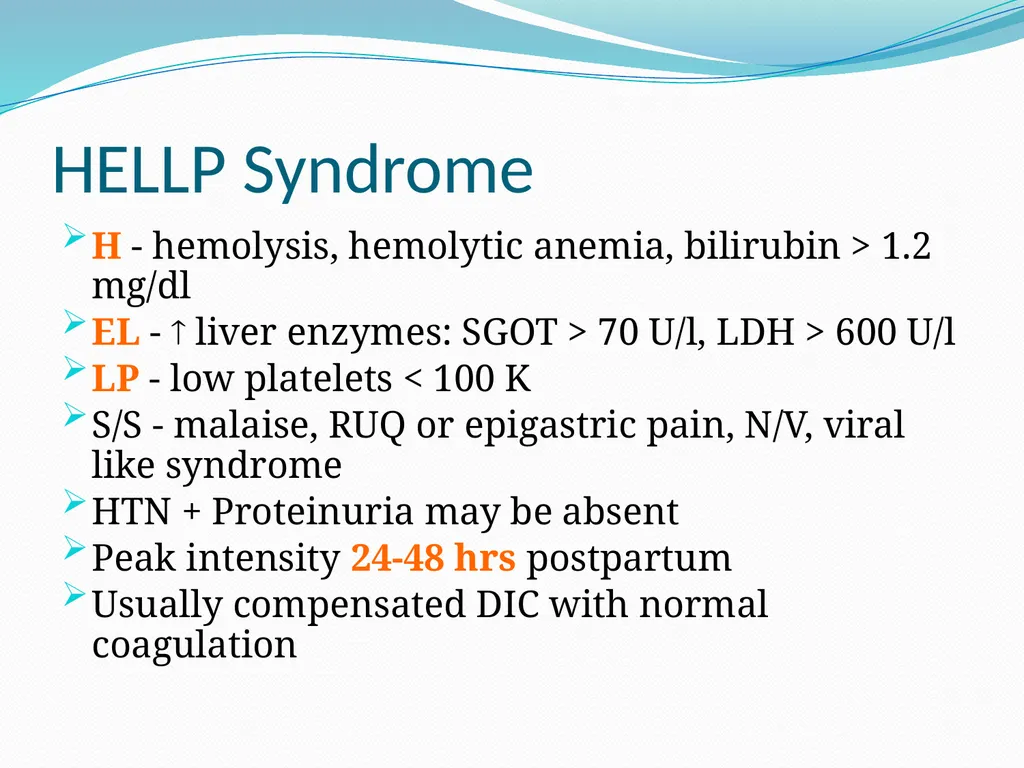
HELLP Syndrome H - hemolysis, hemolytic anemia, bilirubin > 1.2 mg/dl
EL - liver enzymes: SGOT > 70 U/l, LDH > 600 U/l
LP - low platelets < 100 K
S/S - malaise, RUQ or epigastric pain, N/V, viral like syndrome
HTN + Proteinuria may be absent
Peak intensity 24-48 hrs postpartum
Usually compensated DIC with normal coagulation<br>
EL - liver enzymes: SGOT > 70 U/l, LDH > 600 U/l
LP - low platelets < 100 K
S/S - malaise, RUQ or epigastric pain, N/V, viral like syndrome
HTN + Proteinuria may be absent
Peak intensity 24-48 hrs postpartum
Usually compensated DIC with normal coagulation<br>
28
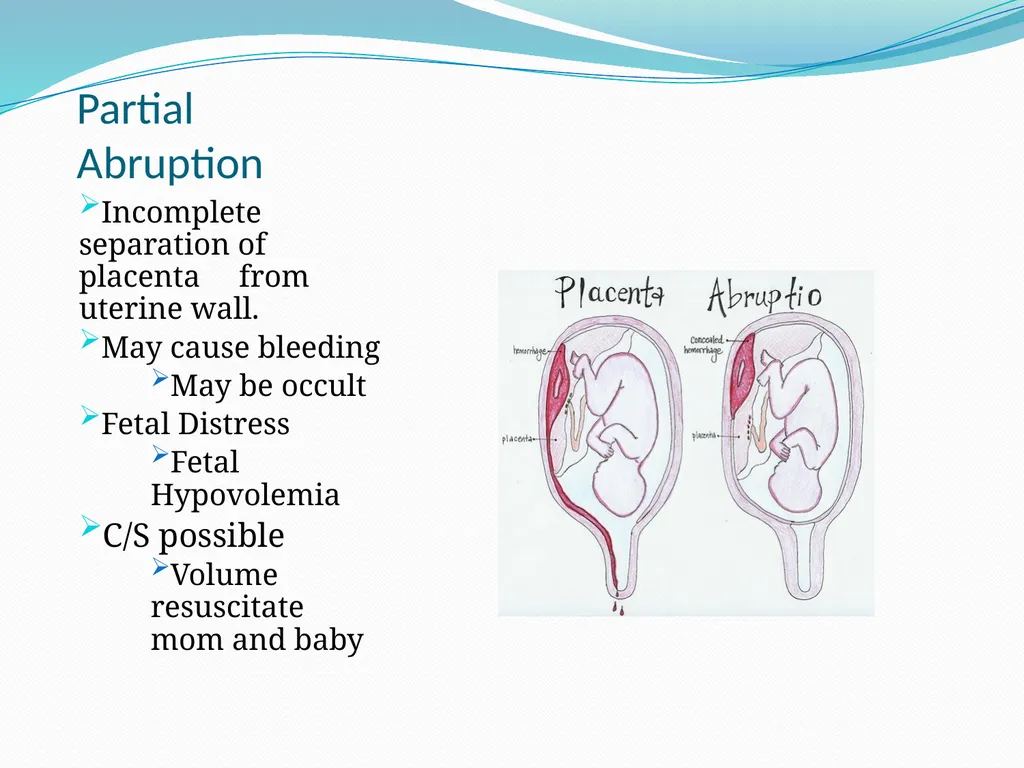
Partial Abruption Incomplete separation of placenta from uterine wall.
May cause bleeding
May be occult
Fetal Distress
Fetal Hypovolemia
C/S possible
Volume resuscitate mom and baby<br>
May cause bleeding
May be occult
Fetal Distress
Fetal Hypovolemia
C/S possible
Volume resuscitate mom and baby<br>
29
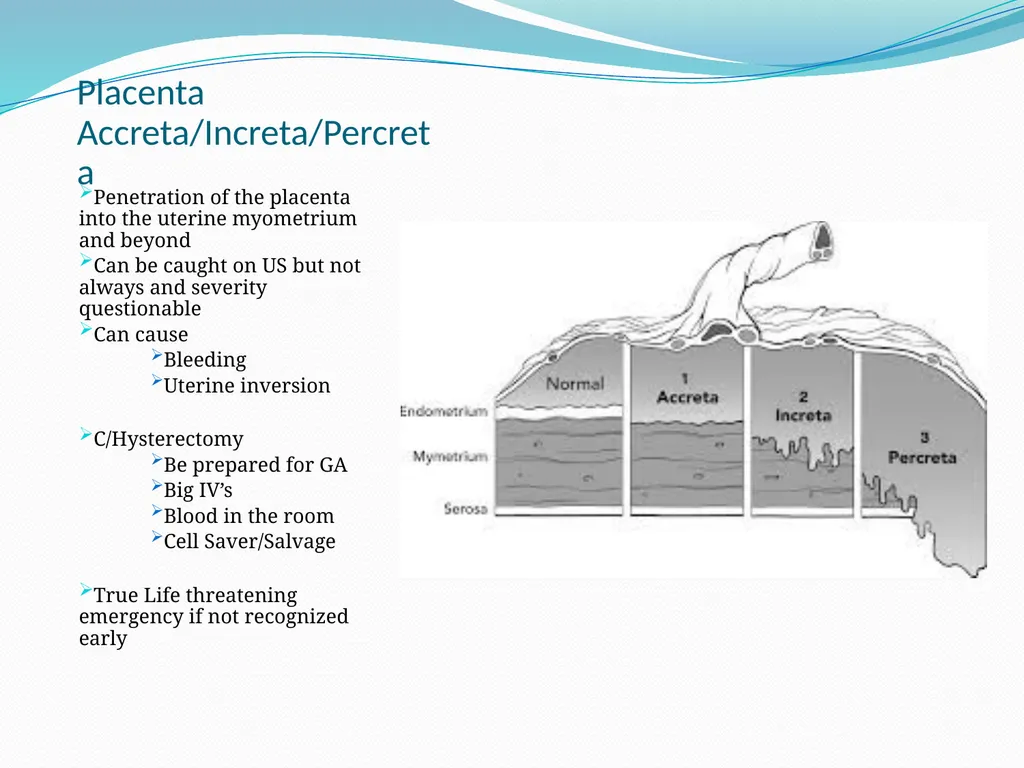
Placenta Accreta/Increta/Percreta Penetration of the placenta into the uterine myometrium and beyond
Can be caught on US but not always and severity questionable
Can cause
Bleeding
Uterine inversion
C/Hysterectomy
Be prepared for GA
Big IV’s
Blood in the room
Cell Saver/Salvage
True Life threatening emergency if not recognized early<br>
Can be caught on US but not always and severity questionable
Can cause
Bleeding
Uterine inversion
C/Hysterectomy
Be prepared for GA
Big IV’s
Blood in the room
Cell Saver/Salvage
True Life threatening emergency if not recognized early<br>
30
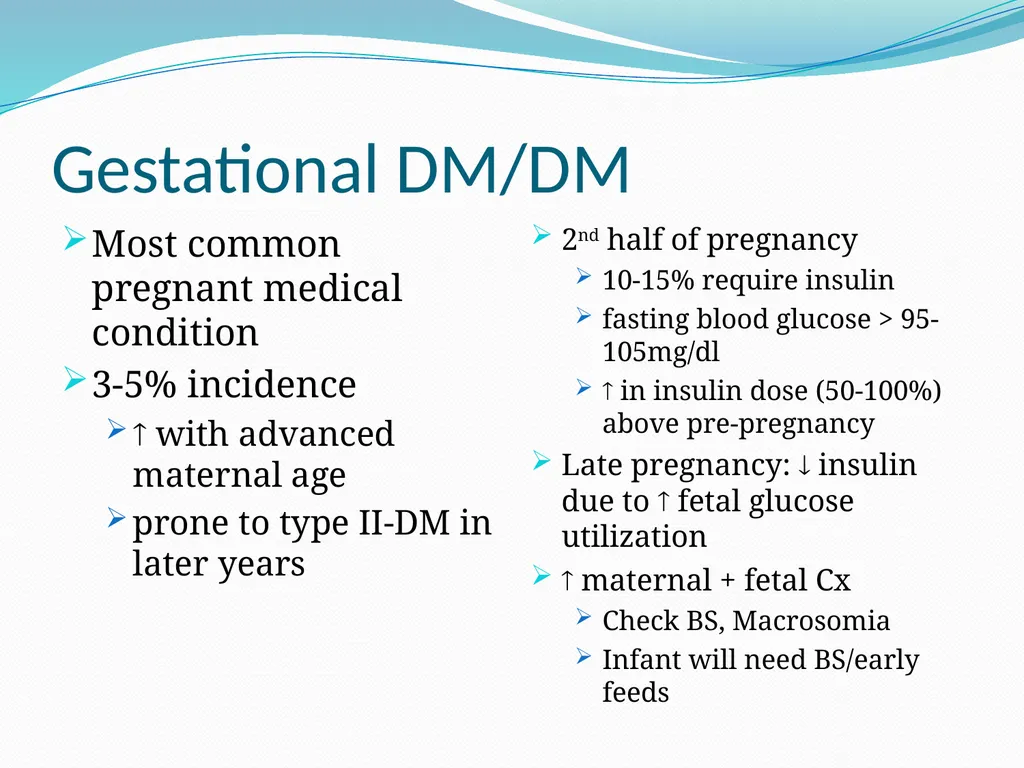
Gestational DM/DM Most common pregnant medical condition
3-5% incidence
with advanced maternal age
prone to type II-DM in later years 2nd half of pregnancy
10-15% require insulin
fasting blood glucose > 95-105mg/dl
in insulin dose (50-100%) above pre-pregnancy
Late pregnancy: insulin due to fetal glucose utilization
maternal + fetal Cx
Check BS, Macrosomia
Infant will need BS/early feeds<br>
3-5% incidence
with advanced maternal age
prone to type II-DM in later years 2nd half of pregnancy
10-15% require insulin
fasting blood glucose > 95-105mg/dl
in insulin dose (50-100%) above pre-pregnancy
Late pregnancy: insulin due to fetal glucose utilization
maternal + fetal Cx
Check BS, Macrosomia
Infant will need BS/early feeds<br>
31
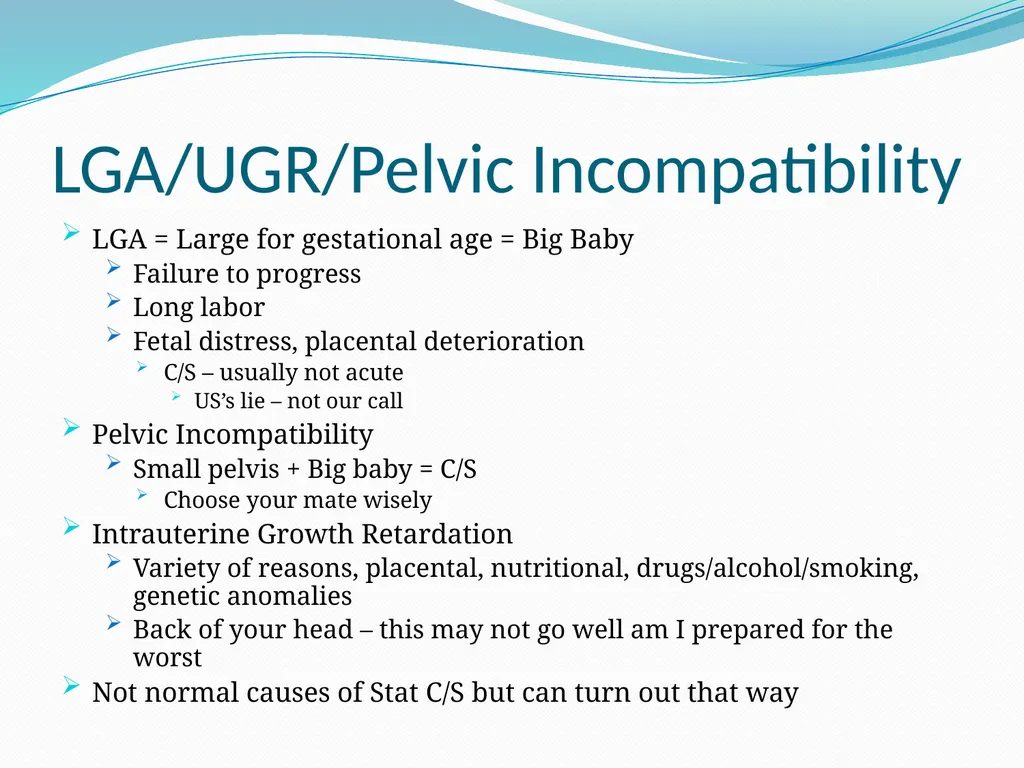
LGA/UGR/Pelvic Incompatibility LGA = Large for gestational age = Big Baby
Failure to progress
Long labor
Fetal distress, placental deterioration
C/S – usually not acute
US’s lie – not our call
Pelvic Incompatibility
Small pelvis + Big baby = C/S
Choose your mate wisely
Intrauterine Growth Retardation
Variety of reasons, placental, nutritional, drugs/alcohol/smoking, genetic anomalies
Back of your head – this may not go well am I prepared for the worst
Not normal causes of Stat C/S but can turn out that way<br>
Failure to progress
Long labor
Fetal distress, placental deterioration
C/S – usually not acute
US’s lie – not our call
Pelvic Incompatibility
Small pelvis + Big baby = C/S
Choose your mate wisely
Intrauterine Growth Retardation
Variety of reasons, placental, nutritional, drugs/alcohol/smoking, genetic anomalies
Back of your head – this may not go well am I prepared for the worst
Not normal causes of Stat C/S but can turn out that way<br>
32
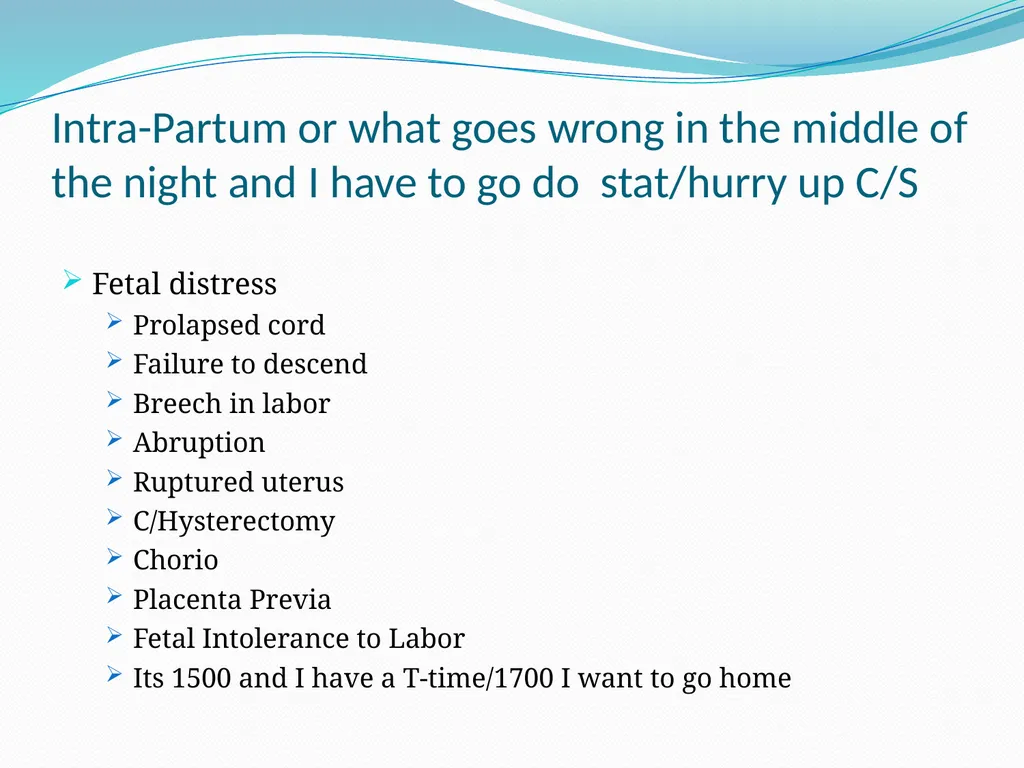
Intra-Partum or what goes wrong in the middle of the night and I have to go do stat/hurry up C/S Fetal distress
Prolapsed cord
Failure to descend
Breech in labor
Abruption
Ruptured uterus
C/Hysterectomy
Chorio
Placenta Previa
Fetal Intolerance to Labor
Its 1500 and I have a T-time/1700 I want to go home<br>
Prolapsed cord
Failure to descend
Breech in labor
Abruption
Ruptured uterus
C/Hysterectomy
Chorio
Placenta Previa
Fetal Intolerance to Labor
Its 1500 and I have a T-time/1700 I want to go home<br>
33
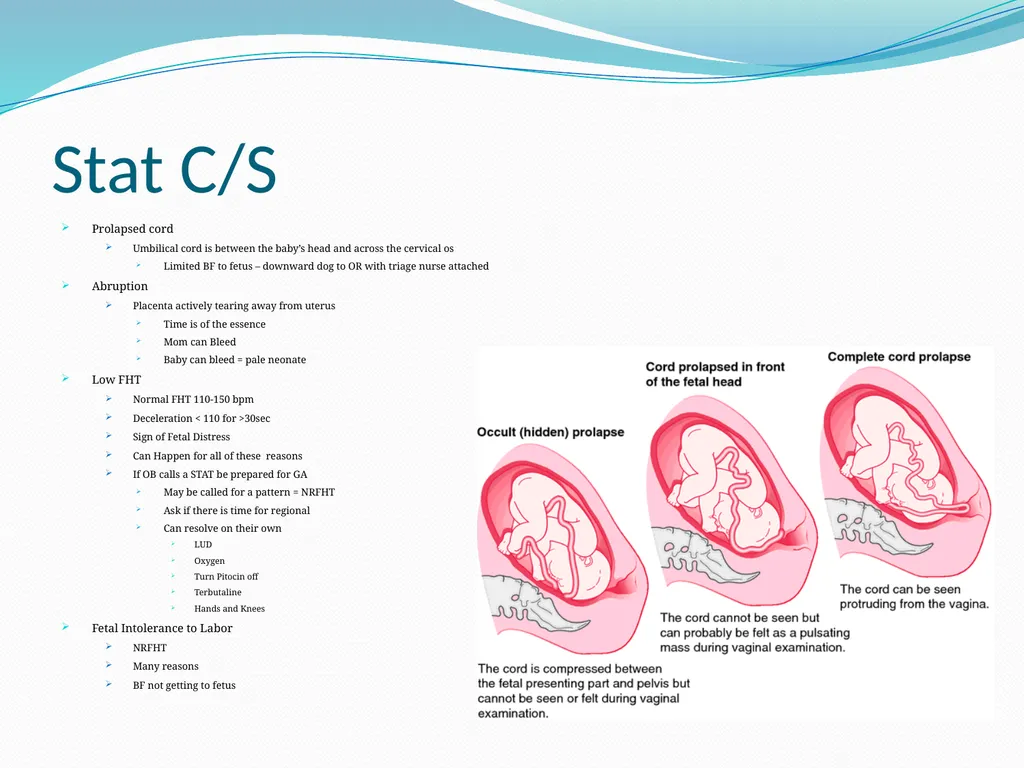
Stat C/S Prolapsed cord
Umbilical cord is between the baby’s head and across the cervical os
Limited BF to fetus – downward dog to OR with triage nurse attached
Abruption
Placenta actively tearing away from uterus
Time is of the essence
Mom can Bleed
Baby can bleed = pale neonate
Low FHT
Normal FHT 110-150 bpm
Deceleration < 110 for >30sec
Sign of Fetal Distress
Can Happen for all of these reasons
If OB calls a STAT be prepared for GA
May be called for a pattern = NRFHT
Ask if there is time for regional
Can resolve on their own
LUD
Oxygen
Turn Pitocin off
Terbutaline
Hands and Knees
Fetal Intolerance to Labor
NRFHT
Many reasons
BF not getting to fetus<br>
Umbilical cord is between the baby’s head and across the cervical os
Limited BF to fetus – downward dog to OR with triage nurse attached
Abruption
Placenta actively tearing away from uterus
Time is of the essence
Mom can Bleed
Baby can bleed = pale neonate
Low FHT
Normal FHT 110-150 bpm
Deceleration < 110 for >30sec
Sign of Fetal Distress
Can Happen for all of these reasons
If OB calls a STAT be prepared for GA
May be called for a pattern = NRFHT
Ask if there is time for regional
Can resolve on their own
LUD
Oxygen
Turn Pitocin off
Terbutaline
Hands and Knees
Fetal Intolerance to Labor
NRFHT
Many reasons
BF not getting to fetus<br>
34
C/S continued Breech in Labor
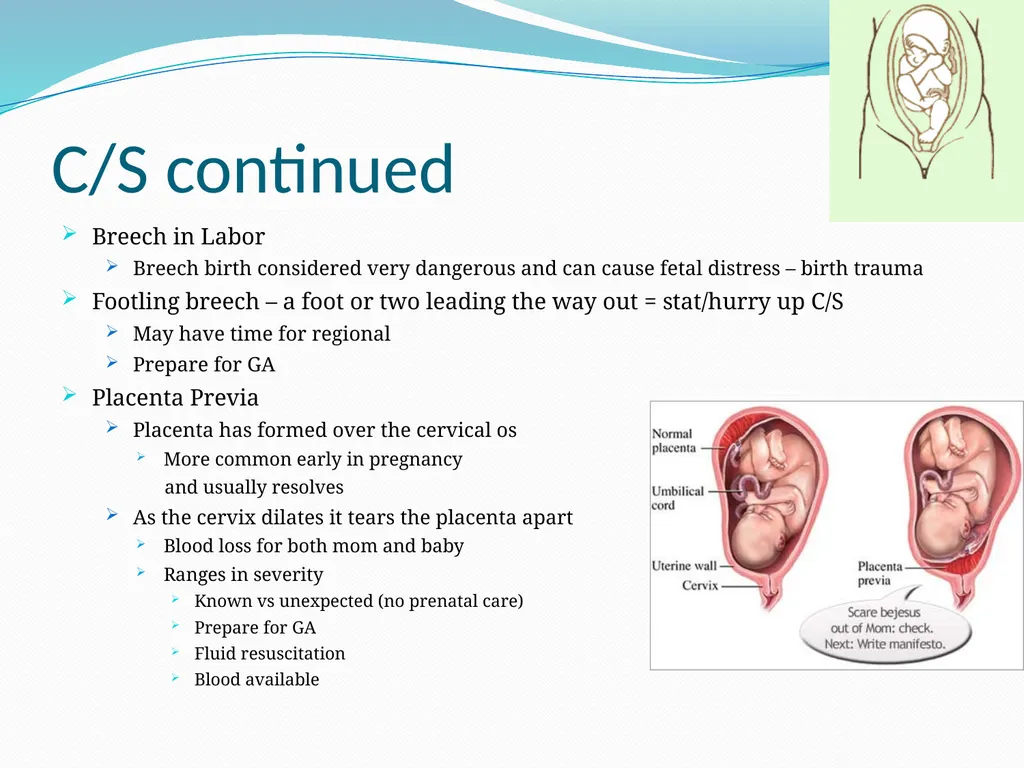
Breech birth considered very dangerous and can cause fetal distress – birth trauma
Footling breech – a foot or two leading the way out = stat/hurry up C/S
May have time for regional
Prepare for GA
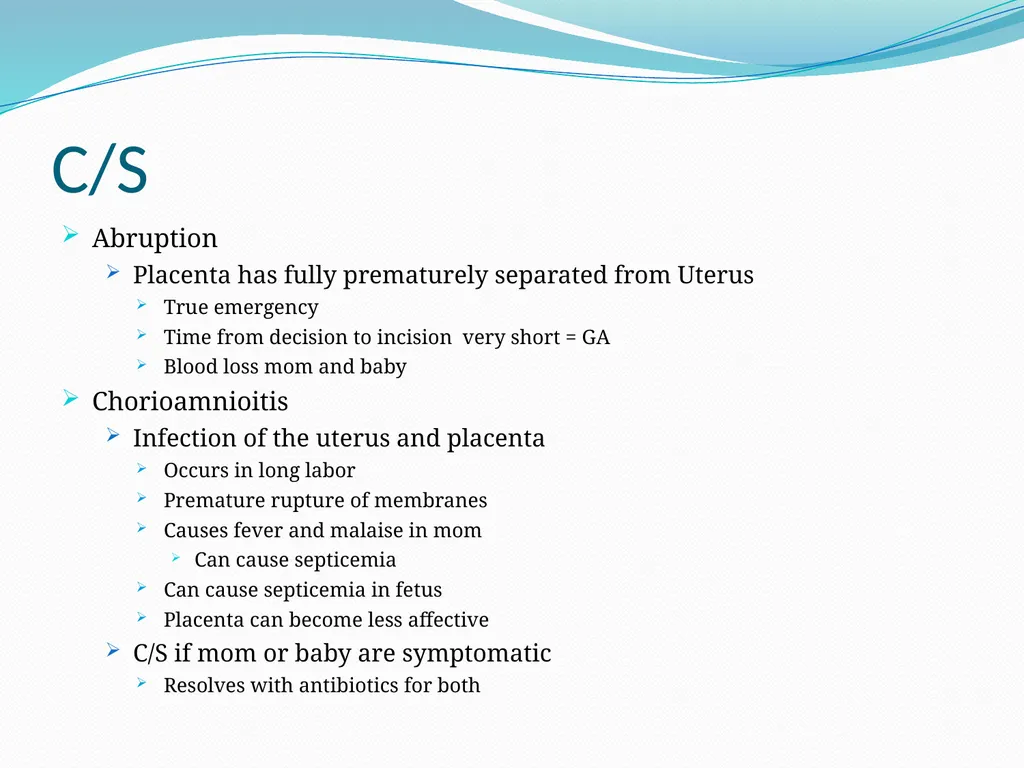
Placenta Previa
Placenta has formed over the cervical os
More common early in pregnancy
and usually resolves
As the cervix dilates it tears the placenta apart
Blood loss for both mom and baby
Ranges in severity
Known vs unexpected (no prenatal care)
Prepare for GA
Fluid resuscitation
Blood available<br>
Breech birth considered very dangerous and can cause fetal distress – birth trauma
Footling breech – a foot or two leading the way out = stat/hurry up C/S
May have time for regional
Prepare for GA
Placenta Previa
Placenta has formed over the cervical os
More common early in pregnancy
and usually resolves
As the cervix dilates it tears the placenta apart
Blood loss for both mom and baby
Ranges in severity
Known vs unexpected (no prenatal care)
Prepare for GA
Fluid resuscitation
Blood available<br>
35
C/S Abruption
Placenta has fully prematurely separated from Uterus
True emergency
Time from decision to incision very short = GA
Blood loss mom and baby
Chorioamnioitis
Infection of the uterus and placenta
Occurs in long labor
Premature rupture of membranes
Causes fever and malaise in mom
Can cause septicemia
Can cause septicemia in fetus
Placenta can become less affective
C/S if mom or baby are symptomatic
Resolves with antibiotics for both<br>
Placenta has fully prematurely separated from Uterus
True emergency
Time from decision to incision very short = GA
Blood loss mom and baby
Chorioamnioitis
Infection of the uterus and placenta
Occurs in long labor
Premature rupture of membranes
Causes fever and malaise in mom
Can cause septicemia
Can cause septicemia in fetus
Placenta can become less affective
C/S if mom or baby are symptomatic
Resolves with antibiotics for both<br>
36
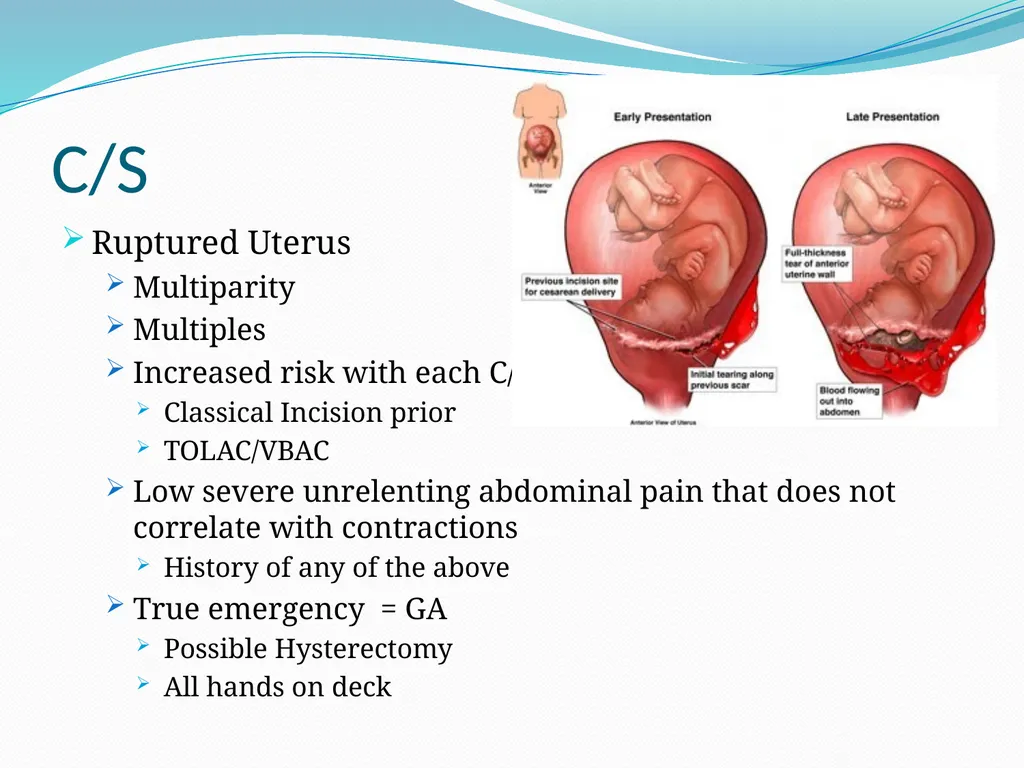
C/S Ruptured Uterus
Multiparity
Multiples
Increased risk with each C/S
Classical Incision prior
TOLAC/VBAC
Low severe unrelenting abdominal pain that does not correlate with contractions
History of any of the above
True emergency = GA
Possible Hysterectomy
All hands on deck<br>
Multiparity
Multiples
Increased risk with each C/S
Classical Incision prior
TOLAC/VBAC
Low severe unrelenting abdominal pain that does not correlate with contractions
History of any of the above
True emergency = GA
Possible Hysterectomy
All hands on deck<br>
37
C/S Failure to Descend
Cervix is dilated but Jr just wont “come on down”
Could be related to position of fetus
OP (Occiput Posterior) or “Sunny side up”
Fetus facing anterior
Fetal intolerance to Labor
NRFHT but there is time for regional
Arrest of Dilation
Cervix will not dilate despite induction efforts
Maternal exhaustion
Hard long labor
Pushing for several hours, or refusal to push anymore
Maternal Desire for C/S
Britany Spears syndrome
Chic way to have a baby
Patients think C/S just as safe as vaginal
Policies to thwart early (39 wks)
C/S in otherwise healthy babies
under way
Most of the time these can be done under reqional
Spinal or existing working epidural
Take care to interrogate your epidural
It may have been turned down to aid pushing efforts
Mom in a very fragile state may cloud the issue<br>
Cervix is dilated but Jr just wont “come on down”
Could be related to position of fetus
OP (Occiput Posterior) or “Sunny side up”
Fetus facing anterior
Fetal intolerance to Labor
NRFHT but there is time for regional
Arrest of Dilation
Cervix will not dilate despite induction efforts
Maternal exhaustion
Hard long labor
Pushing for several hours, or refusal to push anymore
Maternal Desire for C/S
Britany Spears syndrome
Chic way to have a baby
Patients think C/S just as safe as vaginal
Policies to thwart early (39 wks)
C/S in otherwise healthy babies
under way
Most of the time these can be done under reqional
Spinal or existing working epidural
Take care to interrogate your epidural
It may have been turned down to aid pushing efforts
Mom in a very fragile state may cloud the issue<br>
38
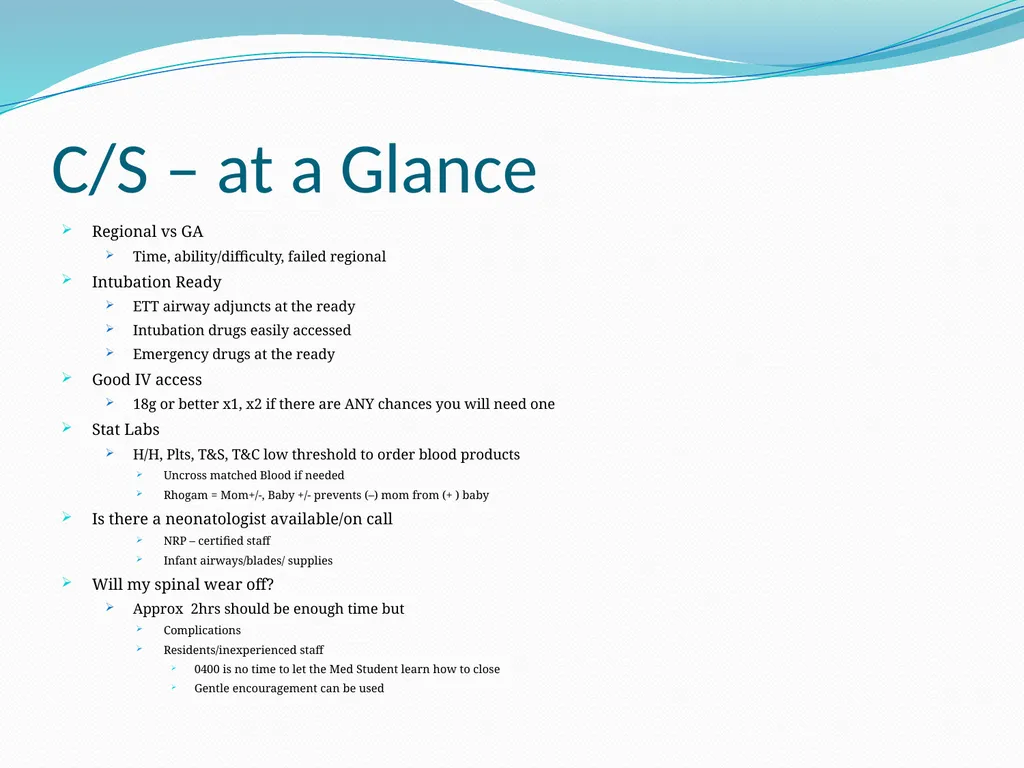
C/S – at a Glance Regional vs GA
Time, ability/difficulty, failed regional
Intubation Ready
ETT airway adjuncts at the ready
Intubation drugs easily accessed
Emergency drugs at the ready
Good IV access
18g or better x1, x2 if there are ANY chances you will need one
Stat Labs
H/H, Plts, T&S, T&C low threshold to order blood products
Uncross matched Blood if needed
Rhogam = Mom+/-, Baby +/- prevents (–) mom from (+ ) baby
Is there a neonatologist available/on call
NRP – certified staff
Infant airways/blades/ supplies
Will my spinal wear off?
Approx 2hrs should be enough time but
Complications
Residents/inexperienced staff
0400 is no time to let the Med Student learn how to close
Gentle encouragement can be used<br>
Time, ability/difficulty, failed regional
Intubation Ready
ETT airway adjuncts at the ready
Intubation drugs easily accessed
Emergency drugs at the ready
Good IV access
18g or better x1, x2 if there are ANY chances you will need one
Stat Labs
H/H, Plts, T&S, T&C low threshold to order blood products
Uncross matched Blood if needed
Rhogam = Mom+/-, Baby +/- prevents (–) mom from (+ ) baby
Is there a neonatologist available/on call
NRP – certified staff
Infant airways/blades/ supplies
Will my spinal wear off?
Approx 2hrs should be enough time but
Complications
Residents/inexperienced staff
0400 is no time to let the Med Student learn how to close
Gentle encouragement can be used<br>
39
Ok so now we are doing a C/S so we can stop worrying right? Maternal Hemorrhage
Uterine Atony – Uterus will not contract and continues to bleed
Long labor
Multiparity/Multigravid
Magnesium/Pitocin
Anesthetic Agents
Retained placental tissues
Inability to stop the bleeding
Unknown source/Occult source
Coagulopathies
Emergent surgery can cloud judgment
Bladder and Bowel perforation
Grab a snickers and prep for GA<br>
Uterine Atony – Uterus will not contract and continues to bleed
Long labor
Multiparity/Multigravid
Magnesium/Pitocin
Anesthetic Agents
Retained placental tissues
Inability to stop the bleeding
Unknown source/Occult source
Coagulopathies
Emergent surgery can cloud judgment
Bladder and Bowel perforation
Grab a snickers and prep for GA<br>
40
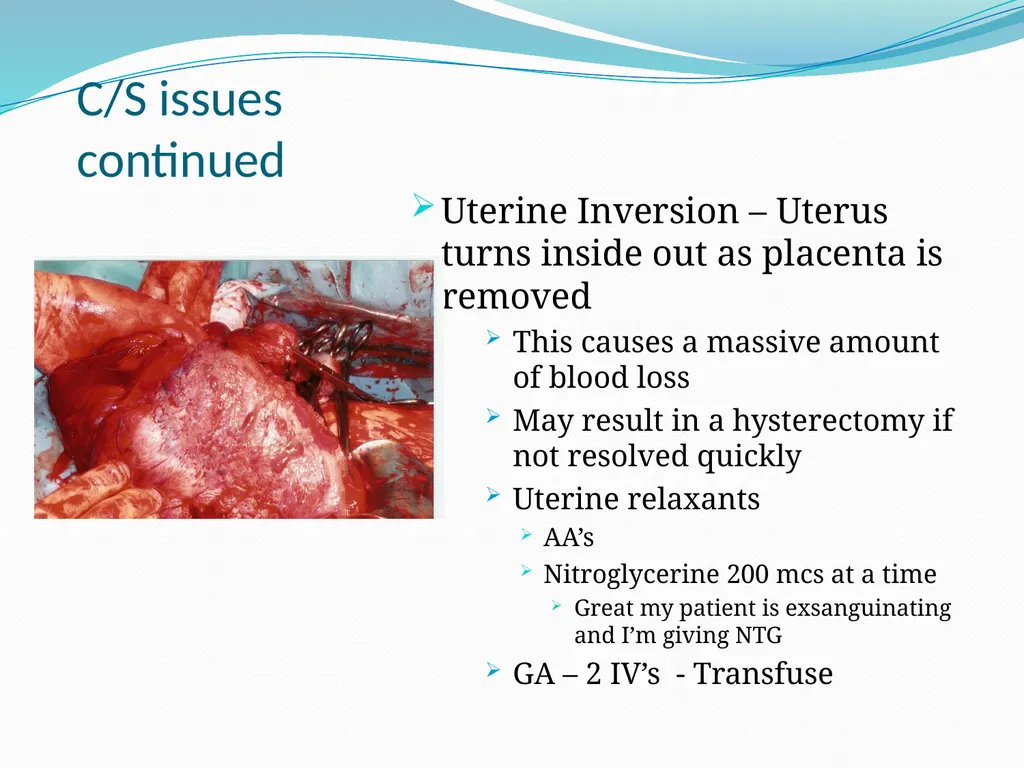
C/S issues continued Uterine Inversion – Uterus turns inside out as placenta is removed
This causes a massive amount of blood loss
May result in a hysterectomy if not resolved quickly
Uterine relaxants
AA’s
Nitroglycerine 200 mcs at a time
Great my patient is exsanguinating and I’m giving NTG
GA – 2 IV’s - Transfuse<br>
This causes a massive amount of blood loss
May result in a hysterectomy if not resolved quickly
Uterine relaxants
AA’s
Nitroglycerine 200 mcs at a time
Great my patient is exsanguinating and I’m giving NTG
GA – 2 IV’s - Transfuse<br>
41
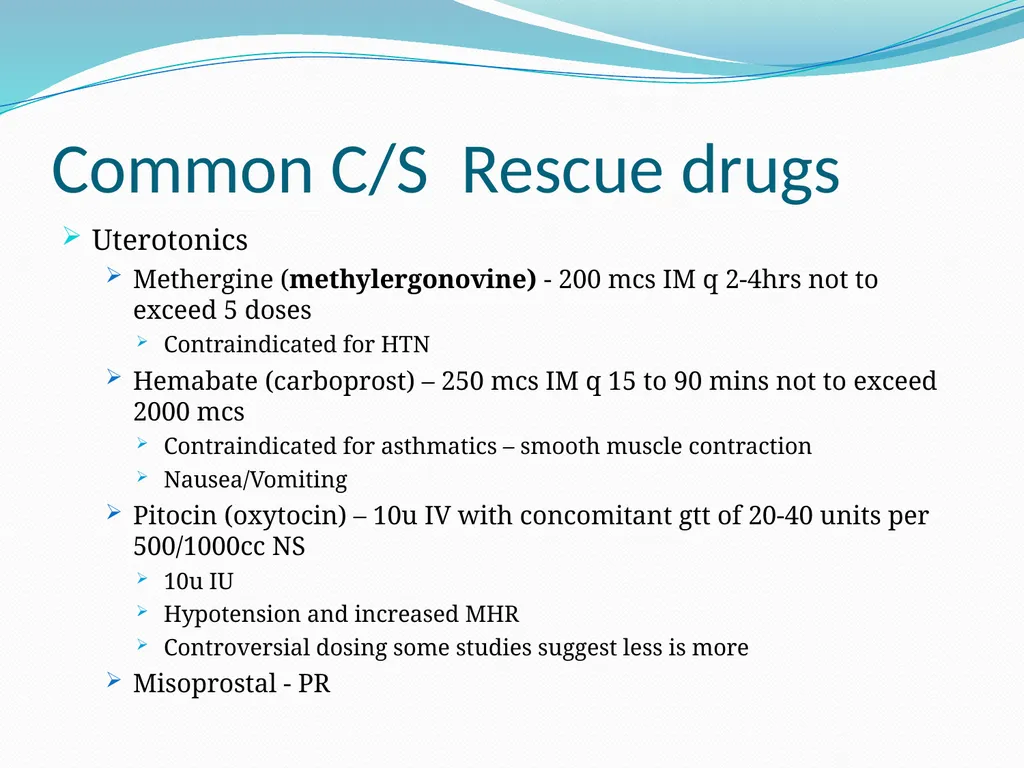
Common C/S Rescue drugs Uterotonics
Methergine (methylergonovine) - 200 mcs IM q 2-4hrs not to exceed 5 doses
Contraindicated for HTN
Hemabate (carboprost) – 250 mcs IM q 15 to 90 mins not to exceed 2000 mcs
Contraindicated for asthmatics – smooth muscle contraction
Nausea/Vomiting
Pitocin (oxytocin) – 10u IV with concomitant gtt of 20-40 units per 500/1000cc NS
10u IU
Hypotension and increased MHR
Controversial dosing some studies suggest less is more
Misoprostal - PR<br>
Methergine (methylergonovine) - 200 mcs IM q 2-4hrs not to exceed 5 doses
Contraindicated for HTN
Hemabate (carboprost) – 250 mcs IM q 15 to 90 mins not to exceed 2000 mcs
Contraindicated for asthmatics – smooth muscle contraction
Nausea/Vomiting
Pitocin (oxytocin) – 10u IV with concomitant gtt of 20-40 units per 500/1000cc NS
10u IU
Hypotension and increased MHR
Controversial dosing some studies suggest less is more
Misoprostal - PR<br>
42
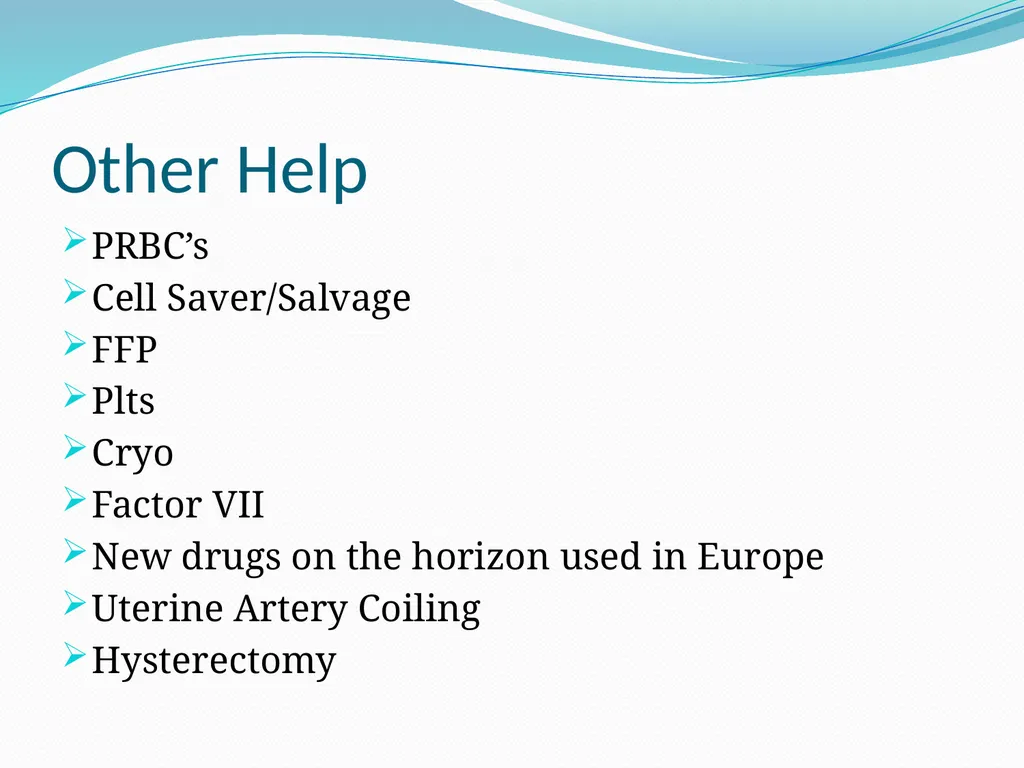
Other Help PRBC’s
Cell Saver/Salvage
FFP
Plts
Cryo
Factor VII
New drugs on the horizon used in Europe
Uterine Artery Coiling
Hysterectomy<br>
Cell Saver/Salvage
FFP
Plts
Cryo
Factor VII
New drugs on the horizon used in Europe
Uterine Artery Coiling
Hysterectomy<br>
43
C/S Hemmorhage
Uterine atony
Retained Placenta
Anticoagulation
Surgical inability to stop bleeding
Bladder/Bowel perforations
Uterine inversion<br>
Uterine atony
Retained Placenta
Anticoagulation
Surgical inability to stop bleeding
Bladder/Bowel perforations
Uterine inversion<br>
44
Post Partum Post Partum Hemmorrhage
Retained placenta
Premies
May need to go to the OR for D&C
Use Epidural if still working
24-72 hrs assume all the risks of active parturient patient
Anesthesia choices based on other risk factors
Full stomach
airway
No kiddo to worry about
How much blood has she actually lost
Look at pads
Uterine atony
Same as discussed
Uterine artery coiling
Hysterctomy
DIC
Post fetal demise
Amniotic Fluid Embolism<br>
Retained placenta
Premies
May need to go to the OR for D&C
Use Epidural if still working
24-72 hrs assume all the risks of active parturient patient
Anesthesia choices based on other risk factors
Full stomach
airway
No kiddo to worry about
How much blood has she actually lost
Look at pads
Uterine atony
Same as discussed
Uterine artery coiling
Hysterctomy
DIC
Post fetal demise
Amniotic Fluid Embolism<br>
45
Post Partum Uterine Artery Rupture/Aneurysm
Coiling vs open surgery
Possible Hysterctomy
Renal Artery Rupture/Aneurysm
Low incidence 0.015-1%
Occult blood loss with no evidence of PPH
Often missed on the DD
S/S or retroperitoneal bleed
Coiling vs .Surgery<br>
Coiling vs open surgery
Possible Hysterctomy
Renal Artery Rupture/Aneurysm
Low incidence 0.015-1%
Occult blood loss with no evidence of PPH
Often missed on the DD
S/S or retroperitoneal bleed
Coiling vs .Surgery<br>
46
Post Partum Amniotic Fluid Embolism – during birth/immediatley post
Amniotic Fluid/Debris enters maternal blood flow
Mimics anaphylactic reaction
Shock
Pulmonary edema/PE/ARDS
Cardiac events
Sepsis
DIC
Up to 50% death rate
Supportive measures
TX DIC
Echmo<br>
Amniotic Fluid/Debris enters maternal blood flow
Mimics anaphylactic reaction
Shock
Pulmonary edema/PE/ARDS
Cardiac events
Sepsis
DIC
Up to 50% death rate
Supportive measures
TX DIC
Echmo<br>
47
Drug abuse Epidemic use of IVD
Heroin
Meth
Cocaine
Hep C, HIV, methadone, subutex
Prescription Meds
Narcotics
THC
Unpredictable pain control
Fetal issues – underweight, no prenatal care
Small placenta, abruptions, spont early birth
Long term issues with abuse<br>
Heroin
Meth
Cocaine
Hep C, HIV, methadone, subutex
Prescription Meds
Narcotics
THC
Unpredictable pain control
Fetal issues – underweight, no prenatal care
Small placenta, abruptions, spont early birth
Long term issues with abuse<br>
48
IN A NUTSHELL Regional first
Labs
Blood products
Prep for GA
airway
Follow your gut<br>
Labs
Blood products
Prep for GA
airway
Follow your gut<br>
49
Questions?????<br>