
An introduction to peer review How to write a



Description: An introduction to peer review How to write a helpful peer review report April 2019 Presented by Zoë Mullan, Editor-in-Chief, The Lancet Global Health About the speaker Zoë Mullan Editor in Chief The Lancet Global Health, London, UK
Related Topics
Download Presentation
"An introduction to peer review How to write a" is the property of its rightful owner. Permission is granted to download and print the materials on this website for personal, non-commercial use only, and to display it on your personal computer provided you do not modify the materials and that you retain all copyright notices contained in the materials. By downloading content from our website, you accept the terms of this agreement.
Presentation Transcript
slide1. An introduction to peer review How to write a helpful peer review report April 2019 Presented by Zoë Mullan, Editor-in-Chief, The Lancet Global Health<br>
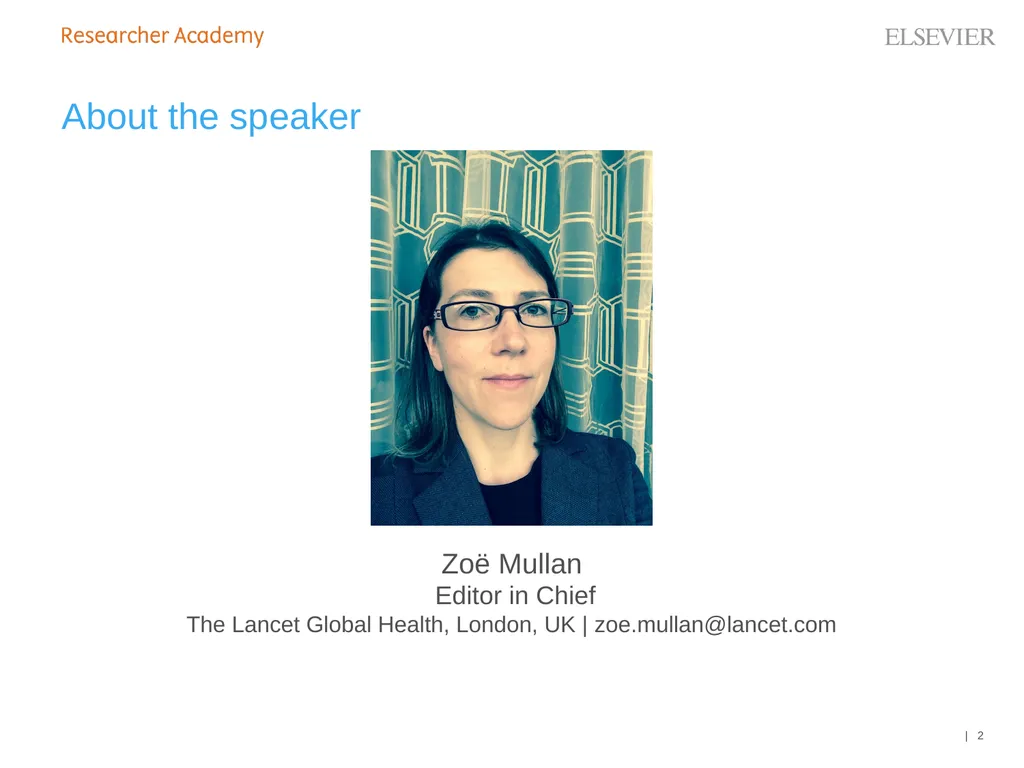
slide2. About the speaker Zoë Mullan Editor in Chief
The Lancet Global Health, London, UK | zoe.mullan@lancet.com<br>
slide3. Section 3.1: How to write a helpful peer review report – comments to authors
a. General considerations
b. Checklists and guidelines
c. Overall structure
d. Section by section Contents<br>
slide4. DO…
Be professional and courteous
Be objective, constructive, and specific
Read the whole paper before starting (including appendices)
Follow the journal’s guidelines
Be consistent with your confidential comments to editors
Remember that the purpose is to assist the authors in improving the paper
DO NOT…
Write anything you would not be happy to receive yourself
Line-by-line edit the paper (copy editors do that)
Ask the authors to include references to your own work unless absolutely necessary
Request additional analyses/experiments unless they are essential to support claims made in the current manuscript General considerations<br>
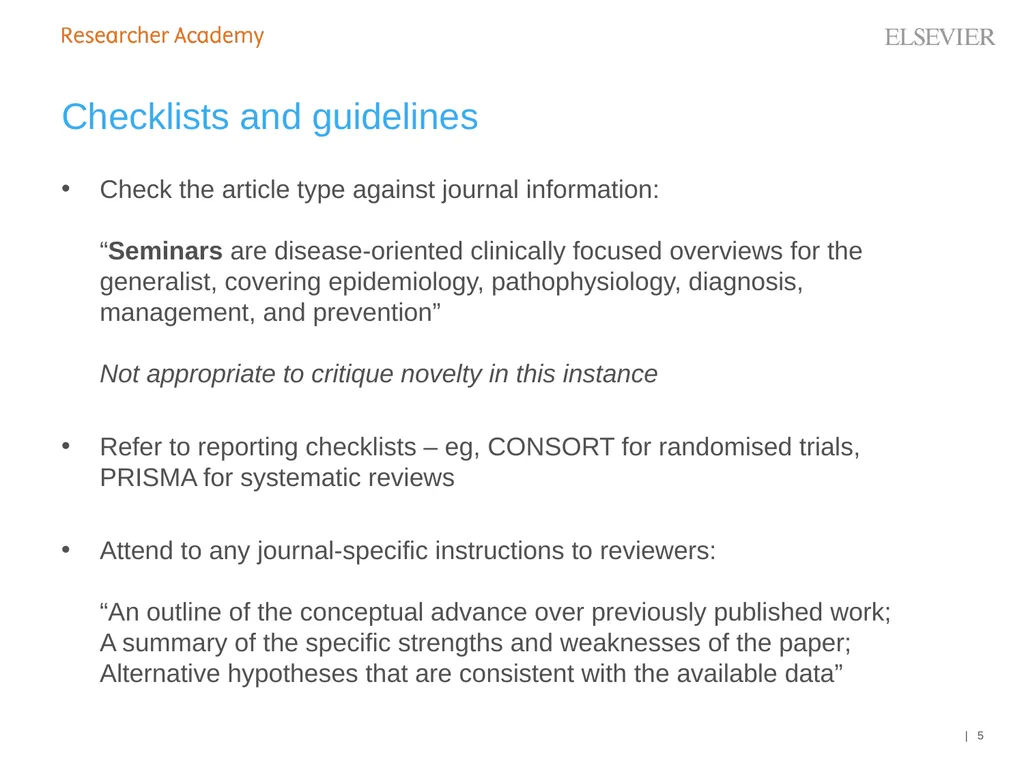
slide5. Check the article type against journal information: “Seminars are disease-oriented clinically focused overviews for the generalist, covering epidemiology, pathophysiology, diagnosis, management, and prevention” Not appropriate to critique novelty in this instance
Refer to reporting checklists – eg, CONSORT for randomised trials, PRISMA for systematic reviews
Attend to any journal-specific instructions to reviewers: “An outline of the conceptual advance over previously published work; A summary of the specific strengths and weaknesses of the paper; Alternative hypotheses that are consistent with the available data” Checklists and guidelines<br>
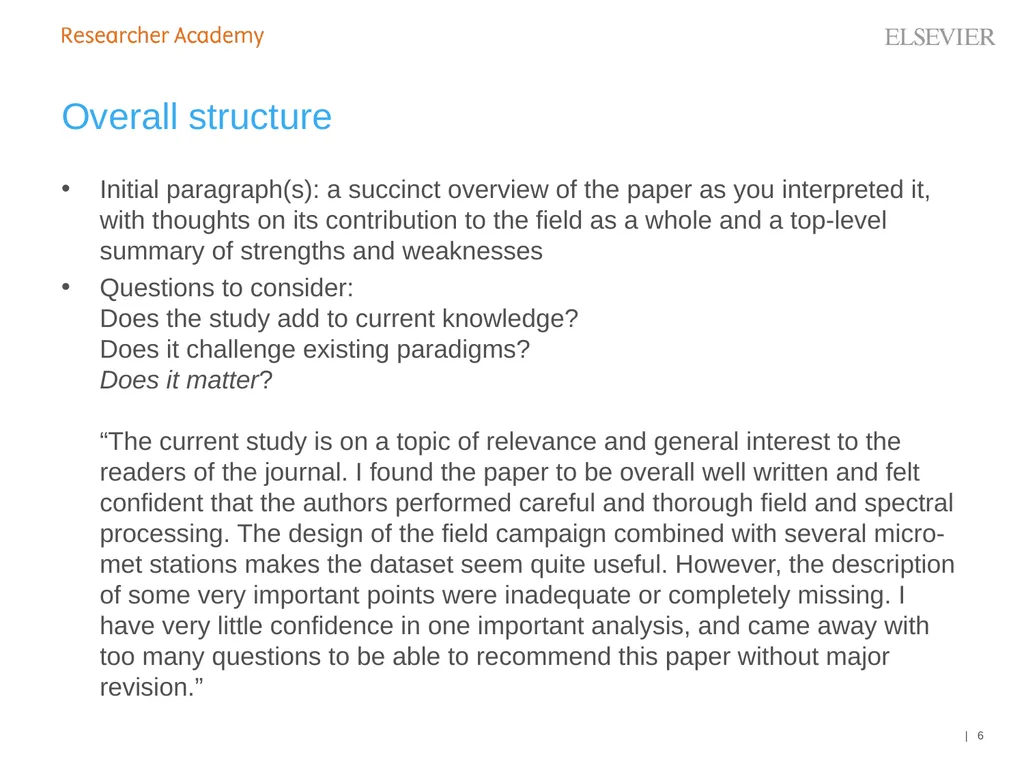
slide6. Initial paragraph(s): a succinct overview of the paper as you interpreted it, with thoughts on its contribution to the field as a whole and a top-level summary of strengths and weaknesses
Questions to consider: Does the study add to current knowledge? Does it challenge existing paradigms? Does it matter? “The current study is on a topic of relevance and general interest to the readers of the journal. I found the paper to be overall well written and felt confident that the authors performed careful and thorough field and spectral processing. The design of the field campaign combined with several micro-met stations makes the dataset seem quite useful. However, the description of some very important points were inadequate or completely missing. I have very little confidence in one important analysis, and came away with too many questions to be able to recommend this paper without major revision.” Overall structure<br>
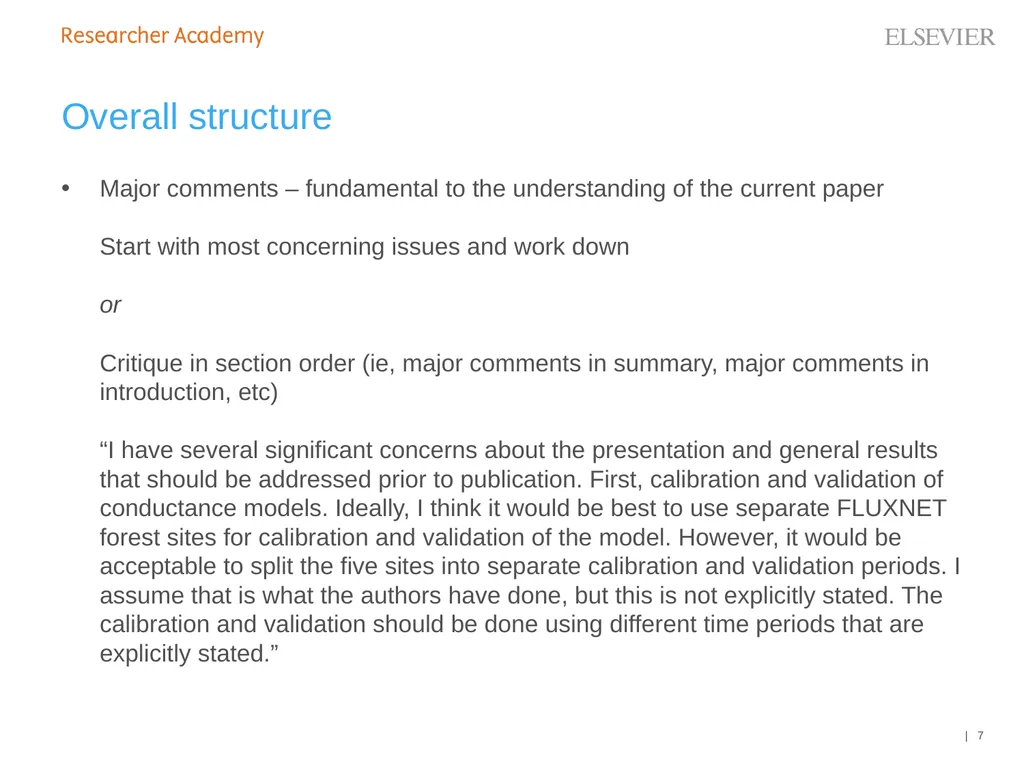
slide7. Major comments – fundamental to the understanding of the current paper Start with most concerning issues and work down or Critique in section order (ie, major comments in summary, major comments in introduction, etc) “I have several significant concerns about the presentation and general results that should be addressed prior to publication. First, calibration and validation of conductance models. Ideally, I think it would be best to use separate FLUXNET forest sites for calibration and validation of the model. However, it would be acceptable to split the five sites into separate calibration and validation periods. I assume that is what the authors have done, but this is not explicitly stated. The calibration and validation should be done using different time periods that are explicitly stated.” Overall structure<br>
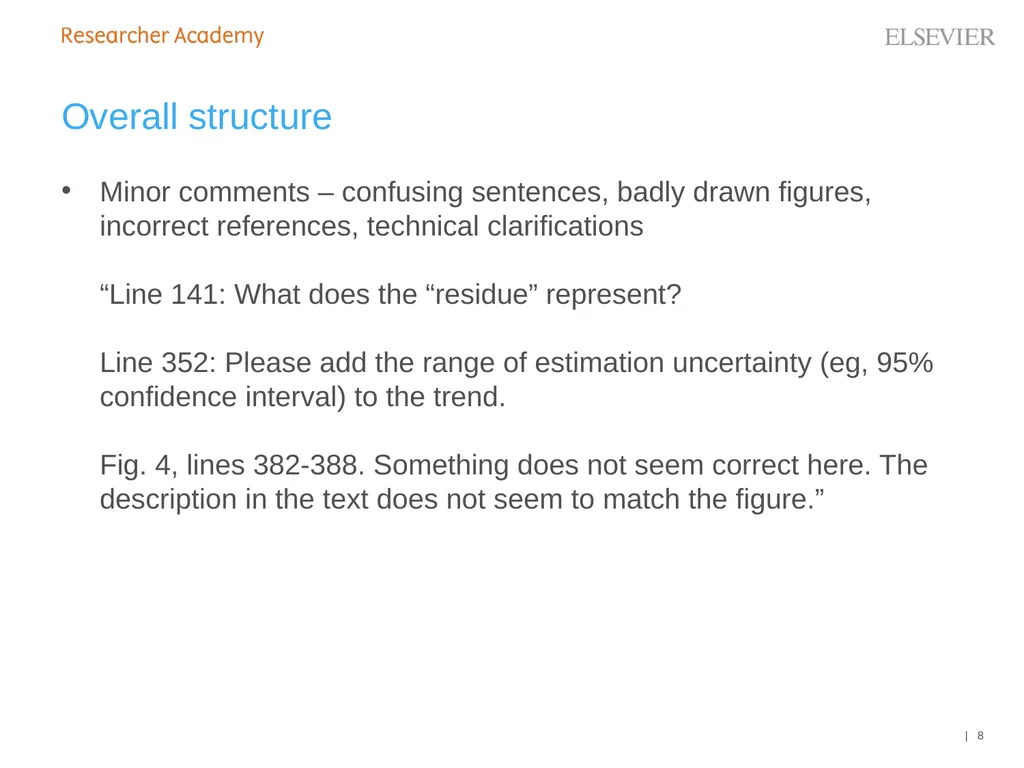
slide8. Minor comments – confusing sentences, badly drawn figures, incorrect references, technical clarifications “Line 141: What does the “residue” represent? Line 352: Please add the range of estimation uncertainty (eg, 95% confidence interval) to the trend. Fig. 4, lines 382-388. Something does not seem correct here. The description in the text does not seem to match the figure.” Overall structure<br>
slide9. Introduction
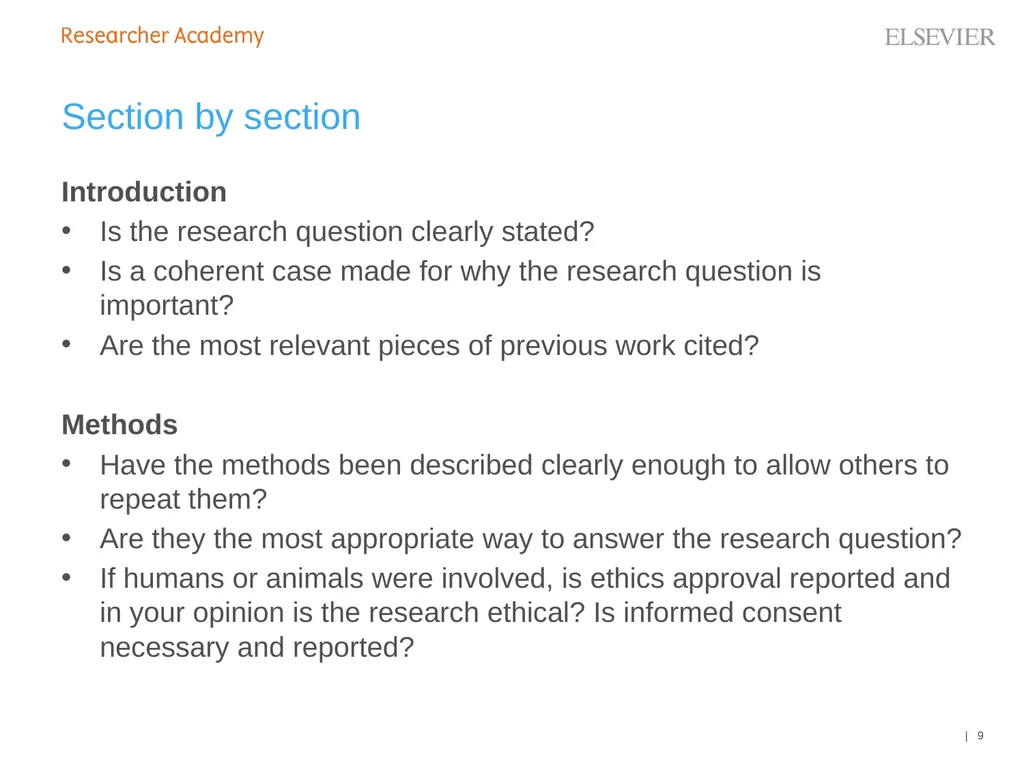
Is the research question clearly stated?
Is a coherent case made for why the research question is important?
Are the most relevant pieces of previous work cited?
Methods
Have the methods been described clearly enough to allow others to repeat them?
Are they the most appropriate way to answer the research question?
If humans or animals were involved, is ethics approval reported and in your opinion is the research ethical? Is informed consent necessary and reported? Section by section<br>
slide10. Results
Are results reported for all experiments/analyses described in the Methods?
Are any results reported for which methods have not been described?
Are they presented clearly and consistently (eg, do the figures and text match up)?
Discussion
Does the interpretation reasonably reflect the results or have the authors “gone beyond the data”?
Are the potential limitations presented? If not, point them out.
Do the results conflict with those of other researchers and have potential explanations been proposed?
Has the research question been answered?
Have the authors summed up what the findings mean in the “grand scheme of things”? Section by section<br>
slide11. Title and abstract
Does the title accurately reflect the research question and study type?
Does the abstract contain the aim of the study and the most important methodological details?
Are the findings reported in the abstract a faithful representation of those reported in the main text?
Is anything presented in the summary that wasn’t described in the main paper?
Is the conclusion justified by the data presented?
Are the implications for future work stated? Section by section<br>
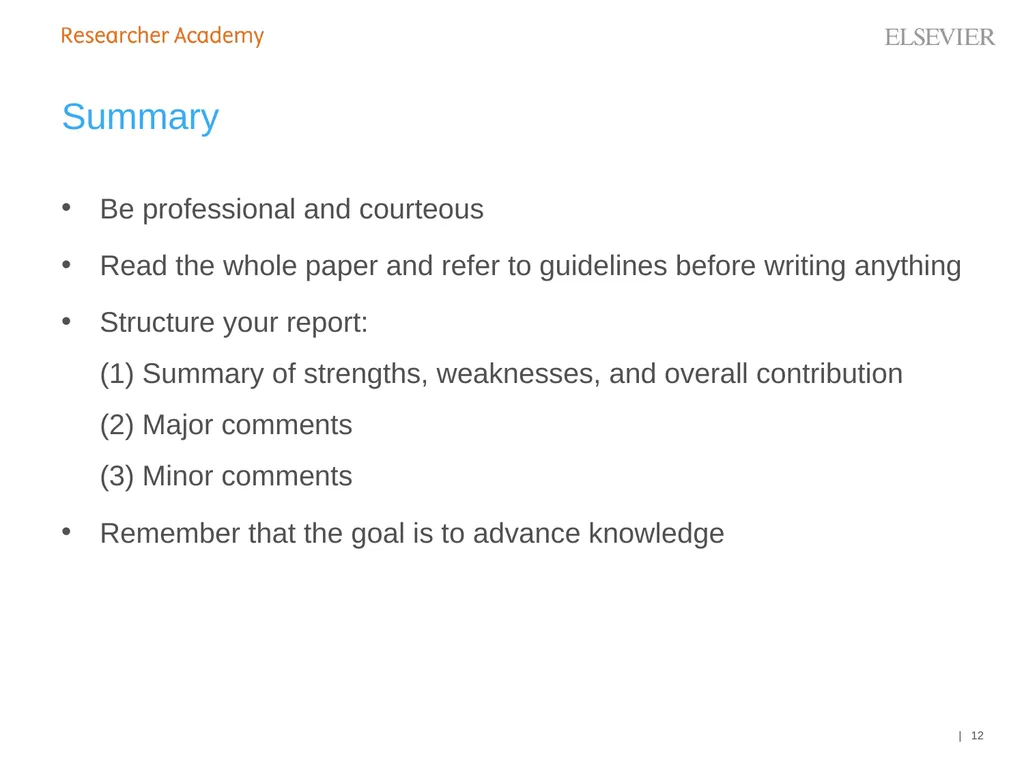
slide12. Be professional and courteous
Read the whole paper and refer to guidelines before writing anything
Structure your report: (1) Summary of strengths, weaknesses, and overall contribution (2) Major comments (3) Minor comments
Remember that the goal is to advance knowledge Summary<br>
slide13. Thank you Ask your questions on: Researcher Academy Mendeley group
Follow us on Twitter<br>
slide2. About the speaker Zoë Mullan Editor in Chief
The Lancet Global Health, London, UK | zoe.mullan@lancet.com<br>
slide3. Section 3.1: How to write a helpful peer review report – comments to authors
a. General considerations
b. Checklists and guidelines
c. Overall structure
d. Section by section Contents<br>
slide4. DO…
Be professional and courteous
Be objective, constructive, and specific
Read the whole paper before starting (including appendices)
Follow the journal’s guidelines
Be consistent with your confidential comments to editors
Remember that the purpose is to assist the authors in improving the paper
DO NOT…
Write anything you would not be happy to receive yourself
Line-by-line edit the paper (copy editors do that)
Ask the authors to include references to your own work unless absolutely necessary
Request additional analyses/experiments unless they are essential to support claims made in the current manuscript General considerations<br>
slide5. Check the article type against journal information: “Seminars are disease-oriented clinically focused overviews for the generalist, covering epidemiology, pathophysiology, diagnosis, management, and prevention” Not appropriate to critique novelty in this instance
Refer to reporting checklists – eg, CONSORT for randomised trials, PRISMA for systematic reviews
Attend to any journal-specific instructions to reviewers: “An outline of the conceptual advance over previously published work; A summary of the specific strengths and weaknesses of the paper; Alternative hypotheses that are consistent with the available data” Checklists and guidelines<br>
slide6. Initial paragraph(s): a succinct overview of the paper as you interpreted it, with thoughts on its contribution to the field as a whole and a top-level summary of strengths and weaknesses
Questions to consider: Does the study add to current knowledge? Does it challenge existing paradigms? Does it matter? “The current study is on a topic of relevance and general interest to the readers of the journal. I found the paper to be overall well written and felt confident that the authors performed careful and thorough field and spectral processing. The design of the field campaign combined with several micro-met stations makes the dataset seem quite useful. However, the description of some very important points were inadequate or completely missing. I have very little confidence in one important analysis, and came away with too many questions to be able to recommend this paper without major revision.” Overall structure<br>
slide7. Major comments – fundamental to the understanding of the current paper Start with most concerning issues and work down or Critique in section order (ie, major comments in summary, major comments in introduction, etc) “I have several significant concerns about the presentation and general results that should be addressed prior to publication. First, calibration and validation of conductance models. Ideally, I think it would be best to use separate FLUXNET forest sites for calibration and validation of the model. However, it would be acceptable to split the five sites into separate calibration and validation periods. I assume that is what the authors have done, but this is not explicitly stated. The calibration and validation should be done using different time periods that are explicitly stated.” Overall structure<br>
slide8. Minor comments – confusing sentences, badly drawn figures, incorrect references, technical clarifications “Line 141: What does the “residue” represent? Line 352: Please add the range of estimation uncertainty (eg, 95% confidence interval) to the trend. Fig. 4, lines 382-388. Something does not seem correct here. The description in the text does not seem to match the figure.” Overall structure<br>
slide9. Introduction
Is the research question clearly stated?
Is a coherent case made for why the research question is important?
Are the most relevant pieces of previous work cited?
Methods
Have the methods been described clearly enough to allow others to repeat them?
Are they the most appropriate way to answer the research question?
If humans or animals were involved, is ethics approval reported and in your opinion is the research ethical? Is informed consent necessary and reported? Section by section<br>
slide10. Results
Are results reported for all experiments/analyses described in the Methods?
Are any results reported for which methods have not been described?
Are they presented clearly and consistently (eg, do the figures and text match up)?
Discussion
Does the interpretation reasonably reflect the results or have the authors “gone beyond the data”?
Are the potential limitations presented? If not, point them out.
Do the results conflict with those of other researchers and have potential explanations been proposed?
Has the research question been answered?
Have the authors summed up what the findings mean in the “grand scheme of things”? Section by section<br>
slide11. Title and abstract
Does the title accurately reflect the research question and study type?
Does the abstract contain the aim of the study and the most important methodological details?
Are the findings reported in the abstract a faithful representation of those reported in the main text?
Is anything presented in the summary that wasn’t described in the main paper?
Is the conclusion justified by the data presented?
Are the implications for future work stated? Section by section<br>
slide12. Be professional and courteous
Read the whole paper and refer to guidelines before writing anything
Structure your report: (1) Summary of strengths, weaknesses, and overall contribution (2) Major comments (3) Minor comments
Remember that the goal is to advance knowledge Summary<br>
slide13. Thank you Ask your questions on: Researcher Academy Mendeley group
Follow us on Twitter<br>