
An Introduction to Transcranial Magnetic
BR
Published · 48 slides · 0 views

1 / 1


Description
An Introduction to Transcranial Magnetic Stimulation: Beyond Depression No fees were exchanged or provided for the production or presentation of this content. There was no industry involvement in the content of the slide deck. 2 The
Related Topics
Share
Embed code
Download this presentation From Below
"An Introduction to Transcranial Magnetic" is the property of its rightful owner. Permission is granted to download and print the materials on this website for personal, non-commercial use only, and to display it on your personal computer provided you do not modify the materials and that you retain all copyright notices contained in the materials. By downloading content from our website, you accept the terms of this agreement.
Presentation Transcript
01
An Introduction to
Transcranial Magnetic Stimulation:
Beyond Depression<br>
02
No fees were exchanged or provided for the production or presentation of this content.
There was no industry involvement in the content of the slide deck. 2<br>
There was no industry involvement in the content of the slide deck. 2<br>
03
The Clinical TMS Society (CTMSS) CTMSS is an international professional association of about 1000 clinicians, researchers, technicians, students and industry partners dedicated to:
Optimizing the clinical practice of TMS
Awareness of TMS
Accessibility of TMS 3<br>
Optimizing the clinical practice of TMS
Awareness of TMS
Accessibility of TMS 3<br>
04
This slide deck was originally conceived, produced, and edited by the Outreach Committee of the Clinical TMS Society.
The society’s board of directors originally approved slide decks for educating other clinicians in September 2017.
Since that time, the slide decks have evolved and been edited. 4<br>
The society’s board of directors originally approved slide decks for educating other clinicians in September 2017.
Since that time, the slide decks have evolved and been edited. 4<br>
05
Learning Objectives At the end of this educational activity, the learner will
Know FDA cleared psychiatric indications for TMS
Understand the basic neurobiology of OCD and addictions as related to the potential mechanism of TMS
Review the data supporting the use of TMS for OCD, smoking cessation, depression with anxious features, and SAINT
Identify the potential risks of TMS
Understand patient appropriateness for TMS based on demographics, diagnosis, and treatment history 5<br>
Know FDA cleared psychiatric indications for TMS
Understand the basic neurobiology of OCD and addictions as related to the potential mechanism of TMS
Review the data supporting the use of TMS for OCD, smoking cessation, depression with anxious features, and SAINT
Identify the potential risks of TMS
Understand patient appropriateness for TMS based on demographics, diagnosis, and treatment history 5<br>
06
TMS:
FDA-Cleared Indications
Other Than MDD<br>
07
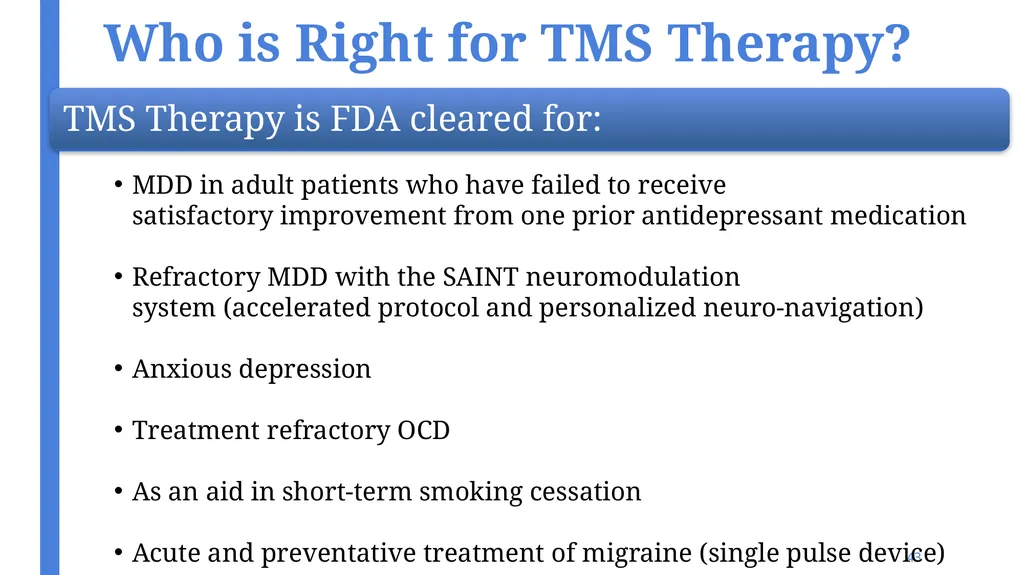
TMS Therapy is FDA-Cleared for: MDD in adult patients who have failed to receive satisfactory improvement from one prior antidepressant medication
Refractory MDD with the SAINT neuromodulation system (accelerated protocol and personalized neuro-navigation)
Anxious depression
Treatment refractory OCD
As an aid in short-term smoking cessation
Acute and preventative treatment of migraine (single pulse device)<br>
Refractory MDD with the SAINT neuromodulation system (accelerated protocol and personalized neuro-navigation)
Anxious depression
Treatment refractory OCD
As an aid in short-term smoking cessation
Acute and preventative treatment of migraine (single pulse device)<br>
08
Stanford Accelerated Intelligent Neuromodulation Therapy
(SAINT)<br>
09
SAINT:
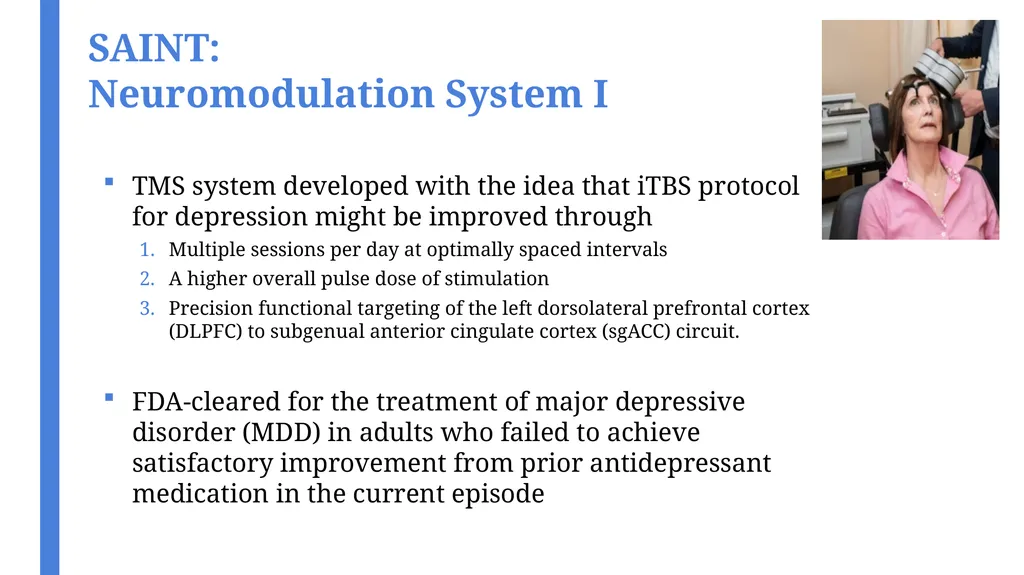
Neuromodulation System I TMS system developed with the idea that iTBS protocol for depression might be improved through
Multiple sessions per day at optimally spaced intervals
A higher overall pulse dose of stimulation
Precision functional targeting of the left dorsolateral prefrontal cortex (DLPFC) to subgenual anterior cingulate cortex (sgACC) circuit.
FDA-cleared for the treatment of major depressive disorder (MDD) in adults who failed to achieve satisfactory improvement from prior antidepressant medication in the current episode<br>
Multiple sessions per day at optimally spaced intervals
A higher overall pulse dose of stimulation
Precision functional targeting of the left dorsolateral prefrontal cortex (DLPFC) to subgenual anterior cingulate cortex (sgACC) circuit.
FDA-cleared for the treatment of major depressive disorder (MDD) in adults who failed to achieve satisfactory improvement from prior antidepressant medication in the current episode<br>
10
RCT of 29 participants with moderate to severe MDD:
(14 active in group; 15 in sham group)
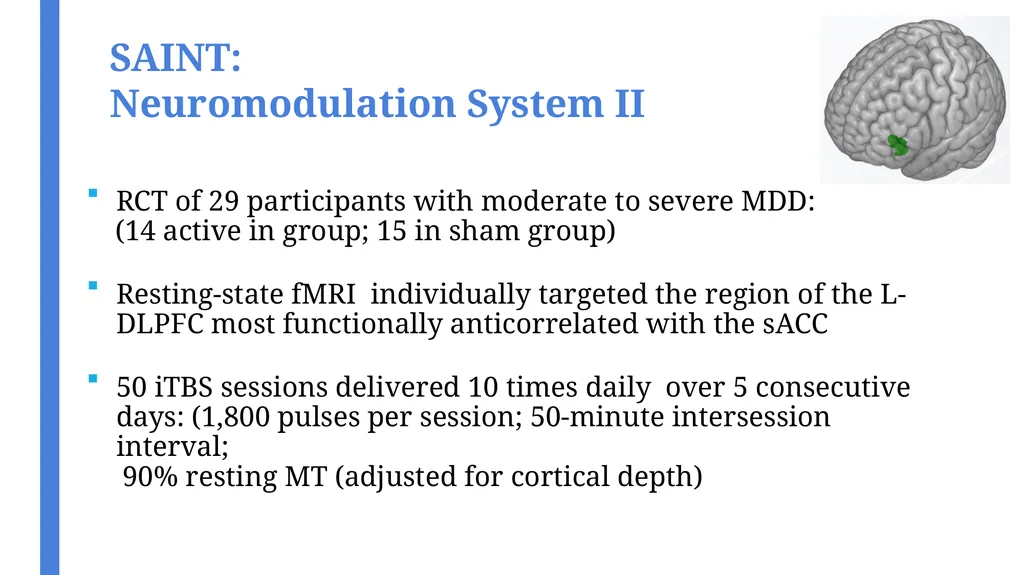
Resting-state fMRI individually targeted the region of the L-DLPFC most functionally anticorrelated with the sACC
50 iTBS sessions delivered 10 times daily over 5 consecutive days: (1,800 pulses per session; 50-minute intersession interval;
90% resting MT (adjusted for cortical depth) 10 SAINT: Neuromodulation System II<br>
(14 active in group; 15 in sham group)
Resting-state fMRI individually targeted the region of the L-DLPFC most functionally anticorrelated with the sACC
50 iTBS sessions delivered 10 times daily over 5 consecutive days: (1,800 pulses per session; 50-minute intersession interval;
90% resting MT (adjusted for cortical depth) 10 SAINT: Neuromodulation System II<br>
11
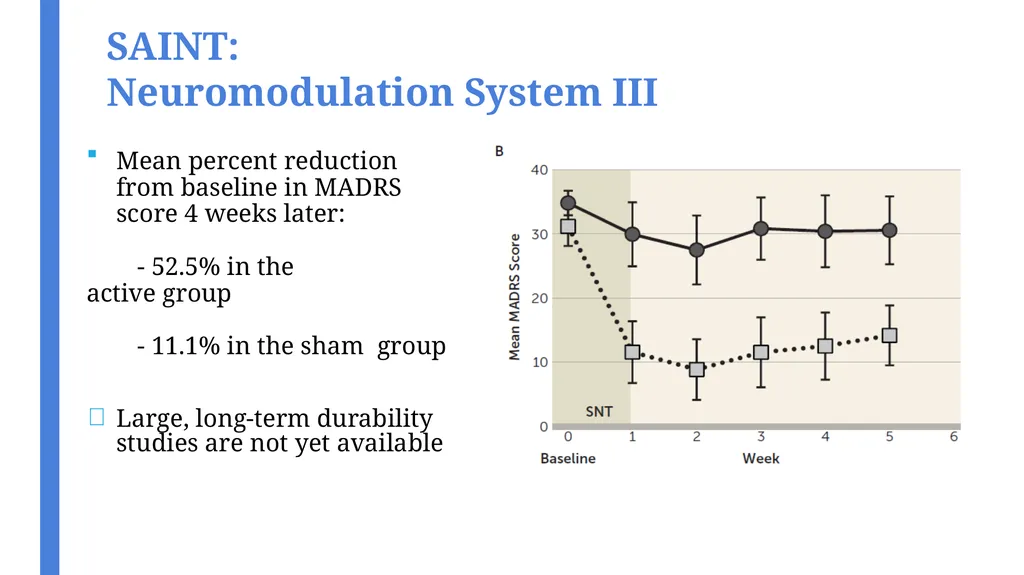
Mean percent reduction from baseline in MADRS score 4 weeks later:
- 52.5% in the active group
- 11.1% in the sham group
Large, long-term durability studies are not yet available 11 SAINT: Neuromodulation System III<br>
- 52.5% in the active group
- 11.1% in the sham group
Large, long-term durability studies are not yet available 11 SAINT: Neuromodulation System III<br>
12
TMS:
Anxious Depression<br>
13
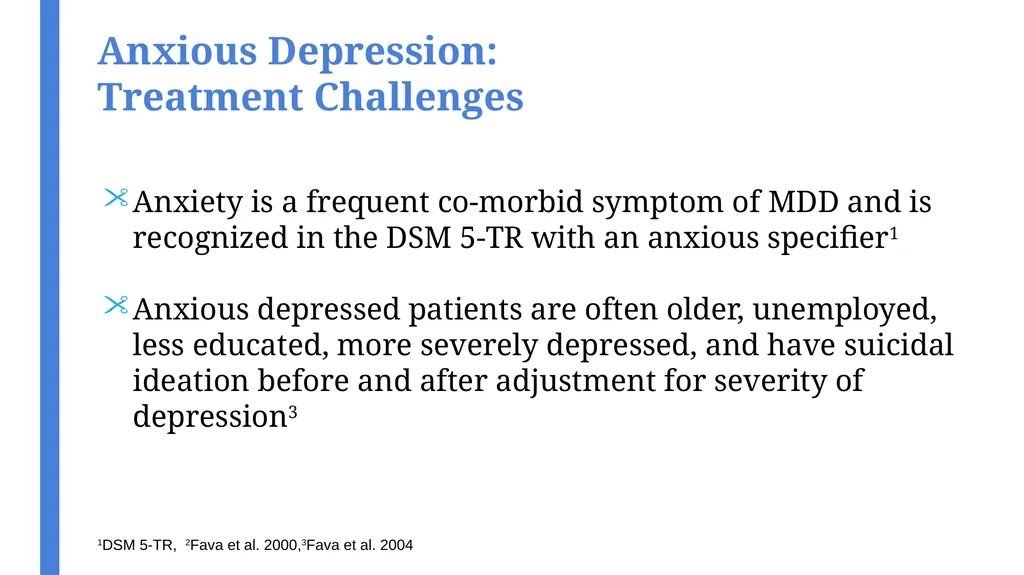
Anxious Depression:
Treatment Challenges Anxiety is a frequent co-morbid symptom of MDD and is recognized in the DSM 5-TR with an anxious specifier1
Anxious depressed patients are often older, unemployed, less educated, more severely depressed, and have suicidal ideation before and after adjustment for severity of depression3 1DSM 5-TR, 2Fava et al. 2000,3Fava et al. 2004<br>
Anxious depressed patients are often older, unemployed, less educated, more severely depressed, and have suicidal ideation before and after adjustment for severity of depression3 1DSM 5-TR, 2Fava et al. 2000,3Fava et al. 2004<br>
14
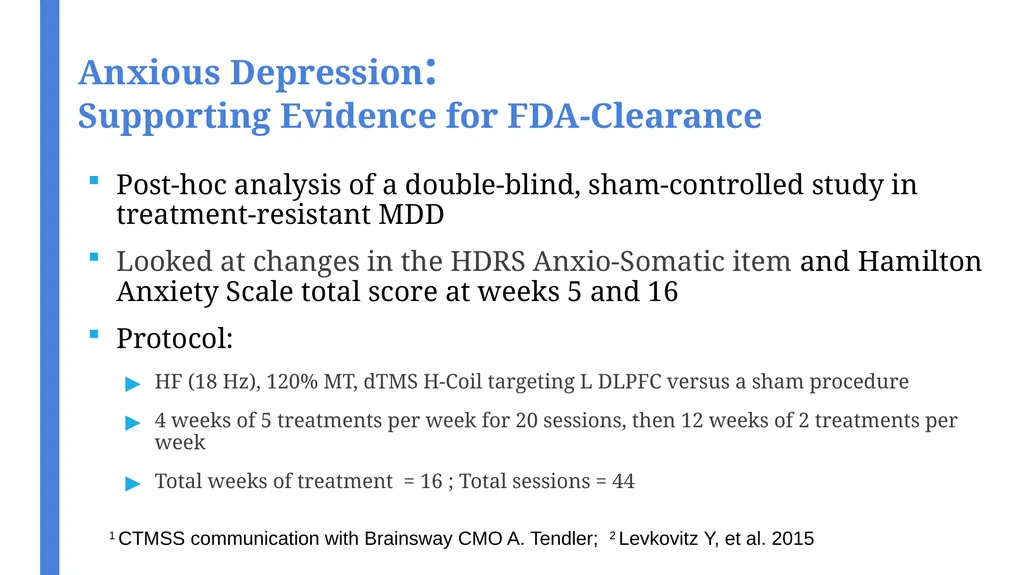
Post-hoc analysis of a double-blind, sham-controlled study in treatment-resistant MDD
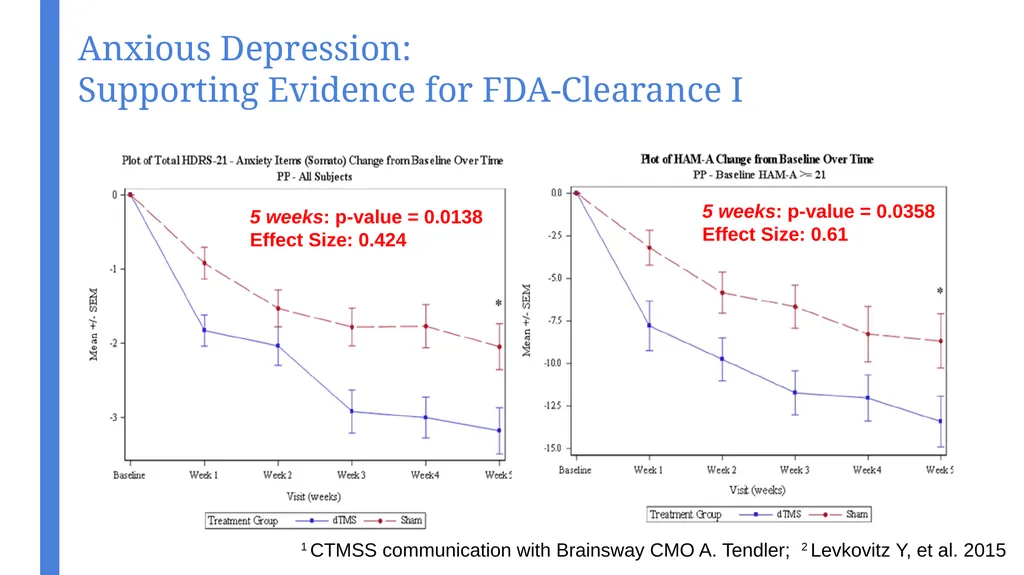
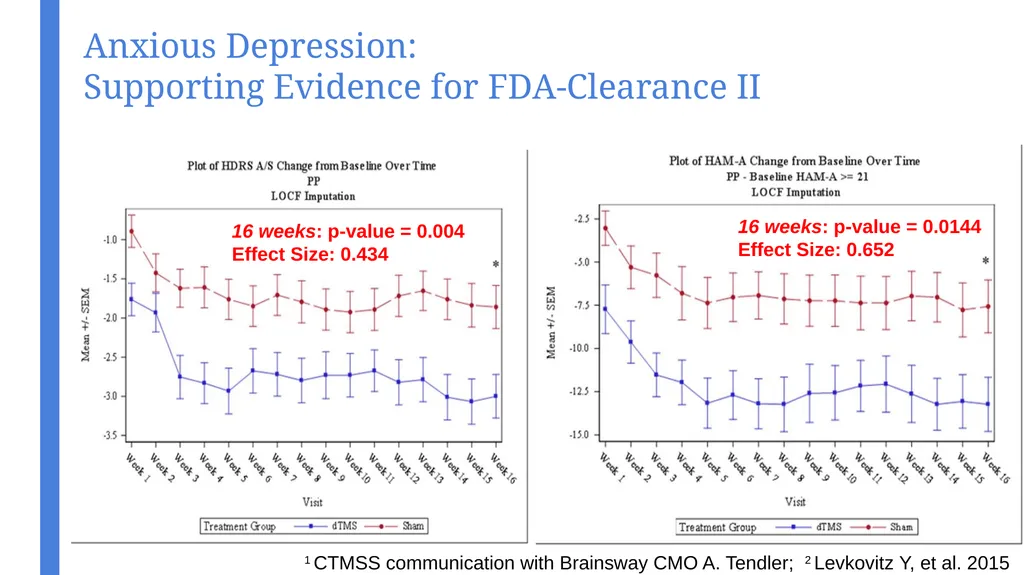
Looked at changes in the HDRS Anxio-Somatic item and Hamilton Anxiety Scale total score at weeks 5 and 16
Protocol:
HF (18 Hz), 120% MT, dTMS H-Coil targeting L DLPFC versus a sham procedure
4 weeks of 5 treatments per week for 20 sessions, then 12 weeks of 2 treatments per week
Total weeks of treatment = 16 ; Total sessions = 44 14 Anxious Depression: Supporting Evidence for FDA-Clearance 1 CTMSS communication with Brainsway CMO A. Tendler; 2 Levkovitz Y, et al. 2015<br>
Looked at changes in the HDRS Anxio-Somatic item and Hamilton Anxiety Scale total score at weeks 5 and 16
Protocol:
HF (18 Hz), 120% MT, dTMS H-Coil targeting L DLPFC versus a sham procedure
4 weeks of 5 treatments per week for 20 sessions, then 12 weeks of 2 treatments per week
Total weeks of treatment = 16 ; Total sessions = 44 14 Anxious Depression: Supporting Evidence for FDA-Clearance 1 CTMSS communication with Brainsway CMO A. Tendler; 2 Levkovitz Y, et al. 2015<br>
15
15 Anxious Depression:
Supporting Evidence for FDA-Clearance I 5 weeks: p-value = 0.0138
Effect Size: 0.424 5 weeks: p-value = 0.0358
Effect Size: 0.61 1 CTMSS communication with Brainsway CMO A. Tendler; 2 Levkovitz Y, et al. 2015<br>
Effect Size: 0.424 5 weeks: p-value = 0.0358
Effect Size: 0.61 1 CTMSS communication with Brainsway CMO A. Tendler; 2 Levkovitz Y, et al. 2015<br>
16
16 Anxious Depression:
Supporting Evidence for FDA-Clearance II 1 CTMSS communication with Brainsway CMO A. Tendler; 2 Levkovitz Y, et al. 2015 16 weeks: p-value = 0.004
Effect Size: 0.434 16 weeks: p-value = 0.0144
Effect Size: 0.652<br>
Effect Size: 0.434 16 weeks: p-value = 0.0144
Effect Size: 0.652<br>
17
TMS:
Migraine Headache<br>
18
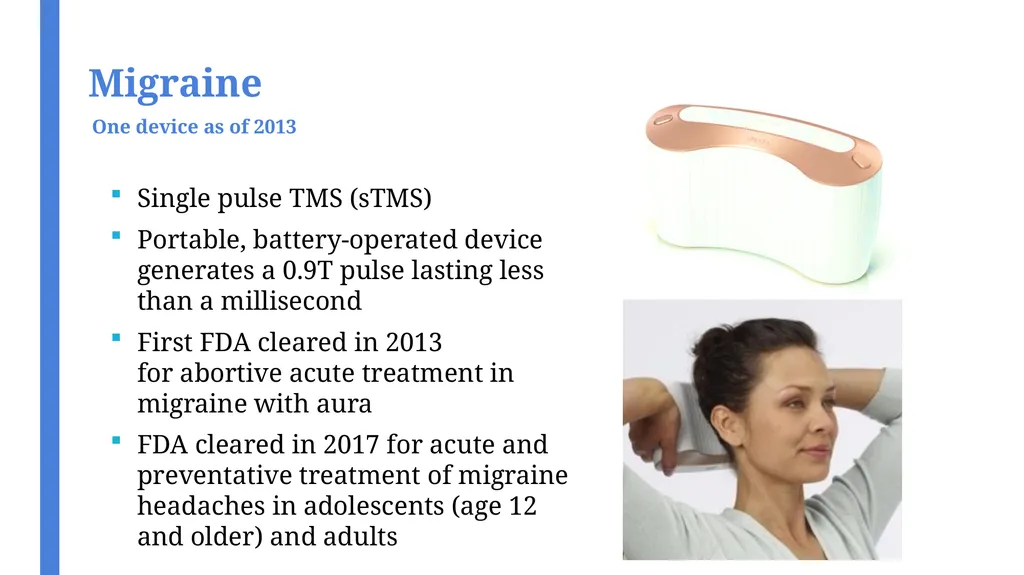
Migraine Single pulse TMS (sTMS)
Portable, battery-operated device generates a 0.9T pulse lasting less than a millisecond
First FDA cleared in 2013 for abortive acute treatment in migraine with aura
FDA cleared in 2017 for acute and preventative treatment of migraine headaches in adolescents (age 12 and older) and adults One device as of 2013<br>
Portable, battery-operated device generates a 0.9T pulse lasting less than a millisecond
First FDA cleared in 2013 for abortive acute treatment in migraine with aura
FDA cleared in 2017 for acute and preventative treatment of migraine headaches in adolescents (age 12 and older) and adults One device as of 2013<br>
19
TMS:
Obsessive-Compulsive Disorder
(OCD)<br>
20
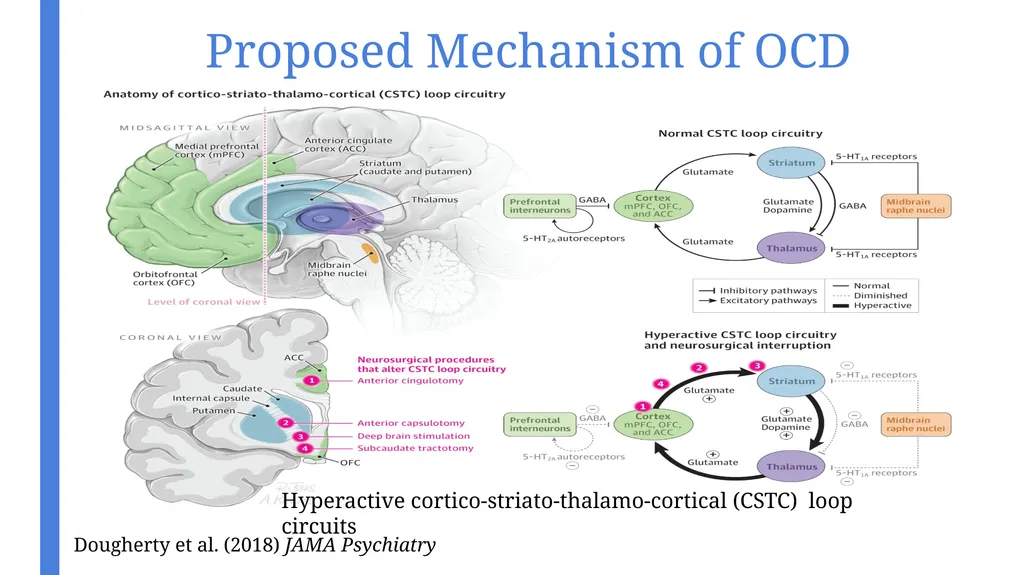
OCD Treatment Challenges OCD has a lifetime prevalence of 2.3%1
10% of patients have no meaningful response to traditional treatments including pharmacotherapy (SSRIs, TCAs, atypical antipsychotics) and cognitive behavioral therapy (e.g., ERP)2
Psychosurgeries (DBS, ablative procedures) come with risk of severe complications (infection, bleeding, device malfunction, agitation/mania, etc.) 20 1Russio et al. (2010);
2Pallanti et al. (2006)<br>
10% of patients have no meaningful response to traditional treatments including pharmacotherapy (SSRIs, TCAs, atypical antipsychotics) and cognitive behavioral therapy (e.g., ERP)2
Psychosurgeries (DBS, ablative procedures) come with risk of severe complications (infection, bleeding, device malfunction, agitation/mania, etc.) 20 1Russio et al. (2010);
2Pallanti et al. (2006)<br>
21
Proposed Mechanism of OCD Hyperactive cortico-striato-thalamo-cortical (CSTC) loop circuits Dougherty et al. (2018) JAMA Psychiatry<br>
22
A Neurochemical Explanation
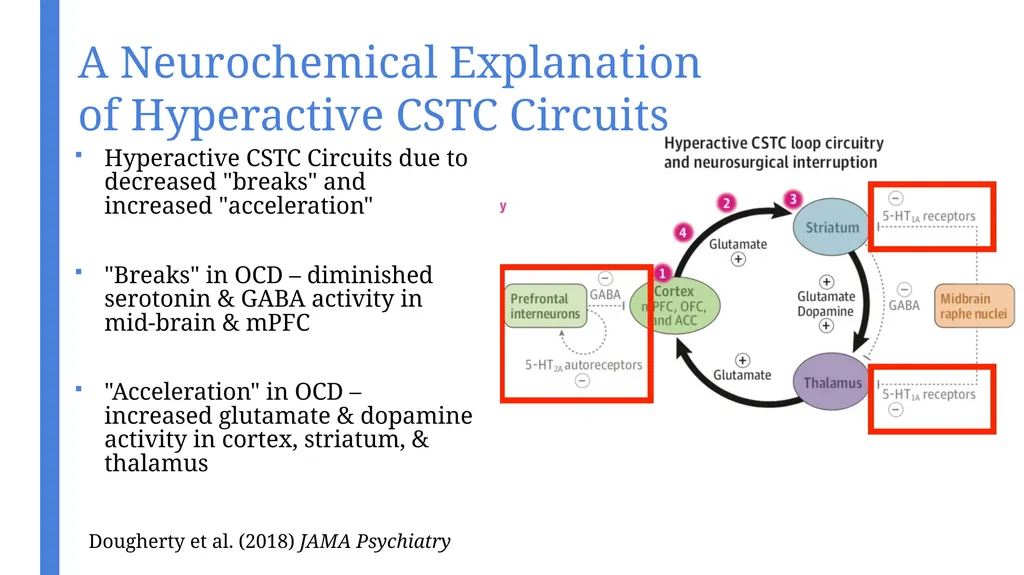
of Hyperactive CSTC Circuits Hyperactive CSTC Circuits due to decreased "breaks" and increased "acceleration"
"Breaks" in OCD – diminished serotonin & GABA activity in mid-brain & mPFC
"Acceleration" in OCD – increased glutamate & dopamine activity in cortex, striatum, & thalamus Dougherty et al. (2018) JAMA Psychiatry<br>
"Breaks" in OCD – diminished serotonin & GABA activity in mid-brain & mPFC
"Acceleration" in OCD – increased glutamate & dopamine activity in cortex, striatum, & thalamus Dougherty et al. (2018) JAMA Psychiatry<br>
23
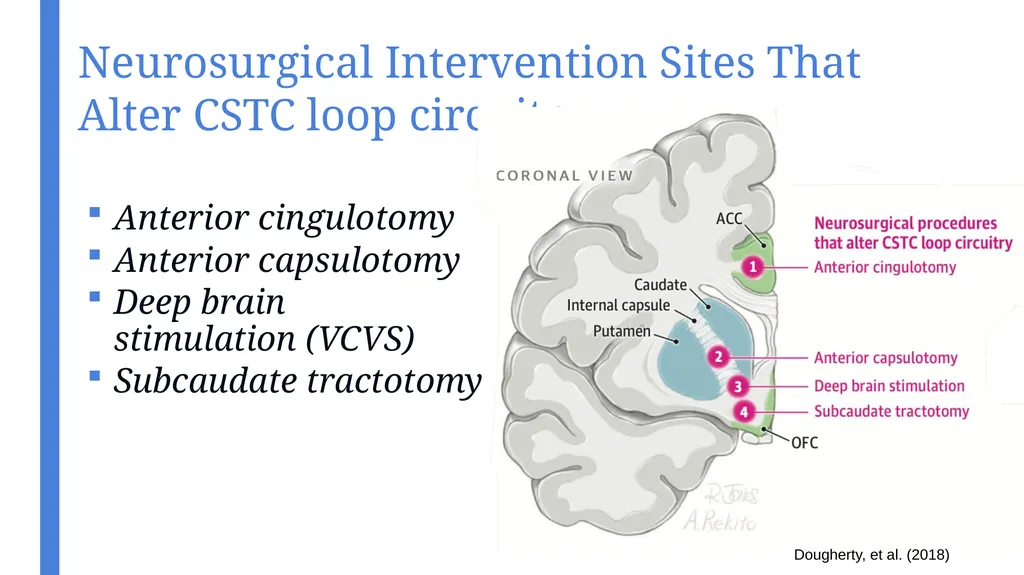
Neurosurgical Intervention Sites That Alter CSTC loop circuitry Anterior cingulotomy
Anterior capsulotomy
Deep brain stimulation (VCVS)
Subcaudate tractotomy Dougherty, et al. (2018)<br>
Anterior capsulotomy
Deep brain stimulation (VCVS)
Subcaudate tractotomy Dougherty, et al. (2018)<br>
24
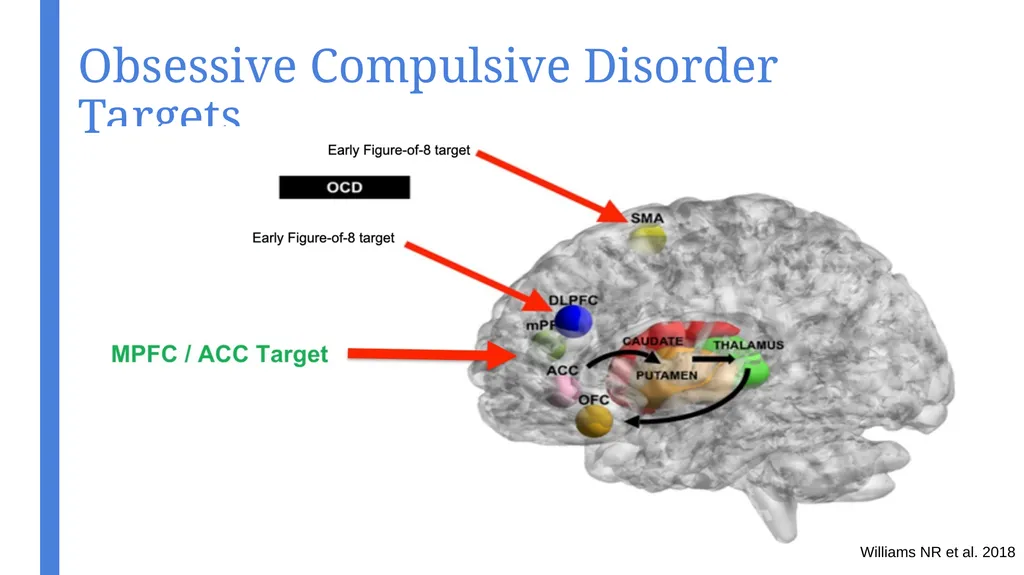
Obsessive Compulsive Disorder Targets Williams NR et al. 2018<br>
25
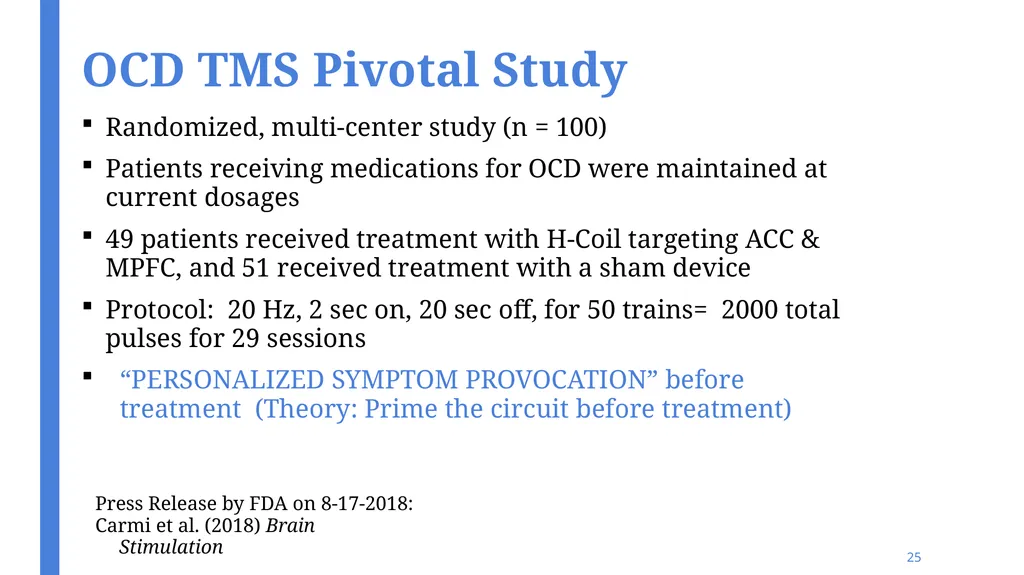
OCD TMS Pivotal Study Randomized, multi-center study (n = 100)
Patients receiving medications for OCD were maintained at current dosages
49 patients received treatment with H-Coil targeting ACC & MPFC, and 51 received treatment with a sham device
Protocol: 20 Hz, 2 sec on, 20 sec off, for 50 trains= 2000 total pulses for 29 sessions
“PERSONALIZED SYMPTOM PROVOCATION” before treatment (Theory: Prime the circuit before treatment) 25 Press Release by FDA on 8-17-2018:
Carmi et al. (2018) Brain Stimulation<br>
Patients receiving medications for OCD were maintained at current dosages
49 patients received treatment with H-Coil targeting ACC & MPFC, and 51 received treatment with a sham device
Protocol: 20 Hz, 2 sec on, 20 sec off, for 50 trains= 2000 total pulses for 29 sessions
“PERSONALIZED SYMPTOM PROVOCATION” before treatment (Theory: Prime the circuit before treatment) 25 Press Release by FDA on 8-17-2018:
Carmi et al. (2018) Brain Stimulation<br>
26
Results of OCD TMS Pivotal Study 38% of patients responded (>30% reduction in YBOCS) to TMS verses 11% of patients undergoing sham
Likely best used as adjunct to exposure therapy and medications
Remission is rare, as is the case with SSRI treatment
Effect sizes are modes (Y-BOCS reduction ~6-9); similar to SSRI outcomes
Large, long-term durability studies are not yet available 26 Press Release by FDA on 8-17-2018:
Carmi et al. (2018) Brain Stimulation<br>
Likely best used as adjunct to exposure therapy and medications
Remission is rare, as is the case with SSRI treatment
Effect sizes are modes (Y-BOCS reduction ~6-9); similar to SSRI outcomes
Large, long-term durability studies are not yet available 26 Press Release by FDA on 8-17-2018:
Carmi et al. (2018) Brain Stimulation<br>
27
TMS:
Smoking Cessation<br>
28
34 million people and an estimated 14% of adults in the US smoke cigarettes
Individuals who attempt to quit smoking average approximately 6 quit attempts before achieving long-term abstinence
The EAGLES trial, an RCT of 8144 people who smoked found a significantly higher 6-month quit rate for varenicline (21.8%) than for bupropion (16.2%) and the nicotine patch (15.7%). Each therapy was more effective than placebo (9.4%).
One RCT of 446 participants found significantly higher 6-month cessation rates from combining varenicline & NRT than from varenicline alone (65.1% vs 46.7%) 28 Smoking Cessation Treatment: Challenges Rigotti et al. (2022) JAMA<br>
Individuals who attempt to quit smoking average approximately 6 quit attempts before achieving long-term abstinence
The EAGLES trial, an RCT of 8144 people who smoked found a significantly higher 6-month quit rate for varenicline (21.8%) than for bupropion (16.2%) and the nicotine patch (15.7%). Each therapy was more effective than placebo (9.4%).
One RCT of 446 participants found significantly higher 6-month cessation rates from combining varenicline & NRT than from varenicline alone (65.1% vs 46.7%) 28 Smoking Cessation Treatment: Challenges Rigotti et al. (2022) JAMA<br>
29
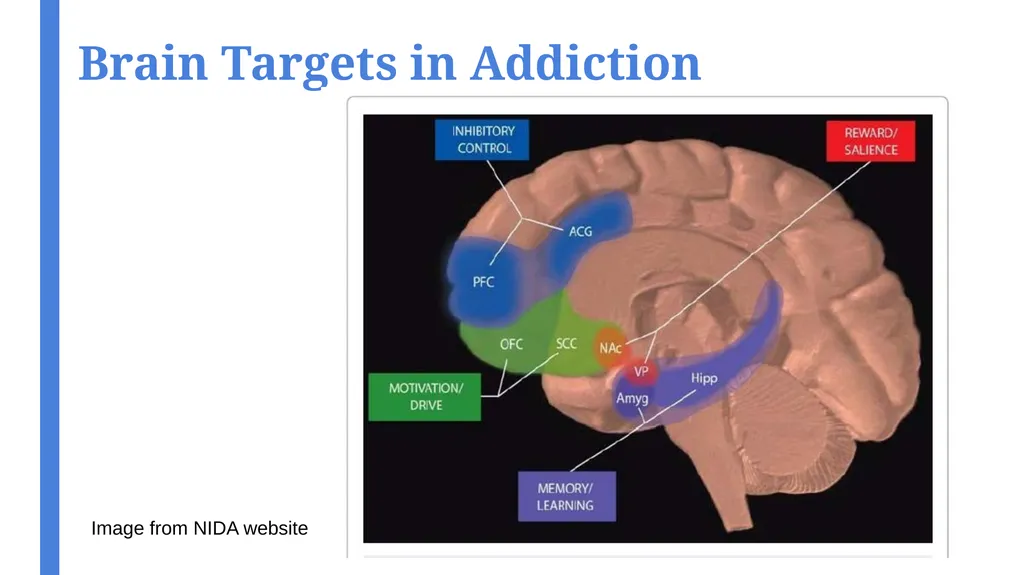
29 Brain Targets in Addiction Image from NIDA website<br>
30
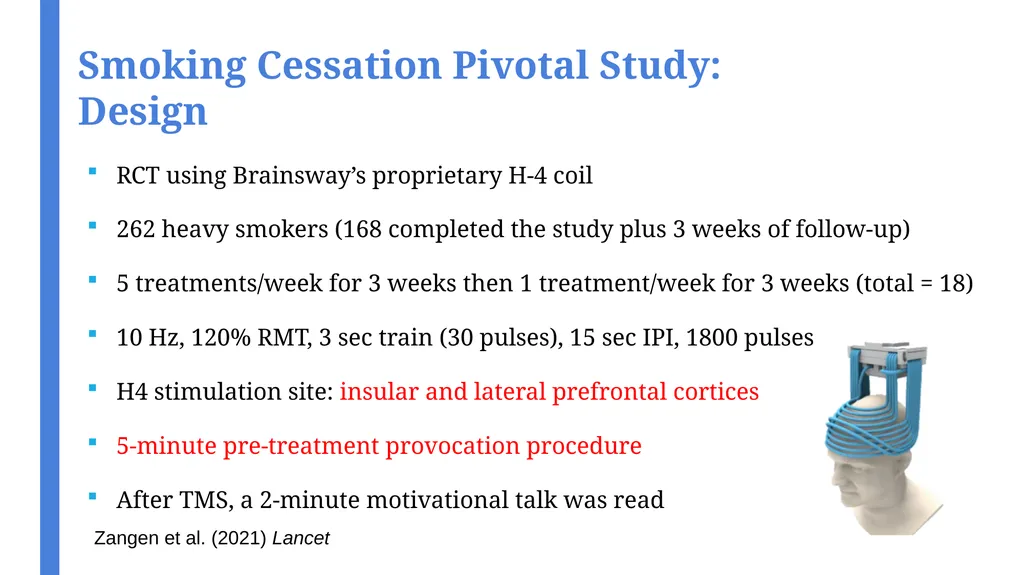
RCT using Brainsway’s proprietary H-4 coil
262 heavy smokers (168 completed the study plus 3 weeks of follow-up)
5 treatments/week for 3 weeks then 1 treatment/week for 3 weeks (total = 18)
10 Hz, 120% RMT, 3 sec train (30 pulses), 15 sec IPI, 1800 pulses
H4 stimulation site: insular and lateral prefrontal cortices
5-minute pre-treatment provocation procedure
After TMS, a 2-minute motivational talk was read 30 Smoking Cessation Pivotal Study: Design Zangen et al. (2021) Lancet<br>
262 heavy smokers (168 completed the study plus 3 weeks of follow-up)
5 treatments/week for 3 weeks then 1 treatment/week for 3 weeks (total = 18)
10 Hz, 120% RMT, 3 sec train (30 pulses), 15 sec IPI, 1800 pulses
H4 stimulation site: insular and lateral prefrontal cortices
5-minute pre-treatment provocation procedure
After TMS, a 2-minute motivational talk was read 30 Smoking Cessation Pivotal Study: Design Zangen et al. (2021) Lancet<br>
31
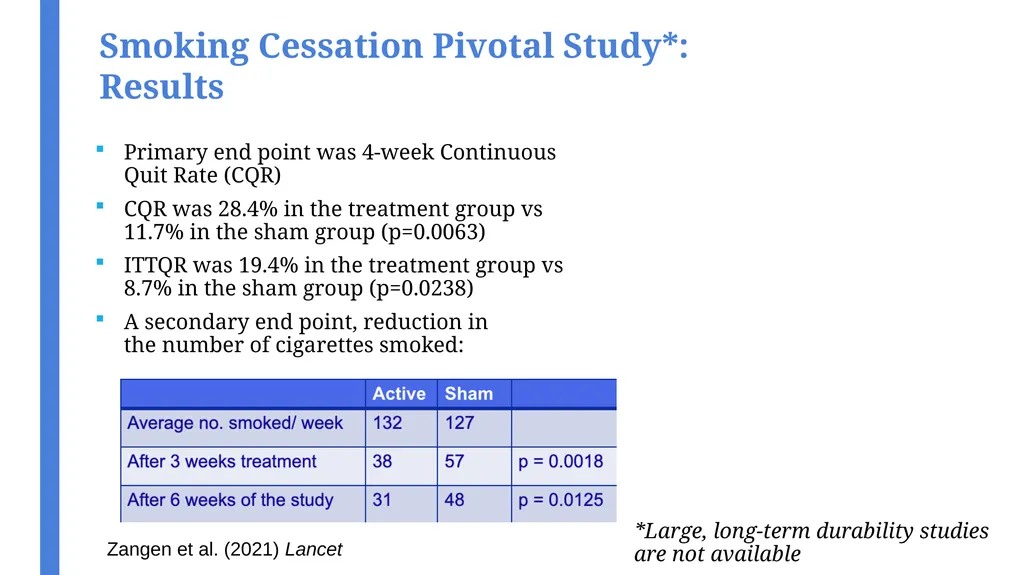
Primary end point was 4-week Continuous Quit Rate (CQR)
CQR was 28.4% in the treatment group vs 11.7% in the sham group (p=0.0063)
ITTQR was 19.4% in the treatment group vs 8.7% in the sham group (p=0.0238)
A secondary end point, reduction in the number of cigarettes smoked: 31 Smoking Cessation Pivotal Study*: Results *Large, long-term durability studies are not available Zangen et al. (2021) Lancet<br>
CQR was 28.4% in the treatment group vs 11.7% in the sham group (p=0.0063)
ITTQR was 19.4% in the treatment group vs 8.7% in the sham group (p=0.0238)
A secondary end point, reduction in the number of cigarettes smoked: 31 Smoking Cessation Pivotal Study*: Results *Large, long-term durability studies are not available Zangen et al. (2021) Lancet<br>
32
TMS:
Adverse Events 32<br>
33
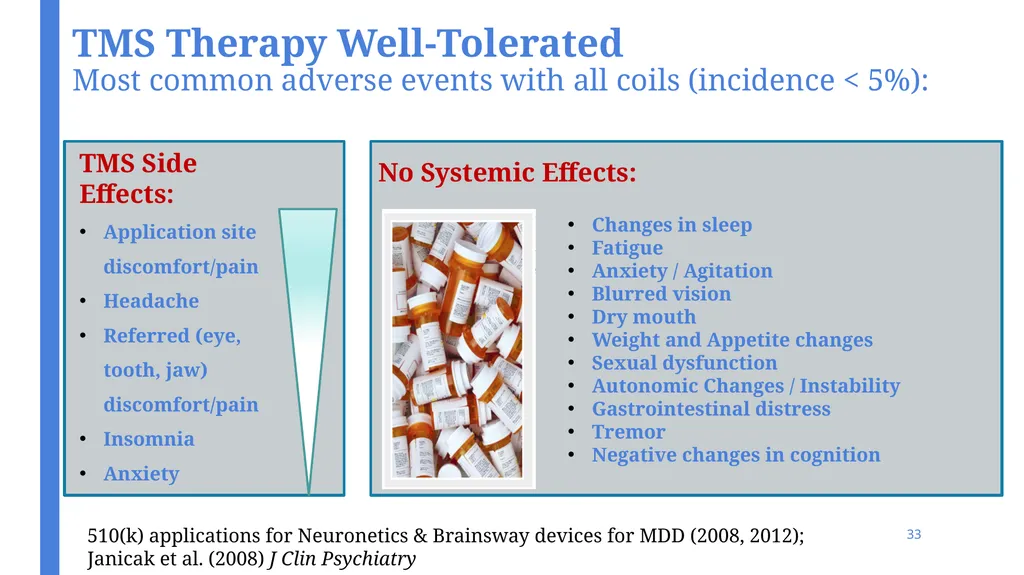
TMS Therapy Well-Tolerated
Most common adverse events with all coils (incidence < 5%): 33 TMS Side Effects:
Application site discomfort/pain
Headache
Referred (eye, tooth, jaw) discomfort/pain
Insomnia
Anxiety No Systemic Effects: 510(k) applications for Neuronetics & Brainsway devices for MDD (2008, 2012); Janicak et al. (2008) J Clin Psychiatry Changes in sleep
Fatigue
Anxiety / Agitation
Blurred vision
Dry mouth
Weight and Appetite changes
Sexual dysfunction
Autonomic Changes / Instability
Gastrointestinal distress
Tremor
Negative changes in cognition<br>
Application site discomfort/pain
Headache
Referred (eye, tooth, jaw) discomfort/pain
Insomnia
Anxiety No Systemic Effects: 510(k) applications for Neuronetics & Brainsway devices for MDD (2008, 2012); Janicak et al. (2008) J Clin Psychiatry Changes in sleep
Fatigue
Anxiety / Agitation
Blurred vision
Dry mouth
Weight and Appetite changes
Sexual dysfunction
Autonomic Changes / Instability
Gastrointestinal distress
Tremor
Negative changes in cognition<br>
34
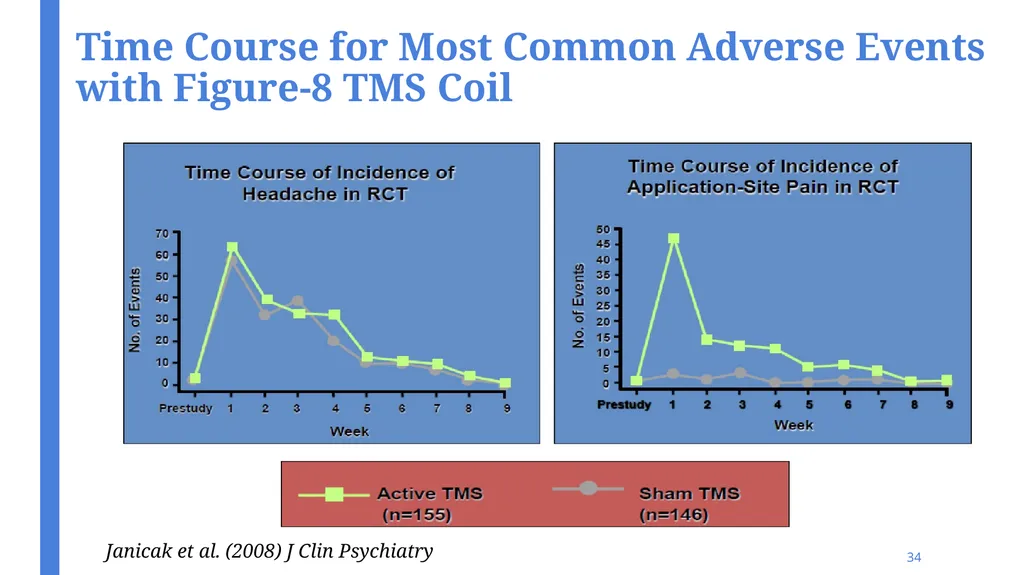
Time Course for Most Common Adverse Events with Figure-8 TMS Coil Janicak et al. (2008) J Clin Psychiatry 34<br>
35
TMS:
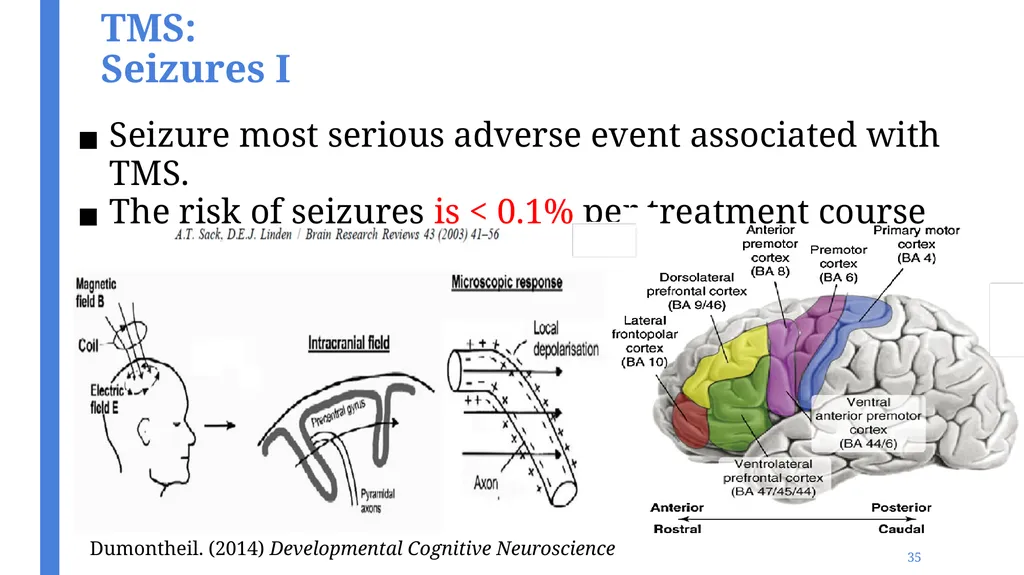
Seizures I Seizure most serious adverse event associated with TMS.
The risk of seizures is < 0.1% per treatment course 35 Dumontheil. (2014) Developmental Cognitive Neuroscience<br>
The risk of seizures is < 0.1% per treatment course 35 Dumontheil. (2014) Developmental Cognitive Neuroscience<br>
36
Most cases associated with TMS were prior to the publication of safety guidelines in 1998 1
The risk is less than or comparable to that associated with antidepressant medications 2
All reported TMS induced seizures have occurred during treatment session itself and have stopped with no sequelae and no progression to epilepsy. 36 Wassermann. (1998) Electroencephalography and Clinical Neurophysiology
George et al. (2013) Curr Opin Psychiatry TMS: Seizures II<br>
The risk is less than or comparable to that associated with antidepressant medications 2
All reported TMS induced seizures have occurred during treatment session itself and have stopped with no sequelae and no progression to epilepsy. 36 Wassermann. (1998) Electroencephalography and Clinical Neurophysiology
George et al. (2013) Curr Opin Psychiatry TMS: Seizures II<br>
37
TMS:
Hearing Loss 1Loo et al. (2001) Biol Psychiatry; 2Zangen et al. (2005) Clin Neurophysiol; 3Folmer et al. (2006) Acta Otolaryngol; Rossi et al. (2007) J Neurol Neurosurg Psychiatry; Janicak et al. (2008) J Clin Psychiatry; 4Koponen et al. (2020) Brain Stim Small proportion of adult humans have experienced transient increases in auditory thresholds1
Permanent threshold shift in a single patient who did not wear ear plugs and was stimulated with H1 coil2
Majority of studies in which hearing protection was used report no changes in hearing3
Recent study examining the sound of 7 different TMS coils found airborne sound exceeded some exposure limits for TMS subjects and, in some cases, for operators.4<br>
Permanent threshold shift in a single patient who did not wear ear plugs and was stimulated with H1 coil2
Majority of studies in which hearing protection was used report no changes in hearing3
Recent study examining the sound of 7 different TMS coils found airborne sound exceeded some exposure limits for TMS subjects and, in some cases, for operators.4<br>
38
TMS:
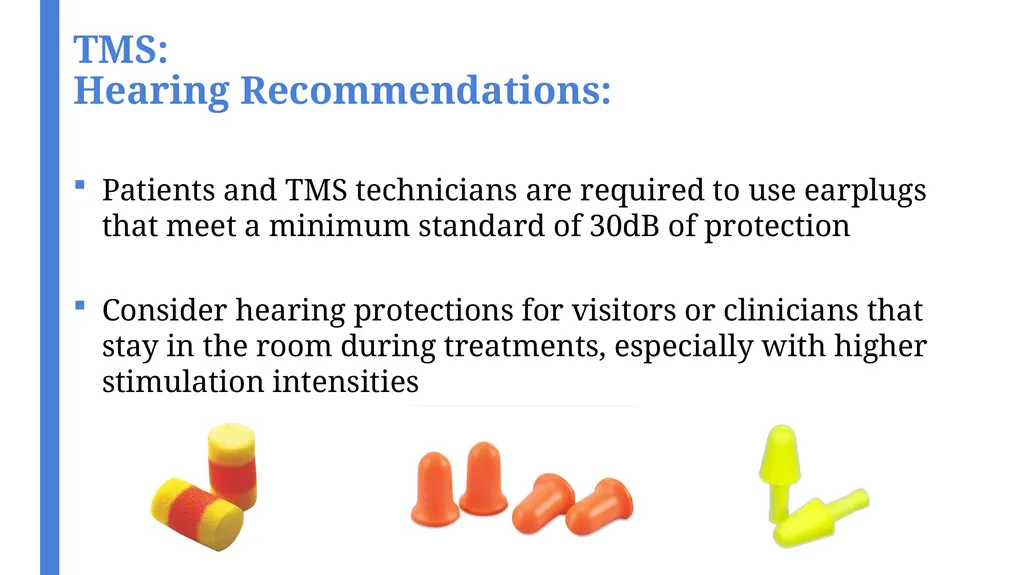
Hearing Recommendations: Patients and TMS technicians are required to use earplugs that meet a minimum standard of 30dB of protection
Consider hearing protections for visitors or clinicians that stay in the room during treatments, especially with higher stimulation intensities<br>
Consider hearing protections for visitors or clinicians that stay in the room during treatments, especially with higher stimulation intensities<br>
39
TMS:
Treatment Emergent Mania (TEM) Review of 10 TMS studies involving both depressed and bipolar patients reported1:
TEM was 0.84% for active treatment group and 0.73% for sham group
The switch rate for unipolar patients was 0.34%
The switch rate for bipolar patients was 3.1%
More recent review of all TEM reported up to 2015 found that2:
Both high and low frequency stimulation could result in TEM
Although, many of the cases of TEM coincided with antidepressant medication changes. 39 1Xia et al. (2008) Int J of Neuropsychopharmacology
2Rachid (2017) J of Psych Practice<br>
TEM was 0.84% for active treatment group and 0.73% for sham group
The switch rate for unipolar patients was 0.34%
The switch rate for bipolar patients was 3.1%
More recent review of all TEM reported up to 2015 found that2:
Both high and low frequency stimulation could result in TEM
Although, many of the cases of TEM coincided with antidepressant medication changes. 39 1Xia et al. (2008) Int J of Neuropsychopharmacology
2Rachid (2017) J of Psych Practice<br>
40
TMS:
Emergence of Suicidal Ideation in Pivotal Study Treatment emergent disease exacerbation in a population with increased severity of clinical condition
1.9% with sham; 0.6% active TMS
One non-lethal overdose in a sham-treated patient
Janicak et al. (2008) J Clinical Psychiatry 40<br>
1.9% with sham; 0.6% active TMS
One non-lethal overdose in a sham-treated patient
Janicak et al. (2008) J Clinical Psychiatry 40<br>
41
Summary<br>
42
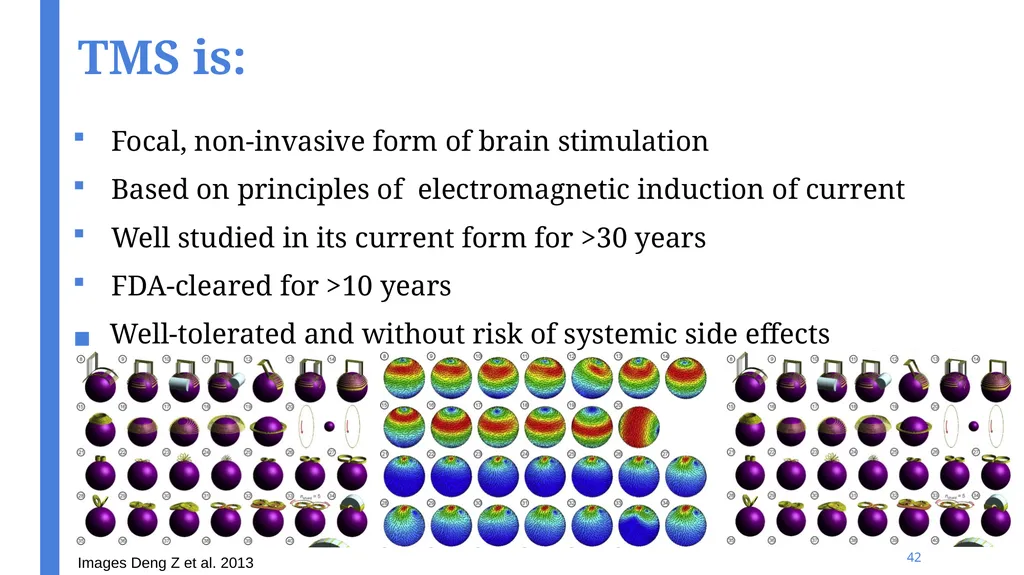
Focal, non-invasive form of brain stimulation
Based on principles of electromagnetic induction of current
Well studied in its current form for >30 years
FDA-cleared for >10 years
Well-tolerated and without risk of systemic side effects 42 TMS is: Images Deng Z et al. 2013<br>
Based on principles of electromagnetic induction of current
Well studied in its current form for >30 years
FDA-cleared for >10 years
Well-tolerated and without risk of systemic side effects 42 TMS is: Images Deng Z et al. 2013<br>
43
Who is Right for TMS Therapy? 43 MDD in adult patients who have failed to receive satisfactory improvement from one prior antidepressant medication
Refractory MDD with the SAINT neuromodulation system (accelerated protocol and personalized neuro-navigation)
Anxious depression
Treatment refractory OCD
As an aid in short-term smoking cessation
Acute and preventative treatment of migraine (single pulse device)<br>
Refractory MDD with the SAINT neuromodulation system (accelerated protocol and personalized neuro-navigation)
Anxious depression
Treatment refractory OCD
As an aid in short-term smoking cessation
Acute and preventative treatment of migraine (single pulse device)<br>
44
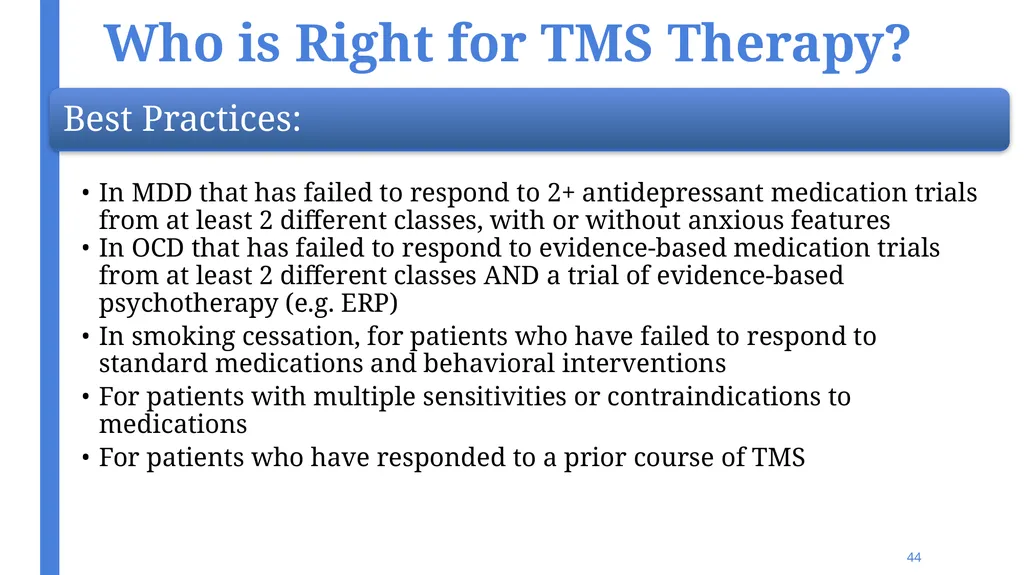
Who is Right for TMS Therapy? 44<br>
45
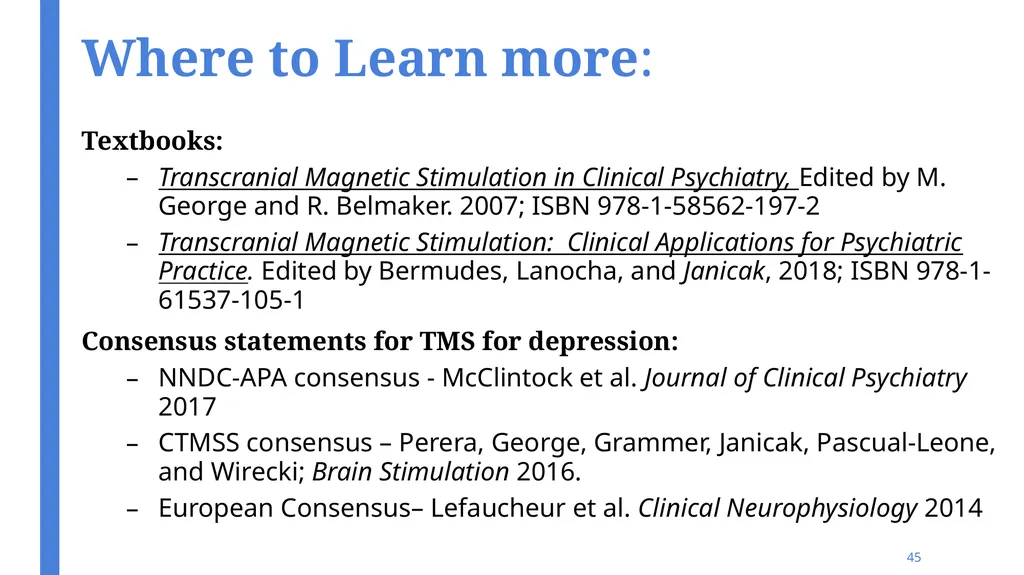
Textbooks:
Transcranial Magnetic Stimulation in Clinical Psychiatry, Edited by M. George and R. Belmaker. 2007; ISBN 978-1-58562-197-2
Transcranial Magnetic Stimulation: Clinical Applications for Psychiatric Practice. Edited by Bermudes, Lanocha, and Janicak, 2018; ISBN 978-1-61537-105-1
Consensus statements for TMS for depression:
NNDC-APA consensus - McClintock et al. Journal of Clinical Psychiatry 2017
CTMSS consensus – Perera, George, Grammer, Janicak, Pascual-Leone, and Wirecki; Brain Stimulation 2016.
European Consensus– Lefaucheur et al. Clinical Neurophysiology 2014 45 Where to Learn more:<br>
Transcranial Magnetic Stimulation in Clinical Psychiatry, Edited by M. George and R. Belmaker. 2007; ISBN 978-1-58562-197-2
Transcranial Magnetic Stimulation: Clinical Applications for Psychiatric Practice. Edited by Bermudes, Lanocha, and Janicak, 2018; ISBN 978-1-61537-105-1
Consensus statements for TMS for depression:
NNDC-APA consensus - McClintock et al. Journal of Clinical Psychiatry 2017
CTMSS consensus – Perera, George, Grammer, Janicak, Pascual-Leone, and Wirecki; Brain Stimulation 2016.
European Consensus– Lefaucheur et al. Clinical Neurophysiology 2014 45 Where to Learn more:<br>
46
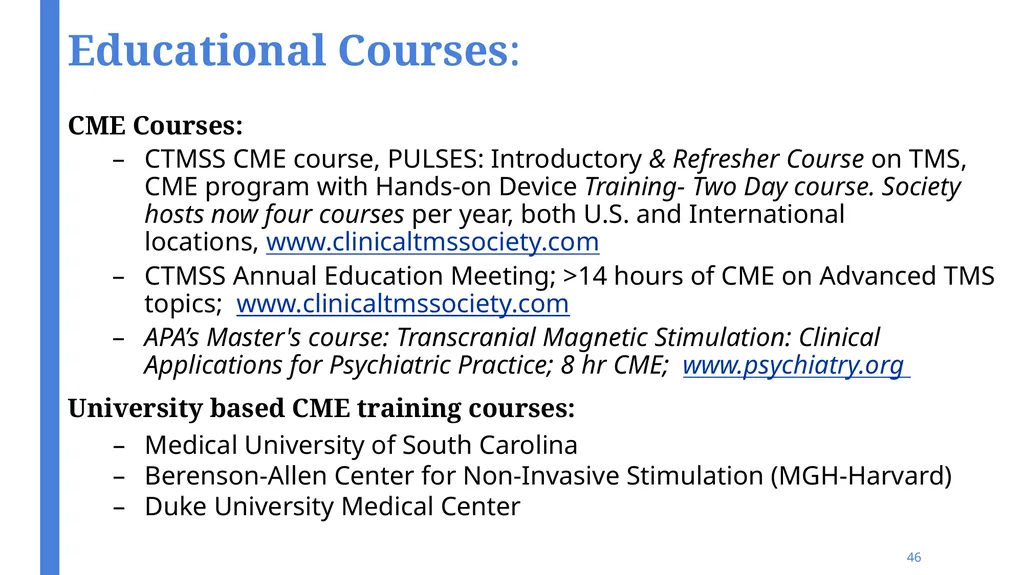
CME Courses:
CTMSS CME course, PULSES: Introductory & Refresher Course on TMS, CME program with Hands-on Device Training- Two Day course. Society hosts now four courses per year, both U.S. and International locations, www.clinicaltmssociety.com
CTMSS Annual Education Meeting; >14 hours of CME on Advanced TMS topics; www.clinicaltmssociety.com
APA’s Master's course: Transcranial Magnetic Stimulation: Clinical Applications for Psychiatric Practice; 8 hr CME; www.psychiatry.org
University based CME training courses:
Medical University of South Carolina
Berenson-Allen Center for Non-Invasive Stimulation (MGH-Harvard)
Duke University Medical Center 46 Educational Courses:<br>
CTMSS CME course, PULSES: Introductory & Refresher Course on TMS, CME program with Hands-on Device Training- Two Day course. Society hosts now four courses per year, both U.S. and International locations, www.clinicaltmssociety.com
CTMSS Annual Education Meeting; >14 hours of CME on Advanced TMS topics; www.clinicaltmssociety.com
APA’s Master's course: Transcranial Magnetic Stimulation: Clinical Applications for Psychiatric Practice; 8 hr CME; www.psychiatry.org
University based CME training courses:
Medical University of South Carolina
Berenson-Allen Center for Non-Invasive Stimulation (MGH-Harvard)
Duke University Medical Center 46 Educational Courses:<br>
47
Thank You ! 47<br>
48
Special thanks to the following CTMSS members:
Kimberly Cress, MD
Randy Pardell, MD
Michelle Cochran, MD
Suzanne Kerns, MD
Bob Sammons, MD,
Linda Carpenter, MD
Mohammed Abdelghani, MD
Mark S. George, MD
Ira Mania, MD
Kristin S. Raj, MD
Philip G. Janicak, MD
Carlos Lowell, MD
Kenneth Goolsby, MD
Members of the CTMSS Outreach and Education Committees
The administrative team at PESC 48<br>
Kimberly Cress, MD
Randy Pardell, MD
Michelle Cochran, MD
Suzanne Kerns, MD
Bob Sammons, MD,
Linda Carpenter, MD
Mohammed Abdelghani, MD
Mark S. George, MD
Ira Mania, MD
Kristin S. Raj, MD
Philip G. Janicak, MD
Carlos Lowell, MD
Kenneth Goolsby, MD
Members of the CTMSS Outreach and Education Committees
The administrative team at PESC 48<br>
49
TMS: Contraindications Only absolute contraindication is non-removable metallic objects in or around the head
- Conductive, ferromagnetic or other magnetic sensitive metals that are implanted or non-removable within 30 cm treatment coil 1 Hadley et al. (2010); 2Philip et al. (2014); 3Schrader et al 2005 Concerns per FDA labeling
- Implanted electrodes/ stimulators
- Deep Brain Stimulator
- Aneurysm clips or coils
- Cochlear implants
- Intracranial Stents
- Bullet or other metal fragments
- Vagus Nerve Stimulators (package insert vs. Practical implementation)1, 2, 3<br>
- Conductive, ferromagnetic or other magnetic sensitive metals that are implanted or non-removable within 30 cm treatment coil 1 Hadley et al. (2010); 2Philip et al. (2014); 3Schrader et al 2005 Concerns per FDA labeling
- Implanted electrodes/ stimulators
- Deep Brain Stimulator
- Aneurysm clips or coils
- Cochlear implants
- Intracranial Stents
- Bullet or other metal fragments
- Vagus Nerve Stimulators (package insert vs. Practical implementation)1, 2, 3<br>
50
TMS or ECT for MDD? TMS is not a replacement for ECT, but is a significantly less invasive treatment modality
ECT is still considered best for MDD with psychotic features, active suicidality, or catatonia
Some patients who fail to respond to ECT respond to TMS, and vice versa1
Head-to-head trials comparing ECT and TMS are not possible due to the challenge of creating double sham designs 1Sackeim, H. (2016) Brain Stimulation 50<br>
ECT is still considered best for MDD with psychotic features, active suicidality, or catatonia
Some patients who fail to respond to ECT respond to TMS, and vice versa1
Head-to-head trials comparing ECT and TMS are not possible due to the challenge of creating double sham designs 1Sackeim, H. (2016) Brain Stimulation 50<br>
51
Categories of TMS Acute Course
Taper
Extension or Continuation TMS
Maintenance
Reintroduction ("Booster" or "Preservation TMS")<br>
Taper
Extension or Continuation TMS
Maintenance
Reintroduction ("Booster" or "Preservation TMS")<br>
52
Extension or Continuation TMS Begins after the acute course and lasts up to 6 months
Designed to obtain remission or prevent relapse of the acute episode
Sometimes at a less frequent interval than the acute series
Pivotol trials on both figure-8 and H-coils showed ongoing gains as well as significant numbers of non-responders converting to responders with course extensions1234
Best practice to be used for partial responders, responders who have not had a plateau in gains, and maybe for non-responders if no reasonable alternatives 1Avery et al. (2008); 2McDonald et al. (2011); 3Levkovitz et al. (2015); 4Yip et al. (2017)<br>
Designed to obtain remission or prevent relapse of the acute episode
Sometimes at a less frequent interval than the acute series
Pivotol trials on both figure-8 and H-coils showed ongoing gains as well as significant numbers of non-responders converting to responders with course extensions1234
Best practice to be used for partial responders, responders who have not had a plateau in gains, and maybe for non-responders if no reasonable alternatives 1Avery et al. (2008); 2McDonald et al. (2011); 3Levkovitz et al. (2015); 4Yip et al. (2017)<br>
53
Maintenance TMS Begins after the end of tapering or extended or continuation TMS
Intended to prevent relapse - "prophylaxis"
There might be a role for TMS maintenance as a substitute or supplement ECT maintenance if the latter is not tolerated
No FDA-cleared protocols to date
Limited and unsupportive research = No clear guide for frequency<br>
Intended to prevent relapse - "prophylaxis"
There might be a role for TMS maintenance as a substitute or supplement ECT maintenance if the latter is not tolerated
No FDA-cleared protocols to date
Limited and unsupportive research = No clear guide for frequency<br>
54
Reintroduction or "Preservation"1 TMS Ideally introduced with early symptoms of relapse, e.g.
a 1-point increase in CGI-S for 2 consecutive weeks2 or
25% increase in HAMD-173
Various paradigms reported for TMS reintroduction
2-2-5 pattern (twice weekly x 2 week, then 5 days/week until baseline achieved2 or as 5x/week until baseline achieved3
Clustered 5 sessions over 3-5 days4, 5
Retrospective chart review6
80% of initial responders, 75% of partial responders, and 0% of non-responders to induction achieved response again to TMS reintroduction 1Wilson et al. (2021); 2Janicak et al. (2010); 3Philip et al. (2016);
4Fitzgerald et al. (2012); 5Pridmore et al. (2018); 6Kelly et al. (2017)<br>
a 1-point increase in CGI-S for 2 consecutive weeks2 or
25% increase in HAMD-173
Various paradigms reported for TMS reintroduction
2-2-5 pattern (twice weekly x 2 week, then 5 days/week until baseline achieved2 or as 5x/week until baseline achieved3
Clustered 5 sessions over 3-5 days4, 5
Retrospective chart review6
80% of initial responders, 75% of partial responders, and 0% of non-responders to induction achieved response again to TMS reintroduction 1Wilson et al. (2021); 2Janicak et al. (2010); 3Philip et al. (2016);
4Fitzgerald et al. (2012); 5Pridmore et al. (2018); 6Kelly et al. (2017)<br>
55
Brainsway’s 7 Coil, US FDA cleared in Aug 2018 Magventure’s Cool D-B80 Coil, US FDA cleared in Aug 2020<br>
56
Smoking Cessation Brainsway’s H-4 Coil, US FDA-Cleared in 2020<br>