Analysis of Sparse Convolutional Neural Networks Sabareesh Ganapathy Manav Garg Prasanna Venkatesh Srinivasan Convolutional Neural Network State of the art in Image classification Terminology Feature Maps, Weights Layers - Convolution,
"Analysis of Sparse Convolutional Neural Networks" is the property of its rightful owner. Permission is granted to
download and print the materials on this website for personal, non-commercial use only, and to display it
on your personal computer provided you do not modify the materials and that you retain all copyright
notices contained in the materials. By downloading content from our website, you accept the terms of this
agreement.
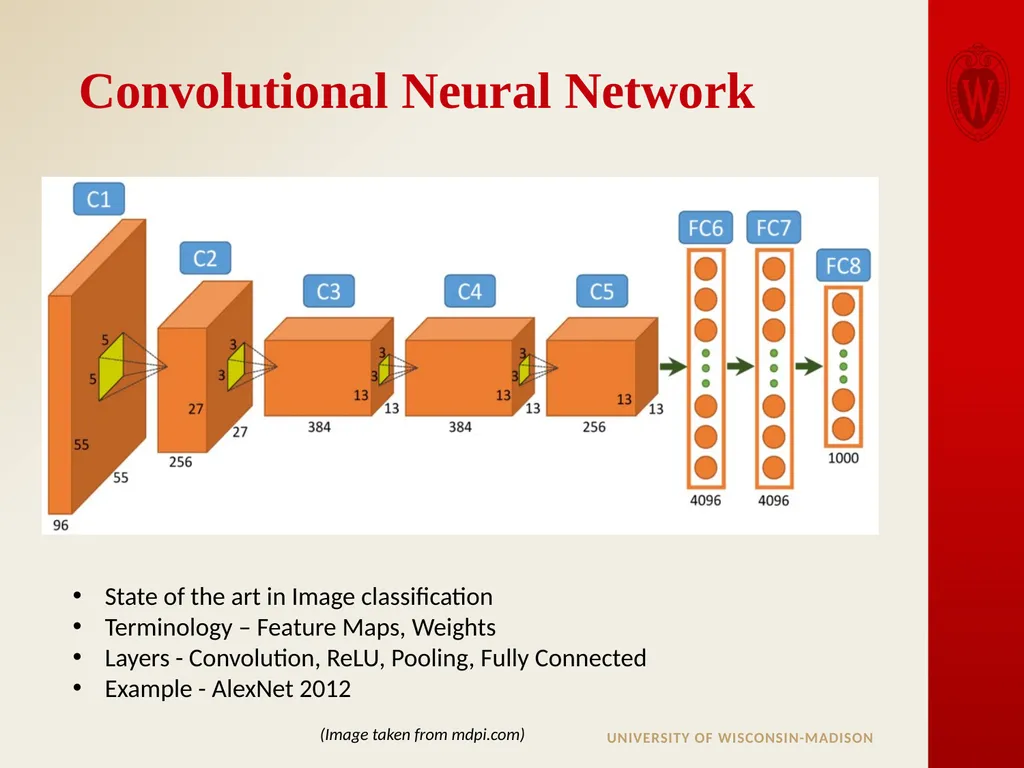
Convolutional Neural Network State of the art in Image classification
Terminology – Feature Maps, Weights
Layers - Convolution, ReLU, Pooling, Fully Connected
Example - AlexNet 2012
(Image taken from mdpi.com)<br>
03
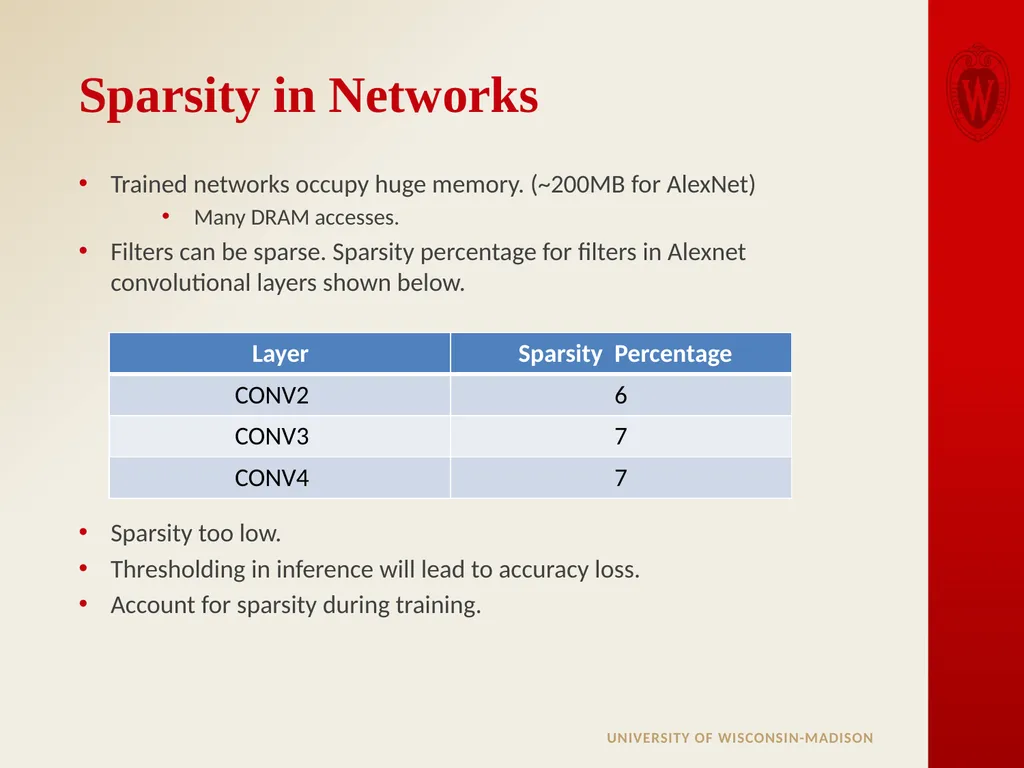
Sparsity in Networks Trained networks occupy huge memory. (~200MB for AlexNet)
Many DRAM accesses.
Filters can be sparse. Sparsity percentage for filters in Alexnet convolutional layers shown below.
Sparsity too low.
Thresholding in inference will lead to accuracy loss.
Account for sparsity during training.<br>
04
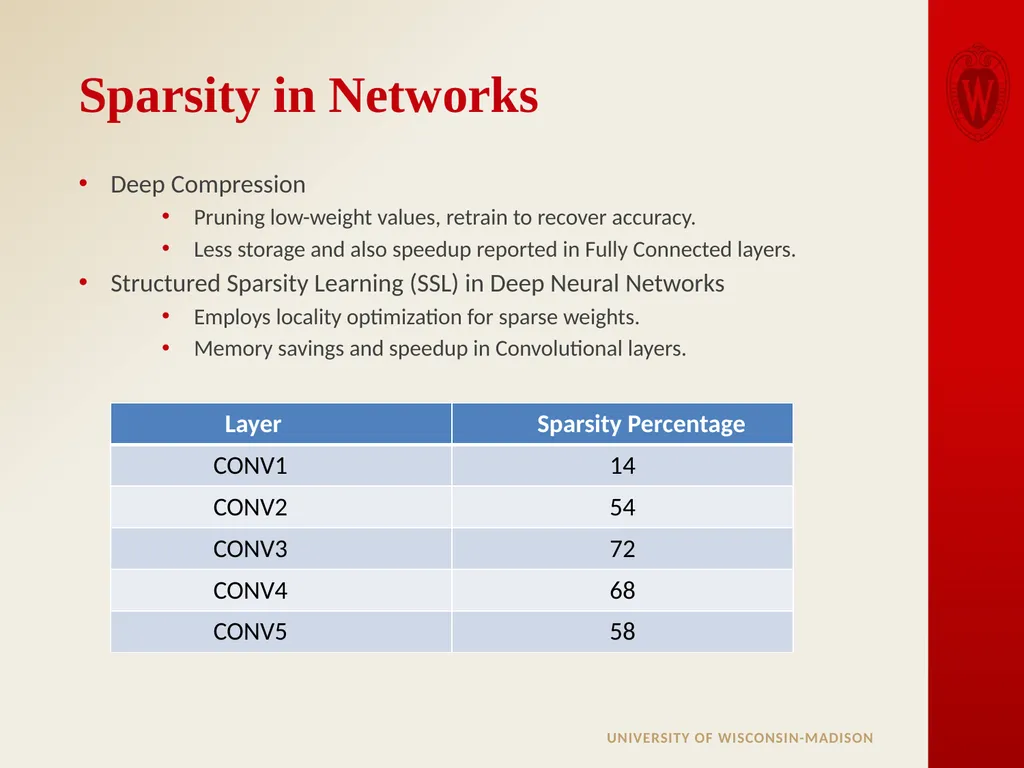
Sparsity in Networks Deep Compression
Pruning low-weight values, retrain to recover accuracy.
Less storage and also speedup reported in Fully Connected layers.
Structured Sparsity Learning (SSL) in Deep Neural Networks
Employs locality optimization for sparse weights.
Memory savings and speedup in Convolutional layers.<br>
05
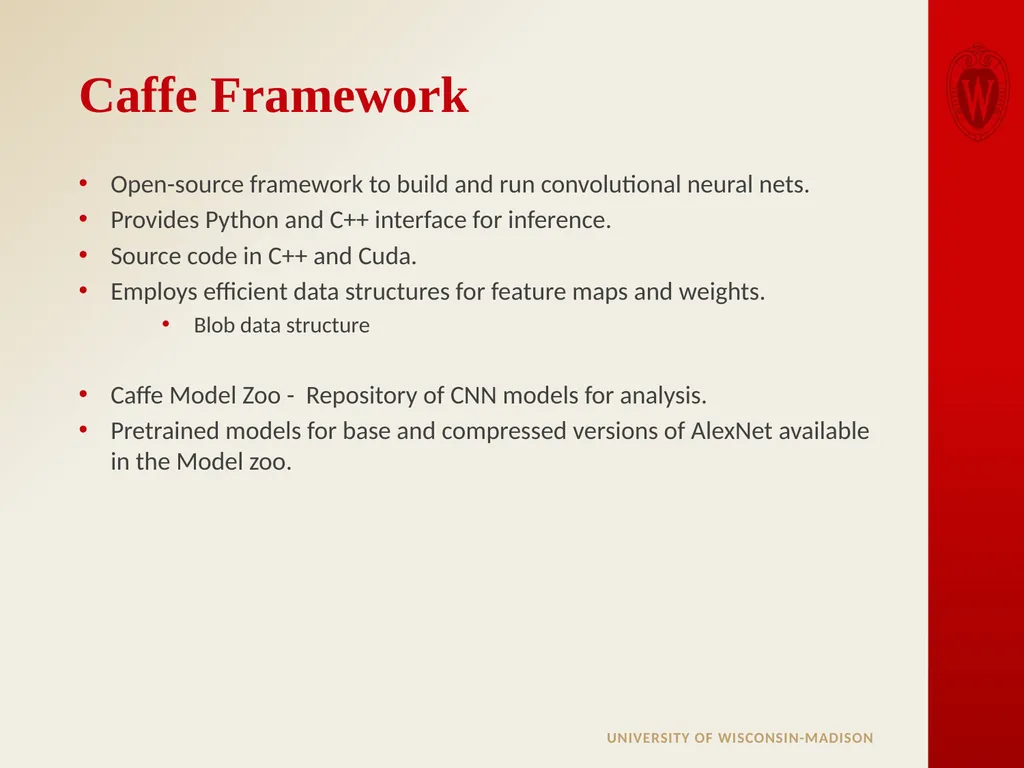
Caffe Framework Open-source framework to build and run convolutional neural nets.
Provides Python and C++ interface for inference.
Source code in C++ and Cuda.
Employs efficient data structures for feature maps and weights.
Blob data structure
Caffe Model Zoo - Repository of CNN models for analysis.
Pretrained models for base and compressed versions of AlexNet available in the Model zoo.<br>
06
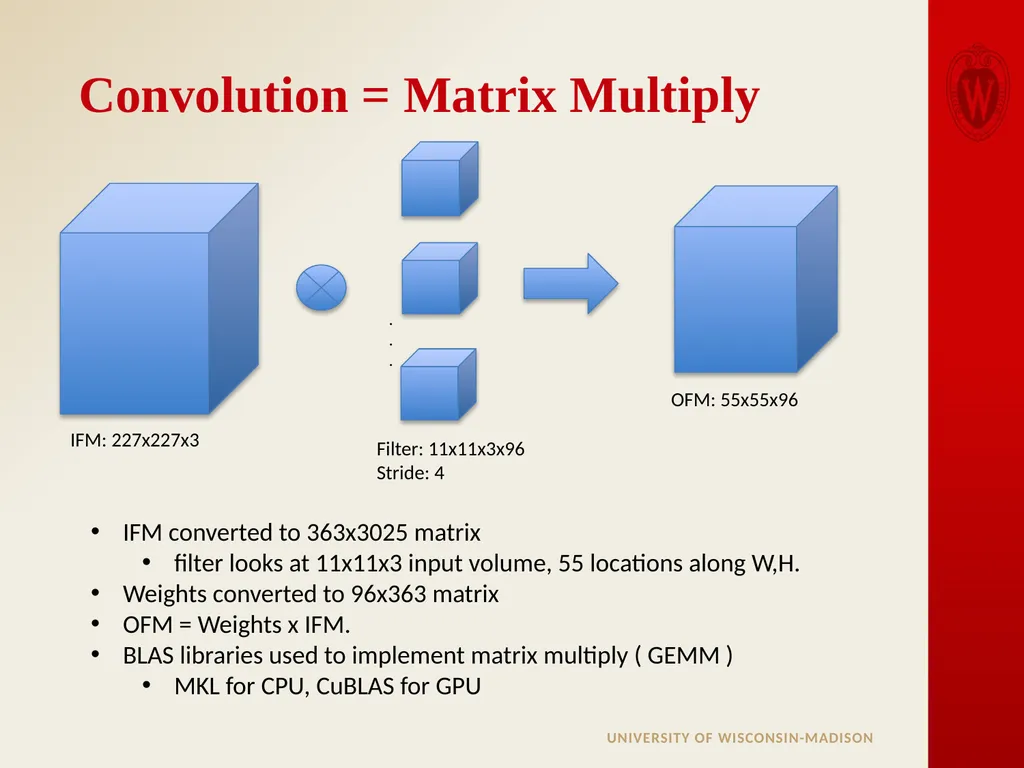
Convolution = Matrix Multiply .
.
. IFM: 227x227x3 Filter: 11x11x3x96
Stride: 4 OFM: 55x55x96 IFM converted to 363x3025 matrix
filter looks at 11x11x3 input volume, 55 locations along W,H.
Weights converted to 96x363 matrix
OFM = Weights x IFM.
BLAS libraries used to implement matrix multiply ( GEMM )
MKL for CPU, CuBLAS for GPU<br>
07
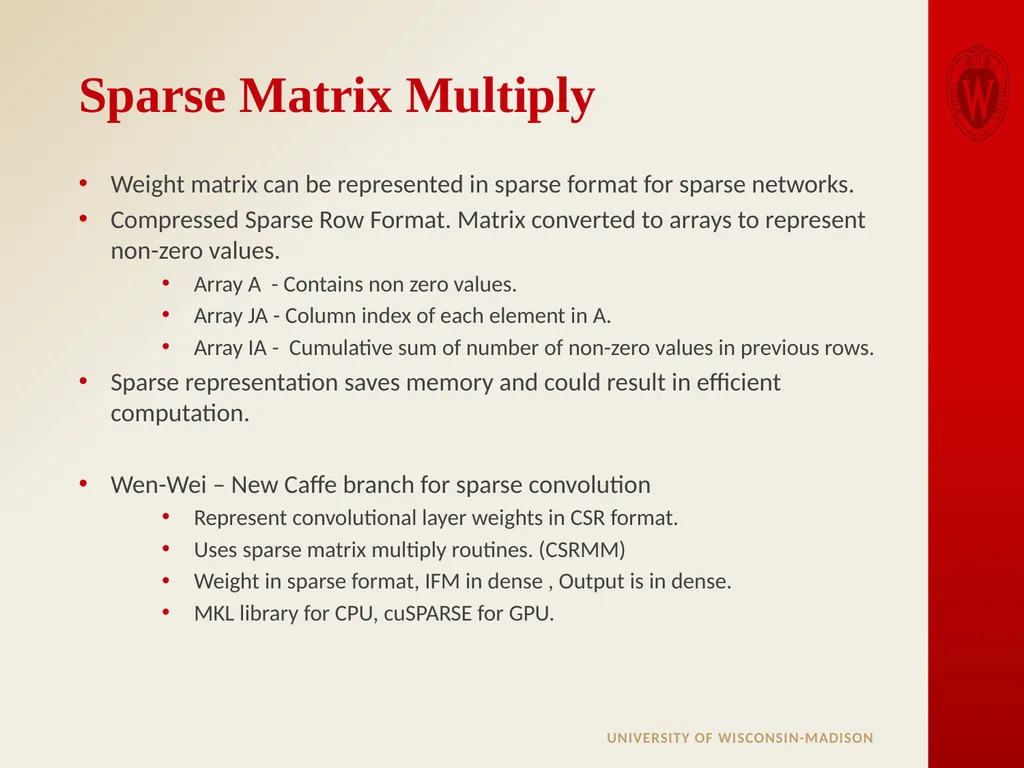
Sparse Matrix Multiply Weight matrix can be represented in sparse format for sparse networks.
Compressed Sparse Row Format. Matrix converted to arrays to represent non-zero values.
Array A - Contains non zero values.
Array JA - Column index of each element in A.
Array IA - Cumulative sum of number of non-zero values in previous rows.
Sparse representation saves memory and could result in efficient computation.
Wen-Wei – New Caffe branch for sparse convolution
Represent convolutional layer weights in CSR format.
Uses sparse matrix multiply routines. (CSRMM)
Weight in sparse format, IFM in dense , Output is in dense.
MKL library for CPU, cuSPARSE for GPU.<br>
08
Analysis Framework Initially gem5-gpu was planned to be used as simulation framework. Gem5 ended up being very slow due to the large size of Deep Neural Networks.
Analysis was performed by running Caffe and Cuda programs on Native Hardware.
For CPU analysis, AWS system with 2 Intel Xeon cores running @ 2.4GHz was used.
For GPU analysis, dodeca system with NVIDIA GeForce GTX 1080 GPU was used.<br>
09
Convolutional Layer Analysis Deep Compression and SSL trained networks were used for analysis. Both showed similar trends.
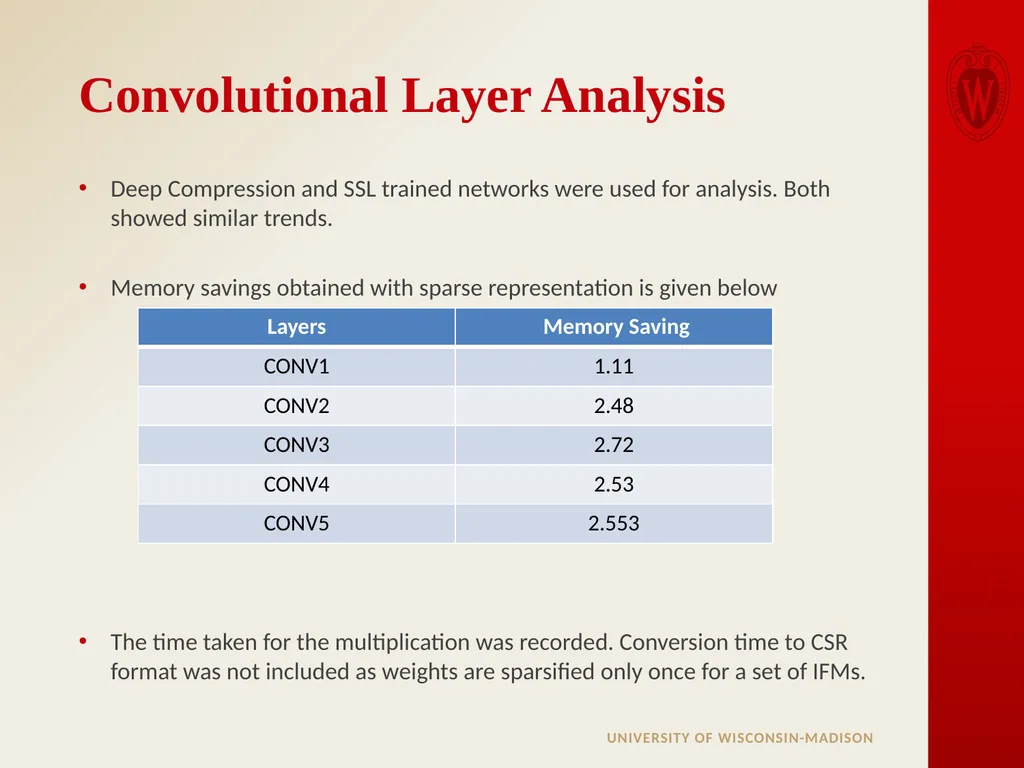
Memory savings obtained with sparse representation is given below
The time taken for the multiplication was recorded. Conversion time to CSR format was not included as weights are sparsified only once for a set of IFMs.<br>
10
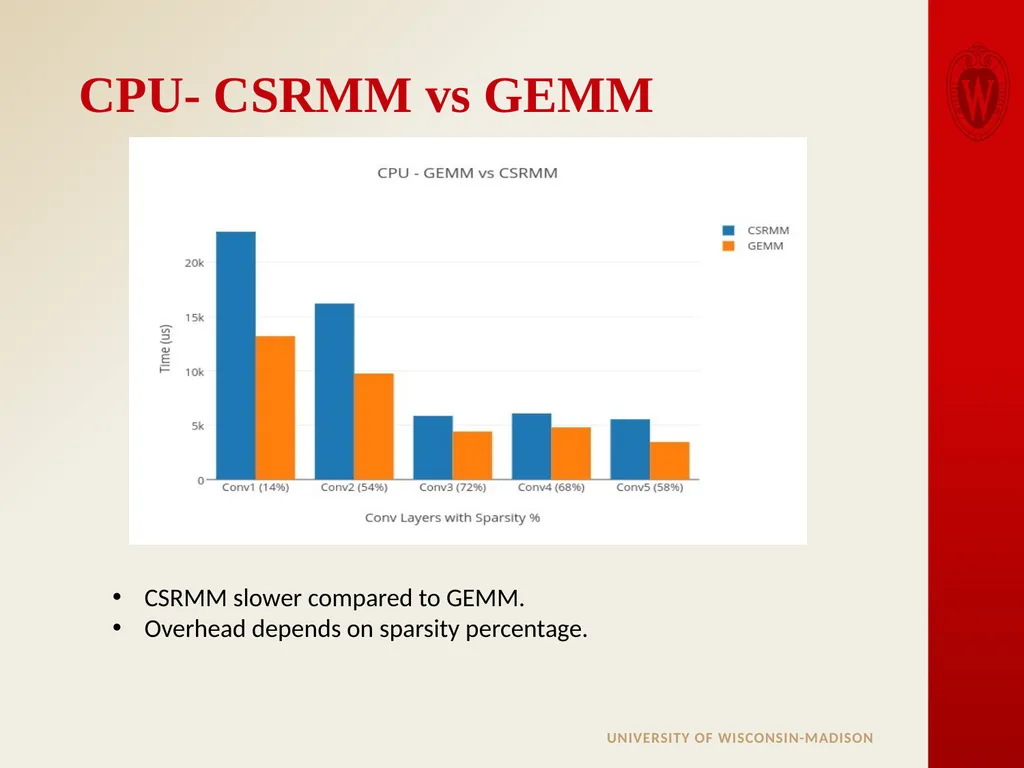
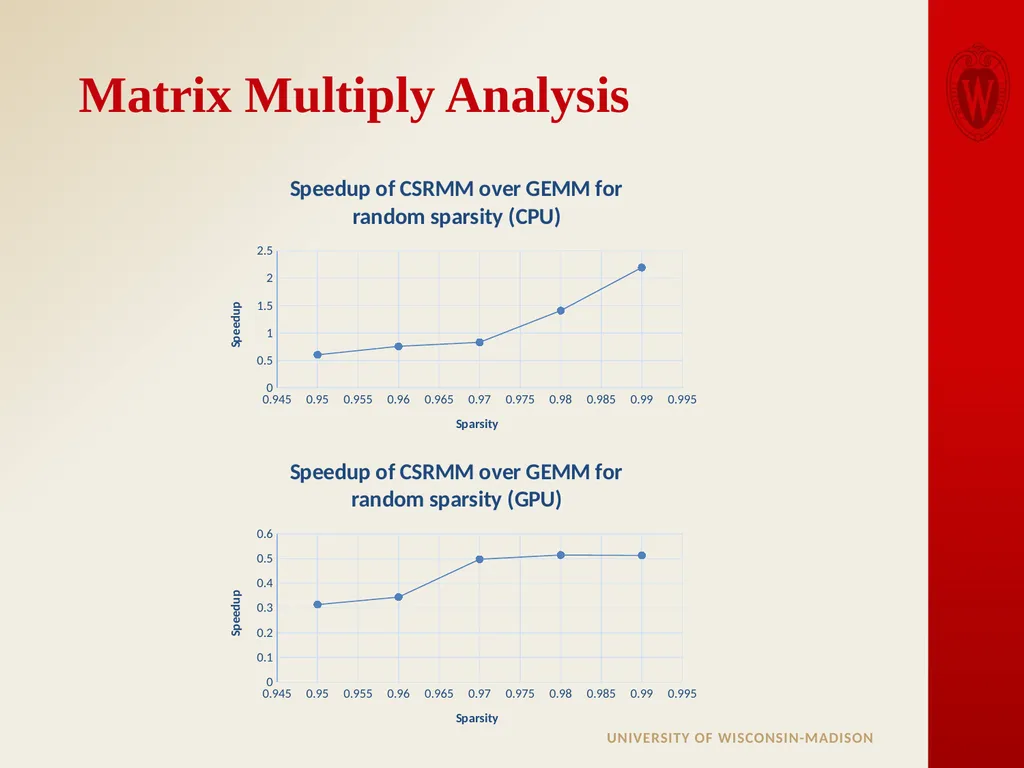
CPU- CSRMM vs GEMM CSRMM slower compared to GEMM.
Overhead depends on sparsity percentage.<br>
11
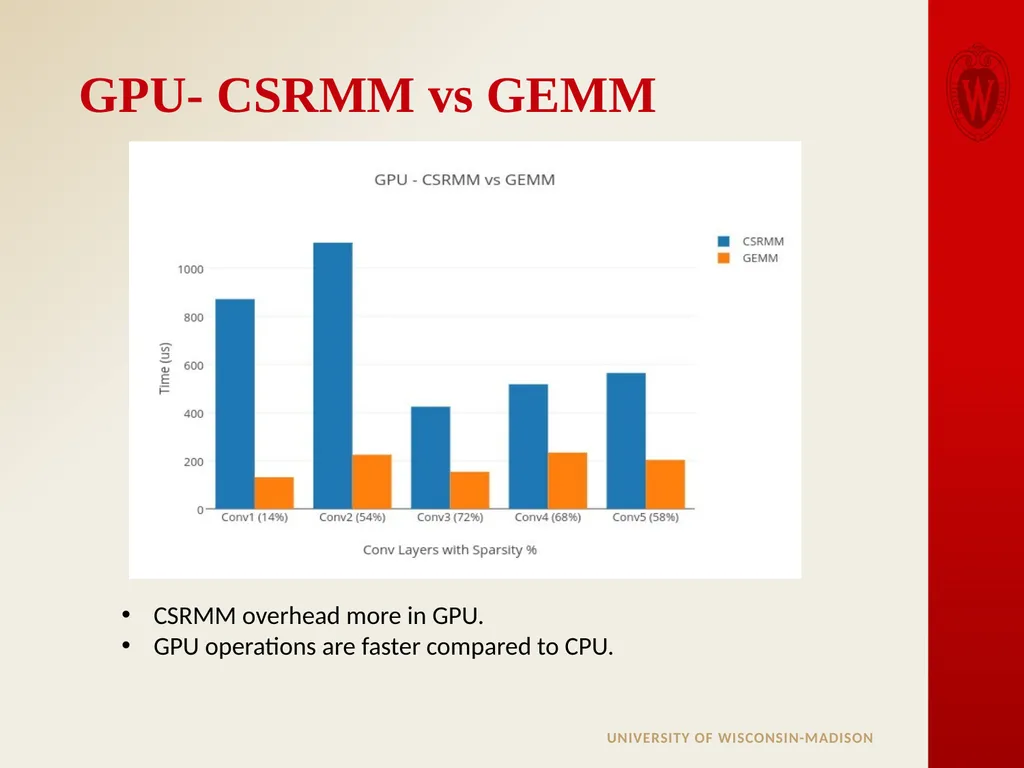
GPU- CSRMM vs GEMM CSRMM overhead more in GPU.
GPU operations are faster compared to CPU.<br>
12
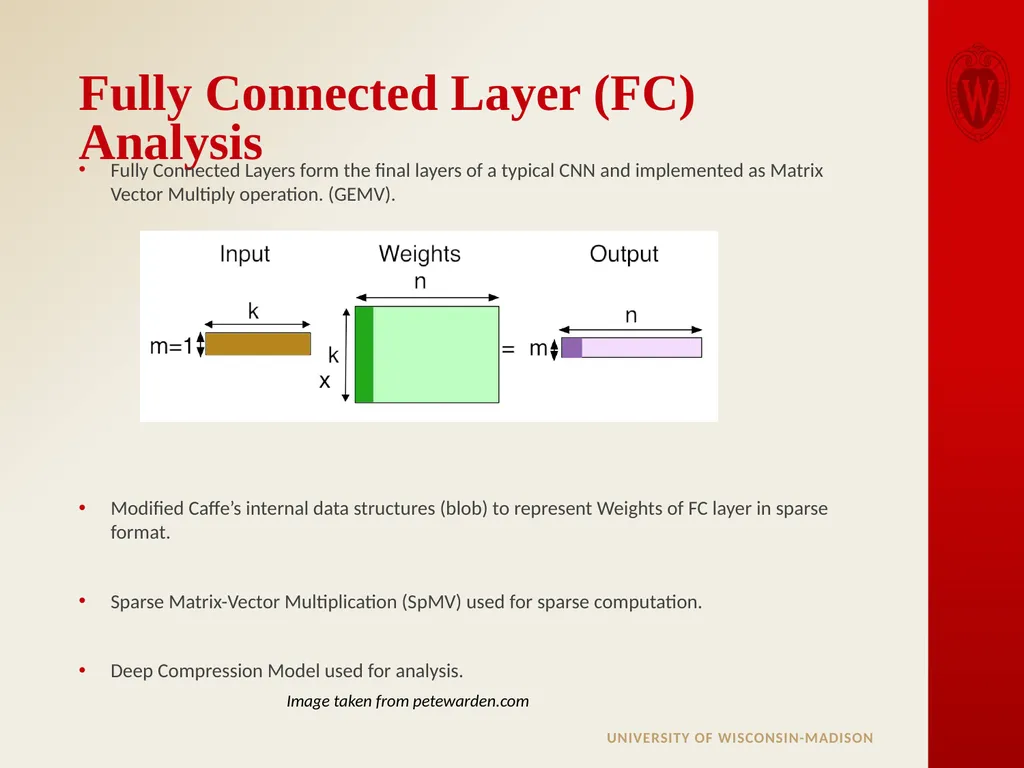
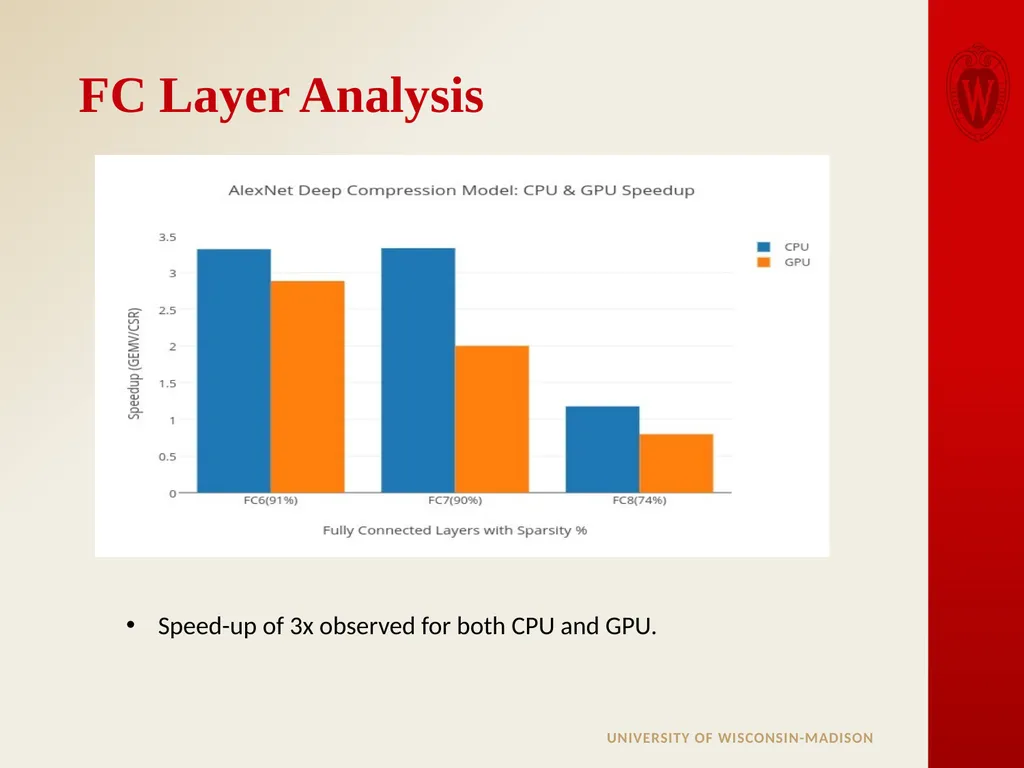
Fully Connected Layer (FC) Analysis Fully Connected Layers form the final layers of a typical CNN and implemented as Matrix Vector Multiply operation. (GEMV).
Modified Caffe’s internal data structures (blob) to represent Weights of FC layer in sparse format.
Sparse Matrix-Vector Multiplication (SpMV) used for sparse computation.
Deep Compression Model used for analysis. Image taken from petewarden.com<br>
13
FC Layer Analysis Speed-up of 3x observed for both CPU and GPU.<br>
14
Matrix Multiply Analysis Custom C++ and Cuda programs were written to measure the time taken to execute only matrix multiplication routines.
This allowed us to vary the sparsity of weight matrix to figure out the break-even point where CSRMM performs faster than GEMM.
Size of the weight matrix were chosen to be equal to that of the largest AlexNet CONV layer.
The zeros were distributed randomly in the weight matrix.<br>
15
Matrix Multiply Analysis<br>
16
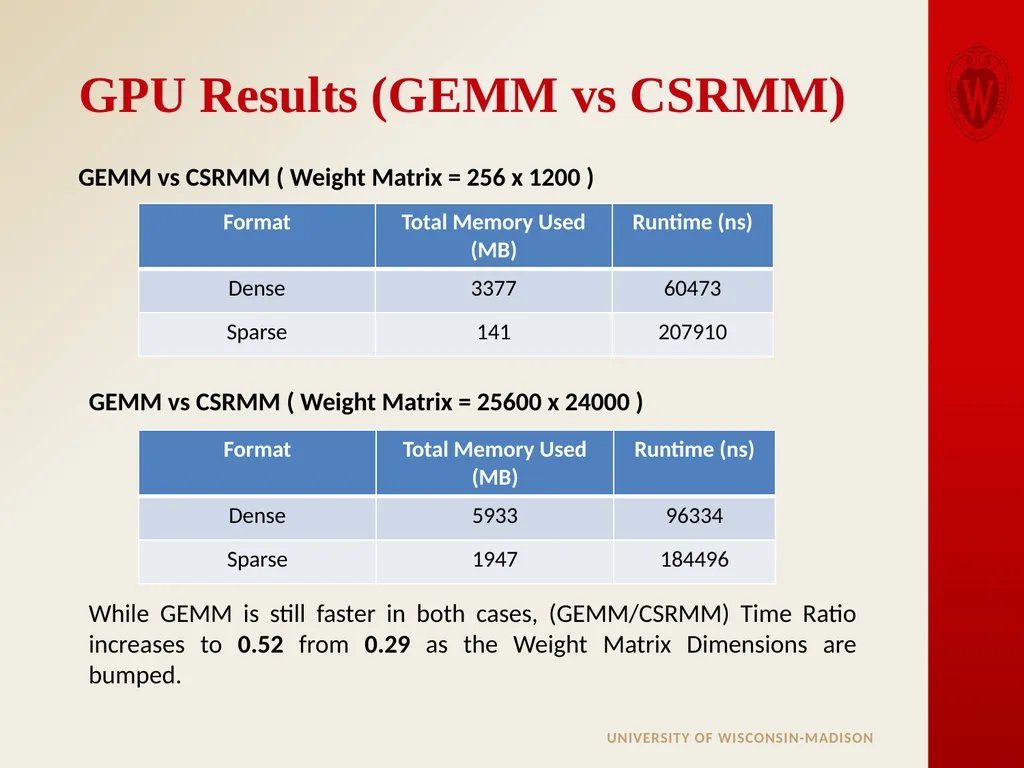
GPU Memory Scaling Experiment Motivation:
As Sparse Matrix representation occupies significantly less space compared to dense representation, a larger working set can fit in the Cache/Memory system in the case of sparse.
Implementation:
As the “Weights” matrix was the one being passed in the Sparse format, we increased its size to a larger value.<br>
17
GPU Results (GEMM vs CSRMM) GEMM vs CSRMM ( Weight Matrix = 25600 x 24000 ) GEMM vs CSRMM ( Weight Matrix = 256 x 1200 ) While GEMM is still faster in both cases, (GEMM/CSRMM) Time Ratio increases to 0.52 from 0.29 as the Weight Matrix Dimensions are bumped.<br>
18
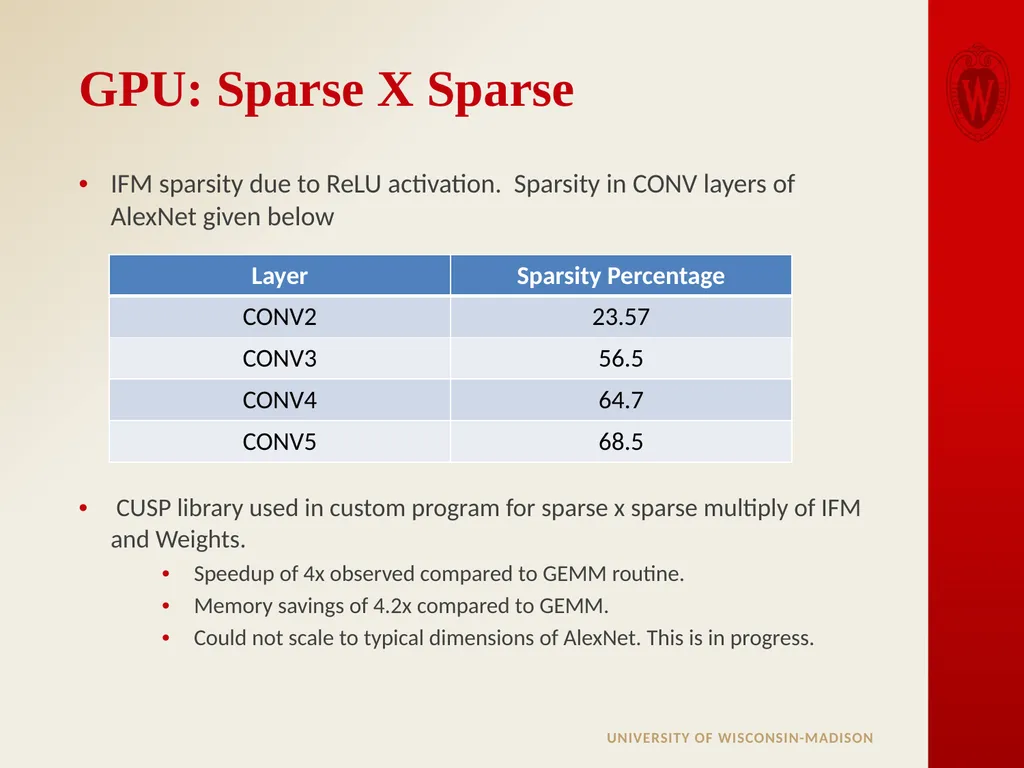
GPU: Sparse X Sparse IFM sparsity due to ReLU activation. Sparsity in CONV layers of AlexNet given below
CUSP library used in custom program for sparse x sparse multiply of IFM and Weights.
Speedup of 4x observed compared to GEMM routine.
Memory savings of 4.2x compared to GEMM.
Could not scale to typical dimensions of AlexNet. This is in progress.<br>
19
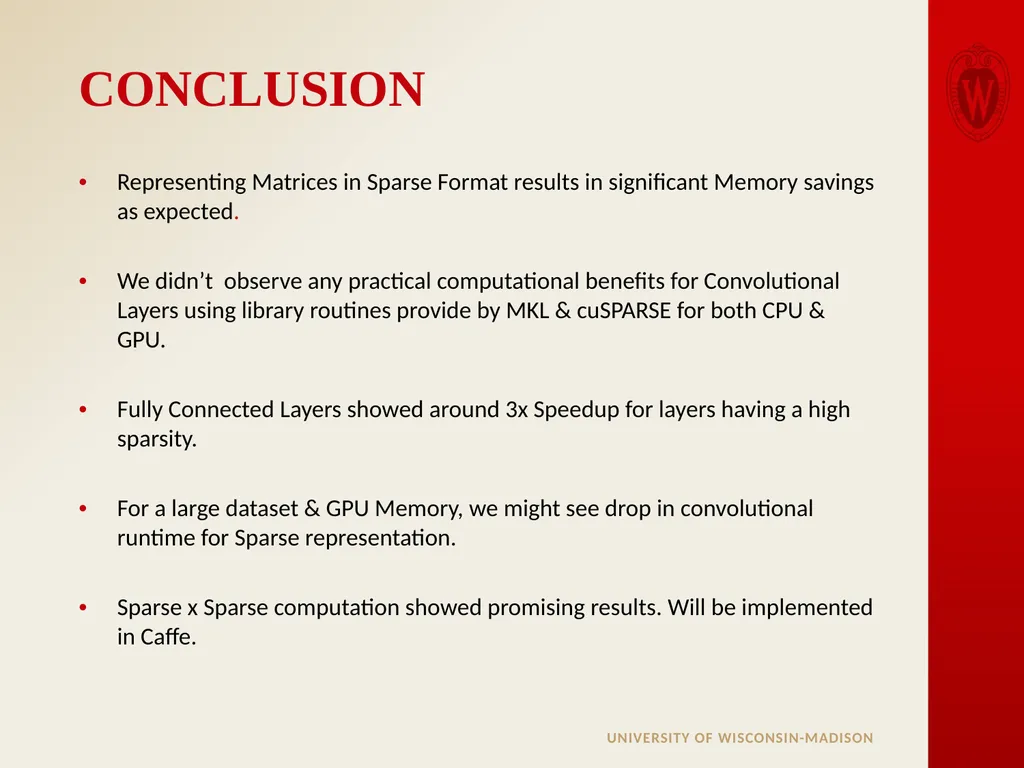
CONCLUSION Representing Matrices in Sparse Format results in significant Memory savings as expected.
We didn’t observe any practical computational benefits for Convolutional Layers using library routines provide by MKL & cuSPARSE for both CPU & GPU.
Fully Connected Layers showed around 3x Speedup for layers having a high sparsity.
For a large dataset & GPU Memory, we might see drop in convolutional runtime for Sparse representation.
Sparse x Sparse computation showed promising results. Will be implemented in Caffe.<br>