
Andy Dorr Assistant Director for Grants
PT
Published · 24 slides · 0 views
1 / 1


Description
Andy Dorr Assistant Director for Grants Administration COPS Office: Who we are 2 The Office of Community Oriented Policing Services (COPS Office) is the component of the U.S. Department of Justice responsible for advancing public safety
Related Topics
Share
Embed code
Download this presentation From Below
"Andy Dorr Assistant Director for Grants" is the property of its rightful owner. Permission is granted to download and print the materials on this website for personal, non-commercial use only, and to display it on your personal computer provided you do not modify the materials and that you retain all copyright notices contained in the materials. By downloading content from our website, you accept the terms of this agreement.
Presentation Transcript
01
Andy Dorr
Assistant Director for Grants Administration<br>
02
COPS Office: Who we are… 2 The Office of Community Oriented Policing Services (COPS Office) is the component of the U.S. Department of Justice responsible for advancing public safety through community policing in the nation's state, local, territorial, and tribal law enforcement agencies.
COPS Office was established by the Violent Crime Control and Law Enforcement Act of 1994.
Since 1994, the COPS Office has invested more than $14 billion to add community policing officers to the nation’s streets, enhance crime fighting technology, support crime prevention initiatives, and provide training and technical assistance to help advance community policing.
The COPS Office has funded more than 130,000 additional officers to more than 13,000 of the nation’s 18,000 law enforcement agencies across the country in small and large jurisdictions alike.<br>
COPS Office was established by the Violent Crime Control and Law Enforcement Act of 1994.
Since 1994, the COPS Office has invested more than $14 billion to add community policing officers to the nation’s streets, enhance crime fighting technology, support crime prevention initiatives, and provide training and technical assistance to help advance community policing.
The COPS Office has funded more than 130,000 additional officers to more than 13,000 of the nation’s 18,000 law enforcement agencies across the country in small and large jurisdictions alike.<br>
03
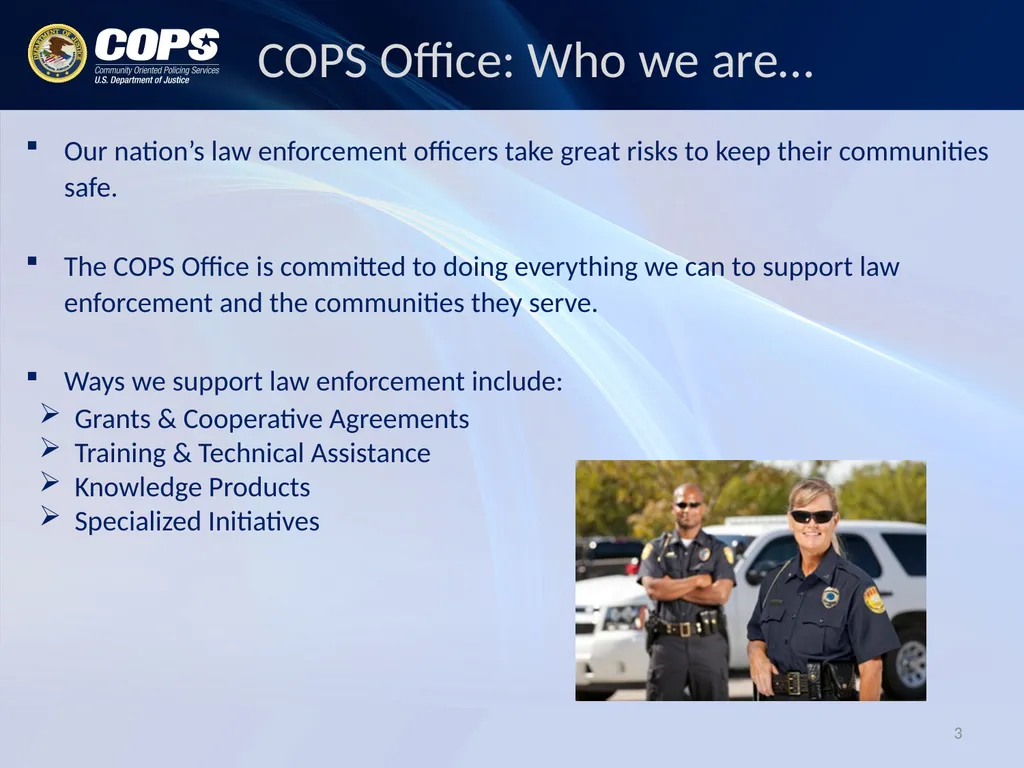
3 Our nation’s law enforcement officers take great risks to keep their communities safe.
The COPS Office is committed to doing everything we can to support law enforcement and the communities they serve.
Ways we support law enforcement include:
Grants & Cooperative Agreements
Training & Technical Assistance
Knowledge Products
Specialized Initiatives COPS Office: Who we are…<br>
The COPS Office is committed to doing everything we can to support law enforcement and the communities they serve.
Ways we support law enforcement include:
Grants & Cooperative Agreements
Training & Technical Assistance
Knowledge Products
Specialized Initiatives COPS Office: Who we are…<br>
04
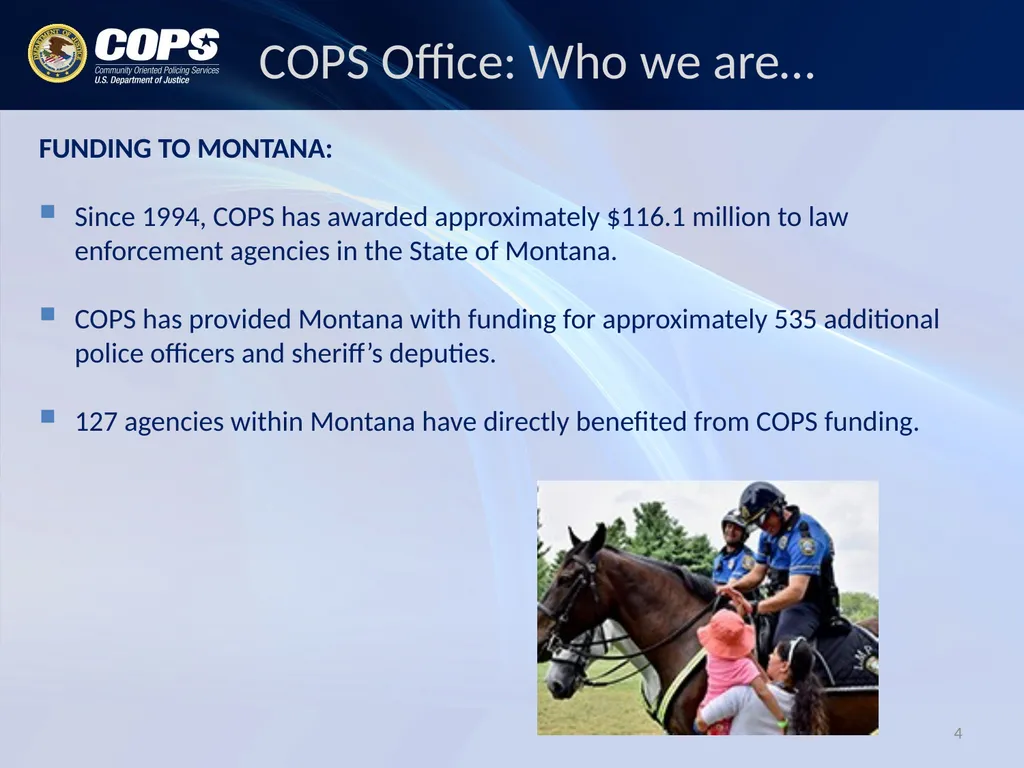
4 FUNDING TO MONTANA:
Since 1994, COPS has awarded approximately $116.1 million to law enforcement agencies in the State of Montana.
COPS has provided Montana with funding for approximately 535 additional police officers and sheriff’s deputies.
127 agencies within Montana have directly benefited from COPS funding. COPS Office: Who we are…<br>
Since 1994, COPS has awarded approximately $116.1 million to law enforcement agencies in the State of Montana.
COPS has provided Montana with funding for approximately 535 additional police officers and sheriff’s deputies.
127 agencies within Montana have directly benefited from COPS funding. COPS Office: Who we are…<br>
05
FY 2020 Funding at a Glance 5<br>
06
FY 2020 Funding at a Glance 6<br>
07
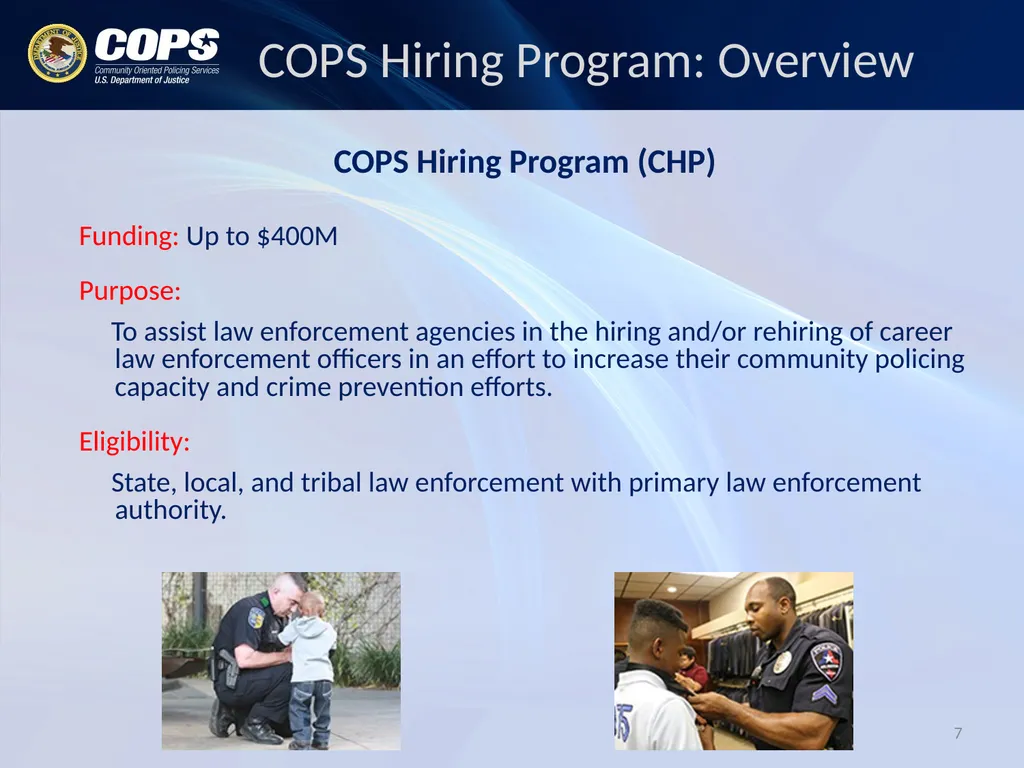
COPS Hiring Program: Overview 7 COPS Hiring Program (CHP)
Funding: Up to $400M
Purpose:
To assist law enforcement agencies in the hiring and/or rehiring of career law enforcement officers in an effort to increase their community policing capacity and crime prevention efforts.
Eligibility:
State, local, and tribal law enforcement with primary law enforcement authority.<br>
Funding: Up to $400M
Purpose:
To assist law enforcement agencies in the hiring and/or rehiring of career law enforcement officers in an effort to increase their community policing capacity and crime prevention efforts.
Eligibility:
State, local, and tribal law enforcement with primary law enforcement authority.<br>
08
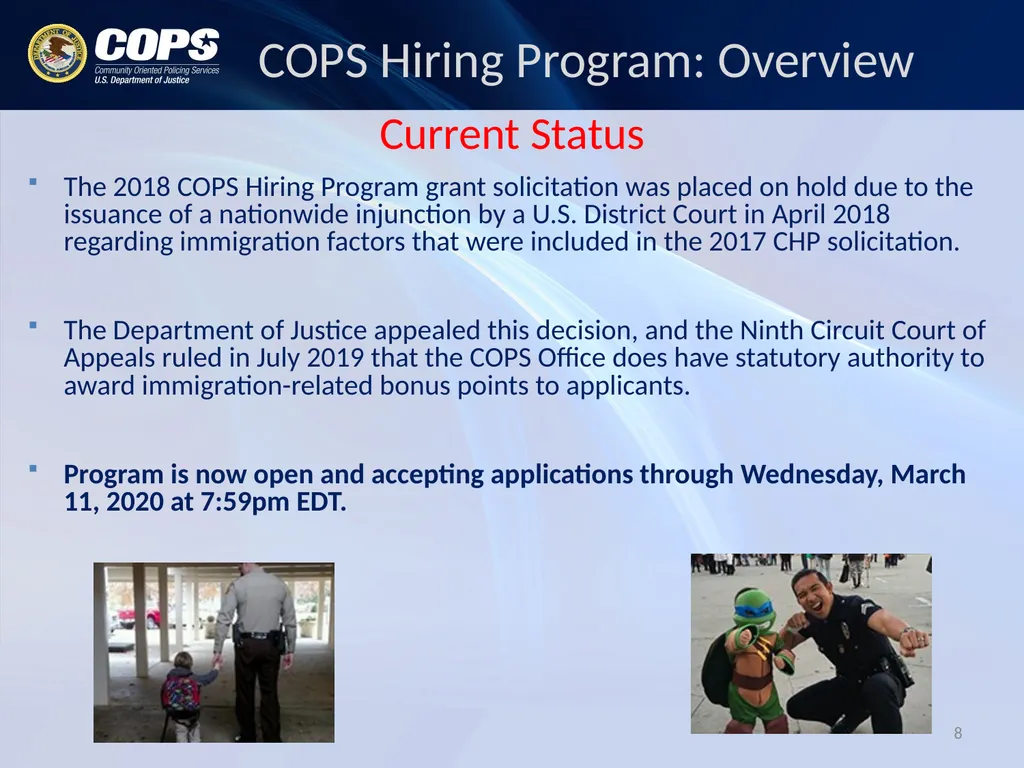
8 Current Status
The 2018 COPS Hiring Program grant solicitation was placed on hold due to the issuance of a nationwide injunction by a U.S. District Court in April 2018 regarding immigration factors that were included in the 2017 CHP solicitation.
The Department of Justice appealed this decision, and the Ninth Circuit Court of Appeals ruled in July 2019 that the COPS Office does have statutory authority to award immigration-related bonus points to applicants.
Program is now open and accepting applications through Wednesday, March 11, 2020 at 7:59pm EDT. COPS Hiring Program: Overview<br>
The 2018 COPS Hiring Program grant solicitation was placed on hold due to the issuance of a nationwide injunction by a U.S. District Court in April 2018 regarding immigration factors that were included in the 2017 CHP solicitation.
The Department of Justice appealed this decision, and the Ninth Circuit Court of Appeals ruled in July 2019 that the COPS Office does have statutory authority to award immigration-related bonus points to applicants.
Program is now open and accepting applications through Wednesday, March 11, 2020 at 7:59pm EDT. COPS Hiring Program: Overview<br>
09
COPS Hiring Program: Overview 9 CHP funds up to 75% of entry-level officer salary and approved fringe benefits costs over three years (thirty-six months), up to a max. federal share of $125k per officer position.
Minimum 25% local cash match required, unless approved for a local match waiver.
Hiring categories:
Newly hired entry-level career law enforcement officers.
Rehired officers (officers laid off at the time of grant application or scheduled to be laid off at a future date).
Retention for 12 months at conclusion of grant.
Funding must be used to supplement, not supplant, state, local, or BIA funds that would have been dedicated toward sworn officer positions if federal funding had not been awarded.<br>
Minimum 25% local cash match required, unless approved for a local match waiver.
Hiring categories:
Newly hired entry-level career law enforcement officers.
Rehired officers (officers laid off at the time of grant application or scheduled to be laid off at a future date).
Retention for 12 months at conclusion of grant.
Funding must be used to supplement, not supplant, state, local, or BIA funds that would have been dedicated toward sworn officer positions if federal funding had not been awarded.<br>
10
COPS Hiring Program: Overview 10 Each applicant must identify a specific public safety problem that will be the focus of any COPS-funded officer positions awarded.
In support of the Attorney General’s priority goals, applicants choosing to focus on the following areas will receive additional consideration:
Violent crime;
Protecting critical infrastructures and information/intelligence systems through homeland security; and
Deploying school resource officers to protect elementary or secondary schools
Additional consideration will also be given for rural applicants.
Funding to be awarded prior to Sept. 30, 2020.<br>
In support of the Attorney General’s priority goals, applicants choosing to focus on the following areas will receive additional consideration:
Violent crime;
Protecting critical infrastructures and information/intelligence systems through homeland security; and
Deploying school resource officers to protect elementary or secondary schools
Additional consideration will also be given for rural applicants.
Funding to be awarded prior to Sept. 30, 2020.<br>
11
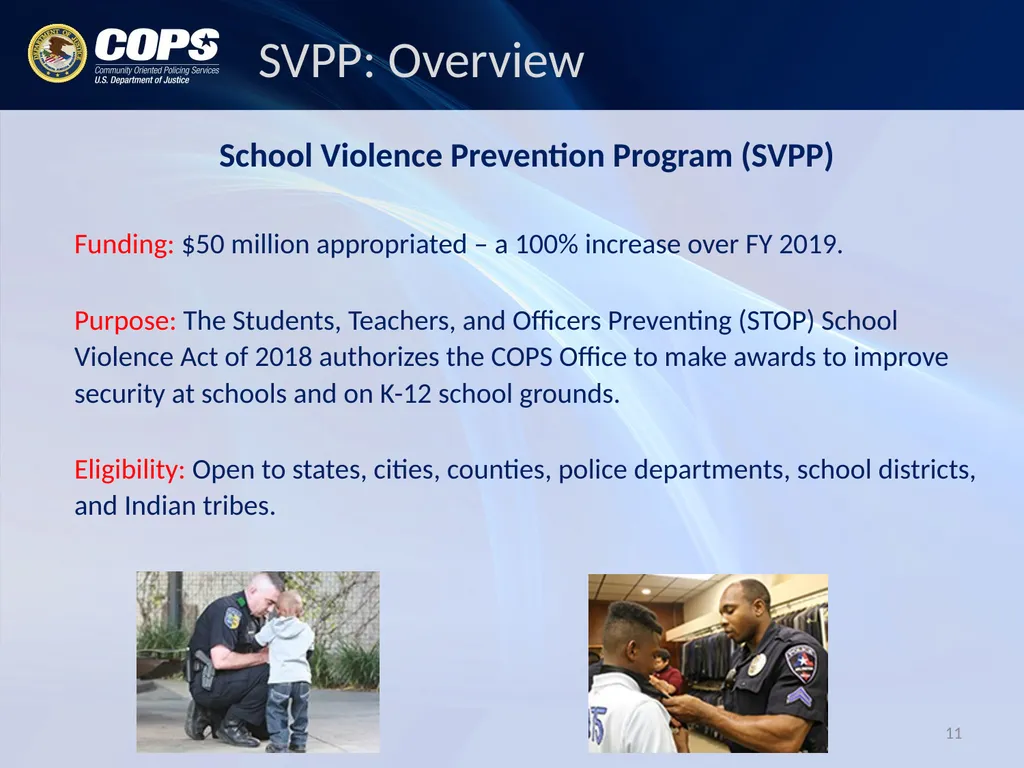
SVPP: Overview 11 School Violence Prevention Program (SVPP)
Funding: $50 million appropriated – a 100% increase over FY 2019.
Purpose: The Students, Teachers, and Officers Preventing (STOP) School Violence Act of 2018 authorizes the COPS Office to make awards to improve security at schools and on K-12 school grounds.
Eligibility: Open to states, cities, counties, police departments, school districts, and Indian tribes.<br>
Funding: $50 million appropriated – a 100% increase over FY 2019.
Purpose: The Students, Teachers, and Officers Preventing (STOP) School Violence Act of 2018 authorizes the COPS Office to make awards to improve security at schools and on K-12 school grounds.
Eligibility: Open to states, cities, counties, police departments, school districts, and Indian tribes.<br>
12
SVPP: Overview 12 Allowable costs include:
Coordination with law enforcement;
Training for local law enforcement officers to prevent students from perpetrating violence against themselves or others;
Target hardening (e.g., locks) and other deterrent measures;
Technology for expedited notification of local law enforcement during an emergency; and
Any other measure the Director of the COPS Office determines may provide a significant improvement in school security.<br>
Coordination with law enforcement;
Training for local law enforcement officers to prevent students from perpetrating violence against themselves or others;
Target hardening (e.g., locks) and other deterrent measures;
Technology for expedited notification of local law enforcement during an emergency; and
Any other measure the Director of the COPS Office determines may provide a significant improvement in school security.<br>
13
COPS Anti Programs: Overview 13 COPS Anti-Methamphetamine Program (CAMP)
Funding: Up to $13M available in FY 2020.
Purpose:
To advance public safety by providing funds to locate and investigate illicit activities related to the manufacture and distribution of methamphetamine. Does not fund lab cleanup.
Funding is for state law enforcement agencies in states with high seizures of precursor chemicals, finished methamphetamine, laboratories, and laboratory dump seizures.
Eligibility:
Open to state law enforcement authorized to engage in or to supervise anti-meth investigative activities.
Status: Opens early 2020<br>
Funding: Up to $13M available in FY 2020.
Purpose:
To advance public safety by providing funds to locate and investigate illicit activities related to the manufacture and distribution of methamphetamine. Does not fund lab cleanup.
Funding is for state law enforcement agencies in states with high seizures of precursor chemicals, finished methamphetamine, laboratories, and laboratory dump seizures.
Eligibility:
Open to state law enforcement authorized to engage in or to supervise anti-meth investigative activities.
Status: Opens early 2020<br>
14
COPS Anti Programs: Overview 14 COPS Anti-Heroin Task Force Program (AHTF)
Funding: Up to $35M available in FY 2020.
Purpose:
Advance public safety by providing funds to investigate illicit activities related to the distribution of heroin or unlawful distribution of prescriptive opioids, or unlawful heroin and prescription opioid traffickers through state-wide collaboration.
Emphasis on states with high rates of primary treatment admissions for heroin and other opioids.
Eligibility:
Open to state law enforcement authorized by law or by a state agency to engage in or to supervise heroin and other opioid investigative activities.
Status: Opens early 2020<br>
Funding: Up to $35M available in FY 2020.
Purpose:
Advance public safety by providing funds to investigate illicit activities related to the distribution of heroin or unlawful distribution of prescriptive opioids, or unlawful heroin and prescription opioid traffickers through state-wide collaboration.
Emphasis on states with high rates of primary treatment admissions for heroin and other opioids.
Eligibility:
Open to state law enforcement authorized by law or by a state agency to engage in or to supervise heroin and other opioid investigative activities.
Status: Opens early 2020<br>
15
COPS Anti Programs: Overview 15 Both programs are open to state-level law enforcement agencies only. However…..
Both programs require awardees to coordinate with federal, state, local, and tribal law enforcement agencies to maximize the impact and effectiveness of the award.
If your jurisdiction has a meth or heroin problem, this program presents a great opportunity for partnering with your state.
Commonly requested costs include equipment, sworn personnel, civilian personnel, contracts, and overtime.<br>
Both programs require awardees to coordinate with federal, state, local, and tribal law enforcement agencies to maximize the impact and effectiveness of the award.
If your jurisdiction has a meth or heroin problem, this program presents a great opportunity for partnering with your state.
Commonly requested costs include equipment, sworn personnel, civilian personnel, contracts, and overtime.<br>
16
Tribal Resources Grant Program: Overview 16 Tribal Resources Grant Program (TRGP)
Funding: Up to $27M available in FY 2020.
Purpose: To meet the most serious needs of law enforcement in Tribal Nations.
Eligibility: Open to Federally Recognized Tribes
Status:
TRGP is an open, competitive solicitation through DOJ’s Coordinated Tribal Assistance Solicitation (CTAS).
Solicitation is OPEN, and closes at 9pm on Tuesday, February 25th.<br>
Funding: Up to $27M available in FY 2020.
Purpose: To meet the most serious needs of law enforcement in Tribal Nations.
Eligibility: Open to Federally Recognized Tribes
Status:
TRGP is an open, competitive solicitation through DOJ’s Coordinated Tribal Assistance Solicitation (CTAS).
Solicitation is OPEN, and closes at 9pm on Tuesday, February 25th.<br>
17
Tribal Resources Grant Program: Overview 17 Program funds new, additional officer positions and Village Public Safety Officers (VPSOs), as well as basic equipment and training.
Award caps are based on sworn force size (<10, 500k; 10-19, 700k, and 20+, 900k).
Equipment/training awards are three (3) years in length. Awards for officer hiring are five (5) years.
Additional consideration for proposals which focus on human trafficking and/or missing and murdered indigenous people.<br>
Award caps are based on sworn force size (<10, 500k; 10-19, 700k, and 20+, 900k).
Equipment/training awards are three (3) years in length. Awards for officer hiring are five (5) years.
Additional consideration for proposals which focus on human trafficking and/or missing and murdered indigenous people.<br>
18
CP Development: Overview 18 Community Policing Development (CPD)
Funding: Up to $6.5M in FY 2020 funding
Purpose: To develop the capacity of law enforcement to implement community policing strategies.
Providing guidance on promising practices through the development and testing of innovative strategies;
Building knowledge about effective practices and outcomes; and
Supporting new, creative approaches to preventing crime and promoting safe communities.
Demonstration projects via the CPD Microgrants Program
Eligibility: Open to all public governmental agencies, for-profit and nonprofit organizations, institutions of higher education, community groups, and faith-based organizations.
Status: Program to open early 2020.<br>
Funding: Up to $6.5M in FY 2020 funding
Purpose: To develop the capacity of law enforcement to implement community policing strategies.
Providing guidance on promising practices through the development and testing of innovative strategies;
Building knowledge about effective practices and outcomes; and
Supporting new, creative approaches to preventing crime and promoting safe communities.
Demonstration projects via the CPD Microgrants Program
Eligibility: Open to all public governmental agencies, for-profit and nonprofit organizations, institutions of higher education, community groups, and faith-based organizations.
Status: Program to open early 2020.<br>
19
Community Policing Development (CPD)
Microgrants Program Purpose:
To develop the capacity of law enforcement to implement community policing strategies.
Applicants are invited to propose demonstration or pilot projects to be implemented in their agency that offer creative ideas to advance crime fighting, community engagement, problem solving, or organization changes in one of 10 areas.
Eligibility: All state, local, and tribal law enforcement agencies.
Status:
Accepting applications until March 11, 2020.
One year awards - cover costs such as non-sworn personnel, equipment, supplies, and travel.
Covers costs such as non-sworn personnel, equipment, supplies, and travel. 19<br>
To develop the capacity of law enforcement to implement community policing strategies.
Applicants are invited to propose demonstration or pilot projects to be implemented in their agency that offer creative ideas to advance crime fighting, community engagement, problem solving, or organization changes in one of 10 areas.
Eligibility: All state, local, and tribal law enforcement agencies.
Status:
Accepting applications until March 11, 2020.
One year awards - cover costs such as non-sworn personnel, equipment, supplies, and travel.
Covers costs such as non-sworn personnel, equipment, supplies, and travel. 19<br>
20
20 Funding: Up to $5M available in FY 2020, up from $2M in FY 2019.
Purpose: Used to develop the capacity of law enforcement to implement community policing strategies by:
Developing and delivery of comprehensive peer mentoring training and support programs
Advancing one or more of the recommendations in the LEMHWA Report to Congress
Creating or enhancing agency peer support programs
Eligibility: All public governmental agencies, federally recognized Indian tribes, for-profit and nonprofit organizations, institutions of higher education, community groups, and faith-based organizations.
Other: Two year award period – covers costs such as non-sworn personnel, equipment, supplies, and travel. Law Enforcement Mental Health and Wellness Act Program (LEMHWA)<br>
Purpose: Used to develop the capacity of law enforcement to implement community policing strategies by:
Developing and delivery of comprehensive peer mentoring training and support programs
Advancing one or more of the recommendations in the LEMHWA Report to Congress
Creating or enhancing agency peer support programs
Eligibility: All public governmental agencies, federally recognized Indian tribes, for-profit and nonprofit organizations, institutions of higher education, community groups, and faith-based organizations.
Other: Two year award period – covers costs such as non-sworn personnel, equipment, supplies, and travel. Law Enforcement Mental Health and Wellness Act Program (LEMHWA)<br>
21
Grant Application Tips 21 Maximize Your Chance of a Successful Grant Application!
Start the application early.
Keep online registrations & passwords (e.g., Grants.gov, COPS website) current.
Read application instructions carefully.
Secure support from key local stakeholders (i.e., City Council, Mayor, etc.) before applying.
Narrative sections should be well-written, concise, and should clearly address all relevant sections/questions.
Double and triple check your application for errors!
Effectively implement any existing COPS/DOJ awards (compliance, reporting, etc.).<br>
Start the application early.
Keep online registrations & passwords (e.g., Grants.gov, COPS website) current.
Read application instructions carefully.
Secure support from key local stakeholders (i.e., City Council, Mayor, etc.) before applying.
Narrative sections should be well-written, concise, and should clearly address all relevant sections/questions.
Double and triple check your application for errors!
Effectively implement any existing COPS/DOJ awards (compliance, reporting, etc.).<br>
22
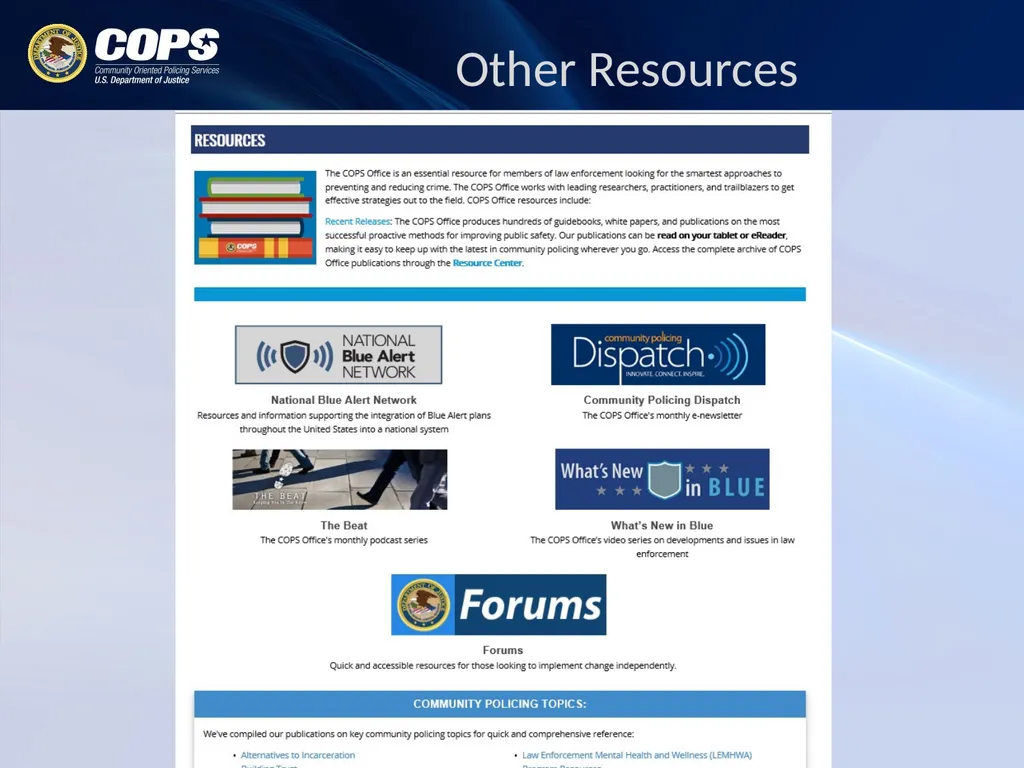
Other Resources What about training?<br>
23
Technical Assistance Collaborative Reform Initiative for Technical Assistance Center (CRI-TAC) advances the practice of community policing in law enforcement agencies by providing customized technical assistance to state, local, tribal, and campus agencies on a variety of topics. The CRI-TAC is here to help.
Tailored, scalable solutions
Informed by cutting-edge innovation and evidence-based and promising practices
Designed in a collaborative manner with the agency
Delivered by subject matter experts from the field
No cost to the requesting agency
Services Provided
Resource Referral
Web-based Training
In-person Training
Virtual Mentoring
On-Site Consultation Visit www.CollaborativeReform.org for more information and to request assistance.<br>
Tailored, scalable solutions
Informed by cutting-edge innovation and evidence-based and promising practices
Designed in a collaborative manner with the agency
Delivered by subject matter experts from the field
No cost to the requesting agency
Services Provided
Resource Referral
Web-based Training
In-person Training
Virtual Mentoring
On-Site Consultation Visit www.CollaborativeReform.org for more information and to request assistance.<br>
24
FOR MORE INFORMATION ON THE COPS OFFICE Website: cops.usdoj.gov
Response Center: 1-800-421-6770
E-mail (General): askcopsrc@usdoj.gov
On Twitter: @COPSOffice
On Facebook: DOJCOPS
CRI-TAC: www.CollaborativeReform.org
Training Portal: www.copstrainingportal.org
Community Policing Dispatch e-newsletter:
cops.usdoj.gov/html/dispatch/index.html
Andy Dorr: Andrew.Dorr@usdoj.gov 202-532-5585<br>
Response Center: 1-800-421-6770
E-mail (General): askcopsrc@usdoj.gov
On Twitter: @COPSOffice
On Facebook: DOJCOPS
CRI-TAC: www.CollaborativeReform.org
Training Portal: www.copstrainingportal.org
Community Policing Dispatch e-newsletter:
cops.usdoj.gov/html/dispatch/index.html
Andy Dorr: Andrew.Dorr@usdoj.gov 202-532-5585<br>