03
ANOVA in Completely Randomized Design This design of experiment is used when the experimental units form a homogeneous group.
Example: Day old chicks, Laboratory animals – mice, rats, G. pigs, and animals of same age and weight, etc.
Random allotment of experimental units (i.e. animals) is done with the help of lottery system or table of random numbers.<br>
04
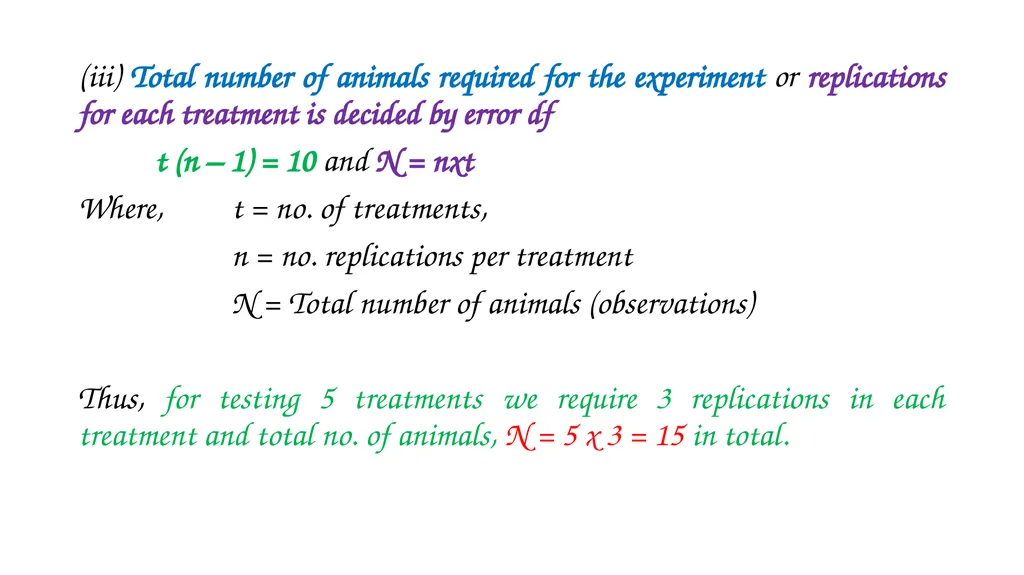
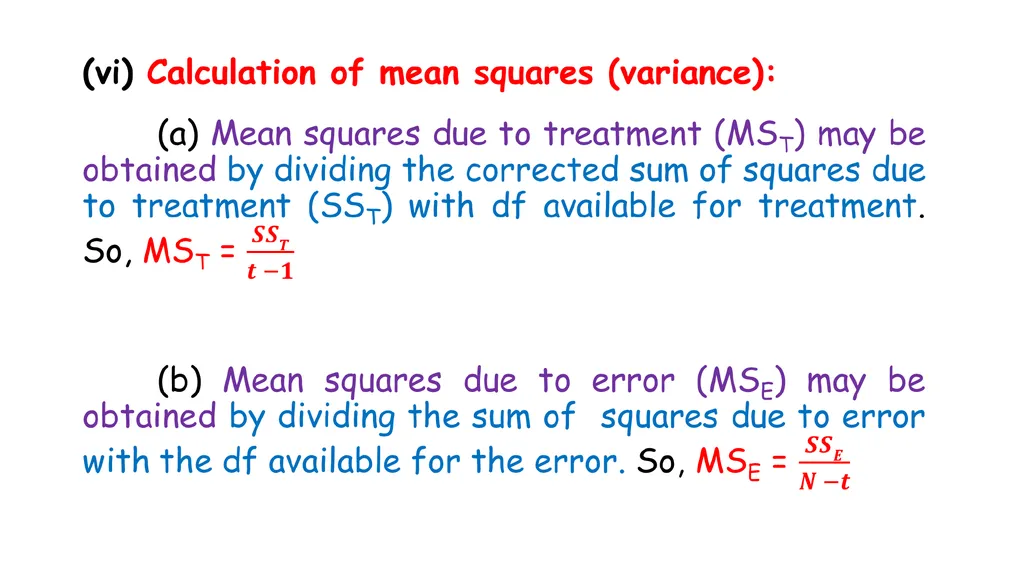
(iii) Total number of animals required for the experiment or replications for each treatment is decided by error df
t (n – 1) = 10 and N = nxt
Where, t = no. of treatments,
n = no. replications per treatment
N = Total number of animals (observations)
Thus, for testing 5 treatments we require 3 replications in each treatment and total no. of animals, N = 5 x 3 = 15 in total.<br>
05
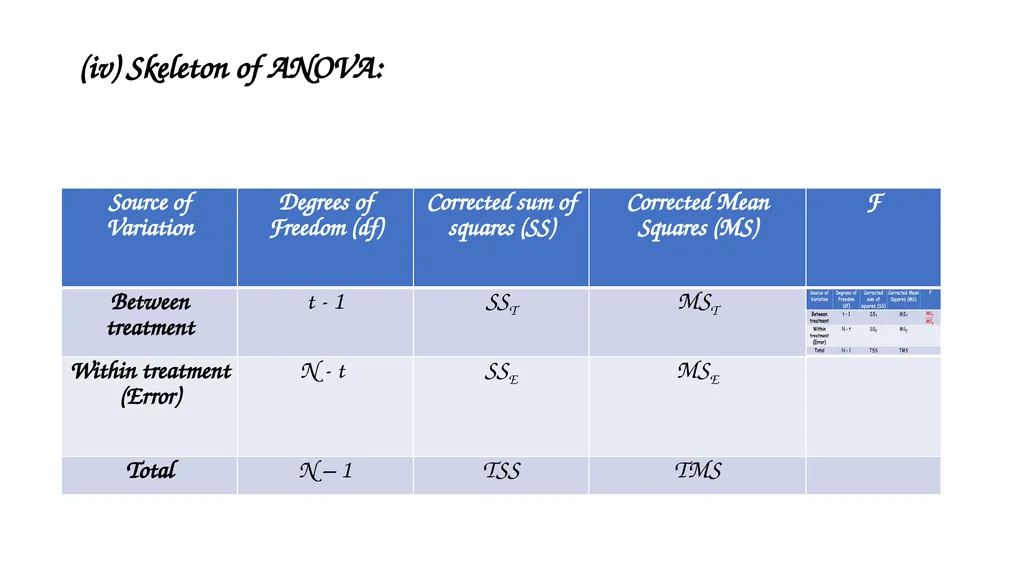
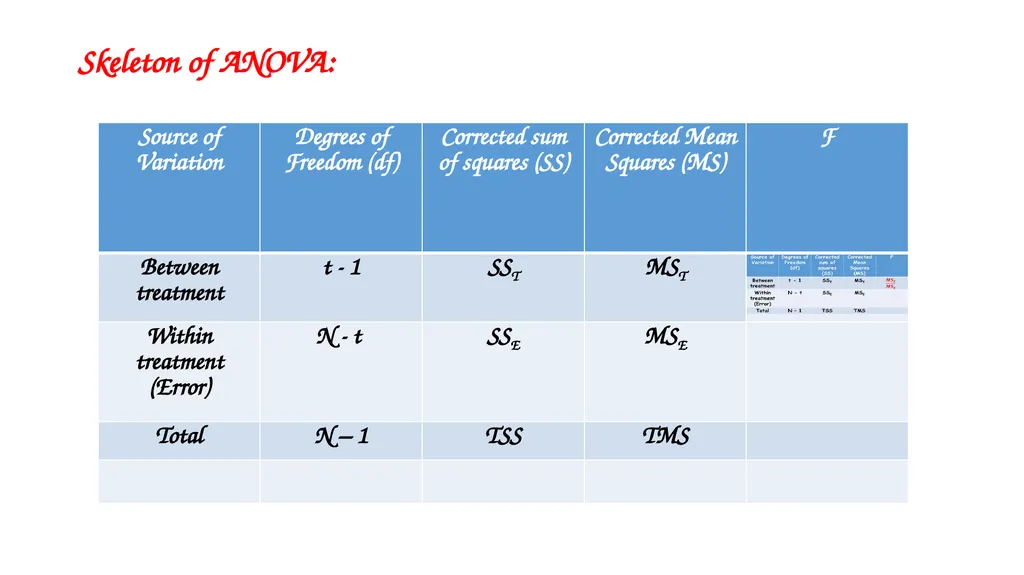
Skeleton of ANOVA:<br>
06
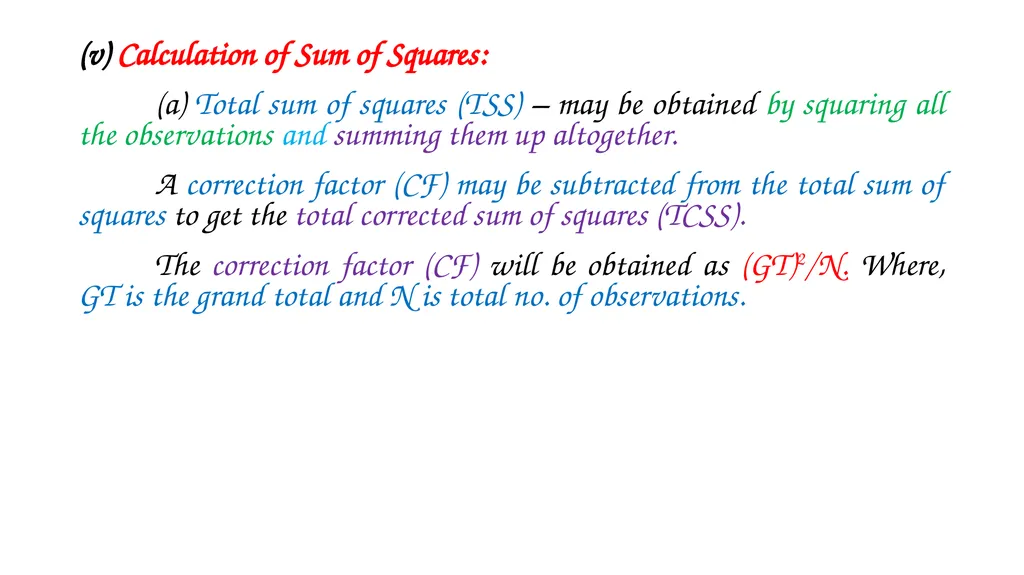
(v) Calculation of Sum of Squares:
(a) Total sum of squares (TSS) – may be obtained by squaring all the observations and summing them up altogether.
A correction factor (CF) may be subtracted from the total sum of squares to get the total corrected sum of squares (TCSS).
The correction factor (CF) will be obtained as (GT)2/N. Where, GT is the grand total and N is total no. of observations.<br>
07
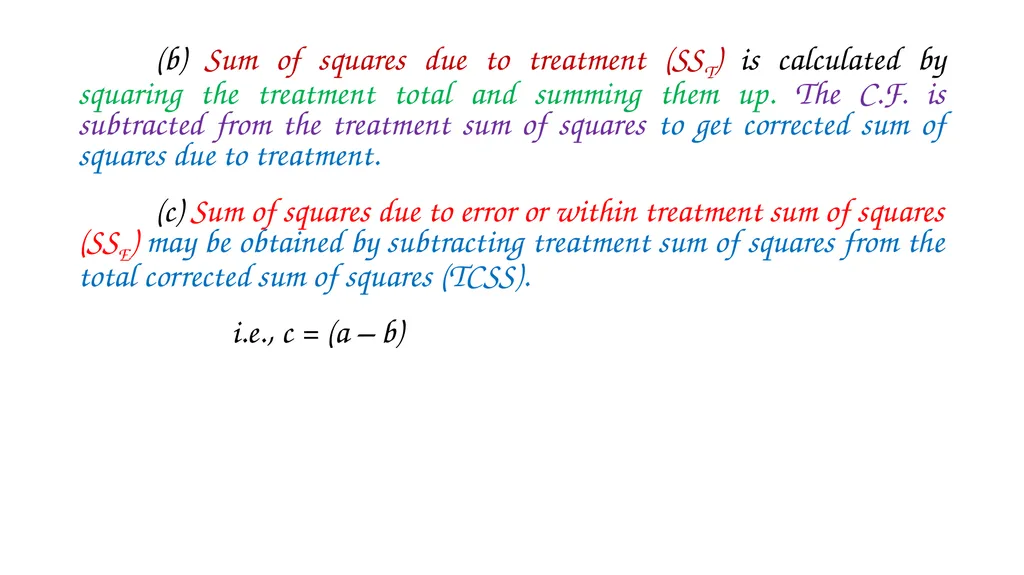
(b) Sum of squares due to treatment (SST) is calculated by squaring the treatment total and summing them up. The C.F. is subtracted from the treatment sum of squares to get corrected sum of squares due to treatment.
(c) Sum of squares due to error or within treatment sum of squares (SSE) may be obtained by subtracting treatment sum of squares from the total corrected sum of squares (TCSS).
i.e., c = (a – b)<br>
08
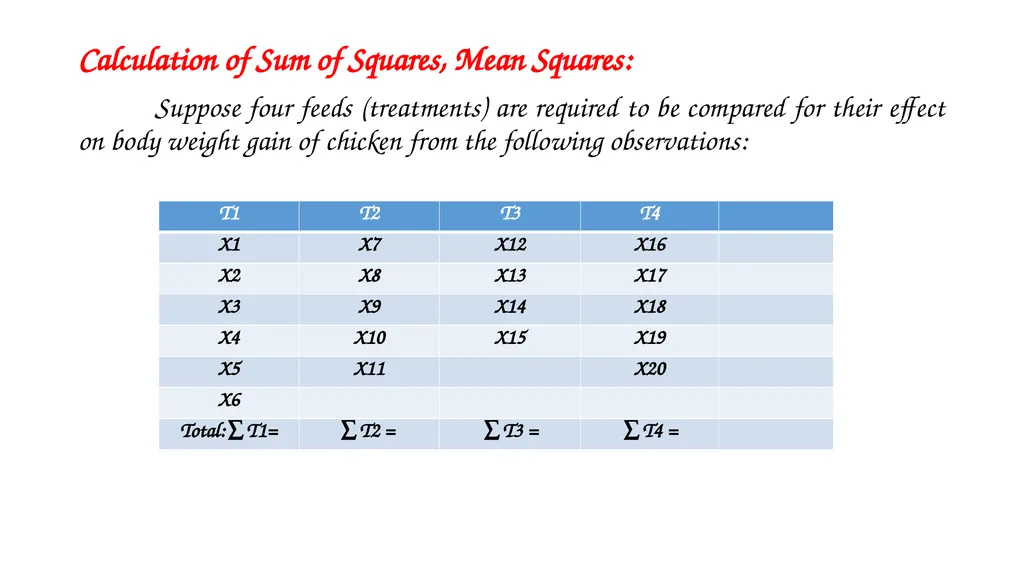
Calculation of Sum of Squares, Mean Squares:
Suppose four feeds (treatments) are required to be compared for their effect on body weight gain of chicken from the following observations:<br>
09
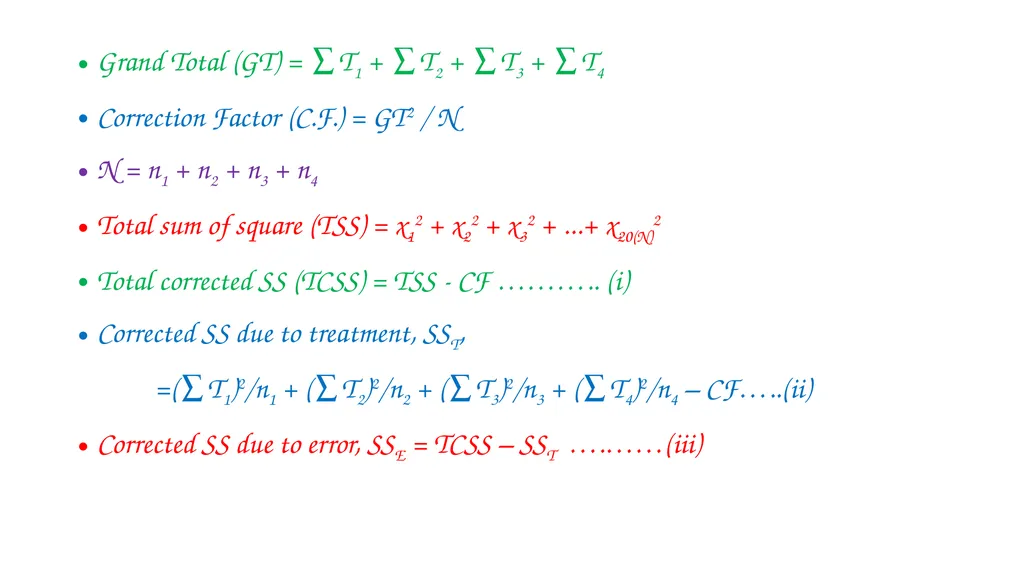
Grand Total (GT) = ∑T1 + ∑T2 + ∑T3 + ∑T4
Correction Factor (C.F.) = GT2 / N
N = n1 + n2 + n3 + n4
Total sum of square (TSS) = x12 + x22 + x32 + ...+ x20(N)2
Total corrected SS (TCSS) = TSS - CF ……….. (i)
Corrected SS due to treatment, SST,
=(∑T1)2/n1 + (∑T2)2/n2 + (∑T3)2/n3 + (∑T4)2/n4 – CF…..(ii)
Corrected SS due to error, SSE = TCSS – SST ….……(iii)<br>
10
Skeleton of ANOVA:<br>
11
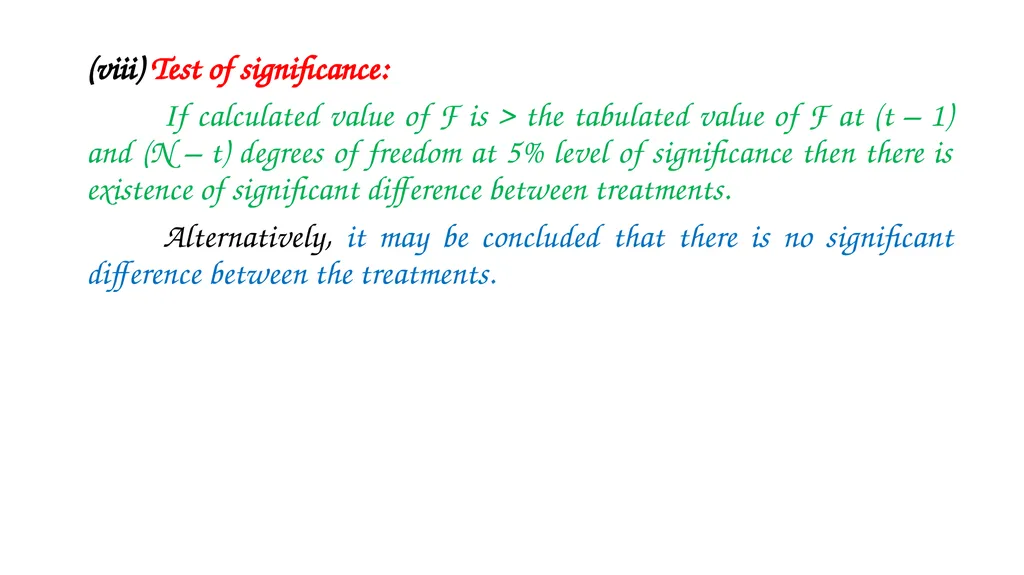
(viii) Test of significance:
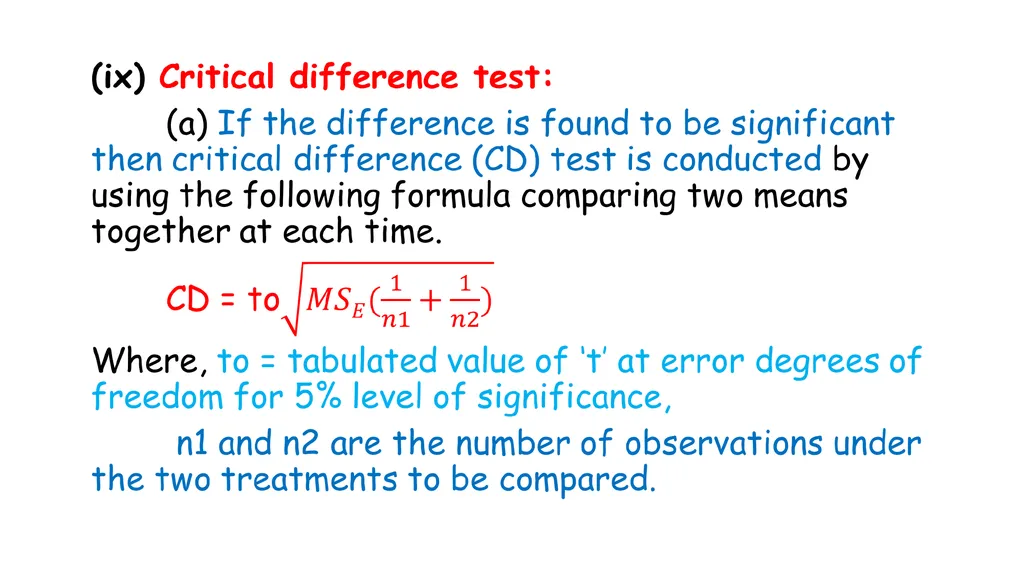
If calculated value of F is > the tabulated value of F at (t – 1) and (N – t) degrees of freedom at 5% level of significance then there is existence of significant difference between treatments.
Alternatively, it may be concluded that there is no significant difference between the treatments.<br>
12
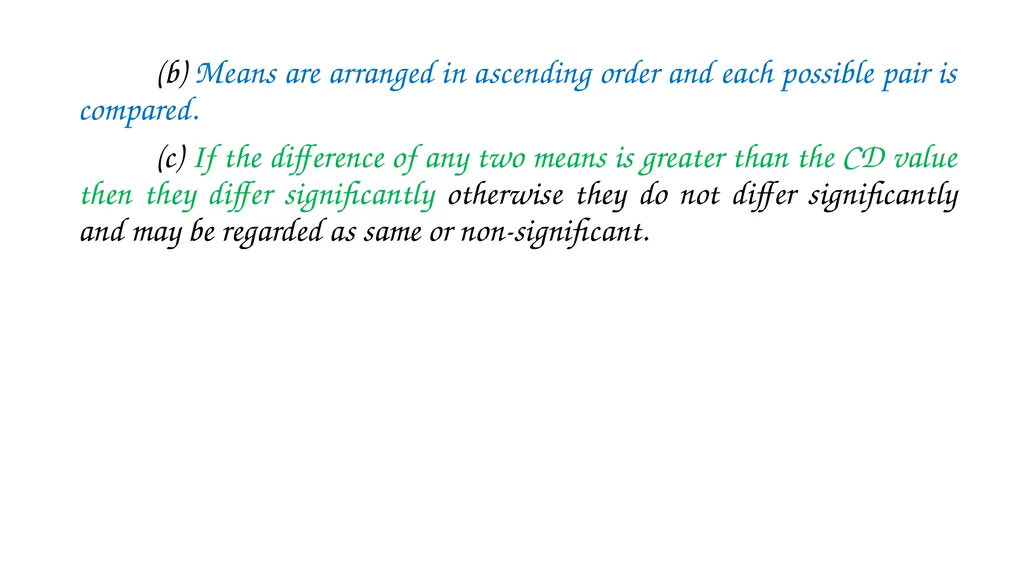
(b) Means are arranged in ascending order and each possible pair is compared.
(c) If the difference of any two means is greater than the CD value then they differ significantly otherwise they do not differ significantly and may be regarded as same or non-significant.<br>
13
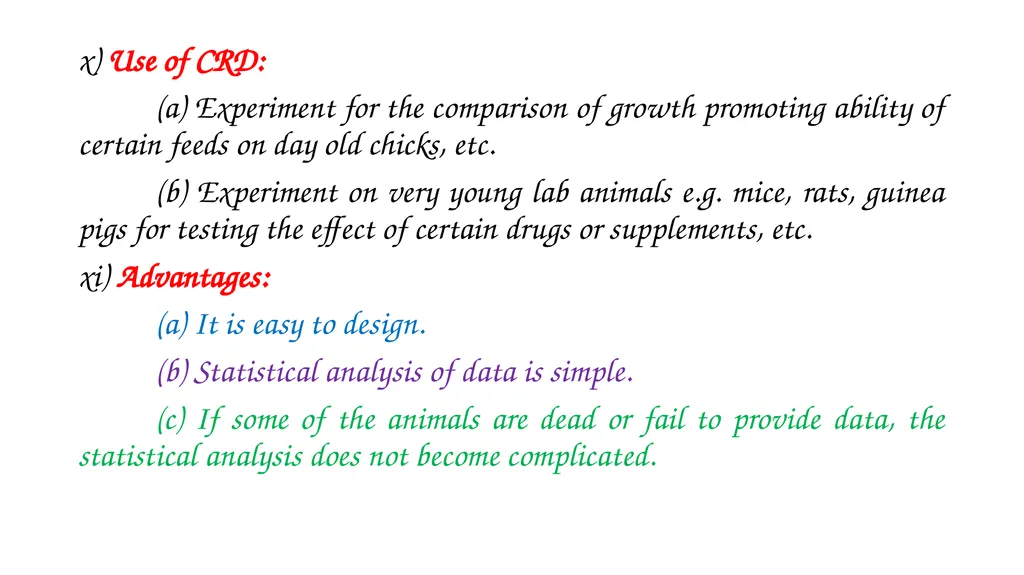
x) Use of CRD:
(a) Experiment for the comparison of growth promoting ability of certain feeds on day old chicks, etc.
(b) Experiment on very young lab animals e.g. mice, rats, guinea pigs for testing the effect of certain drugs or supplements, etc.
xi) Advantages:
(a) It is easy to design.
(b) Statistical analysis of data is simple.
(c) If some of the animals are dead or fail to provide data, the statistical analysis does not become complicated.<br>
14
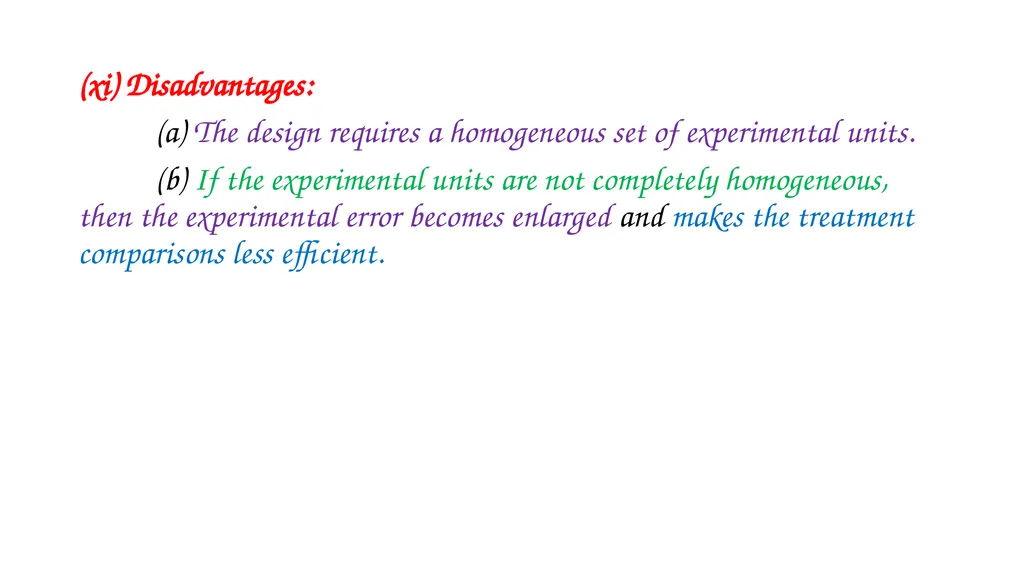
(xi) Disadvantages:
(a) The design requires a homogeneous set of experimental units.
(b) If the experimental units are not completely homogeneous, then the experimental error becomes enlarged and makes the treatment comparisons less efficient.<br>
15
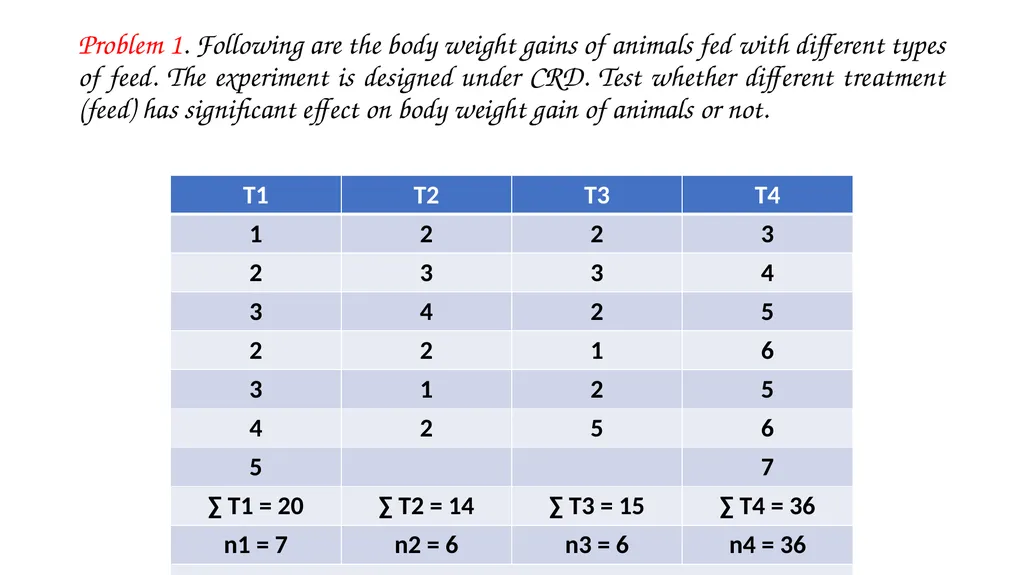
Problem 1. Following are the body weight gains of animals fed with different types of feed. The experiment is designed under CRD. Test whether different treatment (feed) has significant effect on body weight gain of animals or not.<br>
16
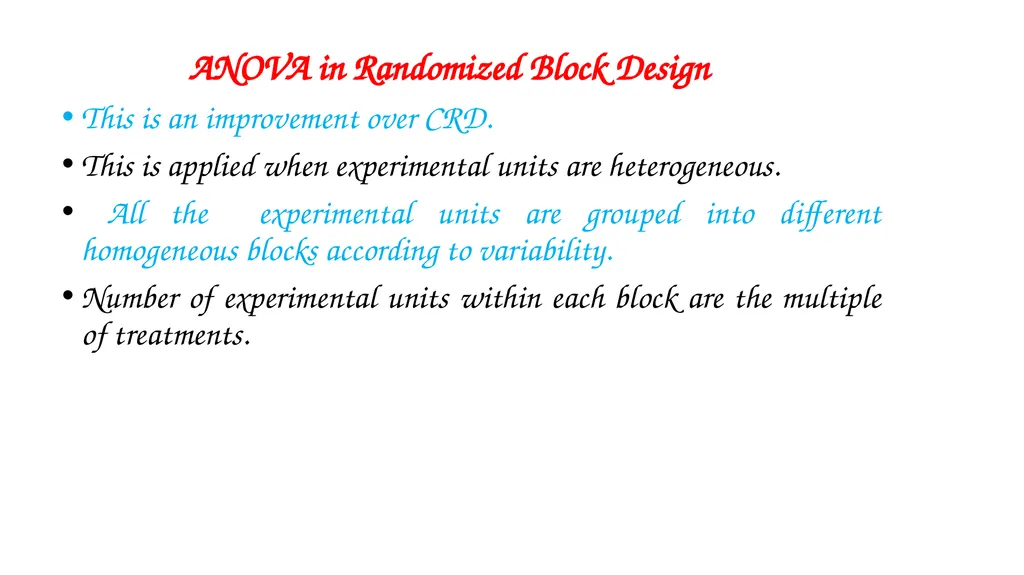
ANOVA in Randomized Block Design This is an improvement over CRD.
This is applied when experimental units are heterogeneous.
All the experimental units are grouped into different homogeneous blocks according to variability.
Number of experimental units within each block are the multiple of treatments.<br>
17
Allotment of treatment is not completely at random like CRD but the allotment is completely random within the homogeneous block.<br>
18
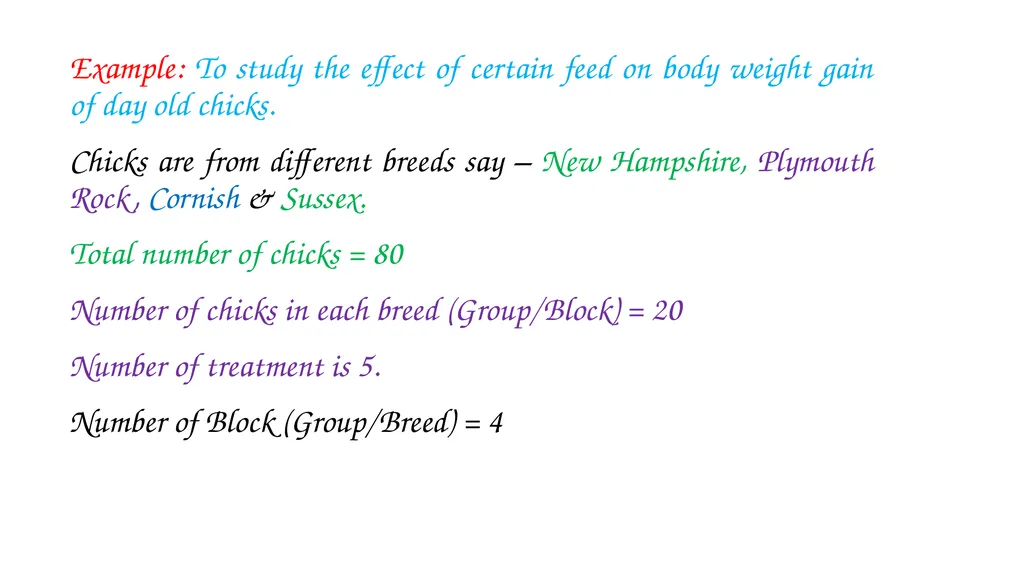
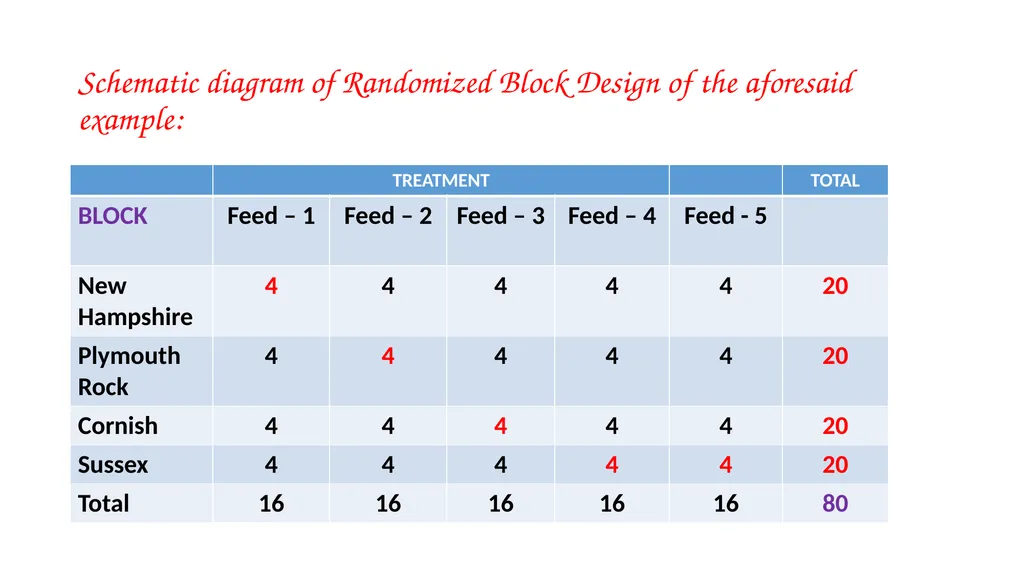
Example: To study the effect of certain feed on body weight gain of day old chicks.
Chicks are from different breeds say – New Hampshire, Plymouth Rock, Cornish & Sussex.
Total number of chicks = 80
Number of chicks in each breed (Group/Block) = 20
Number of treatment is 5.
Number of Block (Group/Breed) = 4<br>
19
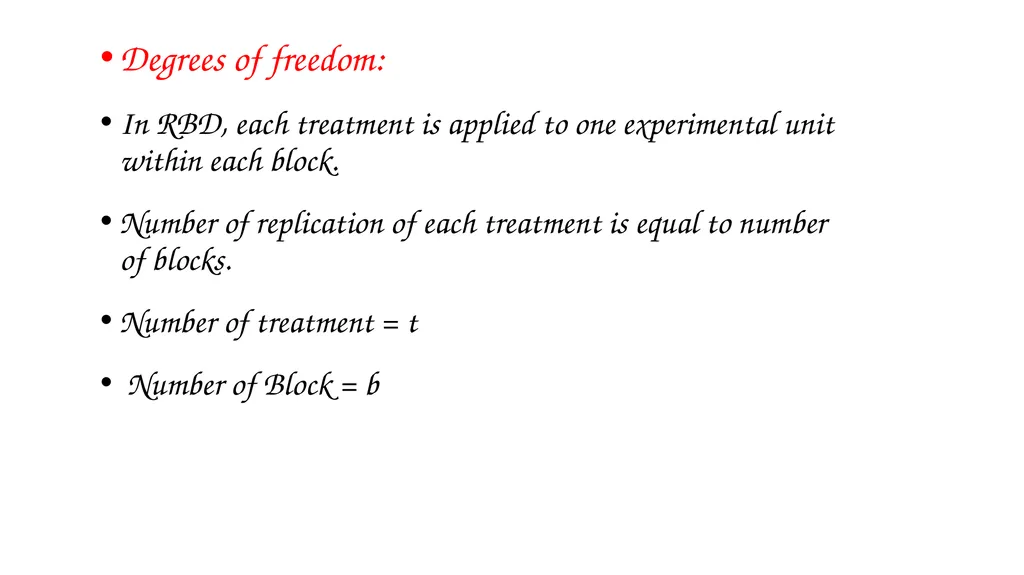
Degrees of freedom:
In RBD, each treatment is applied to one experimental unit within each block.
Number of replication of each treatment is equal to number of blocks.
Number of treatment = t
Number of Block = b<br>
20
Schematic diagram of Randomized Block Design of the aforesaid example:<br>
21
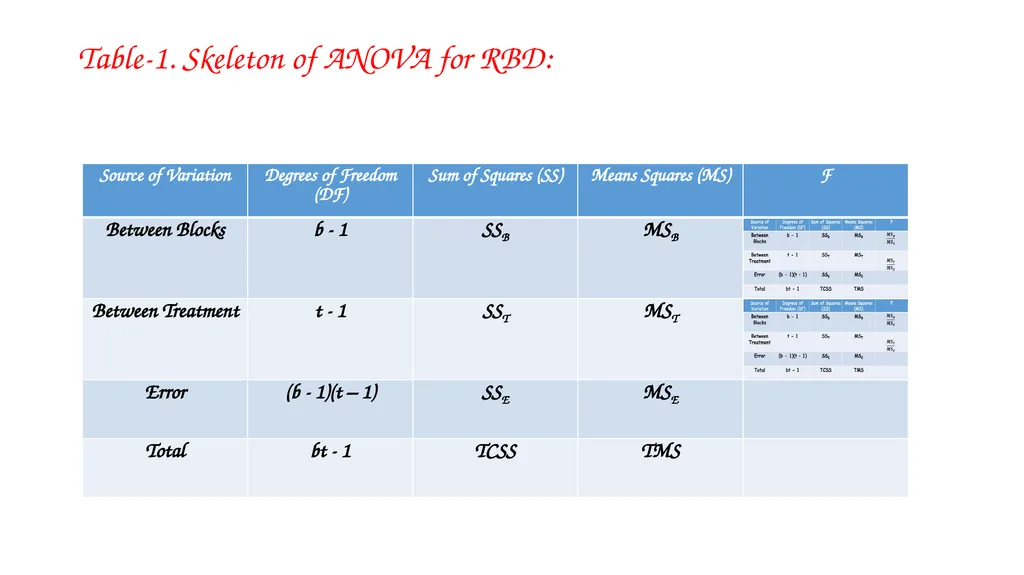
Table-1. Skeleton of ANOVA for RBD:<br>
22
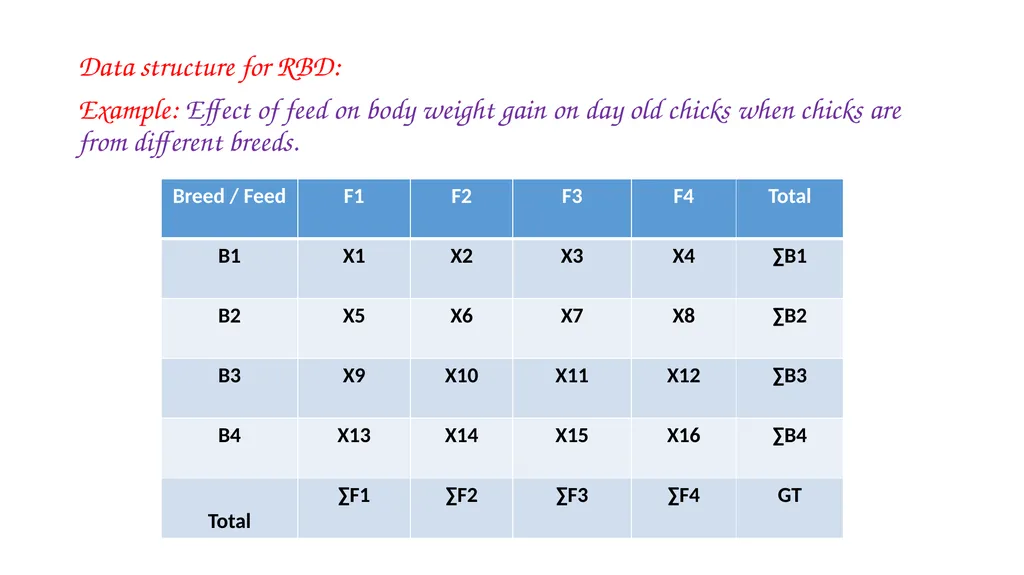
Data structure for RBD:
Example: Effect of feed on body weight gain on day old chicks when chicks are from different breeds.<br>
23
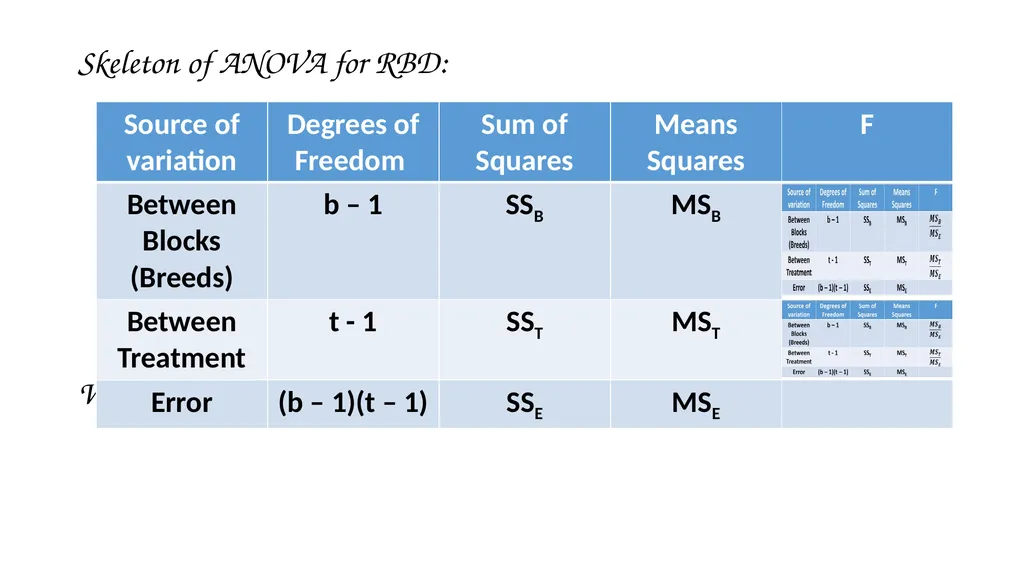
Skeleton of ANOVA for RBD:
Where, b = no. of blocks; t = no. of treatment<br>
24
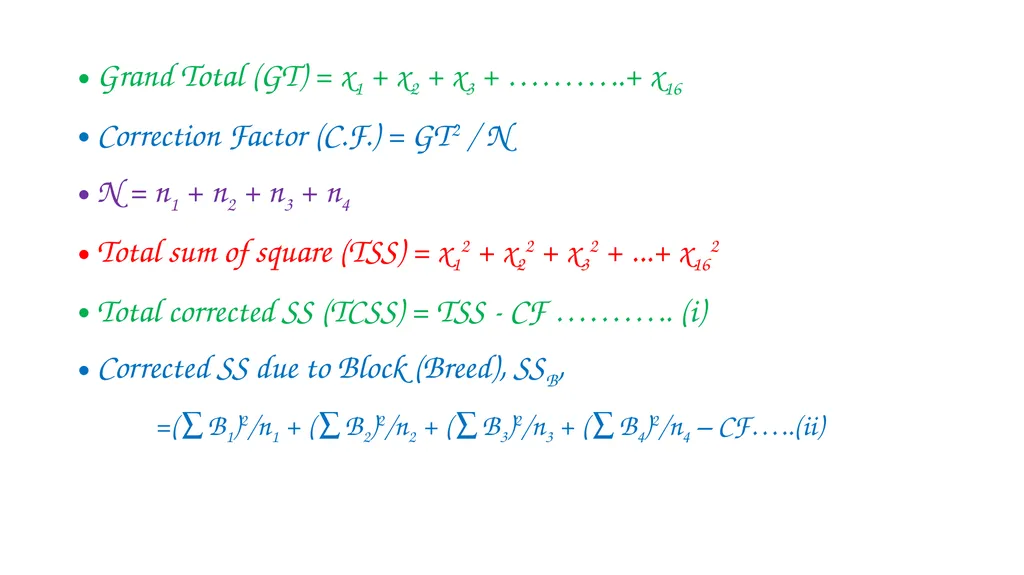
Grand Total (GT) = x1 + x2 + x3 + ………..+ x16
Correction Factor (C.F.) = GT2 / N
N = n1 + n2 + n3 + n4
Total sum of square (TSS) = x12 + x22 + x32 + ...+ x162
Total corrected SS (TCSS) = TSS - CF ……….. (i)
Corrected SS due to Block (Breed), SSB,
=(∑B1)2/n1 + (∑B2)2/n2 + (∑B3)2/n3 + (∑B4)2/n4 – CF…..(ii)<br>
25
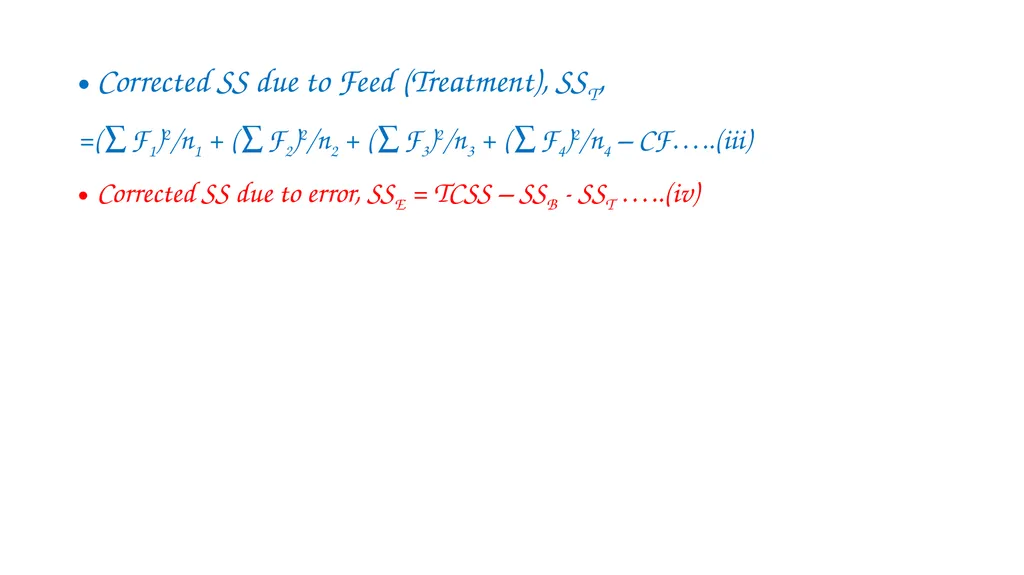
Corrected SS due to Feed (Treatment), SST,
=(∑F1)2/n1 + (∑F2)2/n2 + (∑F3)2/n3 + (∑F4)2/n4 – CF…..(iii)
Corrected SS due to error, SSE = TCSS – SSB - SST …..(iv)<br>
26
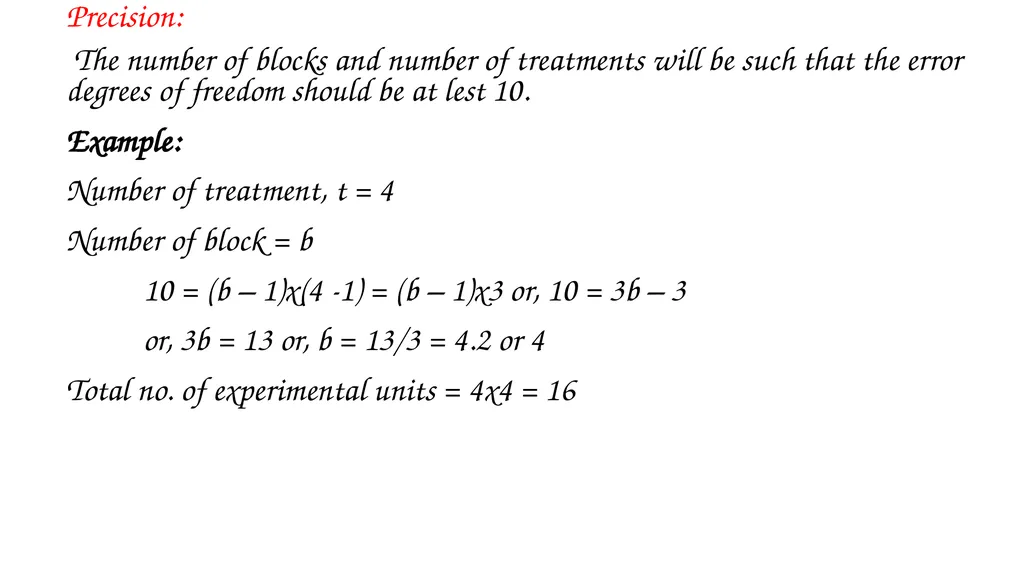
Precision:
The number of blocks and number of treatments will be such that the error degrees of freedom should be at lest 10.
Example:
Number of treatment, t = 4
Number of block = b
10 = (b – 1)x(4 -1) = (b – 1)x3 or, 10 = 3b – 3
or, 3b = 13 or, b = 13/3 = 4.2 or 4
Total no. of experimental units = 4x4 = 16<br>
27
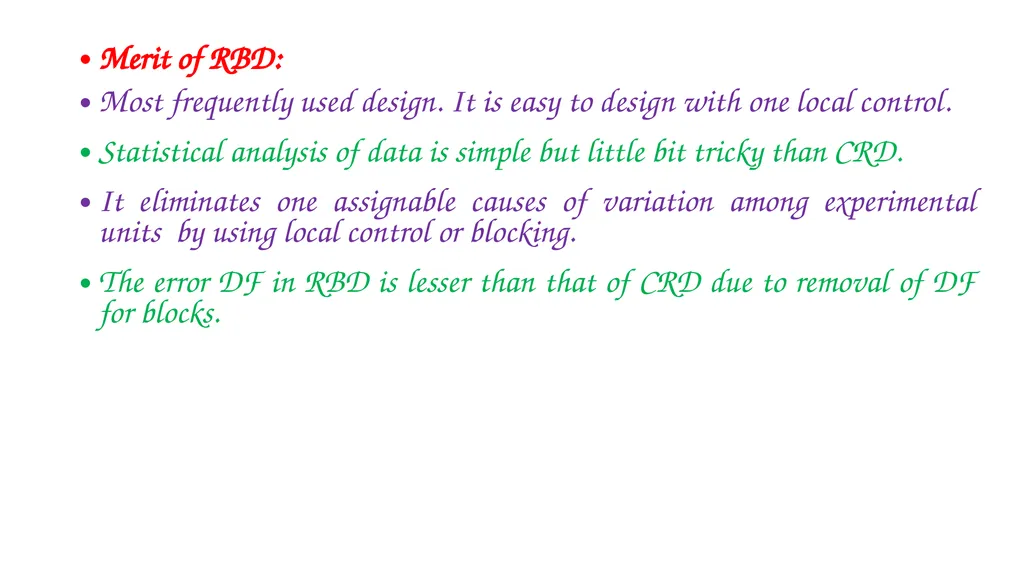
Merit of RBD:
Most frequently used design. It is easy to design with one local control.
Statistical analysis of data is simple but little bit tricky than CRD.
It eliminates one assignable causes of variation among experimental units by using local control or blocking.
The error DF in RBD is lesser than that of CRD due to removal of DF for blocks.<br>
28
Demerit of RBD:
When the number of treatments to be compared is large then it becomes difficult to get large blocks of homogeneous experimental units.
The analysis of data becomes difficult if one or more than one observation in RBD is missing.
Under such condition it will be necessary to remove or omit that block.<br>