ANSP Stakeholder View on RP3 Performance Plan and Target Proposals Luxembourg, 5 September 2019 Thomas Hellbach, AFGPMG FABEC RP3 User Consultation Learning from RP2 for RP3 - Observations Root cause for missing the targets for RP2: The
Related Topics
Share
Embed code
Download this presentation From Below
"ANSP Stakeholder View on RP3 Performance Plan and" is the property of its rightful owner. Permission is granted to
download and print the materials on this website for personal, non-commercial use only, and to display it
on your personal computer provided you do not modify the materials and that you retain all copyright
notices contained in the materials. By downloading content from our website, you accept the terms of this
agreement.
Presentation Transcript
01
ANSP Stakeholder View
on RP3 Performance Plan and Target Proposals Luxembourg, 5 September 2019
Thomas Hellbach, AFG/PMG FABEC RP3 User Consultation<br>
02
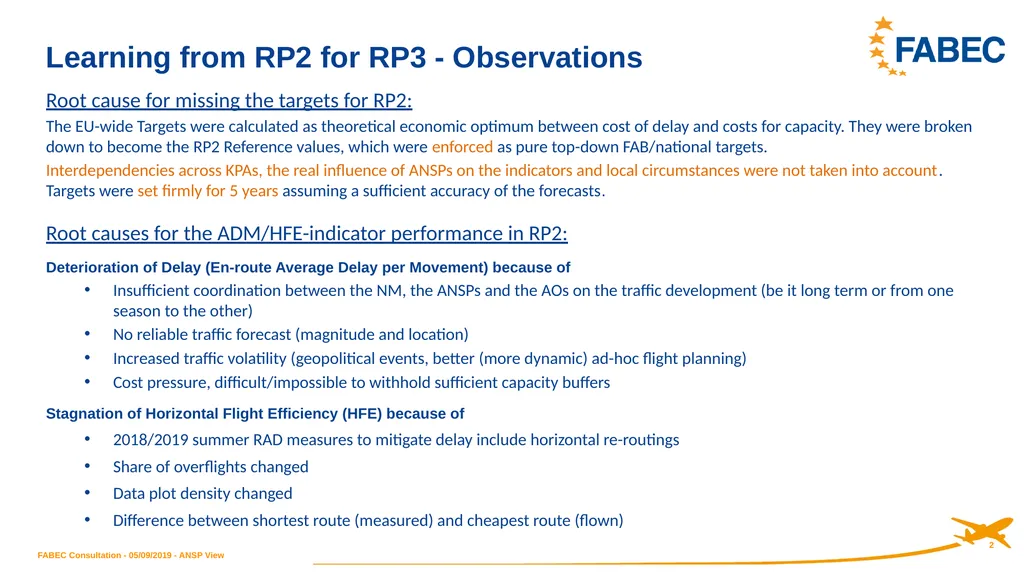
Learning from RP2 for RP3 - Observations Root cause for missing the targets for RP2:
The EU-wide Targets were calculated as theoretical economic optimum between cost of delay and costs for capacity. They were broken down to become the RP2 Reference values, which were enforced as pure top-down FAB/national targets.
Interdependencies across KPAs, the real influence of ANSPs on the indicators and local circumstances were not taken into account. Targets were set firmly for 5 years assuming a sufficient accuracy of the forecasts.
Root causes for the ADM/HFE-indicator performance in RP2:
Deterioration of Delay (En-route Average Delay per Movement) because of
Insufficient coordination between the NM, the ANSPs and the AOs on the traffic development (be it long term or from one season to the other)
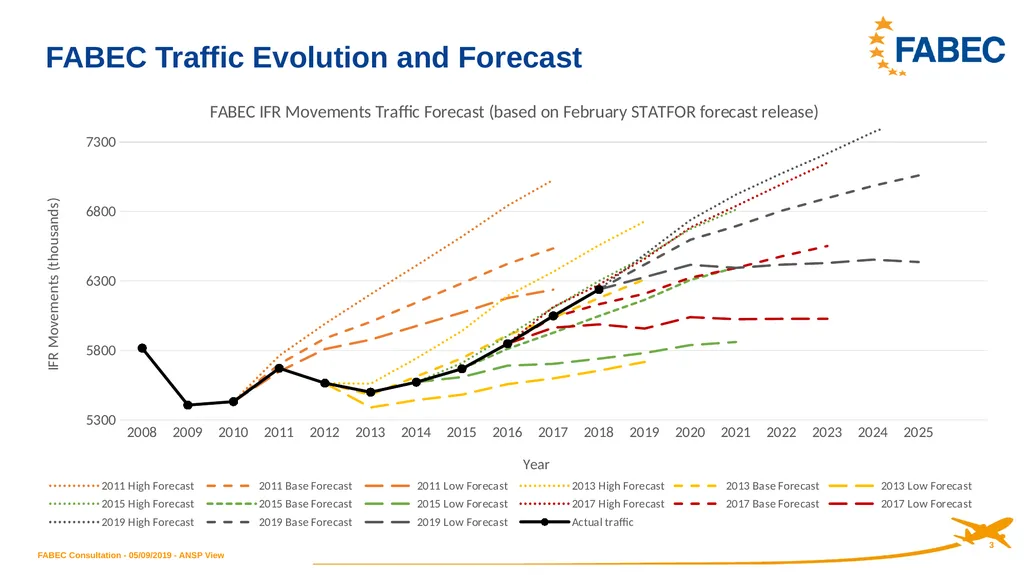
No reliable traffic forecast (magnitude and location)
Increased traffic volatility (geopolitical events, better (more dynamic) ad-hoc flight planning)
Cost pressure, difficult/impossible to withhold sufficient capacity buffers
Stagnation of Horizontal Flight Efficiency (HFE) because of
2018/2019 summer RAD measures to mitigate delay include horizontal re-routings
Share of overflights changed
Data plot density changed
Difference between shortest route (measured) and cheapest route (flown) FABEC Consultation - 05/09/2019 - ANSP View<br>
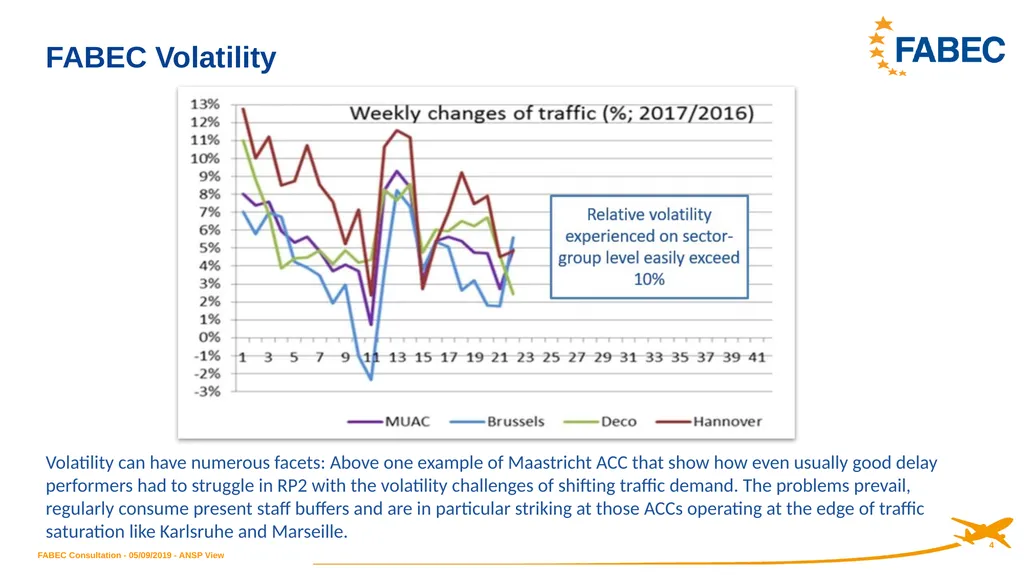
FABEC Volatility FABEC Consultation - 05/09/2019 - ANSP View Volatility can have numerous facets: Above one example of Maastricht ACC that show how even usually good delay performers had to struggle in RP2 with the volatility challenges of shifting traffic demand. The problems prevail, regularly consume present staff buffers and are in particular striking at those ACCs operating at the edge of traffic saturation like Karlsruhe and Marseille.<br>
05
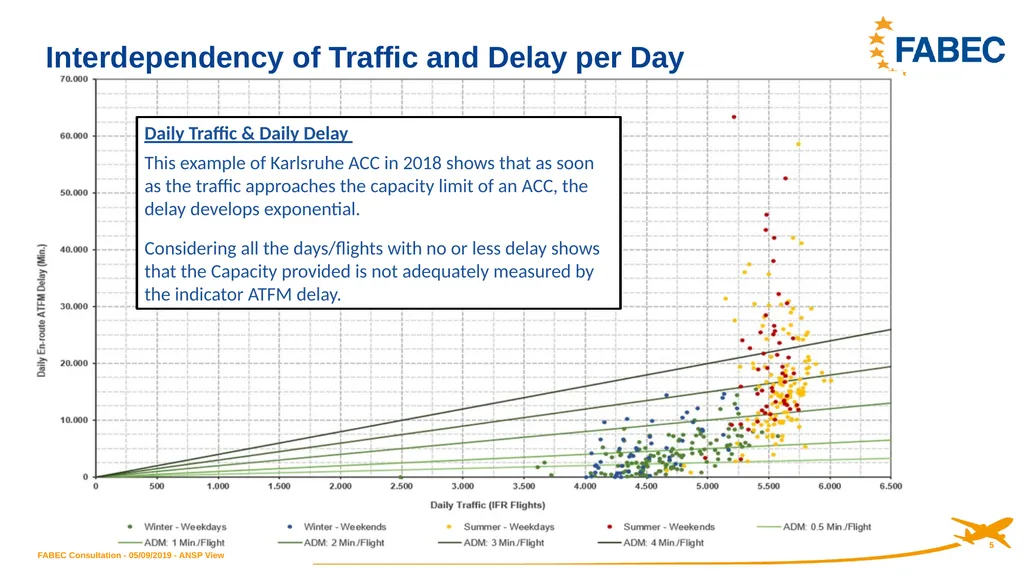
Interdependency of Traffic and Delay per Day FABEC Consultation - 05/09/2019 - ANSP View Daily Traffic & Daily Delay
This example of Karlsruhe ACC in 2018 shows that as soon as the traffic approaches the capacity limit of an ACC, the delay develops exponential.
Considering all the days/flights with no or less delay shows that the Capacity provided is not adequately measured by the indicator ATFM delay.<br>
06
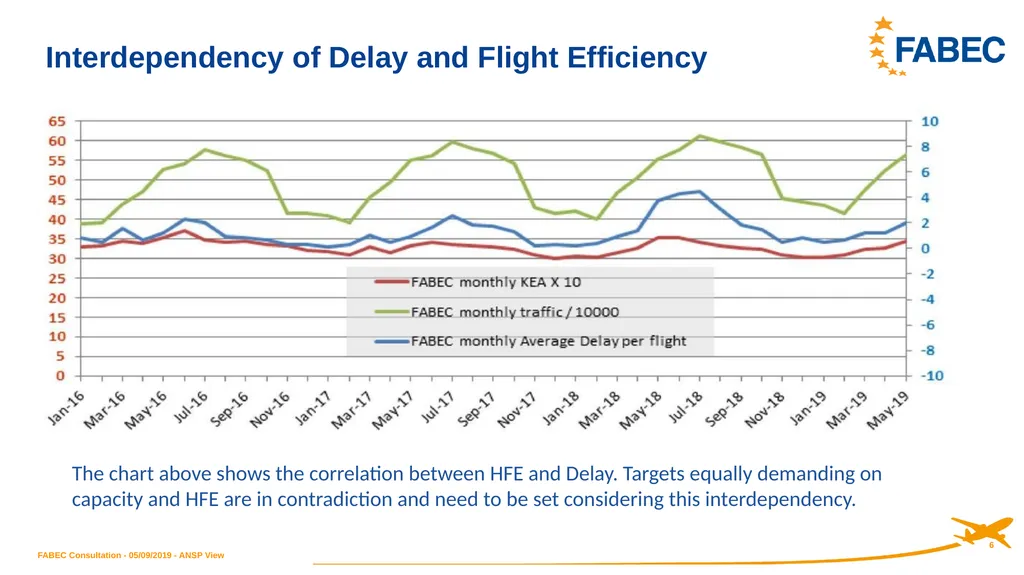
Interdependency of Delay and Flight Efficiency The chart above shows the correlation between HFE and Delay. Targets equally demanding on capacity and HFE are in contradiction and need to be set considering this interdependency. FABEC Consultation - 05/09/2019 - ANSP View<br>
07
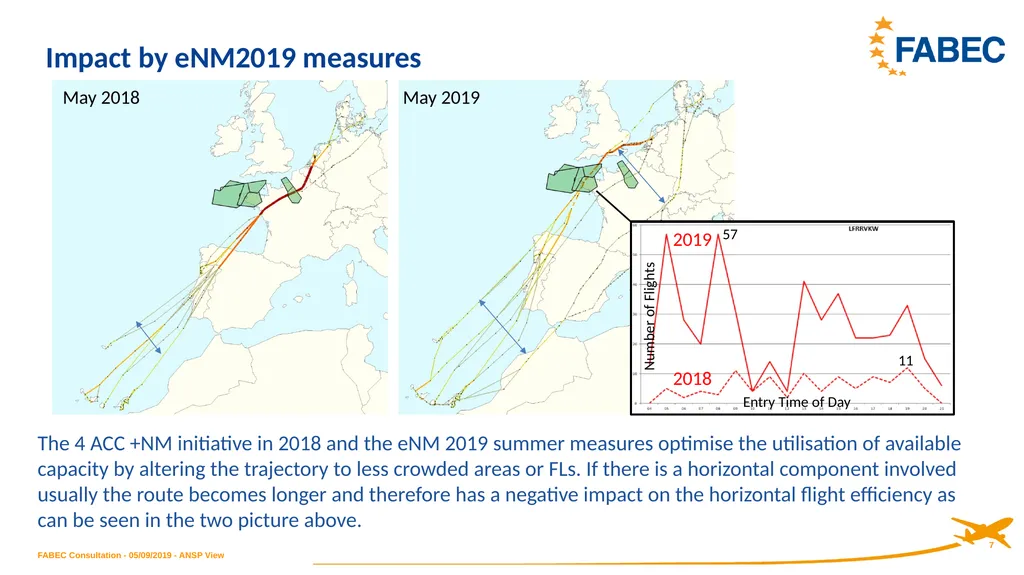
Impact by eNM2019 measures FABEC Consultation - 05/09/2019 - ANSP View The 4 ACC +NM initiative in 2018 and the eNM 2019 summer measures optimise the utilisation of available capacity by altering the trajectory to less crowded areas or FLs. If there is a horizontal component involved usually the route becomes longer and therefore has a negative impact on the horizontal flight efficiency as can be seen in the two picture above. May 2018 May 2019 2018 2019 Number of Flights Entry Time of Day 57 11<br>
08
Conclusion of FABEC ANSP View FABEC ANSPs consider the selection of indicators and the incentive scheme prescribed by the regulation as not innovative enough when compared to RP2, and considering the numerous interdependencies within operations, as too one-sided with regards to the stakeholders addressed.
We consider the methodology used to define reference values as misleading concerning the magnitude of the real performance gains that can be exploited.
We strongly support the consideration of local circumstances in the approval process to justify adapted targets as described in the RP3 Performance Regulation (EU) 2019/317 and referred to by EU COM in the context of the EU target setting process. FABEC Consultation - 05/09/2019 - ANSP View<br>
09
Conclusion on RP3 Performance Plan and Targets ANSPs support the proposed Safety Targets.
ANSPs consider the proposed en-route delay targets to be at the edge of achievability and thus as very ambitious. Only when all planned improvements and assumptions play out as expected or better, the proposed targets are achievable.
ANSPs support the incentive scheme as proposed in the draft FABEC performance plan.
ANSPs consider the targets for the HFE indicator, in particular for the last two years of RP3, as not achievable, because the capacity optimization measures will override any ANSP effort to improve HFE. Furthermore, ANSPs are unable to forecast the huge influence by factors outside their control (share of overflights; shortest/cheapest route difference).
Targets equally demanding on capacity and HFE are in contradiction and need to be set considering this interdependency. FABEC Consultation - 05/09/2019 - ANSP View<br>
10
Thank you
for your attention!<br>
11
Backup<br>
12
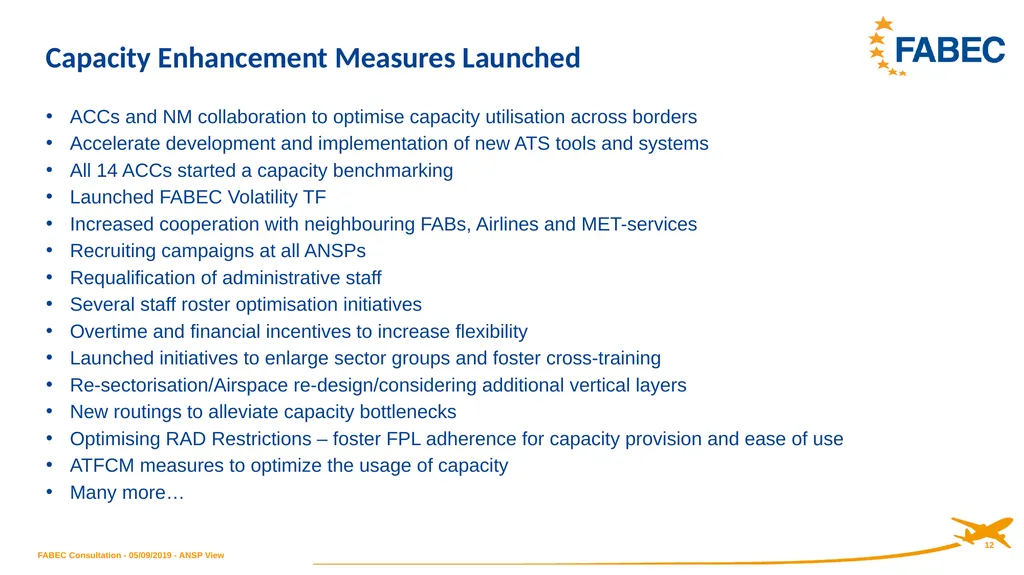
Capacity Enhancement Measures Launched ACCs and NM collaboration to optimise capacity utilisation across borders
Accelerate development and implementation of new ATS tools and systems
All 14 ACCs started a capacity benchmarking
Launched FABEC Volatility TF
Increased cooperation with neighbouring FABs, Airlines and MET-services
Recruiting campaigns at all ANSPs
Requalification of administrative staff
Several staff roster optimisation initiatives
Overtime and financial incentives to increase flexibility
Launched initiatives to enlarge sector groups and foster cross-training
Re-sectorisation/Airspace re-design/considering additional vertical layers
New routings to alleviate capacity bottlenecks
Optimising RAD Restrictions – foster FPL adherence for capacity provision and ease of use
ATFCM measures to optimize the usage of capacity
Many more… FABEC Consultation - 05/09/2019 - ANSP View<br>