
ANTENATAL, INTRAPARTUM & POSTNATAL CARE February
GB
Published · 24 slides · 0 views

1 / 1
Description
ANTENATAL, INTRAPARTUM POSTNATAL CARE February 2021 DEFINITIONS Antenatal care (ANC): Care provided during pregnancy by skilled health-care professionals to ensure best health conditions for both mother and baby. Intrapartum care: Care
Related Topics
Share
Embed code
Download this presentation From Below
"ANTENATAL, INTRAPARTUM & POSTNATAL CARE February" is the property of its rightful owner. Permission is granted to download and print the materials on this website for personal, non-commercial use only, and to display it on your personal computer provided you do not modify the materials and that you retain all copyright notices contained in the materials. By downloading content from our website, you accept the terms of this agreement.
Presentation Transcript
01
ANTENATAL, INTRAPARTUM & POSTNATAL CARE February 2021<br>
02
DEFINITIONS Antenatal care (ANC): Care provided during pregnancy by skilled health-care professionals to ensure best health conditions for both mother and baby.
Intrapartum care: Care provided during childbirth by skilled health-care professionals to ensure best health conditions for both mother and baby.
Postnatal care (PNC): Care provided up to six weeks following childbirth by skilled health-care professionals to ensure best health conditions for both mother and baby.<br>
Intrapartum care: Care provided during childbirth by skilled health-care professionals to ensure best health conditions for both mother and baby.
Postnatal care (PNC): Care provided up to six weeks following childbirth by skilled health-care professionals to ensure best health conditions for both mother and baby.<br>
03
RATIONALE – 1/2 In many contexts, adolescent pregnancy is common: In 2016, an estimated 21 million girls aged 15-19 in developing countries became pregnant, approximately 12 million of whom gave birth. An estimated 2.5 million girls aged under 16 years in low-resource countries give birth every year. Drivers are context specific; they include child marriage, poverty, lack of opportunity & values related to womanhood & motherhood.
Adverse maternal health outcomes among adolescents have major health & social consequences: Pregnancy & childbirth complications are the leading cause of death among girls aged 15-19 years globally. In addition, adolescent mothers face higher risks of maternal morbidity. Early child bearing can increase risks for newborns as well as for young mothers.<br>
Adverse maternal health outcomes among adolescents have major health & social consequences: Pregnancy & childbirth complications are the leading cause of death among girls aged 15-19 years globally. In addition, adolescent mothers face higher risks of maternal morbidity. Early child bearing can increase risks for newborns as well as for young mothers.<br>
04
RATIONALE – 1/2 ANC, IPC & PNC are effective: The health benefits of these interventions for mother and baby are clear. There are not ascertainable harms or burdens.
Access to & provision of good quality services needs attention: Adolescents face barriers to accessing & using skilled care before, during & after pregnancy. Certain groups of adolescents e.g. very young adolescents, unmarried adolescents, & those who are displaced because of war, civil strife or other emergencies face special barriers.<br>
Access to & provision of good quality services needs attention: Adolescents face barriers to accessing & using skilled care before, during & after pregnancy. Certain groups of adolescents e.g. very young adolescents, unmarried adolescents, & those who are displaced because of war, civil strife or other emergencies face special barriers.<br>
05
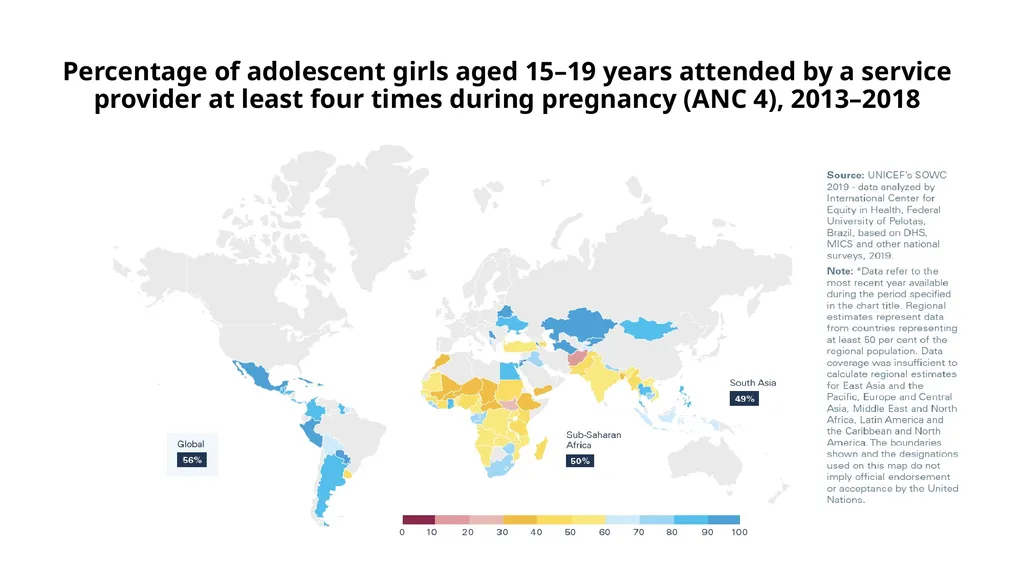
Percentage of adolescent girls aged 15–19 years attended by a service provider at least four times during pregnancy (ANC 4), 2013–2018<br>
06
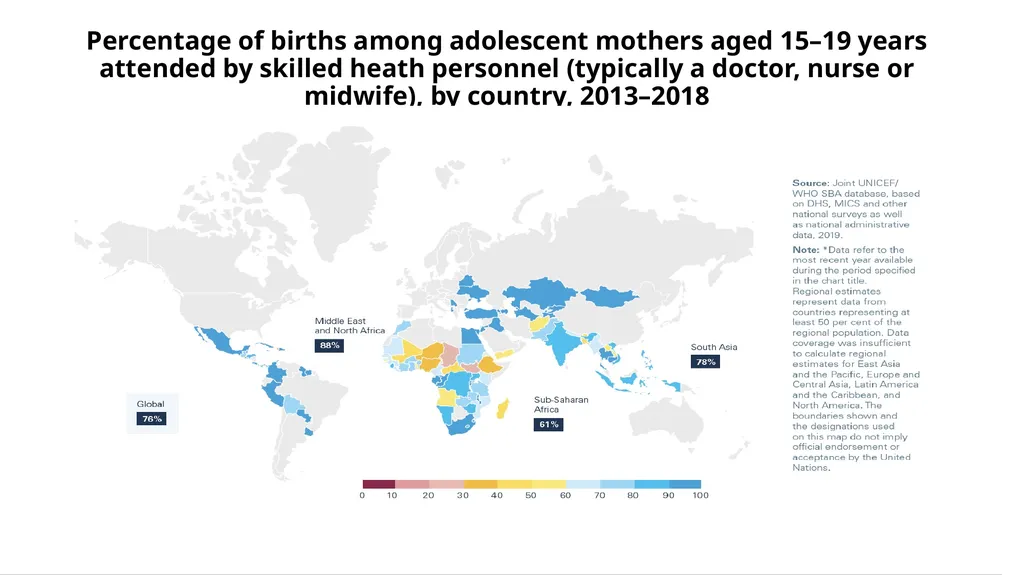
Percentage of births among adolescent mothers aged 15–19 years attended by skilled heath personnel (typically a doctor, nurse or midwife), by country, 2013–2018<br>
07
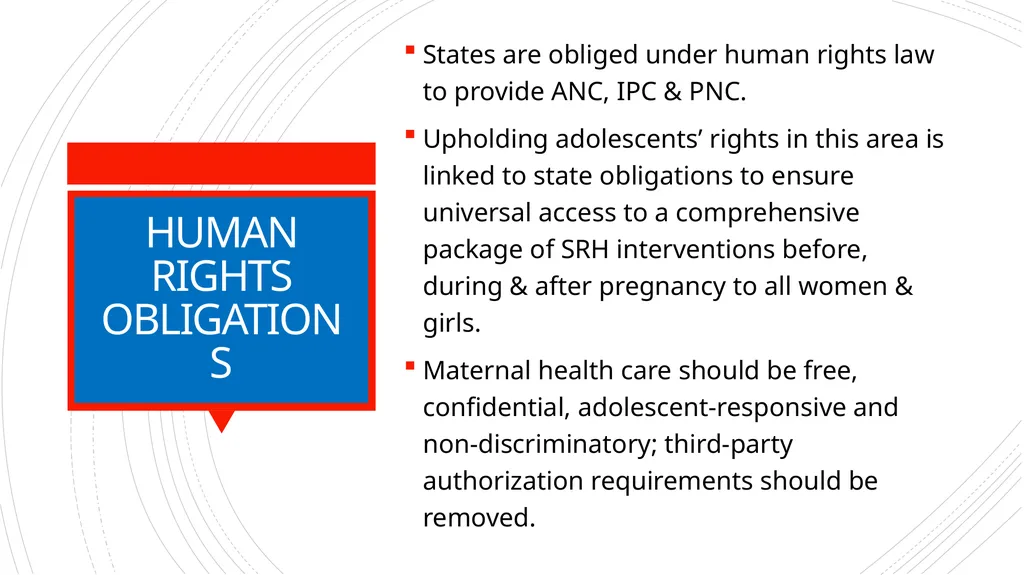
HUMAN RIGHTS OBLIGATIONS States are obliged under human rights law to provide ANC, IPC & PNC.
Upholding adolescents’ rights in this area is linked to state obligations to ensure universal access to a comprehensive package of SRH interventions before, during & after pregnancy to all women & girls.
Maternal health care should be free, confidential, adolescent-responsive and non-discriminatory; third-party authorization requirements should be removed.<br>
Upholding adolescents’ rights in this area is linked to state obligations to ensure universal access to a comprehensive package of SRH interventions before, during & after pregnancy to all women & girls.
Maternal health care should be free, confidential, adolescent-responsive and non-discriminatory; third-party authorization requirements should be removed.<br>
08
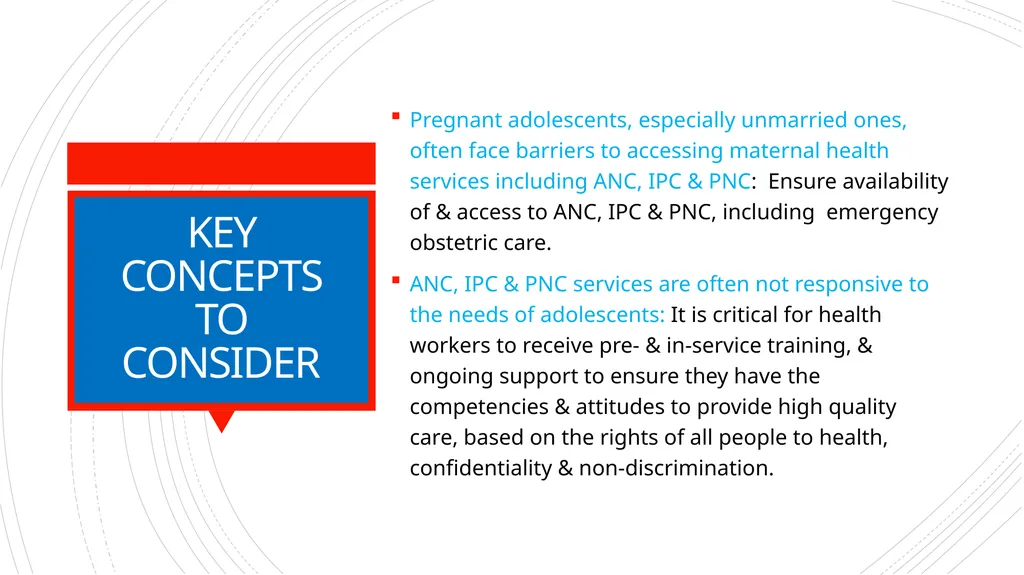
KEY CONCEPTS TO CONSIDER Pregnant adolescents, especially unmarried ones, often face barriers to accessing maternal health services including ANC, IPC & PNC: Ensure availability of & access to ANC, IPC & PNC, including emergency obstetric care.
ANC, IPC & PNC services are often not responsive to the needs of adolescents: It is critical for health workers to receive pre- & in-service training, & ongoing support to ensure they have the competencies & attitudes to provide high quality care, based on the rights of all people to health, confidentiality & non-discrimination.<br>
ANC, IPC & PNC services are often not responsive to the needs of adolescents: It is critical for health workers to receive pre- & in-service training, & ongoing support to ensure they have the competencies & attitudes to provide high quality care, based on the rights of all people to health, confidentiality & non-discrimination.<br>
09
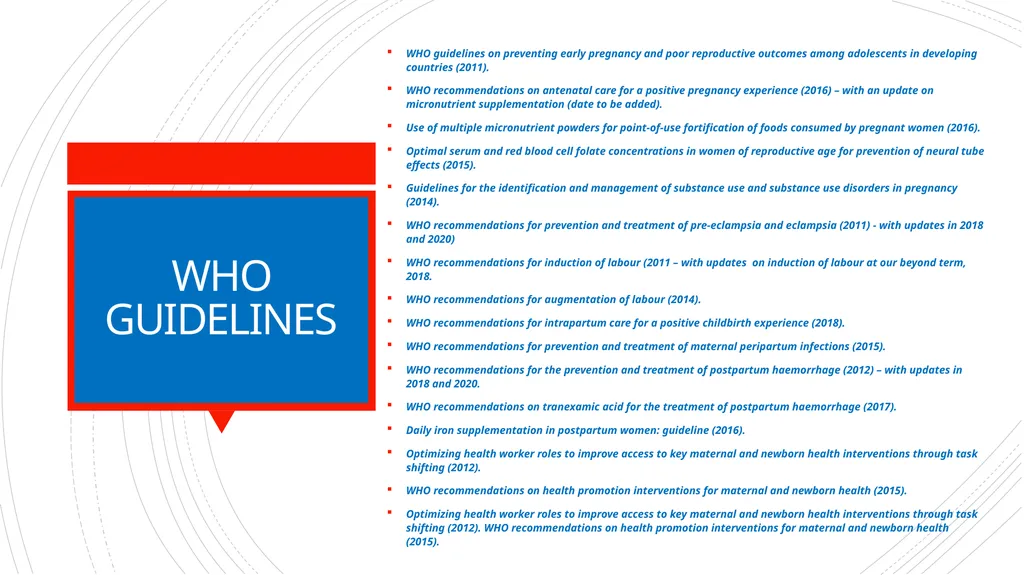
WHO GUIDELINES WHO guidelines on preventing early pregnancy and poor reproductive outcomes among adolescents in developing countries (2011).
WHO recommendations on antenatal care for a positive pregnancy experience (2016) – with an update on micronutrient supplementation (date to be added).
Use of multiple micronutrient powders for point-of-use fortification of foods consumed by pregnant women (2016).
Optimal serum and red blood cell folate concentrations in women of reproductive age for prevention of neural tube effects (2015).
Guidelines for the identification and management of substance use and substance use disorders in pregnancy (2014).
WHO recommendations for prevention and treatment of pre-eclampsia and eclampsia (2011) - with updates in 2018 and 2020)
WHO recommendations for induction of labour (2011 – with updates on induction of labour at our beyond term, 2018.
WHO recommendations for augmentation of labour (2014).
WHO recommendations for intrapartum care for a positive childbirth experience (2018).
WHO recommendations for prevention and treatment of maternal peripartum infections (2015).
WHO recommendations for the prevention and treatment of postpartum haemorrhage (2012) – with updates in 2018 and 2020.
WHO recommendations on tranexamic acid for the treatment of postpartum haemorrhage (2017).
Daily iron supplementation in postpartum women: guideline (2016).
Optimizing health worker roles to improve access to key maternal and newborn health interventions through task shifting (2012).
WHO recommendations on health promotion interventions for maternal and newborn health (2015).
Optimizing health worker roles to improve access to key maternal and newborn health interventions through task shifting (2012). WHO recommendations on health promotion interventions for maternal and newborn health (2015).<br>
WHO recommendations on antenatal care for a positive pregnancy experience (2016) – with an update on micronutrient supplementation (date to be added).
Use of multiple micronutrient powders for point-of-use fortification of foods consumed by pregnant women (2016).
Optimal serum and red blood cell folate concentrations in women of reproductive age for prevention of neural tube effects (2015).
Guidelines for the identification and management of substance use and substance use disorders in pregnancy (2014).
WHO recommendations for prevention and treatment of pre-eclampsia and eclampsia (2011) - with updates in 2018 and 2020)
WHO recommendations for induction of labour (2011 – with updates on induction of labour at our beyond term, 2018.
WHO recommendations for augmentation of labour (2014).
WHO recommendations for intrapartum care for a positive childbirth experience (2018).
WHO recommendations for prevention and treatment of maternal peripartum infections (2015).
WHO recommendations for the prevention and treatment of postpartum haemorrhage (2012) – with updates in 2018 and 2020.
WHO recommendations on tranexamic acid for the treatment of postpartum haemorrhage (2017).
Daily iron supplementation in postpartum women: guideline (2016).
Optimizing health worker roles to improve access to key maternal and newborn health interventions through task shifting (2012).
WHO recommendations on health promotion interventions for maternal and newborn health (2015).
Optimizing health worker roles to improve access to key maternal and newborn health interventions through task shifting (2012). WHO recommendations on health promotion interventions for maternal and newborn health (2015).<br>
10
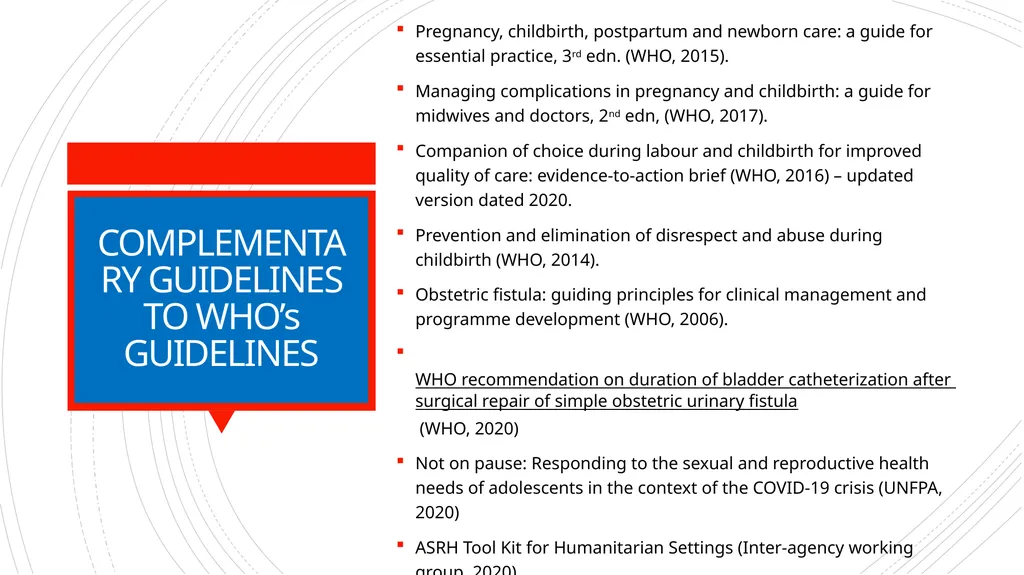
COMPLEMENTARY GUIDELINES TO WHO’s GUIDELINES Pregnancy, childbirth, postpartum and newborn care: a guide for essential practice, 3rd edn. (WHO, 2015).
Managing complications in pregnancy and childbirth: a guide for midwives and doctors, 2nd edn, (WHO, 2017).
Companion of choice during labour and childbirth for improved quality of care: evidence-to-action brief (WHO, 2016) – updated version dated 2020.
Prevention and elimination of disrespect and abuse during childbirth (WHO, 2014).
Obstetric fistula: guiding principles for clinical management and programme development (WHO, 2006).
WHO recommendation on duration of bladder catheterization after surgical repair of simple obstetric urinary fistula (WHO, 2020)
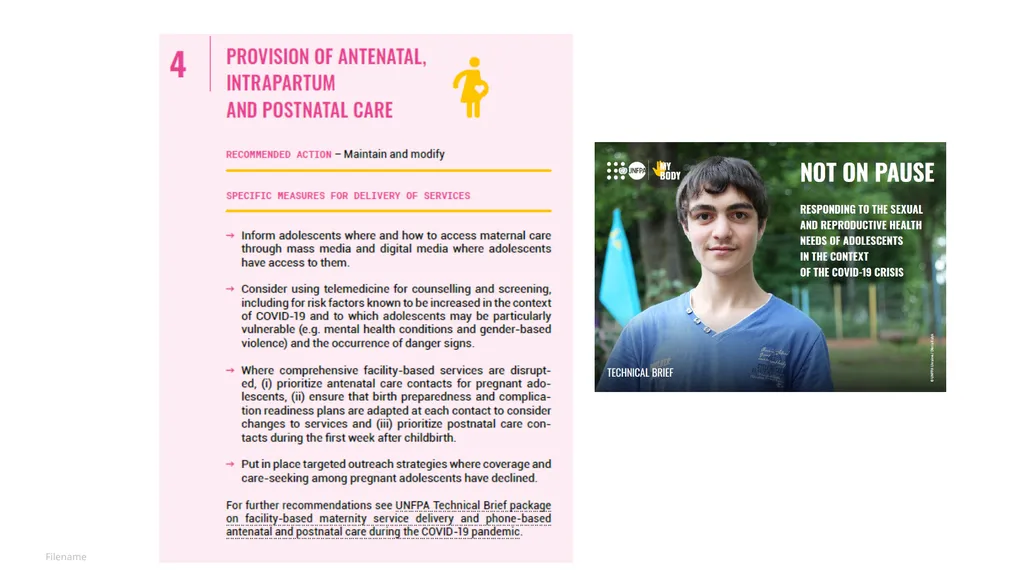
Not on pause: Responding to the sexual and reproductive health needs of adolescents in the context of the COVID-19 crisis (UNFPA, 2020)
ASRH Tool Kit for Humanitarian Settings (Inter-agency working group, 2020)<br>
Managing complications in pregnancy and childbirth: a guide for midwives and doctors, 2nd edn, (WHO, 2017).
Companion of choice during labour and childbirth for improved quality of care: evidence-to-action brief (WHO, 2016) – updated version dated 2020.
Prevention and elimination of disrespect and abuse during childbirth (WHO, 2014).
Obstetric fistula: guiding principles for clinical management and programme development (WHO, 2006).
WHO recommendation on duration of bladder catheterization after surgical repair of simple obstetric urinary fistula (WHO, 2020)
Not on pause: Responding to the sexual and reproductive health needs of adolescents in the context of the COVID-19 crisis (UNFPA, 2020)
ASRH Tool Kit for Humanitarian Settings (Inter-agency working group, 2020)<br>
11
Filename<br>
12
Picture<br>
13
A REGIONAL PERSPECTIVE ANTENATAL, INTRAPARTUM, POSTNATAL CARE<br>
14
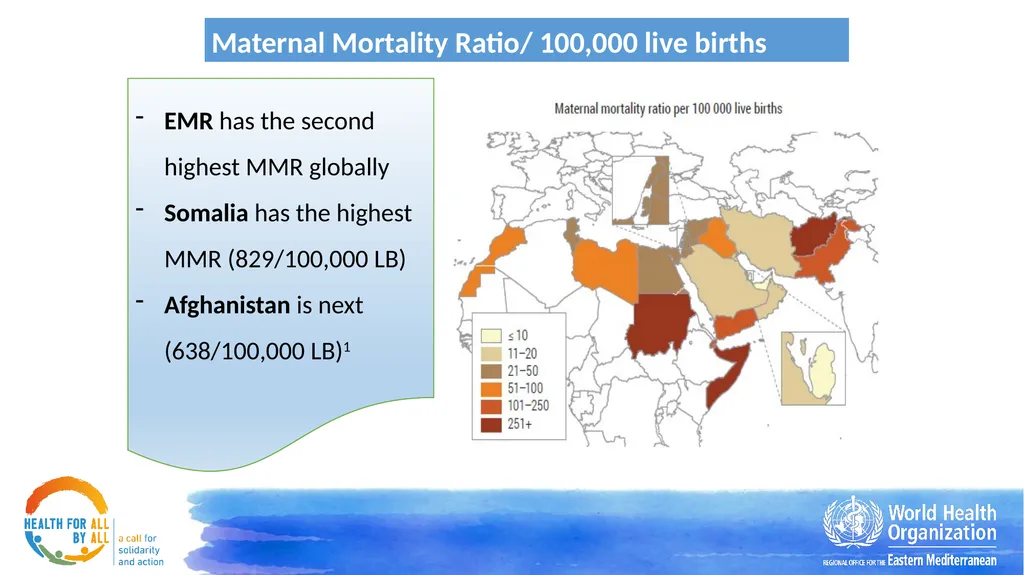
EMR has the second highest MMR globally
Somalia has the highest MMR (829/100,000 LB)
Afghanistan is next (638/100,000 LB)1 Maternal Mortality Ratio/ 100,000 live births<br>
Somalia has the highest MMR (829/100,000 LB)
Afghanistan is next (638/100,000 LB)1 Maternal Mortality Ratio/ 100,000 live births<br>
15
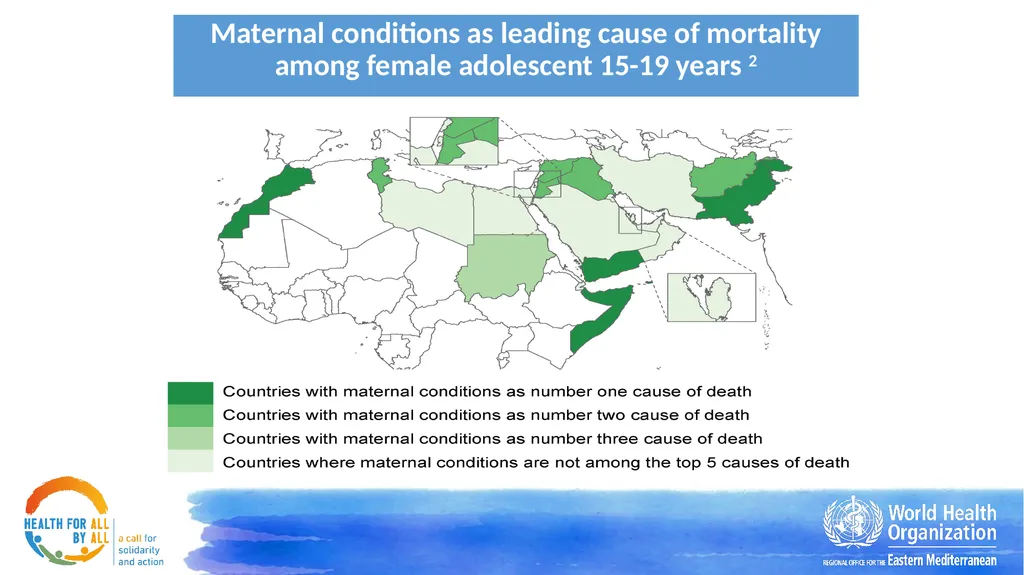
Maternal conditions as leading cause of mortality among female adolescent 15-19 years 2<br>
16
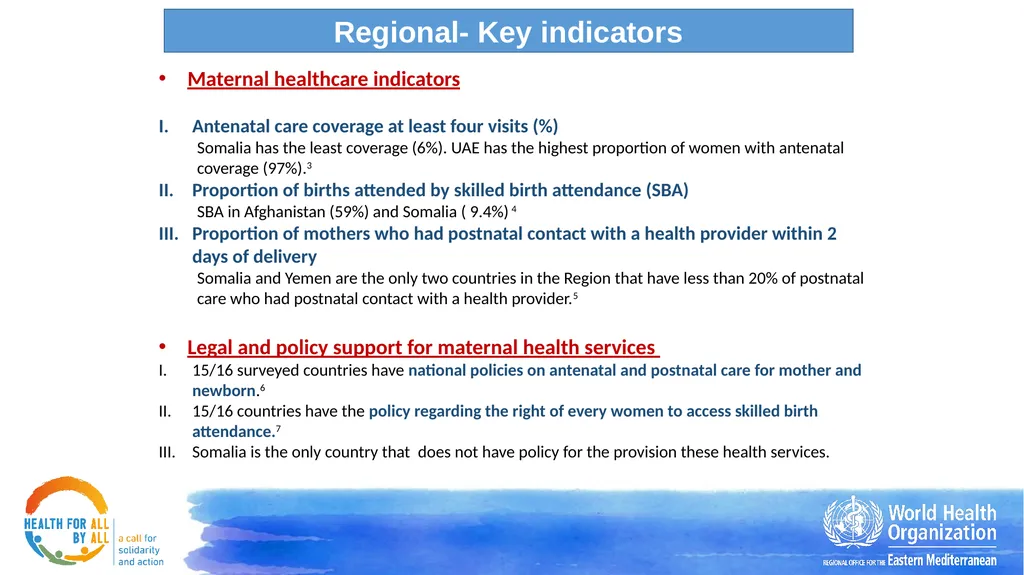
Regional- Key indicators Maternal healthcare indicators
Antenatal care coverage at least four visits (%)
Somalia has the least coverage (6%). UAE has the highest proportion of women with antenatal coverage (97%).3
Proportion of births attended by skilled birth attendance (SBA)
SBA in Afghanistan (59%) and Somalia ( 9.4%) 4
Proportion of mothers who had postnatal contact with a health provider within 2 days of delivery
Somalia and Yemen are the only two countries in the Region that have less than 20% of postnatal care who had postnatal contact with a health provider.5
Legal and policy support for maternal health services
15/16 surveyed countries have national policies on antenatal and postnatal care for mother and newborn.6
15/16 countries have the policy regarding the right of every women to access skilled birth attendance.7
Somalia is the only country that does not have policy for the provision these health services.<br>
Antenatal care coverage at least four visits (%)
Somalia has the least coverage (6%). UAE has the highest proportion of women with antenatal coverage (97%).3
Proportion of births attended by skilled birth attendance (SBA)
SBA in Afghanistan (59%) and Somalia ( 9.4%) 4
Proportion of mothers who had postnatal contact with a health provider within 2 days of delivery
Somalia and Yemen are the only two countries in the Region that have less than 20% of postnatal care who had postnatal contact with a health provider.5
Legal and policy support for maternal health services
15/16 surveyed countries have national policies on antenatal and postnatal care for mother and newborn.6
15/16 countries have the policy regarding the right of every women to access skilled birth attendance.7
Somalia is the only country that does not have policy for the provision these health services.<br>
17
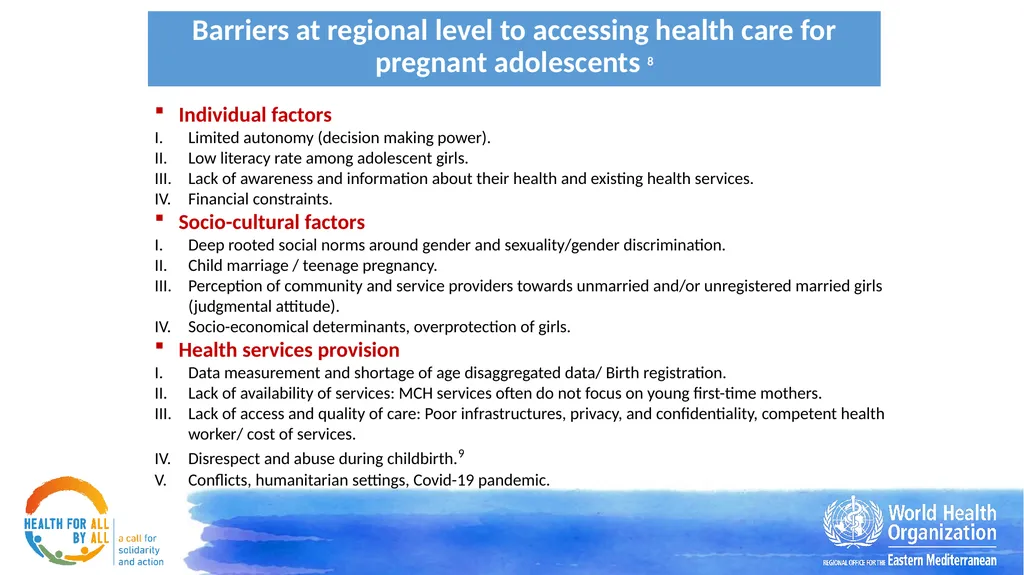
Barriers at regional level to accessing health care for pregnant adolescents 8 Individual factors
Limited autonomy (decision making power).
Low literacy rate among adolescent girls.
Lack of awareness and information about their health and existing health services.
Financial constraints.
Socio-cultural factors
Deep rooted social norms around gender and sexuality/gender discrimination.
Child marriage / teenage pregnancy.
Perception of community and service providers towards unmarried and/or unregistered married girls (judgmental attitude).
Socio-economical determinants, overprotection of girls.
Health services provision
Data measurement and shortage of age disaggregated data/ Birth registration.
Lack of availability of services: MCH services often do not focus on young first-time mothers.
Lack of access and quality of care: Poor infrastructures, privacy, and confidentiality, competent health worker/ cost of services.
Disrespect and abuse during childbirth.9
Conflicts, humanitarian settings, Covid-19 pandemic.<br>
Limited autonomy (decision making power).
Low literacy rate among adolescent girls.
Lack of awareness and information about their health and existing health services.
Financial constraints.
Socio-cultural factors
Deep rooted social norms around gender and sexuality/gender discrimination.
Child marriage / teenage pregnancy.
Perception of community and service providers towards unmarried and/or unregistered married girls (judgmental attitude).
Socio-economical determinants, overprotection of girls.
Health services provision
Data measurement and shortage of age disaggregated data/ Birth registration.
Lack of availability of services: MCH services often do not focus on young first-time mothers.
Lack of access and quality of care: Poor infrastructures, privacy, and confidentiality, competent health worker/ cost of services.
Disrespect and abuse during childbirth.9
Conflicts, humanitarian settings, Covid-19 pandemic.<br>
18
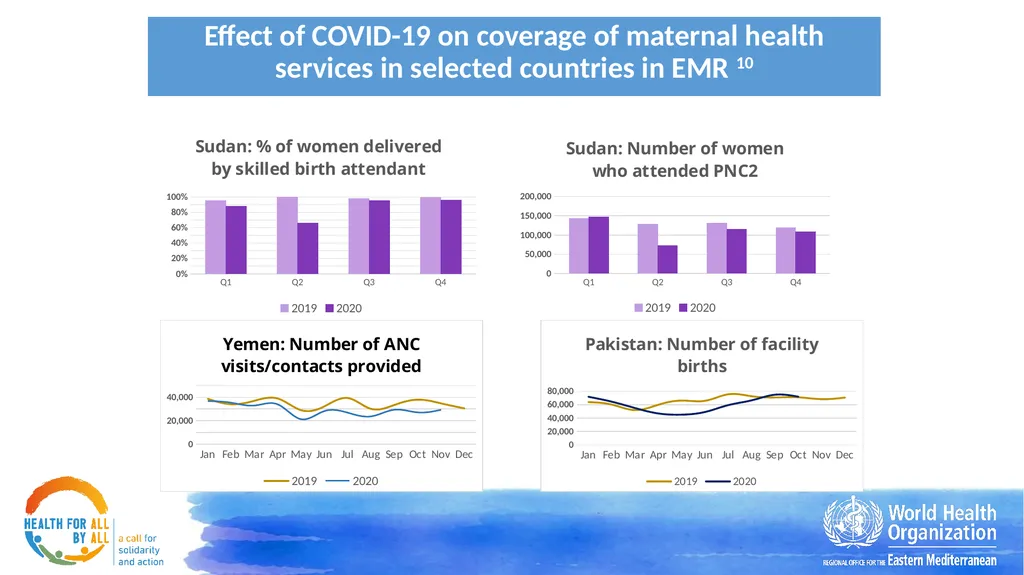
Effect of COVID-19 on coverage of maternal health services in selected countries in EMR 10<br>
19
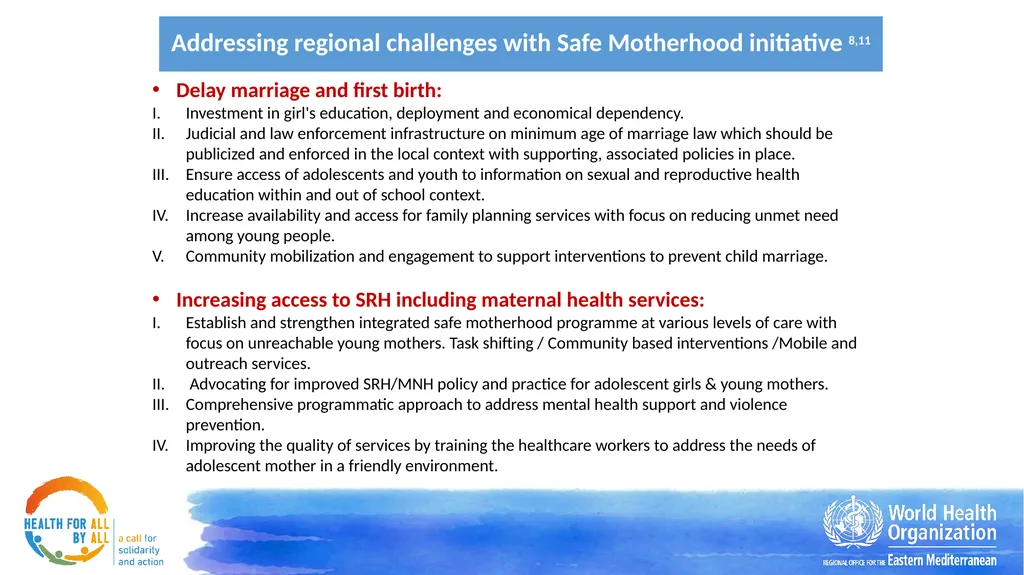
Addressing regional challenges with Safe Motherhood initiative 8,11 Delay marriage and first birth:
Investment in girl's education, deployment and economical dependency.
Judicial and law enforcement infrastructure on minimum age of marriage law which should be publicized and enforced in the local context with supporting, associated policies in place.
Ensure access of adolescents and youth to information on sexual and reproductive health education within and out of school context.
Increase availability and access for family planning services with focus on reducing unmet need among young people.
Community mobilization and engagement to support interventions to prevent child marriage.
Increasing access to SRH including maternal health services:
Establish and strengthen integrated safe motherhood programme at various levels of care with focus on unreachable young mothers. Task shifting / Community based interventions /Mobile and outreach services.
Advocating for improved SRH/MNH policy and practice for adolescent girls & young mothers.
Comprehensive programmatic approach to address mental health support and violence prevention.
Improving the quality of services by training the healthcare workers to address the needs of adolescent mother in a friendly environment.<br>
Investment in girl's education, deployment and economical dependency.
Judicial and law enforcement infrastructure on minimum age of marriage law which should be publicized and enforced in the local context with supporting, associated policies in place.
Ensure access of adolescents and youth to information on sexual and reproductive health education within and out of school context.
Increase availability and access for family planning services with focus on reducing unmet need among young people.
Community mobilization and engagement to support interventions to prevent child marriage.
Increasing access to SRH including maternal health services:
Establish and strengthen integrated safe motherhood programme at various levels of care with focus on unreachable young mothers. Task shifting / Community based interventions /Mobile and outreach services.
Advocating for improved SRH/MNH policy and practice for adolescent girls & young mothers.
Comprehensive programmatic approach to address mental health support and violence prevention.
Improving the quality of services by training the healthcare workers to address the needs of adolescent mother in a friendly environment.<br>
20
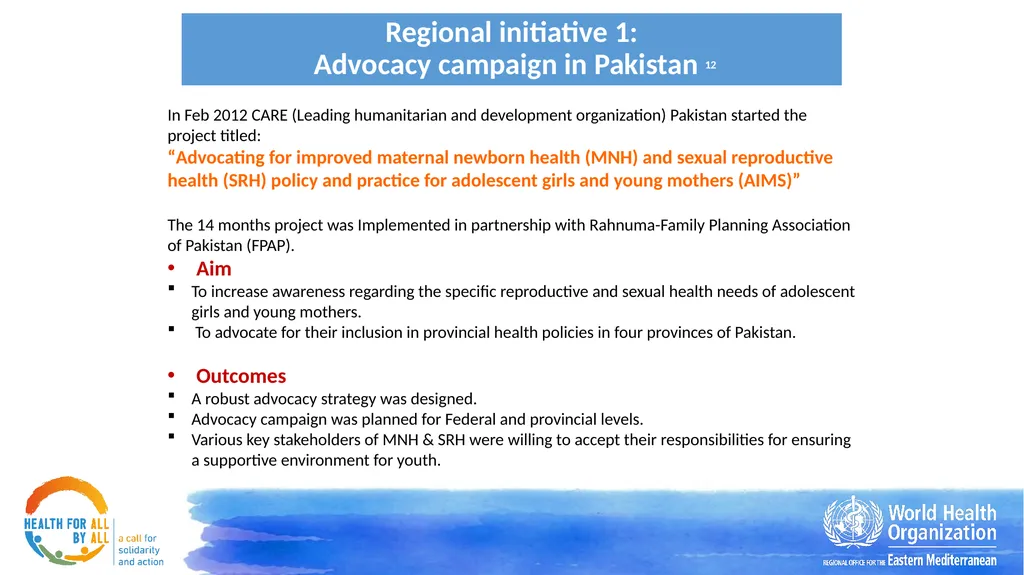
Regional initiative 1:
Advocacy campaign in Pakistan 12 In Feb 2012 CARE (Leading humanitarian and development organization) Pakistan started the project titled:
“Advocating for improved maternal newborn health (MNH) and sexual reproductive health (SRH) policy and practice for adolescent girls and young mothers (AIMS)”
The 14 months project was Implemented in partnership with Rahnuma-Family Planning Association of Pakistan (FPAP).
Aim
To increase awareness regarding the specific reproductive and sexual health needs of adolescent girls and young mothers.
To advocate for their inclusion in provincial health policies in four provinces of Pakistan.
Outcomes
A robust advocacy strategy was designed.
Advocacy campaign was planned for Federal and provincial levels.
Various key stakeholders of MNH & SRH were willing to accept their responsibilities for ensuring a supportive environment for youth.<br>
“Advocating for improved maternal newborn health (MNH) and sexual reproductive health (SRH) policy and practice for adolescent girls and young mothers (AIMS)”
The 14 months project was Implemented in partnership with Rahnuma-Family Planning Association of Pakistan (FPAP).
Aim
To increase awareness regarding the specific reproductive and sexual health needs of adolescent girls and young mothers.
To advocate for their inclusion in provincial health policies in four provinces of Pakistan.
Outcomes
A robust advocacy strategy was designed.
Advocacy campaign was planned for Federal and provincial levels.
Various key stakeholders of MNH & SRH were willing to accept their responsibilities for ensuring a supportive environment for youth.<br>
21
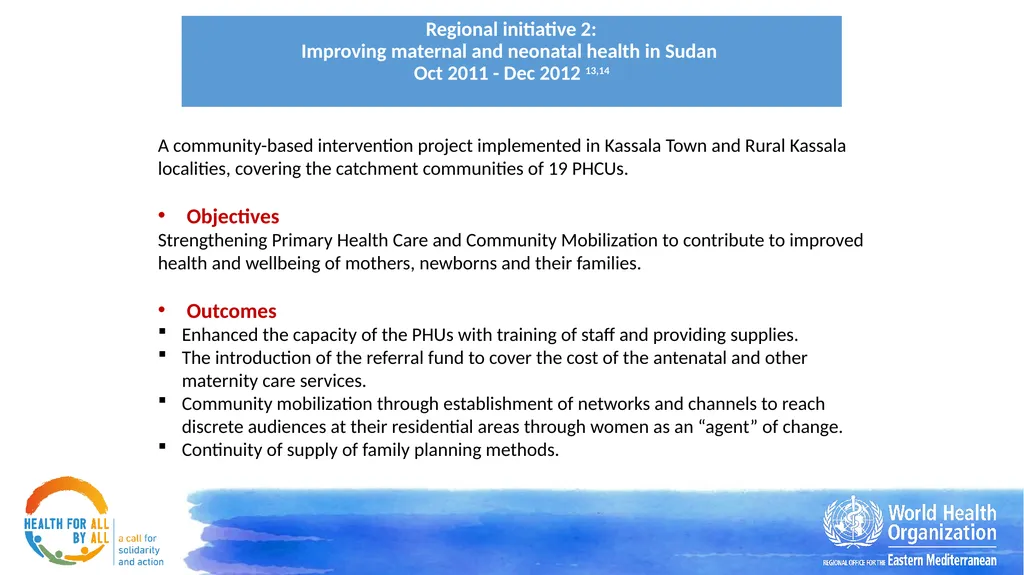
Regional initiative 2:
Improving maternal and neonatal health in Sudan
Oct 2011 - Dec 2012 13,14 A community-based intervention project implemented in Kassala Town and Rural Kassala localities, covering the catchment communities of 19 PHCUs.
Objectives
Strengthening Primary Health Care and Community Mobilization to contribute to improved health and wellbeing of mothers, newborns and their families.
Outcomes
Enhanced the capacity of the PHUs with training of staff and providing supplies.
The introduction of the referral fund to cover the cost of the antenatal and other maternity care services.
Community mobilization through establishment of networks and channels to reach discrete audiences at their residential areas through women as an “agent” of change.
Continuity of supply of family planning methods.<br>
Objectives
Strengthening Primary Health Care and Community Mobilization to contribute to improved health and wellbeing of mothers, newborns and their families.
Outcomes
Enhanced the capacity of the PHUs with training of staff and providing supplies.
The introduction of the referral fund to cover the cost of the antenatal and other maternity care services.
Community mobilization through establishment of networks and channels to reach discrete audiences at their residential areas through women as an “agent” of change.
Continuity of supply of family planning methods.<br>
22
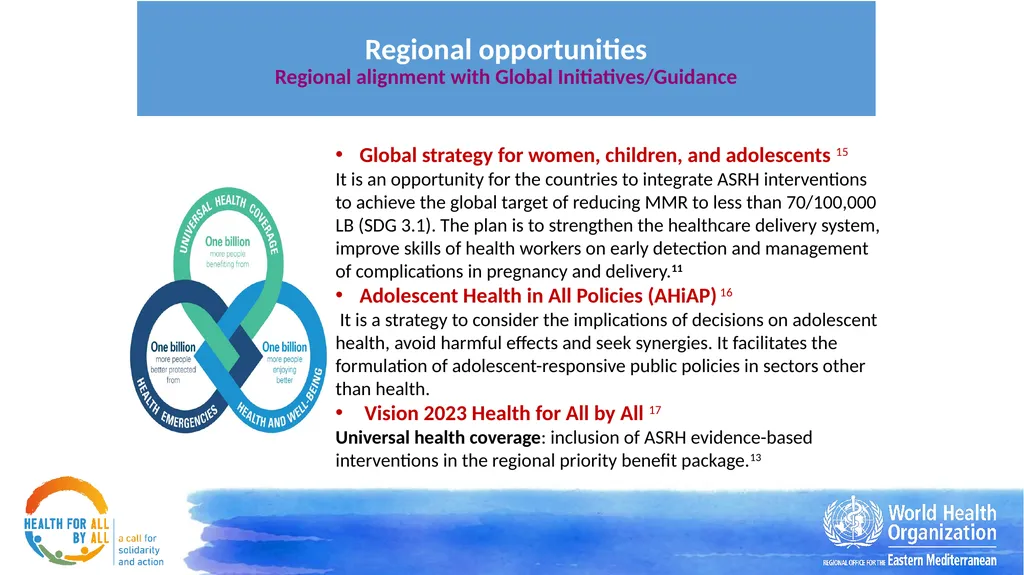
Regional opportunities
Regional alignment with Global Initiatives/Guidance Global strategy for women, children, and adolescents 15
It is an opportunity for the countries to integrate ASRH interventions to achieve the global target of reducing MMR to less than 70/100,000 LB (SDG 3.1). The plan is to strengthen the healthcare delivery system, improve skills of health workers on early detection and management of complications in pregnancy and delivery.11
Adolescent Health in All Policies (AHiAP) 16
It is a strategy to consider the implications of decisions on adolescent health, avoid harmful effects and seek synergies. It facilitates the formulation of adolescent-responsive public policies in sectors other than health.
Vision 2023 Health for All by All 17
Universal health coverage: inclusion of ASRH evidence-based interventions in the regional priority benefit package.13<br>
It is an opportunity for the countries to integrate ASRH interventions to achieve the global target of reducing MMR to less than 70/100,000 LB (SDG 3.1). The plan is to strengthen the healthcare delivery system, improve skills of health workers on early detection and management of complications in pregnancy and delivery.11
Adolescent Health in All Policies (AHiAP) 16
It is a strategy to consider the implications of decisions on adolescent health, avoid harmful effects and seek synergies. It facilitates the formulation of adolescent-responsive public policies in sectors other than health.
Vision 2023 Health for All by All 17
Universal health coverage: inclusion of ASRH evidence-based interventions in the regional priority benefit package.13<br>
23
References WHO Regional Office for the Eastern Mediterranean. Monitoring health and health system performance in the Eastern Mediterranean Region: Core indicators and indicators on the health-related Sustainable Development Goals 2019. Cairo: WHO Regional Office for the Eastern Mediterranean; 2020. Licence: CC BY-NC-SA 3.0 IGO. Available from: https://rho.emro.who.int/sites/default/files/booklets/EMR-HIS-and-core-indicators-2019-final_0.pdf%20
WHO Global Observatory database. Maternal, newborn, child and adolescent health and ageing data portal: Adolescent country profile. World Health Organization; c2021. Available from: https://www.who.int/data/maternal-newborn-child-adolescent-ageing/static-visualizations/adolescent-country-profile
WHO Global Observatory database. Maternal, newborn, child and adolescent health and ageing data portal: Antenatal care coverage - at least four visits (%). World Health Organization; c2021. Available from: https://www.who.int/data/maternal-newborn-child-adolescent-ageing/indicator-explorer-new/mca/antenatal-care-coverage---at-least-four-visits-(-)
WHO Global Observatory database. Maternal, newborn, child and adolescent health and ageing data portal: Proportion of births attended by skilled health personnel (SDG 3.1.2). World Health Organization; c2021. Available from: https://www.who.int/data/maternal-newborn-child-adolescent-ageing/indicator-explorer-new/mca/proportion-of-births-attended-by-skilled-health-personnel
WHO Global Observatory database. Maternal, newborn, child and adolescent health and ageing data portal: Proportion of mothers who had postnatal contact with a health provider within 2 days of delivery. World Health Organization; c2021. Available from: https://www.who.int/data/maternal-newborn-child-adolescent-ageing/indicator-explorer-new/mca/proportion-of-mothers-who-had-postnatal-contact-with-a-health-provider-within-2-days-of-delivery
WHO Global Observatory database. Maternal, newborn, child and adolescent health and ageing data portal: National policy on postnatal care for mothers and newborns. World Health Organization; c2021. Available from: https://www.who.int/data/maternal-newborn-child-adolescent-ageing/national-policies/mca/national-policy-on-postnatal-care-for-mothers-and-newborns?themeId=3af0211e-8037-4fad-b36d-60614c4b37b4
WHO Global Observatory database. Maternal, newborn, child and adolescent health and ageing data portal: National policy/ guideline on right of every women to have access to skilled care at birth. World Health Organization; c2021. Available from: https://www.who.int/data/maternal-newborn-child-adolescent-ageing/national-policies/mca/national-policy-guideline-on-right-of-every-women-to-have-access-to-skilled-care-at-childbirth?themeId=3af0211e-8037-4fad-b36d-60614c4b37b4<br>
WHO Global Observatory database. Maternal, newborn, child and adolescent health and ageing data portal: Adolescent country profile. World Health Organization; c2021. Available from: https://www.who.int/data/maternal-newborn-child-adolescent-ageing/static-visualizations/adolescent-country-profile
WHO Global Observatory database. Maternal, newborn, child and adolescent health and ageing data portal: Antenatal care coverage - at least four visits (%). World Health Organization; c2021. Available from: https://www.who.int/data/maternal-newborn-child-adolescent-ageing/indicator-explorer-new/mca/antenatal-care-coverage---at-least-four-visits-(-)
WHO Global Observatory database. Maternal, newborn, child and adolescent health and ageing data portal: Proportion of births attended by skilled health personnel (SDG 3.1.2). World Health Organization; c2021. Available from: https://www.who.int/data/maternal-newborn-child-adolescent-ageing/indicator-explorer-new/mca/proportion-of-births-attended-by-skilled-health-personnel
WHO Global Observatory database. Maternal, newborn, child and adolescent health and ageing data portal: Proportion of mothers who had postnatal contact with a health provider within 2 days of delivery. World Health Organization; c2021. Available from: https://www.who.int/data/maternal-newborn-child-adolescent-ageing/indicator-explorer-new/mca/proportion-of-mothers-who-had-postnatal-contact-with-a-health-provider-within-2-days-of-delivery
WHO Global Observatory database. Maternal, newborn, child and adolescent health and ageing data portal: National policy on postnatal care for mothers and newborns. World Health Organization; c2021. Available from: https://www.who.int/data/maternal-newborn-child-adolescent-ageing/national-policies/mca/national-policy-on-postnatal-care-for-mothers-and-newborns?themeId=3af0211e-8037-4fad-b36d-60614c4b37b4
WHO Global Observatory database. Maternal, newborn, child and adolescent health and ageing data portal: National policy/ guideline on right of every women to have access to skilled care at birth. World Health Organization; c2021. Available from: https://www.who.int/data/maternal-newborn-child-adolescent-ageing/national-policies/mca/national-policy-guideline-on-right-of-every-women-to-have-access-to-skilled-care-at-childbirth?themeId=3af0211e-8037-4fad-b36d-60614c4b37b4<br>
24
References Mahaini R. Improving maternal health to achieve the Millennium Development Goals in the Eastern Mediterranean Region: a youth lens. East Mediterr Health J. 2008;14 Suppl:S97-106.
WHO. WHO statement on prevention and elimination of disrespect and abuse during facility–based childbirth. World Health Organization; 2015. Available from: https://apps.who.int/iris/bitstream/handle/10665/134588/WHO_RHR_14.23_eng.pdf;jsessionid=B7B5554C4B229F0A00CDD01C3882BE98?sequence=1
WHO EMRO Country dashboard of monitoring the effect COVID-19 on SRMNCAH. (unpublished data).
Safe Motherhood. Priorities for safe motherhood. Safe Motherhood; c2016. Available from: http://www.safemotherhood.org/priorities/index.html
CARE International in Pakistan. Advocating for improved MNH/SRH Policy and Practice for adolescent girls and young mothers: Key achievements, lessons learnt and way forward recommendations. CARE International in Pakistan; 2013. Available from: https://www.care.org/wp-content/uploads/2020/05/PSJ-2013-Way_Forward_Report.pdf
Improving maternal and neonatal health in Kassala State: strengthening primary health care and community mobilization in Kassala town and rural Kassala localities. Oct 2011-Dec 2012. (unpublished).
Abdelrahman Mohamed Mubarak. Evaluation report of a project on: Improving maternal and neonatal health in Kassala State - Strengthening primary health care & community mobilization in Kassala town and rural Kassala localities. (unpublished).
Every Woman Every Child. Global Strategy for Women's, Children's and Adolescents Health 2016-2030. Every Woman Every Child; 2015. Available from: https://www.who.int/life-course/publications/global-strategy-2016-2030/en/
WHO. Global Accelerated Action for the Health of Adolescents (AA-HA!): guidance to support country implementation. Geneva: World Health Organization; 2017. Licence: CC BY-NC-SA 3.0 IGO. Available from: https://apps.who.int/iris/bitstream/handle/10665/255415/9789241512343-eng.pdf?sequence=1
WHO Regional Office for the Eastern Mediterranean. Vision 2023 for Eastern Mediterranean Region. World Health Organization; c2021. Available from: http://www.emro.who.int/about-who/vision2023/vision-2023.html<br>
WHO. WHO statement on prevention and elimination of disrespect and abuse during facility–based childbirth. World Health Organization; 2015. Available from: https://apps.who.int/iris/bitstream/handle/10665/134588/WHO_RHR_14.23_eng.pdf;jsessionid=B7B5554C4B229F0A00CDD01C3882BE98?sequence=1
WHO EMRO Country dashboard of monitoring the effect COVID-19 on SRMNCAH. (unpublished data).
Safe Motherhood. Priorities for safe motherhood. Safe Motherhood; c2016. Available from: http://www.safemotherhood.org/priorities/index.html
CARE International in Pakistan. Advocating for improved MNH/SRH Policy and Practice for adolescent girls and young mothers: Key achievements, lessons learnt and way forward recommendations. CARE International in Pakistan; 2013. Available from: https://www.care.org/wp-content/uploads/2020/05/PSJ-2013-Way_Forward_Report.pdf
Improving maternal and neonatal health in Kassala State: strengthening primary health care and community mobilization in Kassala town and rural Kassala localities. Oct 2011-Dec 2012. (unpublished).
Abdelrahman Mohamed Mubarak. Evaluation report of a project on: Improving maternal and neonatal health in Kassala State - Strengthening primary health care & community mobilization in Kassala town and rural Kassala localities. (unpublished).
Every Woman Every Child. Global Strategy for Women's, Children's and Adolescents Health 2016-2030. Every Woman Every Child; 2015. Available from: https://www.who.int/life-course/publications/global-strategy-2016-2030/en/
WHO. Global Accelerated Action for the Health of Adolescents (AA-HA!): guidance to support country implementation. Geneva: World Health Organization; 2017. Licence: CC BY-NC-SA 3.0 IGO. Available from: https://apps.who.int/iris/bitstream/handle/10665/255415/9789241512343-eng.pdf?sequence=1
WHO Regional Office for the Eastern Mediterranean. Vision 2023 for Eastern Mediterranean Region. World Health Organization; c2021. Available from: http://www.emro.who.int/about-who/vision2023/vision-2023.html<br>