Anti-Poverty Technology: Egan, The Skilled Helper
Description: Anti-Poverty Technology: Egan, The Skilled Helper https:hecourse.engineering.osu.edu Lecture 27.1 Prof. Gerard Egan Professor Emeritus of Organization Development and Psychology in the Quinlan School of Business at Loyola University,
Related Topics
Download Presentation
"Anti-Poverty Technology: Egan, The Skilled Helper" is the property of its rightful owner. Permission is granted to download and print the materials on this website for personal, non-commercial use only, and to display it on your personal computer provided you do not modify the materials and that you retain all copyright notices contained in the materials. By downloading content from our website, you accept the terms of this agreement.
Presentation Transcript
slide1. Anti-Poverty Technology:
Egan, The Skilled Helper https://hecourse.engineering.osu.edu Lecture 27.1<br>
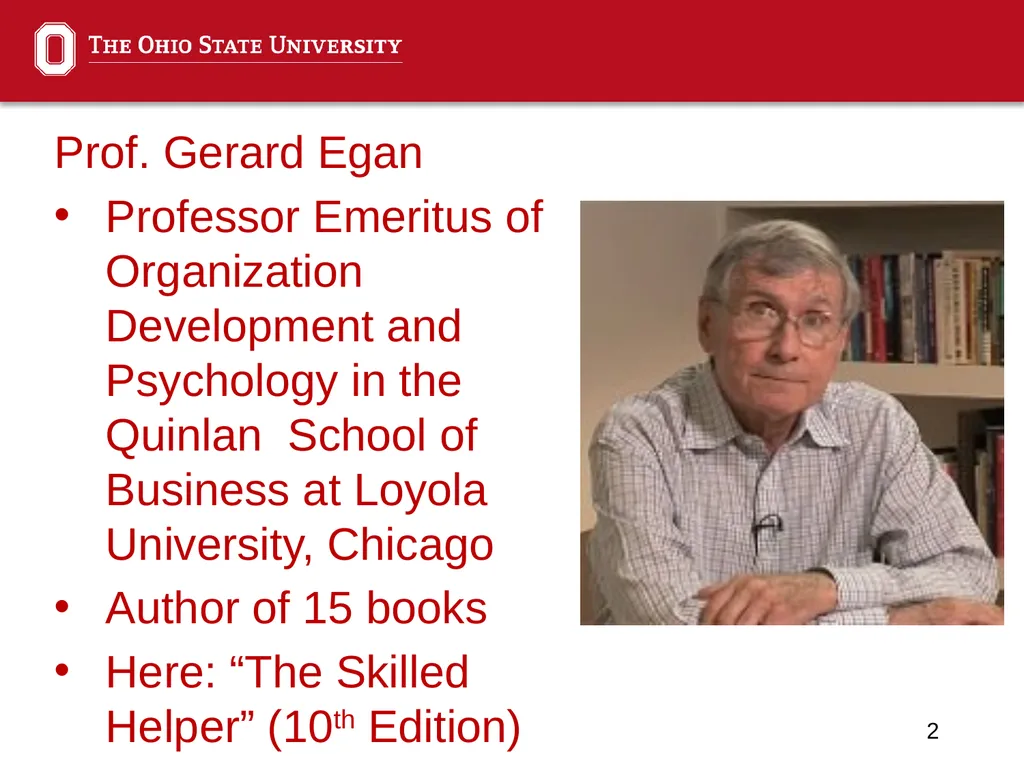
slide2. Prof. Gerard Egan
Professor Emeritus of Organization Development and Psychology in the Quinlan School of Business at Loyola University, Chicago
Author of 15 books
Here: “The Skilled Helper” (10th Edition)<br>
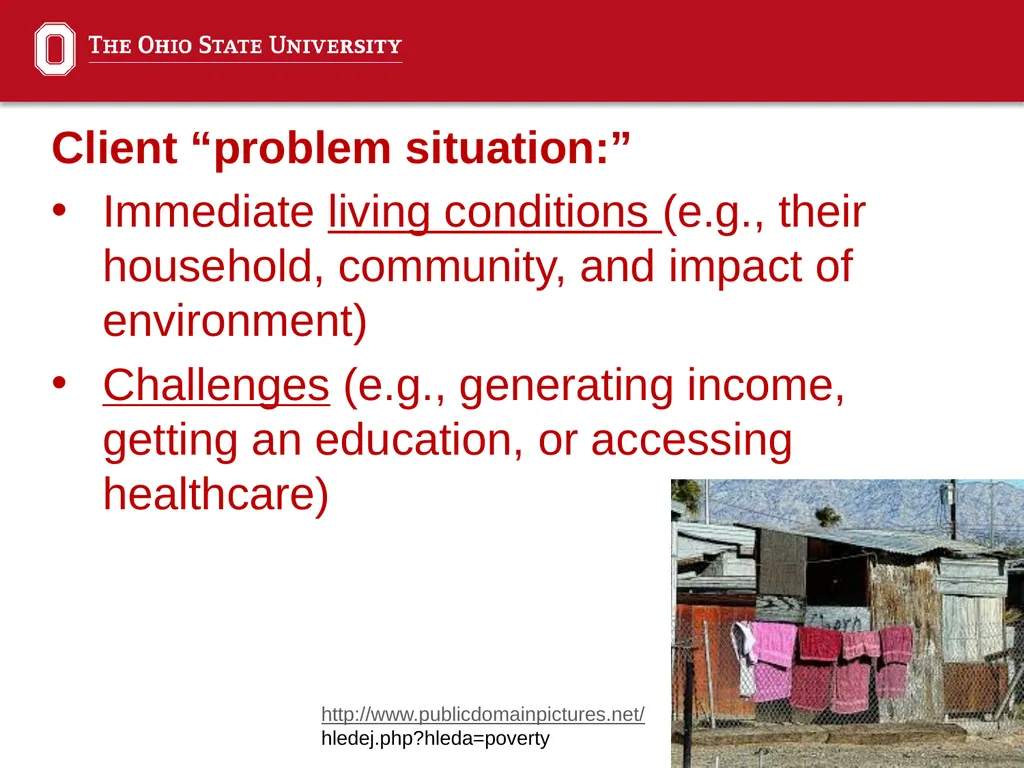
slide3. Client “problem situation:”
Immediate living conditions (e.g., their household, community, and impact of environment)
Challenges (e.g., generating income, getting an education, or accessing healthcare) http://www.publicdomainpictures.net/
hledej.php?hleda=poverty<br>
slide4. Helping objectives:
Help the client solve or manage problems by improving their problem situation
Help them identify resources and opportunities, and exploit their own potential https://pixabay.com/en/reaching-out-helping-cooperation-40805/<br>
slide5. Clients say what they want to do about the problem situation:
What they want, but with guidance
What are the goals, problems to solve:
Important to them
Willing to work on
Primarily client-specified https://pixabay.com/en/
goal-setting-goal-setting-success-976853/<br>
slide6. Helper:
Help client learn to help themselves
Put the client in the “driver’s seat”
Keep goal in mind: “Live-enhancing outcomes” for the client, by the client<br>
slide7. Helper:
Can help find simple-enough goals/problems
Ones that will give fast (small) success to motivate client and give hope
Ones with immediate benefit/cost ratio >1 so will incentivize
Use an exemplar<br>
slide8. Help state goals in terms of outcomes:
Specific
Substantive
Prudent
Realistic
Sustainable
Flexible
Congruent with values
Achievable in some time frame http://www.picserver.org/g/goals.html<br>
slide9. “Second order goals”⇒second order change
Changing the system rather than only adjusting it
Creating something new
Making change that will endure rather than be prone to collapse
Transforming rather than fixing
Using new learning
Addressing causes rather than symptoms
“Substantial,” “real,” or “good” change<br>
slide10. Seeking life-enhancing outcomes is constrained by context:
Problem situation, past successful or failed attempts to change their problem situation and/or employ unused opportunities or resources
Personal history
Expectations, aspirations, and disappointments
Skills and strengths
Hopes and fears<br>
slide11. Openness and readiness for change
Willingness to work for change
Reluctance or resistance to change
Ability and willingness to collaborate with a helper
Sense of right and wrong, ethics, and morality; cultural beliefs, values, and behavioral norms
Existing relationships; Communication skills; Obstacles to change; External factors that support change<br>
slide12. The effective helper should:
Have good interpersonal skills
Seek to build trust with the client
Seek to establish an agreement with the client on the goals of the helping process
Understand the client and her or his problem situation and can identify causes
Promote client self-challenge
Understand the general cultural, social, economic, and political context of the client<br>
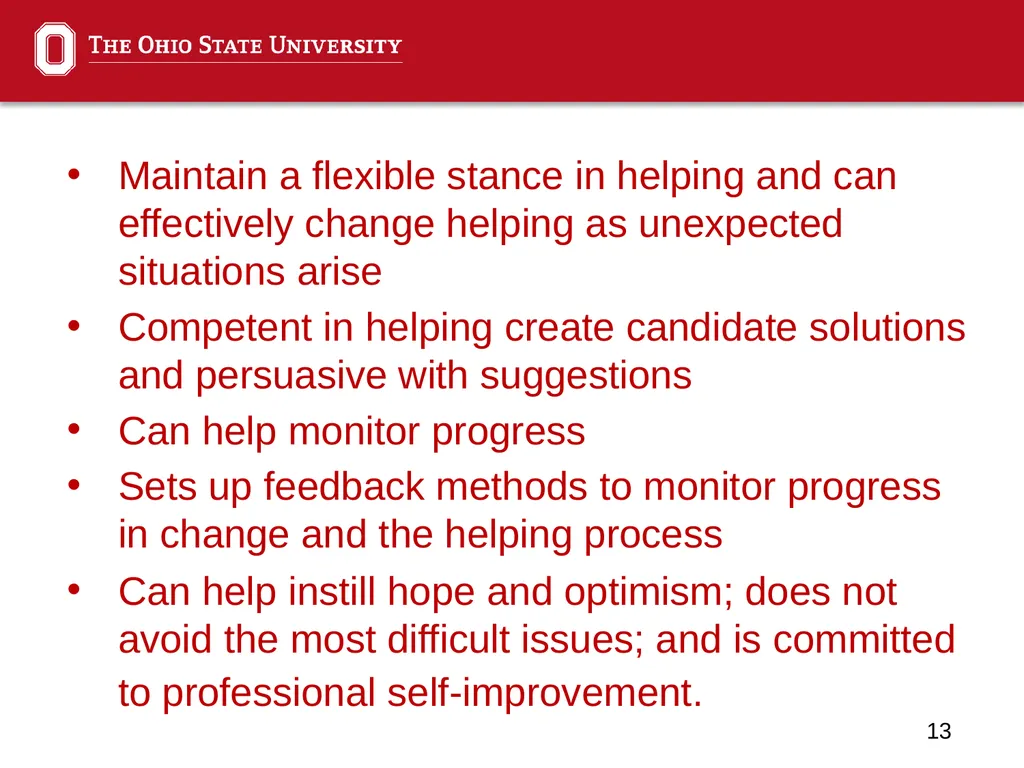
slide13. Maintain a flexible stance in helping and can effectively change helping as unexpected situations arise
Competent in helping create candidate solutions and persuasive with suggestions
Can help monitor progress
Sets up feedback methods to monitor progress in change and the helping process
Can help instill hope and optimism; does not avoid the most difficult issues; and is committed to professional self-improvement.<br>
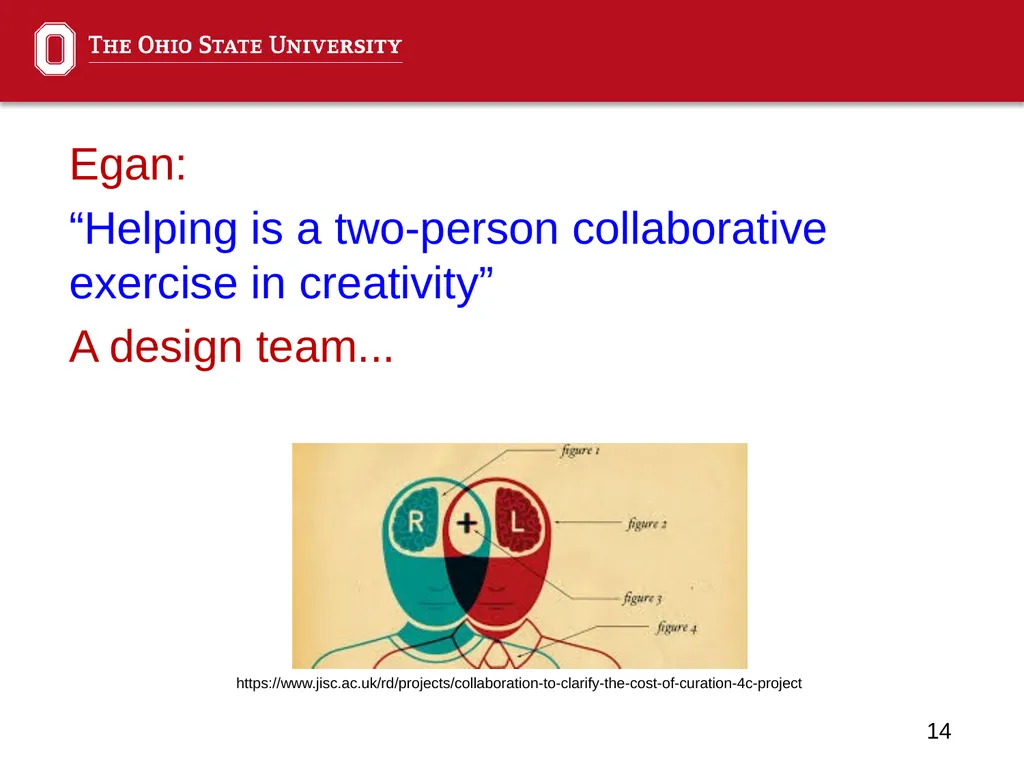
slide14. Egan:
“Helping is a two-person collaborative exercise in creativity”
A design team... https://www.jisc.ac.uk/rd/projects/collaboration-to-clarify-the-cost-of-curation-4c-project<br>
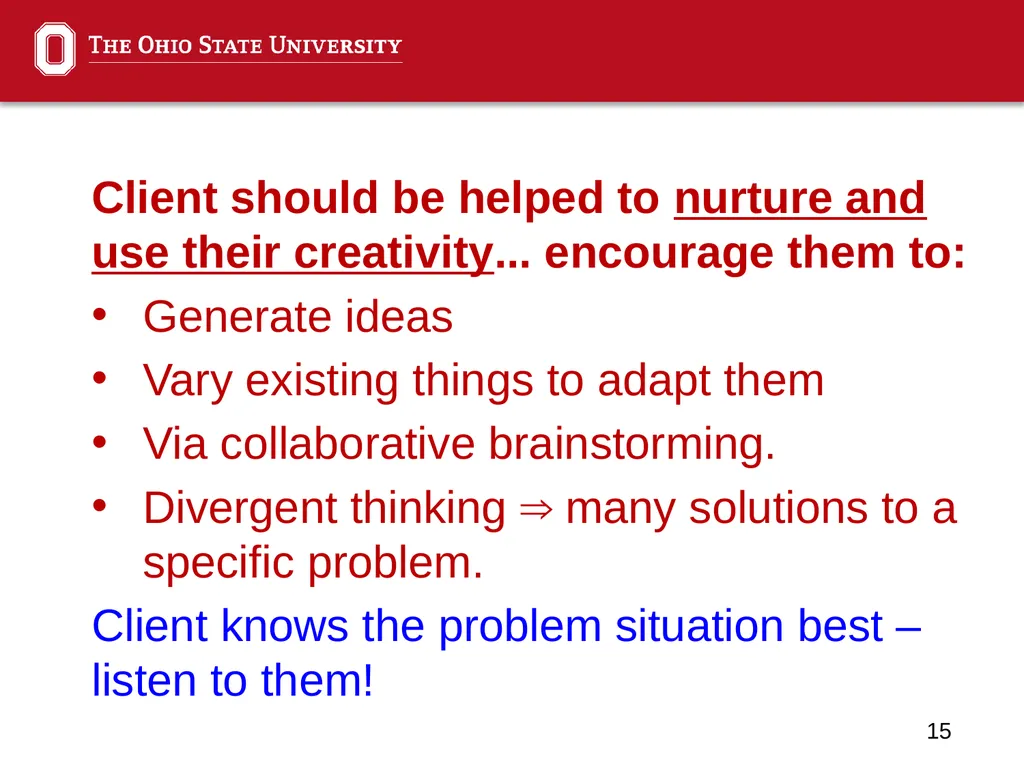
slide15. Client should be helped to nurture and use their creativity... encourage them to:
Generate ideas
Vary existing things to adapt them
Via collaborative brainstorming.
Divergent thinking ⇒ many solutions to a specific problem.
Client knows the problem situation best – listen to them!<br>
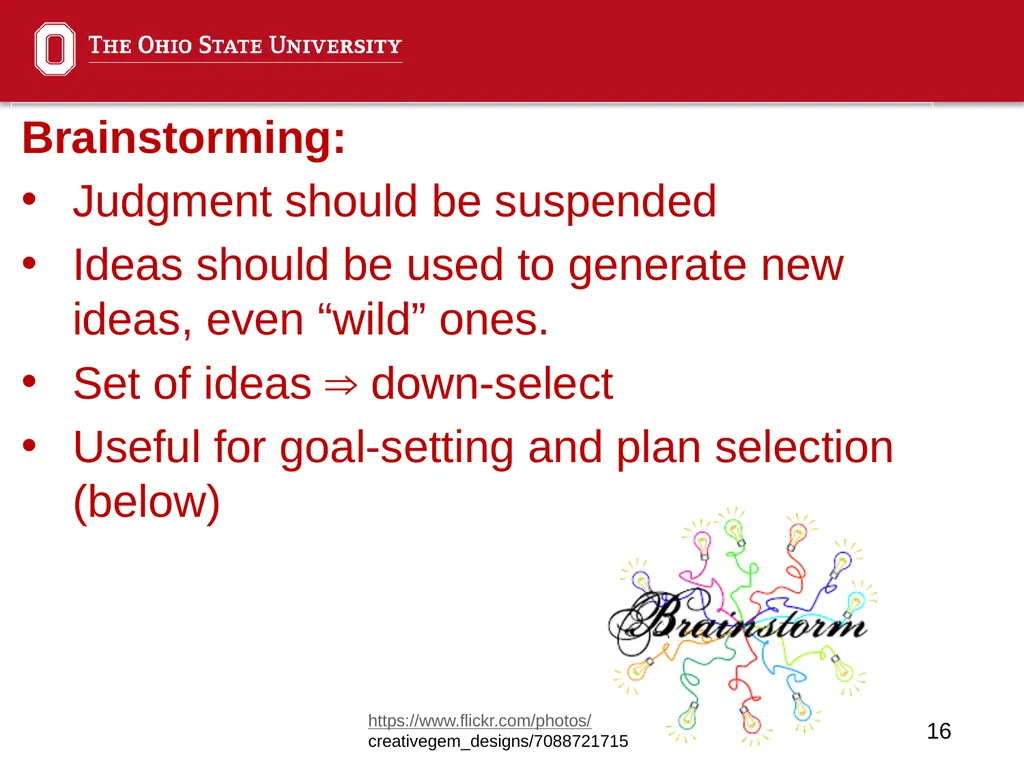
slide16. Brainstorming:
Judgment should be suspended
Ideas should be used to generate new ideas, even “wild” ones.
Set of ideas ⇒ down-select
Useful for goal-setting and plan selection (below) https://www.flickr.com/photos/
creativegem_designs/7088721715<br>
slide17. Tailoring helping to client, example:
Egan:
“clients who were mainly from the lower socioeconomic class wanted advice, signs of real interest in their problems, encouragement and reassurance, understanding, and the instillation of hope from their helpers”<br>
slide18. Helper-client relationship = working alliance
Foundation: “flexibility, honesty, respect, trustworthiness, confidence, warmth, interest, and openness”
Clients appreciate: “self-presentation and body language, nonverbal gestures, emotional support and care, honesty, validation, guidance, challenging, helper's education, helper's appreciation of client self-responsibility”<br>
slide19. Helper:
Show respect, do no harm, do not to rush to judgment about the client and their problem situation.
Competent, committed, genuine (e.g. not being a phony by over-emphasizing professional role)
Show that they are “for” the client
Down-to-earth and non-sentimental (e.g., talk eye-to-eye at their level, not down to them with condescension)
Assume the good will of the client, and always focus on the client's agenda<br>
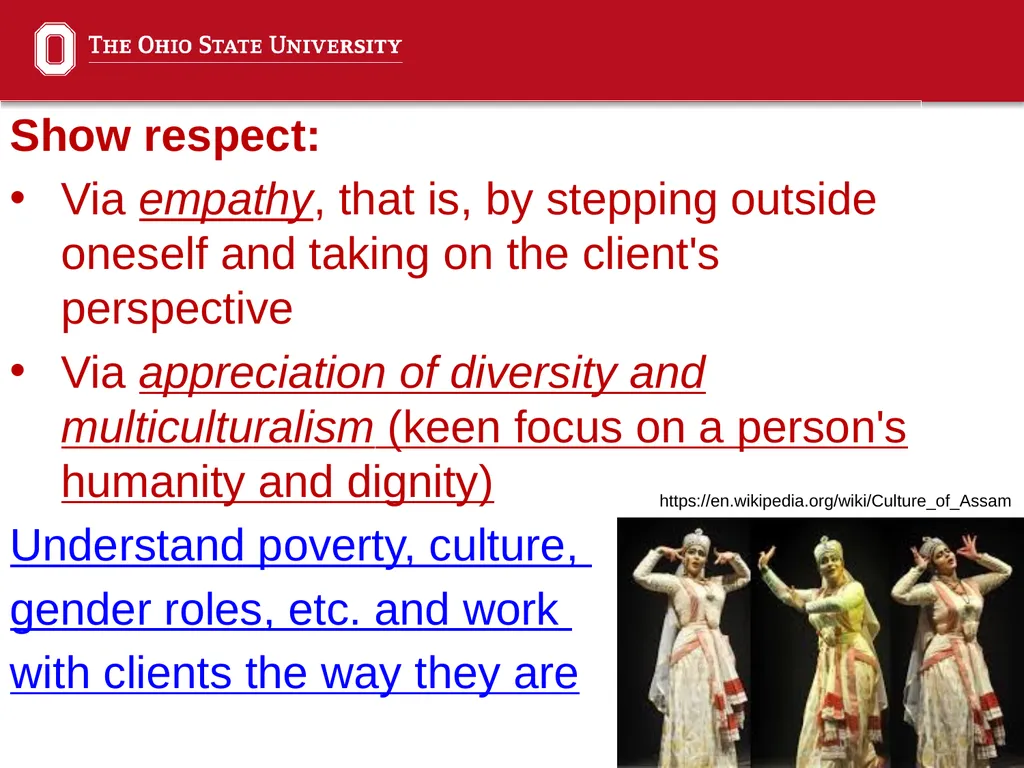
slide20. Show respect:
Via empathy, that is, by stepping outside oneself and taking on the client's perspective
Via appreciation of diversity and multiculturalism (keen focus on a person's humanity and dignity)
Understand poverty, culture,
gender roles, etc. and work
with clients the way they are https://en.wikipedia.org/wiki/Culture_of_Assam<br>
slide21. Communication skills are important:
Paying close attention (“empathetic presence”)
Listening (below, “active listening”)
Understanding what a client is thinking and saying,
Responding based on good understanding,
Helping a client fully explore concerns and focus, and
“Helping clients challenge themselves to develop new perspectives on their problem situations and unused opportunities”
Take turns in speaking: No monologues https://pixabay.com/en/interview
-job-icon-job-interview-
1018332/<br>
slide22. Helper understanding is based on:
“active listening” (empathetic/focused)
Poor listening by helper:
Not engaged with the client
Partial listening “skimming the surface” to pick up pieces of what is said)
Gets the words but is not really present
“Rehearsing" a response while the client is talking<br>
slide23. Focus on the client, organize:
Client experiences
Client points of view and values
Client's intentions, proposals, decisions, and plans
Client strengths, opportunities, and resources.<br>
slide24. Integrate client narrative
Probe/question for clarity
Helper summary, client summary
Respond: Perceptive, having competence (“know how”), being accurate, being assertive, and considering all issues (client, and problem situation, and context).<br>
slide25. Standard problem management framework:
What is going on? (current picture)
What does a better future look like? (preferred picture)
How do I get there? (plans/actions, the way forward)
How do I make it all happen? (implementation)
Client+helper work on all this together<br>
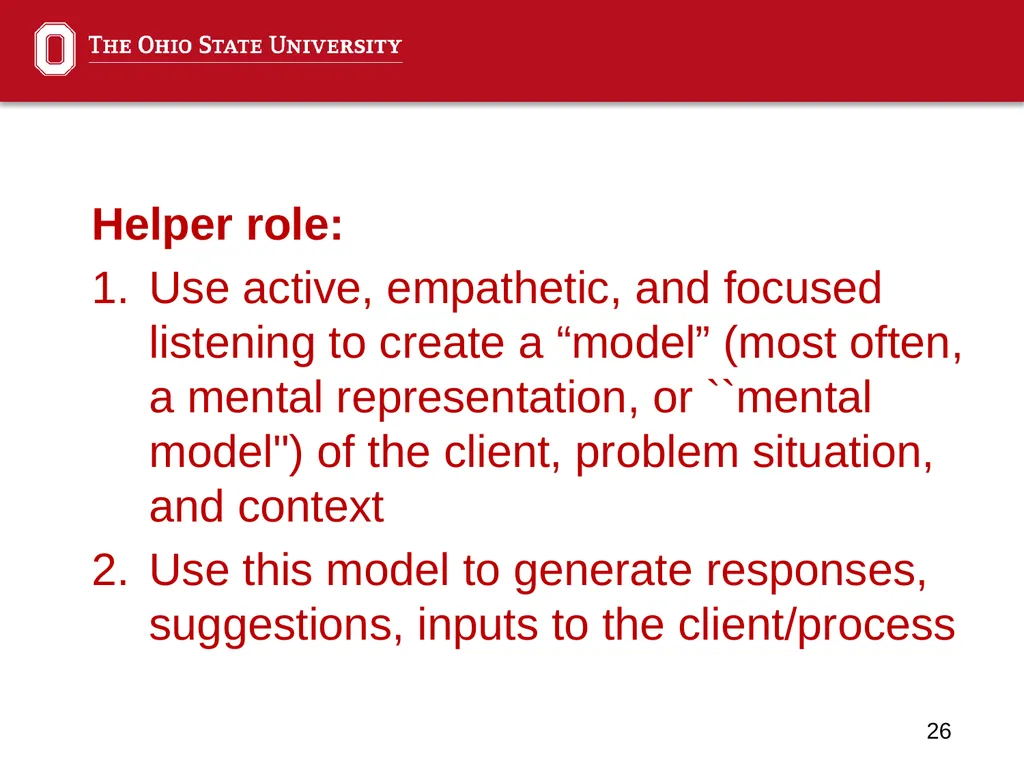
slide26. Helper role:
Use active, empathetic, and focused listening to create a “model” (most often, a mental representation, or ``mental model") of the client, problem situation, and context
Use this model to generate responses, suggestions, inputs to the client/process<br>
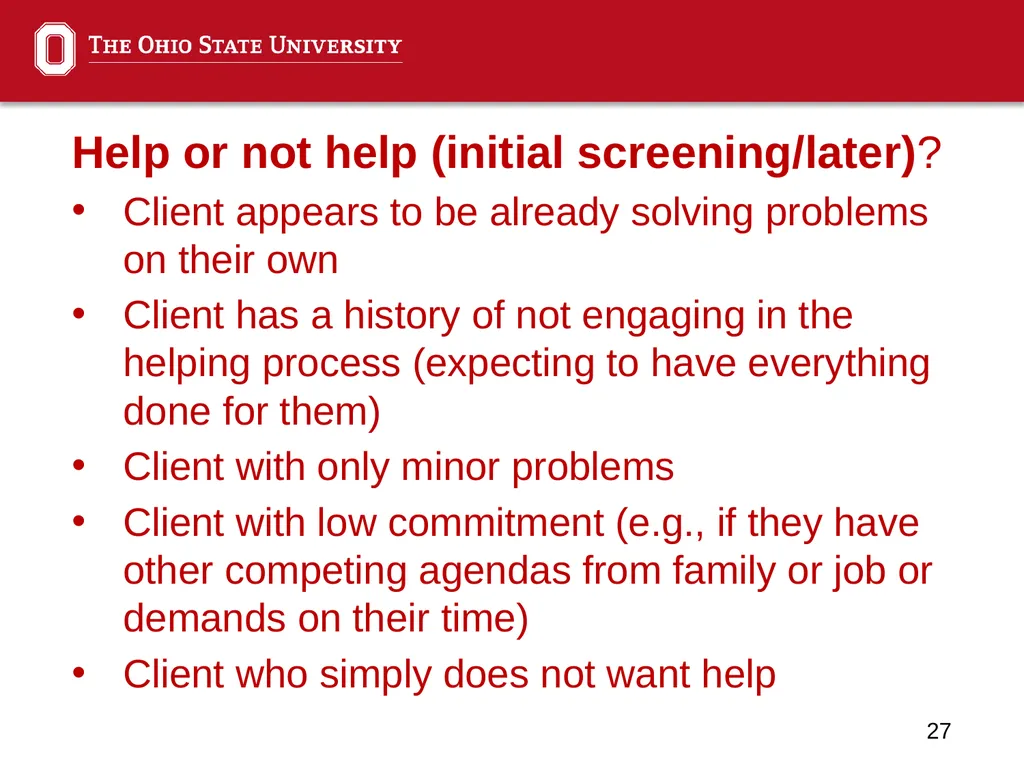
slide27. Help or not help (initial screening/later)?
Client appears to be already solving problems on their own
Client has a history of not engaging in the helping process (expecting to have everything done for them)
Client with only minor problems
Client with low commitment (e.g., if they have other competing agendas from family or job or demands on their time)
Client who simply does not want help<br>
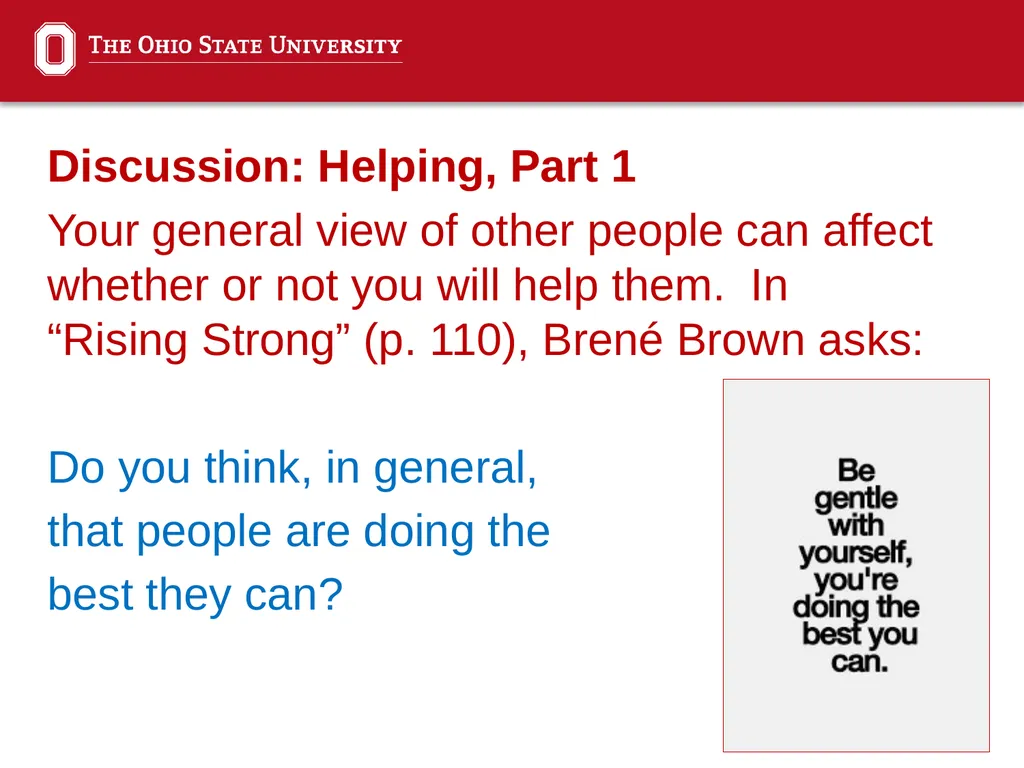
slide28. Discussion: Helping, Part 1
Your general view of other people can affect whether or not you will help them. In “Rising Strong” (p. 110), Brené Brown asks:
Do you think, in general,
that people are doing the
best they can?<br>

Egan, The Skilled Helper https://hecourse.engineering.osu.edu Lecture 27.1<br>
slide2. Prof. Gerard Egan
Professor Emeritus of Organization Development and Psychology in the Quinlan School of Business at Loyola University, Chicago
Author of 15 books
Here: “The Skilled Helper” (10th Edition)<br>
slide3. Client “problem situation:”
Immediate living conditions (e.g., their household, community, and impact of environment)
Challenges (e.g., generating income, getting an education, or accessing healthcare) http://www.publicdomainpictures.net/
hledej.php?hleda=poverty<br>
slide4. Helping objectives:
Help the client solve or manage problems by improving their problem situation
Help them identify resources and opportunities, and exploit their own potential https://pixabay.com/en/reaching-out-helping-cooperation-40805/<br>
slide5. Clients say what they want to do about the problem situation:
What they want, but with guidance
What are the goals, problems to solve:
Important to them
Willing to work on
Primarily client-specified https://pixabay.com/en/
goal-setting-goal-setting-success-976853/<br>
slide6. Helper:
Help client learn to help themselves
Put the client in the “driver’s seat”
Keep goal in mind: “Live-enhancing outcomes” for the client, by the client<br>
slide7. Helper:
Can help find simple-enough goals/problems
Ones that will give fast (small) success to motivate client and give hope
Ones with immediate benefit/cost ratio >1 so will incentivize
Use an exemplar<br>
slide8. Help state goals in terms of outcomes:
Specific
Substantive
Prudent
Realistic
Sustainable
Flexible
Congruent with values
Achievable in some time frame http://www.picserver.org/g/goals.html<br>
slide9. “Second order goals”⇒second order change
Changing the system rather than only adjusting it
Creating something new
Making change that will endure rather than be prone to collapse
Transforming rather than fixing
Using new learning
Addressing causes rather than symptoms
“Substantial,” “real,” or “good” change<br>
slide10. Seeking life-enhancing outcomes is constrained by context:
Problem situation, past successful or failed attempts to change their problem situation and/or employ unused opportunities or resources
Personal history
Expectations, aspirations, and disappointments
Skills and strengths
Hopes and fears<br>
slide11. Openness and readiness for change
Willingness to work for change
Reluctance or resistance to change
Ability and willingness to collaborate with a helper
Sense of right and wrong, ethics, and morality; cultural beliefs, values, and behavioral norms
Existing relationships; Communication skills; Obstacles to change; External factors that support change<br>
slide12. The effective helper should:
Have good interpersonal skills
Seek to build trust with the client
Seek to establish an agreement with the client on the goals of the helping process
Understand the client and her or his problem situation and can identify causes
Promote client self-challenge
Understand the general cultural, social, economic, and political context of the client<br>
slide13. Maintain a flexible stance in helping and can effectively change helping as unexpected situations arise
Competent in helping create candidate solutions and persuasive with suggestions
Can help monitor progress
Sets up feedback methods to monitor progress in change and the helping process
Can help instill hope and optimism; does not avoid the most difficult issues; and is committed to professional self-improvement.<br>
slide14. Egan:
“Helping is a two-person collaborative exercise in creativity”
A design team... https://www.jisc.ac.uk/rd/projects/collaboration-to-clarify-the-cost-of-curation-4c-project<br>
slide15. Client should be helped to nurture and use their creativity... encourage them to:
Generate ideas
Vary existing things to adapt them
Via collaborative brainstorming.
Divergent thinking ⇒ many solutions to a specific problem.
Client knows the problem situation best – listen to them!<br>
slide16. Brainstorming:
Judgment should be suspended
Ideas should be used to generate new ideas, even “wild” ones.
Set of ideas ⇒ down-select
Useful for goal-setting and plan selection (below) https://www.flickr.com/photos/
creativegem_designs/7088721715<br>
slide17. Tailoring helping to client, example:
Egan:
“clients who were mainly from the lower socioeconomic class wanted advice, signs of real interest in their problems, encouragement and reassurance, understanding, and the instillation of hope from their helpers”<br>
slide18. Helper-client relationship = working alliance
Foundation: “flexibility, honesty, respect, trustworthiness, confidence, warmth, interest, and openness”
Clients appreciate: “self-presentation and body language, nonverbal gestures, emotional support and care, honesty, validation, guidance, challenging, helper's education, helper's appreciation of client self-responsibility”<br>
slide19. Helper:
Show respect, do no harm, do not to rush to judgment about the client and their problem situation.
Competent, committed, genuine (e.g. not being a phony by over-emphasizing professional role)
Show that they are “for” the client
Down-to-earth and non-sentimental (e.g., talk eye-to-eye at their level, not down to them with condescension)
Assume the good will of the client, and always focus on the client's agenda<br>
slide20. Show respect:
Via empathy, that is, by stepping outside oneself and taking on the client's perspective
Via appreciation of diversity and multiculturalism (keen focus on a person's humanity and dignity)
Understand poverty, culture,
gender roles, etc. and work
with clients the way they are https://en.wikipedia.org/wiki/Culture_of_Assam<br>
slide21. Communication skills are important:
Paying close attention (“empathetic presence”)
Listening (below, “active listening”)
Understanding what a client is thinking and saying,
Responding based on good understanding,
Helping a client fully explore concerns and focus, and
“Helping clients challenge themselves to develop new perspectives on their problem situations and unused opportunities”
Take turns in speaking: No monologues https://pixabay.com/en/interview
-job-icon-job-interview-
1018332/<br>
slide22. Helper understanding is based on:
“active listening” (empathetic/focused)
Poor listening by helper:
Not engaged with the client
Partial listening “skimming the surface” to pick up pieces of what is said)
Gets the words but is not really present
“Rehearsing" a response while the client is talking<br>
slide23. Focus on the client, organize:
Client experiences
Client points of view and values
Client's intentions, proposals, decisions, and plans
Client strengths, opportunities, and resources.<br>
slide24. Integrate client narrative
Probe/question for clarity
Helper summary, client summary
Respond: Perceptive, having competence (“know how”), being accurate, being assertive, and considering all issues (client, and problem situation, and context).<br>
slide25. Standard problem management framework:
What is going on? (current picture)
What does a better future look like? (preferred picture)
How do I get there? (plans/actions, the way forward)
How do I make it all happen? (implementation)
Client+helper work on all this together<br>
slide26. Helper role:
Use active, empathetic, and focused listening to create a “model” (most often, a mental representation, or ``mental model") of the client, problem situation, and context
Use this model to generate responses, suggestions, inputs to the client/process<br>
slide27. Help or not help (initial screening/later)?
Client appears to be already solving problems on their own
Client has a history of not engaging in the helping process (expecting to have everything done for them)
Client with only minor problems
Client with low commitment (e.g., if they have other competing agendas from family or job or demands on their time)
Client who simply does not want help<br>
slide28. Discussion: Helping, Part 1
Your general view of other people can affect whether or not you will help them. In “Rising Strong” (p. 110), Brené Brown asks:
Do you think, in general,
that people are doing the
best they can?<br>