
Antibiotics and Local Delivery Devices In
OM
Published · 51 slides · 0 views

1 / 1





Description
Antibiotics and Local Delivery Devices In Periodontology Dr.Jafar Naghshbandi D.D.S;M.S Diplomate of the American Board of Periodontology Special Thanks Whoever taught me a word made me his servant. Dr. Raul Caffesse Dr. Jim Simon
Related Topics
Download this presentation From Below
"Antibiotics and Local Delivery Devices In" is the property of its rightful owner. Permission is granted to download and print the materials on this website for personal, non-commercial use only, and to display it on your personal computer provided you do not modify the materials and that you retain all copyright notices contained in the materials. By downloading content from our website, you accept the terms of this agreement.
Share
Embed code
Presentation Transcript
01
Antibiotics and Local Delivery Devices
In
Periodontology Dr.Jafar Naghshbandi D.D.S;M.S
Diplomate of the American Board of Periodontology<br>
Diplomate of the American Board of Periodontology<br>
02
Special Thanks
Whoever taught me a word made me his servant. Dr. Raul Caffesse Dr. Jim Simon<br>
03
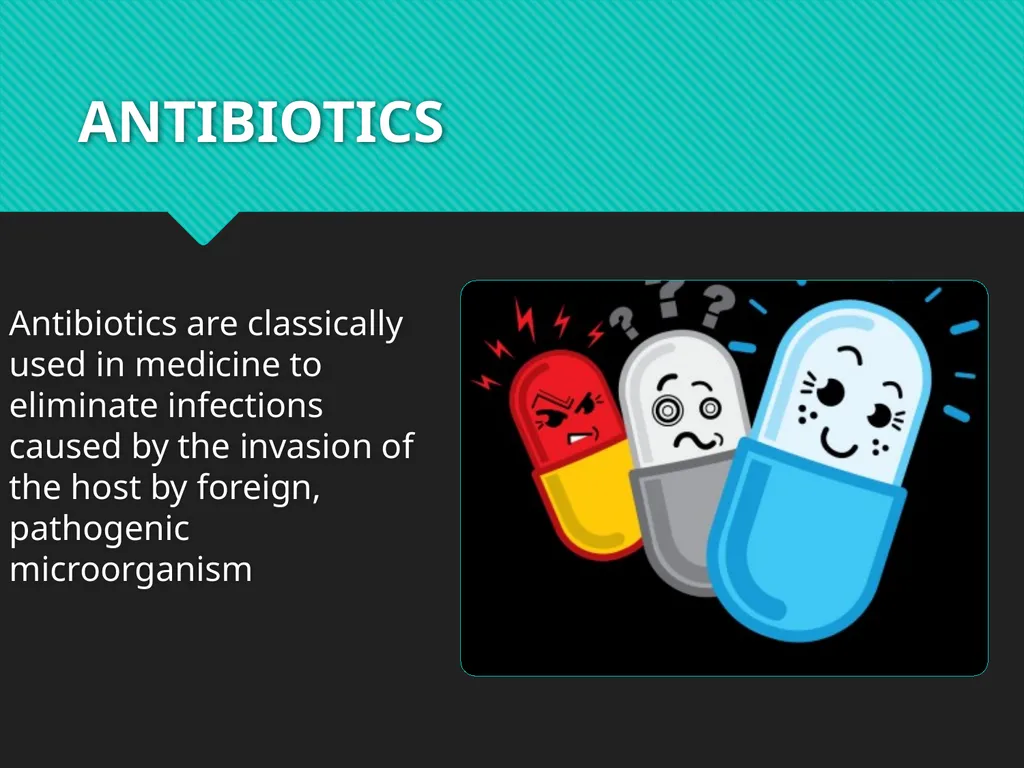
ANTIBIOTICS Antibiotics are classically used in medicine to eliminate infections caused by the invasion of the host by foreign, pathogenic microorganism<br>
04
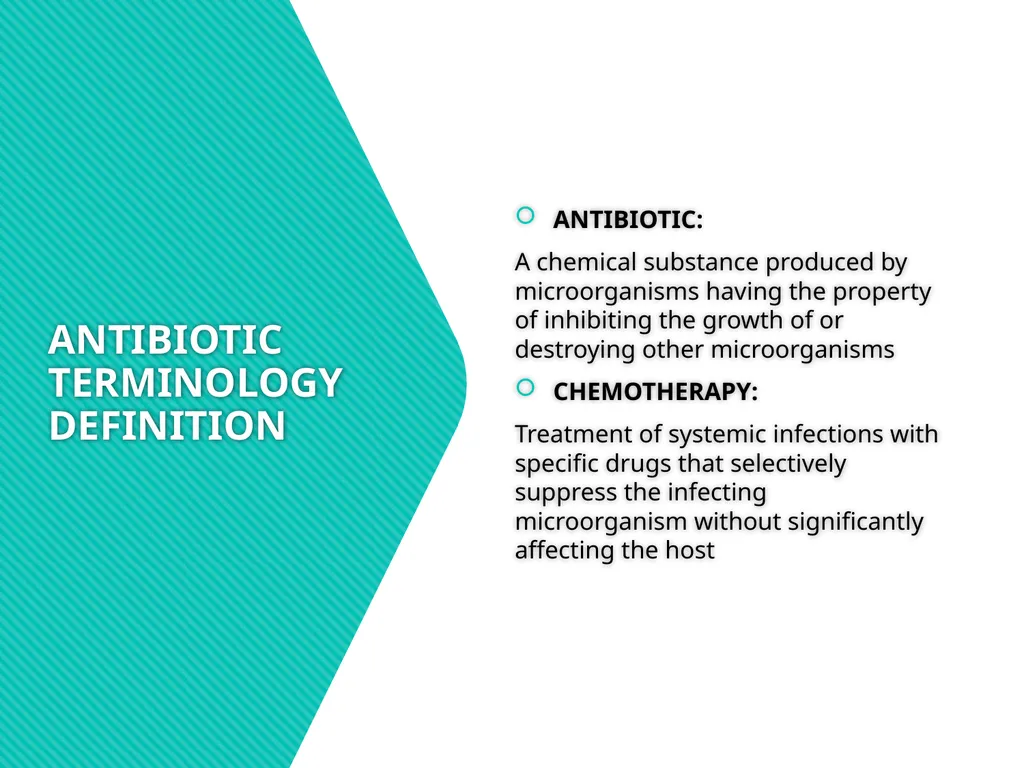
ANTIBIOTIC TERMINOLOGY DEFINITION ANTIBIOTIC:
A chemical substance produced by microorganisms having the property of inhibiting the growth of or destroying other microorganisms
CHEMOTHERAPY:
Treatment of systemic infections with specific drugs that selectively suppress the infecting microorganism without significantly affecting the host<br>
A chemical substance produced by microorganisms having the property of inhibiting the growth of or destroying other microorganisms
CHEMOTHERAPY:
Treatment of systemic infections with specific drugs that selectively suppress the infecting microorganism without significantly affecting the host<br>
05
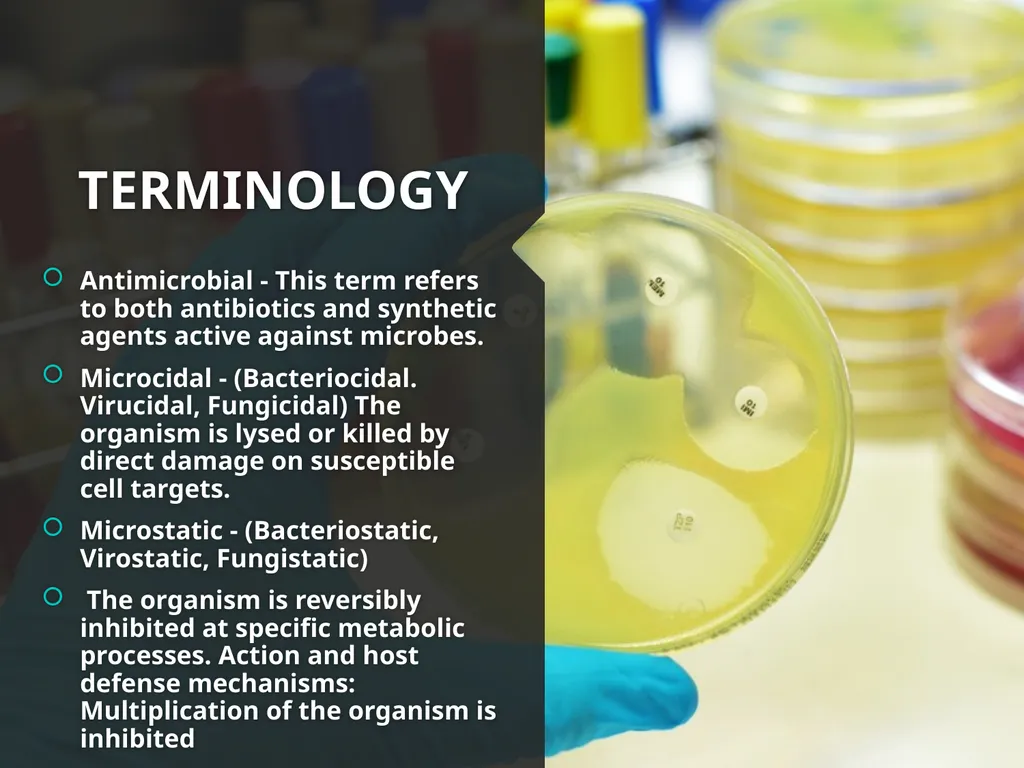
TERMINOLOGY Antimicrobial - This term refers to both antibiotics and synthetic agents active against microbes.
Microcidal - (Bacteriocidal. Virucidal, Fungicidal) The organism is lysed or killed by direct damage on susceptible cell targets.
Microstatic - (Bacteriostatic, Virostatic, Fungistatic)
The organism is reversibly inhibited at specific metabolic processes. Action and host defense mechanisms: Multiplication of the organism is inhibited<br>
Microcidal - (Bacteriocidal. Virucidal, Fungicidal) The organism is lysed or killed by direct damage on susceptible cell targets.
Microstatic - (Bacteriostatic, Virostatic, Fungistatic)
The organism is reversibly inhibited at specific metabolic processes. Action and host defense mechanisms: Multiplication of the organism is inhibited<br>
06
TERMINOLOGY Narrow Spectrum Antimicrobial :
An antimicrobial that acts on a limited number of microbial species, e.g. Nitroimidiazole derivatives etc
Broad Spectrum Antimicrobial :
- An antimicrobial that acts on a wide range of species, e.g., erythromycin for Gram positive. Gram negative, Legionella, Mycoplasma, etc.<br>
An antimicrobial that acts on a limited number of microbial species, e.g. Nitroimidiazole derivatives etc
Broad Spectrum Antimicrobial :
- An antimicrobial that acts on a wide range of species, e.g., erythromycin for Gram positive. Gram negative, Legionella, Mycoplasma, etc.<br>
07
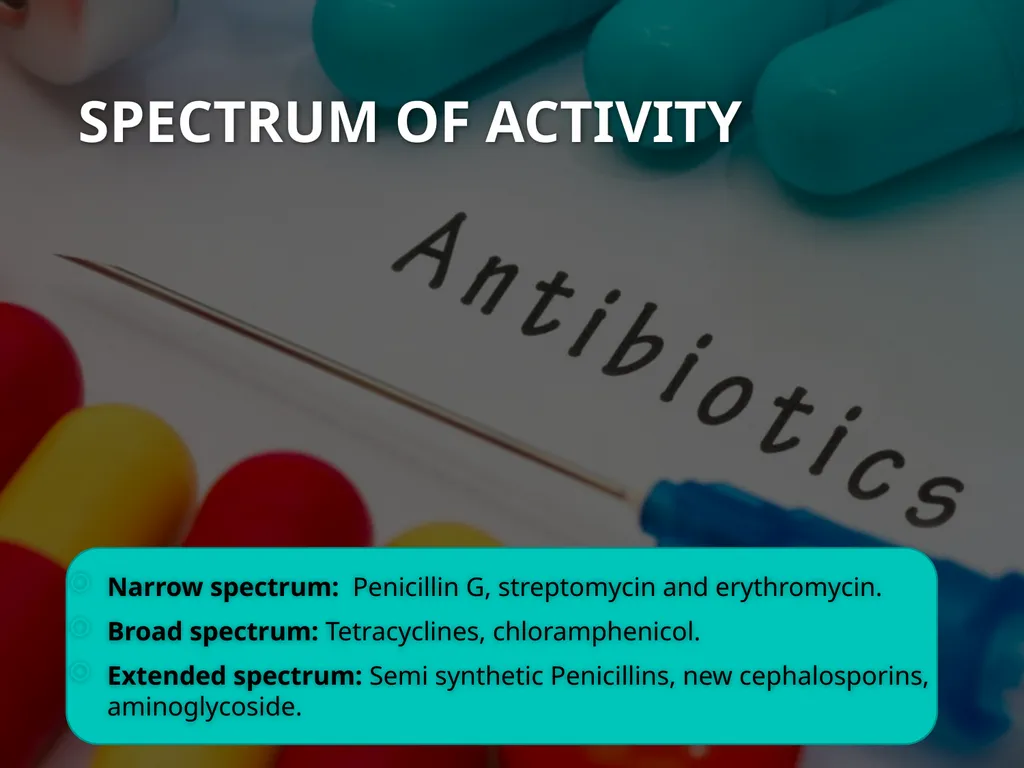
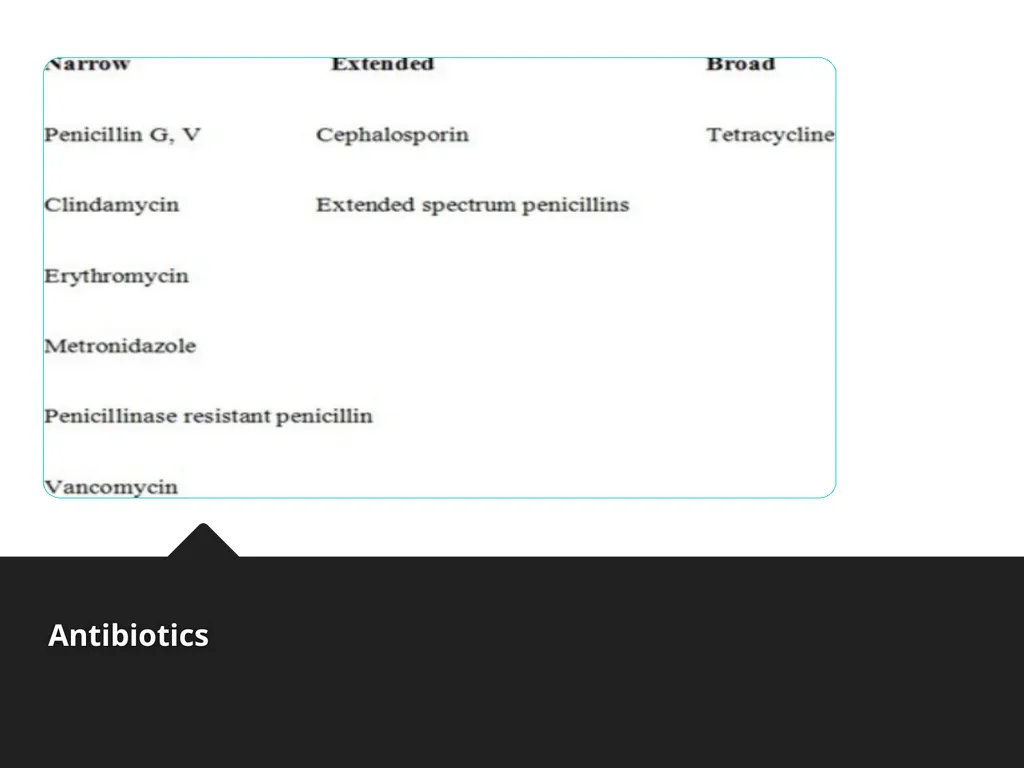
SPECTRUM OF ACTIVITY Narrow spectrum: Penicillin G, streptomycin and erythromycin.
Broad spectrum: Tetracyclines, chloramphenicol.
Extended spectrum: Semi synthetic Penicillins, new cephalosporins, aminoglycoside.<br>
Broad spectrum: Tetracyclines, chloramphenicol.
Extended spectrum: Semi synthetic Penicillins, new cephalosporins, aminoglycoside.<br>
08
Antibiotic Strategies Cardinal Rules:
1) Use the right drug.
2) Use the right dose.
3) Use the correct dosing schedule.
4) Correct duration.
Hard and Fast—Especially early.
Why?
Use a loading dose to rapidly achieve therapeutic blood levels<br>
1) Use the right drug.
2) Use the right dose.
3) Use the correct dosing schedule.
4) Correct duration.
Hard and Fast—Especially early.
Why?
Use a loading dose to rapidly achieve therapeutic blood levels<br>
09
INDICATIONS for ANTIBIOTICS 1. Severity of the infection
Acute onset
Diffuse swelling involves fascial spaces
2. Adequacy of removing the source of infection - During drainage can’t be established immediately
3. The state of patients’ host defense
- When the patient is pyretic
- Compromised host defenses
- For prophylaxis<br>
Acute onset
Diffuse swelling involves fascial spaces
2. Adequacy of removing the source of infection - During drainage can’t be established immediately
3. The state of patients’ host defense
- When the patient is pyretic
- Compromised host defenses
- For prophylaxis<br>
10
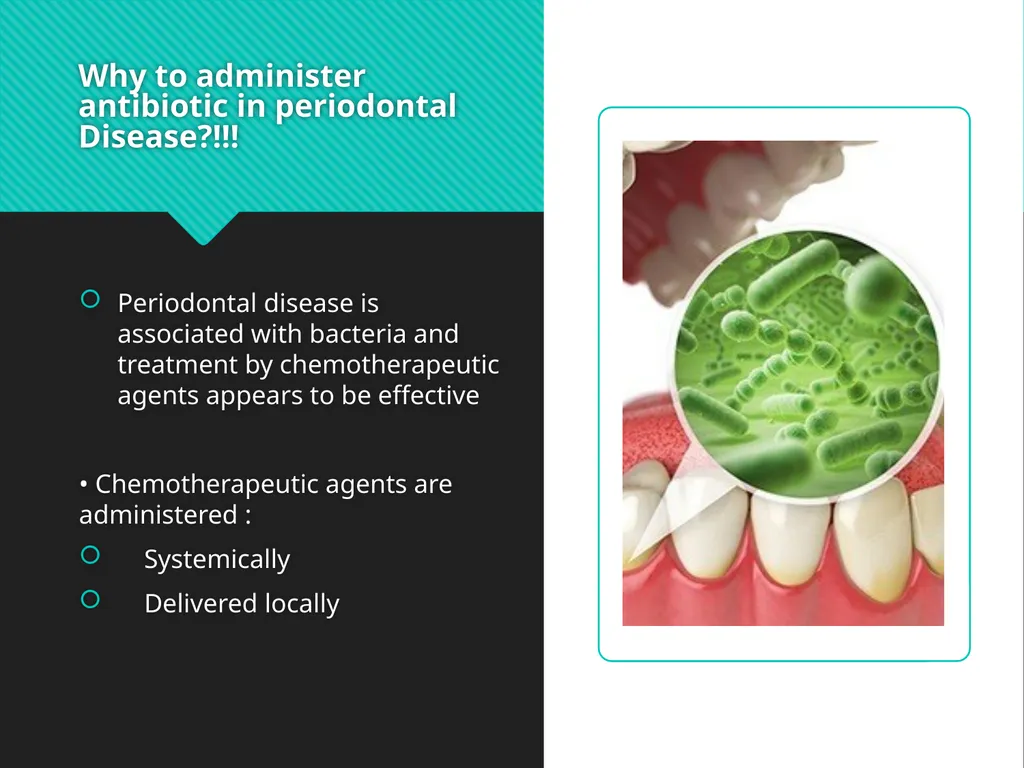
Why to administer antibiotic in periodontal Disease?!!! Periodontal disease is associated with bacteria and treatment by chemotherapeutic agents appears to be effective
• Chemotherapeutic agents are administered :
Systemically
Delivered locally<br>
• Chemotherapeutic agents are administered :
Systemically
Delivered locally<br>
11
CHOICE OF ANTIBIOTICS<br>
12
Antibiotics<br>
13
Indications for antibiotics in periodontal therapy • Acute infections
• Aggressive (early onset) forms of periodontitis
• Recurrent (“refractory”) periodontitis
Severe cases of acute necrotizing ulcerative gingivitis and periodontitis
Multiple abscess formation and gross periodontal infection<br>
• Aggressive (early onset) forms of periodontitis
• Recurrent (“refractory”) periodontitis
Severe cases of acute necrotizing ulcerative gingivitis and periodontitis
Multiple abscess formation and gross periodontal infection<br>
14
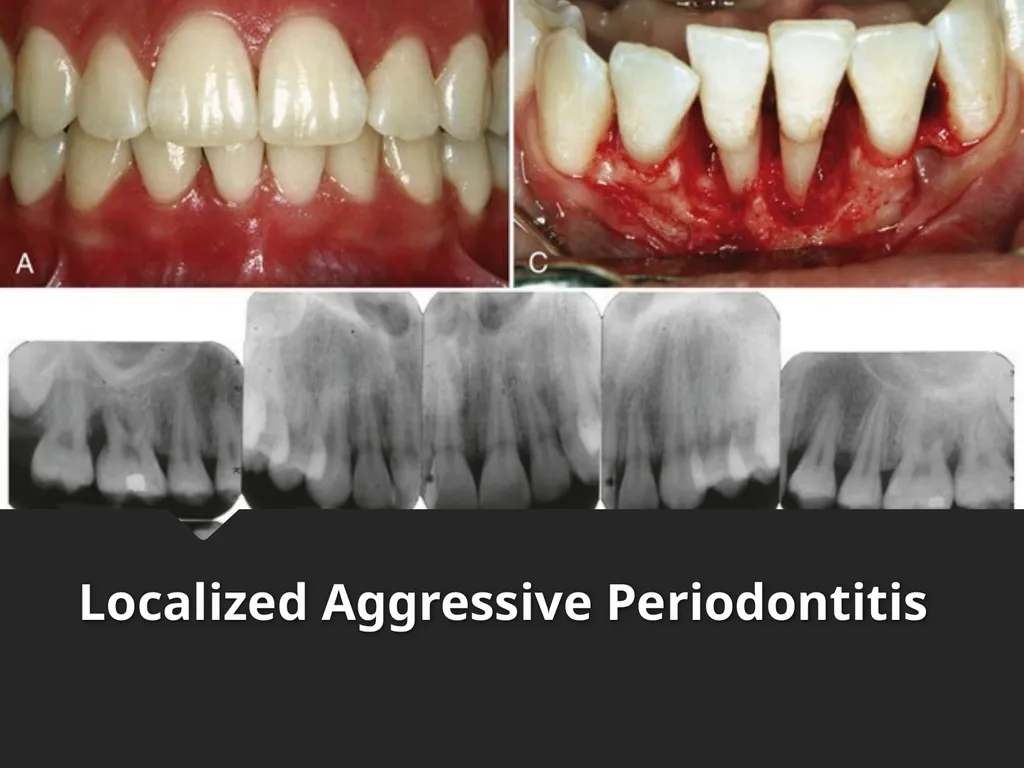
Localized Aggressive Periodontitis<br>
15
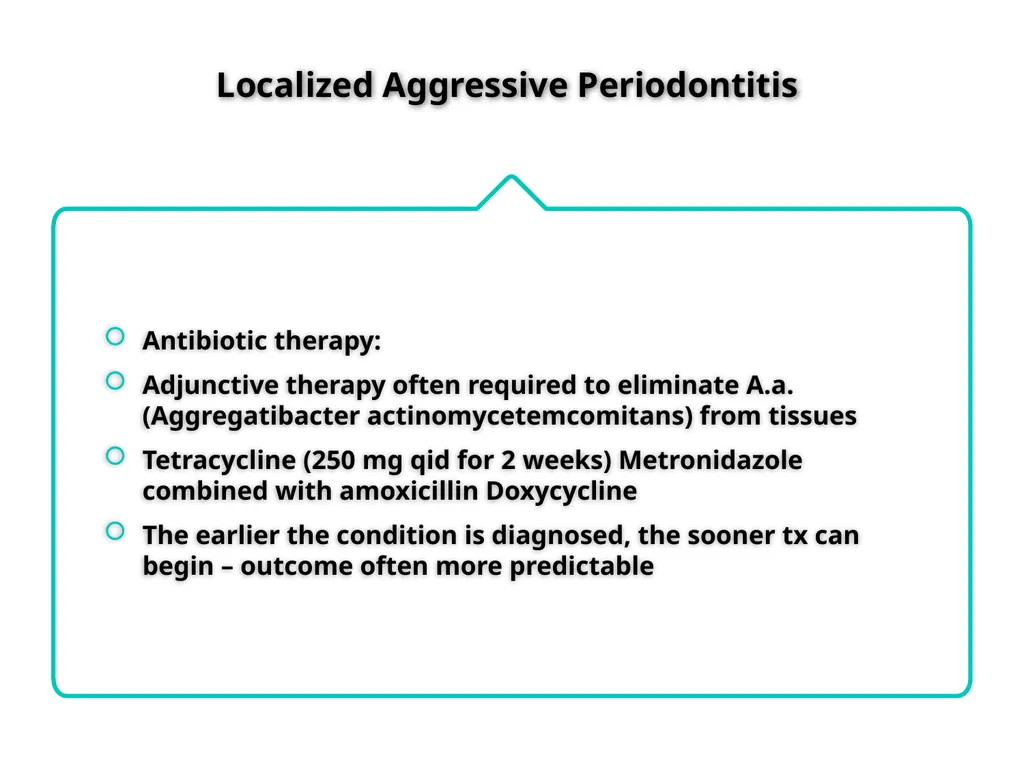
Localized Aggressive Periodontitis Antibiotic therapy:
Adjunctive therapy often required to eliminate A.a. (Aggregatibacter actinomycetemcomitans) from tissues
Tetracycline (250 mg qid for 2 weeks) Metronidazole combined with amoxicillin Doxycycline
The earlier the condition is diagnosed, the sooner tx can begin – outcome often more predictable<br>
Adjunctive therapy often required to eliminate A.a. (Aggregatibacter actinomycetemcomitans) from tissues
Tetracycline (250 mg qid for 2 weeks) Metronidazole combined with amoxicillin Doxycycline
The earlier the condition is diagnosed, the sooner tx can begin – outcome often more predictable<br>
16
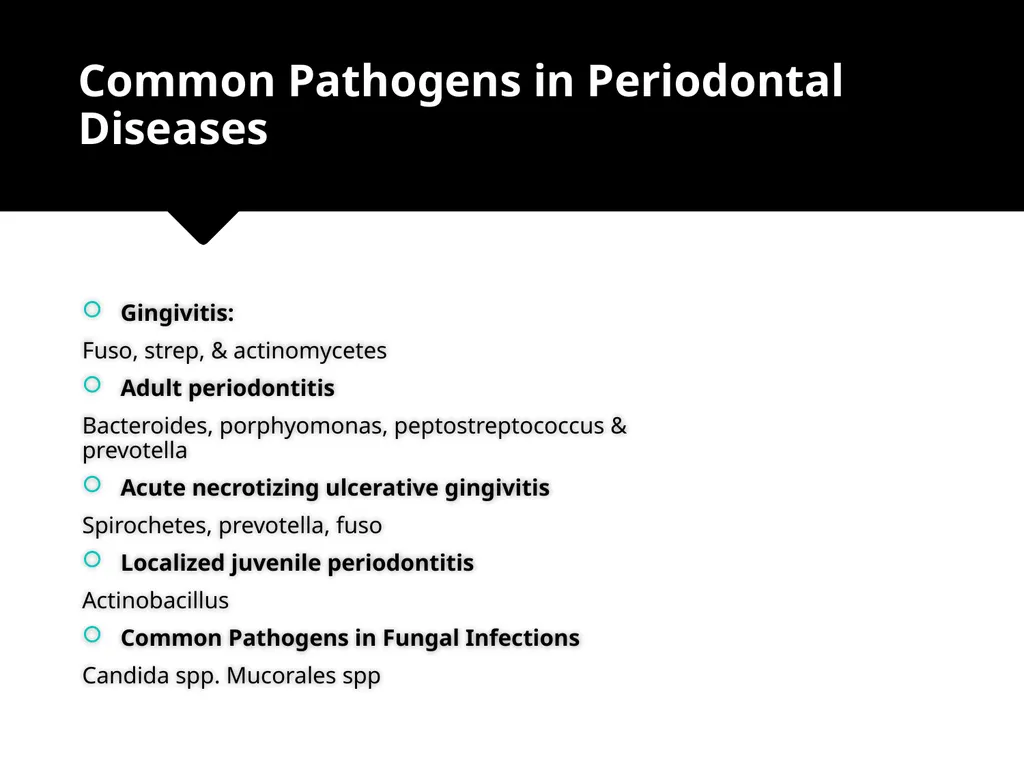
Common Pathogens in Periodontal Diseases Gingivitis:
Fuso, strep, & actinomycetes
Adult periodontitis
Bacteroides, porphyomonas, peptostreptococcus & prevotella
Acute necrotizing ulcerative gingivitis
Spirochetes, prevotella, fuso
Localized juvenile periodontitis
Actinobacillus
Common Pathogens in Fungal Infections
Candida spp. Mucorales spp<br>
Fuso, strep, & actinomycetes
Adult periodontitis
Bacteroides, porphyomonas, peptostreptococcus & prevotella
Acute necrotizing ulcerative gingivitis
Spirochetes, prevotella, fuso
Localized juvenile periodontitis
Actinobacillus
Common Pathogens in Fungal Infections
Candida spp. Mucorales spp<br>
17
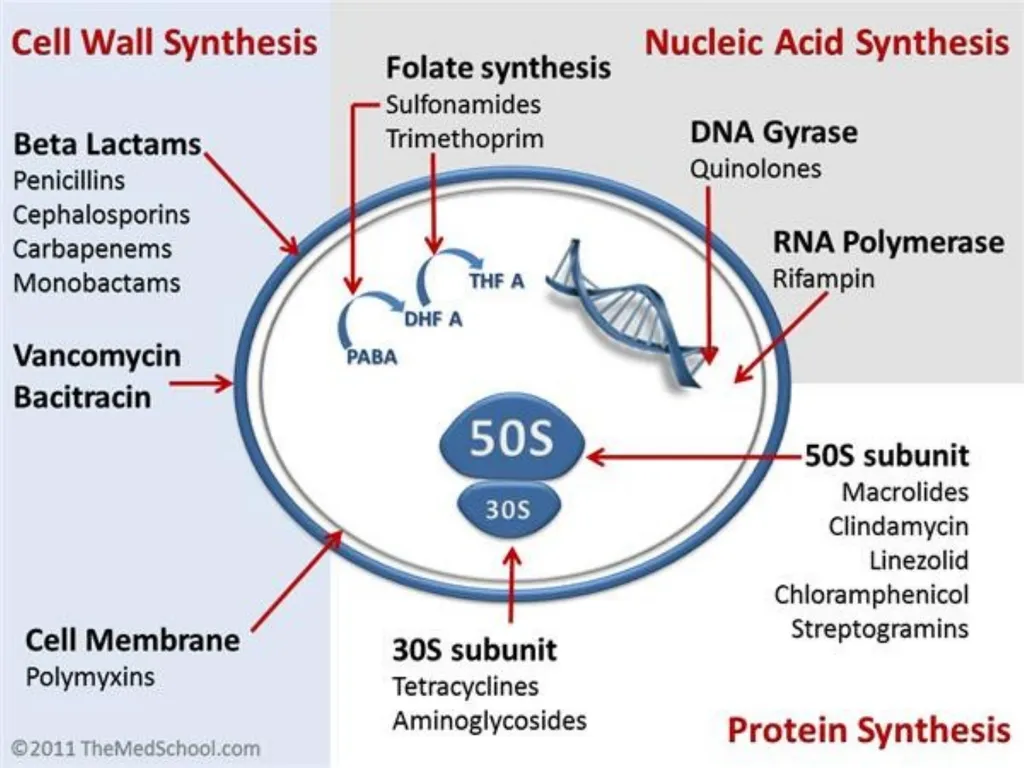
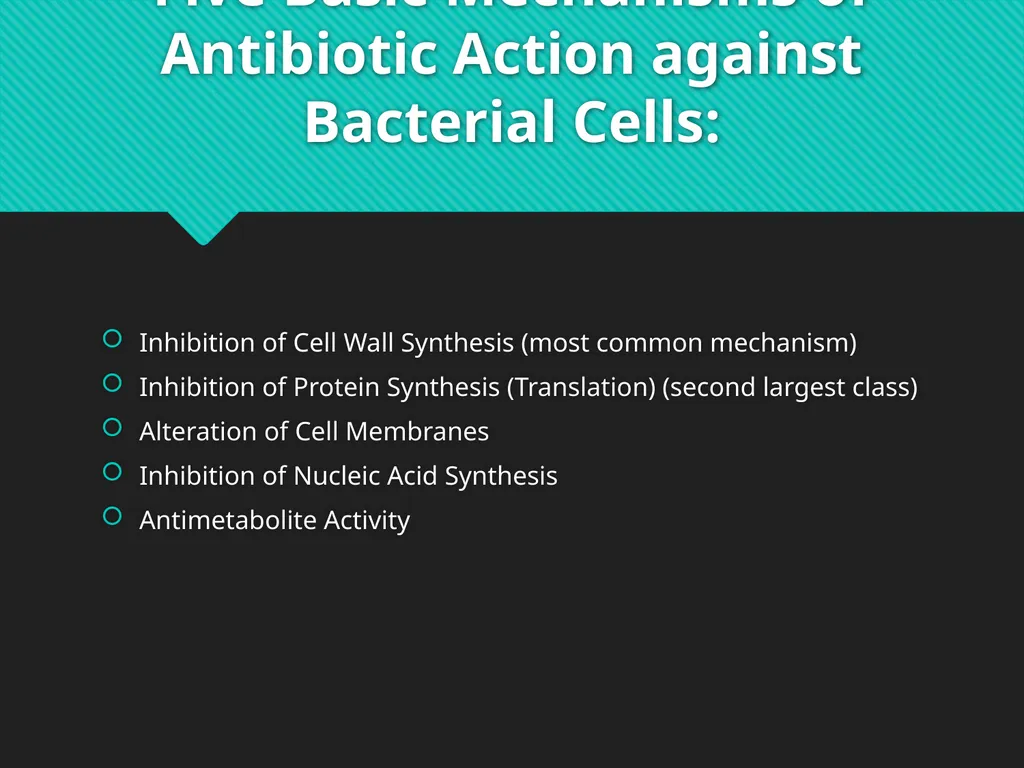
Five Basic Mechanisms of Antibiotic Action against Bacterial Cells: Inhibition of Cell Wall Synthesis (most common mechanism)
Inhibition of Protein Synthesis (Translation) (second largest class)
Alteration of Cell Membranes
Inhibition of Nucleic Acid Synthesis
Antimetabolite Activity<br>
Inhibition of Protein Synthesis (Translation) (second largest class)
Alteration of Cell Membranes
Inhibition of Nucleic Acid Synthesis
Antimetabolite Activity<br>
18
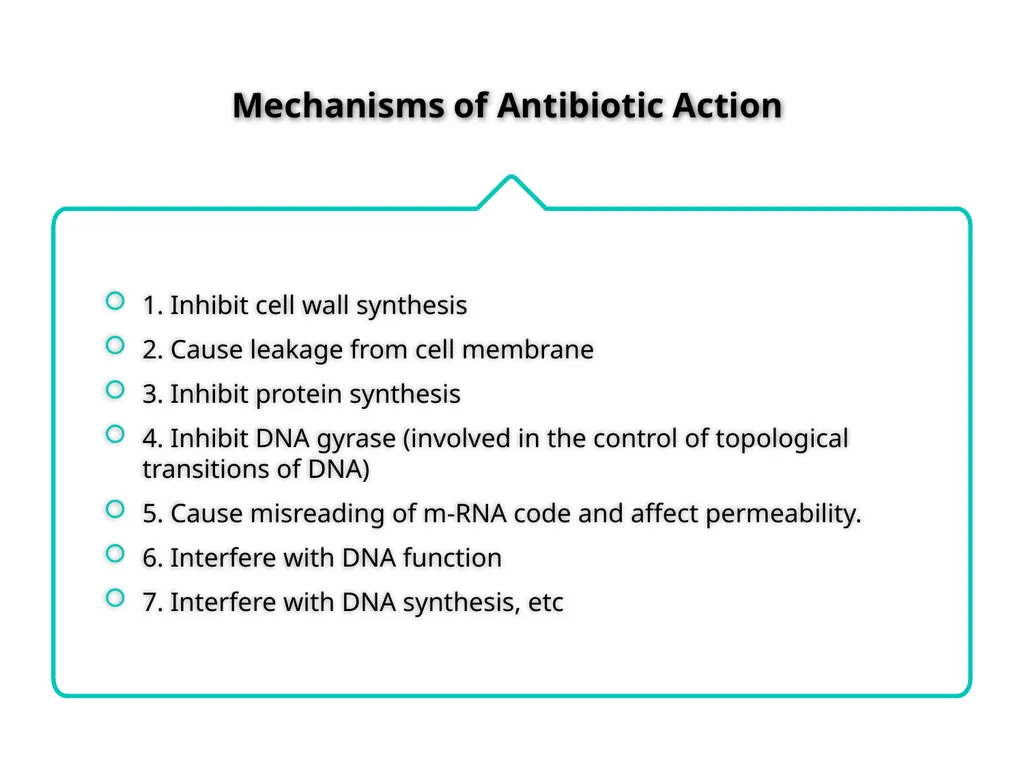
Mechanisms of Antibiotic Action 1. Inhibit cell wall synthesis
2. Cause leakage from cell membrane
3. Inhibit protein synthesis
4. Inhibit DNA gyrase (involved in the control of topological transitions of DNA)
5. Cause misreading of m-RNA code and affect permeability.
6. Interfere with DNA function
7. Interfere with DNA synthesis, etc<br>
2. Cause leakage from cell membrane
3. Inhibit protein synthesis
4. Inhibit DNA gyrase (involved in the control of topological transitions of DNA)
5. Cause misreading of m-RNA code and affect permeability.
6. Interfere with DNA function
7. Interfere with DNA synthesis, etc<br>
19
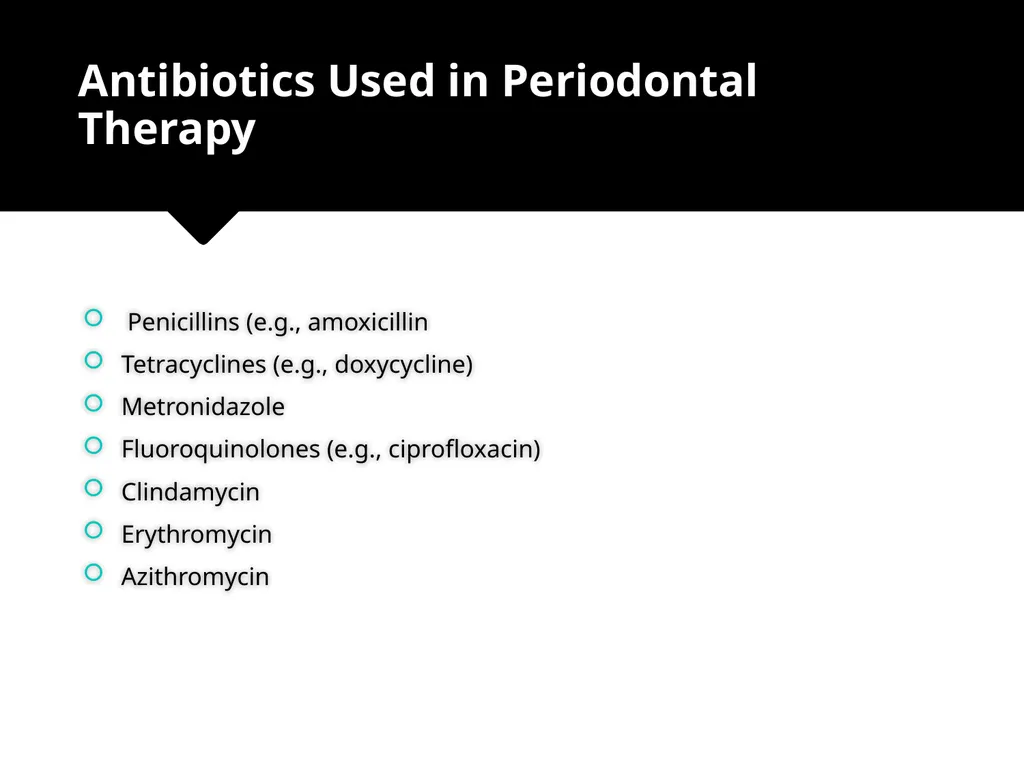
Antibiotics Used in Periodontal Therapy Penicillins (e.g., amoxicillin
Tetracyclines (e.g., doxycycline)
Metronidazole
Fluoroquinolones (e.g., ciprofloxacin)
Clindamycin
Erythromycin
Azithromycin<br>
Tetracyclines (e.g., doxycycline)
Metronidazole
Fluoroquinolones (e.g., ciprofloxacin)
Clindamycin
Erythromycin
Azithromycin<br>
20
Penicillins Bactericidal
Reach effective levels in gingival fluid
Don’t inhibit all A.a. Strains
Inactivated by ß-lactamases
Amoxicillin has enhanced tissue penetration and good activity against gram negatives
Augmentin is as effective as amoxicillin, but resists inactivation by ß-lactamases<br>
Reach effective levels in gingival fluid
Don’t inhibit all A.a. Strains
Inactivated by ß-lactamases
Amoxicillin has enhanced tissue penetration and good activity against gram negatives
Augmentin is as effective as amoxicillin, but resists inactivation by ß-lactamases<br>
21
Penicillins Penicillins inhibit bacterial cell-wall synthesis
Natural penicillins (narrow spectrum)
Amoxicillin is a semi-synthetic penicillin
Broadened antimicrobial spectrum
used in periodontology because it is effective against some subgingival bacterial species such as P. micros & A.actinomycetemcomitans<br>
Natural penicillins (narrow spectrum)
Amoxicillin is a semi-synthetic penicillin
Broadened antimicrobial spectrum
used in periodontology because it is effective against some subgingival bacterial species such as P. micros & A.actinomycetemcomitans<br>
22
Penicillins cont… Can be used in cases of acute infections
Most commonly used in combination with metronidazole
Amoxicillin in combination with clavulonic acid is indicated in the presence of oral bacteria capable of producing β-lactamase 2<br>
Most commonly used in combination with metronidazole
Amoxicillin in combination with clavulonic acid is indicated in the presence of oral bacteria capable of producing β-lactamase 2<br>
23
Tetracyclines Group of broad spectrum antibiotics
Bacteriostatic antibiotics
This group includes tetracycline hydrochloride, minocycline and doxycycline
Regularly used in treatment of refractory periodontitis including localized aggressive periodontitis.
Concentrate in periodontal tissues(conc. in gingival crevice is 2 to 10 times more than in serum)& inhibit the growth of a.a.
Exert anti collagenase effect<br>
Bacteriostatic antibiotics
This group includes tetracycline hydrochloride, minocycline and doxycycline
Regularly used in treatment of refractory periodontitis including localized aggressive periodontitis.
Concentrate in periodontal tissues(conc. in gingival crevice is 2 to 10 times more than in serum)& inhibit the growth of a.a.
Exert anti collagenase effect<br>
24
Pharmacology of
Tetracycline<br>
25
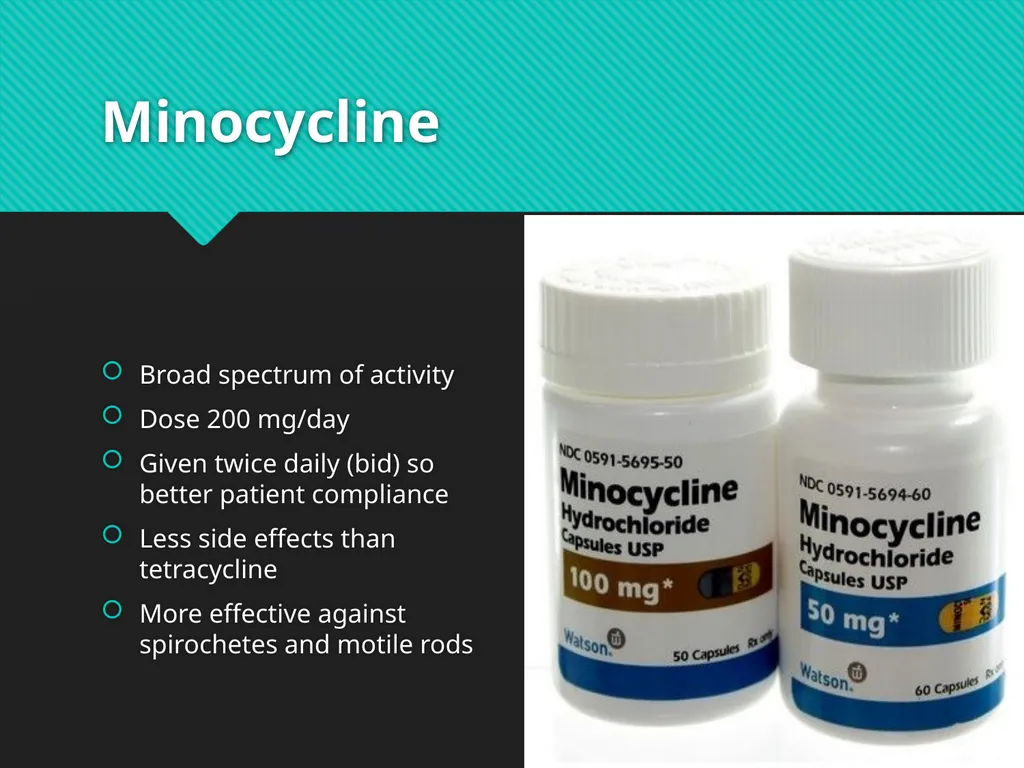
Minocycline Broad spectrum of activity
Dose 200 mg/day
Given twice daily (bid) so better patient compliance
Less side effects than tetracycline
More effective against spirochetes and motile rods<br>
Dose 200 mg/day
Given twice daily (bid) so better patient compliance
Less side effects than tetracycline
More effective against spirochetes and motile rods<br>
26
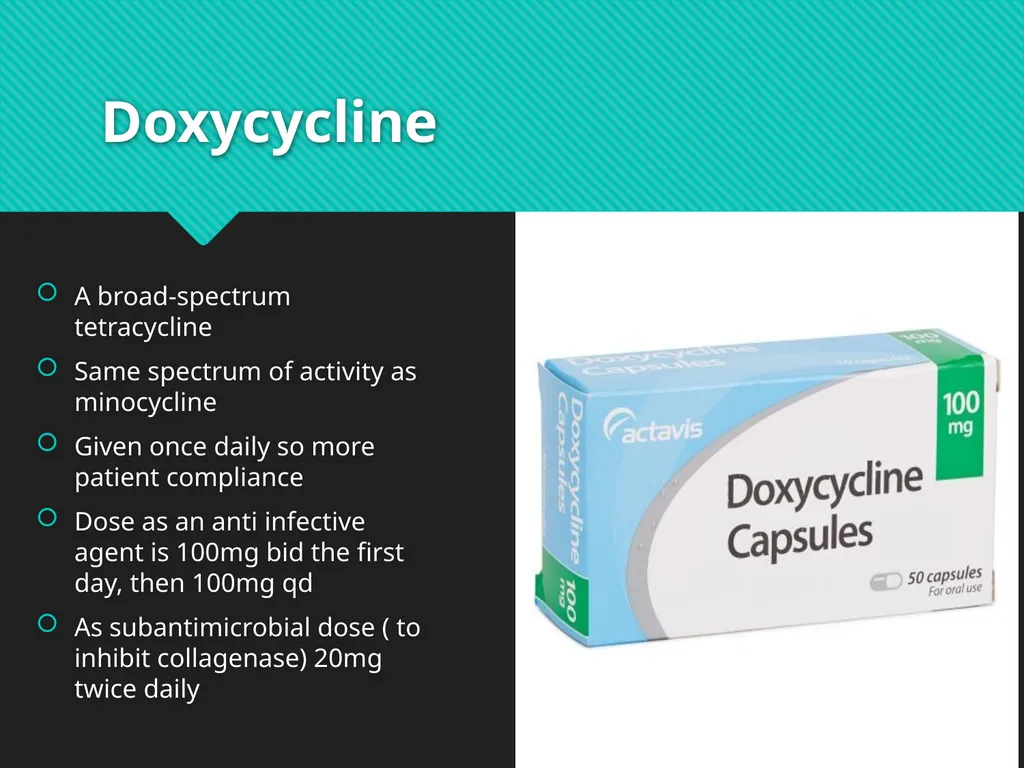
Doxycycline A broad-spectrum tetracycline
Same spectrum of activity as minocycline
Given once daily so more patient compliance
Dose as an anti infective agent is 100mg bid the first day, then 100mg qd
As subantimicrobial dose ( to inhibit collagenase) 20mg twice daily<br>
Same spectrum of activity as minocycline
Given once daily so more patient compliance
Dose as an anti infective agent is 100mg bid the first day, then 100mg qd
As subantimicrobial dose ( to inhibit collagenase) 20mg twice daily<br>
27
Side effects Liver damage
Kidney damage
Phototoxicity
Chelating effects-teeth & bones
Hypersensitivity
Super infections<br>
Kidney damage
Phototoxicity
Chelating effects-teeth & bones
Hypersensitivity
Super infections<br>
28
Metronidazole<br>
29
Metronidazole cont… Relatively ineffective in the suppression of A. actinomycetemcomitans.
Its antimicrobial spectrum is not wide enough for treatment of aggressive periodontitis
Antibiotic of a choice for Periodontal abscesses<br>
Its antimicrobial spectrum is not wide enough for treatment of aggressive periodontitis
Antibiotic of a choice for Periodontal abscesses<br>
30
flagyl,metrogyl Dose- 250mg/tds/oral
Adverse effects
Anorexia, nausea
Abdominal cramps
Metallic taste, headache, glossitis,dryness of mouth
Contraindication
Neurological disease
First trimester of pregnancy
Chronic alcoholism<br>
Adverse effects
Anorexia, nausea
Abdominal cramps
Metallic taste, headache, glossitis,dryness of mouth
Contraindication
Neurological disease
First trimester of pregnancy
Chronic alcoholism<br>
31
Fluoroquinolones (Ciprofloxacin) A quinolone active against gram –ve rods
Bactericidal
Extremely active against A.a., but less active against anaerobic bacteria
Reach higher levels in gingival fluid than in blood serum
Penetrate epithelial cells-can kill invasive bacteria
Includes
Ciprofloxacin, moxifloxacin, levofloxacin and ofloxacin.<br>
Bactericidal
Extremely active against A.a., but less active against anaerobic bacteria
Reach higher levels in gingival fluid than in blood serum
Penetrate epithelial cells-can kill invasive bacteria
Includes
Ciprofloxacin, moxifloxacin, levofloxacin and ofloxacin.<br>
32
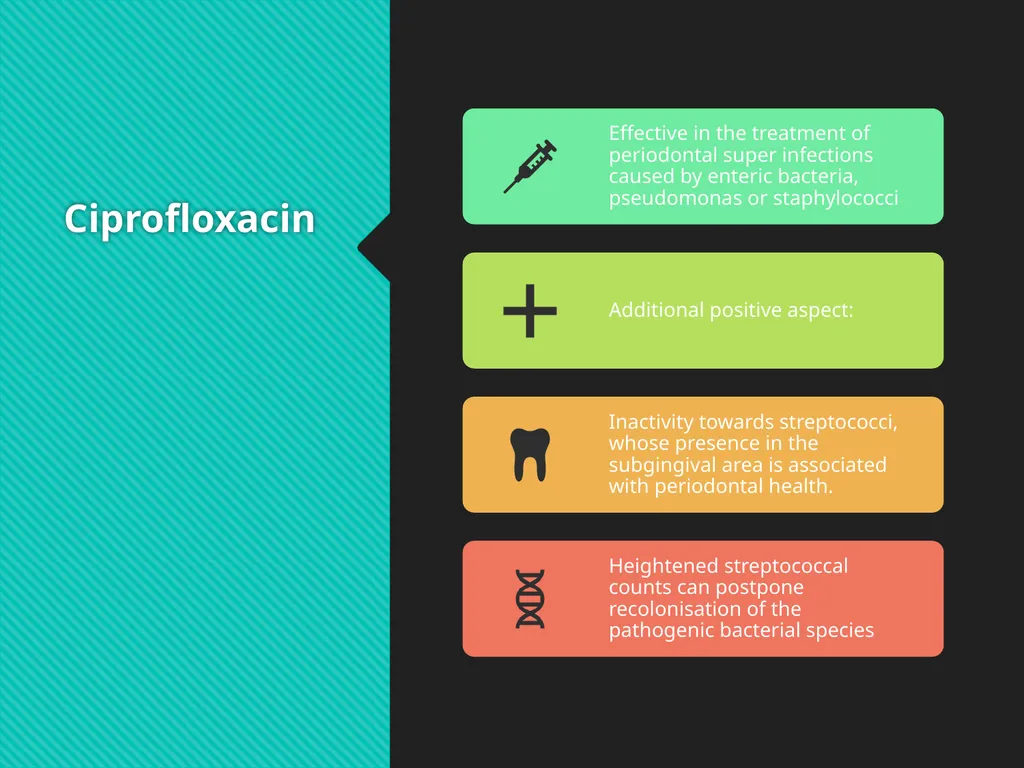
Ciprofloxacin<br>
33
Ciprofloxacin CIFRAN,CIPLOX- 200,500mg tab
Side effects
Gastrointestinal
CNS effects
Hypersensitivity reaction<br>
Side effects
Gastrointestinal
CNS effects
Hypersensitivity reaction<br>
34
Clindamycin (lincosamide class) • Potent bacteriostatic activity against strict anaerobes
• Less effective against facultative pathogens (A.a. and Eikenella)
• Can induce ulcerative colitis
• Often used as an alternative antimicrobial agent in penicillin-allergic patients<br>
• Less effective against facultative pathogens (A.a. and Eikenella)
• Can induce ulcerative colitis
• Often used as an alternative antimicrobial agent in penicillin-allergic patients<br>
35
Clindamycin cont…. DOSE 150-300mg QID ORAL,
Side effects
Rashes
Urticaria (Hives) a kind of skin rash with red, raised, itchy bumps.
Abdominal pain
Pseudomembranous enterocolitis inflammation of the colon associated with an overgrowth of the bacterium Clostridioides difficile (formerly Clostridium difficile)<br>
Side effects
Rashes
Urticaria (Hives) a kind of skin rash with red, raised, itchy bumps.
Abdominal pain
Pseudomembranous enterocolitis inflammation of the colon associated with an overgrowth of the bacterium Clostridioides difficile (formerly Clostridium difficile)<br>
36
Erythromycin
(Macrolides class)<br>
37
Macrolides class of antibiotic Includes :
Erythromycin
Roxithromycin
Azithromycin
Clarithromycin<br>
Erythromycin
Roxithromycin
Azithromycin
Clarithromycin<br>
38
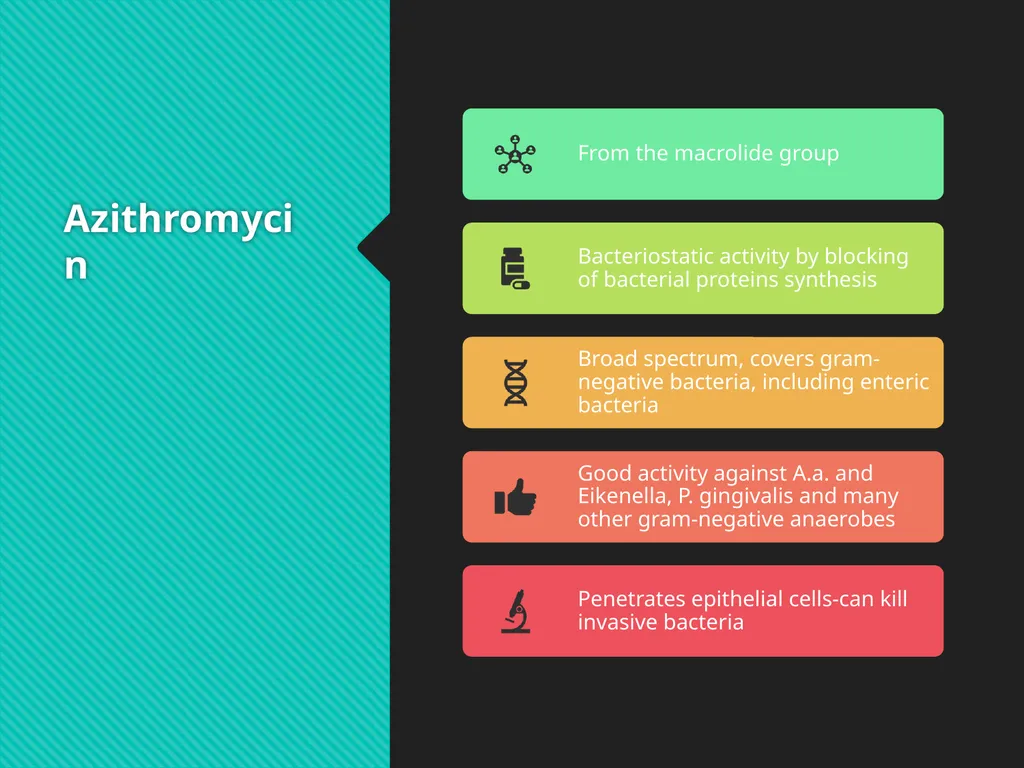
Azithromycin<br>
39
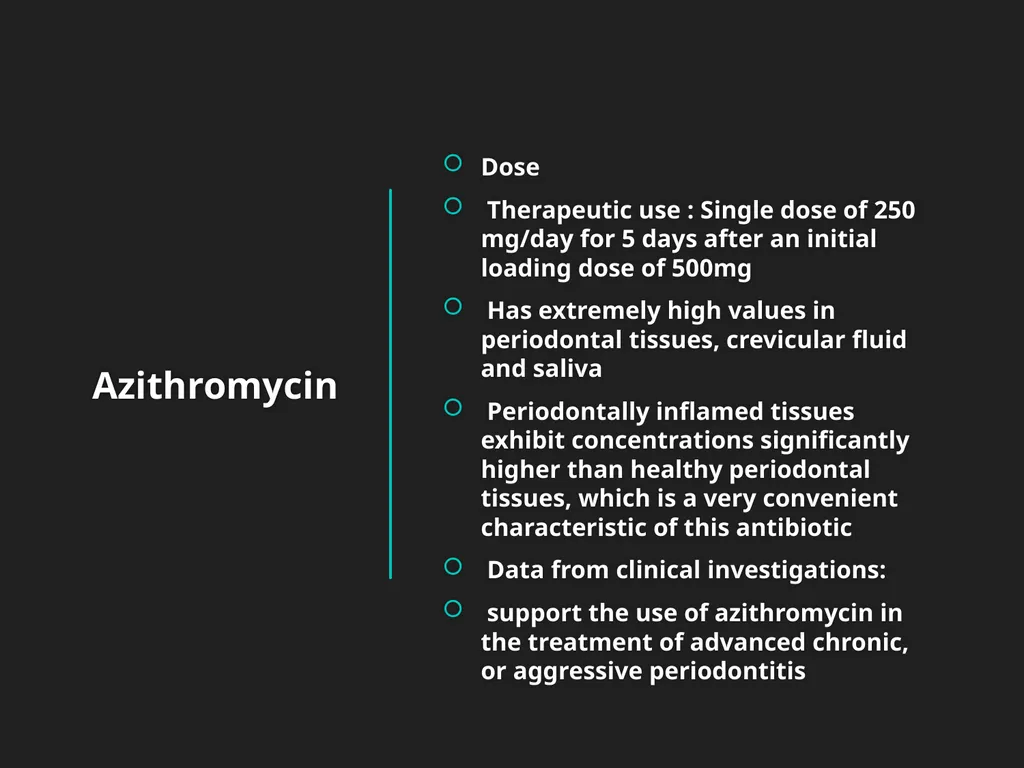
Azithromycin Dose
Therapeutic use : Single dose of 250 mg/day for 5 days after an initial loading dose of 500mg
Has extremely high values in periodontal tissues, crevicular fluid and saliva
Periodontally inflamed tissues exhibit concentrations significantly higher than healthy periodontal tissues, which is a very convenient characteristic of this antibiotic
Data from clinical investigations:
support the use of azithromycin in the treatment of advanced chronic, or aggressive periodontitis<br>
Therapeutic use : Single dose of 250 mg/day for 5 days after an initial loading dose of 500mg
Has extremely high values in periodontal tissues, crevicular fluid and saliva
Periodontally inflamed tissues exhibit concentrations significantly higher than healthy periodontal tissues, which is a very convenient characteristic of this antibiotic
Data from clinical investigations:
support the use of azithromycin in the treatment of advanced chronic, or aggressive periodontitis<br>
40
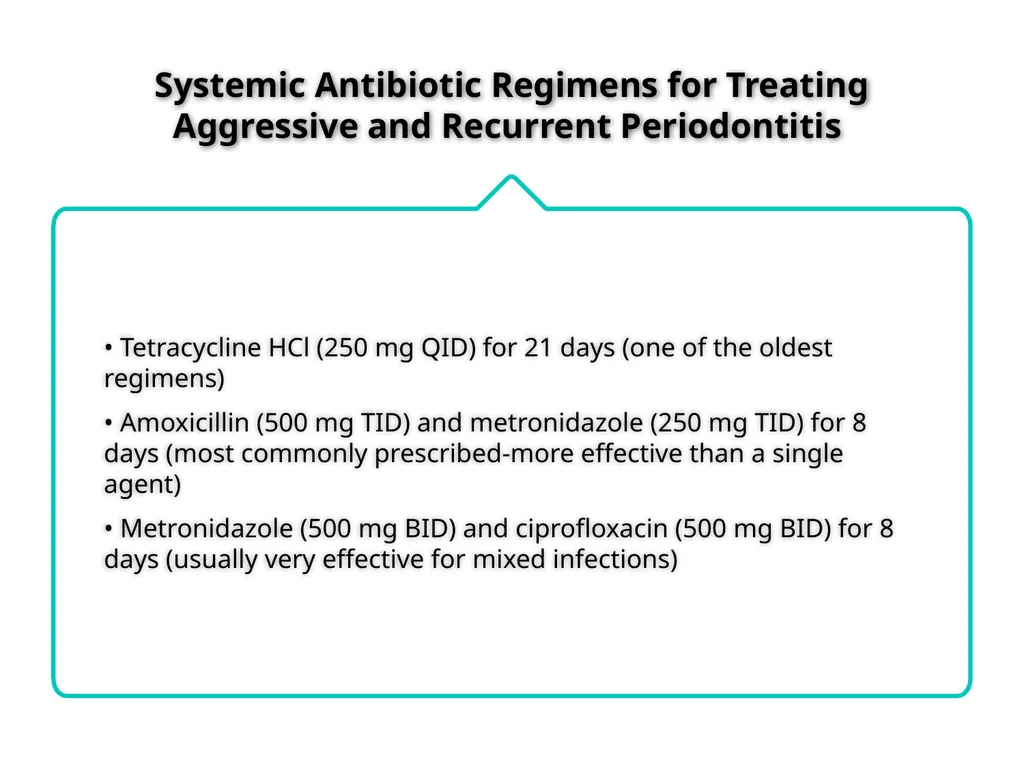
Systemic Antibiotic Regimens for Treating Aggressive and Recurrent Periodontitis • Tetracycline HCl (250 mg QID) for 21 days (one of the oldest regimens)
• Amoxicillin (500 mg TID) and metronidazole (250 mg TID) for 8 days (most commonly prescribed-more effective than a single agent)
• Metronidazole (500 mg BID) and ciprofloxacin (500 mg BID) for 8 days (usually very effective for mixed infections)<br>
• Amoxicillin (500 mg TID) and metronidazole (250 mg TID) for 8 days (most commonly prescribed-more effective than a single agent)
• Metronidazole (500 mg BID) and ciprofloxacin (500 mg BID) for 8 days (usually very effective for mixed infections)<br>
41
Limitations of Systemic Antibiotics in Periodontics • Antibiotics rarely enhance the treatment of chronic periodontitis
• To eliminate bacteria in biofilms effectively, antibiotics must be used in conjunction with mechanical debridement
• No single antibiotic can inhibit all periodontal pathogens
• Antibiotics can have unwanted side effects when given systemically<br>
• To eliminate bacteria in biofilms effectively, antibiotics must be used in conjunction with mechanical debridement
• No single antibiotic can inhibit all periodontal pathogens
• Antibiotics can have unwanted side effects when given systemically<br>
42
Side Effects Associated With Systemic Antibiotics • Induction of antibiotic resistance
• Induction of microbial overgrowth
• Inhibition of oral contraceptives (rare)
• Hypersensitivity or toxicity (e.g., allergy, nausea,
diarrhea, photosensitivity)<br>
• Induction of microbial overgrowth
• Inhibition of oral contraceptives (rare)
• Hypersensitivity or toxicity (e.g., allergy, nausea,
diarrhea, photosensitivity)<br>
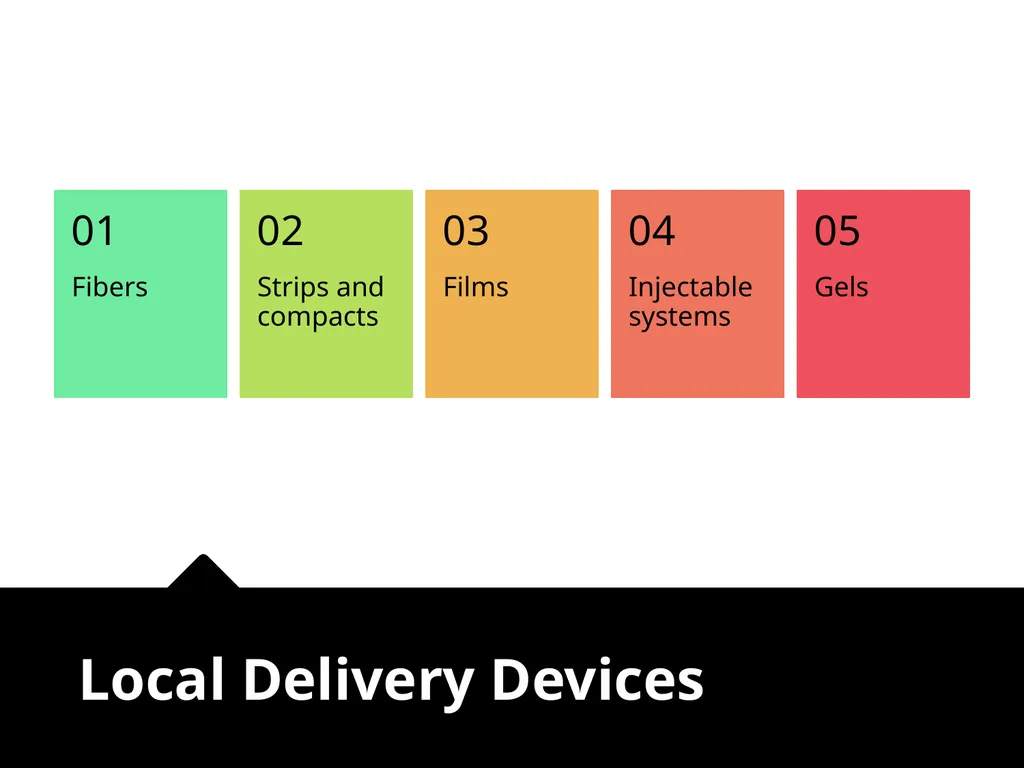
43
Local Delivery Devices<br>
44
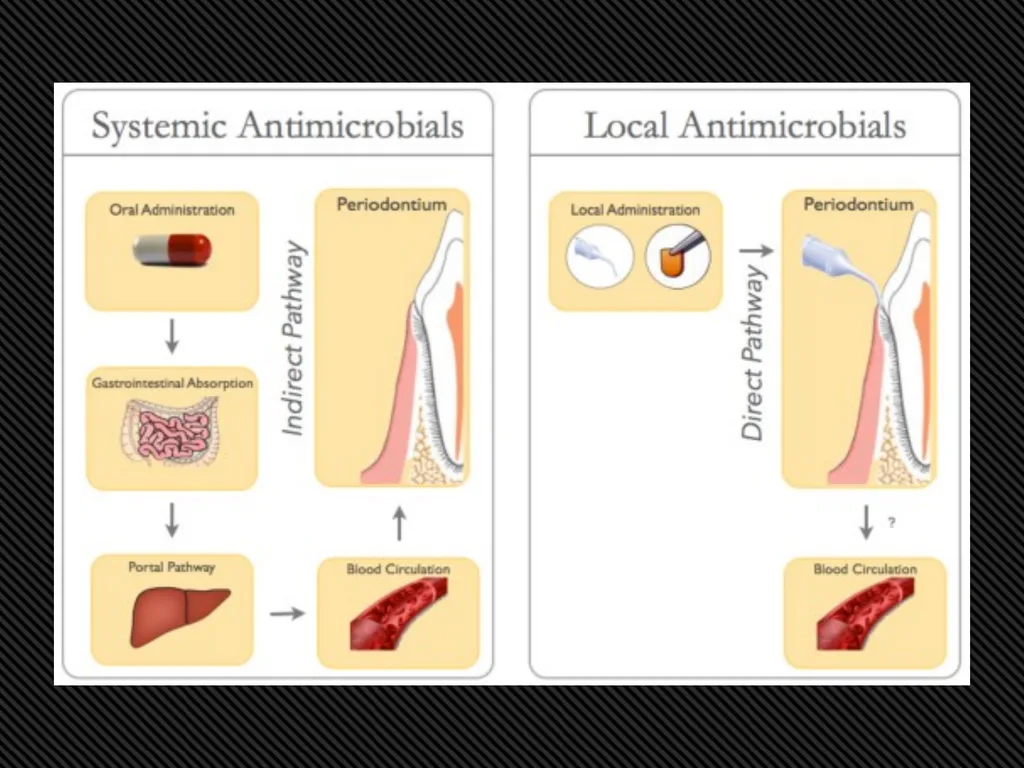
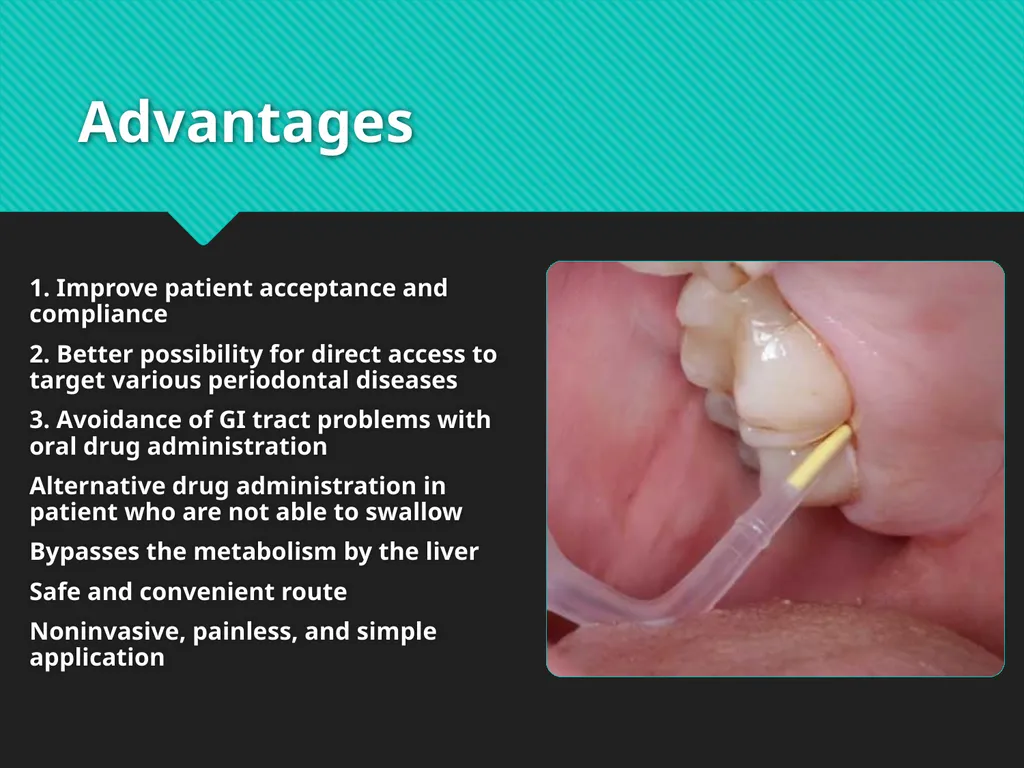
Advantages 1. Improve patient acceptance and compliance
2. Better possibility for direct access to target various periodontal diseases
3. Avoidance of GI tract problems with oral drug administration
Alternative drug administration in patient who are not able to swallow
Bypasses the metabolism by the liver
Safe and convenient route
Noninvasive, painless, and simple application<br>
2. Better possibility for direct access to target various periodontal diseases
3. Avoidance of GI tract problems with oral drug administration
Alternative drug administration in patient who are not able to swallow
Bypasses the metabolism by the liver
Safe and convenient route
Noninvasive, painless, and simple application<br>
45
Limitations Dose limitation because of relatively small area
Pre-systemic metabolism could occur by the enzymes like peptidase and esterase
It should be devoid of irritancy or sensitization
Cost should be taken in consideration<br>
Pre-systemic metabolism could occur by the enzymes like peptidase and esterase
It should be devoid of irritancy or sensitization
Cost should be taken in consideration<br>