
Anticipatory Duty, Teaching, Learning and
JO
Published · 23 slides · 0 views
1 / 1




Description
Anticipatory Duty, Teaching, Learning and Assessment Inclusive Education, Eden Centre for Educational Enhancement First version created 18 December 2024, revisions expected in February 2025. Content: The following slides cover: Anticipatory
Related Topics
Share
Embed code
Download this presentation From Below
"Anticipatory Duty, Teaching, Learning and" is the property of its rightful owner. Permission is granted to download and print the materials on this website for personal, non-commercial use only, and to display it on your personal computer provided you do not modify the materials and that you retain all copyright notices contained in the materials. By downloading content from our website, you accept the terms of this agreement.
Presentation Transcript
01
Anticipatory Duty, Teaching, Learning and Assessment
Inclusive Education, Eden Centre for Educational Enhancement First version created 18 December 2024, revisions expected in February 2025.<br>
02
Content: The following slides cover:
Anticipatory Duty and the Equality Act
EHRC Briefing Note
Assessment Support
Student Wellbeing Support and Guidance
Teaching and Learning Scenarios
Resources and Key Contacts<br>
Anticipatory Duty and the Equality Act
EHRC Briefing Note
Assessment Support
Student Wellbeing Support and Guidance
Teaching and Learning Scenarios
Resources and Key Contacts<br>
03
The Equality Act 2010 Anticipatory Duty is not new: The Equality Act 2010
Anticipatory duty
For service providers, the duty to make reasonable adjustments is 'anticipatory', within reason. This means they have to anticipate, think about and try to predict what adjustments could be needed by customers with different types of disability, support and access requirements.
The service provider must think about all potential disabled customers and not just those who are known to them.<br>
04
The duty to make reasonable adjustments The reasonable adjustments duty was first introduced under the Disability Discrimination Act 1995. The reasonable adjustments duty under the Equality Act operates slightly differently but the object is the same: to avoid as far as possible by reasonable means the disadvantage which a disabled student experiences because of their disability.
The duty requires us to take positive steps to ensure that disabled students can fully
participate in the education and other benefits, facilities and services provided for
students.<br>
The duty requires us to take positive steps to ensure that disabled students can fully
participate in the education and other benefits, facilities and services provided for
students.<br>
05
While this duty does not require the universities to anticipate every need, it does require that the universities think about and provide for ‘features which may impede persons with particular kinds of disability for example, impaired vision, impaired mobility’.
The main implication of the High Court’s ruling on the Natasha Abrahart case under the Equality Act 2010 is the reinforcement of the anticipatory nature of the reasonable adjustment duty under section 20.<br>
The main implication of the High Court’s ruling on the Natasha Abrahart case under the Equality Act 2010 is the reinforcement of the anticipatory nature of the reasonable adjustment duty under section 20.<br>
06
Natasha Abrahart case The High Court found that the duty applies even in the case of an individual student as opposed to groups of students (e.g. who are blind, deaf or are wheelchair users) or types of disabilities.
Until the ruling, the duty may have been read to apply mainly in cases where duty bearers were meant to anticipate and provide for groups of disabled people or certain types of disabilities generally rather than the needs of a specific individual without a reported disability.
Yet Bristol University was found to have breached this duty in relation to an individual student without a reported disability; but whose difficulties with oral assessment, the County Court and the High Court thought were apparent as disability to the University.<br>
07
Key points from EHRC briefing note Student-facing staff should be trained to recognise symptoms of mental health crises and trained to know what to do next to obtain support for the student and remove additional stressors such as deadlines.
Staff should be reminded that where a student has a severe or urgent condition, reasonable adjustments may be made without a diagnosis or medical or expert evidence.
Where a student does not have a diagnosis of disability, but staff are concerned that the student is struggling or failing to engage, staff should take steps to determine whether a student may have a disability and whether to put reasonable adjustments in place. Such steps may include consideration of what the student says about their disability or health condition and how they present when speaking to staff and peers. Their behaviour may also be taken into consideration, for example, attendance at lectures, submission of work, general engagement with courses and other activities and whether there are discrepancies between certain modules or formats of assessment.<br>
08
What is already available to support you and your students<br>
09
Well-Being Support and Adjustments<br>
10
Student Well-Being Support and My Adjustments Staff-Guide-to-My-Adjustments.pdf
Inclusive teaching guides
Cause for Concern<br>
Inclusive teaching guides
Cause for Concern<br>
11
Reasonable adjustments and alternative assessments Requests for alternative assessments are still considered exceptional at LSE.
Applications are made to the Central Exam Adjustment panel and only approved where a strong case is made in supporting (medical) documentation and all other adjustments have been considered and ruled out.
Current process requires requests to be made prior to CEA deadline (around 2 months prior to start of exam period).
Head of DMHS then picks up with relevant department(s) to agree alternative with department, DMHS and student.
Reminders of pre-approved AAs are sent out by Head of DMHS at the start of each academic year.
For more information and support please reach out to Stef Hackney, Head of Disability and Mental Health Manager: s.hackney1@lse.ac.uk.<br>
12
Teaching and Learning Support:
To enhance assessment and learning in the classroom, we strongly encourage our colleagues to utilise the comprehensive resources provided in the Assessment Toolkit, as well as the detailed guidance on learning outcomes available from the Eden Centre. These tools are designed to support teachers around alternative assessments and assessment choices.<br>
13
LSE Assessment Toolkit The LSE Assessment Toolkit -- https://info.lse.ac.uk/staff/divisions/Eden-Centre/Assessment-Toolkit/Selecting-assessment-methods-based-on-skills<br>
14
The Assessment Toolkit can support teachers with: If you’re designing a new course, or considering changing the assessment on an existing course, then you could begin with Selecting assessment methods based on skills, or browse Assessment conditions and Assessment methods for ideas.
For a better understanding of the breadth of assessment possibilities, you can browse Assessment conditions and Assessment methods to familiarise yourself with the language, key concepts and pedagogies underpinning approaches to assessment.
To decide how best to mark, and how to communicate attainment levels to both markers and students, use Assessment criteria and Marking and moderation.
To consider assessment across a whole programme - or how a new or revised course will fit into a programme – see Programme-level assessment environment.<br>
15
Assessment and Programme Learning Outcomes A programme learning outcome (PLO) is a formal statement about what the student is expected to have learnt and achieved by the end of the programme. Learning outcomes represent the threshold standards for what constitutes a pass/fail on the programme.
The following link provides teachers with support in developing PLOs
Please reach out to your Eden Centre Departmental Advisers for more information and support: https://info.lse.ac.uk/staff/divisions/Eden-Centre/Departmental-Advising
Alternatively, please contact Dr Akile Ahmet, Head, Inclusive Education: a.ahmet@lse.ac.uk or Dr Alex Standen, Head, Academic Development: a.m.standen@lse.ac.uk<br>
16
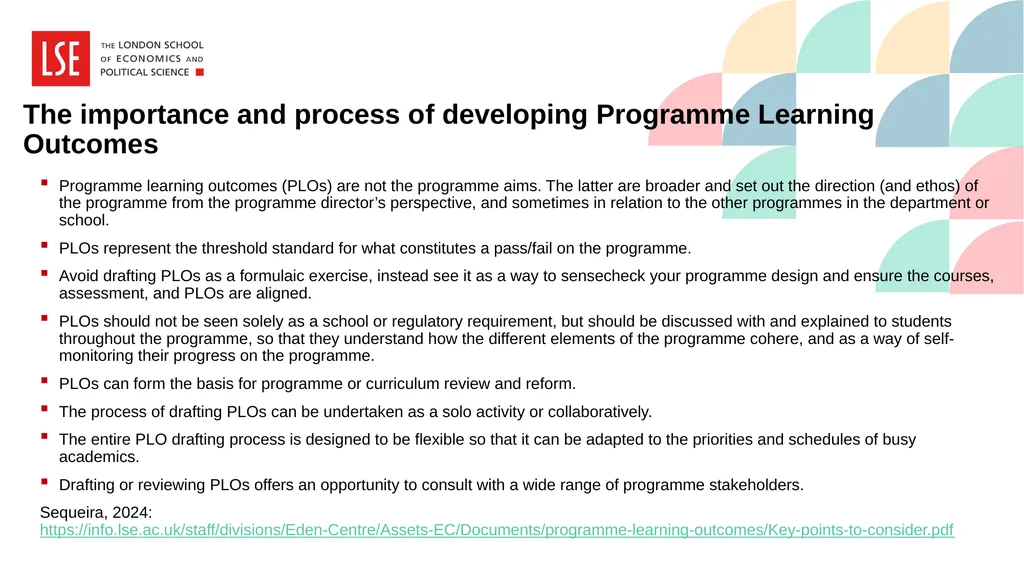
The importance and process of developing Programme Learning Outcomes Programme learning outcomes (PLOs) are not the programme aims. The latter are broader and set out the direction (and ethos) of the programme from the programme director’s perspective, and sometimes in relation to the other programmes in the department or school.
PLOs represent the threshold standard for what constitutes a pass/fail on the programme.
Avoid drafting PLOs as a formulaic exercise, instead see it as a way to sensecheck your programme design and ensure the courses, assessment, and PLOs are aligned.
PLOs should not be seen solely as a school or regulatory requirement, but should be discussed with and explained to students throughout the programme, so that they understand how the different elements of the programme cohere, and as a way of self-monitoring their progress on the programme.
PLOs can form the basis for programme or curriculum review and reform.
The process of drafting PLOs can be undertaken as a solo activity or collaboratively.
The entire PLO drafting process is designed to be flexible so that it can be adapted to the priorities and schedules of busy academics.
Drafting or reviewing PLOs offers an opportunity to consult with a wide range of programme stakeholders.
Sequeira, 2024: https://info.lse.ac.uk/staff/divisions/Eden-Centre/Assets-EC/Documents/programme-learning-outcomes/Key-points-to-consider.pdf<br>
17
Teaching Scenarios:
The following examples provide guidance and support for teachers by outlining potential situations they might encounter with their students and offering strategies to address them effectively.<br>
18
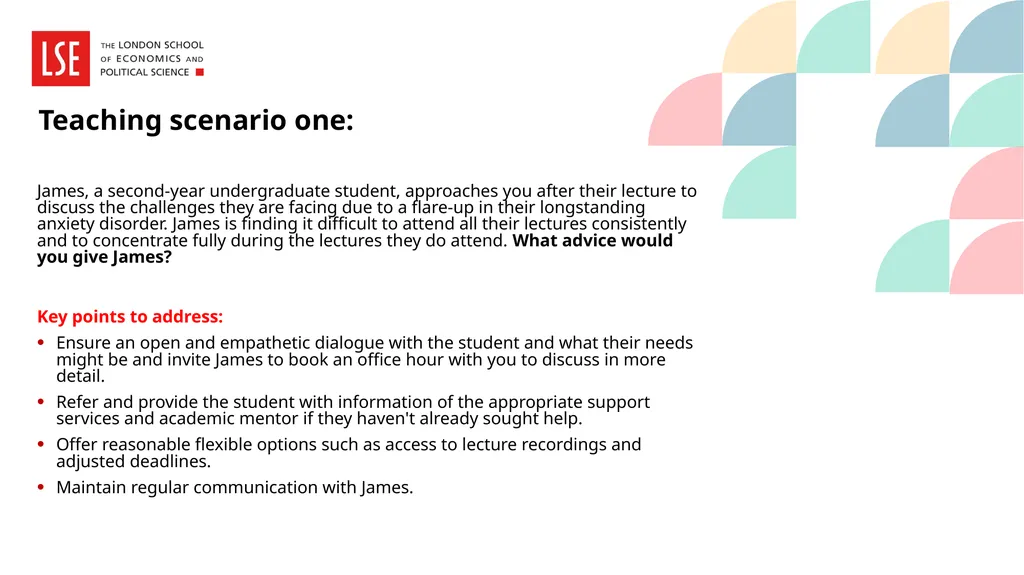
Teaching scenario one: James, a second-year undergraduate student, approaches you after their lecture to discuss the challenges they are facing due to a flare-up in their longstanding anxiety disorder. James is finding it difficult to attend all their lectures consistently and to concentrate fully during the lectures they do attend. What advice would you give James?
Key points to address:
Ensure an open and empathetic dialogue with the student and what their needs might be and invite James to book an office hour with you to discuss in more detail.
Refer and provide the student with information of the appropriate support services and academic mentor if they haven't already sought help.
Offer reasonable flexible options such as access to lecture recordings and adjusted deadlines.
Maintain regular communication with James.<br>
19
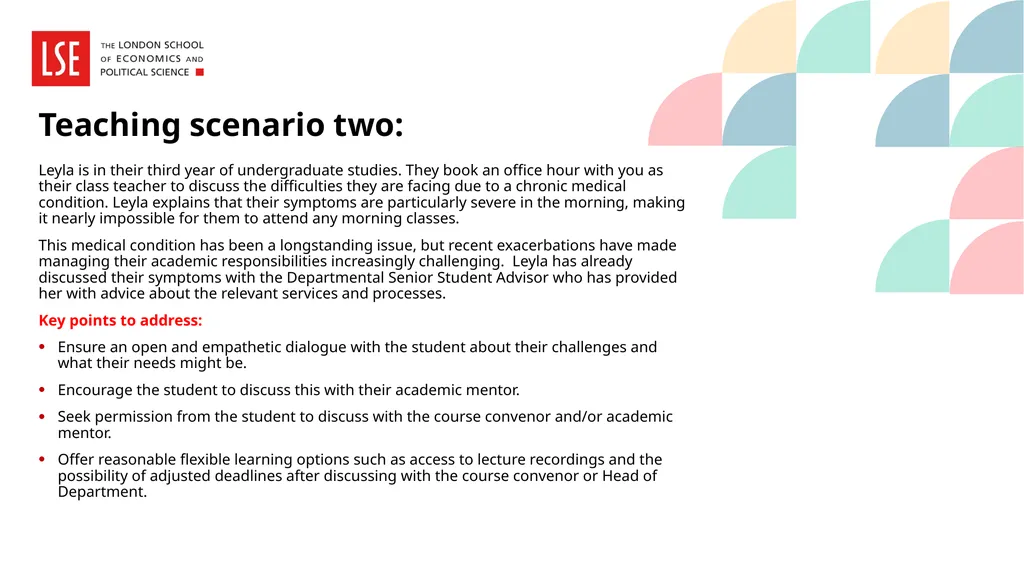
Teaching scenario two: Leyla is in their third year of undergraduate studies. They book an office hour with you as their class teacher to discuss the difficulties they are facing due to a chronic medical condition. Leyla explains that their symptoms are particularly severe in the morning, making it nearly impossible for them to attend any morning classes.
This medical condition has been a longstanding issue, but recent exacerbations have made managing their academic responsibilities increasingly challenging. Leyla has already discussed their symptoms with the Departmental Senior Student Advisor who has provided her with advice about the relevant services and processes.
Key points to address:
Ensure an open and empathetic dialogue with the student about their challenges and what their needs might be.
Encourage the student to discuss this with their academic mentor.
Seek permission from the student to discuss with the course convenor and/or academic mentor.
Offer reasonable flexible learning options such as access to lecture recordings and the possibility of adjusted deadlines after discussing with the course convenor or Head of Department.<br>
20
Teaching scenario three: A postgraduate student, Taylor, has approached you as their academic mentor to discuss the intense anxiety they experience related to participating in class discussions. Taylor explains that anxiety is so overwhelming that it prevents them from speaking up during lectures or group activities, which is affecting their academic performance and participation grades. Taylor has not seen a doctor, nor have they been in touch with the Student Wellbeing Services.
Key points to address:
Ensure an open and empathetic dialogue with the student about their challenges and what their needs might be.
Refer and provide the student with information of the appropriate support services if they haven't already sought help.
Reach out to the class teacher/course convenor to discuss and options for alternative methods of participation in line with the intended learning outcomes of the course such as:
Allowing Taylor to submit written responses or reflections instead of speaking up during class.
Providing opportunities for Taylor to participate in smaller group settings or one-on-one discussions with the instructor.
Utilising online tools such as Menti where Taylor can contribute at their own pace without the pressure of speaking in front of peers.<br>
21
Teaching scenario four: A course you lead has an assigned group presentation as the summative assessment. A student, Dina, has requested an adjustment to work alone due to severe anxiety that makes group work challenging. She has previously had adjustments put in place.
Key points to address:
Ensure an open and empathetic dialogue with the student about their challenges and what their needs might be.
Refer and provide the student with information about the appropriate support services available at LSE.
Offer alternative participation methods: Given the severity of Dina’s anxiety, you could work with Dina to create a participation plan that reasonably accommodates their needs. The plan may include:
Allowing Dina to complete the presentation individually rather than in a group.
Providing options for Dina to present in a smaller setting, such as to the teacher alone or in a recorded format.
Utilising written or multimedia presentation methods where Dina can demonstrate their understanding without the pressure of public speaking.<br>
22
Readings and resources: https://wonkhe.com/blogs/what-should-higher-education-learn-from-the-natasha-abrahart-case/
https://wonkhe.com/blogs/the-university-of-bristol-loses-its-appeal-over-the-abrahart-case/
https://www.hepi.ac.uk/2024/03/19/choosing-to-disclosebut-then-what/
https://www.equalityhumanrights.com/guidance/advice-note-higher-education-sector-legal-case-university-bristol-vs-abrahart
Bunbury, S. (2018). Disability in higher education – do reasonable adjustments contribute to an inclusive curriculum? International Journal of Inclusive Education, 24(9), 964–979. https://doi.org/10.1080/13603116.2018.1503347
Burin, A. K., & Atrey, S. (2024). Unleashing the anticipatory reasonable adjustment duty: University of Bristol v Abrahart (EHRC intervening) [2024] EWHC 299 (KB). International Journal of Discrimination and the Law, 24(1-2), 7-18. https://doi.org/10.1177/13582291241241505
OIA: The Good Practice Framework: Supporting Disabled Students https://www.oiahe.org.uk/media/5wrbx0a3/gpf-supporting-disabled-students.pdf<br>
23
Key contacts: Dr Akile Ahmet, Head, Inclusive Education: a.ahmet@lse.ac.uk
Dr Alex Standen, Head, Academic Development: a.m.standen@lse.ac.uk
Eden Centre Departmental Advisers: https://info.lse.ac.uk/staff/divisions/Eden-Centre/Departmental-Advising
Stef Hackney, Head of Disability and Mental Health Services: s.hackney1@lse.ac.uk
Student Well-Being Services: https://info.lse.ac.uk/current-students/student-wellbeing
Amy Norton, Head, EDI: a.norton@lse.ac.uk<br>