04
Deadweight Loss and�Market Power<br>
05
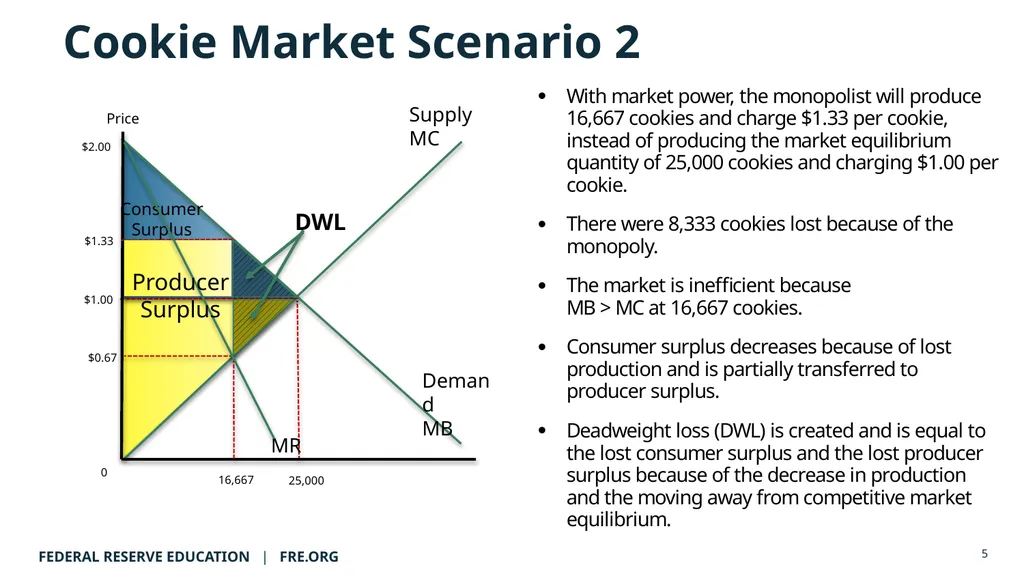
Cookie Market Scenario 2 With market power, the monopolist will produce 16,667 cookies and charge $1.33 per cookie, instead of producing the market equilibrium quantity of 25,000 cookies and charging $1.00 per cookie.
There were 8,333 cookies lost because of the monopoly.
The market is inefficient because �MB > MC at 16,667 cookies.
Consumer surplus decreases because of lost production and is partially transferred to producer surplus.
Deadweight loss (DWL) is created and is equal to the lost consumer surplus and the lost producer surplus because of the decrease in production and the moving away from competitive market equilibrium. Price 25,000 $1.00 $2.00 0 Supply
MC Demand
MB MR $1.33 16,667 Consumer
Surplus $0.67 DWL Producer
Surplus<br>
06
Deadweight Loss and�Government Intervention<br>
07
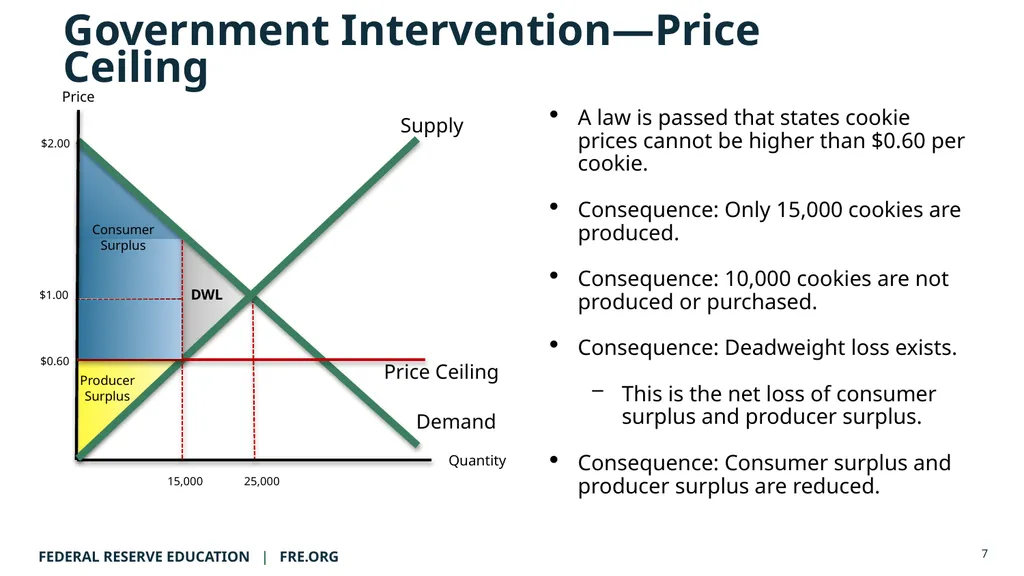
Government Intervention—Price Ceiling A law is passed that states cookie prices cannot be higher than $0.60 per cookie.
Consequence: Only 15,000 cookies are produced.
Consequence: 10,000 cookies are not produced or purchased.
Consequence: Deadweight loss exists.
This is the net loss of consumer surplus and producer surplus.
Consequence: Consumer surplus and producer surplus are reduced. Quantity Price 25,000 $1.00 Demand Supply 15,000 Consumer
Surplus DWL $0.60 $2.00 Price Ceiling Producer
Surplus<br>
08
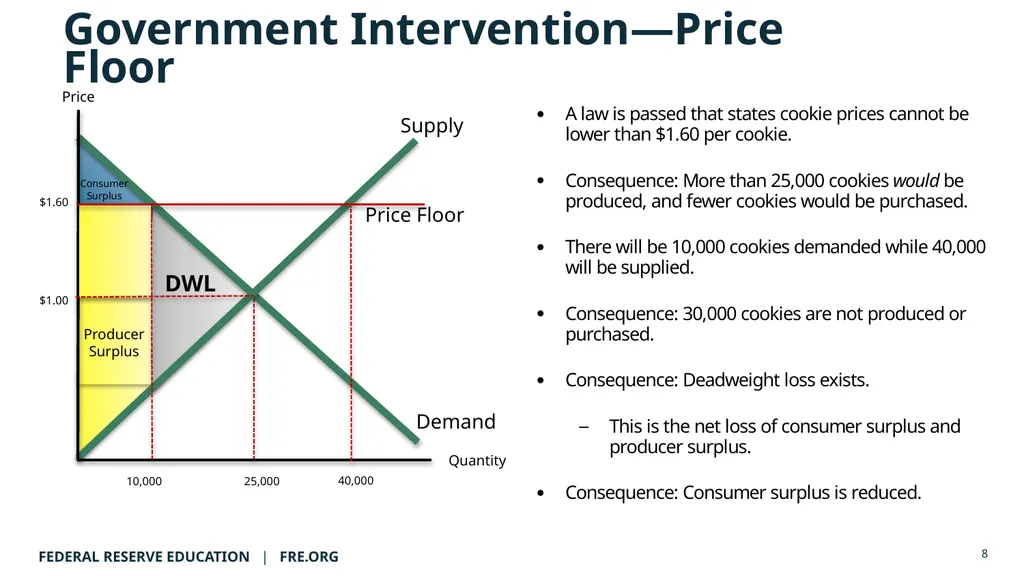
Government Intervention—Price Floor A law is passed that states cookie prices cannot be lower than $1.60 per cookie.
Consequence: More than 25,000 cookies would be produced, and fewer cookies would be purchased.
There will be 10,000 cookies demanded while 40,000 will be supplied.
Consequence: 30,000 cookies are not produced or purchased.
Consequence: Deadweight loss exists.
This is the net loss of consumer surplus and producer surplus.
Consequence: Consumer surplus is reduced. Quantity Price 25,000 $1.00 Demand Supply 10,000 Consumer Surplus DWL $1.60 Producer
Surplus Price Floor 40,000<br>
09
Deadweight Loss and�Externalities<br>
10
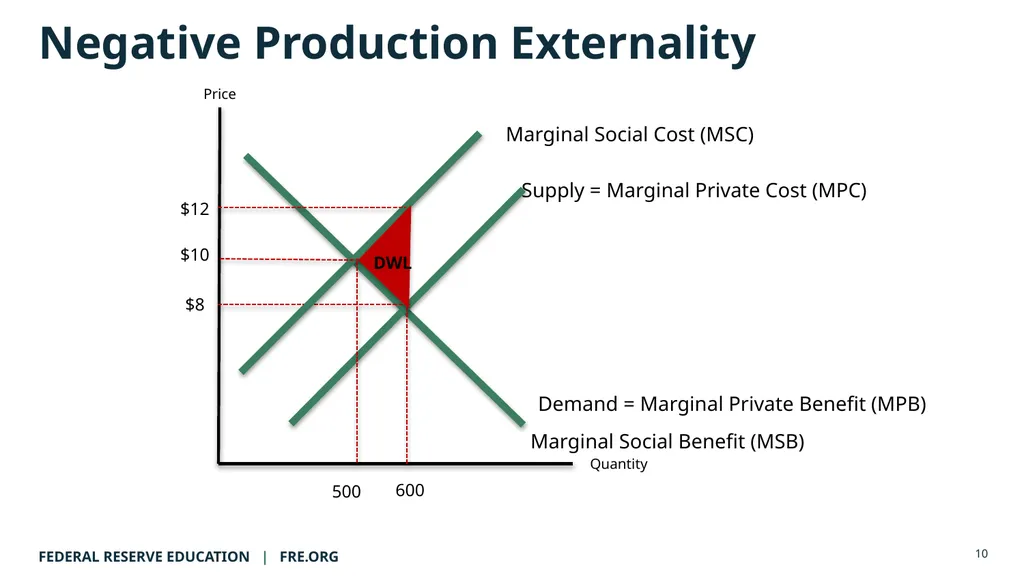
Negative Production Externality Quantity Price $8 600 Marginal Social Cost (MSC) Demand = Marginal Private Benefit (MPB) Supply = Marginal Private Cost (MPC) Marginal Social Benefit (MSB) 500 $10 $12 DWL<br>
11
Deadweight Loss�Calculation Practice<br>
12
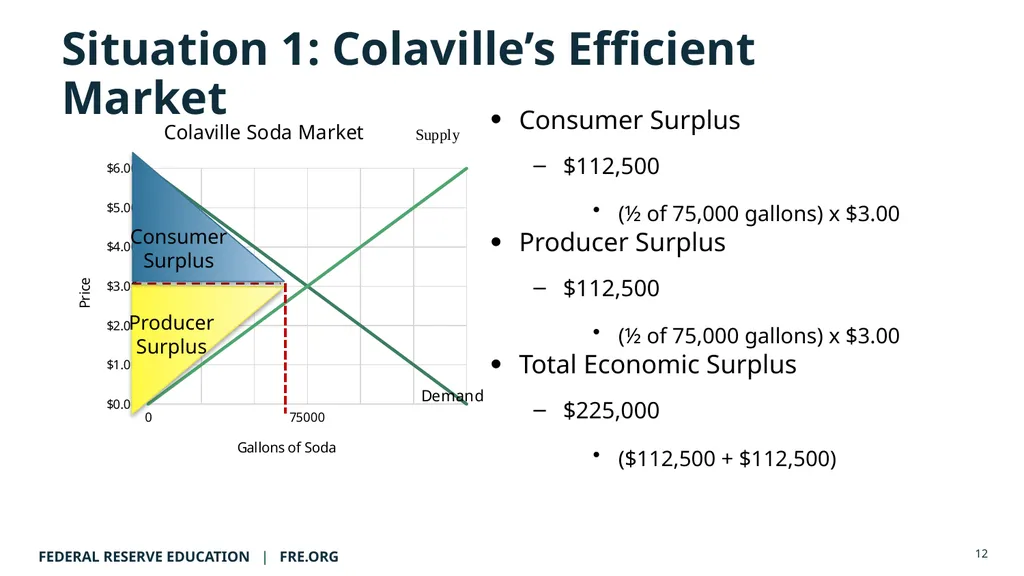
Situation 1: Colaville’s Efficient Market Consumer Surplus
$112,500
(½ of 75,000 gallons) x $3.00
Producer Surplus
$112,500
(½ of 75,000 gallons) x $3.00
Total Economic Surplus
$225,000
($112,500 + $112,500) Producer
Surplus Consumer
Surplus<br>
13
Tax
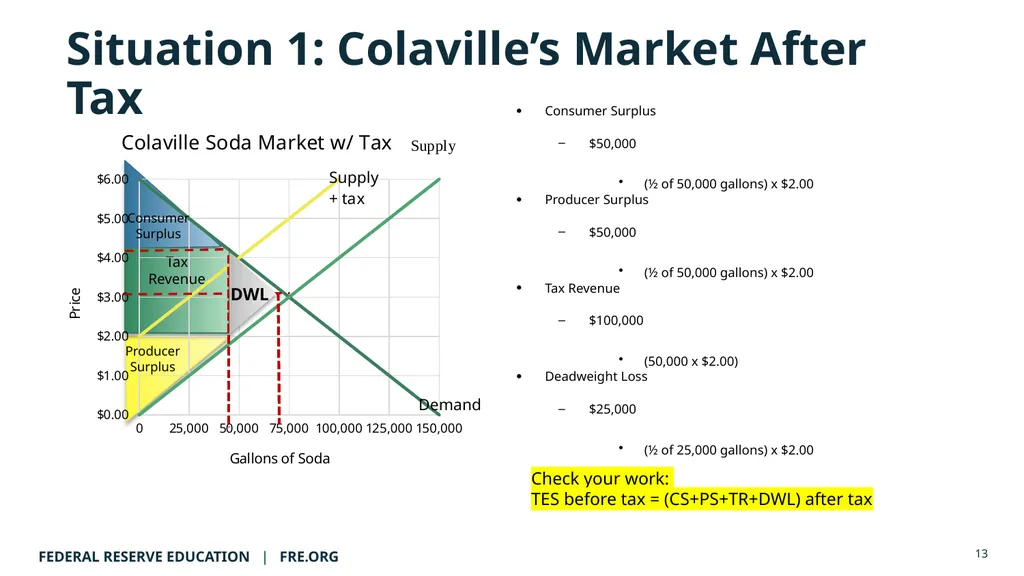
Revenue Situation 1: Colaville’s Market After Tax Consumer Surplus
$50,000
(½ of 50,000 gallons) x $2.00
Producer Surplus
$50,000
(½ of 50,000 gallons) x $2.00
Tax Revenue
$100,000
(50,000 x $2.00)
Deadweight Loss
$25,000
(½ of 25,000 gallons) x $2.00 Demand DWL Check your work: �TES before tax = (CS+PS+TR+DWL) after tax Consumer
Surplus Producer
Surplus<br>
14
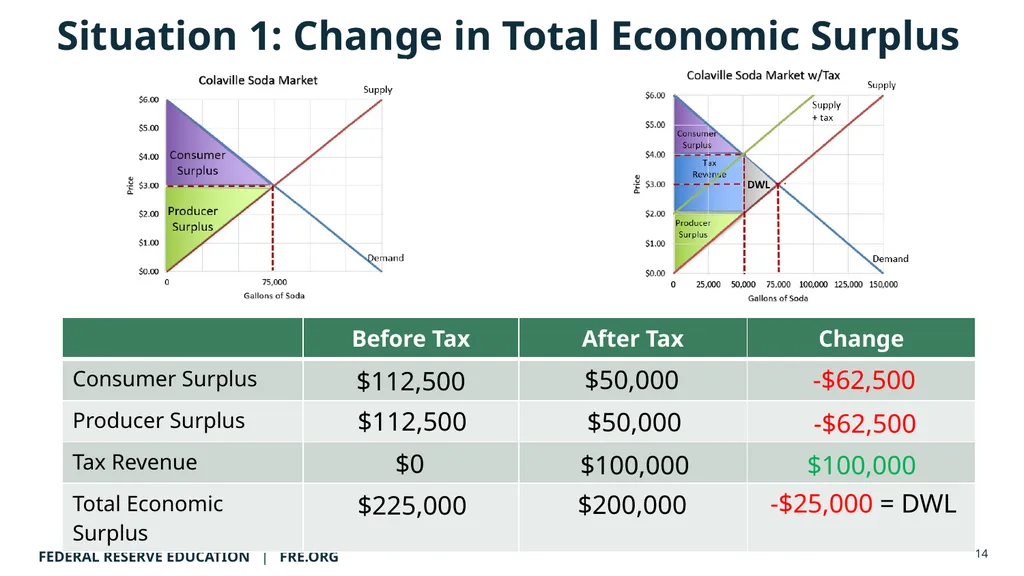
Situation 1: Change in Total Economic Surplus $112,500 $112,500 $0 $225,000 $50,000 $50,000 $100,000 $200,000 -$62,500 $100,000 -$25,000 = DWL -$62,500<br>
15
Deadweight Loss and �International Trade<br>
16
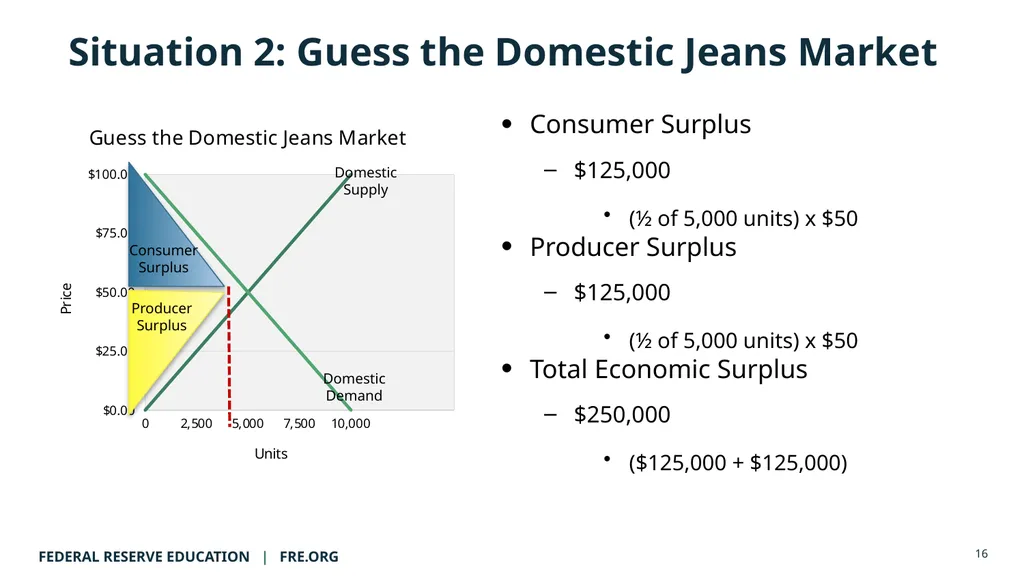
Situation 2: Guess the Domestic Jeans Market Consumer Surplus
$125,000
(½ of 5,000 units) x $50
Producer Surplus
$125,000
(½ of 5,000 units) x $50
Total Economic Surplus
$250,000
($125,000 + $125,000) Consumer
Surplus Producer
Surplus Domestic
Demand Domestic
Supply<br>
17
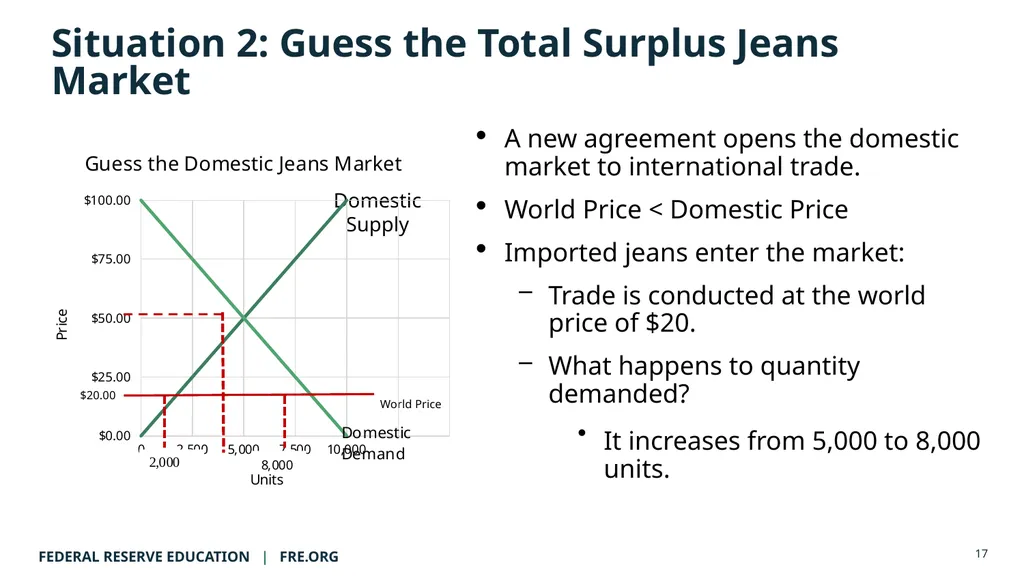
Situation 2: Guess the Total Surplus Jeans Market A new agreement opens the domestic market to international trade.
World Price < Domestic Price
Imported jeans enter the market:
Trade is conducted at the world price of $20.
What happens to quantity demanded?
It increases from 5,000 to 8,000 units. Domestic
Supply World Price $20.00<br>
18
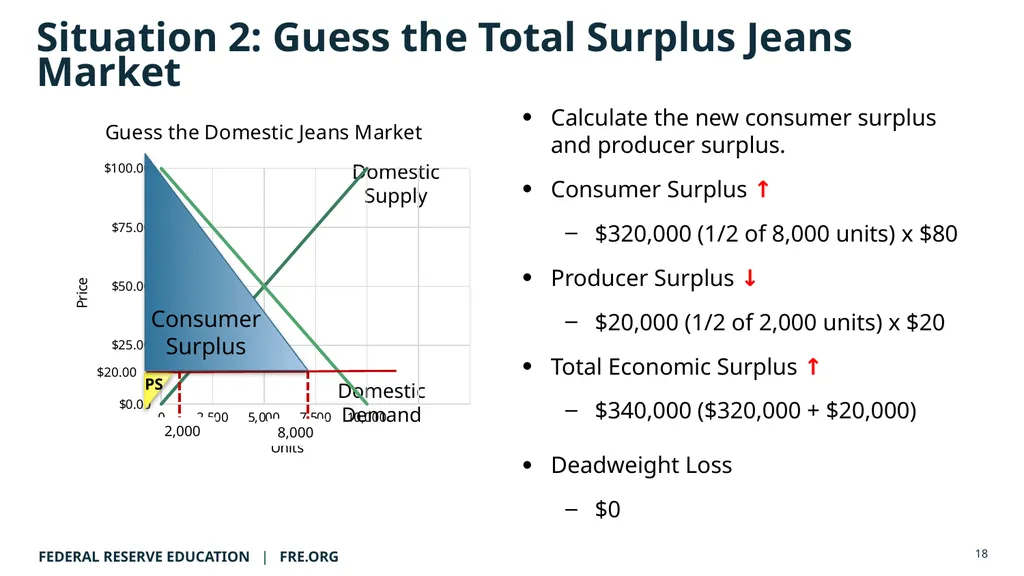
Situation 2: Guess the Total Surplus Jeans Market Calculate the new consumer surplus and producer surplus.
Consumer Surplus ↑
$320,000 (1/2 of 8,000 units) x $80
Producer Surplus ↓
$20,000 (1/2 of 2,000 units) x $20
Total Economic Surplus ↑
$340,000 ($320,000 + $20,000)�
Deadweight Loss
$0 Domestic
Demand Domestic
Supply PS Consumer
Surplus $20.00 2,000 8,000<br>
19
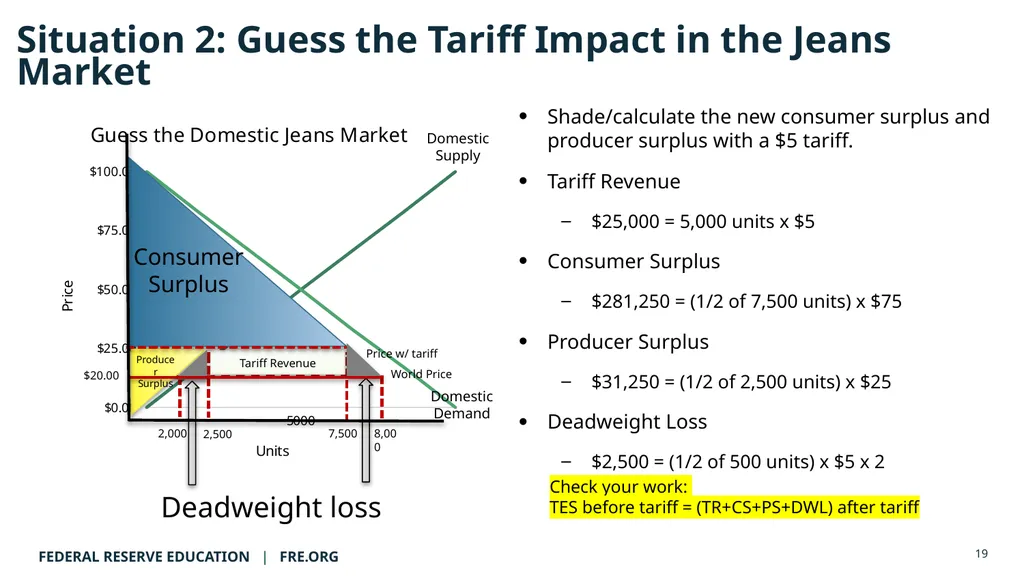
Situation 2: Guess the Tariff Impact in the Jeans Market Shade/calculate the new consumer surplus and producer surplus with a $5 tariff.
Tariff Revenue
$25,000 = 5,000 units x $5
Consumer Surplus
$281,250 = (1/2 of 7,500 units) x $75
Producer Surplus
$31,250 = (1/2 of 2,500 units) x $25
Deadweight Loss
$2,500 = (1/2 of 500 units) x $5 x 2 Domestic
Demand Domestic
Supply 7,500 2,500 Consumer
Surplus World Price Price w/ tariff Producer
Surplus Tariff Revenue Deadweight loss $20.00 2,000 8,000 Check your work: �TES before tariff = (TR+CS+PS+DWL) after tariff<br>
20
Check out fre.org for free, ready to use economics and personal finance resources!<br>