
'Application of APG Classification System in



Description: Application of APG Classification System in Taxonomy Dr. Tripta Jain Assistant Professor Department of Botany Introduction Taxonomy was mainly aimed at some convenient method of classification and communication. At the beginning the
Related Topics
Download Presentation
"'Application of APG Classification System in" is the property of its rightful owner. Permission is granted to download and print the materials on this website for personal, non-commercial use only, and to display it on your personal computer provided you do not modify the materials and that you retain all copyright notices contained in the materials. By downloading content from our website, you accept the terms of this agreement.
Presentation Transcript
slide1. 'Application of APG Classification System in Taxonomy"
Dr. Tripta Jain Assistant Professor Department of Botany<br>
slide2. Introduction Taxonomy was mainly aimed at some convenient method of classification and communication.
At the beginning the classification was purely artificial and involved certain simple characters which can be easily observable.
By the end of 19th century, attempts to classify plants gradually shifted from artificial to natural and phylogenetic.<br>
slide3. Introduction Man has been classifying plants since at least Theophrastus (c. 300bc), current system developed using plant structure dates back to Linnaeus (1753).
So, Linnaeus called the father of biological classification.
Before Linnaeus, classification systems have mainly based on habit.
Basically - three (four) kinds of classification system recognized:
artificial
natural
phylogenetic
Phenetic
phenetic system of classification: a system of classification that does not try to reflect evolutionary relationships; instead it is based on physical similarities among organisms (phenotype); organisms are placed in the same category because they look alike.<br>
slide4. Pre Darwinism and Post Darwinism classifications Pre-Darwinian Classification Systems
The early natural classifications or Pre-Darwinian classification systems were started when the classification systems started to reflect the situation as it might have existed in nature. During that period a number of morphological characters of the plants were considered as they found in nature and the concept of species was based on typological or fixidity concept. Major contributors of this period were Carolus Linnaeus (1707-1778),
Michel Adanson (1763), Bernard de Jussieu (1789), A. P. de Candolle (1813), Bentham and Hooker (1862-1883), etc.
•<br>
slide5. Linnaeus’ classification system
When Linnaeus classified the flowering plants (angiosperms) in his book Species Plantarum (1753), he used the numbers of male and female parts in flowers as the main characters. He realised that this inevitably led to an artificial system, with unrelated plants being put together in many cases, and many of his contemporaries were shocked by the focus on sexual organs. Over the next two and a half centuries, many botanists endeavoured to come up with more natural systems, using more characters, with the intention of recognising groups that more closely reflected relationships. However, even readily recognisable groups such as orchids or legumes were treated as one family in some classifications and as several families in others.
Following important works on plant classification by members of the de Candolle family, de Jussieu and others, Kew botanists, George Bentham and Joseph Hooker, developed a system of classification in the 19th century that was in use in Kew’s Herbarium and elsewhere until a few years ago. In the 20th century, Cronquist (in the USA) and Takhtajan (in Russia) developed widely used systems.<br>
slide6. Post Darwin Natural Systems With the publication of Charles Darwin’s the Origin of Species in 1859 the old concept (typological) on the classification was changed.
The system developed based on the concept of Darwin theory/ evolutionary tendencies is known as phylogenetic systems.
The phylogenetic classification is usually designed on the basis of natural classification. During this period, the alpha taxonomy (describing, naming and classification organisms) is gradually replaced by modern systematics which deals with the relationships between taxa, especially at the higher levels.
Major contributors of the phylogenetic system of classification are Engler and Prantl (1887-1915), Bessey 1915, Hutchinson (1926, 1934), Takhtajan (1964, 1969, 1973 and 1980), Cronquist (1968, 1981), APG, etc.<br>
slide7. DNA comes into the picture
In the early 1990s, the first large analyses of flowering plants based on DNA sequences were published. These had become possible due to major developments in DNA sequencing technology and computing power in the late 20th century. Flowering plants were the first major group on which large groups of scientists collaborated in comprehensive analyses of this type, collecting sequences for the same genes, so that the data could be combined.
In 1993, a landmark paper with an analysis of 500 flowering plants was published by Mark Chase and 41 co-authors, the year after Mark moved from the University of North Carolina to Kew. This paper was based on sequences of one of the major genes involved in photosynthesis, and the analysis involved the botanists working with the computer programmers because the program had to be rewritten to allow them to analyse such a large data set.
The resulting family tree of relationships was an interesting mix of the expected and the unexpected. The monocots (grasses, lilies, orchids etc.) appeared as a group, for example, but the dicots (magnolias, laurels, roses, daisies etc.) did not, and some families that had never previously been thought to be related appeared close to each other. One example of this was so unexpected that fresh samples of the plants were collected and the gene was re-sequenced because people just could not believe the result! The original analysis placed the sacred lotus (Nelumbo) close to plane trees (Platanus) and banksias and their relatives (Proteaceae), and the lack of obvious shared characters made the scientists nervous about the accuracy of the data. However, the new sequences gave the same result and so did analyses of other DNA regions.<br>
slide8. Development of the APG system
Three further versions of the APG classification were published in 2003, 2009 and 2016, each with multiple compilers and contributors. The most recent version, APG IV published this month, has ten compilers and 15 contributors from six countries and is the result of a workshop hosted by Kew in September 2015. An online survey also provided useful background about the views of botanists and other users of the classification around the world (Christenhusz et al., 2015). Each version of APG has included a list of families and/or genera of uncertain position – in 1998, 25 families fell in this category, but by 2016 the list had shrunk to seven genera, demonstrating the increase in knowledge as more plants have been sampled and more DNA regions have been investigated.
The number of higher-level groups, formal and informal, has also increased, as a reflection of increasing confidence in the relationships of families to each other. Changes in APG IV on the basis of published studies include placement of Petenaea in its own family (Petenaeaceae), recognition of Kewaceae for the genus Kewa (previously included in Hypertelis in Molluginaceae) and reorganisation of some families that were known to be problematic. For example, several genera had been moved from Icacinaceae into the previously monogeneric Metteniusaceae.<br>
slide9. Introduction of APG In the late 1990s, an informal group of botanists from major institutions of world that have been carrying out the analysis of plant genetic material came together under the title of the 'Angiosperm Phylogeny Group' or APG.
Their intention was to provide a widely accepted and more stable point of reference for angiosperm classification.
Their first attempt at a new system was published in 1998 (the APG
system). Three revisions have been published, in 2003 (APG II) , 2009 (APG
III) and 2016 (APG IV), each superseding the previous system.
Eight researchers have been listed as authors to the three papers, and a further 33 as contributors.<br>
slide10. Introduction The existing systems are rejected because they are not phylogenetic, i.e. are not based on strictly monophyletic groups (i.e. groups which consist of all descendants of a common ancestor).
APG, show that the monocots form a monophyletic group (clade), but that the dicots do not (-paraphyletic).
Majority of dicot species do form a monophyletic group, called the eudicots or tricolpates. Of the remaining dicot species, most belong to a third major clade known as the Magnoliidae.
The rest include a paraphyletic grouping of primitive species known collectively as the basal angiosperms, plus the families Ceratophyllaceae and Chloranthaceae.<br>
slide11. Introduction Monophyletic refers to a group that consists of a common ancestor plus all descendants of that ancestor. Paraphyletic refers to a group that includes a common ancestor plus some, but not all, descendants of that common ancestor.
The diversity of flowering plants is not evenly distributed. Nearly, all species belong to the eudicot (75%), monocot (23%) and magnoliid (2%) clades. The remaining 5 clades contain a little over 250 species in total, i.e., less than 0.1% of flowering plant diversity, divided among 9 families.<br>
slide12. Principles of APG The principles of the APG's approach to classification were set out in the first paper of 1998, and have remained unchanged in subsequent revisions. These are:
The Linnean system of orders and families should be retained. "The family is
central in flowering plant systematics”.
Groups should be monophyletic (i.e. consist of all descendants of a common ancestor). The main reason why existing systems are rejected is because they do not have this property, they are not phylogenetic.
Families containing only a single genus and orders containing only a single family are avoided where this is possible without violating the over-riding requirement for monophyly.<br>
slide13. Angiosperm Phylogeny Group (2016)."An update of the Angiosperm
Phylogeny Group classification for the orders and families of flowering
plants: APG IV" (PDF). Botanical Journal of the Linnean Society 181 (1): 1–20.doi:10.1111/boj.12385.
APG III. 2009. "An update of the Angiosperm Phylogeny Group classification
for the orders and families of flowering plants: APG III", Botanical Journal of the Linnean Society 161 (2): 105–121.
APG II. 2003. An update of the Angiosperm Phylogeny Group classification for
the orders and families of flowering plants: APG II. Botanical Journal of the Linnean Society 141: 399–436.
APG. 1998. An ordinal classification for the families of flowering plants. Annals of the Missouri Botanical Garden 85: 531–553<br>
slide14. Application of APG The APG publications are increasingly regarded as an authoritative point of reference.
A significant number of major herbaria, including Kew, Edinburgh are changing the
order of their collections in accordance with APG.
The influential World Checklist of Selected Plant Families (also from Kew) is being updated to the APG III system.
In the USA, a recent photographic survey of the plants of the USA and Canada is
organized according to the APG II system.
In the UK, the latest edition of the standard flora of the British Isles (by Stace) is based on the APG III system. The previous edition was based on the Cronquist system.
Flora of Nepal project planning to follow the APG system,<br>
slide15. Summary of APG 1998 Formal, scientific names/ ranks are not used above the level of order, named clades being used instead. Thus eudicots and monocots are not
given a formal rank (Linnean rank) on the grounds that "it is not yet
clear at which level they should be recognized.
The number of families in APG (1998) was 462 and recognized 40 orders, compared to, for example, 232 in Takhtajan's 1997 classification.
A substantial number of taxa whose classification had traditionally been uncertain are given places, although there still remain 25 families of "uncertain position.<br>
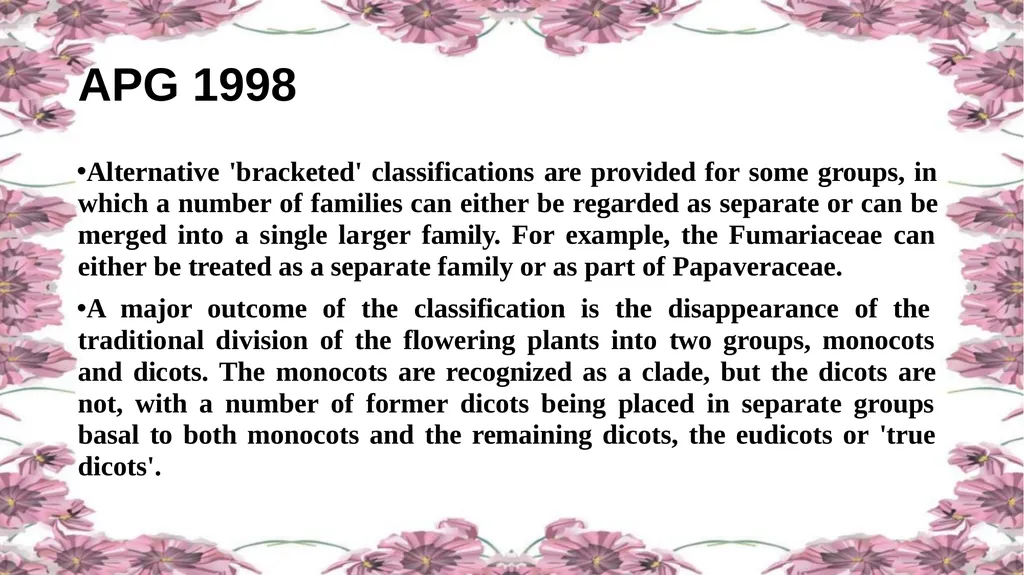
slide16. APG 1998 Alternative 'bracketed' classifications are provided for some groups, in which a number of families can either be regarded as separate or can be merged into a single larger family. For example, the Fumariaceae can either be treated as a separate family or as part of Papaveraceae.
A major outcome of the classification is the disappearance of the traditional division of the flowering plants into two groups, monocots and dicots. The monocots are recognized as a clade, but the dicots are not, with a number of former dicots being placed in separate groups basal to both monocots and the remaining dicots, the eudicots or 'true dicots'.<br>
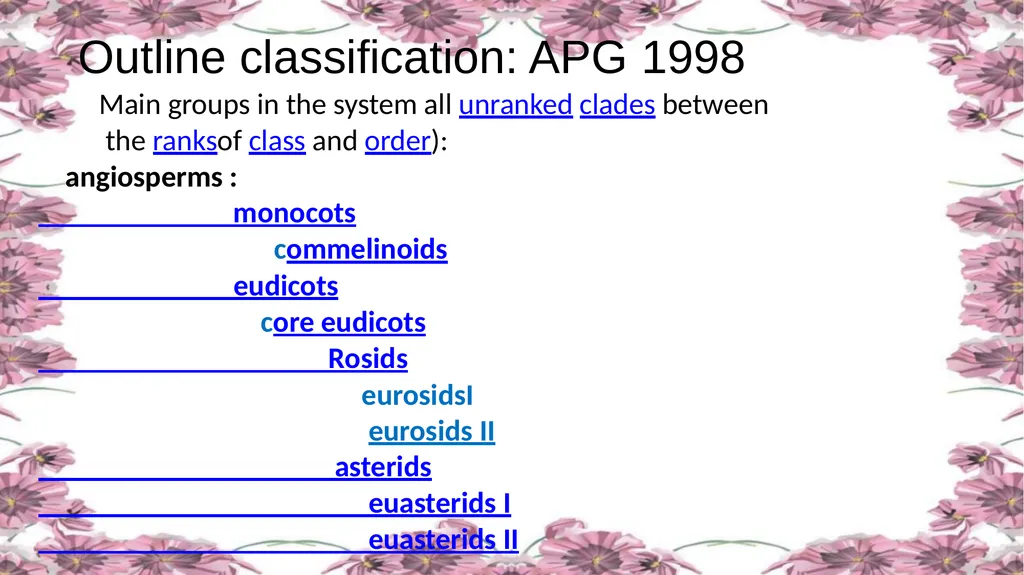
slide17. Outline classification: APG 1998 Main groups in the system all unranked clades between
the ranksof class and order):
angiosperms :
monocots
commelinoids
eudicots
core eudicots
Rosids
eurosidsI eurosids II
asterids
euasterids I
euasterids II<br>
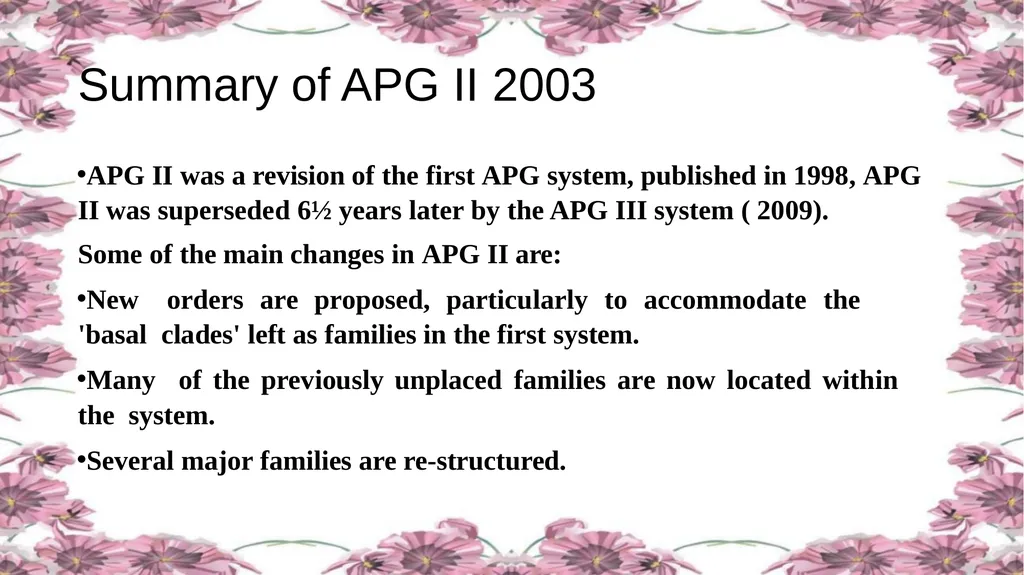
slide18. Summary of APG II 2003 APG II was a revision of the first APG system, published in 1998, APG II was superseded 6½ years later by the APG III system ( 2009).
Some of the main changes in APG II are:
New orders are proposed, particularly to accommodate the 'basal clades' left as families in the first system.
Many of the previously unplaced families are now located within the system.
Several major families are re-structured.<br>
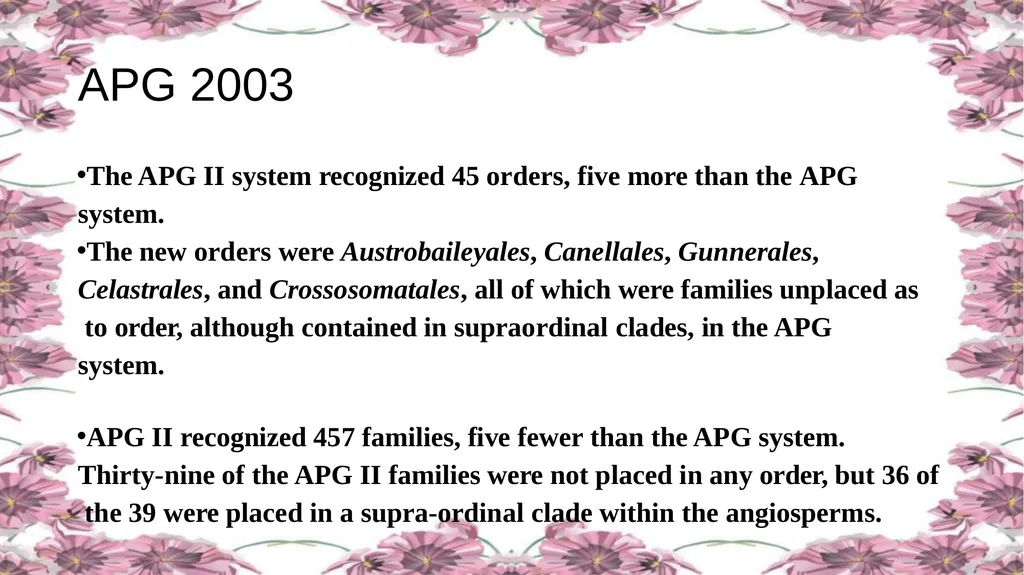
slide19. APG 2003 The APG II system recognized 45 orders, five more than the APG system.
The new orders were Austrobaileyales, Canellales, Gunnerales, Celastrales, and Crossosomatales, all of which were families unplaced as to order, although contained in supraordinal clades, in the APG system.
APG II recognized 457 families, five fewer than the APG system.
Thirty-nine of the APG II families were not placed in any order, but 36 of the 39 were placed in a supra-ordinal clade within the angiosperms.<br>
slide20. APG 2003 Fifty-five of the families came to be known as "bracketed families".
The use of alternative 'bracketed' taxa allowing the choice of either a large family or a number of smaller ones.
For example, the large Asparagaceae family includes 7 'bracketed' families which can either be considered as part of the Asparagaceae or as separate families.<br>
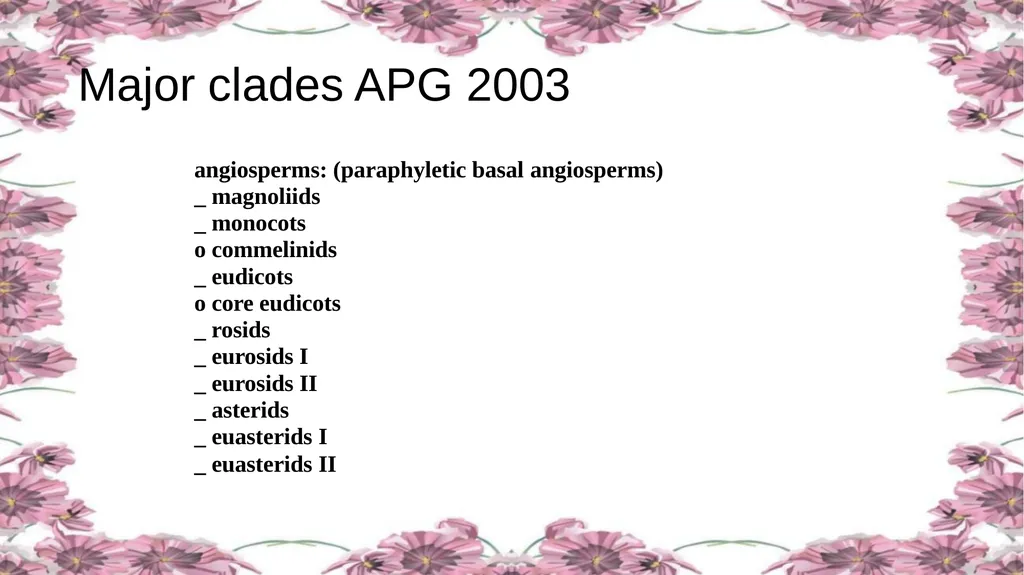
slide21. Major clades APG 2003 angiosperms: (paraphyletic basal angiosperms)
_ magnoliids
_ monocots
o commelinids
_ eudicots
o core eudicots
_ rosids
_ eurosids I
_ eurosids II
_ asterids
_ euasterids I
_ euasterids II<br>
slide22. APG III 2009 The third paper from the APG updates the system described in the 2003 paper.
The broad outline of the system remains unchanged, but the number of previously unplaced families and genera is significantly reduced. This requires the recognition of both new orders and new families compared to the previous classification.
The APG III system recognized all of the 45 orders of the previous system, as well as 14 new ones (the number of orders goes up from 45 to 59).
Only 10 families are not placed in an order and only two of these (Apodanthaceae and Cynomoriaceae) are left entirely outside the classification.<br>
slide23. APG 2009 The designation of alternative "bracketed families" was abandoned in APG III, because its inclusion in the previous system had been unpopular. APG III recognized 415 families, 42 fewer than in the APG II.
Forty-four of the 55 "bracketed families" were discontinued, and 18 other families were discontinued as well. For example, the agave family (Agavaceae) and the hyacinth family (Hyacinthaceae) are no longer regarded as distinct from the broader asparagus family (Asparagaceae).
The classification of the families in APG III which uses formal taxonomic ranks; previously only informal clade names have been tried to use above the ordinal level.<br>
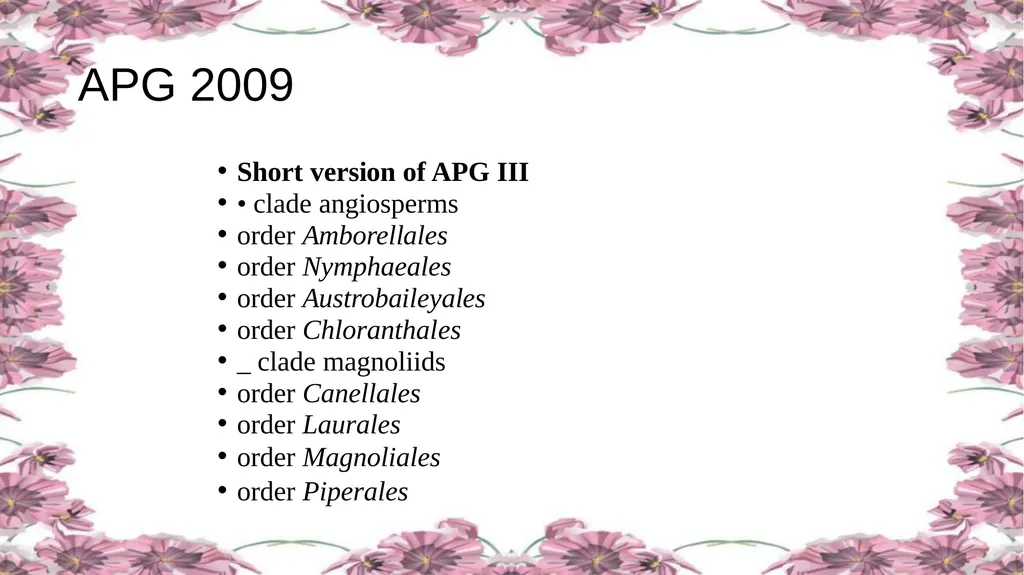
slide24. APG 2009 Short version of APG III
• clade angiosperms
order Amborellales
order Nymphaeales
order Austrobaileyales
order Chloranthales
_ clade magnoliids
order Canellales
order Laurales
order Magnoliales
order Piperales<br>
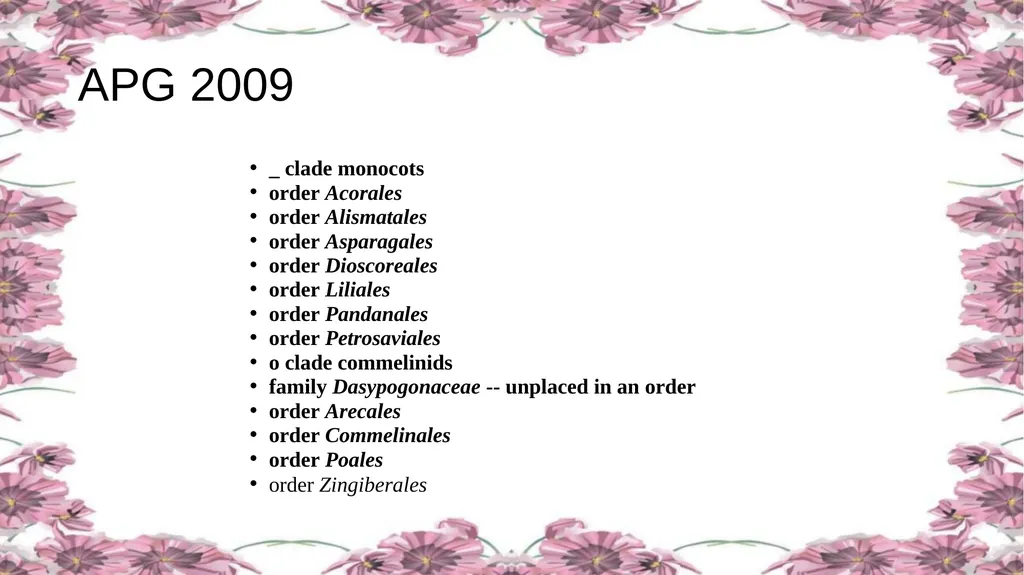
slide25. APG 2009 _ clade monocots
order Acorales
order Alismatales
order Asparagales
order Dioscoreales
order Liliales
order Pandanales
order Petrosaviales
o clade commelinids
family Dasypogonaceae -- unplaced in an order
order Arecales
order Commelinales
order Poales
order Zingiberales<br>
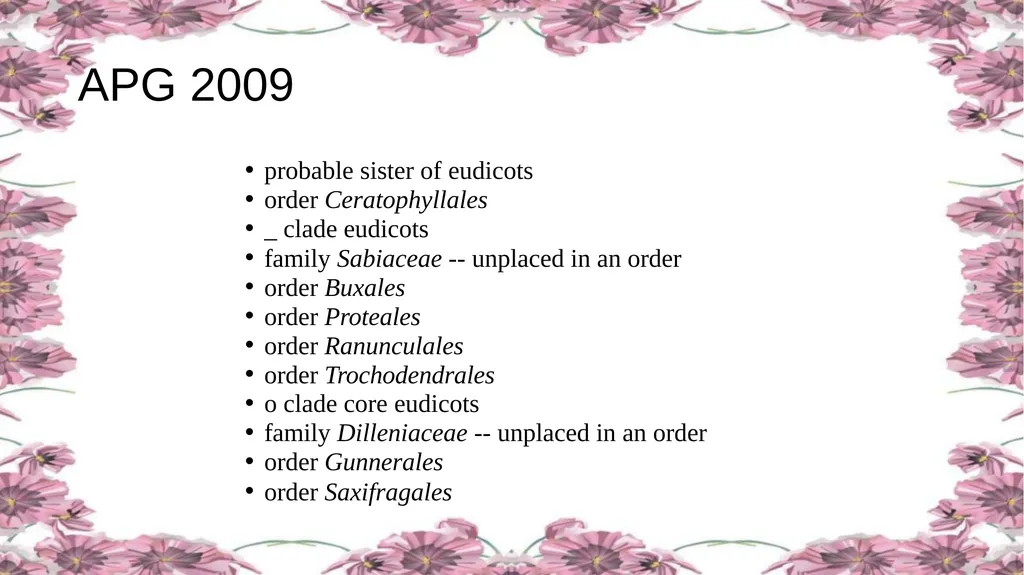
slide26. APG 2009 probable sister of eudicots
order Ceratophyllales
_ clade eudicots
family Sabiaceae -- unplaced in an order
order Buxales
order Proteales
order Ranunculales
order Trochodendrales
o clade core eudicots
family Dilleniaceae -- unplaced in an order
order Gunnerales
order Saxifragales<br>
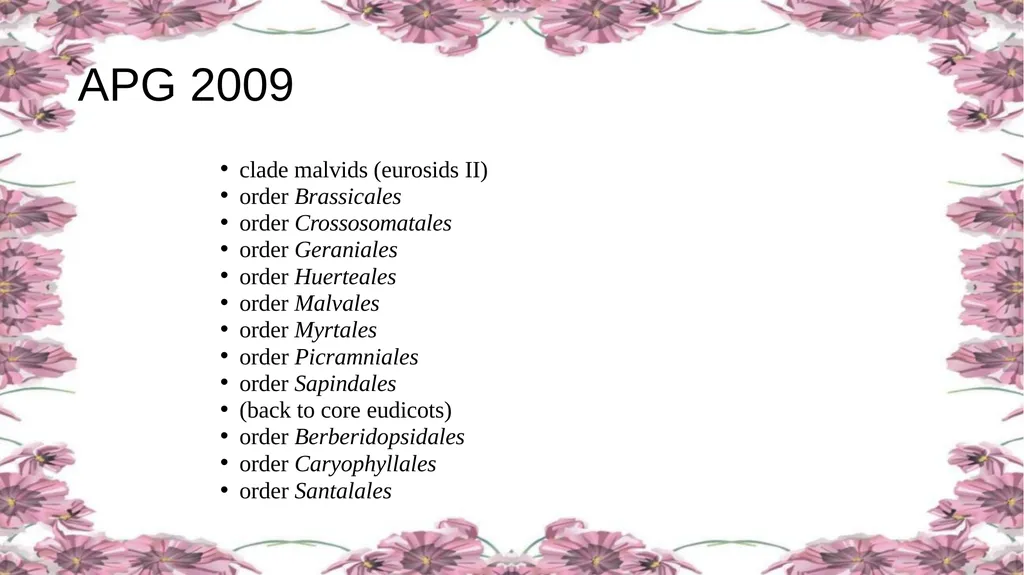
slide27. APG 2009 clade malvids (eurosids II)
order Brassicales
order Crossosomatales
order Geraniales
order Huerteales
order Malvales
order Myrtales
order Picramniales
order Sapindales
(back to core eudicots)
order Berberidopsidales
order Caryophyllales
order Santalales<br>
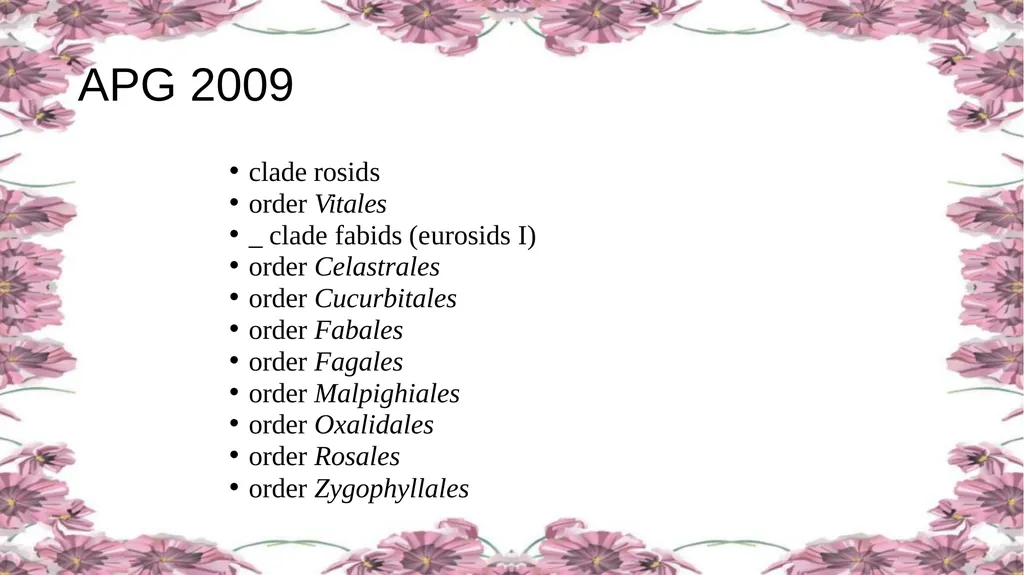
slide28. APG 2009 clade rosids
order Vitales
_ clade fabids (eurosids I)
order Celastrales
order Cucurbitales
order Fabales
order Fagales
order Malpighiales
order Oxalidales
order Rosales
order Zygophyllales<br>
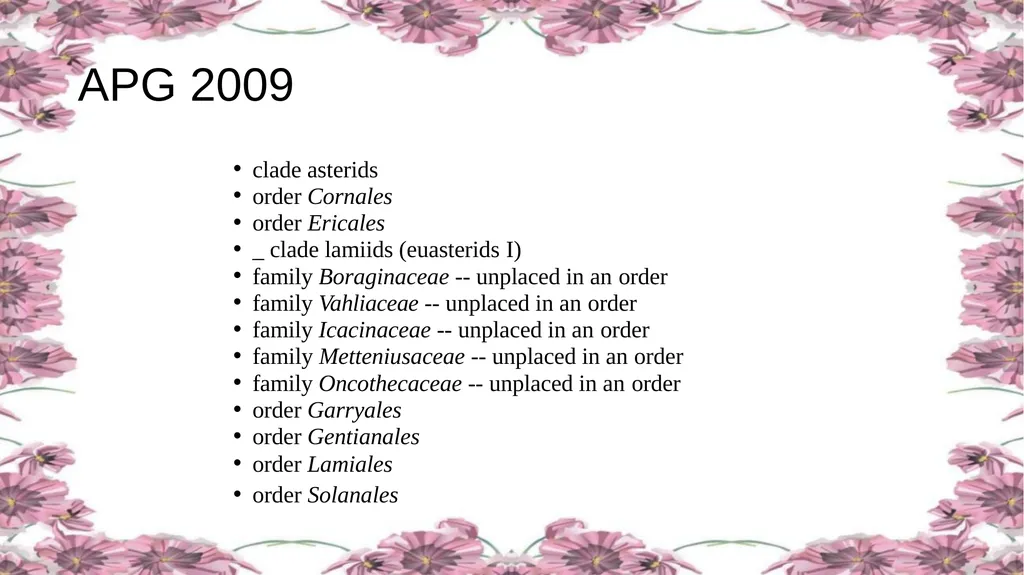
slide29. APG 2009 clade asterids
order Cornales
order Ericales
_ clade lamiids (euasterids I)
family Boraginaceae -- unplaced in an order
family Vahliaceae -- unplaced in an order
family Icacinaceae -- unplaced in an order
family Metteniusaceae -- unplaced in an order
family Oncothecaceae -- unplaced in an order
order Garryales
order Gentianales
order Lamiales
order Solanales<br>
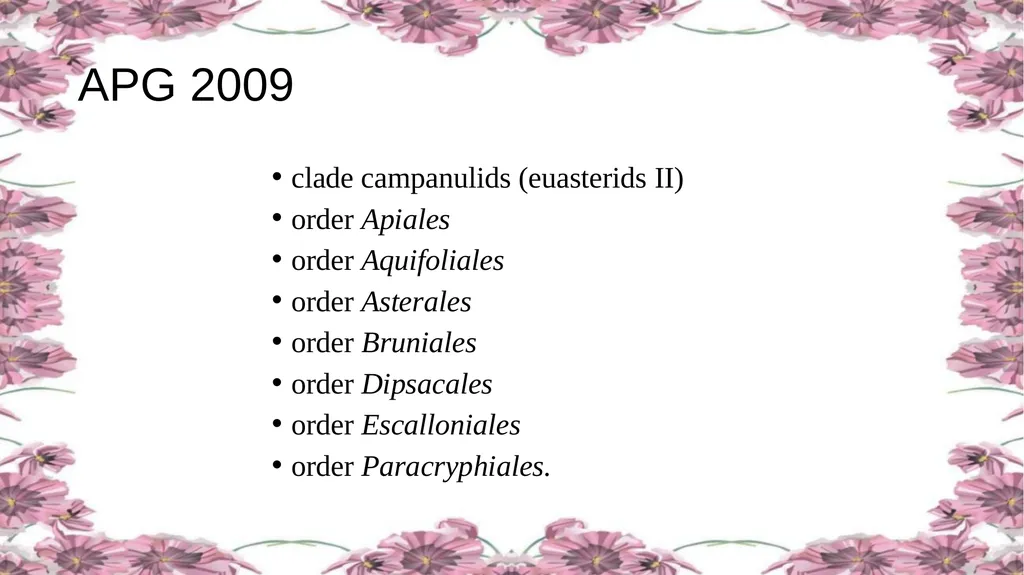
slide30. APG 2009 clade campanulids (euasterids II)
order Apiales
order Aquifoliales
order Asterales
order Bruniales
order Dipsacales
order Escalloniales
order Paracryphiales.<br>
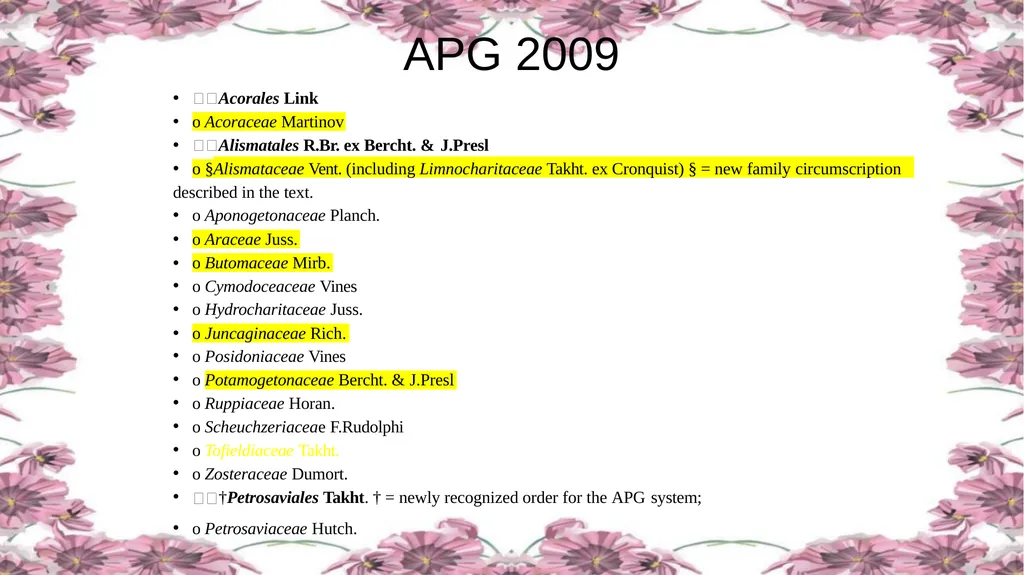
slide31. APG 2009 Acorales Link o Acoraceae Martinov Alismatales R.Br. ex Bercht. & J.Presl •
•
•
• o § Alismataceae Vent. (including Limnocharitaceae Takht. ex Cronquist) § = new family circumscription described in the text. o Araceae Juss. o Butomaceae Mirb. o Juncaginaceae Rich. o Aponogetonaceae Planch.
•
•
o Cymodoceaceae Vines
o Hydrocharitaceae Juss.
•
o Posidoniaceae Vines
o Potamogetonaceae Bercht. & J.Presl
o Ruppiaceae Horan.
o Scheuchzeriaceae F.Rudolphi
o Tofieldiaceae Takht.
o Zosteraceae Dumort.
†Petrosaviales Takht. † = newly recognized order for the APG system;
o Petrosaviaceae Hutch.<br>
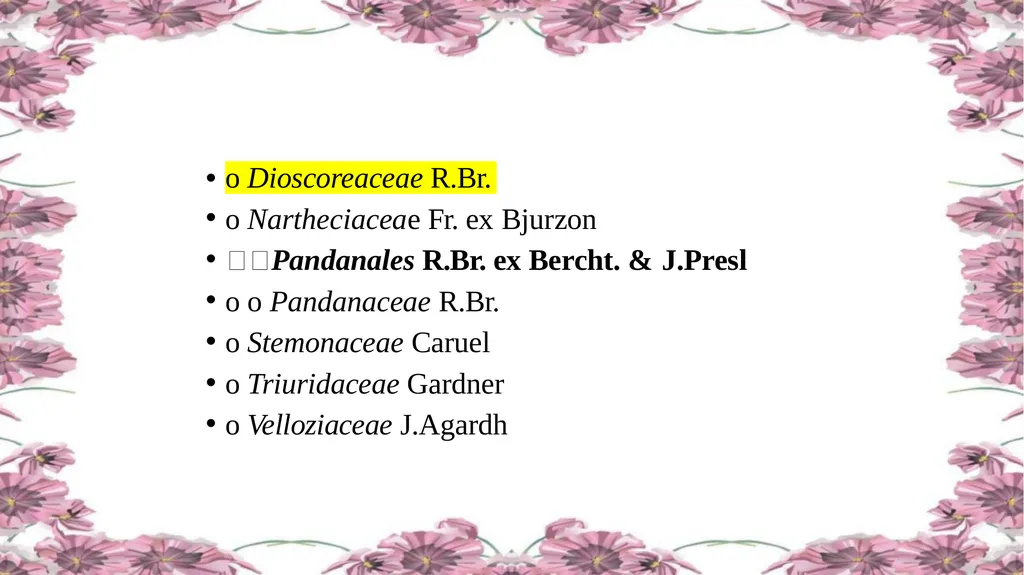
slide32. • o Dioscoreaceae R.Br. o Nartheciaceae Fr. ex Bjurzon
Pandanales R.Br. ex Bercht. & J.Presl
o o Pandanaceae R.Br.
o Stemonaceae Caruel
o Triuridaceae Gardner
o Velloziaceae J.Agardh<br>
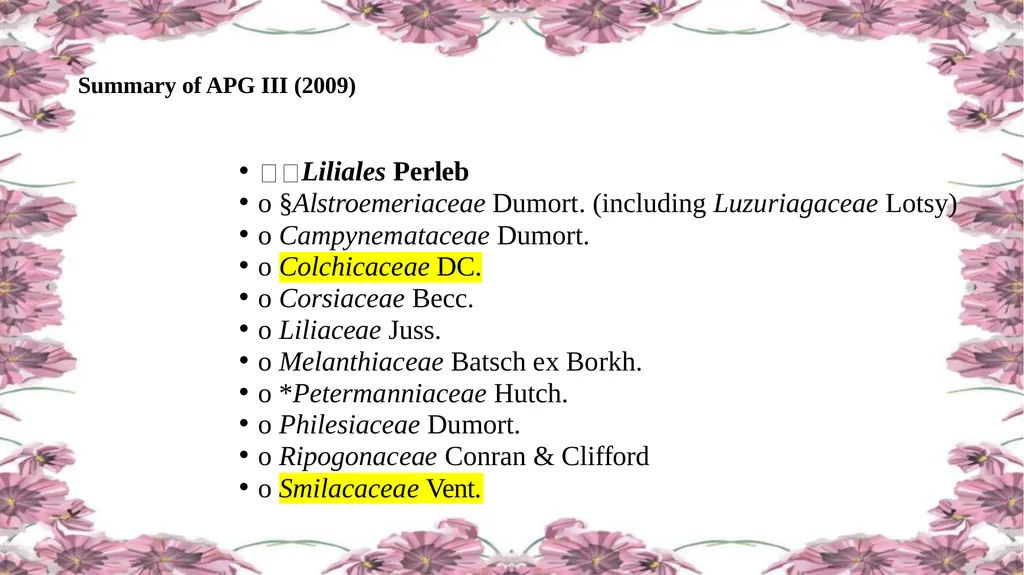
slide33. Summary of APG III (2009) Liliales Perleb
o §Alstroemeriaceae Dumort. (including Luzuriagaceae Lotsy)
o Campynemataceae Dumort.
o Colchicaceae DC.
o Corsiaceae Becc.
o Liliaceae Juss.
o Melanthiaceae Batsch ex Borkh.
o *Petermanniaceae Hutch.
o Philesiaceae Dumort.
o Ripogonaceae Conran & Clifford
o Smilacaceae Vent.<br>
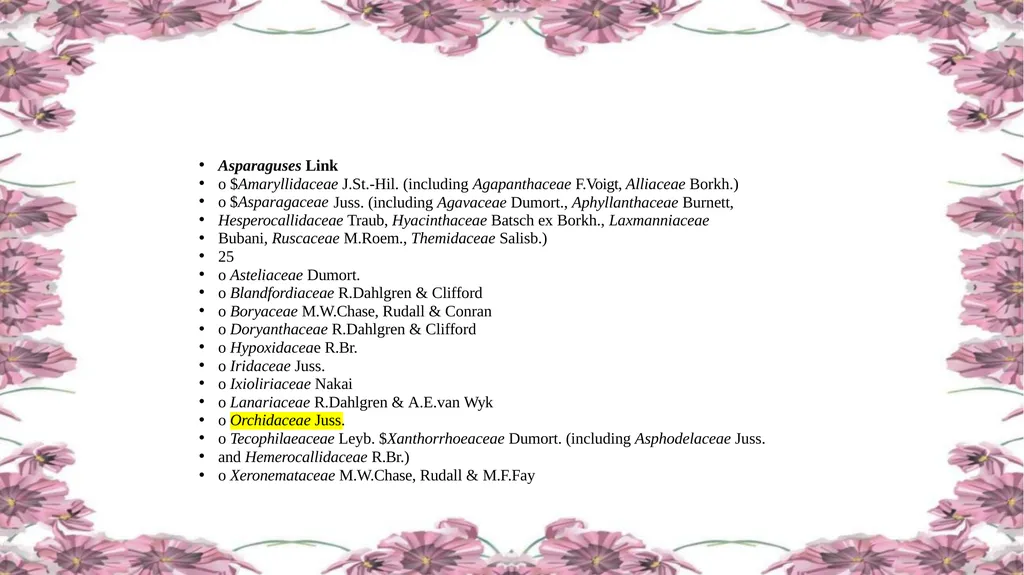
slide34. Juss. (including Agavaceae Dumort., Aphyllanthaceae Burnett, Asparaguses Link
o $Amaryllidaceae J.St.-Hil. (including Agapanthaceae F.Voigt, Alliaceae Borkh.)
o $Asparagaceae
Hesperocallidaceae Traub, Hyacinthaceae Batsch ex Borkh., Laxmanniaceae
Bubani, Ruscaceae M.Roem., Themidaceae Salisb.)
25
o Asteliaceae Dumort.
o Blandfordiaceae R.Dahlgren & Clifford
o Boryaceae M.W.Chase, Rudall & Conran
o Doryanthaceae R.Dahlgren & Clifford
o Hypoxidaceae R.Br.
o Iridaceae Juss.
o Ixioliriaceae Nakai
o Lanariaceae R.Dahlgren & A.E.van Wyk
o Orchidaceae Juss.
o Tecophilaeaceae Leyb. $Xanthorrhoeaceae Dumort. (including Asphodelaceae Juss.
and Hemerocallidaceae R.Br.)
o Xeronemataceae M.W.Chase, Rudall & M.F.Fay<br>
slide35. Comeliness
Dasypogonaceae Dumort.
Arecales Bromhead
o Arecaceae Bercht. & J.Presl
Commelinales Mirb. ex Bercht. & J.Presl
o Commelinaceae Mirb.
o Haemodoraceae R. Br.
o Hanguanaceae Airy Shaw
o Philydraceae Link
o Pontederiaceae Kunth<br>
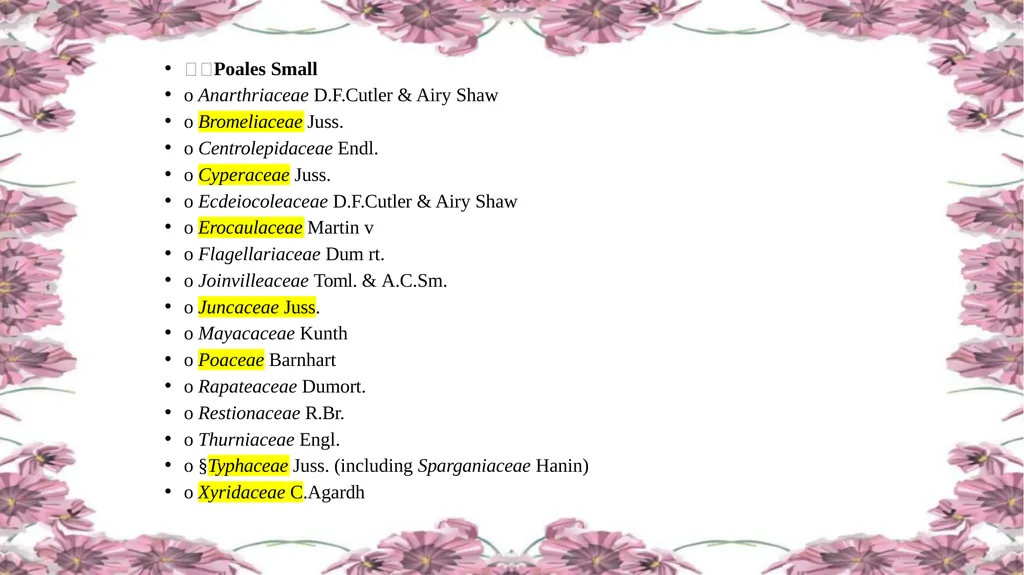
slide36. Poales Small
o Anarthriaceae D.F.Cutler & Airy Shaw
o Bromeliaceae Juss.
o Centrolepidaceae Endl.
o Cyperaceae Juss.
o Ecdeiocoleaceae D.F.Cutler & Airy Shaw
o Erocaulaceae Martin v
o Flagellariaceae Dum rt.
o Joinvilleaceae Toml. & A.C.Sm.
o Juncaceae Juss.
o Mayacaceae Kunth
o Poaceae Barnhart
o Rapateaceae Dumort.
o Restionaceae R.Br.
o Thurniaceae Engl.
o §Typhaceae Juss. (including Sparganiaceae Hanin)
o Xyridaceae C.Agardh<br>
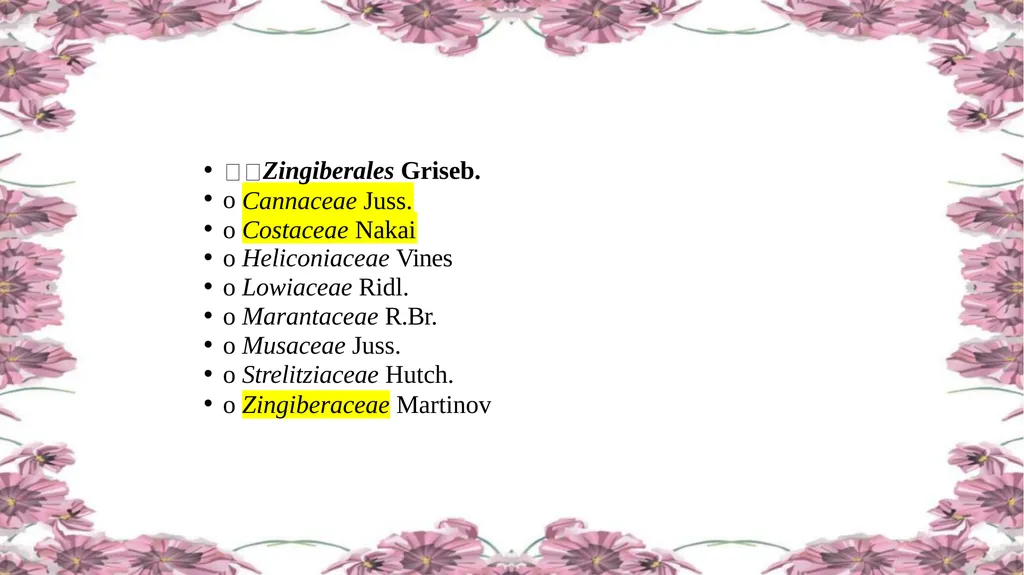
slide37. Cannaceae Juss. Zingiberales Griseb.
o
o Costaceae Nakai o Heliconiaceae Vines
o Lowiaceae Ridl.
o Marantaceae R.Br.
o Musaceae Juss.
o Strelitziaceae Hutch.
o Zingiberaceae Martinov<br>
slide38. APG 2016 IV A fourth version has now been published, but the methodology has been the subject of criticism, and developing a consensus has proved more difficult than in previous iterations.
In particular Peter Stevens has questioned the validity of discussions regarding family delimitation in the absence of changes of phylogenetic relationships.<br>
slide39. APG IV An update of the Angiosperm Phylogeny Group (APG) classification of the orders and families of angiosperms is presented.
Several new orders are recognized: Boraginales, Dilleniales, Icacinales, Metteniusiales and Vahliales.
This brings the total number of orders and families recognized in the APG system to 64 and 416, respectively.
Two additional informal major clades, superrosids and superasterids are proposed, that each comprise the additional orders that are included in the larger clades dominated by the rosids and asterids.
Families that made up potentially monofamilial orders, Dasypogonaceae and Sabiaceae, are instead referred to Arecales and Proteales, respectively<br>
slide40. Two parasitic families formerly of uncertain positions are now placed: Cynomoriaceae in Saxifragales and Apodanthaceae in Cucurbitales<br>
slide41. References
Angiosperm Phylogeny Group (1998). An ordinal classification for the families of flowering plants. Annals of Missouri Botanical Garden 85: 531-553 Available online
APG II. (2003). An update of the Angiosperm Phylogeny Group classification for the orders and families of flowering plants. Botanical Journal of the Linnean Society 141: 399-436 Available online
APG III. (2009). An update of the Angiosperm Phylogeny Group classification for the orders and families of flowering plants: APG III. Botanical Journal of the Linnean Society161: 105-121 Available online
APG IV. (2016). An update of the Angiosperm Phylogeny Group classification for the orders and families of flowering plants: APG IV. Botanical Journal of the Linnean Society181: 1–20 Available online
Byng, J. W. (2014). The Flowering Plants Handbook: a Practical Guide to Families and Genera of the World.
Plant Gateway, Hertford.
Byng, J. W., Bernardini, B., Joseph, J. A., Chase, M. W. & Utteridge, T. M. A. (2014). Phylogenetic relationships of Icacinaceae focusing on the vining genera. Botanical Journal of the Linnean Society 176: 277–294 Available online
Chase, M. W., Soltis, D. E., Olmstead, R. G., Morgan, D., Les, D. H., Mishler, B. D., Duvall, M. R., Price, R. A.,
Hills, H. G., Qiu, Y. L., Kron, K. A., Rettig, J. H., Conti, E., Palmer, J. D., Manhart, J. R., Sytsma, K. J., Michael,
H. J., Kress, W. J., Karol, K. G., Clark, W. D., Hedrén, M., Gaut, B. S., Jansen, R. K., Kim, Y.J., Wimpee, C. F., Smith, J. F., Furnier, G. R., Strauss, S. H., Xiang, Q. Y., Plunkett, G. M., Soltis, P. S., Swensen, S. M., Williams, S. E., Gadek, P. A., Quinn, C. J., Eguiarte, L. E., Golenberg, E., Learn, G. H. Jr, Graham, S. W., Barrett, S. C. H., Dayanandan, S. & Albert, V. A. (1993). Phylogenetics of seed plants: an analysis of nucleotide sequences from the plastid gene rbcL. Annals of the Missouri Botanical Garden 80: 528–
580 Available online<br>
slide42. Christenhusz, M. J. M., Brockington, S. F., Christin, P.-A. & Sage, R.F. (2014). On the disintegration of Molluginaceae: a new genus and family (Kewa, Kewaceae) segregated from Hypertelis, and placement of Macarthuria in Macarthuriaceae. Phytotaxa 181: 238–242 Available online
Christenhusz, M. J. M., Fay, M. F., Clarkson, J. J., Gasson, P., Morales Can, J., Jiménez Barrios, J. B., Chase, M. W. (2010). Petenaeaceae, a new angiosperm family in Huerteales with a distant relationship to Gerrardina (Gerrardinaceae). Botanical Journal of the Linnean Society 164: 16–25 Available online Christenhusz, M. J. M., Vorontsova, M. S., Fay, M. F. & Chase, M. W. (2015). Results from an online survey of family delimitation in angiosperms and ferns: recommendations to the Angiosperm Phylogeny Group for thorny problems in plant classification. Botanical Journal of the Linnean Society 178: 501- 528 Available online
Linnaeus, C. (1753). Species Plantarum. L. Salvius, Stockholm.
Wearn, J. A., Chase, M. W., Mabberley, D. J. & Couch, C. (2013). Utilizing a phylogenetic plant classification for systematic arrangements in botanic gardens and herbaria. Botanical Journal of the Linnean Society 172: 127–141 Available online
Related links Kew Science blog Kew's Science Strategy Linnaeus sexual system
Angiosperm Phylogeny website
Angiosperm Phylogeny Group (APG) classification Chart of flowering plant families<br>
Dr. Tripta Jain Assistant Professor Department of Botany<br>
slide2. Introduction Taxonomy was mainly aimed at some convenient method of classification and communication.
At the beginning the classification was purely artificial and involved certain simple characters which can be easily observable.
By the end of 19th century, attempts to classify plants gradually shifted from artificial to natural and phylogenetic.<br>
slide3. Introduction Man has been classifying plants since at least Theophrastus (c. 300bc), current system developed using plant structure dates back to Linnaeus (1753).
So, Linnaeus called the father of biological classification.
Before Linnaeus, classification systems have mainly based on habit.
Basically - three (four) kinds of classification system recognized:
artificial
natural
phylogenetic
Phenetic
phenetic system of classification: a system of classification that does not try to reflect evolutionary relationships; instead it is based on physical similarities among organisms (phenotype); organisms are placed in the same category because they look alike.<br>
slide4. Pre Darwinism and Post Darwinism classifications Pre-Darwinian Classification Systems
The early natural classifications or Pre-Darwinian classification systems were started when the classification systems started to reflect the situation as it might have existed in nature. During that period a number of morphological characters of the plants were considered as they found in nature and the concept of species was based on typological or fixidity concept. Major contributors of this period were Carolus Linnaeus (1707-1778),
Michel Adanson (1763), Bernard de Jussieu (1789), A. P. de Candolle (1813), Bentham and Hooker (1862-1883), etc.
•<br>
slide5. Linnaeus’ classification system
When Linnaeus classified the flowering plants (angiosperms) in his book Species Plantarum (1753), he used the numbers of male and female parts in flowers as the main characters. He realised that this inevitably led to an artificial system, with unrelated plants being put together in many cases, and many of his contemporaries were shocked by the focus on sexual organs. Over the next two and a half centuries, many botanists endeavoured to come up with more natural systems, using more characters, with the intention of recognising groups that more closely reflected relationships. However, even readily recognisable groups such as orchids or legumes were treated as one family in some classifications and as several families in others.
Following important works on plant classification by members of the de Candolle family, de Jussieu and others, Kew botanists, George Bentham and Joseph Hooker, developed a system of classification in the 19th century that was in use in Kew’s Herbarium and elsewhere until a few years ago. In the 20th century, Cronquist (in the USA) and Takhtajan (in Russia) developed widely used systems.<br>
slide6. Post Darwin Natural Systems With the publication of Charles Darwin’s the Origin of Species in 1859 the old concept (typological) on the classification was changed.
The system developed based on the concept of Darwin theory/ evolutionary tendencies is known as phylogenetic systems.
The phylogenetic classification is usually designed on the basis of natural classification. During this period, the alpha taxonomy (describing, naming and classification organisms) is gradually replaced by modern systematics which deals with the relationships between taxa, especially at the higher levels.
Major contributors of the phylogenetic system of classification are Engler and Prantl (1887-1915), Bessey 1915, Hutchinson (1926, 1934), Takhtajan (1964, 1969, 1973 and 1980), Cronquist (1968, 1981), APG, etc.<br>
slide7. DNA comes into the picture
In the early 1990s, the first large analyses of flowering plants based on DNA sequences were published. These had become possible due to major developments in DNA sequencing technology and computing power in the late 20th century. Flowering plants were the first major group on which large groups of scientists collaborated in comprehensive analyses of this type, collecting sequences for the same genes, so that the data could be combined.
In 1993, a landmark paper with an analysis of 500 flowering plants was published by Mark Chase and 41 co-authors, the year after Mark moved from the University of North Carolina to Kew. This paper was based on sequences of one of the major genes involved in photosynthesis, and the analysis involved the botanists working with the computer programmers because the program had to be rewritten to allow them to analyse such a large data set.
The resulting family tree of relationships was an interesting mix of the expected and the unexpected. The monocots (grasses, lilies, orchids etc.) appeared as a group, for example, but the dicots (magnolias, laurels, roses, daisies etc.) did not, and some families that had never previously been thought to be related appeared close to each other. One example of this was so unexpected that fresh samples of the plants were collected and the gene was re-sequenced because people just could not believe the result! The original analysis placed the sacred lotus (Nelumbo) close to plane trees (Platanus) and banksias and their relatives (Proteaceae), and the lack of obvious shared characters made the scientists nervous about the accuracy of the data. However, the new sequences gave the same result and so did analyses of other DNA regions.<br>
slide8. Development of the APG system
Three further versions of the APG classification were published in 2003, 2009 and 2016, each with multiple compilers and contributors. The most recent version, APG IV published this month, has ten compilers and 15 contributors from six countries and is the result of a workshop hosted by Kew in September 2015. An online survey also provided useful background about the views of botanists and other users of the classification around the world (Christenhusz et al., 2015). Each version of APG has included a list of families and/or genera of uncertain position – in 1998, 25 families fell in this category, but by 2016 the list had shrunk to seven genera, demonstrating the increase in knowledge as more plants have been sampled and more DNA regions have been investigated.
The number of higher-level groups, formal and informal, has also increased, as a reflection of increasing confidence in the relationships of families to each other. Changes in APG IV on the basis of published studies include placement of Petenaea in its own family (Petenaeaceae), recognition of Kewaceae for the genus Kewa (previously included in Hypertelis in Molluginaceae) and reorganisation of some families that were known to be problematic. For example, several genera had been moved from Icacinaceae into the previously monogeneric Metteniusaceae.<br>
slide9. Introduction of APG In the late 1990s, an informal group of botanists from major institutions of world that have been carrying out the analysis of plant genetic material came together under the title of the 'Angiosperm Phylogeny Group' or APG.
Their intention was to provide a widely accepted and more stable point of reference for angiosperm classification.
Their first attempt at a new system was published in 1998 (the APG
system). Three revisions have been published, in 2003 (APG II) , 2009 (APG
III) and 2016 (APG IV), each superseding the previous system.
Eight researchers have been listed as authors to the three papers, and a further 33 as contributors.<br>
slide10. Introduction The existing systems are rejected because they are not phylogenetic, i.e. are not based on strictly monophyletic groups (i.e. groups which consist of all descendants of a common ancestor).
APG, show that the monocots form a monophyletic group (clade), but that the dicots do not (-paraphyletic).
Majority of dicot species do form a monophyletic group, called the eudicots or tricolpates. Of the remaining dicot species, most belong to a third major clade known as the Magnoliidae.
The rest include a paraphyletic grouping of primitive species known collectively as the basal angiosperms, plus the families Ceratophyllaceae and Chloranthaceae.<br>
slide11. Introduction Monophyletic refers to a group that consists of a common ancestor plus all descendants of that ancestor. Paraphyletic refers to a group that includes a common ancestor plus some, but not all, descendants of that common ancestor.
The diversity of flowering plants is not evenly distributed. Nearly, all species belong to the eudicot (75%), monocot (23%) and magnoliid (2%) clades. The remaining 5 clades contain a little over 250 species in total, i.e., less than 0.1% of flowering plant diversity, divided among 9 families.<br>
slide12. Principles of APG The principles of the APG's approach to classification were set out in the first paper of 1998, and have remained unchanged in subsequent revisions. These are:
The Linnean system of orders and families should be retained. "The family is
central in flowering plant systematics”.
Groups should be monophyletic (i.e. consist of all descendants of a common ancestor). The main reason why existing systems are rejected is because they do not have this property, they are not phylogenetic.
Families containing only a single genus and orders containing only a single family are avoided where this is possible without violating the over-riding requirement for monophyly.<br>
slide13. Angiosperm Phylogeny Group (2016)."An update of the Angiosperm
Phylogeny Group classification for the orders and families of flowering
plants: APG IV" (PDF). Botanical Journal of the Linnean Society 181 (1): 1–20.doi:10.1111/boj.12385.
APG III. 2009. "An update of the Angiosperm Phylogeny Group classification
for the orders and families of flowering plants: APG III", Botanical Journal of the Linnean Society 161 (2): 105–121.
APG II. 2003. An update of the Angiosperm Phylogeny Group classification for
the orders and families of flowering plants: APG II. Botanical Journal of the Linnean Society 141: 399–436.
APG. 1998. An ordinal classification for the families of flowering plants. Annals of the Missouri Botanical Garden 85: 531–553<br>
slide14. Application of APG The APG publications are increasingly regarded as an authoritative point of reference.
A significant number of major herbaria, including Kew, Edinburgh are changing the
order of their collections in accordance with APG.
The influential World Checklist of Selected Plant Families (also from Kew) is being updated to the APG III system.
In the USA, a recent photographic survey of the plants of the USA and Canada is
organized according to the APG II system.
In the UK, the latest edition of the standard flora of the British Isles (by Stace) is based on the APG III system. The previous edition was based on the Cronquist system.
Flora of Nepal project planning to follow the APG system,<br>
slide15. Summary of APG 1998 Formal, scientific names/ ranks are not used above the level of order, named clades being used instead. Thus eudicots and monocots are not
given a formal rank (Linnean rank) on the grounds that "it is not yet
clear at which level they should be recognized.
The number of families in APG (1998) was 462 and recognized 40 orders, compared to, for example, 232 in Takhtajan's 1997 classification.
A substantial number of taxa whose classification had traditionally been uncertain are given places, although there still remain 25 families of "uncertain position.<br>
slide16. APG 1998 Alternative 'bracketed' classifications are provided for some groups, in which a number of families can either be regarded as separate or can be merged into a single larger family. For example, the Fumariaceae can either be treated as a separate family or as part of Papaveraceae.
A major outcome of the classification is the disappearance of the traditional division of the flowering plants into two groups, monocots and dicots. The monocots are recognized as a clade, but the dicots are not, with a number of former dicots being placed in separate groups basal to both monocots and the remaining dicots, the eudicots or 'true dicots'.<br>
slide17. Outline classification: APG 1998 Main groups in the system all unranked clades between
the ranksof class and order):
angiosperms :
monocots
commelinoids
eudicots
core eudicots
Rosids
eurosidsI eurosids II
asterids
euasterids I
euasterids II<br>
slide18. Summary of APG II 2003 APG II was a revision of the first APG system, published in 1998, APG II was superseded 6½ years later by the APG III system ( 2009).
Some of the main changes in APG II are:
New orders are proposed, particularly to accommodate the 'basal clades' left as families in the first system.
Many of the previously unplaced families are now located within the system.
Several major families are re-structured.<br>
slide19. APG 2003 The APG II system recognized 45 orders, five more than the APG system.
The new orders were Austrobaileyales, Canellales, Gunnerales, Celastrales, and Crossosomatales, all of which were families unplaced as to order, although contained in supraordinal clades, in the APG system.
APG II recognized 457 families, five fewer than the APG system.
Thirty-nine of the APG II families were not placed in any order, but 36 of the 39 were placed in a supra-ordinal clade within the angiosperms.<br>
slide20. APG 2003 Fifty-five of the families came to be known as "bracketed families".
The use of alternative 'bracketed' taxa allowing the choice of either a large family or a number of smaller ones.
For example, the large Asparagaceae family includes 7 'bracketed' families which can either be considered as part of the Asparagaceae or as separate families.<br>
slide21. Major clades APG 2003 angiosperms: (paraphyletic basal angiosperms)
_ magnoliids
_ monocots
o commelinids
_ eudicots
o core eudicots
_ rosids
_ eurosids I
_ eurosids II
_ asterids
_ euasterids I
_ euasterids II<br>
slide22. APG III 2009 The third paper from the APG updates the system described in the 2003 paper.
The broad outline of the system remains unchanged, but the number of previously unplaced families and genera is significantly reduced. This requires the recognition of both new orders and new families compared to the previous classification.
The APG III system recognized all of the 45 orders of the previous system, as well as 14 new ones (the number of orders goes up from 45 to 59).
Only 10 families are not placed in an order and only two of these (Apodanthaceae and Cynomoriaceae) are left entirely outside the classification.<br>
slide23. APG 2009 The designation of alternative "bracketed families" was abandoned in APG III, because its inclusion in the previous system had been unpopular. APG III recognized 415 families, 42 fewer than in the APG II.
Forty-four of the 55 "bracketed families" were discontinued, and 18 other families were discontinued as well. For example, the agave family (Agavaceae) and the hyacinth family (Hyacinthaceae) are no longer regarded as distinct from the broader asparagus family (Asparagaceae).
The classification of the families in APG III which uses formal taxonomic ranks; previously only informal clade names have been tried to use above the ordinal level.<br>
slide24. APG 2009 Short version of APG III
• clade angiosperms
order Amborellales
order Nymphaeales
order Austrobaileyales
order Chloranthales
_ clade magnoliids
order Canellales
order Laurales
order Magnoliales
order Piperales<br>
slide25. APG 2009 _ clade monocots
order Acorales
order Alismatales
order Asparagales
order Dioscoreales
order Liliales
order Pandanales
order Petrosaviales
o clade commelinids
family Dasypogonaceae -- unplaced in an order
order Arecales
order Commelinales
order Poales
order Zingiberales<br>
slide26. APG 2009 probable sister of eudicots
order Ceratophyllales
_ clade eudicots
family Sabiaceae -- unplaced in an order
order Buxales
order Proteales
order Ranunculales
order Trochodendrales
o clade core eudicots
family Dilleniaceae -- unplaced in an order
order Gunnerales
order Saxifragales<br>
slide27. APG 2009 clade malvids (eurosids II)
order Brassicales
order Crossosomatales
order Geraniales
order Huerteales
order Malvales
order Myrtales
order Picramniales
order Sapindales
(back to core eudicots)
order Berberidopsidales
order Caryophyllales
order Santalales<br>
slide28. APG 2009 clade rosids
order Vitales
_ clade fabids (eurosids I)
order Celastrales
order Cucurbitales
order Fabales
order Fagales
order Malpighiales
order Oxalidales
order Rosales
order Zygophyllales<br>
slide29. APG 2009 clade asterids
order Cornales
order Ericales
_ clade lamiids (euasterids I)
family Boraginaceae -- unplaced in an order
family Vahliaceae -- unplaced in an order
family Icacinaceae -- unplaced in an order
family Metteniusaceae -- unplaced in an order
family Oncothecaceae -- unplaced in an order
order Garryales
order Gentianales
order Lamiales
order Solanales<br>
slide30. APG 2009 clade campanulids (euasterids II)
order Apiales
order Aquifoliales
order Asterales
order Bruniales
order Dipsacales
order Escalloniales
order Paracryphiales.<br>
slide31. APG 2009 Acorales Link o Acoraceae Martinov Alismatales R.Br. ex Bercht. & J.Presl •
•
•
• o § Alismataceae Vent. (including Limnocharitaceae Takht. ex Cronquist) § = new family circumscription described in the text. o Araceae Juss. o Butomaceae Mirb. o Juncaginaceae Rich. o Aponogetonaceae Planch.
•
•
o Cymodoceaceae Vines
o Hydrocharitaceae Juss.
•
o Posidoniaceae Vines
o Potamogetonaceae Bercht. & J.Presl
o Ruppiaceae Horan.
o Scheuchzeriaceae F.Rudolphi
o Tofieldiaceae Takht.
o Zosteraceae Dumort.
†Petrosaviales Takht. † = newly recognized order for the APG system;
o Petrosaviaceae Hutch.<br>
slide32. • o Dioscoreaceae R.Br. o Nartheciaceae Fr. ex Bjurzon
Pandanales R.Br. ex Bercht. & J.Presl
o o Pandanaceae R.Br.
o Stemonaceae Caruel
o Triuridaceae Gardner
o Velloziaceae J.Agardh<br>
slide33. Summary of APG III (2009) Liliales Perleb
o §Alstroemeriaceae Dumort. (including Luzuriagaceae Lotsy)
o Campynemataceae Dumort.
o Colchicaceae DC.
o Corsiaceae Becc.
o Liliaceae Juss.
o Melanthiaceae Batsch ex Borkh.
o *Petermanniaceae Hutch.
o Philesiaceae Dumort.
o Ripogonaceae Conran & Clifford
o Smilacaceae Vent.<br>
slide34. Juss. (including Agavaceae Dumort., Aphyllanthaceae Burnett, Asparaguses Link
o $Amaryllidaceae J.St.-Hil. (including Agapanthaceae F.Voigt, Alliaceae Borkh.)
o $Asparagaceae
Hesperocallidaceae Traub, Hyacinthaceae Batsch ex Borkh., Laxmanniaceae
Bubani, Ruscaceae M.Roem., Themidaceae Salisb.)
25
o Asteliaceae Dumort.
o Blandfordiaceae R.Dahlgren & Clifford
o Boryaceae M.W.Chase, Rudall & Conran
o Doryanthaceae R.Dahlgren & Clifford
o Hypoxidaceae R.Br.
o Iridaceae Juss.
o Ixioliriaceae Nakai
o Lanariaceae R.Dahlgren & A.E.van Wyk
o Orchidaceae Juss.
o Tecophilaeaceae Leyb. $Xanthorrhoeaceae Dumort. (including Asphodelaceae Juss.
and Hemerocallidaceae R.Br.)
o Xeronemataceae M.W.Chase, Rudall & M.F.Fay<br>
slide35. Comeliness
Dasypogonaceae Dumort.
Arecales Bromhead
o Arecaceae Bercht. & J.Presl
Commelinales Mirb. ex Bercht. & J.Presl
o Commelinaceae Mirb.
o Haemodoraceae R. Br.
o Hanguanaceae Airy Shaw
o Philydraceae Link
o Pontederiaceae Kunth<br>
slide36. Poales Small
o Anarthriaceae D.F.Cutler & Airy Shaw
o Bromeliaceae Juss.
o Centrolepidaceae Endl.
o Cyperaceae Juss.
o Ecdeiocoleaceae D.F.Cutler & Airy Shaw
o Erocaulaceae Martin v
o Flagellariaceae Dum rt.
o Joinvilleaceae Toml. & A.C.Sm.
o Juncaceae Juss.
o Mayacaceae Kunth
o Poaceae Barnhart
o Rapateaceae Dumort.
o Restionaceae R.Br.
o Thurniaceae Engl.
o §Typhaceae Juss. (including Sparganiaceae Hanin)
o Xyridaceae C.Agardh<br>
slide37. Cannaceae Juss. Zingiberales Griseb.
o
o Costaceae Nakai o Heliconiaceae Vines
o Lowiaceae Ridl.
o Marantaceae R.Br.
o Musaceae Juss.
o Strelitziaceae Hutch.
o Zingiberaceae Martinov<br>
slide38. APG 2016 IV A fourth version has now been published, but the methodology has been the subject of criticism, and developing a consensus has proved more difficult than in previous iterations.
In particular Peter Stevens has questioned the validity of discussions regarding family delimitation in the absence of changes of phylogenetic relationships.<br>
slide39. APG IV An update of the Angiosperm Phylogeny Group (APG) classification of the orders and families of angiosperms is presented.
Several new orders are recognized: Boraginales, Dilleniales, Icacinales, Metteniusiales and Vahliales.
This brings the total number of orders and families recognized in the APG system to 64 and 416, respectively.
Two additional informal major clades, superrosids and superasterids are proposed, that each comprise the additional orders that are included in the larger clades dominated by the rosids and asterids.
Families that made up potentially monofamilial orders, Dasypogonaceae and Sabiaceae, are instead referred to Arecales and Proteales, respectively<br>
slide40. Two parasitic families formerly of uncertain positions are now placed: Cynomoriaceae in Saxifragales and Apodanthaceae in Cucurbitales<br>
slide41. References
Angiosperm Phylogeny Group (1998). An ordinal classification for the families of flowering plants. Annals of Missouri Botanical Garden 85: 531-553 Available online
APG II. (2003). An update of the Angiosperm Phylogeny Group classification for the orders and families of flowering plants. Botanical Journal of the Linnean Society 141: 399-436 Available online
APG III. (2009). An update of the Angiosperm Phylogeny Group classification for the orders and families of flowering plants: APG III. Botanical Journal of the Linnean Society161: 105-121 Available online
APG IV. (2016). An update of the Angiosperm Phylogeny Group classification for the orders and families of flowering plants: APG IV. Botanical Journal of the Linnean Society181: 1–20 Available online
Byng, J. W. (2014). The Flowering Plants Handbook: a Practical Guide to Families and Genera of the World.
Plant Gateway, Hertford.
Byng, J. W., Bernardini, B., Joseph, J. A., Chase, M. W. & Utteridge, T. M. A. (2014). Phylogenetic relationships of Icacinaceae focusing on the vining genera. Botanical Journal of the Linnean Society 176: 277–294 Available online
Chase, M. W., Soltis, D. E., Olmstead, R. G., Morgan, D., Les, D. H., Mishler, B. D., Duvall, M. R., Price, R. A.,
Hills, H. G., Qiu, Y. L., Kron, K. A., Rettig, J. H., Conti, E., Palmer, J. D., Manhart, J. R., Sytsma, K. J., Michael,
H. J., Kress, W. J., Karol, K. G., Clark, W. D., Hedrén, M., Gaut, B. S., Jansen, R. K., Kim, Y.J., Wimpee, C. F., Smith, J. F., Furnier, G. R., Strauss, S. H., Xiang, Q. Y., Plunkett, G. M., Soltis, P. S., Swensen, S. M., Williams, S. E., Gadek, P. A., Quinn, C. J., Eguiarte, L. E., Golenberg, E., Learn, G. H. Jr, Graham, S. W., Barrett, S. C. H., Dayanandan, S. & Albert, V. A. (1993). Phylogenetics of seed plants: an analysis of nucleotide sequences from the plastid gene rbcL. Annals of the Missouri Botanical Garden 80: 528–
580 Available online<br>
slide42. Christenhusz, M. J. M., Brockington, S. F., Christin, P.-A. & Sage, R.F. (2014). On the disintegration of Molluginaceae: a new genus and family (Kewa, Kewaceae) segregated from Hypertelis, and placement of Macarthuria in Macarthuriaceae. Phytotaxa 181: 238–242 Available online
Christenhusz, M. J. M., Fay, M. F., Clarkson, J. J., Gasson, P., Morales Can, J., Jiménez Barrios, J. B., Chase, M. W. (2010). Petenaeaceae, a new angiosperm family in Huerteales with a distant relationship to Gerrardina (Gerrardinaceae). Botanical Journal of the Linnean Society 164: 16–25 Available online Christenhusz, M. J. M., Vorontsova, M. S., Fay, M. F. & Chase, M. W. (2015). Results from an online survey of family delimitation in angiosperms and ferns: recommendations to the Angiosperm Phylogeny Group for thorny problems in plant classification. Botanical Journal of the Linnean Society 178: 501- 528 Available online
Linnaeus, C. (1753). Species Plantarum. L. Salvius, Stockholm.
Wearn, J. A., Chase, M. W., Mabberley, D. J. & Couch, C. (2013). Utilizing a phylogenetic plant classification for systematic arrangements in botanic gardens and herbaria. Botanical Journal of the Linnean Society 172: 127–141 Available online
Related links Kew Science blog Kew's Science Strategy Linnaeus sexual system
Angiosperm Phylogeny website
Angiosperm Phylogeny Group (APG) classification Chart of flowering plant families<br>