
APPLICATIONS FOR EXTENSIONS OF TIME & RELIEF FROM
MS
Published · 17 slides · 0 views

1 / 1


Description
APPLICATIONS FOR EXTENSIONS OF TIME RELIEF FROM SANCTIONS IDENTIFICATION AND CHALLENGES by KESTON D. McQUILKIN IDENTIFICATION How do I know whether to file an application for an extension of time simpliciter or relief from sanctions? ITS
Related Topics
Share
Embed code
Download this presentation From Below
"APPLICATIONS FOR EXTENSIONS OF TIME & RELIEF FROM" is the property of its rightful owner. Permission is granted to download and print the materials on this website for personal, non-commercial use only, and to display it on your personal computer provided you do not modify the materials and that you retain all copyright notices contained in the materials. By downloading content from our website, you accept the terms of this agreement.
Presentation Transcript
01
APPLICATIONS FOR EXTENSIONS OF TIME
&
RELIEF FROM SANCTIONS
IDENTIFICATION AND CHALLENGES
by
KESTON D. McQUILKIN<br>
&
RELIEF FROM SANCTIONS
IDENTIFICATION AND CHALLENGES
by
KESTON D. McQUILKIN<br>
02
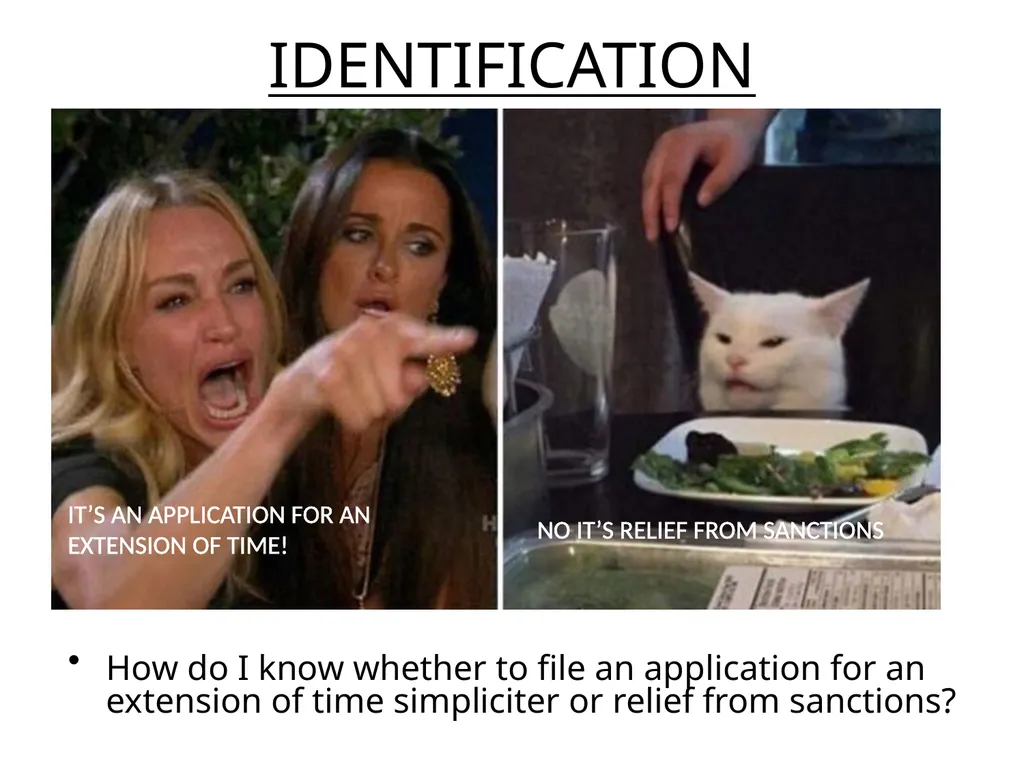
IDENTIFICATION How do I know whether to file an application for an extension of time simpliciter or relief from sanctions? IT’S AN APPLICATION FOR AN EXTENSION OF TIME! NO IT’S RELIEF FROM SANCTIONS<br>
03
Questions to ask to assist in identification:
Has the time for Compliance with the Rule, Direction or Order elapsed or has not yet elapsed?
Does the Rule, Direction or Order include a Sanction?<br>
Has the time for Compliance with the Rule, Direction or Order elapsed or has not yet elapsed?
Does the Rule, Direction or Order include a Sanction?<br>
04
Part 26
Court’s powers in cases of failure to comply with rules, orders or directions
26.6 (2) Where a party has failed to comply with any of these Rules, a direction or any court order, any sanction for non-compliance imposed by the rule or the court order has effect unless the party in default applies for and obtains relief from the sanction, and rule 26.8 shall not apply.
Relief from sanctions
Part 26.7 (1) An application for relief from any sanction imposed for a failure to comply with any rule, court order or direction must be made promptly.<br>
Court’s powers in cases of failure to comply with rules, orders or directions
26.6 (2) Where a party has failed to comply with any of these Rules, a direction or any court order, any sanction for non-compliance imposed by the rule or the court order has effect unless the party in default applies for and obtains relief from the sanction, and rule 26.8 shall not apply.
Relief from sanctions
Part 26.7 (1) An application for relief from any sanction imposed for a failure to comply with any rule, court order or direction must be made promptly.<br>
05
Keron Matthews v The Attorney General of Trinidad and Tobago, [2011] UKPC 38
Lord Dyson @ paragraph 15
“Rule 26.7 provides for applications for relief from any sanction imposed for a failure to comply inter alia with any rule. Rule 26.6(2) provides that where a party has failed inter alia to comply with any rule, “any sanction for non-compliance imposed by the rule....has effect unless the party in default applied for and obtains relief from the sanction”(emphasis added).In the view of the Board, this is aiming at rules which themselves impose or specify the consequences of a failure to comply.”<br>
Lord Dyson @ paragraph 15
“Rule 26.7 provides for applications for relief from any sanction imposed for a failure to comply inter alia with any rule. Rule 26.6(2) provides that where a party has failed inter alia to comply with any rule, “any sanction for non-compliance imposed by the rule....has effect unless the party in default applied for and obtains relief from the sanction”(emphasis added).In the view of the Board, this is aiming at rules which themselves impose or specify the consequences of a failure to comply.”<br>
06
Challenges What should I include in my affidavit in support of my application for relief from sanctions?<br>
07
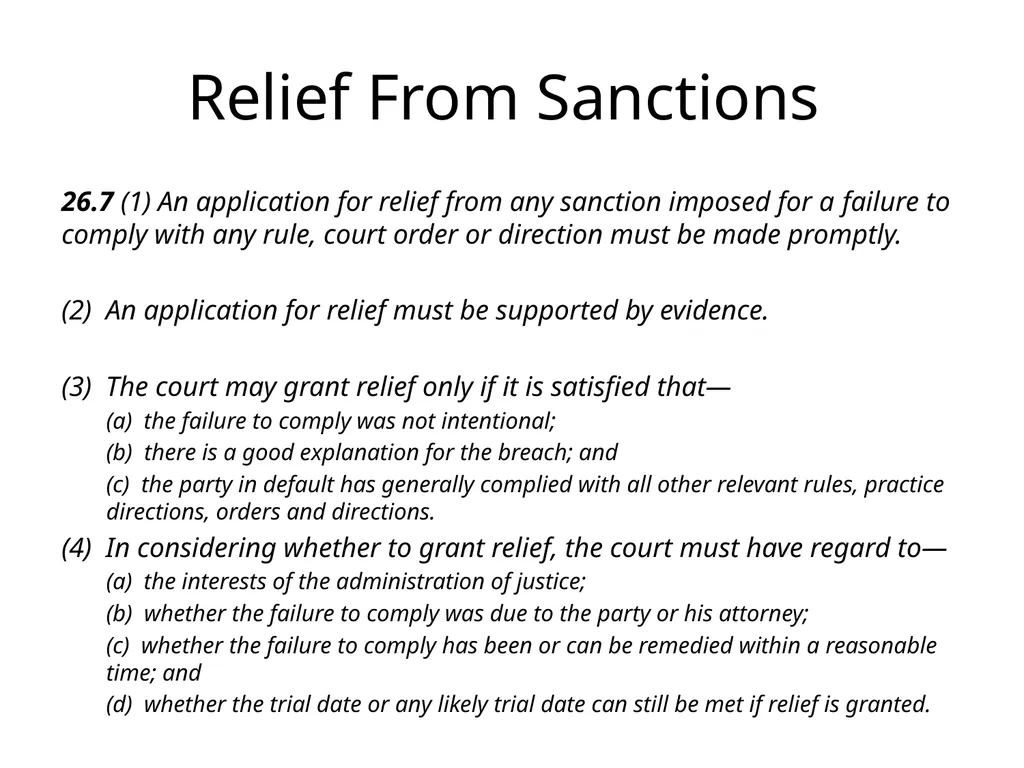
Relief From Sanctions 26.7 (1) An application for relief from any sanction imposed for a failure to comply with any rule, court order or direction must be made promptly.
(2) An application for relief must be supported by evidence.
(3) The court may grant relief only if it is satisfied that—
(a) the failure to comply was not intentional;
(b) there is a good explanation for the breach; and
(c) the party in default has generally complied with all other relevant rules, practice directions, orders and directions.
(4) In considering whether to grant relief, the court must have regard to—
(a) the interests of the administration of justice;
(b) whether the failure to comply was due to the party or his attorney;
(c) whether the failure to comply has been or can be remedied within a reasonable time; and
(d) whether the trial date or any likely trial date can still be met if relief is granted.<br>
(2) An application for relief must be supported by evidence.
(3) The court may grant relief only if it is satisfied that—
(a) the failure to comply was not intentional;
(b) there is a good explanation for the breach; and
(c) the party in default has generally complied with all other relevant rules, practice directions, orders and directions.
(4) In considering whether to grant relief, the court must have regard to—
(a) the interests of the administration of justice;
(b) whether the failure to comply was due to the party or his attorney;
(c) whether the failure to comply has been or can be remedied within a reasonable time; and
(d) whether the trial date or any likely trial date can still be met if relief is granted.<br>
08
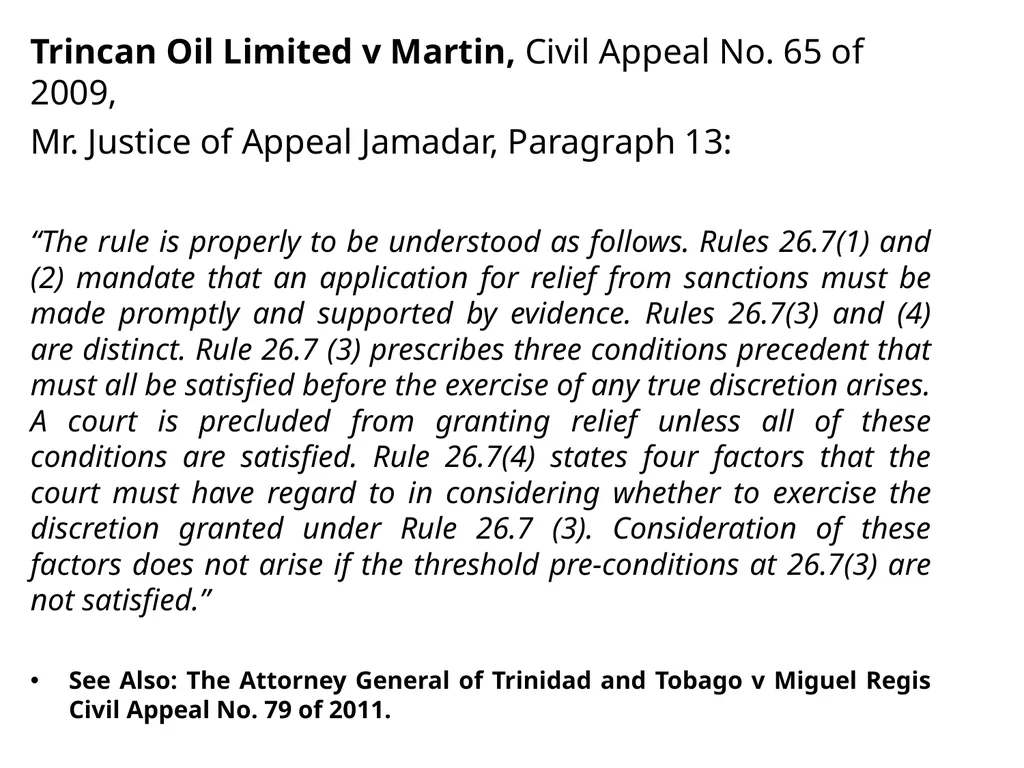
Trincan Oil Limited v Martin, Civil Appeal No. 65 of 2009,
Mr. Justice of Appeal Jamadar, Paragraph 13:
“The rule is properly to be understood as follows. Rules 26.7(1) and (2) mandate that an application for relief from sanctions must be made promptly and supported by evidence. Rules 26.7(3) and (4) are distinct. Rule 26.7 (3) prescribes three conditions precedent that must all be satisfied before the exercise of any true discretion arises. A court is precluded from granting relief unless all of these conditions are satisfied. Rule 26.7(4) states four factors that the court must have regard to in considering whether to exercise the discretion granted under Rule 26.7 (3). Consideration of these factors does not arise if the threshold pre-conditions at 26.7(3) are not satisfied.”
See Also: The Attorney General of Trinidad and Tobago v Miguel Regis Civil Appeal No. 79 of 2011.<br>
Mr. Justice of Appeal Jamadar, Paragraph 13:
“The rule is properly to be understood as follows. Rules 26.7(1) and (2) mandate that an application for relief from sanctions must be made promptly and supported by evidence. Rules 26.7(3) and (4) are distinct. Rule 26.7 (3) prescribes three conditions precedent that must all be satisfied before the exercise of any true discretion arises. A court is precluded from granting relief unless all of these conditions are satisfied. Rule 26.7(4) states four factors that the court must have regard to in considering whether to exercise the discretion granted under Rule 26.7 (3). Consideration of these factors does not arise if the threshold pre-conditions at 26.7(3) are not satisfied.”
See Also: The Attorney General of Trinidad and Tobago v Miguel Regis Civil Appeal No. 79 of 2011.<br>
09
PROMPTLY
26.7 (1) An application for relief from any sanction imposed for a failure to comply with any rule, court order or direction must be made promptly.
Promptly, what is that ?<br>
26.7 (1) An application for relief from any sanction imposed for a failure to comply with any rule, court order or direction must be made promptly.
Promptly, what is that ?<br>
10
In re The Partition Ordinance Chapter 27 No.14...Rawti a/c Roopnarine, Rawti; Roopnarine, Kumar v Harripersad a/c Kissoo, Harripersad; Rakhunanan a/c Boodoo, Harry, Bhagmatic a/c Bhagmatiah a/c Boododdsingh, Bhagmattie; Chanerwali a/c Chanadaye a/c Roopsingh Chanadaye, Civ Appeal 52 of 2012.
The Honourable Mr Justice of Appeal Mendonca at paragraphs 21 to 28
“Whether an Application for Relief is promptly made depends on the facts of each case. What is prompt in one situation may not be so considered in other circumstances. Promptness is therefore influenced by the context and facts of each case.” ...and...”Whether an Application is prompt does not depend simply on the time that has elapsed from the date the Sanction took effect to the date the Application for Relief was made. It depends on the factual context and there are other relevant and more significant matters in this case that the judge did not consider.” ..........
.......... “The Application was ..... made almost four (4) months after the date the Sanction took effect in relation to these Witness Statements. But it was made in the context where the Witness Statements were filed in time and served the following day. This was well before the pre-trial review and the trial date. The parties appeared at the pre-trial review and, having read the statements indicated that they had no evidential objections to them. The Application for Relief was therefore made long before the trial date and in circumstances where it could cause no prejudice to the parties nor delay of the trial. Such considerations are relevant and form an essential part of the context in which promptness must be considered. When those considerations are taken into account it is not possible to regard the Application as not having been made promptly. Indeed, when those circumstances are taken into account the Application for Relief is best viewed in the nature of a house-keeping exercise” [emphasis mine]<br>
The Honourable Mr Justice of Appeal Mendonca at paragraphs 21 to 28
“Whether an Application for Relief is promptly made depends on the facts of each case. What is prompt in one situation may not be so considered in other circumstances. Promptness is therefore influenced by the context and facts of each case.” ...and...”Whether an Application is prompt does not depend simply on the time that has elapsed from the date the Sanction took effect to the date the Application for Relief was made. It depends on the factual context and there are other relevant and more significant matters in this case that the judge did not consider.” ..........
.......... “The Application was ..... made almost four (4) months after the date the Sanction took effect in relation to these Witness Statements. But it was made in the context where the Witness Statements were filed in time and served the following day. This was well before the pre-trial review and the trial date. The parties appeared at the pre-trial review and, having read the statements indicated that they had no evidential objections to them. The Application for Relief was therefore made long before the trial date and in circumstances where it could cause no prejudice to the parties nor delay of the trial. Such considerations are relevant and form an essential part of the context in which promptness must be considered. When those considerations are taken into account it is not possible to regard the Application as not having been made promptly. Indeed, when those circumstances are taken into account the Application for Relief is best viewed in the nature of a house-keeping exercise” [emphasis mine]<br>
11
The failure to comply was not intentional
Trincan Oil Limited v Schnake Civ App 91 of 2009, Mr. Justice of Appeal Jamadar, paragraph 41:
“In my opinion, to establish intentionality for the purpose of Part 26.7 (3) (a) what must be demonstrated is a deliberate positive intention not to comply with a rule. This intention can be inferred from the circumstances surrounding the non-compliance. However, where as in this case there is an explanation given for the failure to comply with a rule which, though it may not be a ‘good explanation’, if it is nevertheless one that is consistent with an intention to appeal, then the requirements of Part 26.7 (3) (a) will more than likely be satisfied.”<br>
Trincan Oil Limited v Schnake Civ App 91 of 2009, Mr. Justice of Appeal Jamadar, paragraph 41:
“In my opinion, to establish intentionality for the purpose of Part 26.7 (3) (a) what must be demonstrated is a deliberate positive intention not to comply with a rule. This intention can be inferred from the circumstances surrounding the non-compliance. However, where as in this case there is an explanation given for the failure to comply with a rule which, though it may not be a ‘good explanation’, if it is nevertheless one that is consistent with an intention to appeal, then the requirements of Part 26.7 (3) (a) will more than likely be satisfied.”<br>
12
A good explanation for the breach ?<br>
13
Rawti Roopnarine, CA (supra)
Mr. Justice of Appeal Mendonca at paragraphs 32 and 33;
“In the AG v Universal Projects Limited [2011] UKPC 37, the Privy Council rejected a submission that a good explanation is one which properly explained how the breach came about, but which may involve an element of fault, such as inefficiency or error in good faith. The Privy Council in its judgment stated (at para. 23):
“The Board cannot accept these submissions. First, if the explanation for the breach, i.e. the failure to serve a defence by March 13th, connotes real or substantial fault on the part of the defendant, then it does not have a “good” explanation for the breach. To describe a good explanation as one which “properly” explains how the breach came about simply begs the question of what is a “proper” explanation. Oversight may be excusable in certain circumstances.
But it is difficult to see how inexcusable oversight can ever amount to a good explanation. Similarly if the explanation for the breach is administrative inefficiency.”
“On the other hand a good explanation does not mean the complete absence of fault. It must at least render the breach excusable. As the Court of Appeal observed in Regis, supra, what is required is a good explanation not an infallible one. When considering the explanation for the breach it must not therefore be subjected to such scrutiny so as to require a standard of perfection.”<br>
Mr. Justice of Appeal Mendonca at paragraphs 32 and 33;
“In the AG v Universal Projects Limited [2011] UKPC 37, the Privy Council rejected a submission that a good explanation is one which properly explained how the breach came about, but which may involve an element of fault, such as inefficiency or error in good faith. The Privy Council in its judgment stated (at para. 23):
“The Board cannot accept these submissions. First, if the explanation for the breach, i.e. the failure to serve a defence by March 13th, connotes real or substantial fault on the part of the defendant, then it does not have a “good” explanation for the breach. To describe a good explanation as one which “properly” explains how the breach came about simply begs the question of what is a “proper” explanation. Oversight may be excusable in certain circumstances.
But it is difficult to see how inexcusable oversight can ever amount to a good explanation. Similarly if the explanation for the breach is administrative inefficiency.”
“On the other hand a good explanation does not mean the complete absence of fault. It must at least render the breach excusable. As the Court of Appeal observed in Regis, supra, what is required is a good explanation not an infallible one. When considering the explanation for the breach it must not therefore be subjected to such scrutiny so as to require a standard of perfection.”<br>
14
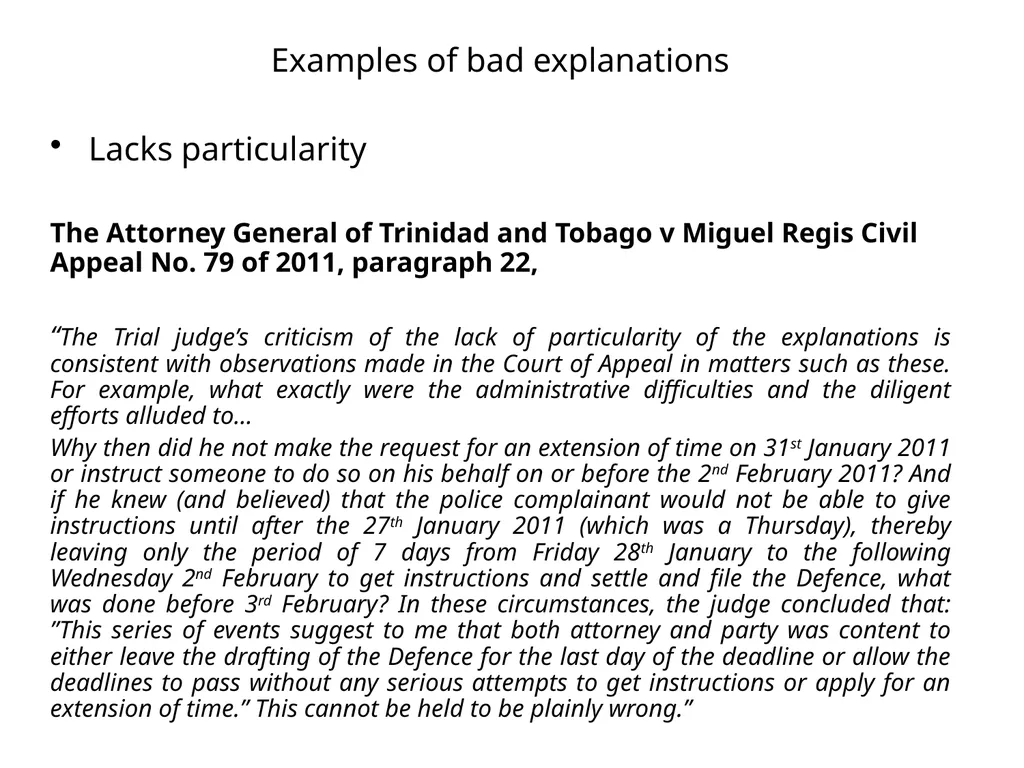
Examples of bad explanations
Lacks particularity
The Attorney General of Trinidad and Tobago v Miguel Regis Civil Appeal No. 79 of 2011, paragraph 22,
“The Trial judge’s criticism of the lack of particularity of the explanations is consistent with observations made in the Court of Appeal in matters such as these. For example, what exactly were the administrative difficulties and the diligent efforts alluded to…
Why then did he not make the request for an extension of time on 31st January 2011 or instruct someone to do so on his behalf on or before the 2nd February 2011? And if he knew (and believed) that the police complainant would not be able to give instructions until after the 27th January 2011 (which was a Thursday), thereby leaving only the period of 7 days from Friday 28th January to the following Wednesday 2nd February to get instructions and settle and file the Defence, what was done before 3rd February? In these circumstances, the judge concluded that: ”This series of events suggest to me that both attorney and party was content to either leave the drafting of the Defence for the last day of the deadline or allow the deadlines to pass without any serious attempts to get instructions or apply for an extension of time.” This cannot be held to be plainly wrong.”<br>
Lacks particularity
The Attorney General of Trinidad and Tobago v Miguel Regis Civil Appeal No. 79 of 2011, paragraph 22,
“The Trial judge’s criticism of the lack of particularity of the explanations is consistent with observations made in the Court of Appeal in matters such as these. For example, what exactly were the administrative difficulties and the diligent efforts alluded to…
Why then did he not make the request for an extension of time on 31st January 2011 or instruct someone to do so on his behalf on or before the 2nd February 2011? And if he knew (and believed) that the police complainant would not be able to give instructions until after the 27th January 2011 (which was a Thursday), thereby leaving only the period of 7 days from Friday 28th January to the following Wednesday 2nd February to get instructions and settle and file the Defence, what was done before 3rd February? In these circumstances, the judge concluded that: ”This series of events suggest to me that both attorney and party was content to either leave the drafting of the Defence for the last day of the deadline or allow the deadlines to pass without any serious attempts to get instructions or apply for an extension of time.” This cannot be held to be plainly wrong.”<br>
15
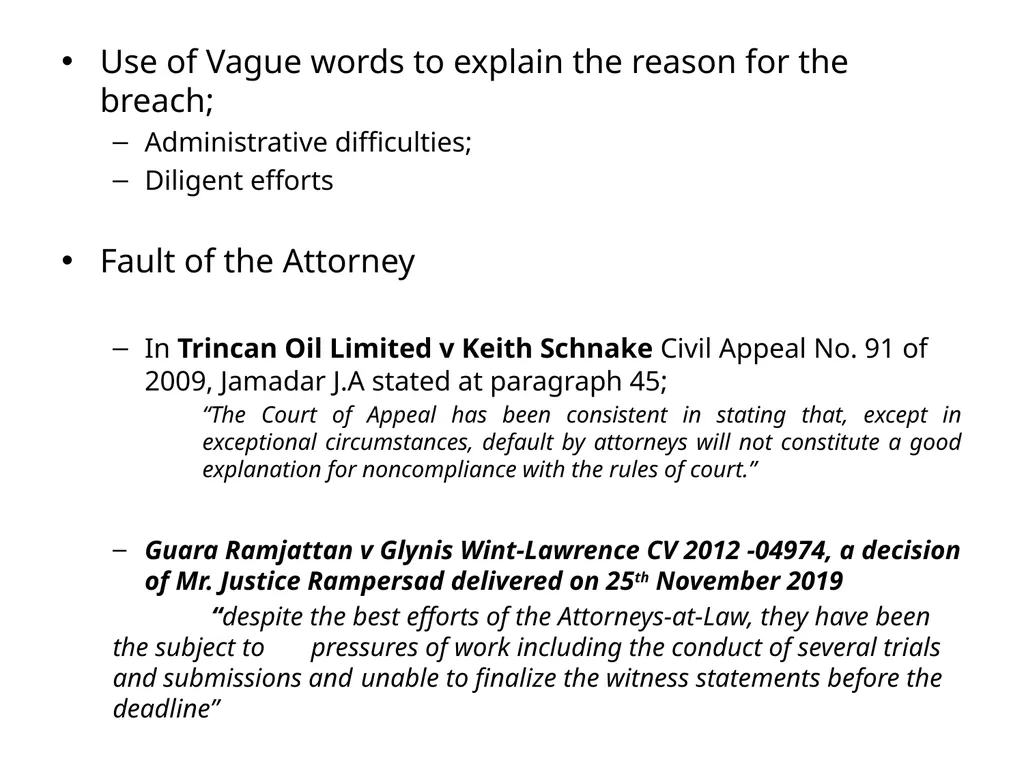
Use of Vague words to explain the reason for the breach;
Administrative difficulties;
Diligent efforts
Fault of the Attorney
In Trincan Oil Limited v Keith Schnake Civil Appeal No. 91 of 2009, Jamadar J.A stated at paragraph 45;
“The Court of Appeal has been consistent in stating that, except in exceptional circumstances, default by attorneys will not constitute a good explanation for noncompliance with the rules of court.”
Guara Ramjattan v Glynis Wint-Lawrence CV 2012 -04974, a decision of Mr. Justice Rampersad delivered on 25th November 2019
“despite the best efforts of the Attorneys-at-Law, they have been the subject to pressures of work including the conduct of several trials and submissions and unable to finalize the witness statements before the deadline”<br>
Administrative difficulties;
Diligent efforts
Fault of the Attorney
In Trincan Oil Limited v Keith Schnake Civil Appeal No. 91 of 2009, Jamadar J.A stated at paragraph 45;
“The Court of Appeal has been consistent in stating that, except in exceptional circumstances, default by attorneys will not constitute a good explanation for noncompliance with the rules of court.”
Guara Ramjattan v Glynis Wint-Lawrence CV 2012 -04974, a decision of Mr. Justice Rampersad delivered on 25th November 2019
“despite the best efforts of the Attorneys-at-Law, they have been the subject to pressures of work including the conduct of several trials and submissions and unable to finalize the witness statements before the deadline”<br>
16
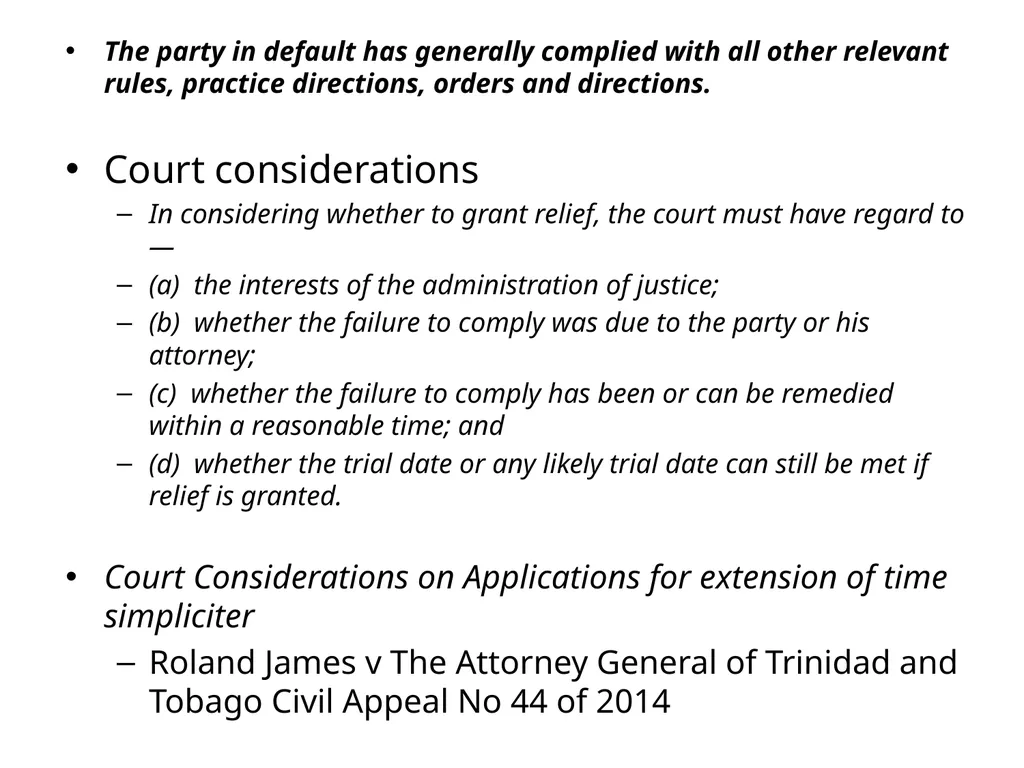
The party in default has generally complied with all other relevant rules, practice directions, orders and directions.
Court considerations
In considering whether to grant relief, the court must have regard to—
(a) the interests of the administration of justice;
(b) whether the failure to comply was due to the party or his attorney;
(c) whether the failure to comply has been or can be remedied within a reasonable time; and
(d) whether the trial date or any likely trial date can still be met if relief is granted.
Court Considerations on Applications for extension of time simpliciter
Roland James v The Attorney General of Trinidad and Tobago Civil Appeal No 44 of 2014<br>
Court considerations
In considering whether to grant relief, the court must have regard to—
(a) the interests of the administration of justice;
(b) whether the failure to comply was due to the party or his attorney;
(c) whether the failure to comply has been or can be remedied within a reasonable time; and
(d) whether the trial date or any likely trial date can still be met if relief is granted.
Court Considerations on Applications for extension of time simpliciter
Roland James v The Attorney General of Trinidad and Tobago Civil Appeal No 44 of 2014<br>
17
Questions????<br>