
APPLIED MEDICAL ETHICS Dr. Deepthi Edussuriya
YM
Published · 37 slides · 0 views

1 / 1



Description
APPLIED MEDICAL ETHICS Dr. Deepthi Edussuriya Senior lecturer At the end of this lesson you should be able to 1. Identify ethical considerations in medical practice 2. Evaluate different approaches to solving ethical dilemmas in medical
Related Topics
Share
Embed code
Download this presentation From Below
"APPLIED MEDICAL ETHICS Dr. Deepthi Edussuriya" is the property of its rightful owner. Permission is granted to download and print the materials on this website for personal, non-commercial use only, and to display it on your personal computer provided you do not modify the materials and that you retain all copyright notices contained in the materials. By downloading content from our website, you accept the terms of this agreement.
Presentation Transcript
01
APPLIED MEDICAL ETHICS Dr. Deepthi Edussuriya
Senior lecturer<br>
Senior lecturer<br>
02
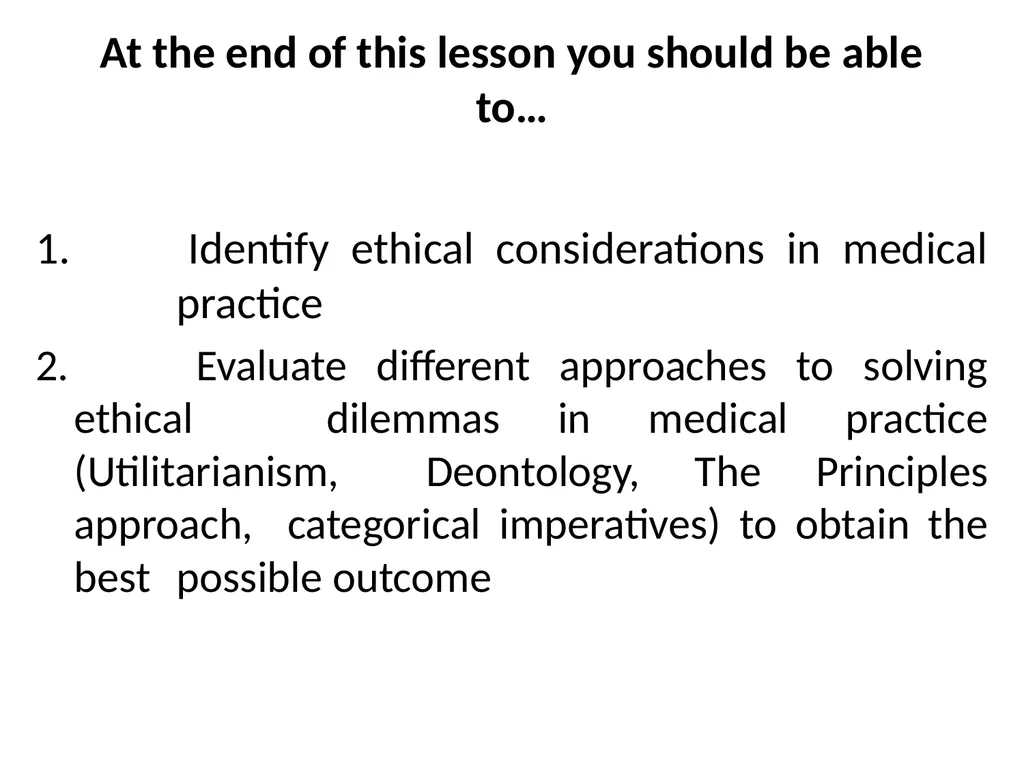
At the end of this lesson you should be able to… 1. Identify ethical considerations in medical practice
2. Evaluate different approaches to solving ethical dilemmas in medical practice (Utilitarianism, Deontology, The Principles approach, categorical imperatives) to obtain the best possible outcome<br>
2. Evaluate different approaches to solving ethical dilemmas in medical practice (Utilitarianism, Deontology, The Principles approach, categorical imperatives) to obtain the best possible outcome<br>
03
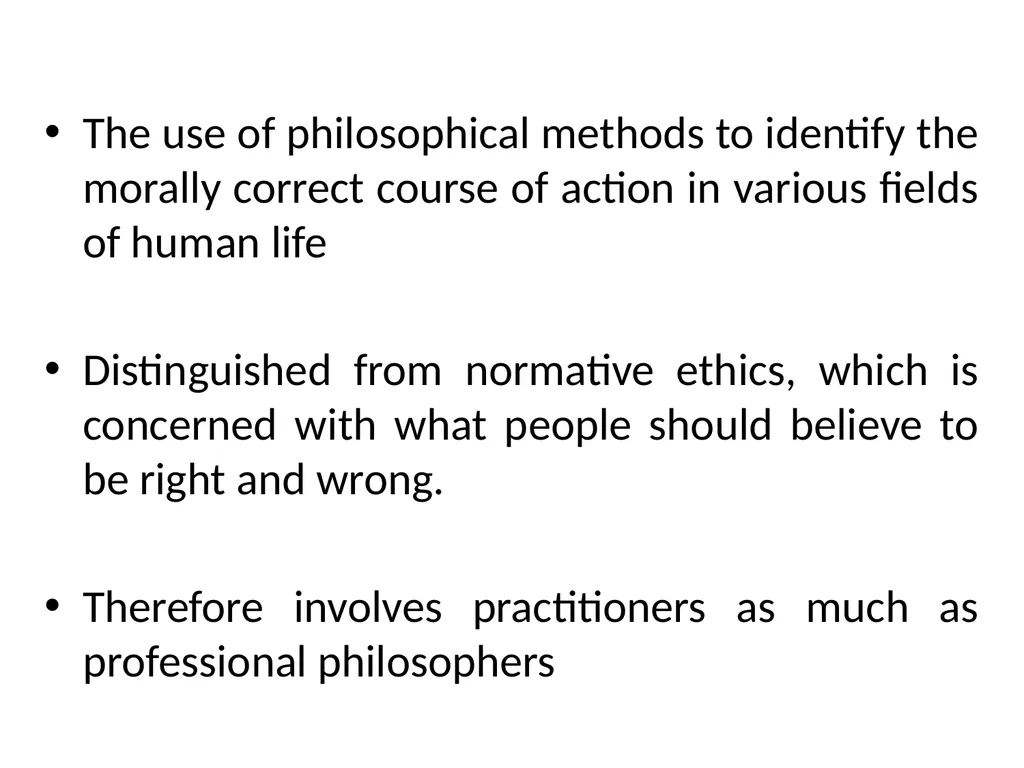
The use of philosophical methods to identify the morally correct course of action in various fields of human life
Distinguished from normative ethics, which is concerned with what people should believe to be right and wrong.
Therefore involves practitioners as much as professional philosophers<br>
Distinguished from normative ethics, which is concerned with what people should believe to be right and wrong.
Therefore involves practitioners as much as professional philosophers<br>
04
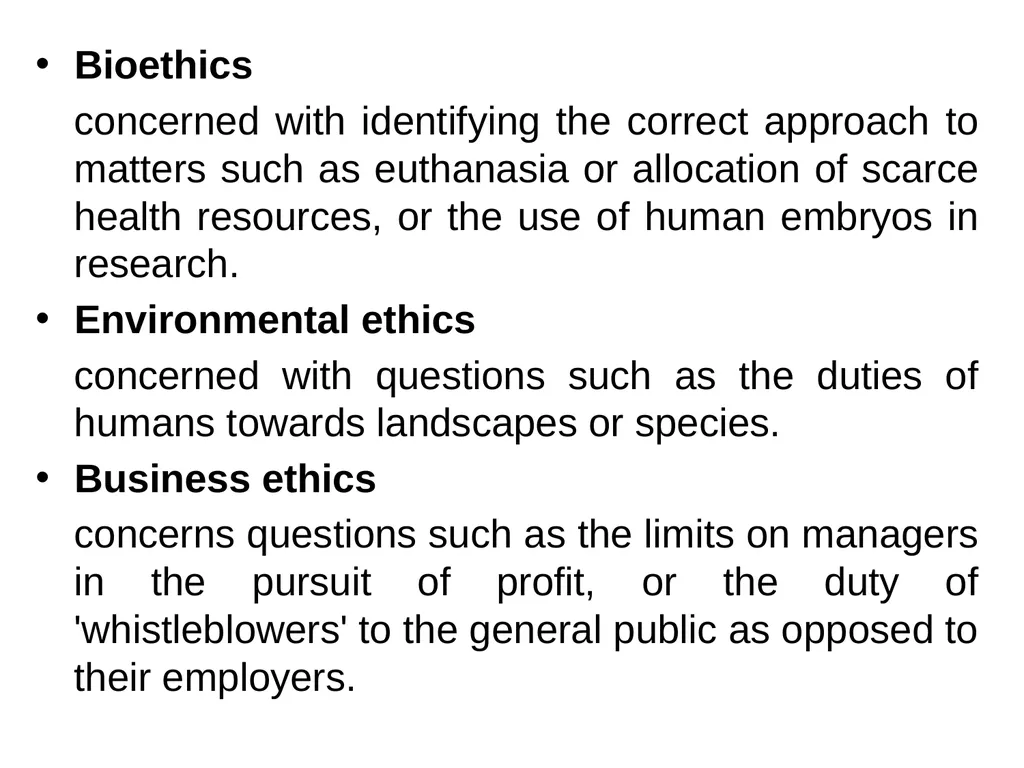
Bioethics
concerned with identifying the correct approach to matters such as euthanasia or allocation of scarce health resources, or the use of human embryos in research.
Environmental ethics
concerned with questions such as the duties of humans towards landscapes or species.
Business ethics
concerns questions such as the limits on managers in the pursuit of profit, or the duty of 'whistleblowers' to the general public as opposed to their employers.<br>
concerned with identifying the correct approach to matters such as euthanasia or allocation of scarce health resources, or the use of human embryos in research.
Environmental ethics
concerned with questions such as the duties of humans towards landscapes or species.
Business ethics
concerns questions such as the limits on managers in the pursuit of profit, or the duty of 'whistleblowers' to the general public as opposed to their employers.<br>
05
Ethics is NOT a set of rules, nor is it a formula. A one rule fits all approach might be unethical as it fails to consider the specific interests of those involved
Ethics DOES seek to set up guidelines for good ethical practice
Guidelines issued by medical professional bodies should always be considered; but be prepared for exceptions. Since guidelines may change in the light of experience and new evidence it is necessary to be aware of any changes<br>
Ethics DOES seek to set up guidelines for good ethical practice
Guidelines issued by medical professional bodies should always be considered; but be prepared for exceptions. Since guidelines may change in the light of experience and new evidence it is necessary to be aware of any changes<br>
06
Approach to ethical dilemmas Define the nature of the problem.
Example:
A baby born prematurely at 24 weeks gestation is put in intensive care. However she is not thriving and scans suggest she has profound brain damage. She cannot breathe unassisted and the care team believe she is suffering and it is not in her interest to keep her alive. The parents do not agree. What should the clinician do?<br>
Example:
A baby born prematurely at 24 weeks gestation is put in intensive care. However she is not thriving and scans suggest she has profound brain damage. She cannot breathe unassisted and the care team believe she is suffering and it is not in her interest to keep her alive. The parents do not agree. What should the clinician do?<br>
07
Dissect problem by considering… Consequences
What are the consequences of any given course of action? Consider both benefits and harms
Duties and Obligations
What are the duties of the clinician? Does the dilemma arise from a conflict of duties? To whom does the clinician owe these duties? If so how best can this dilemma be resolved?
Categorical imperatives
Is it a case of respect for confidentiality/informed consent?
Application of principles
How might the four key principles of ethical clinical practice be applied?<br>
What are the consequences of any given course of action? Consider both benefits and harms
Duties and Obligations
What are the duties of the clinician? Does the dilemma arise from a conflict of duties? To whom does the clinician owe these duties? If so how best can this dilemma be resolved?
Categorical imperatives
Is it a case of respect for confidentiality/informed consent?
Application of principles
How might the four key principles of ethical clinical practice be applied?<br>
08
Theories of applied ethics Utilitarianism (consequentialism)
Deontological ethics<br>
Deontological ethics<br>
09
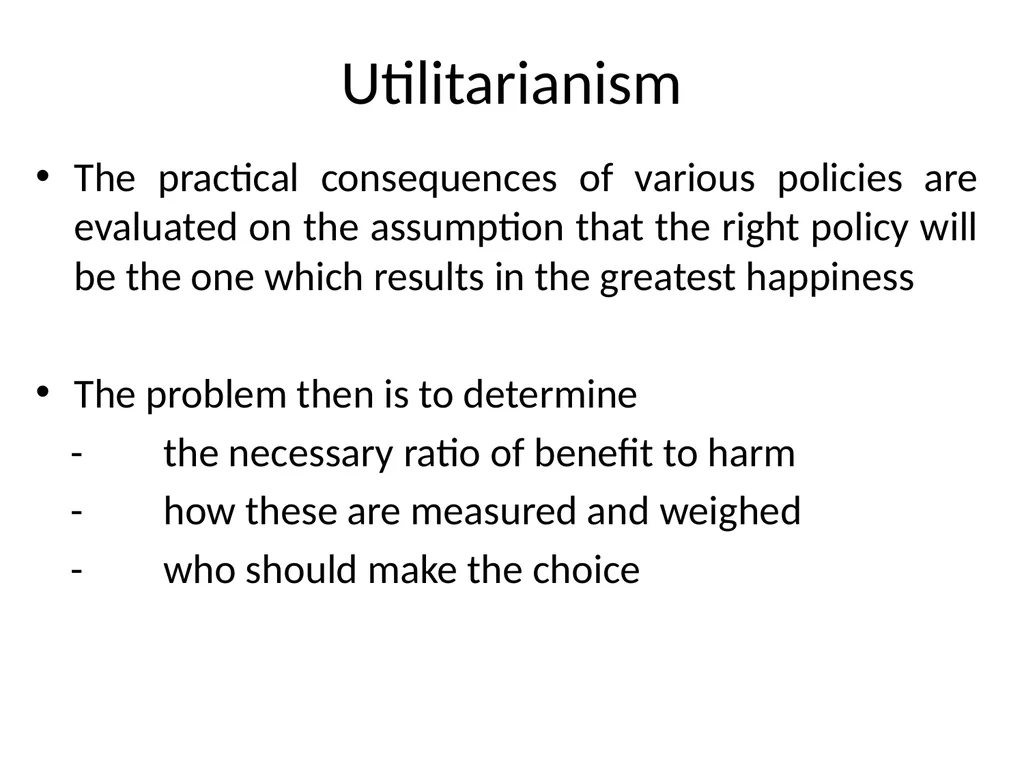
Utilitarianism The practical consequences of various policies are evaluated on the assumption that the right policy will be the one which results in the greatest happiness
The problem then is to determine
- the necessary ratio of benefit to harm
- how these are measured and weighed
- who should make the choice<br>
The problem then is to determine
- the necessary ratio of benefit to harm
- how these are measured and weighed
- who should make the choice<br>
10
Utilitarianism Criticism
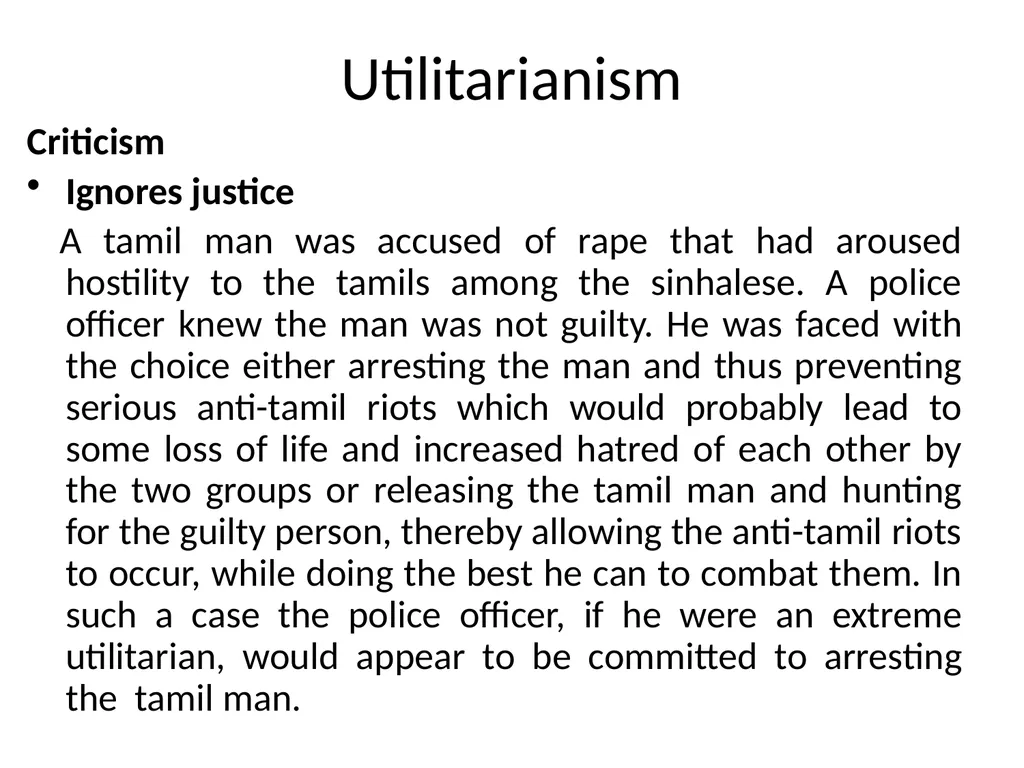
Ignores justice
A tamil man was accused of rape that had aroused hostility to the tamils among the sinhalese. A police officer knew the man was not guilty. He was faced with the choice either arresting the man and thus preventing serious anti-tamil riots which would probably lead to some loss of life and increased hatred of each other by the two groups or releasing the tamil man and hunting for the guilty person, thereby allowing the anti-tamil riots to occur, while doing the best he can to combat them. In such a case the police officer, if he were an extreme utilitarian, would appear to be committed to arresting the tamil man.<br>
Ignores justice
A tamil man was accused of rape that had aroused hostility to the tamils among the sinhalese. A police officer knew the man was not guilty. He was faced with the choice either arresting the man and thus preventing serious anti-tamil riots which would probably lead to some loss of life and increased hatred of each other by the two groups or releasing the tamil man and hunting for the guilty person, thereby allowing the anti-tamil riots to occur, while doing the best he can to combat them. In such a case the police officer, if he were an extreme utilitarian, would appear to be committed to arresting the tamil man.<br>
11
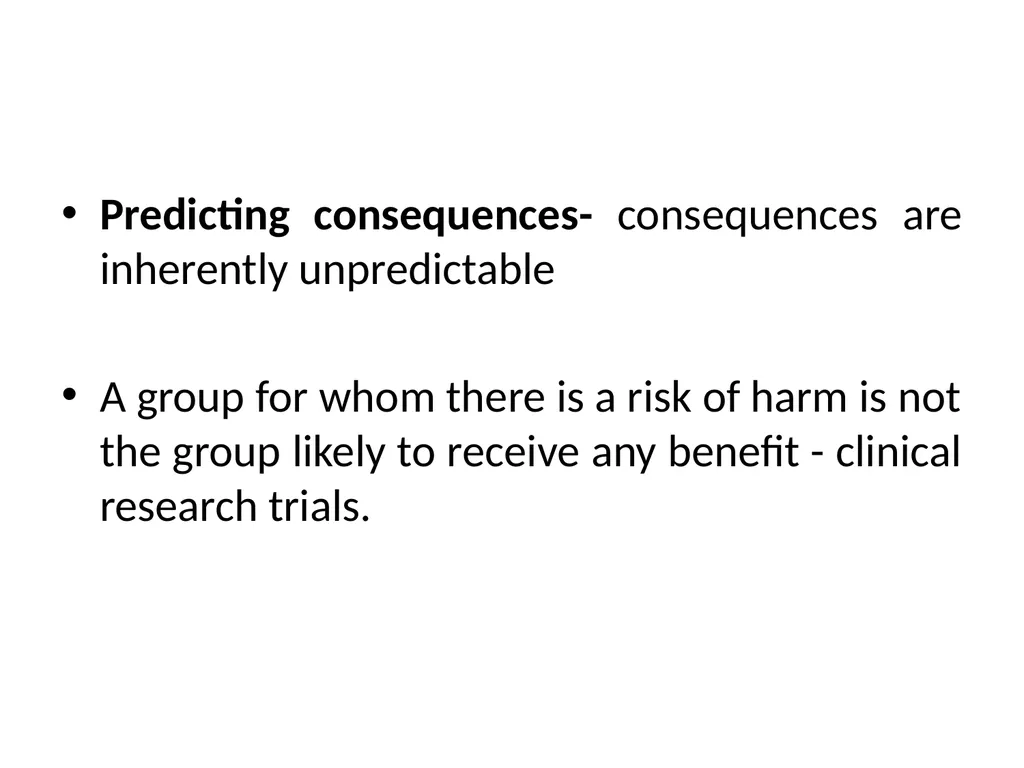
Predicting consequences- consequences are inherently unpredictable
A group for whom there is a risk of harm is not the group likely to receive any benefit - clinical research trials.<br>
A group for whom there is a risk of harm is not the group likely to receive any benefit - clinical research trials.<br>
12
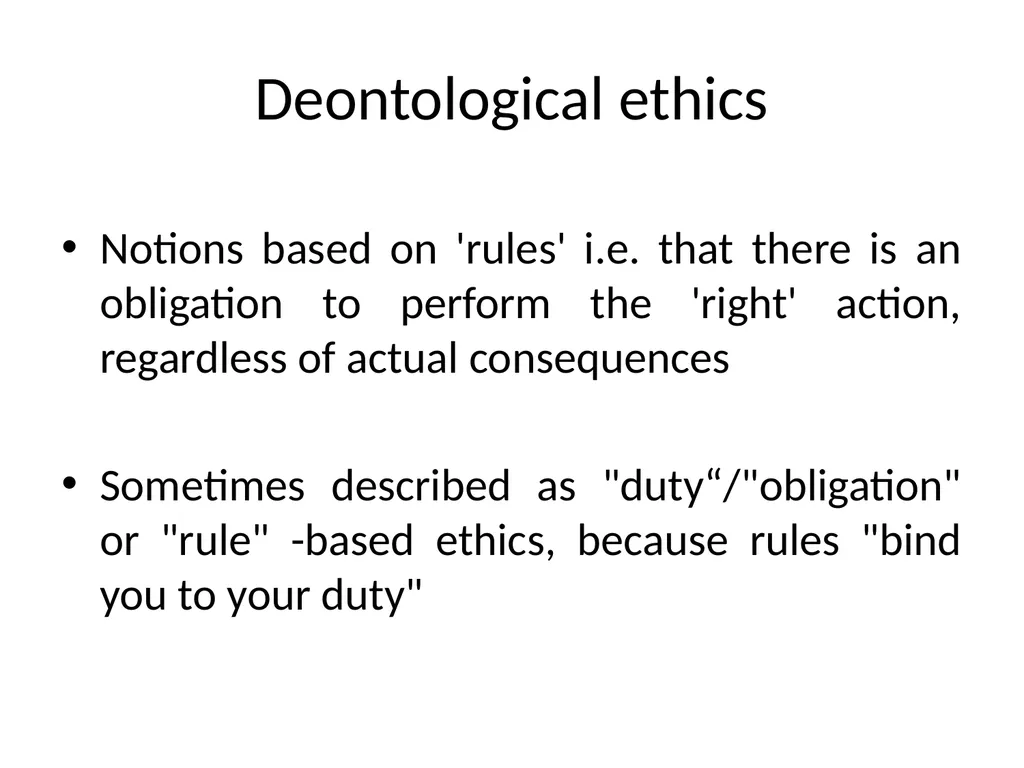
Deontological ethics Notions based on 'rules' i.e. that there is an obligation to perform the 'right' action, regardless of actual consequences
Sometimes described as "duty“/"obligation" or "rule" -based ethics, because rules "bind you to your duty"<br>
Sometimes described as "duty“/"obligation" or "rule" -based ethics, because rules "bind you to your duty"<br>
13
Deontological ethics… Duties and obligations are rarely determined by empirical data – they are difficult to quantify or measure and they are extremely difficult to partition
Consider a person who has been asked to look after a dog whilst also caring for children playing on playground swings and roundabouts. How best should this person discharge their duty if the dog should run off?
Consider a family practitioner who is treating a patient for a sexually transmitted disease and this patient’s partner is also one of the GP’s patients.<br>
Consider a person who has been asked to look after a dog whilst also caring for children playing on playground swings and roundabouts. How best should this person discharge their duty if the dog should run off?
Consider a family practitioner who is treating a patient for a sexually transmitted disease and this patient’s partner is also one of the GP’s patients.<br>
14
When considering the choice between two alternative actions, A and B, the consequentialist approach considers which of the two choices is likely to produce the greatest net benefit. Consider, however, what should happen if B is likely to produce the most benefit but A has been promised.<br>
15
There are several ways to consider this problem… Consequentialist approach
Considers the result of breaking the promise in the net evaluation of benefits and harms, adhering to the view that the ends might still justify the means (including breaking the promise) if the net benefit is sufficient to outweigh the cost of breaking the promise (such costs may involve considerations such as loss of trust and unhappiness at the decision).
The deontological approach
Considers the promise as a duty, the breech of which requires specific justification involving a conflict of duties (say the duty to keep the promise against the duty to do what is in the best interest of the patient, or community). This emphasis on outcome on the one hand and duty on the other may lead to different resolutions.<br>
Considers the result of breaking the promise in the net evaluation of benefits and harms, adhering to the view that the ends might still justify the means (including breaking the promise) if the net benefit is sufficient to outweigh the cost of breaking the promise (such costs may involve considerations such as loss of trust and unhappiness at the decision).
The deontological approach
Considers the promise as a duty, the breech of which requires specific justification involving a conflict of duties (say the duty to keep the promise against the duty to do what is in the best interest of the patient, or community). This emphasis on outcome on the one hand and duty on the other may lead to different resolutions.<br>
16
The ‘Principles’ approach. Four fundamental principles are often applied in modern medical ethics
1. Respect for individual autonomy – individuals are regarded as moral agents with duties and obligations and the capacity to understand and make ethical decisions.
2. Principle of beneficence – seek to do good
3. Principle of non-maleficence – avoid doing harm
4. Principle of Justice – people should be treated fairly.<br>
1. Respect for individual autonomy – individuals are regarded as moral agents with duties and obligations and the capacity to understand and make ethical decisions.
2. Principle of beneficence – seek to do good
3. Principle of non-maleficence – avoid doing harm
4. Principle of Justice – people should be treated fairly.<br>
17
However, applying any one of these principles may conflict with one or more of the others For example, applying principles beneficence and non-maleficience in relation to a mentally ill patient may conflict with autonomy
Consider these principles in relation to the case of the premature baby presented above. How should the clinician resolve principles beneficence and non-maleficience? Where do the parents stand in relation to the principle of autonomy?<br>
Consider these principles in relation to the case of the premature baby presented above. How should the clinician resolve principles beneficence and non-maleficience? Where do the parents stand in relation to the principle of autonomy?<br>
18
Paternalism (‘doctor knows best’) -the exception not the rule Modern medicine seeks to avoid a paternalistic (doctor knows best) approach to their patients. Instead it considers the doctor and patient mutually engaging in the decision making with the final decision on treatment options being that of the patient. Respect for autonomy, informed consent and confidentiality are now key markers for ethical practice and there must be exceptional circumstances or reasons for breeching them.
Nevertheless, there may be circumstances where the paternalistic approach is still a major factor.
In the case of the sick premature baby in intensive care presented above. A key approach here for ethical practice is to consider how best the clinician should act in the interest of this baby whilst still respecting the involvement of the parents in the decision.<br>
Nevertheless, there may be circumstances where the paternalistic approach is still a major factor.
In the case of the sick premature baby in intensive care presented above. A key approach here for ethical practice is to consider how best the clinician should act in the interest of this baby whilst still respecting the involvement of the parents in the decision.<br>
19
Is lying right or wrong? consequentialist may argue that lying is wrong because of the negative consequences produced by lying—though a consequentialist may allow that certain foreseeable consequences might make lying acceptable<br>
20
A deontologist might argue that lying is always wrong, regardless of any potential "good" that might come from lying<br>
21
Altruism is an ethical doctrine that holds that individuals have a moral obligation to help, serve, or benefit others, if necessary, at the sacrifice of self-interest.<br>
22
Which of the following do you consider to be the best description (hint: only one should be picked)? 1) Ethics decides what is right or wrong
2) Ethics decides what is moral
3) Ethics considers the nature of, and how best to deal with conflicts in moral imperatives<br>
2) Ethics decides what is moral
3) Ethics considers the nature of, and how best to deal with conflicts in moral imperatives<br>
23
The correct answer is 3.
Ethics does not decide what is moral.
Ethics arises because we have conflicts between and arising from moral imperatives.
Ethics does to an extent decide how best we deal with these conflicts but it doesn’t decide what is ‘right’ and ‘wrong’ per se.<br>
Ethics does not decide what is moral.
Ethics arises because we have conflicts between and arising from moral imperatives.
Ethics does to an extent decide how best we deal with these conflicts but it doesn’t decide what is ‘right’ and ‘wrong’ per se.<br>
24
Which of the following is true (only one is true)? 1) Deontology is the consideration of duties and obligations
2) Deontology considers the balance of benefits and harms
3) Deontology considers that ‘ends may justify means’<br>
2) Deontology considers the balance of benefits and harms
3) Deontology considers that ‘ends may justify means’<br>
25
The correct answer is 1.
Deontology is the consideration or study of duties and obligations.
The discharge of duties may have consequences but the duties exist regardless of these outcomes – they are ‘ends in themselves’.
A deontology approach considers how best to deal with conflicts of duties, to whom they are owed and how extensive they are.<br>
Deontology is the consideration or study of duties and obligations.
The discharge of duties may have consequences but the duties exist regardless of these outcomes – they are ‘ends in themselves’.
A deontology approach considers how best to deal with conflicts of duties, to whom they are owed and how extensive they are.<br>
26
Which of the following is true (more than one may be true)? 1. A Utilitarian approach in ethics considers the consequences of actions or choices
2. A Utilitarian approach in ethics considers that ends may justify means
3. A Utilitarian approach in ethics considers whether clinicians have discharged their duties in the best interests of their patients.<br>
2. A Utilitarian approach in ethics considers that ends may justify means
3. A Utilitarian approach in ethics considers whether clinicians have discharged their duties in the best interests of their patients.<br>
27
Generally both 1 and 2 are correct.
3 might be considered in utilitarian ethics where ‘best’ interest is judged by an assessment of the greatest benefit in relation to harm; although ‘duty’ in a utilitarian perspective is usually determined by a consideration of the best outcome – i.e. ends justifying means.
In contrast deontology considers duties to exist independently of outcome.<br>
3 might be considered in utilitarian ethics where ‘best’ interest is judged by an assessment of the greatest benefit in relation to harm; although ‘duty’ in a utilitarian perspective is usually determined by a consideration of the best outcome – i.e. ends justifying means.
In contrast deontology considers duties to exist independently of outcome.<br>
28
Informed Consent There are essentially two views of consent:
1. ‘clinician-centred’ view,
a legalistic approach to consent and considers what the
clinician should tell a patient about the nature of a procedure and the risks. It is the minimum required to
protect the clinician
2. The second is a ‘patient-centred’ view, which considers what is necessary to enable the patient to make an informed choice. This is what is referred to in ethics as ‘informed consent’.<br>
1. ‘clinician-centred’ view,
a legalistic approach to consent and considers what the
clinician should tell a patient about the nature of a procedure and the risks. It is the minimum required to
protect the clinician
2. The second is a ‘patient-centred’ view, which considers what is necessary to enable the patient to make an informed choice. This is what is referred to in ethics as ‘informed consent’.<br>
29
Informed consent requires that everything is done to ensure that the patient understands 1. The nature of the procedure – what is to be done and in simple terms how it is to be done.
2. The risks involved (but as above, this is not simply a list of all possible risks). They are the most likely risks and any that the patient themselves might be concerned about in making a decision. If a patient asks about a risk that the clinician has not mentioned, then the clinician should inform the patient about that risk.
3. The consequences – what are the likely outcomes of the procedure and alternatives
4. The alternatives – this includes information about what the likely outcome would be if the patient chooses
not to have the procedure and any other alternative the patient themselves may ask about where relevant.<br>
2. The risks involved (but as above, this is not simply a list of all possible risks). They are the most likely risks and any that the patient themselves might be concerned about in making a decision. If a patient asks about a risk that the clinician has not mentioned, then the clinician should inform the patient about that risk.
3. The consequences – what are the likely outcomes of the procedure and alternatives
4. The alternatives – this includes information about what the likely outcome would be if the patient chooses
not to have the procedure and any other alternative the patient themselves may ask about where relevant.<br>
30
A 12 year old child has undergone several treatment regimes for cancer over a period of years none of which have been successful. New treatments might offer some benefit but are considered unlikely to lead to a complete cure. Research trials indicate that the benefit can be between a few months to a year of life. After much discussion the parents withhold their consent when the new treatment is suggested by the clinical specialists at the hospital. The parents are concerned that the potential side effects outweigh the possible extension of the child’s life. They believe their child has already suffered enough over the years of treatment.
Consider what the clinicians should do and what factors should be taken into account.<br>
Consider what the clinicians should do and what factors should be taken into account.<br>
31
A 12 year old child has undergone several treatment regimes for cancer over a period of years none of which have been successful. The parents have heard of a new treatment which clinical trials suggest might prolong life of some cancer patients by between a few months and a year. As a result they have requested that this treatment be given to their child. However, the specialist clinicians at the hospital do not believe there would be any significant benefit for the child and that the side-effects of the treatment can often be debilitating.
Consider what the clinicians should do and what factors should be taken into account.<br>
Consider what the clinicians should do and what factors should be taken into account.<br>
32
A pregnant woman with a previous section has been advised to go for a normal delivery for her 2nd delivery. While in labour, she wants to have a section because she is worried about a rupture of the uterine scar. The clinicians are confident that the labour would progress without a complication. Should the obstetrician do a section to abide by the patients wish?<br>
33
A couple who have been married for ten years visit a gynaecologist for infertility treatment. The woman has a history of irregular menstrual cycles. The Gynaecologist treats the patient to stimulate the ovaries without success. After a few cycles of treatment the patient decides to see the gynaecologist on her own. She reveals that she had never had cycles (primary amenorrhea). The patient does not wish her clinical condition to be discussed with her husband because she is concerned about the consequences in relation to her marriage. Considering that the doctor was consulted by the couple for fertility treatment, what should the doctor do?<br>
34
Human Rights and medical practice “All humans should be treated equally”
“All humans should be treated fairly”
“All humans should be given an equal consideration of their interests”<br>
“All humans should be treated fairly”
“All humans should be given an equal consideration of their interests”<br>
35
Treating people equally in all circumstances would lead to unfairness because it would fail to take account of differing physical and mental abilities or of the social and economic circumstances of the individual. Treating people equally without regard for their interests, their abilities or their circumstances is likely to be unfair.<br>
36
I cannot run a hundred metres in 10 seconds, nor am I an accomplished concert pianist. From a moral perspective, however, I do expect to be given an equal consideration of my interests and needs when I consult a medical practitioner. I certainly would not wish that they consider my life to be of less value because I do not have these abilities.
Central to the concept of human rights is that they apply simply because someone is human and for no other reason.<br>
Central to the concept of human rights is that they apply simply because someone is human and for no other reason.<br>
37
Human Rights provide a universal framework for ethical medical practice. It is debatable whether this framework provides clear solutions to ethical dilemmas.
It can be said to present a frame of moral imperatives in the form of rights.
The major impact of human rights is in relation to discrimination and justice, access to health care and empowerment.<br>
It can be said to present a frame of moral imperatives in the form of rights.
The major impact of human rights is in relation to discrimination and justice, access to health care and empowerment.<br>