
Applying Scrum to research software projects
Description: Applying Scrum to research software projects Applying Scrum to research software projects Introduction to Scrum How to apply Scrum to research software projects What has worked well Challenges faced How our approach has changed Introduction
Related Topics
Download Presentation
"Applying Scrum to research software projects" is the property of its rightful owner. Permission is granted to download and print the materials on this website for personal, non-commercial use only, and to display it on your personal computer provided you do not modify the materials and that you retain all copyright notices contained in the materials. By downloading content from our website, you accept the terms of this agreement.
Presentation Transcript
slide1. Applying Scrum to research software projects<br>
slide2. Applying Scrum to research software projects Introduction to Scrum
How to apply Scrum to research software projects
What has worked well
Challenges faced
How our approach has changed<br>
slide3. Introduction to Scrum Modern Agile software development methodology
Developed in the 1990s and has evolved over time
Three main elements:
Team & roles
Events / meetings
Artifacts<br>
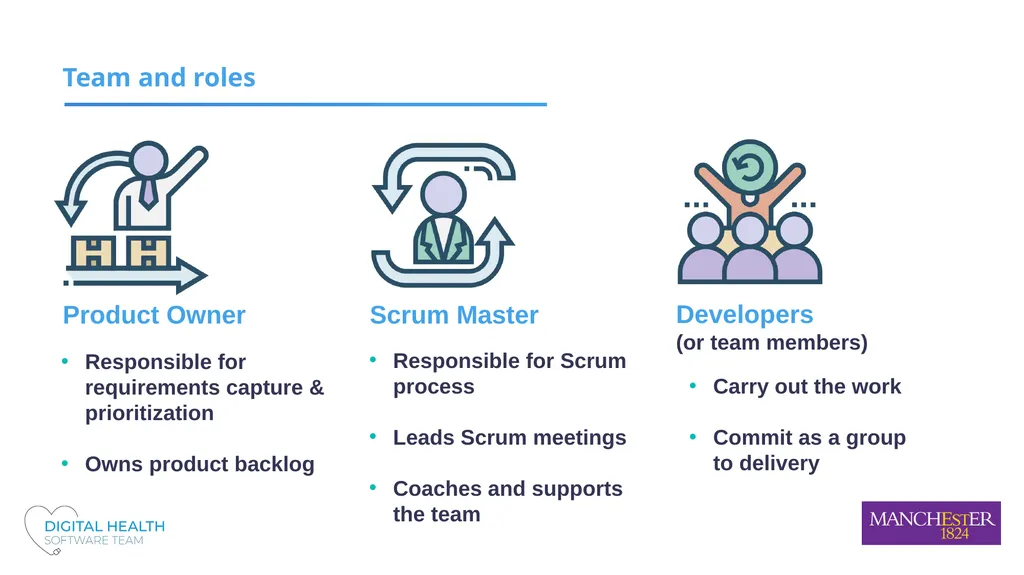
slide4. Team and roles Responsible for requirements capture & prioritization
Owns product backlog Product Owner Responsible for Scrum process
Leads Scrum meetings
Coaches and supports the team Scrum Master Carry out the work
Commit as a group to delivery Developers
(or team members)<br>
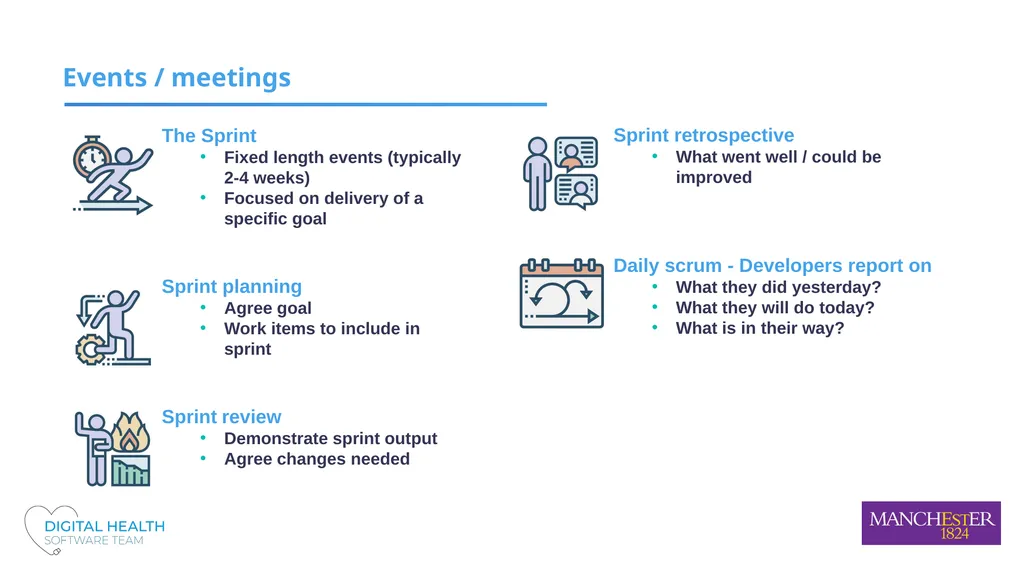
slide5. Events / meetings Sprint retrospective
What went well / could be improved
Daily scrum - Developers report on
What they did yesterday?
What they will do today?
What is in their way? The Sprint
Fixed length events (typically 2-4 weeks)
Focused on delivery of a specific goal
Sprint planning
Agree goal
Work items to include in sprint
Sprint review
Demonstrate sprint output
Agree changes needed<br>
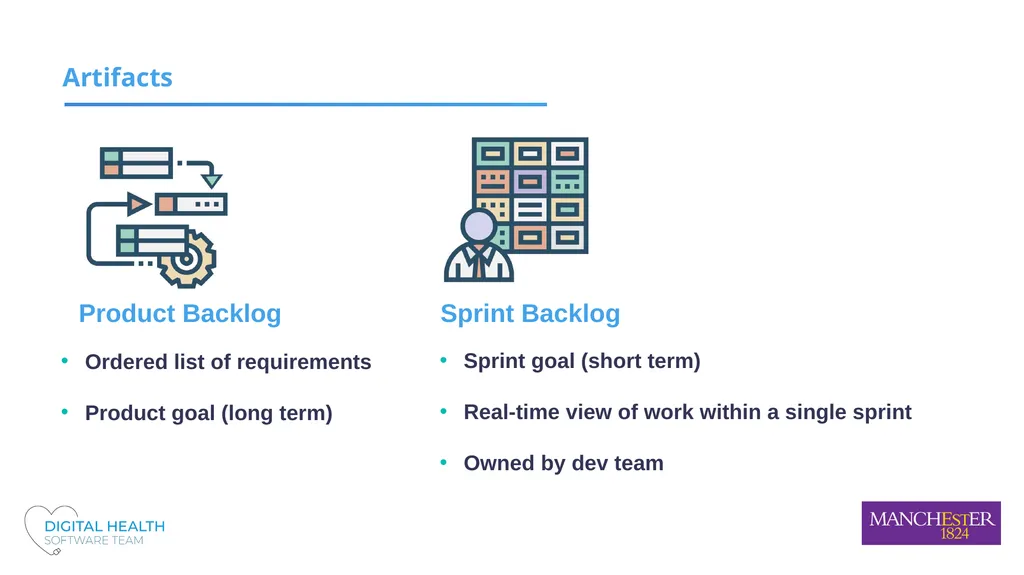
slide6. Artifacts Ordered list of requirements
Product goal (long term) Product Backlog Sprint goal (short term)
Real-time view of work within a single sprint
Owned by dev team Sprint Backlog<br>
slide7. Applying Scrum to software research projects What has worked well
Challenges faced
How our approach has changed<br>
slide8. What has worked well Effective way of planning
Good for team ownership / engagement
When applied effectively enables issues / delays to be picked up quickly
Review and retro allows for regular feedback and process improvements
Is fairly lightweight<br>
slide9. Challenges faced Commitments in grant application with fixed funding
Insufficient access / availability of research team
Customer proxy not always ideal
Dev team can lose sight of overall project goals<br>
slide10. How our approach has changed Initially had small team so single person as Scrum Master and Product Owner. This is BAD!
As team grew were able to separate these roles
Now give team better visibility and ownership of longer-term goals
Experimenting with different
estimation approaches<br>
slide11. Conclusions Can Scrum be applied to research software projects? Yes!
Carefully consider roles
Adjust approach to reflect relationship with research team
Regularly review and improve process<br>
slide2. Applying Scrum to research software projects Introduction to Scrum
How to apply Scrum to research software projects
What has worked well
Challenges faced
How our approach has changed<br>
slide3. Introduction to Scrum Modern Agile software development methodology
Developed in the 1990s and has evolved over time
Three main elements:
Team & roles
Events / meetings
Artifacts<br>
slide4. Team and roles Responsible for requirements capture & prioritization
Owns product backlog Product Owner Responsible for Scrum process
Leads Scrum meetings
Coaches and supports the team Scrum Master Carry out the work
Commit as a group to delivery Developers
(or team members)<br>
slide5. Events / meetings Sprint retrospective
What went well / could be improved
Daily scrum - Developers report on
What they did yesterday?
What they will do today?
What is in their way? The Sprint
Fixed length events (typically 2-4 weeks)
Focused on delivery of a specific goal
Sprint planning
Agree goal
Work items to include in sprint
Sprint review
Demonstrate sprint output
Agree changes needed<br>
slide6. Artifacts Ordered list of requirements
Product goal (long term) Product Backlog Sprint goal (short term)
Real-time view of work within a single sprint
Owned by dev team Sprint Backlog<br>
slide7. Applying Scrum to software research projects What has worked well
Challenges faced
How our approach has changed<br>
slide8. What has worked well Effective way of planning
Good for team ownership / engagement
When applied effectively enables issues / delays to be picked up quickly
Review and retro allows for regular feedback and process improvements
Is fairly lightweight<br>
slide9. Challenges faced Commitments in grant application with fixed funding
Insufficient access / availability of research team
Customer proxy not always ideal
Dev team can lose sight of overall project goals<br>
slide10. How our approach has changed Initially had small team so single person as Scrum Master and Product Owner. This is BAD!
As team grew were able to separate these roles
Now give team better visibility and ownership of longer-term goals
Experimenting with different
estimation approaches<br>
slide11. Conclusions Can Scrum be applied to research software projects? Yes!
Carefully consider roles
Adjust approach to reflect relationship with research team
Regularly review and improve process<br>