
Approximation Algorithms for Regret-Bounded
OM
Published · 23 slides · 0 views
1 / 1



Description
Approximation Algorithms for Regret-Bounded Vehicle Routing and Applications Chaitanya Swamy University of Waterloo Joint work with Zachary Friggstad University of Alberta Vehicle routing problems (VRPs) client Typical setup: visit all
Related Topics
Share
Embed code
Download this presentation From Below
"Approximation Algorithms for Regret-Bounded" is the property of its rightful owner. Permission is granted to download and print the materials on this website for personal, non-commercial use only, and to display it on your personal computer provided you do not modify the materials and that you retain all copyright notices contained in the materials. By downloading content from our website, you accept the terms of this agreement.
Presentation Transcript
01
Approximation Algorithms for Regret-Bounded Vehicle Routing and Applications Chaitanya Swamy
University of Waterloo
Joint work with Zachary Friggstad
University of Alberta<br>
University of Waterloo
Joint work with Zachary Friggstad
University of Alberta<br>
02
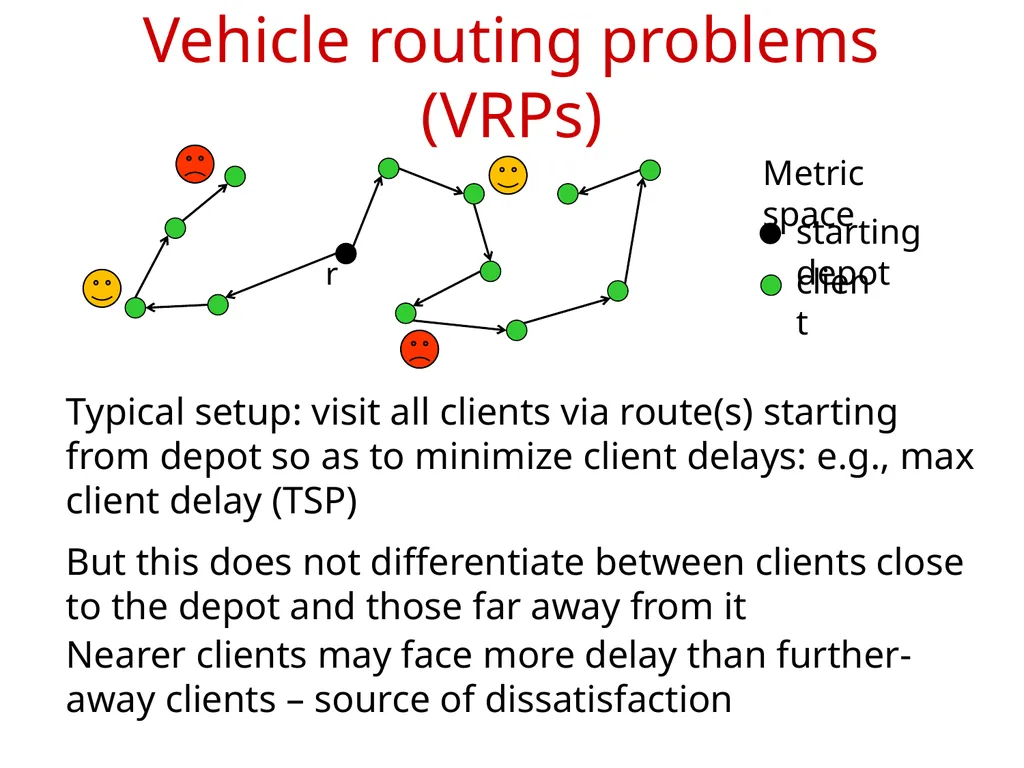
Vehicle routing problems (VRPs) client Typical setup: visit all clients via route(s) starting from depot so as to minimize client delays: e.g., max client delay (TSP)
But this does not differentiate between clients close to the depot and those far away from it
Nearer clients may face more delay than further-away clients – source of dissatisfaction starting depot r Metric space<br>
But this does not differentiate between clients close to the depot and those far away from it
Nearer clients may face more delay than further-away clients – source of dissatisfaction starting depot r Metric space<br>
03
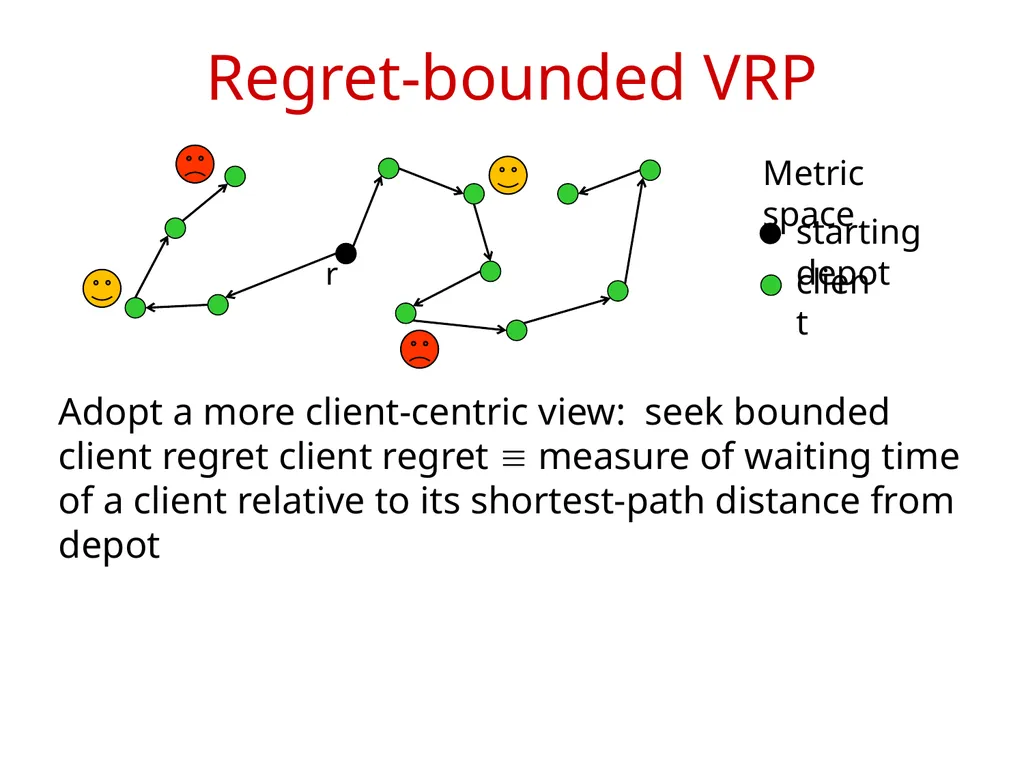
Regret-bounded VRP Adopt a more client-centric view: seek bounded client regret client regret measure of waiting time of a client relative to its shortest-path distance from depot r client starting depot Metric space<br>
04
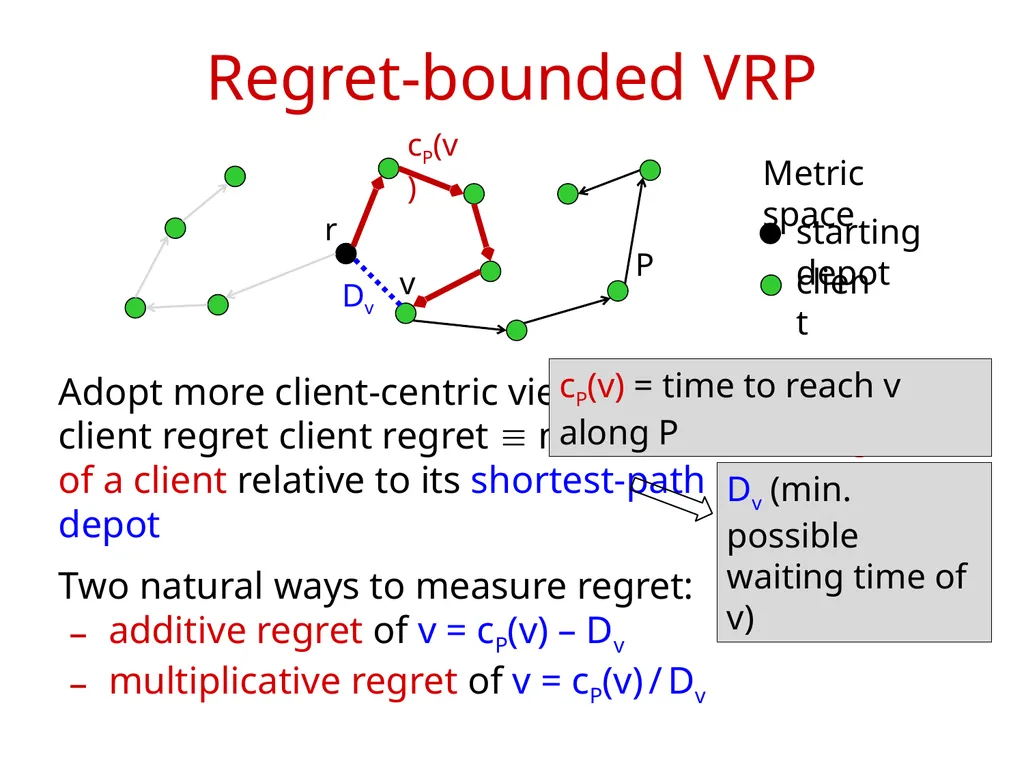
Regret-bounded VRP Adopt more client-centric view: ensure bounded client regret client regret measure of waiting time of a client relative to its shortest-path distance from depot
Two natural ways to measure regret:
additive regret of v = cP(v) – Dv
multiplicative regret of v = cP(v) / Dv r v cP(v) P Dv cP(v) = time to reach v along P Dv (min. possible waiting time of v) client starting depot Metric space<br>
Two natural ways to measure regret:
additive regret of v = cP(v) – Dv
multiplicative regret of v = cP(v) / Dv r v cP(v) P Dv cP(v) = time to reach v along P Dv (min. possible waiting time of v) client starting depot Metric space<br>
05
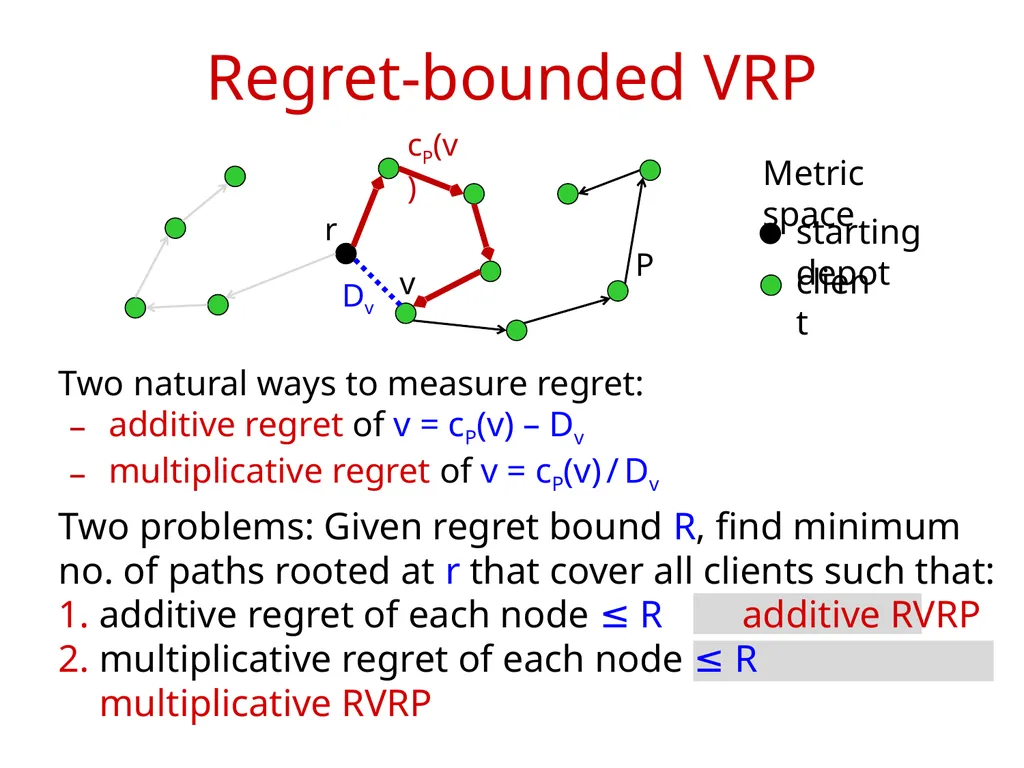
Regret-bounded VRP Two natural ways to measure regret:
additive regret of v = cP(v) – Dv
multiplicative regret of v = cP(v) / Dv r v cP(v) P Dv Two problems: Given regret bound R, find minimum no. of paths rooted at r that cover all clients such that:
additive regret of each node ≤ R additive RVRP
multiplicative regret of each node ≤ R multiplicative RVRP client starting depot Metric space<br>
additive regret of v = cP(v) – Dv
multiplicative regret of v = cP(v) / Dv r v cP(v) P Dv Two problems: Given regret bound R, find minimum no. of paths rooted at r that cover all clients such that:
additive regret of each node ≤ R additive RVRP
multiplicative regret of each node ≤ R multiplicative RVRP client starting depot Metric space<br>
06
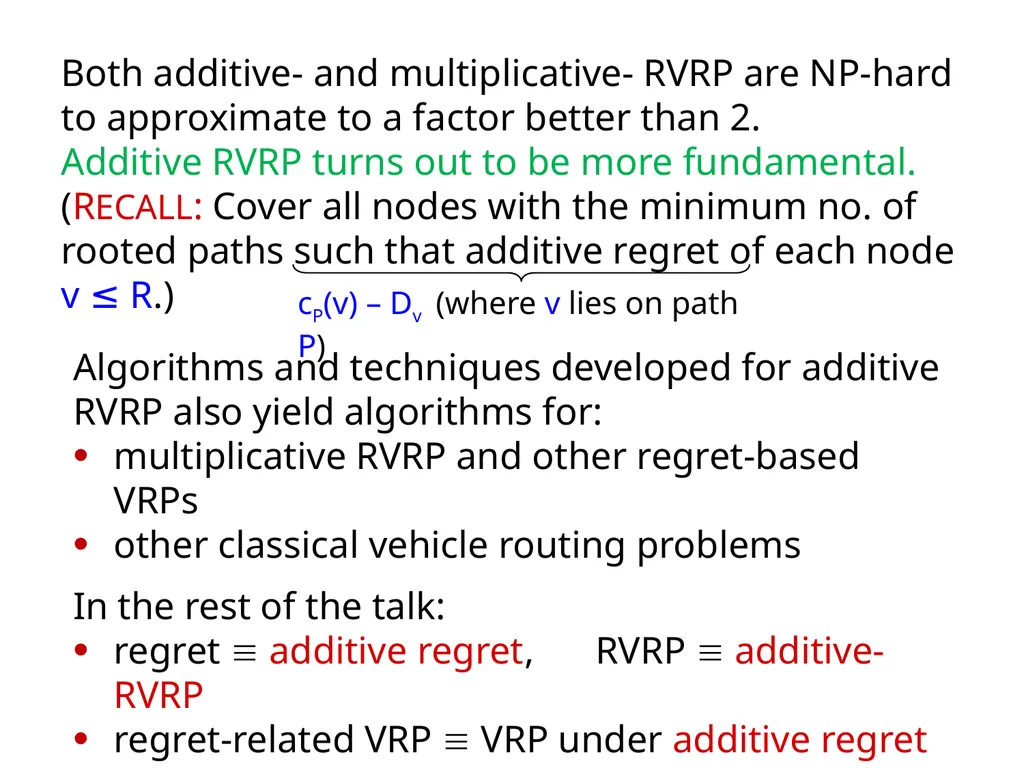
Both additive- and multiplicative- RVRP are NP-hard to approximate to a factor better than 2.
Additive RVRP turns out to be more fundamental.
(RECALL: Cover all nodes with the minimum no. of rooted paths such that additive regret of each node v ≤ R.) cP(v) – Dv (where v lies on path P) Algorithms and techniques developed for additive RVRP also yield algorithms for:
multiplicative RVRP and other regret-based VRPs
other classical vehicle routing problems
In the rest of the talk:
regret additive regret, RVRP additive-RVRP
regret-related VRP VRP under additive regret<br>
Additive RVRP turns out to be more fundamental.
(RECALL: Cover all nodes with the minimum no. of rooted paths such that additive regret of each node v ≤ R.) cP(v) – Dv (where v lies on path P) Algorithms and techniques developed for additive RVRP also yield algorithms for:
multiplicative RVRP and other regret-based VRPs
other classical vehicle routing problems
In the rest of the talk:
regret additive regret, RVRP additive-RVRP
regret-related VRP VRP under additive regret<br>
07
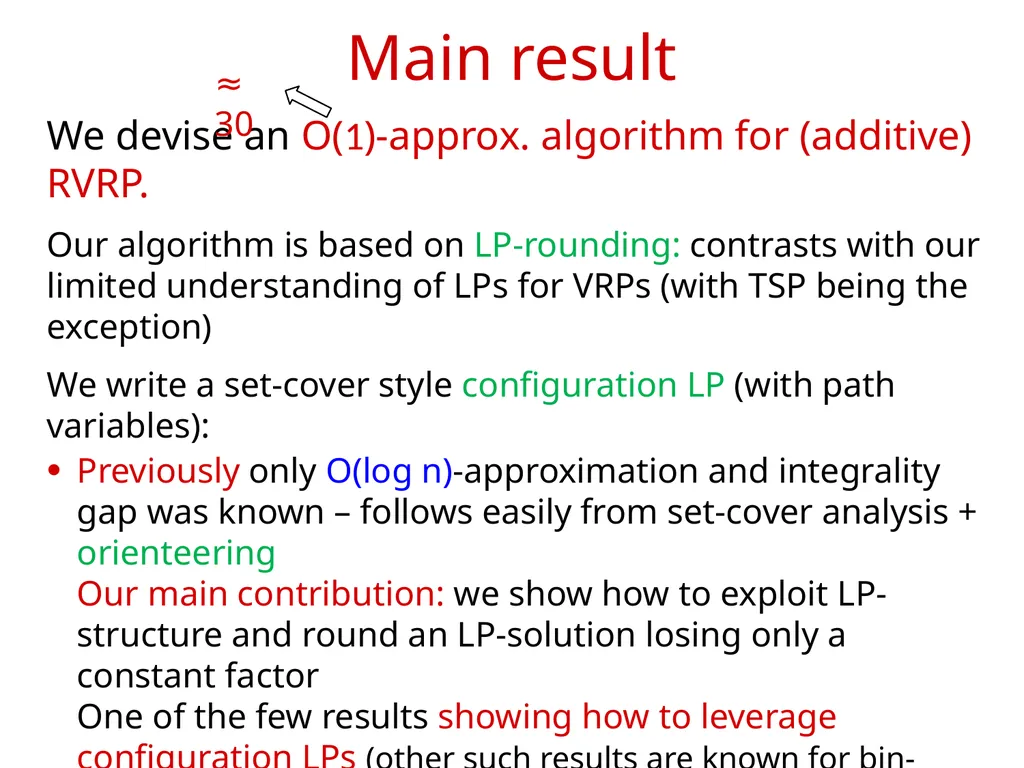
Main result We devise an O(1)-approx. algorithm for (additive) RVRP.
Our algorithm is based on LP-rounding: contrasts with our limited understanding of LPs for VRPs (with TSP being the exception)
We write a set-cover style configuration LP (with path variables):
Previously only O(log n)-approximation and integrality gap was known – follows easily from set-cover analysis + orienteering
Our main contribution: we show how to exploit LP-structure and round an LP-solution losing only a constant factor
One of the few results showing how to leverage configuration LPs (other such results are known for bin-packing, Santa Claus problem, min-makespan scheduling, combinatorial auctions)
Near-optimal LP solution can be efficiently obtained: orienteering yields approximate separation oracle for dual LP ≈ 30<br>
Our algorithm is based on LP-rounding: contrasts with our limited understanding of LPs for VRPs (with TSP being the exception)
We write a set-cover style configuration LP (with path variables):
Previously only O(log n)-approximation and integrality gap was known – follows easily from set-cover analysis + orienteering
Our main contribution: we show how to exploit LP-structure and round an LP-solution losing only a constant factor
One of the few results showing how to leverage configuration LPs (other such results are known for bin-packing, Santa Claus problem, min-makespan scheduling, combinatorial auctions)
Near-optimal LP solution can be efficiently obtained: orienteering yields approximate separation oracle for dual LP ≈ 30<br>
08
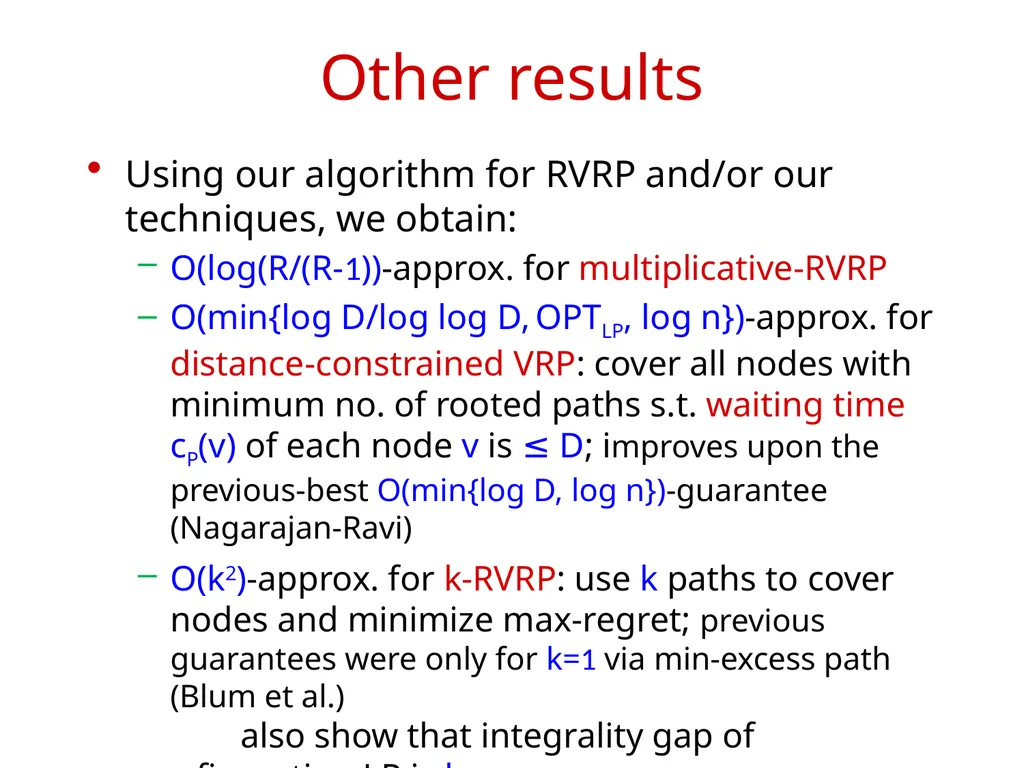
Other results Using our algorithm for RVRP and/or our techniques, we obtain:
O(log(R/(R-1))-approx. for multiplicative-RVRP
O(min{log D/log log D, OPTLP, log n})-approx. for distance-constrained VRP: cover all nodes with minimum no. of rooted paths s.t. waiting time cP(v) of each node v is ≤ D; improves upon the previous-best O(min{log D, log n})-guarantee (Nagarajan-Ravi)
O(k2)-approx. for k-RVRP: use k paths to cover nodes and minimize max-regret; previous guarantees were only for k=1 via min-excess path (Blum et al.)
also show that integrality gap of configuration LP is k<br>
O(log(R/(R-1))-approx. for multiplicative-RVRP
O(min{log D/log log D, OPTLP, log n})-approx. for distance-constrained VRP: cover all nodes with minimum no. of rooted paths s.t. waiting time cP(v) of each node v is ≤ D; improves upon the previous-best O(min{log D, log n})-guarantee (Nagarajan-Ravi)
O(k2)-approx. for k-RVRP: use k paths to cover nodes and minimize max-regret; previous guarantees were only for k=1 via min-excess path (Blum et al.)
also show that integrality gap of configuration LP is k<br>
09
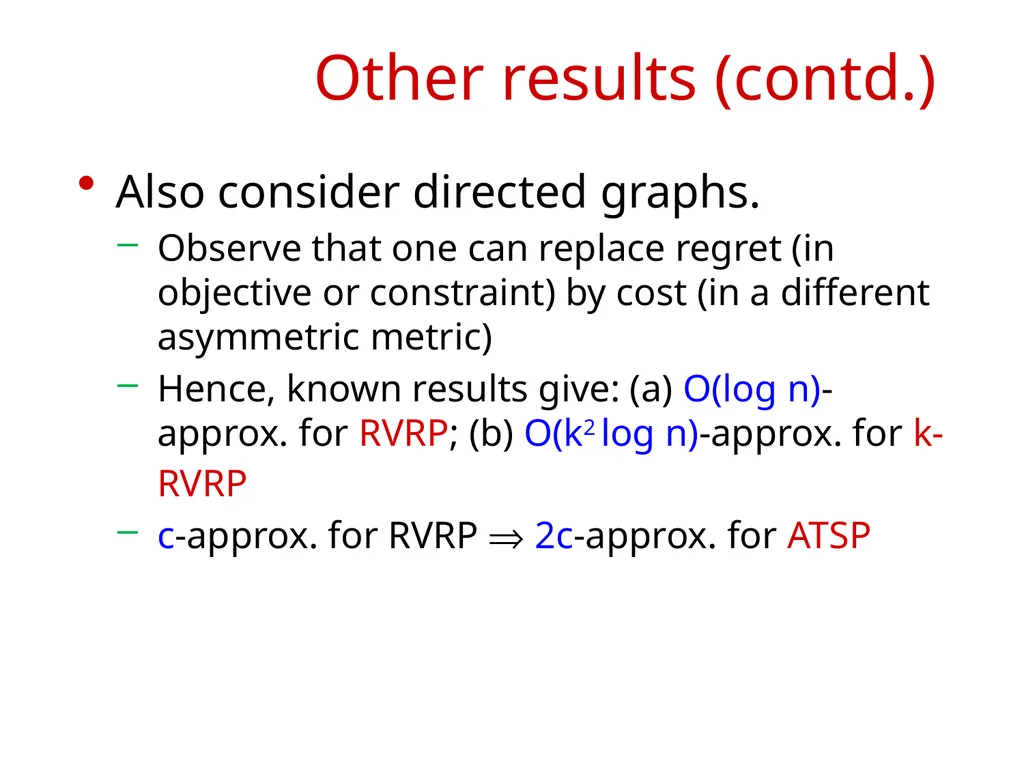
Other results (contd.) Also consider directed graphs.
Observe that one can replace regret (in objective or constraint) by cost (in a different asymmetric metric)
Hence, known results give: (a) O(log n)-approx. for RVRP; (b) O(k2 log n)-approx. for k-RVRP
c-approx. for RVRP Þ 2c-approx. for ATSP<br>
Observe that one can replace regret (in objective or constraint) by cost (in a different asymmetric metric)
Hence, known results give: (a) O(log n)-approx. for RVRP; (b) O(k2 log n)-approx. for k-RVRP
c-approx. for RVRP Þ 2c-approx. for ATSP<br>
10
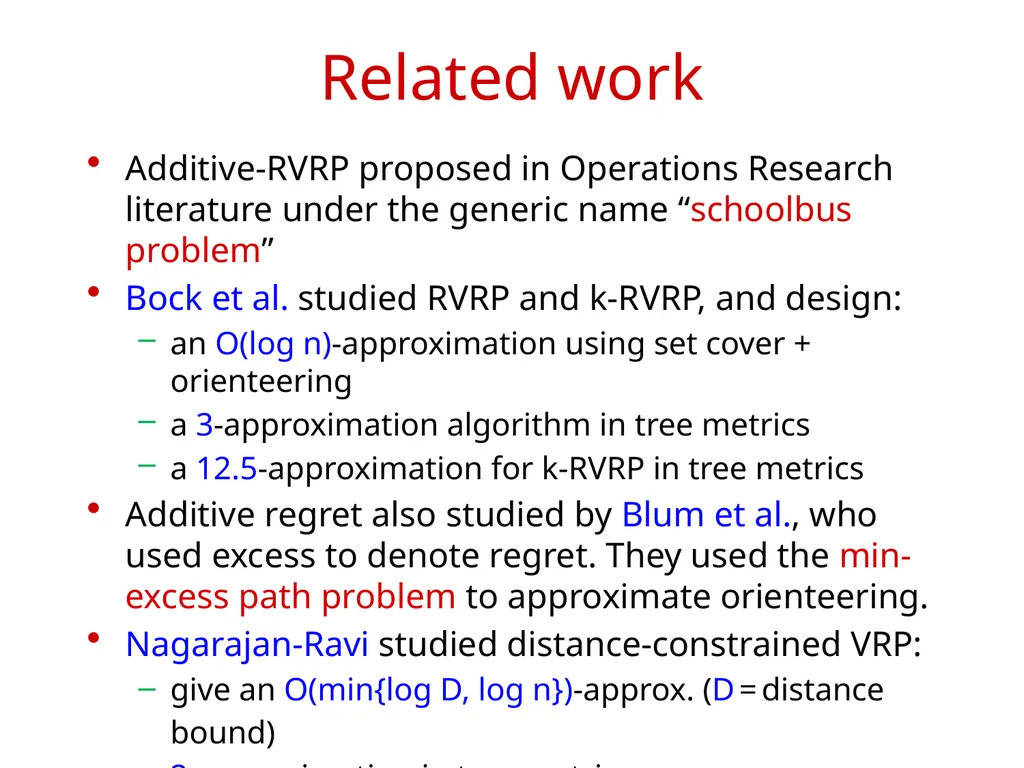
Related work Additive-RVRP proposed in Operations Research literature under the generic name “schoolbus problem”
Bock et al. studied RVRP and k-RVRP, and design:
an O(log n)-approximation using set cover + orienteering
a 3-approximation algorithm in tree metrics
a 12.5-approximation for k-RVRP in tree metrics
Additive regret also studied by Blum et al., who used excess to denote regret. They used the min-excess path problem to approximate orienteering.
Nagarajan-Ravi studied distance-constrained VRP:
give an O(min{log D, log n})-approx. (D = distance bound)
2-approximation in tree metrics<br>
Bock et al. studied RVRP and k-RVRP, and design:
an O(log n)-approximation using set cover + orienteering
a 3-approximation algorithm in tree metrics
a 12.5-approximation for k-RVRP in tree metrics
Additive regret also studied by Blum et al., who used excess to denote regret. They used the min-excess path problem to approximate orienteering.
Nagarajan-Ravi studied distance-constrained VRP:
give an O(min{log D, log n})-approx. (D = distance bound)
2-approximation in tree metrics<br>
11
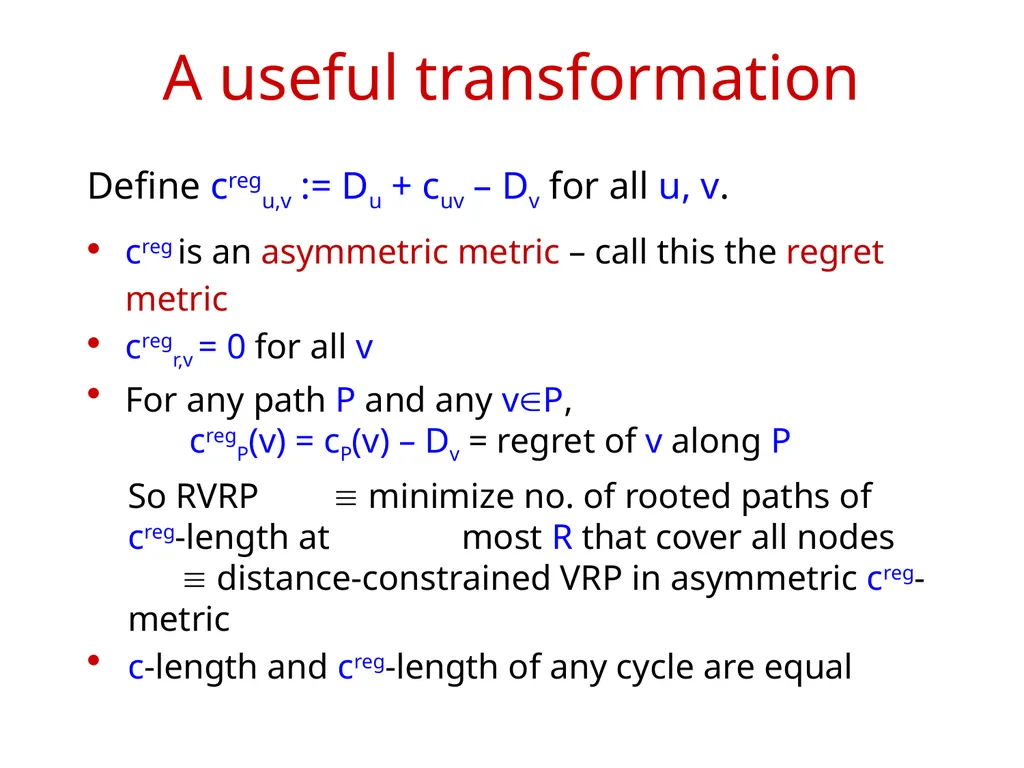
A useful transformation Define cregu,v := Du + cuv – Dv for all u, v.
creg is an asymmetric metric – call this the regret metric
cregr,v = 0 for all v
For any path P and any vP,
cregP(v) = cP(v) – Dv = regret of v along P
So RVRP minimize no. of rooted paths of creg-length at most R that cover all nodes
distance-constrained VRP in asymmetric creg-metric
c-length and creg-length of any cycle are equal<br>
creg is an asymmetric metric – call this the regret metric
cregr,v = 0 for all v
For any path P and any vP,
cregP(v) = cP(v) – Dv = regret of v along P
So RVRP minimize no. of rooted paths of creg-length at most R that cover all nodes
distance-constrained VRP in asymmetric creg-metric
c-length and creg-length of any cycle are equal<br>
12
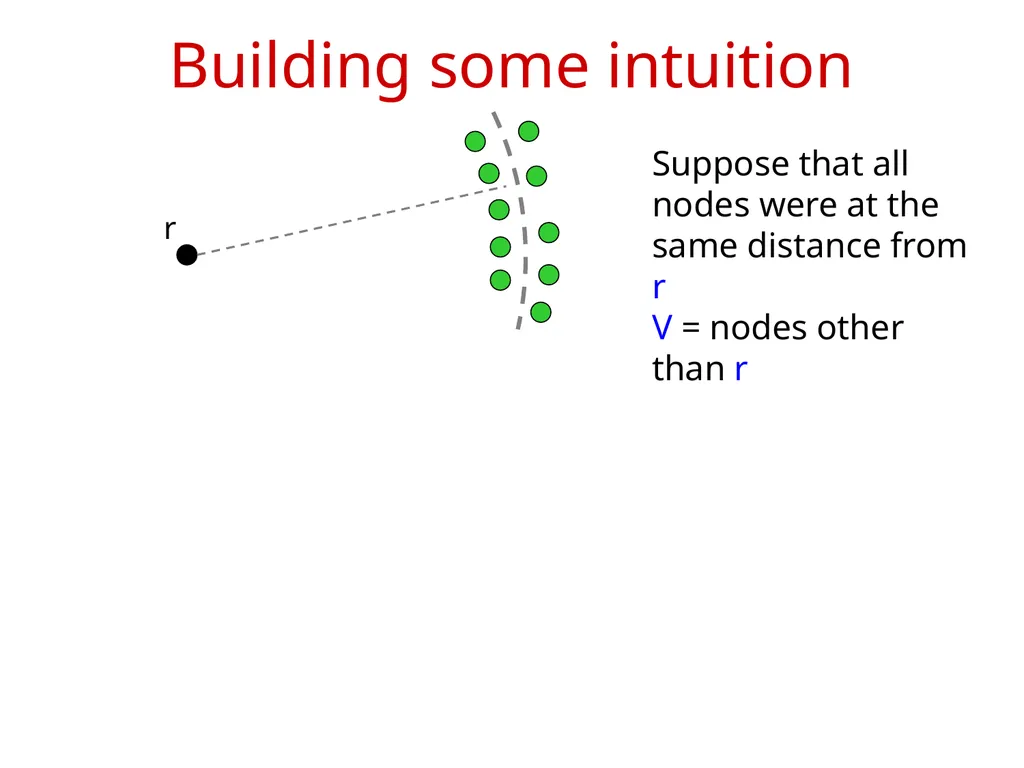
Building some intuition r Suppose that all nodes were at the same distance from r
V = nodes other than r<br>
V = nodes other than r<br>
13
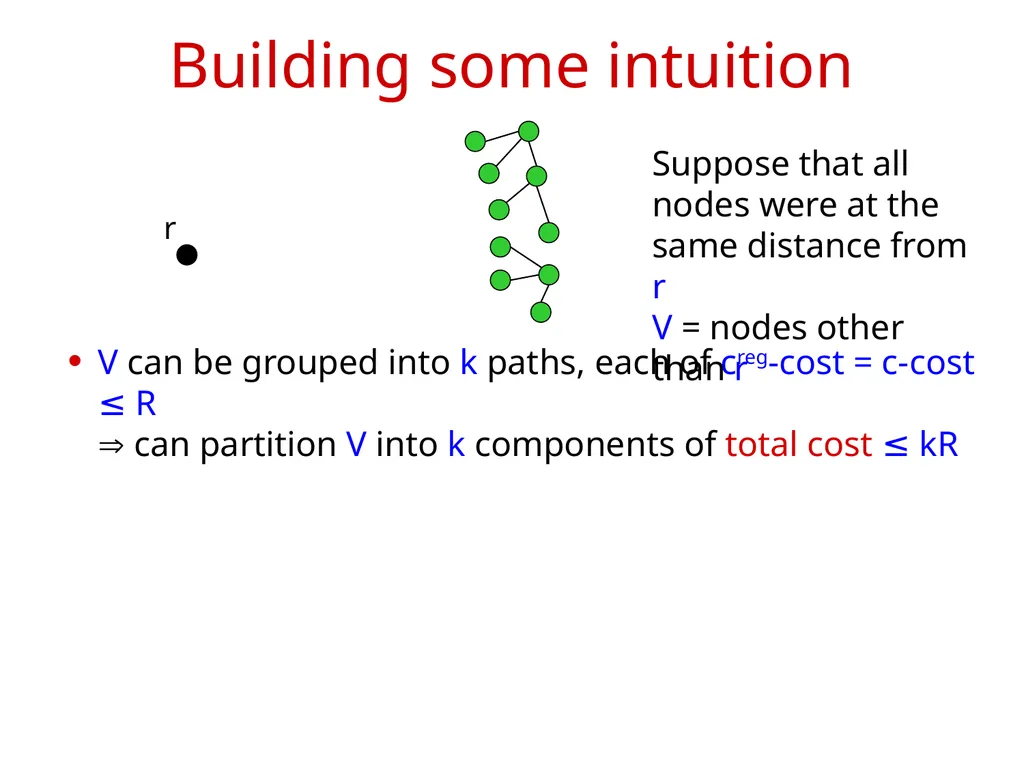
Building some intuition V can be grouped into k paths, each of creg-cost = c-cost ≤ R
can partition V into k components of total cost ≤ kR r Suppose that all nodes were at the same distance from r
V = nodes other than r<br>
can partition V into k components of total cost ≤ kR r Suppose that all nodes were at the same distance from r
V = nodes other than r<br>
14
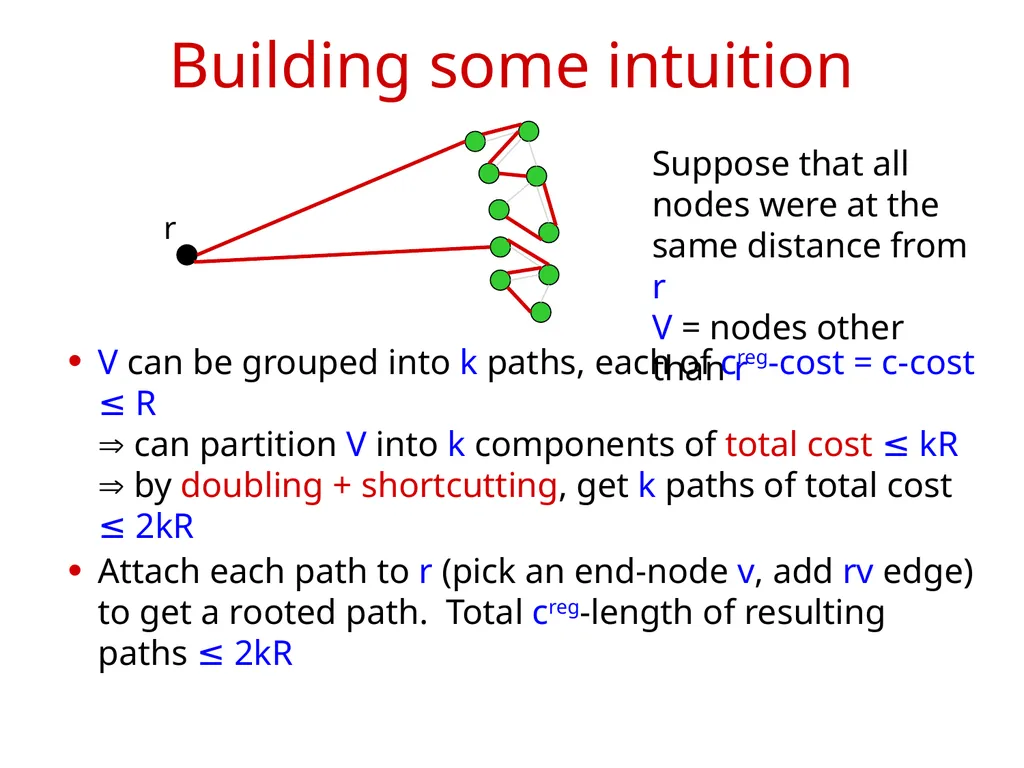
Building some intuition Suppose that all nodes were at the same distance from r
V = nodes other than r V can be grouped into k paths, each of creg-cost = c-cost ≤ R
can partition V into k components of total cost ≤ kR
by doubling + shortcutting, get k paths of total cost ≤ 2kR
Attach each path to r (pick an end-node v, add rv edge) to get a rooted path. Total creg-length of resulting paths ≤ 2kR r<br>
V = nodes other than r V can be grouped into k paths, each of creg-cost = c-cost ≤ R
can partition V into k components of total cost ≤ kR
by doubling + shortcutting, get k paths of total cost ≤ 2kR
Attach each path to r (pick an end-node v, add rv edge) to get a rooted path. Total creg-length of resulting paths ≤ 2kR r<br>
15
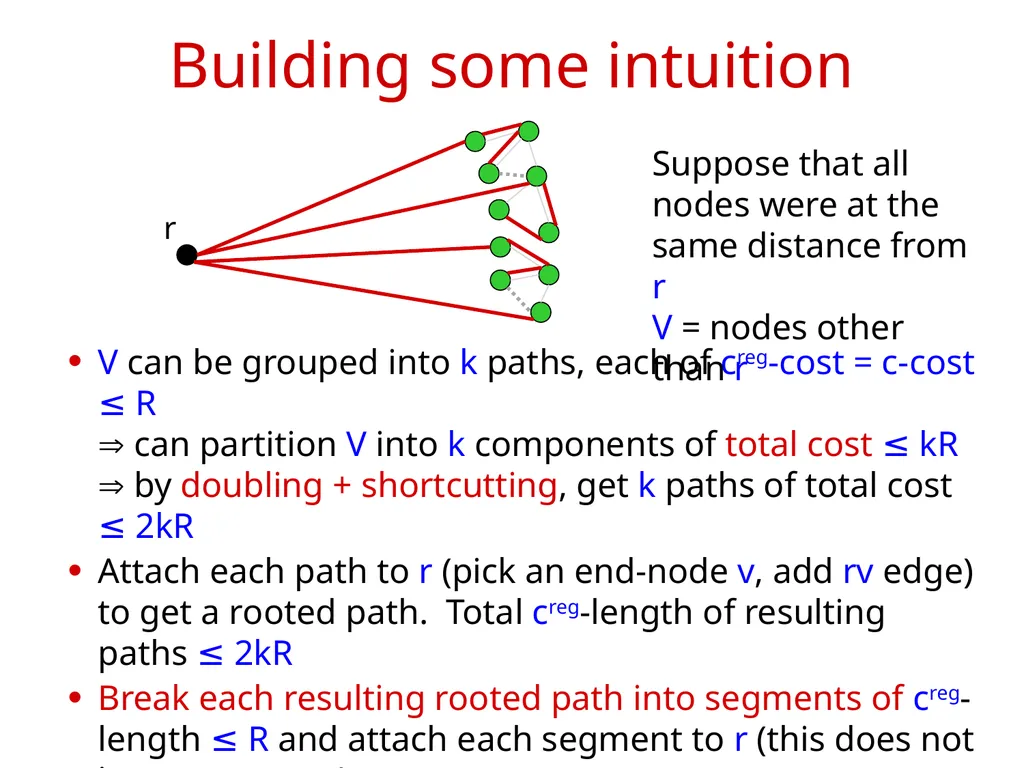
Building some intuition V can be grouped into k paths, each of creg-cost = c-cost ≤ R
can partition V into k components of total cost ≤ kR
by doubling + shortcutting, get k paths of total cost ≤ 2kR
Attach each path to r (pick an end-node v, add rv edge) to get a rooted path. Total creg-length of resulting paths ≤ 2kR
Break each resulting rooted path into segments of creg-length ≤ R and attach each segment to r (this does not increase regret)
This gives ≤ 3k rooted paths covering V, each of creg-length ≤ R. r Suppose that all nodes were at the same distance from r
V = nodes other than r<br>
can partition V into k components of total cost ≤ kR
by doubling + shortcutting, get k paths of total cost ≤ 2kR
Attach each path to r (pick an end-node v, add rv edge) to get a rooted path. Total creg-length of resulting paths ≤ 2kR
Break each resulting rooted path into segments of creg-length ≤ R and attach each segment to r (this does not increase regret)
This gives ≤ 3k rooted paths covering V, each of creg-length ≤ R. r Suppose that all nodes were at the same distance from r
V = nodes other than r<br>
16
Lemma: Given at most ak paths of total creg-cost at most bkR, we can efficiently find at most (a+b)k paths, each of creg-cost ≤ R.<br>
17
Lemma: Given at most ak paths of total creg-cost at most bkR, we can efficiently find at most (a+b)k paths, each of creg-cost ≤ R. So, suffices to find O(OPT) paths of total creg-length O(R.OPT). Lemma (Blum et al.): total c-cost of red edges on P ≤ 1.5 creg(P). Dv path P<br>
18
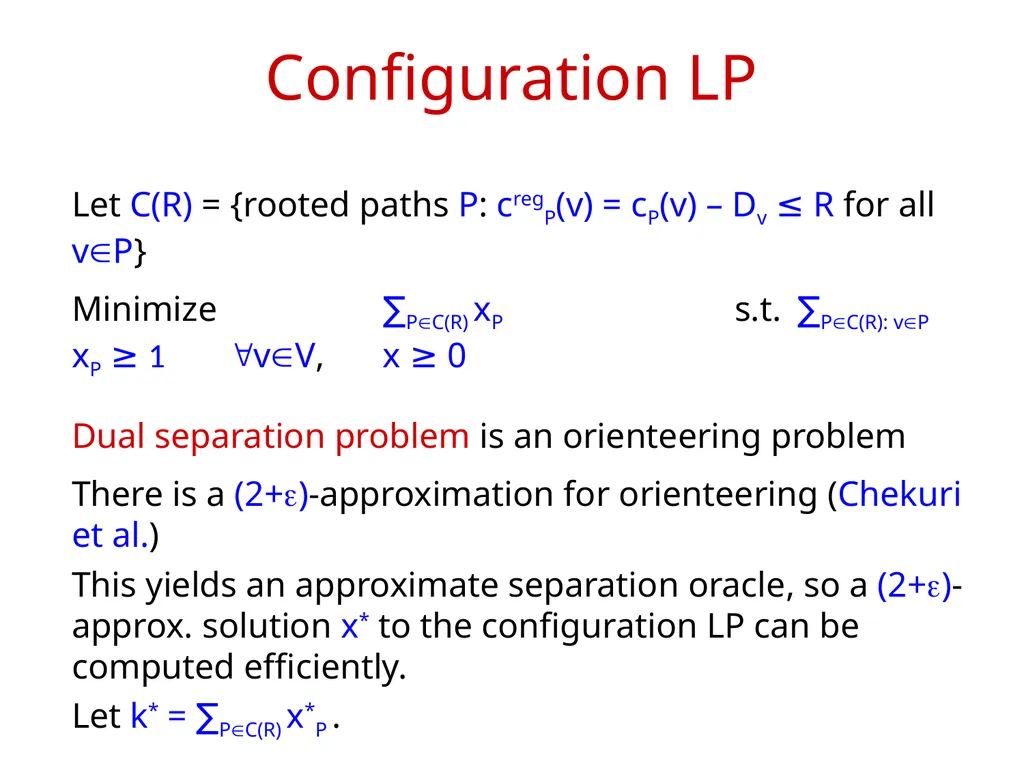
Configuration LP Let C(R) = {rooted paths P: cregP(v) = cP(v) – Dv ≤ R for all vP}
Minimize ∑PC(R) xP s.t. ∑PC(R): vP xP ≥ 1 vV, x ≥ 0
Dual separation problem is an orienteering problem
There is a (2+)-approximation for orienteering (Chekuri et al.)
This yields an approximate separation oracle, so a (2+)-approx. solution x* to the configuration LP can be computed efficiently.
Let k* = ∑PC(R) x*P .<br>
Minimize ∑PC(R) xP s.t. ∑PC(R): vP xP ≥ 1 vV, x ≥ 0
Dual separation problem is an orienteering problem
There is a (2+)-approximation for orienteering (Chekuri et al.)
This yields an approximate separation oracle, so a (2+)-approx. solution x* to the configuration LP can be computed efficiently.
Let k* = ∑PC(R) x*P .<br>
19
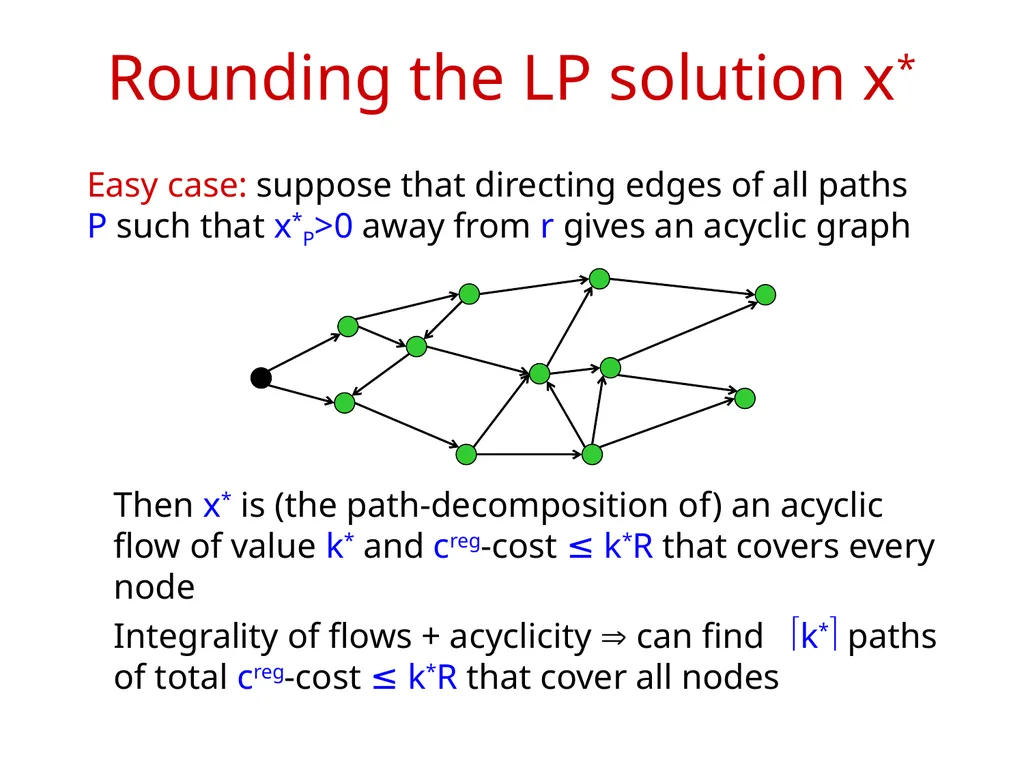
Rounding the LP solution x* Easy case: suppose that directing edges of all paths P such that x*P>0 away from r gives an acyclic graph Then x* is (the path-decomposition of) an acyclic flow of value k* and creg-cost ≤ k*R that covers every node
Integrality of flows + acyclicity can find k* paths of total creg-cost ≤ k*R that cover all nodes<br>
Integrality of flows + acyclicity can find k* paths of total creg-cost ≤ k*R that cover all nodes<br>
20
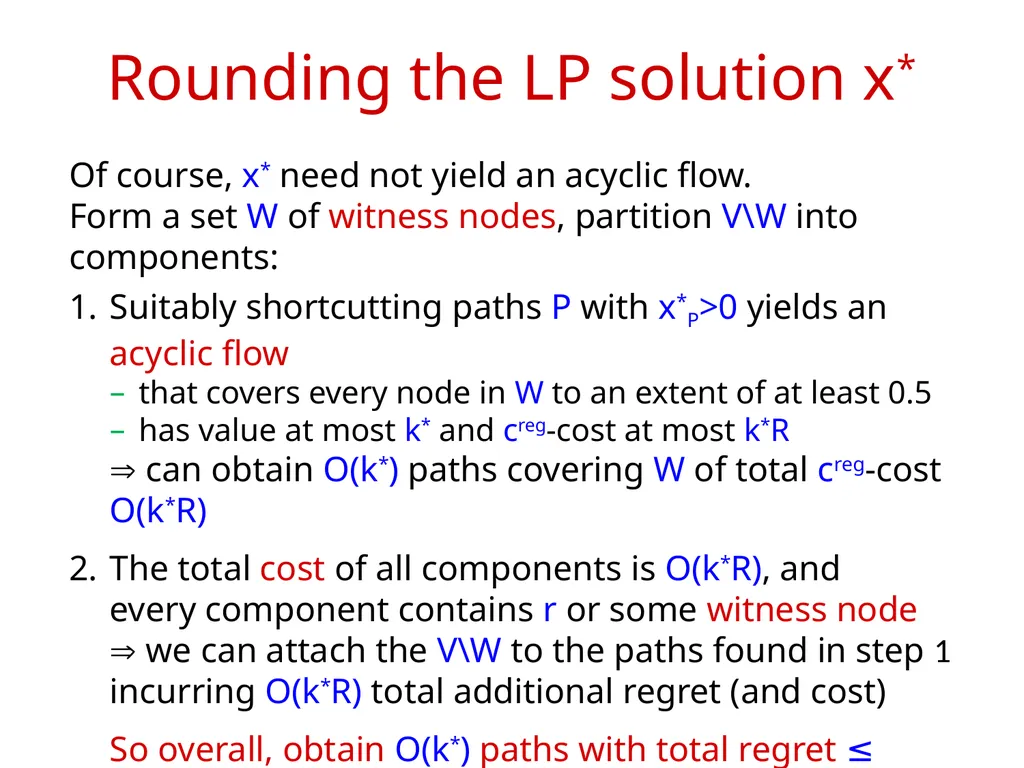
Rounding the LP solution x* Of course, x* need not yield an acyclic flow.
Form a set W of witness nodes, partition V\W into components:
Suitably shortcutting paths P with x*P>0 yields an acyclic flow
that covers every node in W to an extent of at least 0.5
has value at most k* and creg-cost at most k*R
can obtain O(k*) paths covering W of total creg-cost O(k*R)
The total cost of all components is O(k*R), and
every component contains r or some witness node
we can attach the V\W to the paths found in step 1 incurring O(k*R) total additional regret (and cost)
So overall, obtain O(k*) paths with total regret ≤ O(k*R)<br>
Form a set W of witness nodes, partition V\W into components:
Suitably shortcutting paths P with x*P>0 yields an acyclic flow
that covers every node in W to an extent of at least 0.5
has value at most k* and creg-cost at most k*R
can obtain O(k*) paths covering W of total creg-cost O(k*R)
The total cost of all components is O(k*R), and
every component contains r or some witness node
we can attach the V\W to the paths found in step 1 incurring O(k*R) total additional regret (and cost)
So overall, obtain O(k*) paths with total regret ≤ O(k*R)<br>
21
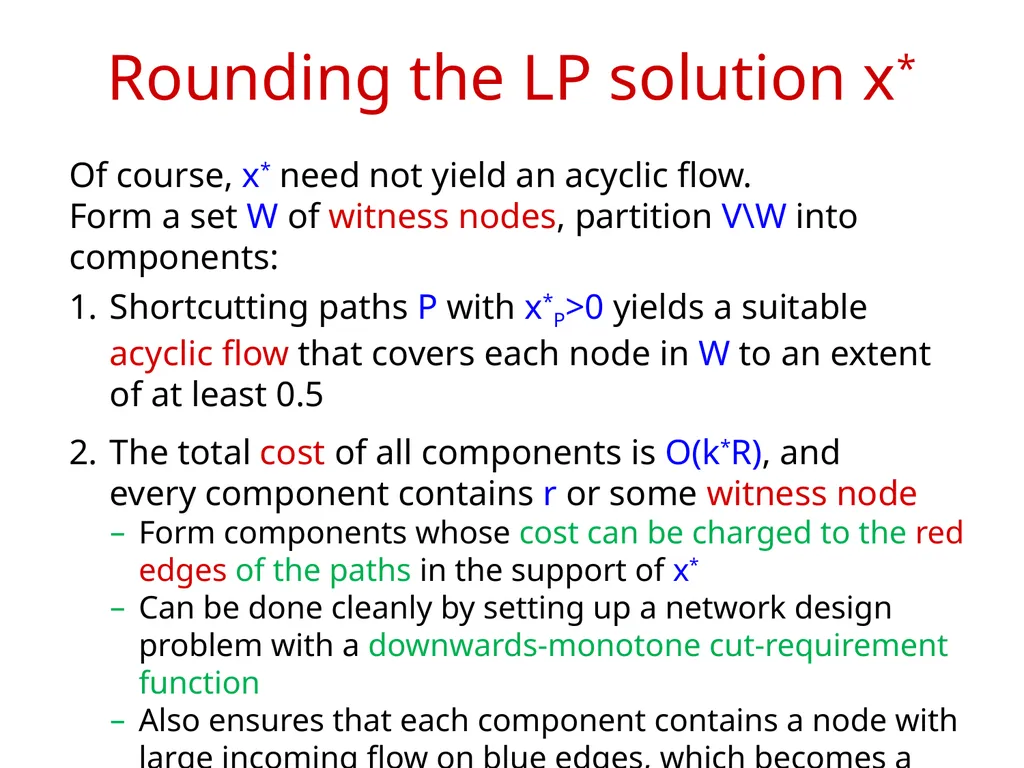
Rounding the LP solution x* Of course, x* need not yield an acyclic flow.
Form a set W of witness nodes, partition V\W into components:
Shortcutting paths P with x*P>0 yields a suitable acyclic flow that covers each node in W to an extent of at least 0.5
The total cost of all components is O(k*R), and
every component contains r or some witness node
Form components whose cost can be charged to the red edges of the paths in the support of x*
Can be done cleanly by setting up a network design problem with a downwards-monotone cut-requirement function
Also ensures that each component contains a node with large incoming flow on blue edges, which becomes a witness node<br>
Form a set W of witness nodes, partition V\W into components:
Shortcutting paths P with x*P>0 yields a suitable acyclic flow that covers each node in W to an extent of at least 0.5
The total cost of all components is O(k*R), and
every component contains r or some witness node
Form components whose cost can be charged to the red edges of the paths in the support of x*
Can be done cleanly by setting up a network design problem with a downwards-monotone cut-requirement function
Also ensures that each component contains a node with large incoming flow on blue edges, which becomes a witness node<br>
22
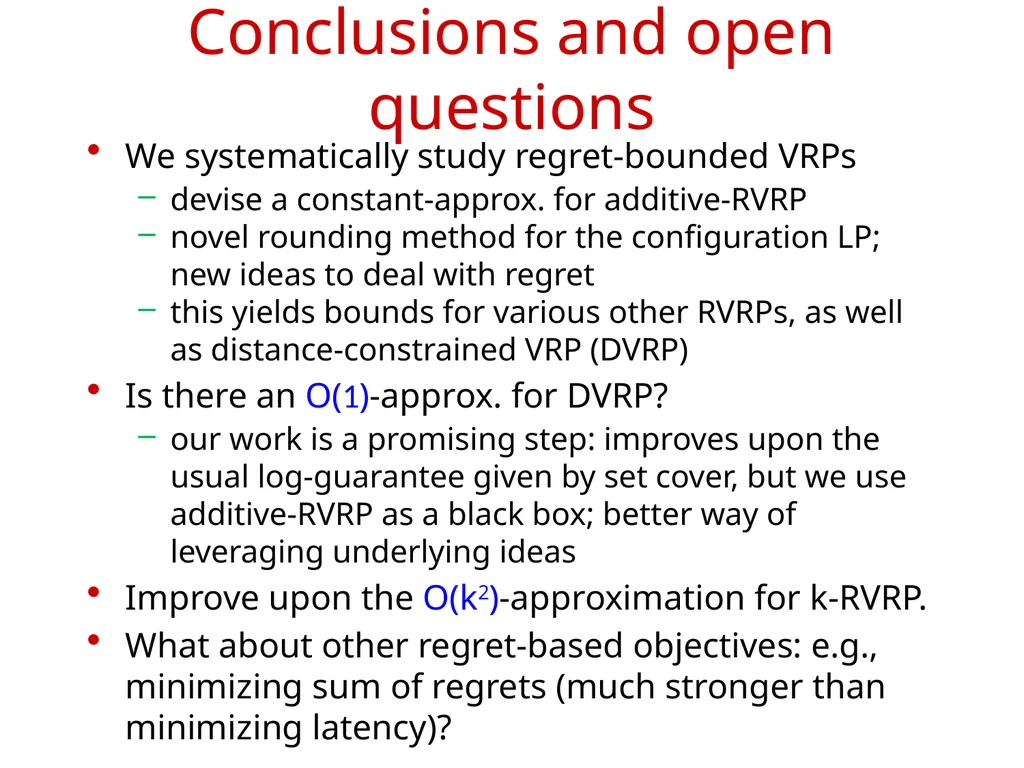
Conclusions and open questions We systematically study regret-bounded VRPs
devise a constant-approx. for additive-RVRP
novel rounding method for the configuration LP; new ideas to deal with regret
this yields bounds for various other RVRPs, as well as distance-constrained VRP (DVRP)
Is there an O(1)-approx. for DVRP?
our work is a promising step: improves upon the usual log-guarantee given by set cover, but we use additive-RVRP as a black box; better way of leveraging underlying ideas
Improve upon the O(k2)-approximation for k-RVRP.
What about other regret-based objectives: e.g., minimizing sum of regrets (much stronger than minimizing latency)?<br>
devise a constant-approx. for additive-RVRP
novel rounding method for the configuration LP; new ideas to deal with regret
this yields bounds for various other RVRPs, as well as distance-constrained VRP (DVRP)
Is there an O(1)-approx. for DVRP?
our work is a promising step: improves upon the usual log-guarantee given by set cover, but we use additive-RVRP as a black box; better way of leveraging underlying ideas
Improve upon the O(k2)-approximation for k-RVRP.
What about other regret-based objectives: e.g., minimizing sum of regrets (much stronger than minimizing latency)?<br>
23
Thank You.<br>