Aquatic specimens adaptations Hydrophis Habitat Food source Sea snakes, or coral reef snakes, are a subfamily of venomous elapid snakes, the Hydrophiinae, that inhabit marine environments for most or all of their lives. Most are
"Aquatic specimens adaptations Hydrophis Habitat /" is the property of its rightful owner. Permission is granted to
download and print the materials on this website for personal, non-commercial use only, and to display it
on your personal computer provided you do not modify the materials and that you retain all copyright
notices contained in the materials. By downloading content from our website, you accept the terms of this
agreement.
Presentation Transcript
01
Aquatic specimens adaptations<br>
02
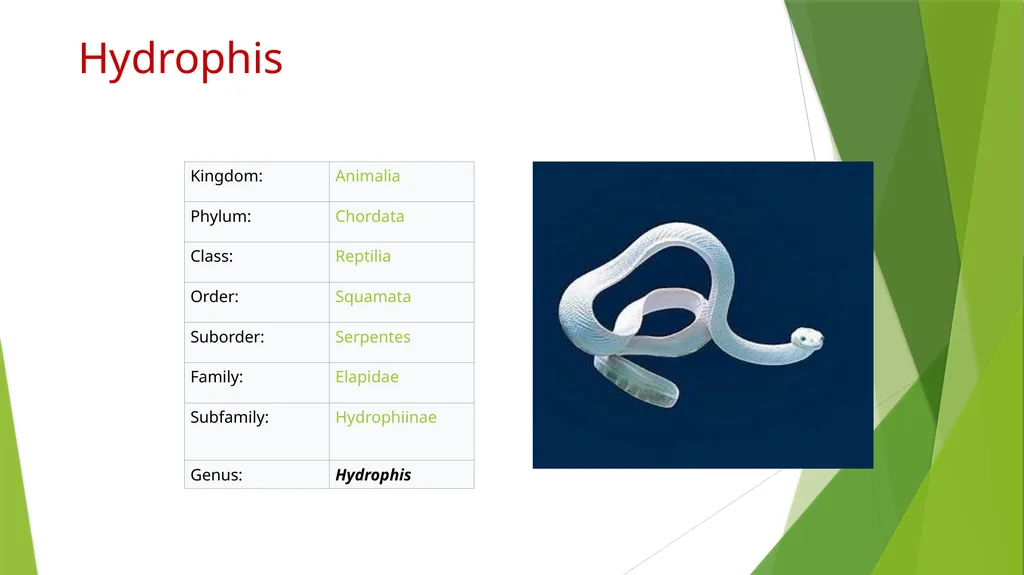
Hydrophis<br>
03
Habitat / Food source Sea snakes, or coral reef snakes, are a subfamily of venomous elapid snakes, the Hydrophiinae, that inhabit marine environments for most or all of their lives.
Most are extensively adapted to a fully aquatic life and are unable to move on land.
They feed on small fish and occasionally young octopus.<br>
04
They are typically found in Indo-Australian and Southeast Asian waters. Currently, around 36 species are recognized.
Most species of sea snakes are able to respire through the top of their skin.<br>
05
Habitat / Food source An aquatic animal faces challenges not encountered by its terrestrial counterparts, promoting adaptive responses in multiple traits.
For example, a thicker dermis might protect snakes when they are pushed against sharp objects by water currents, and might enable a snake to shed fouling organisms attached to its skin.
We thus predicted that marine snakes should have thicker skin than terrestrial species.<br>
06
Live mainly in waters less than 30 metres (about 100 feet) deep, as they must dive to the seafloor to obtain their food among coral reefs, among mangroves, or on the ocean bottom. Some species prefer hard bottoms (corals), while others prefer soft bottoms (mud or sand) in which to hunt their prey.
Most sea snakes feed upon fishes of various sizes and shapes, including eels. Hydrophis specializes in burrowing eels.<br>
07
Body structure sea snake have paddle-like tails and laterally compressed body that give them an eel-like appearance.
Unlike fish, they do not have gills and must surface regularly to breathe.
Most sea snakes are completely aquatic and have adapted to sea environments in many ways, the most characteristic of which is a paddle-like tail that has improved their swimming ability.<br>
08
This has often caused the ventral scales to become reduced in size, even difficult to distinguish from the adjoining scales.
Their lack of ventral scales means they have become virtually helpless on land, but as they live out their entire lifecycles at sea, they have no need to leave the water.<br>
09
Auatic adaptation features In adaptation to marine life, true sea snakes have a flattened body with a short tail, valvular nostrils on top of the snout, and elongated lungs that extend the entire length of the body.
Their scales are very small and usually not overlapping (juxtaposed), abutting against one another like paving stones.
The belly scales are reduced in size in the primitive species, whereas in the more advanced forms they are absent.<br>
10
As a result, the advanced species cannot crawl and are thus helpless on land.
When swimming, a keel is formed along part of the belly, increasing surface area and aiding propulsion, which occurs by lateral undulation.
Sea snakes can remain submerged for several hours, possibly as much as eight or more. This remarkable feat is partly due to the fact that they can breathe through their skin.<br>
11
More than 90 percent of waste carbon dioxide and 33 percent of their oxygen requirement can be transported via cutaneous respiration.
Moreover, a 2019 study of the blue-banded sea snake (or annulated sea snake, Hydrophis cyanocinctus) found a highly vascularized area between the snout and the top of the head, which allows oxygen to be transported directly from the water to the snake’s brain.<br>
12
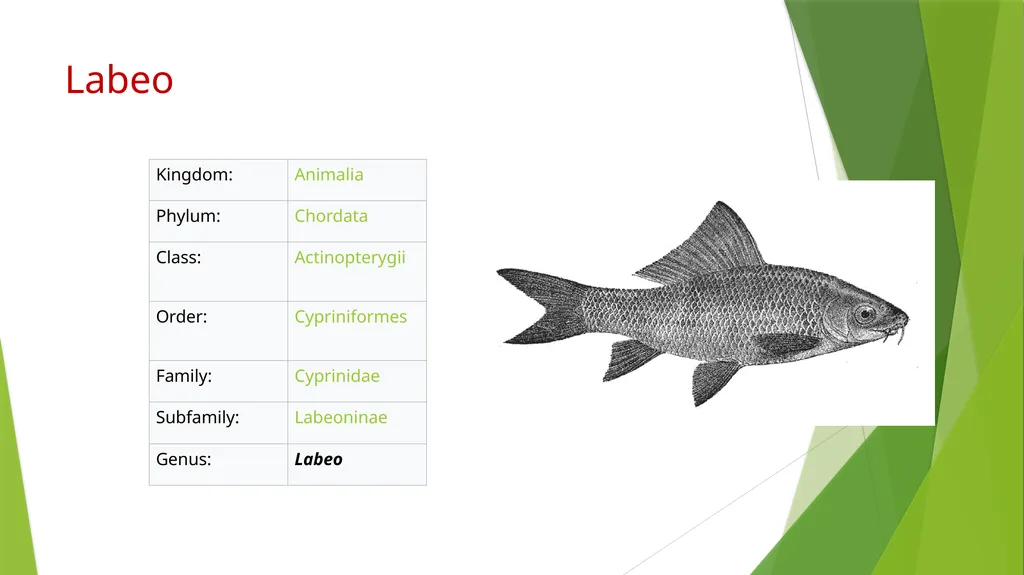
Labeo<br>
13
Habitat / Food source Labeo is a genus of carps in the family Cyprinidae.
They are found in freshwater habitats in the tropics and subtropics of Africa and Asia.<br>
14
Body structure Labeos are larger, and have a more spindle-shaped body, as they are mostly free-swimming.
Their mouths look very different, too; they have a pronounced rostral cap, which covers the upper lip except when feeding.<br>
15
The lips are expanded into thick, sausage-shaped pads which have keratinized edges.
The genus name Labeo is Latin for "one who has large lips".<br>