Aquatic specimens adaptations Anguilla Habitat Food source The Anguillidae are a family of ray-finned fish that contains the freshwater eels. Eighteen of the 19 extant species and six subspecies in this family are in the genus Anguilla.
"Aquatic specimens adaptations Anguilla Habitat /" is the property of its rightful owner. Permission is granted to
download and print the materials on this website for personal, non-commercial use only, and to display it
on your personal computer provided you do not modify the materials and that you retain all copyright
notices contained in the materials. By downloading content from our website, you accept the terms of this
agreement.
Presentation Transcript
01
Aquatic specimens adaptations<br>
02
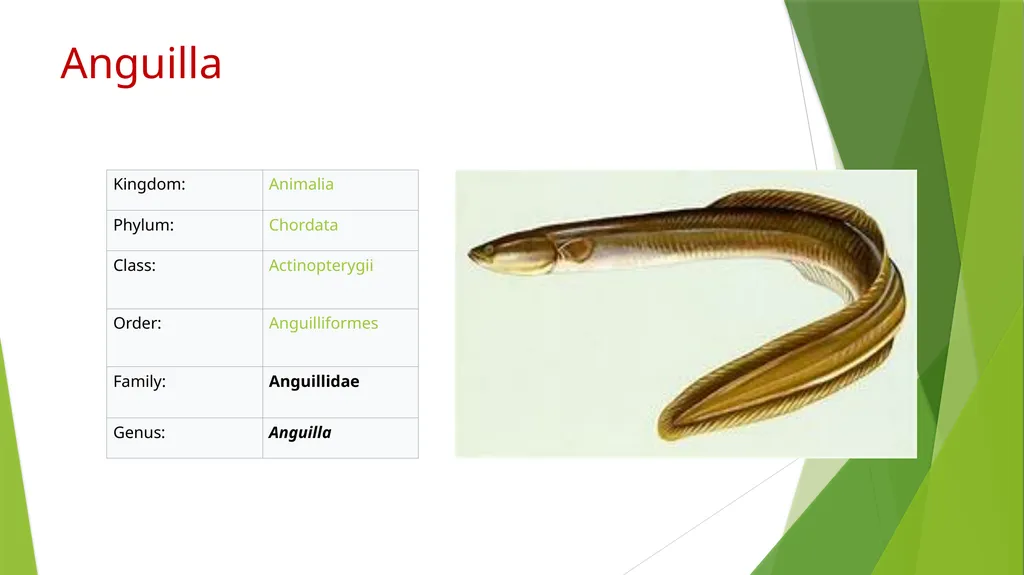
Anguilla<br>
03
Habitat / Food source The Anguillidae are a family of ray-finned fish that contains the freshwater eels.
Eighteen of the 19 extant species and six subspecies in this family are in the genus Anguilla.<br>
04
They are elongated fish with snake-like bodies, their long dorsal, caudal and anal fins forming a continuous fringe.
They are catadromous fish, spending their adult lives in fresh water, but migrating to the ocean to breed.<br>
05
Habitat / Food source Freshwater eels are aquatic and live in various habitats, including freshwater, estuaries, and saltwater/marine habitats, and occupy the roles of both predator and prey, and evidence has been found of nematode parasitism in some species.<br>
06
Some eel species have been observed consuming the eggs of predatory fish such as trout, aiding in population control in these systems.
Juvenile eels occupy small spaces in between rocks, in crevices or mud.<br>
07
Body structure Adult freshwater eels are elongated with tubelike, snake-shaped bodies.
They have large, pointed heads and their dorsal fins are usually continuous with their caudal and anal fins, to form a fringe lining the posterior end of their bodies.
They have relatively well developed eyes and pectoral fins compared to saltwater eels that they use to navigate through river bottoms and shallow water. .<br>
08
Body structure Ventral lateral gill slits make up eighty-five percent of gas exchange and are highly efficient in converting between salt and freshwater.
This feature really separates the Anguillidae, freshwater eels, from other eels who have internal gill chambers.
Since the dorsal, anal and caudal fins are fused there is no need for pelvic fins. Dorsal fin begins mid body creating a long continuous fin where in other species it begins more posterior and is not as prominent in length.<br>
09
Their body movement depends highly on undulation originating near the anterior axial end.
Due to the fins being fused we see a highly skilled swimmer amongst the Anguillidae which aids in migration and hunting/predation.<br>
10
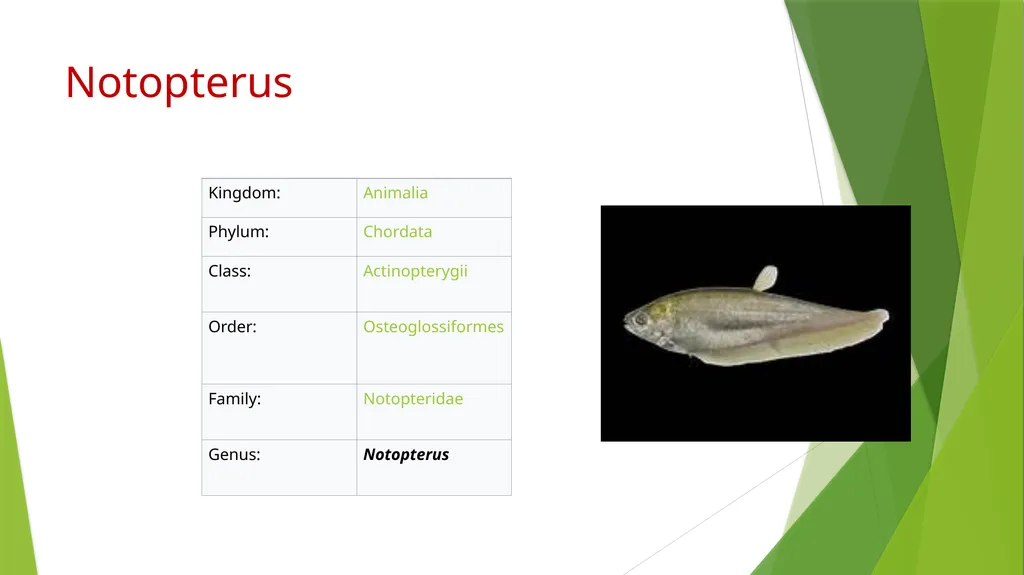
Notopterus<br>
11
Habitat / Food source The bronze featherback (Notopterus notopterus) is a fish in family Notopteridae found in South and Southeast Asia.
Although primarily found in fresh water, it has been known to enter brackish water.
At present it is the only member of its genus, but as currently defined it is likely a species complex.<br>
12
Body structure Featherbacks have slender, elongated, bodies, giving them a knife-like appearance.
The caudal fin is small and fused with the anal fin, which runs most of the length of the body. Where present, the dorsal fin is small and narrow, giving rise to the common name of "featherback".<br>
13
The fish swims by holding its body rigid and rippling the anal fin to propel itself forward or backwards.
Notopterids have specialized swim bladders.
The organ extends throughout the body and even into the fins in some cases.<br>
14
Although the swim bladder is not highly vascularised, it can absorb oxygen from air and also functions to produce sound by squeezing air through a narrow passage into the pharynx.<br>