
Aquatic Therapy For Neurological Conditions
CM
Published · 38 slides · 0 views

1 / 1


Description
Aquatic Therapy For Neurological Conditions Meredith Smythe, SPT UNC Chapel Hill Disclaimer: all videos and pictures are for one time use and educational purposes only and will not be distributed.
Related Topics
Share
Embed code
Download this presentation From Below
"Aquatic Therapy For Neurological Conditions" is the property of its rightful owner. Permission is granted to download and print the materials on this website for personal, non-commercial use only, and to display it on your personal computer provided you do not modify the materials and that you retain all copyright notices contained in the materials. By downloading content from our website, you accept the terms of this agreement.
Presentation Transcript
01
Aquatic Therapy For Neurological Conditions
Meredith Smythe, SPT UNC Chapel Hill
Disclaimer: all videos and pictures are for one time use and educational purposes only and will not be distributed. https://www.youtube.com/watch?v=fEG5_3VWFOU&list=PL2VuyKHfWNghNqe7zEhR9opxDzP61EQeg&index=11<br>
Meredith Smythe, SPT UNC Chapel Hill
Disclaimer: all videos and pictures are for one time use and educational purposes only and will not be distributed. https://www.youtube.com/watch?v=fEG5_3VWFOU&list=PL2VuyKHfWNghNqe7zEhR9opxDzP61EQeg&index=11<br>
02
Presentation Outline: Learning Objectives:
Properties of Water: Buoyancy, Hydrostatic Pressure, Center of Buoyancy, Water Resistance, Turbulence, Thermodynamics
Indications for Aquatic Therapy (AT)
Contraindications for Aquatic Therapy (AT)
Types of Aquatic Therapy: Ai Chi, Aquatic PNF, Bad Ragaz Ring Method, Halliwick Method, Watsu
Evidence for Aquatic Therapy in Patients with Neurological Conditions
Case Example
Questions<br>
Properties of Water: Buoyancy, Hydrostatic Pressure, Center of Buoyancy, Water Resistance, Turbulence, Thermodynamics
Indications for Aquatic Therapy (AT)
Contraindications for Aquatic Therapy (AT)
Types of Aquatic Therapy: Ai Chi, Aquatic PNF, Bad Ragaz Ring Method, Halliwick Method, Watsu
Evidence for Aquatic Therapy in Patients with Neurological Conditions
Case Example
Questions<br>
03
Learning objectives: To identify specific qualities of water such as buoyancy and how they are used in therapy
To understand when and how water can be appropriate in treating patients with neurological disease
To understand indications for aquatic therapy and how to work with temperature sensitivity with patients
To understand contraindications for AT
To review the evidence of benefits of AT for patients with neurological conditions
To review examples aquatic exercises<br>
To understand when and how water can be appropriate in treating patients with neurological disease
To understand indications for aquatic therapy and how to work with temperature sensitivity with patients
To understand contraindications for AT
To review the evidence of benefits of AT for patients with neurological conditions
To review examples aquatic exercises<br>
04
Properties of Water: Buoyancy Buoyancy
Specific Gravity
Water’s density is 1g/cm3
Body <1 floats
Body>1 sinks 3
Avg male= .95
Avg female= .75<br>
Specific Gravity
Water’s density is 1g/cm3
Body <1 floats
Body>1 sinks 3
Avg male= .95
Avg female= .75<br>
05
Properties of Water: Buoyancy Buoyancy
When a body is immersed in water, it experiences an upward force equal to the weight of the volume of water displaced2 (Archimedes principal)
Decreases weight bearing force
Increases pain free movement
Buoyancy can be used to challenge balance and postural stablity3<br>
When a body is immersed in water, it experiences an upward force equal to the weight of the volume of water displaced2 (Archimedes principal)
Decreases weight bearing force
Increases pain free movement
Buoyancy can be used to challenge balance and postural stablity3<br>
06
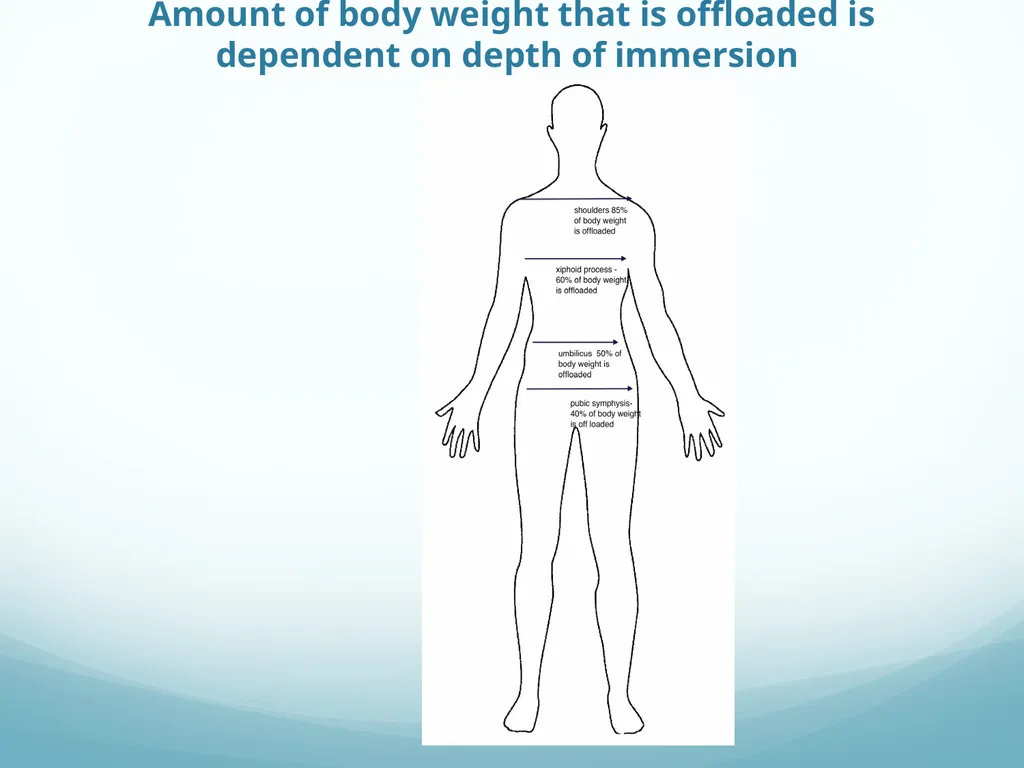
Amount of body weight that is offloaded is dependent on depth of immersion<br>
07
Properties of Water: Hydrostatic Pressure Hydrostatic Pressure= Pressure that the water exerts on the body
Degree of pressure depends on:3
Density of the fluid
Depth of immersion
Physiological Effects:
Helps with venous insufficiency and edema
Strengthens respiratory muscles (diaphragm and intercostals)
Stimulates sensory input 3<br>
Degree of pressure depends on:3
Density of the fluid
Depth of immersion
Physiological Effects:
Helps with venous insufficiency and edema
Strengthens respiratory muscles (diaphragm and intercostals)
Stimulates sensory input 3<br>
08
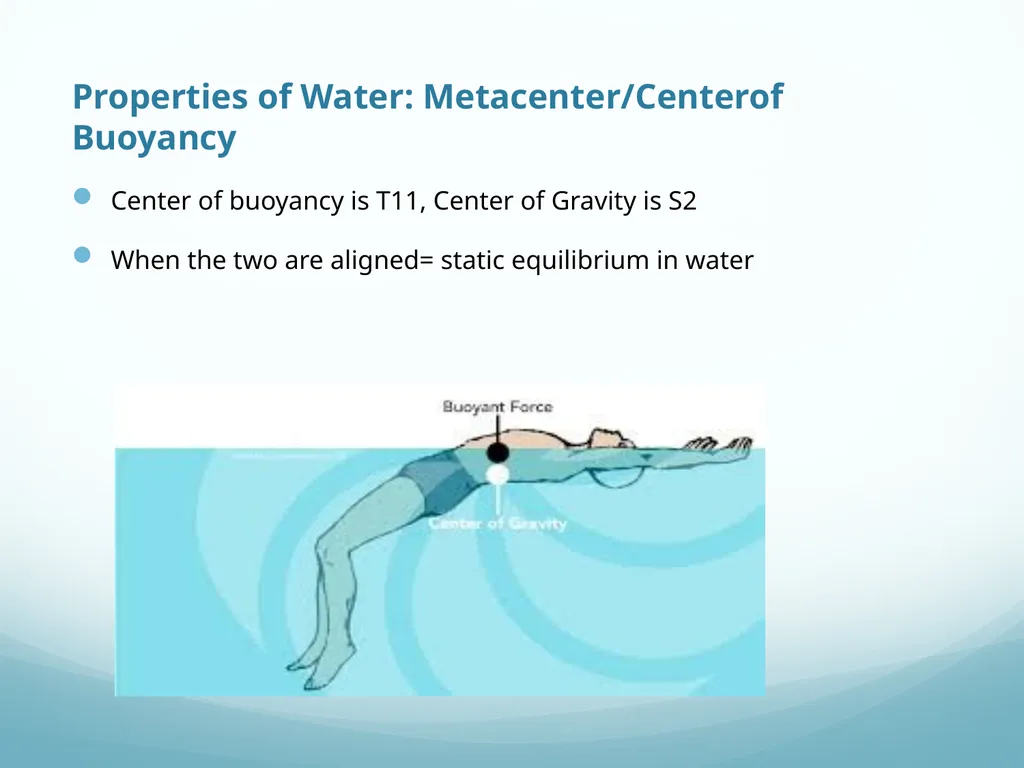
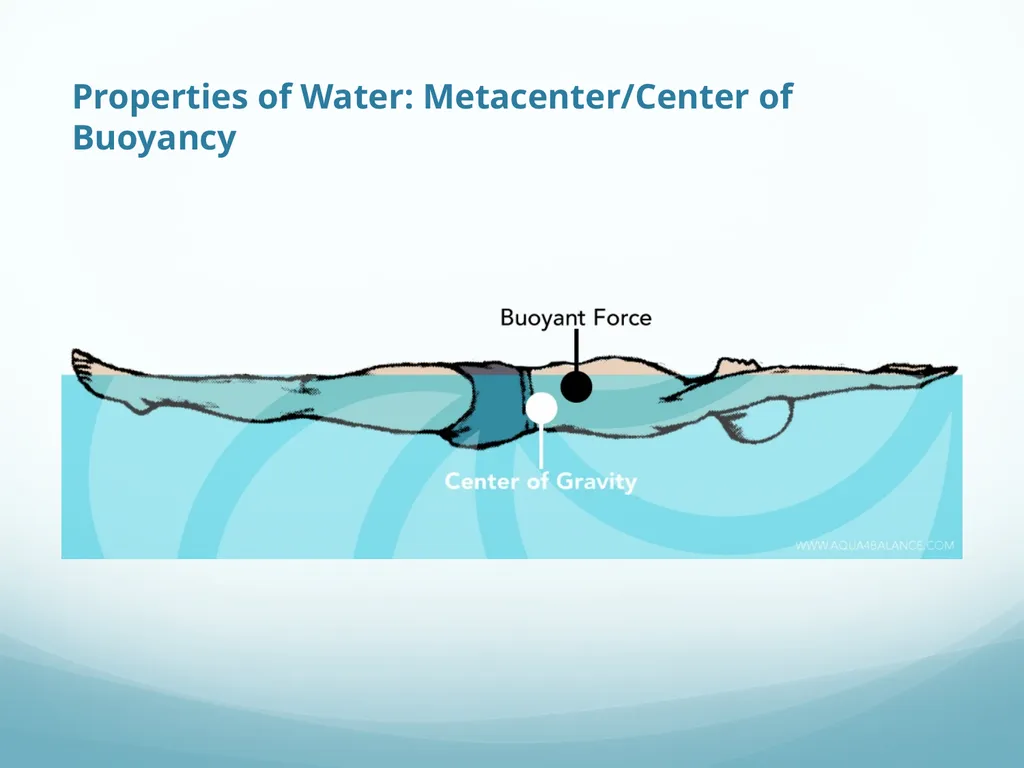
Properties of Water: Metacenter/Centerof Buoyancy Center of buoyancy is T11, Center of Gravity is S2
When the two are aligned= static equilibrium in water<br>
When the two are aligned= static equilibrium in water<br>
09
Properties of Water: Metacenter/Center of Buoyancy<br>
10
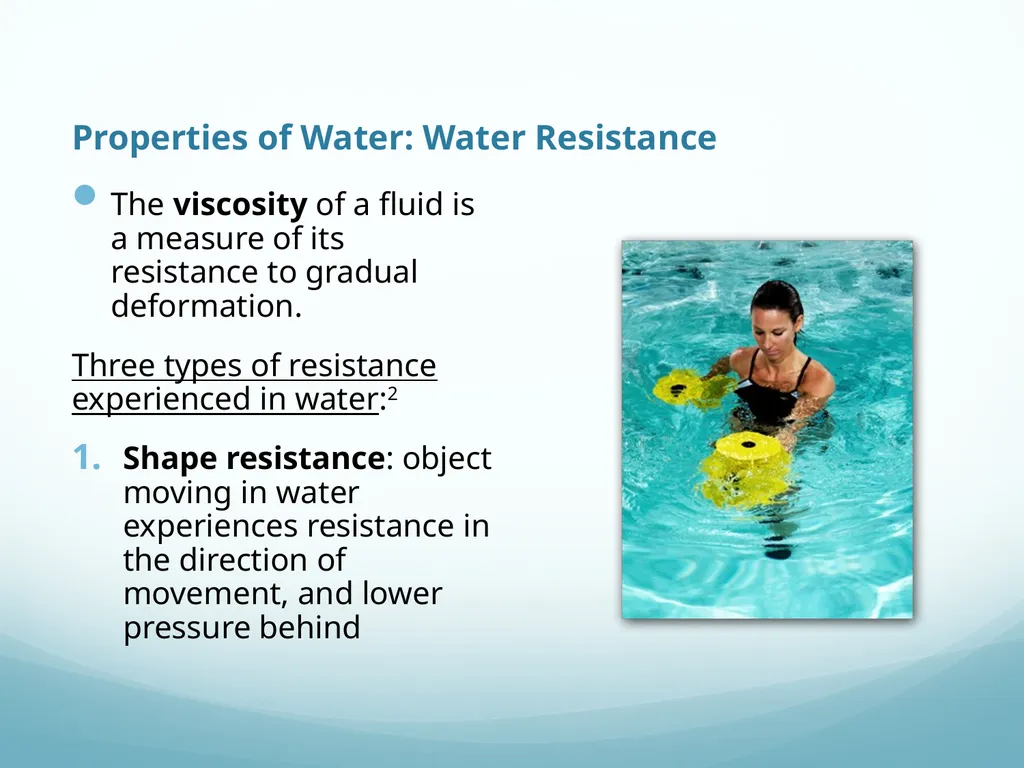
Properties of Water: Water Resistance The viscosity of a fluid is a measure of its resistance to gradual deformation.
Three types of resistance experienced in water:2
Shape resistance: object moving in water experiences resistance in the direction of movement, and lower pressure behind<br>
Three types of resistance experienced in water:2
Shape resistance: object moving in water experiences resistance in the direction of movement, and lower pressure behind<br>
11
Properties of Water: Water Resistance Wave resistance:2 a body encounters resistance with colliding waves from moving water
Friction:2 force acting opposite to the relative motion of the object.
Resistance felt is dependent on the velocity of movement and surface area of the object high-speed movements cause more resistance<br>
Friction:2 force acting opposite to the relative motion of the object.
Resistance felt is dependent on the velocity of movement and surface area of the object high-speed movements cause more resistance<br>
12
Properties of Water: Turbulence Turbulence= violent/unsteady movement of air or water
swirling/ sloshing
generally increases resistance3
Ways to provide turbulence:
Walk one direction and return the other direction
Perform exercise in front of a jet at the side of the pool<br>
swirling/ sloshing
generally increases resistance3
Ways to provide turbulence:
Walk one direction and return the other direction
Perform exercise in front of a jet at the side of the pool<br>
13
Properties of Water: Thermodynamics Heat capacity of water is 1000x greater than air 4,2
Efficient conductor transfers heat 25x faster than air
Heat capacity of human body< water
Human body will approach equilibrium faster than the water 4<br>
Efficient conductor transfers heat 25x faster than air
Heat capacity of human body< water
Human body will approach equilibrium faster than the water 4<br>
14
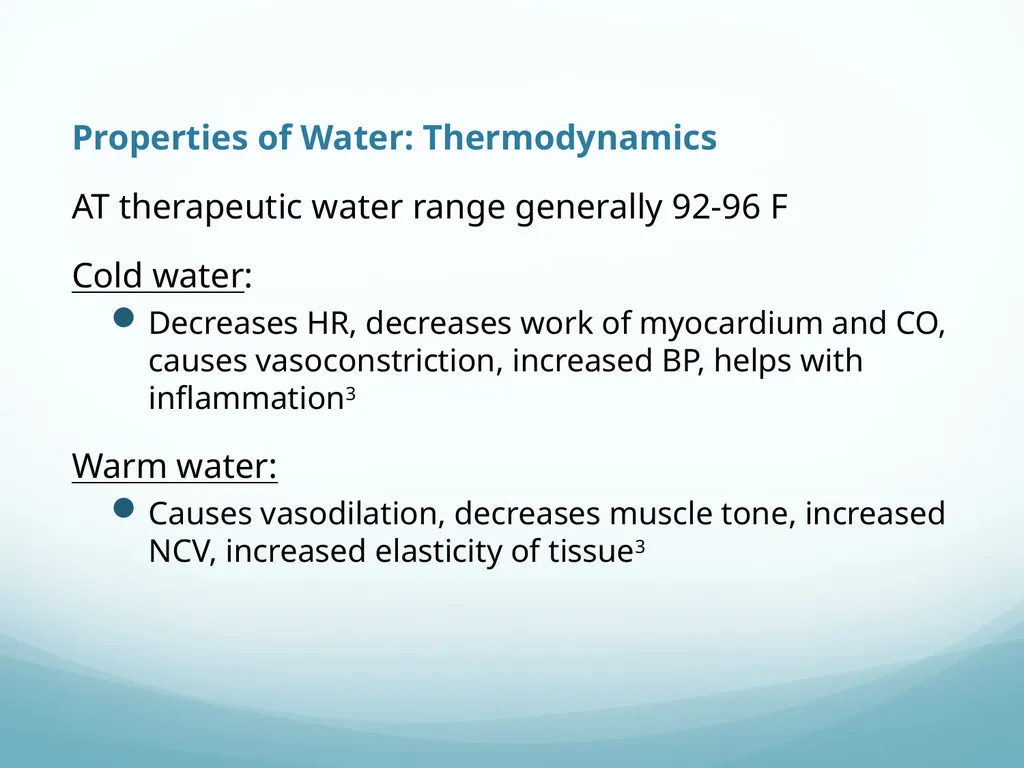
Properties of Water: Thermodynamics AT therapeutic water range generally 92-96 F
Cold water:
Decreases HR, decreases work of myocardium and CO, causes vasoconstriction, increased BP, helps with inflammation3
Warm water:
Causes vasodilation, decreases muscle tone, increased NCV, increased elasticity of tissue3<br>
Cold water:
Decreases HR, decreases work of myocardium and CO, causes vasoconstriction, increased BP, helps with inflammation3
Warm water:
Causes vasodilation, decreases muscle tone, increased NCV, increased elasticity of tissue3<br>
15
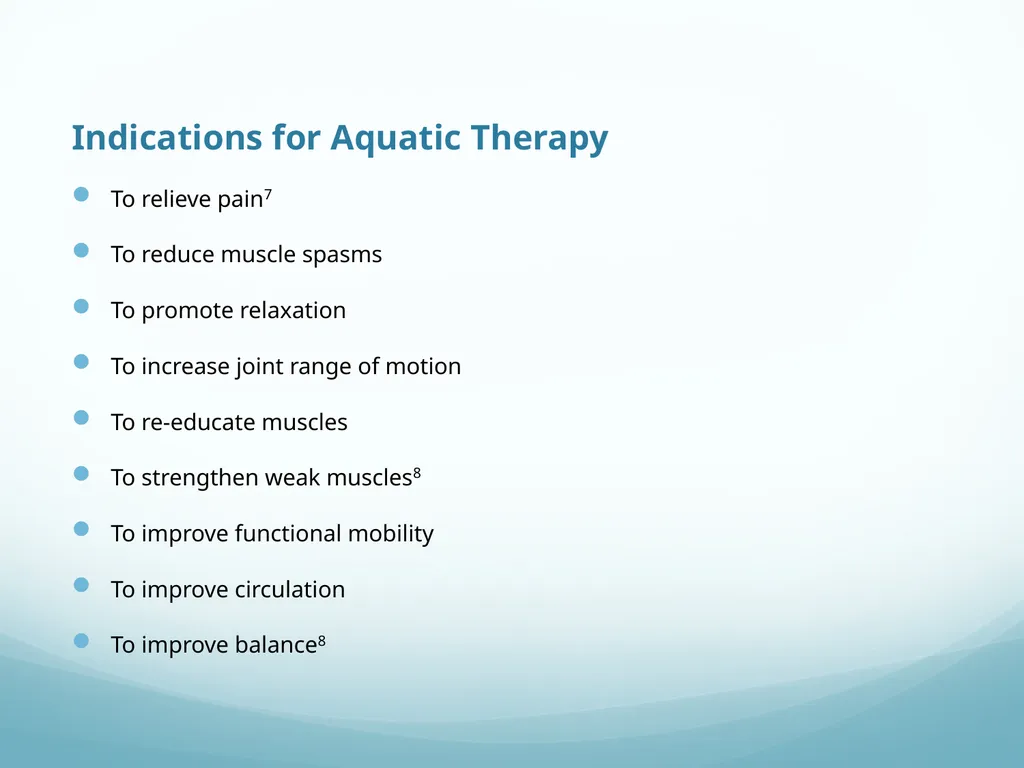
Indications for Aquatic Therapy To relieve pain7
To reduce muscle spasms
To promote relaxation
To increase joint range of motion
To re-educate muscles
To strengthen weak muscles8
To improve functional mobility
To improve circulation
To improve balance8<br>
To reduce muscle spasms
To promote relaxation
To increase joint range of motion
To re-educate muscles
To strengthen weak muscles8
To improve functional mobility
To improve circulation
To improve balance8<br>
16
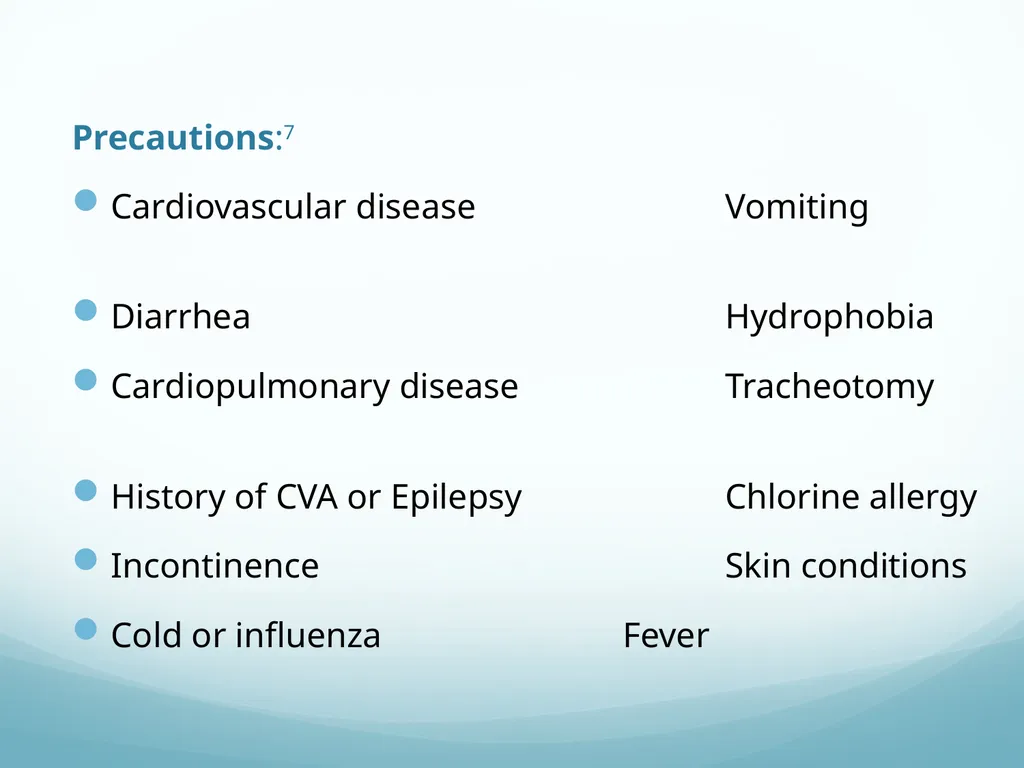
Precautions:7 Cardiovascular disease Vomiting
Diarrhea Hydrophobia
Cardiopulmonary disease Tracheotomy
History of CVA or Epilepsy Chlorine allergy
Incontinence Skin conditions
Cold or influenza Fever<br>
Diarrhea Hydrophobia
Cardiopulmonary disease Tracheotomy
History of CVA or Epilepsy Chlorine allergy
Incontinence Skin conditions
Cold or influenza Fever<br>
17
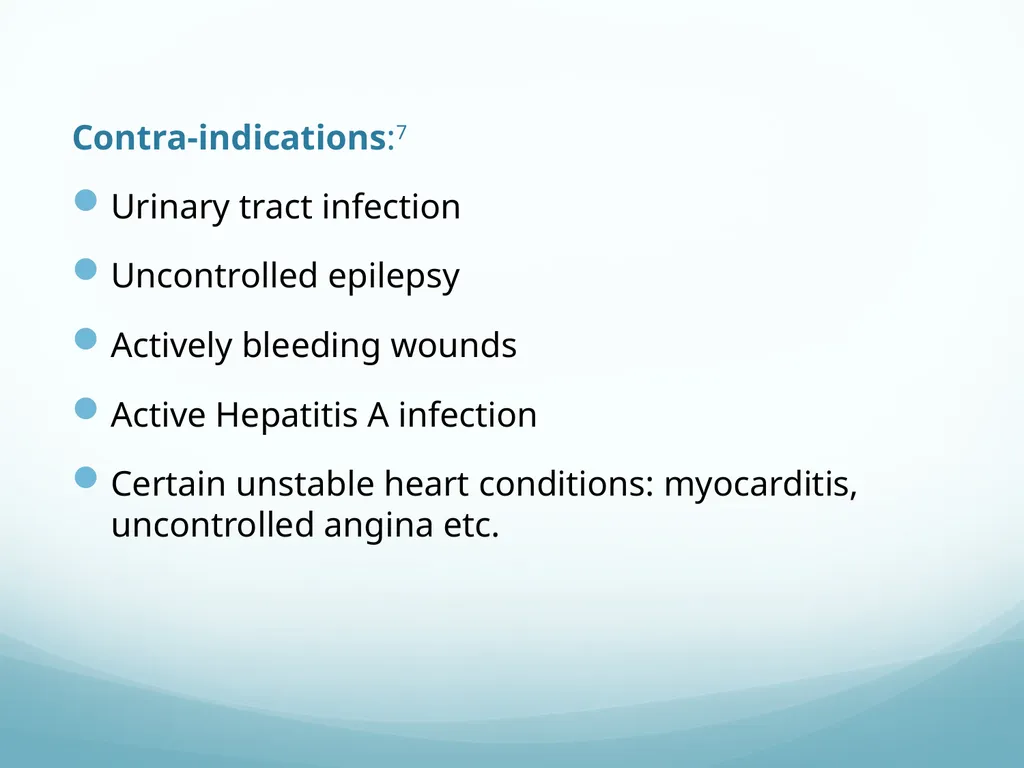
Contra-indications:7 Urinary tract infection
Uncontrolled epilepsy
Actively bleeding wounds
Active Hepatitis A infection
Certain unstable heart conditions: myocarditis, uncontrolled angina etc.<br>
Uncontrolled epilepsy
Actively bleeding wounds
Active Hepatitis A infection
Certain unstable heart conditions: myocarditis, uncontrolled angina etc.<br>
18
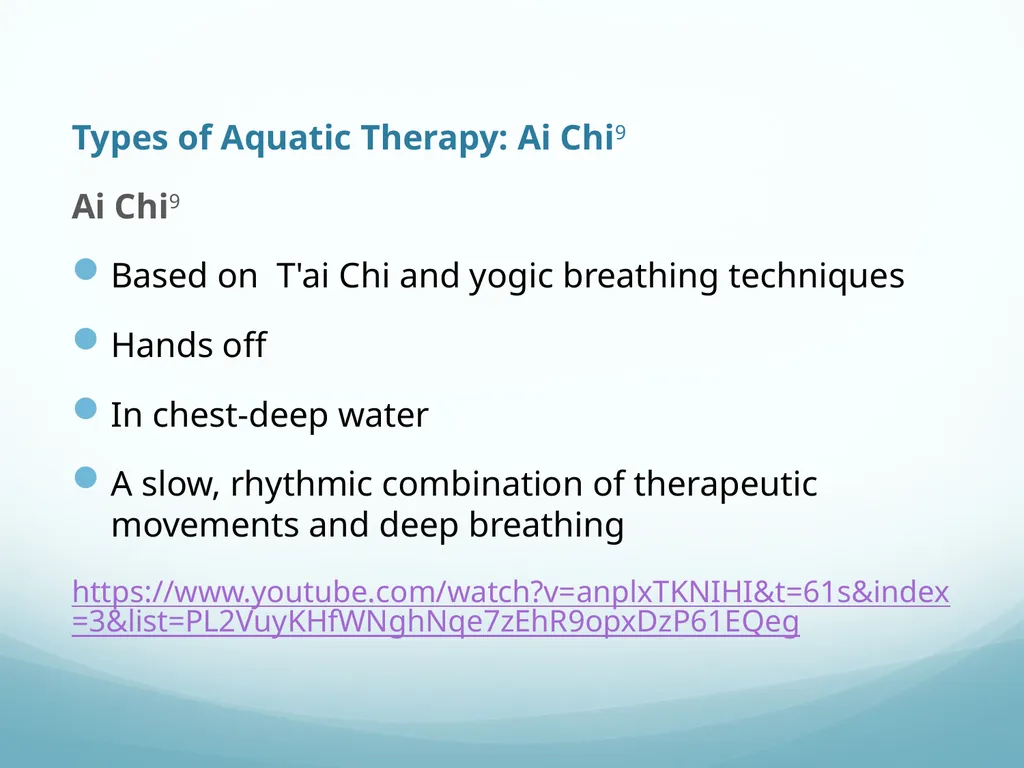
Types of Aquatic Therapy: Ai Chi9 Ai Chi9
Based on T'ai Chi and yogic breathing techniques
Hands off
In chest-deep water
A slow, rhythmic combination of therapeutic movements and deep breathing
https://www.youtube.com/watch?v=anplxTKNIHI&t=61s&index=3&list=PL2VuyKHfWNghNqe7zEhR9opxDzP61EQeg<br>
Based on T'ai Chi and yogic breathing techniques
Hands off
In chest-deep water
A slow, rhythmic combination of therapeutic movements and deep breathing
https://www.youtube.com/watch?v=anplxTKNIHI&t=61s&index=3&list=PL2VuyKHfWNghNqe7zEhR9opxDzP61EQeg<br>
19
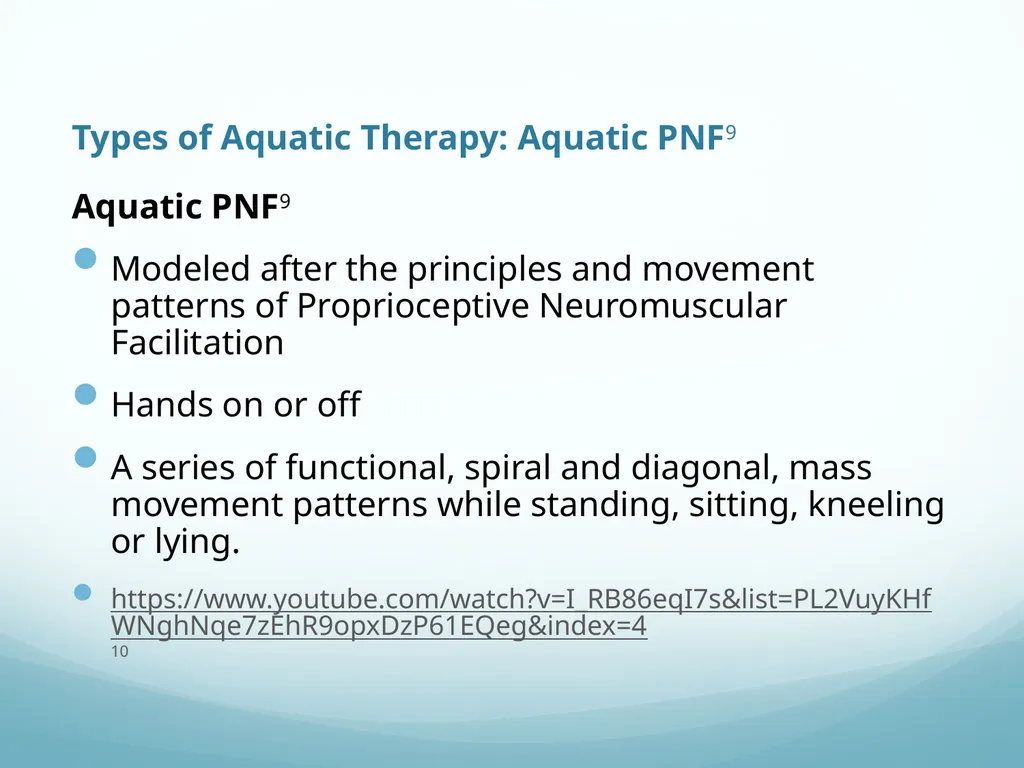
Types of Aquatic Therapy: Aquatic PNF9 Aquatic PNF9
Modeled after the principles and movement patterns of Proprioceptive Neuromuscular Facilitation
Hands on or off
A series of functional, spiral and diagonal, mass movement patterns while standing, sitting, kneeling or lying.
https://www.youtube.com/watch?v=I_RB86eqI7s&list=PL2VuyKHfWNghNqe7zEhR9opxDzP61EQeg&index=410<br>
Modeled after the principles and movement patterns of Proprioceptive Neuromuscular Facilitation
Hands on or off
A series of functional, spiral and diagonal, mass movement patterns while standing, sitting, kneeling or lying.
https://www.youtube.com/watch?v=I_RB86eqI7s&list=PL2VuyKHfWNghNqe7zEhR9opxDzP61EQeg&index=410<br>
20
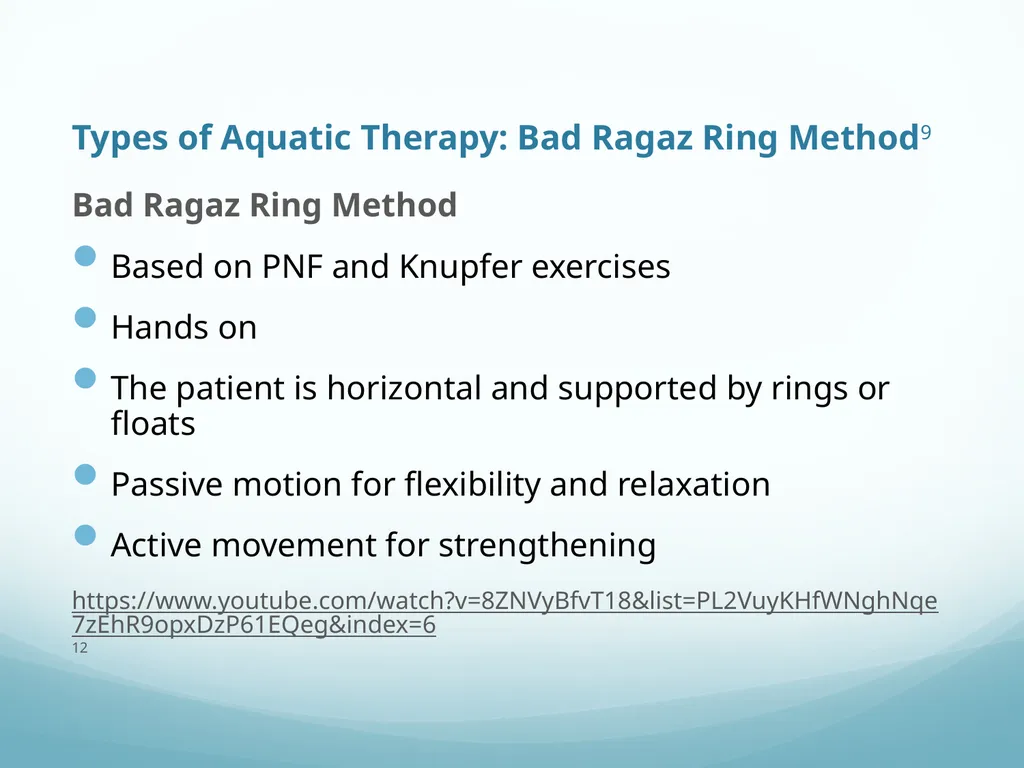
Types of Aquatic Therapy: Bad Ragaz Ring Method9 Bad Ragaz Ring Method
Based on PNF and Knupfer exercises
Hands on
The patient is horizontal and supported by rings or floats
Passive motion for flexibility and relaxation
Active movement for strengthening
https://www.youtube.com/watch?v=8ZNVyBfvT18&list=PL2VuyKHfWNghNqe7zEhR9opxDzP61EQeg&index=612<br>
Based on PNF and Knupfer exercises
Hands on
The patient is horizontal and supported by rings or floats
Passive motion for flexibility and relaxation
Active movement for strengthening
https://www.youtube.com/watch?v=8ZNVyBfvT18&list=PL2VuyKHfWNghNqe7zEhR9opxDzP61EQeg&index=612<br>
21
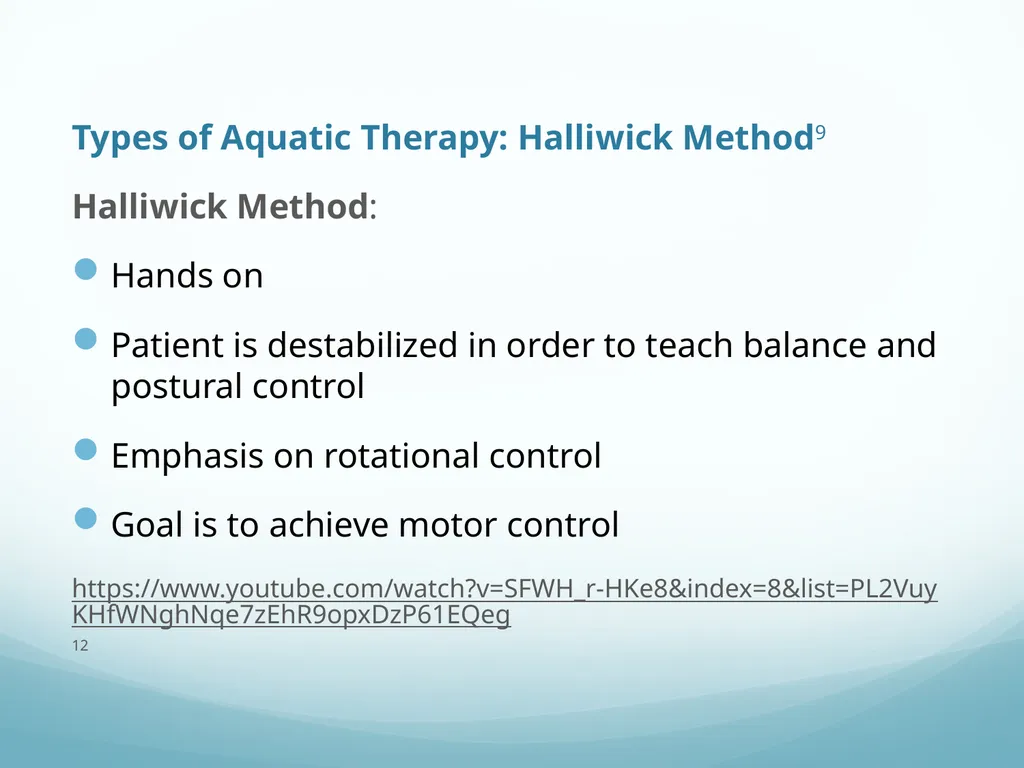
Types of Aquatic Therapy: Halliwick Method9 Halliwick Method:
Hands on
Patient is destabilized in order to teach balance and postural control
Emphasis on rotational control
Goal is to achieve motor control
https://www.youtube.com/watch?v=SFWH_r-HKe8&index=8&list=PL2VuyKHfWNghNqe7zEhR9opxDzP61EQeg12<br>
Hands on
Patient is destabilized in order to teach balance and postural control
Emphasis on rotational control
Goal is to achieve motor control
https://www.youtube.com/watch?v=SFWH_r-HKe8&index=8&list=PL2VuyKHfWNghNqe7zEhR9opxDzP61EQeg12<br>
22
Types of Aquatic Therapy: Watsu9 Watsu
Based on Zen Shiatu massage
Warm water
Hands on
Patient is passive
Stabilize one segment- to get a stretch at another segment (due to drag)
https://www.youtube.com/watch?v=58ya3qtSyMY&list=PL2VuyKHfWNghNqe7zEhR9opxDzP61EQeg&index=71313<br>
Based on Zen Shiatu massage
Warm water
Hands on
Patient is passive
Stabilize one segment- to get a stretch at another segment (due to drag)
https://www.youtube.com/watch?v=58ya3qtSyMY&list=PL2VuyKHfWNghNqe7zEhR9opxDzP61EQeg&index=71313<br>
23
Studies Supporting the Use of AT in Multiple Sclerosis (MS) Kargarfar et al:14 An RCT of 32 women aged 32.6 +/-8.0 years with Relapsing Remitting Multiple Sclerosis
AT group: 8 weeks of aquatic exercise 3x a week for sixty minutes.
Control group were asked to maintain their normal activity.
Findings: Kargarfard et al
The aquatic therapy group experienced an decrease in fatigue in the Modified Fatigue Impact Scale (MFIS)
The aquatic therapy group showed an improvement in health related quality of life in Multiple Sclerosis Quality of Life-54 (MSQOL-54) in the aquatic exercise group.14<br>
AT group: 8 weeks of aquatic exercise 3x a week for sixty minutes.
Control group were asked to maintain their normal activity.
Findings: Kargarfard et al
The aquatic therapy group experienced an decrease in fatigue in the Modified Fatigue Impact Scale (MFIS)
The aquatic therapy group showed an improvement in health related quality of life in Multiple Sclerosis Quality of Life-54 (MSQOL-54) in the aquatic exercise group.14<br>
24
Studies Supporting the Use of AT in MS Mar et al15 : RCT of 73 subjects with MS age 46 +/- 9.97 years
The experimental group completed 40 sessions of Ai-Chi over 20 weeks.
Control group performed 40 sessions of abdominal breathing and contraction-relaxation exercises.<br>
The experimental group completed 40 sessions of Ai-Chi over 20 weeks.
Control group performed 40 sessions of abdominal breathing and contraction-relaxation exercises.<br>
25
Studies Supporting the Use of AT in MS Findings: Mar et al15
The experimental group showed a significant decrease in pain intensity versus baseline.
The experimental group showed a significant reduction in muscle spasms, fatigue (Fatigue Severity Scale), depression (Beck Depression inventory), and increased autonomy compared to the control group. 15<br>
The experimental group showed a significant decrease in pain intensity versus baseline.
The experimental group showed a significant reduction in muscle spasms, fatigue (Fatigue Severity Scale), depression (Beck Depression inventory), and increased autonomy compared to the control group. 15<br>
26
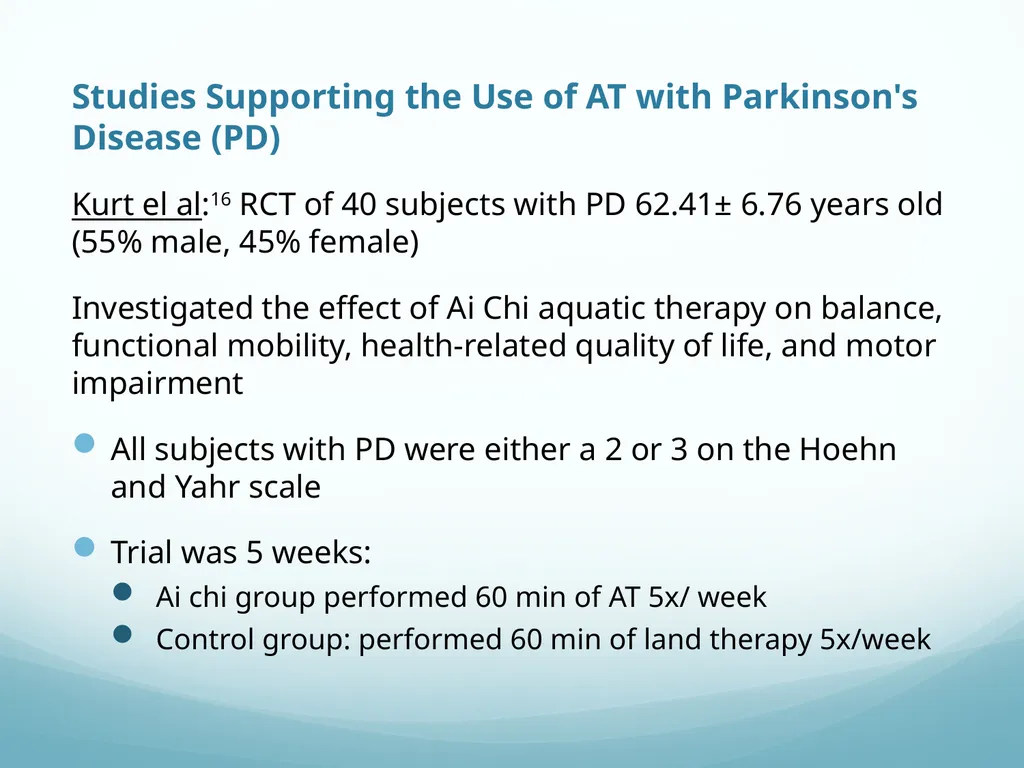
Studies Supporting the Use of AT with Parkinson's Disease (PD) Kurt el al:16 RCT of 40 subjects with PD 62.41± 6.76 years old (55% male, 45% female)
Investigated the effect of Ai Chi aquatic therapy on balance, functional mobility, health-related quality of life, and motor impairment
All subjects with PD were either a 2 or 3 on the Hoehn and Yahr scale
Trial was 5 weeks:
Ai chi group performed 60 min of AT 5x/ week
Control group: performed 60 min of land therapy 5x/week<br>
Investigated the effect of Ai Chi aquatic therapy on balance, functional mobility, health-related quality of life, and motor impairment
All subjects with PD were either a 2 or 3 on the Hoehn and Yahr scale
Trial was 5 weeks:
Ai chi group performed 60 min of AT 5x/ week
Control group: performed 60 min of land therapy 5x/week<br>
27
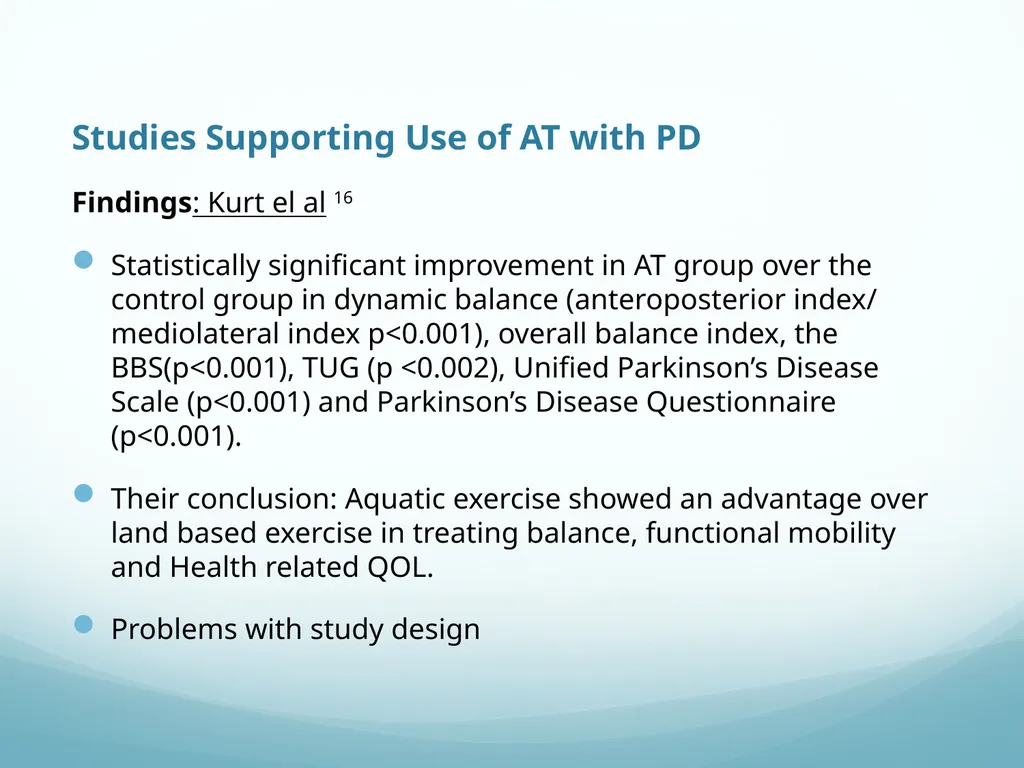
Studies Supporting Use of AT with PD Findings: Kurt el al 16
Statistically significant improvement in AT group over the control group in dynamic balance (anteroposterior index/ mediolateral index p<0.001), overall balance index, the BBS(p<0.001), TUG (p <0.002), Unified Parkinson’s Disease Scale (p<0.001) and Parkinson’s Disease Questionnaire (p<0.001).
Their conclusion: Aquatic exercise showed an advantage over land based exercise in treating balance, functional mobility and Health related QOL.
Problems with study design<br>
Statistically significant improvement in AT group over the control group in dynamic balance (anteroposterior index/ mediolateral index p<0.001), overall balance index, the BBS(p<0.001), TUG (p <0.002), Unified Parkinson’s Disease Scale (p<0.001) and Parkinson’s Disease Questionnaire (p<0.001).
Their conclusion: Aquatic exercise showed an advantage over land based exercise in treating balance, functional mobility and Health related QOL.
Problems with study design<br>
28
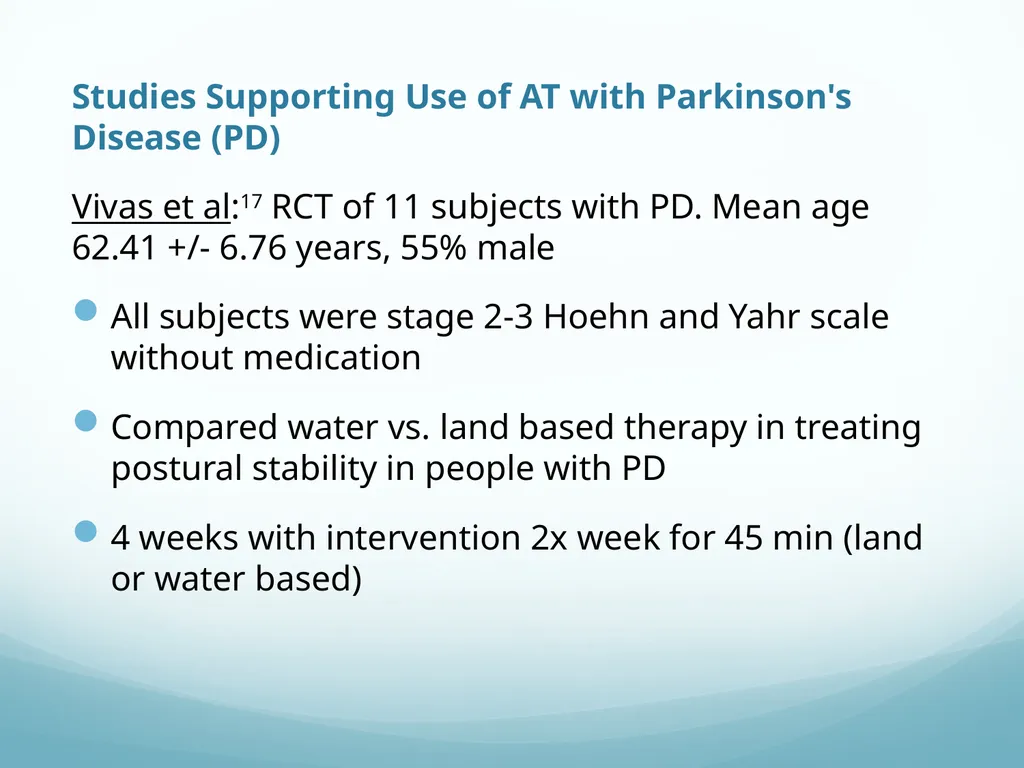
Studies Supporting Use of AT with Parkinson's Disease (PD) Vivas et al:17 RCT of 11 subjects with PD. Mean age 62.41 +/- 6.76 years, 55% male
All subjects were stage 2-3 Hoehn and Yahr scale without medication
Compared water vs. land based therapy in treating postural stability in people with PD
4 weeks with intervention 2x week for 45 min (land or water based)<br>
All subjects were stage 2-3 Hoehn and Yahr scale without medication
Compared water vs. land based therapy in treating postural stability in people with PD
4 weeks with intervention 2x week for 45 min (land or water based)<br>
29
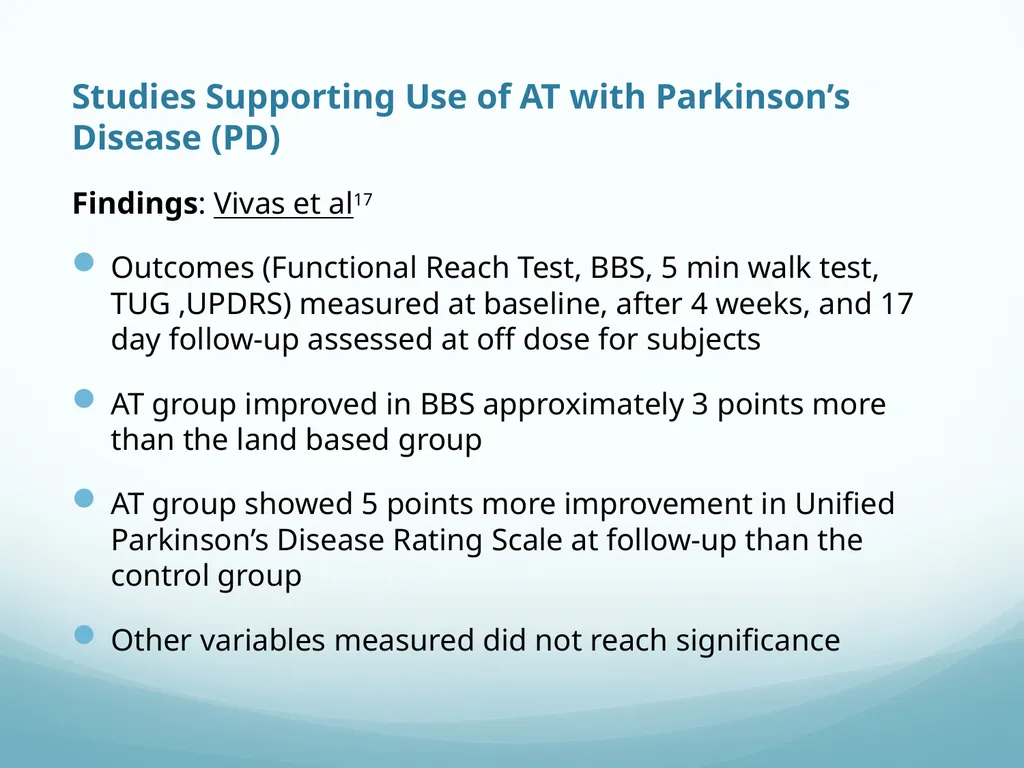
Studies Supporting Use of AT with Parkinson’s Disease (PD) Findings: Vivas et al17
Outcomes (Functional Reach Test, BBS, 5 min walk test, TUG ,UPDRS) measured at baseline, after 4 weeks, and 17 day follow-up assessed at off dose for subjects
AT group improved in BBS approximately 3 points more than the land based group
AT group showed 5 points more improvement in Unified Parkinson’s Disease Rating Scale at follow-up than the control group
Other variables measured did not reach significance<br>
Outcomes (Functional Reach Test, BBS, 5 min walk test, TUG ,UPDRS) measured at baseline, after 4 weeks, and 17 day follow-up assessed at off dose for subjects
AT group improved in BBS approximately 3 points more than the land based group
AT group showed 5 points more improvement in Unified Parkinson’s Disease Rating Scale at follow-up than the control group
Other variables measured did not reach significance<br>
30
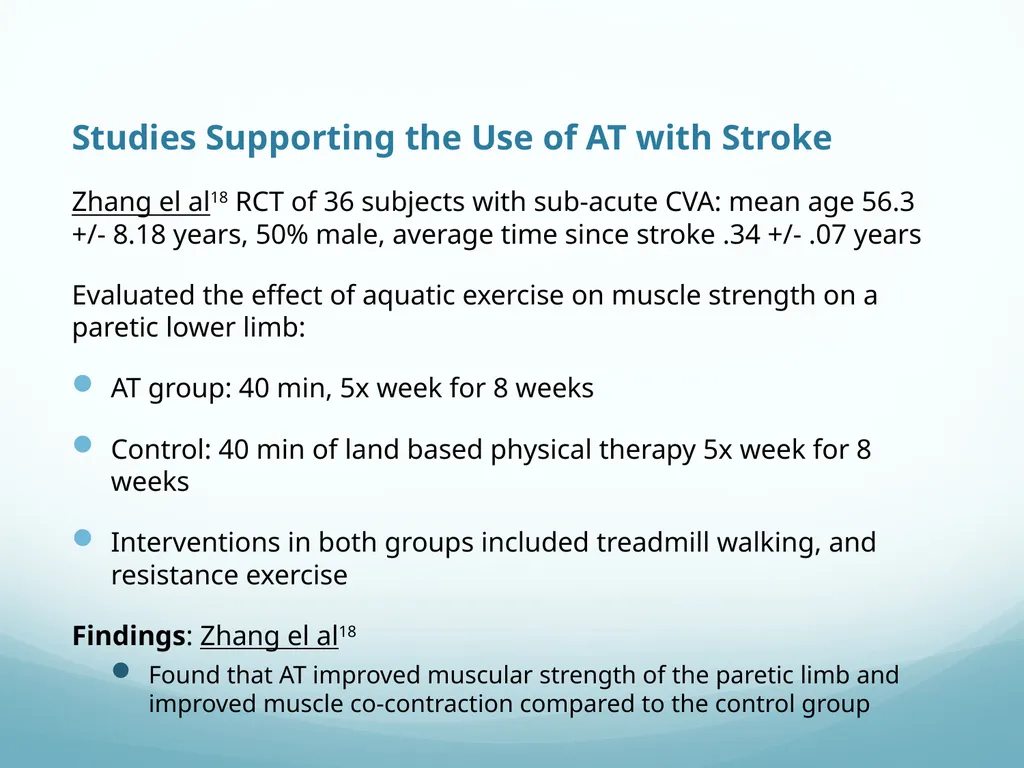
Studies Supporting the Use of AT with Stroke Zhang el al18 RCT of 36 subjects with sub-acute CVA: mean age 56.3 +/- 8.18 years, 50% male, average time since stroke .34 +/- .07 years
Evaluated the effect of aquatic exercise on muscle strength on a paretic lower limb:
AT group: 40 min, 5x week for 8 weeks
Control: 40 min of land based physical therapy 5x week for 8 weeks
Interventions in both groups included treadmill walking, and resistance exercise
Findings: Zhang el al18
Found that AT improved muscular strength of the paretic limb and improved muscle co-contraction compared to the control group<br>
Evaluated the effect of aquatic exercise on muscle strength on a paretic lower limb:
AT group: 40 min, 5x week for 8 weeks
Control: 40 min of land based physical therapy 5x week for 8 weeks
Interventions in both groups included treadmill walking, and resistance exercise
Findings: Zhang el al18
Found that AT improved muscular strength of the paretic limb and improved muscle co-contraction compared to the control group<br>
31
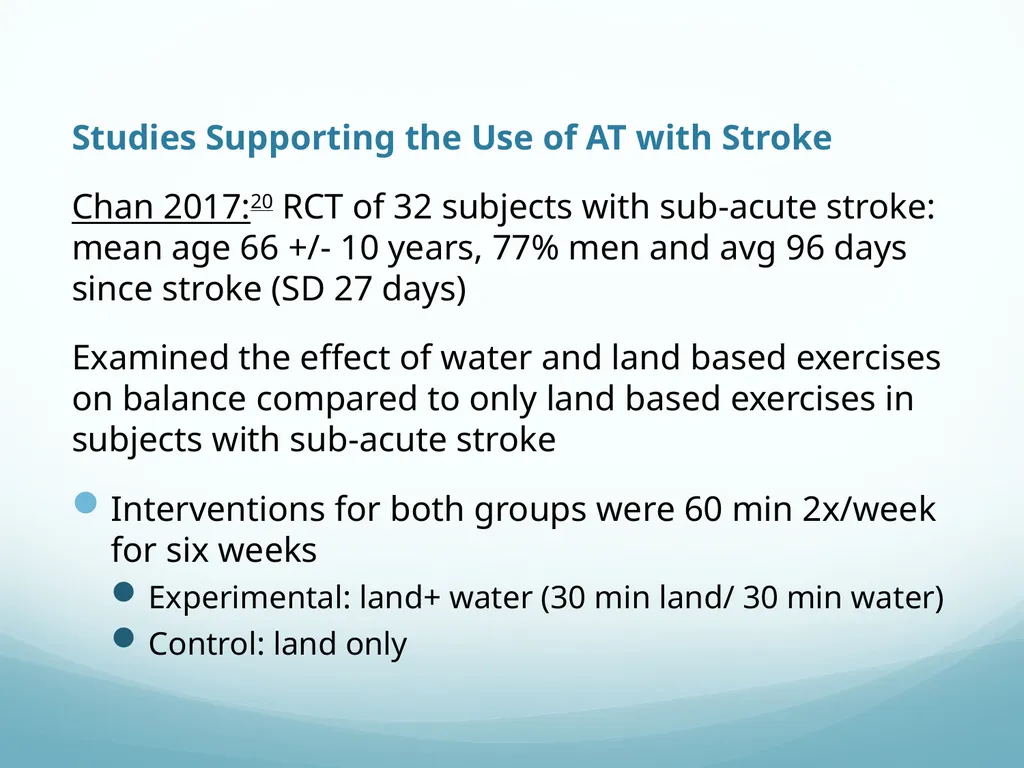
Studies Supporting the Use of AT with Stroke Chan 2017:20 RCT of 32 subjects with sub-acute stroke: mean age 66 +/- 10 years, 77% men and avg 96 days since stroke (SD 27 days)
Examined the effect of water and land based exercises on balance compared to only land based exercises in subjects with sub-acute stroke
Interventions for both groups were 60 min 2x/week for six weeks
Experimental: land+ water (30 min land/ 30 min water)
Control: land only<br>
Examined the effect of water and land based exercises on balance compared to only land based exercises in subjects with sub-acute stroke
Interventions for both groups were 60 min 2x/week for six weeks
Experimental: land+ water (30 min land/ 30 min water)
Control: land only<br>
32
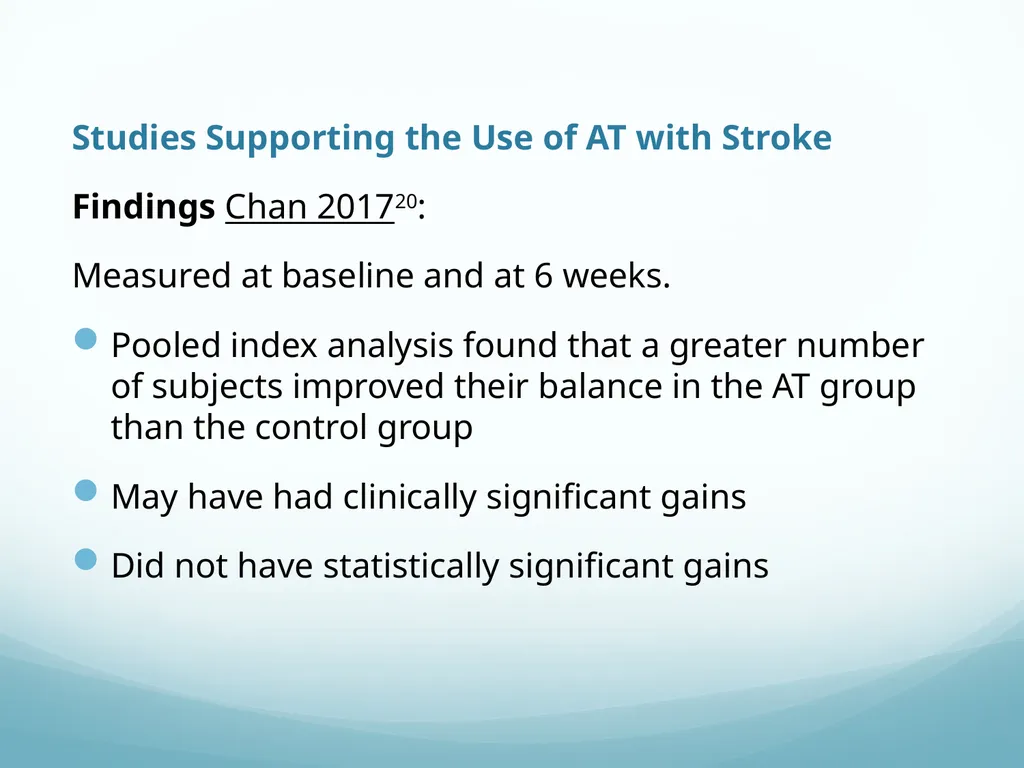
Studies Supporting the Use of AT with Stroke Findings Chan 201720:
Measured at baseline and at 6 weeks.
Pooled index analysis found that a greater number of subjects improved their balance in the AT group than the control group
May have had clinically significant gains
Did not have statistically significant gains<br>
Measured at baseline and at 6 weeks.
Pooled index analysis found that a greater number of subjects improved their balance in the AT group than the control group
May have had clinically significant gains
Did not have statistically significant gains<br>
33
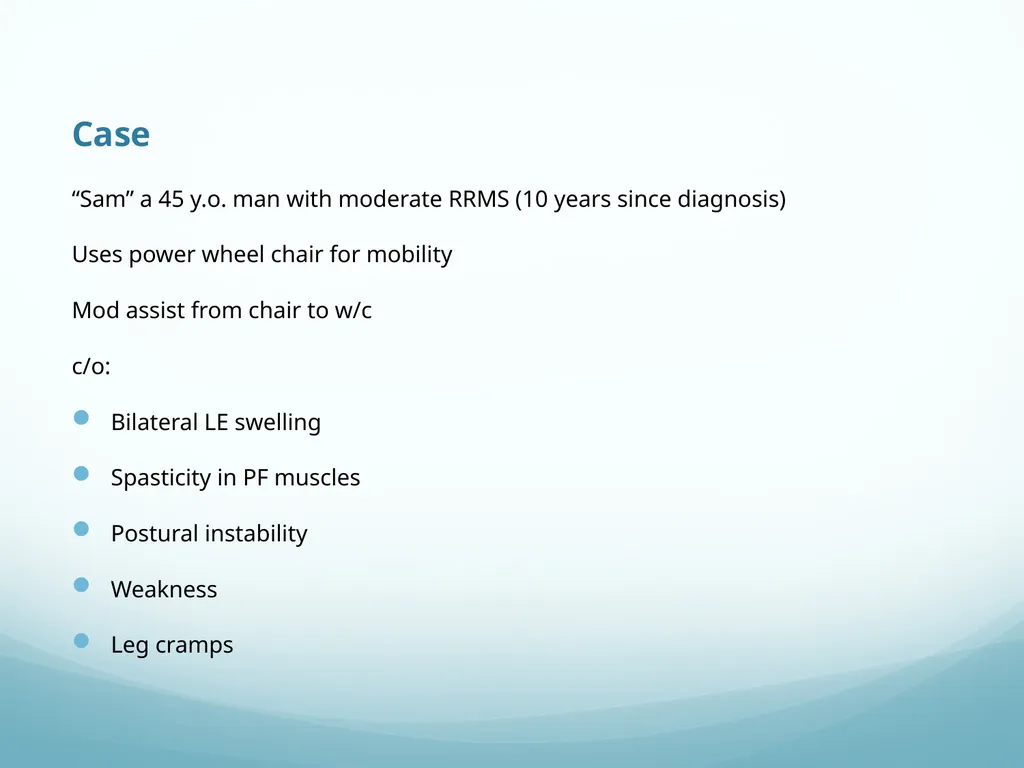
Case “Sam” a 45 y.o. man with moderate RRMS (10 years since diagnosis)
Uses power wheel chair for mobility
Mod assist from chair to w/c
c/o:
Bilateral LE swelling
Spasticity in PF muscles
Postural instability
Weakness
Leg cramps<br>
Uses power wheel chair for mobility
Mod assist from chair to w/c
c/o:
Bilateral LE swelling
Spasticity in PF muscles
Postural instability
Weakness
Leg cramps<br>
34
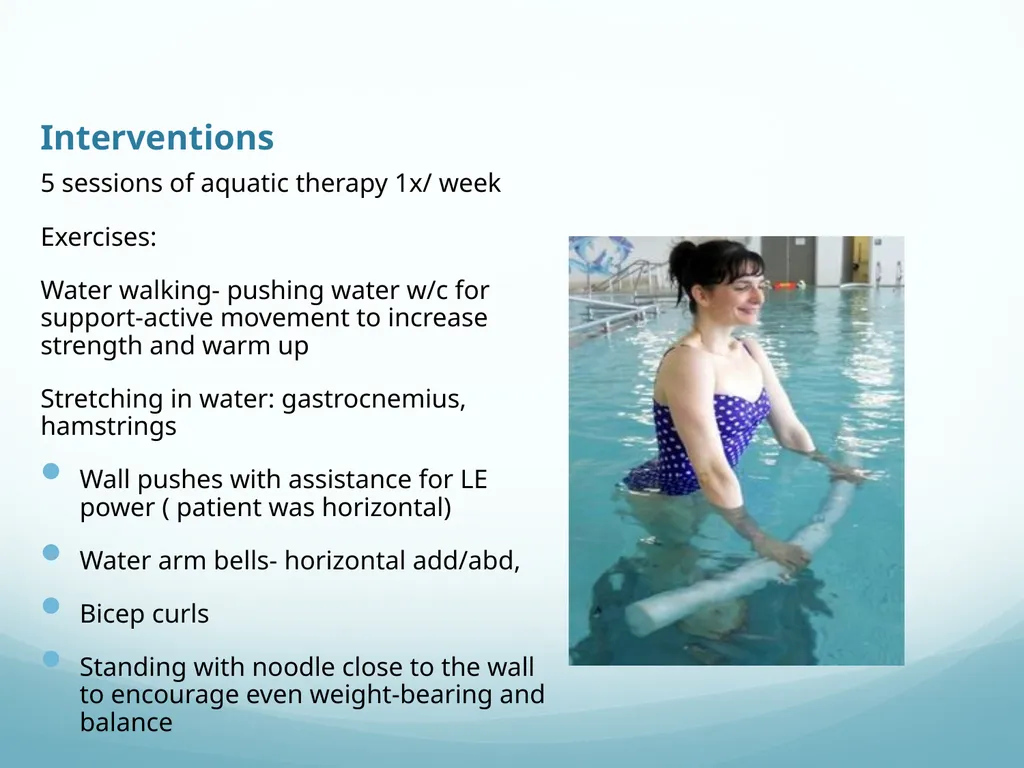
Interventions 5 sessions of aquatic therapy 1x/ week
Exercises:
Water walking- pushing water w/c for support-active movement to increase strength and warm up
Stretching in water: gastrocnemius, hamstrings
Wall pushes with assistance for LE power ( patient was horizontal)
Water arm bells- horizontal add/abd,
Bicep curls
Standing with noodle close to the wall to encourage even weight-bearing and balance<br>
Exercises:
Water walking- pushing water w/c for support-active movement to increase strength and warm up
Stretching in water: gastrocnemius, hamstrings
Wall pushes with assistance for LE power ( patient was horizontal)
Water arm bells- horizontal add/abd,
Bicep curls
Standing with noodle close to the wall to encourage even weight-bearing and balance<br>
35
Outcomes Reduced swelling
Patient reported less spasticity
Progressed to min/mod assist from chair to water w/c
Found a type of exercise that he enjoys<br>
Patient reported less spasticity
Progressed to min/mod assist from chair to water w/c
Found a type of exercise that he enjoys<br>
36
Reflection: Would you refer a patient with a neurological diagnosis to aquatic therapy? Why?
What are some things that the water has to offer that are different from land?
Questions?<br>
What are some things that the water has to offer that are different from land?
Questions?<br>
37
References Hosptial HH. Rehabilitation After Stroke: Aquatic Therapy Improves Pain, Moblity, and Balance. https://www.youtube.com/watch?\v=fEG5_3VWFOU&index=1&list=PL2VuyKHfWNghNqe7zEhR9opxDzP61EQeg. Accessed March 30, 2017.
Torres-Ronda L, Schelling X. The Properties of Water and Their Applications for Training. J Hum Kinet. 2014;44(December):237-248.
Vargas LG. Aquatic Therapy: Intervention and Applications.1st ed. Ravensdale: Idyll Arbor, Inc; 2004: 5-12.
Becker BE. Clinical Review: Current Concepts Aquatic Therapy: Scientific Foundations and Clinical Rehabilitation Applications. Phys Med Rehabil. 2009;1(September):859-872.
Buoyancy in water. http://aqua4balance.com/healing-properties-of-water/buoyancy-in-water.html. Accessed April 2, 2017.
Spa HS. Physical therapy. http://www.h2xrx.com/physical_therapy.php. Accessed April 8, 2017.
Howell D, Ramage E. Australian Guidelines for Aquatic Physiotherapists Working in and/or Managing Hydrotherapy Pools. Austrian Physiotherapy Association. Hawthorn; 2015: 56-78.
Physiopedia.com. Aquatherapy. http://www.physio-pedia.com/Aquatherapy#cite_note-Meeusen_et_al.-3. Accessed April 1, 2017.
Aquaticnet.com. Article - How to define aquatic specially techniques. http://www.aquaticnet.com/Article - How to define aquatic specially techniques.htm. Accessed January 12, 2017.
Meno J. Deep Water Lower Extremity D1 Pattern. https://www.youtube.com/watch?v=I_RB86eqI7s&index=4&list=PL2VuyKHfWNghNqe7zEhR9opxDzP61EQeg. Accessed April 1, 2017.<br>
Torres-Ronda L, Schelling X. The Properties of Water and Their Applications for Training. J Hum Kinet. 2014;44(December):237-248.
Vargas LG. Aquatic Therapy: Intervention and Applications.1st ed. Ravensdale: Idyll Arbor, Inc; 2004: 5-12.
Becker BE. Clinical Review: Current Concepts Aquatic Therapy: Scientific Foundations and Clinical Rehabilitation Applications. Phys Med Rehabil. 2009;1(September):859-872.
Buoyancy in water. http://aqua4balance.com/healing-properties-of-water/buoyancy-in-water.html. Accessed April 2, 2017.
Spa HS. Physical therapy. http://www.h2xrx.com/physical_therapy.php. Accessed April 8, 2017.
Howell D, Ramage E. Australian Guidelines for Aquatic Physiotherapists Working in and/or Managing Hydrotherapy Pools. Austrian Physiotherapy Association. Hawthorn; 2015: 56-78.
Physiopedia.com. Aquatherapy. http://www.physio-pedia.com/Aquatherapy#cite_note-Meeusen_et_al.-3. Accessed April 1, 2017.
Aquaticnet.com. Article - How to define aquatic specially techniques. http://www.aquaticnet.com/Article - How to define aquatic specially techniques.htm. Accessed January 12, 2017.
Meno J. Deep Water Lower Extremity D1 Pattern. https://www.youtube.com/watch?v=I_RB86eqI7s&index=4&list=PL2VuyKHfWNghNqe7zEhR9opxDzP61EQeg. Accessed April 1, 2017.<br>
38
Lambeck J. The Bad Ragaz Ring Method Trunkpattern. https://www.youtube.com/watch?v=8ZNVyBfvT18&list=PL2VuyKHfWNghNqe7zEhR9opxDzP61EQeg&index=6. Accessed April 1, 2017.
Lambeck J. Halliwick Longitudinal Rotation Control. https://www.youtube.com/watch?v=SFWH_r-HKe8&list=PL2VuyKHfWNghNqe7zEhR9opxDzP61EQeg&index=8. Accessed April 1, 2017.
Center OW. WATSU. https://www.youtube.com/watch?v=_gBtpZ92p4A&list=PL2VuyKHfWNghNqe7zEhR9opxDzP61EQeg&index=5&t=32s. Accessed April 1, 2017.
Kargarfar, Mehdi, Etemadifar, Masoud, Baker, Peter, Mehrabi, Maryam, Hayatbakhsh R. Effect of Aquatic Exercise Training on Fatigue and Health-Related Quality of Life in Patients With Multiple Sclerosis. Phys Med Rehabil. 2012;93(October):1701-1708.
Castro-Sánchez, AM, Matarán-Peñarrocha GA, Lara-Palomo I, Saavedra-Hernández M, Arroyo-Morales M M-L. Hydrotherapy for the Treatment of Pain in People with Multiple Sclerosis : A Randomized Controlled Trial. Evidence-based Complement Altern Med. 2012;(473963).
Kurt EE, Büyükturan B, Büyükturan Ö, et al. Effects of Ai Chi on Balance, Quality of Life, Functional Mobility, and Motor Impairment in Patients with Parkinson’s Disease. Disabil Rehabil. 2017:1-6.
Vivas J, Arias P, Cudeiro J. Aquatic Therapy Versus Conventional Land-Based Therapy for Parkinson ’ s Disease: An Open-Label Pilot Study. YAPMR. 2011;92(8):1202-1210.
Zhang, Wang Y, Huang L-P, Bai, B, Zhou, S, Yim,M-M, Zhao, H , Zhou X-N. Aquatic Therapy Improves Outcomes for Subacute Stroke Patients by Enhancing Muscular Strength of Paretic Lower Limbs Without Increasing Spasticity: A Randomized Controlled Trial. Am J Phys Med Rehabil. 2016;95(11):840-849.
Plecash AR, Leavitt BR. Aquatherapy for Neurodegenerative Disorders. J Huntingtons Dis. 2014;3:5-11.
Chan K, Phadke CP, Stremler D. Topics in Stroke Rehabilitation:The Effect of Water-Based Exercises on Balance in Persons Post-Stroke : A Randomized Controlled Trial. Top Stroke Rehabil. 2017;9357(March):1-8.
Mary Noodles. https://www.pinterest.com/maryvorster1/mary-noodles/. Accessed April 7, 2017. References<br>
Lambeck J. Halliwick Longitudinal Rotation Control. https://www.youtube.com/watch?v=SFWH_r-HKe8&list=PL2VuyKHfWNghNqe7zEhR9opxDzP61EQeg&index=8. Accessed April 1, 2017.
Center OW. WATSU. https://www.youtube.com/watch?v=_gBtpZ92p4A&list=PL2VuyKHfWNghNqe7zEhR9opxDzP61EQeg&index=5&t=32s. Accessed April 1, 2017.
Kargarfar, Mehdi, Etemadifar, Masoud, Baker, Peter, Mehrabi, Maryam, Hayatbakhsh R. Effect of Aquatic Exercise Training on Fatigue and Health-Related Quality of Life in Patients With Multiple Sclerosis. Phys Med Rehabil. 2012;93(October):1701-1708.
Castro-Sánchez, AM, Matarán-Peñarrocha GA, Lara-Palomo I, Saavedra-Hernández M, Arroyo-Morales M M-L. Hydrotherapy for the Treatment of Pain in People with Multiple Sclerosis : A Randomized Controlled Trial. Evidence-based Complement Altern Med. 2012;(473963).
Kurt EE, Büyükturan B, Büyükturan Ö, et al. Effects of Ai Chi on Balance, Quality of Life, Functional Mobility, and Motor Impairment in Patients with Parkinson’s Disease. Disabil Rehabil. 2017:1-6.
Vivas J, Arias P, Cudeiro J. Aquatic Therapy Versus Conventional Land-Based Therapy for Parkinson ’ s Disease: An Open-Label Pilot Study. YAPMR. 2011;92(8):1202-1210.
Zhang, Wang Y, Huang L-P, Bai, B, Zhou, S, Yim,M-M, Zhao, H , Zhou X-N. Aquatic Therapy Improves Outcomes for Subacute Stroke Patients by Enhancing Muscular Strength of Paretic Lower Limbs Without Increasing Spasticity: A Randomized Controlled Trial. Am J Phys Med Rehabil. 2016;95(11):840-849.
Plecash AR, Leavitt BR. Aquatherapy for Neurodegenerative Disorders. J Huntingtons Dis. 2014;3:5-11.
Chan K, Phadke CP, Stremler D. Topics in Stroke Rehabilitation:The Effect of Water-Based Exercises on Balance in Persons Post-Stroke : A Randomized Controlled Trial. Top Stroke Rehabil. 2017;9357(March):1-8.
Mary Noodles. https://www.pinterest.com/maryvorster1/mary-noodles/. Accessed April 7, 2017. References<br>