
Arab Contribution to World Culture and
EM
Published · 24 slides · 0 views

1 / 1


Description
Arab Contribution to World Culture and Civilization The Arabs A population inhabiting the Arab world. They primarily live in the Arab states in Western Asia, North Africa and western Indian Ocean islands Form a significant diaspora, with
Related Topics
Share
Embed code
Download this presentation From Below
"Arab Contribution to World Culture and" is the property of its rightful owner. Permission is granted to download and print the materials on this website for personal, non-commercial use only, and to display it on your personal computer provided you do not modify the materials and that you retain all copyright notices contained in the materials. By downloading content from our website, you accept the terms of this agreement.
Presentation Transcript
01
Arab Contribution to World Culture and Civilization<br>
02
The Arabs A population inhabiting the Arab world.
They primarily live in the Arab states in Western Asia, North Africa and western Indian Ocean islands
Form a significant diaspora, with Arab communities established around the world
The world's second largest ethnic group<br>
They primarily live in the Arab states in Western Asia, North Africa and western Indian Ocean islands
Form a significant diaspora, with Arab communities established around the world
The world's second largest ethnic group<br>
03
The Arab World The Arab world (Arabic: العالم العربي al-ʿālam al-ʿarabī) currently consists of the 22 Arab countries of the Arab League
These Arab states occupy North Africa and West Asia
The contemporary Arab world has a combined population of around 422 million inhabitants<br>
These Arab states occupy North Africa and West Asia
The contemporary Arab world has a combined population of around 422 million inhabitants<br>
04
The Arabian Peninsula The Arabian peninsula, simplified as Arabia is a peninsula of Western Asia situated northeast of Africa
It is the largest peninsula in the world, at 3,237,500 sqkm.
Consists of the countries Yemen, Oman, Qatar, Bahrain, Kuwait, Saudi Arabia and the United Arab Emirates<br>
It is the largest peninsula in the world, at 3,237,500 sqkm.
Consists of the countries Yemen, Oman, Qatar, Bahrain, Kuwait, Saudi Arabia and the United Arab Emirates<br>
05
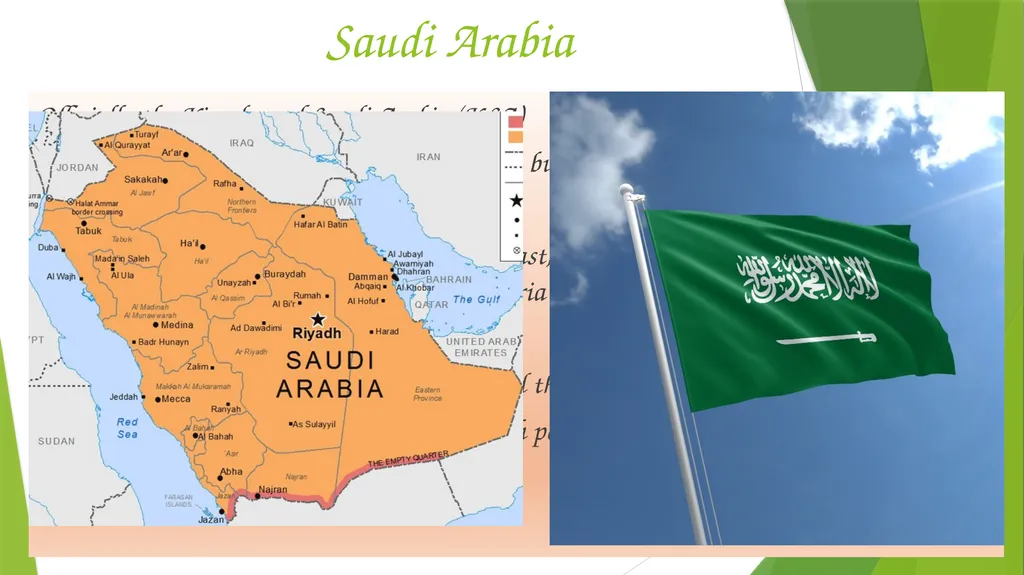
Saudi Arabia Officially the Kingdom of Saudi Arabia (KSA)
A country in Western Asia constituting the bulk of the Arabian Peninsula.
Land area: 2,150,000 km2 (830,000 sq mi)
The largest sovereign state in the Middle East, geographically the fifth-largest in Asia, second-largest in the Arab world after Algeria and 12th-largest in the world.
The largest economy in the Middle East and the 18th largest in the world.
Population: 33.4 million with 50% of youth population under 25<br>
A country in Western Asia constituting the bulk of the Arabian Peninsula.
Land area: 2,150,000 km2 (830,000 sq mi)
The largest sovereign state in the Middle East, geographically the fifth-largest in Asia, second-largest in the Arab world after Algeria and 12th-largest in the world.
The largest economy in the Middle East and the 18th largest in the world.
Population: 33.4 million with 50% of youth population under 25<br>
06
The United Arab Emirates (UAE) Arabic: الإمارات العربية المتحدة
Sometimes simply called the Emirates (Arabic: الإمارات al-ʾImārāt)
A country in Western Asia at the southeast end of the Arabian Peninsula on the Persian Gulf, bordering Oman to the east and Saudi Arabia to the south, sharing maritime borders with Qatar to the west and Iran to the north.
A federation of seven emirates:
Abu Dhabi (the capital), Ajman, Dubai, Fujairah, Ras Al Khaimah, Sharjah and Umm Al Quwain.
Each emirate governed by a ruler (Amir/Emir).Together, they jointly form the Federal Supreme Council. One of the rulers serves as the President of the United Arab Emirates.
In 2013, the UAE's population was 9.2 million, of which 1.4 million are Emirati citizens and 7.8 million are expatriates<br>
Sometimes simply called the Emirates (Arabic: الإمارات al-ʾImārāt)
A country in Western Asia at the southeast end of the Arabian Peninsula on the Persian Gulf, bordering Oman to the east and Saudi Arabia to the south, sharing maritime borders with Qatar to the west and Iran to the north.
A federation of seven emirates:
Abu Dhabi (the capital), Ajman, Dubai, Fujairah, Ras Al Khaimah, Sharjah and Umm Al Quwain.
Each emirate governed by a ruler (Amir/Emir).Together, they jointly form the Federal Supreme Council. One of the rulers serves as the President of the United Arab Emirates.
In 2013, the UAE's population was 9.2 million, of which 1.4 million are Emirati citizens and 7.8 million are expatriates<br>
07
Culture The sum total of
ideas
beliefs
customs
values,
knowledge and
material artefacts
that are handed down from one generation to the next in a society<br>
ideas
beliefs
customs
values,
knowledge and
material artefacts
that are handed down from one generation to the next in a society<br>
08
Civilization 1. A state of human society that is very developed and organized
2. A society, its culture and its way of life during a particular period of time or in a particular part of the world (e.g., the civilizations of ancient Egypt and Greece)
A civilization is any complex society characterized by urban development, social stratification imposed by a cultural elite, symbolic systems of communication (for example, writing systems), and a perceived separation from and domination over the natural environment.<br>
2. A society, its culture and its way of life during a particular period of time or in a particular part of the world (e.g., the civilizations of ancient Egypt and Greece)
A civilization is any complex society characterized by urban development, social stratification imposed by a cultural elite, symbolic systems of communication (for example, writing systems), and a perceived separation from and domination over the natural environment.<br>
09
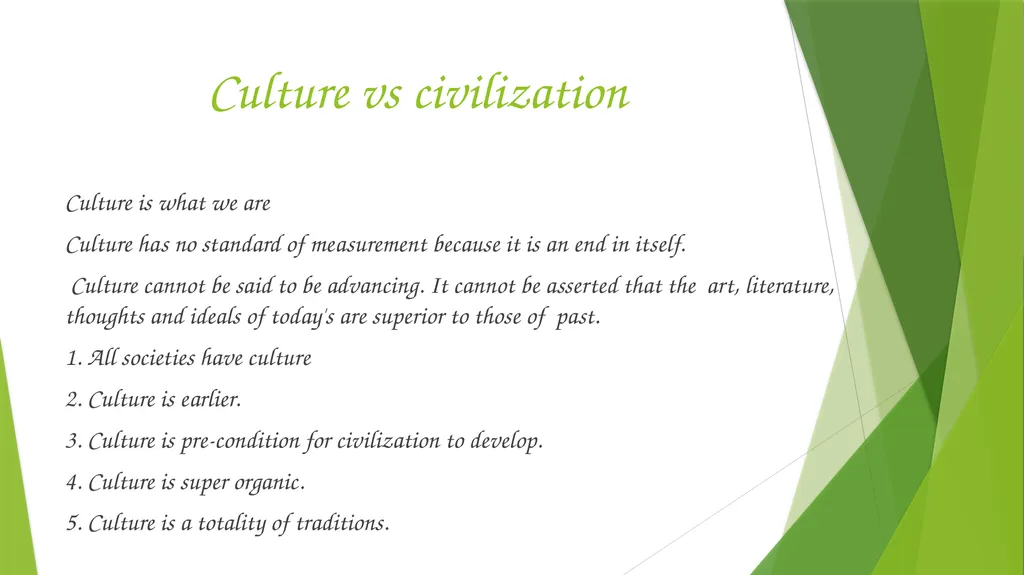
Culture vs civilization Culture is what we are
Culture has no standard of measurement because it is an end in itself.
Culture cannot be said to be advancing. It cannot be asserted that the art, literature, thoughts and ideals of today's are superior to those of past.
1. All societies have culture
2. Culture is earlier.
3. Culture is pre-condition for civilization to develop.
4. Culture is super organic.
5. Culture is a totality of traditions.<br>
Culture has no standard of measurement because it is an end in itself.
Culture cannot be said to be advancing. It cannot be asserted that the art, literature, thoughts and ideals of today's are superior to those of past.
1. All societies have culture
2. Culture is earlier.
3. Culture is pre-condition for civilization to develop.
4. Culture is super organic.
5. Culture is a totality of traditions.<br>
10
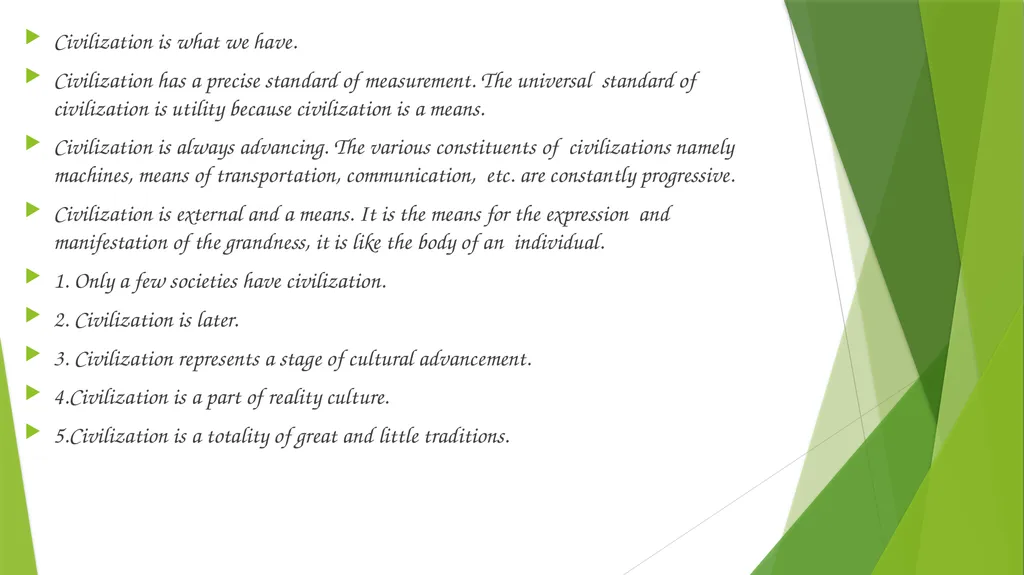
Civilization is what we have.
Civilization has a precise standard of measurement. The universal standard of civilization is utility because civilization is a means.
Civilization is always advancing. The various constituents of civilizations namely machines, means of transportation, communication, etc. are constantly progressive.
Civilization is external and a means. It is the means for the expression and manifestation of the grandness, it is like the body of an individual.
1. Only a few societies have civilization.
2. Civilization is later.
3. Civilization represents a stage of cultural advancement.
4.Civilization is a part of reality culture.
5.Civilization is a totality of great and little traditions.<br>
Civilization has a precise standard of measurement. The universal standard of civilization is utility because civilization is a means.
Civilization is always advancing. The various constituents of civilizations namely machines, means of transportation, communication, etc. are constantly progressive.
Civilization is external and a means. It is the means for the expression and manifestation of the grandness, it is like the body of an individual.
1. Only a few societies have civilization.
2. Civilization is later.
3. Civilization represents a stage of cultural advancement.
4.Civilization is a part of reality culture.
5.Civilization is a totality of great and little traditions.<br>
11
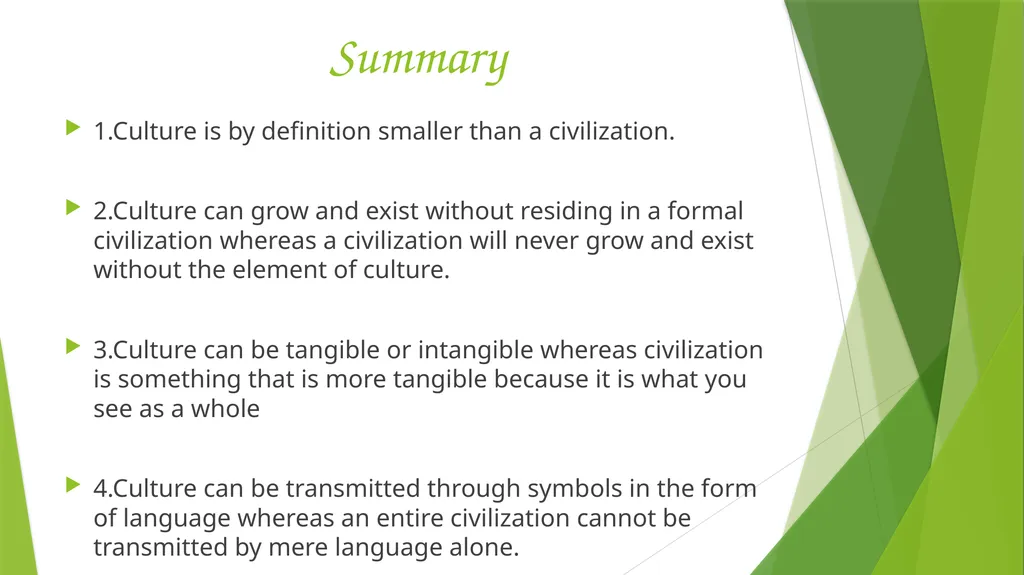
Summary 1.Culture is by definition smaller than a civilization.
2.Culture can grow and exist without residing in a formal civilization whereas a civilization will never grow and exist without the element of culture.
3.Culture can be tangible or intangible whereas civilization is something that is more tangible because it is what you see as a whole
4.Culture can be transmitted through symbols in the form of language whereas an entire civilization cannot be transmitted by mere language alone.<br>
2.Culture can grow and exist without residing in a formal civilization whereas a civilization will never grow and exist without the element of culture.
3.Culture can be tangible or intangible whereas civilization is something that is more tangible because it is what you see as a whole
4.Culture can be transmitted through symbols in the form of language whereas an entire civilization cannot be transmitted by mere language alone.<br>
12
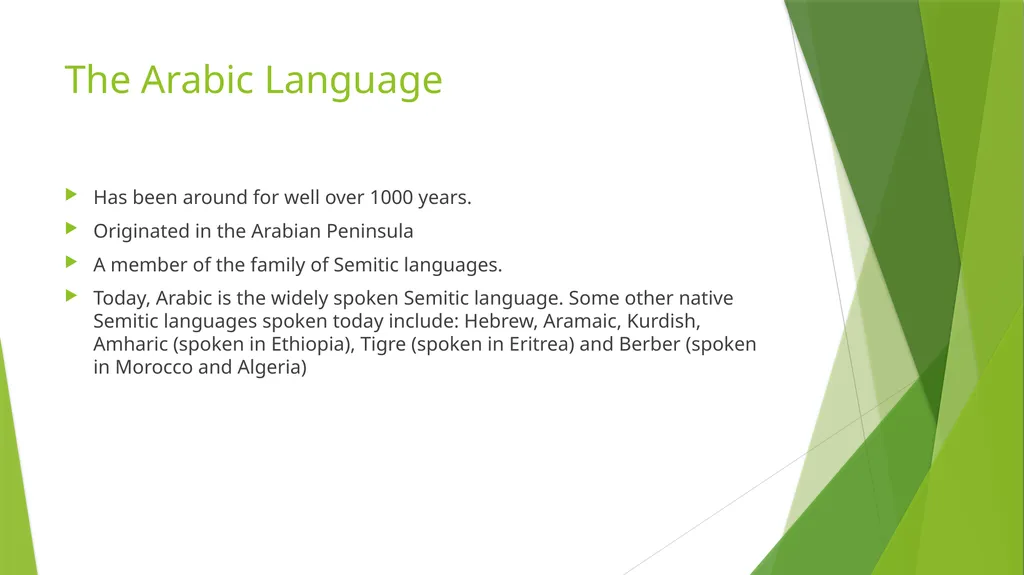
The Arabic Language Has been around for well over 1000 years.
Originated in the Arabian Peninsula
A member of the family of Semitic languages.
Today, Arabic is the widely spoken Semitic language. Some other native Semitic languages spoken today include: Hebrew, Aramaic, Kurdish, Amharic (spoken in Ethiopia), Tigre (spoken in Eritrea) and Berber (spoken in Morocco and Algeria)<br>
Originated in the Arabian Peninsula
A member of the family of Semitic languages.
Today, Arabic is the widely spoken Semitic language. Some other native Semitic languages spoken today include: Hebrew, Aramaic, Kurdish, Amharic (spoken in Ethiopia), Tigre (spoken in Eritrea) and Berber (spoken in Morocco and Algeria)<br>
13
The Spread of Arabic The spread of the Arabic language occurred as a result of various nomadic tribes traveling out of the Arabic Peninsula.
Rapid growth of the Arabic language happened as a result of the Islamic Conquests that took place in the 7th century C.E.
Through these conquests, the Arabic language made its way into Northern Africa, the Iberian Peninsula (Spain) and east into modern day China.
The Qur’an has served as the basis of the Arabic language to this day.<br>
Rapid growth of the Arabic language happened as a result of the Islamic Conquests that took place in the 7th century C.E.
Through these conquests, the Arabic language made its way into Northern Africa, the Iberian Peninsula (Spain) and east into modern day China.
The Qur’an has served as the basis of the Arabic language to this day.<br>
14
Arabic: Present Status one of the six most spoken languages in the world, comprising more than 400 million speakers. If it is considered a set of different languages, Egyptian Arabic would be the most widely spoken variety of Arabic.
Over the centuries of its existence, the Arabic language has adopted words from other languages including Hebrew, Aramaic, Persian, Greek, English and French. It has also influenced other languages as well including Turkish, Bengali, Hindi, Indonesian and Tagalog.
The Arabic language continues to be a crucial language in world affairs. Whether you want to expand your professional opportunities, learn about a new culture or interact with the growing number of Arabic speakers
The Arabic language continues to be a crucial language in world affairs. Whether you want to expand your professional opportunities, learn about a new culture or interact with the growing number of Arabic speakers<br>
Over the centuries of its existence, the Arabic language has adopted words from other languages including Hebrew, Aramaic, Persian, Greek, English and French. It has also influenced other languages as well including Turkish, Bengali, Hindi, Indonesian and Tagalog.
The Arabic language continues to be a crucial language in world affairs. Whether you want to expand your professional opportunities, learn about a new culture or interact with the growing number of Arabic speakers
The Arabic language continues to be a crucial language in world affairs. Whether you want to expand your professional opportunities, learn about a new culture or interact with the growing number of Arabic speakers<br>
15
Arabic: Interaction with other Languages Over the centuries of its existence, the Arabic language has adopted words from other languages including Hebrew, Aramaic, Persian, Greek, English and French.
Influenced other languages as well including Turkish, Bengali, Hindi, Indonesian and Tagalog (standardized form: Filippino, the national language of the Philippines)<br>
Influenced other languages as well including Turkish, Bengali, Hindi, Indonesian and Tagalog (standardized form: Filippino, the national language of the Philippines)<br>
16
1. Most Words in the Arabic language always start with a consonant letter
2. The Arabic alphabet only has 3 vowels
3. Arabic is written in script (cursive), right to left
Characters are written joined together in a flowing manner; this makes the writing faster.
4. some consonants would share the same shape. As a way of differentiating the consonants that shared the same shape, a system of dots, which were placed over the letters, was developed.
5. Has to be understood from its context:
Not using short vowel signs (diacritical marks) unless for beginners. One should know Arabic to read it.
6. written language is quite different from the spoken version, which probably provides another challenge for those trying to learn to speak it, and for those trying to do an English to Arabic translation and vice versa.<br>
2. The Arabic alphabet only has 3 vowels
3. Arabic is written in script (cursive), right to left
Characters are written joined together in a flowing manner; this makes the writing faster.
4. some consonants would share the same shape. As a way of differentiating the consonants that shared the same shape, a system of dots, which were placed over the letters, was developed.
5. Has to be understood from its context:
Not using short vowel signs (diacritical marks) unless for beginners. One should know Arabic to read it.
6. written language is quite different from the spoken version, which probably provides another challenge for those trying to learn to speak it, and for those trying to do an English to Arabic translation and vice versa.<br>
17
Arab History: The Periods Jahiliyya Period (500?-610 CE)
The common term for the period immediately preceding the mission of Prophet Muhammad-A designation for the pre-Islamic period.
Excelled in poetry
Literature of the period was synonymous with poetry
The earliest poems that have been preserved date from the beginning of the 6th century.
570 CE: Birth of Prophet Muhammad<br>
The common term for the period immediately preceding the mission of Prophet Muhammad-A designation for the pre-Islamic period.
Excelled in poetry
Literature of the period was synonymous with poetry
The earliest poems that have been preserved date from the beginning of the 6th century.
570 CE: Birth of Prophet Muhammad<br>
18
Islamic Period (610-660 CE) 610 CE: Prophethood
622 CE: Hijra (migration) from Makkah to Madina (Beginning of the Hijra Era)
632 CE: Death of Prophet Muhammad<br>
622 CE: Hijra (migration) from Makkah to Madina (Beginning of the Hijra Era)
632 CE: Death of Prophet Muhammad<br>
19
The Umayyad Period (660-750 CE) Period of the Umayyad dynasty started by Mu’awiya
Period of slow progress in literature, culture etc.<br>
Period of slow progress in literature, culture etc.<br>
20
The Abbasid Period (750-1258 CE) The Golden Period of Arab history
Baghdad, the capital, was the world centre of culture and science
Bayt al-Hikma (House of Wisdom): Centre for science and scientific translation started by the Caliph al-Mamun<br>
Baghdad, the capital, was the world centre of culture and science
Bayt al-Hikma (House of Wisdom): Centre for science and scientific translation started by the Caliph al-Mamun<br>
21
Period of decadence (16th-18th c. CE) The Arab scholarship declined
No significant contribution to science and knowledge<br>
No significant contribution to science and knowledge<br>
22
The Qur’an Revelation: A turning point in Arab history and culture
An easy book to read
Most Muslims read it as a devotional exercise
Most Muslims believe that it is a closed book which one can only read, recite and obey. But obedience requires knowing what kind of society the Quran seeks.
Addresses the entire humanity, not the Muslims only.<br>
An easy book to read
Most Muslims read it as a devotional exercise
Most Muslims believe that it is a closed book which one can only read, recite and obey. But obedience requires knowing what kind of society the Quran seeks.
Addresses the entire humanity, not the Muslims only.<br>
23
Approaches to the Qur’an Muslims approach the Qur’an from a large number of different perspectives:
-Theological
-Devotional
-Literary
-Literal
-Legal
-Rhetorical
-Mystical
-Philosophical<br>
-Theological
-Devotional
-Literary
-Literal
-Legal
-Rhetorical
-Mystical
-Philosophical<br>
24
The Qur’an: A Major Driving Force A major driving force behind the scientific spirit of Arab civilization was the notion of ijtihad, systematic original thinking, based on the Quranic injunctions to think and reason, to use the mind which became a fundamental component of the classical worldview of Islam.
Later ijtihad was replaced by taqlid, or imitation of the thought and work of earlier generation of scholars. Thus the minds were closed not just on religious but also on scientific and technological issues.<br>
Later ijtihad was replaced by taqlid, or imitation of the thought and work of earlier generation of scholars. Thus the minds were closed not just on religious but also on scientific and technological issues.<br>