Architecture and Design SE499: Software Design &
Description: Architecture and Design SE499: Software Design Development Project 1 Understanding Software Architecture Software architecture refers to the high-level structure of a software system, including the components, interactions, and
Related Topics
Download Presentation
"Architecture and Design SE499: Software Design &" is the property of its rightful owner. Permission is granted to download and print the materials on this website for personal, non-commercial use only, and to display it on your personal computer provided you do not modify the materials and that you retain all copyright notices contained in the materials. By downloading content from our website, you accept the terms of this agreement.
Presentation Transcript
slide1. Architecture and Design SE499: Software Design & Development Project 1<br>
slide2. Understanding Software Architecture Software architecture refers to the high-level structure of a software system, including the components, interactions, and relationships between them.
It provides a blueprint for the software system, which helps in understanding how the different parts of the system fit together and how they will work together to meet the requirements. 2<br>
slide3. Understanding Software Architecture Think of it as the 'skeleton' of a software system.
Components: The actual pieces of software (programs, libraries, databases, etc.) that carry out system functions.
Relationships: The interactions and dependencies between these components.
Properties: The individual and collective characteristics of components and their relationships, such as performance, security, and usability. 3<br>
slide4. Why is Software Architecture Important? Software architecture serves as the foundation of a software system.
Its importance cannot be overstated, and here's why:
Quality Attributes: It defines the system's properties, such as scalability, reliability, and performance.
Risk Management: It helps identify and mitigate potential risks in the early stages of software development.
Communication: It provides a shared vocabulary for stakeholders, aiding understanding and collaboration.
Future-Proofing: It makes future changes and enhancements more manageable by providing a clear structure and roadmap. 4<br>
slide5. Key Concepts in Software Architecture Components, connectors, and configurations
Architectural styles and patterns
Layers and tiers in architecture 5<br>
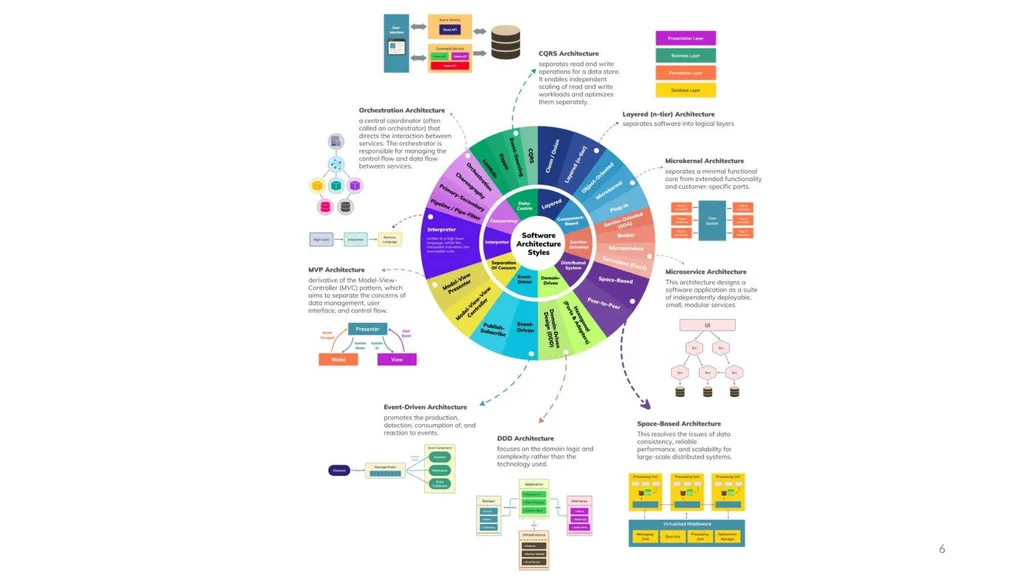
slide6. 6<br>
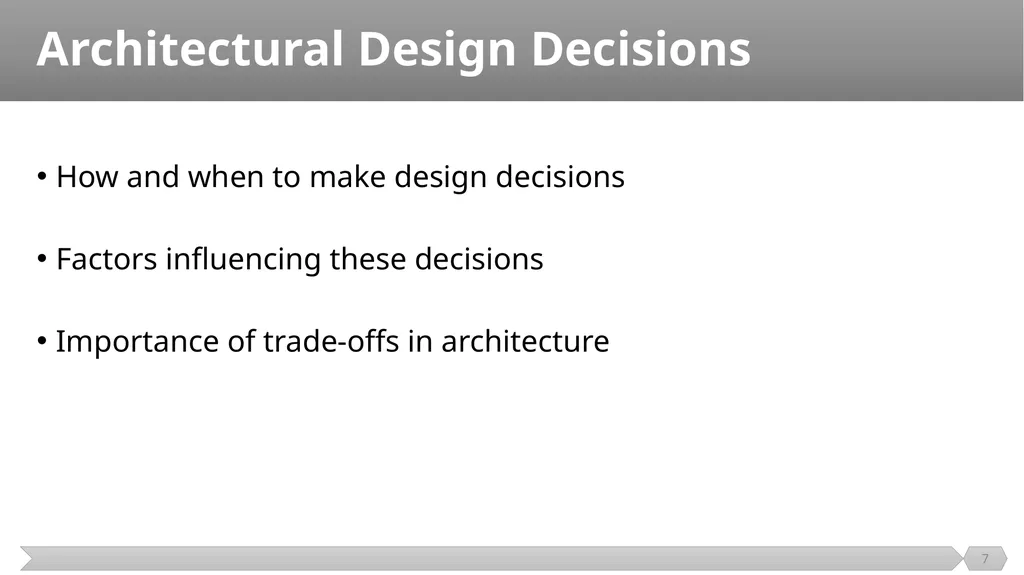
slide7. Architectural Design Decisions How and when to make design decisions
Factors influencing these decisions
Importance of trade-offs in architecture 7<br>
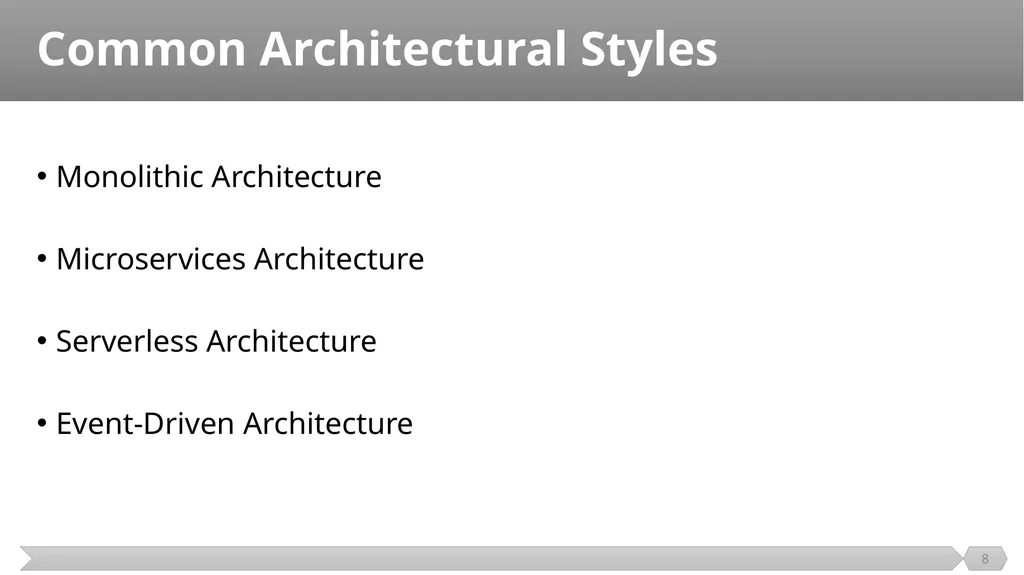
slide8. Common Architectural Styles Monolithic Architecture
Microservices Architecture
Serverless Architecture
Event-Driven Architecture 8<br>
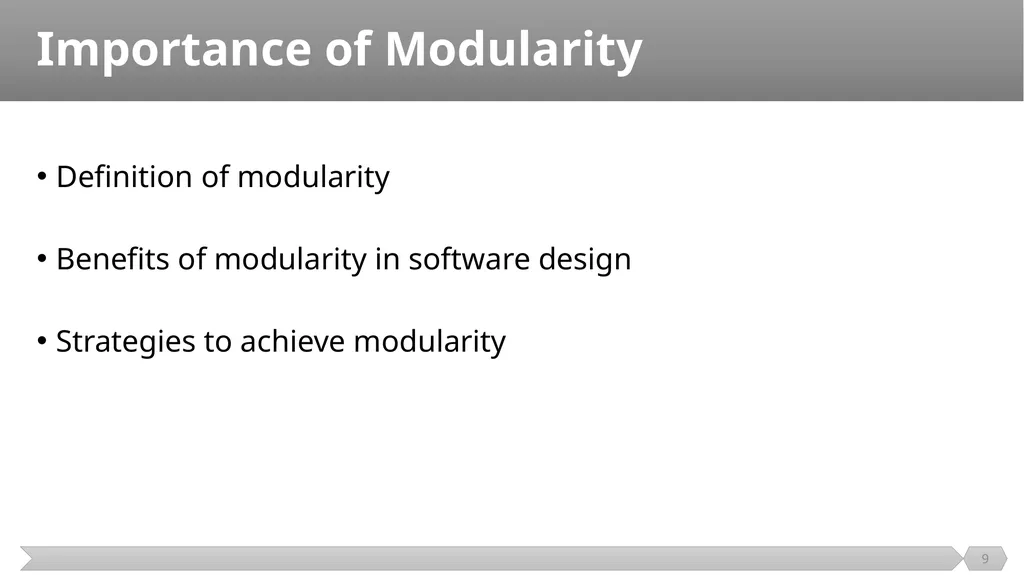
slide9. Importance of Modularity Definition of modularity
Benefits of modularity in software design
Strategies to achieve modularity 9<br>
slide10. Software architecture characteristics Aligning Architecture with Business Goals
Scalability
Maintainability
Extensibility
Flexibility
Performance Efficiency
Security
Usability
Reusability 10<br>
slide11. Understanding Software Design Software design refers to the process of creating a plan, blueprint, or architecture for a software system.
It involves making decisions about the structure, functionality, and behavior of the system, as well as the algorithms and data structures that will be used to implement it. 11<br>
slide12. Understanding Software Design Software design is a critical step in the software development process, as it helps ensure that the system is developed efficiently, effectively, and meets the requirements of its users.
It involves a series of activities, including:
Defining the system's requirements and constraints
Creating models, prototypes, and diagrams to represent the system's architecture and functionality
Identifying and evaluating design options and trade-offs
Selecting the most appropriate design solution
Documenting the design in sufficient detail to allow for its implementation 12<br>
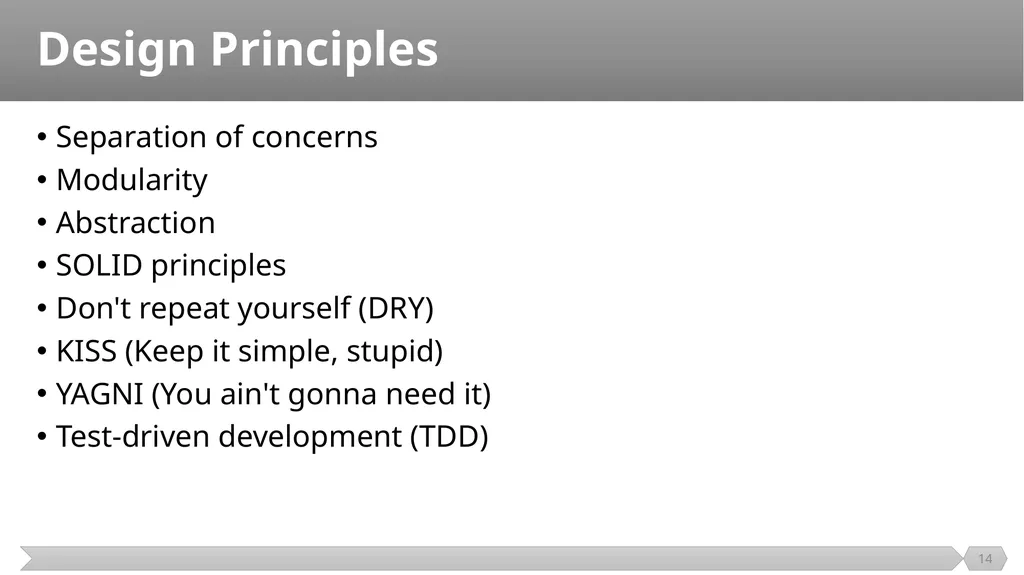
slide13. Design Principles Separation of concerns
Modularity
Abstraction
SOLID principles
Don't repeat yourself (DRY)
KISS (Keep it simple, stupid)
YAGNI (You ain't gonna need it)
Test-driven development (TDD) 13<br>
slide14. Design Principles Separation of concerns
Modularity
Abstraction
SOLID principles
Don't repeat yourself (DRY)
KISS (Keep it simple, stupid)
YAGNI (You ain't gonna need it)
Test-driven development (TDD) 14<br>
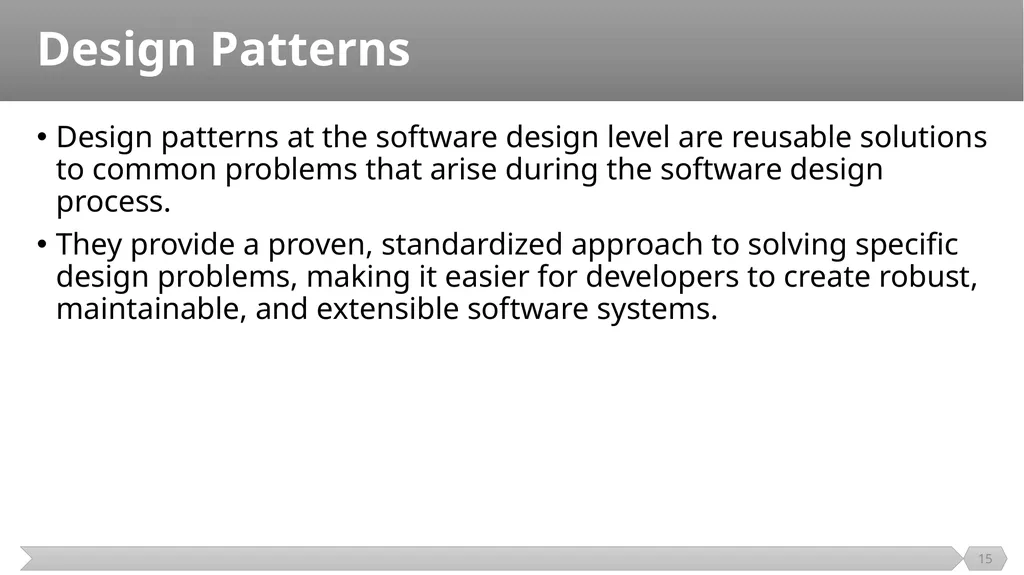
slide15. Design Patterns Design patterns at the software design level are reusable solutions to common problems that arise during the software design process.
They provide a proven, standardized approach to solving specific design problems, making it easier for developers to create robust, maintainable, and extensible software systems. 15<br>
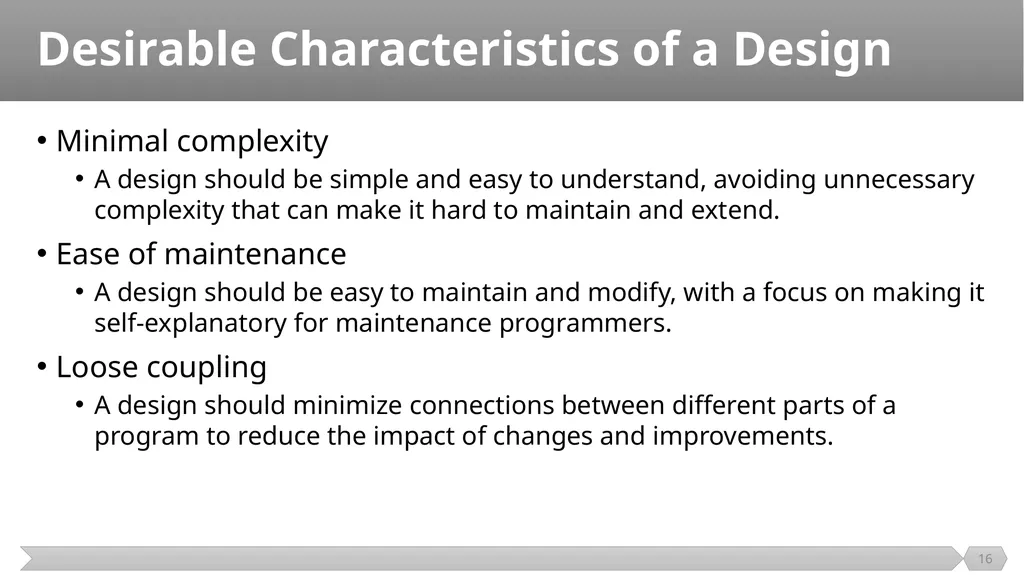
slide16. Desirable Characteristics of a Design Minimal complexity
A design should be simple and easy to understand, avoiding unnecessary complexity that can make it hard to maintain and extend.
Ease of maintenance
A design should be easy to maintain and modify, with a focus on making it self-explanatory for maintenance programmers.
Loose coupling
A design should minimize connections between different parts of a program to reduce the impact of changes and improvements. 16<br>
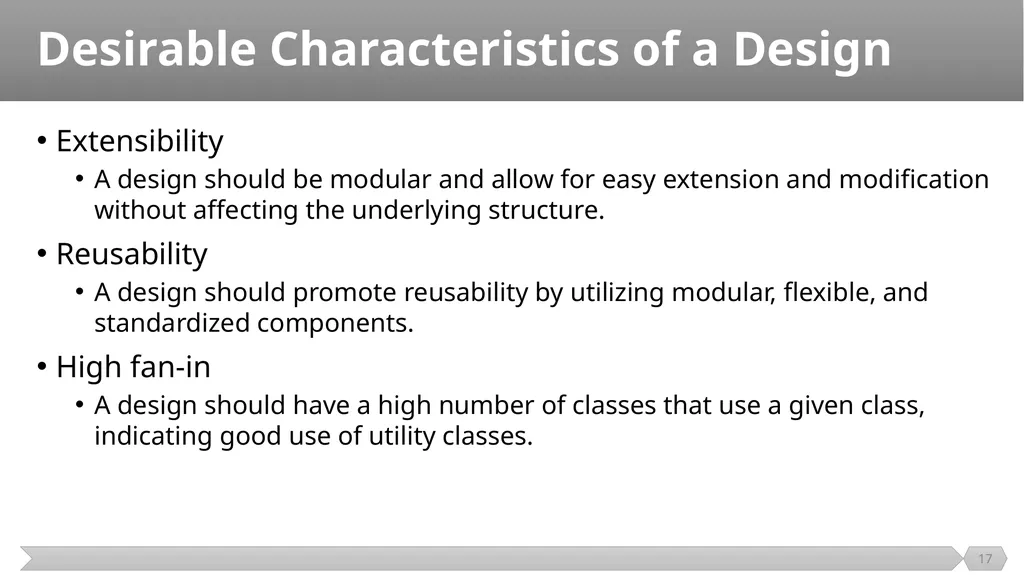
slide17. Desirable Characteristics of a Design Extensibility
A design should be modular and allow for easy extension and modification without affecting the underlying structure.
Reusability
A design should promote reusability by utilizing modular, flexible, and standardized components.
High fan-in
A design should have a high number of classes that use a given class, indicating good use of utility classes. 17<br>
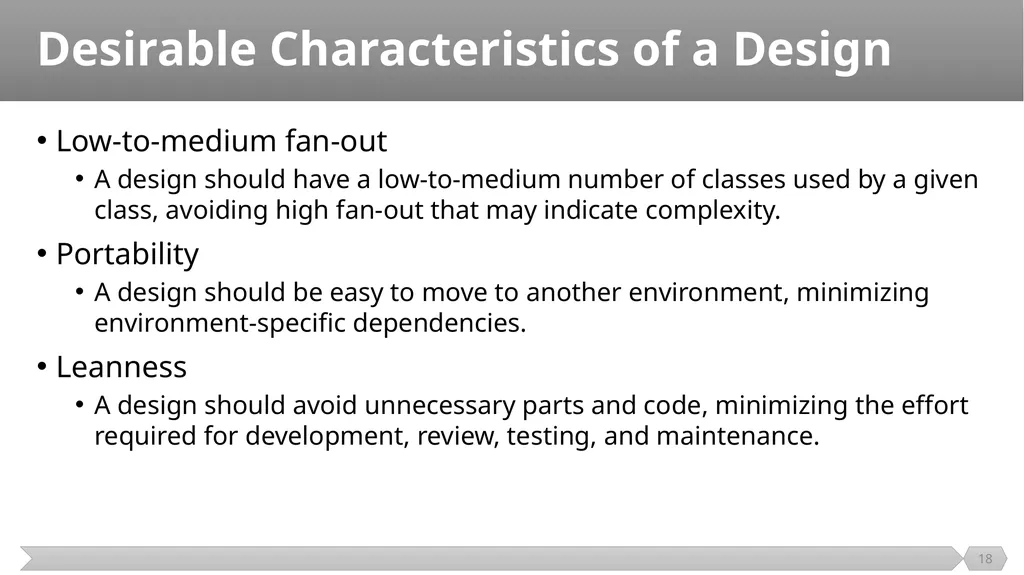
slide18. Desirable Characteristics of a Design Low-to-medium fan-out
A design should have a low-to-medium number of classes used by a given class, avoiding high fan-out that may indicate complexity.
Portability
A design should be easy to move to another environment, minimizing environment-specific dependencies.
Leanness
A design should avoid unnecessary parts and code, minimizing the effort required for development, review, testing, and maintenance. 18<br>
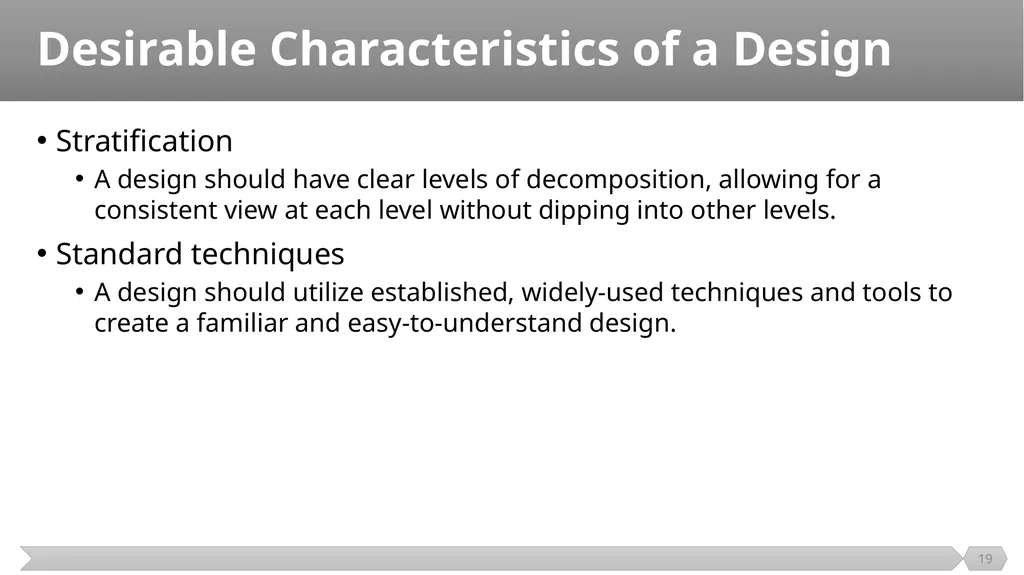
slide19. Desirable Characteristics of a Design Stratification
A design should have clear levels of decomposition, allowing for a consistent view at each level without dipping into other levels.
Standard techniques
A design should utilize established, widely-used techniques and tools to create a familiar and easy-to-understand design. 19<br>
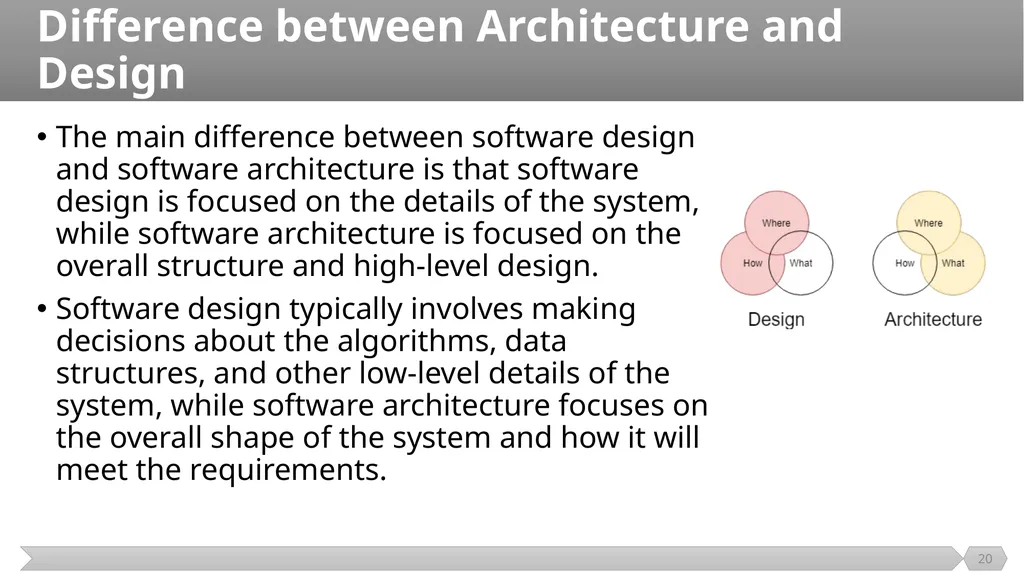
slide20. Difference between Architecture and Design The main difference between software design and software architecture is that software design is focused on the details of the system, while software architecture is focused on the overall structure and high-level design.
Software design typically involves making decisions about the algorithms, data structures, and other low-level details of the system, while software architecture focuses on the overall shape of the system and how it will meet the requirements. 20<br>
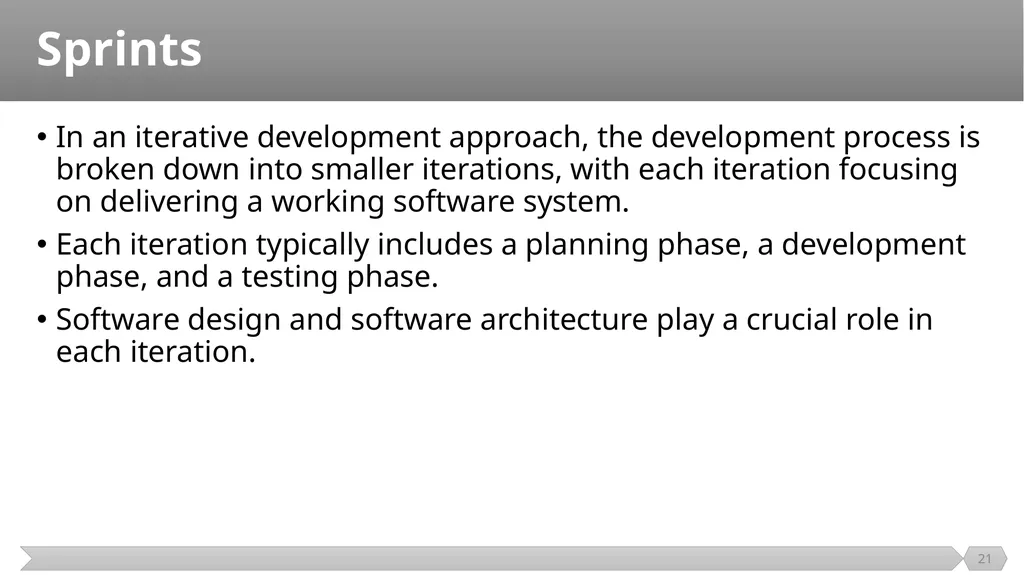
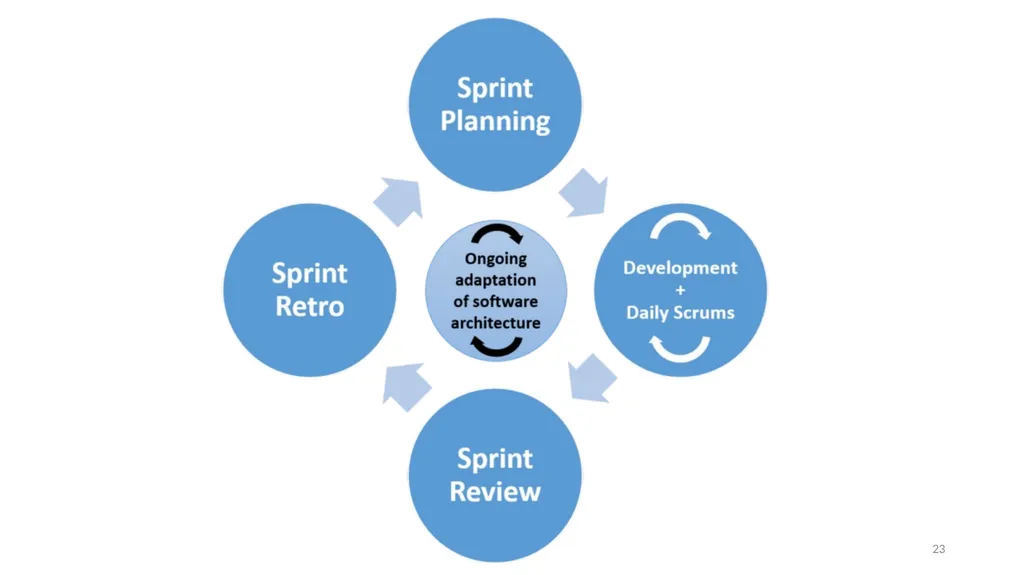
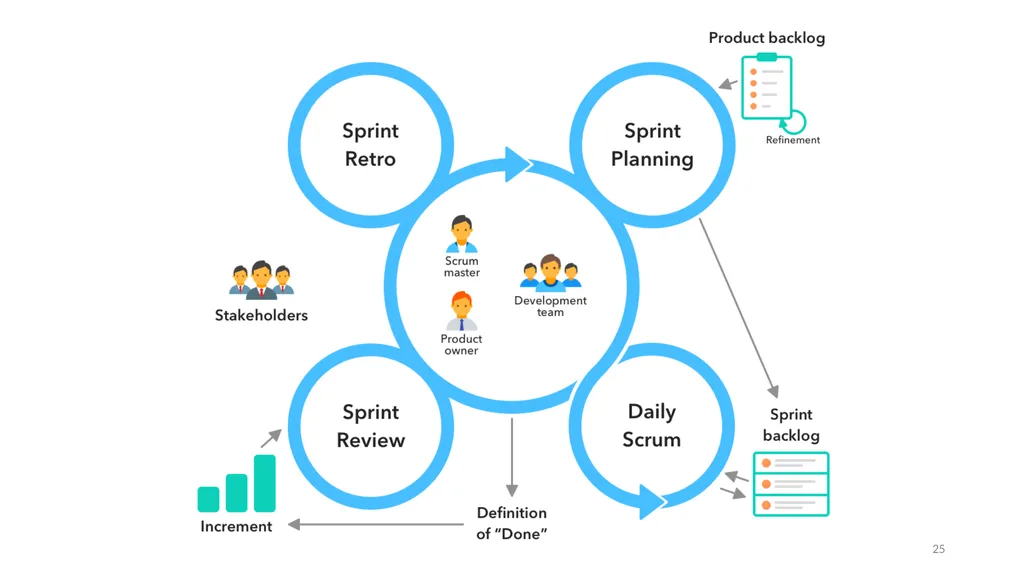
slide21. Sprints In an iterative development approach, the development process is broken down into smaller iterations, with each iteration focusing on delivering a working software system.
Each iteration typically includes a planning phase, a development phase, and a testing phase.
Software design and software architecture play a crucial role in each iteration. 21<br>
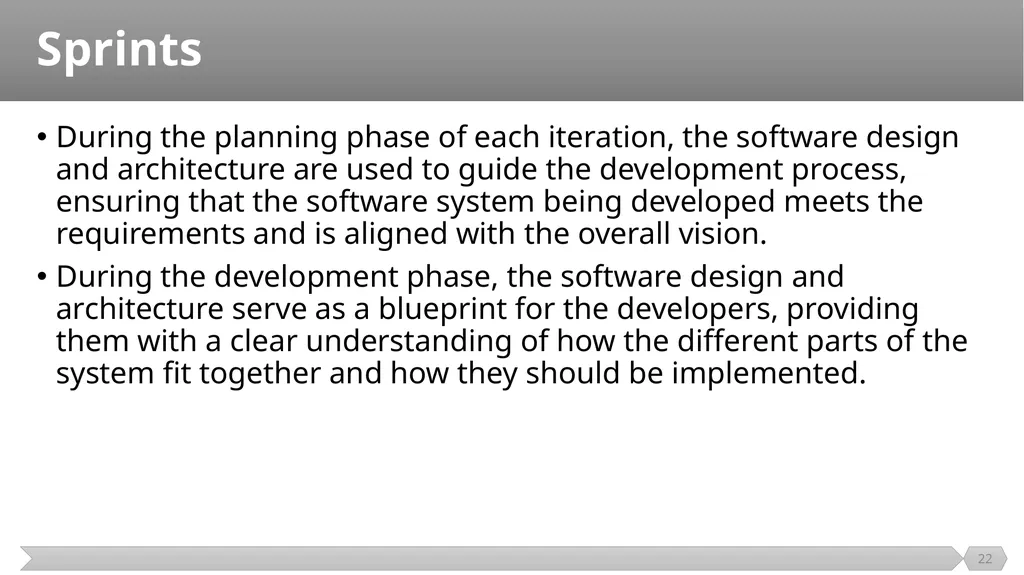
slide22. Sprints During the planning phase of each iteration, the software design and architecture are used to guide the development process, ensuring that the software system being developed meets the requirements and is aligned with the overall vision.
During the development phase, the software design and architecture serve as a blueprint for the developers, providing them with a clear understanding of how the different parts of the system fit together and how they should be implemented. 22<br>

slide23. 23<br>
slide24. 24<br>
slide25. 25<br>
slide2. Understanding Software Architecture Software architecture refers to the high-level structure of a software system, including the components, interactions, and relationships between them.
It provides a blueprint for the software system, which helps in understanding how the different parts of the system fit together and how they will work together to meet the requirements. 2<br>
slide3. Understanding Software Architecture Think of it as the 'skeleton' of a software system.
Components: The actual pieces of software (programs, libraries, databases, etc.) that carry out system functions.
Relationships: The interactions and dependencies between these components.
Properties: The individual and collective characteristics of components and their relationships, such as performance, security, and usability. 3<br>
slide4. Why is Software Architecture Important? Software architecture serves as the foundation of a software system.
Its importance cannot be overstated, and here's why:
Quality Attributes: It defines the system's properties, such as scalability, reliability, and performance.
Risk Management: It helps identify and mitigate potential risks in the early stages of software development.
Communication: It provides a shared vocabulary for stakeholders, aiding understanding and collaboration.
Future-Proofing: It makes future changes and enhancements more manageable by providing a clear structure and roadmap. 4<br>
slide5. Key Concepts in Software Architecture Components, connectors, and configurations
Architectural styles and patterns
Layers and tiers in architecture 5<br>
slide6. 6<br>
slide7. Architectural Design Decisions How and when to make design decisions
Factors influencing these decisions
Importance of trade-offs in architecture 7<br>
slide8. Common Architectural Styles Monolithic Architecture
Microservices Architecture
Serverless Architecture
Event-Driven Architecture 8<br>
slide9. Importance of Modularity Definition of modularity
Benefits of modularity in software design
Strategies to achieve modularity 9<br>
slide10. Software architecture characteristics Aligning Architecture with Business Goals
Scalability
Maintainability
Extensibility
Flexibility
Performance Efficiency
Security
Usability
Reusability 10<br>
slide11. Understanding Software Design Software design refers to the process of creating a plan, blueprint, or architecture for a software system.
It involves making decisions about the structure, functionality, and behavior of the system, as well as the algorithms and data structures that will be used to implement it. 11<br>
slide12. Understanding Software Design Software design is a critical step in the software development process, as it helps ensure that the system is developed efficiently, effectively, and meets the requirements of its users.
It involves a series of activities, including:
Defining the system's requirements and constraints
Creating models, prototypes, and diagrams to represent the system's architecture and functionality
Identifying and evaluating design options and trade-offs
Selecting the most appropriate design solution
Documenting the design in sufficient detail to allow for its implementation 12<br>
slide13. Design Principles Separation of concerns
Modularity
Abstraction
SOLID principles
Don't repeat yourself (DRY)
KISS (Keep it simple, stupid)
YAGNI (You ain't gonna need it)
Test-driven development (TDD) 13<br>
slide14. Design Principles Separation of concerns
Modularity
Abstraction
SOLID principles
Don't repeat yourself (DRY)
KISS (Keep it simple, stupid)
YAGNI (You ain't gonna need it)
Test-driven development (TDD) 14<br>
slide15. Design Patterns Design patterns at the software design level are reusable solutions to common problems that arise during the software design process.
They provide a proven, standardized approach to solving specific design problems, making it easier for developers to create robust, maintainable, and extensible software systems. 15<br>
slide16. Desirable Characteristics of a Design Minimal complexity
A design should be simple and easy to understand, avoiding unnecessary complexity that can make it hard to maintain and extend.
Ease of maintenance
A design should be easy to maintain and modify, with a focus on making it self-explanatory for maintenance programmers.
Loose coupling
A design should minimize connections between different parts of a program to reduce the impact of changes and improvements. 16<br>
slide17. Desirable Characteristics of a Design Extensibility
A design should be modular and allow for easy extension and modification without affecting the underlying structure.
Reusability
A design should promote reusability by utilizing modular, flexible, and standardized components.
High fan-in
A design should have a high number of classes that use a given class, indicating good use of utility classes. 17<br>
slide18. Desirable Characteristics of a Design Low-to-medium fan-out
A design should have a low-to-medium number of classes used by a given class, avoiding high fan-out that may indicate complexity.
Portability
A design should be easy to move to another environment, minimizing environment-specific dependencies.
Leanness
A design should avoid unnecessary parts and code, minimizing the effort required for development, review, testing, and maintenance. 18<br>
slide19. Desirable Characteristics of a Design Stratification
A design should have clear levels of decomposition, allowing for a consistent view at each level without dipping into other levels.
Standard techniques
A design should utilize established, widely-used techniques and tools to create a familiar and easy-to-understand design. 19<br>
slide20. Difference between Architecture and Design The main difference between software design and software architecture is that software design is focused on the details of the system, while software architecture is focused on the overall structure and high-level design.
Software design typically involves making decisions about the algorithms, data structures, and other low-level details of the system, while software architecture focuses on the overall shape of the system and how it will meet the requirements. 20<br>
slide21. Sprints In an iterative development approach, the development process is broken down into smaller iterations, with each iteration focusing on delivering a working software system.
Each iteration typically includes a planning phase, a development phase, and a testing phase.
Software design and software architecture play a crucial role in each iteration. 21<br>
slide22. Sprints During the planning phase of each iteration, the software design and architecture are used to guide the development process, ensuring that the software system being developed meets the requirements and is aligned with the overall vision.
During the development phase, the software design and architecture serve as a blueprint for the developers, providing them with a clear understanding of how the different parts of the system fit together and how they should be implemented. 22<br>

slide23. 23<br>
slide24. 24<br>
slide25. 25<br>