Are Hedge Funds Exploiting Climate Concerns? George O. Aragon (Arizona State University) Yuxiang Jiang (Southwestern University of Finance and Economics) Juha Joenväärä (Aalto University) Cristian Ioan Tiu (University at Buffalo) GRASFI
"Are Hedge Funds Exploiting Climate Concerns?" is the property of its rightful owner. Permission is granted to
download and print the materials on this website for personal, non-commercial use only, and to display it
on your personal computer provided you do not modify the materials and that you retain all copyright
notices contained in the materials. By downloading content from our website, you accept the terms of this
agreement.
Presentation Transcript
01
Are Hedge Funds Exploiting Climate Concerns? George O. Aragon (Arizona State University)
Yuxiang Jiang (Southwestern University of Finance and Economics)
Juha Joenväärä (Aalto University)
Cristian Ioan Tiu (University at Buffalo) GRASFI Conference 2024
Singapore, September 3, 2024<br>
02
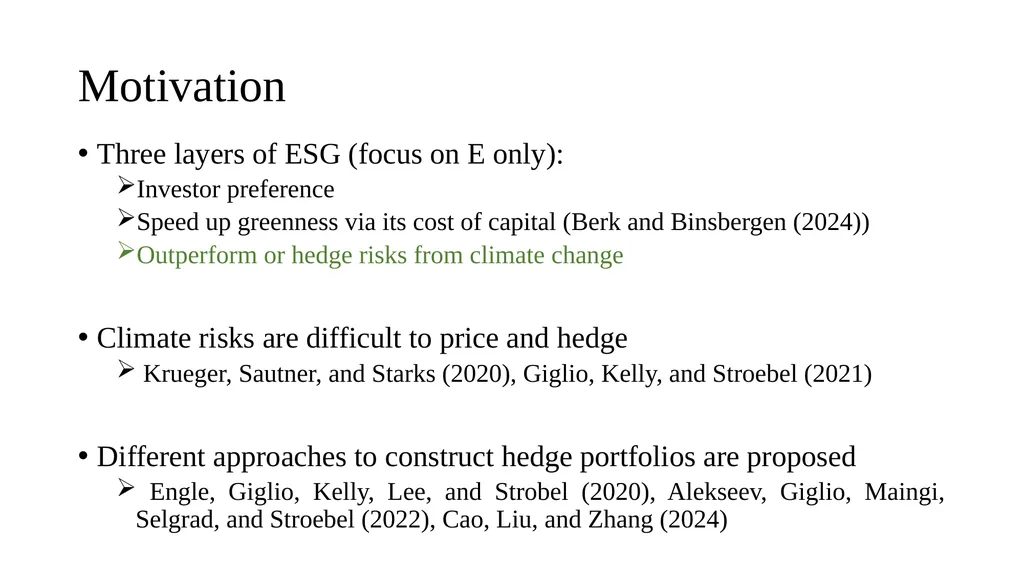
Motivation Three layers of ESG (focus on E only):
Investor preference
Speed up greenness via its cost of capital (Berk and Binsbergen (2024))
Outperform or hedge risks from climate change
Climate risks are difficult to price and hedge
Krueger, Sautner, and Starks (2020), Giglio, Kelly, and Stroebel (2021)
Different approaches to construct hedge portfolios are proposed
Engle, Giglio, Kelly, Lee, and Strobel (2020), Alekseev, Giglio, Maingi, Selgrad, and Stroebel (2022), Cao, Liu, and Zhang (2024)<br>
03
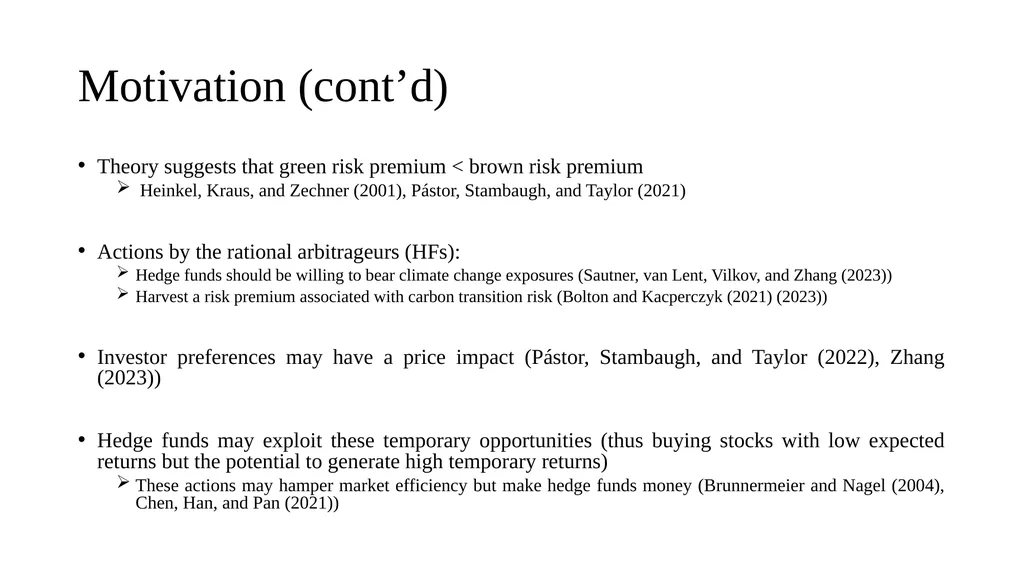
Motivation (cont’d) Theory suggests that green risk premium < brown risk premium
Heinkel, Kraus, and Zechner (2001), Pástor, Stambaugh, and Taylor (2021)
Actions by the rational arbitrageurs (HFs):
Hedge funds should be willing to bear climate change exposures (Sautner, van Lent, Vilkov, and Zhang (2023))
Harvest a risk premium associated with carbon transition risk (Bolton and Kacperczyk (2021) (2023))
Investor preferences may have a price impact (Pástor, Stambaugh, and Taylor (2022), Zhang (2023))
Hedge funds may exploit these temporary opportunities (thus buying stocks with low expected returns but the potential to generate high temporary returns)
These actions may hamper market efficiency but make hedge funds money (Brunnermeier and Nagel (2004), Chen, Han, and Pan (2021))<br>
04
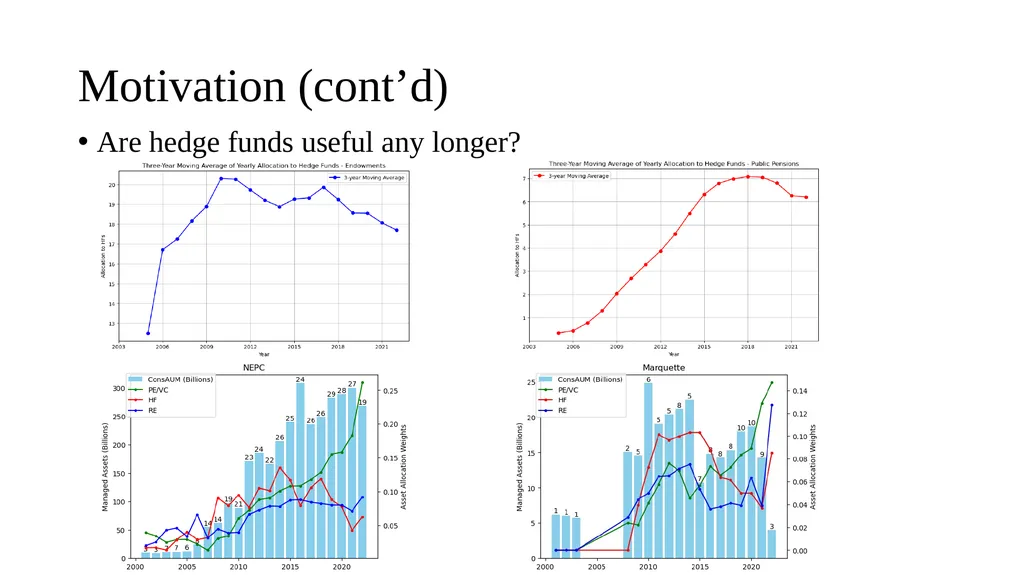
Motivation (cont’d) Are hedge funds useful any longer?<br>
05
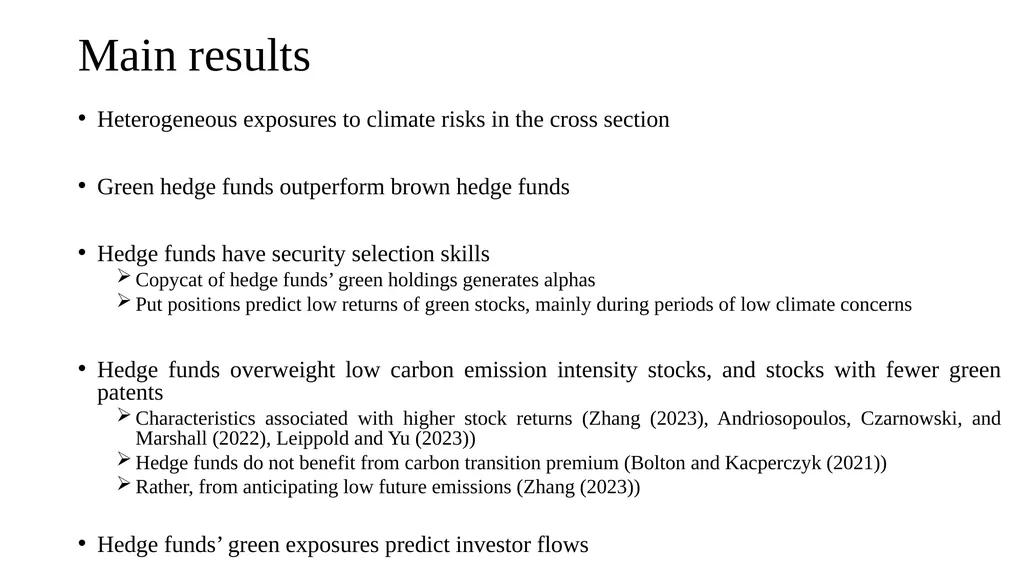
Main results Heterogeneous exposures to climate risks in the cross section
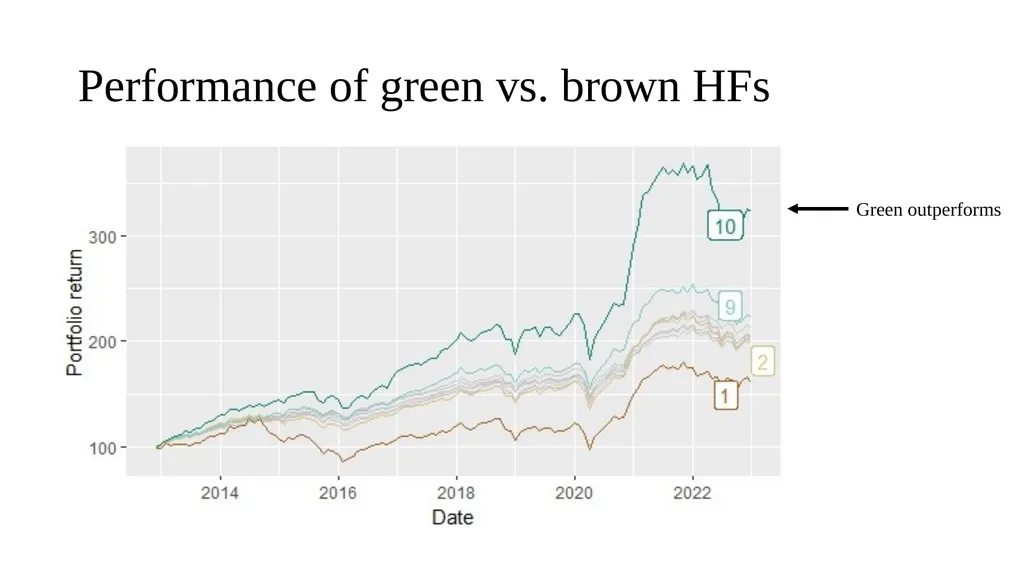
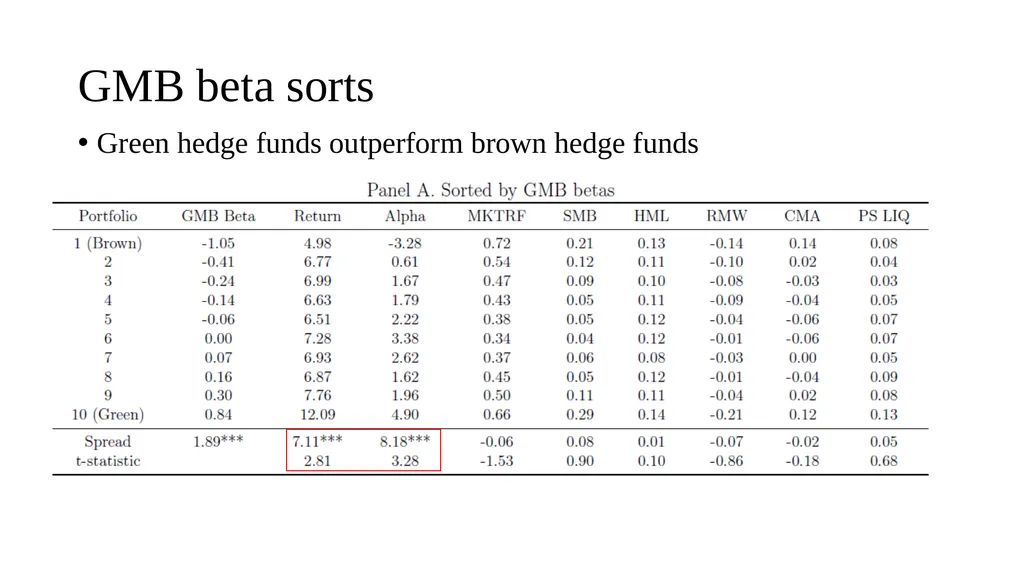
Green hedge funds outperform brown hedge funds
Hedge funds have security selection skills
Copycat of hedge funds’ green holdings generates alphas
Put positions predict low returns of green stocks, mainly during periods of low climate concerns
Hedge funds overweight low carbon emission intensity stocks, and stocks with fewer green patents
Characteristics associated with higher stock returns (Zhang (2023), Andriosopoulos, Czarnowski, and Marshall (2022), Leippold and Yu (2023))
Hedge funds do not benefit from carbon transition premium (Bolton and Kacperczyk (2021))
Rather, from anticipating low future emissions (Zhang (2023))
Hedge funds’ green exposures predict investor flows<br>
06
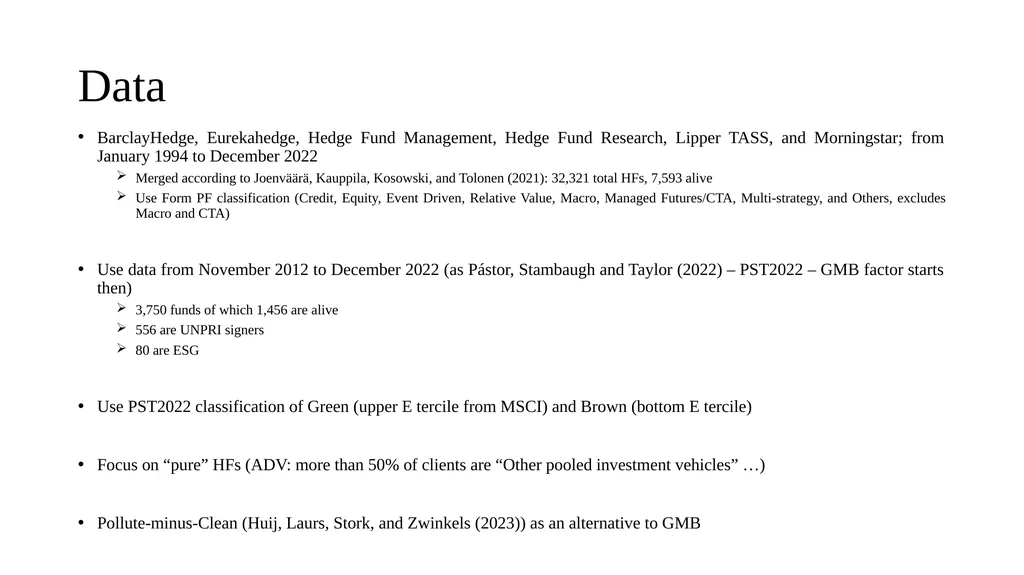
Data BarclayHedge, Eurekahedge, Hedge Fund Management, Hedge Fund Research, Lipper TASS, and Morningstar; from January 1994 to December 2022
Merged according to Joenväärä, Kauppila, Kosowski, and Tolonen (2021): 32,321 total HFs, 7,593 alive
Use Form PF classification (Credit, Equity, Event Driven, Relative Value, Macro, Managed Futures/CTA, Multi-strategy, and Others, excludes Macro and CTA)
Use data from November 2012 to December 2022 (as Pástor, Stambaugh and Taylor (2022) – PST2022 – GMB factor starts then)
3,750 funds of which 1,456 are alive
556 are UNPRI signers
80 are ESG
Use PST2022 classification of Green (upper E tercile from MSCI) and Brown (bottom E tercile)
Focus on “pure” HFs (ADV: more than 50% of clients are “Other pooled investment vehicles” …)
Pollute-minus-Clean (Huij, Laurs, Stork, and Zwinkels (2023)) as an alternative to GMB<br>
07
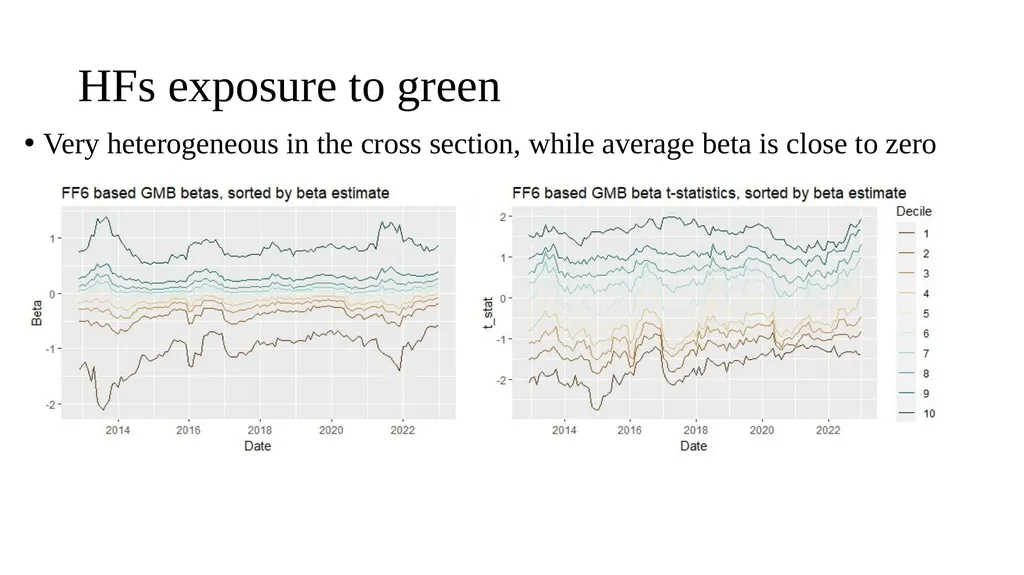
HFs exposure to green Very heterogeneous in the cross section, while average beta is close to zero<br>
08
Performance of green vs. brown HFs Green outperforms<br>
09
GMB beta sorts Green hedge funds outperform brown hedge funds<br>
10
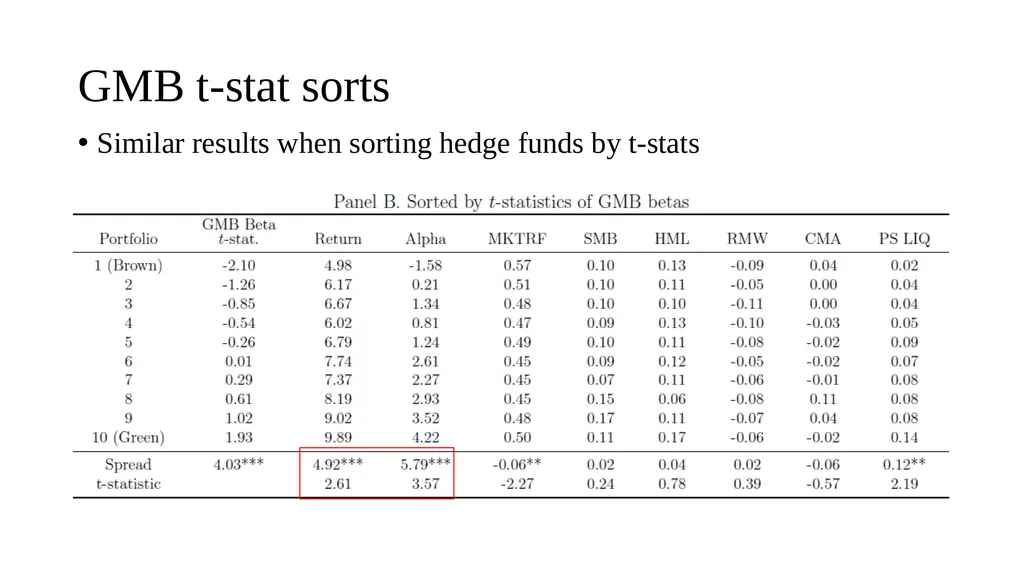
GMB t-stat sorts Similar results when sorting hedge funds by t-stats<br>
11
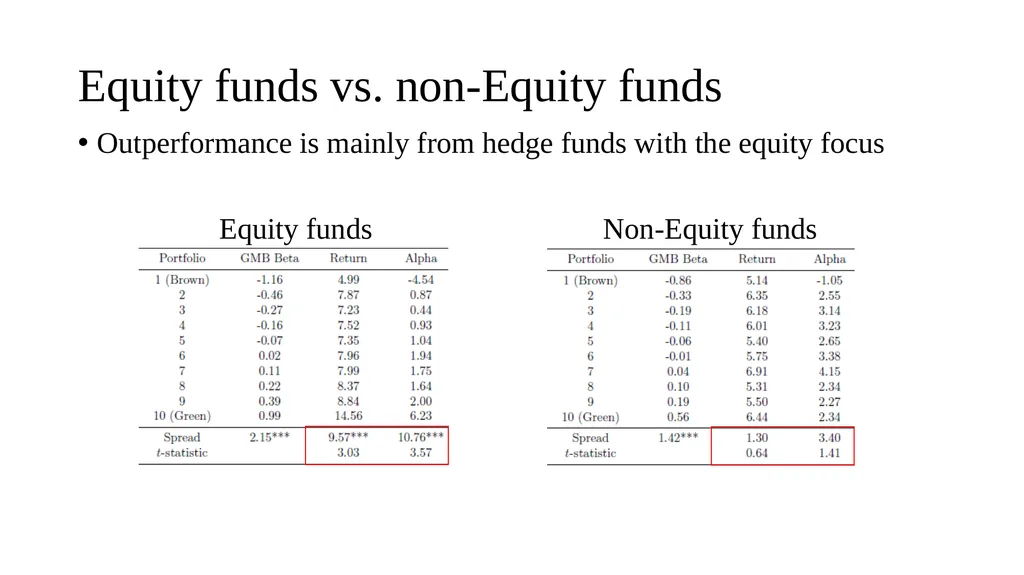
Equity funds vs. non-Equity funds Outperformance is mainly from hedge funds with the equity focus
Equity funds Non-Equity funds<br>
12
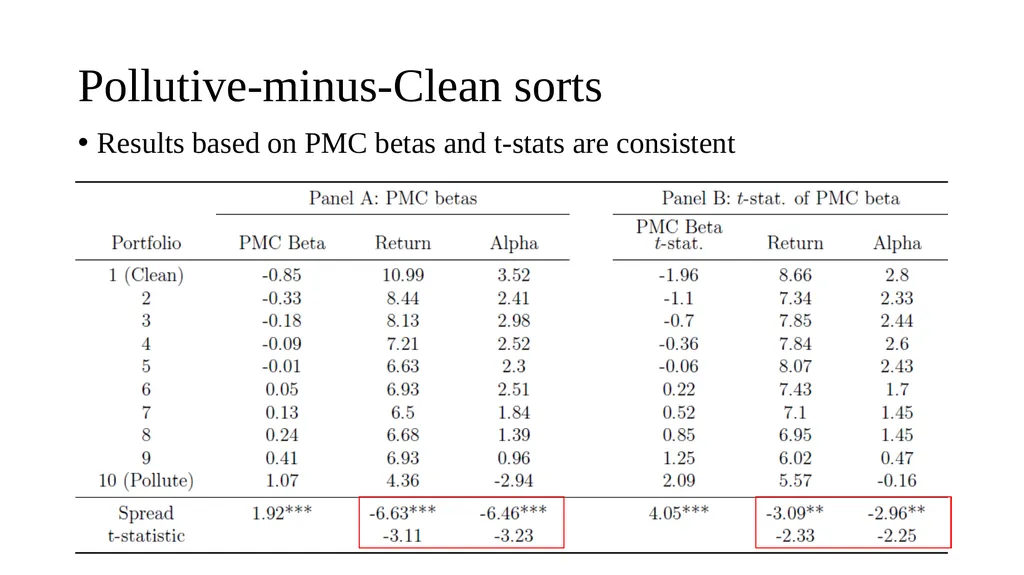
Pollutive-minus-Clean sorts Results based on PMC betas and t-stats are consistent<br>
13
Green exposures Hedge funds exposed to green stocks (or clean stocks) outperform
Not due to mechanical exposures to GMB or PMC factors
Similar results after controlling for GMB or PMC factors<br>
14
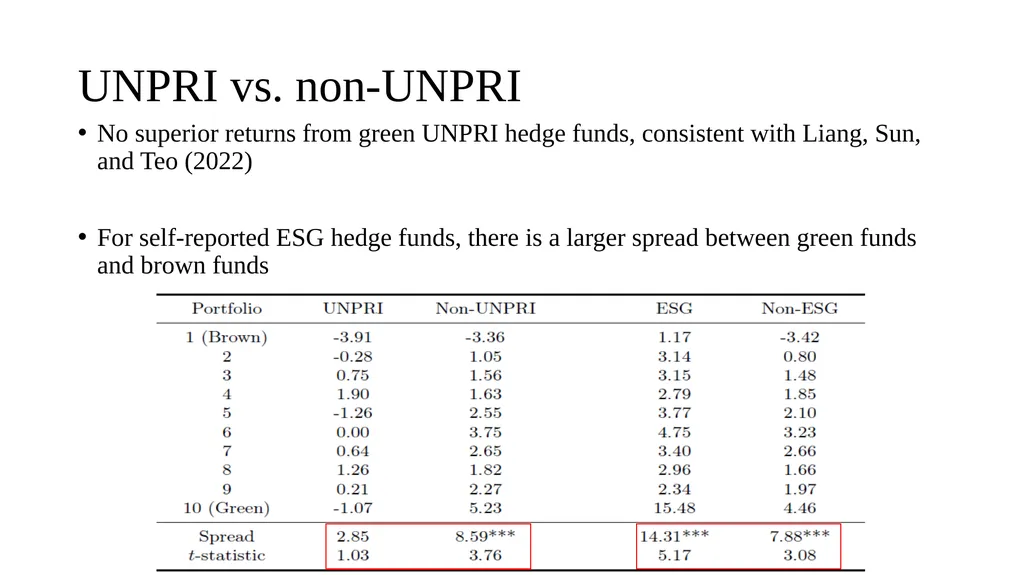
UNPRI vs. non-UNPRI No superior returns from green UNPRI hedge funds, consistent with Liang, Sun, and Teo (2022)
For self-reported ESG hedge funds, there is a larger spread between green funds and brown funds<br>
15
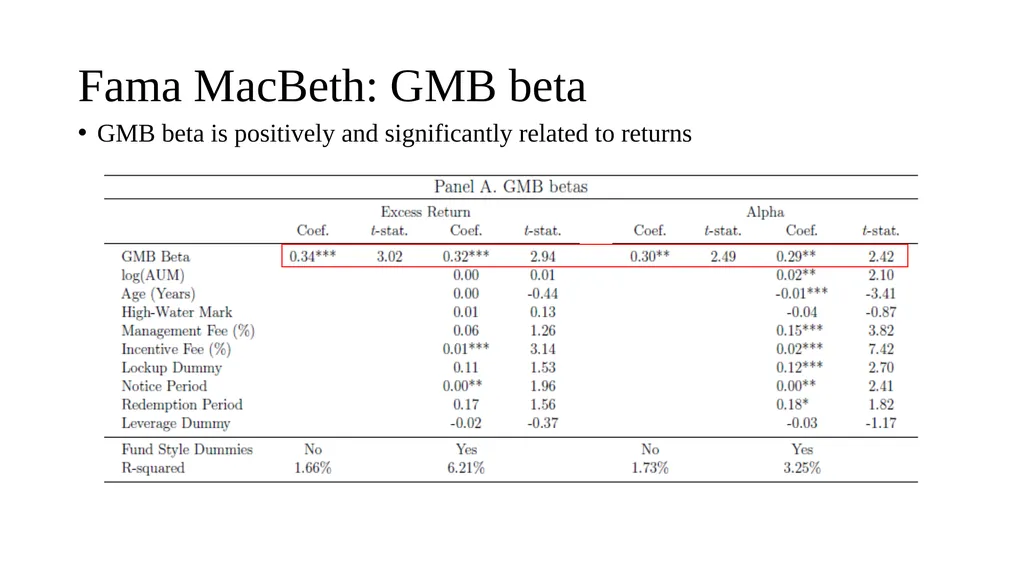
Fama MacBeth: GMB beta GMB beta is positively and significantly related to returns<br>
16
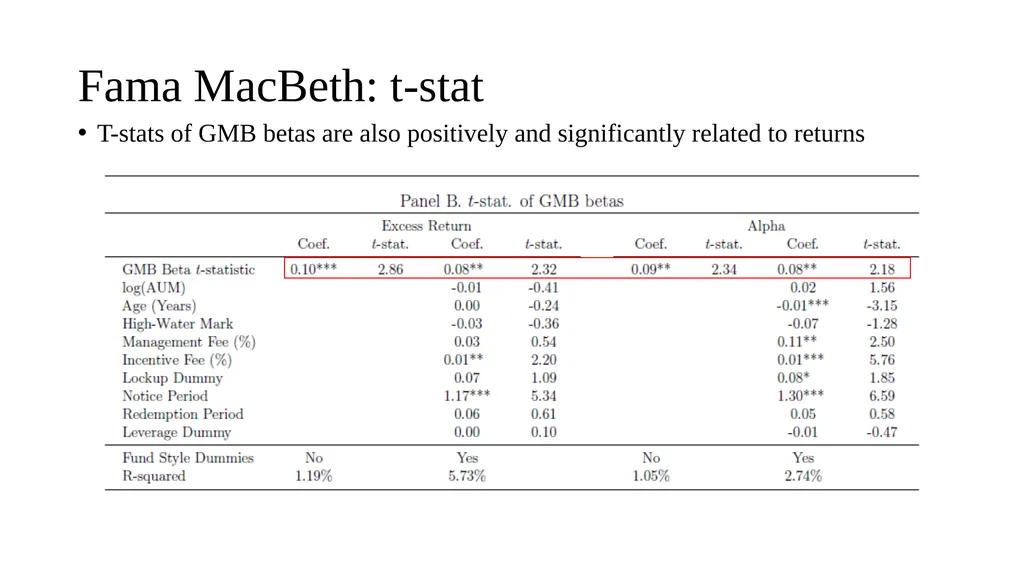
Fama MacBeth: t-stat T-stats of GMB betas are also positively and significantly related to returns<br>
17
Why do green hedge funds outperform? We analyze holdings data
Do green hedge funds hold green stocks? (Lettau, Ludvigson, and Manoel, 2018)
Two “copycat” portfolios:
Green stocks owned by hedge funds (green copycat)
Brown stocks owned by hedge funds (brown copycat)
Two benchmark portfolios:
One for green stocks (green benchmark)
The other for brown stocks (brown benchmark)<br>
18
Green funds and green holdings Green hedge funds tend to hold more green stocks<br>
19
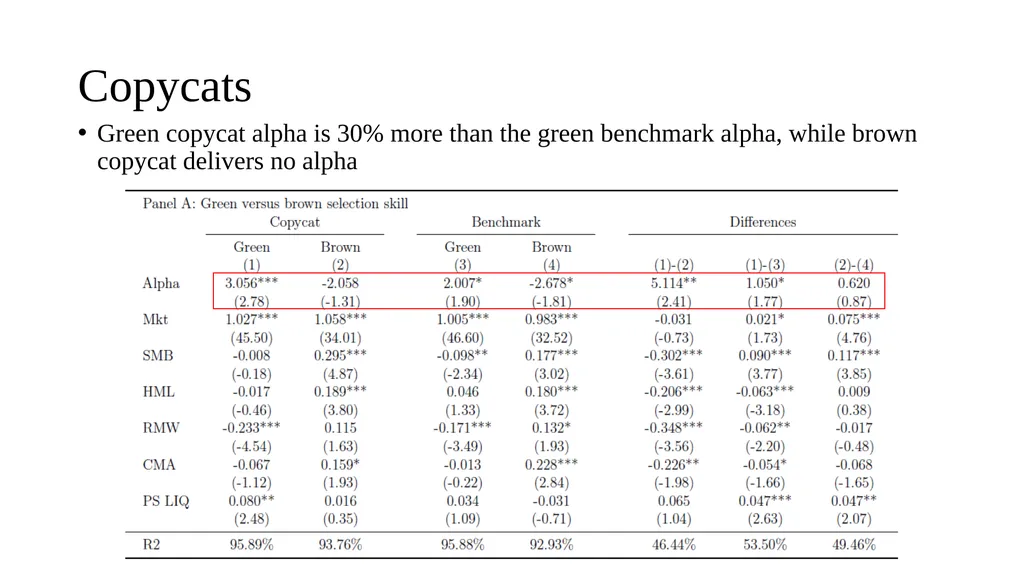
Copycats Green copycat alpha is 30% more than the green benchmark alpha, while brown copycat delivers no alpha<br>
20
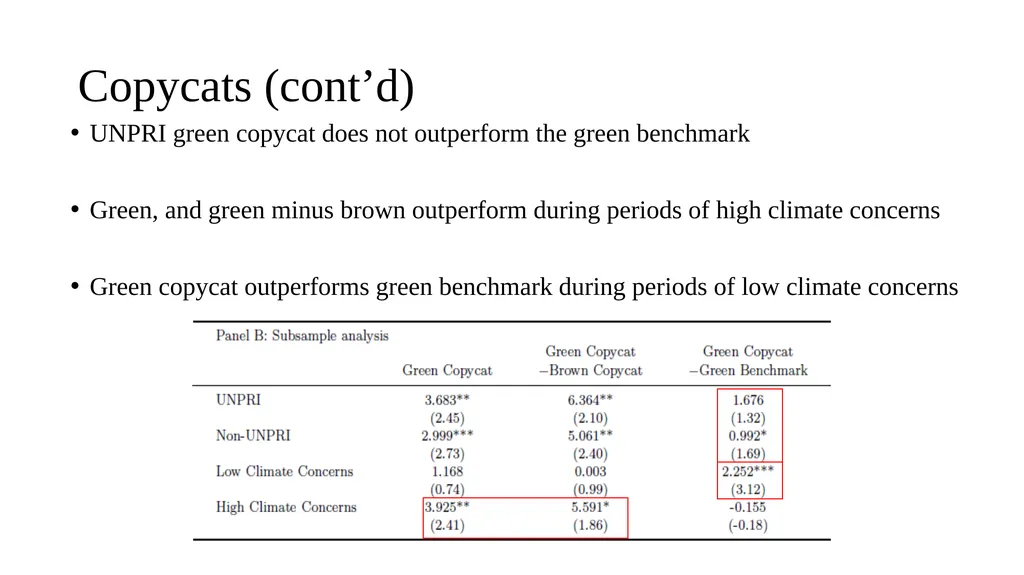
Copycats (cont’d) UNPRI green copycat does not outperform the green benchmark
Green, and green minus brown outperform during periods of high climate concerns
Green copycat outperforms green benchmark during periods of low climate concerns<br>
21
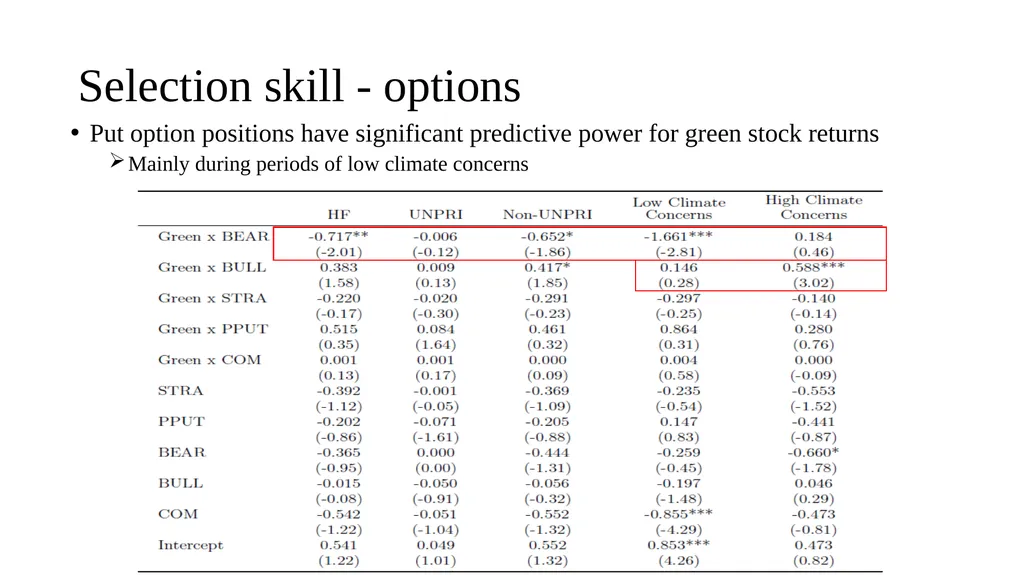
Selection skill - options Put option positions have significant predictive power for green stock returns
Mainly during periods of low climate concerns<br>
22
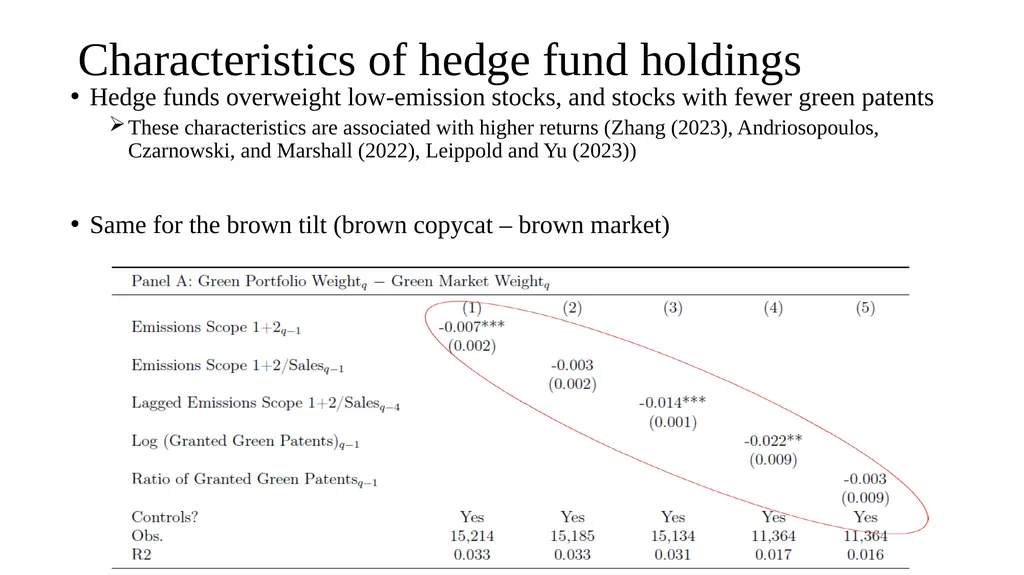
Characteristics of hedge fund holdings Hedge funds overweight low-emission stocks, and stocks with fewer green patents
These characteristics are associated with higher returns (Zhang (2023), Andriosopoulos, Czarnowski, and Marshall (2022), Leippold and Yu (2023))
Same for the brown tilt (brown copycat – brown market)<br>
23
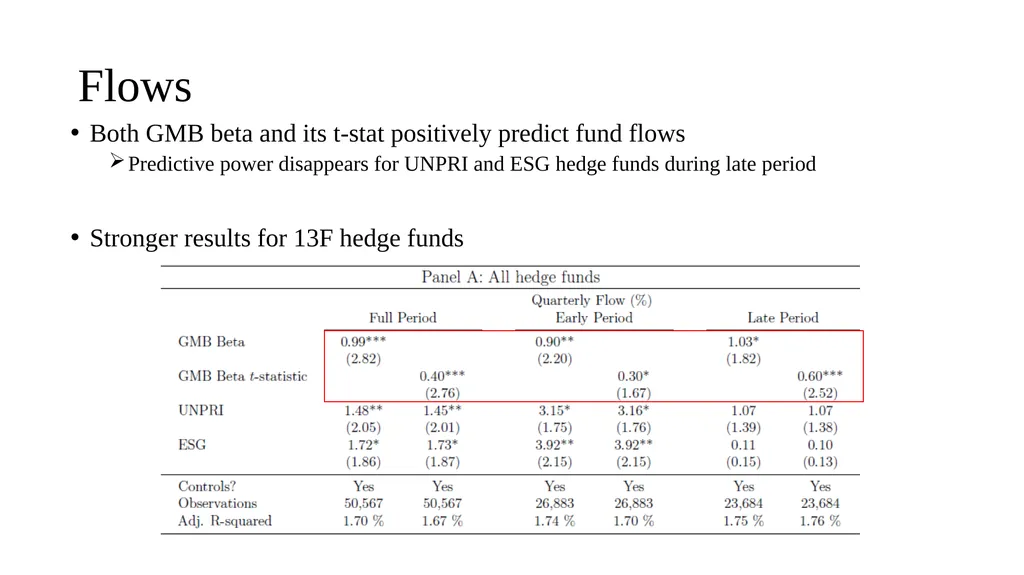
Flows Both GMB beta and its t-stat positively predict fund flows
Predictive power disappears for UNPRI and ESG hedge funds during late period
Stronger results for 13F hedge funds<br>
24
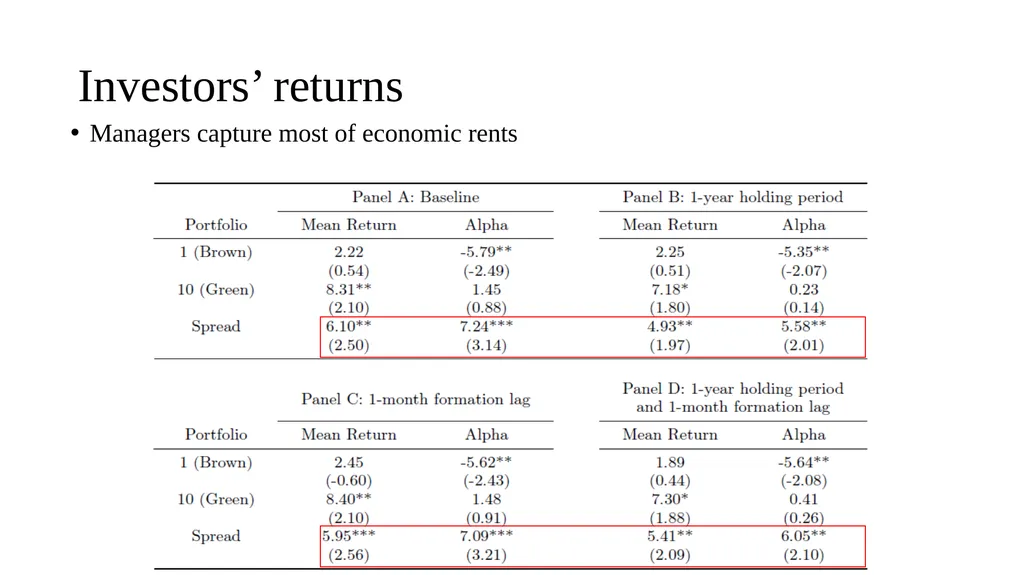
Investors’ returns Managers capture most of economic rents<br>
25
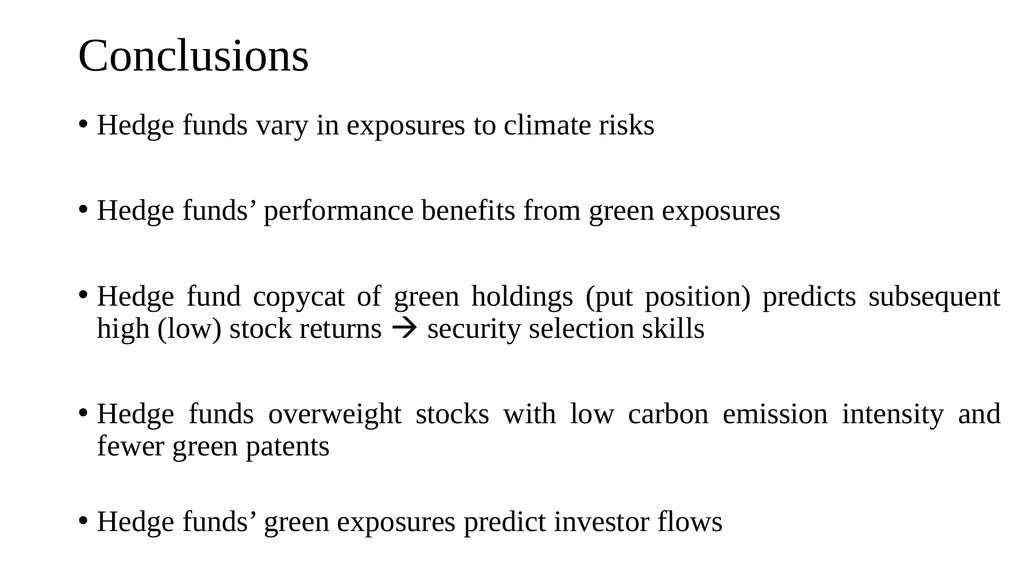
Conclusions Hedge funds vary in exposures to climate risks
Hedge funds’ performance benefits from green exposures
Hedge fund copycat of green holdings (put position) predicts subsequent high (low) stock returns security selection skills
Hedge funds overweight stocks with low carbon emission intensity and fewer green patents
Hedge funds’ green exposures predict investor flows<br>