
Are you in the right course? SE 433/333 Software

Description: Are you in the right course? SE 433333 Software Testing Quality Assurance March 28, 2017 SE 433: Lecture 1 1 of 98 SE 433333 Software Testing Quality Assurance Dennis Mumaugh, Instructor dmumaughdepaul.edu Office: CDM, Room 428
Related Topics
Download Presentation
"Are you in the right course? SE 433/333 Software" is the property of its rightful owner. Permission is granted to download and print the materials on this website for personal, non-commercial use only, and to display it on your personal computer provided you do not modify the materials and that you retain all copyright notices contained in the materials. By downloading content from our website, you accept the terms of this agreement.
Presentation Transcript
slide1. Are you in the right course? SE 433/333 Software Testing
& Quality Assurance March 28, 2017 SE 433: Lecture 1 1 of 98<br>
slide2. SE 433/333 Software Testing & Quality Assurance Dennis Mumaugh, Instructor
dmumaugh@depaul.edu
Office: CDM, Room 428
Office Hours: Tuesday, 4:00 – 5:30 March 28, 2017 SE 433: Lecture 1 2 of 98<br>
slide3. Administrivia: Introduction Dennis Mumaugh
Undergraduate: BSEE – University of California, Berkeley
MS Computer Science – University of Maryland
Ph.D. Studies – University of Maryland
Teaching at DePaul since September 2000
Work
Senior Engineer – National Security Agency
ARPANet Pioneer, Unix™ Technology Transfer
Member of the Technical Staff – Bell Labs/Lucent Technologies
Unix Development – Current Engineering
IS&R Systems – Knowledge Based Systems
Software Tools and OO Technology
Interests
Operating Systems and System Programming
Software Productivity, Compilers and Software Metrics
Software Engineering March 28, 2017 SE 433: Lecture 1 3 of 98<br>
slide4. Administrivia: Basic Information Contact Information:
Email: dmumaugh@depaul.edu
Phone: 630-983-1221 (10:00 am - 11:00 pm) except just before class (After 3pm)
Office Hours
Tuesday: 4:00 pm to 5:30 pm, Loop, CDM, Room 428
By arrangement March 28, 2017 SE 433: Lecture 1 4 of 98<br>
slide5. Administrivia: Basic Information Class home page http://condor.depaul.edu/dmumaugh/classes/SE433S17, contains syllabus and schedule, lecture notes, homework, more reading material
About the Lecture Notes – look at “notes” section of the slides
Also look at the expanded readings page: http://condor.depaul.edu/dmumaugh/readings/SE433readings.html
Desire2Learn:
Course materials, assignments, assignment submissions, assignment solutions, examinations and quizzes and grades will be available on the Desire2learn – https://d2l.depaul.edu/
Email
All students are expected to have an email address.
Please make sure it is valid and make sure Campus Connection has the current email address. March 28, 2017 SE 433: Lecture 1 5 of 98<br>
slide6. Administrivia: Basic Information Course mailing list:
se433@mailman.depaul.edu
To subscribe to the list or unsubscribe from it, go to http://mailman.depaul.edu/mailman/listinfo/se433.
I’ll bulk subscribe on Saturday.
If necessary, update your spam filter to accept messages from the mailing list.
Unless your message is personal, send it to the course mailing list!
I will respond to questions related to the lectures and assignments.
You are also encouraged to respond to other students’ questions.
The mailing list is archived. You may subscribe to a digest.
Last minute information will go to the mailing list March 28, 2017 SE 433: Lecture 1 6 of 98<br>
slide7. Administrivia: reading materials Primary Textbook
Software Testing and Analysis: Process, Principles and Techniques, by Mauro Pezze and Michal Young
References
The Art of Software Testing, Second Edition
by Glenford J. Myers et al
Available in e-book through library
Software Engineering: A Practitioner's Approach, 6th ed
by Roger S Pressman (Chapters 13 and 14)
Lecture notes and supplementary materials
Available on D2L March 28, 2017 SE 433: Lecture 1 7 of 98<br>
slide8. Administrivia: reading materials A note on reading list
You are not expected to read all of the material on the reading list.
Look at the various articles as you have time.
Many say the same thing but with a different perspective.
Don't get overwhelmed in reading March 28, 2017 SE 433: Lecture 1 8 of 98<br>
slide9. Administrivia: Course structure Ten classes + Midterm Exam + Final Exam
Weekly reading, assignments (10)
Class structure: lecture (with short break near the middle).
Topics and reading assignments are on the class web page March 28, 2017 SE 433: Lecture 1 9 of 98<br>
slide10. Administrivia: required software Access to MS Word and PowerPoint (or equivalent)
Java
Java development and testing software:
Eclipse,
JUnit,
Ant,
Cobertura. March 28, 2017 SE 433: Lecture 1 10 of 98<br>
slide11. Administrivia: Support Technical questions can be addressed during office hours or by email
Use the mailing list for all technical questions
Provide appropriate support to each other
I do not preview homework, but I will answer questions or make suggestions to generic problems
If you contact me by e-mail
Please include your name and the course number in all correspondence March 28, 2017 SE 433: Lecture 1 11 of 98<br>
slide12. Administrivia: Miscellany Communications development:
An essential part of this course is communicating your ideas in prose, as well as in technical graphical artifacts.
The ability to communicate clearly and effectively is a skill that will pay off both in and out of class.
Motivation from a recent NPR business report:
Robert Half surveyed their corporate customers concerning resumes they had received.
Corporate reviewers spent about 10-15 seconds deciding whether to examine the resume further.
They instantly tossed the resume if they detected any grammatical or spelling errors.
Treat your coursework as if it were being reviewed by the manager who does your performance review and sets your salary. March 28, 2017 SE 433: Lecture 1 12 of 98<br>
slide13. Administrivia: Miscellany Intellectual property issues:
All material in this course is property of either the instructor or Xiaoping Jia.
You are permitted to download and print copies of the material.
You are not permitted to redistribute the material in any form.
Plagiarism:
All individual assignments must represent your own work.
It's a great idea to get together in study groups to discuss the problems, but you should then do the assignments individually.
Plagiarism is to take and use as one’s own, or copy without acknowledgement, the works of another person. The provider of such material can be ruled equally culpable.
If you hand in late homework with prior permission, it must be your own work, not a copy of the solutions presented in class. March 28, 2017 SE 433: Lecture 1 13 of 98<br>
slide14. Administrivia: Miscellany There will be a lot of ambiguity and lack of firm direction in the assignments and the information.
That is typical of much of engineering.
This requires you to provide your own experience. Or to research and discover your information.
Using previous solutions/techniques will not necessarily work. You may have to invent something.
Understanding a problem (statement):
An essential part of this course is understanding written material, ideas in prose. The ability to understand a document, to "read between the lines", is a skill that will pay off both in and out of class.
Areas of concern:
Projects are implemented with the wrong features.
Students answer the wrong question on a test.
People confuse the subsystems of a design.
People do not read, really read things. March 28, 2017 SE 433: Lecture 1 14 of 98<br>
slide15. Administrivia: Feedback/Participation Feedback/Participation
Share your thoughts
Ask questions – wave your hand forcefully to get my attention
Speak loudly so all can hear
Give me verbal and non-verbal feedback
Don't just sit there . . . nod, smile, frown, shake your head
Make sure your email address is correct and works March 28, 2017 SE 433: Lecture 1 15 of 98<br>
slide16. Homework logistics Homework must be submitted via Desire2Learn by 11:59 PM Chicago Time on the assignment due date.
Do not rely on the deadline, clocks differ. Be early.
Submit MS Word or Adobe PDF files only [I accept either format of MS Word]
No extra credit assignments.
Late Policy
Late assignments will not be accepted except for special circumstances. March 28, 2017 SE 433: Lecture 1 16 of 98<br>
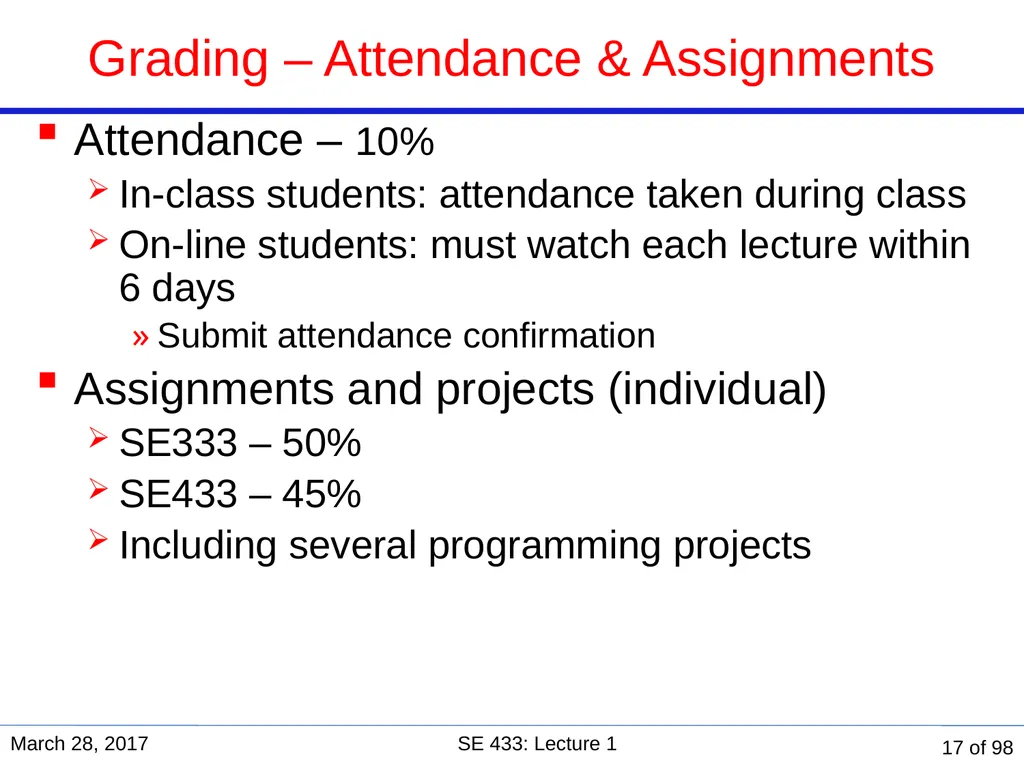
slide17. Grading – Attendance & Assignments Attendance – 10%
In-class students: attendance taken during class
On-line students: must watch each lecture within 6 days
Submit attendance confirmation
Assignments and projects (individual)
SE333 – 50%
SE433 – 45%
Including several programming projects March 28, 2017 SE 433: Lecture 1 17 of 98<br>
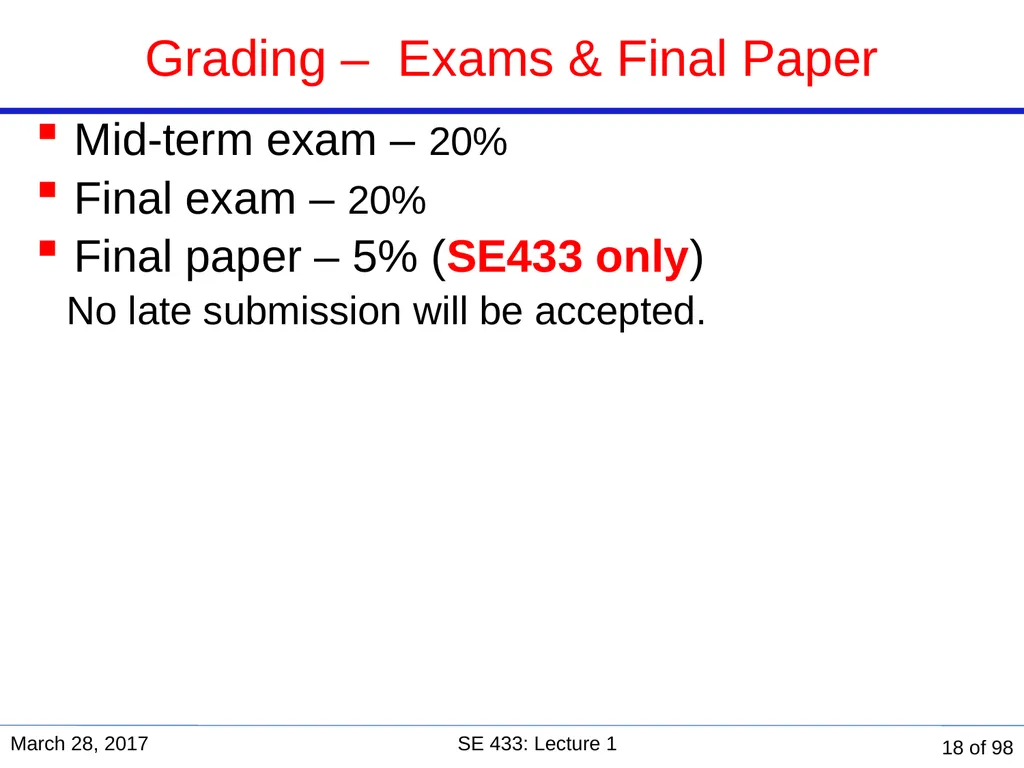
slide18. Grading – Exams & Final Paper Mid-term exam – 20%
Final exam – 20%
Final paper – 5% (SE433 only)
No late submission will be accepted. March 28, 2017 SE 433: Lecture 1 18 of 98<br>
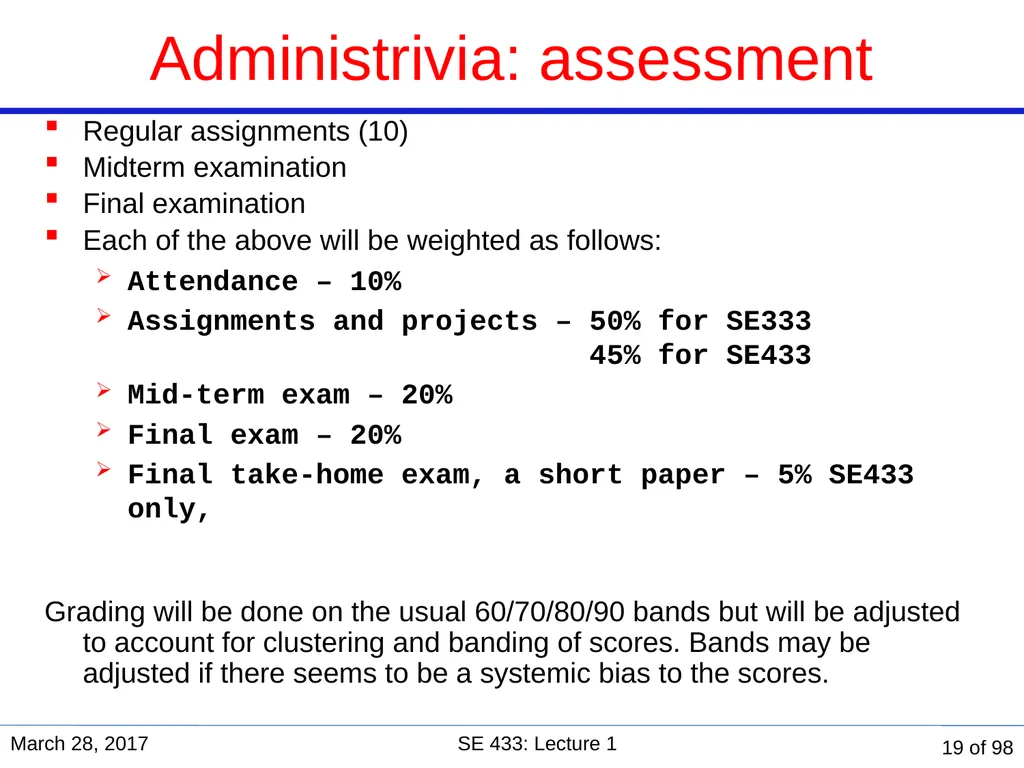
slide19. Administrivia: assessment Regular assignments (10)
Midterm examination
Final examination
Each of the above will be weighted as follows:
Attendance – 10%
Assignments and projects – 50% for SE333 45% for SE433
Mid-term exam – 20%
Final exam – 20%
Final take-home exam, a short paper – 5% SE433 only,
Grading will be done on the usual 60/70/80/90 bands but will be adjusted to account for clustering and banding of scores. Bands may be adjusted if there seems to be a systemic bias to the scores. March 28, 2017 SE 433: Lecture 1 19 of 98<br>
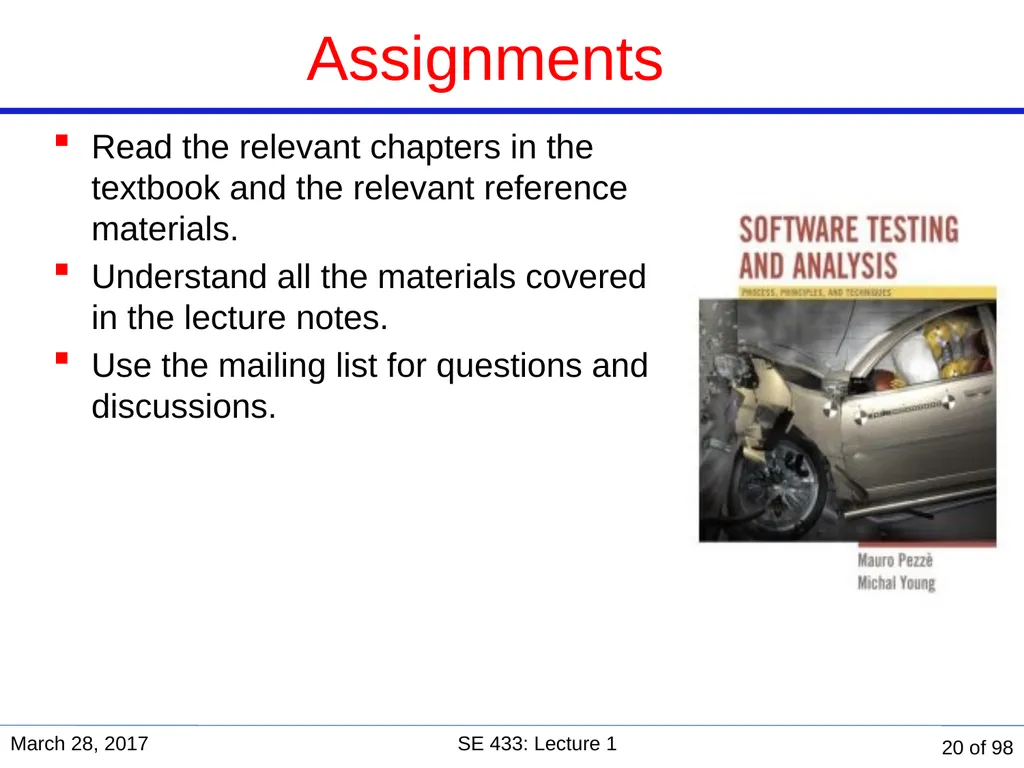
slide20. Assignments Read the relevant chapters in the textbook and the relevant reference materials.
Understand all the materials covered in the lecture notes.
Use the mailing list for questions and discussions. March 28, 2017 SE 433: Lecture 1 20 of 98<br>
slide21. Course Specific Information March 28, 2017 SE 433: Lecture 1 21 of 98<br>
slide22. Prerequisites Data Structures II (CSC 301, 403, 383, 393), or
Object-Oriented Modeling (SE430)
Proficient in programming and data structures
Assignments will use Java
Familiar with object-oriented modeling and principles
Familiar with software development processes March 28, 2017 SE 433: Lecture 1 22 of 98<br>
slide23. Course Objectives Understand how to achieve high quality in software development
Study the processes, techniques, and tools for software testing
Focus on software testing and analysis
basic principles and techniques
underlying theory
organizational and process issues March 28, 2017 SE 433: Lecture 1 23 of 98<br>
slide24. Learning Outcomes Applications of techniques and tools at the module and system levels
Understanding of the techniques, processes, and tools at the project and organization levels
Emphasis
practical techniques to achieve an acceptable level of quality at an acceptable cost.
realistic strategies for reliable and cost-effective software testing. March 28, 2017 SE 433: Lecture 1 24 of 98<br>
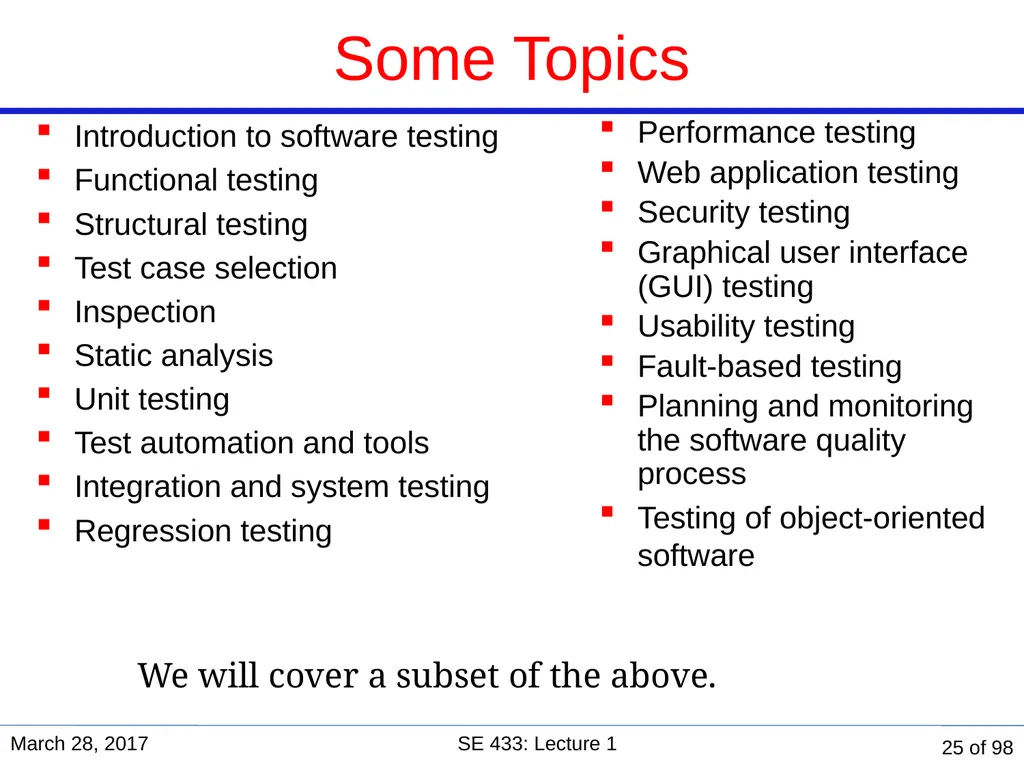
slide25. We will cover a subset of the above. Some Topics Introduction to software testing
Functional testing
Structural testing
Test case selection
Inspection
Static analysis
Unit testing
Test automation and tools
Integration and system testing
Regression testing March 28, 2017 SE 433: Lecture 1 Performance testing
Web application testing
Security testing
Graphical user interface (GUI) testing
Usability testing
Fault-based testing
Planning and monitoring the software quality process
Testing of object-oriented software 25 of 98<br>
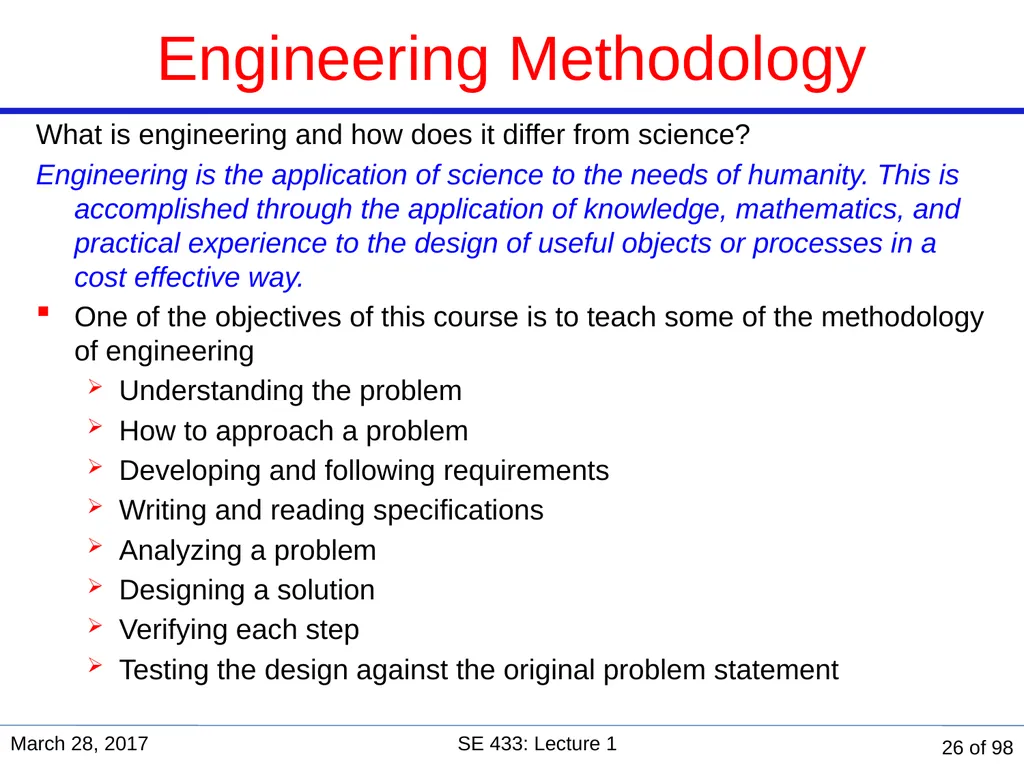
slide26. Engineering Methodology What is engineering and how does it differ from science?
Engineering is the application of science to the needs of humanity. This is accomplished through the application of knowledge, mathematics, and practical experience to the design of useful objects or processes in a cost effective way.
One of the objectives of this course is to teach some of the methodology of engineering
Understanding the problem
How to approach a problem
Developing and following requirements
Writing and reading specifications
Analyzing a problem
Designing a solution
Verifying each step
Testing the design against the original problem statement March 28, 2017 SE 433: Lecture 1 26 of 98<br>
slide27. Surviving SE433 Make sure you read things, sometimes more than once. People do not seem to read assignments and web pages (or do not follow instructions).
The pace is quick. The intent of the course is to learn by doing, not by reading; but there is a lot of information to process.
Read the assignments carefully. Note special requirements, such as formats and use of predefined templates!
Start your assignments right after they are handed out (assigned). They will take some time and starting on the night before it is due is not a good strategy.
Reading list:
Is it required? No.
Is it useful? Yes, especially if you are serious about a career in software development.
The articles are usually short but informative. Most are supplemental – useful for understanding but the notes cover the major points.
Reading should be done in parallel with the lectures.
Pace yourself. Remember: “This too shall pass.” March 28, 2017 SE 433: Lecture 1 27 of 98<br>
slide28. SE 433 – Class 1 Topics: Introduction and Overview:
Class Logistics and Administrivia;
Introduction to Software Testing
Reading
Pezze and Young: Chapters 1-4 March 28, 2017 SE 433: Lecture 1 28 of 98<br>
slide29. Thought for the Day Software Testing takes at least twice as long as estimated. March 28, 2017 SE 433: Lecture 1 29 of 98<br>
slide30. On Testing For the Snark’s a peculiar creature, that won’t
Be caught in a commonplace way.
Do all that you know, and try all that you don’t:
Not a chance must be wasted to-day!
— Lewis Carroll
The Hunting of the Snark,
an Agony in Eight Fits (1876) March 28, 2017 SE 433: Lecture 1 30 of 98<br>
slide31. Why Programs fail In Federalist 51, James Madison wrote: “If men were angels, no government would be necessary.”
If he lived today, Madison might have written: “If software developers were angels, debugging would be unnecessary.” March 28, 2017 SE 433: Lecture 1 31 of 98<br>
slide32. Why Programs fail Congratulations!
Your code is complete. It compiles. It runs …
Your program fails. How can this be?
There is a defect in the code. When the code is executed, the defect causes bad behavior, which later becomes visible as a failure.
Before a program can be debugged, we must set it up such that it can be tested — that is, executed with the intent to make it fail.
The first step in debugging is to reproduce the problem in question — that is, to create a test case that causes the program to fail in the specified way.
The first reason is to bring it under control, such that it can be observed.
The second reason is to verify the success of the fix.
Now you will have the fun of testing and debugging! March 28, 2017 SE 433: Lecture 1 32 of 98<br>
slide33. Myth Busters Software Testing March 28, 2017 SE 433: Lecture 1 33 of 98<br>
slide34. Myth #1 in Software Testing Q: What is the objective of software testing?
A: Testing is to show that there are no
errors/bugs/defects in the software. March 28, 2017 SE 433: Lecture 1 34 of 98<br>
slide35. Myth #1 in Software Testing Q: What is the objective of software testing?
A: Testing is to show that there are no
errors/bugs/defects in the software. Fact:
No!! The main objective of testing is to discover defects.
Testing is a destructive activity. March 28, 2017 SE 433: Lecture 1 35 of 98<br>
slide36. Myth #2 in Software Testing Q: What is the objective of software testing?
A: Testing is to ensure that the software does what it is supposed to do. March 28, 2017 SE 433: Lecture 1 36 of 98<br>
slide37. Myth #2 in Software Testing Q: What is the objective of software testing?
A: Testing is to ensure that the software does what it is supposed to do. Fact:
Only partly true.
Testing is also to ensure the software does not do what it is not supposed to do. March 28, 2017 SE 433: Lecture 1 37 of 98<br>
slide38. Myth #3 in Software Testing Q: How challenging is software testing?
A: Testing is easier than design and
implementation. March 28, 2017 SE 433: Lecture 1 38 of 98<br>
slide39. Myth #3 in Software Testing Q: How challenging is software testing?
A: Testing is easier than design and
implementation. Fact:
Must consider all possible scenarios.
Implied and unstated requirements and threats.
Must be imaginative and creative. March 28, 2017 SE 433: Lecture 1 39 of 98<br>
slide40. Myth #4 in Software Testing Q: How challenging is software testing?
A: Testing is an extremely creative and
intellectually challenging task. March 28, 2017 SE 433: Lecture 1 40 of 98<br>
slide41. Myth #4 in Software Testing Q: How challenging is software testing?
A: Testing is an extremely creative and
intellectually challenging task. March 28, 2017 SE 433: Lecture 1 41 of 98<br>
slide42. What is Software Testing ? Software testing is the process of executing a program with the intent of finding bugs. March 28, 2017 SE 433: Lecture 1 42 of 98<br>
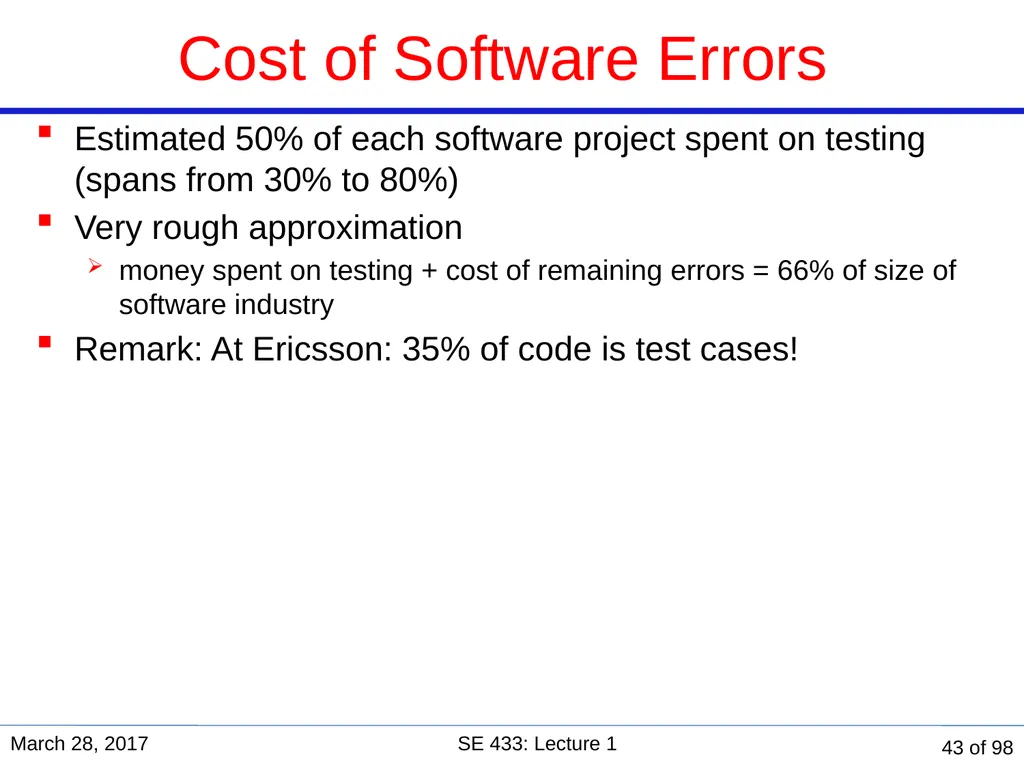
slide43. Cost of Software Errors Estimated 50% of each software project spent on testing (spans from 30% to 80%)
Very rough approximation
money spent on testing + cost of remaining errors = 66% of size of software industry
Remark: At Ericsson: 35% of code is test cases! March 28, 2017 SE 433: Lecture 1 43 of 98<br>
slide44. Failure and Specification Some failures are obvious
obviously wrong output/behavior
non-termination
Crash
freeze
...but most are not!
In general, what constitutes a failure, is defined by a specification!
Correctness is a relative notion
— B. Meyer, 1997 March 28, 2017 SE 433: Lecture 1 44 of 98<br>
slide45. Why Does Software Testing Matter? March 28, 2017 SE 433: Lecture 1 45 of 98<br>
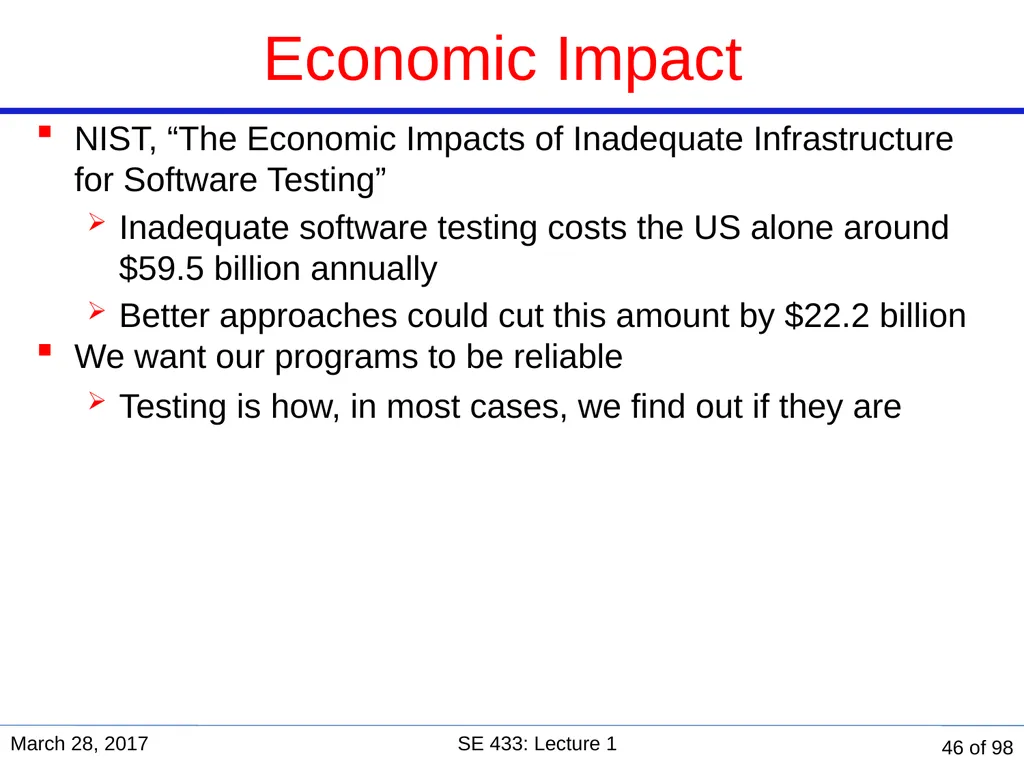
slide46. Economic Impact NIST, “The Economic Impacts of Inadequate Infrastructure for Software Testing”
Inadequate software testing costs the US alone around $59.5 billion annually
Better approaches could cut this amount by $22.2 billion
We want our programs to be reliable
Testing is how, in most cases, we find out if they are March 28, 2017 SE 433: Lecture 1 46 of 98<br>
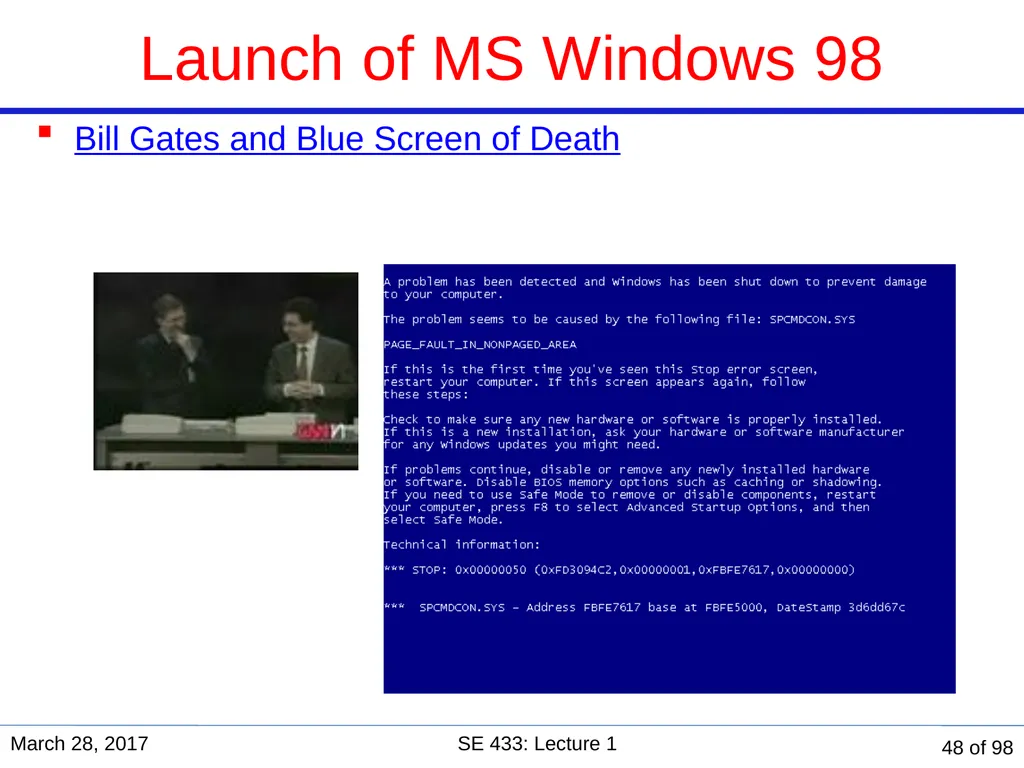
slide47. Launch of MS Windows 98 Bill Gates and Blue Screen of Death March 28, 2017 SE 433: Lecture 1 47 of 98<br>
slide48. Launch of MS Windows 98 Bill Gates and Blue Screen of Death March 28, 2017 SE 433: Lecture 1 48 of 98<br>
slide49. Why Do We Test? Testing is expensive.
So are failures!
What do we gain from that cost?
Finding bugs
Leading to
Fixing bugs
Raising the quality of the program or system we are testing March 28, 2017 SE 433: Lecture 1 49 of 98<br>
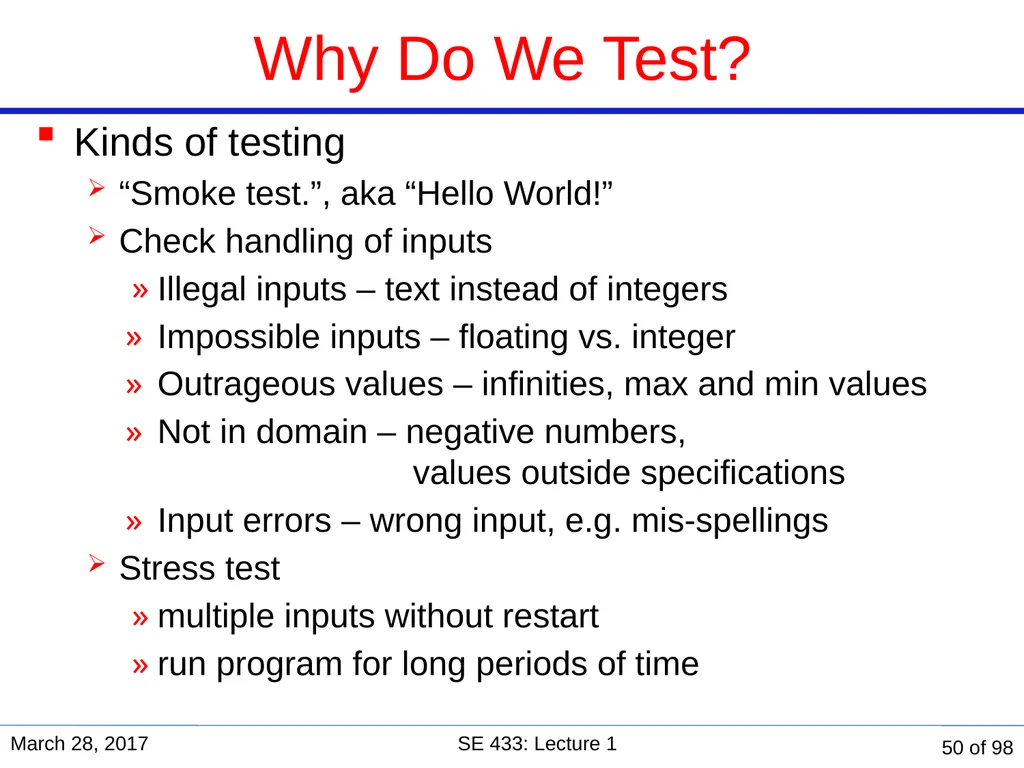
slide50. Why Do We Test? Kinds of testing
“Smoke test.”, aka “Hello World!”
Check handling of inputs
Illegal inputs – text instead of integers
Impossible inputs – floating vs. integer
Outrageous values – infinities, max and min values
Not in domain – negative numbers, values outside specifications
Input errors – wrong input, e.g. mis-spellings
Stress test
multiple inputs without restart
run program for long periods of time March 28, 2017 SE 433: Lecture 1 50 of 98<br>
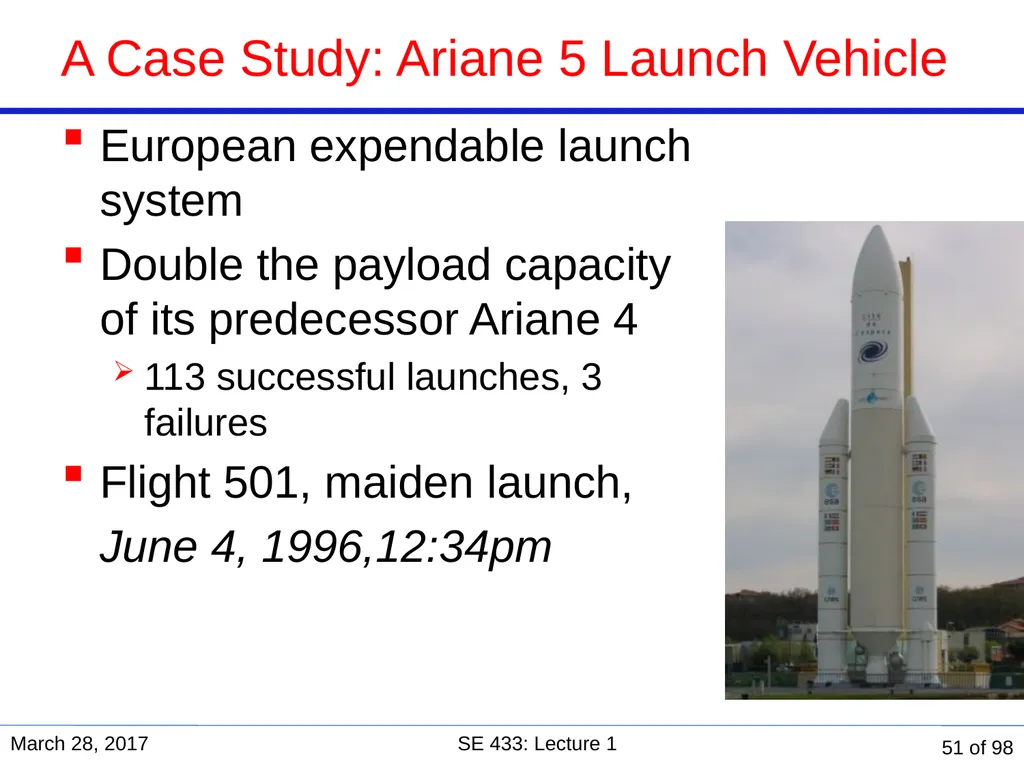
slide51. A Case Study: Ariane 5 Launch Vehicle European expendable launch system
Double the payload capacity of its predecessor Ariane 4
113 successful launches, 3 failures
Flight 501, maiden launch,
June 4, 1996,12:34pm March 28, 2017 SE 433: Lecture 1 51 of 98<br>
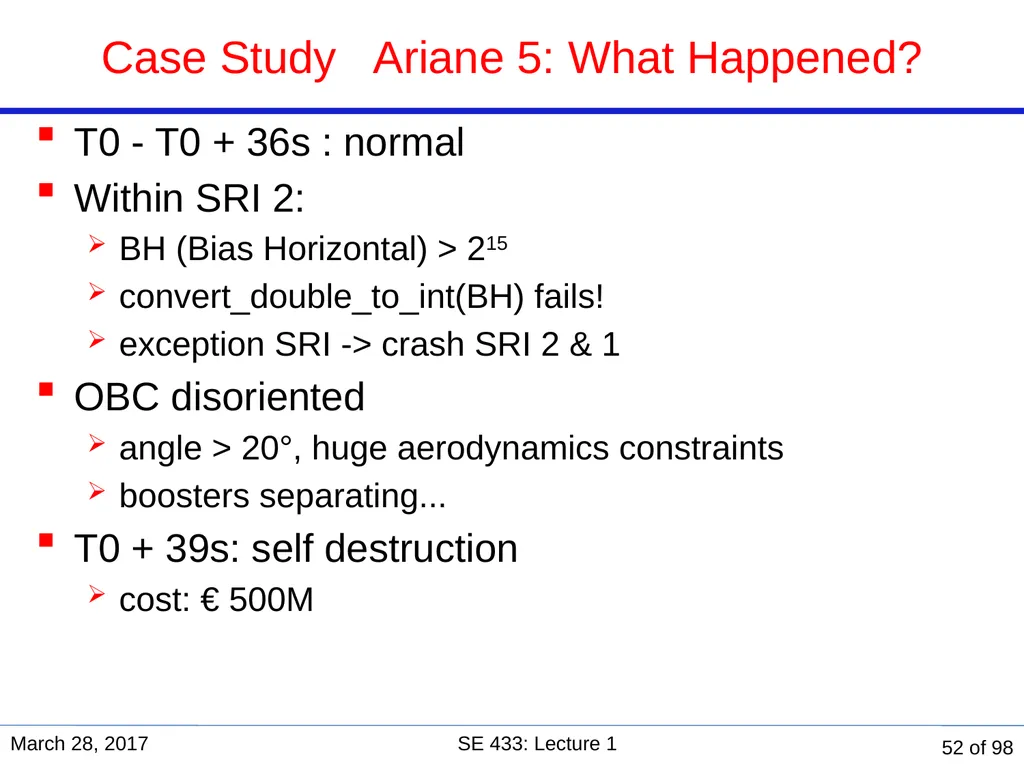
slide52. Case Study Ariane 5: What Happened? T0 - T0 + 36s : normal
Within SRI 2:
BH (Bias Horizontal) > 215
convert_double_to_int(BH) fails!
exception SRI -> crash SRI 2 & 1
OBC disoriented
angle > 20°, huge aerodynamics constraints
boosters separating...
T0 + 39s: self destruction
cost: € 500M March 28, 2017 SE 433: Lecture 1 52 of 98<br>
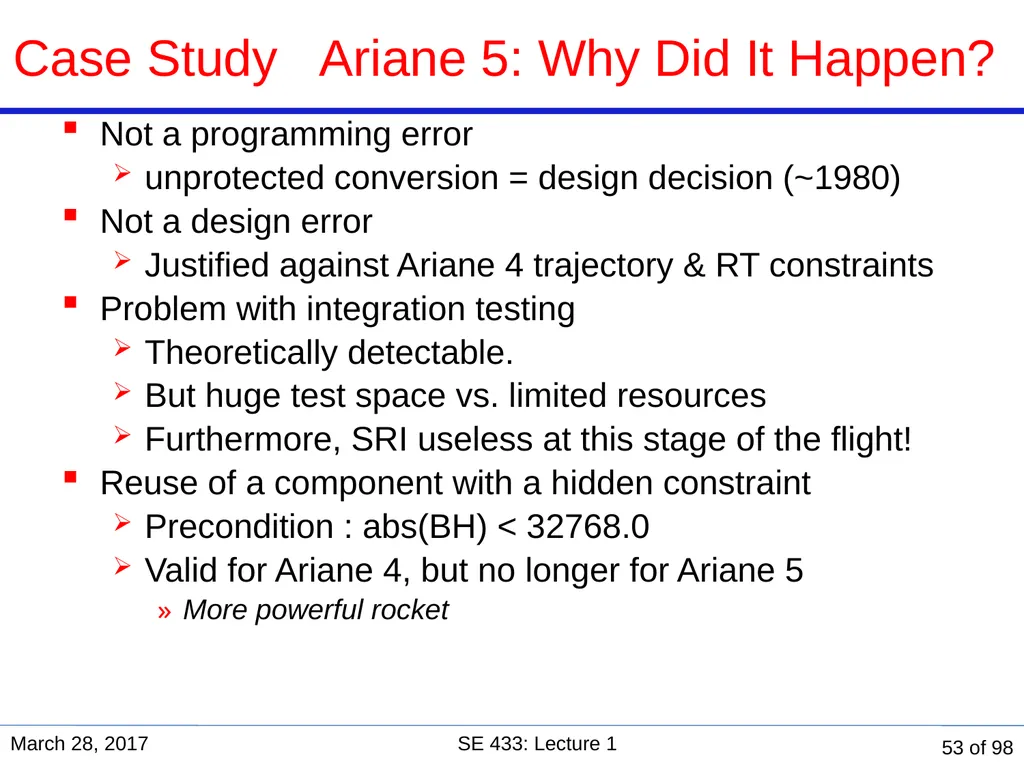
slide53. Case Study Ariane 5: Why Did It Happen? Not a programming error
unprotected conversion = design decision (~1980)
Not a design error
Justified against Ariane 4 trajectory & RT constraints
Problem with integration testing
Theoretically detectable.
But huge test space vs. limited resources
Furthermore, SRI useless at this stage of the flight!
Reuse of a component with a hidden constraint
Precondition : abs(BH) < 32768.0
Valid for Ariane 4, but no longer for Ariane 5
More powerful rocket March 28, 2017 SE 433: Lecture 1 53 of 98<br>
slide54. Case Study Ariane 5: Lessons Learned in Software Eng. Test! Test! Test!
Test! Even when the code is reused.
When reuse, ensure the assumptions are still valid.
When write reusable code, document the assumptions.
Write fail-safe code.
Do not propagate errors. March 28, 2017 SE 433: Lecture 1 54 of 98<br>
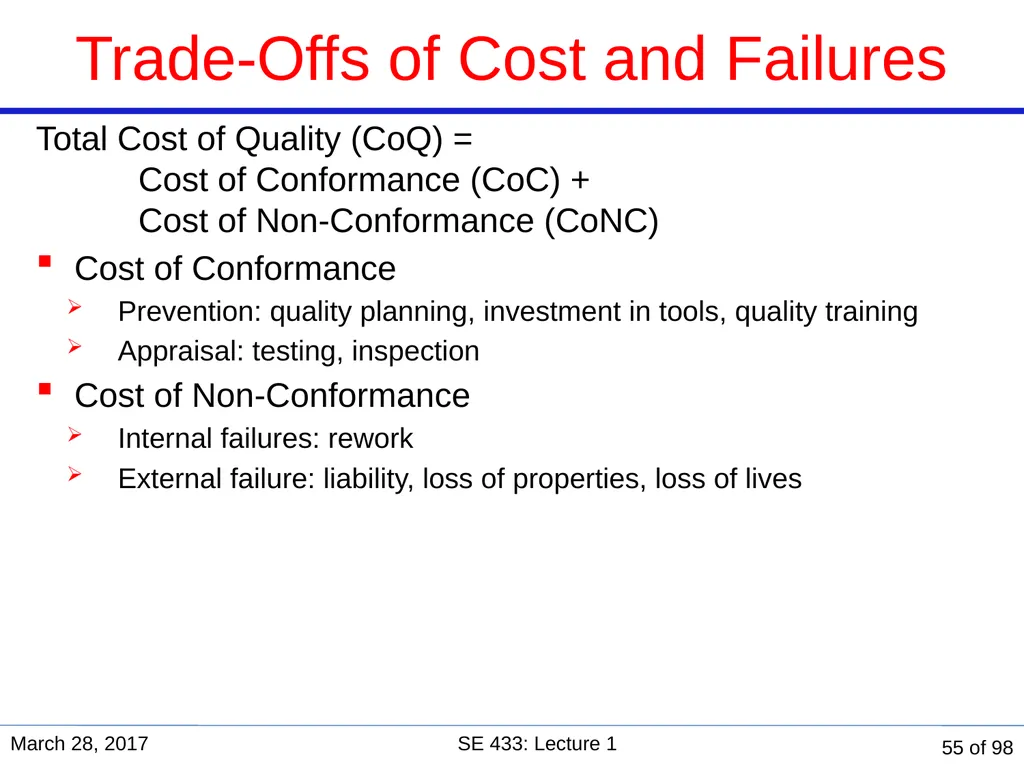
slide55. Trade-Offs of Cost and Failures Total Cost of Quality (CoQ) = Cost of Conformance (CoC) + Cost of Non-Conformance (CoNC)
Cost of Conformance
Prevention: quality planning, investment in tools, quality training
Appraisal: testing, inspection
Cost of Non-Conformance
Internal failures: rework
External failure: liability, loss of properties, loss of lives March 28, 2017 SE 433: Lecture 1 55 of 98<br>
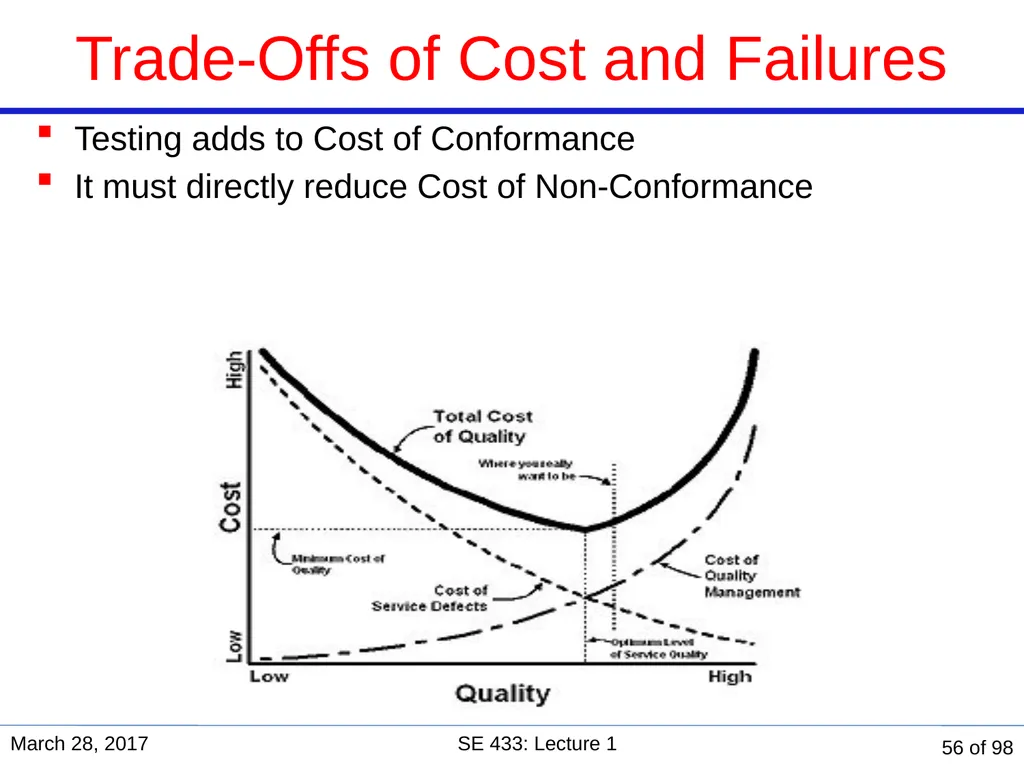
slide56. Trade-Offs of Cost and Failures Testing adds to Cost of Conformance
It must directly reduce Cost of Non-Conformance March 28, 2017 SE 433: Lecture 1 56 of 98<br>
slide57. A Self Assessment Test March 28, 2017 SE 433: Lecture 1 57 of 98<br>
slide58. Test the Following Program The program reads in 3 integer values that represent the lengths of the sides of a triangle.
The program prints a message that states whether the triangle is
Equilateral (all 3 sides are equal)
Isosceles (exactly 2 of the 3 sides are equal)
Scalene (all 3 sides are of a different length)
Write a set of test cases that you feel would adequately test this program. March 28, 2017 SE 433: Lecture 1 58 of 98<br>
slide59. How Did You Do?<br>
slide60. Test the Following Program Write a set of test cases that you feel would adequately test this program.
How many cases are needed (look back at slide 50)?
How do you plan to test the program.
Run it many times with different inputs.
Once and manually enter the values.
A file with a set of lines with test values. March 28, 2017 SE 433: Lecture 1 60 of 98<br>
slide61. Assignment Assignment 1 Part I due April 4, 2017
Part I: Write a Java program to determine types of triangles.
The program reads 3 integer numbers from the standard input. The numbers represent the lengths of the sides of a triangle. The program prints a message to the standard output that indicates whether the triangle represented by the input is
an equilateral (all 3 sides are equal), or
an isosceles (exactly 2 of the 3 sides are equal), or
a scalene (all 3 sides are of different lengths)
The program should print out appropriate messages when an erroneous input or condition is encountered.
Submission: The source code (i.e., the .java file) of your program.
Hint: Your program must read the numbers from the standard input, or a file fed to the standard input. One way to do this is to use the java.util.Scanner class.
Part II: Due date: April 11, 2017, Design a test suite to thoroughly test your program. And, Test it. March 28, 2017 SE 433: Lecture 1 61 of 98<br>
slide62. Software Testing Terminologies March 28, 2017 SE 433: Lecture 1 62 of 98<br>
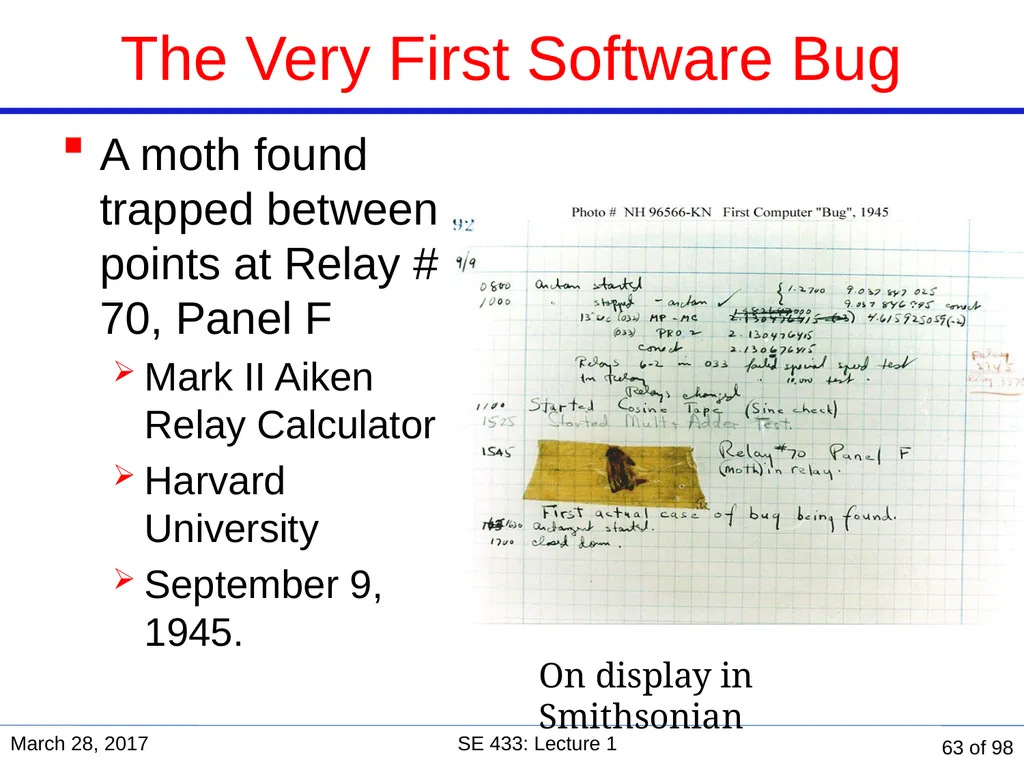
slide63. The Very First Software Bug A moth found trapped between points at Relay # 70, Panel F
Mark II Aiken Relay Calculator
Harvard University
September 9, 1945. On display in Smithsonian March 28, 2017 SE 433: Lecture 1 63 of 98<br>
slide64. Failures Failures are
deviation of the observed behavior of a system from its specification, i.e., its expected behavior.
Failures can only be determined with respect to the specifications.
Failures are concerned with the observed behavior and outcome of the system. March 28, 2017 SE 433: Lecture 1 64 of 98<br>
slide65. Defects Defects are
flaws in a system that can cause the system to fail to perform its required function
e.g. an incorrect condition or statement.
Defects are concerned with specific parts or components of the system.
Defects are synonymous with faults, bugs. March 28, 2017 SE 433: Lecture 1 65 of 98<br>
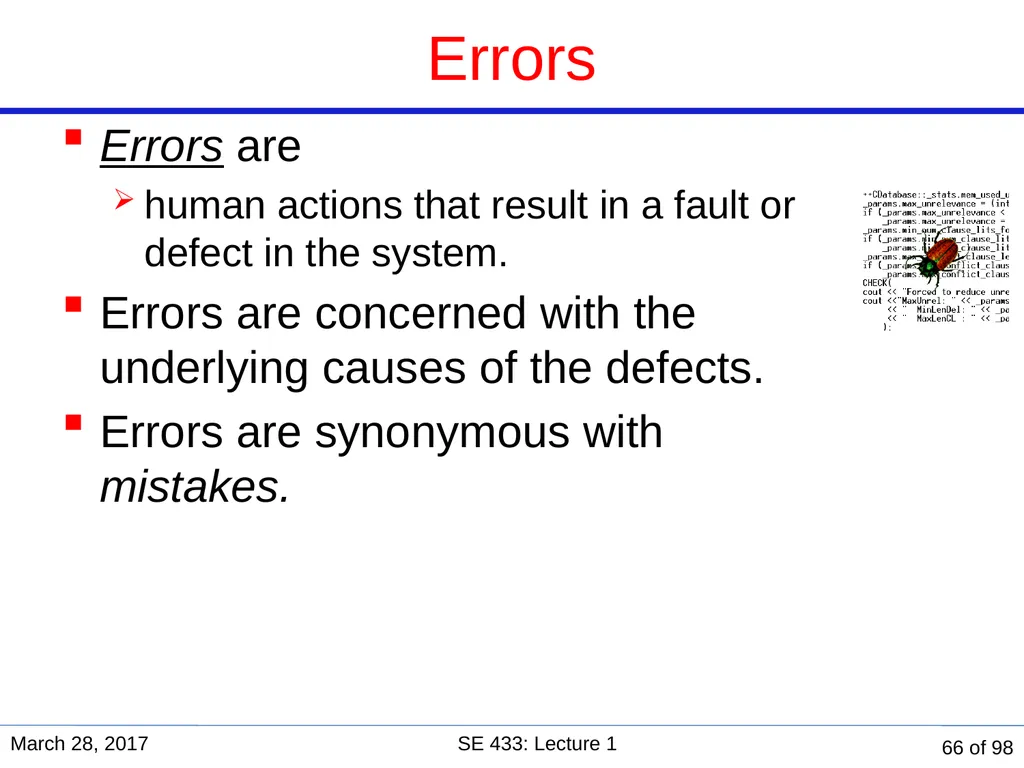
slide66. Errors Errors are
human actions that result in a fault or defect in the system.
Errors are concerned with the underlying causes of the defects.
Errors are synonymous with mistakes. March 28, 2017 SE 433: Lecture 1 66 of 98<br>
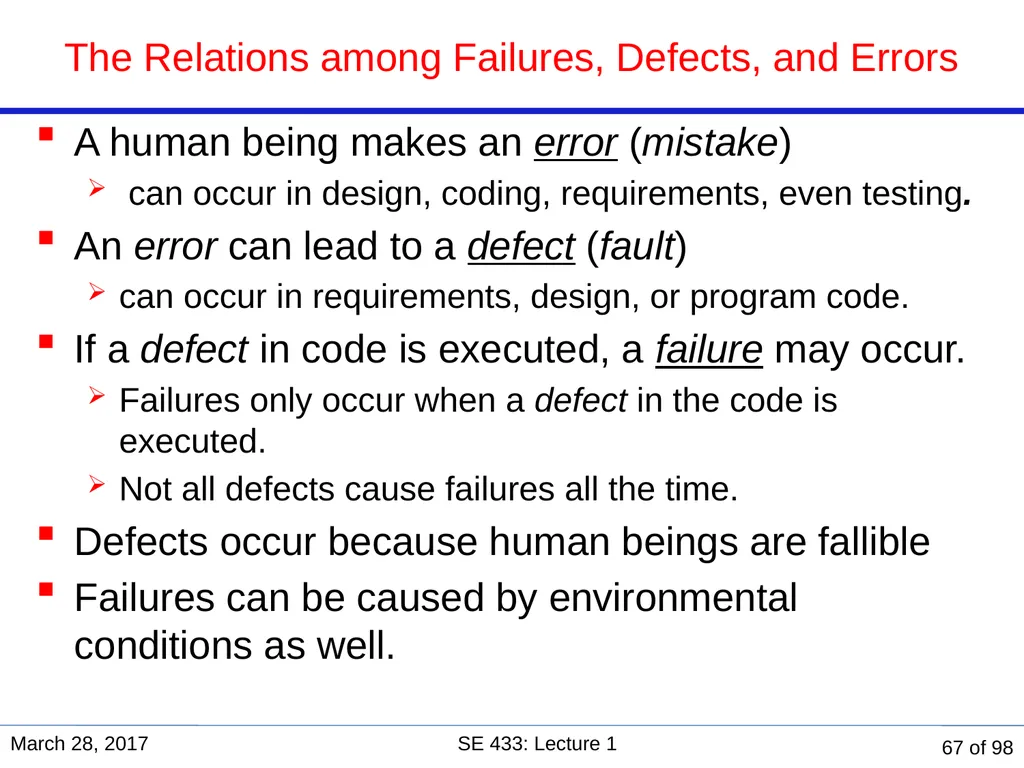
slide67. The Relations among Failures, Defects, and Errors A human being makes an error (mistake)
can occur in design, coding, requirements, even testing.
An error can lead to a defect (fault)
can occur in requirements, design, or program code.
If a defect in code is executed, a failure may occur.
Failures only occur when a defect in the code is executed.
Not all defects cause failures all the time.
Defects occur because human beings are fallible
Failures can be caused by environmental conditions as well. March 28, 2017 SE 433: Lecture 1 67 of 98<br>
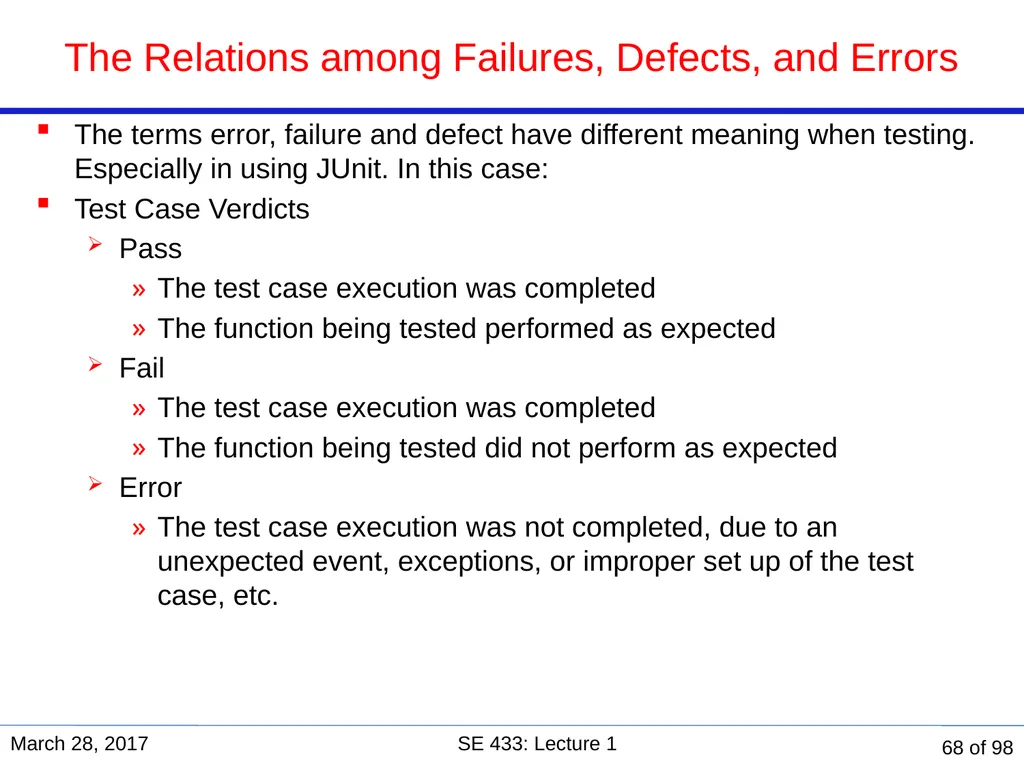
slide68. The Relations among Failures, Defects, and Errors The terms error, failure and defect have different meaning when testing. Especially in using JUnit. In this case:
Test Case Verdicts
Pass
The test case execution was completed
The function being tested performed as expected
Fail
The test case execution was completed
The function being tested did not perform as expected
Error
The test case execution was not completed, due to an unexpected event, exceptions, or improper set up of the test case, etc. March 28, 2017 SE 433: Lecture 1 68 of 98<br>
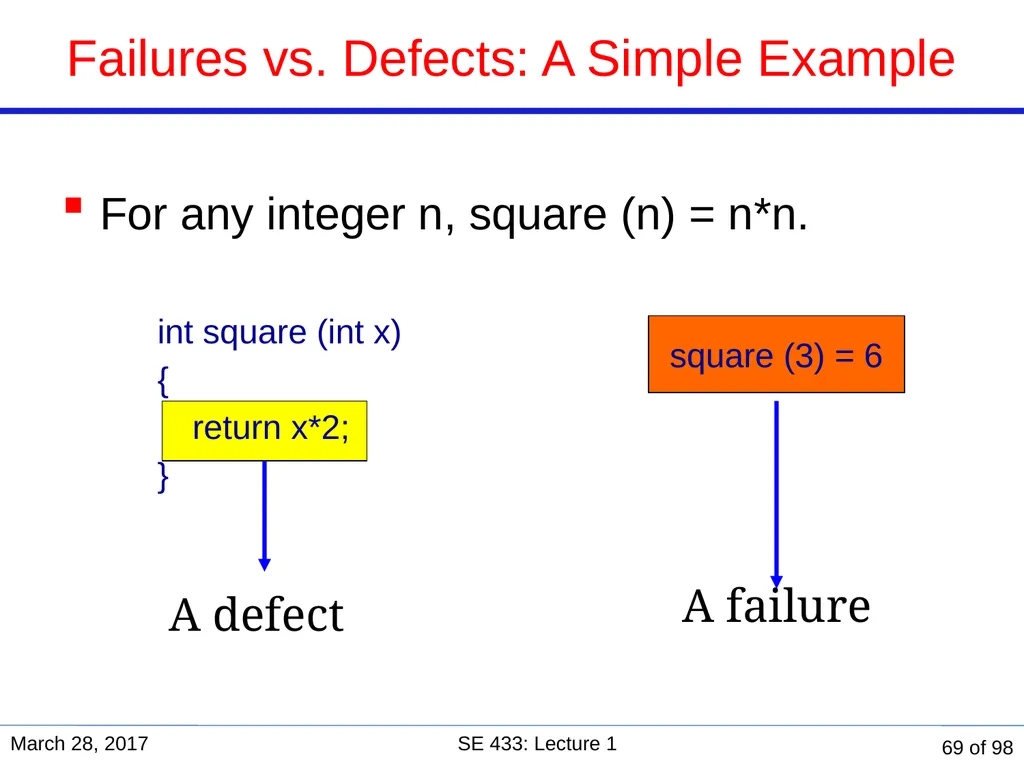
slide69. Failures vs. Defects: A Simple Example For any integer n, square (n) = n*n.
int square (int x)
{
return x*2;
} square (3) = 6 A failure A defect March 28, 2017 SE 433: Lecture 1 69 of 98<br>
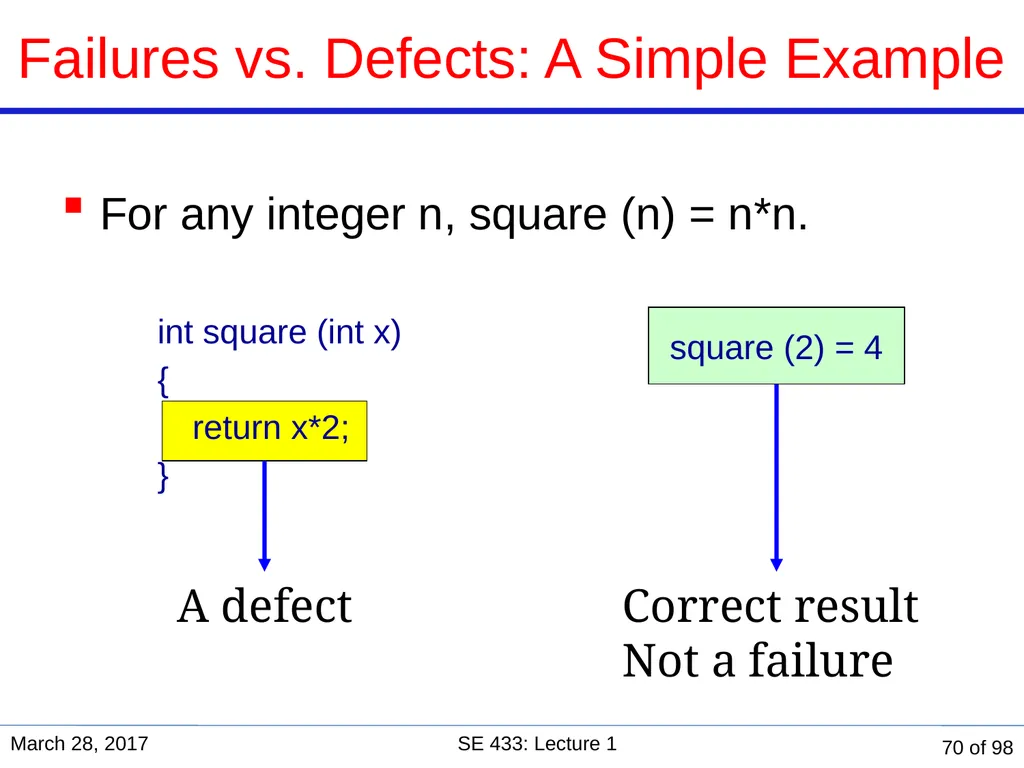
slide70. Failures vs. Defects: A Simple Example For any integer n, square (n) = n*n.
int square (int x)
{
return x*2;
} Correct result
Not a failure A defect square (2) = 4 March 28, 2017 SE 433: Lecture 1 70 of 98<br>
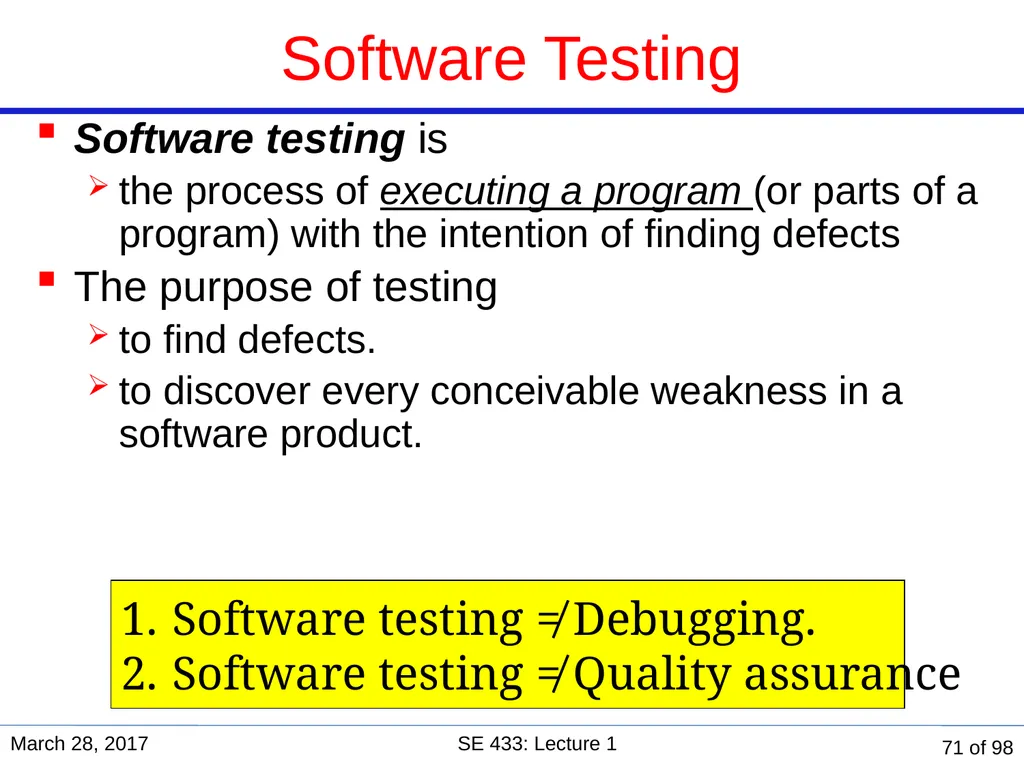
slide71. Software Testing Software testing is
the process of executing a program (or parts of a program) with the intention of finding defects
The purpose of testing
to find defects.
to discover every conceivable weakness in a software product. Software testing ≠ Debugging.
Software testing ≠ Quality assurance March 28, 2017 SE 433: Lecture 1 71 of 98<br>
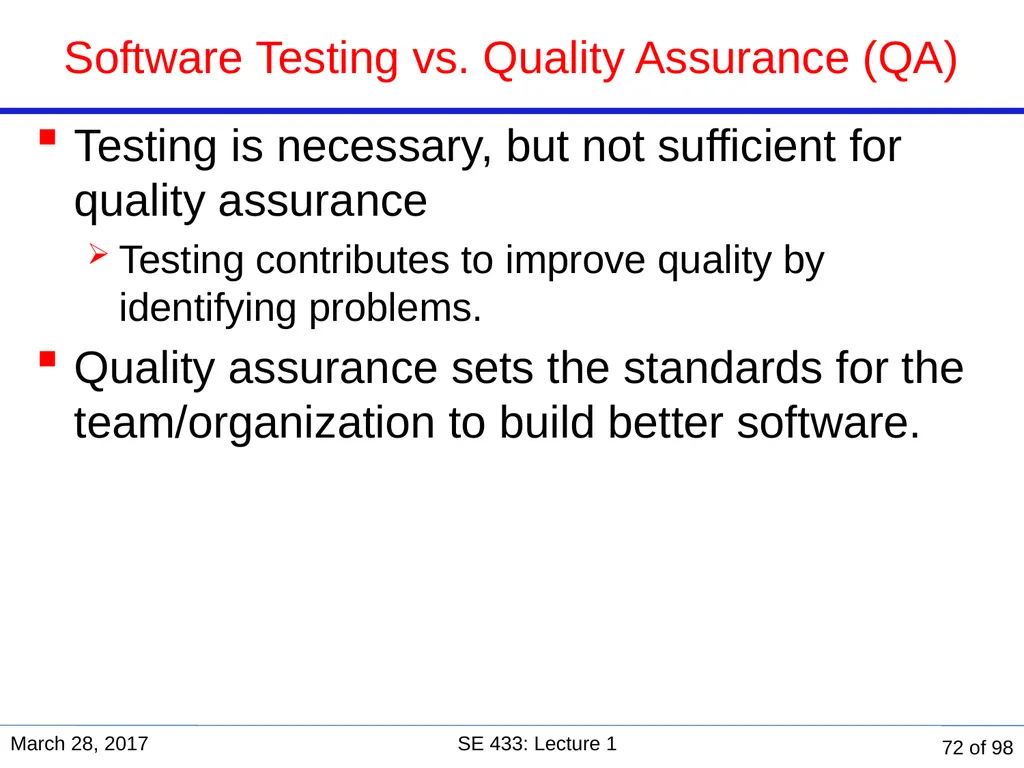
slide72. Software Testing vs. Quality Assurance (QA) Testing is necessary, but not sufficient for quality assurance
Testing contributes to improve quality by identifying problems.
Quality assurance sets the standards for the team/organization to build better software. March 28, 2017 SE 433: Lecture 1 72 of 98<br>
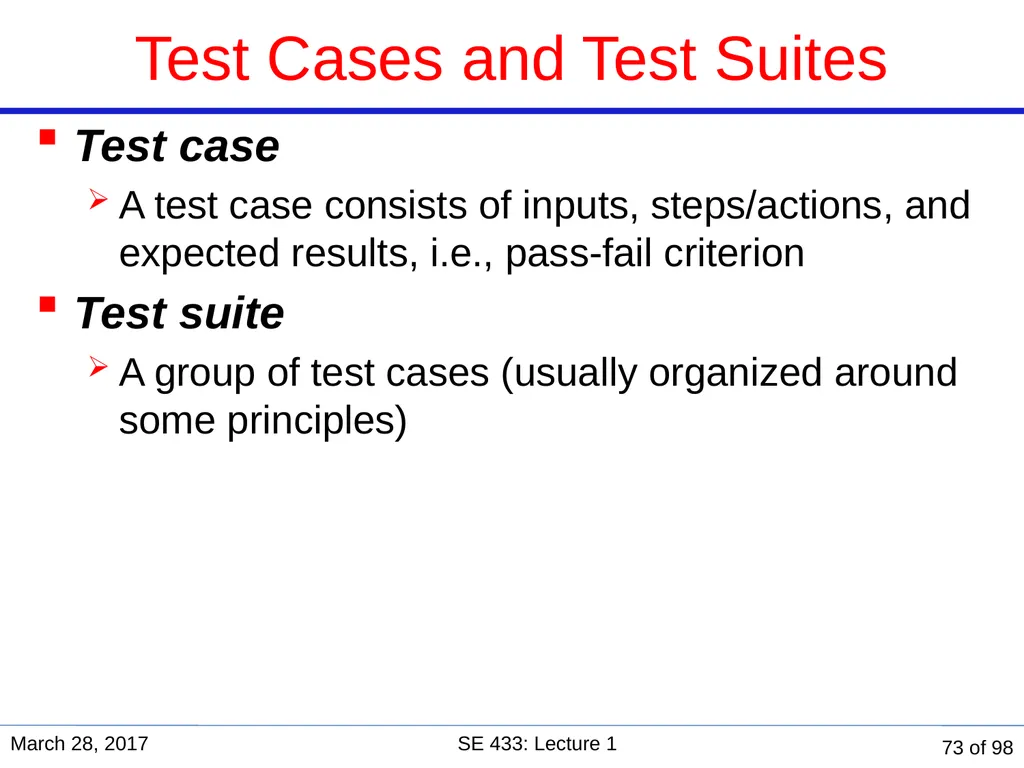
slide73. Test Cases and Test Suites Test case
A test case consists of inputs, steps/actions, and expected results, i.e., pass-fail criterion
Test suite
A group of test cases (usually organized around some principles) March 28, 2017 SE 433: Lecture 1 73 of 98<br>
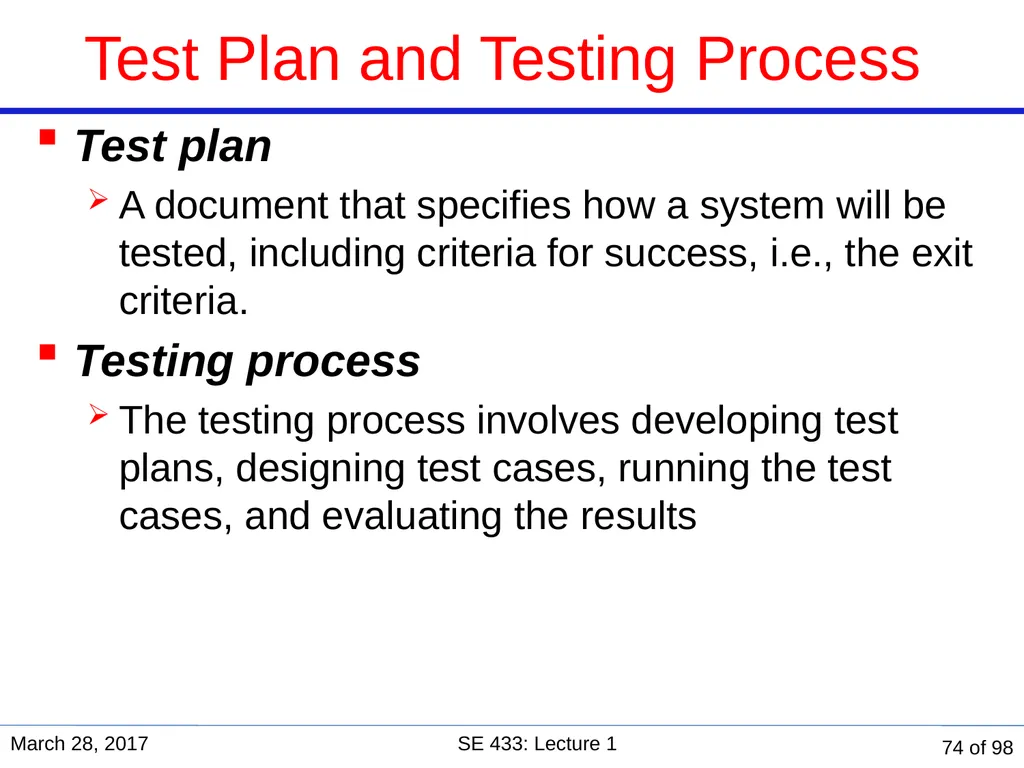
slide74. Test Plan and Testing Process Test plan
A document that specifies how a system will be tested, including criteria for success, i.e., the exit criteria.
Testing process
The testing process involves developing test plans, designing test cases, running the test cases, and evaluating the results March 28, 2017 SE 433: Lecture 1 74 of 98<br>
slide75. Techniques for Software Testing March 28, 2017 SE 433: Lecture 1 75 of 98<br>
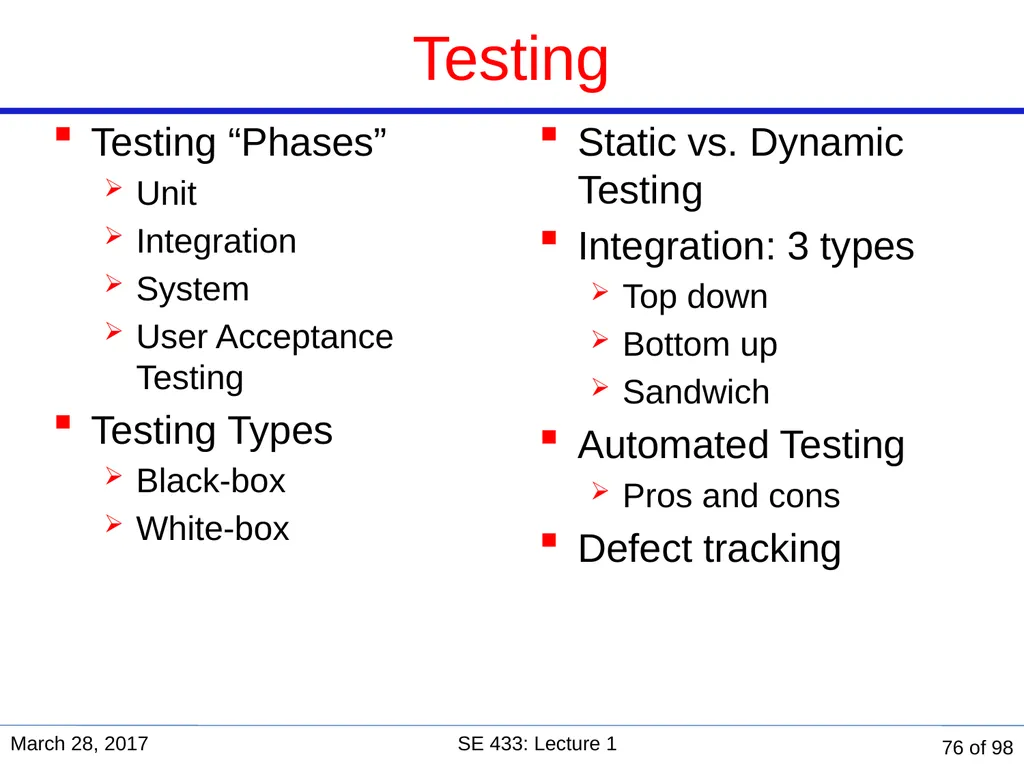
slide76. Testing Testing “Phases”
Unit
Integration
System
User Acceptance Testing
Testing Types
Black-box
White-box Static vs. Dynamic Testing
Integration: 3 types
Top down
Bottom up
Sandwich
Automated Testing
Pros and cons
Defect tracking March 28, 2017 SE 433: Lecture 1 76 of 98<br>
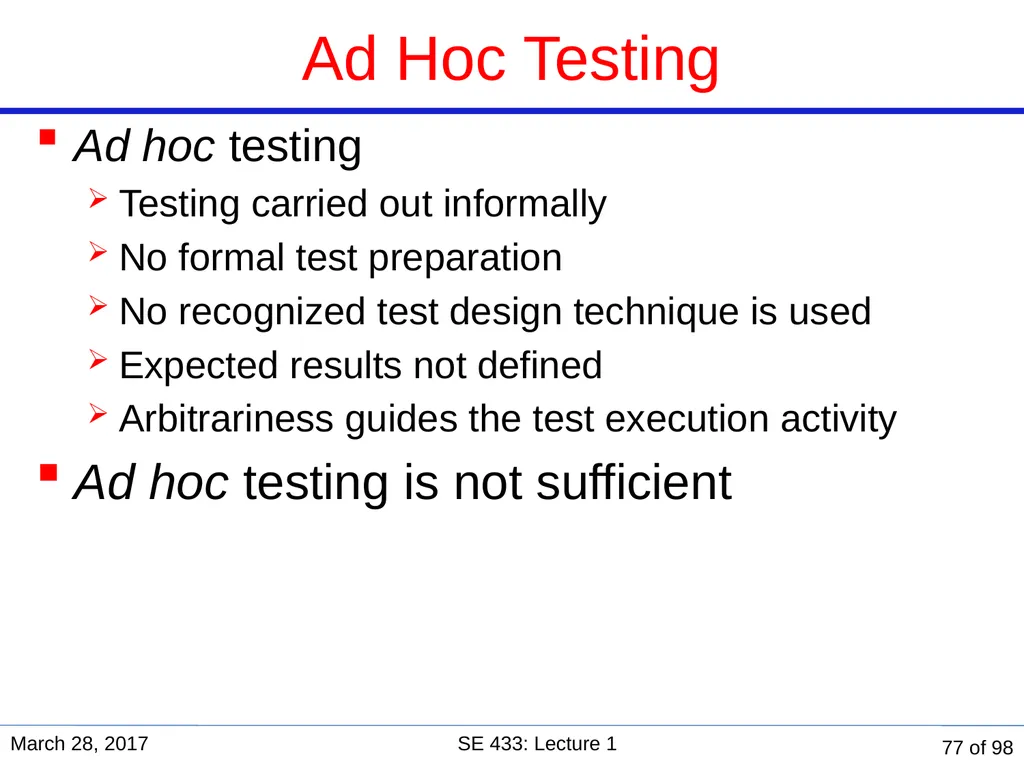
slide77. Ad Hoc Testing Ad hoc testing
Testing carried out informally
No formal test preparation
No recognized test design technique is used
Expected results not defined
Arbitrariness guides the test execution activity
Ad hoc testing is not sufficient March 28, 2017 SE 433: Lecture 1 77 of 98<br>
slide78. Black Box Testing Treats a program or system as a black box
Design test cases without the knowledge of internal structure and design of the system
Design test cases based on the functional requirements of the system
a.k.a: functional testing
Send the system inputs, observe the outputs, decide if the system passed or failed the test
Sometimes you don’t have access to source code March 28, 2017 SE 433: Lecture 1 78 of 98<br>
slide79. White Box Testing Open up the box!
a.k.a: glass box, clear box, or structural testing
Design test cases by examining the internal design and source code of the program
Require detailed knowledge of its structure
Introduce the idea of measuring coverage:
How adequate, or thorough, is the test suite? March 28, 2017 SE 433: Lecture 1 79 of 98<br>
slide80. Software Analysis Software analysis is
the process of finding defects in a program (or parts of a program) without executing the program.
a.k.a. static analysis
Complementary to software testing
Same purpose, different techniques
Software analysis can be
automated, i.e., using tools, static analyzers
manual, e.g., inspection, code review March 28, 2017 SE 433: Lecture 1 80 of 98<br>
slide81. Basic Principles of Software Testing March 28, 2017 SE 433: Lecture 1 81 of 98<br>
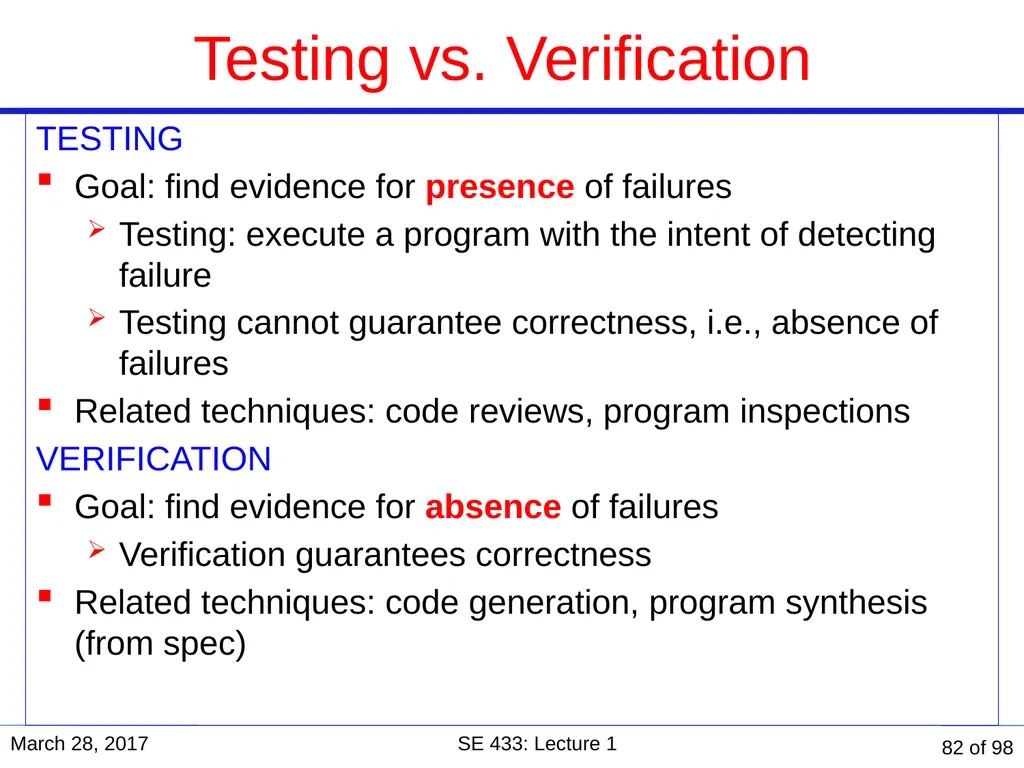
slide82. Testing vs. Verification TESTING
Goal: find evidence for presence of failures
Testing: execute a program with the intent of detecting failure
Testing cannot guarantee correctness, i.e., absence of failures
Related techniques: code reviews, program inspections
VERIFICATION
Goal: find evidence for absence of failures
Verification guarantees correctness
Related techniques: code generation, program synthesis (from spec) March 28, 2017 SE 433: Lecture 1 82 of 98<br>
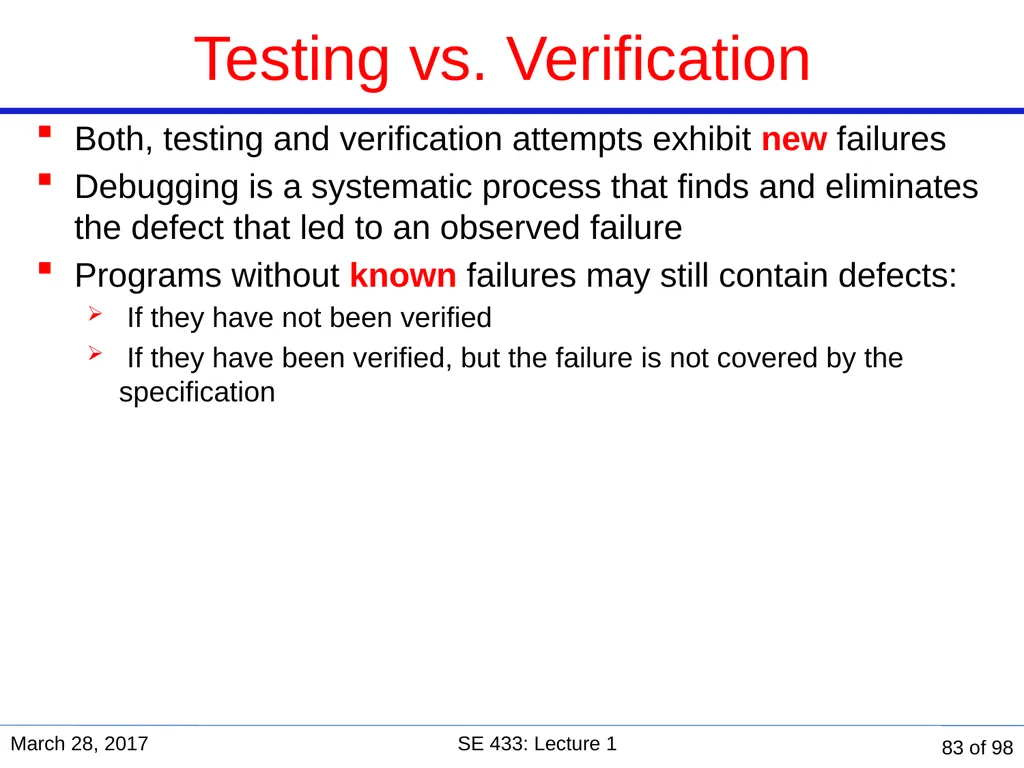
slide83. Testing vs. Verification Both, testing and verification attempts exhibit new failures
Debugging is a systematic process that finds and eliminates the defect that led to an observed failure
Programs without known failures may still contain defects:
If they have not been verified
If they have been verified, but the failure is not covered by the specification March 28, 2017 SE 433: Lecture 1 83 of 98<br>
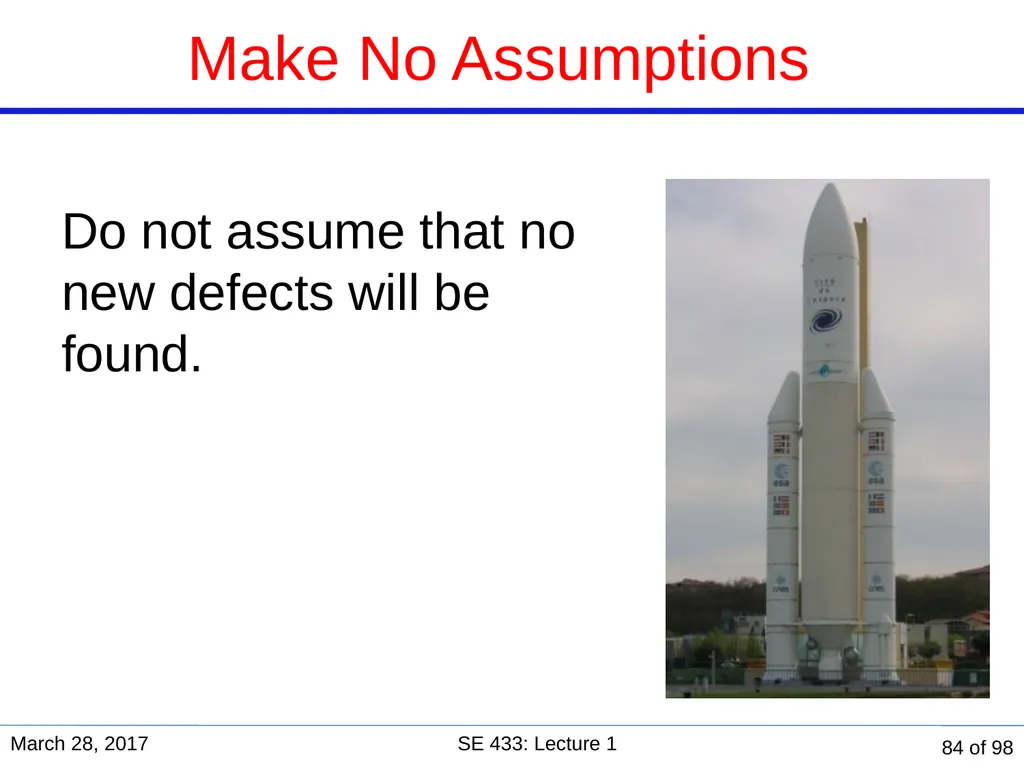
slide84. Make No Assumptions Do not assume that no new defects will be found. March 28, 2017 SE 433: Lecture 1 84 of 98<br>
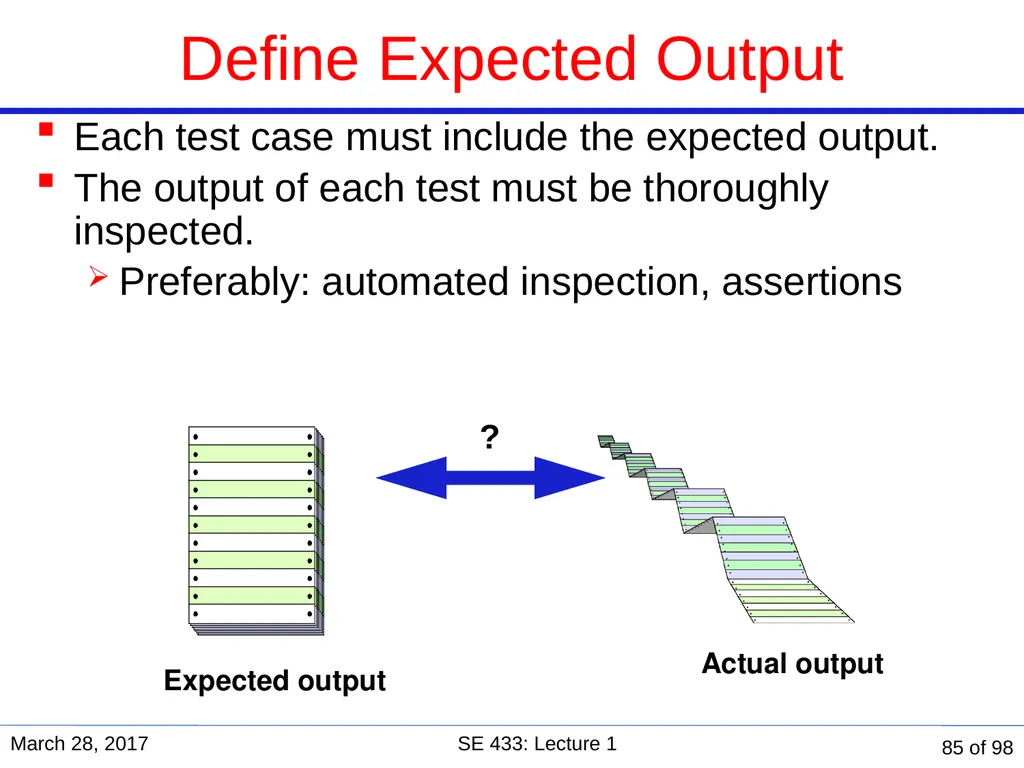
slide85. Define Expected Output Each test case must include the expected output.
The output of each test must be thoroughly inspected.
Preferably: automated inspection, assertions March 28, 2017 SE 433: Lecture 1 85 of 98<br>
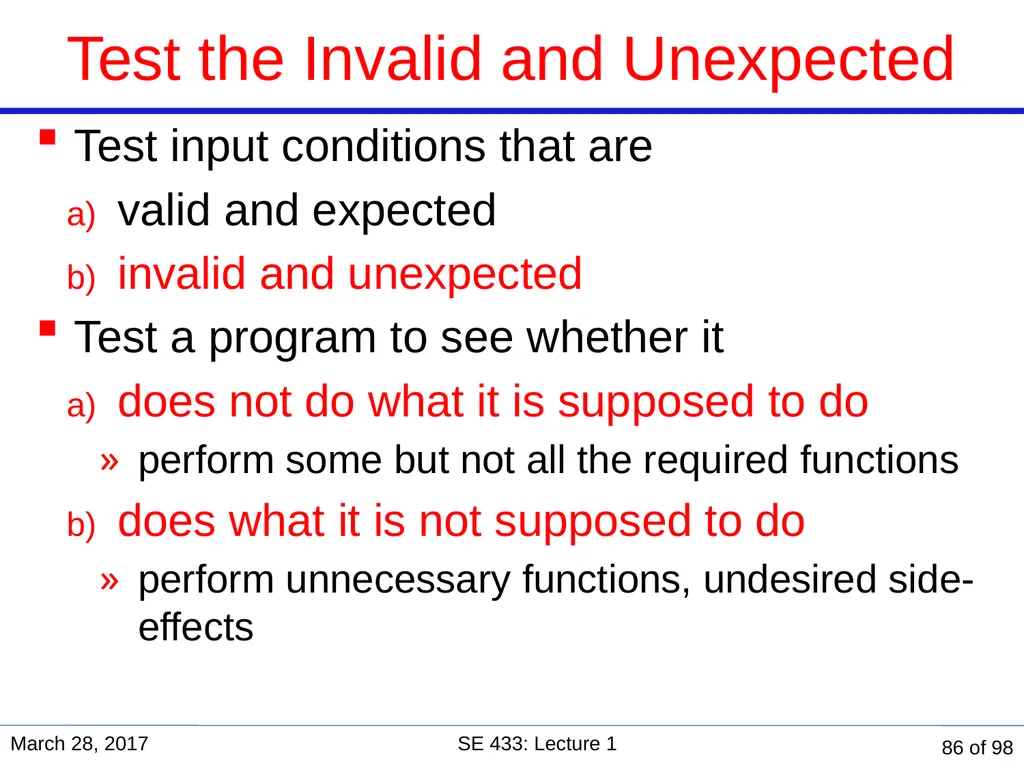
slide86. Test the Invalid and Unexpected Test input conditions that are
valid and expected
invalid and unexpected
Test a program to see whether it
does not do what it is supposed to do
perform some but not all the required functions
does what it is not supposed to do
perform unnecessary functions, undesired side-effects March 28, 2017 SE 433: Lecture 1 86 of 98<br>
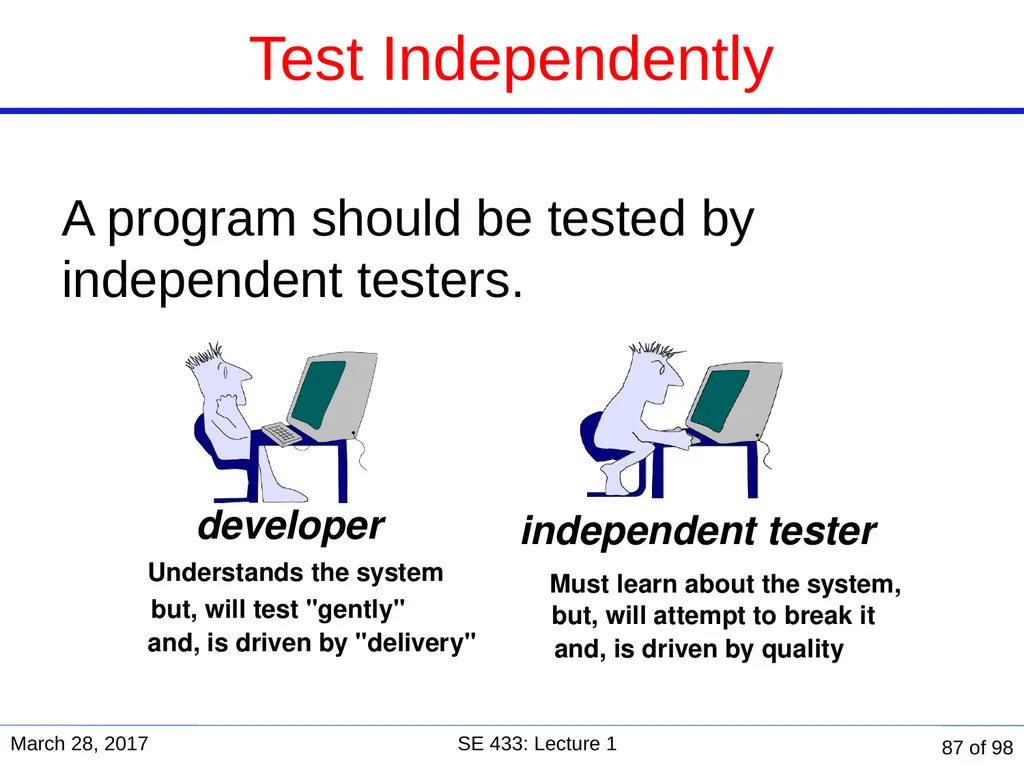
slide87. Test Independently A program should be tested by independent testers. March 28, 2017 SE 433: Lecture 1 87 of 98<br>
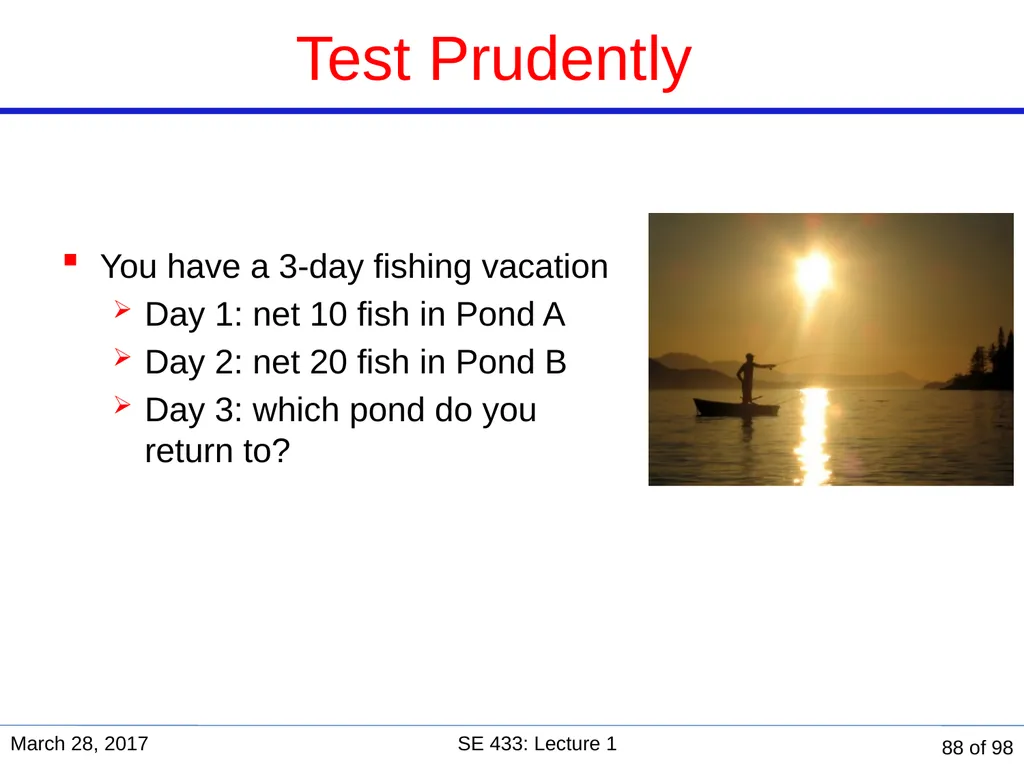
slide88. Test Prudently You have a 3-day fishing vacation
Day 1: net 10 fish in Pond A
Day 2: net 20 fish in Pond B
Day 3: which pond do you return to? March 28, 2017 SE 433: Lecture 1 88 of 98<br>
slide89. Test Prudently Defects tend to cluster rather than evenly distribute.
The probability of the existence of more defects in a component is proportional to the number of defects already found in the component.
A small number of modules usually contains most of the defects discovered during pre-release testing, or is responsible for most of the operational failures. March 28, 2017 SE 433: Lecture 1 89 of 98<br>
slide90. Tool Support is Essential Some Reasons for Using Tools
Automate repetitive tasks
Avoid typos, etc.
Cope with large programs
Tools Used
Test script
Automated compilation, build and testing: Ant
Automated running of tests: JUnit
Debugging: Eclipse debugger
Code Coverage: Cobertura March 28, 2017 SE 433: Lecture 1 90 of 98<br>
slide91. Limitations of Software Testing March 28, 2017 SE 433: Lecture 1 91 of 98<br>
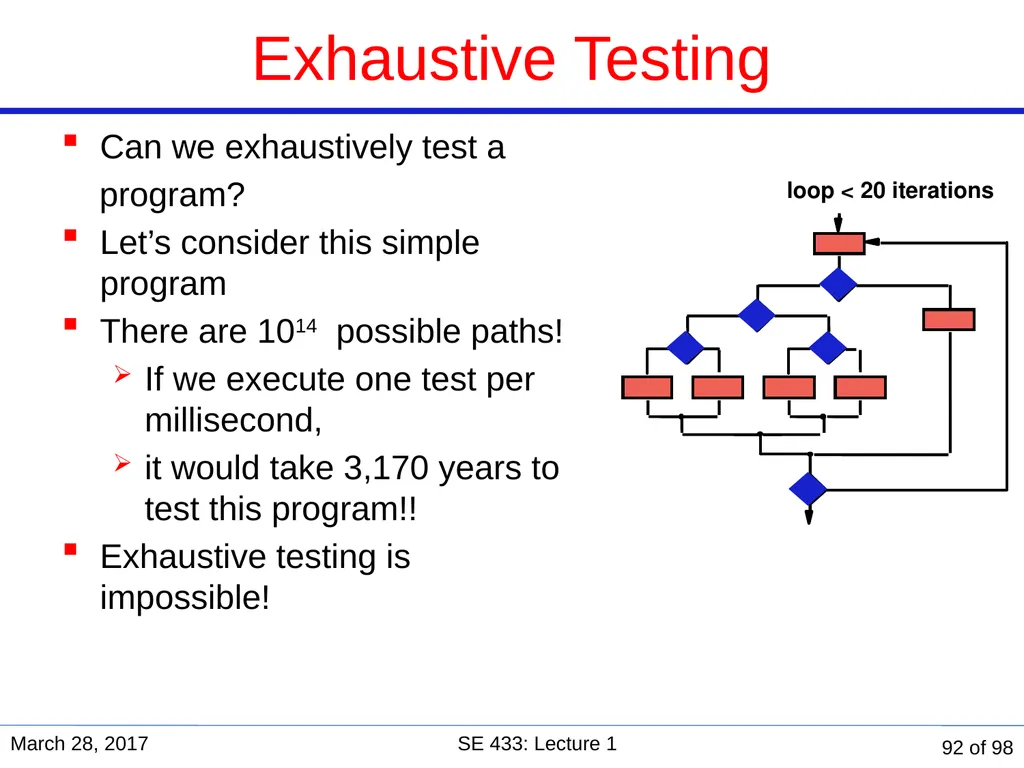
slide92. Exhaustive Testing Can we exhaustively test a
program?
Let’s consider this simple program
There are 1014 possible paths!
If we execute one test per millisecond,
it would take 3,170 years to test this program!!
Exhaustive testing is impossible! loop < 20 iterations March 28, 2017 SE 433: Lecture 1 92 of 98<br>
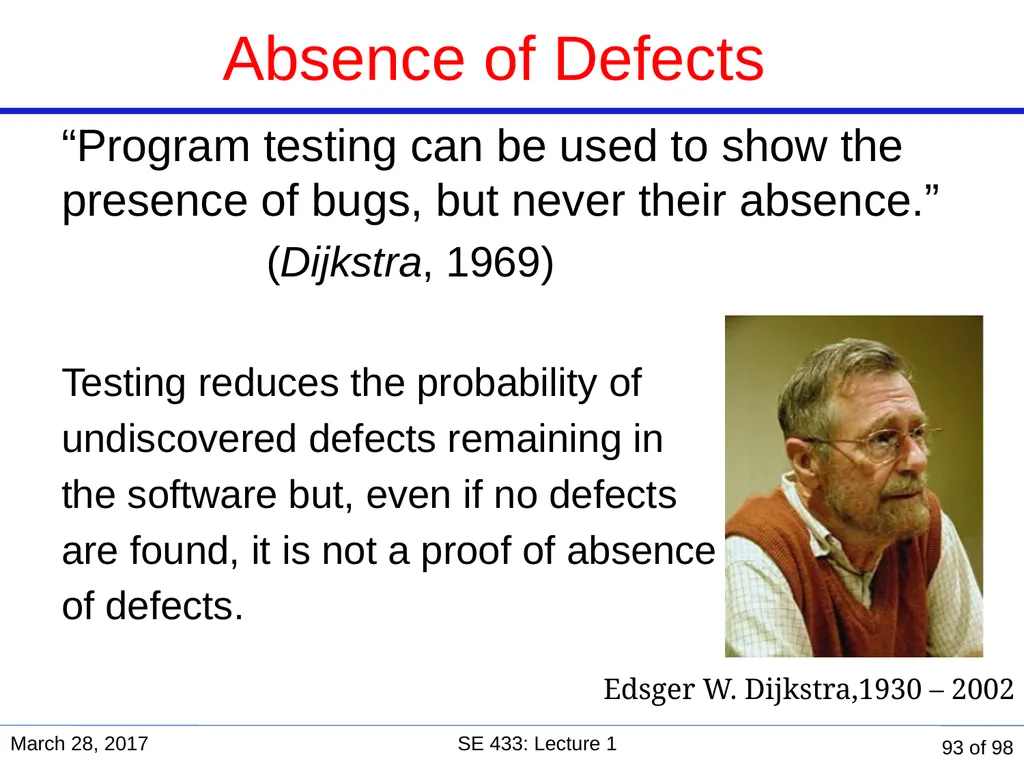
slide93. Absence of Defects “Program testing can be used to show the presence of bugs, but never their absence.”
(Dijkstra, 1969)
Testing reduces the probability of
undiscovered defects remaining in
the software but, even if no defects
are found, it is not a proof of absence
of defects. Edsger W. Dijkstra,1930 – 2002 March 28, 2017 SE 433: Lecture 1 93 of 98<br>
slide94. When to Stop Testing? One of the most difficult problems in testing is not knowing when to stop.
You can use metrics to make a guess. Keep track of the defect rate. When it goes towards zero you can use it as an indicator. Or, …
Even if you do find the last bug, you’ll never know it. March 28, 2017 SE 433: Lecture 1 94 of 98<br>
slide95. How Much Testing is Enough? Take into account
the level of risk, including technical, safety, and business risks, and
project constraints such as time and budget.
Testing should provide feedback to stakeholders to make informed decisions
about the release of the software,
for the next development step, or
handover to customers.
In Lecture 10 we will discuss some techniques for making this decision. March 28, 2017 SE 433: Lecture 1 95 of 98<br>
slide96. Summary – Key Concepts Objective and principles of testing
Cost of quality
Fundamentals and basic terminologies in testing
Failures, defects, faults, errors, mistakes
Testing, analysis, black-box and white-box testing
Test cases, test suites, test plan, test process
Independent testing
Limitations of testing, exhaustive testing March 28, 2017 SE 433: Lecture 1 96 of 98<br>
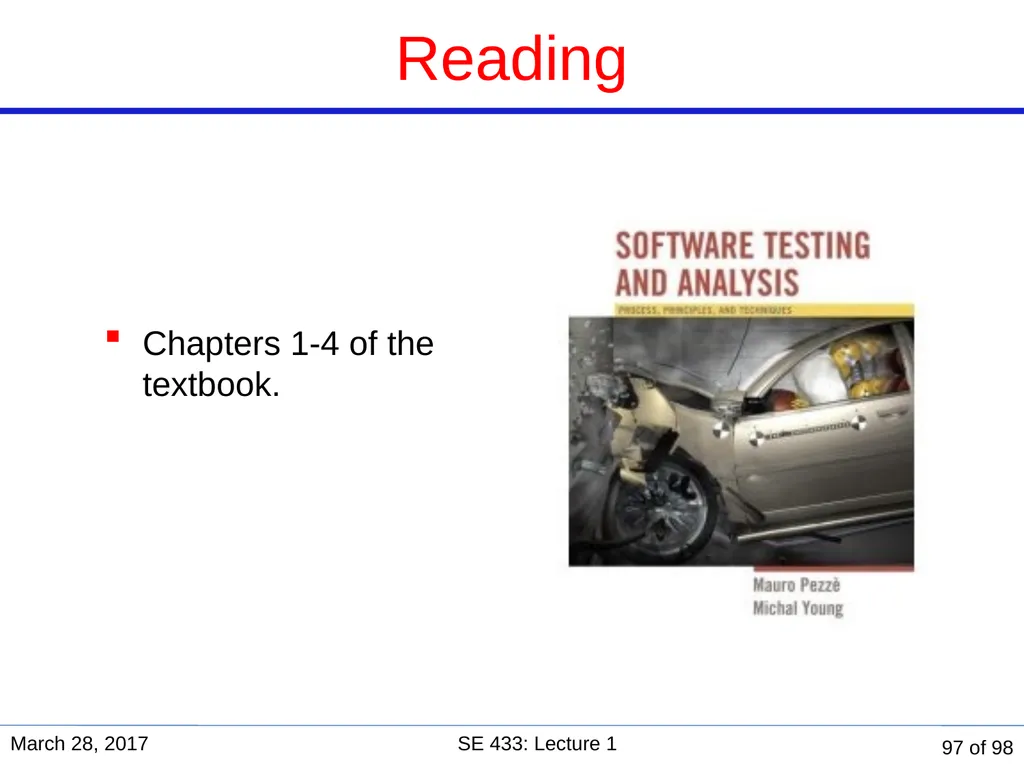
slide97. Reading Chapters 1-4 of the textbook. March 28, 2017 SE 433: Lecture 1 97 of 98<br>
slide98. Next Class Topic:
Software Quality
Reading:
Pezze and Young: Chapters 1-4
Assignment:
Assignment 1: Determining Types of Triangles March 28, 2017 SE 433: Lecture 1 98 of 98<br>
slide2. SE 433/333 Software Testing & Quality Assurance Dennis Mumaugh, Instructor
dmumaugh@depaul.edu
Office: CDM, Room 428
Office Hours: Tuesday, 4:00 – 5:30 March 28, 2017 SE 433: Lecture 1 2 of 98<br>
slide3. Administrivia: Introduction Dennis Mumaugh
Undergraduate: BSEE – University of California, Berkeley
MS Computer Science – University of Maryland
Ph.D. Studies – University of Maryland
Teaching at DePaul since September 2000
Work
Senior Engineer – National Security Agency
ARPANet Pioneer, Unix™ Technology Transfer
Member of the Technical Staff – Bell Labs/Lucent Technologies
Unix Development – Current Engineering
IS&R Systems – Knowledge Based Systems
Software Tools and OO Technology
Interests
Operating Systems and System Programming
Software Productivity, Compilers and Software Metrics
Software Engineering March 28, 2017 SE 433: Lecture 1 3 of 98<br>
slide4. Administrivia: Basic Information Contact Information:
Email: dmumaugh@depaul.edu
Phone: 630-983-1221 (10:00 am - 11:00 pm) except just before class (After 3pm)
Office Hours
Tuesday: 4:00 pm to 5:30 pm, Loop, CDM, Room 428
By arrangement March 28, 2017 SE 433: Lecture 1 4 of 98<br>
slide5. Administrivia: Basic Information Class home page http://condor.depaul.edu/dmumaugh/classes/SE433S17, contains syllabus and schedule, lecture notes, homework, more reading material
About the Lecture Notes – look at “notes” section of the slides
Also look at the expanded readings page: http://condor.depaul.edu/dmumaugh/readings/SE433readings.html
Desire2Learn:
Course materials, assignments, assignment submissions, assignment solutions, examinations and quizzes and grades will be available on the Desire2learn – https://d2l.depaul.edu/
All students are expected to have an email address.
Please make sure it is valid and make sure Campus Connection has the current email address. March 28, 2017 SE 433: Lecture 1 5 of 98<br>
slide6. Administrivia: Basic Information Course mailing list:
se433@mailman.depaul.edu
To subscribe to the list or unsubscribe from it, go to http://mailman.depaul.edu/mailman/listinfo/se433.
I’ll bulk subscribe on Saturday.
If necessary, update your spam filter to accept messages from the mailing list.
Unless your message is personal, send it to the course mailing list!
I will respond to questions related to the lectures and assignments.
You are also encouraged to respond to other students’ questions.
The mailing list is archived. You may subscribe to a digest.
Last minute information will go to the mailing list March 28, 2017 SE 433: Lecture 1 6 of 98<br>
slide7. Administrivia: reading materials Primary Textbook
Software Testing and Analysis: Process, Principles and Techniques, by Mauro Pezze and Michal Young
References
The Art of Software Testing, Second Edition
by Glenford J. Myers et al
Available in e-book through library
Software Engineering: A Practitioner's Approach, 6th ed
by Roger S Pressman (Chapters 13 and 14)
Lecture notes and supplementary materials
Available on D2L March 28, 2017 SE 433: Lecture 1 7 of 98<br>
slide8. Administrivia: reading materials A note on reading list
You are not expected to read all of the material on the reading list.
Look at the various articles as you have time.
Many say the same thing but with a different perspective.
Don't get overwhelmed in reading March 28, 2017 SE 433: Lecture 1 8 of 98<br>
slide9. Administrivia: Course structure Ten classes + Midterm Exam + Final Exam
Weekly reading, assignments (10)
Class structure: lecture (with short break near the middle).
Topics and reading assignments are on the class web page March 28, 2017 SE 433: Lecture 1 9 of 98<br>
slide10. Administrivia: required software Access to MS Word and PowerPoint (or equivalent)
Java
Java development and testing software:
Eclipse,
JUnit,
Ant,
Cobertura. March 28, 2017 SE 433: Lecture 1 10 of 98<br>
slide11. Administrivia: Support Technical questions can be addressed during office hours or by email
Use the mailing list for all technical questions
Provide appropriate support to each other
I do not preview homework, but I will answer questions or make suggestions to generic problems
If you contact me by e-mail
Please include your name and the course number in all correspondence March 28, 2017 SE 433: Lecture 1 11 of 98<br>
slide12. Administrivia: Miscellany Communications development:
An essential part of this course is communicating your ideas in prose, as well as in technical graphical artifacts.
The ability to communicate clearly and effectively is a skill that will pay off both in and out of class.
Motivation from a recent NPR business report:
Robert Half surveyed their corporate customers concerning resumes they had received.
Corporate reviewers spent about 10-15 seconds deciding whether to examine the resume further.
They instantly tossed the resume if they detected any grammatical or spelling errors.
Treat your coursework as if it were being reviewed by the manager who does your performance review and sets your salary. March 28, 2017 SE 433: Lecture 1 12 of 98<br>
slide13. Administrivia: Miscellany Intellectual property issues:
All material in this course is property of either the instructor or Xiaoping Jia.
You are permitted to download and print copies of the material.
You are not permitted to redistribute the material in any form.
Plagiarism:
All individual assignments must represent your own work.
It's a great idea to get together in study groups to discuss the problems, but you should then do the assignments individually.
Plagiarism is to take and use as one’s own, or copy without acknowledgement, the works of another person. The provider of such material can be ruled equally culpable.
If you hand in late homework with prior permission, it must be your own work, not a copy of the solutions presented in class. March 28, 2017 SE 433: Lecture 1 13 of 98<br>
slide14. Administrivia: Miscellany There will be a lot of ambiguity and lack of firm direction in the assignments and the information.
That is typical of much of engineering.
This requires you to provide your own experience. Or to research and discover your information.
Using previous solutions/techniques will not necessarily work. You may have to invent something.
Understanding a problem (statement):
An essential part of this course is understanding written material, ideas in prose. The ability to understand a document, to "read between the lines", is a skill that will pay off both in and out of class.
Areas of concern:
Projects are implemented with the wrong features.
Students answer the wrong question on a test.
People confuse the subsystems of a design.
People do not read, really read things. March 28, 2017 SE 433: Lecture 1 14 of 98<br>
slide15. Administrivia: Feedback/Participation Feedback/Participation
Share your thoughts
Ask questions – wave your hand forcefully to get my attention
Speak loudly so all can hear
Give me verbal and non-verbal feedback
Don't just sit there . . . nod, smile, frown, shake your head
Make sure your email address is correct and works March 28, 2017 SE 433: Lecture 1 15 of 98<br>
slide16. Homework logistics Homework must be submitted via Desire2Learn by 11:59 PM Chicago Time on the assignment due date.
Do not rely on the deadline, clocks differ. Be early.
Submit MS Word or Adobe PDF files only [I accept either format of MS Word]
No extra credit assignments.
Late Policy
Late assignments will not be accepted except for special circumstances. March 28, 2017 SE 433: Lecture 1 16 of 98<br>
slide17. Grading – Attendance & Assignments Attendance – 10%
In-class students: attendance taken during class
On-line students: must watch each lecture within 6 days
Submit attendance confirmation
Assignments and projects (individual)
SE333 – 50%
SE433 – 45%
Including several programming projects March 28, 2017 SE 433: Lecture 1 17 of 98<br>
slide18. Grading – Exams & Final Paper Mid-term exam – 20%
Final exam – 20%
Final paper – 5% (SE433 only)
No late submission will be accepted. March 28, 2017 SE 433: Lecture 1 18 of 98<br>
slide19. Administrivia: assessment Regular assignments (10)
Midterm examination
Final examination
Each of the above will be weighted as follows:
Attendance – 10%
Assignments and projects – 50% for SE333 45% for SE433
Mid-term exam – 20%
Final exam – 20%
Final take-home exam, a short paper – 5% SE433 only,
Grading will be done on the usual 60/70/80/90 bands but will be adjusted to account for clustering and banding of scores. Bands may be adjusted if there seems to be a systemic bias to the scores. March 28, 2017 SE 433: Lecture 1 19 of 98<br>
slide20. Assignments Read the relevant chapters in the textbook and the relevant reference materials.
Understand all the materials covered in the lecture notes.
Use the mailing list for questions and discussions. March 28, 2017 SE 433: Lecture 1 20 of 98<br>
slide21. Course Specific Information March 28, 2017 SE 433: Lecture 1 21 of 98<br>
slide22. Prerequisites Data Structures II (CSC 301, 403, 383, 393), or
Object-Oriented Modeling (SE430)
Proficient in programming and data structures
Assignments will use Java
Familiar with object-oriented modeling and principles
Familiar with software development processes March 28, 2017 SE 433: Lecture 1 22 of 98<br>
slide23. Course Objectives Understand how to achieve high quality in software development
Study the processes, techniques, and tools for software testing
Focus on software testing and analysis
basic principles and techniques
underlying theory
organizational and process issues March 28, 2017 SE 433: Lecture 1 23 of 98<br>
slide24. Learning Outcomes Applications of techniques and tools at the module and system levels
Understanding of the techniques, processes, and tools at the project and organization levels
Emphasis
practical techniques to achieve an acceptable level of quality at an acceptable cost.
realistic strategies for reliable and cost-effective software testing. March 28, 2017 SE 433: Lecture 1 24 of 98<br>
slide25. We will cover a subset of the above. Some Topics Introduction to software testing
Functional testing
Structural testing
Test case selection
Inspection
Static analysis
Unit testing
Test automation and tools
Integration and system testing
Regression testing March 28, 2017 SE 433: Lecture 1 Performance testing
Web application testing
Security testing
Graphical user interface (GUI) testing
Usability testing
Fault-based testing
Planning and monitoring the software quality process
Testing of object-oriented software 25 of 98<br>
slide26. Engineering Methodology What is engineering and how does it differ from science?
Engineering is the application of science to the needs of humanity. This is accomplished through the application of knowledge, mathematics, and practical experience to the design of useful objects or processes in a cost effective way.
One of the objectives of this course is to teach some of the methodology of engineering
Understanding the problem
How to approach a problem
Developing and following requirements
Writing and reading specifications
Analyzing a problem
Designing a solution
Verifying each step
Testing the design against the original problem statement March 28, 2017 SE 433: Lecture 1 26 of 98<br>
slide27. Surviving SE433 Make sure you read things, sometimes more than once. People do not seem to read assignments and web pages (or do not follow instructions).
The pace is quick. The intent of the course is to learn by doing, not by reading; but there is a lot of information to process.
Read the assignments carefully. Note special requirements, such as formats and use of predefined templates!
Start your assignments right after they are handed out (assigned). They will take some time and starting on the night before it is due is not a good strategy.
Reading list:
Is it required? No.
Is it useful? Yes, especially if you are serious about a career in software development.
The articles are usually short but informative. Most are supplemental – useful for understanding but the notes cover the major points.
Reading should be done in parallel with the lectures.
Pace yourself. Remember: “This too shall pass.” March 28, 2017 SE 433: Lecture 1 27 of 98<br>
slide28. SE 433 – Class 1 Topics: Introduction and Overview:
Class Logistics and Administrivia;
Introduction to Software Testing
Reading
Pezze and Young: Chapters 1-4 March 28, 2017 SE 433: Lecture 1 28 of 98<br>
slide29. Thought for the Day Software Testing takes at least twice as long as estimated. March 28, 2017 SE 433: Lecture 1 29 of 98<br>
slide30. On Testing For the Snark’s a peculiar creature, that won’t
Be caught in a commonplace way.
Do all that you know, and try all that you don’t:
Not a chance must be wasted to-day!
— Lewis Carroll
The Hunting of the Snark,
an Agony in Eight Fits (1876) March 28, 2017 SE 433: Lecture 1 30 of 98<br>
slide31. Why Programs fail In Federalist 51, James Madison wrote: “If men were angels, no government would be necessary.”
If he lived today, Madison might have written: “If software developers were angels, debugging would be unnecessary.” March 28, 2017 SE 433: Lecture 1 31 of 98<br>
slide32. Why Programs fail Congratulations!
Your code is complete. It compiles. It runs …
Your program fails. How can this be?
There is a defect in the code. When the code is executed, the defect causes bad behavior, which later becomes visible as a failure.
Before a program can be debugged, we must set it up such that it can be tested — that is, executed with the intent to make it fail.
The first step in debugging is to reproduce the problem in question — that is, to create a test case that causes the program to fail in the specified way.
The first reason is to bring it under control, such that it can be observed.
The second reason is to verify the success of the fix.
Now you will have the fun of testing and debugging! March 28, 2017 SE 433: Lecture 1 32 of 98<br>
slide33. Myth Busters Software Testing March 28, 2017 SE 433: Lecture 1 33 of 98<br>
slide34. Myth #1 in Software Testing Q: What is the objective of software testing?
A: Testing is to show that there are no
errors/bugs/defects in the software. March 28, 2017 SE 433: Lecture 1 34 of 98<br>
slide35. Myth #1 in Software Testing Q: What is the objective of software testing?
A: Testing is to show that there are no
errors/bugs/defects in the software. Fact:
No!! The main objective of testing is to discover defects.
Testing is a destructive activity. March 28, 2017 SE 433: Lecture 1 35 of 98<br>
slide36. Myth #2 in Software Testing Q: What is the objective of software testing?
A: Testing is to ensure that the software does what it is supposed to do. March 28, 2017 SE 433: Lecture 1 36 of 98<br>
slide37. Myth #2 in Software Testing Q: What is the objective of software testing?
A: Testing is to ensure that the software does what it is supposed to do. Fact:
Only partly true.
Testing is also to ensure the software does not do what it is not supposed to do. March 28, 2017 SE 433: Lecture 1 37 of 98<br>
slide38. Myth #3 in Software Testing Q: How challenging is software testing?
A: Testing is easier than design and
implementation. March 28, 2017 SE 433: Lecture 1 38 of 98<br>
slide39. Myth #3 in Software Testing Q: How challenging is software testing?
A: Testing is easier than design and
implementation. Fact:
Must consider all possible scenarios.
Implied and unstated requirements and threats.
Must be imaginative and creative. March 28, 2017 SE 433: Lecture 1 39 of 98<br>
slide40. Myth #4 in Software Testing Q: How challenging is software testing?
A: Testing is an extremely creative and
intellectually challenging task. March 28, 2017 SE 433: Lecture 1 40 of 98<br>
slide41. Myth #4 in Software Testing Q: How challenging is software testing?
A: Testing is an extremely creative and
intellectually challenging task. March 28, 2017 SE 433: Lecture 1 41 of 98<br>
slide42. What is Software Testing ? Software testing is the process of executing a program with the intent of finding bugs. March 28, 2017 SE 433: Lecture 1 42 of 98<br>
slide43. Cost of Software Errors Estimated 50% of each software project spent on testing (spans from 30% to 80%)
Very rough approximation
money spent on testing + cost of remaining errors = 66% of size of software industry
Remark: At Ericsson: 35% of code is test cases! March 28, 2017 SE 433: Lecture 1 43 of 98<br>
slide44. Failure and Specification Some failures are obvious
obviously wrong output/behavior
non-termination
Crash
freeze
...but most are not!
In general, what constitutes a failure, is defined by a specification!
Correctness is a relative notion
— B. Meyer, 1997 March 28, 2017 SE 433: Lecture 1 44 of 98<br>
slide45. Why Does Software Testing Matter? March 28, 2017 SE 433: Lecture 1 45 of 98<br>
slide46. Economic Impact NIST, “The Economic Impacts of Inadequate Infrastructure for Software Testing”
Inadequate software testing costs the US alone around $59.5 billion annually
Better approaches could cut this amount by $22.2 billion
We want our programs to be reliable
Testing is how, in most cases, we find out if they are March 28, 2017 SE 433: Lecture 1 46 of 98<br>
slide47. Launch of MS Windows 98 Bill Gates and Blue Screen of Death March 28, 2017 SE 433: Lecture 1 47 of 98<br>
slide48. Launch of MS Windows 98 Bill Gates and Blue Screen of Death March 28, 2017 SE 433: Lecture 1 48 of 98<br>
slide49. Why Do We Test? Testing is expensive.
So are failures!
What do we gain from that cost?
Finding bugs
Leading to
Fixing bugs
Raising the quality of the program or system we are testing March 28, 2017 SE 433: Lecture 1 49 of 98<br>
slide50. Why Do We Test? Kinds of testing
“Smoke test.”, aka “Hello World!”
Check handling of inputs
Illegal inputs – text instead of integers
Impossible inputs – floating vs. integer
Outrageous values – infinities, max and min values
Not in domain – negative numbers, values outside specifications
Input errors – wrong input, e.g. mis-spellings
Stress test
multiple inputs without restart
run program for long periods of time March 28, 2017 SE 433: Lecture 1 50 of 98<br>
slide51. A Case Study: Ariane 5 Launch Vehicle European expendable launch system
Double the payload capacity of its predecessor Ariane 4
113 successful launches, 3 failures
Flight 501, maiden launch,
June 4, 1996,12:34pm March 28, 2017 SE 433: Lecture 1 51 of 98<br>
slide52. Case Study Ariane 5: What Happened? T0 - T0 + 36s : normal
Within SRI 2:
BH (Bias Horizontal) > 215
convert_double_to_int(BH) fails!
exception SRI -> crash SRI 2 & 1
OBC disoriented
angle > 20°, huge aerodynamics constraints
boosters separating...
T0 + 39s: self destruction
cost: € 500M March 28, 2017 SE 433: Lecture 1 52 of 98<br>
slide53. Case Study Ariane 5: Why Did It Happen? Not a programming error
unprotected conversion = design decision (~1980)
Not a design error
Justified against Ariane 4 trajectory & RT constraints
Problem with integration testing
Theoretically detectable.
But huge test space vs. limited resources
Furthermore, SRI useless at this stage of the flight!
Reuse of a component with a hidden constraint
Precondition : abs(BH) < 32768.0
Valid for Ariane 4, but no longer for Ariane 5
More powerful rocket March 28, 2017 SE 433: Lecture 1 53 of 98<br>
slide54. Case Study Ariane 5: Lessons Learned in Software Eng. Test! Test! Test!
Test! Even when the code is reused.
When reuse, ensure the assumptions are still valid.
When write reusable code, document the assumptions.
Write fail-safe code.
Do not propagate errors. March 28, 2017 SE 433: Lecture 1 54 of 98<br>
slide55. Trade-Offs of Cost and Failures Total Cost of Quality (CoQ) = Cost of Conformance (CoC) + Cost of Non-Conformance (CoNC)
Cost of Conformance
Prevention: quality planning, investment in tools, quality training
Appraisal: testing, inspection
Cost of Non-Conformance
Internal failures: rework
External failure: liability, loss of properties, loss of lives March 28, 2017 SE 433: Lecture 1 55 of 98<br>
slide56. Trade-Offs of Cost and Failures Testing adds to Cost of Conformance
It must directly reduce Cost of Non-Conformance March 28, 2017 SE 433: Lecture 1 56 of 98<br>
slide57. A Self Assessment Test March 28, 2017 SE 433: Lecture 1 57 of 98<br>
slide58. Test the Following Program The program reads in 3 integer values that represent the lengths of the sides of a triangle.
The program prints a message that states whether the triangle is
Equilateral (all 3 sides are equal)
Isosceles (exactly 2 of the 3 sides are equal)
Scalene (all 3 sides are of a different length)
Write a set of test cases that you feel would adequately test this program. March 28, 2017 SE 433: Lecture 1 58 of 98<br>
slide59. How Did You Do?<br>
slide60. Test the Following Program Write a set of test cases that you feel would adequately test this program.
How many cases are needed (look back at slide 50)?
How do you plan to test the program.
Run it many times with different inputs.
Once and manually enter the values.
A file with a set of lines with test values. March 28, 2017 SE 433: Lecture 1 60 of 98<br>
slide61. Assignment Assignment 1 Part I due April 4, 2017
Part I: Write a Java program to determine types of triangles.
The program reads 3 integer numbers from the standard input. The numbers represent the lengths of the sides of a triangle. The program prints a message to the standard output that indicates whether the triangle represented by the input is
an equilateral (all 3 sides are equal), or
an isosceles (exactly 2 of the 3 sides are equal), or
a scalene (all 3 sides are of different lengths)
The program should print out appropriate messages when an erroneous input or condition is encountered.
Submission: The source code (i.e., the .java file) of your program.
Hint: Your program must read the numbers from the standard input, or a file fed to the standard input. One way to do this is to use the java.util.Scanner class.
Part II: Due date: April 11, 2017, Design a test suite to thoroughly test your program. And, Test it. March 28, 2017 SE 433: Lecture 1 61 of 98<br>
slide62. Software Testing Terminologies March 28, 2017 SE 433: Lecture 1 62 of 98<br>
slide63. The Very First Software Bug A moth found trapped between points at Relay # 70, Panel F
Mark II Aiken Relay Calculator
Harvard University
September 9, 1945. On display in Smithsonian March 28, 2017 SE 433: Lecture 1 63 of 98<br>
slide64. Failures Failures are
deviation of the observed behavior of a system from its specification, i.e., its expected behavior.
Failures can only be determined with respect to the specifications.
Failures are concerned with the observed behavior and outcome of the system. March 28, 2017 SE 433: Lecture 1 64 of 98<br>
slide65. Defects Defects are
flaws in a system that can cause the system to fail to perform its required function
e.g. an incorrect condition or statement.
Defects are concerned with specific parts or components of the system.
Defects are synonymous with faults, bugs. March 28, 2017 SE 433: Lecture 1 65 of 98<br>
slide66. Errors Errors are
human actions that result in a fault or defect in the system.
Errors are concerned with the underlying causes of the defects.
Errors are synonymous with mistakes. March 28, 2017 SE 433: Lecture 1 66 of 98<br>
slide67. The Relations among Failures, Defects, and Errors A human being makes an error (mistake)
can occur in design, coding, requirements, even testing.
An error can lead to a defect (fault)
can occur in requirements, design, or program code.
If a defect in code is executed, a failure may occur.
Failures only occur when a defect in the code is executed.
Not all defects cause failures all the time.
Defects occur because human beings are fallible
Failures can be caused by environmental conditions as well. March 28, 2017 SE 433: Lecture 1 67 of 98<br>
slide68. The Relations among Failures, Defects, and Errors The terms error, failure and defect have different meaning when testing. Especially in using JUnit. In this case:
Test Case Verdicts
Pass
The test case execution was completed
The function being tested performed as expected
Fail
The test case execution was completed
The function being tested did not perform as expected
Error
The test case execution was not completed, due to an unexpected event, exceptions, or improper set up of the test case, etc. March 28, 2017 SE 433: Lecture 1 68 of 98<br>
slide69. Failures vs. Defects: A Simple Example For any integer n, square (n) = n*n.
int square (int x)
{
return x*2;
} square (3) = 6 A failure A defect March 28, 2017 SE 433: Lecture 1 69 of 98<br>
slide70. Failures vs. Defects: A Simple Example For any integer n, square (n) = n*n.
int square (int x)
{
return x*2;
} Correct result
Not a failure A defect square (2) = 4 March 28, 2017 SE 433: Lecture 1 70 of 98<br>
slide71. Software Testing Software testing is
the process of executing a program (or parts of a program) with the intention of finding defects
The purpose of testing
to find defects.
to discover every conceivable weakness in a software product. Software testing ≠ Debugging.
Software testing ≠ Quality assurance March 28, 2017 SE 433: Lecture 1 71 of 98<br>
slide72. Software Testing vs. Quality Assurance (QA) Testing is necessary, but not sufficient for quality assurance
Testing contributes to improve quality by identifying problems.
Quality assurance sets the standards for the team/organization to build better software. March 28, 2017 SE 433: Lecture 1 72 of 98<br>
slide73. Test Cases and Test Suites Test case
A test case consists of inputs, steps/actions, and expected results, i.e., pass-fail criterion
Test suite
A group of test cases (usually organized around some principles) March 28, 2017 SE 433: Lecture 1 73 of 98<br>
slide74. Test Plan and Testing Process Test plan
A document that specifies how a system will be tested, including criteria for success, i.e., the exit criteria.
Testing process
The testing process involves developing test plans, designing test cases, running the test cases, and evaluating the results March 28, 2017 SE 433: Lecture 1 74 of 98<br>
slide75. Techniques for Software Testing March 28, 2017 SE 433: Lecture 1 75 of 98<br>
slide76. Testing Testing “Phases”
Unit
Integration
System
User Acceptance Testing
Testing Types
Black-box
White-box Static vs. Dynamic Testing
Integration: 3 types
Top down
Bottom up
Sandwich
Automated Testing
Pros and cons
Defect tracking March 28, 2017 SE 433: Lecture 1 76 of 98<br>
slide77. Ad Hoc Testing Ad hoc testing
Testing carried out informally
No formal test preparation
No recognized test design technique is used
Expected results not defined
Arbitrariness guides the test execution activity
Ad hoc testing is not sufficient March 28, 2017 SE 433: Lecture 1 77 of 98<br>
slide78. Black Box Testing Treats a program or system as a black box
Design test cases without the knowledge of internal structure and design of the system
Design test cases based on the functional requirements of the system
a.k.a: functional testing
Send the system inputs, observe the outputs, decide if the system passed or failed the test
Sometimes you don’t have access to source code March 28, 2017 SE 433: Lecture 1 78 of 98<br>
slide79. White Box Testing Open up the box!
a.k.a: glass box, clear box, or structural testing
Design test cases by examining the internal design and source code of the program
Require detailed knowledge of its structure
Introduce the idea of measuring coverage:
How adequate, or thorough, is the test suite? March 28, 2017 SE 433: Lecture 1 79 of 98<br>
slide80. Software Analysis Software analysis is
the process of finding defects in a program (or parts of a program) without executing the program.
a.k.a. static analysis
Complementary to software testing
Same purpose, different techniques
Software analysis can be
automated, i.e., using tools, static analyzers
manual, e.g., inspection, code review March 28, 2017 SE 433: Lecture 1 80 of 98<br>
slide81. Basic Principles of Software Testing March 28, 2017 SE 433: Lecture 1 81 of 98<br>
slide82. Testing vs. Verification TESTING
Goal: find evidence for presence of failures
Testing: execute a program with the intent of detecting failure
Testing cannot guarantee correctness, i.e., absence of failures
Related techniques: code reviews, program inspections
VERIFICATION
Goal: find evidence for absence of failures
Verification guarantees correctness
Related techniques: code generation, program synthesis (from spec) March 28, 2017 SE 433: Lecture 1 82 of 98<br>
slide83. Testing vs. Verification Both, testing and verification attempts exhibit new failures
Debugging is a systematic process that finds and eliminates the defect that led to an observed failure
Programs without known failures may still contain defects:
If they have not been verified
If they have been verified, but the failure is not covered by the specification March 28, 2017 SE 433: Lecture 1 83 of 98<br>
slide84. Make No Assumptions Do not assume that no new defects will be found. March 28, 2017 SE 433: Lecture 1 84 of 98<br>
slide85. Define Expected Output Each test case must include the expected output.
The output of each test must be thoroughly inspected.
Preferably: automated inspection, assertions March 28, 2017 SE 433: Lecture 1 85 of 98<br>
slide86. Test the Invalid and Unexpected Test input conditions that are
valid and expected
invalid and unexpected
Test a program to see whether it
does not do what it is supposed to do
perform some but not all the required functions
does what it is not supposed to do
perform unnecessary functions, undesired side-effects March 28, 2017 SE 433: Lecture 1 86 of 98<br>
slide87. Test Independently A program should be tested by independent testers. March 28, 2017 SE 433: Lecture 1 87 of 98<br>
slide88. Test Prudently You have a 3-day fishing vacation
Day 1: net 10 fish in Pond A
Day 2: net 20 fish in Pond B
Day 3: which pond do you return to? March 28, 2017 SE 433: Lecture 1 88 of 98<br>
slide89. Test Prudently Defects tend to cluster rather than evenly distribute.
The probability of the existence of more defects in a component is proportional to the number of defects already found in the component.
A small number of modules usually contains most of the defects discovered during pre-release testing, or is responsible for most of the operational failures. March 28, 2017 SE 433: Lecture 1 89 of 98<br>
slide90. Tool Support is Essential Some Reasons for Using Tools
Automate repetitive tasks
Avoid typos, etc.
Cope with large programs
Tools Used
Test script
Automated compilation, build and testing: Ant
Automated running of tests: JUnit
Debugging: Eclipse debugger
Code Coverage: Cobertura March 28, 2017 SE 433: Lecture 1 90 of 98<br>
slide91. Limitations of Software Testing March 28, 2017 SE 433: Lecture 1 91 of 98<br>
slide92. Exhaustive Testing Can we exhaustively test a
program?
Let’s consider this simple program
There are 1014 possible paths!
If we execute one test per millisecond,
it would take 3,170 years to test this program!!
Exhaustive testing is impossible! loop < 20 iterations March 28, 2017 SE 433: Lecture 1 92 of 98<br>
slide93. Absence of Defects “Program testing can be used to show the presence of bugs, but never their absence.”
(Dijkstra, 1969)
Testing reduces the probability of
undiscovered defects remaining in
the software but, even if no defects
are found, it is not a proof of absence
of defects. Edsger W. Dijkstra,1930 – 2002 March 28, 2017 SE 433: Lecture 1 93 of 98<br>
slide94. When to Stop Testing? One of the most difficult problems in testing is not knowing when to stop.
You can use metrics to make a guess. Keep track of the defect rate. When it goes towards zero you can use it as an indicator. Or, …
Even if you do find the last bug, you’ll never know it. March 28, 2017 SE 433: Lecture 1 94 of 98<br>
slide95. How Much Testing is Enough? Take into account
the level of risk, including technical, safety, and business risks, and
project constraints such as time and budget.
Testing should provide feedback to stakeholders to make informed decisions
about the release of the software,
for the next development step, or
handover to customers.
In Lecture 10 we will discuss some techniques for making this decision. March 28, 2017 SE 433: Lecture 1 95 of 98<br>
slide96. Summary – Key Concepts Objective and principles of testing
Cost of quality
Fundamentals and basic terminologies in testing
Failures, defects, faults, errors, mistakes
Testing, analysis, black-box and white-box testing
Test cases, test suites, test plan, test process
Independent testing
Limitations of testing, exhaustive testing March 28, 2017 SE 433: Lecture 1 96 of 98<br>
slide97. Reading Chapters 1-4 of the textbook. March 28, 2017 SE 433: Lecture 1 97 of 98<br>
slide98. Next Class Topic:
Software Quality
Reading:
Pezze and Young: Chapters 1-4
Assignment:
Assignment 1: Determining Types of Triangles March 28, 2017 SE 433: Lecture 1 98 of 98<br>