ARISTOTLE: Introduction PLATO: The forms patterns or ideals are not in this world and can only be known through a process of education Images make up the lowest category of objects of knowledge art is only imitation ARISTOTLE: The
"ARISTOTLE: Introduction PLATO: The forms [patterns" is the property of its rightful owner. Permission is granted to
download and print the materials on this website for personal, non-commercial use only, and to display it
on your personal computer provided you do not modify the materials and that you retain all copyright
notices contained in the materials. By downloading content from our website, you accept the terms of this
agreement.
Presentation Transcript
01
ARISTOTLE: Introduction PLATO: The forms [patterns or ideals] are not in this world and can only be known through a process of education
Images make up the lowest category of “objects of knowledge” – art is only “imitation”
ARISTOTLE: The “forms” [or patterns] that enable us to understand objects don’t exist apart from particular objects.
The emphasis is on experience as a source of knowledge
Thus art, as a way of expressing human experience, has a higher place in Aristotle’s categories.<br>
02
Aristotle’s Classification of Knowledge & Human Activities His starting point: Every activity has its proper end at which it aims.
Theoretical Sciences
includes Metaphysics, Physics and Mathematics
Productive /Practical Sciences -- are those where reason serves human beings.
Productive Sciences: These involve "know-how" and include many “crafts”, including art.
Practical Science or ETHICS: Humans as AGENTS rather than producers.<br>
03
Aristotle: Poetics In the Poetics Aristotle presents his definition of the genre, including his theory of “catharsis”
Intro to Greek tragedy:
Everyone knew the stories,
The plays were performed by men wearing masks.
The plays told particular stories with a universal application. [the masks helped to universalize the particular.]<br>
04
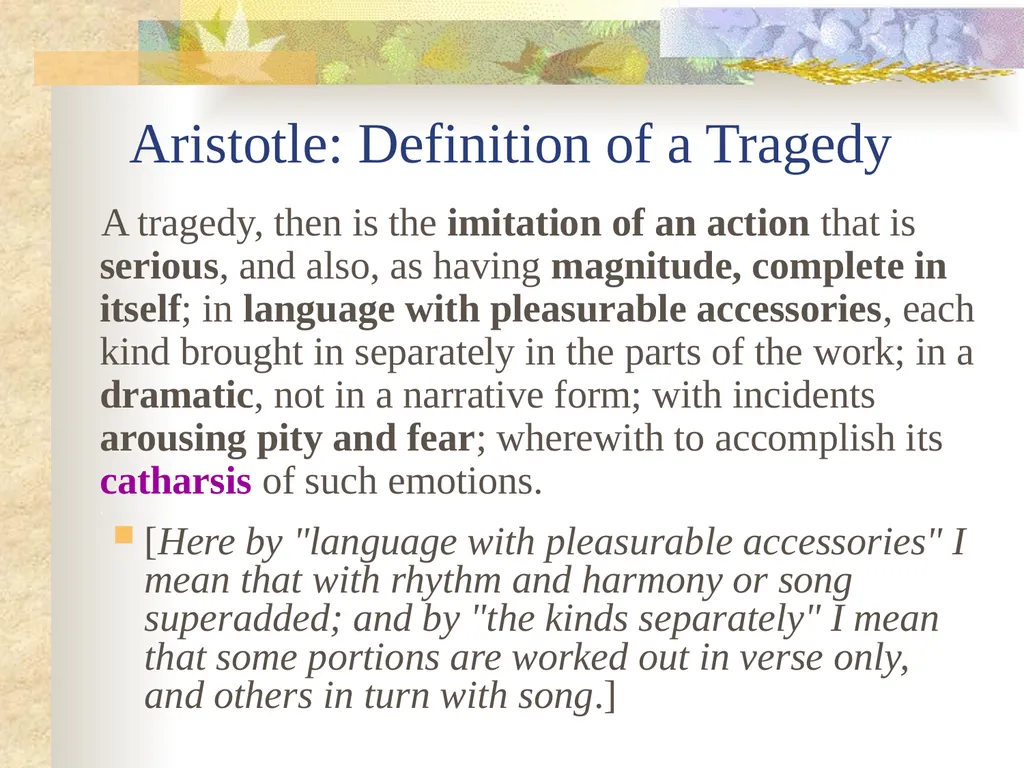
Aristotle: Definition of a Tragedy A tragedy, then is the imitation of an action that is serious, and also, as having magnitude, complete in itself; in language with pleasurable accessories, each kind brought in separately in the parts of the work; in a dramatic, not in a narrative form; with incidents arousing pity and fear; wherewith to accomplish its catharsis of such emotions. .
[Here by "language with pleasurable accessories" I mean that with rhythm and harmony or song superadded; and by "the kinds separately" I mean that some portions are worked out in verse only, and others in turn with song.]<br>
05
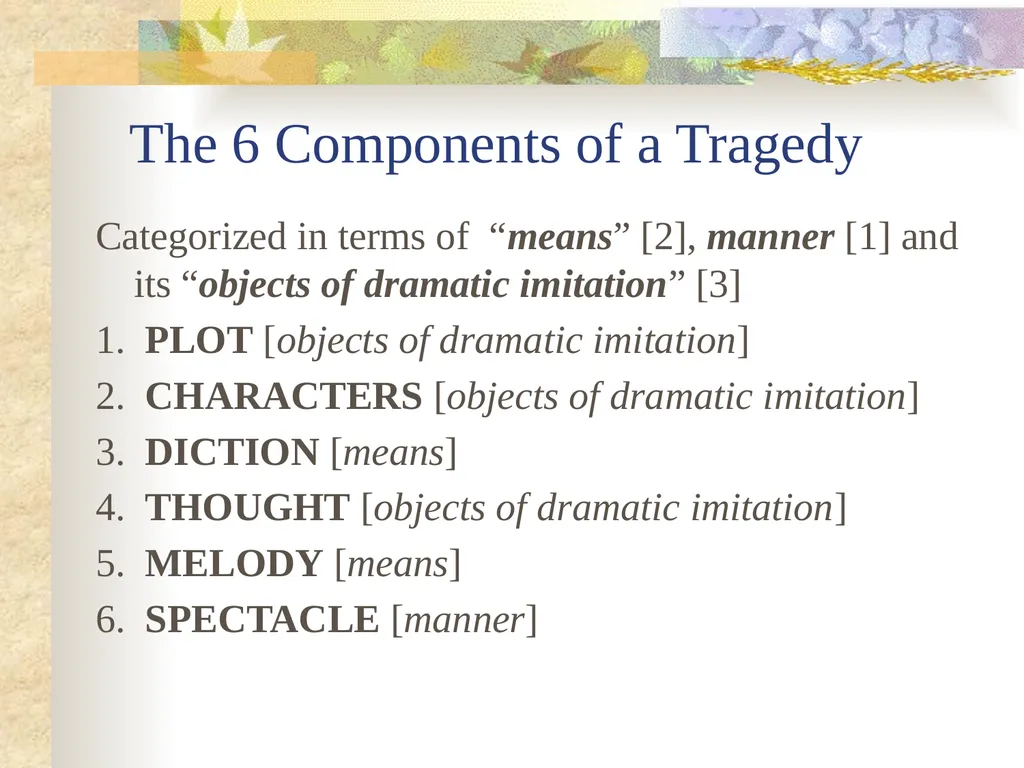
The 6 Components of a Tragedy Categorized in terms of “means” [2], manner [1] and its “objects of dramatic imitation” [3]
1. PLOT [objects of dramatic imitation]
2. CHARACTERS [objects of dramatic imitation]
3. DICTION [means]
4. THOUGHT [objects of dramatic imitation]
5. MELODY [means]
6. SPECTACLE [manner]<br>
06
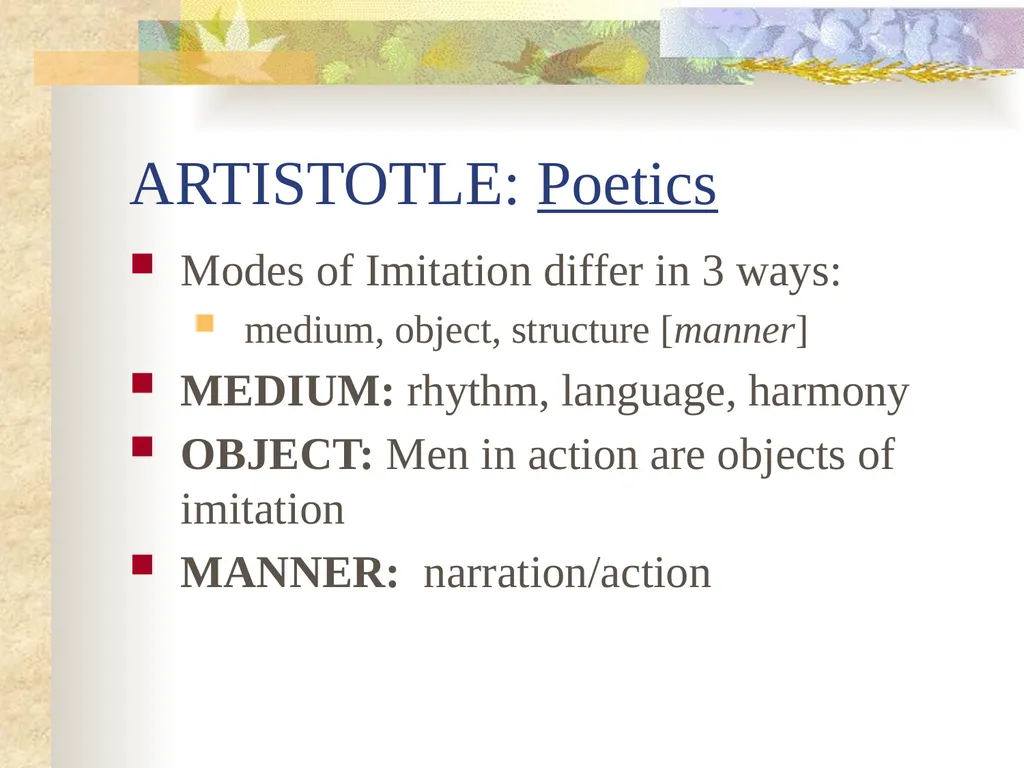
ARTISTOTLE: Poetics Modes of Imitation differ in 3 ways:
medium, object, structure [manner]
MEDIUM: rhythm, language, harmony
OBJECT: Men in action are objects of imitation
MANNER: narration/action<br>
07
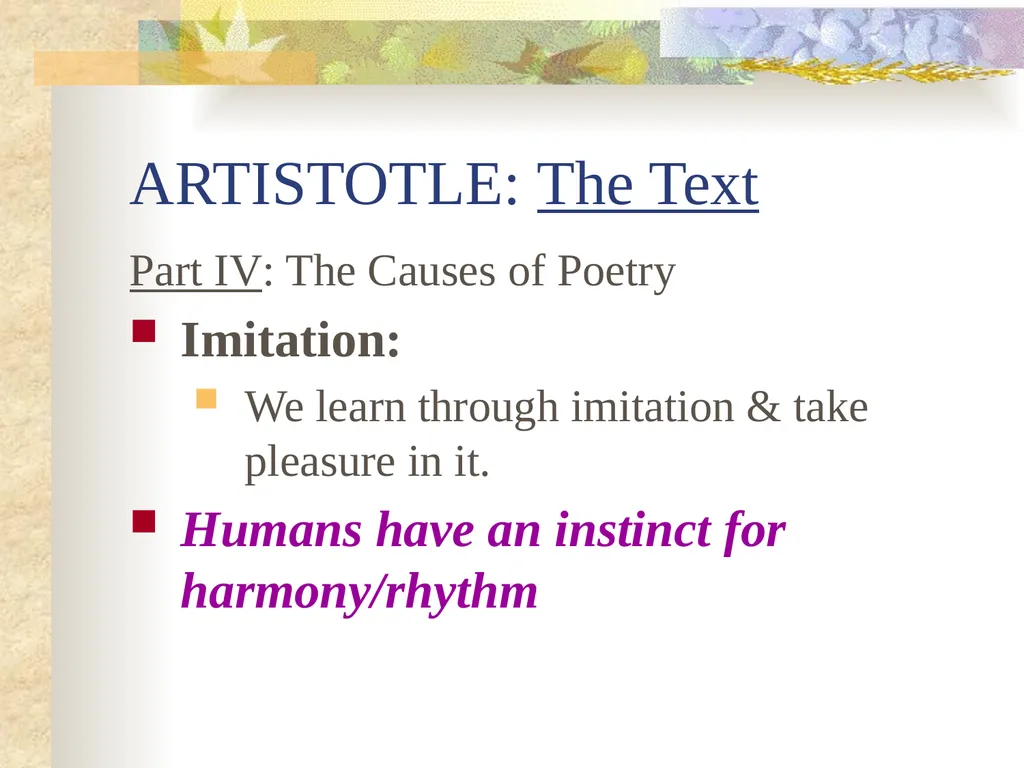
ARTISTOTLE: The Text Part IV: The Causes of Poetry
Imitation:
We learn through imitation & take pleasure in it.
Humans have an instinct for harmony/rhythm<br>
08
Structure of a tragedy Part IX: Aristotle is defining “aesthetic quality”
TRAGEDY is the “Imitation of an action that is complete, whole and of a certain magnitude.”
unity of plot
express the universal [history expresses the particular]
events inspiring fear and pity
reversal of the situation through recognition [of persons]<br>
09
Plot/Characters/Thought PLOT is the most important: tragedy is an imitation of action and life
“Character gives us our qualities, but it is by our actions that we are happy or the reverse.”
CHARACTERS are the second:
Representations of an action: the agents have two causes of their actions: thought and character.
The comparison with painting: beautiful colors without order do not give the same pleasure as a simple black & white sketch or a portrait.
THOUGHT is 3rd:
“the power of saying whatever can be said.”<br>
10
Discussion of the PLOT I The plot must be an “imitation of an action that is complete in itself, as a WHOLE of some magnitude”
Unity of Plot: The plot must represent an action and form a complete whole with a beginning, middle and end
“Removal of one incident will destroy it, for that which makes no perceptible difference by its presence or absence is no real part of the whole."<br>
11
Discussion of the PLOT II The PLOT "must make a universal statement
Aristotle believed poetry was more important than history because poetry states universals.
The playwright should include incidents arousing pity and fear [see catharsis above in slide #4]
That are both unexpected and "in consequence" of one another.<br>
12
ARTISTOTLE: The Text Part XIII: The change of fortune.
Through error or frailty rather than vice or depravity.
Part XIV: Fear & Pity
Best done through structure of the pieces rather than spectacle.
What kind of circumstances?
Part XV: Character
Good character; propriety; true to life; consistency<br>
13
Questions for Discussion What criteria do you think Aristotle is proposing for art in general?
What effect does he think art has on us?
How can you apply Aristotle to contemporary art/theatre?
How does he differ from Plato? How is he similar?
How might his view be applied to representing the holocaust?<br>