
Aristotle: Tragedy & Comedy Aristotle (384 – 322
MS
Published · 32 slides · 0 views
1 / 1
Description
Aristotle: Tragedy Comedy Aristotle (384 322 BCE) Greek philosopher born in Macedonia Son of Nicomachus, physician to the king Entered Platos Academy at age 18 c. 342 BCE began tutor to Alexander the Great Founded the Lyceum Principal
Related Topics
Share
Embed code
Download this presentation From Below
"Aristotle: Tragedy & Comedy Aristotle (384 – 322" is the property of its rightful owner. Permission is granted to download and print the materials on this website for personal, non-commercial use only, and to display it on your personal computer provided you do not modify the materials and that you retain all copyright notices contained in the materials. By downloading content from our website, you accept the terms of this agreement.
Presentation Transcript
01
Aristotle: Tragedy & Comedy<br>
02
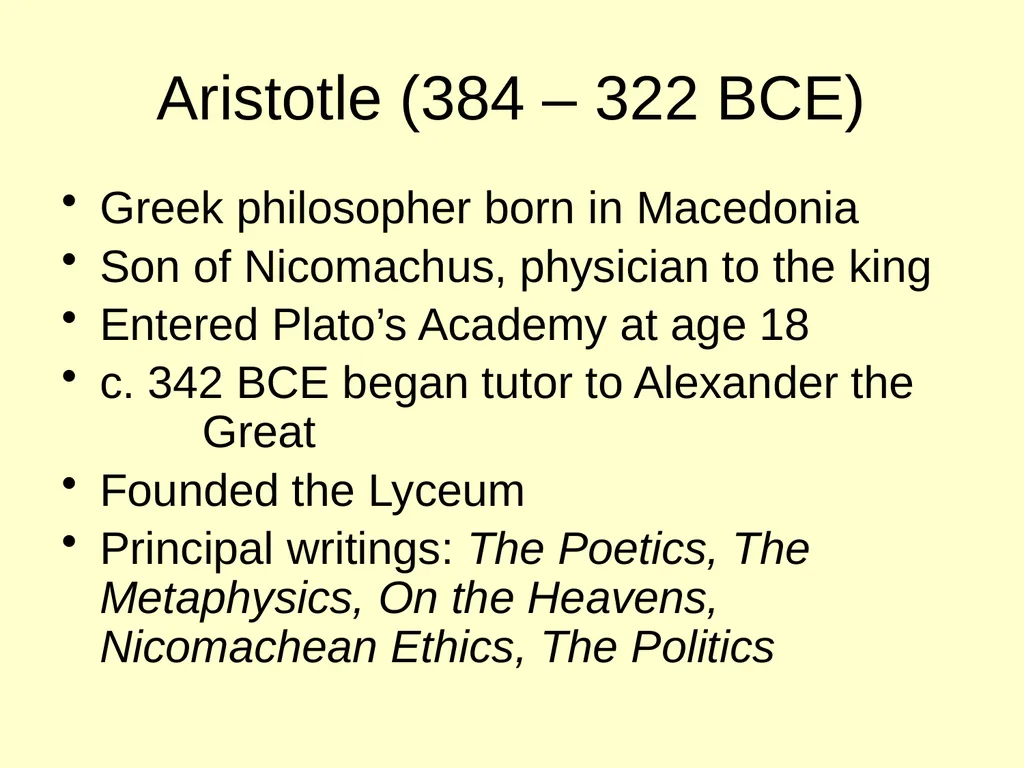
Aristotle (384 – 322 BCE) Greek philosopher born in Macedonia
Son of Nicomachus, physician to the king
Entered Plato’s Academy at age 18
c. 342 BCE began tutor to Alexander the Great
Founded the Lyceum
Principal writings: The Poetics, The Metaphysics, On the Heavens, Nicomachean Ethics, The Politics<br>
Son of Nicomachus, physician to the king
Entered Plato’s Academy at age 18
c. 342 BCE began tutor to Alexander the Great
Founded the Lyceum
Principal writings: The Poetics, The Metaphysics, On the Heavens, Nicomachean Ethics, The Politics<br>
03
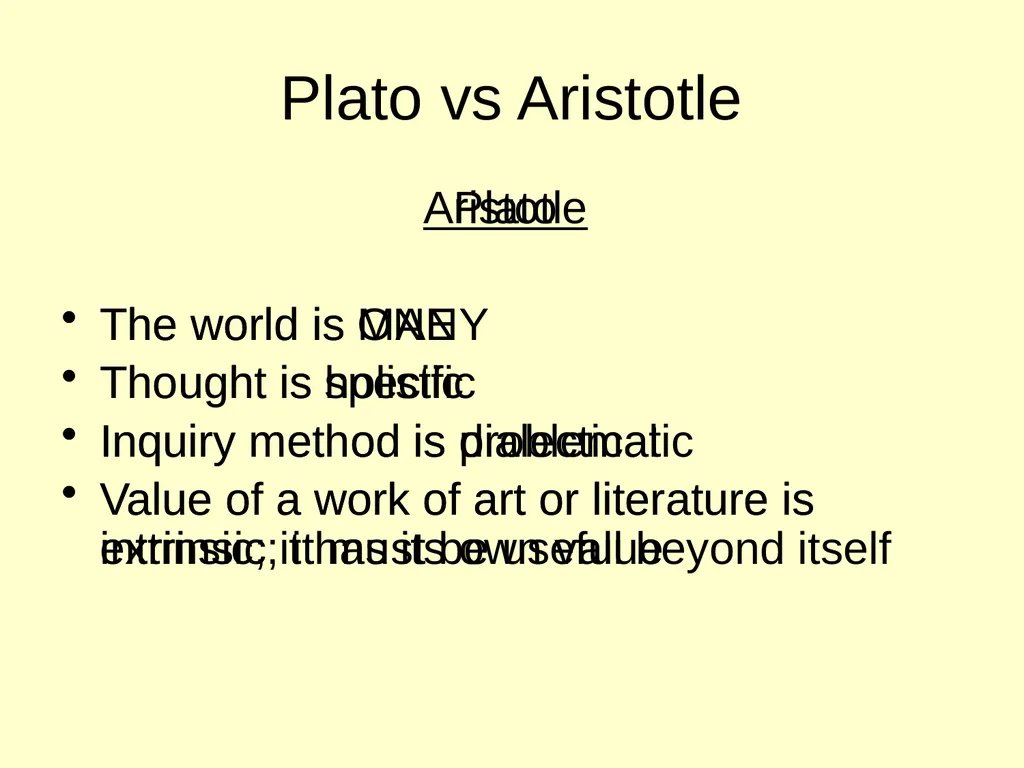
Plato vs Aristotle Plato
The world is ONE
Thought is holistic
Inquiry method is dialectical
Value of a work of art or literature is extrinsic; it must be useful beyond itself Aristotle
The world is MANY
Thought is specific
Inquiry method is problematic
Value of a work of art or literature is intrinsic; it has its own value<br>
The world is ONE
Thought is holistic
Inquiry method is dialectical
Value of a work of art or literature is extrinsic; it must be useful beyond itself Aristotle
The world is MANY
Thought is specific
Inquiry method is problematic
Value of a work of art or literature is intrinsic; it has its own value<br>
04
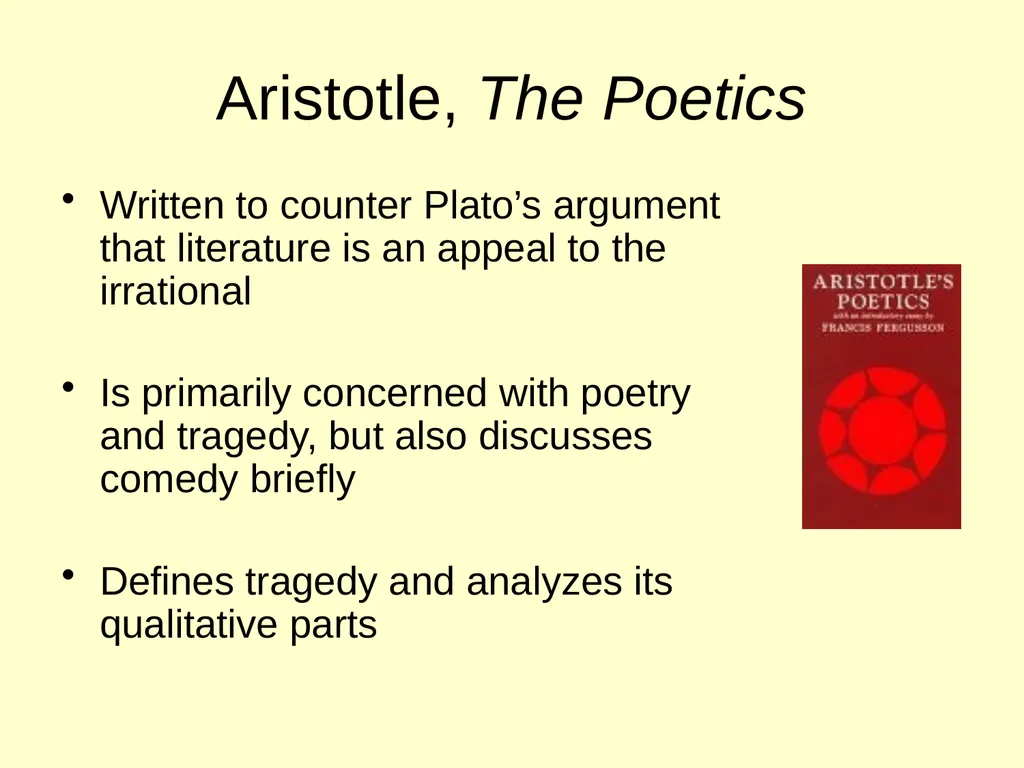
Aristotle, The Poetics Written to counter Plato’s argument that literature is an appeal to the irrational
Is primarily concerned with poetry and tragedy, but also discusses comedy briefly
Defines tragedy and analyzes its qualitative parts<br>
Is primarily concerned with poetry and tragedy, but also discusses comedy briefly
Defines tragedy and analyzes its qualitative parts<br>
05
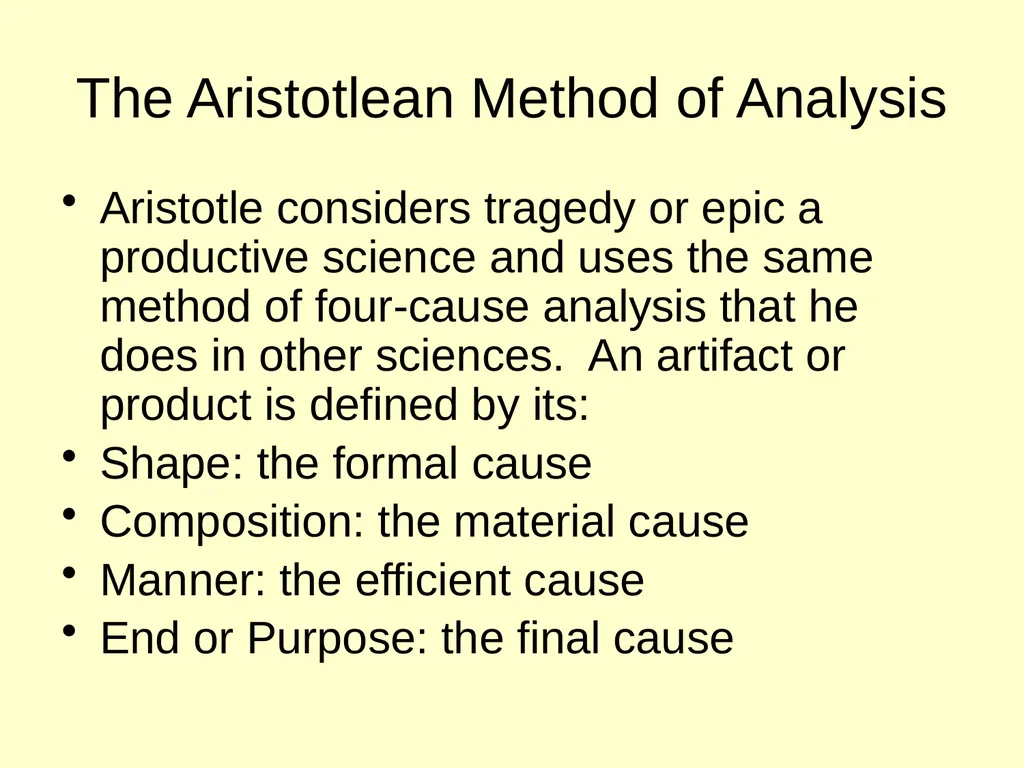
The Aristotlean Method of Analysis Aristotle considers tragedy or epic a productive science and uses the same method of four-cause analysis that he does in other sciences. An artifact or product is defined by its:
Shape: the formal cause
Composition: the material cause
Manner: the efficient cause
End or Purpose: the final cause<br>
Shape: the formal cause
Composition: the material cause
Manner: the efficient cause
End or Purpose: the final cause<br>
06
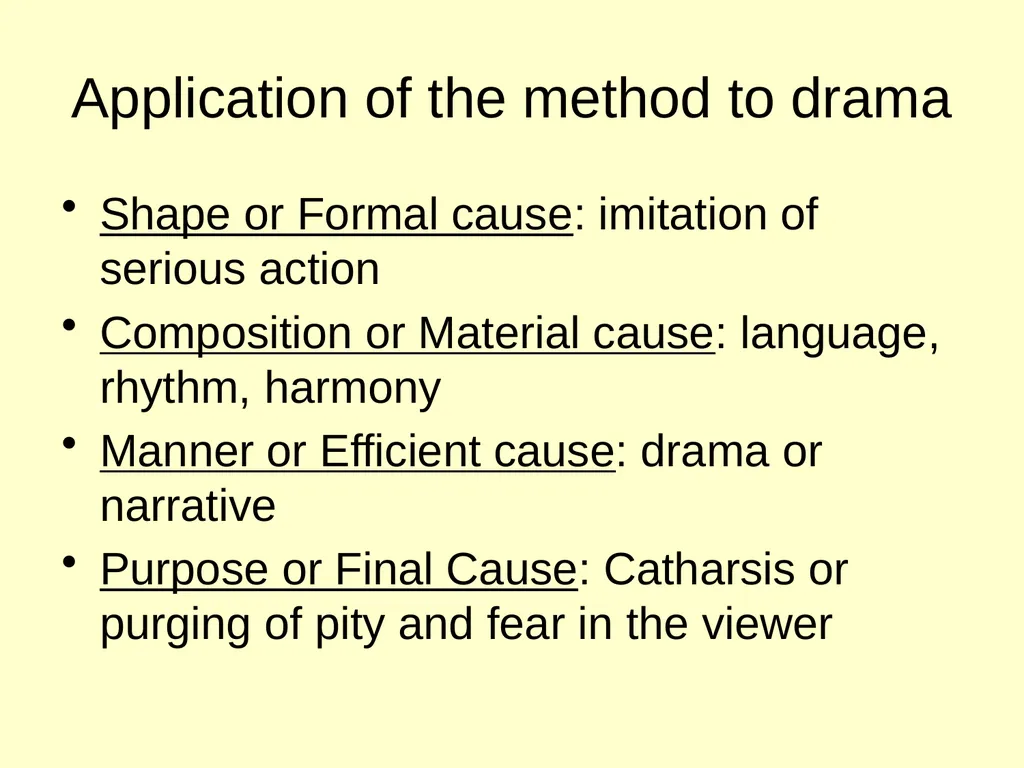
Application of the method to drama Shape or Formal cause: imitation of serious action
Composition or Material cause: language, rhythm, harmony
Manner or Efficient cause: drama or narrative
Purpose or Final Cause: Catharsis or purging of pity and fear in the viewer<br>
Composition or Material cause: language, rhythm, harmony
Manner or Efficient cause: drama or narrative
Purpose or Final Cause: Catharsis or purging of pity and fear in the viewer<br>
07
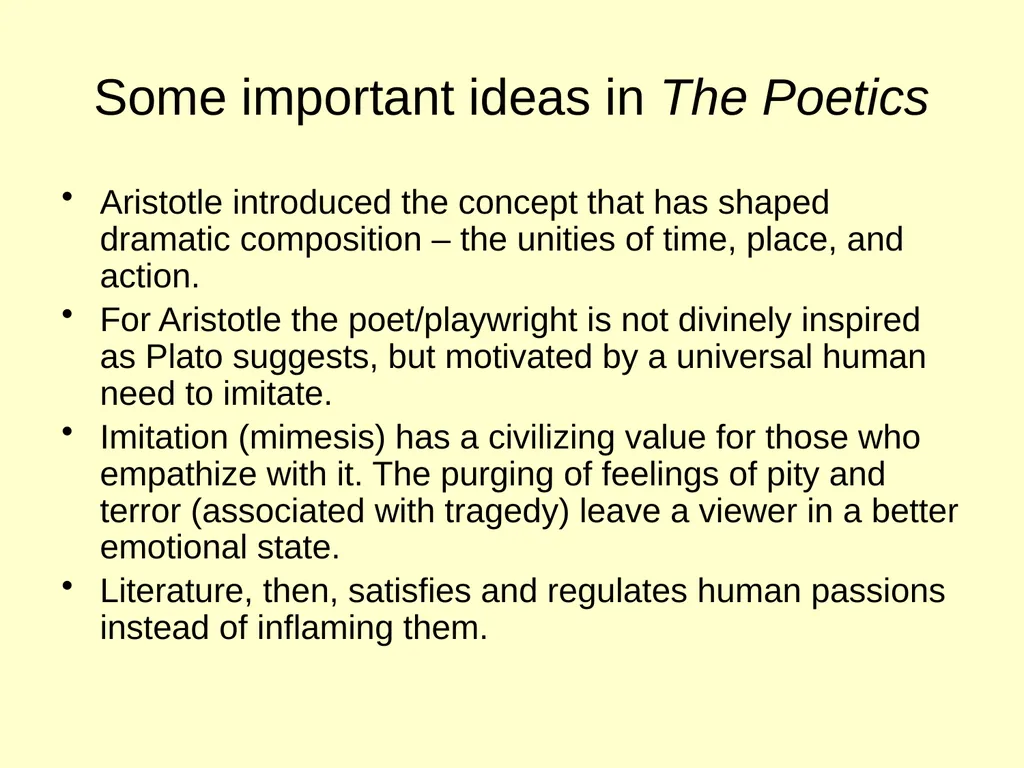
Some important ideas in The Poetics Aristotle introduced the concept that has shaped dramatic composition – the unities of time, place, and action.
For Aristotle the poet/playwright is not divinely inspired as Plato suggests, but motivated by a universal human need to imitate.
Imitation (mimesis) has a civilizing value for those who empathize with it. The purging of feelings of pity and terror (associated with tragedy) leave a viewer in a better emotional state.
Literature, then, satisfies and regulates human passions instead of inflaming them.<br>
For Aristotle the poet/playwright is not divinely inspired as Plato suggests, but motivated by a universal human need to imitate.
Imitation (mimesis) has a civilizing value for those who empathize with it. The purging of feelings of pity and terror (associated with tragedy) leave a viewer in a better emotional state.
Literature, then, satisfies and regulates human passions instead of inflaming them.<br>
08
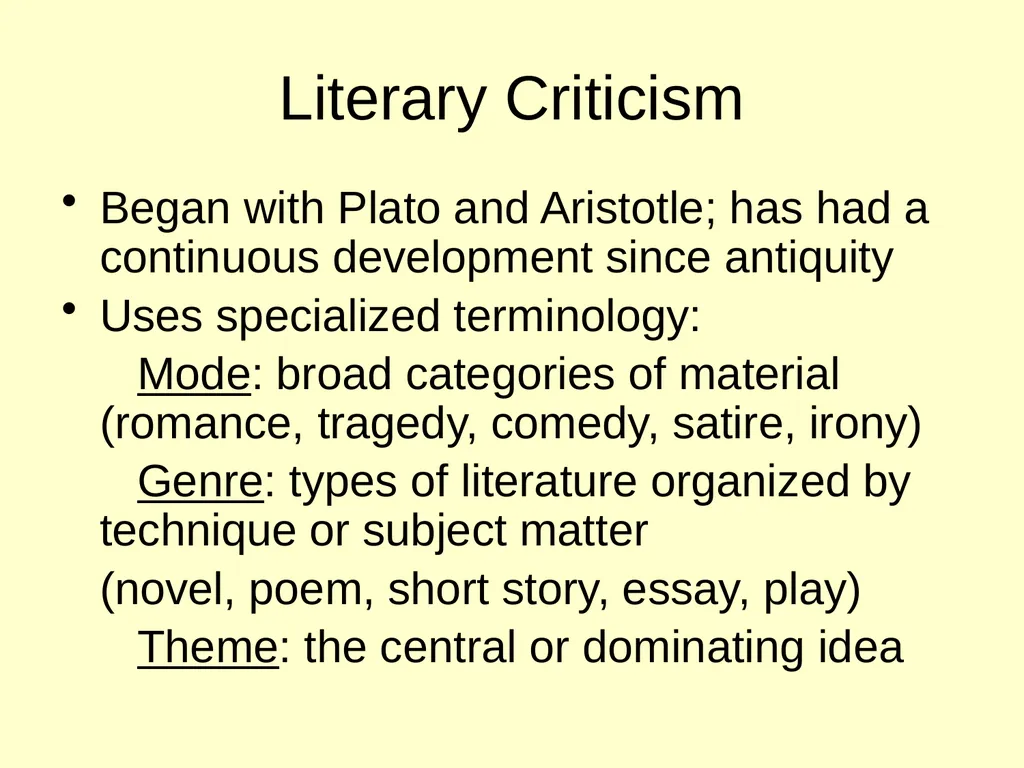
Literary Criticism Began with Plato and Aristotle; has had a continuous development since antiquity
Uses specialized terminology:
Mode: broad categories of material (romance, tragedy, comedy, satire, irony)
Genre: types of literature organized by technique or subject matter
(novel, poem, short story, essay, play)
Theme: the central or dominating idea<br>
Uses specialized terminology:
Mode: broad categories of material (romance, tragedy, comedy, satire, irony)
Genre: types of literature organized by technique or subject matter
(novel, poem, short story, essay, play)
Theme: the central or dominating idea<br>
09
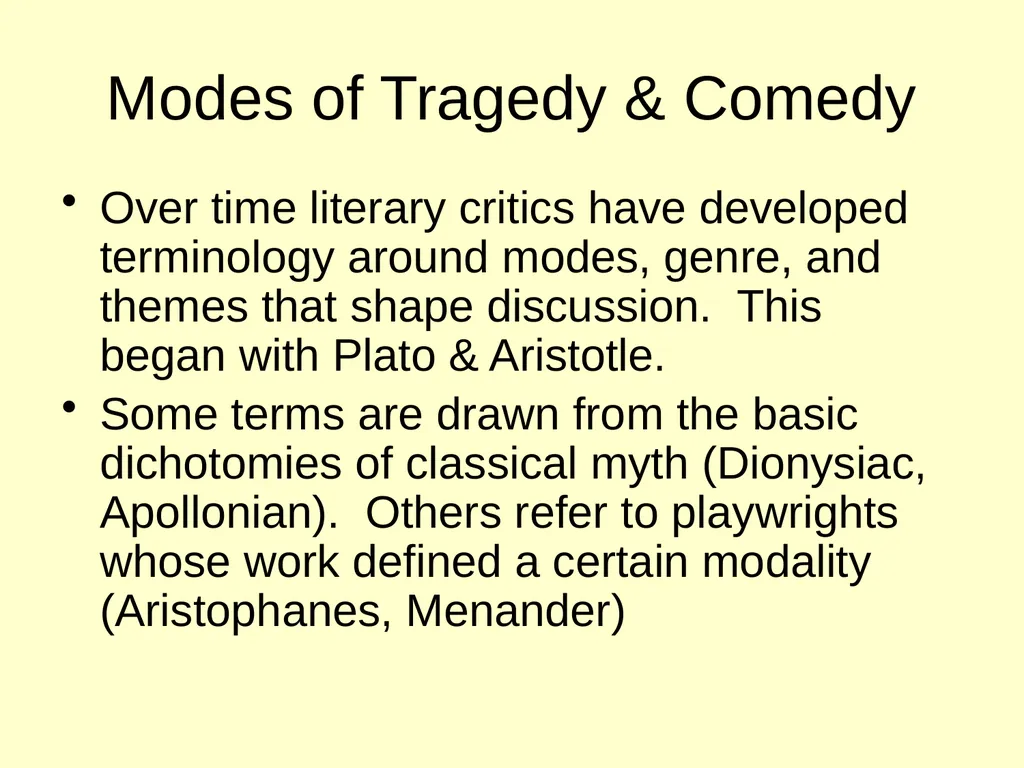
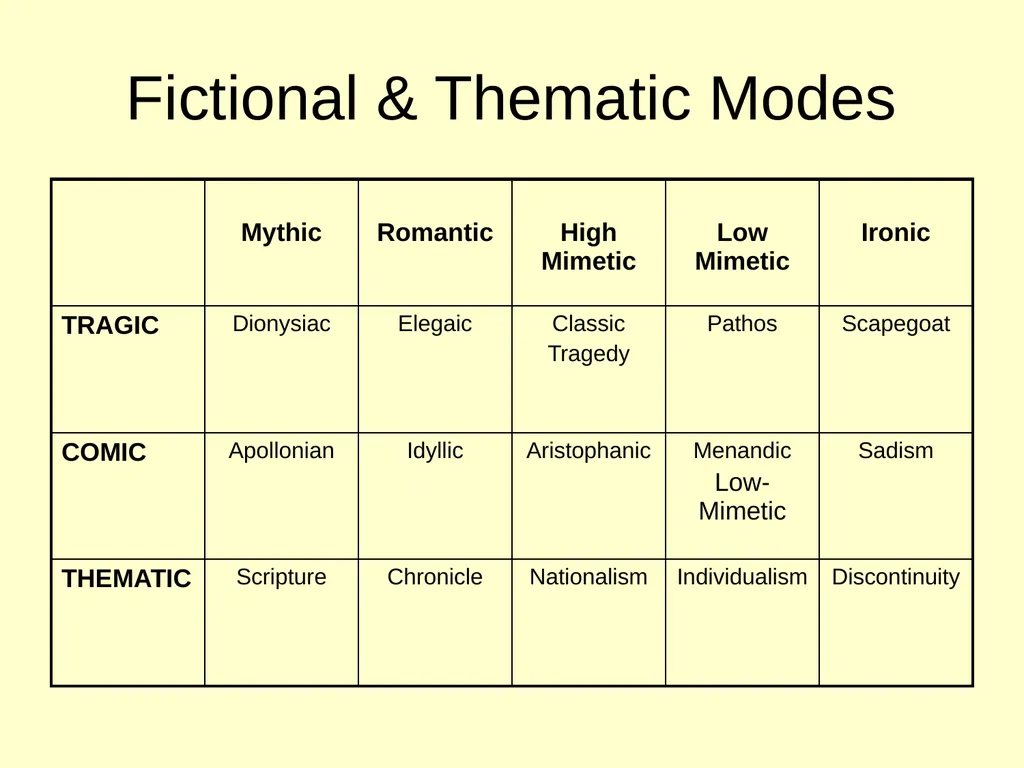
Modes of Tragedy & Comedy Over time literary critics have developed terminology around modes, genre, and themes that shape discussion. This began with Plato & Aristotle.
Some terms are drawn from the basic dichotomies of classical myth (Dionysiac, Apollonian). Others refer to playwrights whose work defined a certain modality (Aristophanes, Menander)<br>
Some terms are drawn from the basic dichotomies of classical myth (Dionysiac, Apollonian). Others refer to playwrights whose work defined a certain modality (Aristophanes, Menander)<br>
10
Fictional & Thematic Modes<br>
11
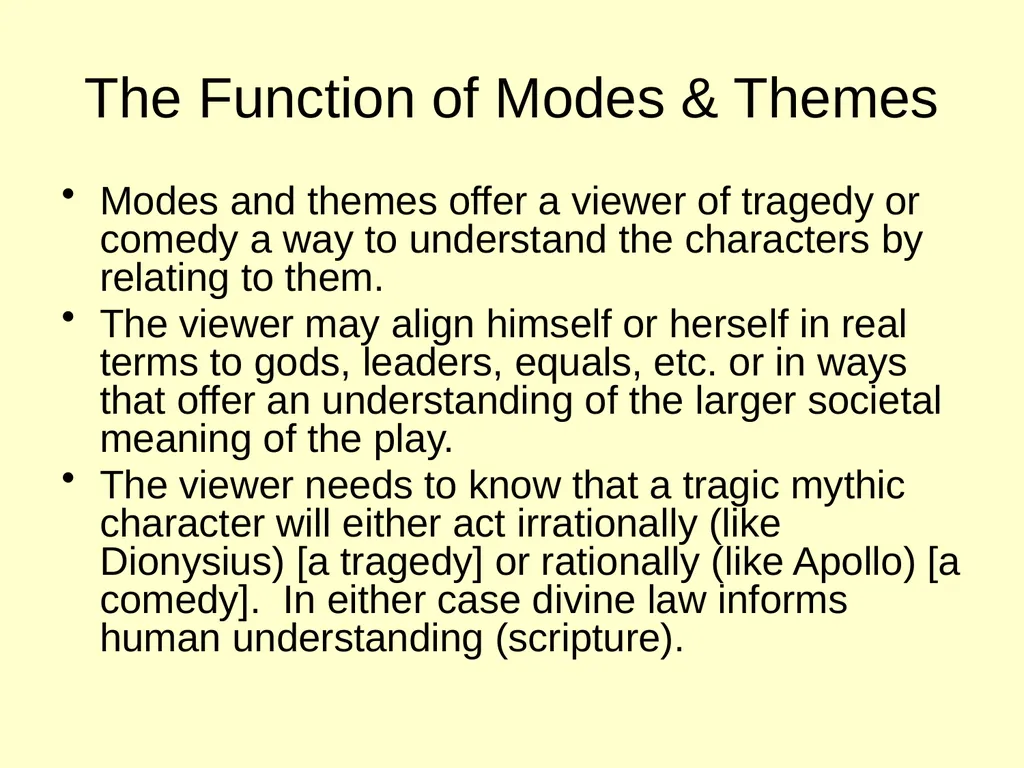
The Function of Modes & Themes Modes and themes offer a viewer of tragedy or comedy a way to understand the characters by relating to them.
The viewer may align himself or herself in real terms to gods, leaders, equals, etc. or in ways that offer an understanding of the larger societal meaning of the play.
The viewer needs to know that a tragic mythic character will either act irrationally (like Dionysius) [a tragedy] or rationally (like Apollo) [a comedy]. In either case divine law informs human understanding (scripture).<br>
The viewer may align himself or herself in real terms to gods, leaders, equals, etc. or in ways that offer an understanding of the larger societal meaning of the play.
The viewer needs to know that a tragic mythic character will either act irrationally (like Dionysius) [a tragedy] or rationally (like Apollo) [a comedy]. In either case divine law informs human understanding (scripture).<br>
12
Does this work in modern literature? Modern epics or tragedies generally involve more characters and use more themes than the classical dramas that Aristotle enjoyed. But modern epics do employ many of the devices Aristotle describes.
Consider Tolkein’s The Fellowship of the Ring.
It is a mythic romance.
Sauron and Gandalf represent the tension between the Dionysiac (irrational) and the Apollonian (rational) elements in the “divine” character. Both are superior in kind to the reader. The various heroes (Aragorn, Frodo) each reach out to the reader/viewer on a particular level. Aragorn is both mythic and romantic, but in an idyllic way. He integrates himself into a new society and fulfills his destiny. And so his people celebrate him. Frodo is romantic, but in an elegaic way because cannot re-integrate. And so the Hobbits mourn him. Both are superior in degree to other humans either because of background or because they have special advantages (the ring). The Hobbits Merry and Pippin are the placeholders for all of us in a national chronicle.<br>
Consider Tolkein’s The Fellowship of the Ring.
It is a mythic romance.
Sauron and Gandalf represent the tension between the Dionysiac (irrational) and the Apollonian (rational) elements in the “divine” character. Both are superior in kind to the reader. The various heroes (Aragorn, Frodo) each reach out to the reader/viewer on a particular level. Aragorn is both mythic and romantic, but in an idyllic way. He integrates himself into a new society and fulfills his destiny. And so his people celebrate him. Frodo is romantic, but in an elegaic way because cannot re-integrate. And so the Hobbits mourn him. Both are superior in degree to other humans either because of background or because they have special advantages (the ring). The Hobbits Merry and Pippin are the placeholders for all of us in a national chronicle.<br>
13
The Hero Whether the story is a tragedy or a comedy, the central character is the element around which the action flows.
The reader or audience is expected to engage with this hero and assumes a perspective in relationship to the hero as the action begins.<br>
The reader or audience is expected to engage with this hero and assumes a perspective in relationship to the hero as the action begins.<br>
14
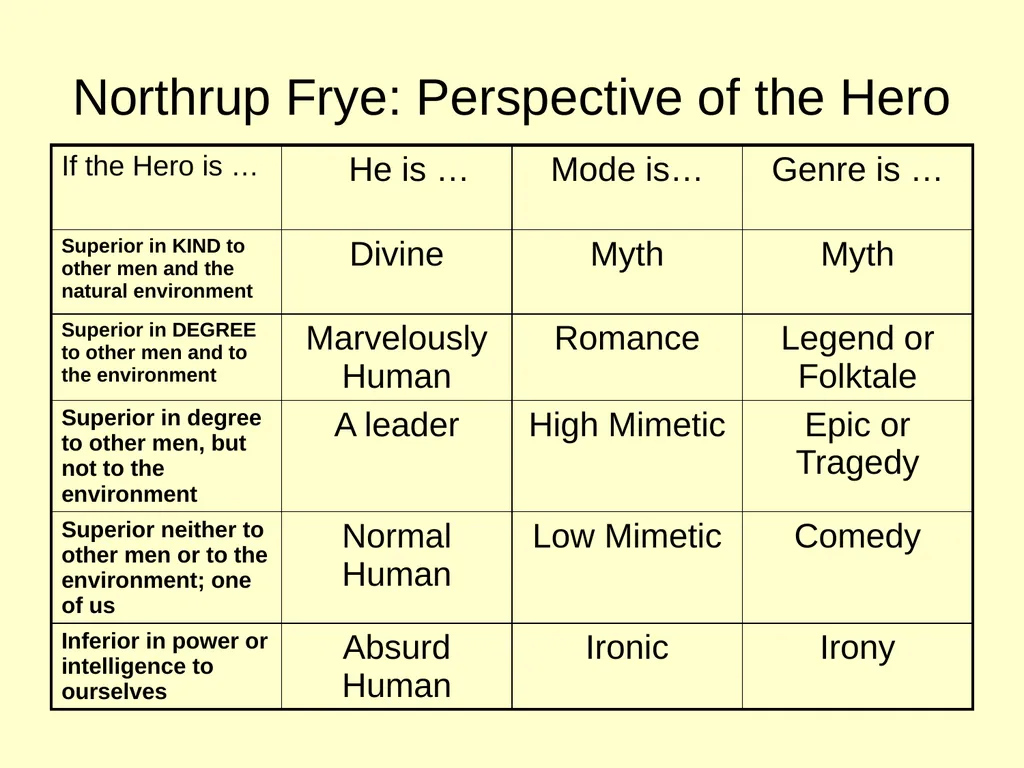
Northrup Frye: Perspective of the Hero<br>
15
What is comedy? The basic requirement of comedy is a happy ending.
The formula of comedy has more to do with conventions and expectations than with jokes or other humor.
THE COMEDY IS A STORY OF THE RISE IN FORTUNE OF A SYMPATHETIC CENTRAL CHARACTER.
Ethos is central. The social context of the hero and the way he or she acts on values shared with the audience shapes the viewer’s reaction.<br>
The formula of comedy has more to do with conventions and expectations than with jokes or other humor.
THE COMEDY IS A STORY OF THE RISE IN FORTUNE OF A SYMPATHETIC CENTRAL CHARACTER.
Ethos is central. The social context of the hero and the way he or she acts on values shared with the audience shapes the viewer’s reaction.<br>
16
Elements of Comedy A comedy is about ordinary people and situations. The audience is on an equal level in perspective with the comic hero and the cast of supporting characters.
Characters do not have to imitate actions, but rather replicate everyday situations that the viewer can anticipate. This makes the modality low mimetic.<br>
Characters do not have to imitate actions, but rather replicate everyday situations that the viewer can anticipate. This makes the modality low mimetic.<br>
17
The Comic Hero The main character must be recognizably human in every way, having just enough charm or worth to gain the support of the audience.
Aristotle says that the comic figures are “average to below average” in moral character. They are often clever servants or charming knaves. Classic examples in literature are Huck Finn or Shakespeare’s Falstaff.
Sometimes the comic hero or heroine is of low birth, but has obvious real worth. Watching such a character rise in fortune is a stock plot of comedy.
If the main character is worthless or totally inept, the play is not a comedy. It is a farce, and the modality is ironic. Ridiculous characters who are self-important rather than noble are featured in the farce or low comedy. In a farce the main character is not supported by the audience, but suffers its contempt.<br>
Aristotle says that the comic figures are “average to below average” in moral character. They are often clever servants or charming knaves. Classic examples in literature are Huck Finn or Shakespeare’s Falstaff.
Sometimes the comic hero or heroine is of low birth, but has obvious real worth. Watching such a character rise in fortune is a stock plot of comedy.
If the main character is worthless or totally inept, the play is not a comedy. It is a farce, and the modality is ironic. Ridiculous characters who are self-important rather than noble are featured in the farce or low comedy. In a farce the main character is not supported by the audience, but suffers its contempt.<br>
18
What is tragedy? Tragedy is the mirror image or negative of comedy.
Tragedy is a story of the downfall of a sympathetic central character.
Pathos is central; the audience is moved to pity by the downfall of the hero.<br>
Tragedy is a story of the downfall of a sympathetic central character.
Pathos is central; the audience is moved to pity by the downfall of the hero.<br>
19
The Origins of Tragedy Tragoedia is a Greek word meaning “goat song.” Its origins are perhaps linked to the singing of a choral lyric (dithyramb) on a circular dancing floor (orchestra) by a group of men impersonating satyrs and dressed in goat skins.
Eventually dithyramb widened from a simple chant to include mythic stories, and an actor (hypokrites – an answerer [the origin of our word hypocrite]) was introduced to answer questions posed by the chorus. This actor gradually became the “hero” and one or two more actors were added as foils to his story.<br>
Eventually dithyramb widened from a simple chant to include mythic stories, and an actor (hypokrites – an answerer [the origin of our word hypocrite]) was introduced to answer questions posed by the chorus. This actor gradually became the “hero” and one or two more actors were added as foils to his story.<br>
20
The Nature of Tragedy Greek tragedy depicts the downfall of a noble hero or heroine through a combination of excessive pride, fate, and the will of the gods.
Essential to tragedy is the audience reaction to the fall of the hero. The audience must engage with the dilemma and choices of the hero, and see himself or herself as potentially suffering in the same way. This is why most tragedy in western literature is either high mimetic (noble hero) or low mimetic (ordinary hero). Imitation is the key to audience sympathy.<br>
Essential to tragedy is the audience reaction to the fall of the hero. The audience must engage with the dilemma and choices of the hero, and see himself or herself as potentially suffering in the same way. This is why most tragedy in western literature is either high mimetic (noble hero) or low mimetic (ordinary hero). Imitation is the key to audience sympathy.<br>
21
Aristotle, Poetics, Chapter VI “Tragedy, then, is an imitation of an action that is serious, complete, and of a certain magnitude; in language embellished with each kind of artistic ornament, the several kinds being found in separate parts of the play; in the form of action, not of narrative; through pity and fear effecting the proper purgation of these emotions.”<br>
22
Aristotle’s Six Elements of Tragedy Mythos (Plot: the most important. It will always include pathos.)
Ethos (Character and setting)
Diction (Verbal Expression)
Dianoia (Thought, i.e. theme)
Spectacle (Visual adornment)
Melody (Song-composition)<br>
Ethos (Character and setting)
Diction (Verbal Expression)
Dianoia (Thought, i.e. theme)
Spectacle (Visual adornment)
Melody (Song-composition)<br>
23
The Tragic Hero A tragedy deals with a hero’s separation from society. This separation is most often the ultimate one – death.
Separation applies to Frye’s modes in this way:
Mythic: death of gods
Romance: Mourning for the death of heroes
High mimetic: death or suffering of a noble human
Low mimetic: the death or sacrifice of a normal human like ourselves
Ironic: the death or suffering of a weak and pitiful human being.<br>
Separation applies to Frye’s modes in this way:
Mythic: death of gods
Romance: Mourning for the death of heroes
High mimetic: death or suffering of a noble human
Low mimetic: the death or sacrifice of a normal human like ourselves
Ironic: the death or suffering of a weak and pitiful human being.<br>
24
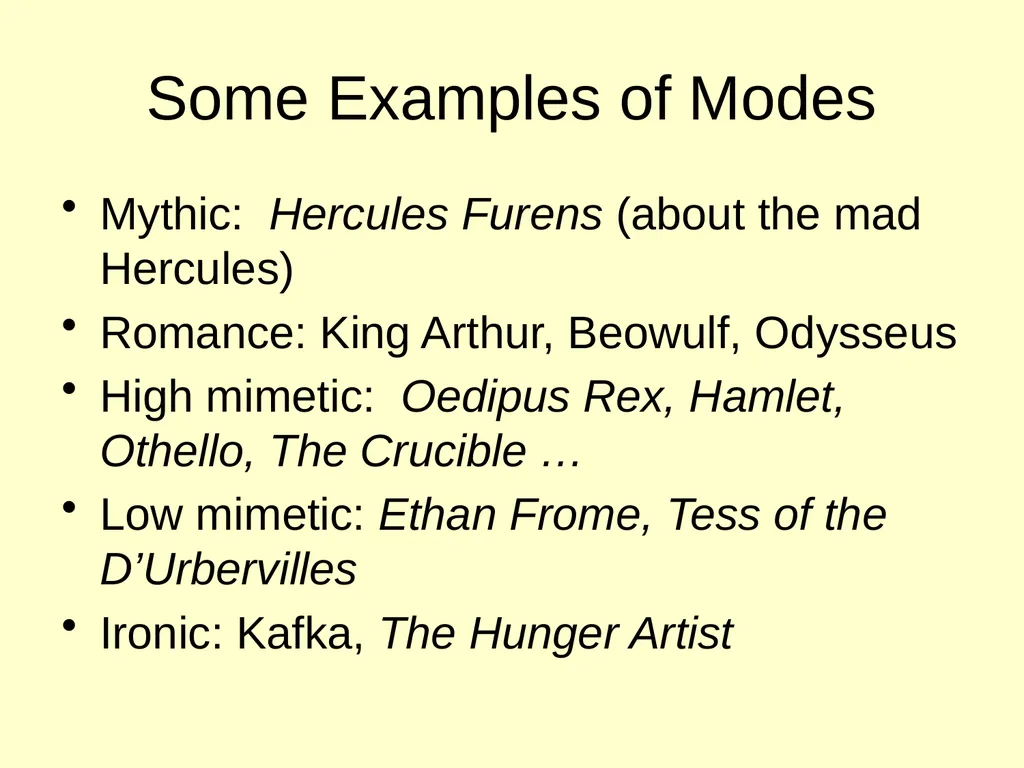
Some Examples of Modes Mythic: Hercules Furens (about the mad Hercules)
Romance: King Arthur, Beowulf, Odysseus
High mimetic: Oedipus Rex, Hamlet, Othello, The Crucible …
Low mimetic: Ethan Frome, Tess of the D’Urbervilles
Ironic: Kafka, The Hunger Artist<br>
Romance: King Arthur, Beowulf, Odysseus
High mimetic: Oedipus Rex, Hamlet, Othello, The Crucible …
Low mimetic: Ethan Frome, Tess of the D’Urbervilles
Ironic: Kafka, The Hunger Artist<br>
25
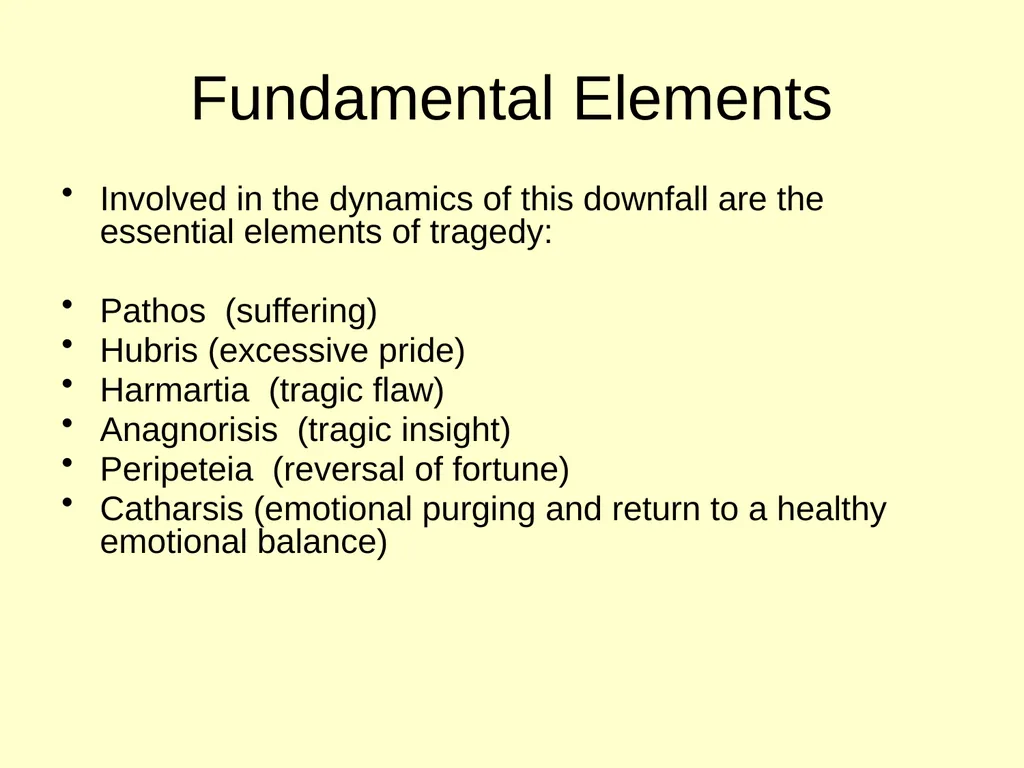
Fundamental Elements Involved in the dynamics of this downfall are the essential elements of tragedy:
Pathos (suffering)
Hubris (excessive pride)
Harmartia (tragic flaw)
Anagnorisis (tragic insight)
Peripeteia (reversal of fortune)
Catharsis (emotional purging and return to a healthy emotional balance)<br>
Pathos (suffering)
Hubris (excessive pride)
Harmartia (tragic flaw)
Anagnorisis (tragic insight)
Peripeteia (reversal of fortune)
Catharsis (emotional purging and return to a healthy emotional balance)<br>
26
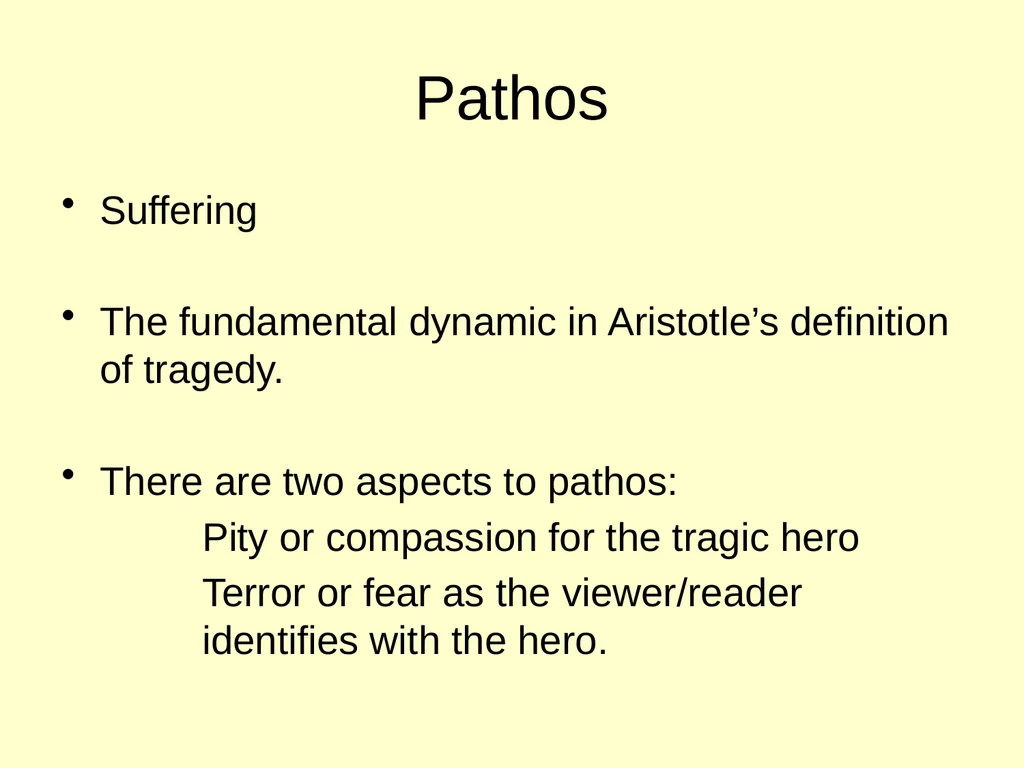
Pathos Suffering
The fundamental dynamic in Aristotle’s definition of tragedy.
There are two aspects to pathos:
Pity or compassion for the tragic hero
Terror or fear as the viewer/reader identifies with the hero.<br>
The fundamental dynamic in Aristotle’s definition of tragedy.
There are two aspects to pathos:
Pity or compassion for the tragic hero
Terror or fear as the viewer/reader identifies with the hero.<br>
27
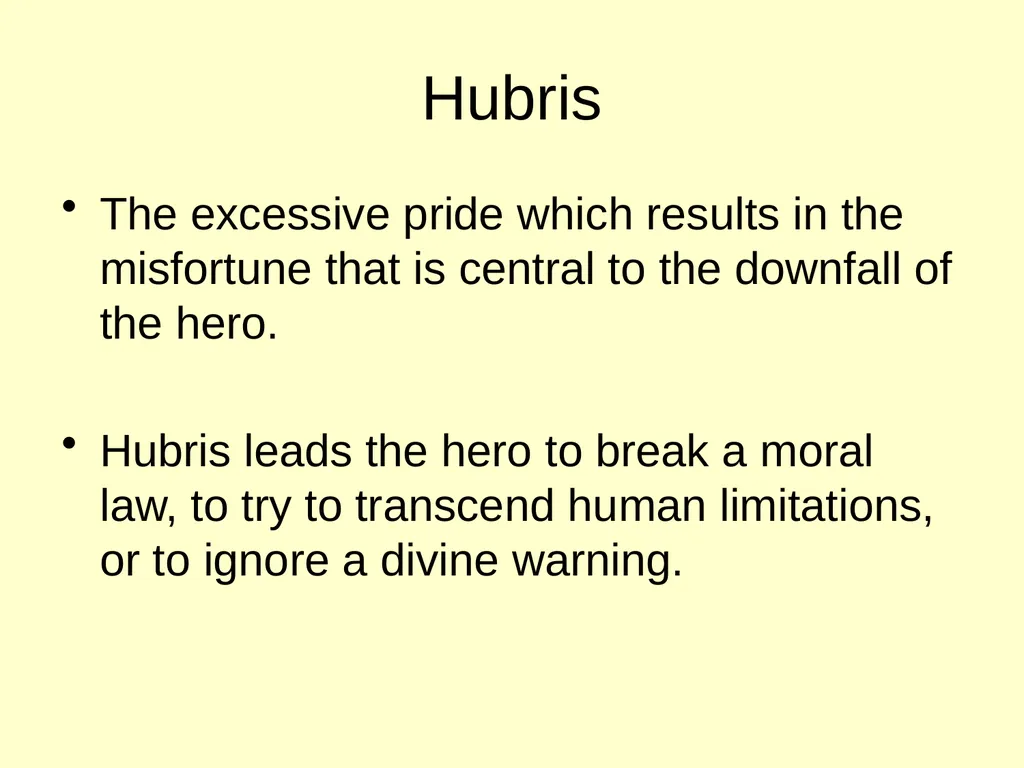
Hubris The excessive pride which results in the misfortune that is central to the downfall of the hero.
Hubris leads the hero to break a moral law, to try to transcend human limitations, or to ignore a divine warning.<br>
Hubris leads the hero to break a moral law, to try to transcend human limitations, or to ignore a divine warning.<br>
28
Harmartia The error, frailty, mistaken judgment, or misstep through which the fortunes of the tragic hero are reversed.
Aristotle says that the hero should be a person “who is not eminently good or just, yet whose misfortune is brought about by some error or frailty.”
While harmartia is often called the hero’s “tragic flaw” the flaw is not necessarily a flaw in character. It may simply be a bad choice, a decision made in ignorance, an inherited weakness, an accident, or some other mistake due to personal circumstances.<br>
Aristotle says that the hero should be a person “who is not eminently good or just, yet whose misfortune is brought about by some error or frailty.”
While harmartia is often called the hero’s “tragic flaw” the flaw is not necessarily a flaw in character. It may simply be a bad choice, a decision made in ignorance, an inherited weakness, an accident, or some other mistake due to personal circumstances.<br>
29
Anagnorisis In Aristotelian definition of tragedy it was the discovery of one's own identity or true character or of someone else's identity or true nature by the tragic hero. The discovery may arrive by messenger, but anagnorisis is the moment of insight for the hero as he suddenly understands the web of fate in which he has entangled himself.
This discovery then causes a reversal of fortune, or peripeteia.
In his Poetics, Aristotle defined anagnorisis as "a change from ignorance to knowledge, producing love or hate between the persons destined by the poet for good or bad fortune."<br>
This discovery then causes a reversal of fortune, or peripeteia.
In his Poetics, Aristotle defined anagnorisis as "a change from ignorance to knowledge, producing love or hate between the persons destined by the poet for good or bad fortune."<br>
30
Peripeteia The turning point in a drama after which the plot moves steadily to its denouement. It is discussed by Aristotle in the Poetics as the shift of the tragic protagonist's fortune from good to bad, which is essential to the plot of a tragedy. It is often an ironic twist, as in Sophocles' Oedipus Rex when a messenger brings Oedipus news about his parents that he thinks will cheer him, but the news instead slowly brings about the awful recognition that leads to Oedipus's catastrophe.
Peripeteia can occur in both comedy as well, but is most powerful in tragedy.<br>
Peripeteia can occur in both comedy as well, but is most powerful in tragedy.<br>
31
Catharsis In Aristotle’s time catharsis had both a medical and a religious connotation.
In medical terms it referred to the discharge from the body of the excess of elements produced by sickness and a return to health.
In religious terms (as explained by Plato) catharsis is the process by which the soul collects its elements, brings itself together from all parts of the body, and is able to exist “alone by itself, freed from the body as from fetters.”
Aristotle describes the objective of catharsis as something in between the two. It is defining element of tragedy and its objective is “through pity and fear effecting the proper purgation of these emotions.”
In literature a cathartic effect is produced by witnessing a tragic action. It is meant to be beneficial. How it is produced is not always clear. It might be didactic (that is, taught by the example of the hero). It might be through the “shock value” of the hero’s downfall that helps the audience work through emotional imbalances. It might also be that the hero is a scapegoat. What happens to him or her was what might have happened to the audience member and the viewer escapes his or her potential fate because the hero takes it on. In any case the idea is that the emotional struggles of the hero, which produce pity and fear in the audience, cause a kind of emotional exhaustion in the audience. This empathic identification allows for an end calm (“all passion spent”) result in the viewer, and this is beneficial both to the individual and to society.<br>
In medical terms it referred to the discharge from the body of the excess of elements produced by sickness and a return to health.
In religious terms (as explained by Plato) catharsis is the process by which the soul collects its elements, brings itself together from all parts of the body, and is able to exist “alone by itself, freed from the body as from fetters.”
Aristotle describes the objective of catharsis as something in between the two. It is defining element of tragedy and its objective is “through pity and fear effecting the proper purgation of these emotions.”
In literature a cathartic effect is produced by witnessing a tragic action. It is meant to be beneficial. How it is produced is not always clear. It might be didactic (that is, taught by the example of the hero). It might be through the “shock value” of the hero’s downfall that helps the audience work through emotional imbalances. It might also be that the hero is a scapegoat. What happens to him or her was what might have happened to the audience member and the viewer escapes his or her potential fate because the hero takes it on. In any case the idea is that the emotional struggles of the hero, which produce pity and fear in the audience, cause a kind of emotional exhaustion in the audience. This empathic identification allows for an end calm (“all passion spent”) result in the viewer, and this is beneficial both to the individual and to society.<br>
32
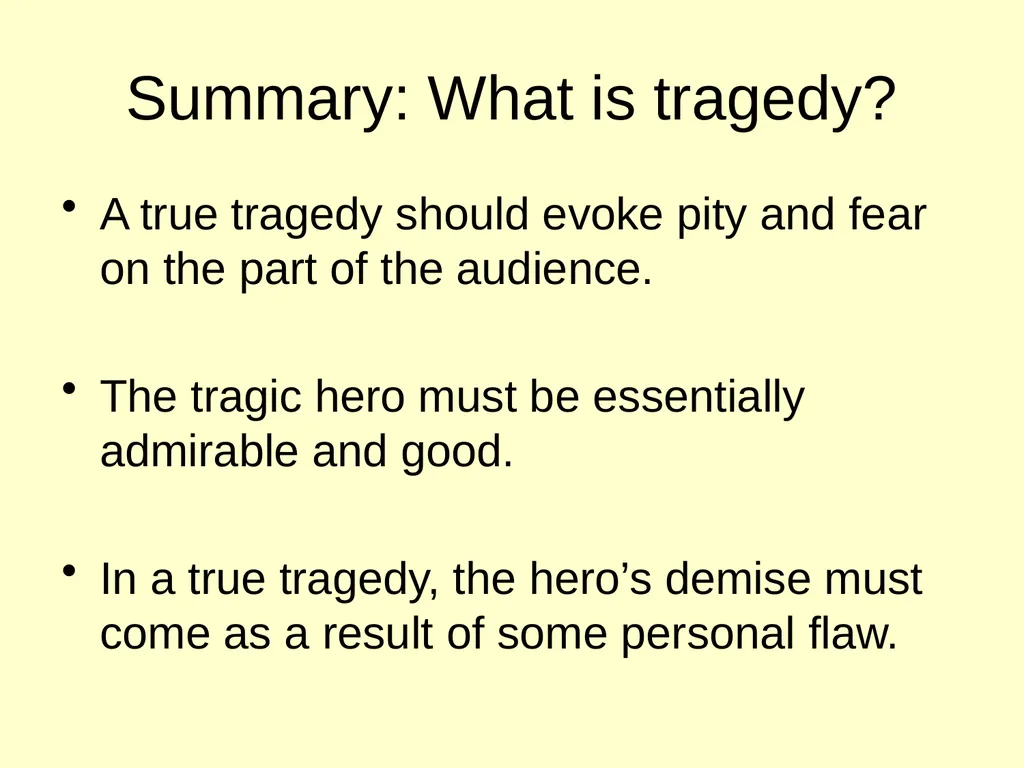
Summary: What is tragedy? A true tragedy should evoke pity and fear on the part of the audience.
The tragic hero must be essentially admirable and good.
In a true tragedy, the hero’s demise must come as a result of some personal flaw.<br>
The tragic hero must be essentially admirable and good.
In a true tragedy, the hero’s demise must come as a result of some personal flaw.<br>