ARITHMETIC PROGRESSION If various terms of a sequence are formed by adding a fixed number to the previous term or the difference between two successive terms is a fixed number, then the sequence is called AP. For example : 5, 10, 15, 20,
"ARITHMETIC PROGRESSION If various terms of a" is the property of its rightful owner. Permission is granted to
download and print the materials on this website for personal, non-commercial use only, and to display it
on your personal computer provided you do not modify the materials and that you retain all copyright
notices contained in the materials. By downloading content from our website, you accept the terms of this
agreement.
Presentation Transcript
01
ARITHMETIC
PROGRESSION<br>
02
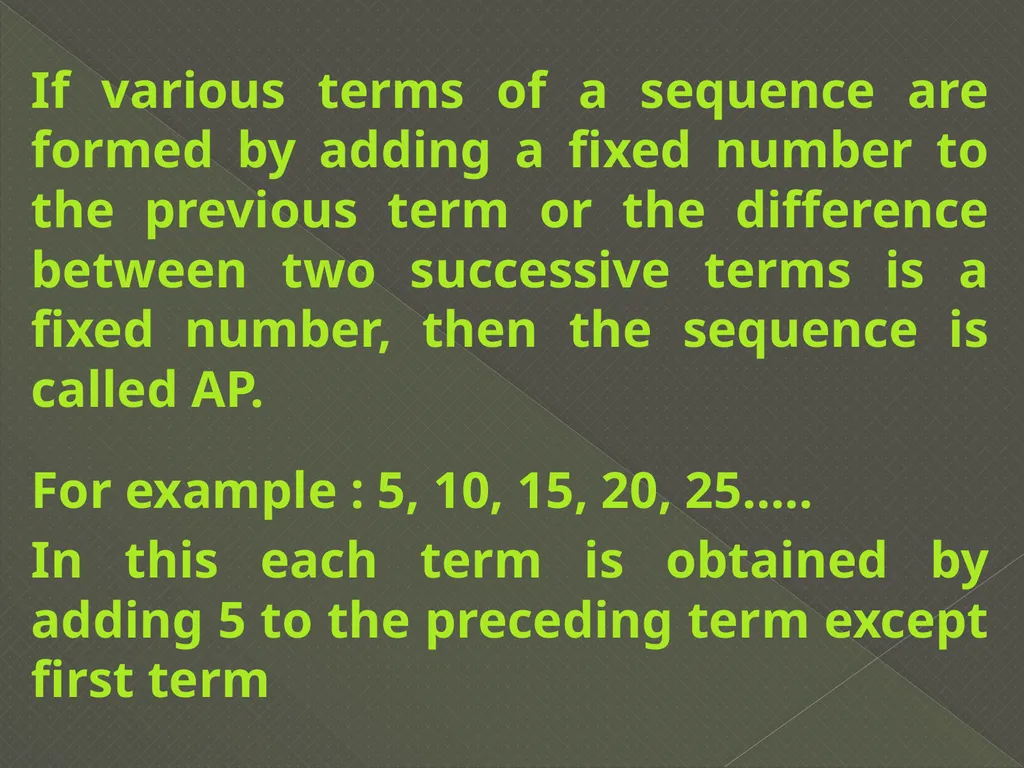
If various terms of a sequence are formed by adding a fixed number to the previous term or the difference between two successive terms is a fixed number, then the sequence is called AP. For example : 5, 10, 15, 20, 25…..
In this each term is obtained by adding 5 to the preceding term except first term<br>
03
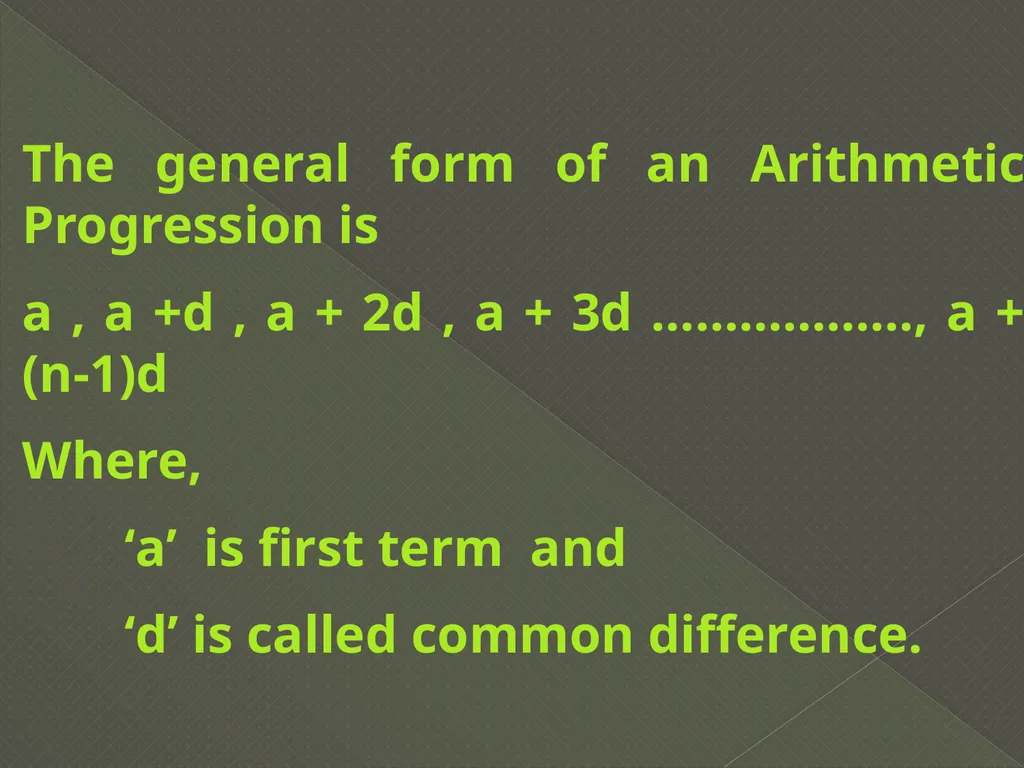
The general form of an Arithmetic Progression is
a , a +d , a + 2d , a + 3d ………………, a + (n-1)d
Where,
‘a’ is first term and
‘d’ is called common difference.<br>
04
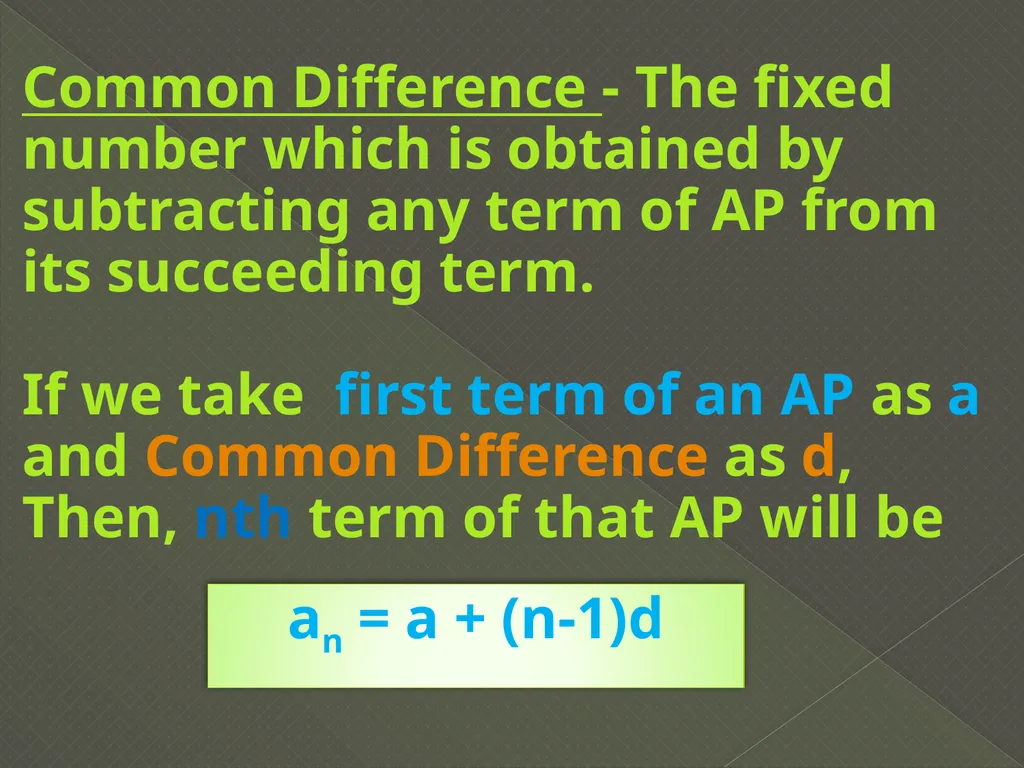
Common Difference - The fixed number which is obtained by subtracting any term of AP from its succeeding term.
If we take first term of an AP as a
and Common Difference as d,
Then, nth term of that AP will be an = a + (n-1)d<br>
05
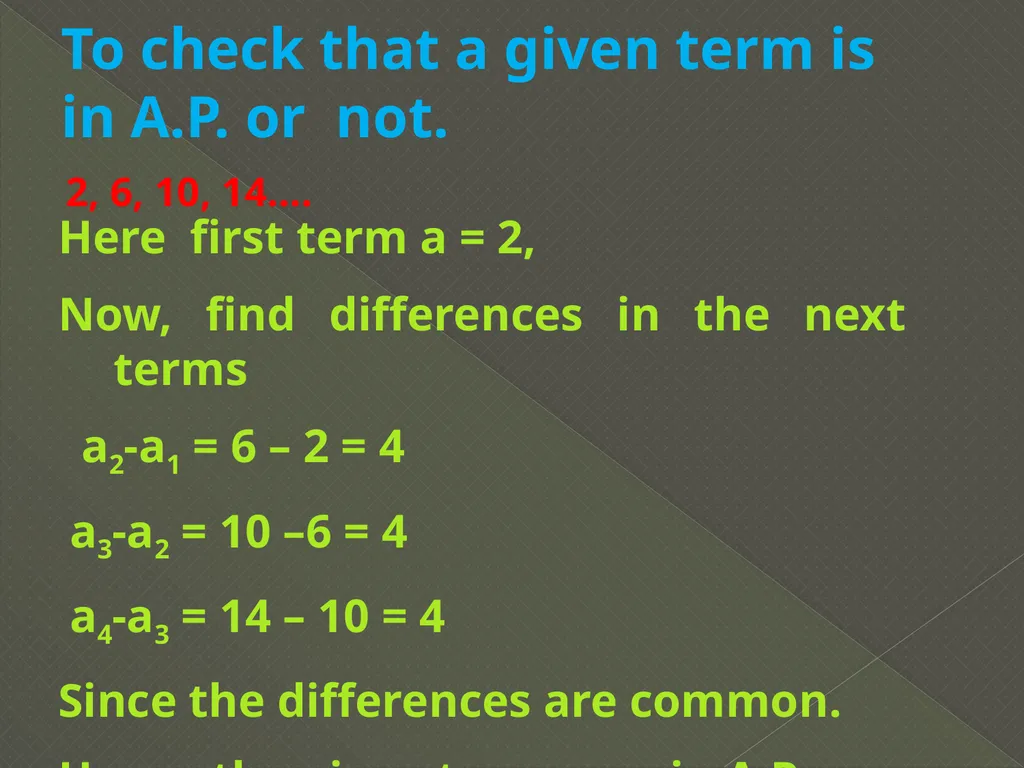
To check that a given term is in A.P. or not. 2, 6, 10, 14…. Here first term a = 2,
Now, find differences in the next terms
a2-a1 = 6 – 2 = 4
a3-a2 = 10 –6 = 4
a4-a3 = 14 – 10 = 4
Since the differences are common.
Hence the given terms are in A.P.<br>
06
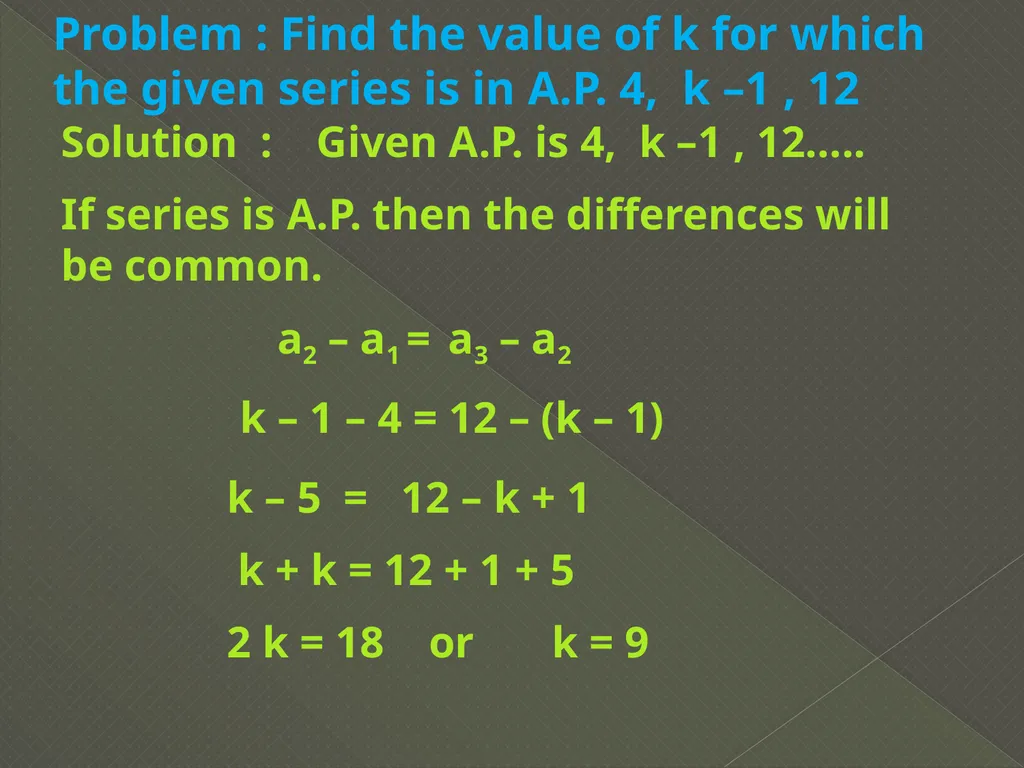
Problem : Find the value of k for which the given series is in A.P. 4, k –1 , 12 Solution : Given A.P. is 4, k –1 , 12…..
If series is A.P. then the differences will be common.
a2 – a1 = a3 – a2
k – 1 – 4 = 12 – (k – 1)
k – 5 = 12 – k + 1
k + k = 12 + 1 + 5
2 k = 18 or k = 9<br>
07
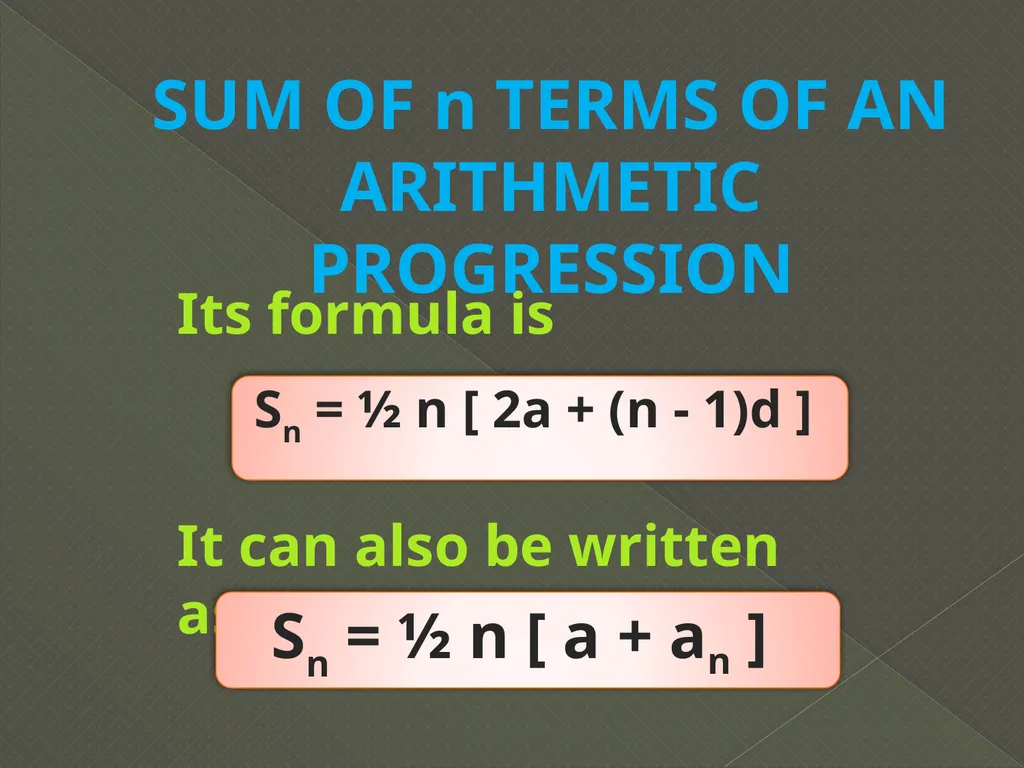
Its formula is SUM OF n TERMS OF AN ARITHMETIC PROGRESSION It can also be written as Sn = ½ n [ 2a + (n - 1)d ] Sn = ½ n [ a + an ]<br>
08
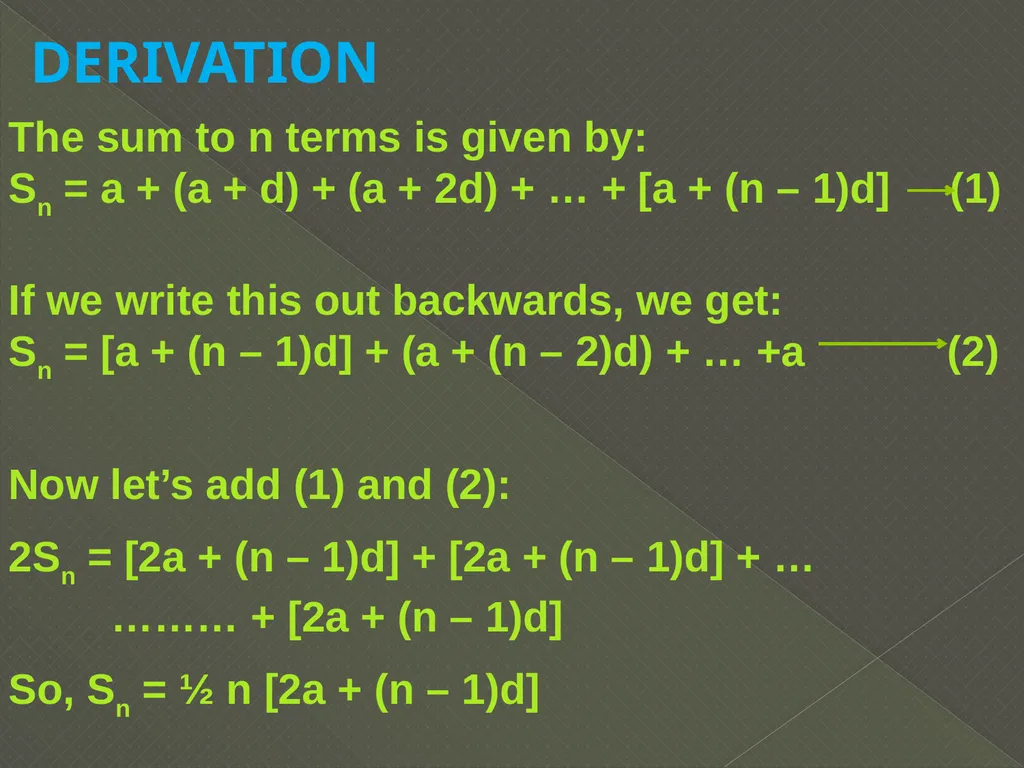
DERIVATION The sum to n terms is given by: Sn = a + (a + d) + (a + 2d) + … + [a + (n – 1)d] (1)
If we write this out backwards, we get: Sn = [a + (n – 1)d] + (a + (n – 2)d) + … +a (2)
Now let’s add (1) and (2):
2Sn = [2a + (n – 1)d] + [2a + (n – 1)d] + … ……… + [2a + (n – 1)d]
So, Sn = ½ n [2a + (n – 1)d]<br>
09
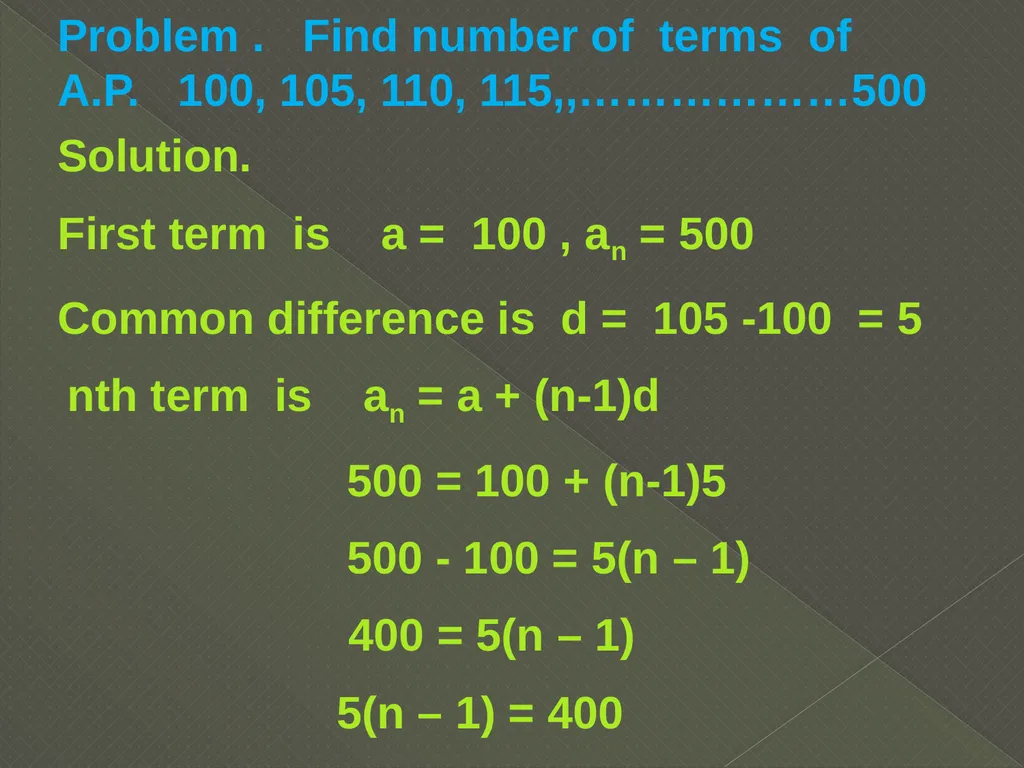
Problem . Find number of terms of A.P. 100, 105, 110, 115,,………………500 Solution.
First term is a = 100 , an = 500
Common difference is d = 105 -100 = 5
nth term is an = a + (n-1)d
500 = 100 + (n-1)5
500 - 100 = 5(n – 1)
400 = 5(n – 1)
5(n – 1) = 400<br>
10
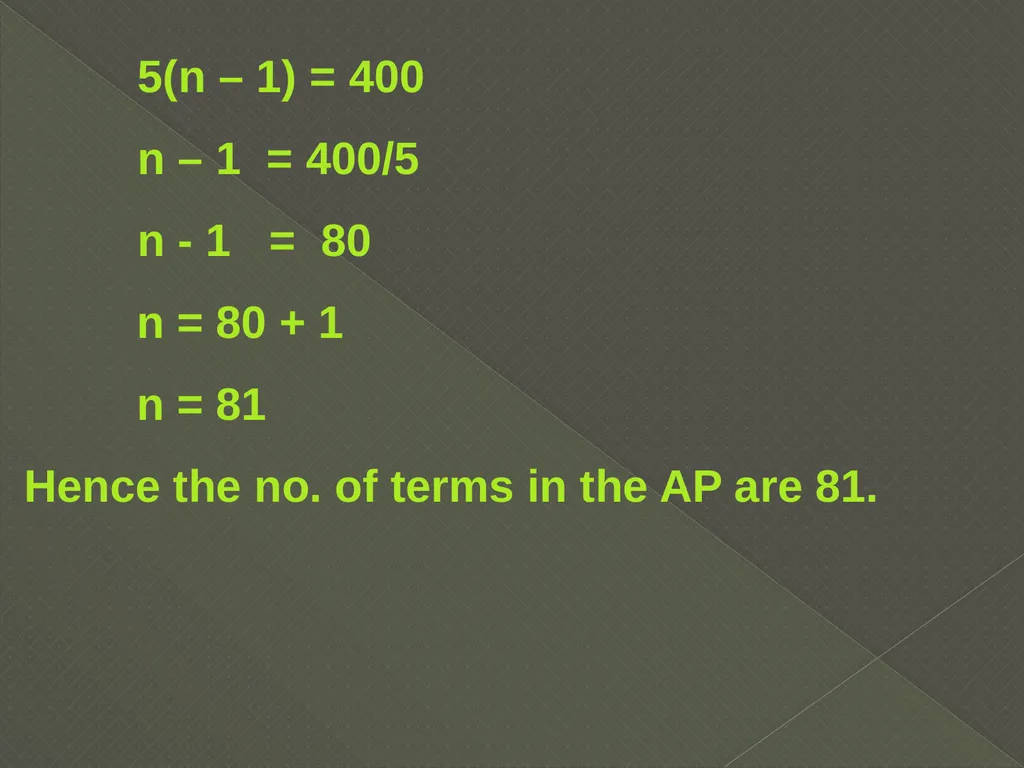
5(n – 1) = 400
n – 1 = 400/5
n - 1 = 80
n = 80 + 1
n = 81
Hence the no. of terms in the AP are 81.<br>
11
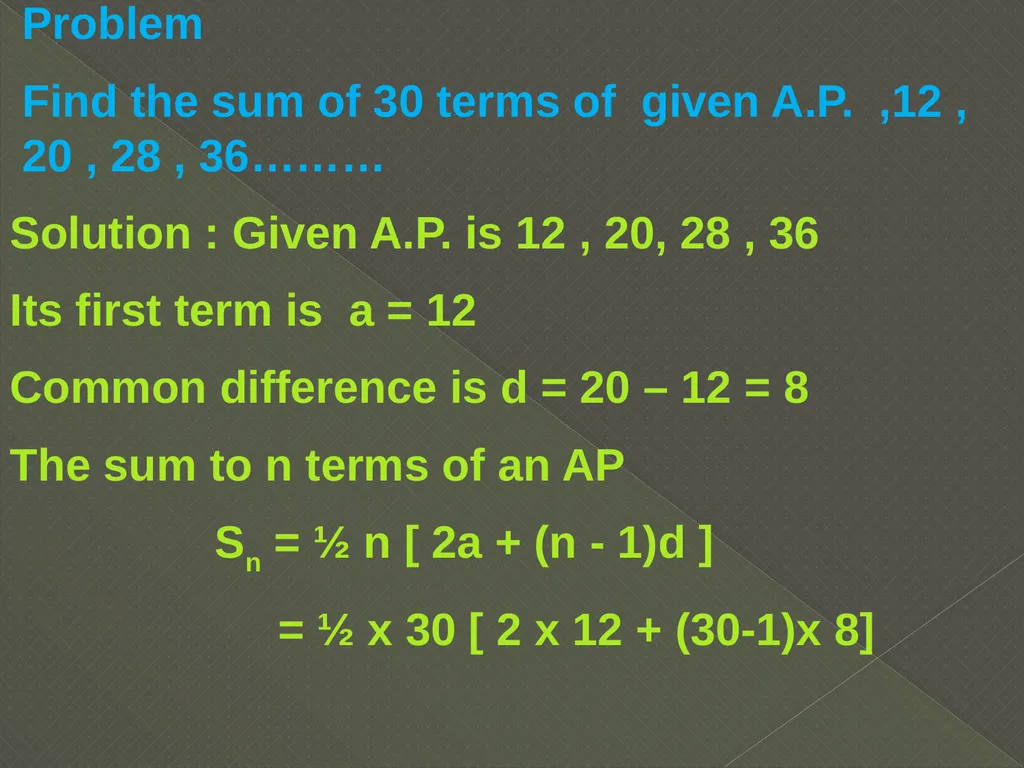
Problem
Find the sum of 30 terms of given A.P. ,12 , 20 , 28 , 36……… Solution : Given A.P. is 12 , 20, 28 , 36
Its first term is a = 12
Common difference is d = 20 – 12 = 8
The sum to n terms of an AP
Sn = ½ n [ 2a + (n - 1)d ]
= ½ x 30 [ 2 x 12 + (30-1)x 8]<br>
12
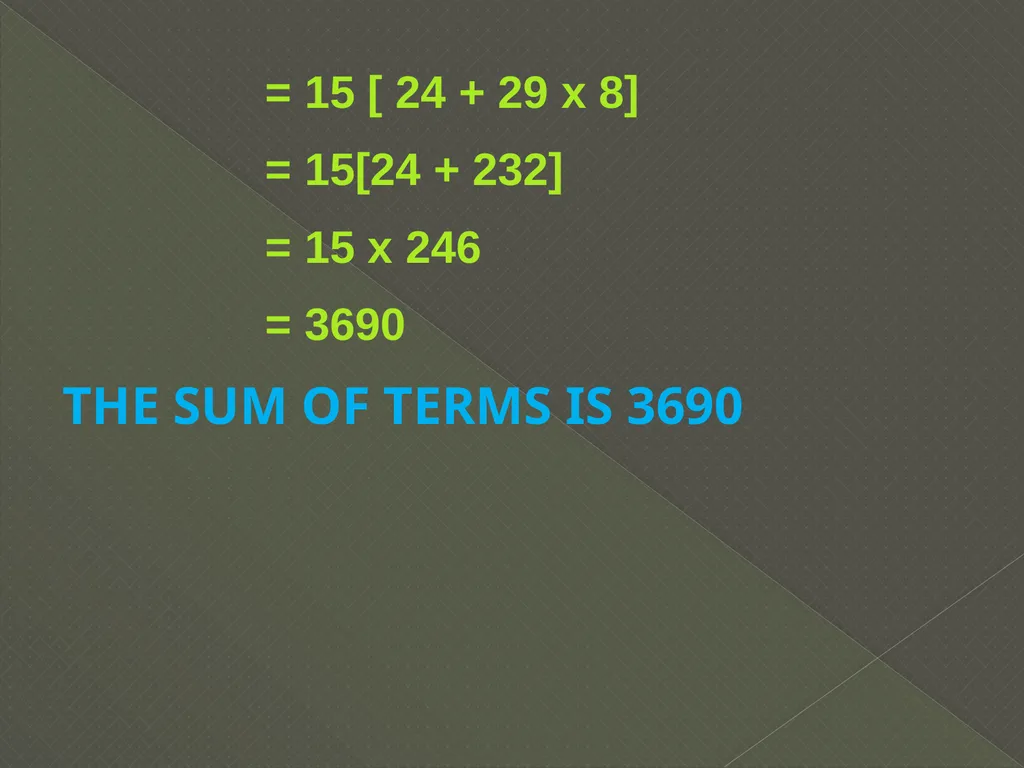
= 15 [ 24 + 29 x 8]
= 15[24 + 232]
= 15 x 246
= 3690 THE SUM OF TERMS IS 3690<br>
13
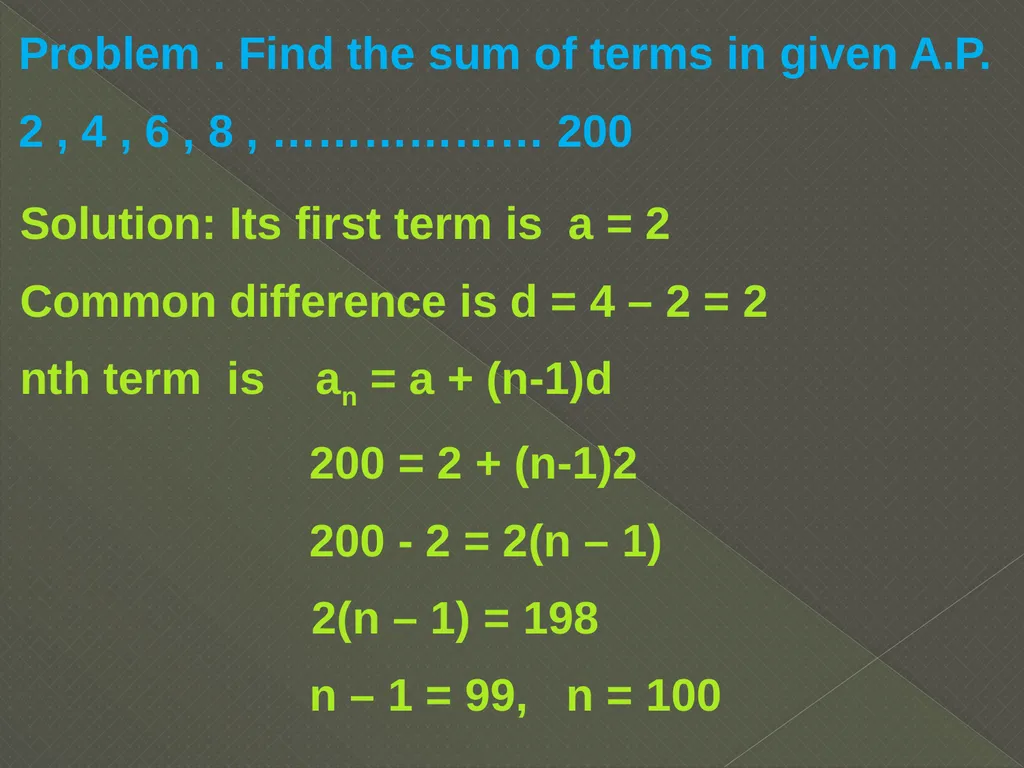
Problem . Find the sum of terms in given A.P.
2 , 4 , 6 , 8 , ……………… 200 Solution: Its first term is a = 2
Common difference is d = 4 – 2 = 2
nth term is an = a + (n-1)d
200 = 2 + (n-1)2
200 - 2 = 2(n – 1)
2(n – 1) = 198
n – 1 = 99, n = 100<br>
14
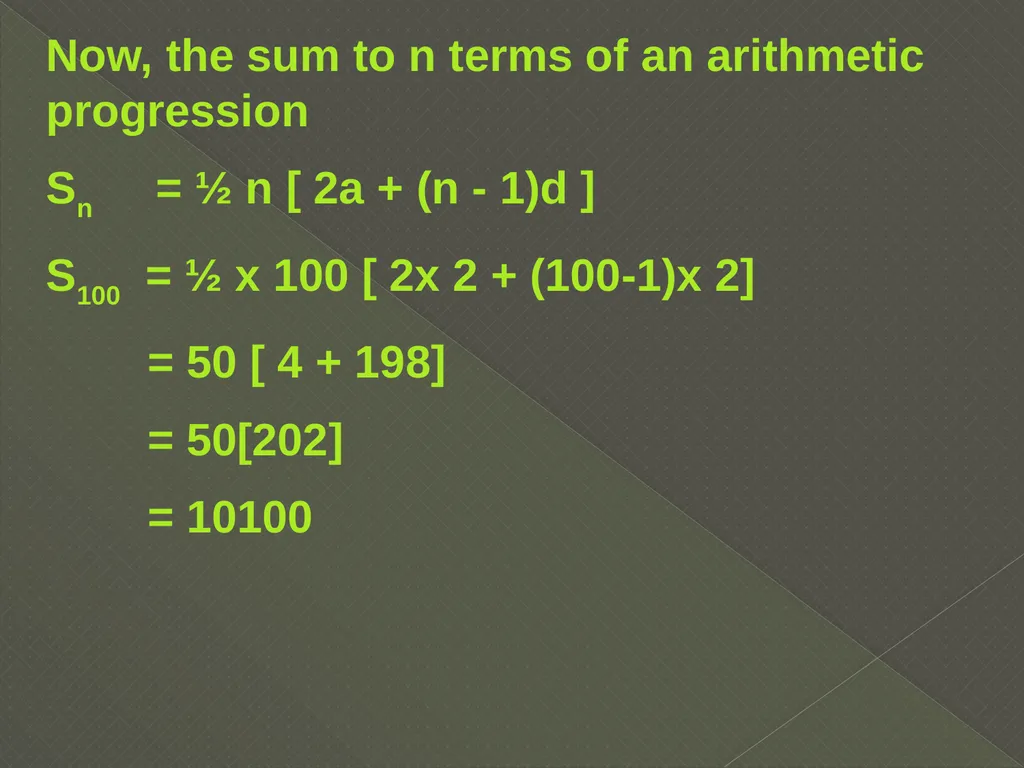
Now, the sum to n terms of an arithmetic progression
Sn = ½ n [ 2a + (n - 1)d ]
S100 = ½ x 100 [ 2x 2 + (100-1)x 2]
= 50 [ 4 + 198]
= 50[202]
= 10100<br>