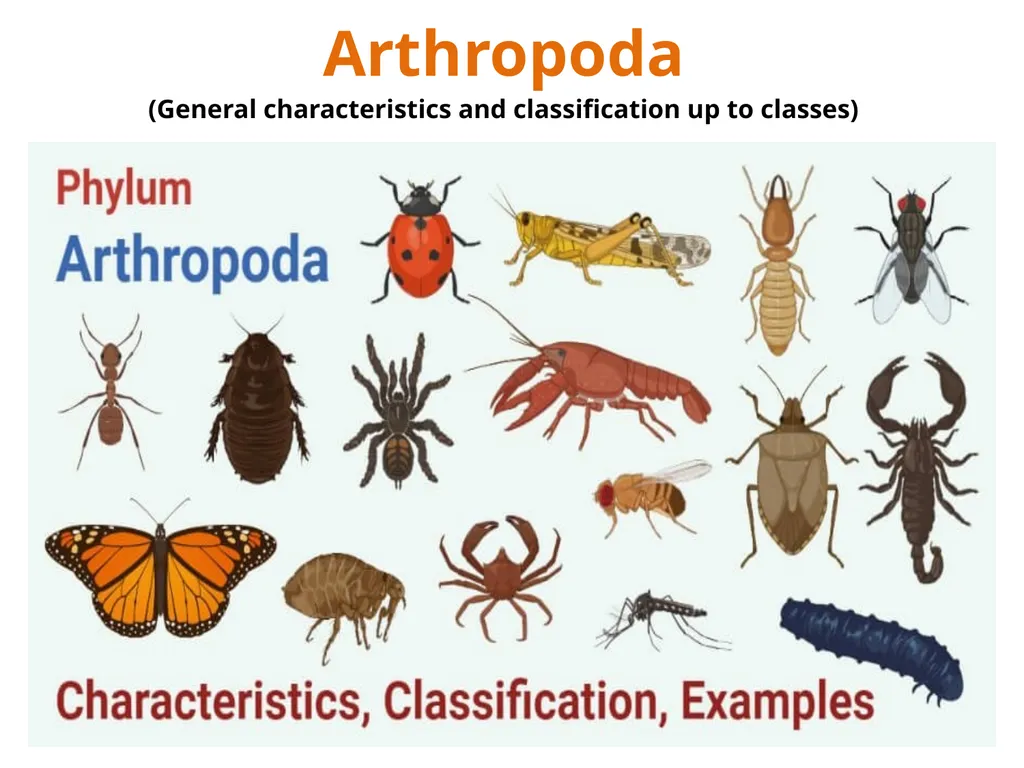
Arthropoda (General characteristics and classification up to classes) Phylum Arthropoda is the largest phylum of the animal kingdom. The word comes from Greek arthron ( joint) and podos or pous ( foot) i.e. animals with jointed legs.
"Arthropoda (General characteristics and" is the property of its rightful owner. Permission is granted to
download and print the materials on this website for personal, non-commercial use only, and to display it
on your personal computer provided you do not modify the materials and that you retain all copyright
notices contained in the materials. By downloading content from our website, you accept the terms of this
agreement.
Presentation Transcript
01
Arthropoda
(General characteristics and classification up to classes)<br>
02
Phylum Arthropoda is the largest phylum of the animal kingdom.
The word comes from Greek arthron (= joint) and podos or pous (= foot) i.e. “animals with jointed legs”.
This represents approximately three-quarters of all known biological organisms, living or extinct.<br>
03
Characteristic Features of Arthropods:
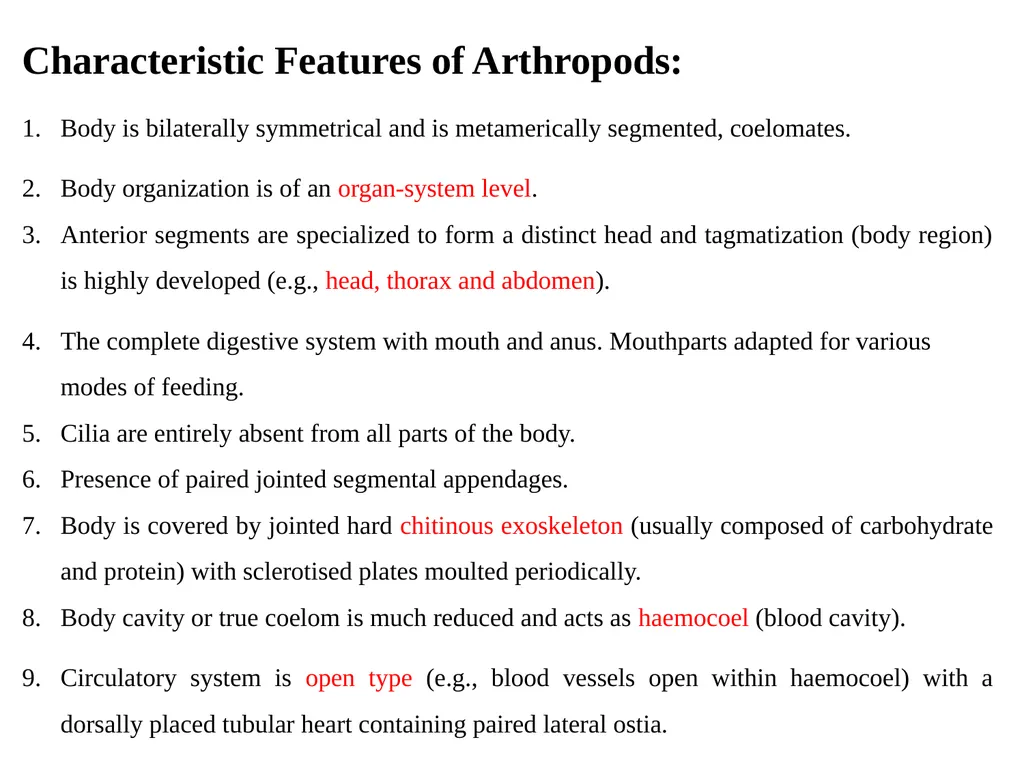
Body is bilaterally symmetrical and is metamerically segmented, coelomates.
Body organization is of an organ-system level.
Anterior segments are specialized to form a distinct head and tagmatization (body region) is highly developed (e.g., head, thorax and abdomen).
The complete digestive system with mouth and anus. Mouthparts adapted for various modes of feeding.
Cilia are entirely absent from all parts of the body.
Presence of paired jointed segmental appendages.
Body is covered by jointed hard chitinous exoskeleton (usually composed of carbohydrate and protein) with sclerotised plates moulted periodically.
Body cavity or true coelom is much reduced and acts as haemocoel (blood cavity).
Circulatory system is open type (e.g., blood vessels open within haemocoel) with a dorsally placed tubular heart containing paired lateral ostia.<br>
04
The Malpighian tubules act as excretory organs, found in many terrestrial arthropods.
Respiration by gills, trachea, book gill or book lung and other types.
Central nervous system includes a dorsally placed anterior brain and ganglionated double ventral nerve cord.
Sense organs include compound eye, simple eyes, antennae, statocycts etc. Presence of compound eyes in many groups (e.g., many crustaceans and most insects), in which each eye is composed of several visual units (e.g., ommatidia).
Sexes are usually separate; some hermaphrodite.
Fertilization internal in terrestrial species but external in aquatic species.
Development may be direct or indirect (e.g., via larval stages).
Parental care is often well marked in many arthropods.<br>
05
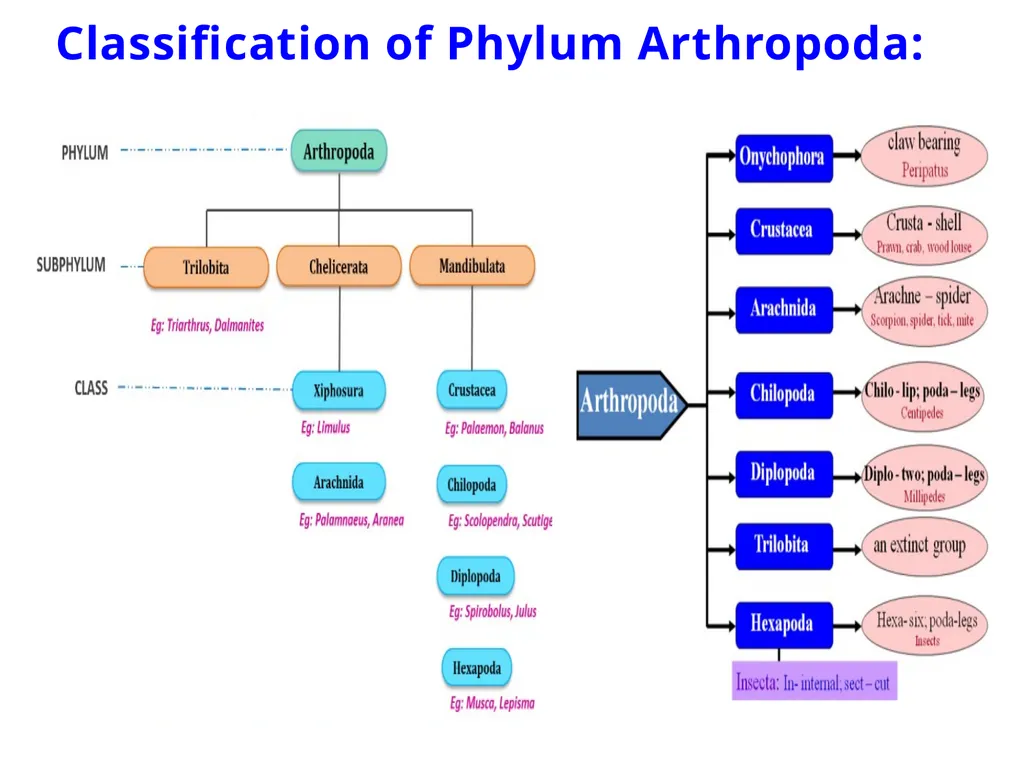
Classification of Phylum Arthropoda:<br>
06
Sub Phylum I: Trilobita (Gr. tri=three, lobos=lobes)
This subphylum includes extinct arthropods which were abundant during Paleozoic era.
These fossil trilobites were exclusively marine bottom dwellers.
Their body can be divided into head, thorax and pygidium.
A pair of longitudinal axial furrows divided the body into median axial lobe and two lateral pleural lobes.
Head was distinct with one pair of antennae and compound eyes.
All the post-antennal appendages were biramous and unspecialized.
Examples: Triarthus, Dalmanites<br>
07
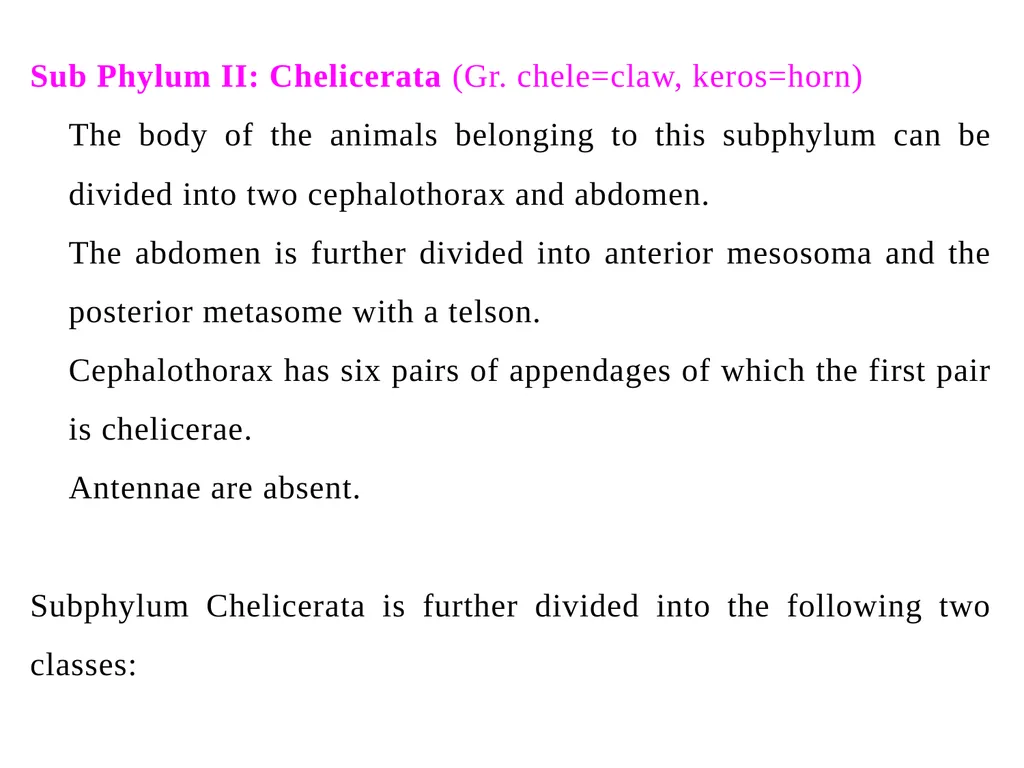
Sub Phylum II: Chelicerata (Gr. chele=claw, keros=horn)
The body of the animals belonging to this subphylum can be divided into two cephalothorax and abdomen.
The abdomen is further divided into anterior mesosoma and the posterior metasome with a telson.
Cephalothorax has six pairs of appendages of which the first pair is chelicerae.
Antennae are absent.
Subphylum Chelicerata is further divided into the following two classes:<br>
08
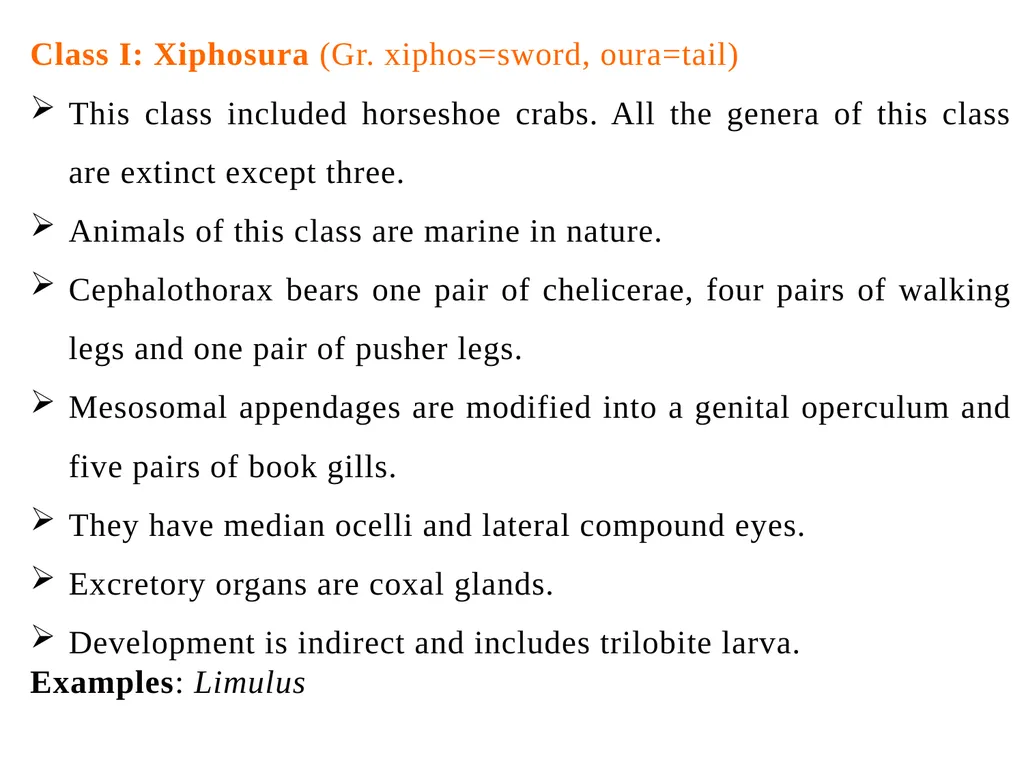
Class I: Xiphosura (Gr. xiphos=sword, oura=tail)
This class included horseshoe crabs. All the genera of this class are extinct except three.
Animals of this class are marine in nature.
Cephalothorax bears one pair of chelicerae, four pairs of walking legs and one pair of pusher legs.
Mesosomal appendages are modified into a genital operculum and five pairs of book gills.
They have median ocelli and lateral compound eyes.
Excretory organs are coxal glands.
Development is indirect and includes trilobite larva.
Examples: Limulus<br>
09
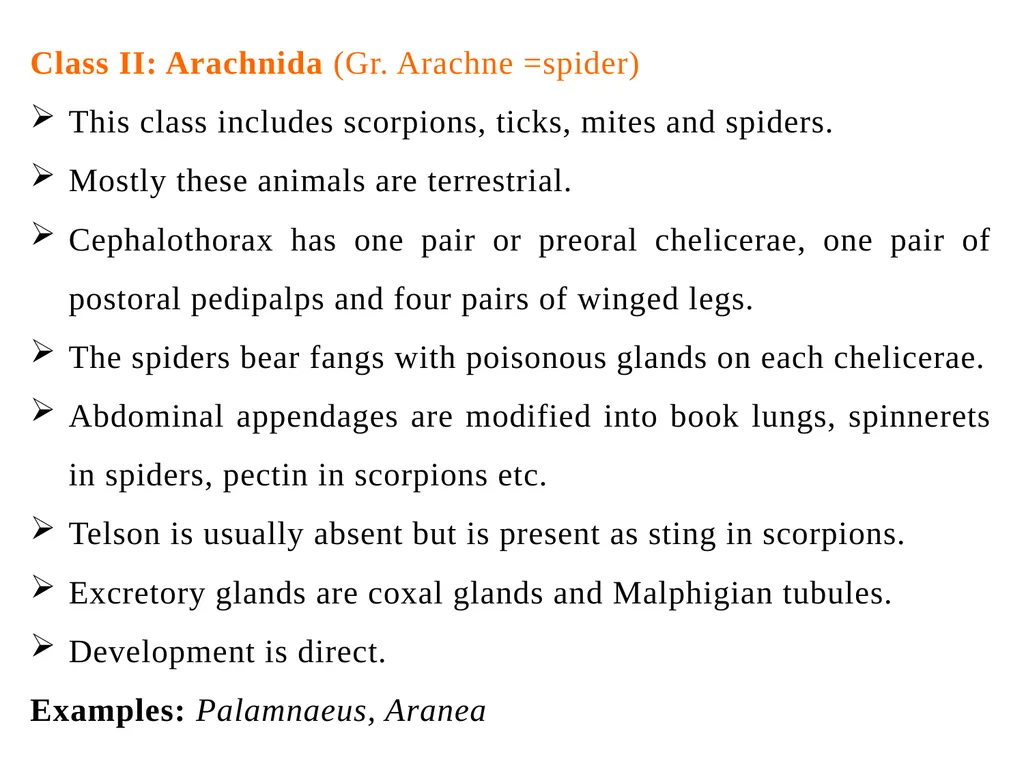
Class II: Arachnida (Gr. Arachne =spider)
This class includes scorpions, ticks, mites and spiders.
Mostly these animals are terrestrial.
Cephalothorax has one pair or preoral chelicerae, one pair of postoral pedipalps and four pairs of winged legs.
The spiders bear fangs with poisonous glands on each chelicerae.
Abdominal appendages are modified into book lungs, spinnerets in spiders, pectin in scorpions etc.
Telson is usually absent but is present as sting in scorpions.
Excretory glands are coxal glands and Malphigian tubules.
Development is direct.
Examples: Palamnaeus, Aranea<br>
10
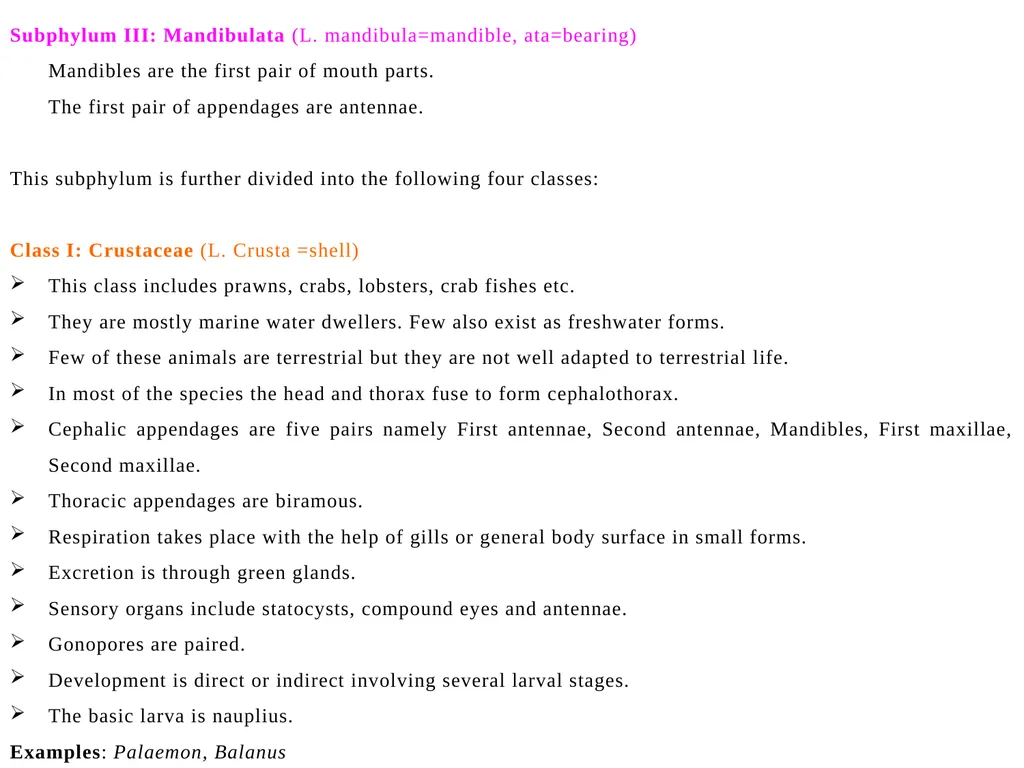
Subphylum III: Mandibulata (L. mandibula=mandible, ata=bearing)
Mandibles are the first pair of mouth parts.
The first pair of appendages are antennae.
This subphylum is further divided into the following four classes:
Class I: Crustaceae (L. Crusta =shell)
This class includes prawns, crabs, lobsters, crab fishes etc.
They are mostly marine water dwellers. Few also exist as freshwater forms.
Few of these animals are terrestrial but they are not well adapted to terrestrial life.
In most of the species the head and thorax fuse to form cephalothorax.
Cephalic appendages are five pairs namely First antennae, Second antennae, Mandibles, First maxillae, Second maxillae.
Thoracic appendages are biramous.
Respiration takes place with the help of gills or general body surface in small forms.
Excretion is through green glands.
Sensory organs include statocysts, compound eyes and antennae.
Gonopores are paired.
Development is direct or indirect involving several larval stages.
The basic larva is nauplius.
Examples: Palaemon, Balanus<br>
11
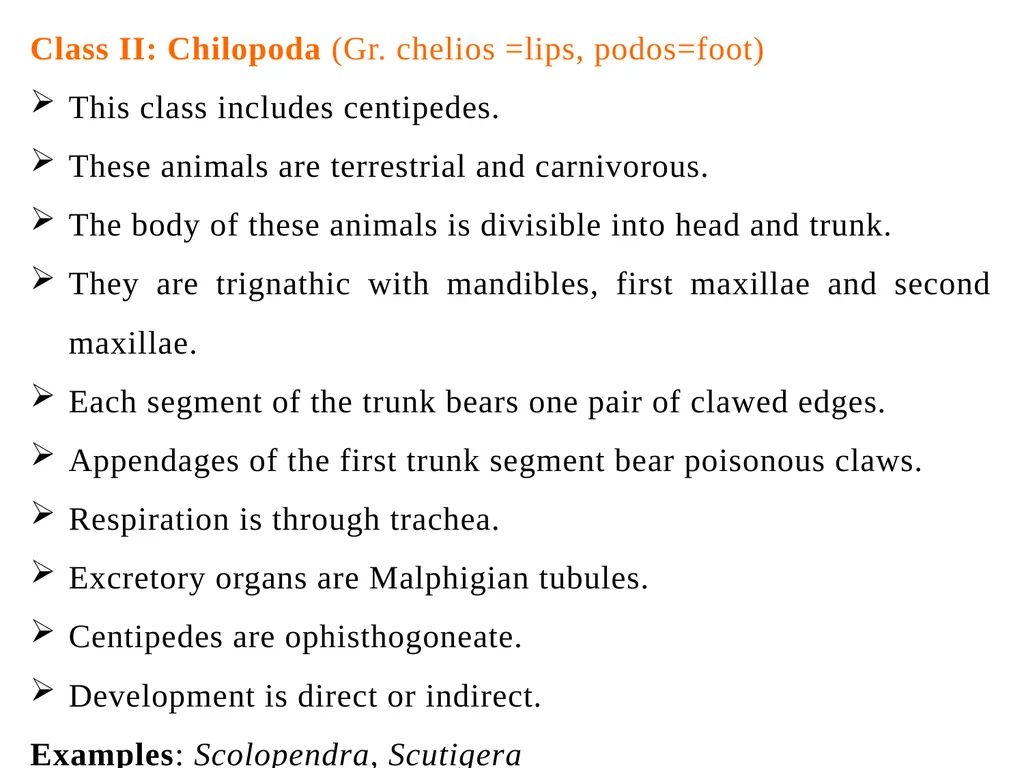
Class II: Chilopoda (Gr. chelios =lips, podos=foot)
This class includes centipedes.
These animals are terrestrial and carnivorous.
The body of these animals is divisible into head and trunk.
They are trignathic with mandibles, first maxillae and second maxillae.
Each segment of the trunk bears one pair of clawed edges.
Appendages of the first trunk segment bear poisonous claws.
Respiration is through trachea.
Excretory organs are Malphigian tubules.
Centipedes are ophisthogoneate.
Development is direct or indirect.
Examples: Scolopendra, Scutigera<br>
12
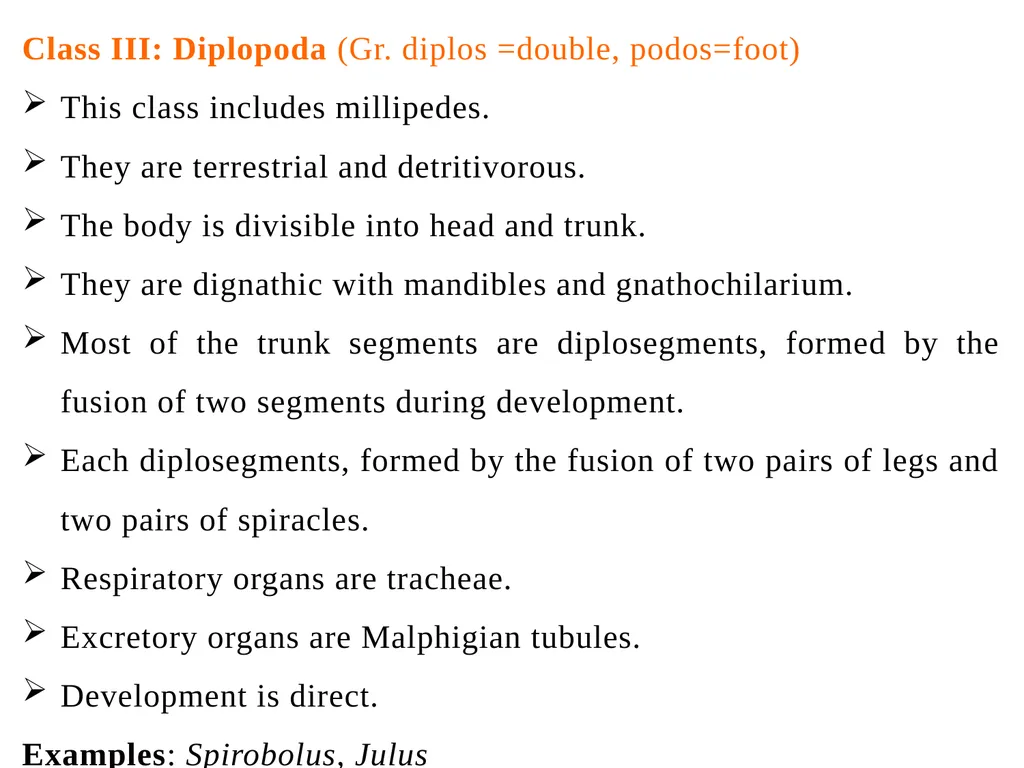
Class III: Diplopoda (Gr. diplos =double, podos=foot)
This class includes millipedes.
They are terrestrial and detritivorous.
The body is divisible into head and trunk.
They are dignathic with mandibles and gnathochilarium.
Most of the trunk segments are diplosegments, formed by the fusion of two segments during development.
Each diplosegments, formed by the fusion of two pairs of legs and two pairs of spiracles.
Respiratory organs are tracheae.
Excretory organs are Malphigian tubules.
Development is direct.
Examples: Spirobolus, Julus<br>
13
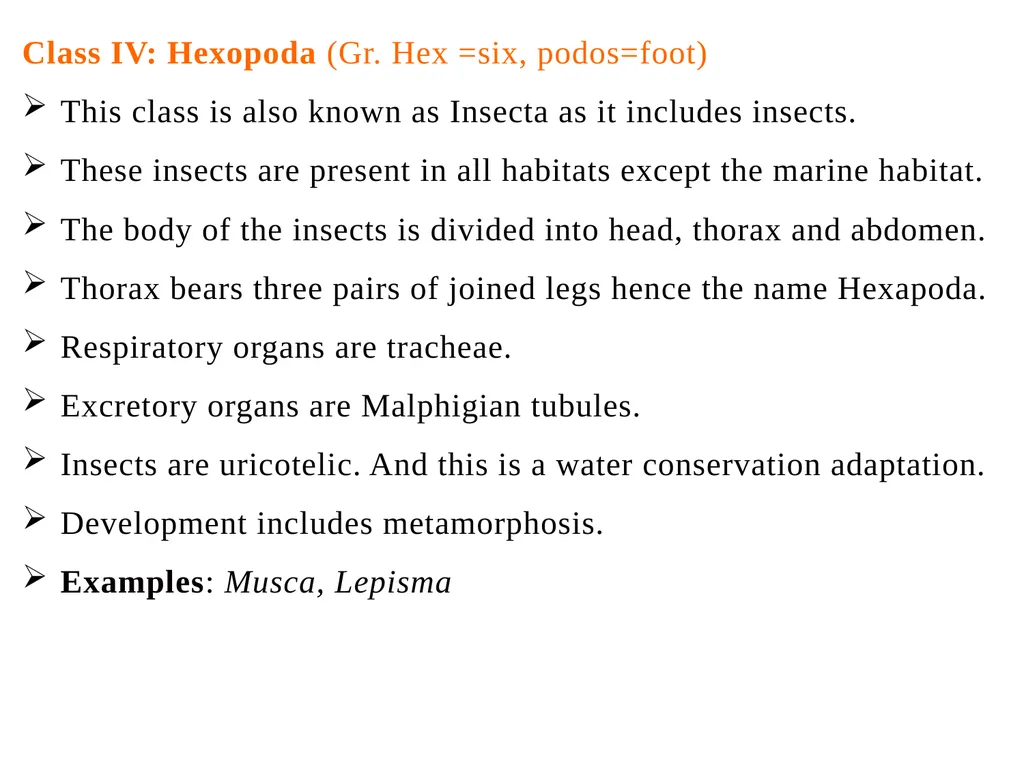
Class IV: Hexopoda (Gr. Hex =six, podos=foot)
This class is also known as Insecta as it includes insects.
These insects are present in all habitats except the marine habitat.
The body of the insects is divided into head, thorax and abdomen.
Thorax bears three pairs of joined legs hence the name Hexapoda.
Respiratory organs are tracheae.
Excretory organs are Malphigian tubules.
Insects are uricotelic. And this is a water conservation adaptation.
Development includes metamorphosis.
Examples: Musca, Lepisma<br>