
ARTICLE OF THE WEEK INSTRUCTIONS Slide 3: Guess
LV
Published · 13 slides · 0 views

1 / 1
Description
ARTICLE OF THE WEEK INSTRUCTIONS Slide 3: Guess the Article Slide 4: Introducing Article 24 Slide 5: Exploring Article 24 - Question Slide 6: Exploring Article 24 - Answers Slide 7, 8 9: Primary activities Slide 10, 11 12: Secondary
Related Topics
Share
Embed code
Download this presentation From Below
"ARTICLE OF THE WEEK INSTRUCTIONS Slide 3: Guess" is the property of its rightful owner. Permission is granted to download and print the materials on this website for personal, non-commercial use only, and to display it on your personal computer provided you do not modify the materials and that you retain all copyright notices contained in the materials. By downloading content from our website, you accept the terms of this agreement.
Presentation Transcript
01
ARTICLE OF THE WEEK<br>
02
INSTRUCTIONS Slide 3: Guess the Article
Slide 4: Introducing Article 24
Slide 5: Exploring Article 24 - Question
Slide 6: Exploring Article 24 - Answers
Slide 7, 8 & 9: Primary activities
Slide 10, 11 & 12: Secondary activities
Slide 13: Reflection<br>
Slide 4: Introducing Article 24
Slide 5: Exploring Article 24 - Question
Slide 6: Exploring Article 24 - Answers
Slide 7, 8 & 9: Primary activities
Slide 10, 11 & 12: Secondary activities
Slide 13: Reflection<br>
03
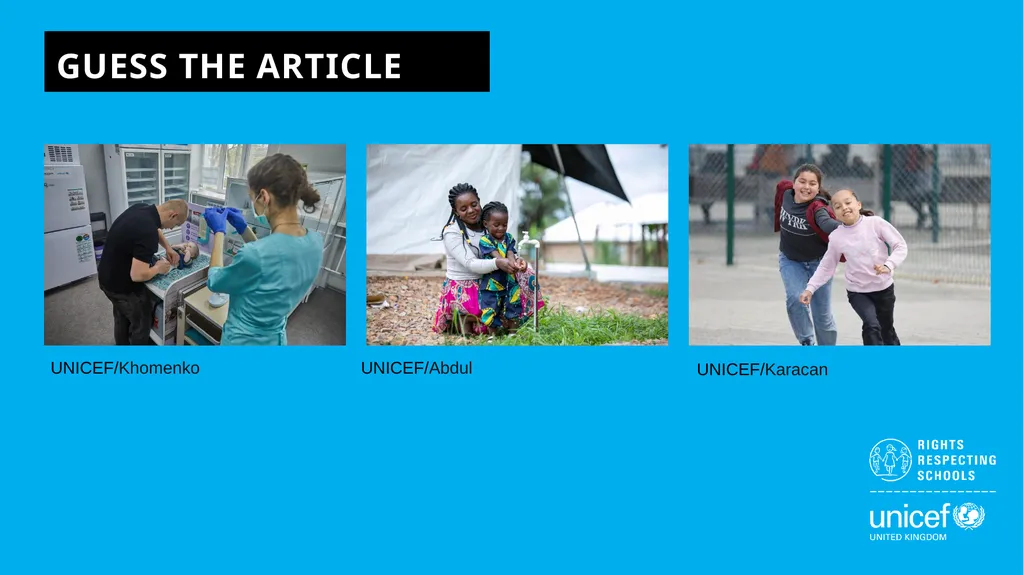
GUESS THE ARTICLE UNICEF/Khomenko UNICEF/Abdul UNICEF/Karacan<br>
04
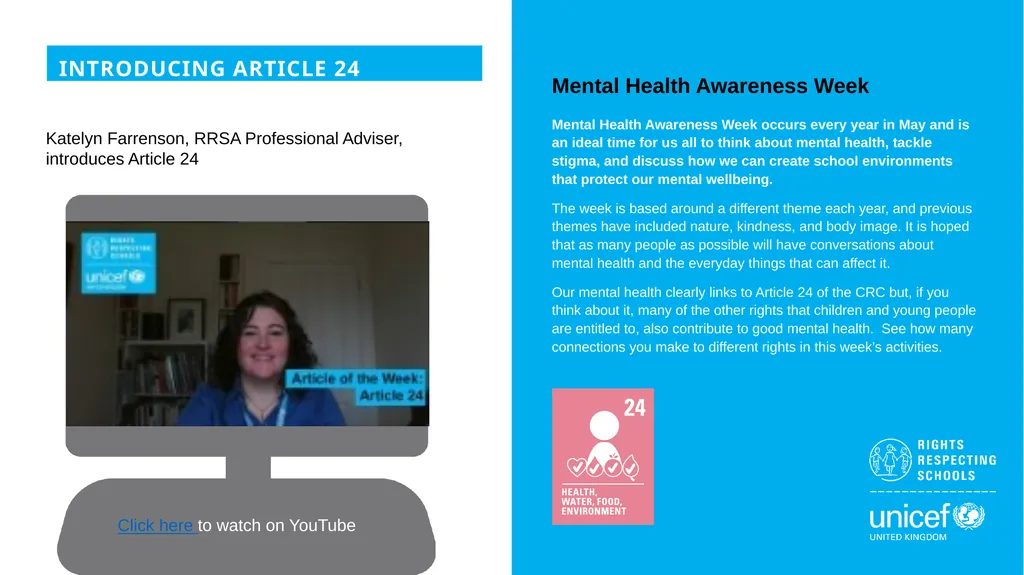
INTRODUCING ARTICLE 24 Katelyn Farrenson, RRSA Professional Adviser,
introduces Article 24 Click here to watch on YouTube Mental Health Awareness Week Mental Health Awareness Week occurs every year in May and is an ideal time for us all to think about mental health, tackle stigma, and discuss how we can create school environments that protect our mental wellbeing.
The week is based around a different theme each year, and previous themes have included nature, kindness, and body image. It is hoped that as many people as possible will have conversations about mental health and the everyday things that can affect it.
Our mental health clearly links to Article 24 of the CRC but, if you think about it, many of the other rights that children and young people are entitled to, also contribute to good mental health. See how many connections you make to different rights in this week’s activities.<br>
introduces Article 24 Click here to watch on YouTube Mental Health Awareness Week Mental Health Awareness Week occurs every year in May and is an ideal time for us all to think about mental health, tackle stigma, and discuss how we can create school environments that protect our mental wellbeing.
The week is based around a different theme each year, and previous themes have included nature, kindness, and body image. It is hoped that as many people as possible will have conversations about mental health and the everyday things that can affect it.
Our mental health clearly links to Article 24 of the CRC but, if you think about it, many of the other rights that children and young people are entitled to, also contribute to good mental health. See how many connections you make to different rights in this week’s activities.<br>
05
EXPLORING MENTAL HEALTH Have a think and write down some answers. What do you need for positive mental health?<br>
06
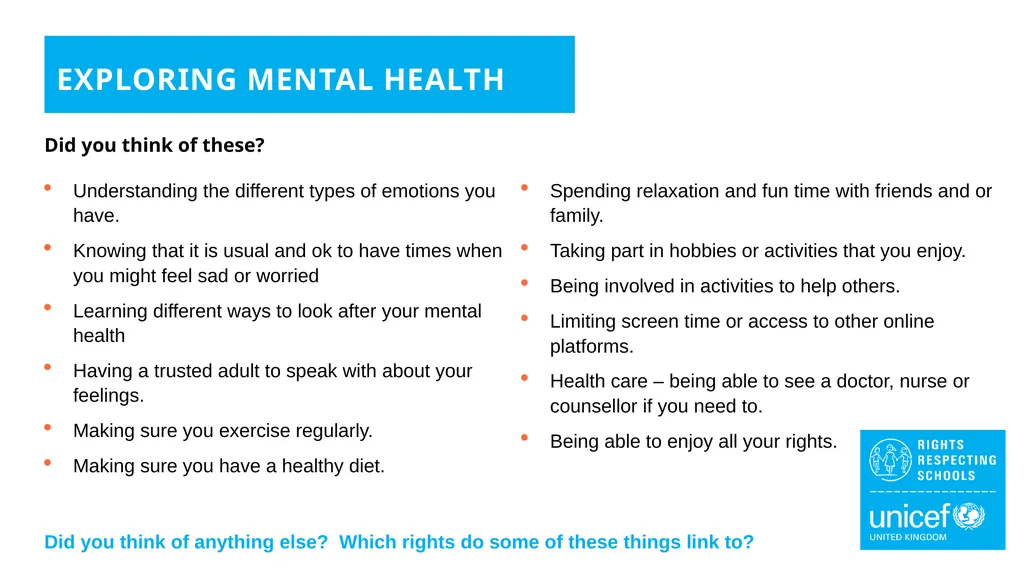
EXPLORING MENTAL HEALTH Did you think of anything else? Which rights do some of these things link to? Did you think of these? Understanding the different types of emotions you have.
Knowing that it is usual and ok to have times when you might feel sad or worried
Learning different ways to look after your mental health
Having a trusted adult to speak with about your feelings.
Making sure you exercise regularly.
Making sure you have a healthy diet.
Spending relaxation and fun time with friends and or family.
Taking part in hobbies or activities that you enjoy.
Being involved in activities to help others.
Limiting screen time or access to other online platforms.
Health care – being able to see a doctor, nurse or counsellor if you need to.
Being able to enjoy all your rights.<br>
Knowing that it is usual and ok to have times when you might feel sad or worried
Learning different ways to look after your mental health
Having a trusted adult to speak with about your feelings.
Making sure you exercise regularly.
Making sure you have a healthy diet.
Spending relaxation and fun time with friends and or family.
Taking part in hobbies or activities that you enjoy.
Being involved in activities to help others.
Limiting screen time or access to other online platforms.
Health care – being able to see a doctor, nurse or counsellor if you need to.
Being able to enjoy all your rights.<br>
07
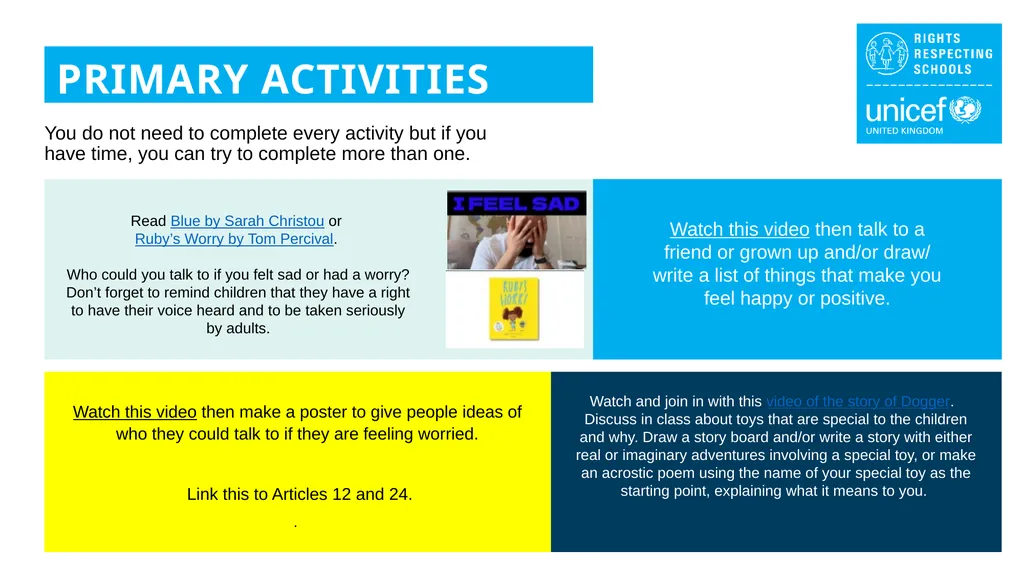
PRIMARY ACTIVITIES You do not need to complete every activity but if you have time, you can try to complete more than one. Watch and join in with this video of the story of Dogger. Discuss in class about toys that are special to the children and why. Draw a story board and/or write a story with either real or imaginary adventures involving a special toy, or make an acrostic poem using the name of your special toy as the starting point, explaining what it means to you. Read Blue by Sarah Christou or Ruby’s Worry by Tom Percival.
Who could you talk to if you felt sad or had a worry? Don’t forget to remind children that they have a right to have their voice heard and to be taken seriously by adults. Watch this video then make a poster to give people ideas of who they could talk to if they are feeling worried.
Link this to Articles 12 and 24.
. Watch this video then talk to a friend or grown up and/or draw/ write a list of things that make you feel happy or positive.<br>
Who could you talk to if you felt sad or had a worry? Don’t forget to remind children that they have a right to have their voice heard and to be taken seriously by adults. Watch this video then make a poster to give people ideas of who they could talk to if they are feeling worried.
Link this to Articles 12 and 24.
. Watch this video then talk to a friend or grown up and/or draw/ write a list of things that make you feel happy or positive.<br>
08
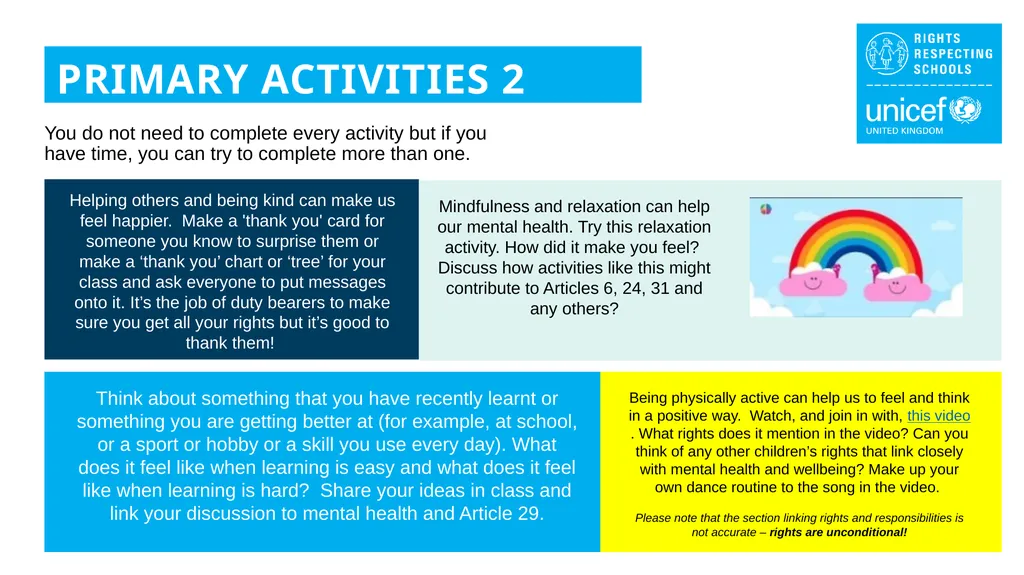
PRIMARY ACTIVITIES 2 You do not need to complete every activity but if you have time, you can try to complete more than one. Think about something that you have recently learnt or something you are getting better at (for example, at school, or a sport or hobby or a skill you use every day). What does it feel like when learning is easy and what does it feel like when learning is hard? Share your ideas in class and link your discussion to mental health and Article 29. Being physically active can help us to feel and think in a positive way. Watch, and join in with, this video. What rights does it mention in the video? Can you think of any other children’s rights that link closely with mental health and wellbeing? Make up your own dance routine to the song in the video.
Please note that the section linking rights and responsibilities is not accurate – rights are unconditional! Mindfulness and relaxation can help our mental health. Try this relaxation activity. How did it make you feel? Discuss how activities like this might contribute to Articles 6, 24, 31 and any others? Helping others and being kind can make us feel happier. Make a 'thank you' card for someone you know to surprise them or make a ‘thank you’ chart or ‘tree’ for your class and ask everyone to put messages onto it. It’s the job of duty bearers to make sure you get all your rights but it’s good to thank them!<br>
Please note that the section linking rights and responsibilities is not accurate – rights are unconditional! Mindfulness and relaxation can help our mental health. Try this relaxation activity. How did it make you feel? Discuss how activities like this might contribute to Articles 6, 24, 31 and any others? Helping others and being kind can make us feel happier. Make a 'thank you' card for someone you know to surprise them or make a ‘thank you’ chart or ‘tree’ for your class and ask everyone to put messages onto it. It’s the job of duty bearers to make sure you get all your rights but it’s good to thank them!<br>
09
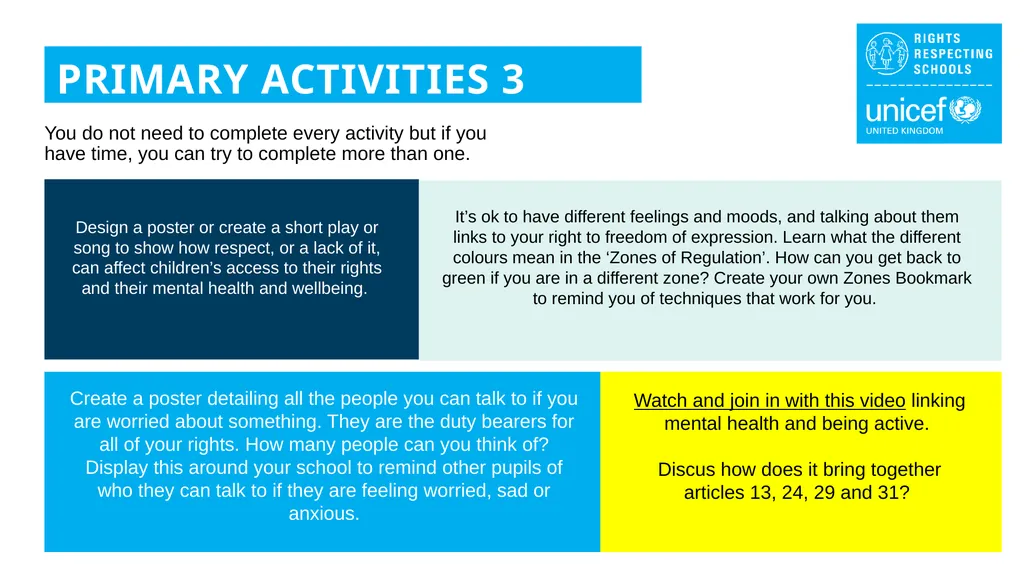
PRIMARY ACTIVITIES 3 You do not need to complete every activity but if you have time, you can try to complete more than one. Create a poster detailing all the people you can talk to if you are worried about something. They are the duty bearers for all of your rights. How many people can you think of? Display this around your school to remind other pupils of who they can talk to if they are feeling worried, sad or anxious. Watch and join in with this video linking mental health and being active.
Discus how does it bring together articles 13, 24, 29 and 31? It’s ok to have different feelings and moods, and talking about them links to your right to freedom of expression. Learn what the different colours mean in the ‘Zones of Regulation’. How can you get back to green if you are in a different zone? Create your own Zones Bookmark to remind you of techniques that work for you. Design a poster or create a short play or song to show how respect, or a lack of it, can affect children’s access to their rights and their mental health and wellbeing.<br>
Discus how does it bring together articles 13, 24, 29 and 31? It’s ok to have different feelings and moods, and talking about them links to your right to freedom of expression. Learn what the different colours mean in the ‘Zones of Regulation’. How can you get back to green if you are in a different zone? Create your own Zones Bookmark to remind you of techniques that work for you. Design a poster or create a short play or song to show how respect, or a lack of it, can affect children’s access to their rights and their mental health and wellbeing.<br>
10
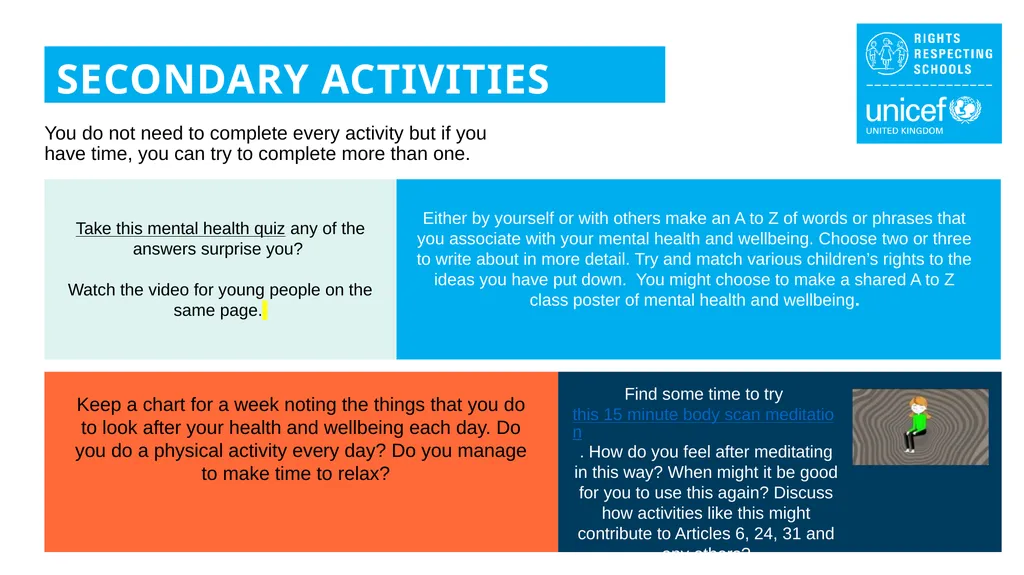
SECONDARY ACTIVITIES You do not need to complete every activity but if you have time, you can try to complete more than one. Take this mental health quiz any of the answers surprise you?
Watch the video for young people on the same page. Keep a chart for a week noting the things that you do to look after your health and wellbeing each day. Do you do a physical activity every day? Do you manage to make time to relax? Either by yourself or with others make an A to Z of words or phrases that you associate with your mental health and wellbeing. Choose two or three to write about in more detail. Try and match various children’s rights to the ideas you have put down. You might choose to make a shared A to Z class poster of mental health and wellbeing. Find some time to try this 15 minute body scan meditation. How do you feel after meditating in this way? When might it be good for you to use this again? Discuss how activities like this might contribute to Articles 6, 24, 31 and any others?<br>
Watch the video for young people on the same page. Keep a chart for a week noting the things that you do to look after your health and wellbeing each day. Do you do a physical activity every day? Do you manage to make time to relax? Either by yourself or with others make an A to Z of words or phrases that you associate with your mental health and wellbeing. Choose two or three to write about in more detail. Try and match various children’s rights to the ideas you have put down. You might choose to make a shared A to Z class poster of mental health and wellbeing. Find some time to try this 15 minute body scan meditation. How do you feel after meditating in this way? When might it be good for you to use this again? Discuss how activities like this might contribute to Articles 6, 24, 31 and any others?<br>
11
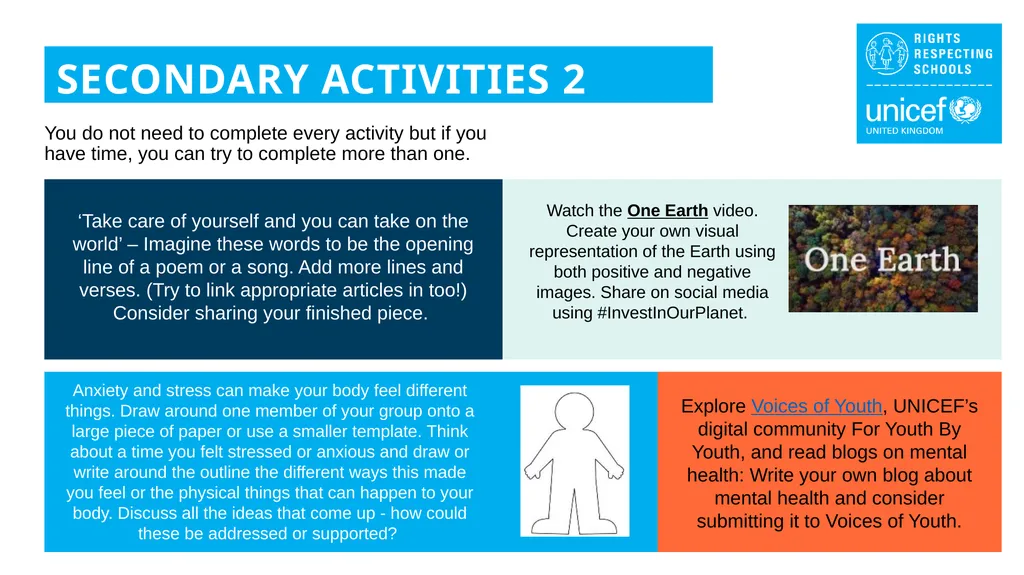
You do not need to complete every activity but if you have time, you can try to complete more than one. SECONDARY ACTIVITIES 2 Watch the One Earth video. Create your own visual representation of the Earth using both positive and negative images. Share on social media using #InvestInOurPlanet. Anxiety and stress can make your body feel different things. Draw around one member of your group onto a large piece of paper or use a smaller template. Think about a time you felt stressed or anxious and draw or write around the outline the different ways this made you feel or the physical things that can happen to your body. Discuss all the ideas that come up - how could these be addressed or supported? ‘Take care of yourself and you can take on the world’ – Imagine these words to be the opening line of a poem or a song. Add more lines and verses. (Try to link appropriate articles in too!) Consider sharing your finished piece. Explore Voices of Youth, UNICEF’s digital community For Youth By Youth, and read blogs on mental health: Write your own blog about mental health and consider submitting it to Voices of Youth.<br>
12
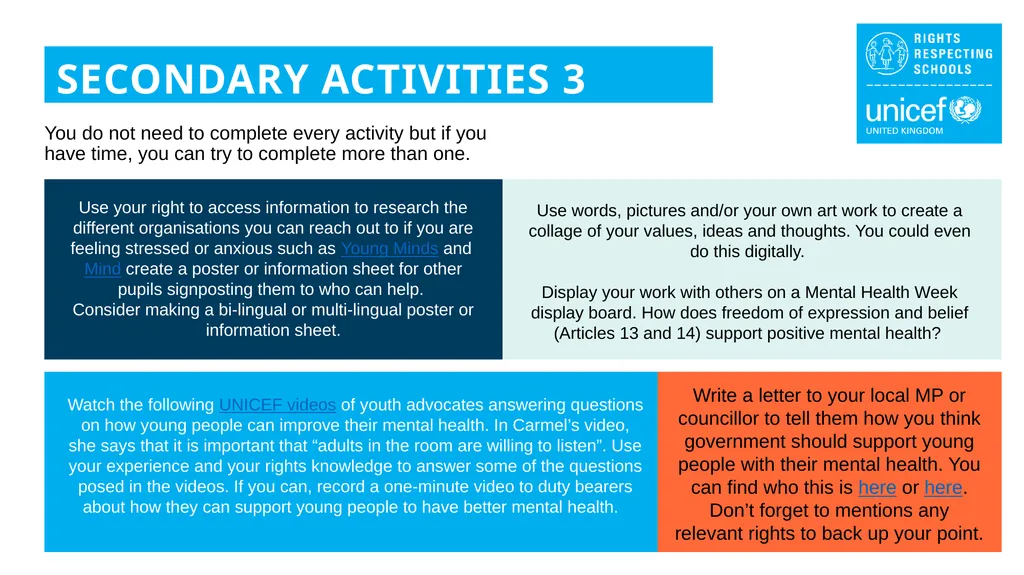
You do not need to complete every activity but if you have time, you can try to complete more than one. SECONDARY ACTIVITIES 3 Use words, pictures and/or your own art work to create a collage of your values, ideas and thoughts. You could even do this digitally.
Display your work with others on a Mental Health Week display board. How does freedom of expression and belief (Articles 13 and 14) support positive mental health? Watch the following UNICEF videos of youth advocates answering questions on how young people can improve their mental health. In Carmel’s video, she says that it is important that “adults in the room are willing to listen”. Use your experience and your rights knowledge to answer some of the questions posed in the videos. If you can, record a one-minute video to duty bearers about how they can support young people to have better mental health. Use your right to access information to research the different organisations you can reach out to if you are feeling stressed or anxious such as Young Minds and Mind create a poster or information sheet for other pupils signposting them to who can help.
Consider making a bi-lingual or multi-lingual poster or information sheet. Write a letter to your local MP or councillor to tell them how you think government should support young people with their mental health. You can find who this is here or here. Don’t forget to mentions any relevant rights to back up your point.<br>
Display your work with others on a Mental Health Week display board. How does freedom of expression and belief (Articles 13 and 14) support positive mental health? Watch the following UNICEF videos of youth advocates answering questions on how young people can improve their mental health. In Carmel’s video, she says that it is important that “adults in the room are willing to listen”. Use your experience and your rights knowledge to answer some of the questions posed in the videos. If you can, record a one-minute video to duty bearers about how they can support young people to have better mental health. Use your right to access information to research the different organisations you can reach out to if you are feeling stressed or anxious such as Young Minds and Mind create a poster or information sheet for other pupils signposting them to who can help.
Consider making a bi-lingual or multi-lingual poster or information sheet. Write a letter to your local MP or councillor to tell them how you think government should support young people with their mental health. You can find who this is here or here. Don’t forget to mentions any relevant rights to back up your point.<br>
13
REFLECTION Find somewhere quiet and give yourself time and space to think about the following:
Everybody has mental health – all the time! Most people have times when their mental health is not as good as it is at other times.
Education about health and wellbeing is part of Article 24. What have you learnt recently about your own mental health?
What have you learnt about supporting the mental health of others?
How do the other rights you enjoy support your mental health and wellbeing?<br>
Everybody has mental health – all the time! Most people have times when their mental health is not as good as it is at other times.
Education about health and wellbeing is part of Article 24. What have you learnt recently about your own mental health?
What have you learnt about supporting the mental health of others?
How do the other rights you enjoy support your mental health and wellbeing?<br>