
Assessing WJEC Eduqas A level Film Studies
DP
Published · 33 slides · 0 views

1 / 1





Description
Assessing WJEC Eduqas A level Film Studies Assessing evidence It is important to ensure objectivity in assessing students responses, both at the initial marking stage and during internal standardisation. Do not allow personal knowledge of
Related Topics
Share
Embed code
Download this presentation From Below
"Assessing WJEC Eduqas A level Film Studies" is the property of its rightful owner. Permission is granted to download and print the materials on this website for personal, non-commercial use only, and to display it on your personal computer provided you do not modify the materials and that you retain all copyright notices contained in the materials. By downloading content from our website, you accept the terms of this agreement.
Presentation Transcript
01
Assessing WJEC Eduqas A level Film Studies<br>
02
Assessing evidence It is important to ensure objectivity in assessing students’ responses, both at the initial marking stage and during internal standardisation. Do not allow personal knowledge of individual students to affect assessment decisions: ensure that you mark the student responses in front of you rather than the students behind them. JCQ has provided training on ensuring objectivity when assessing students’ evidence.
You should also consider the purpose of the assessment, particularly if you are selecting evidence which has been completed earlier in the course.
Formative assessment, conducted during the course of the learning in order to gauge student understanding, may not always provide appropriate evidence, as the student may not have fully developed their understanding of all concepts to the best of their ability at this point in time.
Summative assessment, either at the end of the course or the end of a component, may provide a more realistic picture of the students’ attainment levels.<br>
You should also consider the purpose of the assessment, particularly if you are selecting evidence which has been completed earlier in the course.
Formative assessment, conducted during the course of the learning in order to gauge student understanding, may not always provide appropriate evidence, as the student may not have fully developed their understanding of all concepts to the best of their ability at this point in time.
Summative assessment, either at the end of the course or the end of a component, may provide a more realistic picture of the students’ attainment levels.<br>
03
Assessing evidence Understanding the assessment criteria
Assessment criteria generally take two forms:
objective marking – generally for low tariff responses, where knowledge of objective information is being assessed
the exercising of academic judgement via:
an assessment grid setting out criteria for different levels of response
indicative content, that is, an indication of the kind of content responses may include.<br>
Assessment criteria generally take two forms:
objective marking – generally for low tariff responses, where knowledge of objective information is being assessed
the exercising of academic judgement via:
an assessment grid setting out criteria for different levels of response
indicative content, that is, an indication of the kind of content responses may include.<br>
04
Assessing evidence Understanding the assessment criteria – objective marking
For questions assessing objective knowledge, the assessment criteria should be applied precisely. Marks should be awarded as indicated and no further subdivision made.
Where the assessment criteria list points which may be included in students' answers, the list is not exhaustive and teachers should credit valid alternative responses which are not listed.
In general, credit should be given according to the accuracy and relevance of students’ answers.<br>
For questions assessing objective knowledge, the assessment criteria should be applied precisely. Marks should be awarded as indicated and no further subdivision made.
Where the assessment criteria list points which may be included in students' answers, the list is not exhaustive and teachers should credit valid alternative responses which are not listed.
In general, credit should be given according to the accuracy and relevance of students’ answers.<br>
05
Assessing evidence Understanding the assessment criteria – exercising academic judgement through levels of response mark schemes
Firstly, identify the appropriate band a student’s response falls into according to the criteria. Award a band where the student’s response covers the majority of the criteria.
Secondly, consider a mark in the centre of the band and then increase or decrease the mark depending on the quality of the answer, which may be reflected in the amount of indicative content covered.
If a response falls between two bands, consider whether there are more characteristics of the higher or lower of the two bands and award accordingly.
Indicative content is not exhaustive and other valid responses may be credited.
Use of appropriate subject terminology is rewarded within the marking criteria.<br>
Firstly, identify the appropriate band a student’s response falls into according to the criteria. Award a band where the student’s response covers the majority of the criteria.
Secondly, consider a mark in the centre of the band and then increase or decrease the mark depending on the quality of the answer, which may be reflected in the amount of indicative content covered.
If a response falls between two bands, consider whether there are more characteristics of the higher or lower of the two bands and award accordingly.
Indicative content is not exhaustive and other valid responses may be credited.
Use of appropriate subject terminology is rewarded within the marking criteria.<br>
06
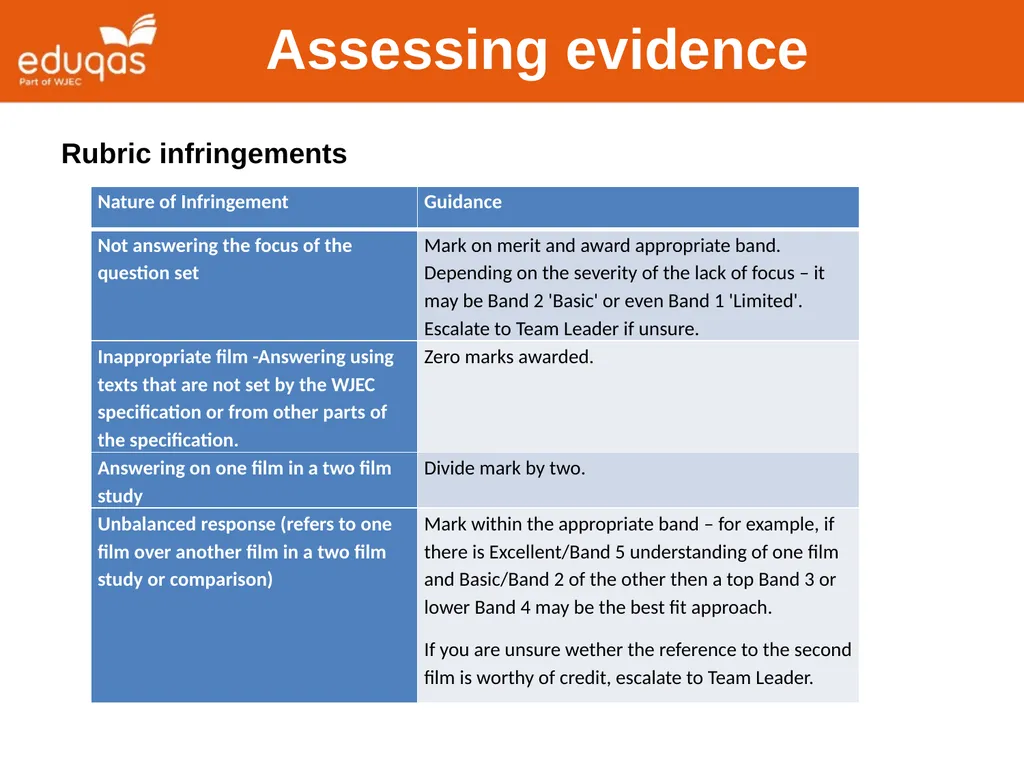
Assessing evidence Rubric infringements<br>
07
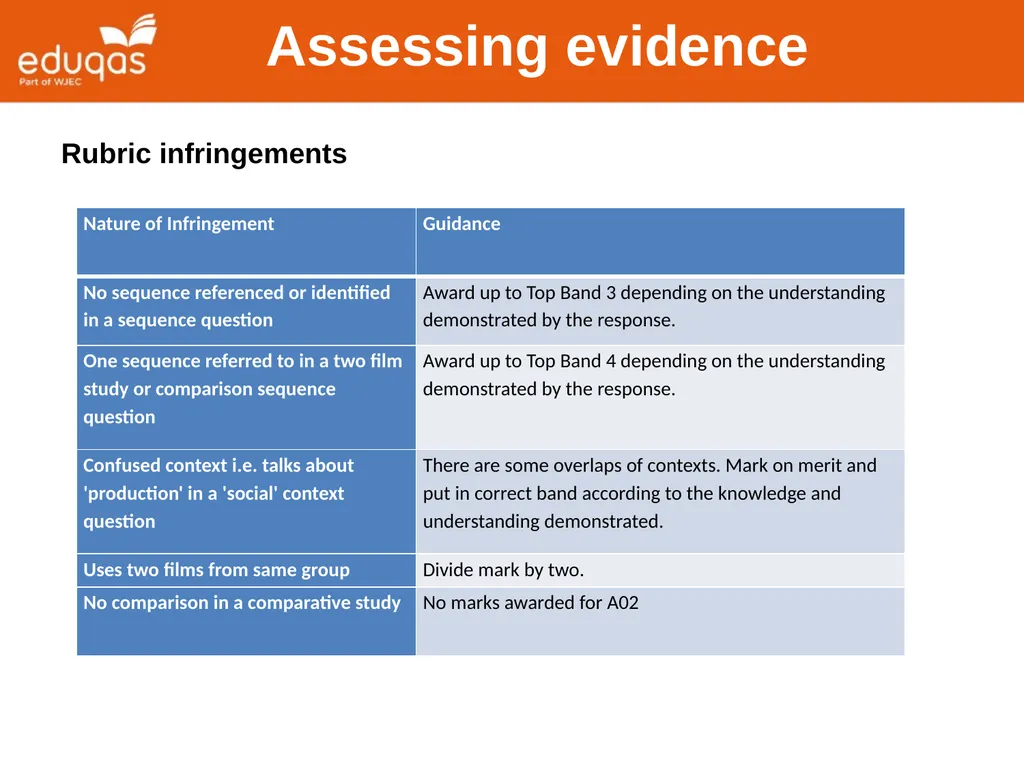
Assessing evidence Rubric infringements<br>
08
Component 1<br>
09
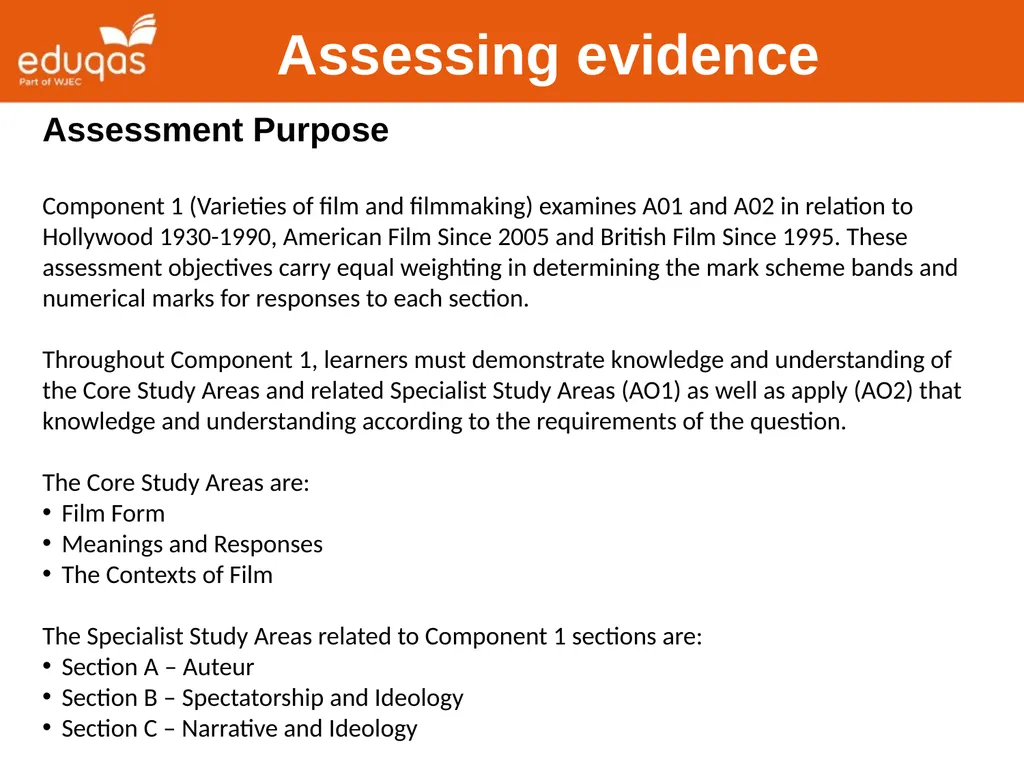
Assessing evidence Assessment Purpose
Component 1 (Varieties of film and filmmaking) examines A01 and A02 in relation to Hollywood 1930-1990, American Film Since 2005 and British Film Since 1995. These assessment objectives carry equal weighting in determining the mark scheme bands and numerical marks for responses to each section.
Throughout Component 1, learners must demonstrate knowledge and understanding of the Core Study Areas and related Specialist Study Areas (AO1) as well as apply (AO2) that knowledge and understanding according to the requirements of the question.
The Core Study Areas are:
Film Form
Meanings and Responses
The Contexts of Film
The Specialist Study Areas related to Component 1 sections are:
Section A – Auteur
Section B – Spectatorship and Ideology
Section C – Narrative and Ideology<br>
Component 1 (Varieties of film and filmmaking) examines A01 and A02 in relation to Hollywood 1930-1990, American Film Since 2005 and British Film Since 1995. These assessment objectives carry equal weighting in determining the mark scheme bands and numerical marks for responses to each section.
Throughout Component 1, learners must demonstrate knowledge and understanding of the Core Study Areas and related Specialist Study Areas (AO1) as well as apply (AO2) that knowledge and understanding according to the requirements of the question.
The Core Study Areas are:
Film Form
Meanings and Responses
The Contexts of Film
The Specialist Study Areas related to Component 1 sections are:
Section A – Auteur
Section B – Spectatorship and Ideology
Section C – Narrative and Ideology<br>
10
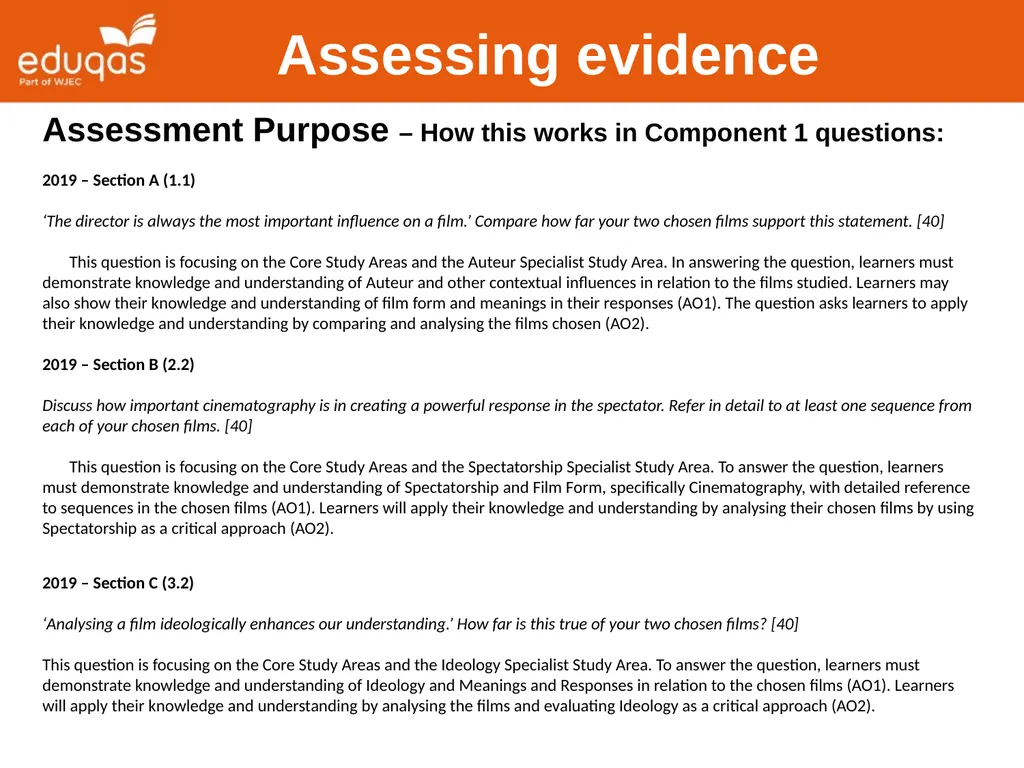
Assessing evidence Assessment Purpose – How this works in Component 1 questions:
2019 – Section A (1.1)
‘The director is always the most important influence on a film.’ Compare how far your two chosen films support this statement. [40]
This question is focusing on the Core Study Areas and the Auteur Specialist Study Area. In answering the question, learners must demonstrate knowledge and understanding of Auteur and other contextual influences in relation to the films studied. Learners may also show their knowledge and understanding of film form and meanings in their responses (AO1). The question asks learners to apply their knowledge and understanding by comparing and analysing the films chosen (AO2).
2019 – Section B (2.2)
Discuss how important cinematography is in creating a powerful response in the spectator. Refer in detail to at least one sequence from each of your chosen films. [40]
This question is focusing on the Core Study Areas and the Spectatorship Specialist Study Area. To answer the question, learners must demonstrate knowledge and understanding of Spectatorship and Film Form, specifically Cinematography, with detailed reference to sequences in the chosen films (AO1). Learners will apply their knowledge and understanding by analysing their chosen films by using Spectatorship as a critical approach (AO2).
2019 – Section C (3.2)
‘Analysing a film ideologically enhances our understanding.’ How far is this true of your two chosen films? [40]
This question is focusing on the Core Study Areas and the Ideology Specialist Study Area. To answer the question, learners must demonstrate knowledge and understanding of Ideology and Meanings and Responses in relation to the chosen films (AO1). Learners will apply their knowledge and understanding by analysing the films and evaluating Ideology as a critical approach (AO2).<br>
2019 – Section A (1.1)
‘The director is always the most important influence on a film.’ Compare how far your two chosen films support this statement. [40]
This question is focusing on the Core Study Areas and the Auteur Specialist Study Area. In answering the question, learners must demonstrate knowledge and understanding of Auteur and other contextual influences in relation to the films studied. Learners may also show their knowledge and understanding of film form and meanings in their responses (AO1). The question asks learners to apply their knowledge and understanding by comparing and analysing the films chosen (AO2).
2019 – Section B (2.2)
Discuss how important cinematography is in creating a powerful response in the spectator. Refer in detail to at least one sequence from each of your chosen films. [40]
This question is focusing on the Core Study Areas and the Spectatorship Specialist Study Area. To answer the question, learners must demonstrate knowledge and understanding of Spectatorship and Film Form, specifically Cinematography, with detailed reference to sequences in the chosen films (AO1). Learners will apply their knowledge and understanding by analysing their chosen films by using Spectatorship as a critical approach (AO2).
2019 – Section C (3.2)
‘Analysing a film ideologically enhances our understanding.’ How far is this true of your two chosen films? [40]
This question is focusing on the Core Study Areas and the Ideology Specialist Study Area. To answer the question, learners must demonstrate knowledge and understanding of Ideology and Meanings and Responses in relation to the chosen films (AO1). Learners will apply their knowledge and understanding by analysing the films and evaluating Ideology as a critical approach (AO2).<br>
11
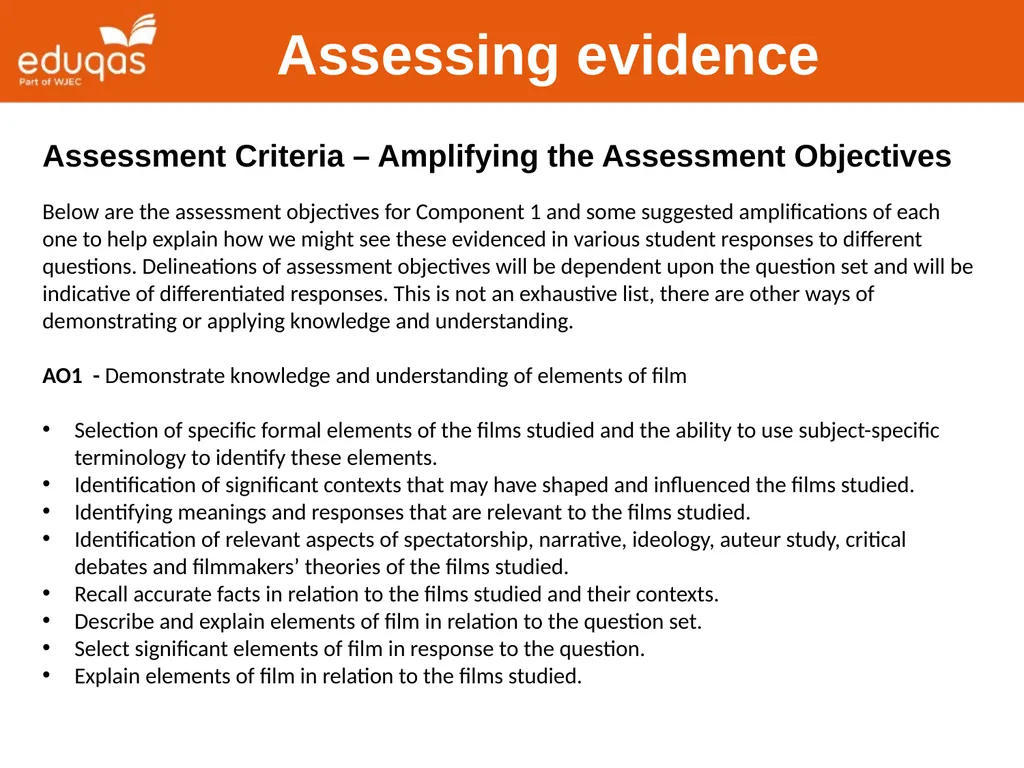
Assessing evidence Assessment Criteria – Amplifying the Assessment Objectives
Below are the assessment objectives for Component 1 and some suggested amplifications of each one to help explain how we might see these evidenced in various student responses to different questions. Delineations of assessment objectives will be dependent upon the question set and will be indicative of differentiated responses. This is not an exhaustive list, there are other ways of demonstrating or applying knowledge and understanding.
AO1 - Demonstrate knowledge and understanding of elements of film
Selection of specific formal elements of the films studied and the ability to use subject-specific terminology to identify these elements.
Identification of significant contexts that may have shaped and influenced the films studied.
Identifying meanings and responses that are relevant to the films studied.
Identification of relevant aspects of spectatorship, narrative, ideology, auteur study, critical debates and filmmakers’ theories of the films studied.
Recall accurate facts in relation to the films studied and their contexts.
Describe and explain elements of film in relation to the question set.
Select significant elements of film in response to the question.
Explain elements of film in relation to the films studied.<br>
Below are the assessment objectives for Component 1 and some suggested amplifications of each one to help explain how we might see these evidenced in various student responses to different questions. Delineations of assessment objectives will be dependent upon the question set and will be indicative of differentiated responses. This is not an exhaustive list, there are other ways of demonstrating or applying knowledge and understanding.
AO1 - Demonstrate knowledge and understanding of elements of film
Selection of specific formal elements of the films studied and the ability to use subject-specific terminology to identify these elements.
Identification of significant contexts that may have shaped and influenced the films studied.
Identifying meanings and responses that are relevant to the films studied.
Identification of relevant aspects of spectatorship, narrative, ideology, auteur study, critical debates and filmmakers’ theories of the films studied.
Recall accurate facts in relation to the films studied and their contexts.
Describe and explain elements of film in relation to the question set.
Select significant elements of film in response to the question.
Explain elements of film in relation to the films studied.<br>
12
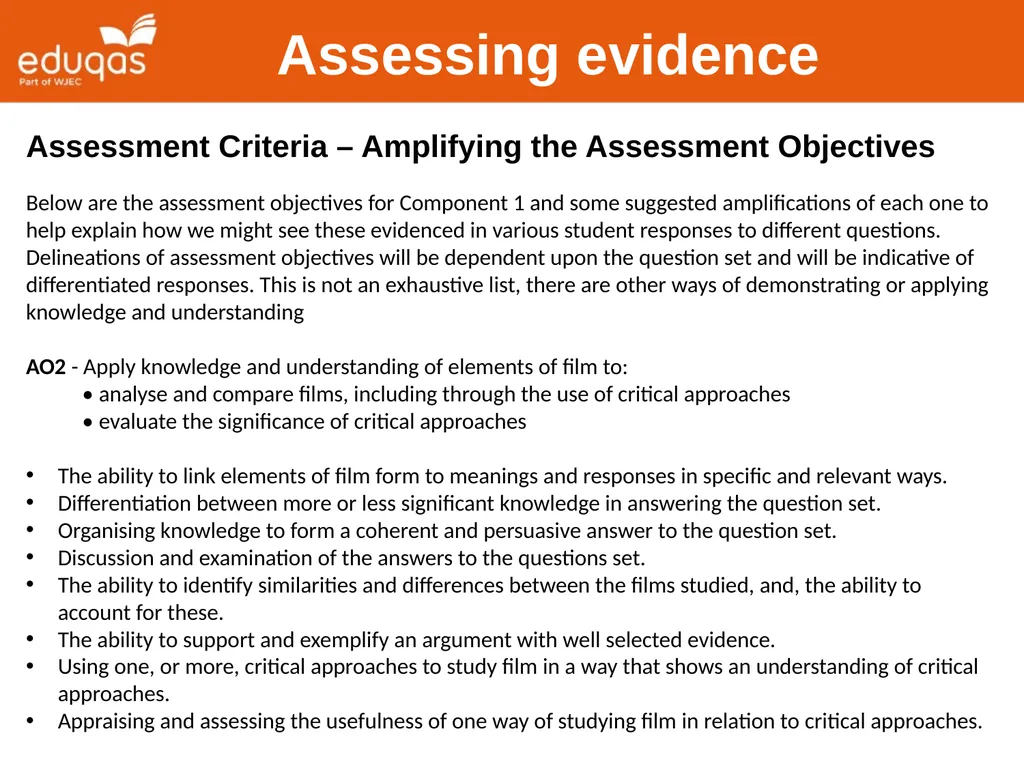
Assessing evidence Assessment Criteria – Amplifying the Assessment Objectives
Below are the assessment objectives for Component 1 and some suggested amplifications of each one to help explain how we might see these evidenced in various student responses to different questions. Delineations of assessment objectives will be dependent upon the question set and will be indicative of differentiated responses. This is not an exhaustive list, there are other ways of demonstrating or applying knowledge and understanding
AO2 - Apply knowledge and understanding of elements of film to:
• analyse and compare films, including through the use of critical approaches
• evaluate the significance of critical approaches
The ability to link elements of film form to meanings and responses in specific and relevant ways.
Differentiation between more or less significant knowledge in answering the question set.
Organising knowledge to form a coherent and persuasive answer to the question set.
Discussion and examination of the answers to the questions set.
The ability to identify similarities and differences between the films studied, and, the ability to account for these.
The ability to support and exemplify an argument with well selected evidence.
Using one, or more, critical approaches to study film in a way that shows an understanding of critical approaches.
Appraising and assessing the usefulness of one way of studying film in relation to critical approaches.<br>
Below are the assessment objectives for Component 1 and some suggested amplifications of each one to help explain how we might see these evidenced in various student responses to different questions. Delineations of assessment objectives will be dependent upon the question set and will be indicative of differentiated responses. This is not an exhaustive list, there are other ways of demonstrating or applying knowledge and understanding
AO2 - Apply knowledge and understanding of elements of film to:
• analyse and compare films, including through the use of critical approaches
• evaluate the significance of critical approaches
The ability to link elements of film form to meanings and responses in specific and relevant ways.
Differentiation between more or less significant knowledge in answering the question set.
Organising knowledge to form a coherent and persuasive answer to the question set.
Discussion and examination of the answers to the questions set.
The ability to identify similarities and differences between the films studied, and, the ability to account for these.
The ability to support and exemplify an argument with well selected evidence.
Using one, or more, critical approaches to study film in a way that shows an understanding of critical approaches.
Appraising and assessing the usefulness of one way of studying film in relation to critical approaches.<br>
13
Assessing evidence Assessment Criteria – Amplifying the Mark Scheme Bands:
General Information
Marking should be positive, rewarding achievement rather than penalising failure or omissions. The awarding of marks must be directly related to the marking criteria. Examiners should use the generic assessment grid and the indicative content for each question when assessing a candidate’s response.
Band Descriptors
When awarding a mark, examiners should select the band that most closely describes the quality of the work being assessed. Marking grids, which include guidance on how to allocate marks within bands, have been constructed using the principles below. Once the appropriate band has been selected, examiners should award in the notional centre of the band, awarding higher or lower depending on the strength of the response.
Where the candidate's work securely meets the descriptors, award marks in the notional centre of a band and then adjust higher or lower depending on the degree to which the band's criteria are met.
Where the candidate’s work convincingly meets the descriptors, the highest mark should be awarded, depending on the strength of the answer
Where the candidate’s work less securely meets the descriptors, the lowest mark should be awarded, depending on the degree of its weaknesses.
Where a candidate's work combines the qualities of two different bands, examiners should use their professional judgement to award a mark in the band which best describes the majority of the candidate's work.
Where there is a two mark range within each band, examiners should award: the upper of the two marks for work which convincingly meets the descriptors or the lower of the two marks for work which less strongly meets the descriptors.
Assessors should use the full range of marks available to them.<br>
General Information
Marking should be positive, rewarding achievement rather than penalising failure or omissions. The awarding of marks must be directly related to the marking criteria. Examiners should use the generic assessment grid and the indicative content for each question when assessing a candidate’s response.
Band Descriptors
When awarding a mark, examiners should select the band that most closely describes the quality of the work being assessed. Marking grids, which include guidance on how to allocate marks within bands, have been constructed using the principles below. Once the appropriate band has been selected, examiners should award in the notional centre of the band, awarding higher or lower depending on the strength of the response.
Where the candidate's work securely meets the descriptors, award marks in the notional centre of a band and then adjust higher or lower depending on the degree to which the band's criteria are met.
Where the candidate’s work convincingly meets the descriptors, the highest mark should be awarded, depending on the strength of the answer
Where the candidate’s work less securely meets the descriptors, the lowest mark should be awarded, depending on the degree of its weaknesses.
Where a candidate's work combines the qualities of two different bands, examiners should use their professional judgement to award a mark in the band which best describes the majority of the candidate's work.
Where there is a two mark range within each band, examiners should award: the upper of the two marks for work which convincingly meets the descriptors or the lower of the two marks for work which less strongly meets the descriptors.
Assessors should use the full range of marks available to them.<br>
14
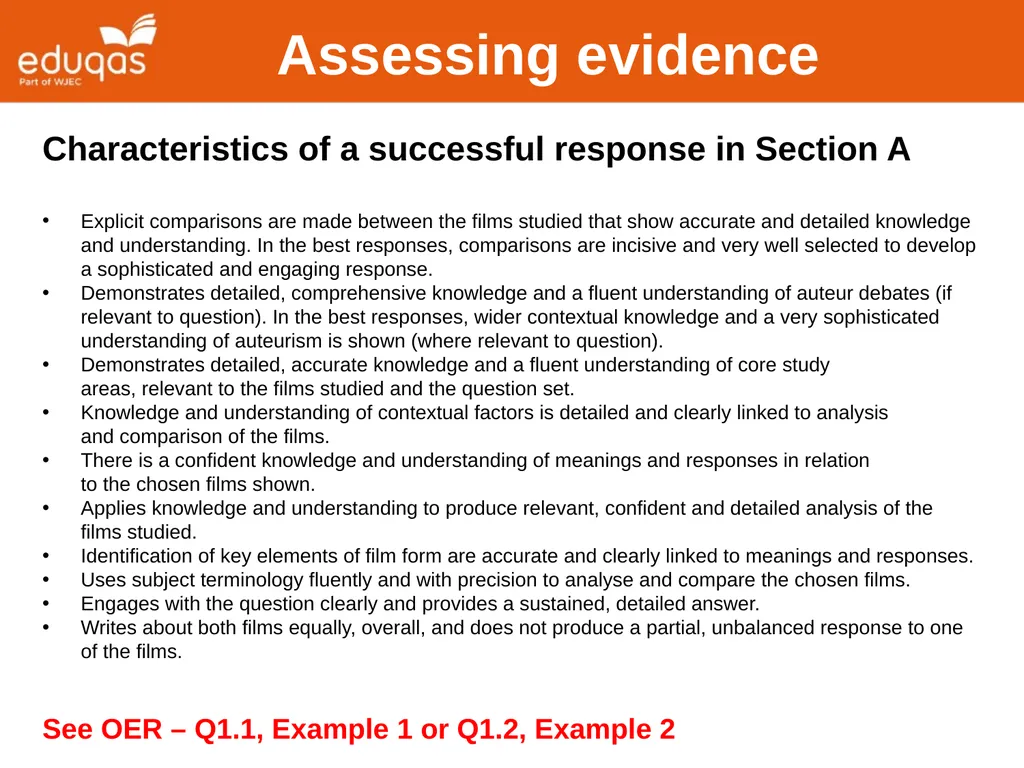
Assessing evidence Characteristics of a successful response in Section A
Explicit comparisons are made between the films studied that show accurate and detailed knowledge and understanding. In the best responses, comparisons are incisive and very well selected to develop a sophisticated and engaging response.
Demonstrates detailed, comprehensive knowledge and a fluent understanding of auteur debates (if relevant to question). In the best responses, wider contextual knowledge and a very sophisticated understanding of auteurism is shown (where relevant to question).
Demonstrates detailed, accurate knowledge and a fluent understanding of core study areas, relevant to the films studied and the question set.
Knowledge and understanding of contextual factors is detailed and clearly linked to analysis and comparison of the films.
There is a confident knowledge and understanding of meanings and responses in relation to the chosen films shown.
Applies knowledge and understanding to produce relevant, confident and detailed analysis of the films studied.
Identification of key elements of film form are accurate and clearly linked to meanings and responses.
Uses subject terminology fluently and with precision to analyse and compare the chosen films.
Engages with the question clearly and provides a sustained, detailed answer.
Writes about both films equally, overall, and does not produce a partial, unbalanced response to one of the films.
See OER – Q1.1, Example 1 or Q1.2, Example 2<br>
Explicit comparisons are made between the films studied that show accurate and detailed knowledge and understanding. In the best responses, comparisons are incisive and very well selected to develop a sophisticated and engaging response.
Demonstrates detailed, comprehensive knowledge and a fluent understanding of auteur debates (if relevant to question). In the best responses, wider contextual knowledge and a very sophisticated understanding of auteurism is shown (where relevant to question).
Demonstrates detailed, accurate knowledge and a fluent understanding of core study areas, relevant to the films studied and the question set.
Knowledge and understanding of contextual factors is detailed and clearly linked to analysis and comparison of the films.
There is a confident knowledge and understanding of meanings and responses in relation to the chosen films shown.
Applies knowledge and understanding to produce relevant, confident and detailed analysis of the films studied.
Identification of key elements of film form are accurate and clearly linked to meanings and responses.
Uses subject terminology fluently and with precision to analyse and compare the chosen films.
Engages with the question clearly and provides a sustained, detailed answer.
Writes about both films equally, overall, and does not produce a partial, unbalanced response to one of the films.
See OER – Q1.1, Example 1 or Q1.2, Example 2<br>
15
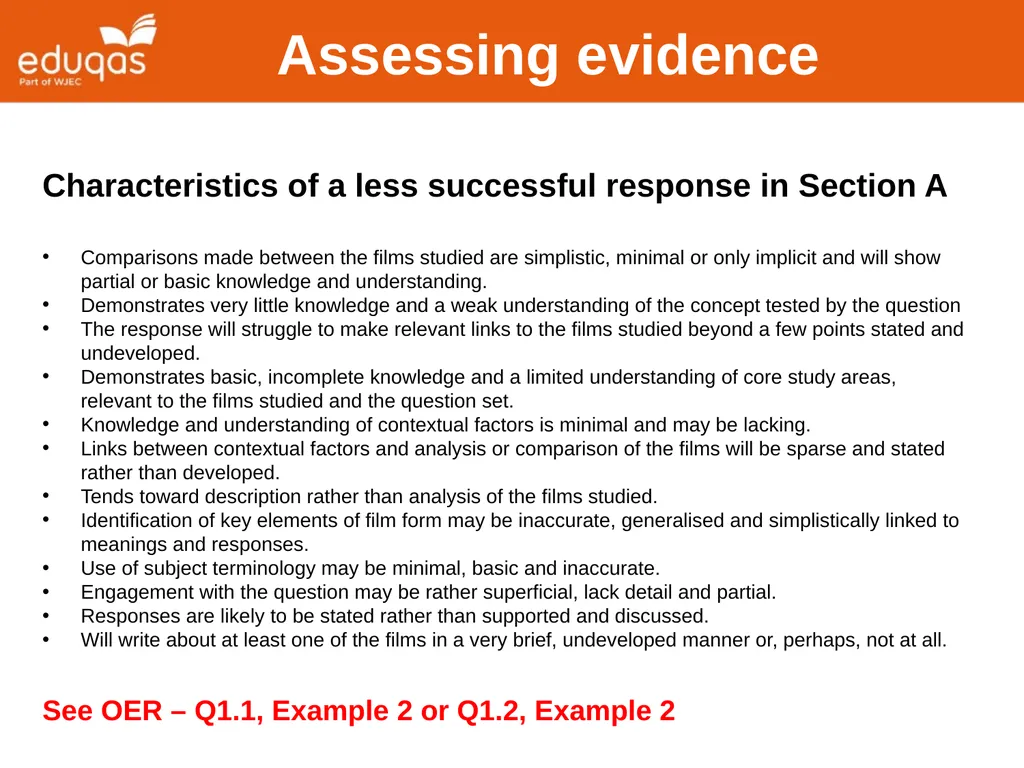
Assessing evidence Characteristics of a less successful response in Section A
Comparisons made between the films studied are simplistic, minimal or only implicit and will show partial or basic knowledge and understanding.
Demonstrates very little knowledge and a weak understanding of the concept tested by the question
The response will struggle to make relevant links to the films studied beyond a few points stated and undeveloped.
Demonstrates basic, incomplete knowledge and a limited understanding of core study areas, relevant to the films studied and the question set.
Knowledge and understanding of contextual factors is minimal and may be lacking.
Links between contextual factors and analysis or comparison of the films will be sparse and stated rather than developed.
Tends toward description rather than analysis of the films studied.
Identification of key elements of film form may be inaccurate, generalised and simplistically linked to meanings and responses.
Use of subject terminology may be minimal, basic and inaccurate.
Engagement with the question may be rather superficial, lack detail and partial.
Responses are likely to be stated rather than supported and discussed.
Will write about at least one of the films in a very brief, undeveloped manner or, perhaps, not at all.
See OER – Q1.1, Example 2 or Q1.2, Example 2<br>
Comparisons made between the films studied are simplistic, minimal or only implicit and will show partial or basic knowledge and understanding.
Demonstrates very little knowledge and a weak understanding of the concept tested by the question
The response will struggle to make relevant links to the films studied beyond a few points stated and undeveloped.
Demonstrates basic, incomplete knowledge and a limited understanding of core study areas, relevant to the films studied and the question set.
Knowledge and understanding of contextual factors is minimal and may be lacking.
Links between contextual factors and analysis or comparison of the films will be sparse and stated rather than developed.
Tends toward description rather than analysis of the films studied.
Identification of key elements of film form may be inaccurate, generalised and simplistically linked to meanings and responses.
Use of subject terminology may be minimal, basic and inaccurate.
Engagement with the question may be rather superficial, lack detail and partial.
Responses are likely to be stated rather than supported and discussed.
Will write about at least one of the films in a very brief, undeveloped manner or, perhaps, not at all.
See OER – Q1.1, Example 2 or Q1.2, Example 2<br>
16
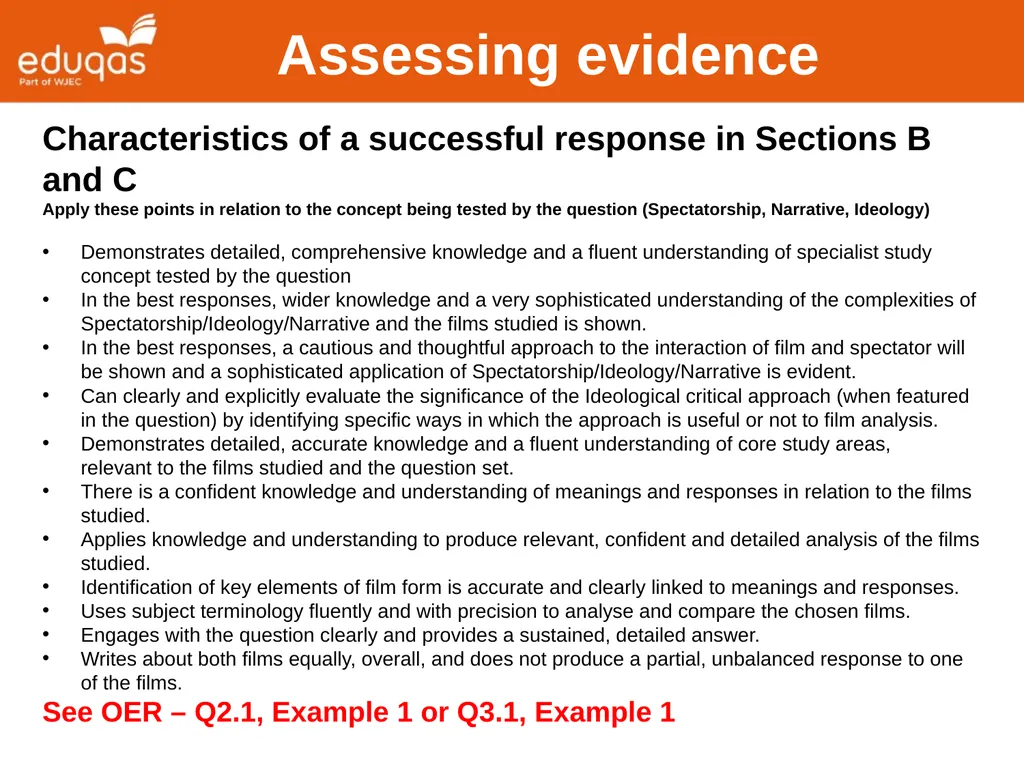
Assessing evidence Characteristics of a successful response in Sections B and C
Apply these points in relation to the concept being tested by the question (Spectatorship, Narrative, Ideology)
Demonstrates detailed, comprehensive knowledge and a fluent understanding of specialist study concept tested by the question
In the best responses, wider knowledge and a very sophisticated understanding of the complexities of Spectatorship/Ideology/Narrative and the films studied is shown.
In the best responses, a cautious and thoughtful approach to the interaction of film and spectator will be shown and a sophisticated application of Spectatorship/Ideology/Narrative is evident.
Can clearly and explicitly evaluate the significance of the Ideological critical approach (when featured in the question) by identifying specific ways in which the approach is useful or not to film analysis.
Demonstrates detailed, accurate knowledge and a fluent understanding of core study areas, relevant to the films studied and the question set.
There is a confident knowledge and understanding of meanings and responses in relation to the films studied.
Applies knowledge and understanding to produce relevant, confident and detailed analysis of the films studied.
Identification of key elements of film form is accurate and clearly linked to meanings and responses.
Uses subject terminology fluently and with precision to analyse and compare the chosen films.
Engages with the question clearly and provides a sustained, detailed answer.
Writes about both films equally, overall, and does not produce a partial, unbalanced response to one of the films.
See OER – Q2.1, Example 1 or Q3.1, Example 1<br>
Apply these points in relation to the concept being tested by the question (Spectatorship, Narrative, Ideology)
Demonstrates detailed, comprehensive knowledge and a fluent understanding of specialist study concept tested by the question
In the best responses, wider knowledge and a very sophisticated understanding of the complexities of Spectatorship/Ideology/Narrative and the films studied is shown.
In the best responses, a cautious and thoughtful approach to the interaction of film and spectator will be shown and a sophisticated application of Spectatorship/Ideology/Narrative is evident.
Can clearly and explicitly evaluate the significance of the Ideological critical approach (when featured in the question) by identifying specific ways in which the approach is useful or not to film analysis.
Demonstrates detailed, accurate knowledge and a fluent understanding of core study areas, relevant to the films studied and the question set.
There is a confident knowledge and understanding of meanings and responses in relation to the films studied.
Applies knowledge and understanding to produce relevant, confident and detailed analysis of the films studied.
Identification of key elements of film form is accurate and clearly linked to meanings and responses.
Uses subject terminology fluently and with precision to analyse and compare the chosen films.
Engages with the question clearly and provides a sustained, detailed answer.
Writes about both films equally, overall, and does not produce a partial, unbalanced response to one of the films.
See OER – Q2.1, Example 1 or Q3.1, Example 1<br>
17
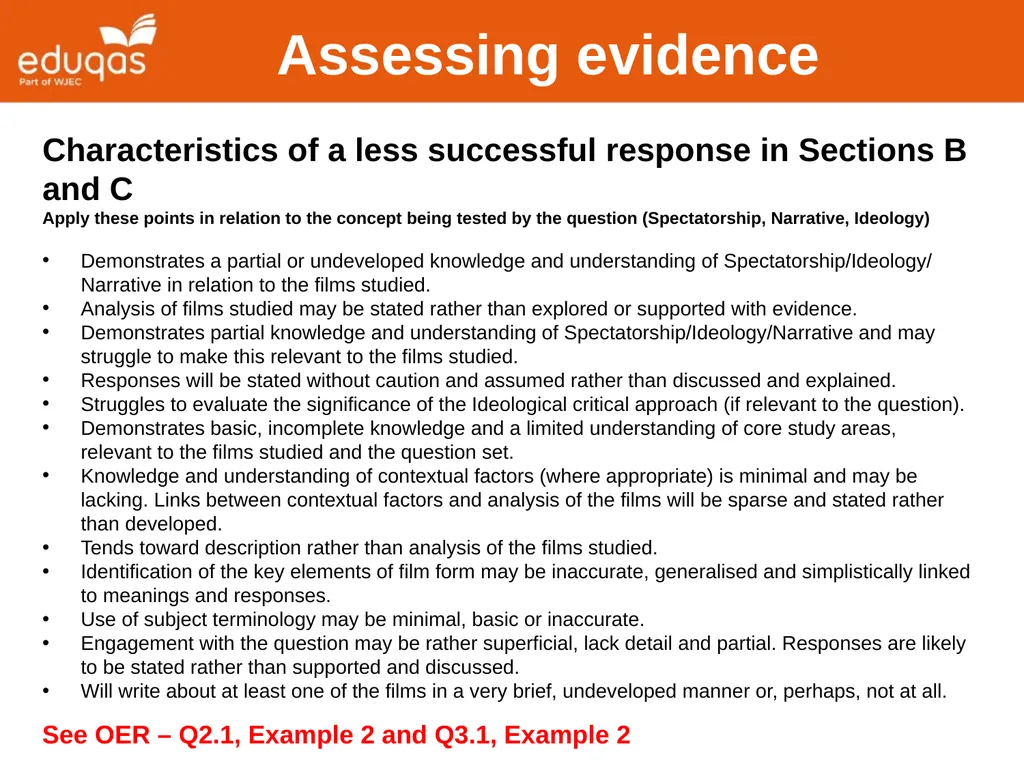
Assessing evidence Characteristics of a less successful response in Sections B and C
Apply these points in relation to the concept being tested by the question (Spectatorship, Narrative, Ideology)
Demonstrates a partial or undeveloped knowledge and understanding of Spectatorship/Ideology/ Narrative in relation to the films studied.
Analysis of films studied may be stated rather than explored or supported with evidence.
Demonstrates partial knowledge and understanding of Spectatorship/Ideology/Narrative and may struggle to make this relevant to the films studied.
Responses will be stated without caution and assumed rather than discussed and explained.
Struggles to evaluate the significance of the Ideological critical approach (if relevant to the question).
Demonstrates basic, incomplete knowledge and a limited understanding of core study areas, relevant to the films studied and the question set.
Knowledge and understanding of contextual factors (where appropriate) is minimal and may be lacking. Links between contextual factors and analysis of the films will be sparse and stated rather than developed.
Tends toward description rather than analysis of the films studied.
Identification of the key elements of film form may be inaccurate, generalised and simplistically linked to meanings and responses.
Use of subject terminology may be minimal, basic or inaccurate.
Engagement with the question may be rather superficial, lack detail and partial. Responses are likely to be stated rather than supported and discussed.
Will write about at least one of the films in a very brief, undeveloped manner or, perhaps, not at all. See OER – Q2.1, Example 2 and Q3.1, Example 2<br>
Apply these points in relation to the concept being tested by the question (Spectatorship, Narrative, Ideology)
Demonstrates a partial or undeveloped knowledge and understanding of Spectatorship/Ideology/ Narrative in relation to the films studied.
Analysis of films studied may be stated rather than explored or supported with evidence.
Demonstrates partial knowledge and understanding of Spectatorship/Ideology/Narrative and may struggle to make this relevant to the films studied.
Responses will be stated without caution and assumed rather than discussed and explained.
Struggles to evaluate the significance of the Ideological critical approach (if relevant to the question).
Demonstrates basic, incomplete knowledge and a limited understanding of core study areas, relevant to the films studied and the question set.
Knowledge and understanding of contextual factors (where appropriate) is minimal and may be lacking. Links between contextual factors and analysis of the films will be sparse and stated rather than developed.
Tends toward description rather than analysis of the films studied.
Identification of the key elements of film form may be inaccurate, generalised and simplistically linked to meanings and responses.
Use of subject terminology may be minimal, basic or inaccurate.
Engagement with the question may be rather superficial, lack detail and partial. Responses are likely to be stated rather than supported and discussed.
Will write about at least one of the films in a very brief, undeveloped manner or, perhaps, not at all. See OER – Q2.1, Example 2 and Q3.1, Example 2<br>
18
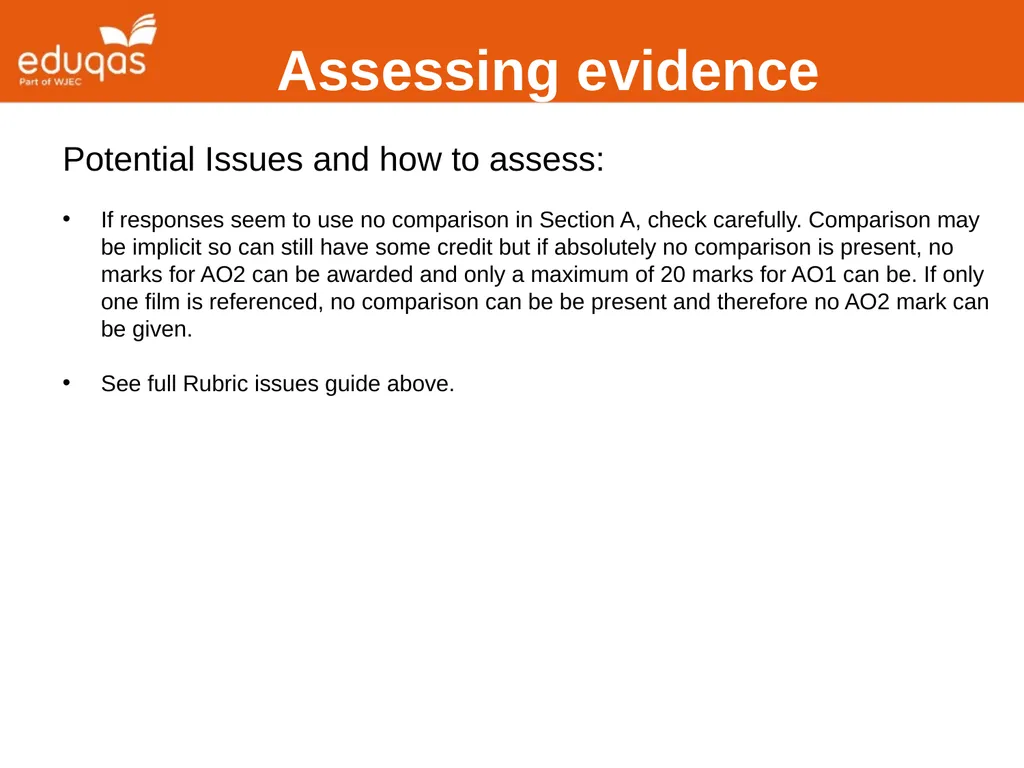
Assessing evidence Potential Issues and how to assess:
If responses seem to use no comparison in Section A, check carefully. Comparison may be implicit so can still have some credit but if absolutely no comparison is present, no marks for AO2 can be awarded and only a maximum of 20 marks for AO1 can be. If only one film is referenced, no comparison can be be present and therefore no AO2 mark can be given.
See full Rubric issues guide above.<br>
If responses seem to use no comparison in Section A, check carefully. Comparison may be implicit so can still have some credit but if absolutely no comparison is present, no marks for AO2 can be awarded and only a maximum of 20 marks for AO1 can be. If only one film is referenced, no comparison can be be present and therefore no AO2 mark can be given.
See full Rubric issues guide above.<br>
19
Component 2<br>
20
Assessing evidence Assessment Purpose
Component 2 (Global Film-making Perspectives) examines A01 and A02 in relation to Global English language film (produced outside the US), Global non-English language film and Contemporary UK film (produced after 2010)
These assessment objectives carry equal weighting in determining the mark scheme bands and numerical marks for responses to each section.
Throughout Component 2, learners must demonstrate knowledge and understanding of the Core Study Areas and related Specialist Study Areas (AO1) as well as apply (AO2) that knowledge and understanding according to the requirements of the question.
The Core Study Areas are:
Film Form
Meanings and Responses
The Contexts of Film
The Specialist Study Areas related to Component 1 sections are:
Section B – Critical Debates/ Film-makers Theories
Section C – Critical Debates
Section D – Narrative/Auteur<br>
Component 2 (Global Film-making Perspectives) examines A01 and A02 in relation to Global English language film (produced outside the US), Global non-English language film and Contemporary UK film (produced after 2010)
These assessment objectives carry equal weighting in determining the mark scheme bands and numerical marks for responses to each section.
Throughout Component 2, learners must demonstrate knowledge and understanding of the Core Study Areas and related Specialist Study Areas (AO1) as well as apply (AO2) that knowledge and understanding according to the requirements of the question.
The Core Study Areas are:
Film Form
Meanings and Responses
The Contexts of Film
The Specialist Study Areas related to Component 1 sections are:
Section B – Critical Debates/ Film-makers Theories
Section C – Critical Debates
Section D – Narrative/Auteur<br>
21
Assessing evidence Assessment Criteria – Amplifying the Assessment Objectives
Below are the assessment objectives for Component 2 and some suggested amplifications of each one to help explain how we might see these evidenced in various student responses to different questions. Delineations of assessment objectives will be dependent upon the question set and will be indicative of differentiated responses. This is not an exhaustive list, there are other ways of demonstrating or applying knowledge and understanding
AO1 - Demonstrate knowledge and understanding of elements of film
Selection of specific formal elements of the films studied and the ability to use subject-specific terminology to identify these elements.
Identification of significant contexts that may have shaped and influenced the films studied.
Identifying meanings and responses that are relevant to the films studied.
Identification of relevant aspects of spectatorship, narrative, ideology, auteur study, critical debates and filmmakers’ theories of the films studied.
Recall accurate facts in relation to the films studied and their contexts.
Describe and explain elements of film in relation to the question set.
Select significant elements of film in response to the question.
Explain elements of film in relation to the films studied.<br>
Below are the assessment objectives for Component 2 and some suggested amplifications of each one to help explain how we might see these evidenced in various student responses to different questions. Delineations of assessment objectives will be dependent upon the question set and will be indicative of differentiated responses. This is not an exhaustive list, there are other ways of demonstrating or applying knowledge and understanding
AO1 - Demonstrate knowledge and understanding of elements of film
Selection of specific formal elements of the films studied and the ability to use subject-specific terminology to identify these elements.
Identification of significant contexts that may have shaped and influenced the films studied.
Identifying meanings and responses that are relevant to the films studied.
Identification of relevant aspects of spectatorship, narrative, ideology, auteur study, critical debates and filmmakers’ theories of the films studied.
Recall accurate facts in relation to the films studied and their contexts.
Describe and explain elements of film in relation to the question set.
Select significant elements of film in response to the question.
Explain elements of film in relation to the films studied.<br>
22
Assessing evidence Assessment Criteria – Amplifying the Assessment Objectives
Below are the assessment objectives for Component 2 and some suggested amplifications of each one to help explain how we might see these evidenced in various student responses to different questions. Delineations of assessment objectives will be dependent upon the question set and will be indicative of differentiated responses. This is not an exhaustive list, there are other ways of demonstrating or applying knowledge and understanding
AO2 - Apply knowledge and understanding of elements of film to analyse films
The ability to link elements of film form to meanings and responses in specific and relevant ways.
Differentiation between more or less significant knowledge in answering the question set.
Organising knowledge to form a coherent and persuasive answer to the question set.
Discussion and examination of the answers to the questions set.
The ability to support and exemplify an argument with well selected evidence.
Showing an understanding of film studied in a way that shows an understanding of critical debates (when tested by the question).<br>
Below are the assessment objectives for Component 2 and some suggested amplifications of each one to help explain how we might see these evidenced in various student responses to different questions. Delineations of assessment objectives will be dependent upon the question set and will be indicative of differentiated responses. This is not an exhaustive list, there are other ways of demonstrating or applying knowledge and understanding
AO2 - Apply knowledge and understanding of elements of film to analyse films
The ability to link elements of film form to meanings and responses in specific and relevant ways.
Differentiation between more or less significant knowledge in answering the question set.
Organising knowledge to form a coherent and persuasive answer to the question set.
Discussion and examination of the answers to the questions set.
The ability to support and exemplify an argument with well selected evidence.
Showing an understanding of film studied in a way that shows an understanding of critical debates (when tested by the question).<br>
23
Assessing evidence Assessment Criteria – Amplifying the Mark Scheme Bands:
General Information
Marking should be positive, rewarding achievement rather than penalising failure or omissions. The awarding of marks must be directly related to the marking criteria. Examiners should use the generic assessment grid and the indicative content for each question when assessing a candidate’s response.
Band Descriptors
When awarding a mark, examiners should select the band that most closely describes the quality of the work being assessed. Marking grids, which include guidance on how to allocate marks within bands, have been constructed using the principles below. Once the appropriate band has been selected, examiners should award in the notional centre of the band, awarding higher or lower depending on the strength of the response.
Where the candidate's work securely meets the descriptors, award marks in the notional centre of a band and then adjust higher or lower depending on the degree to which the band's criteria are met.
Where the candidate’s work convincingly meets the descriptors, the highest mark should be awarded, depending on the strength of the answer
Where the candidate’s work less securely meets the descriptors, the lowest mark should be awarded, depending on the degree of its weaknesses.
Where a candidate's work combines the qualities of two different bands, examiners should use their professional judgement to award a mark in the band which best describes the majority of the candidate's work.
Where there is a two mark range within each band, examiners should award: the upper of the two marks for work which convincingly meets the descriptors or the lower of the two marks for work which less strongly meets the descriptors.
Examiners should use the full range of marks available to them.<br>
General Information
Marking should be positive, rewarding achievement rather than penalising failure or omissions. The awarding of marks must be directly related to the marking criteria. Examiners should use the generic assessment grid and the indicative content for each question when assessing a candidate’s response.
Band Descriptors
When awarding a mark, examiners should select the band that most closely describes the quality of the work being assessed. Marking grids, which include guidance on how to allocate marks within bands, have been constructed using the principles below. Once the appropriate band has been selected, examiners should award in the notional centre of the band, awarding higher or lower depending on the strength of the response.
Where the candidate's work securely meets the descriptors, award marks in the notional centre of a band and then adjust higher or lower depending on the degree to which the band's criteria are met.
Where the candidate’s work convincingly meets the descriptors, the highest mark should be awarded, depending on the strength of the answer
Where the candidate’s work less securely meets the descriptors, the lowest mark should be awarded, depending on the degree of its weaknesses.
Where a candidate's work combines the qualities of two different bands, examiners should use their professional judgement to award a mark in the band which best describes the majority of the candidate's work.
Where there is a two mark range within each band, examiners should award: the upper of the two marks for work which convincingly meets the descriptors or the lower of the two marks for work which less strongly meets the descriptors.
Examiners should use the full range of marks available to them.<br>
24
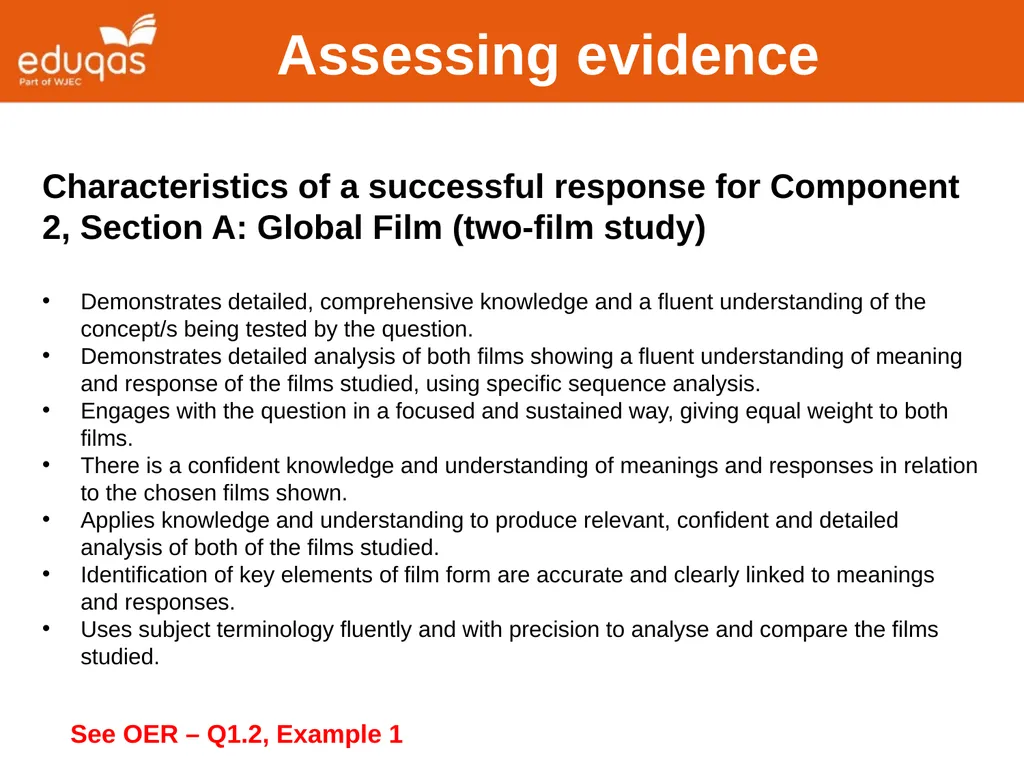
Assessing evidence Characteristics of a successful response for Component 2, Section A: Global Film (two-film study)
Demonstrates detailed, comprehensive knowledge and a fluent understanding of the concept/s being tested by the question.
Demonstrates detailed analysis of both films showing a fluent understanding of meaning and response of the films studied, using specific sequence analysis.
Engages with the question in a focused and sustained way, giving equal weight to both films.
There is a confident knowledge and understanding of meanings and responses in relation to the chosen films shown.
Applies knowledge and understanding to produce relevant, confident and detailed analysis of both of the films studied.
Identification of key elements of film form are accurate and clearly linked to meanings and responses.
Uses subject terminology fluently and with precision to analyse and compare the films studied. See OER – Q1.2, Example 1<br>
Demonstrates detailed, comprehensive knowledge and a fluent understanding of the concept/s being tested by the question.
Demonstrates detailed analysis of both films showing a fluent understanding of meaning and response of the films studied, using specific sequence analysis.
Engages with the question in a focused and sustained way, giving equal weight to both films.
There is a confident knowledge and understanding of meanings and responses in relation to the chosen films shown.
Applies knowledge and understanding to produce relevant, confident and detailed analysis of both of the films studied.
Identification of key elements of film form are accurate and clearly linked to meanings and responses.
Uses subject terminology fluently and with precision to analyse and compare the films studied. See OER – Q1.2, Example 1<br>
25
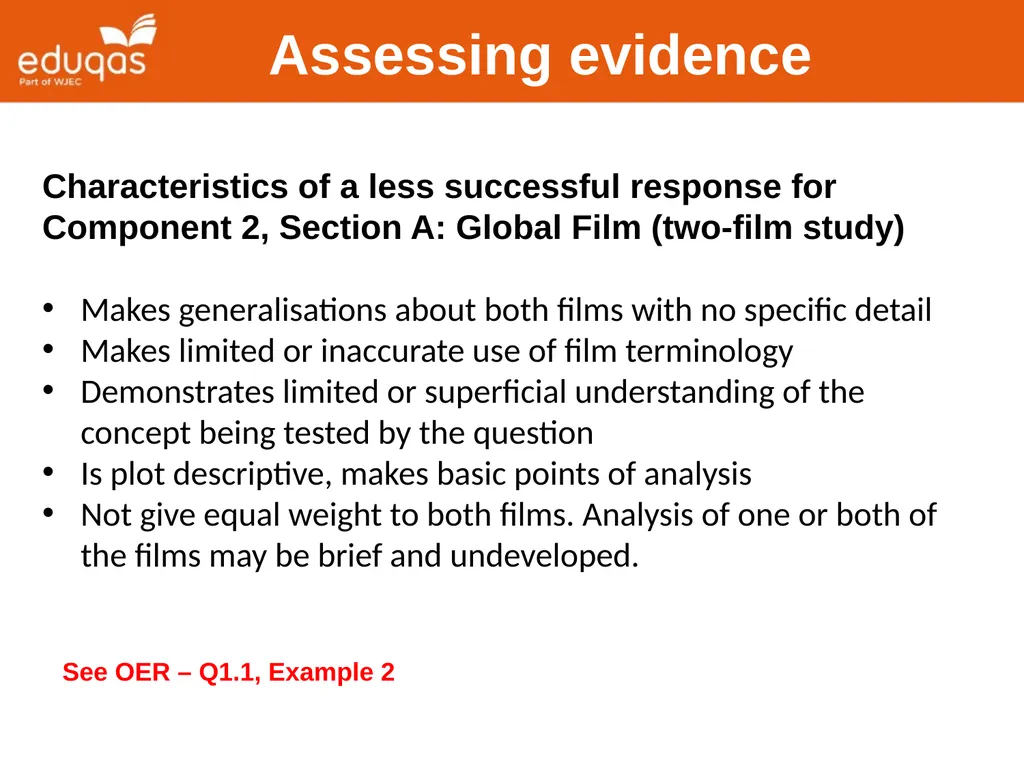
Assessing evidence Characteristics of a less successful response for Component 2, Section A: Global Film (two-film study)
Makes generalisations about both films with no specific detail
Makes limited or inaccurate use of film terminology
Demonstrates limited or superficial understanding of the concept being tested by the question
Is plot descriptive, makes basic points of analysis
Not give equal weight to both films. Analysis of one or both of the films may be brief and undeveloped. See OER – Q1.1, Example 2<br>
Makes generalisations about both films with no specific detail
Makes limited or inaccurate use of film terminology
Demonstrates limited or superficial understanding of the concept being tested by the question
Is plot descriptive, makes basic points of analysis
Not give equal weight to both films. Analysis of one or both of the films may be brief and undeveloped. See OER – Q1.1, Example 2<br>
26
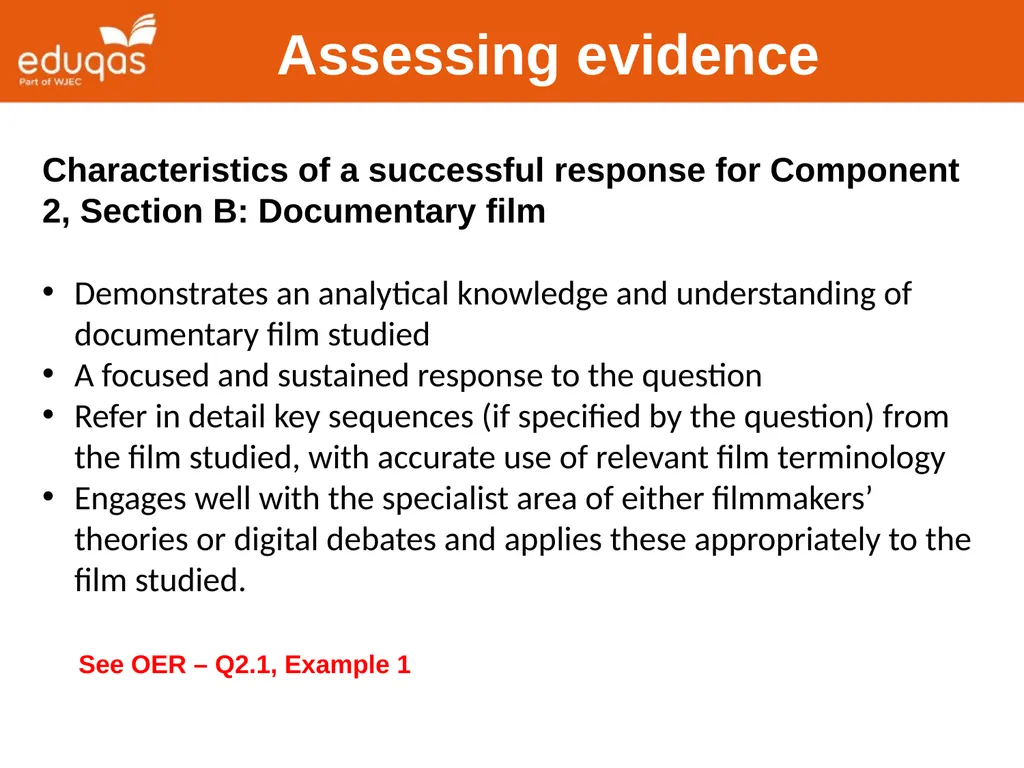
Assessing evidence Characteristics of a successful response for Component 2, Section B: Documentary film
Demonstrates an analytical knowledge and understanding of documentary film studied
A focused and sustained response to the question
Refer in detail key sequences (if specified by the question) from the film studied, with accurate use of relevant film terminology
Engages well with the specialist area of either filmmakers’ theories or digital debates and applies these appropriately to the film studied. See OER – Q2.1, Example 1<br>
Demonstrates an analytical knowledge and understanding of documentary film studied
A focused and sustained response to the question
Refer in detail key sequences (if specified by the question) from the film studied, with accurate use of relevant film terminology
Engages well with the specialist area of either filmmakers’ theories or digital debates and applies these appropriately to the film studied. See OER – Q2.1, Example 1<br>
27
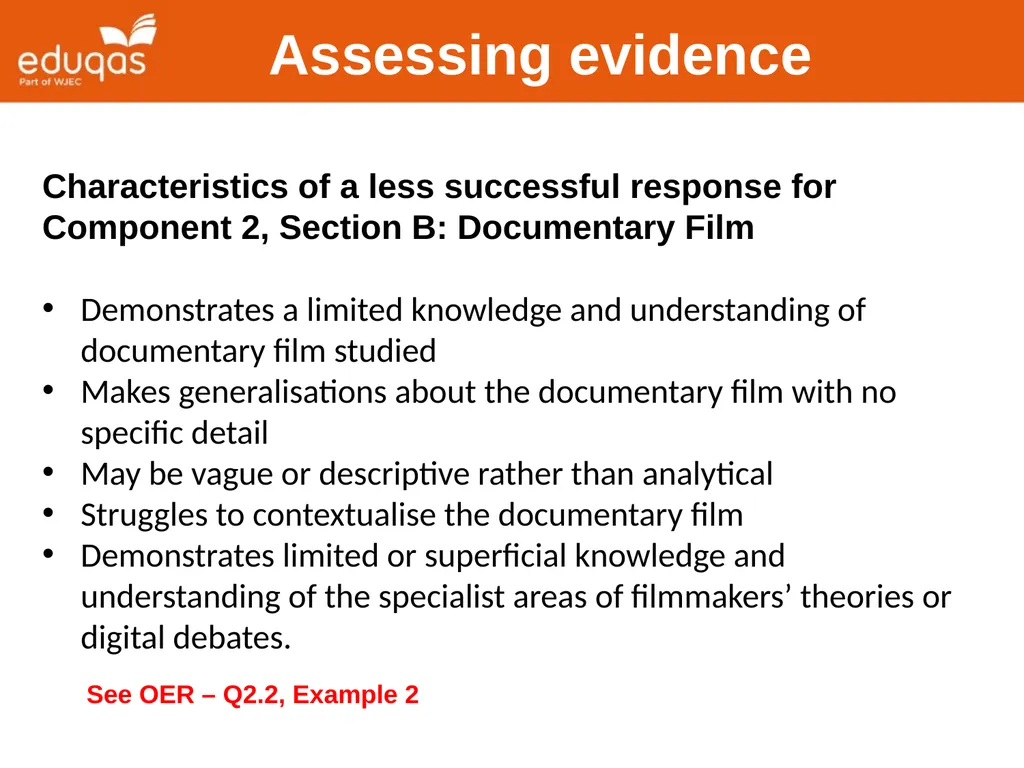
Assessing evidence Characteristics of a less successful response for Component 2, Section B: Documentary Film
Demonstrates a limited knowledge and understanding of documentary film studied
Makes generalisations about the documentary film with no specific detail
May be vague or descriptive rather than analytical
Struggles to contextualise the documentary film
Demonstrates limited or superficial knowledge and understanding of the specialist areas of filmmakers’ theories or digital debates. See OER – Q2.2, Example 2<br>
Demonstrates a limited knowledge and understanding of documentary film studied
Makes generalisations about the documentary film with no specific detail
May be vague or descriptive rather than analytical
Struggles to contextualise the documentary film
Demonstrates limited or superficial knowledge and understanding of the specialist areas of filmmakers’ theories or digital debates. See OER – Q2.2, Example 2<br>
28
Assessing evidence Characteristics of a successful response for Component 2, Section C, Silent Cinema
Be able to engage well with the concept or debate being tested by the question
Uses detailed and relevant examples from their silent film option to illustrate key points.
Refers in detail to one or more key sequences from the silent film option studied, with accurate use of relevant film terminology
Demonstrates a good knowledge and understanding of the film movement relevant to the chosen silent film option.
Demonstrates a good knowledge and understanding of the silent film option’s contexts. See OER – Q3.2, Example 1<br>
Be able to engage well with the concept or debate being tested by the question
Uses detailed and relevant examples from their silent film option to illustrate key points.
Refers in detail to one or more key sequences from the silent film option studied, with accurate use of relevant film terminology
Demonstrates a good knowledge and understanding of the film movement relevant to the chosen silent film option.
Demonstrates a good knowledge and understanding of the silent film option’s contexts. See OER – Q3.2, Example 1<br>
29
Assessing evidence Characteristics of a less successful response for Component 2, Section C: Silent Cinema
Demonstrates a limited or superficial knowledge and understanding of the film option studied
Has an incoherent grasp of the critical debate or concept being tested by the question and may struggle to apply this to the silent film option.
Make generalisations about the silent film option with no specific detail
Struggle to contextualise the silent film option
Have limited awareness and understanding of the film movement relevant to the silent film option. See OER – Q3.1, Example 2<br>
Demonstrates a limited or superficial knowledge and understanding of the film option studied
Has an incoherent grasp of the critical debate or concept being tested by the question and may struggle to apply this to the silent film option.
Make generalisations about the silent film option with no specific detail
Struggle to contextualise the silent film option
Have limited awareness and understanding of the film movement relevant to the silent film option. See OER – Q3.1, Example 2<br>
30
Assessing evidence Characteristics of a successful response for Component 2, Section D: Experimental Film
Demonstrates sophisticated understanding of the specialist area being tested by the question
Makes detailed references to the films to illustrate or evidence key points.
Refers in detail to one or more key sequences (if requested by the question)
Accurate use of relevant film terminology to analyse film option studied
Demonstrates excellent knowledge and understanding of the experimental film movement relevant to the film option studied. See OER – Q4.1, Example 1<br>
Demonstrates sophisticated understanding of the specialist area being tested by the question
Makes detailed references to the films to illustrate or evidence key points.
Refers in detail to one or more key sequences (if requested by the question)
Accurate use of relevant film terminology to analyse film option studied
Demonstrates excellent knowledge and understanding of the experimental film movement relevant to the film option studied. See OER – Q4.1, Example 1<br>
31
Assessing evidence Characteristics of a less successful response for Component 2, Section D: Experimental Film
Demonstrate a limited or superficial knowledge of the specialist area being tested by the question
Makes generalisations about the experimental film option with no specific detail from the films
More descriptive than analytical
Struggles to contextualise the experimental film option
Has limited awareness and understanding of the film movement relevant to the silent film option. See OER – Q4.2, Example 1<br>
Demonstrate a limited or superficial knowledge of the specialist area being tested by the question
Makes generalisations about the experimental film option with no specific detail from the films
More descriptive than analytical
Struggles to contextualise the experimental film option
Has limited awareness and understanding of the film movement relevant to the silent film option. See OER – Q4.2, Example 1<br>
32
Assessing evidence Potential problem areas / what not to reward
Please see Rubric Infringements outlined above.<br>
Please see Rubric Infringements outlined above.<br>
33
If you have any questions, contact our specialist subject officers and administrative support team for your subject with any queries.
film@wjec.co.uk<br>
film@wjec.co.uk<br>