
Assessment in the Classroom: Making it Work Online
TG
Published · 37 slides · 0 views

1 / 1


Description
Assessment in the Classroom: Making it Work Online Dr. Kwesi Tandoh, Dan Jones, Angelia Yount Presentation ObjectivesOutcomes Define the terms assessment and authentic assessment. Differentiate between assessment and evaluation. Identify
Related Topics
Share
Embed code
Download this presentation From Below
"Assessment in the Classroom: Making it Work Online" is the property of its rightful owner. Permission is granted to download and print the materials on this website for personal, non-commercial use only, and to display it on your personal computer provided you do not modify the materials and that you retain all copyright notices contained in the materials. By downloading content from our website, you accept the terms of this agreement.
Presentation Transcript
01
Assessment in the Classroom:
Making it Work Online Dr. Kwesi Tandoh, Dan Jones, Angelia Yount<br>
02
Presentation Objectives/Outcomes Define the terms assessment and authentic assessment.
Differentiate between assessment and evaluation.
Identify the different forms of assessment.
Implement Quality Matters standards to maximize quality assessments in online learning.<br>
Differentiate between assessment and evaluation.
Identify the different forms of assessment.
Implement Quality Matters standards to maximize quality assessments in online learning.<br>
03
Assessment vs. Evaluation? Assessment is:
“Gathering of evidence and documentation of learning.” (Trussell-Cullen 1998)
“The gathering of information concerning the functioning of students, staff, and institutions of higher education and Evaluation as the use of that information for institutional and individual improvement.” (Astin and Antonio, 2012)
“Process whereby teachers find out what students have learned in the classroom and how well they are learning.” (Angelo & Cross 1993)<br>
“Gathering of evidence and documentation of learning.” (Trussell-Cullen 1998)
“The gathering of information concerning the functioning of students, staff, and institutions of higher education and Evaluation as the use of that information for institutional and individual improvement.” (Astin and Antonio, 2012)
“Process whereby teachers find out what students have learned in the classroom and how well they are learning.” (Angelo & Cross 1993)<br>
04
Assessment vs. Evaluation? On the other hand Evaluation is:
“Viewed as a process whereby we seek to interpret the assessment data and make appropriate professional judgments based on that data.” (Trussell-Cullen 1998)<br>
“Viewed as a process whereby we seek to interpret the assessment data and make appropriate professional judgments based on that data.” (Trussell-Cullen 1998)<br>
05
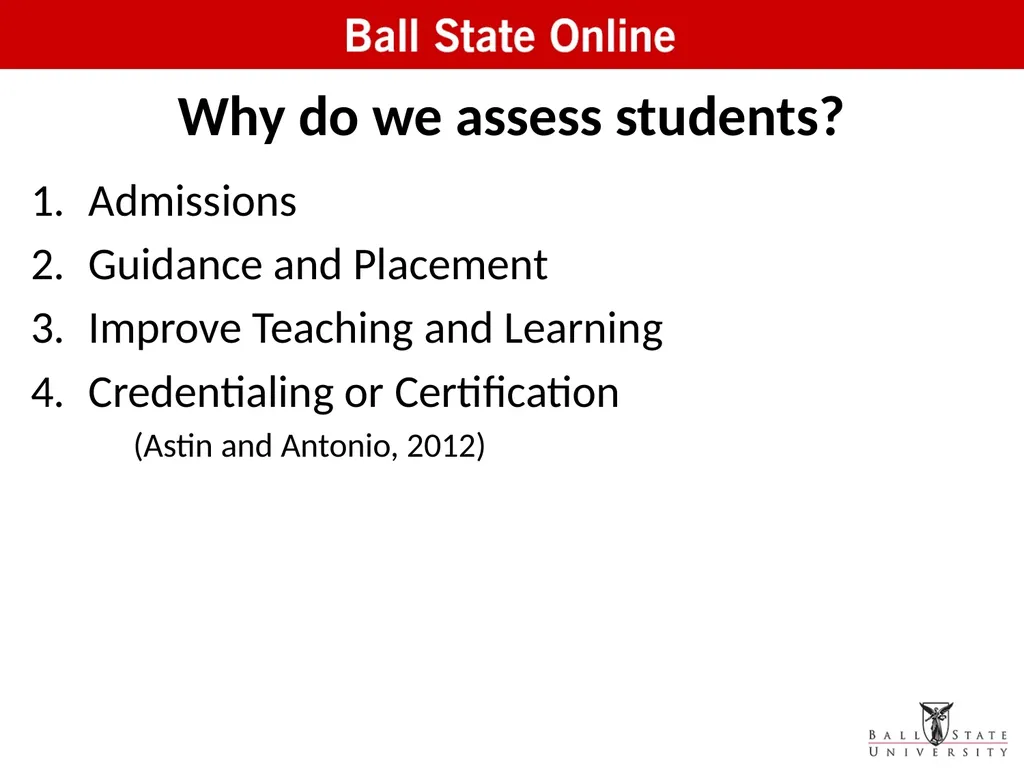
Why do we assess students? Admissions
Guidance and Placement
Improve Teaching and Learning
Credentialing or Certification
(Astin and Antonio, 2012)<br>
Guidance and Placement
Improve Teaching and Learning
Credentialing or Certification
(Astin and Antonio, 2012)<br>
06
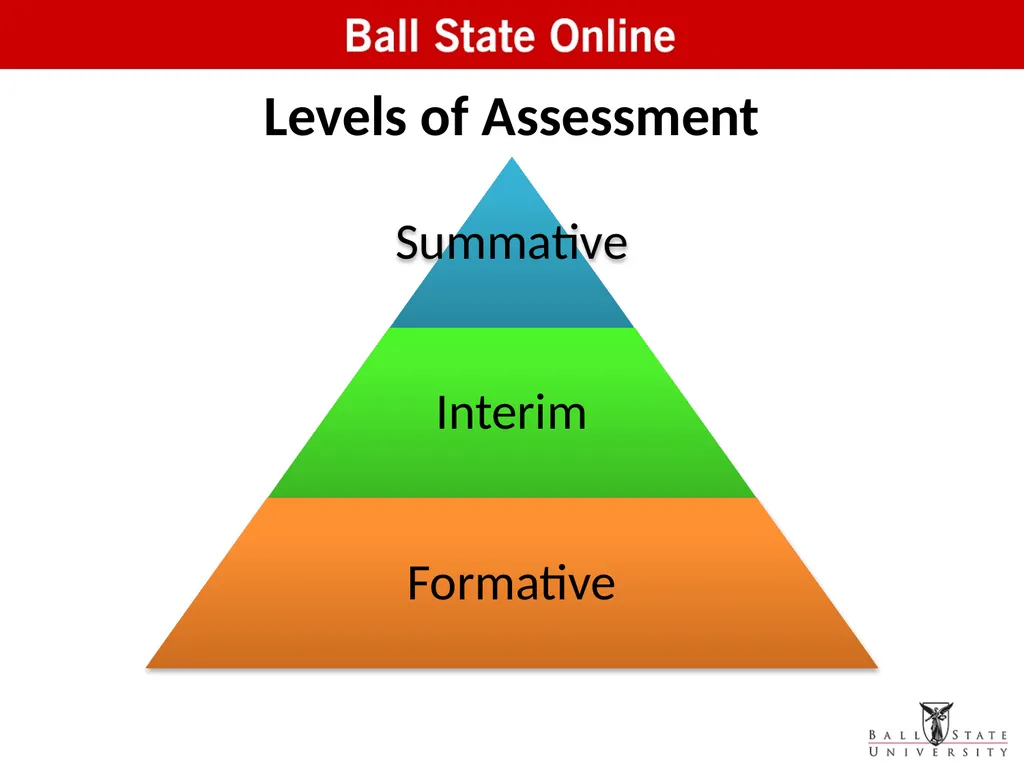
Levels of Assessment Summative Interim Formative<br>
07
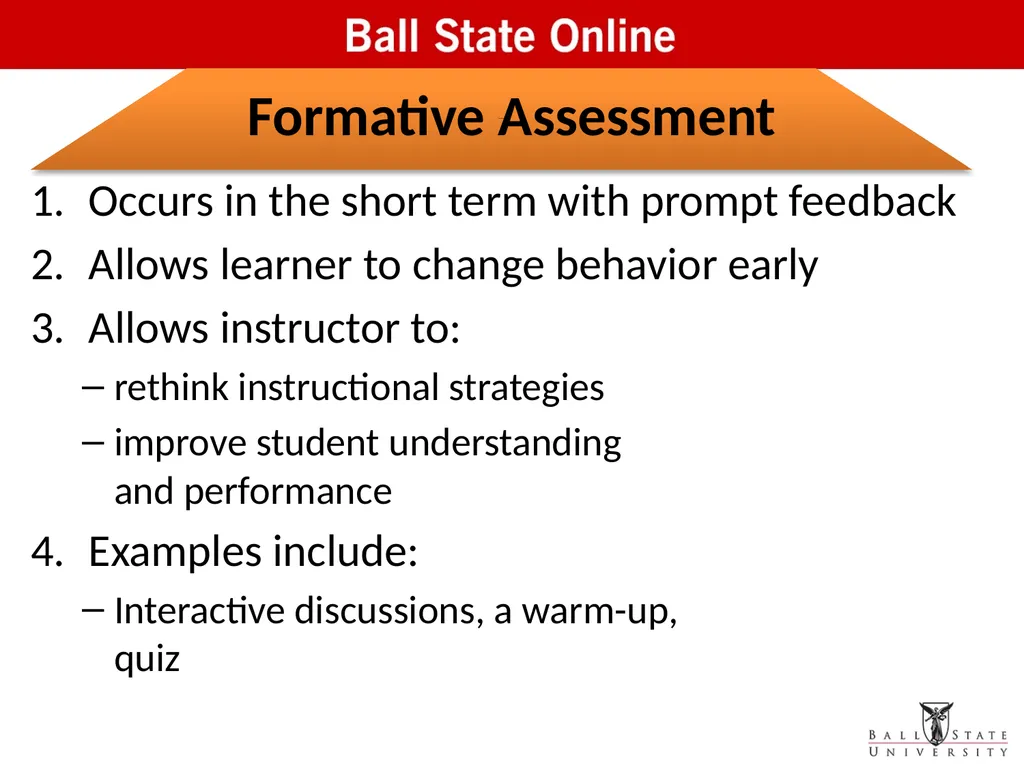
Formative Formative Assessment Occurs in the short term with prompt feedback
Allows learner to change behavior early
Allows instructor to:
rethink instructional strategies
improve student understanding and performance
Examples include:
Interactive discussions, a warm-up, quiz<br>
Allows learner to change behavior early
Allows instructor to:
rethink instructional strategies
improve student understanding and performance
Examples include:
Interactive discussions, a warm-up, quiz<br>
08
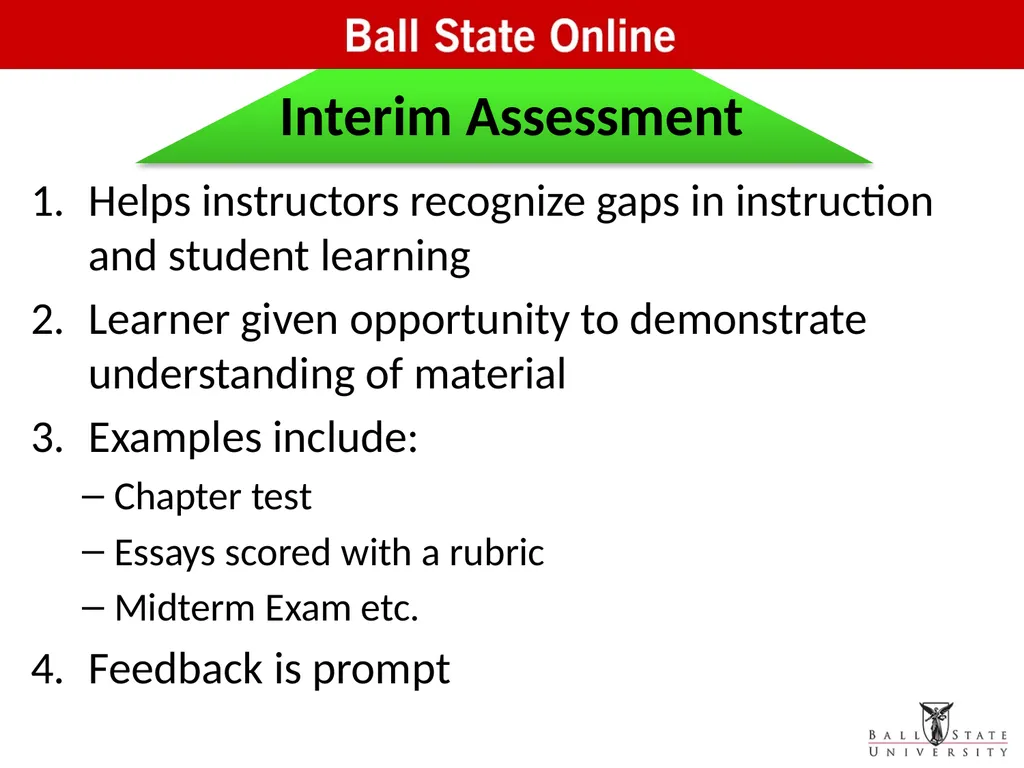
Interim Assessment Helps instructors recognize gaps in instruction and student learning
Learner given opportunity to demonstrate understanding of material
Examples include:
Chapter test
Essays scored with a rubric
Midterm Exam etc.
Feedback is prompt<br>
Learner given opportunity to demonstrate understanding of material
Examples include:
Chapter test
Essays scored with a rubric
Midterm Exam etc.
Feedback is prompt<br>
09
Summative Assessment Mainly at the end of the term or semester
Results mostly for teachers and institutional use
Very limited feedback to student
Least impact on student learning
Instructors and institutions use these to identify strengths and weaknesses of the curriculum
Examples include:
Final Exam, GRE, Research Projects, musical recitals etc.<br>
Results mostly for teachers and institutional use
Very limited feedback to student
Least impact on student learning
Instructors and institutions use these to identify strengths and weaknesses of the curriculum
Examples include:
Final Exam, GRE, Research Projects, musical recitals etc.<br>
10
Types of Assessment Authentic / Alternative Traditional<br>
11
What is Traditional Assessment? “Students typically select an answer or recall information to complete the assessment. These tests may be standardized or teacher-created. They may be administered locally or statewide, or internationally.” (Mueller 2005)<br>
12
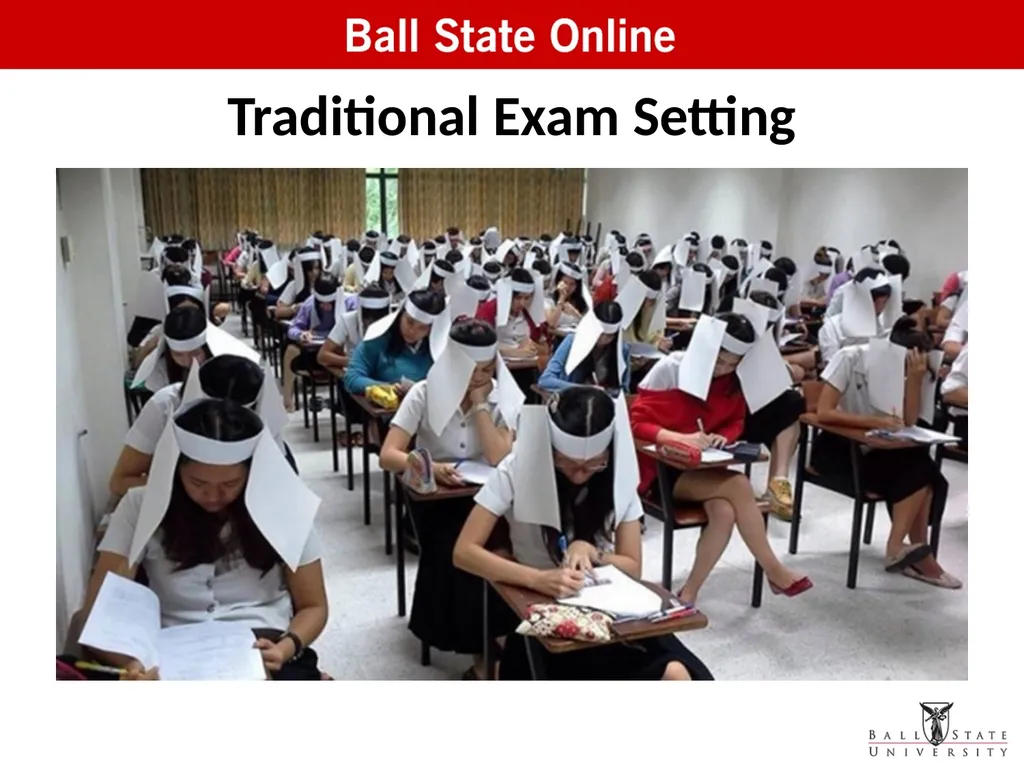
Traditional Exam Setting<br>
13
Examples of Traditional Assessment Written assessment-Unseen Exam:
Multiple Choice Exams
True-false
Matching
Open ended:
Essay
Written examination<br>
Multiple Choice Exams
True-false
Matching
Open ended:
Essay
Written examination<br>
14
Unseen Exam What is it?
This is the traditional form of summative assessment.
Students answer a number of questions such as, essay, problem, short-answer or multiple-choice.
Students have either minimal or no prior information, and have to produce answers in a set period, with recourse to no other resources than those in their heads, or specific equipment provided by the examiner.<br>
This is the traditional form of summative assessment.
Students answer a number of questions such as, essay, problem, short-answer or multiple-choice.
Students have either minimal or no prior information, and have to produce answers in a set period, with recourse to no other resources than those in their heads, or specific equipment provided by the examiner.<br>
15
Unseen Exam Pros and Cons Pros
Mostly takes place in a highly controlled and proctored environment. Very secure
It is one of the few ways of ensuring that students revise the entire course material, and commit it to memory.
Cons
Encourages regurgitation or rote learning whether the material is relevant or not.
Examinations typically generate high degrees of anxiety, amounting to cognitive paralysis on the part of some candidates.
Requires very specific skills, which may well be irrelevant to the subject being examined, and are therefore often low on validity, but high on discrimination potential.
Promotes guessing and discourages authentic learning.<br>
Mostly takes place in a highly controlled and proctored environment. Very secure
It is one of the few ways of ensuring that students revise the entire course material, and commit it to memory.
Cons
Encourages regurgitation or rote learning whether the material is relevant or not.
Examinations typically generate high degrees of anxiety, amounting to cognitive paralysis on the part of some candidates.
Requires very specific skills, which may well be irrelevant to the subject being examined, and are therefore often low on validity, but high on discrimination potential.
Promotes guessing and discourages authentic learning.<br>
16
Pros and Cons of Traditional Assessment Pros
Cost-effective
Minimizes plagiarism
Encourages student learning
Cons
Low feedback
Does not help theory/practice gap
Encourages rote learning
Does not measure teamwork etc.
Reveal only whether student can recognize, recall, or “plug in” what was learned out of contest
Limited to paper and pencil<br>
Cost-effective
Minimizes plagiarism
Encourages student learning
Cons
Low feedback
Does not help theory/practice gap
Encourages rote learning
Does not measure teamwork etc.
Reveal only whether student can recognize, recall, or “plug in” what was learned out of contest
Limited to paper and pencil<br>
17
What is Authentic Assessment? “Students are asked to perform real-world tasks that demonstrate meaningful application of essential knowledge and skills.” (Jon Mueller, 2005)
“...Engaging and worthy problems or questions of importance, in which students must use knowledge to fashion performances effectively and creatively.” (Wiggins, 1993).
“Call upon the examinee to demonstrate specific skills and competencies." (Stiggins, 1987).
“Directly examines student performance on worthy intellectual tasks.” (Wiggins, 1990).<br>
“...Engaging and worthy problems or questions of importance, in which students must use knowledge to fashion performances effectively and creatively.” (Wiggins, 1993).
“Call upon the examinee to demonstrate specific skills and competencies." (Stiggins, 1987).
“Directly examines student performance on worthy intellectual tasks.” (Wiggins, 1990).<br>
18
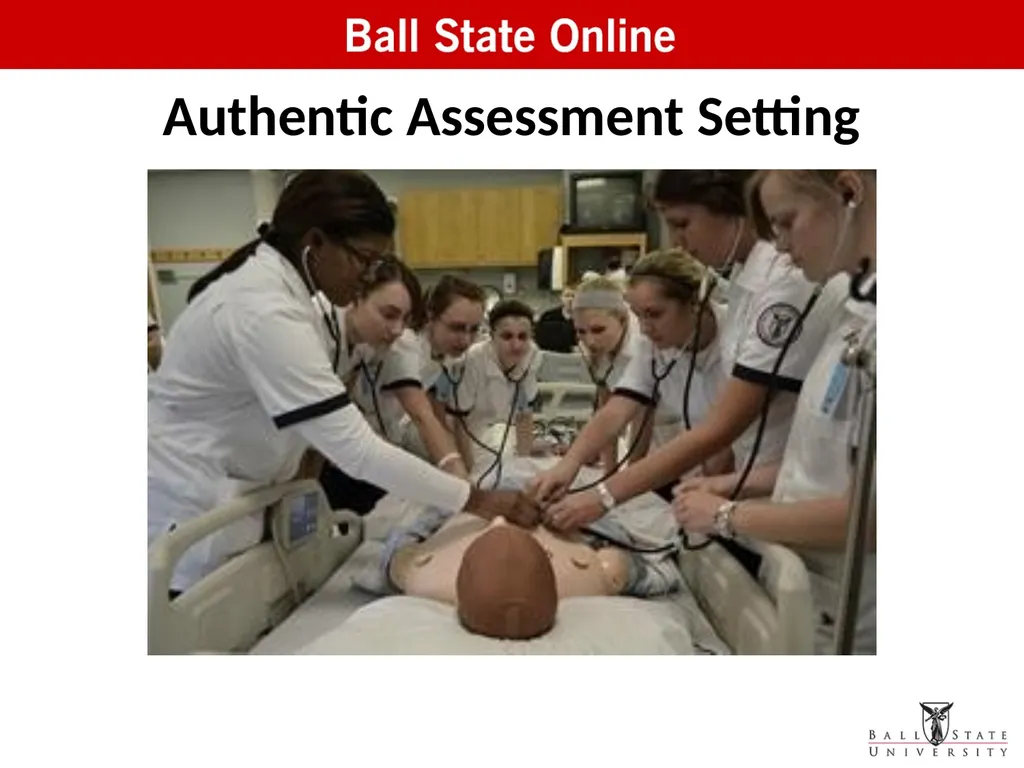
Authentic Assessment Setting<br>
19
Examples of Authentic Assessment Case Studies
Simulations
Projects
Presentations
Portfolios
Musical Recitals<br>
Simulations
Projects
Presentations
Portfolios
Musical Recitals<br>
20
What is a Case Study? A case is the study which investigates specific research questions(that may be fairly loose from the beginning) and seeks to use a range of different kinds of evidence(each with its own strengths and weaknesses) in the case setting to get the best possible answers (Gilham, 2000)
Can be a unit of human activity linked to real world issue
Can only be studied or understood in context
Exists in the here and now
It can be an individual: group- such as a team, tribe
It can be large scale: a community, an institution<br>
Can be a unit of human activity linked to real world issue
Can only be studied or understood in context
Exists in the here and now
It can be an individual: group- such as a team, tribe
It can be large scale: a community, an institution<br>
21
Case Study Pros and Cons Pros
Excellent for assessment of application of principles to real-world situations.
Provides useful information for formative purposes, including diagnosis of problems.
Cons
It is not ideal in a context where criteria for assessment of correct or successful answers are contestable or unclear.
Requires a degree of sophistication on the part of students.
The design and the grading of case-study based work is time-consuming<br>
Excellent for assessment of application of principles to real-world situations.
Provides useful information for formative purposes, including diagnosis of problems.
Cons
It is not ideal in a context where criteria for assessment of correct or successful answers are contestable or unclear.
Requires a degree of sophistication on the part of students.
The design and the grading of case-study based work is time-consuming<br>
22
What is a portfolio? A collection, usually of items(focused artifacts) which are prepared for a purpose or assessment
Pros
Shows evidence of assembled information to show how the student has met specified learning outcomes or assessment criteria.
Valuable for the assessment of vocational or professional practice—including work experience placements—often in conjunction with direct observation.
Cons
Evidence is not easy to come by
Often too cumbersome to navigate<br>
Pros
Shows evidence of assembled information to show how the student has met specified learning outcomes or assessment criteria.
Valuable for the assessment of vocational or professional practice—including work experience placements—often in conjunction with direct observation.
Cons
Evidence is not easy to come by
Often too cumbersome to navigate<br>
23
Authentic Assessment Pros and Cons Pros
Uses direct measures that allows students to use acquired skills
Uses task that mirror priorities and challenges found in best instructional activities – research, writing, oral presentations
Captures constructive nature of learning
Integrates teaching, learning, and assessment
Provides multiple paths to demonstrate student learning
Cons
Too cumbersome and often hard to compile and navigate
Requires students to access too many outside resources
Is too expensive<br>
Uses direct measures that allows students to use acquired skills
Uses task that mirror priorities and challenges found in best instructional activities – research, writing, oral presentations
Captures constructive nature of learning
Integrates teaching, learning, and assessment
Provides multiple paths to demonstrate student learning
Cons
Too cumbersome and often hard to compile and navigate
Requires students to access too many outside resources
Is too expensive<br>
24
The Assessment Dilemma Can Assessment be done Effectively Online as in a Face-to-face Learning Environment?<br>
25
Why do We Assess Online? Can maintain records of correspondence
Test can be archived for future references and quality control
Help settle future complaints
Allows anonymous proctoring
Cost-effective
Prompt feedback
Convenient
Easy access to analytics for effective decision-making for the institution, department, and faculty<br>
Test can be archived for future references and quality control
Help settle future complaints
Allows anonymous proctoring
Cost-effective
Prompt feedback
Convenient
Easy access to analytics for effective decision-making for the institution, department, and faculty<br>
26
Online Assessment Pros and Cons Advantages Provide easy access to records
Cost effective
Convenient (Can be taken anywhere anytime)
Instant feedback
Remote Proctoring
Analytics Disadvantages Cheating
Technology Glitches
Identity Fraud
Students can not seek real-time clarification
Proctoring can be expensive<br>
Cost effective
Convenient (Can be taken anywhere anytime)
Instant feedback
Remote Proctoring
Analytics Disadvantages Cheating
Technology Glitches
Identity Fraud
Students can not seek real-time clarification
Proctoring can be expensive<br>
27
How and Why Do Students Cheat? How Students Cheat Copying from peers during exam
System of “signing” with other students
Hide cheat sheet to avoid being connected with it
Getting instructor edition of textbook
Make excuses to take test later Why Students Cheat Inadequate time management
To achieve recognition and success
Lack of preparation
The “only way” to avoid failure and shame
No supervision
Others are doing it<br>
System of “signing” with other students
Hide cheat sheet to avoid being connected with it
Getting instructor edition of textbook
Make excuses to take test later Why Students Cheat Inadequate time management
To achieve recognition and success
Lack of preparation
The “only way” to avoid failure and shame
No supervision
Others are doing it<br>
28
Quality Matters To The Rescue General Standard 3
Assessments are integral to the learning process and are designed to evaluate learner progress in achieving the stated learning objectives or mastering the competencies.<br>
Assessments are integral to the learning process and are designed to evaluate learner progress in achieving the stated learning objectives or mastering the competencies.<br>
29
Assessment Meets Learning Outcomes (3.1) Required level of thinking matches learning outcomes
Range of required items match stated learning outcomes<br>
Range of required items match stated learning outcomes<br>
30
Assessment Grading Policy is Clear (3.2) Clear and straight to the point
Matches stated learning outcomes
Weighted fairly to final grade<br>
Matches stated learning outcomes
Weighted fairly to final grade<br>
31
Specific and Descriptive Evaluation (3.3) Clarity of instructions
Realistic time on task
Appropriate vocabulary
Make-up exams of same type as original
Suitable exam layout<br>
Realistic time on task
Appropriate vocabulary
Make-up exams of same type as original
Suitable exam layout<br>
32
Sequenced and Varied (QM Standard 3.4) Utilize multiple modes of assessment such as portfolios, rubrics, group assessment, self-assessment, and peer assessment
Administer open book quizzes or exams
Assessments build on prior submitted work, e.g. revisions or drafts. For example assessments could progress:
Self-Assessments (multiple choice, matching, fill in the blank, etc.)
Group projects
Portfolio
Simulation<br>
Administer open book quizzes or exams
Assessments build on prior submitted work, e.g. revisions or drafts. For example assessments could progress:
Self-Assessments (multiple choice, matching, fill in the blank, etc.)
Group projects
Portfolio
Simulation<br>
33
Opportunities to Track Learner Progress (3.5) Administer open book quizzes or exams (also in 3.4)
Debrief students after quizzes or exams by asking specific questions about answers
Timely Feedback
Emphasize time on task
Peer reviews
Make sure assignments are due frequently throughout the Semester<br>
Debrief students after quizzes or exams by asking specific questions about answers
Timely Feedback
Emphasize time on task
Peer reviews
Make sure assignments are due frequently throughout the Semester<br>
34
As Educators we Must Always Remember that…… THE PURPOSE
OF ASSESSMENT
IS TO IMPROVE
LEARNING<br>
OF ASSESSMENT
IS TO IMPROVE
LEARNING<br>
35
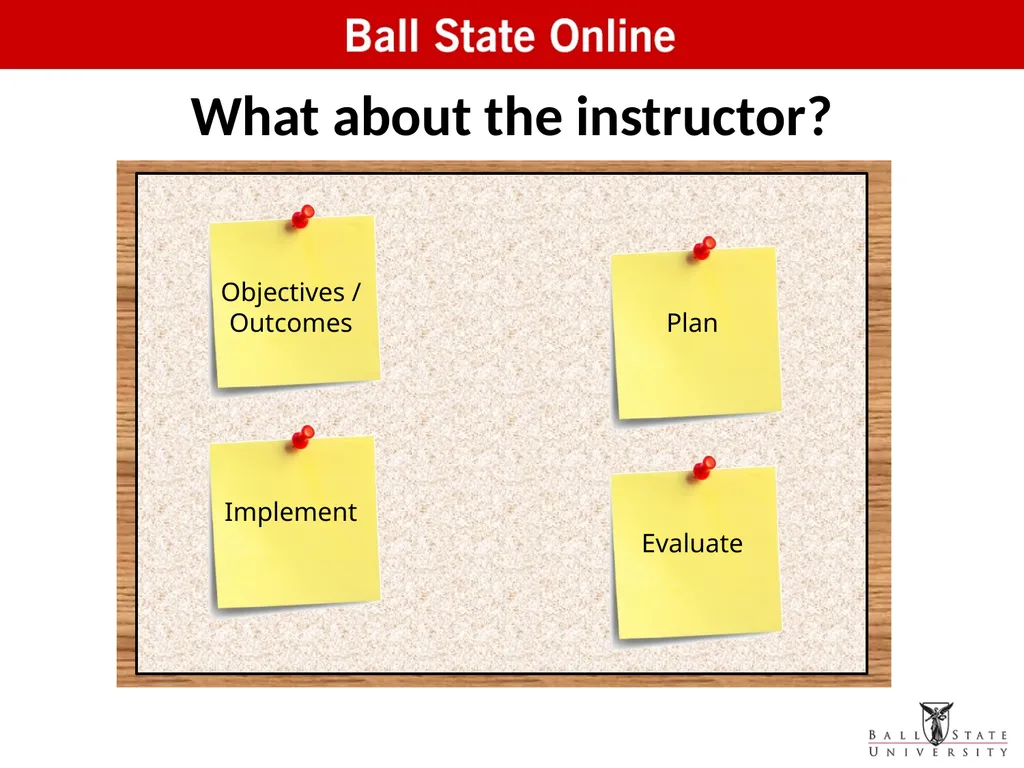
What about the instructor?<br>
36
There Will always be…… http://www.keepcalm-o-matic.co.uk/p/keep-calm-and-assess-students/<br>
37
References Angelo, T. A., & Cross, K. P. (1993). Classroom assessment techniques.
Astin, Alexander W. & Antonio, Anthony Lising (2012). Assessment for Excellence, Second Edition
Gillham, B. (2000). Case study research methods. Bloomsbury Publishing.
Mueller, J. (2005). The authentic assessment toolbox: Enhancing student learning through online faculty development. Journal of Online Learning and Teaching, 1(1), 1-7.
Mueller, Jon. (2014). Authentic Assessment Toolbox Retrieved 2/24/2015 from http://jfmueller.faculty.noctrl.edu/toolbox/index.htm
Trussell-Cullen, Alan (1998). Assessment in the learner-centered classroom
Wiggins, G. (1990). The Case for Authentic Assessment. ERIC Digest.
Three Types of Assessment (2015). Retrieved 9/7/2015 from http://www.monroeisd.us/departments/curriculum/instructionalservices/assessment/typesofassessment/<br>
Astin, Alexander W. & Antonio, Anthony Lising (2012). Assessment for Excellence, Second Edition
Gillham, B. (2000). Case study research methods. Bloomsbury Publishing.
Mueller, J. (2005). The authentic assessment toolbox: Enhancing student learning through online faculty development. Journal of Online Learning and Teaching, 1(1), 1-7.
Mueller, Jon. (2014). Authentic Assessment Toolbox Retrieved 2/24/2015 from http://jfmueller.faculty.noctrl.edu/toolbox/index.htm
Trussell-Cullen, Alan (1998). Assessment in the learner-centered classroom
Wiggins, G. (1990). The Case for Authentic Assessment. ERIC Digest.
Three Types of Assessment (2015). Retrieved 9/7/2015 from http://www.monroeisd.us/departments/curriculum/instructionalservices/assessment/typesofassessment/<br>