Assessment of the Fluid Dynamics Boundary Condition in Ablating or Blowing Flows Brett A. Cruden, Dinesh K. Prabhu, Arnaud Borner, Jeremie Meurisse, John Thornton, Georgios Bellas-Chatzigeorgis AMA Inc at NASA Ames Research Center AIAA
"Assessment of the Fluid Dynamics Boundary" is the property of its rightful owner. Permission is granted to
download and print the materials on this website for personal, non-commercial use only, and to display it
on your personal computer provided you do not modify the materials and that you retain all copyright
notices contained in the materials. By downloading content from our website, you accept the terms of this
agreement.
Presentation Transcript
01
Assessment of the Fluid Dynamics Boundary Condition in Ablating or Blowing Flows Brett A. Cruden, Dinesh K. Prabhu, Arnaud Borner, Jeremie Meurisse, John Thornton, Georgios Bellas-Chatzigeorgis
AMA Inc at NASA Ames Research Center AIAA AVIATION
June 2023
San Diego, CA 1<br>
02
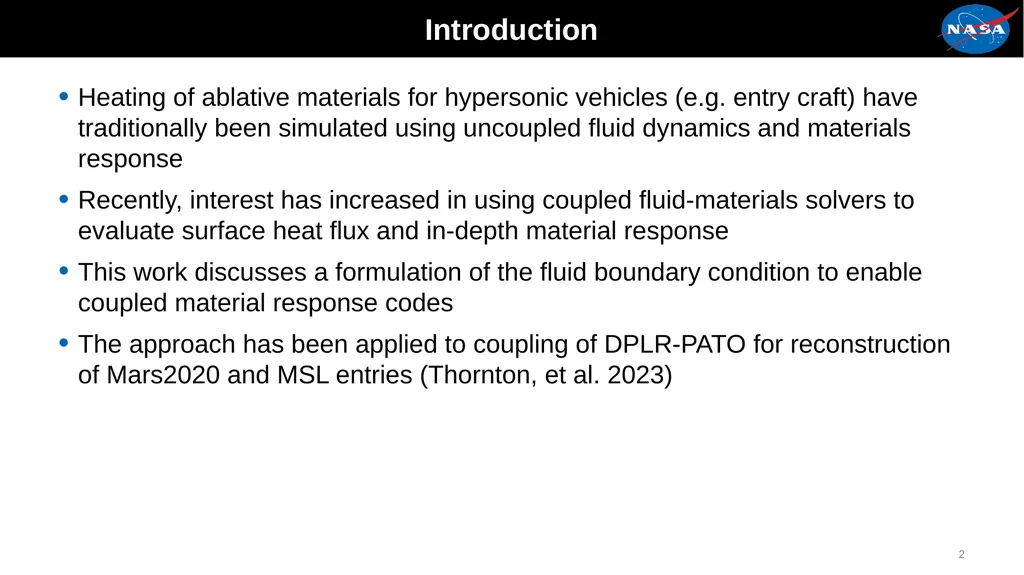
Introduction Heating of ablative materials for hypersonic vehicles (e.g. entry craft) have traditionally been simulated using uncoupled fluid dynamics and materials response
Recently, interest has increased in using coupled fluid-materials solvers to evaluate surface heat flux and in-depth material response
This work discusses a formulation of the fluid boundary condition to enable coupled material response codes
The approach has been applied to coupling of DPLR-PATO for reconstruction of Mars2020 and MSL entries (Thornton, et al. 2023) 2<br>
03
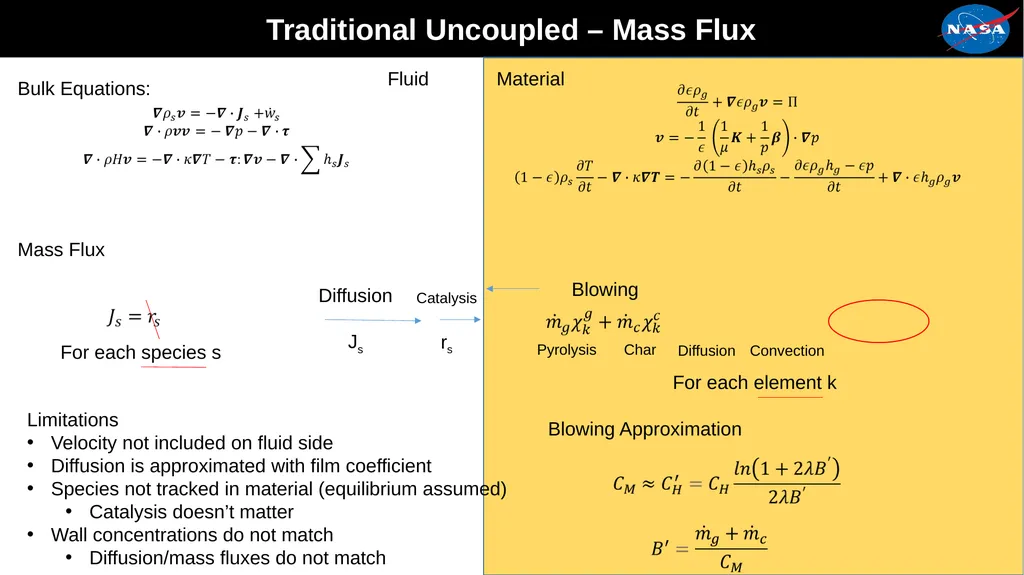
Diffusion
Js Traditional Uncoupled – Mass Flux Bulk Equations:
Mass Flux Fluid Material Catalysis
rs For each species s Blowing Pyrolysis Char Gas Flux Diffusion Convection Film Coefficient For each element k Limitations
Velocity not included on fluid side
Diffusion is approximated with film coefficient
Species not tracked in material (equilibrium assumed)
Catalysis doesn’t matter
Wall concentrations do not match
Diffusion/mass fluxes do not match Blowing Approximation 3<br>
04
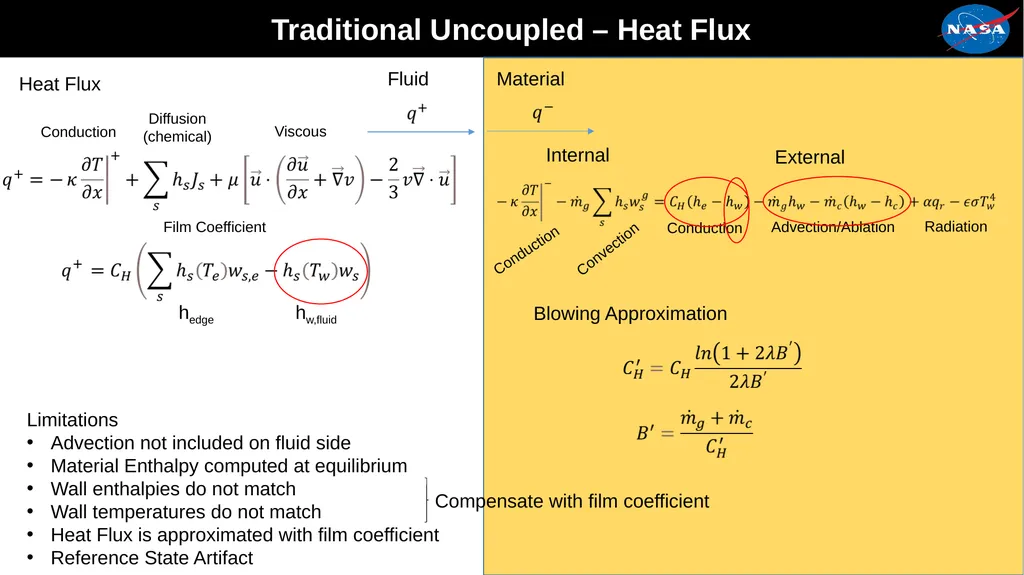
Traditional Uncoupled – Heat Flux Heat Flux Fluid Material Conduction Diffusion
(chemical) Viscous hedge hw,fluid Internal External Film Coefficient Conduction Convection Conduction Advection/Ablation Radiation Limitations
Advection not included on fluid side
Material Enthalpy computed at equilibrium
Wall enthalpies do not match
Wall temperatures do not match
Heat Flux is approximated with film coefficient
Reference State Artifact Blowing Approximation Compensate with film coefficient 4<br>
05
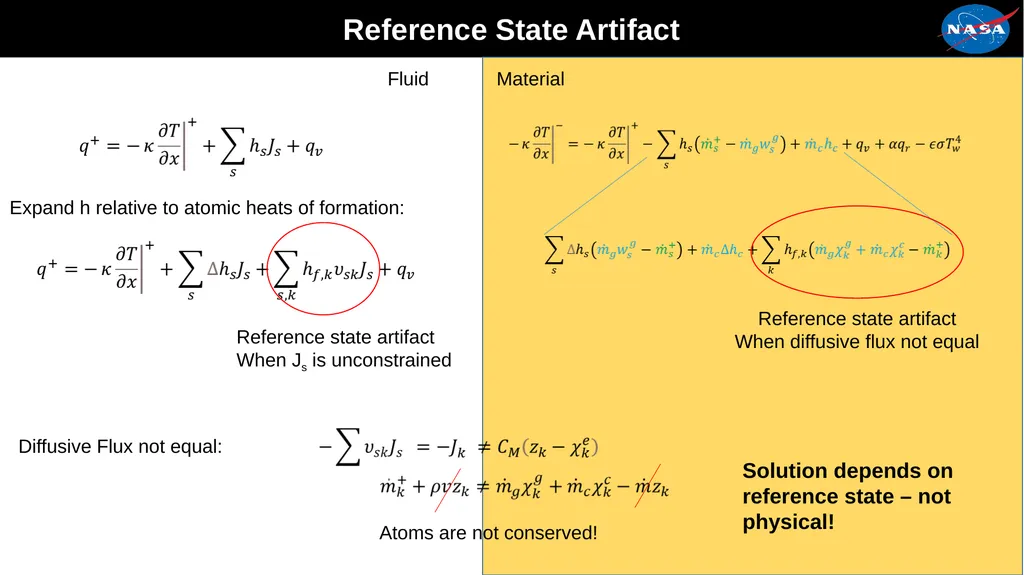
Reference State Artifact Fluid Material Expand h relative to atomic heats of formation: Reference state artifact
When Js is unconstrained Diffusive Flux not equal: Atoms are not conserved! Reference state artifact
When diffusive flux not equal Solution depends on reference state – not physical! 5<br>
06
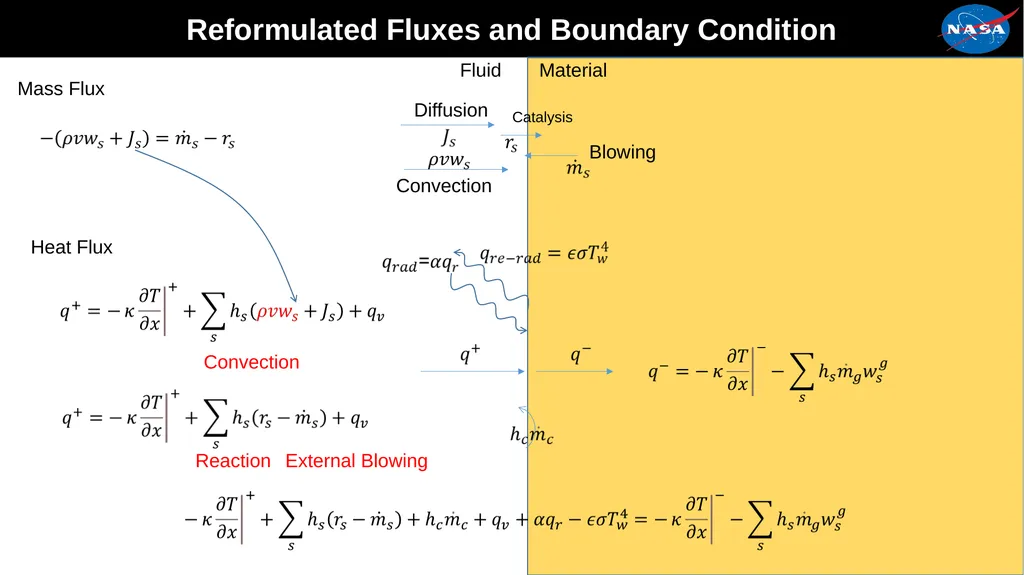
Diffusion Reformulated Fluxes and Boundary Condition Fluid Material Catalysis Blowing Convection Mass Flux Heat Flux Convection Reaction External Blowing 6<br>
07
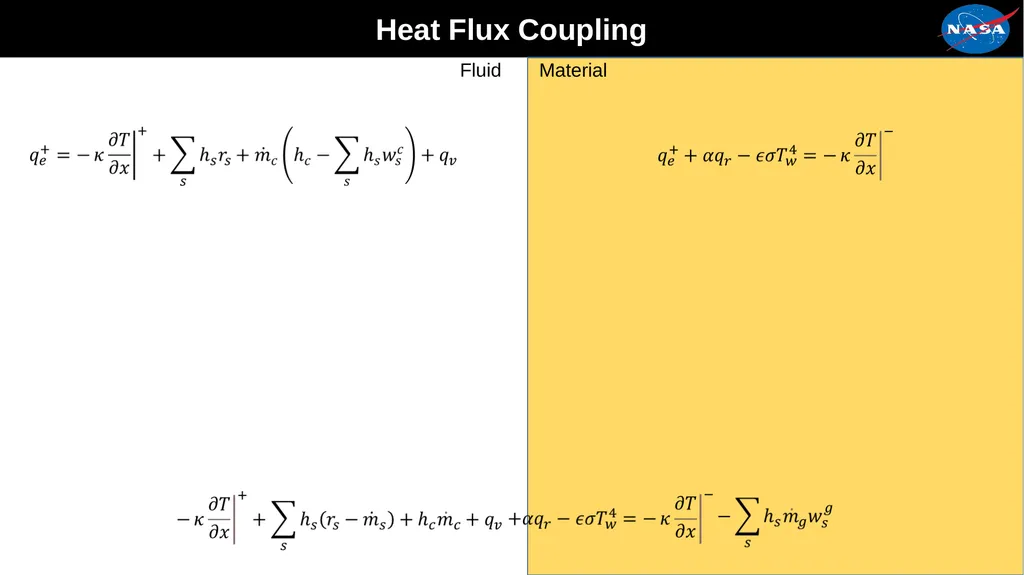
Heat Flux Coupling Fluid Material 7<br>
08
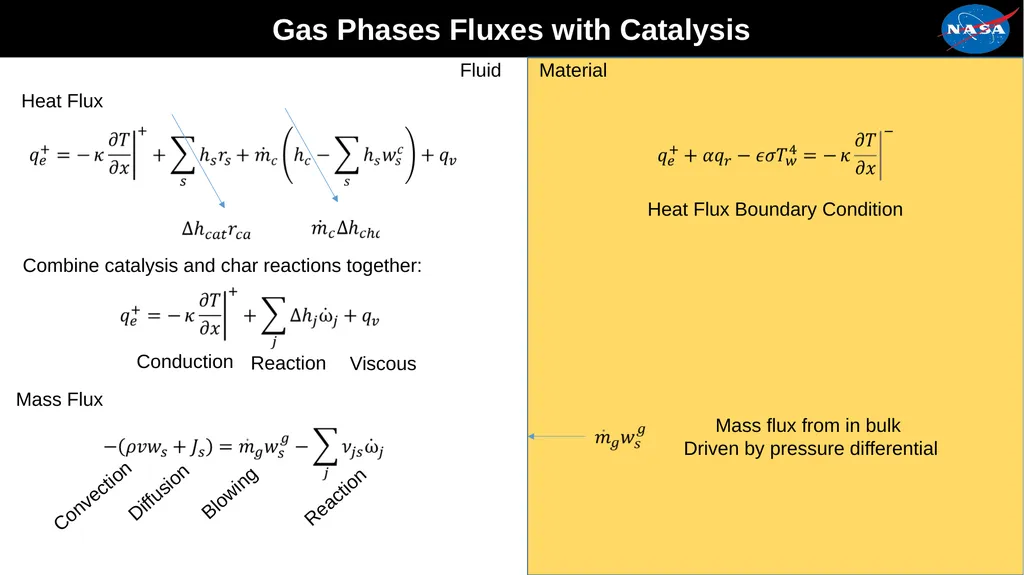
Gas Phases Fluxes with Catalysis Fluid Material Heat Flux Heat Flux Boundary Condition Combine catalysis and char reactions together: Reaction Conduction Viscous Mass Flux Mass flux from in bulk
Driven by pressure differential Convection Diffusion Blowing Reaction 8<br>
09
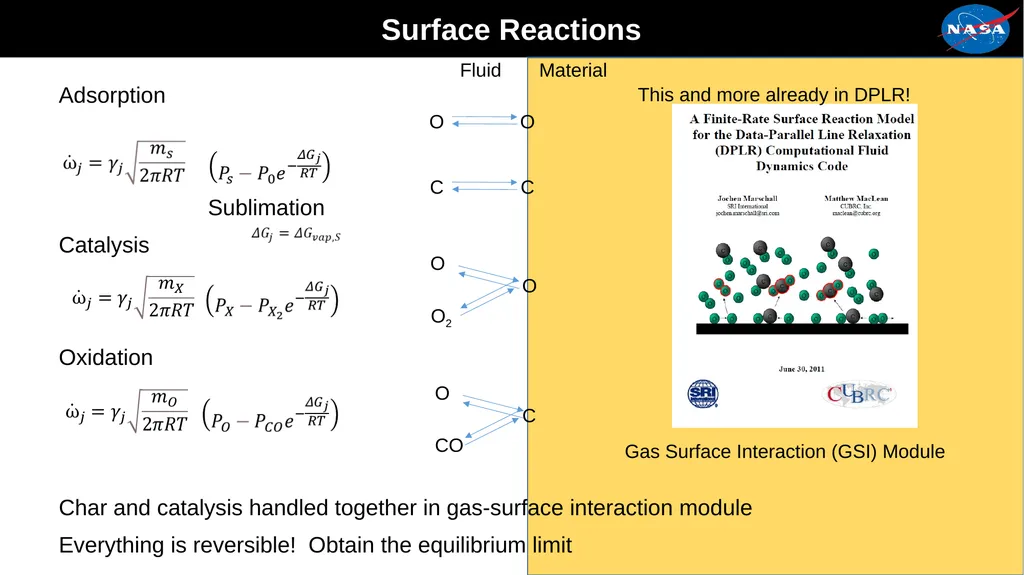
Adsorption
Sublimation
Catalysis
Oxidation
Char and catalysis handled together in gas-surface interaction module
Everything is reversible! Obtain the equilibrium limit Surface Reactions Fluid Material O O O O O2 C O CO C C This and more already in DPLR! Gas Surface Interaction (GSI) Module 9<br>
10
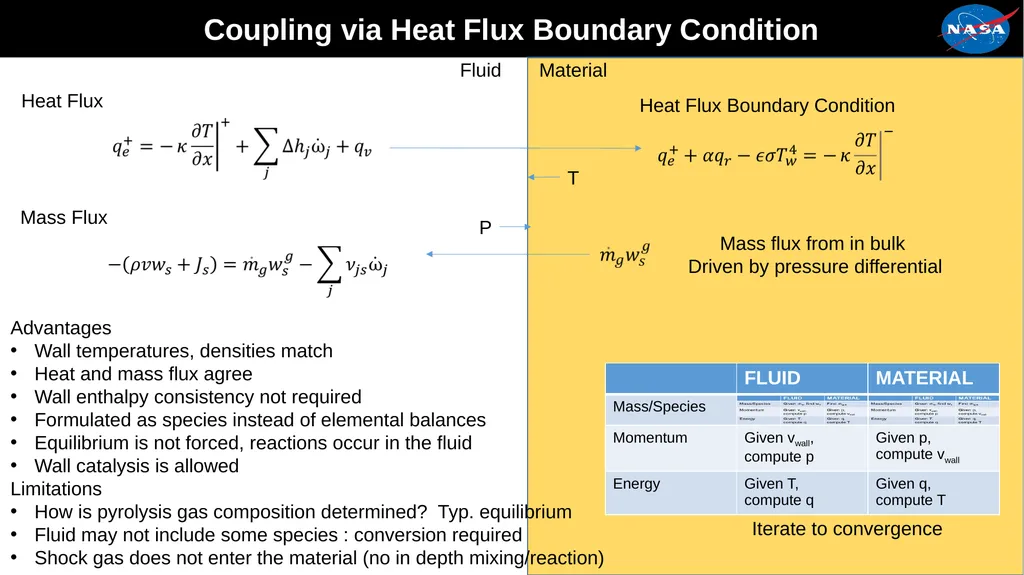
Coupling via Heat Flux Boundary Condition Fluid Material Heat Flux Heat Flux Boundary Condition Mass Flux Mass flux from in bulk
Driven by pressure differential Advantages
Wall temperatures, densities match
Heat and mass flux agree
Wall enthalpy consistency not required
Formulated as species instead of elemental balances
Equilibrium is not forced, reactions occur in the fluid
Wall catalysis is allowed
Limitations
How is pyrolysis gas composition determined? Typ. equilibrium
Fluid may not include some species : conversion required
Shock gas does not enter the material (no in depth mixing/reaction) P T 10 Iterate to convergence<br>
11
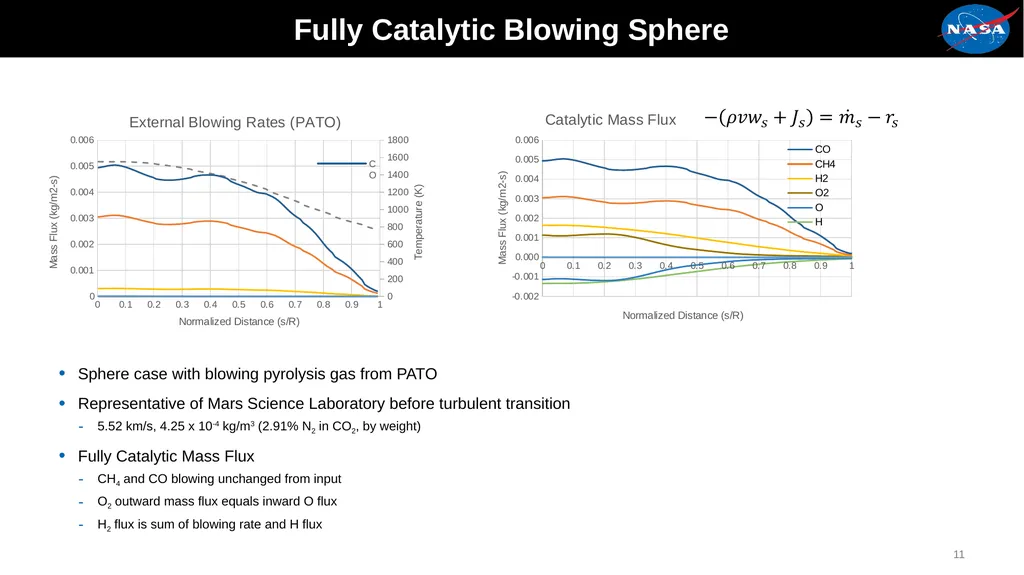
Fully Catalytic Blowing Sphere Sphere case with blowing pyrolysis gas from PATO
Representative of Mars Science Laboratory before turbulent transition
5.52 km/s, 4.25 x 10⁻⁴ kg/m3 (2.91% N2 in CO2, by weight)
Fully Catalytic Mass Flux
CH4 and CO blowing unchanged from input
O2 outward mass flux equals inward O flux
H2 flux is sum of blowing rate and H flux 11<br>
12
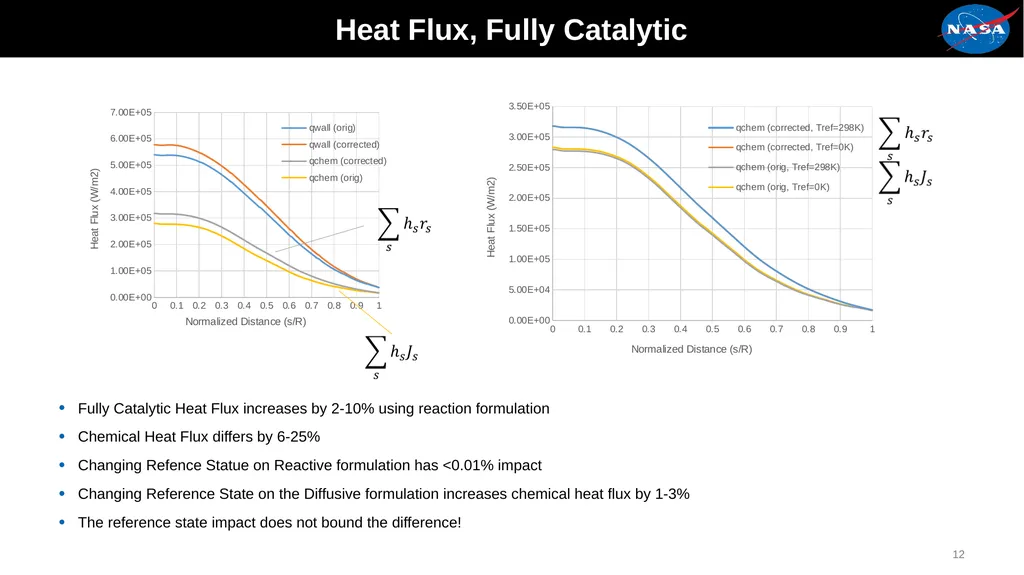
Heat Flux, Fully Catalytic Fully Catalytic Heat Flux increases by 2-10% using reaction formulation
Chemical Heat Flux differs by 6-25%
Changing Refence Statue on Reactive formulation has <0.01% impact
Changing Reference State on the Diffusive formulation increases chemical heat flux by 1-3%
The reference state impact does not bound the difference! 12<br>
13
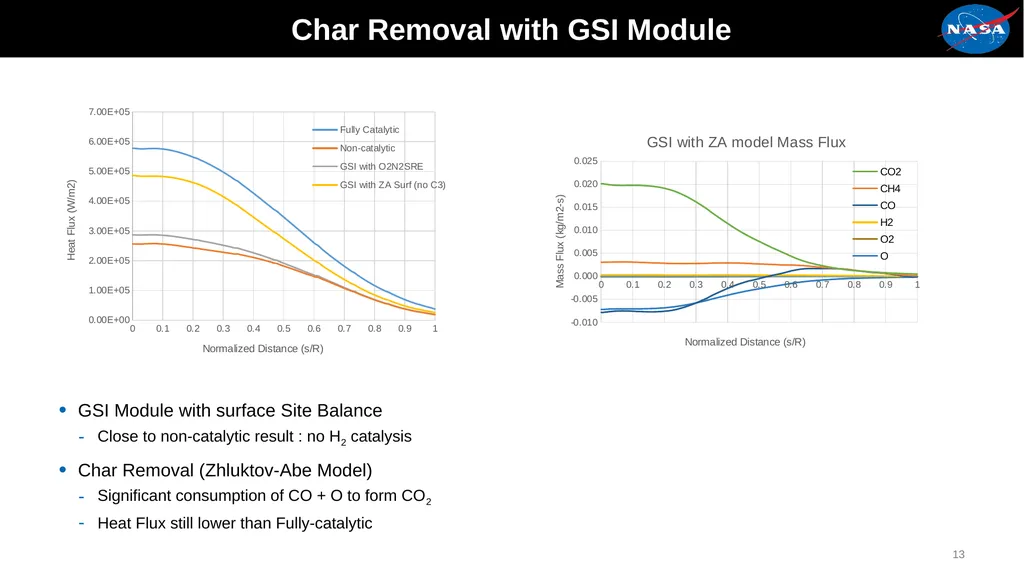
Char Removal with GSI Module GSI Module with surface Site Balance
Close to non-catalytic result : no H2 catalysis
Char Removal (Zhluktov-Abe Model)
Significant consumption of CO + O to form CO2
Heat Flux still lower than Fully-catalytic 13<br>
14
Silica Vaporization Heat Flux Surface Temperature increased by 1000K, blowing unchanged
GSI model based on unity probably of SiO adsorption/desorption predicts
SiO desorption leaves additional adsorbed O atom
Adsorbed O atoms combine with themselves and the adsorbed byproduct to produce O2
Further from the stagnation line, SiO redeposits and O atom adsorption exceeds O2 production
Char enthalpy lowers heat flux where SiO is removed, necessary to include solid char term 14<br>
15
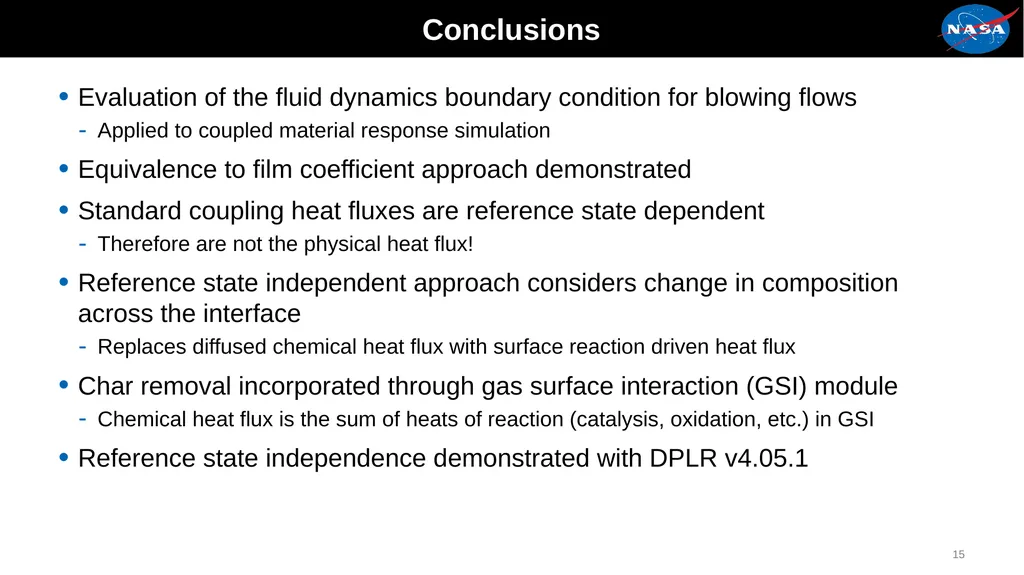
Conclusions Evaluation of the fluid dynamics boundary condition for blowing flows
Applied to coupled material response simulation
Equivalence to film coefficient approach demonstrated
Standard coupling heat fluxes are reference state dependent
Therefore are not the physical heat flux!
Reference state independent approach considers change in composition across the interface
Replaces diffused chemical heat flux with surface reaction driven heat flux
Char removal incorporated through gas surface interaction (GSI) module
Chemical heat flux is the sum of heats of reaction (catalysis, oxidation, etc.) in GSI
Reference state independence demonstrated with DPLR v4.05.1 15<br>