
ASTM D3512/D3512M-16 Standard Test Method for
CM
Published · 33 slides · 0 views
1 / 1
Description
ASTM D3512D3512M-16 Standard Test Method for Pilling Resistance and Other Related Surface Changes of Textile Fabrics: Random Tumble Pilling Tester Current Version ASTM D3512D3512M-16 D: miscellaneous materials and products M: metric units
Related Topics
Share
Embed code
Download this presentation From Below
"ASTM D3512/D3512M-16 Standard Test Method for" is the property of its rightful owner. Permission is granted to download and print the materials on this website for personal, non-commercial use only, and to display it on your personal computer provided you do not modify the materials and that you retain all copyright notices contained in the materials. By downloading content from our website, you accept the terms of this agreement.
Presentation Transcript
01
ASTM D3512/D3512M-16 Standard Test Method for Pilling Resistance and Other Related Surface Changes of Textile Fabrics: Random Tumble Pilling Tester<br>
02
Current Version ASTM D3512/D3512M-16
D: miscellaneous materials and products
M: metric units considered standard
16: last revised in 2016 ASTM D3512<br>
D: miscellaneous materials and products
M: metric units considered standard
16: last revised in 2016 ASTM D3512<br>
03
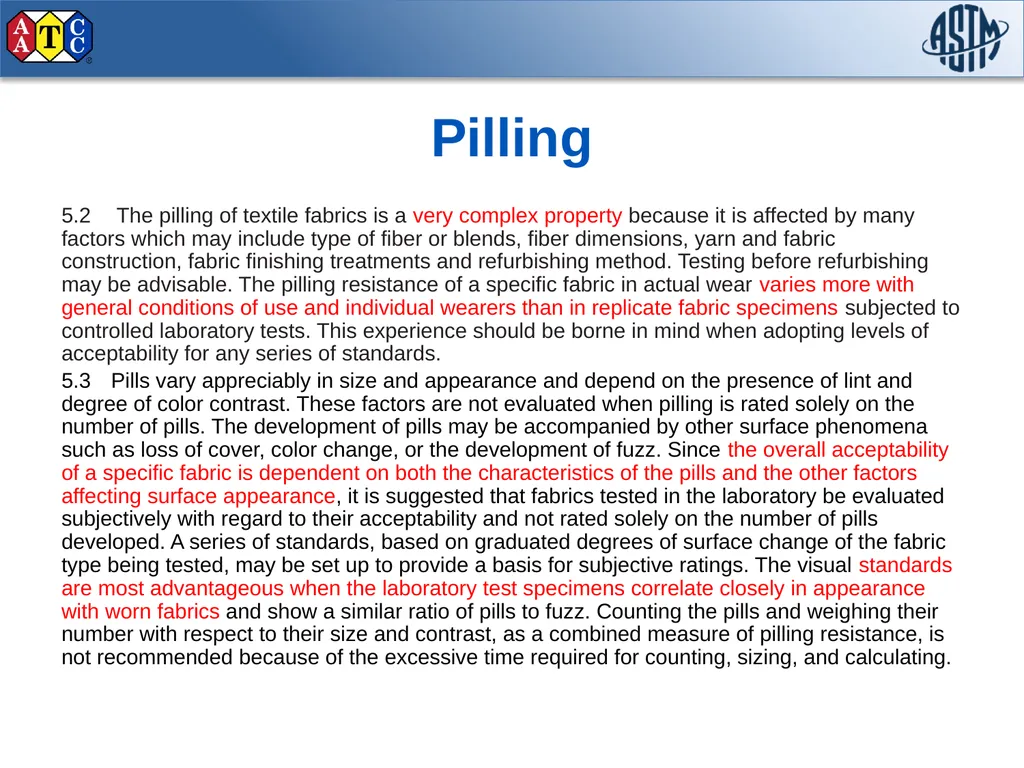
Pilling 5.2 The pilling of textile fabrics is a very complex property because it is affected by many factors which may include type of fiber or blends, fiber dimensions, yarn and fabric construction, fabric finishing treatments and refurbishing method. Testing before refurbishing may be advisable. The pilling resistance of a specific fabric in actual wear varies more with general conditions of use and individual wearers than in replicate fabric specimens subjected to controlled laboratory tests. This experience should be borne in mind when adopting levels of acceptability for any series of standards.
5.3 Pills vary appreciably in size and appearance and depend on the presence of lint and degree of color contrast. These factors are not evaluated when pilling is rated solely on the number of pills. The development of pills may be accompanied by other surface phenomena such as loss of cover, color change, or the development of fuzz. Since the overall acceptability of a specific fabric is dependent on both the characteristics of the pills and the other factors affecting surface appearance, it is suggested that fabrics tested in the laboratory be evaluated subjectively with regard to their acceptability and not rated solely on the number of pills developed. A series of standards, based on graduated degrees of surface change of the fabric type being tested, may be set up to provide a basis for subjective ratings. The visual standards are most advantageous when the laboratory test specimens correlate closely in appearance with worn fabrics and show a similar ratio of pills to fuzz. Counting the pills and weighing their number with respect to their size and contrast, as a combined measure of pilling resistance, is not recommended because of the excessive time required for counting, sizing, and calculating.<br>
5.3 Pills vary appreciably in size and appearance and depend on the presence of lint and degree of color contrast. These factors are not evaluated when pilling is rated solely on the number of pills. The development of pills may be accompanied by other surface phenomena such as loss of cover, color change, or the development of fuzz. Since the overall acceptability of a specific fabric is dependent on both the characteristics of the pills and the other factors affecting surface appearance, it is suggested that fabrics tested in the laboratory be evaluated subjectively with regard to their acceptability and not rated solely on the number of pills developed. A series of standards, based on graduated degrees of surface change of the fabric type being tested, may be set up to provide a basis for subjective ratings. The visual standards are most advantageous when the laboratory test specimens correlate closely in appearance with worn fabrics and show a similar ratio of pills to fuzz. Counting the pills and weighing their number with respect to their size and contrast, as a combined measure of pilling resistance, is not recommended because of the excessive time required for counting, sizing, and calculating.<br>
04
Scope Determination of the propensity of a fabric to form pills and other surface changes using the random tumble pilling tester
“Generally applicable to all types of woven and knitted apparel fabrics”
Silicone resins may cause erroneous results ASTM D3512<br>
“Generally applicable to all types of woven and knitted apparel fabrics”
Silicone resins may cause erroneous results ASTM D3512<br>
05
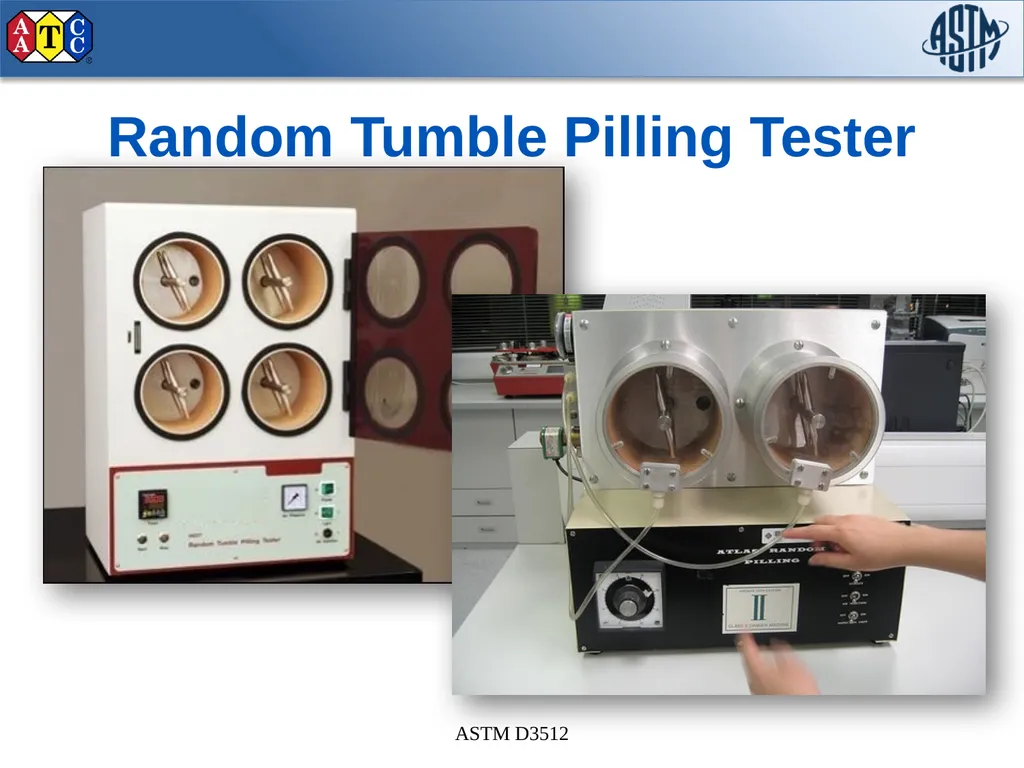
Random Tumble Pilling Tester ASTM D3512<br>
06
Test Apparatus & Materials Random Tumble Pilling Tester
Air Injection Device (14-21 kPa, 2-3 psi)
included in most new testers
Cork Liners
1.5-mm thick
store in cool, dry place
may require trimming
do not sand
Cotton Sliver
4301 tex, fine American upland, or equivalent
improves visibility of pills ASTM D3512<br>
Air Injection Device (14-21 kPa, 2-3 psi)
included in most new testers
Cork Liners
1.5-mm thick
store in cool, dry place
may require trimming
do not sand
Cotton Sliver
4301 tex, fine American upland, or equivalent
improves visibility of pills ASTM D3512<br>
07
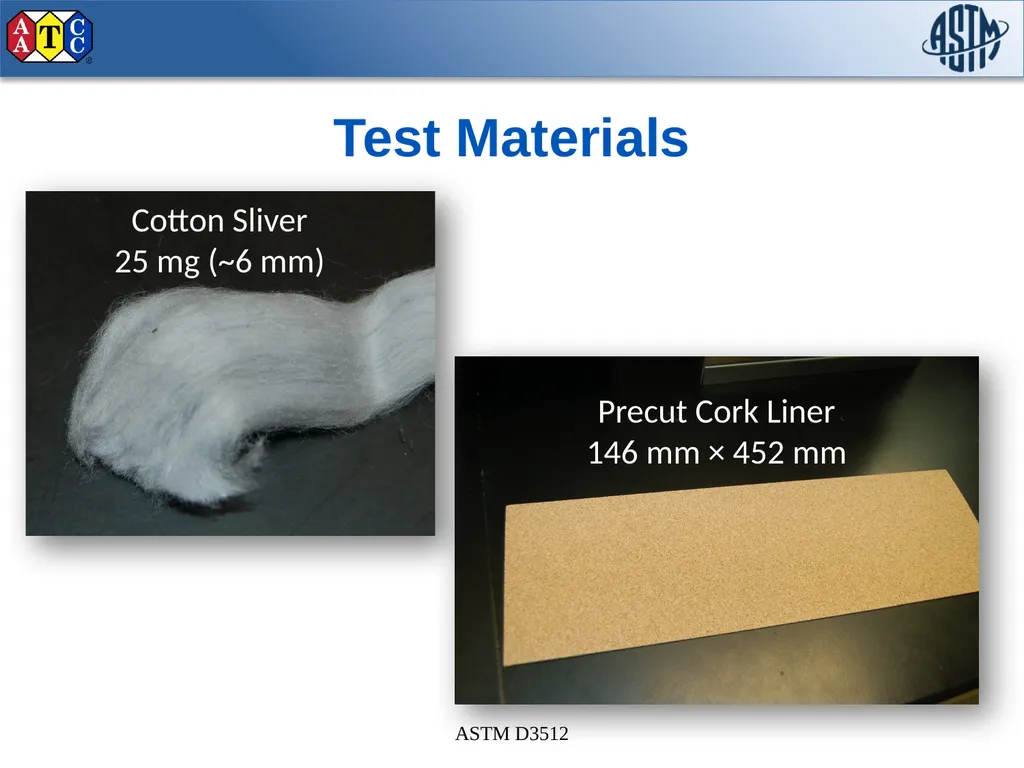
Test Materials ASTM D3512 Cotton Sliver
25 mg (~6 mm) Precut Cork Liner
146 mm × 452 mm<br>
25 mg (~6 mm) Precut Cork Liner
146 mm × 452 mm<br>
08
Apparatus & Materials White, All-purpose Glue
for sealing specimen edges
Plastic Bottle
for applying diluted glue
25-mm Wide Masking Tape
to secure cork liner to chamber ASTM D3512<br>
for sealing specimen edges
Plastic Bottle
for applying diluted glue
25-mm Wide Masking Tape
to secure cork liner to chamber ASTM D3512<br>
09
Other Apparatus & Materials Vacuum Cleaner
home canister type
to clean specimens & chambers after testing
Laundering and/or drycleaning facilities
refurbishment not required or specified in test method
launder/dryclean samples before cutting specimens ASTM D3512<br>
home canister type
to clean specimens & chambers after testing
Laundering and/or drycleaning facilities
refurbishment not required or specified in test method
launder/dryclean samples before cutting specimens ASTM D3512<br>
10
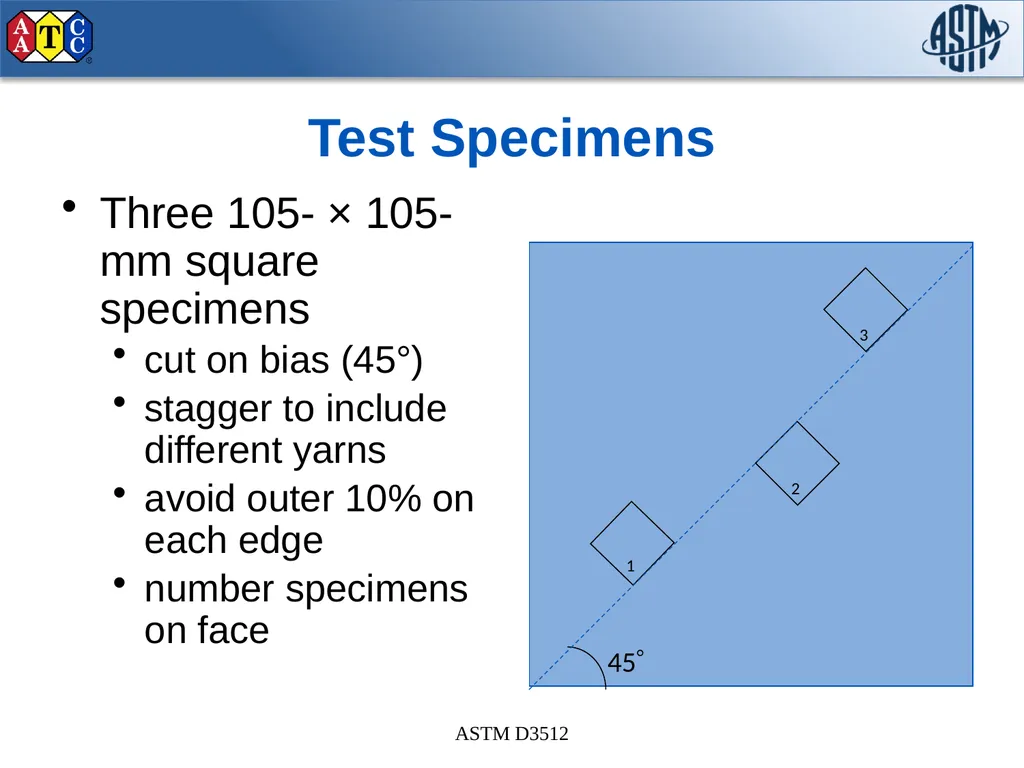
Test Specimens Three 105- × 105-mm square specimens
cut on bias (45°)
stagger to include different yarns
avoid outer 10% on each edge
number specimens on face ASTM D3512<br>
cut on bias (45°)
stagger to include different yarns
avoid outer 10% on each edge
number specimens on face ASTM D3512<br>
11
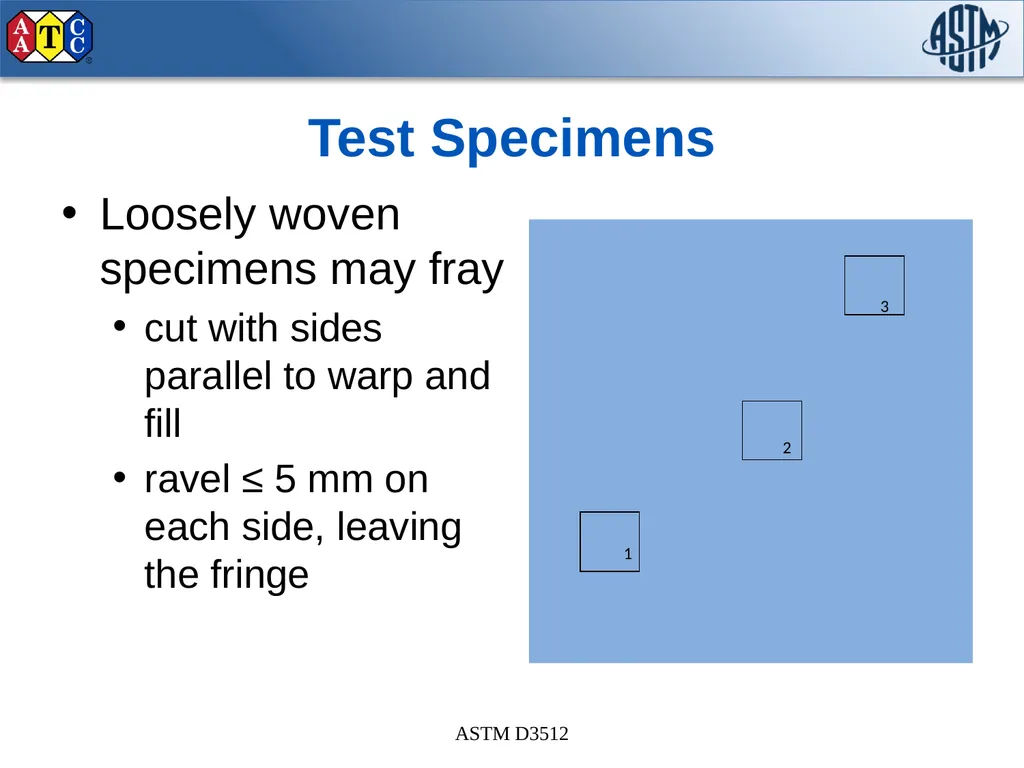
Test Specimens Loosely woven specimens may fray
cut with sides parallel to warp and fill
ravel ≤ 5 mm on each side, leaving the fringe ASTM D3512<br>
cut with sides parallel to warp and fill
ravel ≤ 5 mm on each side, leaving the fringe ASTM D3512<br>
12
Test Specimens Seal edges with adhesive on the face of the fabric
Adhesive bead ≤ 3mm wide
Hang specimens on racks to dry (2 h minimum)
Unsealed specimen edges acceptable ASTM D3512<br>
Adhesive bead ≤ 3mm wide
Hang specimens on racks to dry (2 h minimum)
Unsealed specimen edges acceptable ASTM D3512<br>
13
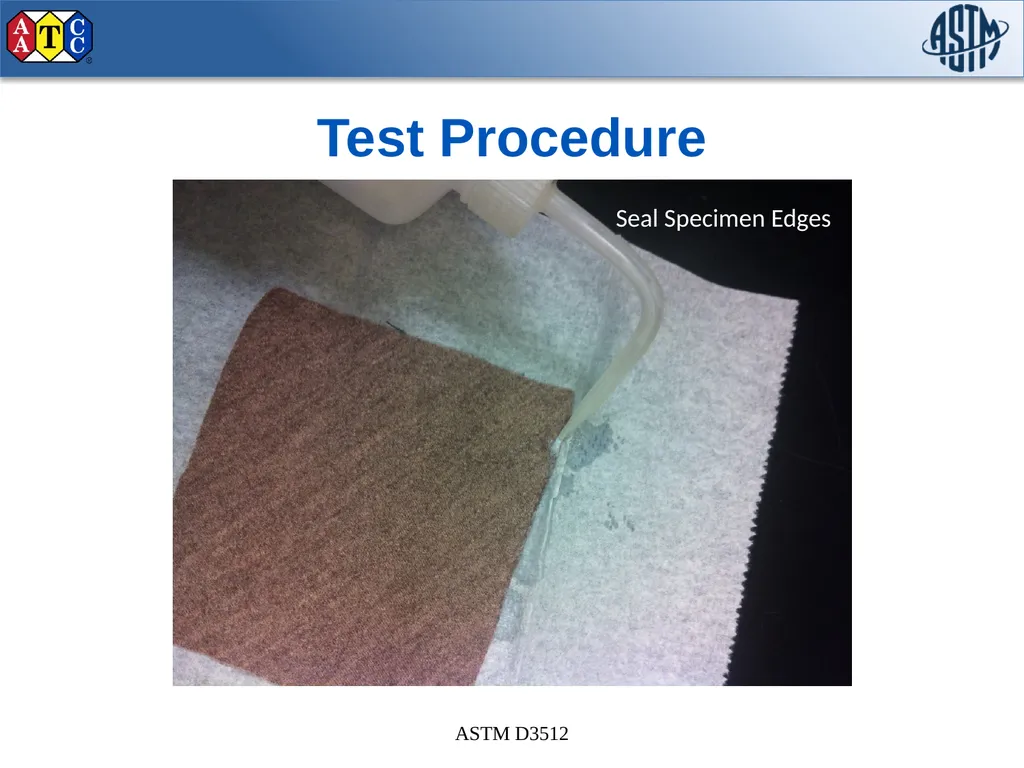
Test Procedure ASTM D3512 Seal Specimen Edges<br>
14
Notes Condition test specimens and cork liners
ASTM D1776
21°C ± 2°C
65% ± 5% relative humidity
or other conditions as agreed upon
Perform test in standard atmosphere
All specimens in a chamber should be from the same sample
do NOT mix fabric types
use fewer than three specimens if necessary (same amount of sliver) ASTM D3512<br>
ASTM D1776
21°C ± 2°C
65% ± 5% relative humidity
or other conditions as agreed upon
Perform test in standard atmosphere
All specimens in a chamber should be from the same sample
do NOT mix fabric types
use fewer than three specimens if necessary (same amount of sliver) ASTM D3512<br>
15
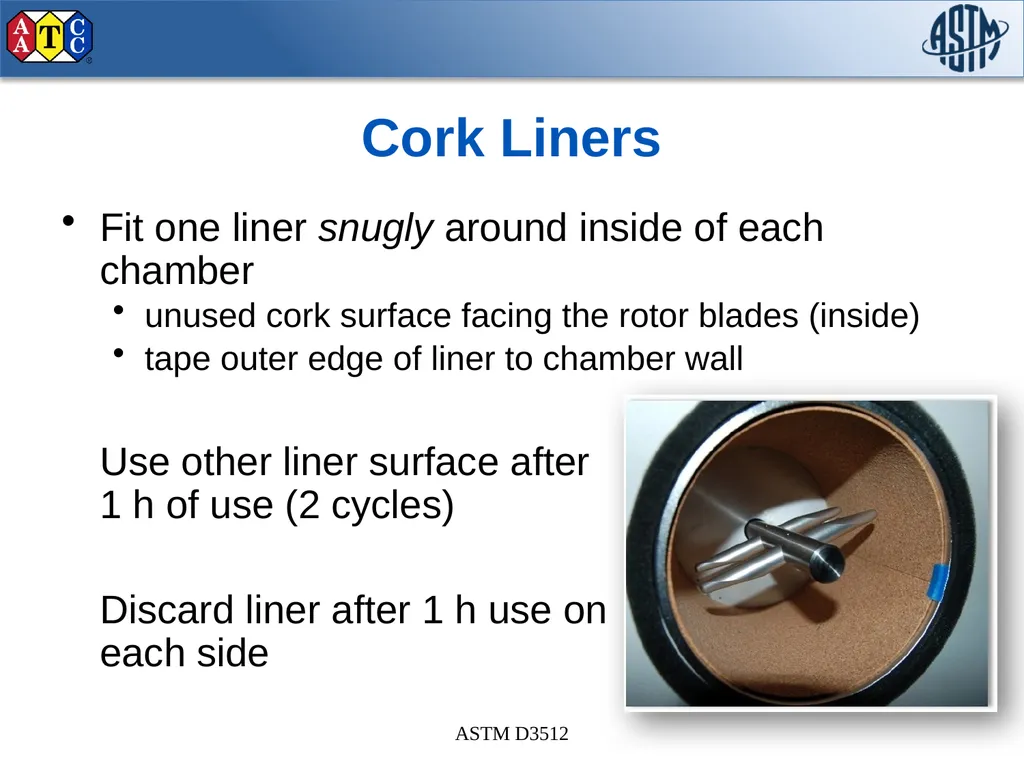
Cork Liners Fit one liner snugly around inside of each chamber
unused cork surface facing the rotor blades (inside)
tape outer edge of liner to chamber wall
Use other liner surface after 1 h of use (2 cycles)
Discard liner after 1 h use on each side ASTM D3512<br>
unused cork surface facing the rotor blades (inside)
tape outer edge of liner to chamber wall
Use other liner surface after 1 h of use (2 cycles)
Discard liner after 1 h use on each side ASTM D3512<br>
16
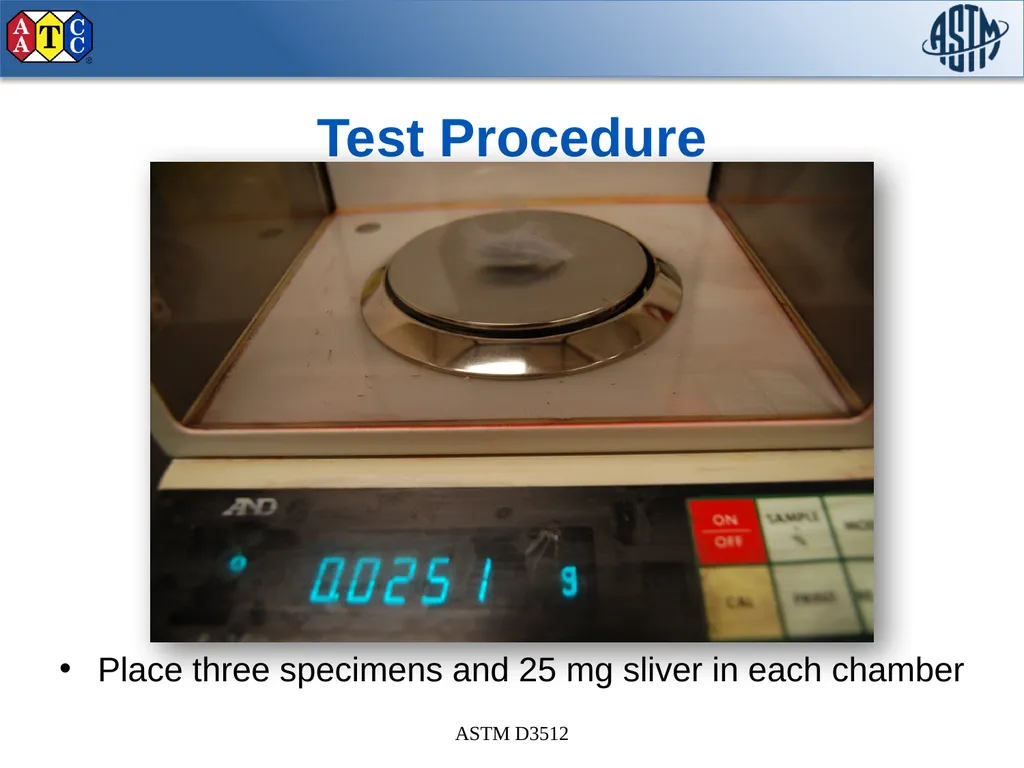
Test Procedure ASTM D3512 Place three specimens and 25 mg sliver in each chamber<br>
17
Test Procedure Close door/cover chamber
Set timer for 30 minutes (1,800 seconds)
Other times may be appropriate (change sliver at 30-min intervals; change liner at 1-h intervals)
Start motor, airflow, impeller ASTM D3512<br>
Set timer for 30 minutes (1,800 seconds)
Other times may be appropriate (change sliver at 30-min intervals; change liner at 1-h intervals)
Start motor, airflow, impeller ASTM D3512<br>
18
Preparation for Evaluation Remove specimens from chamber and clean excess fiber NOT entangled in pills
Holding one corner, suck specimen into vacuum hose
Repeat, holding an adjacent corner ASTM D3512<br>
Holding one corner, suck specimen into vacuum hose
Repeat, holding an adjacent corner ASTM D3512<br>
19
Troubleshooting Check chambers frequently
Specimens may wedge around impeller or stick to chamber wall
Stop impeller, shut air, open chamber, and free specimen
Record and report stops or other abnormal specimen behavior
Clean impeller blade if necessary ASTM D3512<br>
Specimens may wedge around impeller or stick to chamber wall
Stop impeller, shut air, open chamber, and free specimen
Record and report stops or other abnormal specimen behavior
Clean impeller blade if necessary ASTM D3512<br>
20
Evaluation Apparatus & Materials Apparatus for Fabric Evaluation
cool white fluorescent (CWF) illumination
4100K - 4500K correlated color temperature
simultaneous viewing of specimen and standards
Double-face tape
adhere specimen to rating apparatus
Rating Standards
in-house standard fabrics
OR
photographs ASTM D3512<br>
cool white fluorescent (CWF) illumination
4100K - 4500K correlated color temperature
simultaneous viewing of specimen and standards
Double-face tape
adhere specimen to rating apparatus
Rating Standards
in-house standard fabrics
OR
photographs ASTM D3512<br>
21
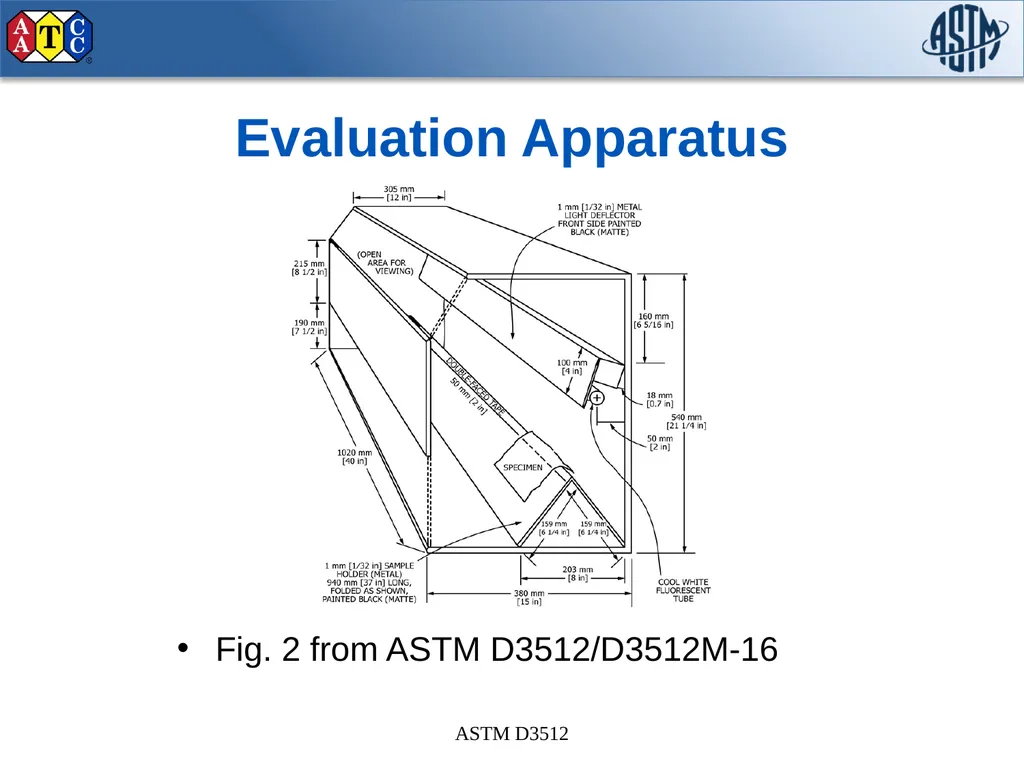
Evaluation Apparatus ASTM D3512 Fig. 2 from ASTM D3512/D3512M-16<br>
22
Rating Standards – Fabrics Series of tested specimens showing varied degree of pilling, other distortion, or both
separate set for each type of fabric to be tested
store carefully to preserve appearance ASTM D3512<br>
separate set for each type of fabric to be tested
store carefully to preserve appearance ASTM D3512<br>
23
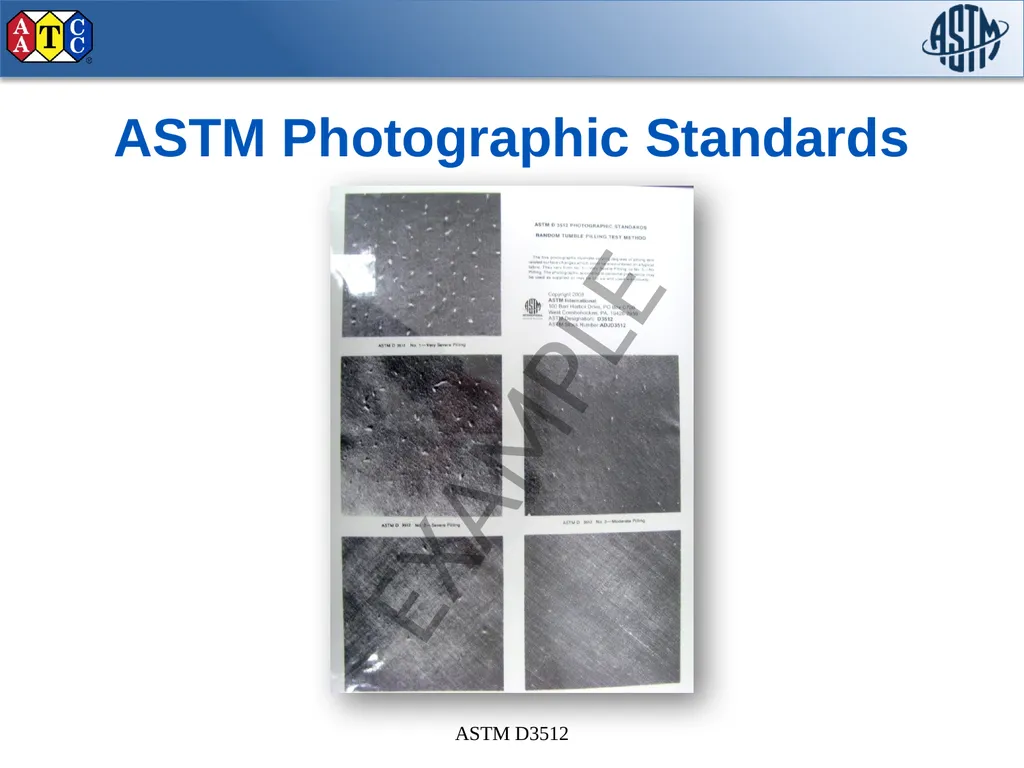
Rating Standards - Photos Standard series of five photographs showing varied degree of pilling
In-house series of photos
matte finish
105 mm² (same size as specimens) ASTM D3512<br>
In-house series of photos
matte finish
105 mm² (same size as specimens) ASTM D3512<br>
24
ASTM Photographic Standards ASTM D3512 EXAMPLE<br>
25
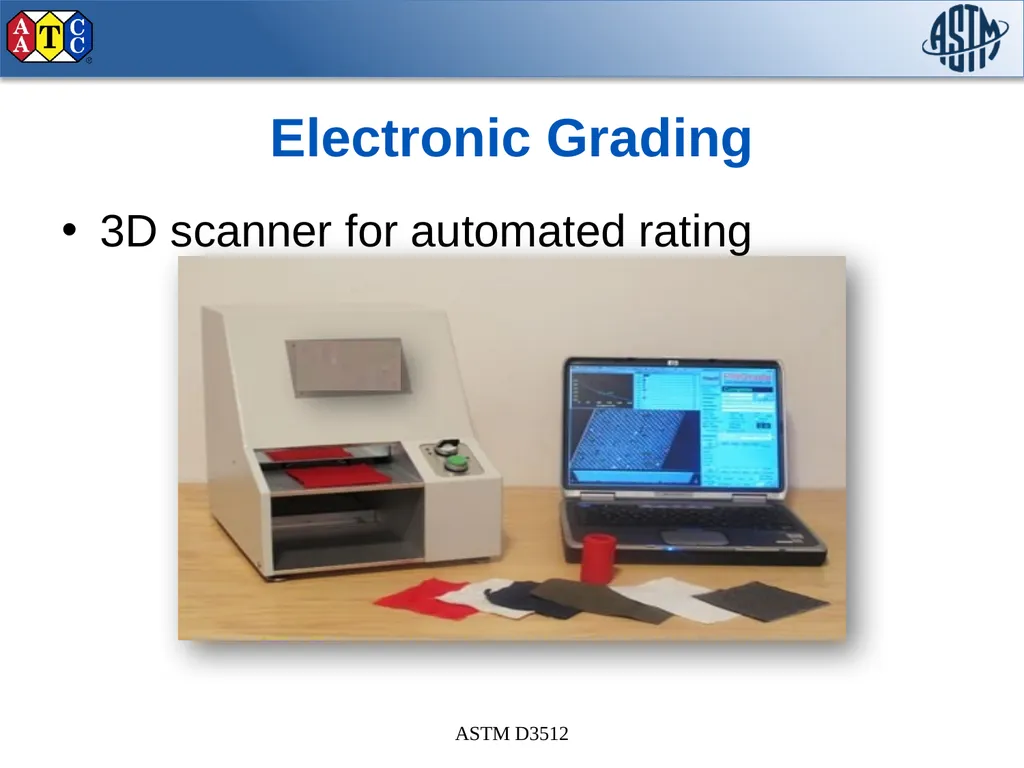
Electronic Grading 3D scanner for automated rating ASTM D3512<br>
26
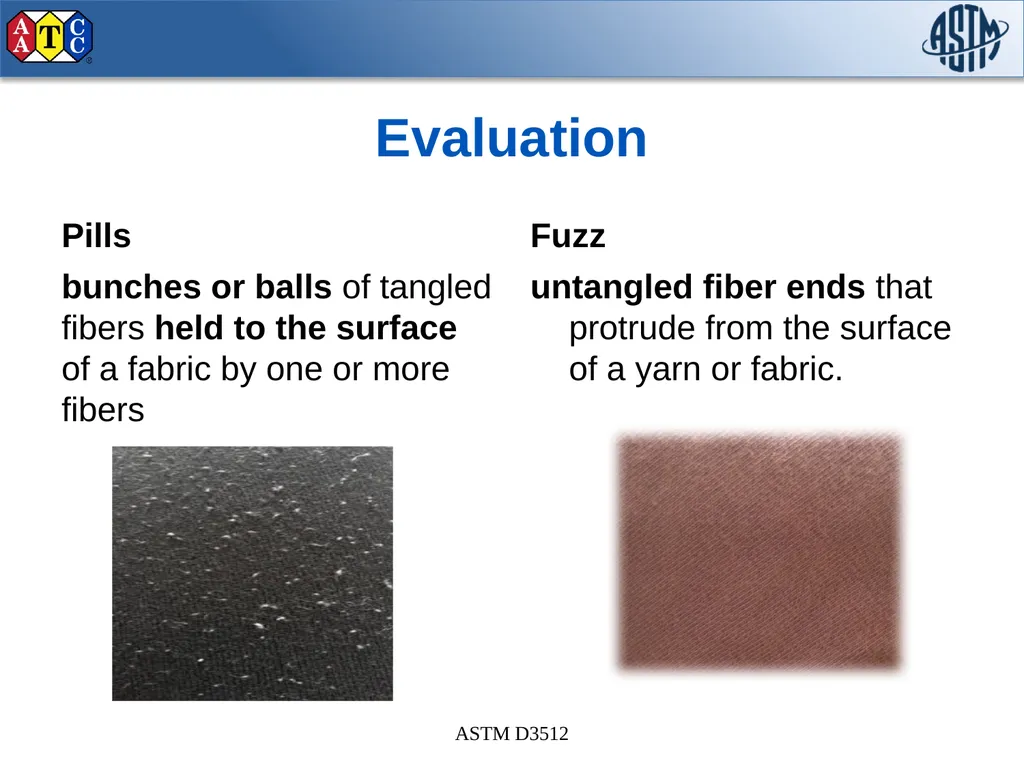
Evaluation Pills bunches or balls of tangled fibers held to the surface of a fabric by one or more fibers Fuzz untangled fiber ends that protrude from the surface of a yarn or fabric. ASTM D3512<br>
27
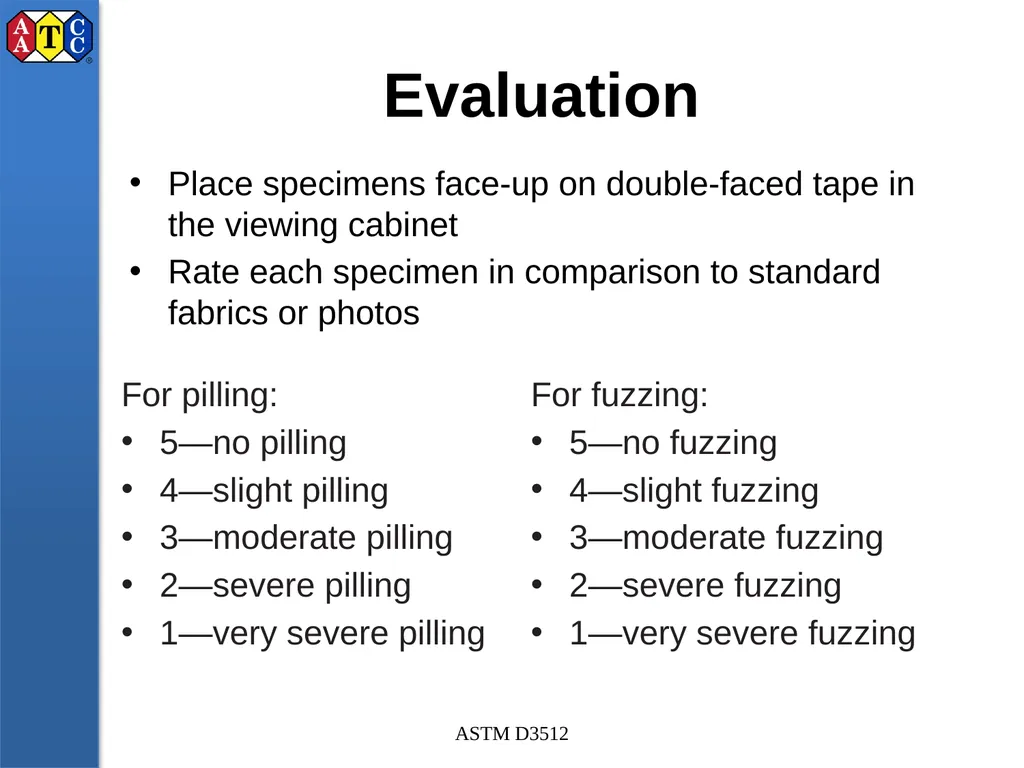
Evaluation For pilling:
5—no pilling
4—slight pilling
3—moderate pilling
2—severe pilling
1—very severe pilling For fuzzing:
5—no fuzzing
4—slight fuzzing
3—moderate fuzzing
2—severe fuzzing
1—very severe fuzzing ASTM D3512 Place specimens face-up on double-faced tape in the viewing cabinet
Rate each specimen in comparison to standard fabrics or photos<br>
5—no pilling
4—slight pilling
3—moderate pilling
2—severe pilling
1—very severe pilling For fuzzing:
5—no fuzzing
4—slight fuzzing
3—moderate fuzzing
2—severe fuzzing
1—very severe fuzzing ASTM D3512 Place specimens face-up on double-faced tape in the viewing cabinet
Rate each specimen in comparison to standard fabrics or photos<br>
28
Evaluation Check specimens for non-uniformity
Report concentration of pills in one area or strip
Discard specimens with concentration of pills in a general line not parallel to either fabric direction
Specimen probably wedged around impeller for one or more periods ASTM D3512<br>
Report concentration of pills in one area or strip
Discard specimens with concentration of pills in a general line not parallel to either fabric direction
Specimen probably wedged around impeller for one or more periods ASTM D3512<br>
29
Evaluation Evaluate other surface effects
fuzzing
pile separation
loss of cover
color change
Separate set of in-house standards for each surface effect recommended ASTM D3512<br>
fuzzing
pile separation
loss of cover
color change
Separate set of in-house standards for each surface effect recommended ASTM D3512<br>
30
Report Test method
Material tested
Sampling method
Individual specimen ratings
Sample average (three specimens)
lot average (multiple samples) if applicable
Edges glued or not glued
Laundering or drycleaning conditions, if applicable
Running time
Viewing apparatus and option
Rating standard used ASTM D3512<br>
Material tested
Sampling method
Individual specimen ratings
Sample average (three specimens)
lot average (multiple samples) if applicable
Edges glued or not glued
Laundering or drycleaning conditions, if applicable
Running time
Viewing apparatus and option
Rating standard used ASTM D3512<br>
31
Cork Liner Calibration Check surface friction
place cork liner on inclined plane
place smooth weight on cork liner
always use same weight and angle
time slide of weight
clean bottom of weight with cloth and solution of detergent and water
wipe weight dry
Compare data from each shipment ASTM D3512<br>
place cork liner on inclined plane
place smooth weight on cork liner
always use same weight and angle
time slide of weight
clean bottom of weight with cloth and solution of detergent and water
wipe weight dry
Compare data from each shipment ASTM D3512<br>
32
Apparatus Calibration Test in-house calibration fabric(s)
no universal standard fabric available
choose fabric with consistent results
Compare results to “known” value
weekly for constant use
before each test for occasional use
when results appear questionable
following change in test equipment
for inter-lab comparison ASTM D3512<br>
no universal standard fabric available
choose fabric with consistent results
Compare results to “known” value
weekly for constant use
before each test for occasional use
when results appear questionable
following change in test equipment
for inter-lab comparison ASTM D3512<br>
33
Maintenance Vacuum test chamber after each test
Clean around impeller with a sharp instrument
After every hour of running time, remove liner and clean impeller
wipe with a cloth and solution of detergent and water
allow chamber to dry before next use
See manufacturer’s instructions for specific calibration and maintenance information. ASTM D3512<br>
Clean around impeller with a sharp instrument
After every hour of running time, remove liner and clean impeller
wipe with a cloth and solution of detergent and water
allow chamber to dry before next use
See manufacturer’s instructions for specific calibration and maintenance information. ASTM D3512<br>