
Atmospheric Sciences 101 Instructor: Cliff Mass
Description: Atmospheric Sciences 101 Instructor: Cliff Mass TA: Conor McNicholas Goals of class Become knowledgeable observers of the atmosphere Being able to interpret satellite and radar imagery, and weather maps Acquire basic understanding of key
Related Topics
Download Presentation
"Atmospheric Sciences 101 Instructor: Cliff Mass" is the property of its rightful owner. Permission is granted to download and print the materials on this website for personal, non-commercial use only, and to display it on your personal computer provided you do not modify the materials and that you retain all copyright notices contained in the materials. By downloading content from our website, you accept the terms of this agreement.
Presentation Transcript
slide1. Atmospheric Sciences 101 Instructor: Cliff Mass
TA: Conor McNicholas<br>
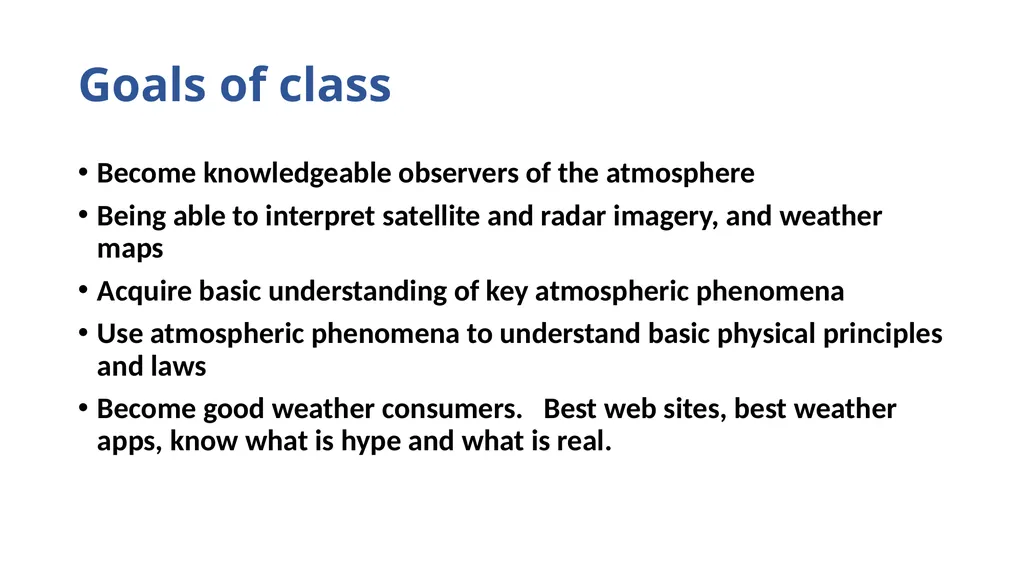
slide2. Goals of class Become knowledgeable observers of the atmosphere
Being able to interpret satellite and radar imagery, and weather maps
Acquire basic understanding of key atmospheric phenomena
Use atmospheric phenomena to understand basic physical principles and laws
Become good weather consumers. Best web sites, best weather apps, know what is hype and what is real.<br>
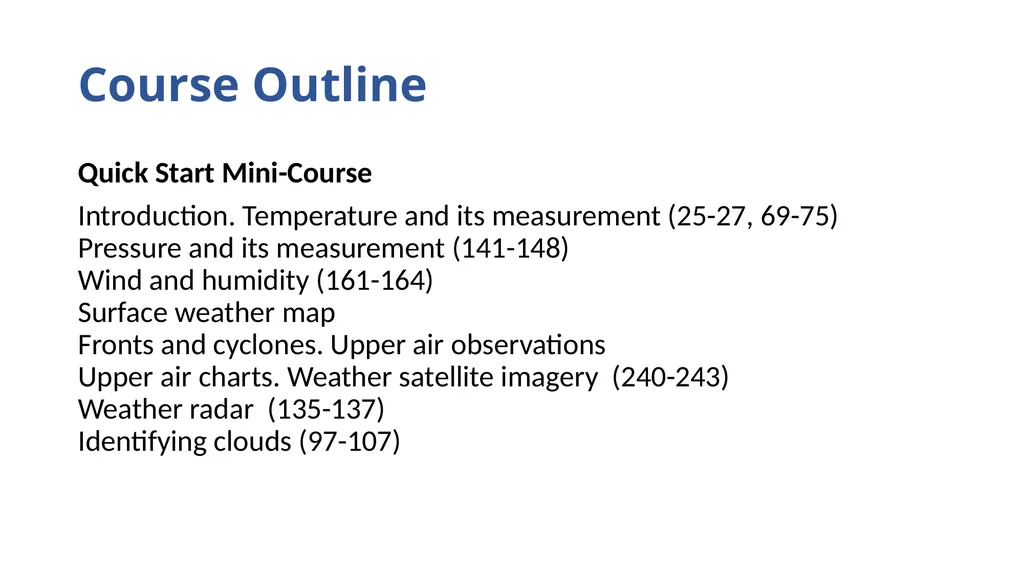
slide3. Course Outline Quick Start Mini-Course
Introduction. Temperature and its measurement (25-27, 69-75) Pressure and its measurement (141-148) Wind and humidity (161-164) Surface weather map Fronts and cyclones. Upper air observations Upper air charts. Weather satellite imagery (240-243) Weather radar (135-137) Identifying clouds (97-107)<br>
slide4. Course Outline The Basics
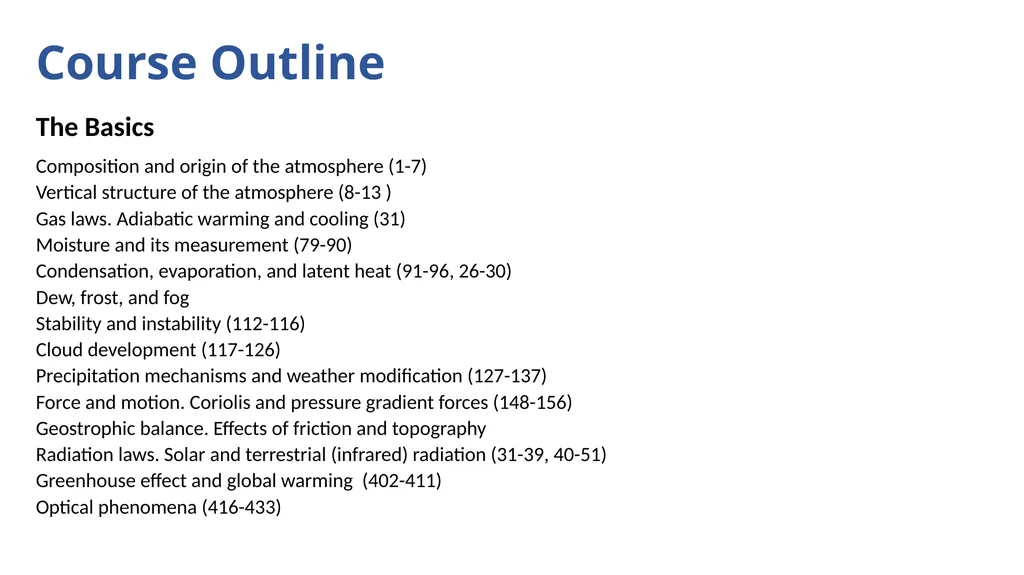
Composition and origin of the atmosphere (1-7) Vertical structure of the atmosphere (8-13 ) Gas laws. Adiabatic warming and cooling (31) Moisture and its measurement (79-90) Condensation, evaporation, and latent heat (91-96, 26-30) Dew, frost, and fog Stability and instability (112-116) Cloud development (117-126) Precipitation mechanisms and weather modification (127-137) Force and motion. Coriolis and pressure gradient forces (148-156) Geostrophic balance. Effects of friction and topography Radiation laws. Solar and terrestrial (infrared) radiation (31-39, 40-51) Greenhouse effect and global warming (402-411) Optical phenomena (416-433)<br>
slide5. Course Outline Storms and Weather Systems
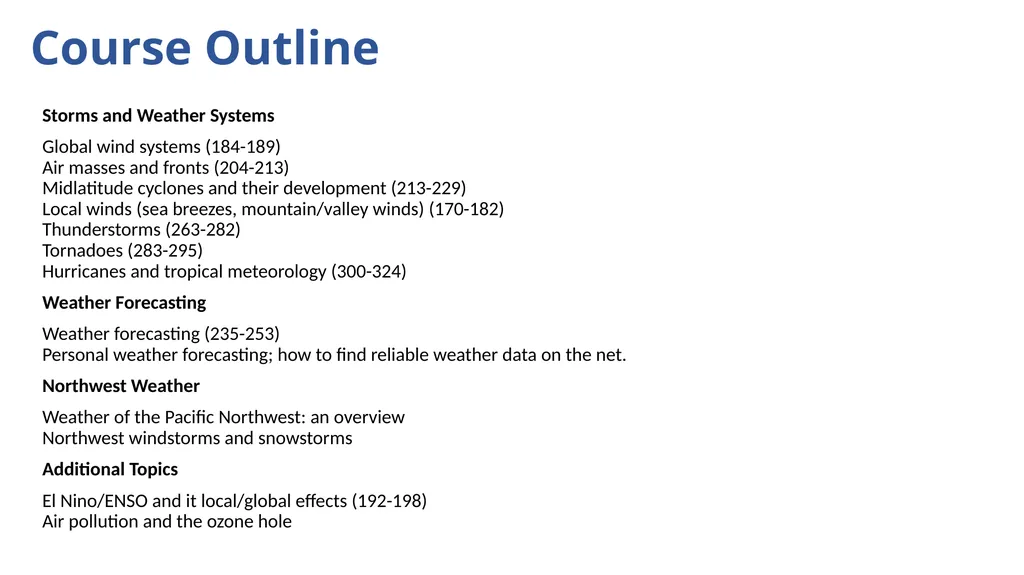
Global wind systems (184-189) Air masses and fronts (204-213) Midlatitude cyclones and their development (213-229) Local winds (sea breezes, mountain/valley winds) (170-182) Thunderstorms (263-282) Tornadoes (283-295) Hurricanes and tropical meteorology (300-324)
Weather Forecasting
Weather forecasting (235-253) Personal weather forecasting; how to find reliable weather data on the net.
Northwest Weather
Weather of the Pacific Northwest: an overview Northwest windstorms and snowstorms
Additional Topics
El Nino/ENSO and it local/global effects (192-198) Air pollution and the ozone hole<br>
slide6. Books No required book, but there are good supplementary books
Don’t want you to spend a fortune
Will deepen your learning and help clarify material if you follow along in one of the recommended books
Two possibilities
Hakim/Patoux: Weather, A Concise Introduction
Ahrens: Meteorology Today, Weather, Essentials of Meteorology<br>
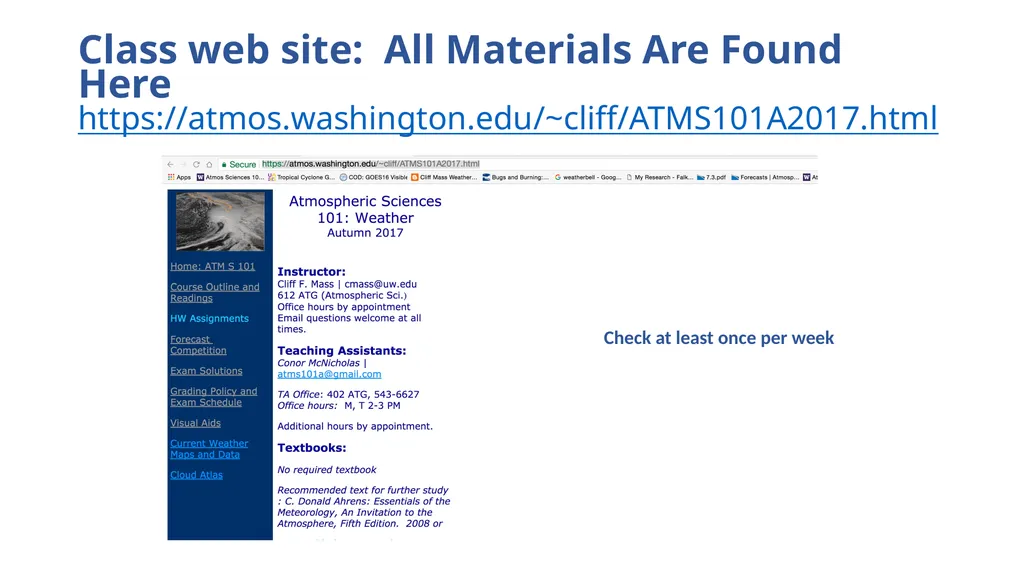
slide7. Class web site: All Materials Are Found Here https://atmos.washington.edu/~cliff/ATMS101A2017.html Check at least once per week<br>
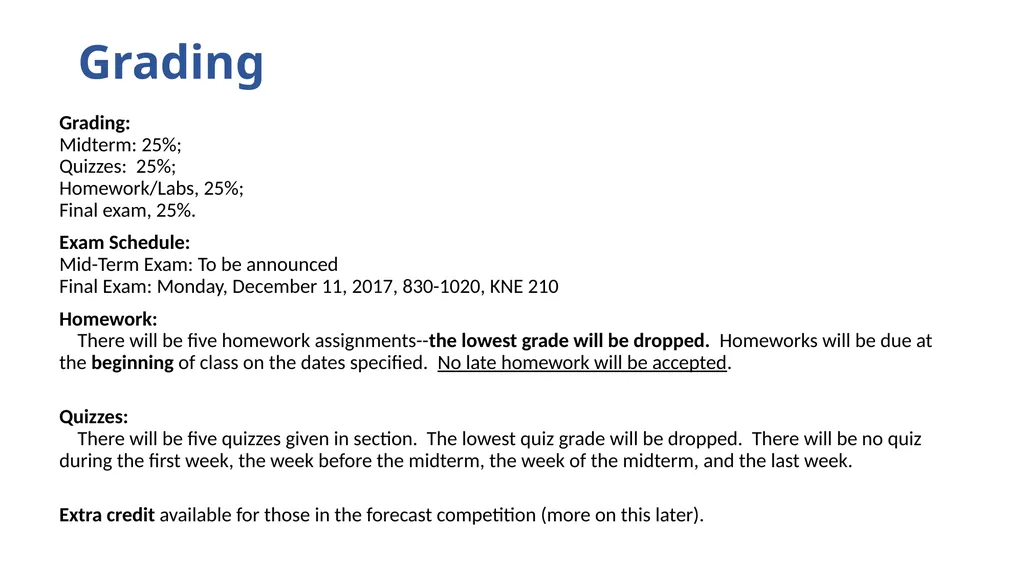
slide8. Grading Grading: Midterm: 25%; Quizzes: 25%; Homework/Labs, 25%; Final exam, 25%.
Exam Schedule: Mid-Term Exam: To be announced Final Exam: Monday, December 11, 2017, 830-1020, KNE 210
Homework: There will be five homework assignments--the lowest grade will be dropped. Homeworks will be due at the beginning of class on the dates specified. No late homework will be accepted.
Quizzes: There will be five quizzes given in section. The lowest quiz grade will be dropped. There will be no quiz during the first week, the week before the midterm, the week of the midterm, and the last week.
Extra credit available for those in the forecast competition (more on this later).<br>
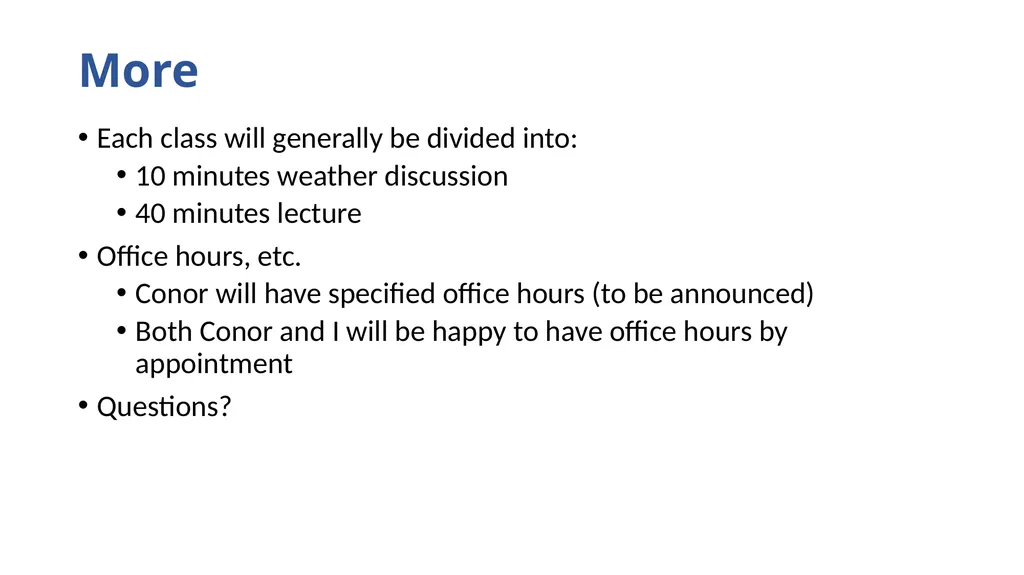
slide9. More Each class will generally be divided into:
10 minutes weather discussion
40 minutes lecture
Office hours, etc.
Conor will have specified office hours (to be announced)
Both Conor and I will be happy to have office hours by appointment
Questions?<br>
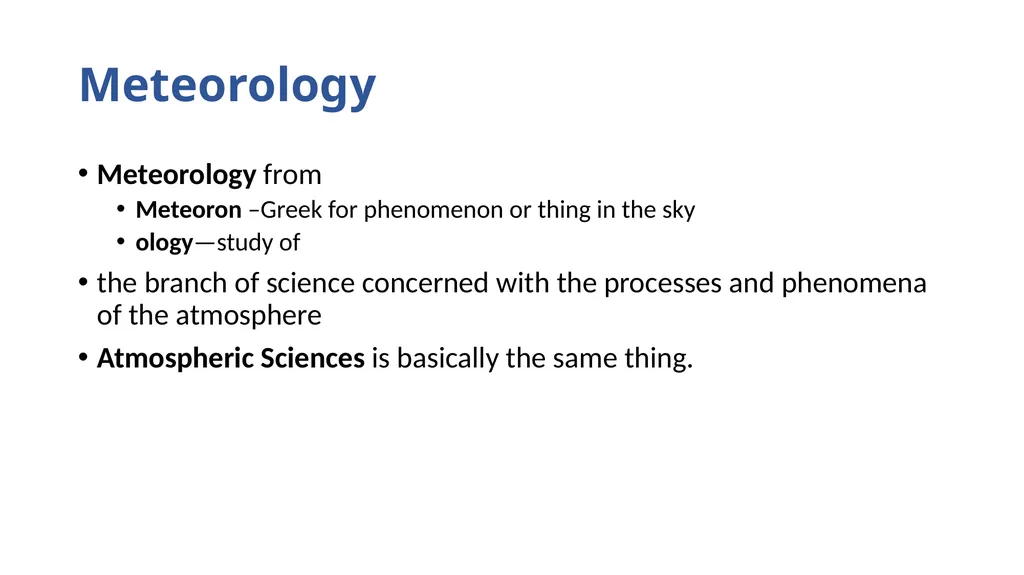
slide10. Meteorology Meteorology from
Meteoron –Greek for phenomenon or thing in the sky
ology—study of
the branch of science concerned with the processes and phenomena of the atmosphere
Atmospheric Sciences is basically the same thing.<br>
TA: Conor McNicholas<br>
slide2. Goals of class Become knowledgeable observers of the atmosphere
Being able to interpret satellite and radar imagery, and weather maps
Acquire basic understanding of key atmospheric phenomena
Use atmospheric phenomena to understand basic physical principles and laws
Become good weather consumers. Best web sites, best weather apps, know what is hype and what is real.<br>
slide3. Course Outline Quick Start Mini-Course
Introduction. Temperature and its measurement (25-27, 69-75) Pressure and its measurement (141-148) Wind and humidity (161-164) Surface weather map Fronts and cyclones. Upper air observations Upper air charts. Weather satellite imagery (240-243) Weather radar (135-137) Identifying clouds (97-107)<br>
slide4. Course Outline The Basics
Composition and origin of the atmosphere (1-7) Vertical structure of the atmosphere (8-13 ) Gas laws. Adiabatic warming and cooling (31) Moisture and its measurement (79-90) Condensation, evaporation, and latent heat (91-96, 26-30) Dew, frost, and fog Stability and instability (112-116) Cloud development (117-126) Precipitation mechanisms and weather modification (127-137) Force and motion. Coriolis and pressure gradient forces (148-156) Geostrophic balance. Effects of friction and topography Radiation laws. Solar and terrestrial (infrared) radiation (31-39, 40-51) Greenhouse effect and global warming (402-411) Optical phenomena (416-433)<br>
slide5. Course Outline Storms and Weather Systems
Global wind systems (184-189) Air masses and fronts (204-213) Midlatitude cyclones and their development (213-229) Local winds (sea breezes, mountain/valley winds) (170-182) Thunderstorms (263-282) Tornadoes (283-295) Hurricanes and tropical meteorology (300-324)
Weather Forecasting
Weather forecasting (235-253) Personal weather forecasting; how to find reliable weather data on the net.
Northwest Weather
Weather of the Pacific Northwest: an overview Northwest windstorms and snowstorms
Additional Topics
El Nino/ENSO and it local/global effects (192-198) Air pollution and the ozone hole<br>
slide6. Books No required book, but there are good supplementary books
Don’t want you to spend a fortune
Will deepen your learning and help clarify material if you follow along in one of the recommended books
Two possibilities
Hakim/Patoux: Weather, A Concise Introduction
Ahrens: Meteorology Today, Weather, Essentials of Meteorology<br>
slide7. Class web site: All Materials Are Found Here https://atmos.washington.edu/~cliff/ATMS101A2017.html Check at least once per week<br>
slide8. Grading Grading: Midterm: 25%; Quizzes: 25%; Homework/Labs, 25%; Final exam, 25%.
Exam Schedule: Mid-Term Exam: To be announced Final Exam: Monday, December 11, 2017, 830-1020, KNE 210
Homework: There will be five homework assignments--the lowest grade will be dropped. Homeworks will be due at the beginning of class on the dates specified. No late homework will be accepted.
Quizzes: There will be five quizzes given in section. The lowest quiz grade will be dropped. There will be no quiz during the first week, the week before the midterm, the week of the midterm, and the last week.
Extra credit available for those in the forecast competition (more on this later).<br>
slide9. More Each class will generally be divided into:
10 minutes weather discussion
40 minutes lecture
Office hours, etc.
Conor will have specified office hours (to be announced)
Both Conor and I will be happy to have office hours by appointment
Questions?<br>
slide10. Meteorology Meteorology from
Meteoron –Greek for phenomenon or thing in the sky
ology—study of
the branch of science concerned with the processes and phenomena of the atmosphere
Atmospheric Sciences is basically the same thing.<br>