Atomic Model: Timeline Rutherford Democritus Thompson Bohr Chadwick Schrodinger Dalton Bohr Model Bohrs theory begins with Rutherfords picture of an atom as a nucleus surrounded by electrons moving in circular orbits. In his theory, Bohr
"Atomic Model: Timeline Rutherford Democritus" is the property of its rightful owner. Permission is granted to
download and print the materials on this website for personal, non-commercial use only, and to display it
on your personal computer provided you do not modify the materials and that you retain all copyright
notices contained in the materials. By downloading content from our website, you accept the terms of this
agreement.
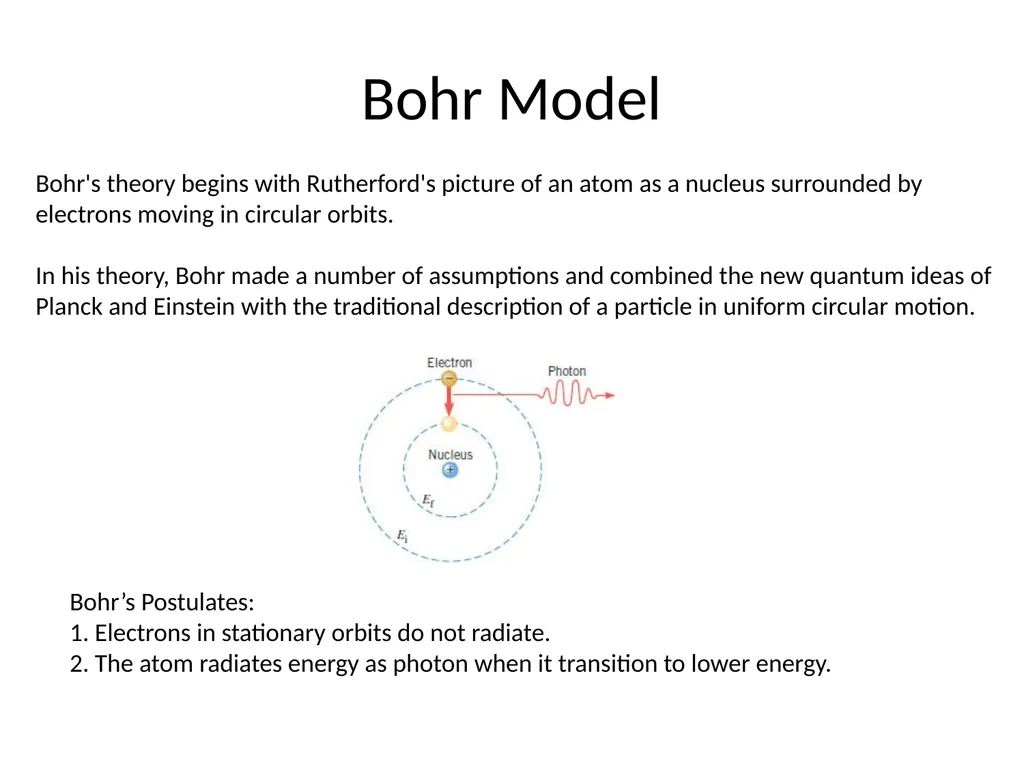
Bohr Model Bohr's theory begins with Rutherford's picture of an atom as a nucleus surrounded by electrons moving in circular orbits.
In his theory, Bohr made a number of assumptions and combined the new quantum ideas of Planck and Einstein with the traditional description of a particle in uniform circular motion. Bohr’s Postulates:
1. Electrons in stationary orbits do not radiate.
2. The atom radiates energy as photon when it transition to lower energy.<br>
03
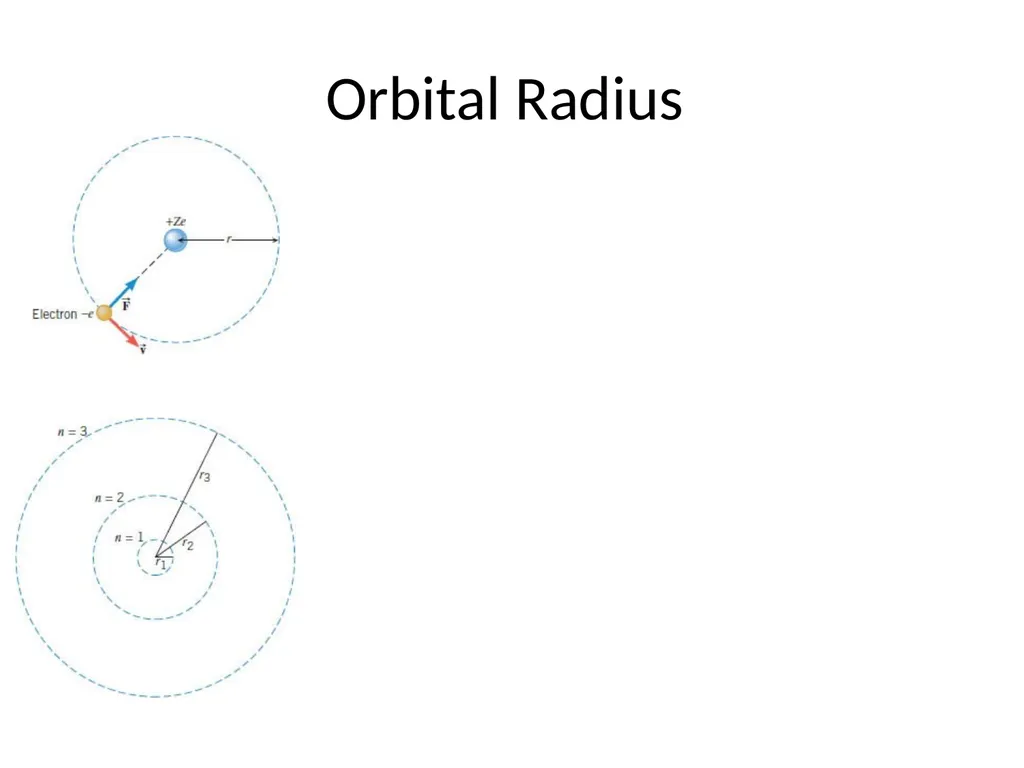
Orbital Radius<br>
04
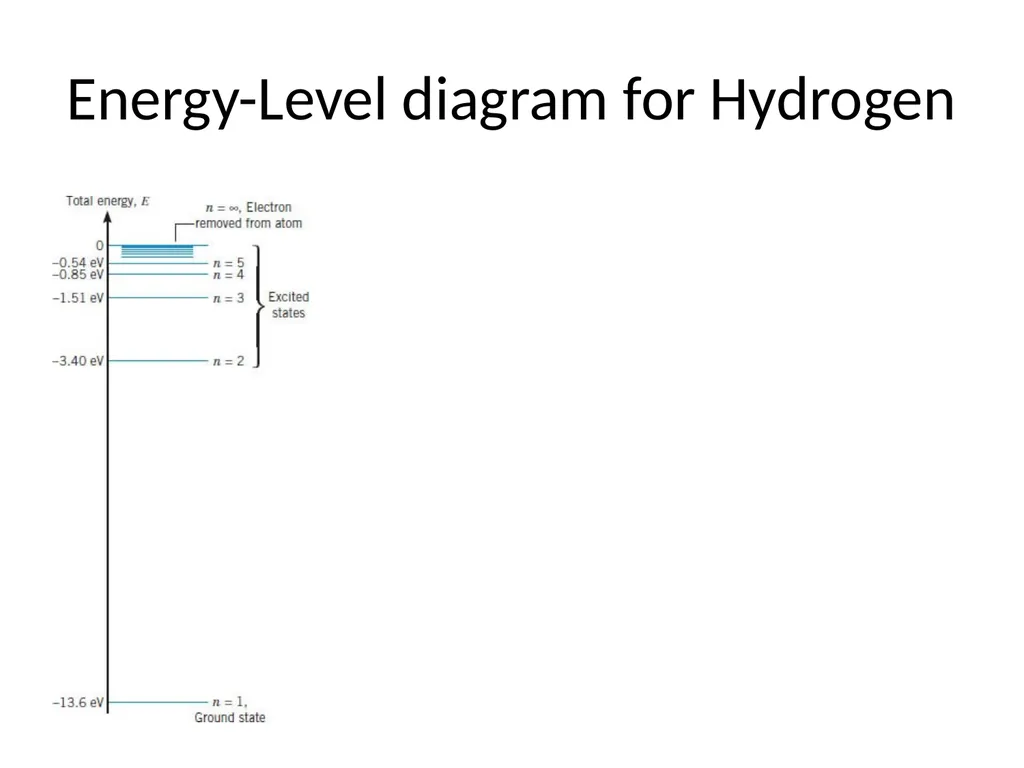
Energy-Level diagram for Hydrogen<br>
05
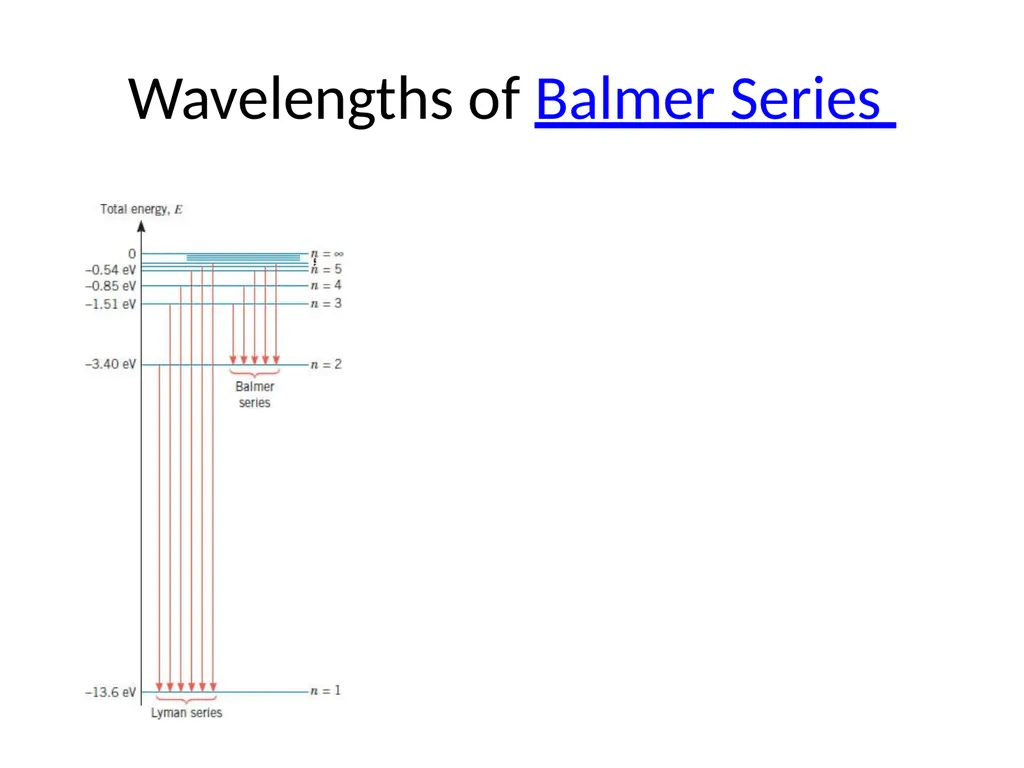
Wavelengths of Balmer Series<br>
06
X-rays X-rays were discovered by the Dutch physicist Wilhelm K. Roentgen (1845-1923), who performed much of his work in Germany.
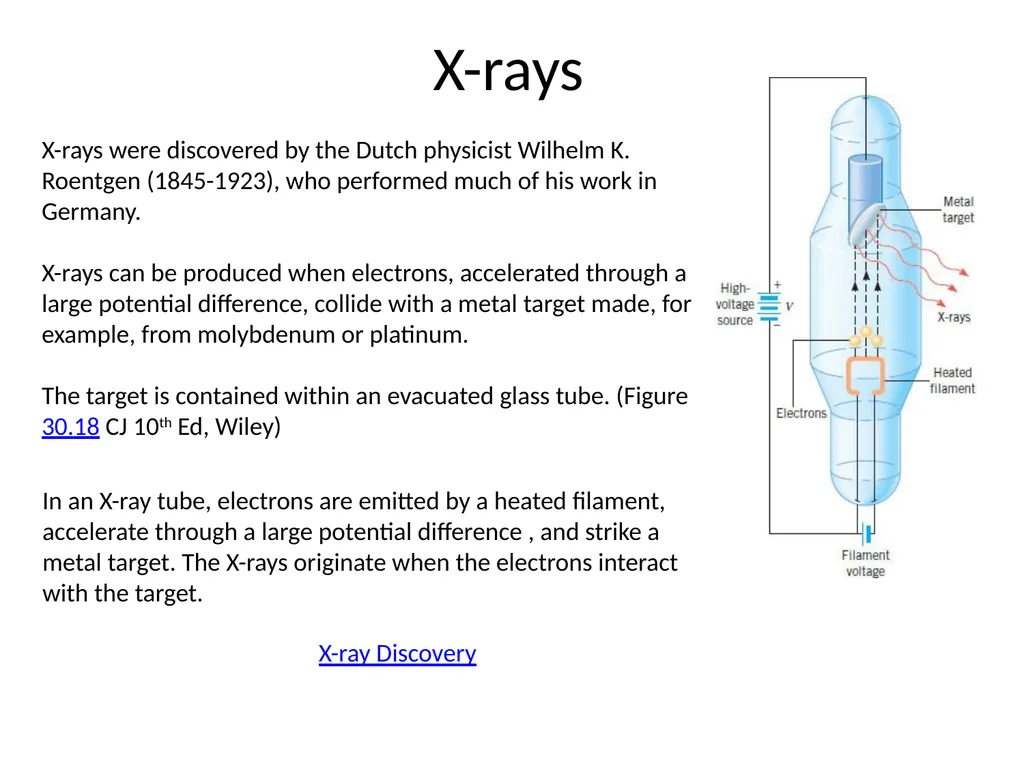
X-rays can be produced when electrons, accelerated through a large potential difference, collide with a metal target made, for example, from molybdenum or platinum.
The target is contained within an evacuated glass tube. (Figure 30.18 CJ 10th Ed, Wiley) In an X-ray tube, electrons are emitted by a heated filament, accelerate through a large potential difference , and strike a metal target. The X-rays originate when the electrons interact with the target. X-ray Discovery<br>
07
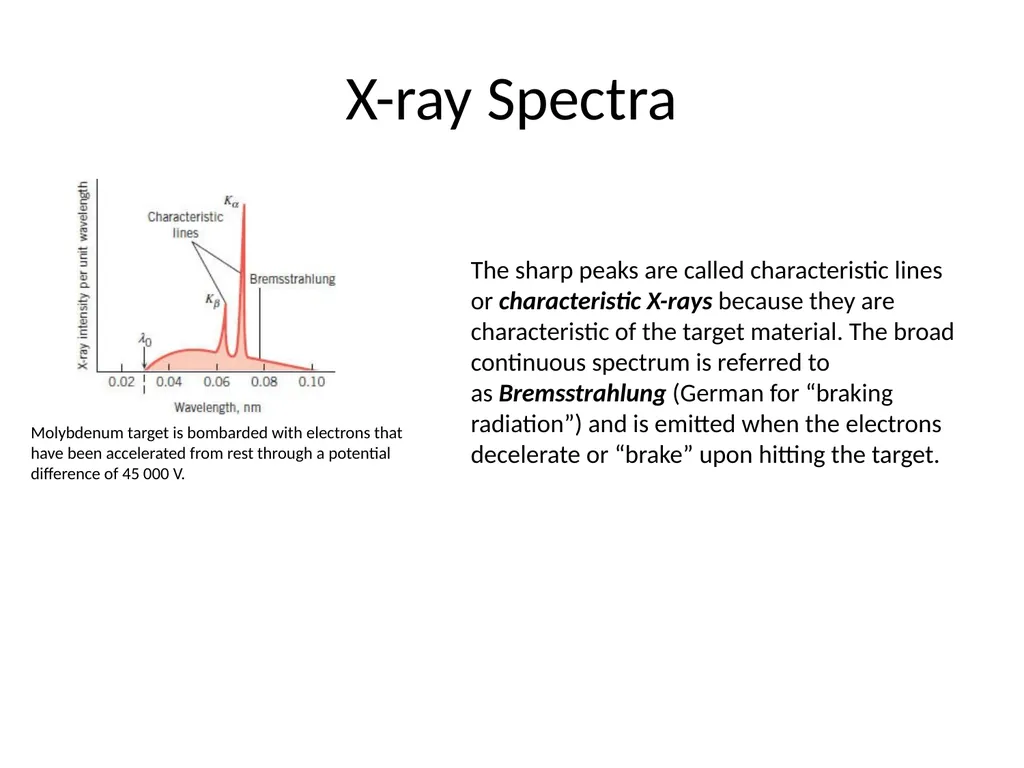
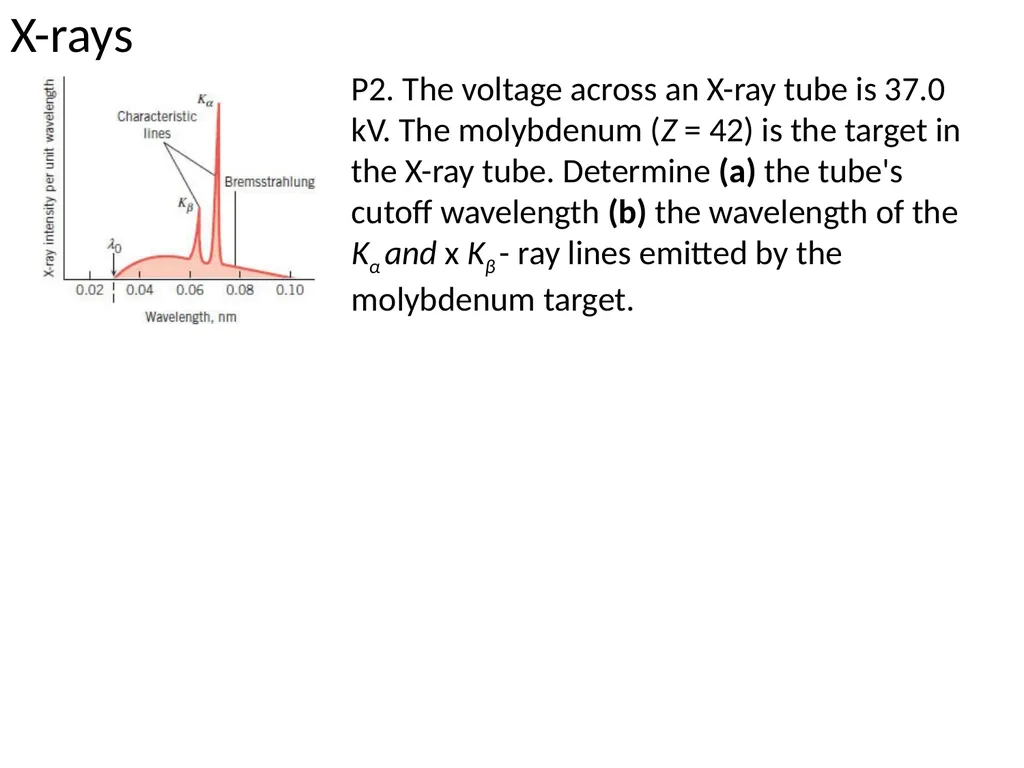
X-ray Spectra Molybdenum target is bombarded with electrons that have been accelerated from rest through a potential difference of 45 000 V. The sharp peaks are called characteristic lines or characteristic X-rays because they are characteristic of the target material. The broad continuous spectrum is referred to as Bremsstrahlung (German for “braking radiation”) and is emitted when the electrons decelerate or “brake” upon hitting the target.<br>
08
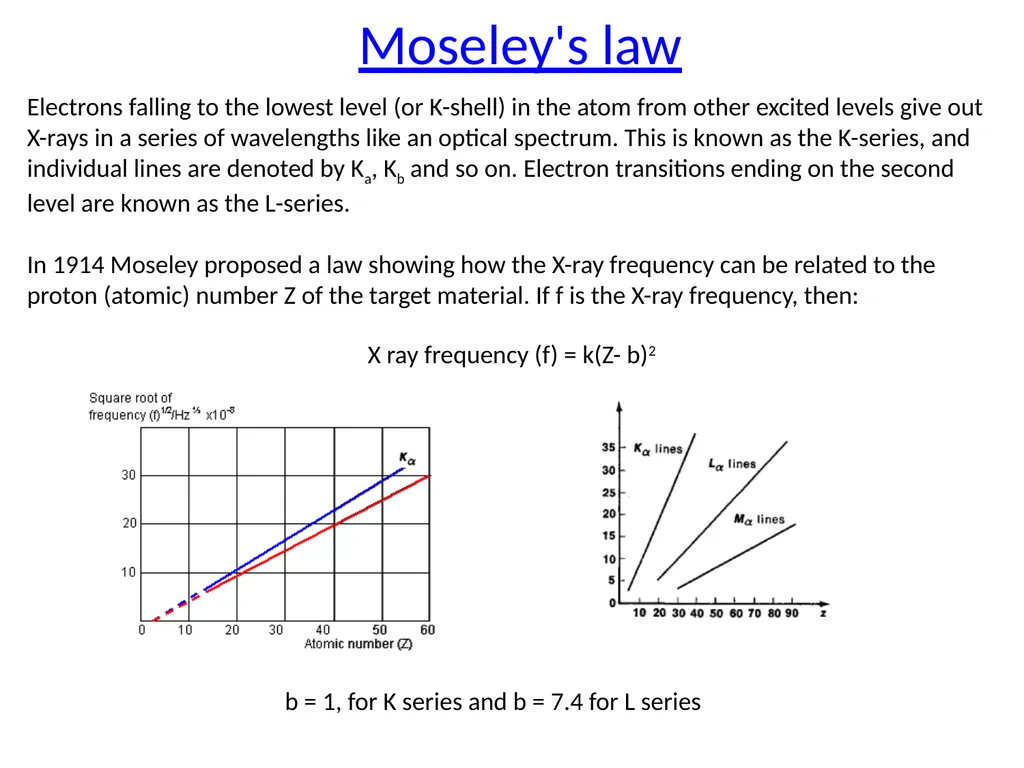
Moseley's law Electrons falling to the lowest level (or K-shell) in the atom from other excited levels give out X-rays in a series of wavelengths like an optical spectrum. This is known as the K-series, and individual lines are denoted by Ka, Kb and so on. Electron transitions ending on the second level are known as the L-series.
In 1914 Moseley proposed a law showing how the X-ray frequency can be related to the proton (atomic) number Z of the target material. If f is the X-ray frequency, then: X ray frequency (f) = k(Z- b)2 b = 1, for K series and b = 7.4 for L series<br>
09
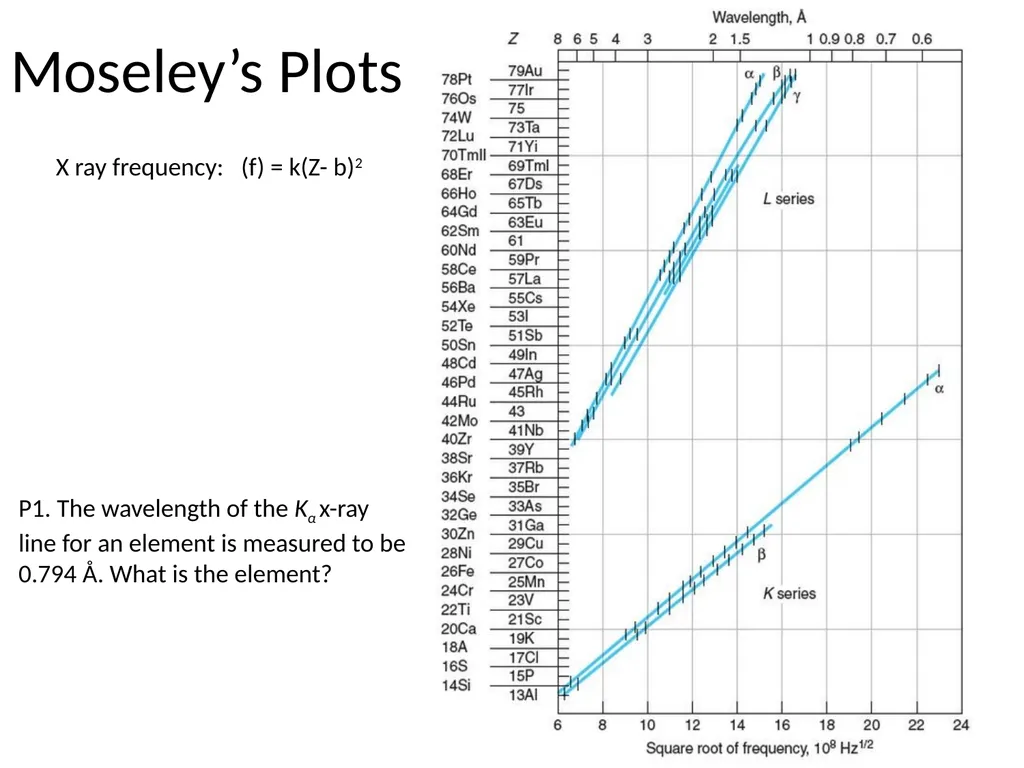
Moseley’s Plots X ray frequency: (f) = k(Z- b)2 P1. The wavelength of the Kα x-ray line for an element is measured to be 0.794 Å. What is the element?<br>
10
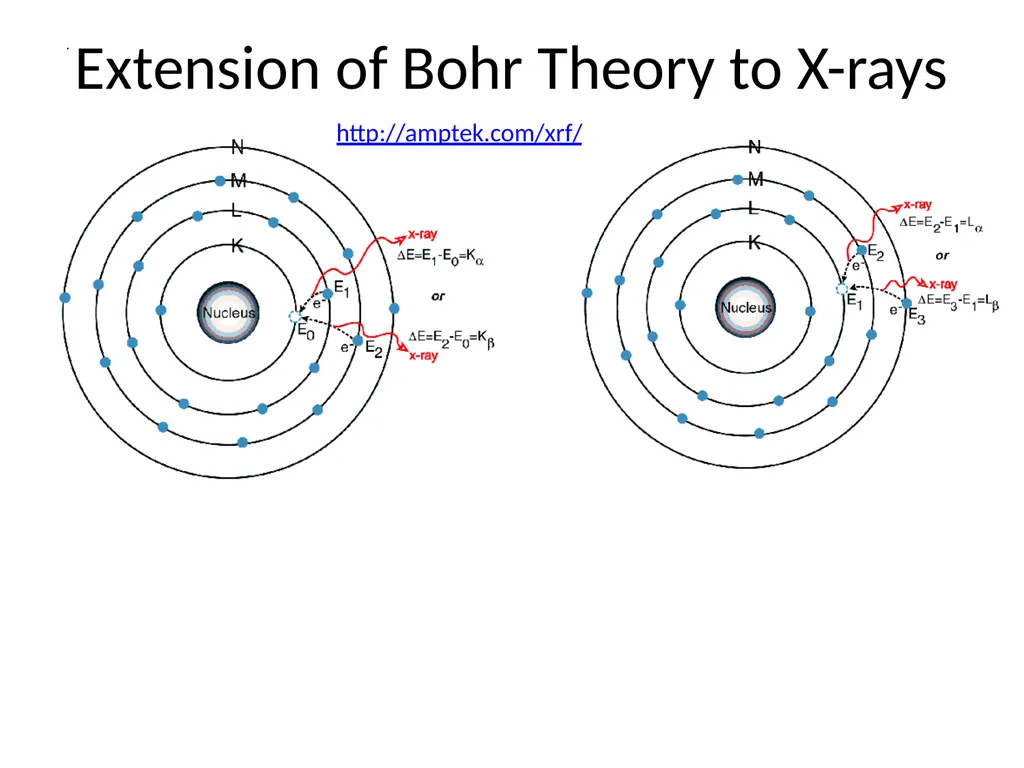
Extension of Bohr Theory to X-rays http://amptek.com/xrf/ .<br>
11
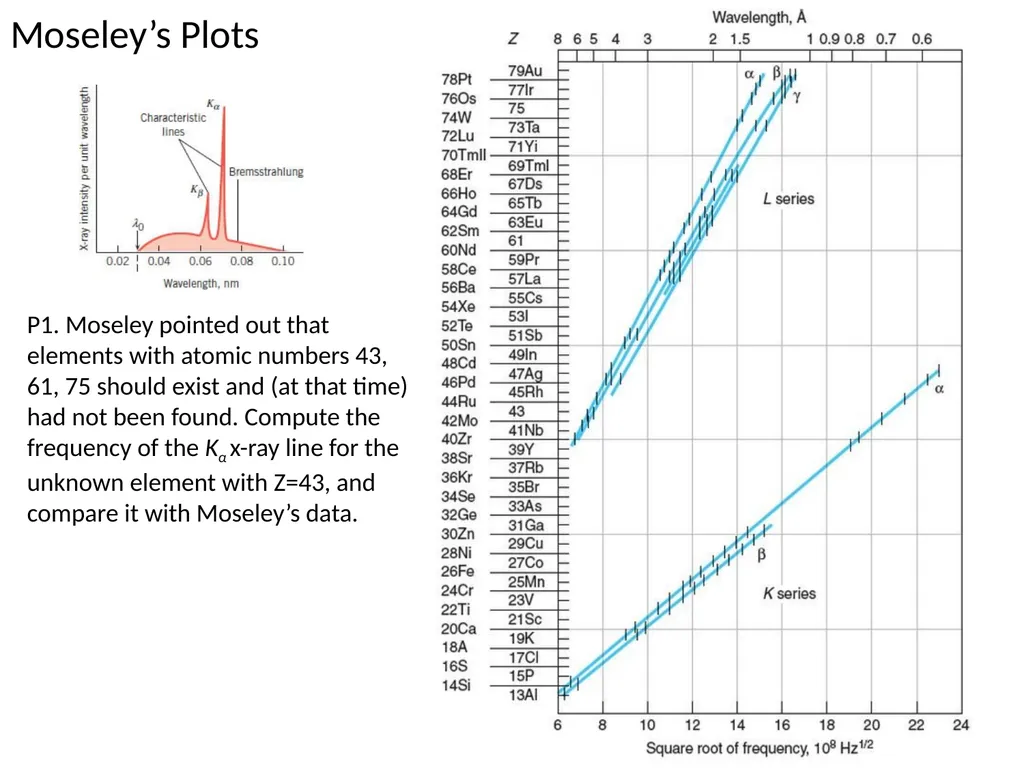
Moseley’s Plots P1. Moseley pointed out that elements with atomic numbers 43, 61, 75 should exist and (at that time) had not been found. Compute the frequency of the Kα x-ray line for the unknown element with Z=43, and compare it with Moseley’s data.<br>
12
X-rays P2. The voltage across an X-ray tube is 37.0 kV. The molybdenum (Z = 42) is the target in the X-ray tube. Determine (a) the tube's cutoff wavelength (b) the wavelength of the Kα and x Kβ - ray lines emitted by the molybdenum target.<br>