Attendee journey mapping template A participant
Description: Attendee journey mapping template A participant journey map helps you visualize this process, ensuring a seamless and engaging event. Use this template to build your own journey map and craft an exceptional attendee experience. 03152024
Related Topics
Download Presentation
"Attendee journey mapping template A participant" is the property of its rightful owner. Permission is granted to download and print the materials on this website for personal, non-commercial use only, and to display it on your personal computer provided you do not modify the materials and that you retain all copyright notices contained in the materials. By downloading content from our website, you accept the terms of this agreement.
Presentation Transcript
slide1. Attendee journey mapping template
A participant journey map helps you visualize this process, ensuring a seamless and engaging event. Use this template to build your own journey map and craft an exceptional attendee experience. 03/15/2024 Add Logo<br>
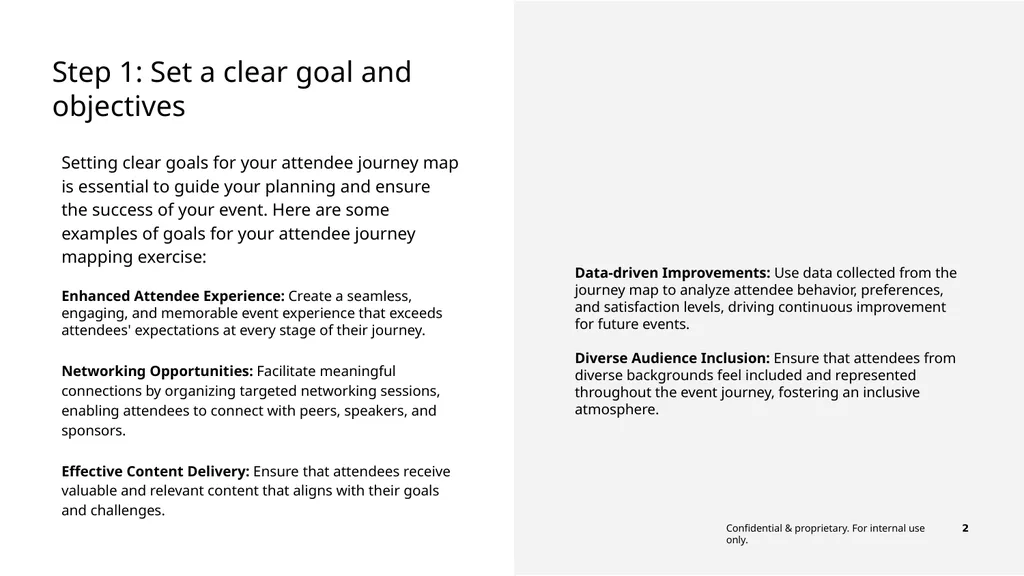
slide2. Setting clear goals for your attendee journey map is essential to guide your planning and ensure the success of your event. Here are some examples of goals for your attendee journey mapping exercise:
Enhanced Attendee Experience: Create a seamless, engaging, and memorable event experience that exceeds attendees' expectations at every stage of their journey.
Networking Opportunities: Facilitate meaningful connections by organizing targeted networking sessions, enabling attendees to connect with peers, speakers, and sponsors.
Effective Content Delivery: Ensure that attendees receive valuable and relevant content that aligns with their goals and challenges. Step 1: Set a clear goal and objectives Data-driven Improvements: Use data collected from the journey map to analyze attendee behavior, preferences, and satisfaction levels, driving continuous improvement for future events.
Diverse Audience Inclusion: Ensure that attendees from diverse backgrounds feel included and represented throughout the event journey, fostering an inclusive atmosphere.<br>
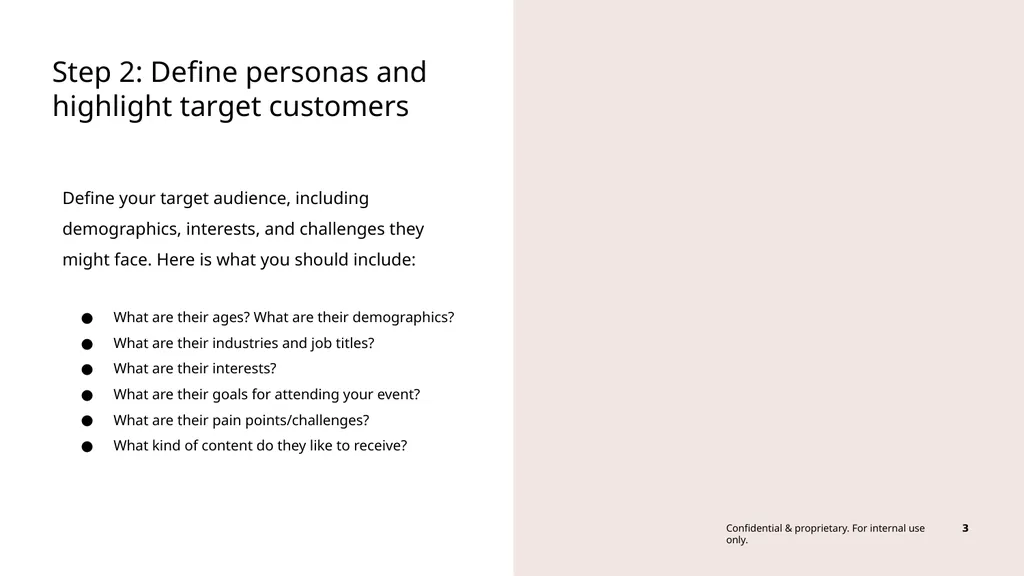
slide3. Define your target audience, including demographics, interests, and challenges they might face. Here is what you should include:
What are their ages? What are their demographics?
What are their industries and job titles?
What are their interests?
What are their goals for attending your event?
What are their pain points/challenges?
What kind of content do they like to receive? Step 2: Define personas and highlight target customers<br>
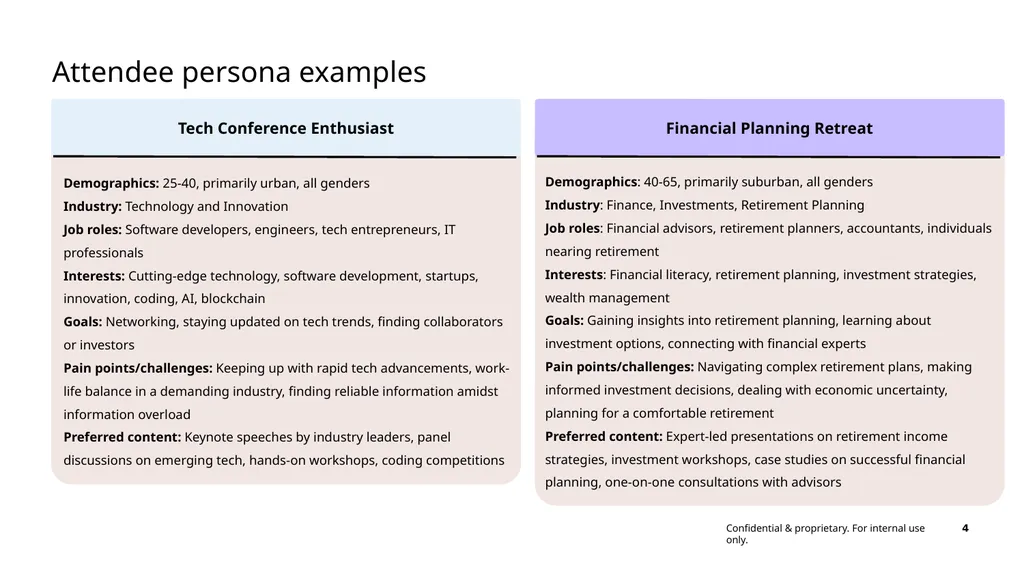
slide4. Attendee persona examples Tech Conference Enthusiast Demographics: 25-40, primarily urban, all genders
Industry: Technology and Innovation
Job roles: Software developers, engineers, tech entrepreneurs, IT professionals
Interests: Cutting-edge technology, software development, startups, innovation, coding, AI, blockchain
Goals: Networking, staying updated on tech trends, finding collaborators or investors
Pain points/challenges: Keeping up with rapid tech advancements, work-life balance in a demanding industry, finding reliable information amidst information overload
Preferred content: Keynote speeches by industry leaders, panel discussions on emerging tech, hands-on workshops, coding competitions Financial Planning Retreat Demographics: 40-65, primarily suburban, all genders
Industry: Finance, Investments, Retirement Planning
Job roles: Financial advisors, retirement planners, accountants, individuals nearing retirement
Interests: Financial literacy, retirement planning, investment strategies, wealth management
Goals: Gaining insights into retirement planning, learning about investment options, connecting with financial experts
Pain points/challenges: Navigating complex retirement plans, making informed investment decisions, dealing with economic uncertainty, planning for a comfortable retirement
Preferred content: Expert-led presentations on retirement income strategies, investment workshops, case studies on successful financial planning, one-on-one consultations with advisors<br>
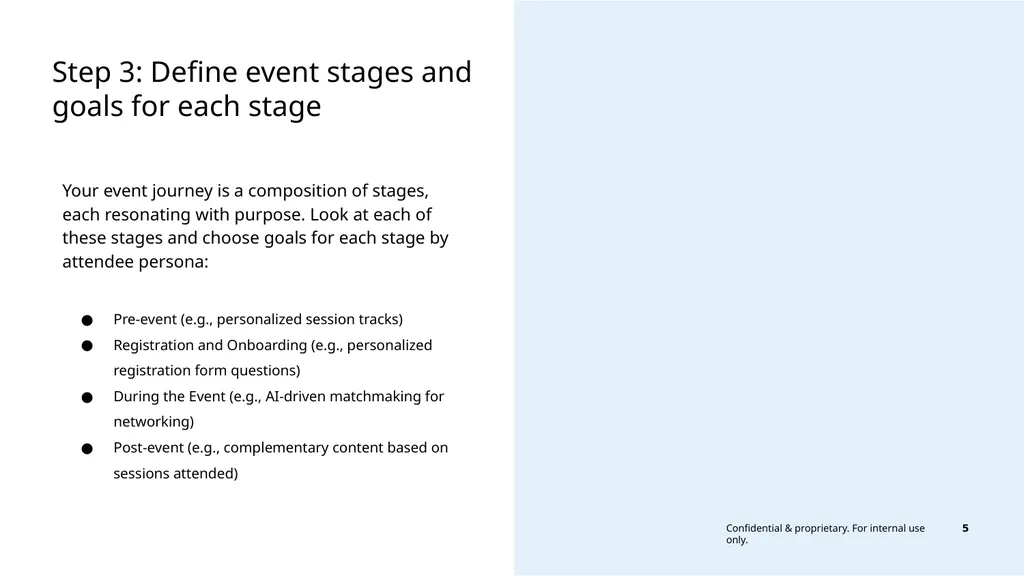
slide5. Your event journey is a composition of stages, each resonating with purpose. Look at each of these stages and choose goals for each stage by attendee persona:
Pre-event (e.g., personalized session tracks)
Registration and Onboarding (e.g., personalized registration form questions)
During the Event (e.g., AI-driven matchmaking for networking)
Post-event (e.g., complementary content based on sessions attended) Step 3: Define event stages and goals for each stage<br>
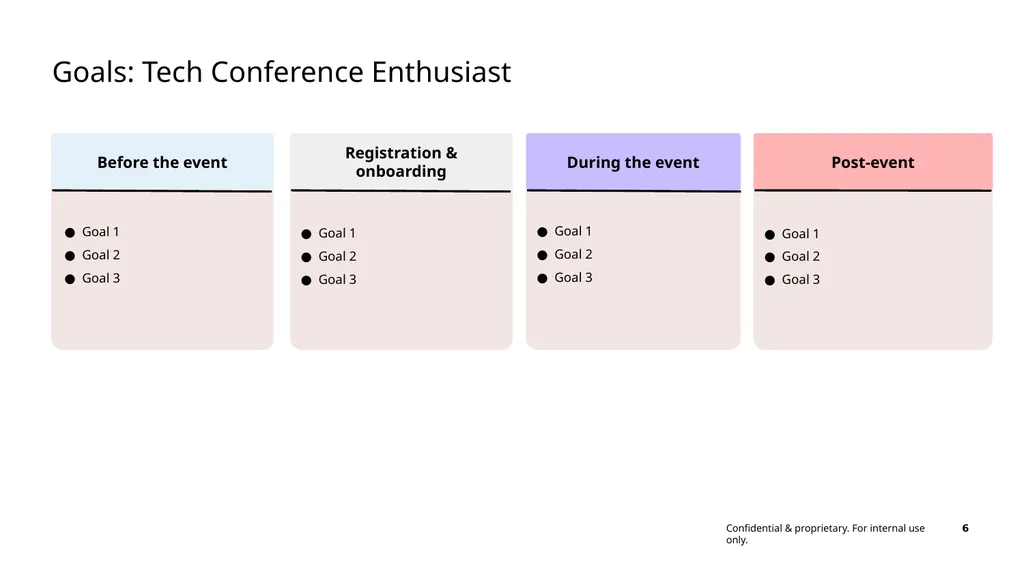
slide6. Goals: Tech Conference Enthusiast Registration & onboarding ● Goal 1
● Goal 2
● Goal 3 During the event ● Goal 1
● Goal 2
● Goal 3 Post-event ● Goal 1
● Goal 2
● Goal 3 Before the event ● Goal 1
● Goal 2
● Goal 3<br>
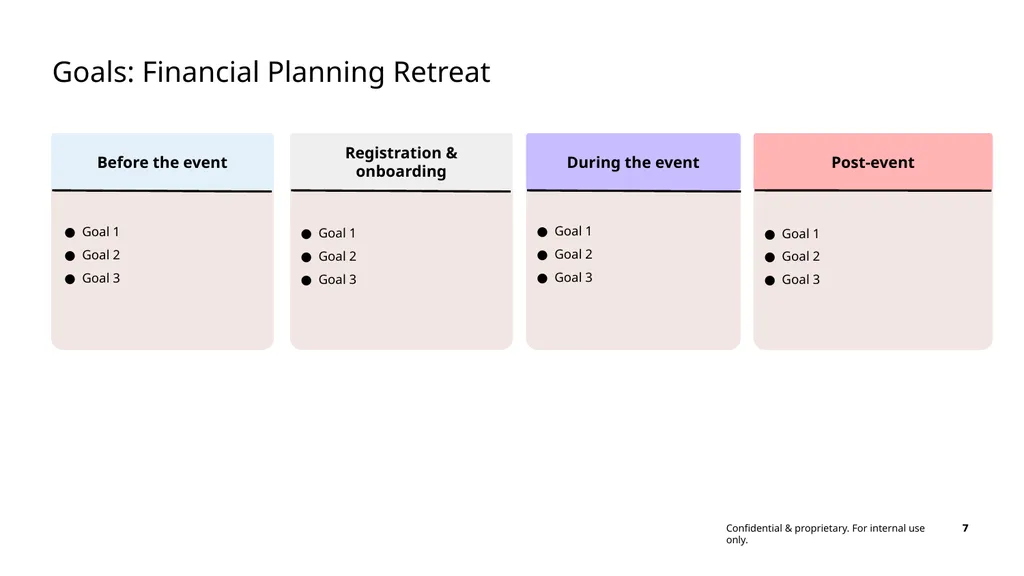
slide7. Goals: Financial Planning Retreat Registration & onboarding ● Goal 1
● Goal 2
● Goal 3 During the event ● Goal 1
● Goal 2
● Goal 3 Post-event ● Goal 1
● Goal 2
● Goal 3 Before the event ● Goal 1
● Goal 2
● Goal 3<br>
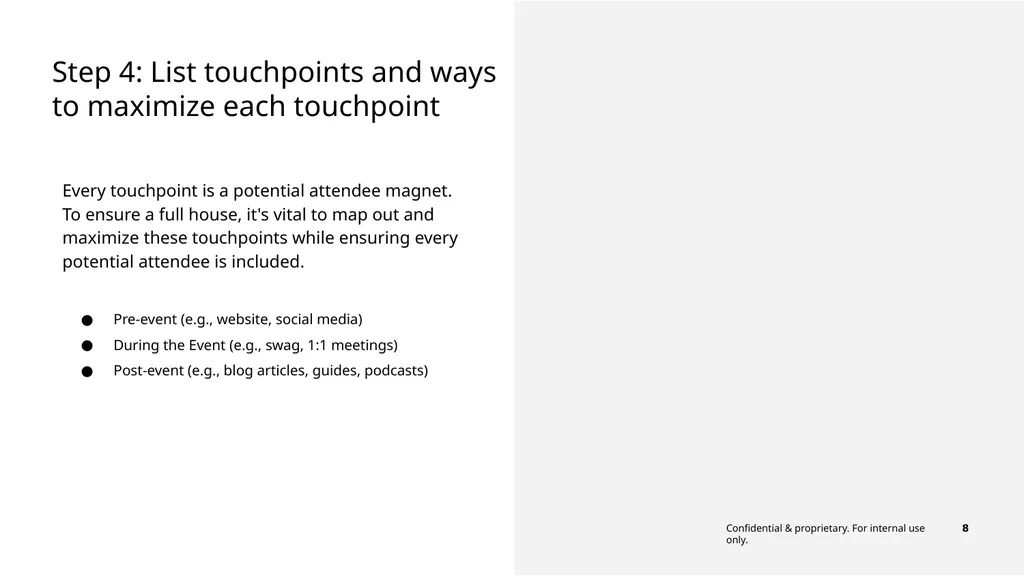
slide8. Every touchpoint is a potential attendee magnet. To ensure a full house, it's vital to map out and maximize these touchpoints while ensuring every potential attendee is included.
Pre-event (e.g., website, social media)
During the Event (e.g., swag, 1:1 meetings)
Post-event (e.g., blog articles, guides, podcasts) Step 4: List touchpoints and ways to maximize each touchpoint<br>
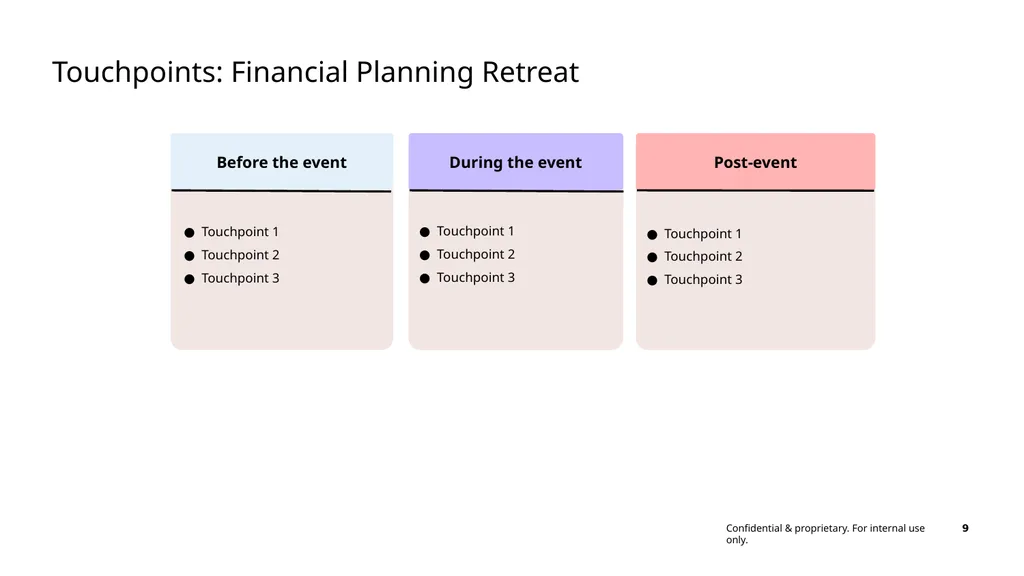
slide9. Touchpoints: Financial Planning Retreat During the event ● Touchpoint 1
● Touchpoint 2
● Touchpoint 3 Post-event ● Touchpoint 1
● Touchpoint 2
● Touchpoint 3 Before the event ● Touchpoint 1
● Touchpoint 2
● Touchpoint 3<br>
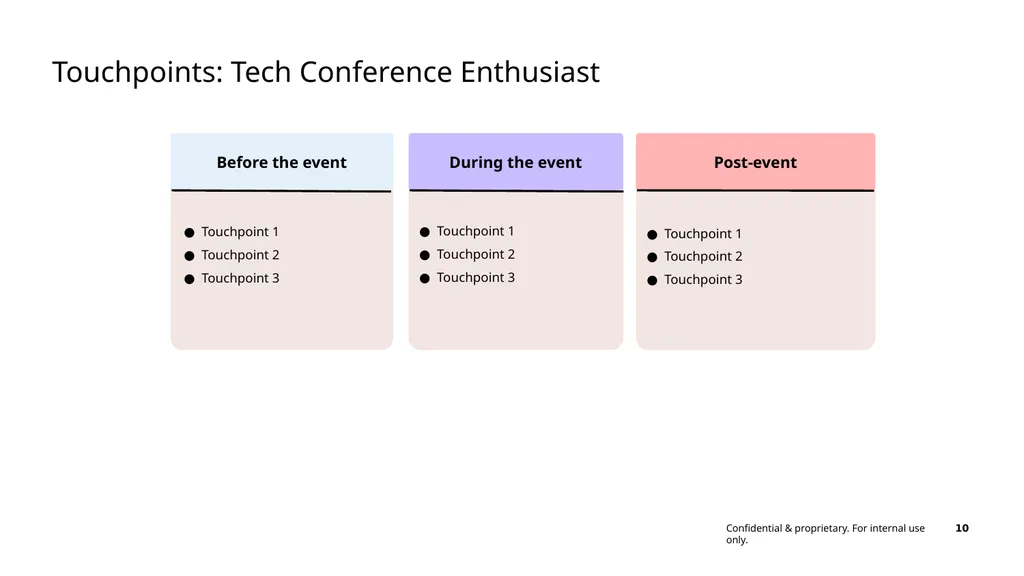
slide10. Touchpoints: Tech Conference Enthusiast During the event ● Touchpoint 1
● Touchpoint 2
● Touchpoint 3 Post-event ● Touchpoint 1
● Touchpoint 2
● Touchpoint 3 Before the event ● Touchpoint 1
● Touchpoint 2
● Touchpoint 3<br>
slide11. Once you’ve dealt with the touchpoints, it’s time to gather feedback about the attendee's preferences and impressions. The qualitative feedback you receive from your audience will help you navigate through their likes, dislikes, and pain points.
Here are 10 questions to ask: Step 5: Gather attendee feedback to identify challenges and successes Did you find the event content relevant to your interests and needs? How did it align with your expectations?
Were there specific sessions or workshops that you found particularly valuable or applicable to your professional/personal growth?
Did you have opportunities to connect with peers, speakers, or sponsors that resonated with your industry or interests?
How did you feel about the level of personalization in the event? Did you receive information or recommendations that felt tailored to you?
Were there any aspects of the event where you wished for more personalization or customization?
Did you find the networking opportunities suitable for your goals? Were there any specific connections you made that you found valuable?
Were the event communications clear and relevant? Did you receive the information you needed at each stage of the journey?
Did you feel that your feedback and opinions were valued by the event organizers? Were there instances where you saw your input implemented?
Were there any touchpoints in the journey where you encountered challenges or felt that your needs weren't adequately addressed?
Overall, how would you rate the personalized experience you had during the event on a scale of 1 to 10, with 10 being highly personalized and meaningful?<br>
slide12. As you wrap up this journey, it's vital to refine and enhance the event experience design for your attendees in the future. Here's how you can do it:
Define key performance indicators (KPIs)
Analyze feedback and attendee data/NPS
Iterate and refine
Brainstorm ideas to innovate
Evaluate impact
Repeat the process Step 6: Improve Your Attendee Journey and Map for the Next Event<br>

slide13. Good luck!<br>
A participant journey map helps you visualize this process, ensuring a seamless and engaging event. Use this template to build your own journey map and craft an exceptional attendee experience. 03/15/2024 Add Logo<br>
slide2. Setting clear goals for your attendee journey map is essential to guide your planning and ensure the success of your event. Here are some examples of goals for your attendee journey mapping exercise:
Enhanced Attendee Experience: Create a seamless, engaging, and memorable event experience that exceeds attendees' expectations at every stage of their journey.
Networking Opportunities: Facilitate meaningful connections by organizing targeted networking sessions, enabling attendees to connect with peers, speakers, and sponsors.
Effective Content Delivery: Ensure that attendees receive valuable and relevant content that aligns with their goals and challenges. Step 1: Set a clear goal and objectives Data-driven Improvements: Use data collected from the journey map to analyze attendee behavior, preferences, and satisfaction levels, driving continuous improvement for future events.
Diverse Audience Inclusion: Ensure that attendees from diverse backgrounds feel included and represented throughout the event journey, fostering an inclusive atmosphere.<br>
slide3. Define your target audience, including demographics, interests, and challenges they might face. Here is what you should include:
What are their ages? What are their demographics?
What are their industries and job titles?
What are their interests?
What are their goals for attending your event?
What are their pain points/challenges?
What kind of content do they like to receive? Step 2: Define personas and highlight target customers<br>
slide4. Attendee persona examples Tech Conference Enthusiast Demographics: 25-40, primarily urban, all genders
Industry: Technology and Innovation
Job roles: Software developers, engineers, tech entrepreneurs, IT professionals
Interests: Cutting-edge technology, software development, startups, innovation, coding, AI, blockchain
Goals: Networking, staying updated on tech trends, finding collaborators or investors
Pain points/challenges: Keeping up with rapid tech advancements, work-life balance in a demanding industry, finding reliable information amidst information overload
Preferred content: Keynote speeches by industry leaders, panel discussions on emerging tech, hands-on workshops, coding competitions Financial Planning Retreat Demographics: 40-65, primarily suburban, all genders
Industry: Finance, Investments, Retirement Planning
Job roles: Financial advisors, retirement planners, accountants, individuals nearing retirement
Interests: Financial literacy, retirement planning, investment strategies, wealth management
Goals: Gaining insights into retirement planning, learning about investment options, connecting with financial experts
Pain points/challenges: Navigating complex retirement plans, making informed investment decisions, dealing with economic uncertainty, planning for a comfortable retirement
Preferred content: Expert-led presentations on retirement income strategies, investment workshops, case studies on successful financial planning, one-on-one consultations with advisors<br>
slide5. Your event journey is a composition of stages, each resonating with purpose. Look at each of these stages and choose goals for each stage by attendee persona:
Pre-event (e.g., personalized session tracks)
Registration and Onboarding (e.g., personalized registration form questions)
During the Event (e.g., AI-driven matchmaking for networking)
Post-event (e.g., complementary content based on sessions attended) Step 3: Define event stages and goals for each stage<br>
slide6. Goals: Tech Conference Enthusiast Registration & onboarding ● Goal 1
● Goal 2
● Goal 3 During the event ● Goal 1
● Goal 2
● Goal 3 Post-event ● Goal 1
● Goal 2
● Goal 3 Before the event ● Goal 1
● Goal 2
● Goal 3<br>
slide7. Goals: Financial Planning Retreat Registration & onboarding ● Goal 1
● Goal 2
● Goal 3 During the event ● Goal 1
● Goal 2
● Goal 3 Post-event ● Goal 1
● Goal 2
● Goal 3 Before the event ● Goal 1
● Goal 2
● Goal 3<br>
slide8. Every touchpoint is a potential attendee magnet. To ensure a full house, it's vital to map out and maximize these touchpoints while ensuring every potential attendee is included.
Pre-event (e.g., website, social media)
During the Event (e.g., swag, 1:1 meetings)
Post-event (e.g., blog articles, guides, podcasts) Step 4: List touchpoints and ways to maximize each touchpoint<br>
slide9. Touchpoints: Financial Planning Retreat During the event ● Touchpoint 1
● Touchpoint 2
● Touchpoint 3 Post-event ● Touchpoint 1
● Touchpoint 2
● Touchpoint 3 Before the event ● Touchpoint 1
● Touchpoint 2
● Touchpoint 3<br>
slide10. Touchpoints: Tech Conference Enthusiast During the event ● Touchpoint 1
● Touchpoint 2
● Touchpoint 3 Post-event ● Touchpoint 1
● Touchpoint 2
● Touchpoint 3 Before the event ● Touchpoint 1
● Touchpoint 2
● Touchpoint 3<br>
slide11. Once you’ve dealt with the touchpoints, it’s time to gather feedback about the attendee's preferences and impressions. The qualitative feedback you receive from your audience will help you navigate through their likes, dislikes, and pain points.
Here are 10 questions to ask: Step 5: Gather attendee feedback to identify challenges and successes Did you find the event content relevant to your interests and needs? How did it align with your expectations?
Were there specific sessions or workshops that you found particularly valuable or applicable to your professional/personal growth?
Did you have opportunities to connect with peers, speakers, or sponsors that resonated with your industry or interests?
How did you feel about the level of personalization in the event? Did you receive information or recommendations that felt tailored to you?
Were there any aspects of the event where you wished for more personalization or customization?
Did you find the networking opportunities suitable for your goals? Were there any specific connections you made that you found valuable?
Were the event communications clear and relevant? Did you receive the information you needed at each stage of the journey?
Did you feel that your feedback and opinions were valued by the event organizers? Were there instances where you saw your input implemented?
Were there any touchpoints in the journey where you encountered challenges or felt that your needs weren't adequately addressed?
Overall, how would you rate the personalized experience you had during the event on a scale of 1 to 10, with 10 being highly personalized and meaningful?<br>
slide12. As you wrap up this journey, it's vital to refine and enhance the event experience design for your attendees in the future. Here's how you can do it:
Define key performance indicators (KPIs)
Analyze feedback and attendee data/NPS
Iterate and refine
Brainstorm ideas to innovate
Evaluate impact
Repeat the process Step 6: Improve Your Attendee Journey and Map for the Next Event<br>
slide13. Good luck!<br>