
Attention-deficit/ Hyperactivity Disorder: Best



Description: Attention-deficit Hyperactivity Disorder: Best Practice Protocols Elizabeth A. Lowenhaupt, MD, FAAP PCMH-Kids Behavioral Health Learning Collaborative April 27, 2016 DISCLOSURE The commercial entities with which Iwe have relationships do
Related Topics
Download Presentation
"Attention-deficit/ Hyperactivity Disorder: Best" is the property of its rightful owner. Permission is granted to download and print the materials on this website for personal, non-commercial use only, and to display it on your personal computer provided you do not modify the materials and that you retain all copyright notices contained in the materials. By downloading content from our website, you accept the terms of this agreement.
Presentation Transcript
slide1. Attention-deficit/
Hyperactivity Disorder:
Best Practice Protocols Elizabeth A. Lowenhaupt, MD, FAAP
PCMH-Kids Behavioral Health Learning Collaborative April 27, 2016<br>
slide2. DISCLOSURE The commercial entities with which I/we have relationships do not produce health-care related products or services relevant to the content I am presenting.
This presentation does include discussion of medication use which is “off-label”, which I will identify as such.<br>
slide3. GOALS To provide resources and references for providers, patients, and their families;
To review the clinical practice guidelines/(parameters) established by the American Academy of Pediatrics (and American Academy of Child & Adolescent Psychiatry) for the assessment and treatment of attention-deficit/hyperactivity disorder; and
To set the scene for more in-depth case discussion to follow.<br>
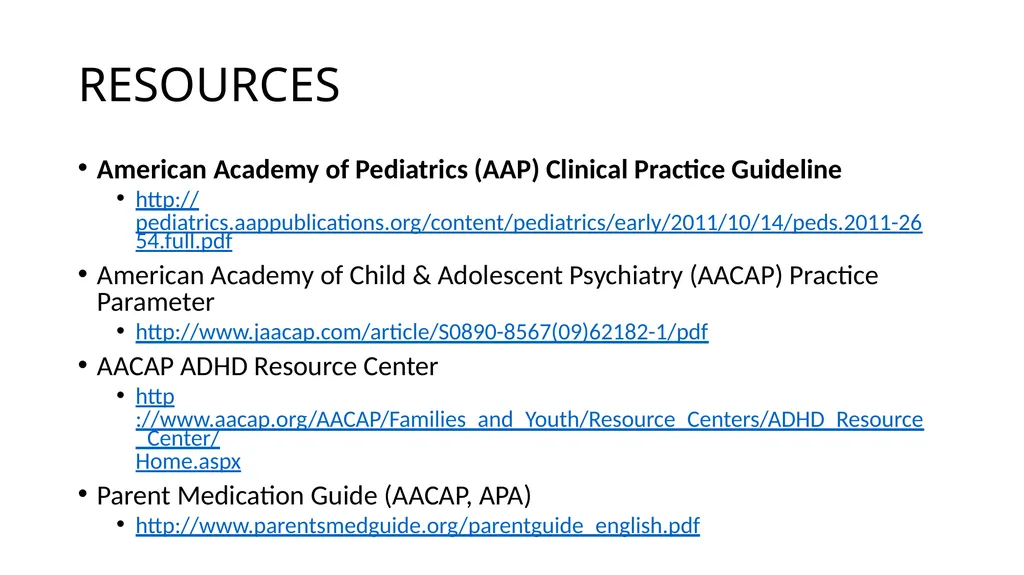
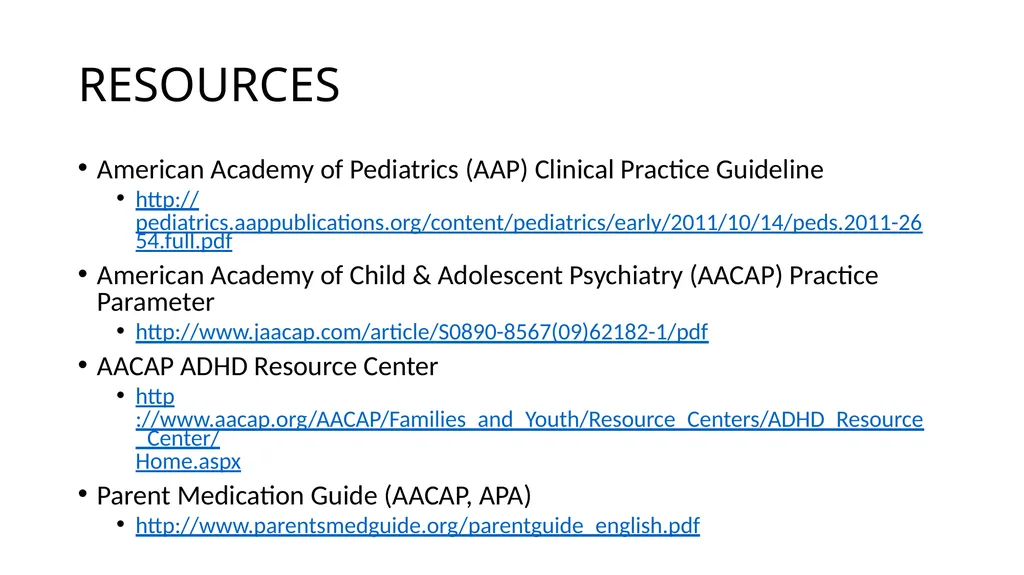
slide4. RESOURCES American Academy of Pediatrics (AAP) Clinical Practice Guideline
http://pediatrics.aappublications.org/content/pediatrics/early/2011/10/14/peds.2011-2654.full.pdf
American Academy of Child & Adolescent Psychiatry (AACAP) Practice Parameter
http://www.jaacap.com/article/S0890-8567(09)62182-1/pdf
AACAP ADHD Resource Center
http://www.aacap.org/AACAP/Families_and_Youth/Resource_Centers/ADHD_Resource_Center/Home.aspx
Parent Medication Guide (AACAP, APA)
http://www.parentsmedguide.org/parentguide_english.pdf<br>
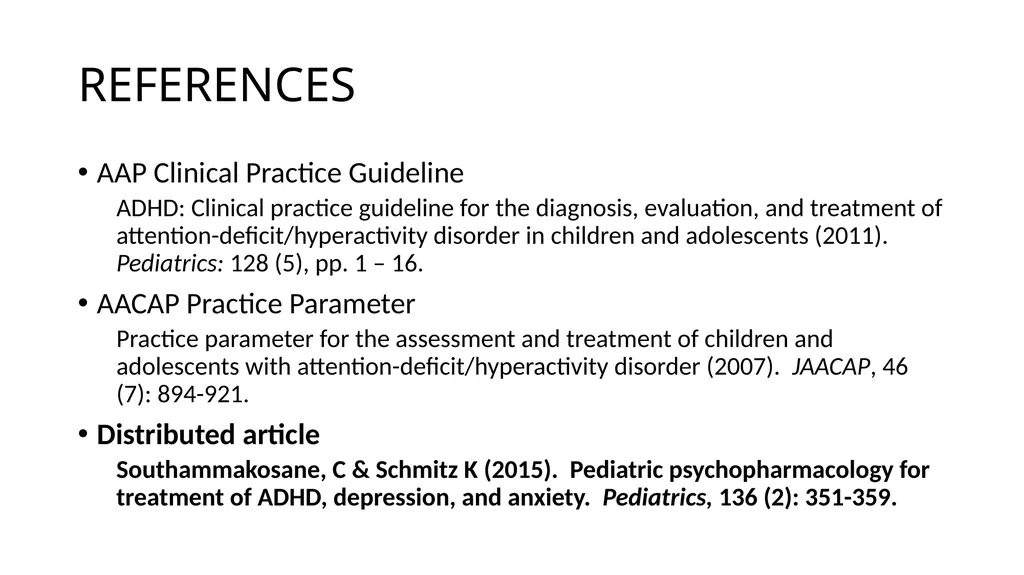
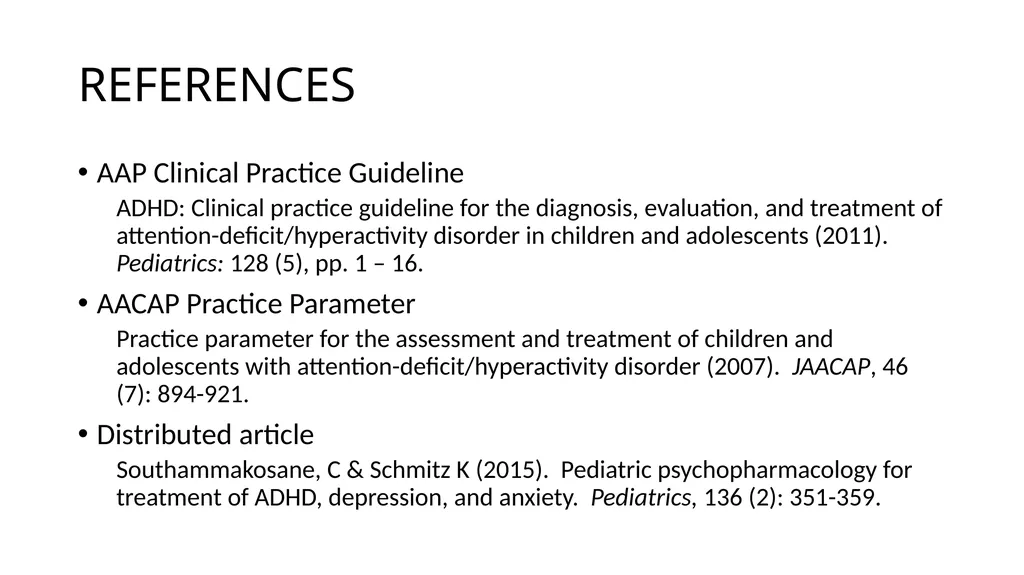
slide5. REFERENCES AAP Clinical Practice Guideline
ADHD: Clinical practice guideline for the diagnosis, evaluation, and treatment of attention-deficit/hyperactivity disorder in children and adolescents (2011). Pediatrics: 128 (5), pp. 1 – 16.
AACAP Practice Parameter
Practice parameter for the assessment and treatment of children and adolescents with attention-deficit/hyperactivity disorder (2007). JAACAP, 46 (7): 894-921.
Distributed article
Southammakosane, C & Schmitz K (2015). Pediatric psychopharmacology for treatment of ADHD, depression, and anxiety. Pediatrics, 136 (2): 351-359.<br>
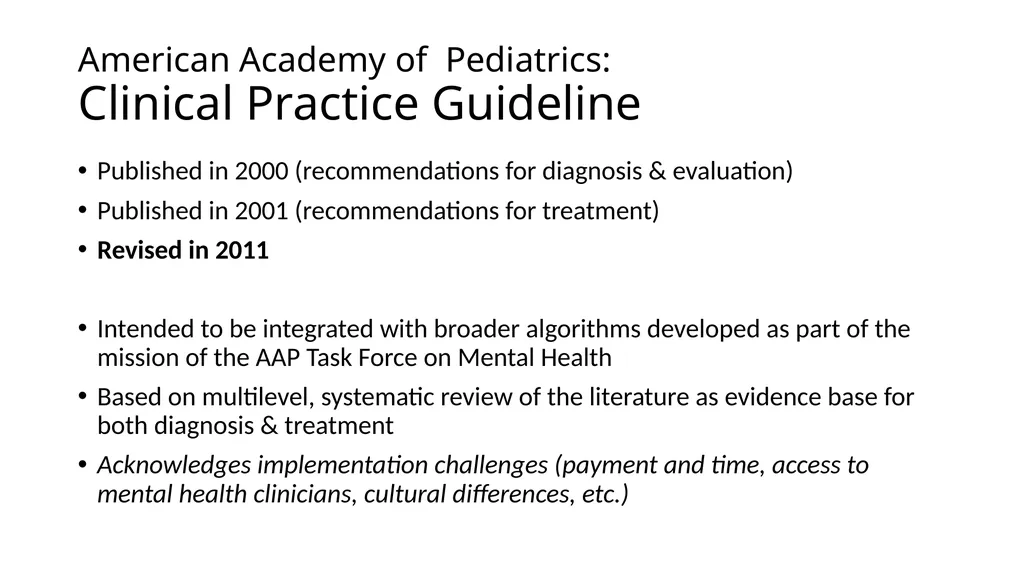
slide6. American Academy of Pediatrics: Clinical Practice Guideline Published in 2000 (recommendations for diagnosis & evaluation)
Published in 2001 (recommendations for treatment)
Revised in 2011
Intended to be integrated with broader algorithms developed as part of the mission of the AAP Task Force on Mental Health
Based on multilevel, systematic review of the literature as evidence base for both diagnosis & treatment
Acknowledges implementation challenges (payment and time, access to mental health clinicians, cultural differences, etc.)<br>
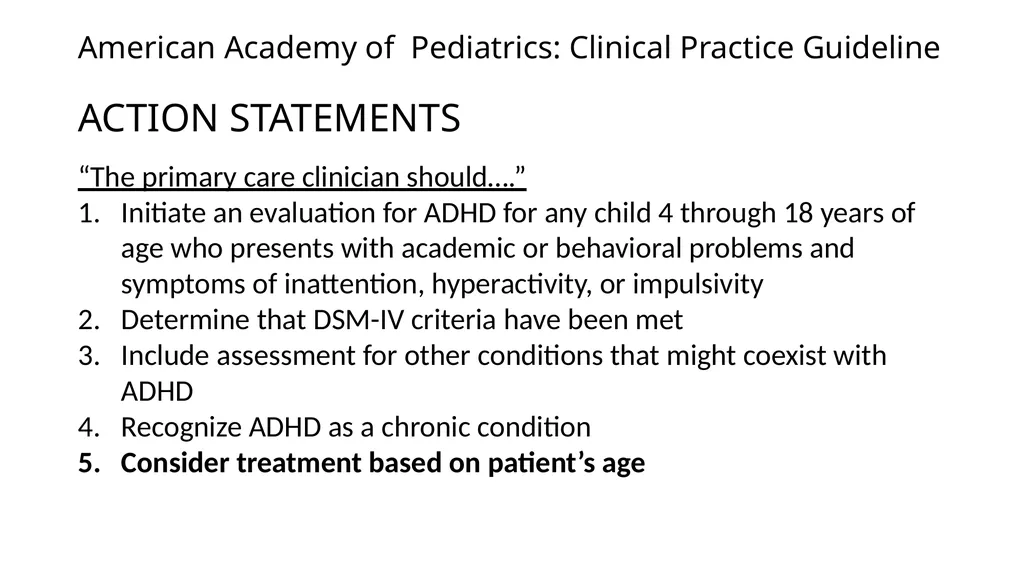
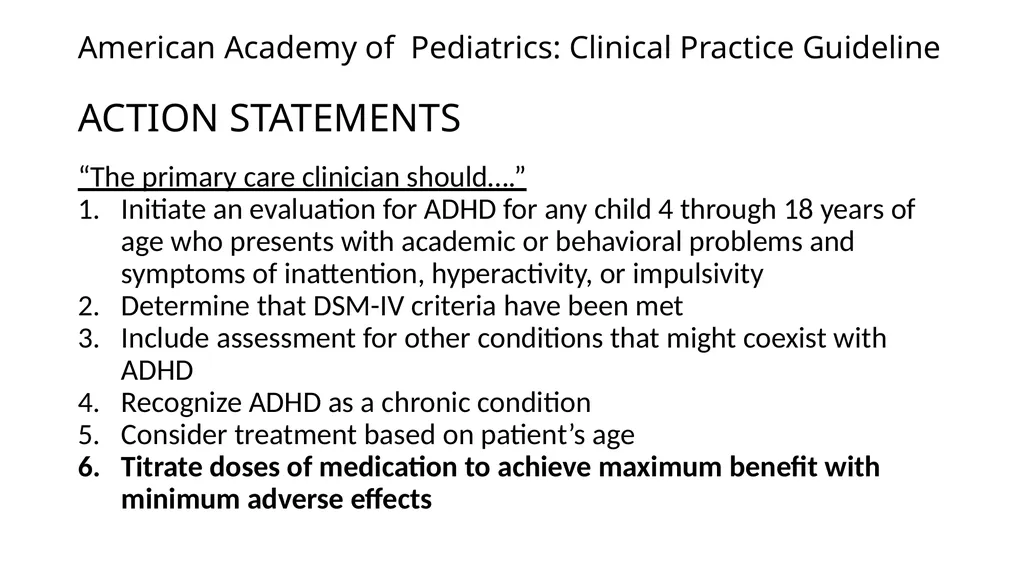
slide7. American Academy of Pediatrics: Clinical Practice Guideline ACTION STATEMENTS “The primary care clinician should….”<br>
slide8. American Academy of Pediatrics: Clinical Practice Guideline ACTION STATEMENTS “The primary care clinician should….”
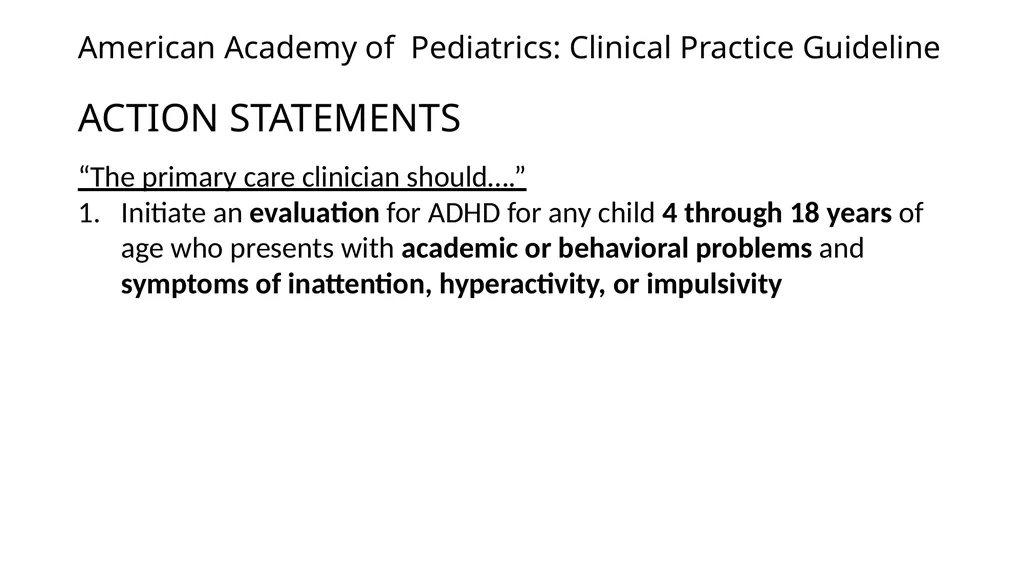
Initiate an evaluation for ADHD for any child 4 through 18 years of age who presents with academic or behavioral problems and symptoms of inattention, hyperactivity, or impulsivity<br>
slide9. American Academy of Pediatrics: Clinical Practice Guideline ACTION STATEMENTS “The primary care clinician should….”
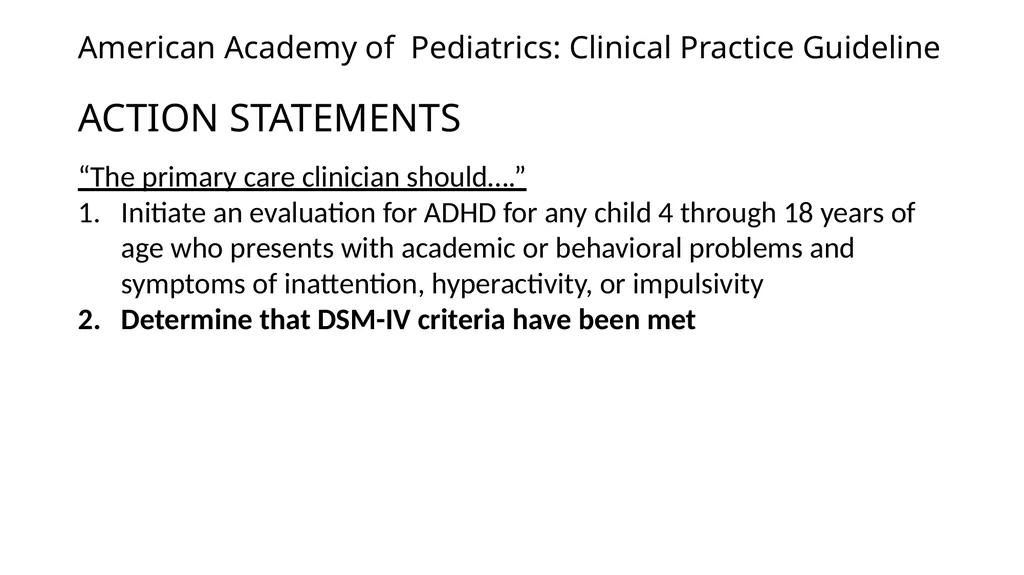
Initiate an evaluation for ADHD for any child 4 through 18 years of age who presents with academic or behavioral problems and symptoms of inattention, hyperactivity, or impulsivity
Determine that DSM-IV criteria have been met<br>
slide10. American Academy of Pediatrics: Clinical Practice Guideline ACTION STATEMENTS “The primary care clinician should….”
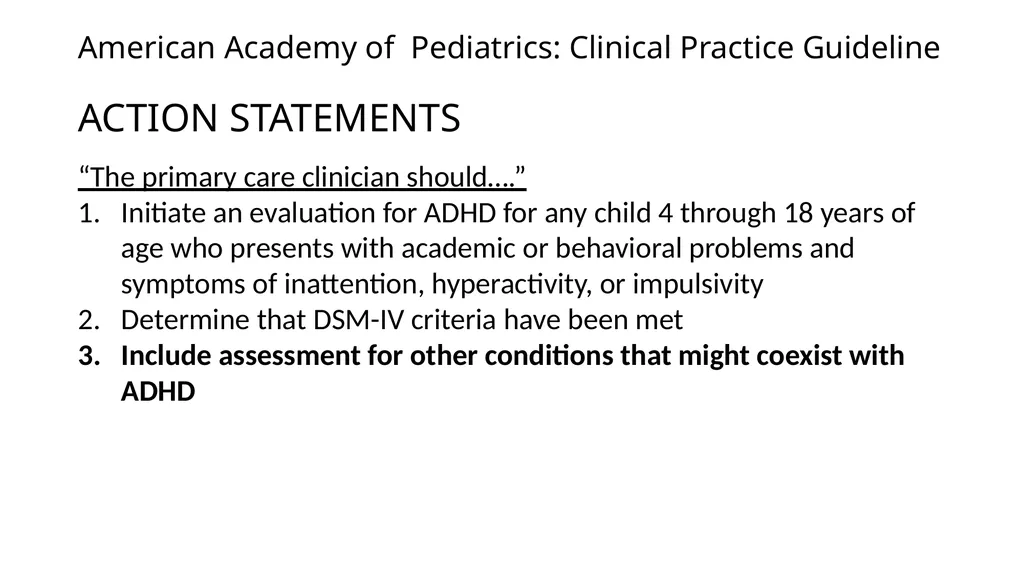
Initiate an evaluation for ADHD for any child 4 through 18 years of age who presents with academic or behavioral problems and symptoms of inattention, hyperactivity, or impulsivity
Determine that DSM-IV criteria have been met
Include assessment for other conditions that might coexist with ADHD<br>
slide11. American Academy of Pediatrics: Clinical Practice Guideline ACTION STATEMENTS “The primary care clinician should….”
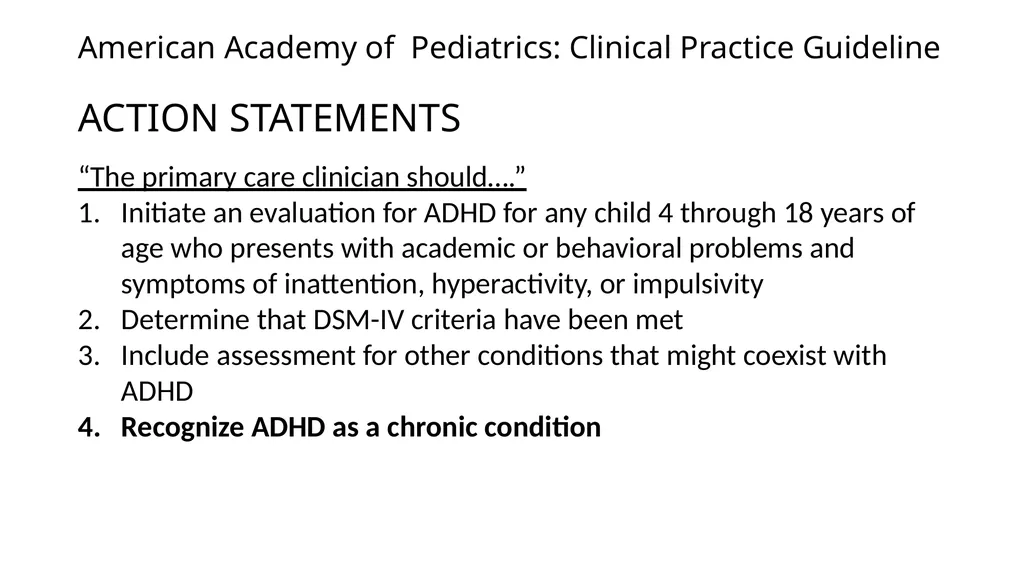
Initiate an evaluation for ADHD for any child 4 through 18 years of age who presents with academic or behavioral problems and symptoms of inattention, hyperactivity, or impulsivity
Determine that DSM-IV criteria have been met
Include assessment for other conditions that might coexist with ADHD
Recognize ADHD as a chronic condition<br>
slide12. American Academy of Pediatrics: Clinical Practice Guideline ACTION STATEMENTS “The primary care clinician should….”
Initiate an evaluation for ADHD for any child 4 through 18 years of age who presents with academic or behavioral problems and symptoms of inattention, hyperactivity, or impulsivity
Determine that DSM-IV criteria have been met
Include assessment for other conditions that might coexist with ADHD
Recognize ADHD as a chronic condition
Consider treatment based on patient’s age<br>
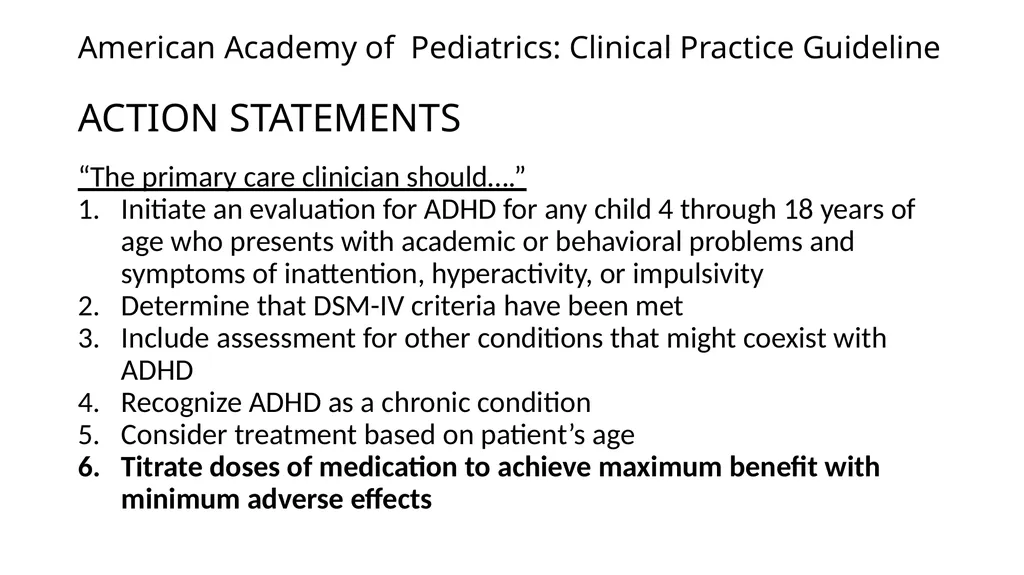
slide13. American Academy of Pediatrics: Clinical Practice Guideline ACTION STATEMENTS “The primary care clinician should….”
Initiate an evaluation for ADHD for any child 4 through 18 years of age who presents with academic or behavioral problems and symptoms of inattention, hyperactivity, or impulsivity
Determine that DSM-IV criteria have been met
Include assessment for other conditions that might coexist with ADHD
Recognize ADHD as a chronic condition
Consider treatment based on patient’s age
Titrate doses of medication to achieve maximum benefit with minimum adverse effects<br>
slide14. American Academy of Pediatrics: Clinical Practice Guideline ACTION STATEMENTS<br>
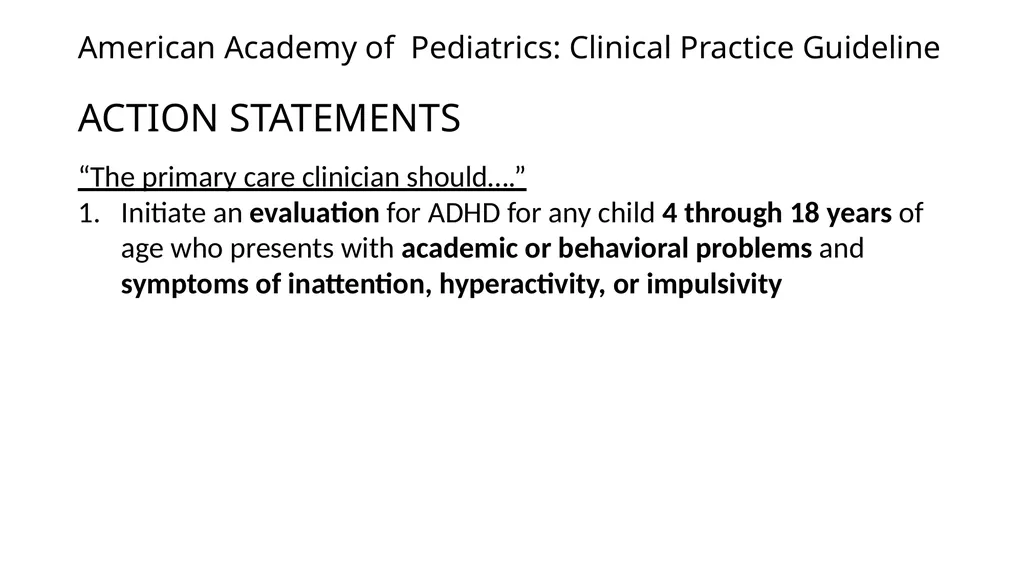
slide15. American Academy of Pediatrics: Clinical Practice Guideline ACTION STATEMENTS “The primary care clinician should….”
Initiate an evaluation for ADHD for any child 4 through 18 years of age who presents with academic or behavioral problems and symptoms of inattention, hyperactivity, or impulsivity<br>
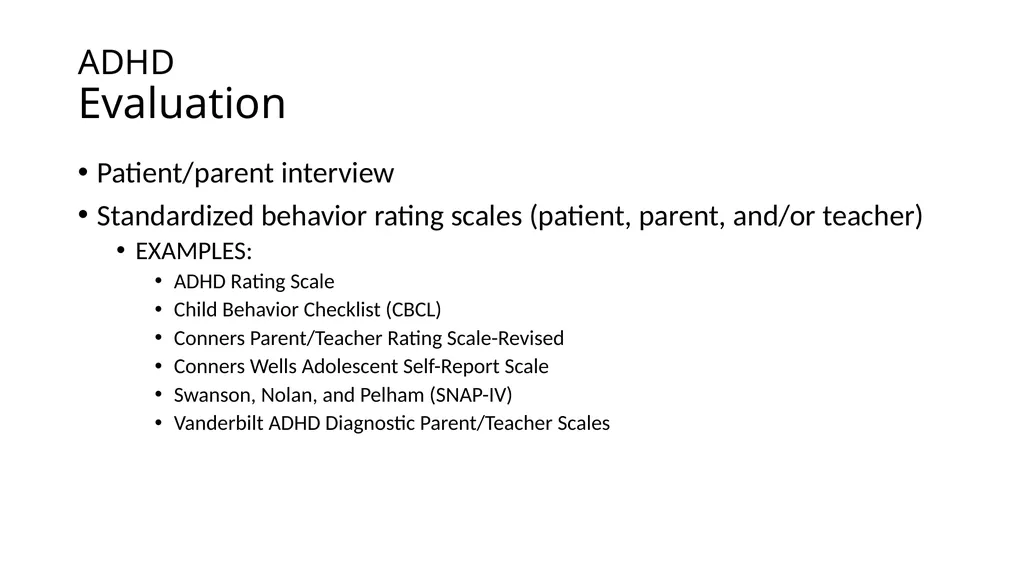
slide16. ADHD Evaluation Patient/parent interview
Standardized behavior rating scales (patient, parent, and/or teacher)
EXAMPLES:
ADHD Rating Scale
Child Behavior Checklist (CBCL)
Conners Parent/Teacher Rating Scale-Revised
Conners Wells Adolescent Self-Report Scale
Swanson, Nolan, and Pelham (SNAP-IV)
Vanderbilt ADHD Diagnostic Parent/Teacher Scales<br>
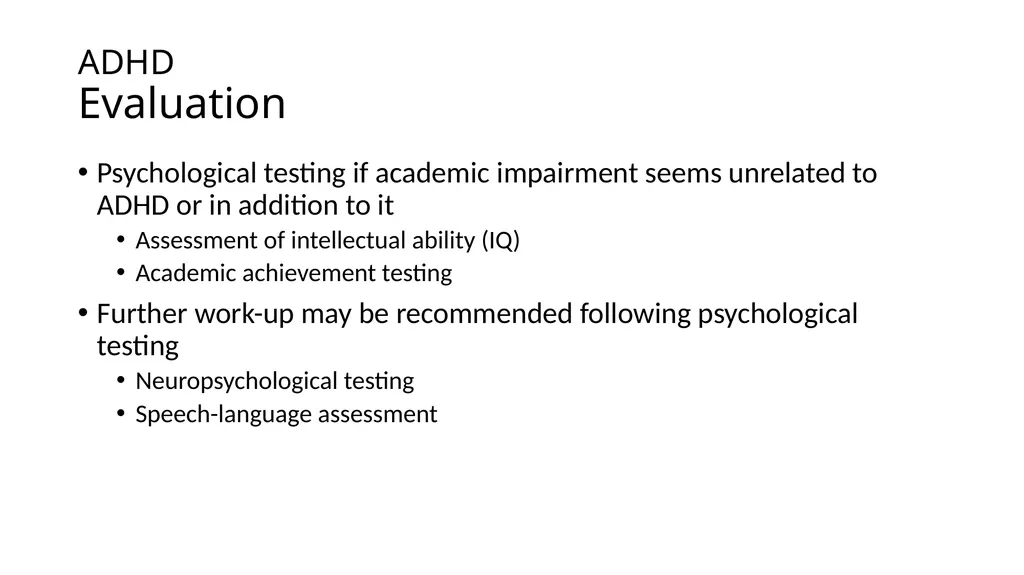
slide17. ADHD Evaluation Psychological testing if academic impairment seems unrelated to ADHD or in addition to it
Assessment of intellectual ability (IQ)
Academic achievement testing
Further work-up may be recommended following psychological testing
Neuropsychological testing
Speech-language assessment<br>
slide18. American Academy of Pediatrics: Clinical Practice Guideline ACTION STATEMENTS “The primary care clinician should….”
Initiate an evaluation for ADHD for any child 4 through 18 years of age who presents with academic or behavioral problems and symptoms of inattention, hyperactivity, or impulsivity
Determine that DSM-IV criteria have been met<br>
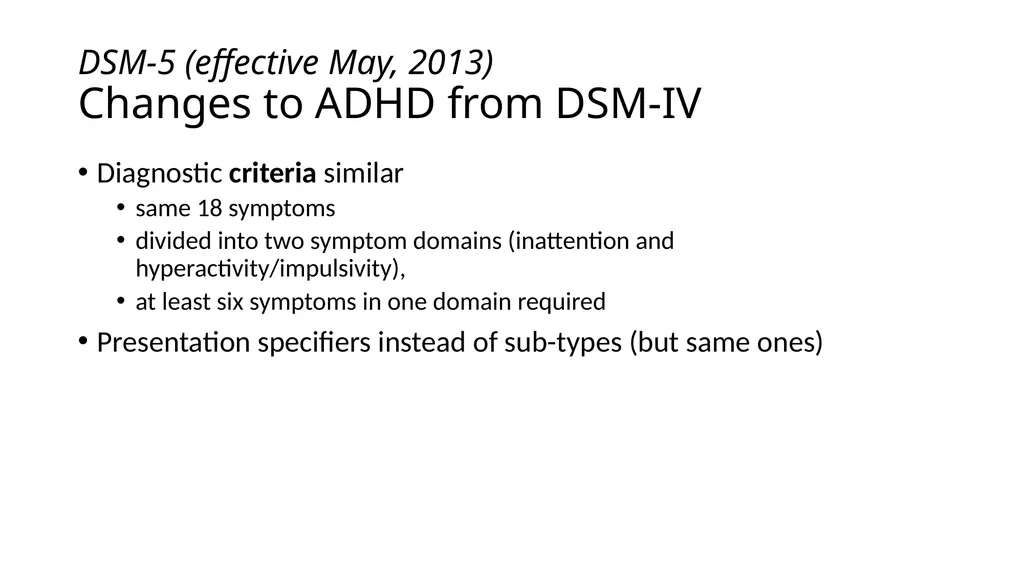
slide19. DSM-5 (effective May, 2013) Changes to ADHD from DSM-IV Diagnostic criteria similar
same 18 symptoms
divided into two symptom domains (inattention and hyperactivity/impulsivity),
at least six symptoms in one domain required
Presentation specifiers instead of sub-types (but same ones)<br>
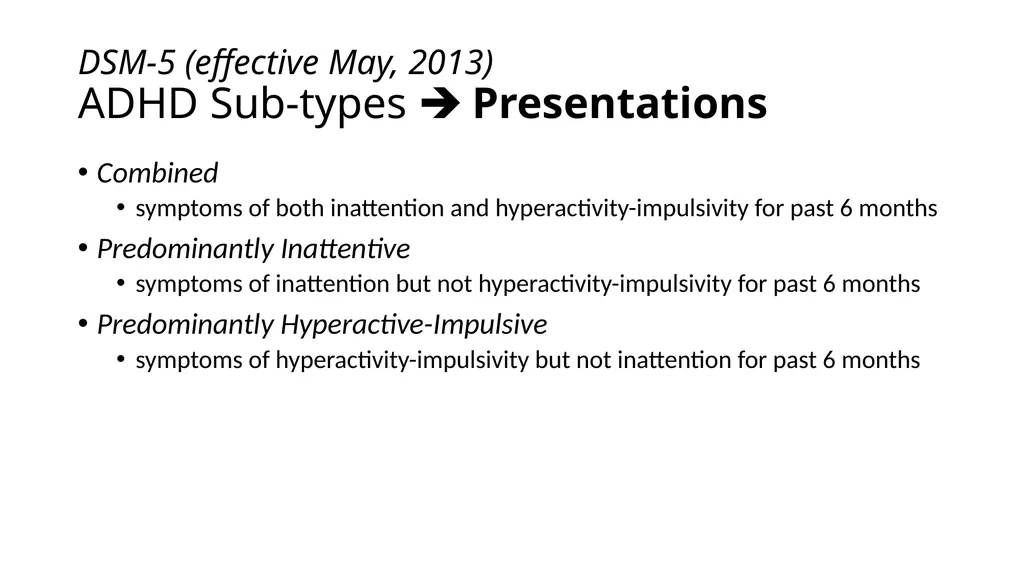
slide20. DSM-5 (effective May, 2013) ADHD Sub-types Presentations Combined
symptoms of both inattention and hyperactivity-impulsivity for past 6 months
Predominantly Inattentive
symptoms of inattention but not hyperactivity-impulsivity for past 6 months
Predominantly Hyperactive-Impulsive
symptoms of hyperactivity-impulsivity but not inattention for past 6 months<br>
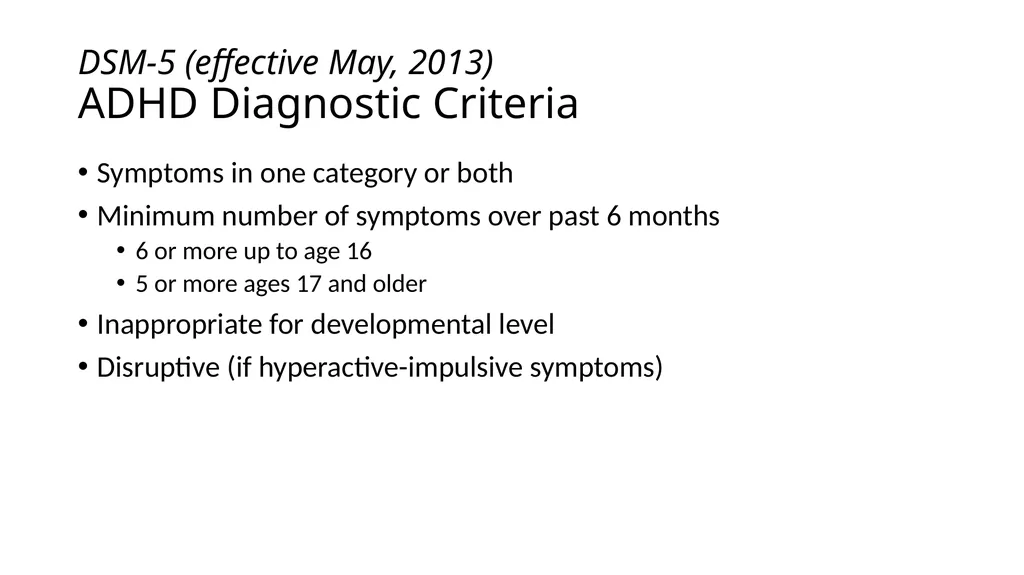
slide21. DSM-5 (effective May, 2013) ADHD Diagnostic Criteria Symptoms in one category or both
Minimum number of symptoms over past 6 months
6 or more up to age 16
5 or more ages 17 and older
Inappropriate for developmental level
Disruptive (if hyperactive-impulsive symptoms)<br>
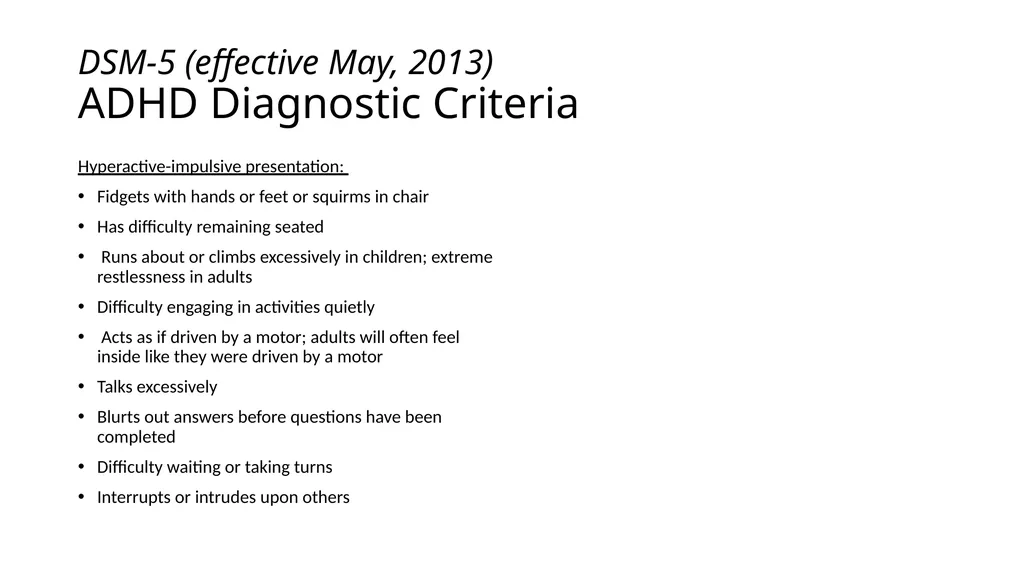
slide22. DSM-5 (effective May, 2013) ADHD Diagnostic Criteria Hyperactive-impulsive presentation:
Fidgets with hands or feet or squirms in chair
Has difficulty remaining seated
Runs about or climbs excessively in children; extreme restlessness in adults
Difficulty engaging in activities quietly
Acts as if driven by a motor; adults will often feel inside like they were driven by a motor
Talks excessively
Blurts out answers before questions have been completed
Difficulty waiting or taking turns
Interrupts or intrudes upon others<br>
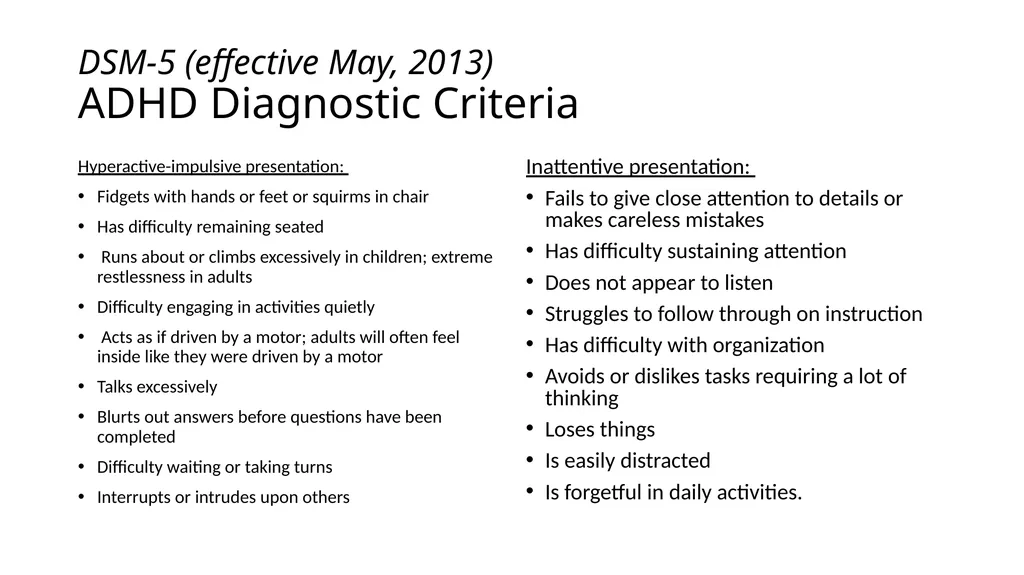
slide23. DSM-5 (effective May, 2013) ADHD Diagnostic Criteria Hyperactive-impulsive presentation:
Fidgets with hands or feet or squirms in chair
Has difficulty remaining seated
Runs about or climbs excessively in children; extreme restlessness in adults
Difficulty engaging in activities quietly
Acts as if driven by a motor; adults will often feel inside like they were driven by a motor
Talks excessively
Blurts out answers before questions have been completed
Difficulty waiting or taking turns
Interrupts or intrudes upon others Inattentive presentation:
Fails to give close attention to details or makes careless mistakes
Has difficulty sustaining attention
Does not appear to listen
Struggles to follow through on instruction
Has difficulty with organization
Avoids or dislikes tasks requiring a lot of thinking
Loses things
Is easily distracted
Is forgetful in daily activities.<br>
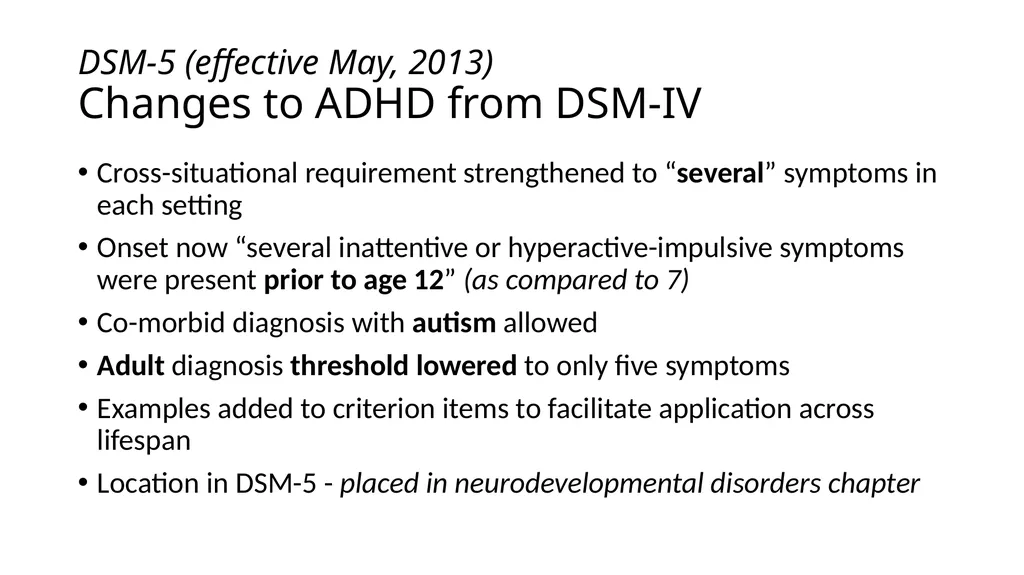
slide24. DSM-5 (effective May, 2013) Changes to ADHD from DSM-IV Cross-situational requirement strengthened to “several” symptoms in each setting
Onset now “several inattentive or hyperactive-impulsive symptoms were present prior to age 12” (as compared to 7)
Co-morbid diagnosis with autism allowed
Adult diagnosis threshold lowered to only five symptoms
Examples added to criterion items to facilitate application across lifespan
Location in DSM-5 - placed in neurodevelopmental disorders chapter<br>
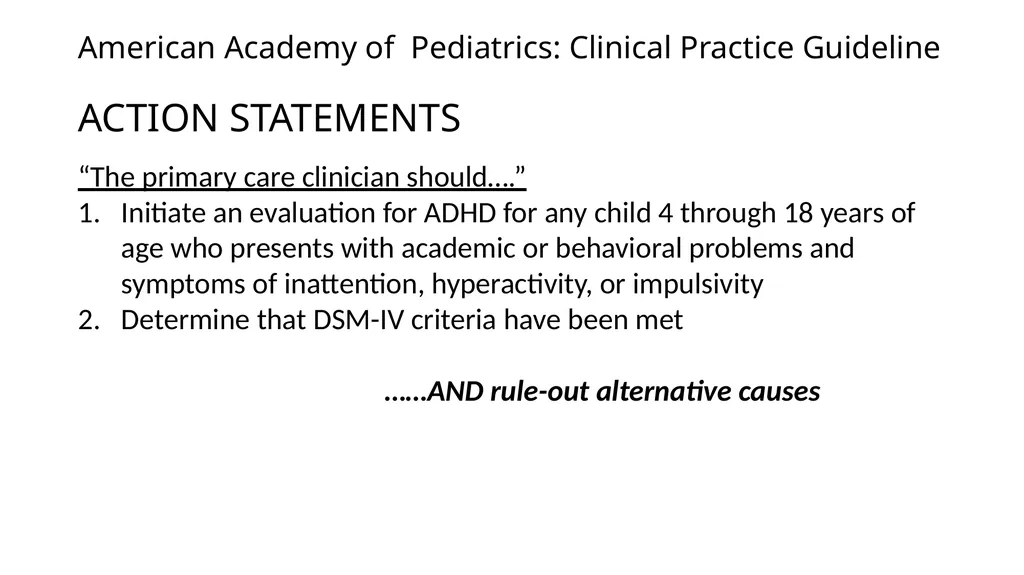
slide25. American Academy of Pediatrics: Clinical Practice Guideline ACTION STATEMENTS “The primary care clinician should….”
Initiate an evaluation for ADHD for any child 4 through 18 years of age who presents with academic or behavioral problems and symptoms of inattention, hyperactivity, or impulsivity
Determine that DSM-IV criteria have been met
……AND rule-out alternative causes<br>
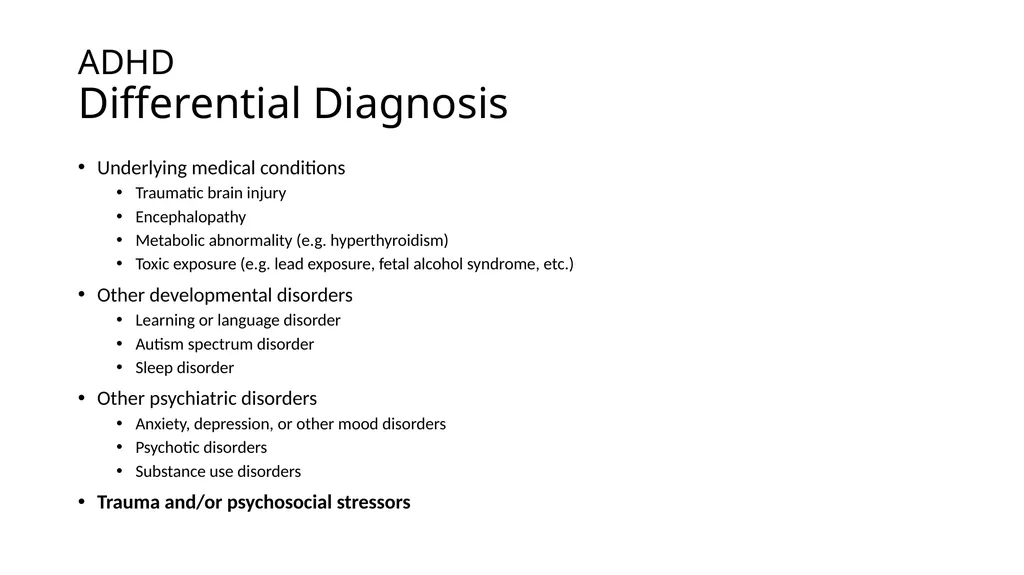
slide26. ADHD Differential Diagnosis Underlying medical conditions
Traumatic brain injury
Encephalopathy
Metabolic abnormality (e.g. hyperthyroidism)
Toxic exposure (e.g. lead exposure, fetal alcohol syndrome, etc.)
Other developmental disorders
Learning or language disorder
Autism spectrum disorder
Sleep disorder
Other psychiatric disorders
Anxiety, depression, or other mood disorders
Psychotic disorders
Substance use disorders
Trauma and/or psychosocial stressors<br>
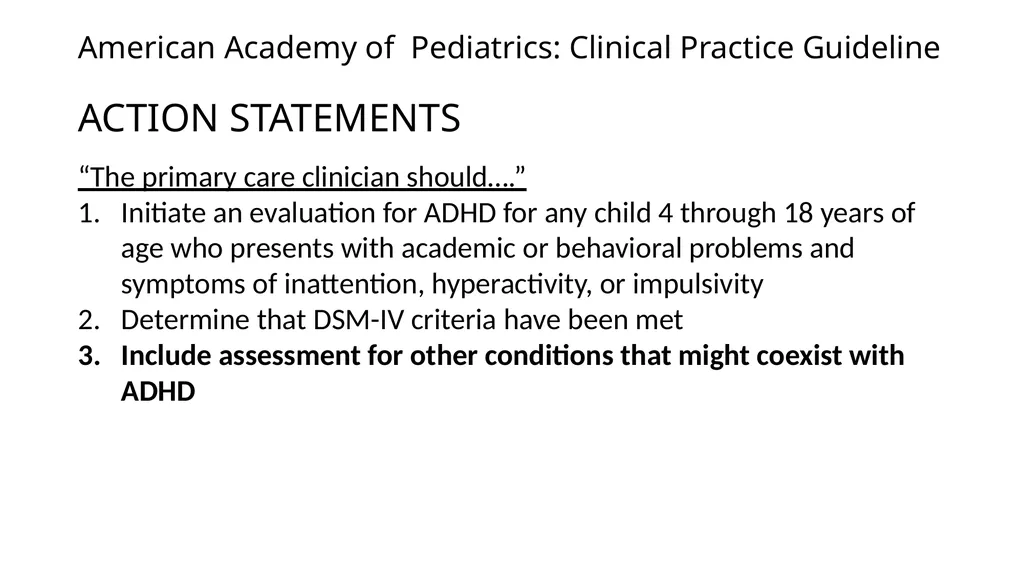
slide27. American Academy of Pediatrics: Clinical Practice Guideline ACTION STATEMENTS “The primary care clinician should….”
Initiate an evaluation for ADHD for any child 4 through 18 years of age who presents with academic or behavioral problems and symptoms of inattention, hyperactivity, or impulsivity
Determine that DSM-IV criteria have been met
Include assessment for other conditions that might coexist with ADHD<br>
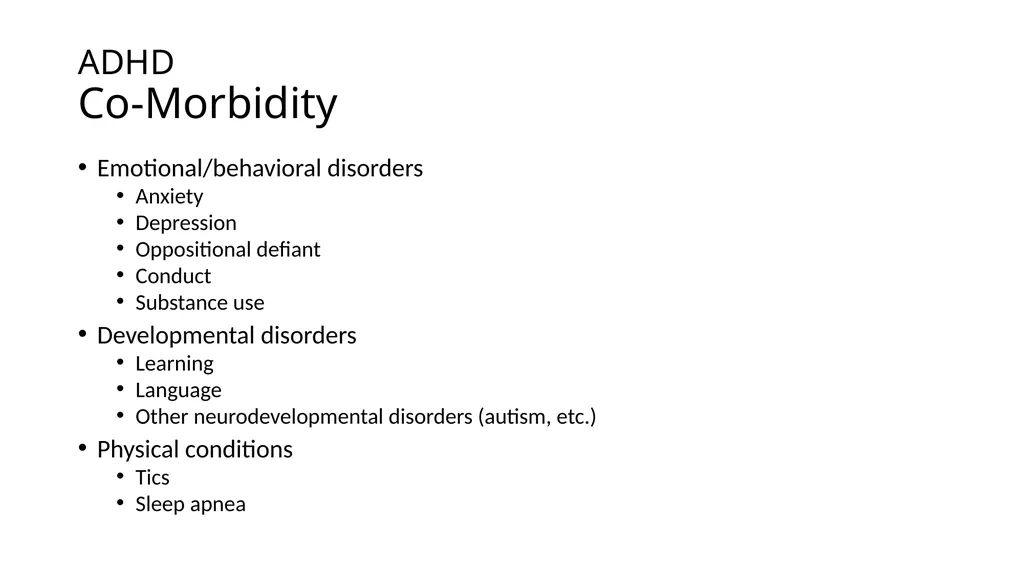
slide28. ADHD Co-Morbidity Emotional/behavioral disorders
Anxiety
Depression
Oppositional defiant
Conduct
Substance use
Developmental disorders
Learning
Language
Other neurodevelopmental disorders (autism, etc.)
Physical conditions
Tics
Sleep apnea<br>
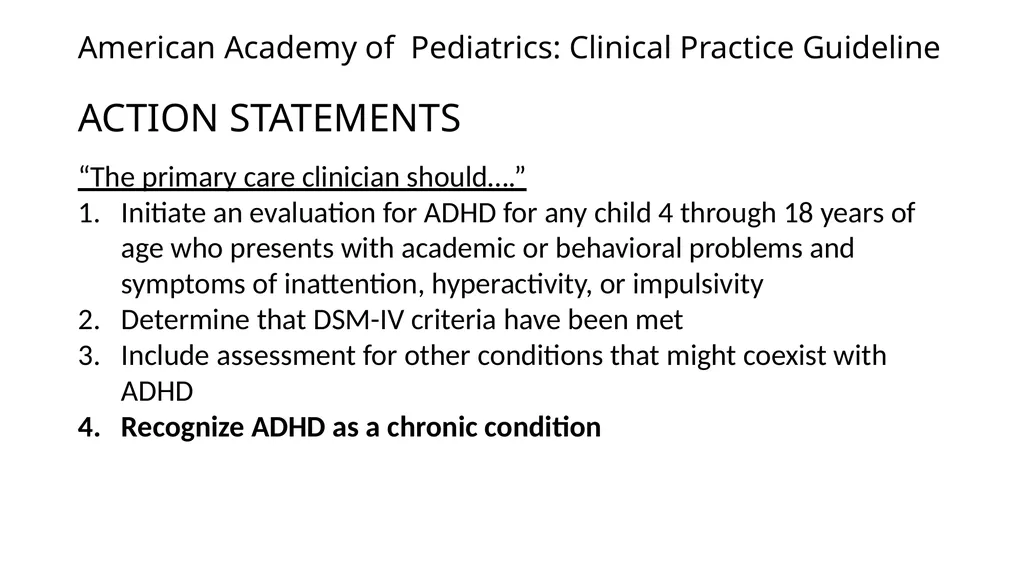
slide29. American Academy of Pediatrics: Clinical Practice Guideline ACTION STATEMENTS “The primary care clinician should….”
Initiate an evaluation for ADHD for any child 4 through 18 years of age who presents with academic or behavioral problems and symptoms of inattention, hyperactivity, or impulsivity
Determine that DSM-IV criteria have been met
Include assessment for other conditions that might coexist with ADHD
Recognize ADHD as a chronic condition<br>
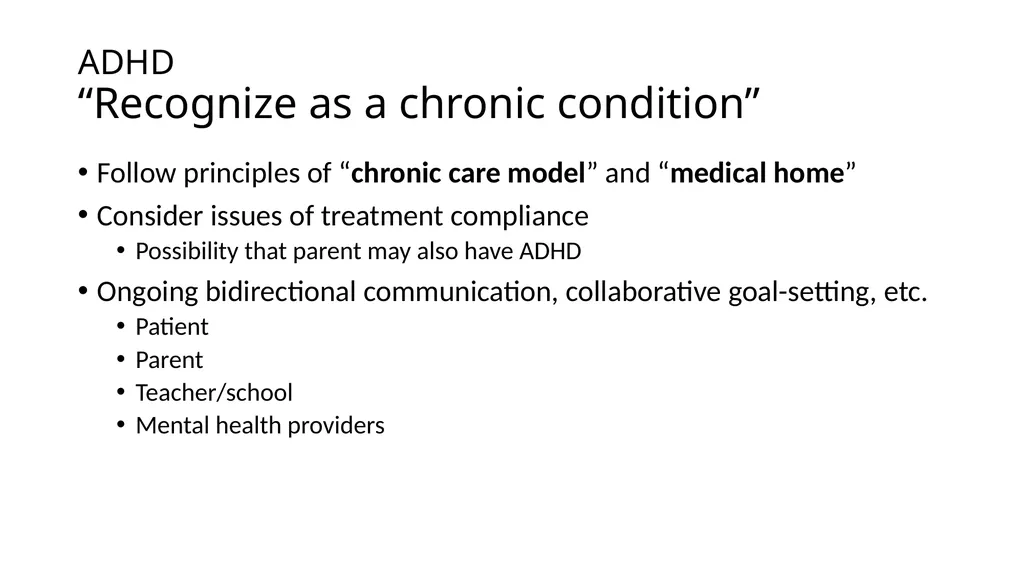
slide30. ADHD “Recognize as a chronic condition” Follow principles of “chronic care model” and “medical home”
Consider issues of treatment compliance
Possibility that parent may also have ADHD
Ongoing bidirectional communication, collaborative goal-setting, etc.
Patient
Parent
Teacher/school
Mental health providers<br>
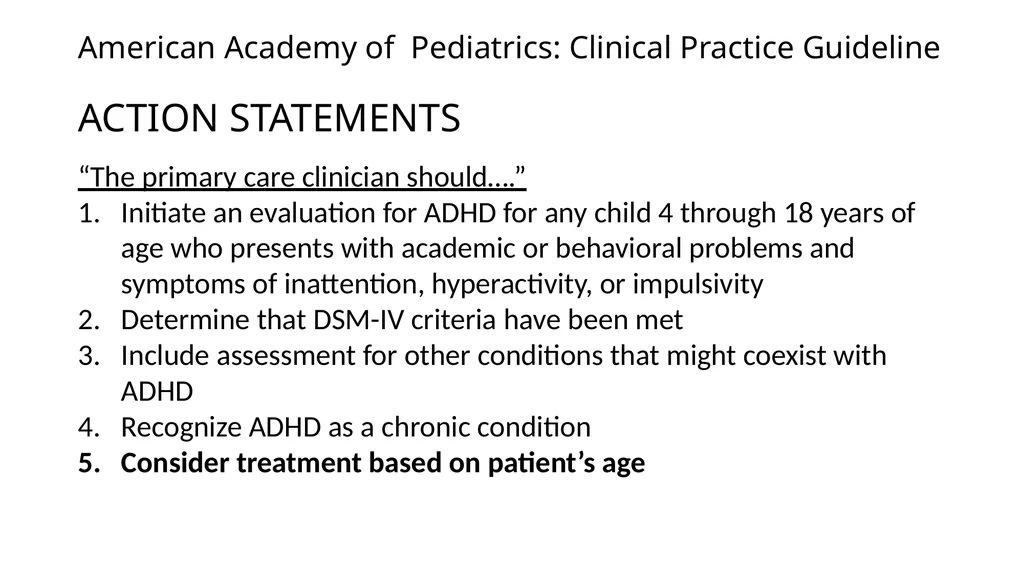
slide31. American Academy of Pediatrics: Clinical Practice Guideline ACTION STATEMENTS “The primary care clinician should….”
Initiate an evaluation for ADHD for any child 4 through 18 years of age who presents with academic or behavioral problems and symptoms of inattention, hyperactivity, or impulsivity
Determine that DSM-IV criteria have been met
Include assessment for other conditions that might coexist with ADHD
Recognize ADHD as a chronic condition
Consider treatment based on patient’s age<br>
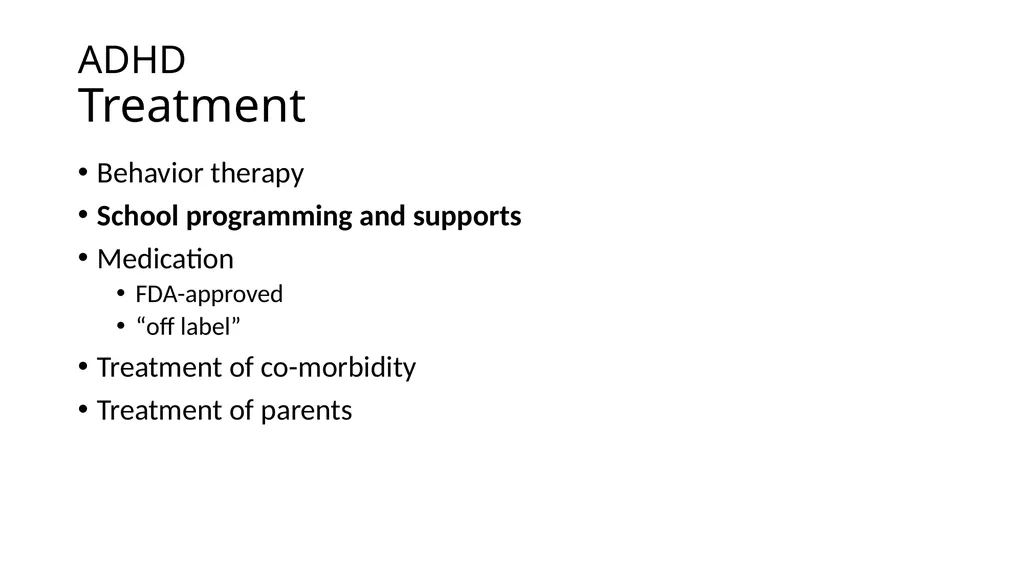
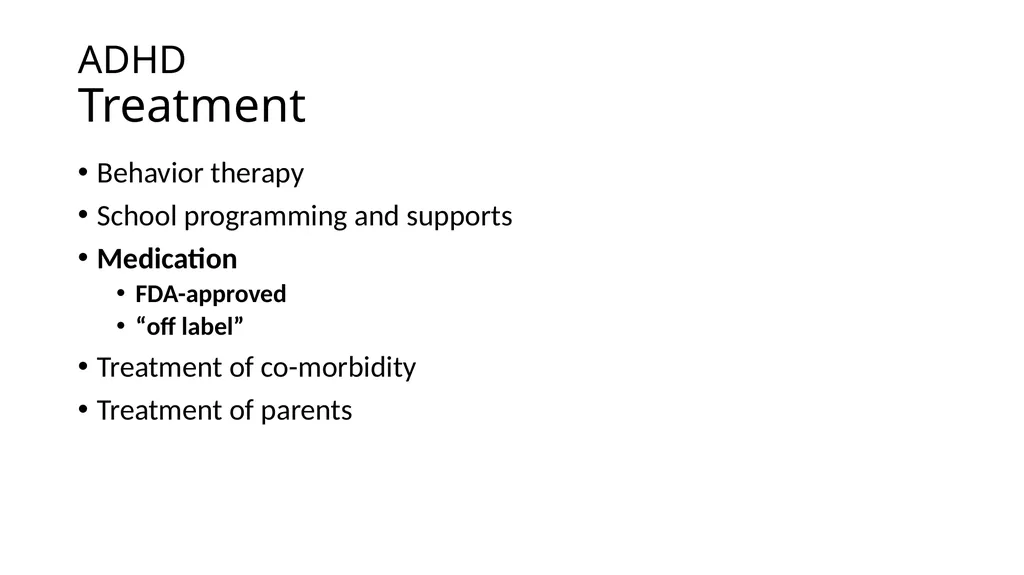
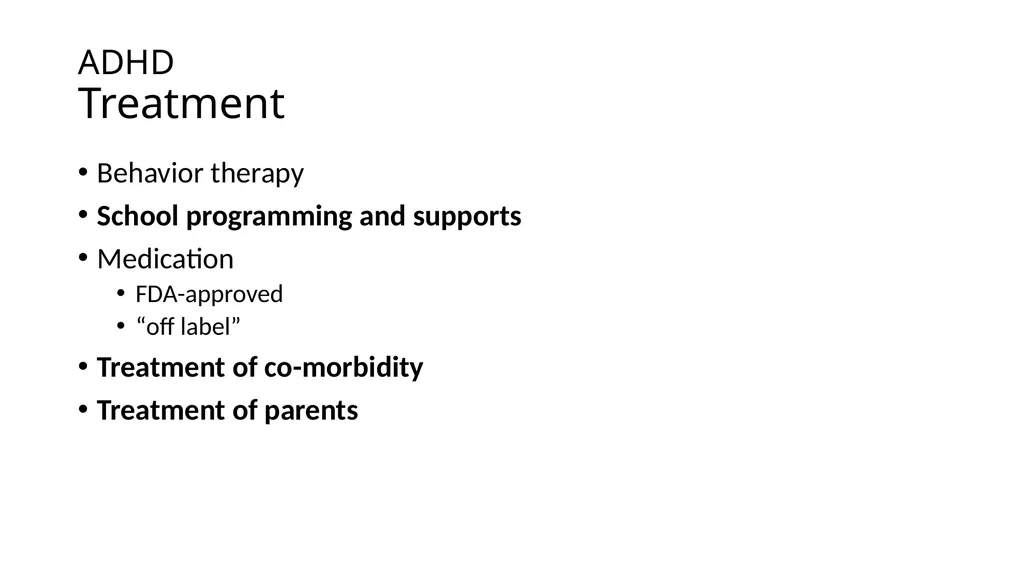
slide32. ADHD Treatment Behavior therapy
School programming and supports
Medication
FDA-approved
“off label”
Treatment of co-morbidity
Treatment of parents<br>
slide33. ADHD Treatment (varies by age) Preschool (4-5 years)
School-aged (6-11 years)
Adolescent (12 – 18 years)<br>
slide34. ADHD Treatment (varies by age) Preschool (4-5 years)
First-line treatment = evidence-based parent- and/or teacher-administrated behavior therapy
Consider medication if no significant improvement AND moderate-to-severe disturbance in function OR if benefits outweigh risks when no behavior therapy available
Best evidence for methylphenidate
FDA approval only for dextroamphetamine
Lower doses needed due to side effects
Concern for decreasing growth velocity (worst during first 2 years of treatment, total range of 1-2 cm)<br>
slide35. ADHD Treatment (varies by age) School-aged children (6-11 years)
Recommend FDA-approved medication AND evidence-based parent- and/or teacher-administered behavior therapy
Either one ok on its own
Include school program/placement as part of treatment plan<br>
slide36. ADHD Treatment (varies by age) Adolescent (12-18 years)
Recommend FDA-approved medication AND evidence-based parent- and/or teacher-administered behavior therapy
Medication alone ok
Assess for symptoms of substance abuse
Consider in making diagnosis
Consider in recommending treatment POTENTIAL FOR ABUSE/DIVERSION
Consider risks for driving when developing medication treatment plan<br>
slide37. ADHD Treatment Behavior therapy
School programming and supports
Medication
FDA-approved
“off label”
Treatment of co-morbidity
Treatment of parents<br>
slide38. ADHD Treatment Behavior therapy
School programming and supports
Medication
FDA-approved
“off label”
Treatment of co-morbidity
Treatment of parents<br>
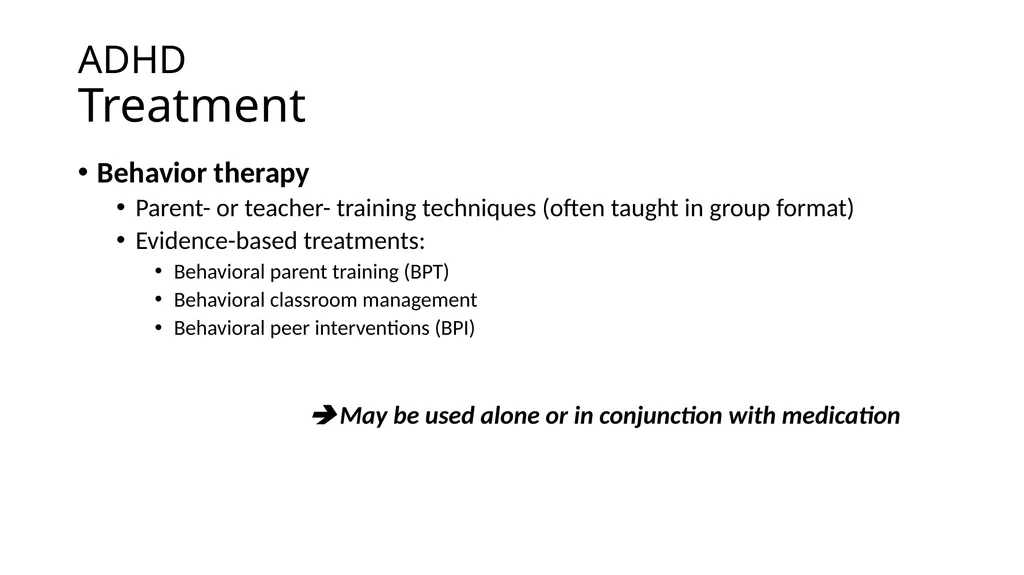
slide39. ADHD Treatment Behavior therapy
Parent- or teacher- training techniques (often taught in group format)
Evidence-based treatments:
Behavioral parent training (BPT)
Behavioral classroom management
Behavioral peer interventions (BPI)
May be used alone or in conjunction with medication<br>
slide40. ADHD Treatment Behavior therapy
School programming and supports
Medication
FDA-approved
“off label”
Treatment of co-morbidity
Treatment of parents<br>
slide41. ADHD Treatment Behavior therapy
School programming and supports
Medication
FDA-approved
“off label”
Treatment of co-morbidity
Treatment of parents<br>
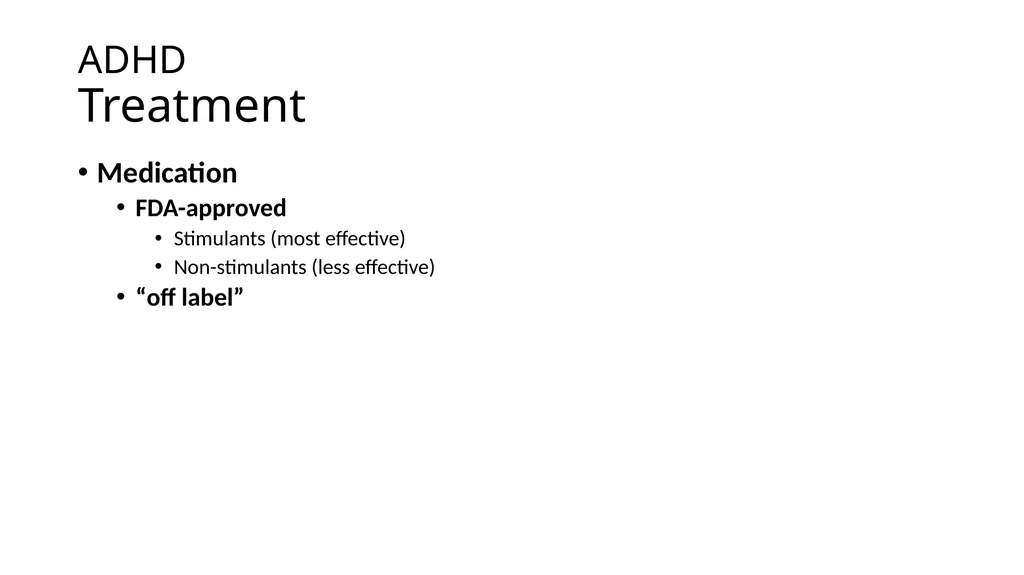
slide42. ADHD Treatment Medication
FDA-approved
Stimulants (most effective)
Non-stimulants (less effective)
“off label”<br>
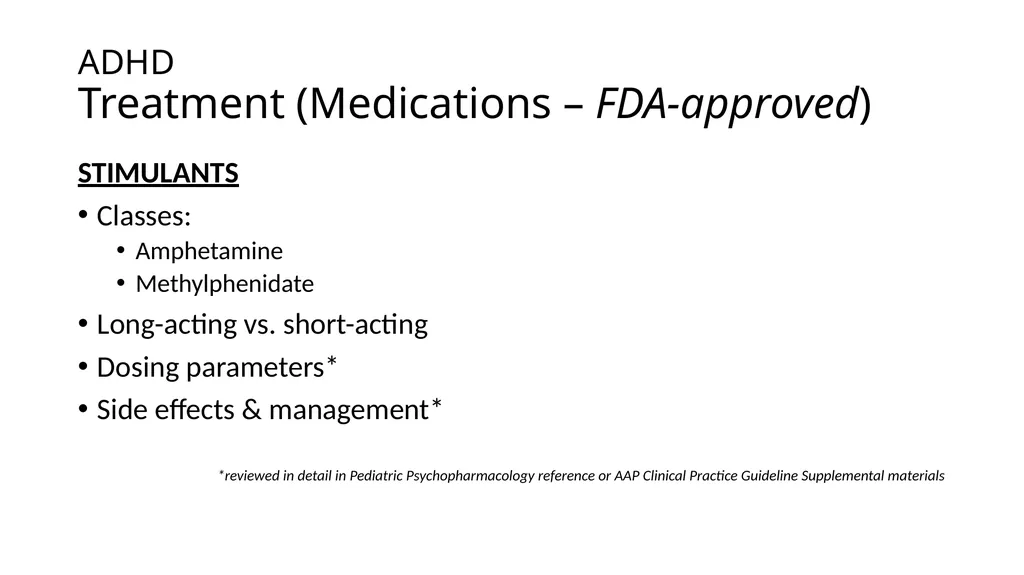
slide43. ADHD Treatment (Medications – FDA-approved) STIMULANTS
Classes:
Amphetamine
Methylphenidate
Long-acting vs. short-acting
Dosing parameters*
Side effects & management*
*reviewed in detail in Pediatric Psychopharmacology reference or AAP Clinical Practice Guideline Supplemental materials<br>
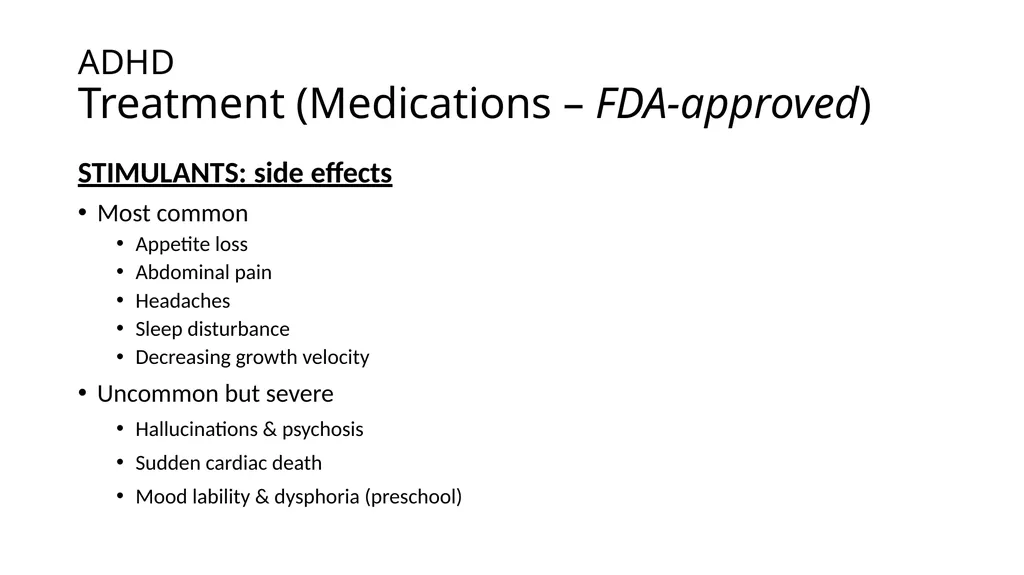
slide44. ADHD Treatment (Medications – FDA-approved) STIMULANTS: side effects
Most common
Appetite loss
Abdominal pain
Headaches
Sleep disturbance
Decreasing growth velocity
Uncommon but severe
Hallucinations & psychosis
Sudden cardiac death
Mood lability & dysphoria (preschool)<br>
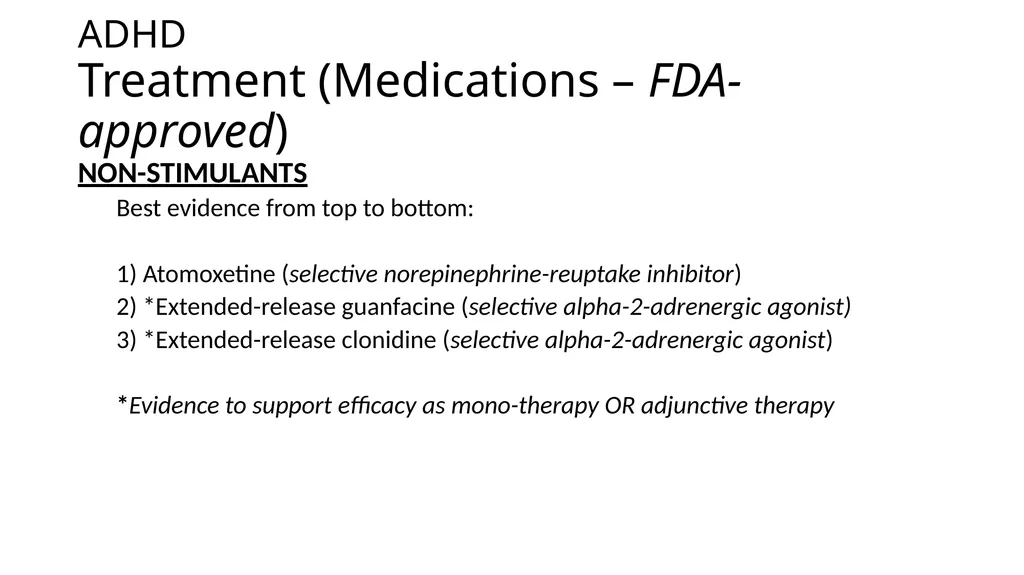
slide45. ADHD Treatment (Medications – FDA-approved) NON-STIMULANTS
Best evidence from top to bottom:
1) Atomoxetine (selective norepinephrine-reuptake inhibitor)
2) *Extended-release guanfacine (selective alpha-2-adrenergic agonist)
3) *Extended-release clonidine (selective alpha-2-adrenergic agonist)
*Evidence to support efficacy as mono-therapy OR adjunctive therapy<br>
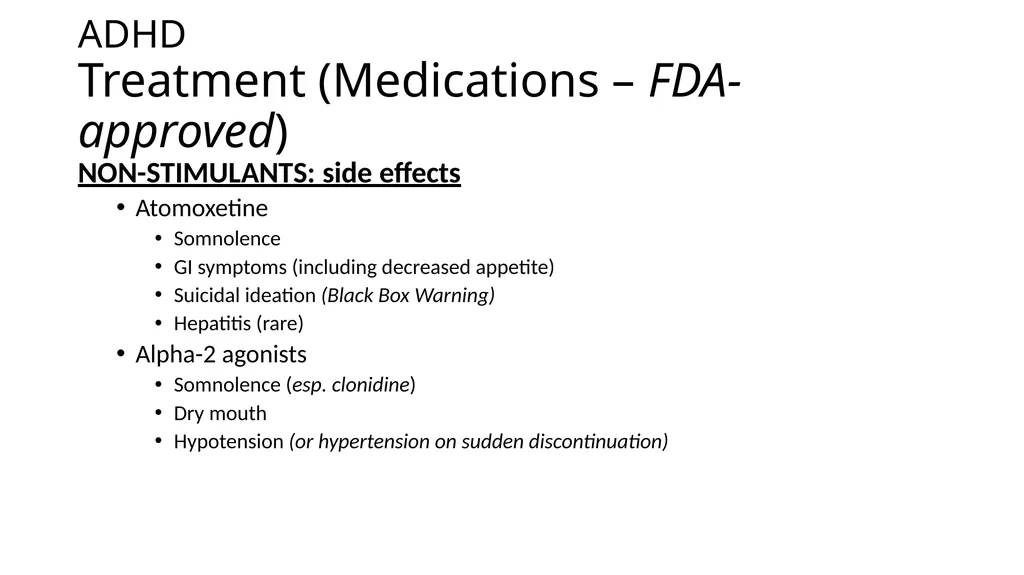
slide46. ADHD Treatment (Medications – FDA-approved) NON-STIMULANTS: side effects
Atomoxetine
Somnolence
GI symptoms (including decreased appetite)
Suicidal ideation (Black Box Warning)
Hepatitis (rare)
Alpha-2 agonists
Somnolence (esp. clonidine)
Dry mouth
Hypotension (or hypertension on sudden discontinuation)<br>
slide47. ADHD Treatment Behavior therapy
School programming and supports
Medication
FDA-approved
“off label”
Treatment of co-morbidity
Treatment of parents<br>
slide48. American Academy of Pediatrics: Clinical Practice Guideline ACTION STATEMENTS “The primary care clinician should….”
Initiate an evaluation for ADHD for any child 4 through 18 years of age who presents with academic or behavioral problems and symptoms of inattention, hyperactivity, or impulsivity
Determine that DSM-IV criteria have been met
Include assessment for other conditions that might coexist with ADHD
Recognize ADHD as a chronic condition
Consider treatment based on patient’s age
Titrate doses of medication to achieve maximum benefit with minimum adverse effects<br>
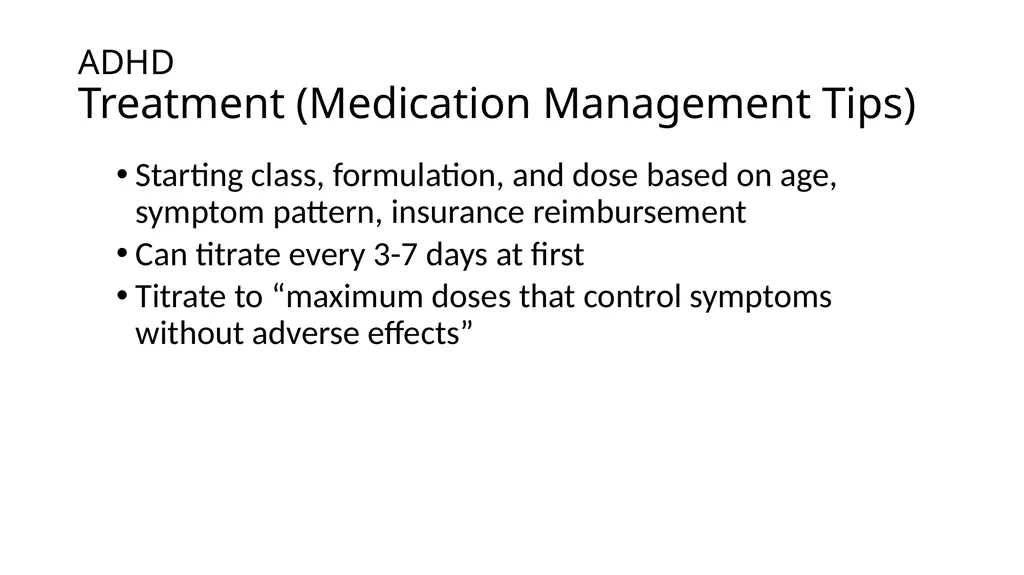
slide49. ADHD Treatment (Medication Management Tips) Starting class, formulation, and dose based on age, symptom pattern, insurance reimbursement
Can titrate every 3-7 days at first
Titrate to “maximum doses that control symptoms without adverse effects”<br>
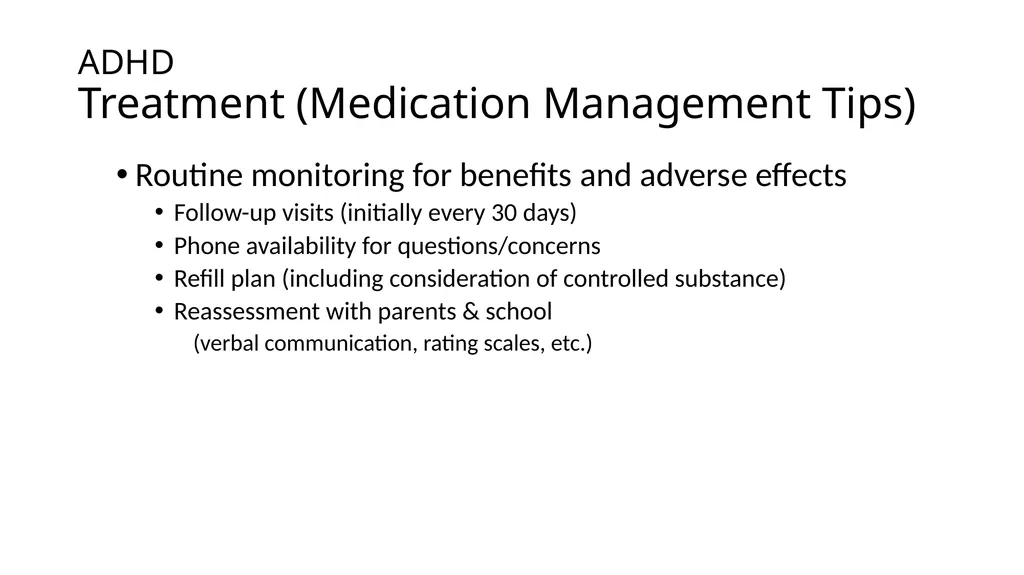
slide50. ADHD Treatment (Medication Management Tips) Routine monitoring for benefits and adverse effects
Follow-up visits (initially every 30 days)
Phone availability for questions/concerns
Refill plan (including consideration of controlled substance)
Reassessment with parents & school
(verbal communication, rating scales, etc.)<br>
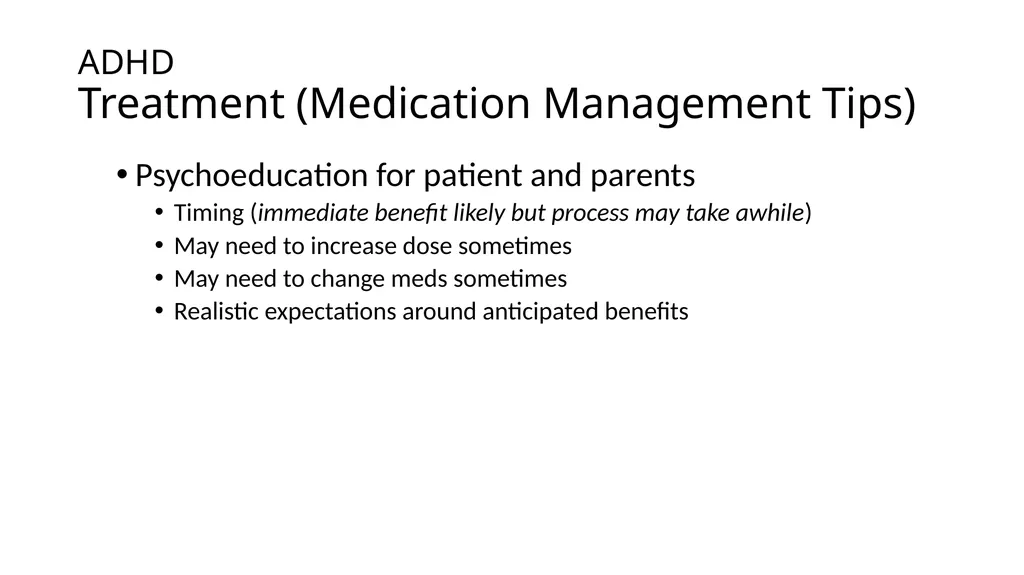
slide51. ADHD Treatment (Medication Management Tips) Psychoeducation for patient and parents
Timing (immediate benefit likely but process may take awhile)
May need to increase dose sometimes
May need to change meds sometimes
Realistic expectations around anticipated benefits<br>
slide52. RESOURCES American Academy of Pediatrics (AAP) Clinical Practice Guideline
http://pediatrics.aappublications.org/content/pediatrics/early/2011/10/14/peds.2011-2654.full.pdf
American Academy of Child & Adolescent Psychiatry (AACAP) Practice Parameter
http://www.jaacap.com/article/S0890-8567(09)62182-1/pdf
AACAP ADHD Resource Center
http://www.aacap.org/AACAP/Families_and_Youth/Resource_Centers/ADHD_Resource_Center/Home.aspx
Parent Medication Guide (AACAP, APA)
http://www.parentsmedguide.org/parentguide_english.pdf<br>
slide53. REFERENCES AAP Clinical Practice Guideline
ADHD: Clinical practice guideline for the diagnosis, evaluation, and treatment of attention-deficit/hyperactivity disorder in children and adolescents (2011). Pediatrics: 128 (5), pp. 1 – 16.
AACAP Practice Parameter
Practice parameter for the assessment and treatment of children and adolescents with attention-deficit/hyperactivity disorder (2007). JAACAP, 46 (7): 894-921.
Distributed article
Southammakosane, C & Schmitz K (2015). Pediatric psychopharmacology for treatment of ADHD, depression, and anxiety. Pediatrics, 136 (2): 351-359.<br>
slide54. Case Presentation & Panel Discussion<br>
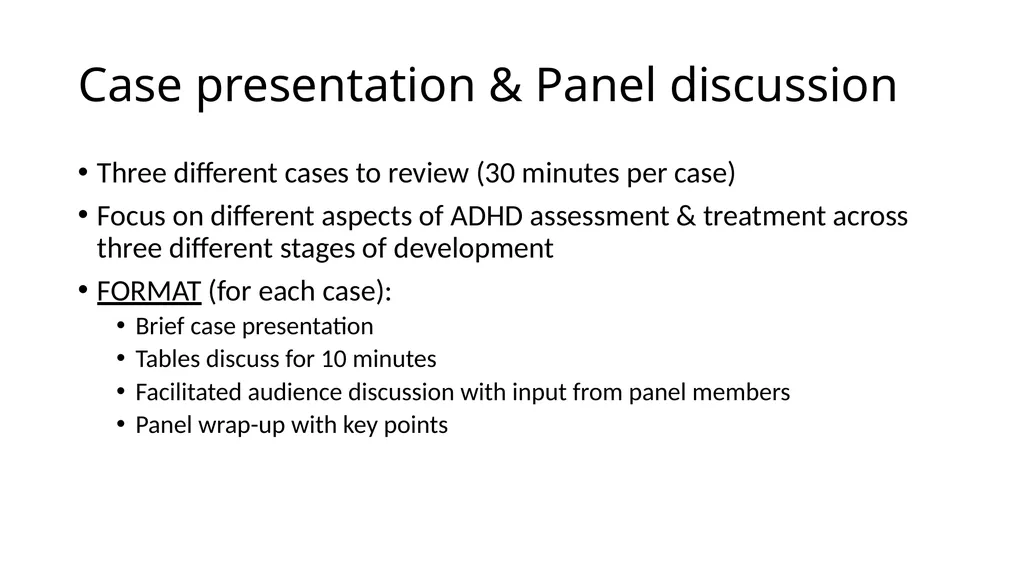
slide55. Case presentation & Panel discussion Three different cases to review (30 minutes per case)
Focus on different aspects of ADHD assessment & treatment across three different stages of development
FORMAT (for each case):
Brief case presentation
Tables discuss for 10 minutes
Facilitated audience discussion with input from panel members
Panel wrap-up with key points<br>
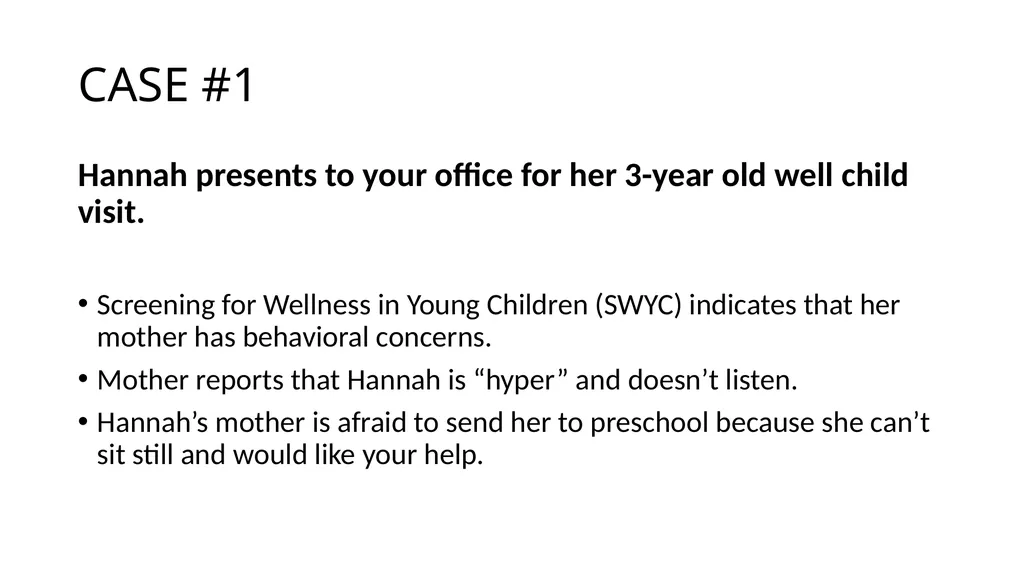
slide56. CASE #1 Hannah presents to your office for her 3-year old well child visit.
Screening for Wellness in Young Children (SWYC) indicates that her mother has behavioral concerns.
Mother reports that Hannah is “hyper” and doesn’t listen.
Hannah’s mother is afraid to send her to preschool because she can’t sit still and would like your help.<br>
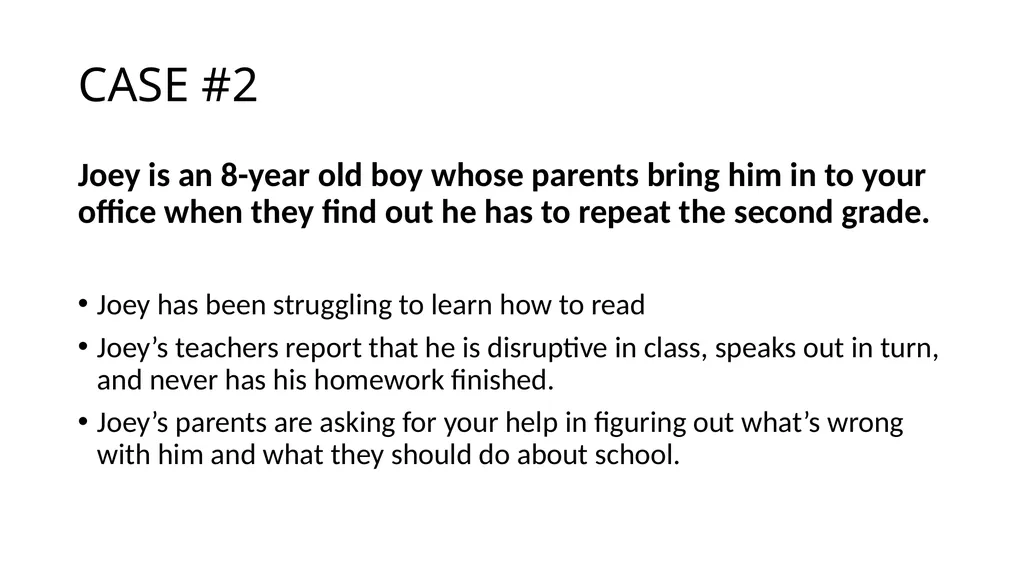
slide57. CASE #2 Joey is an 8-year old boy whose parents bring him in to your office when they find out he has to repeat the second grade.
Joey has been struggling to learn how to read
Joey’s teachers report that he is disruptive in class, speaks out in turn, and never has his homework finished.
Joey’s parents are asking for your help in figuring out what’s wrong with him and what they should do about school.<br>
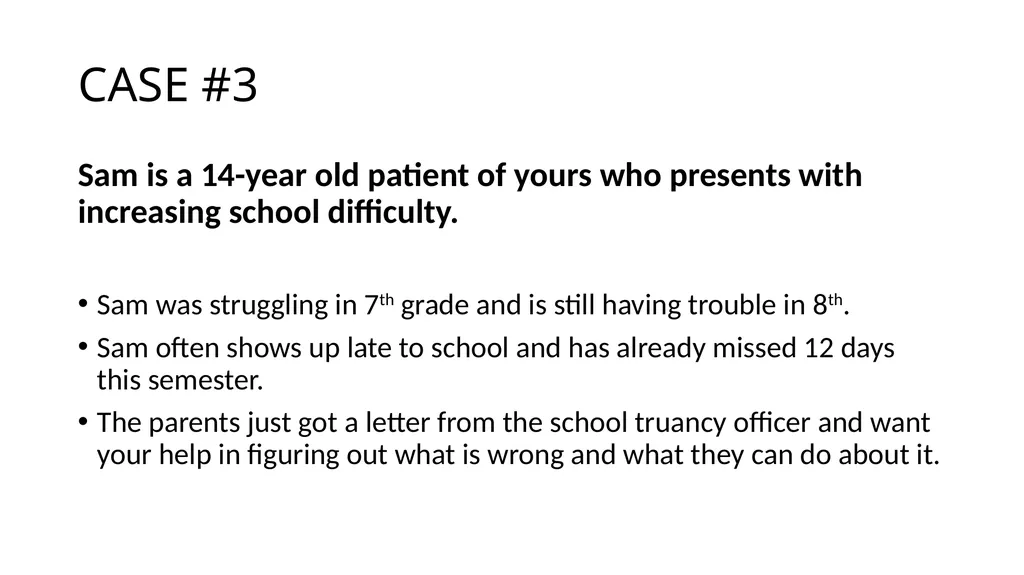
slide58. CASE #3 Sam is a 14-year old patient of yours who presents with increasing school difficulty.
Sam was struggling in 7th grade and is still having trouble in 8th.
Sam often shows up late to school and has already missed 12 days this semester.
The parents just got a letter from the school truancy officer and want your help in figuring out what is wrong and what they can do about it.<br>
PCMH-Kids Behavioral Health Learning Collaborative April 27, 2016<br>
slide2. DISCLOSURE The commercial entities with which I/we have relationships do not produce health-care related products or services relevant to the content I am presenting.
This presentation does include discussion of medication use which is “off-label”, which I will identify as such.<br>
slide3. GOALS To provide resources and references for providers, patients, and their families;
To review the clinical practice guidelines/(parameters) established by the American Academy of Pediatrics (and American Academy of Child & Adolescent Psychiatry) for the assessment and treatment of attention-deficit/hyperactivity disorder; and
To set the scene for more in-depth case discussion to follow.<br>
slide4. RESOURCES American Academy of Pediatrics (AAP) Clinical Practice Guideline
http://pediatrics.aappublications.org/content/pediatrics/early/2011/10/14/peds.2011-2654.full.pdf
American Academy of Child & Adolescent Psychiatry (AACAP) Practice Parameter
http://www.jaacap.com/article/S0890-8567(09)62182-1/pdf
AACAP ADHD Resource Center
http://www.aacap.org/AACAP/Families_and_Youth/Resource_Centers/ADHD_Resource_Center/Home.aspx
Parent Medication Guide (AACAP, APA)
http://www.parentsmedguide.org/parentguide_english.pdf<br>
slide5. REFERENCES AAP Clinical Practice Guideline
ADHD: Clinical practice guideline for the diagnosis, evaluation, and treatment of attention-deficit/hyperactivity disorder in children and adolescents (2011). Pediatrics: 128 (5), pp. 1 – 16.
AACAP Practice Parameter
Practice parameter for the assessment and treatment of children and adolescents with attention-deficit/hyperactivity disorder (2007). JAACAP, 46 (7): 894-921.
Distributed article
Southammakosane, C & Schmitz K (2015). Pediatric psychopharmacology for treatment of ADHD, depression, and anxiety. Pediatrics, 136 (2): 351-359.<br>
slide6. American Academy of Pediatrics: Clinical Practice Guideline Published in 2000 (recommendations for diagnosis & evaluation)
Published in 2001 (recommendations for treatment)
Revised in 2011
Intended to be integrated with broader algorithms developed as part of the mission of the AAP Task Force on Mental Health
Based on multilevel, systematic review of the literature as evidence base for both diagnosis & treatment
Acknowledges implementation challenges (payment and time, access to mental health clinicians, cultural differences, etc.)<br>
slide7. American Academy of Pediatrics: Clinical Practice Guideline ACTION STATEMENTS “The primary care clinician should….”<br>
slide8. American Academy of Pediatrics: Clinical Practice Guideline ACTION STATEMENTS “The primary care clinician should….”
Initiate an evaluation for ADHD for any child 4 through 18 years of age who presents with academic or behavioral problems and symptoms of inattention, hyperactivity, or impulsivity<br>
slide9. American Academy of Pediatrics: Clinical Practice Guideline ACTION STATEMENTS “The primary care clinician should….”
Initiate an evaluation for ADHD for any child 4 through 18 years of age who presents with academic or behavioral problems and symptoms of inattention, hyperactivity, or impulsivity
Determine that DSM-IV criteria have been met<br>
slide10. American Academy of Pediatrics: Clinical Practice Guideline ACTION STATEMENTS “The primary care clinician should….”
Initiate an evaluation for ADHD for any child 4 through 18 years of age who presents with academic or behavioral problems and symptoms of inattention, hyperactivity, or impulsivity
Determine that DSM-IV criteria have been met
Include assessment for other conditions that might coexist with ADHD<br>
slide11. American Academy of Pediatrics: Clinical Practice Guideline ACTION STATEMENTS “The primary care clinician should….”
Initiate an evaluation for ADHD for any child 4 through 18 years of age who presents with academic or behavioral problems and symptoms of inattention, hyperactivity, or impulsivity
Determine that DSM-IV criteria have been met
Include assessment for other conditions that might coexist with ADHD
Recognize ADHD as a chronic condition<br>
slide12. American Academy of Pediatrics: Clinical Practice Guideline ACTION STATEMENTS “The primary care clinician should….”
Initiate an evaluation for ADHD for any child 4 through 18 years of age who presents with academic or behavioral problems and symptoms of inattention, hyperactivity, or impulsivity
Determine that DSM-IV criteria have been met
Include assessment for other conditions that might coexist with ADHD
Recognize ADHD as a chronic condition
Consider treatment based on patient’s age<br>
slide13. American Academy of Pediatrics: Clinical Practice Guideline ACTION STATEMENTS “The primary care clinician should….”
Initiate an evaluation for ADHD for any child 4 through 18 years of age who presents with academic or behavioral problems and symptoms of inattention, hyperactivity, or impulsivity
Determine that DSM-IV criteria have been met
Include assessment for other conditions that might coexist with ADHD
Recognize ADHD as a chronic condition
Consider treatment based on patient’s age
Titrate doses of medication to achieve maximum benefit with minimum adverse effects<br>
slide14. American Academy of Pediatrics: Clinical Practice Guideline ACTION STATEMENTS<br>
slide15. American Academy of Pediatrics: Clinical Practice Guideline ACTION STATEMENTS “The primary care clinician should….”
Initiate an evaluation for ADHD for any child 4 through 18 years of age who presents with academic or behavioral problems and symptoms of inattention, hyperactivity, or impulsivity<br>
slide16. ADHD Evaluation Patient/parent interview
Standardized behavior rating scales (patient, parent, and/or teacher)
EXAMPLES:
ADHD Rating Scale
Child Behavior Checklist (CBCL)
Conners Parent/Teacher Rating Scale-Revised
Conners Wells Adolescent Self-Report Scale
Swanson, Nolan, and Pelham (SNAP-IV)
Vanderbilt ADHD Diagnostic Parent/Teacher Scales<br>
slide17. ADHD Evaluation Psychological testing if academic impairment seems unrelated to ADHD or in addition to it
Assessment of intellectual ability (IQ)
Academic achievement testing
Further work-up may be recommended following psychological testing
Neuropsychological testing
Speech-language assessment<br>
slide18. American Academy of Pediatrics: Clinical Practice Guideline ACTION STATEMENTS “The primary care clinician should….”
Initiate an evaluation for ADHD for any child 4 through 18 years of age who presents with academic or behavioral problems and symptoms of inattention, hyperactivity, or impulsivity
Determine that DSM-IV criteria have been met<br>
slide19. DSM-5 (effective May, 2013) Changes to ADHD from DSM-IV Diagnostic criteria similar
same 18 symptoms
divided into two symptom domains (inattention and hyperactivity/impulsivity),
at least six symptoms in one domain required
Presentation specifiers instead of sub-types (but same ones)<br>
slide20. DSM-5 (effective May, 2013) ADHD Sub-types Presentations Combined
symptoms of both inattention and hyperactivity-impulsivity for past 6 months
Predominantly Inattentive
symptoms of inattention but not hyperactivity-impulsivity for past 6 months
Predominantly Hyperactive-Impulsive
symptoms of hyperactivity-impulsivity but not inattention for past 6 months<br>
slide21. DSM-5 (effective May, 2013) ADHD Diagnostic Criteria Symptoms in one category or both
Minimum number of symptoms over past 6 months
6 or more up to age 16
5 or more ages 17 and older
Inappropriate for developmental level
Disruptive (if hyperactive-impulsive symptoms)<br>
slide22. DSM-5 (effective May, 2013) ADHD Diagnostic Criteria Hyperactive-impulsive presentation:
Fidgets with hands or feet or squirms in chair
Has difficulty remaining seated
Runs about or climbs excessively in children; extreme restlessness in adults
Difficulty engaging in activities quietly
Acts as if driven by a motor; adults will often feel inside like they were driven by a motor
Talks excessively
Blurts out answers before questions have been completed
Difficulty waiting or taking turns
Interrupts or intrudes upon others<br>
slide23. DSM-5 (effective May, 2013) ADHD Diagnostic Criteria Hyperactive-impulsive presentation:
Fidgets with hands or feet or squirms in chair
Has difficulty remaining seated
Runs about or climbs excessively in children; extreme restlessness in adults
Difficulty engaging in activities quietly
Acts as if driven by a motor; adults will often feel inside like they were driven by a motor
Talks excessively
Blurts out answers before questions have been completed
Difficulty waiting or taking turns
Interrupts or intrudes upon others Inattentive presentation:
Fails to give close attention to details or makes careless mistakes
Has difficulty sustaining attention
Does not appear to listen
Struggles to follow through on instruction
Has difficulty with organization
Avoids or dislikes tasks requiring a lot of thinking
Loses things
Is easily distracted
Is forgetful in daily activities.<br>
slide24. DSM-5 (effective May, 2013) Changes to ADHD from DSM-IV Cross-situational requirement strengthened to “several” symptoms in each setting
Onset now “several inattentive or hyperactive-impulsive symptoms were present prior to age 12” (as compared to 7)
Co-morbid diagnosis with autism allowed
Adult diagnosis threshold lowered to only five symptoms
Examples added to criterion items to facilitate application across lifespan
Location in DSM-5 - placed in neurodevelopmental disorders chapter<br>
slide25. American Academy of Pediatrics: Clinical Practice Guideline ACTION STATEMENTS “The primary care clinician should….”
Initiate an evaluation for ADHD for any child 4 through 18 years of age who presents with academic or behavioral problems and symptoms of inattention, hyperactivity, or impulsivity
Determine that DSM-IV criteria have been met
……AND rule-out alternative causes<br>
slide26. ADHD Differential Diagnosis Underlying medical conditions
Traumatic brain injury
Encephalopathy
Metabolic abnormality (e.g. hyperthyroidism)
Toxic exposure (e.g. lead exposure, fetal alcohol syndrome, etc.)
Other developmental disorders
Learning or language disorder
Autism spectrum disorder
Sleep disorder
Other psychiatric disorders
Anxiety, depression, or other mood disorders
Psychotic disorders
Substance use disorders
Trauma and/or psychosocial stressors<br>
slide27. American Academy of Pediatrics: Clinical Practice Guideline ACTION STATEMENTS “The primary care clinician should….”
Initiate an evaluation for ADHD for any child 4 through 18 years of age who presents with academic or behavioral problems and symptoms of inattention, hyperactivity, or impulsivity
Determine that DSM-IV criteria have been met
Include assessment for other conditions that might coexist with ADHD<br>
slide28. ADHD Co-Morbidity Emotional/behavioral disorders
Anxiety
Depression
Oppositional defiant
Conduct
Substance use
Developmental disorders
Learning
Language
Other neurodevelopmental disorders (autism, etc.)
Physical conditions
Tics
Sleep apnea<br>
slide29. American Academy of Pediatrics: Clinical Practice Guideline ACTION STATEMENTS “The primary care clinician should….”
Initiate an evaluation for ADHD for any child 4 through 18 years of age who presents with academic or behavioral problems and symptoms of inattention, hyperactivity, or impulsivity
Determine that DSM-IV criteria have been met
Include assessment for other conditions that might coexist with ADHD
Recognize ADHD as a chronic condition<br>
slide30. ADHD “Recognize as a chronic condition” Follow principles of “chronic care model” and “medical home”
Consider issues of treatment compliance
Possibility that parent may also have ADHD
Ongoing bidirectional communication, collaborative goal-setting, etc.
Patient
Parent
Teacher/school
Mental health providers<br>
slide31. American Academy of Pediatrics: Clinical Practice Guideline ACTION STATEMENTS “The primary care clinician should….”
Initiate an evaluation for ADHD for any child 4 through 18 years of age who presents with academic or behavioral problems and symptoms of inattention, hyperactivity, or impulsivity
Determine that DSM-IV criteria have been met
Include assessment for other conditions that might coexist with ADHD
Recognize ADHD as a chronic condition
Consider treatment based on patient’s age<br>
slide32. ADHD Treatment Behavior therapy
School programming and supports
Medication
FDA-approved
“off label”
Treatment of co-morbidity
Treatment of parents<br>
slide33. ADHD Treatment (varies by age) Preschool (4-5 years)
School-aged (6-11 years)
Adolescent (12 – 18 years)<br>
slide34. ADHD Treatment (varies by age) Preschool (4-5 years)
First-line treatment = evidence-based parent- and/or teacher-administrated behavior therapy
Consider medication if no significant improvement AND moderate-to-severe disturbance in function OR if benefits outweigh risks when no behavior therapy available
Best evidence for methylphenidate
FDA approval only for dextroamphetamine
Lower doses needed due to side effects
Concern for decreasing growth velocity (worst during first 2 years of treatment, total range of 1-2 cm)<br>
slide35. ADHD Treatment (varies by age) School-aged children (6-11 years)
Recommend FDA-approved medication AND evidence-based parent- and/or teacher-administered behavior therapy
Either one ok on its own
Include school program/placement as part of treatment plan<br>
slide36. ADHD Treatment (varies by age) Adolescent (12-18 years)
Recommend FDA-approved medication AND evidence-based parent- and/or teacher-administered behavior therapy
Medication alone ok
Assess for symptoms of substance abuse
Consider in making diagnosis
Consider in recommending treatment POTENTIAL FOR ABUSE/DIVERSION
Consider risks for driving when developing medication treatment plan<br>
slide37. ADHD Treatment Behavior therapy
School programming and supports
Medication
FDA-approved
“off label”
Treatment of co-morbidity
Treatment of parents<br>
slide38. ADHD Treatment Behavior therapy
School programming and supports
Medication
FDA-approved
“off label”
Treatment of co-morbidity
Treatment of parents<br>
slide39. ADHD Treatment Behavior therapy
Parent- or teacher- training techniques (often taught in group format)
Evidence-based treatments:
Behavioral parent training (BPT)
Behavioral classroom management
Behavioral peer interventions (BPI)
May be used alone or in conjunction with medication<br>
slide40. ADHD Treatment Behavior therapy
School programming and supports
Medication
FDA-approved
“off label”
Treatment of co-morbidity
Treatment of parents<br>
slide41. ADHD Treatment Behavior therapy
School programming and supports
Medication
FDA-approved
“off label”
Treatment of co-morbidity
Treatment of parents<br>
slide42. ADHD Treatment Medication
FDA-approved
Stimulants (most effective)
Non-stimulants (less effective)
“off label”<br>
slide43. ADHD Treatment (Medications – FDA-approved) STIMULANTS
Classes:
Amphetamine
Methylphenidate
Long-acting vs. short-acting
Dosing parameters*
Side effects & management*
*reviewed in detail in Pediatric Psychopharmacology reference or AAP Clinical Practice Guideline Supplemental materials<br>
slide44. ADHD Treatment (Medications – FDA-approved) STIMULANTS: side effects
Most common
Appetite loss
Abdominal pain
Headaches
Sleep disturbance
Decreasing growth velocity
Uncommon but severe
Hallucinations & psychosis
Sudden cardiac death
Mood lability & dysphoria (preschool)<br>
slide45. ADHD Treatment (Medications – FDA-approved) NON-STIMULANTS
Best evidence from top to bottom:
1) Atomoxetine (selective norepinephrine-reuptake inhibitor)
2) *Extended-release guanfacine (selective alpha-2-adrenergic agonist)
3) *Extended-release clonidine (selective alpha-2-adrenergic agonist)
*Evidence to support efficacy as mono-therapy OR adjunctive therapy<br>
slide46. ADHD Treatment (Medications – FDA-approved) NON-STIMULANTS: side effects
Atomoxetine
Somnolence
GI symptoms (including decreased appetite)
Suicidal ideation (Black Box Warning)
Hepatitis (rare)
Alpha-2 agonists
Somnolence (esp. clonidine)
Dry mouth
Hypotension (or hypertension on sudden discontinuation)<br>
slide47. ADHD Treatment Behavior therapy
School programming and supports
Medication
FDA-approved
“off label”
Treatment of co-morbidity
Treatment of parents<br>
slide48. American Academy of Pediatrics: Clinical Practice Guideline ACTION STATEMENTS “The primary care clinician should….”
Initiate an evaluation for ADHD for any child 4 through 18 years of age who presents with academic or behavioral problems and symptoms of inattention, hyperactivity, or impulsivity
Determine that DSM-IV criteria have been met
Include assessment for other conditions that might coexist with ADHD
Recognize ADHD as a chronic condition
Consider treatment based on patient’s age
Titrate doses of medication to achieve maximum benefit with minimum adverse effects<br>
slide49. ADHD Treatment (Medication Management Tips) Starting class, formulation, and dose based on age, symptom pattern, insurance reimbursement
Can titrate every 3-7 days at first
Titrate to “maximum doses that control symptoms without adverse effects”<br>
slide50. ADHD Treatment (Medication Management Tips) Routine monitoring for benefits and adverse effects
Follow-up visits (initially every 30 days)
Phone availability for questions/concerns
Refill plan (including consideration of controlled substance)
Reassessment with parents & school
(verbal communication, rating scales, etc.)<br>
slide51. ADHD Treatment (Medication Management Tips) Psychoeducation for patient and parents
Timing (immediate benefit likely but process may take awhile)
May need to increase dose sometimes
May need to change meds sometimes
Realistic expectations around anticipated benefits<br>
slide52. RESOURCES American Academy of Pediatrics (AAP) Clinical Practice Guideline
http://pediatrics.aappublications.org/content/pediatrics/early/2011/10/14/peds.2011-2654.full.pdf
American Academy of Child & Adolescent Psychiatry (AACAP) Practice Parameter
http://www.jaacap.com/article/S0890-8567(09)62182-1/pdf
AACAP ADHD Resource Center
http://www.aacap.org/AACAP/Families_and_Youth/Resource_Centers/ADHD_Resource_Center/Home.aspx
Parent Medication Guide (AACAP, APA)
http://www.parentsmedguide.org/parentguide_english.pdf<br>
slide53. REFERENCES AAP Clinical Practice Guideline
ADHD: Clinical practice guideline for the diagnosis, evaluation, and treatment of attention-deficit/hyperactivity disorder in children and adolescents (2011). Pediatrics: 128 (5), pp. 1 – 16.
AACAP Practice Parameter
Practice parameter for the assessment and treatment of children and adolescents with attention-deficit/hyperactivity disorder (2007). JAACAP, 46 (7): 894-921.
Distributed article
Southammakosane, C & Schmitz K (2015). Pediatric psychopharmacology for treatment of ADHD, depression, and anxiety. Pediatrics, 136 (2): 351-359.<br>
slide54. Case Presentation & Panel Discussion<br>
slide55. Case presentation & Panel discussion Three different cases to review (30 minutes per case)
Focus on different aspects of ADHD assessment & treatment across three different stages of development
FORMAT (for each case):
Brief case presentation
Tables discuss for 10 minutes
Facilitated audience discussion with input from panel members
Panel wrap-up with key points<br>
slide56. CASE #1 Hannah presents to your office for her 3-year old well child visit.
Screening for Wellness in Young Children (SWYC) indicates that her mother has behavioral concerns.
Mother reports that Hannah is “hyper” and doesn’t listen.
Hannah’s mother is afraid to send her to preschool because she can’t sit still and would like your help.<br>
slide57. CASE #2 Joey is an 8-year old boy whose parents bring him in to your office when they find out he has to repeat the second grade.
Joey has been struggling to learn how to read
Joey’s teachers report that he is disruptive in class, speaks out in turn, and never has his homework finished.
Joey’s parents are asking for your help in figuring out what’s wrong with him and what they should do about school.<br>
slide58. CASE #3 Sam is a 14-year old patient of yours who presents with increasing school difficulty.
Sam was struggling in 7th grade and is still having trouble in 8th.
Sam often shows up late to school and has already missed 12 days this semester.
The parents just got a letter from the school truancy officer and want your help in figuring out what is wrong and what they can do about it.<br>