ATTITUDES TO HEALTH AND AGE IN INSURANCE: SOME

Published  . 0 views
↓ Download
ATTITUDES TO HEALTH AND AGE IN INSURANCE: SOME
1 / 1
ATTITUDES TO HEALTH AND AGE IN INSURANCE: SOME - slide 1 of 21 ATTITUDES TO HEALTH AND AGE IN INSURANCE: SOME - slide 2 of 21 ATTITUDES TO HEALTH AND AGE IN INSURANCE: SOME - slide 3 of 21 ATTITUDES TO HEALTH AND AGE IN INSURANCE: SOME - slide 4 of 21 ATTITUDES TO HEALTH AND AGE IN INSURANCE: SOME - slide 5 of 21 ATTITUDES TO HEALTH AND AGE IN INSURANCE: SOME - slide 6 of 21 ATTITUDES TO HEALTH AND AGE IN INSURANCE: SOME - slide 7 of 21 ATTITUDES TO HEALTH AND AGE IN INSURANCE: SOME - slide 8 of 21 ATTITUDES TO HEALTH AND AGE IN INSURANCE: SOME - slide 9 of 21 ATTITUDES TO HEALTH AND AGE IN INSURANCE: SOME - slide 10 of 21 ATTITUDES TO HEALTH AND AGE IN INSURANCE: SOME - slide 11 of 21 ATTITUDES TO HEALTH AND AGE IN INSURANCE: SOME - slide 12 of 21 ATTITUDES TO HEALTH AND AGE IN INSURANCE: SOME - slide 13 of 21 ATTITUDES TO HEALTH AND AGE IN INSURANCE: SOME - slide 14 of 21 ATTITUDES TO HEALTH AND AGE IN INSURANCE: SOME - slide 15 of 21 ATTITUDES TO HEALTH AND AGE IN INSURANCE: SOME - slide 16 of 21 ATTITUDES TO HEALTH AND AGE IN INSURANCE: SOME - slide 17 of 21 ATTITUDES TO HEALTH AND AGE IN INSURANCE: SOME - slide 18 of 21 ATTITUDES TO HEALTH AND AGE IN INSURANCE: SOME - slide 19 of 21 ATTITUDES TO HEALTH AND AGE IN INSURANCE: SOME - slide 20 of 21 ATTITUDES TO HEALTH AND AGE IN INSURANCE: SOME - slide 21 of 21
Description: ATTITUDES TO HEALTH AND AGE IN INSURANCE: SOME EQUALITY LAW PERSPECTIVES Mary Honan BL SAY NO TO AGEISM Article 1 Purpose The purpose of this Directive is to lay down a framework for combating discrimination based on sex in access to and

Related Topics

Download Presentation

"ATTITUDES TO HEALTH AND AGE IN INSURANCE: SOME" is the property of its rightful owner. Permission is granted to download and print the materials on this website for personal, non-commercial use only, and to display it on your personal computer provided you do not modify the materials and that you retain all copyright notices contained in the materials. By downloading content from our website, you accept the terms of this agreement.

Presentation Transcript

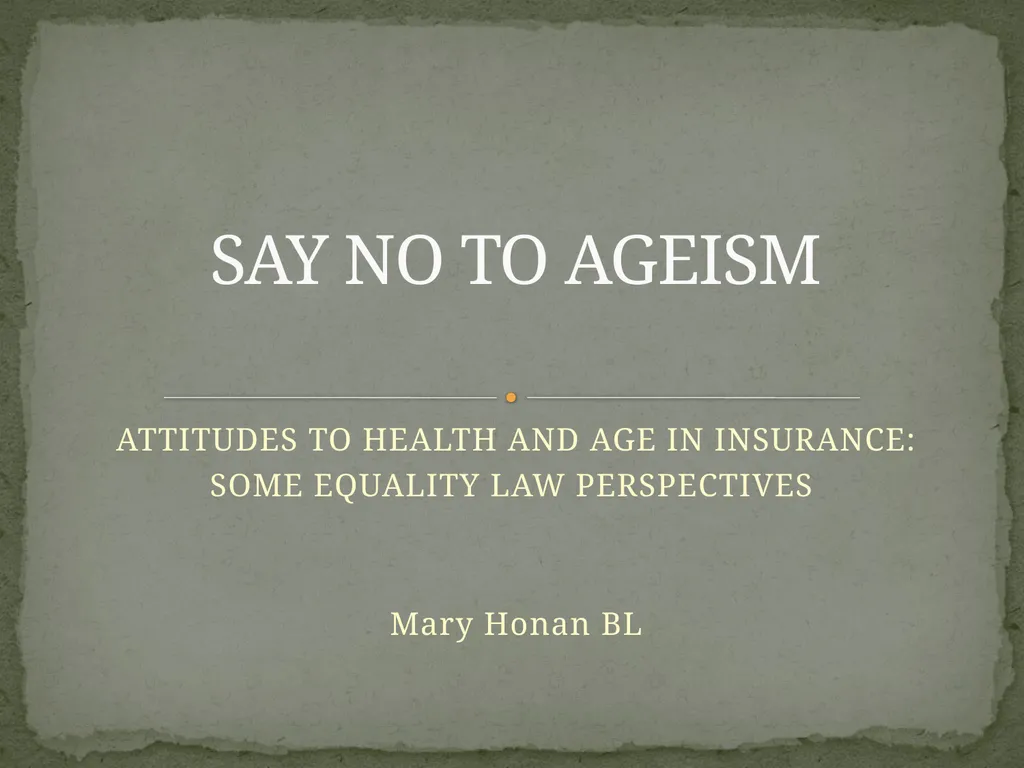
slide1. ATTITUDES TO HEALTH AND AGE IN INSURANCE:
SOME EQUALITY LAW PERSPECTIVES

Mary Honan BL SAY NO TO AGEISM<br>
slide2. Article 1
Purpose

The purpose of this Directive is to lay down a framework for combating discrimination based on sex in access to and supply of goods and services, with a view to putting into effect in the Member States the principle of equal treatment between men and women. Council Directive 2004/113/EC of 13 December 2004<br>
slide3. Actuarial factors
1. Member States shall ensure that in all new contracts concluded after 21 December 2007 at the latest, the use of sex as a factor in the calculation of premiums and benefits for the purposes of insurance and related financial services shall not result in differences in individuals' premiums and benefits.

2. Notwithstanding paragraph 1, Member States may decide before 21 December 2007 to permit proportionate differences in individuals' premiums and benefits where the use of sex is a determining factor… These Member States shall review their decision five years after 21 December 2007… Article 5<br>
slide4. Article 1: Purpose
The main objective of the directive is to combat discrimination based on religion or belief, disability, age or sexual orientation and to put into effect the principle of equal treatment, outside the field of employment.

Scope: Goods and services, education, housing, etc. Proposal for a Council Directive on implementing the principle of equal treatment between persons irrespective of religion or belief, disability, age or sexual orientation - 2 July 2008<br>
slide5. The Equal Status Acts 2000-2011 prohibit discrimination in the provision of goods and services, access to education, accommodation, housing, etc.

Nine prohibited grounds:
Gender
Civil status
Family status
Sexual orientation
Religious belief
Age
Disability
Race colour, nationality, ethnic or national origins
Membership of the Traveller community Equal Status Act 2000<br>
slide6. 5.—(1) A person shall not discriminate in disposing of goods to the public generally or a section of the public or in providing a service, whether the disposal or provision is for consideration or otherwise and whether the service provided can be availed of only by a section of the public. Goods and services: section 5(1)<br>
slide7. Section 5 (2)(d ):
differences in the treatment of persons in relation to annuities, pensions, insurance policies or any other matters
related to the assessment of risk where the treatment—
(i) is effected by reference to—

(I) actuarial or statistical data obtained from a
source on which it is reasonable to rely, or
(II) other relevant underwriting or commercial
factors,
and
(ii) is reasonable having regard to the data or other relevant
factors, Exemption re actuarial data etc.<br>
slide8. Aged 77
Refused quotation: told did not quote for new business to over-70s
Defence = treatment within exemption in section 5(2)(d):
Analysis of age re accidents – larger claims at extreme ends of age spectrum
Statistical data indicated costs accelerated with age in over-70s
Volatile sector of market
Insurance to older clients unprofitable Ross v Royal & Sun Alliance<br>
slide9. Relevant questions for Equality Tribunal: Was Mr Ross’ treatment effected by -
actuarial or statistical data?
source on which it was reasonable to rely?
or other underwriting or commercial factors?

And was the treatment/policy reasonable having regard to the data?
Was it reasonable having regard to other relevant factors? Exemption?<br>
slide10. Actuarial or statistical data? Yes – but…
From a source on which it was reasonable to rely? No.
Source and integrity of data called into question
Some data no longer available
‘black holes’ in data
More recent software package showed different outcomes


Other relevant underwriting or commercial factors? Yes – but ignored many other relevant factors.

And was the treatment reasonable having regard to the data? No.
Was it reasonable having regard to other relevant factors? No. Conclusions of Tribunal<br>
slide11. Other relevant factors ignored, e.g.:
Health of insurance seeker
Driving experience
Claims history
Condition/age of car
Declined Cases Agreement

Exposure to over-70s market damage business?
No evidence that there was a large market of ‘floating’ over-70s customers seeking to change insurer. In fact, evidence was to contrary. Tribunal…<br>
slide12. Unable to provide full details of data relied on
Not reasonable to rely on source of data
Policy was not reasonable taking account of data or other relevant factors
‘Across the board’ policy: did not address the individual request Summary of Tribunal decision<br>
slide13. Complainant v Life Assurance Provider – S2009-033
[Life insurance cover for mortgage/disability]

Medical history of depression and alcohol/cannabis use - presented claimant as greater risk of further suicide attempts/self-harm.
Insurer took into account each individual’s risk profile – e.g. medical history, hobbies, alcohol use, smoking, etc.
Insurer had taken ‘considered’ approach - and applied it in transparent manner.
Not a blanket policy of excluding persons with mental health difficulties including self-harm/suicidal tendencies. Exemption allowed<br>
slide14. Complainant v Life Assurance Provider – S2011-064
[Life assurance/disability]

Actuarial/statistical data re risk factors for life expectancy of persons with depression and alcohol dependency syndrome.
Reliable medical research.
Risks so high as to make it untenable to provide cover. Exemption allowed<br>
slide15. Mr A v Life Assurance Company - S2011-008
[Application for extension of income protection policy/disability]
Top-up of policy to E200,000 p.a. refused – Diabetes

Medical and statistical data re effect of Diabetes on person in workplace – substantially higher risk of needing time off.
Data from source on which it was reasonable to rely.
Re-insurance and internal manuals provided mechanism for calculation of risk – specific loadings added to specific categories.
Consideration of other relevant factors such as the type of insurance and overall level of cover sought.
No blanket policy – decision reasonable having regard to data and relevant factors. Exemption allowed<br>
slide16. Payment Protection Scheme [2003]
In ‘good health’?

Claimed based on wrist injury [2005].
Refused because of ongoing back problem and therefore not in ‘good health’ – not eligible for scheme.

Tribunal – policy (i.e. must have no health issues) was a ‘blanket ban’ on anyone with a disability. Jordan v Marsh Ireland – S2008-054<br>
slide17. Complainant v Insurance Company – S2008-045
[No appearance by complainants]

Over-65s couple charged E229 – E69 if couple under-65.

Is this – like Ross – a blanket policy based on age?

Is there data which can substantiate a straight cut-off at age 65? Travel insurance<br>
slide18. Opt-out derogation permitted by A.5(2) invalid.
No temporary limitation – therefore derogation could persist indefinitely.
Worked against the achievement of objective of equal treatment between men and women.
From 21 December 2012 the unisex rule must be applied per Art. 5(1) of Directive 2004/113 Association Belge des Consommateurs Test-Achats ASBL and others v Council of Ministers<br>
slide19. Insurers can no longer rely on actuarial/statistical data based directly on sex.
But can still rely on data relating to all the other relevant factors which should underpin the decision to insure – such as medical history, state of health, pre-existing conditions, driving record, no claims bonus, etc.
These factors may impact differently on male and female drivers, e.g. safety record? But this is not directly discriminatory.
If such factors impact indirectly on a particular gender , they will have to be justified by the criteria set out in ECJ.
If such factors can be justified they will not be unlawful. Consequences?<br>
slide20. As in Ross and other Irish cases, basic principle in Test-Achats is avoidance of ‘blanket policy’.
Test-Achats is likely to be relied on in all discrimination cases where a policy appears to be based directly on a prohibited ground – whether gender, age, religion, etc.
Probable that Test-Achats will be applied beyond scope of that case, for example to occupational pension schemes, etc. Future?<br>
slide21. Some responses to Test-Achats have been somewhat extreme, such as:
Cheaper premiums for high-risk individuals could have impact on road safety?
Encouragement of risk-taking behaviour? Carnage on the roads?
No evidence is yet apparent for such responses.

Assessment of risk should be based not on generalisations or stereotypes but on sound data – this is what Test-Achats and similar decisions seek to ensure. Stereotype v sound data<br>