
Audio Information The presenter started speaking
AS
Published · 39 slides · 0 views

1 / 1










Description
Audio Information The presenter started speaking Still hearing music? Close and restart the session Change your audio setting by Choosing Audio Video Select Switch Audio Call in The phone information is in the chat Email for technical
Related Topics
Share
Embed code
Download this presentation From Below
"Audio Information The presenter started speaking" is the property of its rightful owner. Permission is granted to download and print the materials on this website for personal, non-commercial use only, and to display it on your personal computer provided you do not modify the materials and that you retain all copyright notices contained in the materials. By downloading content from our website, you accept the terms of this agreement.
Presentation Transcript
01
Audio Information The presenter started speaking
Still hearing music?
Close and restart the session
Change your audio setting by
Choosing “Audio & Video”
Select “Switch Audio”
Call in
The phone information is in the chat
Email for technical difficulties
wps.gha.education@wpsic.com<br>
Still hearing music?
Close and restart the session
Change your audio setting by
Choosing “Audio & Video”
Select “Switch Audio”
Call in
The phone information is in the chat
Email for technical difficulties
wps.gha.education@wpsic.com<br>
02
Preventive Services for Lung Cancer Screening (Clinical) November 2025<br>
03
Housekeeping Training Center webpage
Training Material
Upcoming Events
Encore Presentations
60 to 90 days
Send questions and comments in Chat
After this, tell CMS how we did on the survey<br>
Training Material
Upcoming Events
Encore Presentations
60 to 90 days
Send questions and comments in Chat
After this, tell CMS how we did on the survey<br>
04
Disclaimer This material is a tool to assist the provider community. Medicare rules change often.
The basis for answers given today rely on facts given in the question. Medicare rules determine final coverage.
Access CMS’ website for current coverage, regulations and rulings.<br>
The basis for answers given today rely on facts given in the question. Medicare rules determine final coverage.
Access CMS’ website for current coverage, regulations and rulings.<br>
05
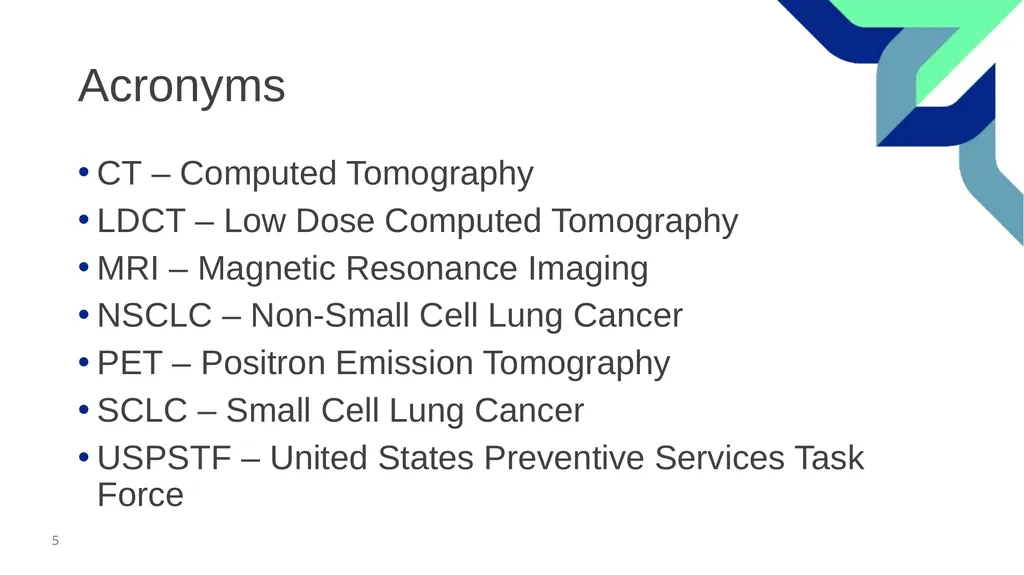
Acronyms CT – Computed Tomography
LDCT – Low Dose Computed Tomography
MRI – Magnetic Resonance Imaging
NSCLC – Non-Small Cell Lung Cancer
PET – Positron Emission Tomography
SCLC – Small Cell Lung Cancer
USPSTF – United States Preventive Services Task Force<br>
LDCT – Low Dose Computed Tomography
MRI – Magnetic Resonance Imaging
NSCLC – Non-Small Cell Lung Cancer
PET – Positron Emission Tomography
SCLC – Small Cell Lung Cancer
USPSTF – United States Preventive Services Task Force<br>
06
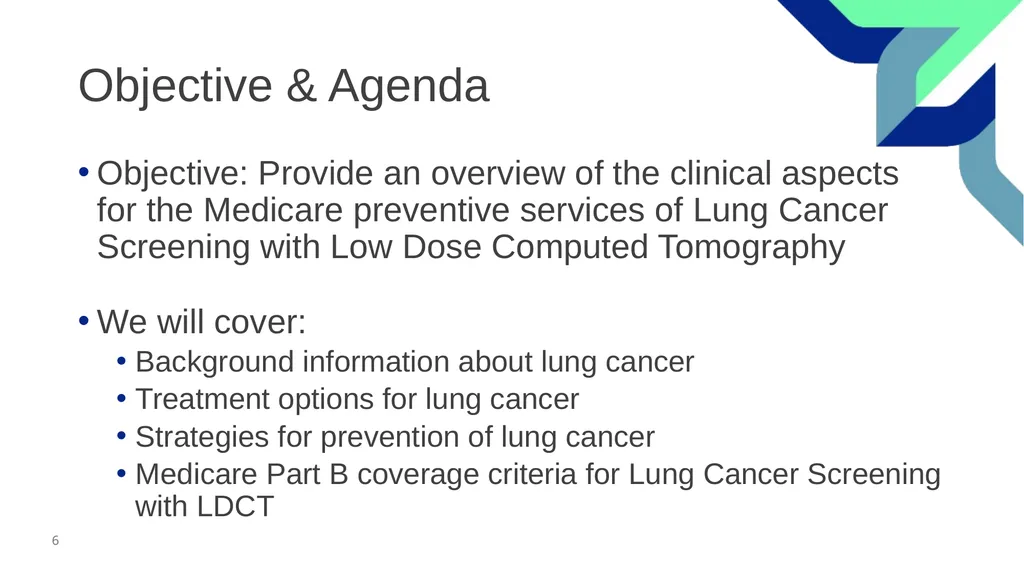
Objective & Agenda Objective: Provide an overview of the clinical aspects for the Medicare preventive services of Lung Cancer Screening with Low Dose Computed Tomography
We will cover:
Background information about lung cancer
Treatment options for lung cancer
Strategies for prevention of lung cancer
Medicare Part B coverage criteria for Lung Cancer Screening with LDCT<br>
We will cover:
Background information about lung cancer
Treatment options for lung cancer
Strategies for prevention of lung cancer
Medicare Part B coverage criteria for Lung Cancer Screening with LDCT<br>
07
Background on Lung Cancer<br>
08
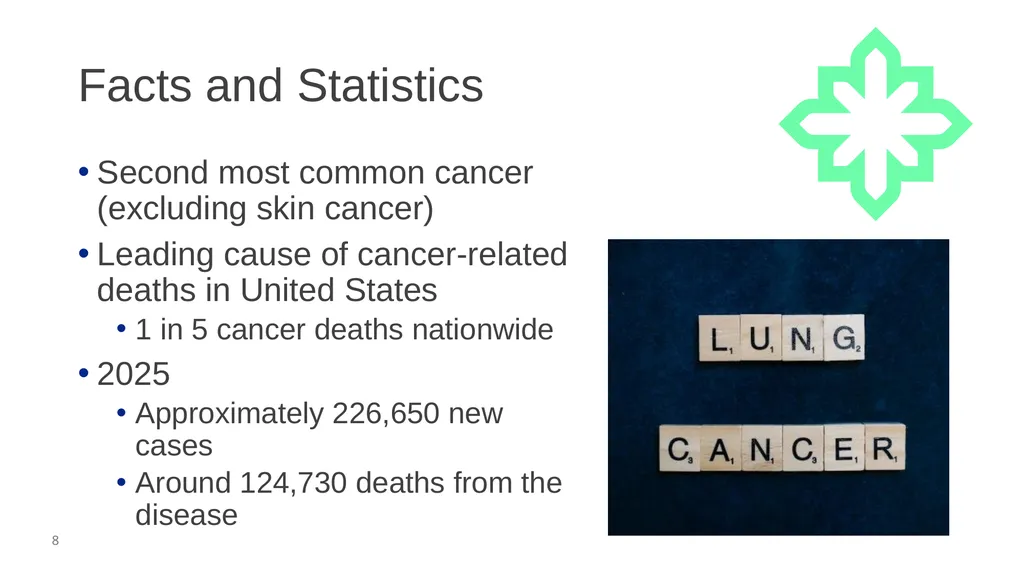
Facts and Statistics Second most common cancer (excluding skin cancer)
Leading cause of cancer-related deaths in United States
1 in 5 cancer deaths nationwide
2025
Approximately 226,650 new cases
Around 124,730 deaths from the disease<br>
Leading cause of cancer-related deaths in United States
1 in 5 cancer deaths nationwide
2025
Approximately 226,650 new cases
Around 124,730 deaths from the disease<br>
09
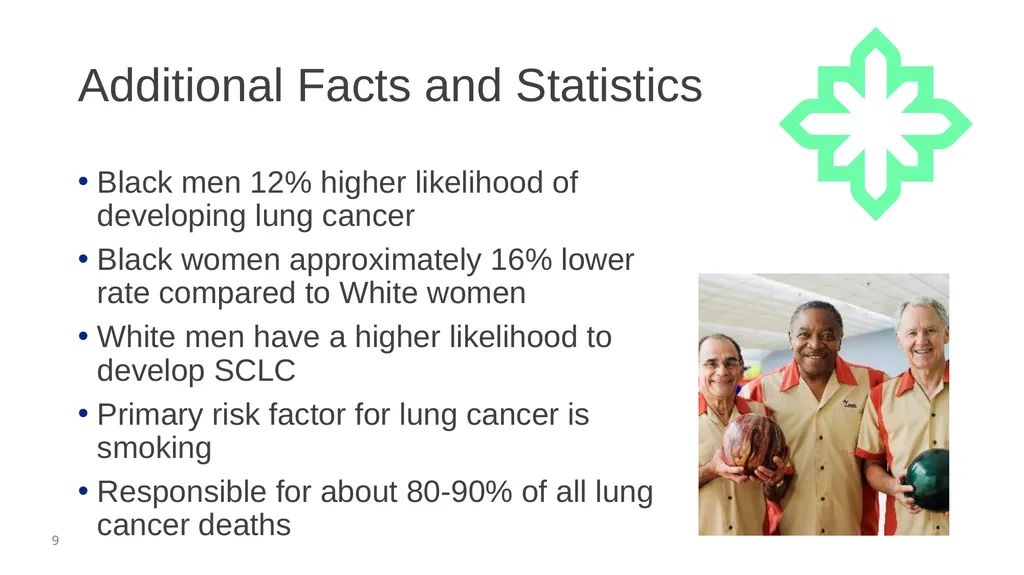
Additional Facts and Statistics Black men 12% higher likelihood of developing lung cancer
Black women approximately 16% lower rate compared to White women
White men have a higher likelihood to develop SCLC
Primary risk factor for lung cancer is smoking
Responsible for about 80-90% of all lung cancer deaths<br>
Black women approximately 16% lower rate compared to White women
White men have a higher likelihood to develop SCLC
Primary risk factor for lung cancer is smoking
Responsible for about 80-90% of all lung cancer deaths<br>
10
Lung Cancer Occurs when abnormal, malignant cells start growing uncontrollably within the lung tissue
Multiply and form tumors
May eventually spread or metastasize
Primary lung cancer refers to cancer that originates specifically within the lung tissue
Secondary lung cancer refers to cancer from another part of the body that metastasizes to the lungs<br>
Multiply and form tumors
May eventually spread or metastasize
Primary lung cancer refers to cancer that originates specifically within the lung tissue
Secondary lung cancer refers to cancer from another part of the body that metastasizes to the lungs<br>
11
Types of Lung Cancer Most Common Types
Non-small cell lung cancer (NSCLC)
Adenocarcinoma
Squamous cell carcinoma
Large cell carcinoma
Small cell lung cancer (SCLC) Less Common Types
Mesothelioma
Lung carcinoid tumors
Chest wall tumors
Metastasized cancers from other areas of the body<br>
Non-small cell lung cancer (NSCLC)
Adenocarcinoma
Squamous cell carcinoma
Large cell carcinoma
Small cell lung cancer (SCLC) Less Common Types
Mesothelioma
Lung carcinoid tumors
Chest wall tumors
Metastasized cancers from other areas of the body<br>
12
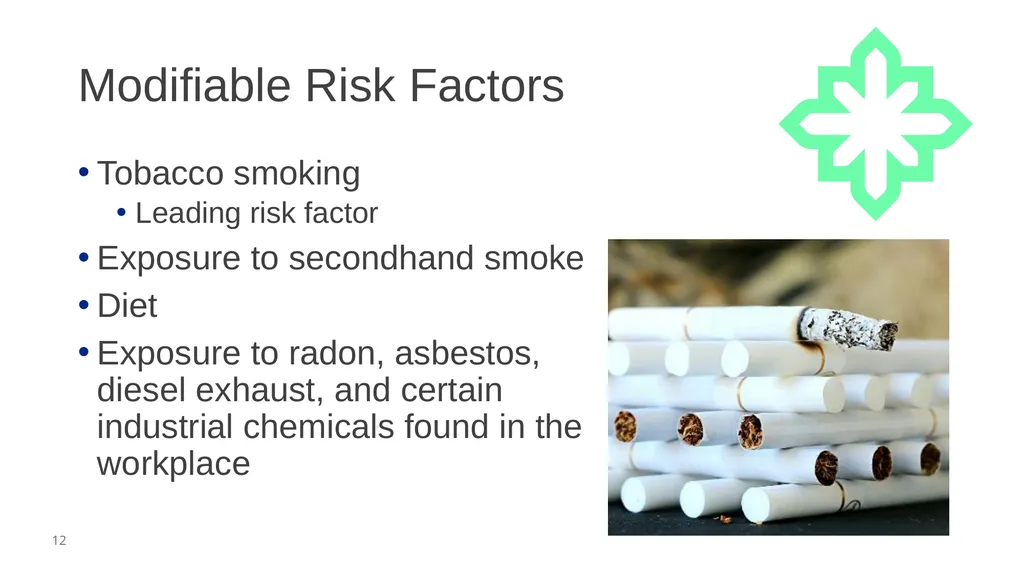
Modifiable Risk Factors Tobacco smoking
Leading risk factor
Exposure to secondhand smoke
Diet
Exposure to radon, asbestos, diesel exhaust, and certain industrial chemicals found in the workplace<br>
Leading risk factor
Exposure to secondhand smoke
Diet
Exposure to radon, asbestos, diesel exhaust, and certain industrial chemicals found in the workplace<br>
13
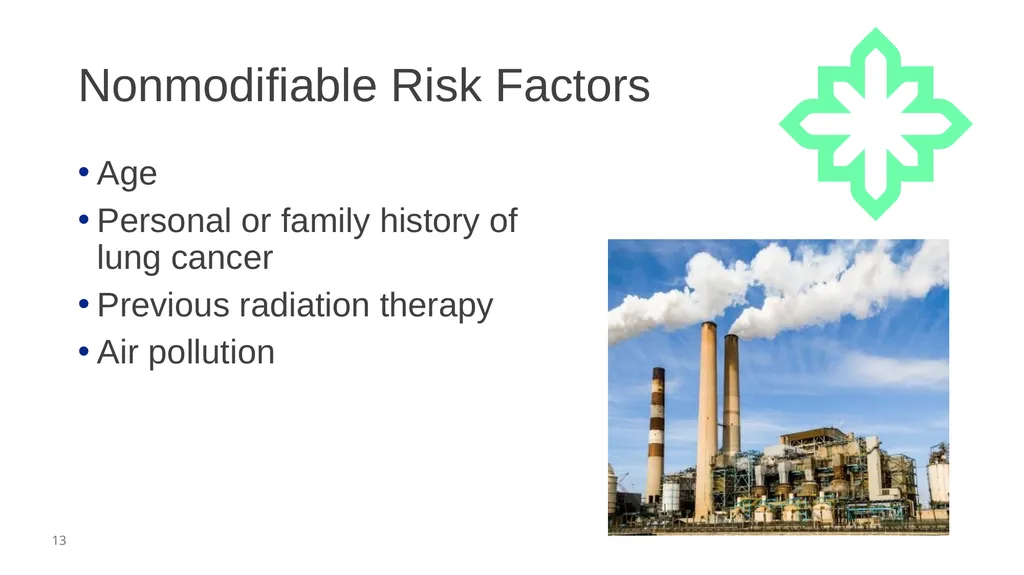
Nonmodifiable Risk Factors Age
Personal or family history of lung cancer
Previous radiation therapy
Air pollution<br>
Personal or family history of lung cancer
Previous radiation therapy
Air pollution<br>
14
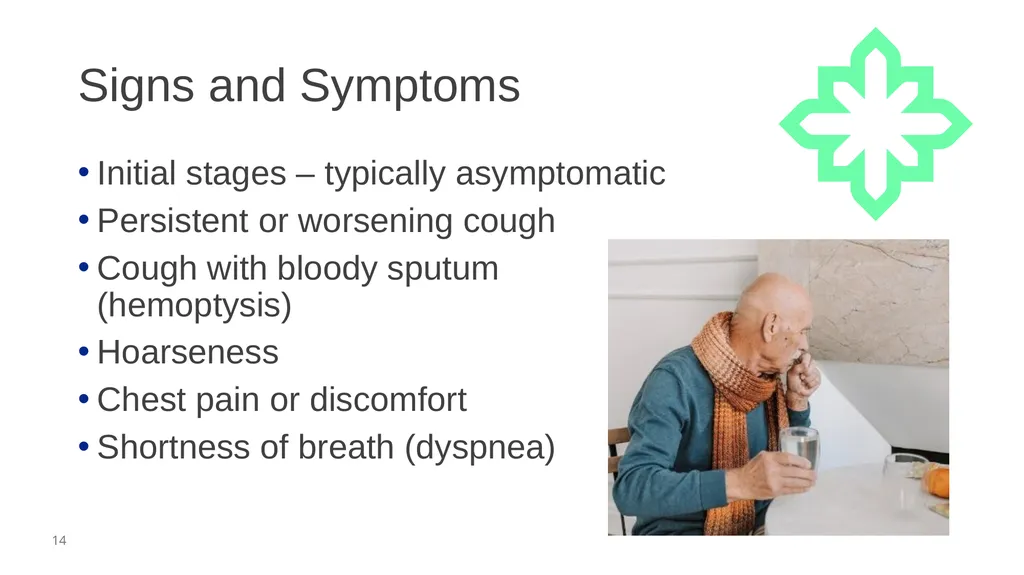
Signs and Symptoms Initial stages – typically asymptomatic
Persistent or worsening cough
Cough with bloody sputum (hemoptysis)
Hoarseness
Chest pain or discomfort
Shortness of breath (dyspnea)<br>
Persistent or worsening cough
Cough with bloody sputum (hemoptysis)
Hoarseness
Chest pain or discomfort
Shortness of breath (dyspnea)<br>
15
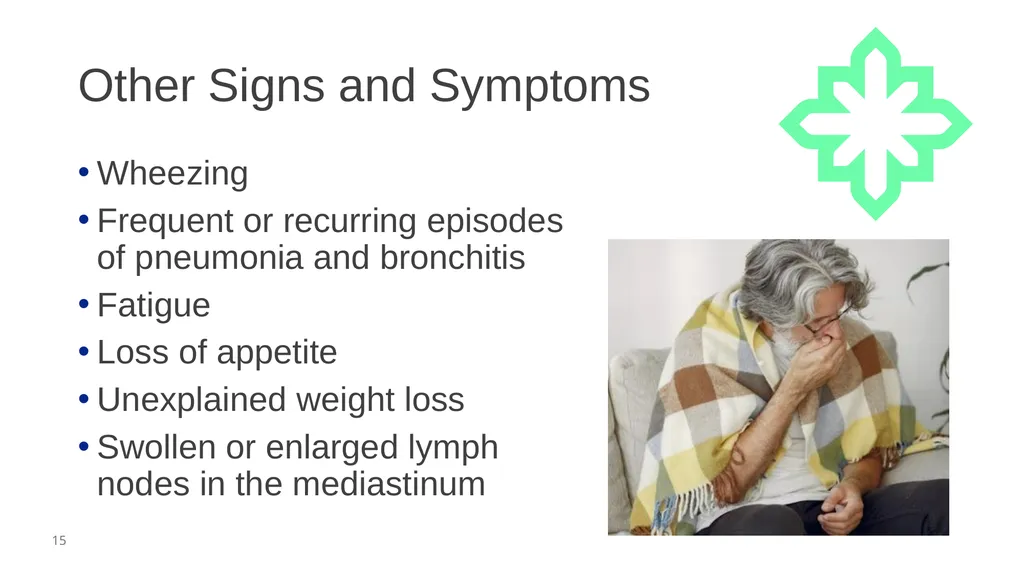
Other Signs and Symptoms Wheezing
Frequent or recurring episodes of pneumonia and bronchitis
Fatigue
Loss of appetite
Unexplained weight loss
Swollen or enlarged lymph nodes in the mediastinum<br>
Frequent or recurring episodes of pneumonia and bronchitis
Fatigue
Loss of appetite
Unexplained weight loss
Swollen or enlarged lymph nodes in the mediastinum<br>
16
Additional Signs and Symptoms Bone pain
Headache
Difficulty swallowing (dysphagia)
Swelling of the face, neck, or arms
Enlarged lymph nodes in the neck or collarbone area
Weakness or numbness in the arms or legs Clubbing of fingers
Dizziness
Balance issues
Jaundice
Syndromes
Horner syndrome due to Pancoast tumors
Superior vena cava syndrome
Paraneoplastic syndromes<br>
Headache
Difficulty swallowing (dysphagia)
Swelling of the face, neck, or arms
Enlarged lymph nodes in the neck or collarbone area
Weakness or numbness in the arms or legs Clubbing of fingers
Dizziness
Balance issues
Jaundice
Syndromes
Horner syndrome due to Pancoast tumors
Superior vena cava syndrome
Paraneoplastic syndromes<br>
17
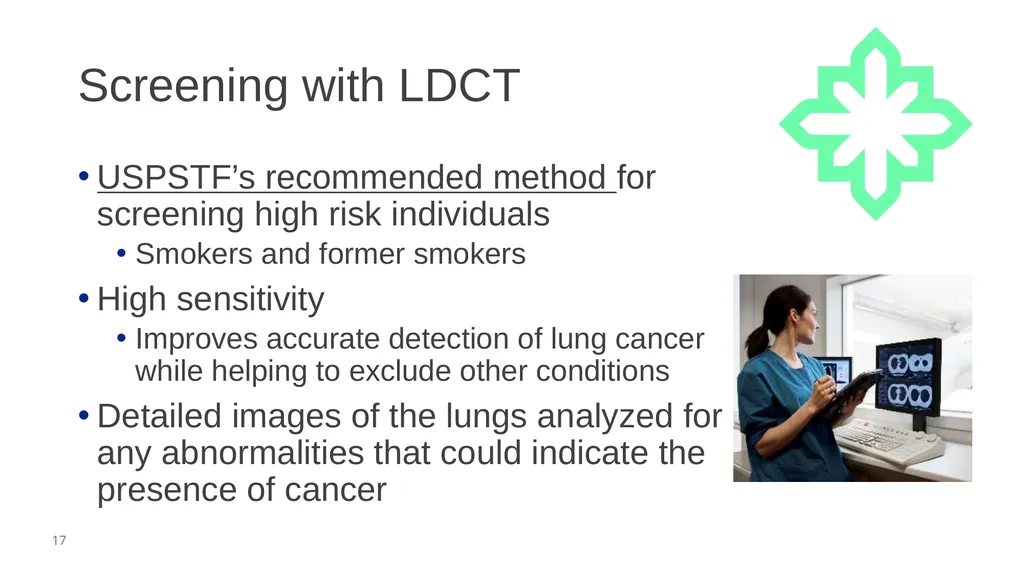
Screening with LDCT USPSTF’s recommended method for screening high risk individuals
Smokers and former smokers
High sensitivity
Improves accurate detection of lung cancer while helping to exclude other conditions
Detailed images of the lungs analyzed for any abnormalities that could indicate the presence of cancer<br>
Smokers and former smokers
High sensitivity
Improves accurate detection of lung cancer while helping to exclude other conditions
Detailed images of the lungs analyzed for any abnormalities that could indicate the presence of cancer<br>
18
Diagnosis/Tests Completion of a medical history and a physical examination
Questions regarding any current symptoms as well when the symptoms initially appeared
Chest X-ray
Additional tests
Imaging tests to determine location and size of cancer
Sputum cytology
Biopsy
Imaging tests if provider suspects lung cancer has metastasized<br>
Questions regarding any current symptoms as well when the symptoms initially appeared
Chest X-ray
Additional tests
Imaging tests to determine location and size of cancer
Sputum cytology
Biopsy
Imaging tests if provider suspects lung cancer has metastasized<br>
19
Staging – NSCLC American Joint Committee on Cancer (AJCC) classification
0, IA1, IA2 IA3, IB, IIA, IIB, IIC, IIIA, IIIB, IIIC, IVA, and IVB
The higher the number, the more advanced the cancer is
T, N, and M to further define the stage grouping
Non-Small Cell Lung Cancer Stages<br>
0, IA1, IA2 IA3, IB, IIA, IIB, IIC, IIIA, IIIB, IIIC, IVA, and IVB
The higher the number, the more advanced the cancer is
T, N, and M to further define the stage grouping
Non-Small Cell Lung Cancer Stages<br>
20
Staging – SCLC Two-stage system
Limited
Extensive
Small Cell Lung Cancer Stages<br>
Limited
Extensive
Small Cell Lung Cancer Stages<br>
21
Treatment Surgery (Surgical resection of the lung)
Sleeve resection
Wedge resection
Segmental resection
Lobectomy
Pneumonectomy
Removal of lymph nodes Chemotherapy
Radiation therapy
External beam radiation therapy (EBRT)
Brachytherapy
Proton therapy
Often administered in combination with chemotherapy<br>
Sleeve resection
Wedge resection
Segmental resection
Lobectomy
Pneumonectomy
Removal of lymph nodes Chemotherapy
Radiation therapy
External beam radiation therapy (EBRT)
Brachytherapy
Proton therapy
Often administered in combination with chemotherapy<br>
22
Additional Treatment Immunotherapy
Ablative therapies for NSCLC
Cold therapy such as cryoablation
Heat therapy such as radiofrequency ablation (or RFA) and microwave ablation
Targeted therapy for NSCLC
Tumor Treating Fields (TTF) therapy for NSCLC
Palliative care (supportive care)<br>
Ablative therapies for NSCLC
Cold therapy such as cryoablation
Heat therapy such as radiofrequency ablation (or RFA) and microwave ablation
Targeted therapy for NSCLC
Tumor Treating Fields (TTF) therapy for NSCLC
Palliative care (supportive care)<br>
23
Prevention Quit smoking or never starting in the first place
The Great American Smokeout ®
Avoid secondhand smoke whenever possible
Avoid the use of supplements such as beta carotene (if a smoker)
Reduce or limit amount of exposure to radon Reduce or limit amount of exposure to hazardous chemicals commonly found in the workplace
Test well water for arsenic contamination
Consume a healthy, well-balanced diet
Get screened for lung cancer<br>
The Great American Smokeout ®
Avoid secondhand smoke whenever possible
Avoid the use of supplements such as beta carotene (if a smoker)
Reduce or limit amount of exposure to radon Reduce or limit amount of exposure to hazardous chemicals commonly found in the workplace
Test well water for arsenic contamination
Consume a healthy, well-balanced diet
Get screened for lung cancer<br>
24
Eligibility and Coverage<br>
25
Eligibility Covers for Medicare Part B beneficiaries who meet the following criteria
Are between the ages of 50–77
Have no signs or symptoms of lung cancer
Have a history of tobacco smoking equivalent to at least 20 pack-years
1 pack-year is equal to smoking 1 pack of 20 cigarettes per day for 1 year
Either currently smokes or quit smoking within the last 15 years
Received an order from their healthcare provider for lung cancer screening with LDCT<br>
Are between the ages of 50–77
Have no signs or symptoms of lung cancer
Have a history of tobacco smoking equivalent to at least 20 pack-years
1 pack-year is equal to smoking 1 pack of 20 cigarettes per day for 1 year
Either currently smokes or quit smoking within the last 15 years
Received an order from their healthcare provider for lung cancer screening with LDCT<br>
26
Frequency Covered annually
Prior to the initial lung cancer screening with LDCT, must receive a counseling and shared decision-making visit (G0296)
For subsequent annual screenings, the counseling and shared decision-making visit is not required but may still be provided at the provider’s discretion<br>
Prior to the initial lung cancer screening with LDCT, must receive a counseling and shared decision-making visit (G0296)
For subsequent annual screenings, the counseling and shared decision-making visit is not required but may still be provided at the provider’s discretion<br>
27
Counseling and Shared Decision-Making Visit Required documentation
Confirmation that the patient meets all eligibility criteria for lung cancer screening
Evidence of shared decision-making discussion using one or more decision aids
Documentation of counseling on importance of adhering to annual lung cancer screening with LDCT
Counseling to discuss the importance of abstaining from cigarette smoking
If appropriate, provide information about tobacco-cessation resources<br>
Confirmation that the patient meets all eligibility criteria for lung cancer screening
Evidence of shared decision-making discussion using one or more decision aids
Documentation of counseling on importance of adhering to annual lung cancer screening with LDCT
Counseling to discuss the importance of abstaining from cigarette smoking
If appropriate, provide information about tobacco-cessation resources<br>
28
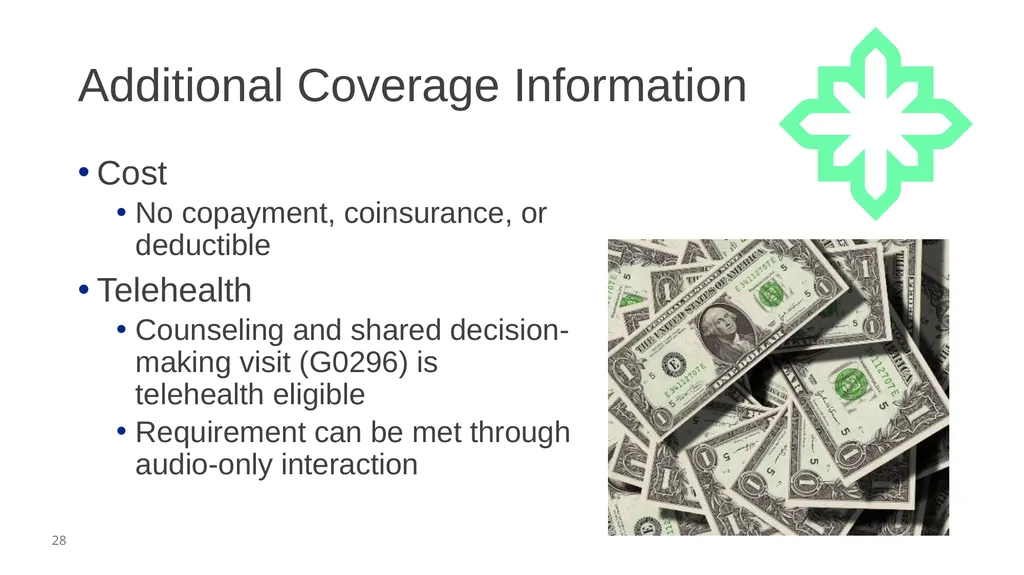
Additional Coverage Information Cost
No copayment, coinsurance, or deductible
Telehealth
Counseling and shared decision-making visit (G0296) is telehealth eligible
Requirement can be met through audio-only interaction<br>
No copayment, coinsurance, or deductible
Telehealth
Counseling and shared decision-making visit (G0296) is telehealth eligible
Requirement can be met through audio-only interaction<br>
29
Providers/Setting Reading radiologist
Must hold board certification or board eligibility from the American Board of Radiology or an equivalent organization
Lung cancer screening with LDCT
Must be provided in a radiology imaging facility that uses a standardized system for identifying, classifying, and reporting lung nodules
Reference : Medicare Claims Processing Manual, Chapter 18, § 220<br>
Must hold board certification or board eligibility from the American Board of Radiology or an equivalent organization
Lung cancer screening with LDCT
Must be provided in a radiology imaging facility that uses a standardized system for identifying, classifying, and reporting lung nodules
Reference : Medicare Claims Processing Manual, Chapter 18, § 220<br>
30
Documentation<br>
31
Documentation Requirements Date service was provided
Signed and dated physician or qualified non-physician practitioner order for the procedure performed
Documentation that the counseling and shared decision-making visit occurred prior to the initial lung cancer screening with LDCT being performed Test results and documentation of any follow-up care or counseling that was given following evaluation of results
Documentation to support medical necessity
Documentation dated and signed with provider’s credentials<br>
Signed and dated physician or qualified non-physician practitioner order for the procedure performed
Documentation that the counseling and shared decision-making visit occurred prior to the initial lung cancer screening with LDCT being performed Test results and documentation of any follow-up care or counseling that was given following evaluation of results
Documentation to support medical necessity
Documentation dated and signed with provider’s credentials<br>
32
Review of Today’s Webinar During today’s webinar, we
Discussed background information about lung cancer
Explained treatment options for lung cancer
Discussed strategies for prevention of lung cancer
Reviewed Medicare Part B coverage criteria for the Lung Cancer Screening with LDCT<br>
Discussed background information about lung cancer
Explained treatment options for lung cancer
Discussed strategies for prevention of lung cancer
Reviewed Medicare Part B coverage criteria for the Lung Cancer Screening with LDCT<br>
33
Resources MLN006559 – Medicare Preventive Services – Lung Cancer Screening with Low Dose Computed Tomography (LDCT)
National Coverage Determination (NCD) 210.14 Lung Cancer Screening with Low Dose Computed Tomography (LDCT)
American Cancer Society – Lung Cancer
Encore: Preventive Services: Lung Cancer Screening & Smoking Cessation (billing)<br>
National Coverage Determination (NCD) 210.14 Lung Cancer Screening with Low Dose Computed Tomography (LDCT)
American Cancer Society – Lung Cancer
Encore: Preventive Services: Lung Cancer Screening & Smoking Cessation (billing)<br>
34
Questions and Answers<br>
35
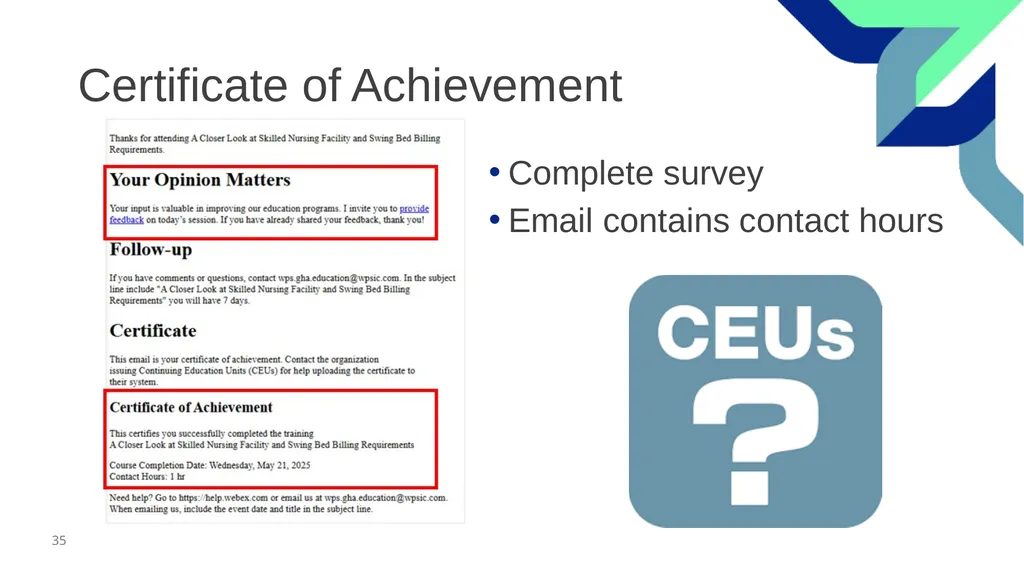
Certificate of Achievement Complete survey
Email contains contact hours<br>
Email contains contact hours<br>
36
Follow-up Questions Send your questions by 12:00 PM CT for seven days following the training
Email wps.gha.education@wpsic.com
Subject Line: Lung Cancer Screening (Clinical)
Send claim specific questions to Customer Service<br>
Email wps.gha.education@wpsic.com
Subject Line: Lung Cancer Screening (Clinical)
Send claim specific questions to Customer Service<br>
37
Survey Let us know what you think!
Take time to complete the survey now.
Survey link in chat
Redirect after closing webinar<br>
Take time to complete the survey now.
Survey link in chat
Redirect after closing webinar<br>
38
We Hear You We are committed to making changes to improve your education experience.
Based on survey comments
Chapters to YouTube
Training indicators<br>
Based on survey comments
Chapters to YouTube
Training indicators<br>
39
Thanks for attending!<br>