
Audit Quality: What are the weak links? 4th
GB
Published · 25 slides · 0 views

1 / 1
Description
Audit Quality: What are the weak links? 4th EIASM-BOCCONI WORKSHOP ON AUDIT QUALITY 27 September 2012 by Theodore J. Mock University of California, Riverside tmockucr.edu Updated following Workshop. See notes for some additional
Related Topics
Share
Embed code
Download this presentation From Below
"Audit Quality: What are the weak links? 4th" is the property of its rightful owner. Permission is granted to download and print the materials on this website for personal, non-commercial use only, and to display it on your personal computer provided you do not modify the materials and that you retain all copyright notices contained in the materials. By downloading content from our website, you accept the terms of this agreement.
Presentation Transcript
01
Audit Quality:
What are the weak links? 4th EIASM-BOCCONI
WORKSHOP ON AUDIT QUALITY
27 September 2012*
by
Theodore J. Mock
University of California, Riverside
tmock@ucr.edu *Updated following Workshop. See notes for some additional explanation and comment<br>
What are the weak links? 4th EIASM-BOCCONI
WORKSHOP ON AUDIT QUALITY
27 September 2012*
by
Theodore J. Mock
University of California, Riverside
tmock@ucr.edu *Updated following Workshop. See notes for some additional explanation and comment<br>
02
Audit Quality [ AC ]:
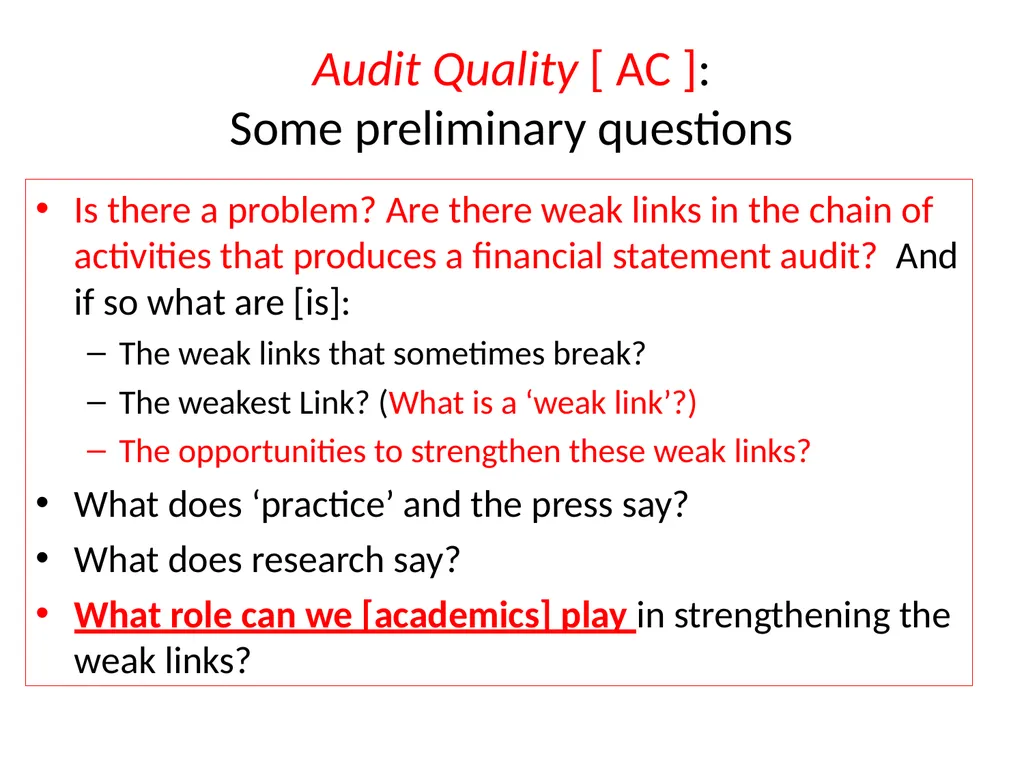
Some preliminary questions Is there a problem? Are there weak links in the chain of activities that produces a financial statement audit? And if so what are [is]:
The weak links that sometimes break?
The weakest Link? (What is a ‘weak link’?)
The opportunities to strengthen these weak links?
What does ‘practice’ and the press say?
What does research say?
What role can we [academics] play in strengthening the weak links?<br>
The weak links that sometimes break?
The weakest Link? (What is a ‘weak link’?)
The opportunities to strengthen these weak links?
What does ‘practice’ and the press say?
What does research say?
What role can we [academics] play in strengthening the weak links?<br>
03
Is there a Problem?
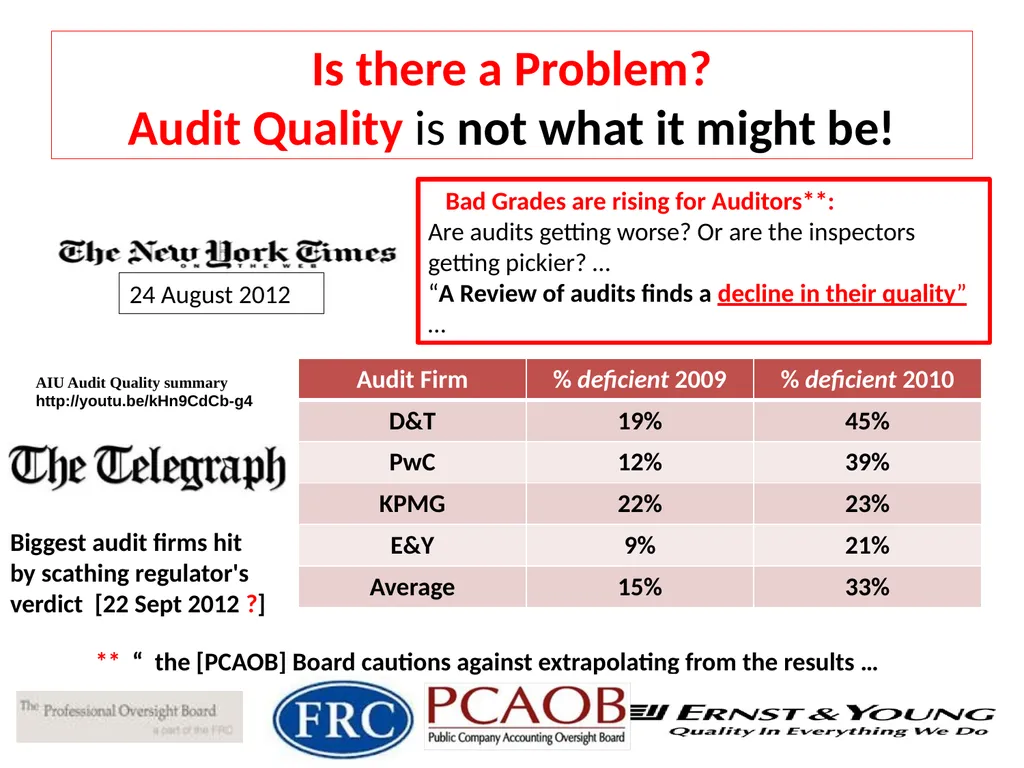
Audit Quality is not what it might be! Bad Grades are rising for Auditors**:
Are audits getting worse? Or are the inspectors getting pickier? …
“A Review of audits finds a decline in their quality” … 24 August 2012 ** “ the [PCAOB] Board cautions against extrapolating from the results … AIU Audit Quality summary
http://youtu.be/kHn9CdCb-g4 Biggest audit firms hit by scathing regulator's verdict [22 Sept 2012 ?]<br>
Are audits getting worse? Or are the inspectors getting pickier? …
“A Review of audits finds a decline in their quality” … 24 August 2012 ** “ the [PCAOB] Board cautions against extrapolating from the results … AIU Audit Quality summary
http://youtu.be/kHn9CdCb-g4 Biggest audit firms hit by scathing regulator's verdict [22 Sept 2012 ?]<br>
04
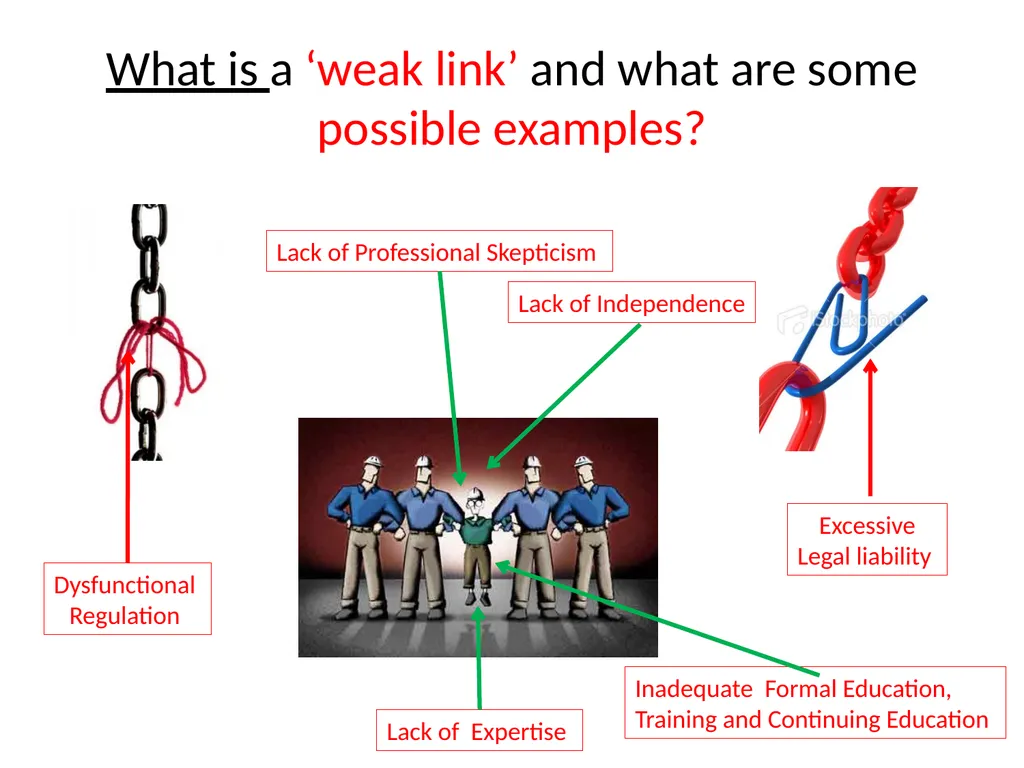
What is a ‘weak link’ and what are some possible examples? Lack of Professional Skepticism Lack of Independence Lack of Expertise Excessive
Legal liability Dysfunctional
Regulation Inadequate Formal Education,
Training and Continuing Education<br>
Legal liability Dysfunctional
Regulation Inadequate Formal Education,
Training and Continuing Education<br>
05
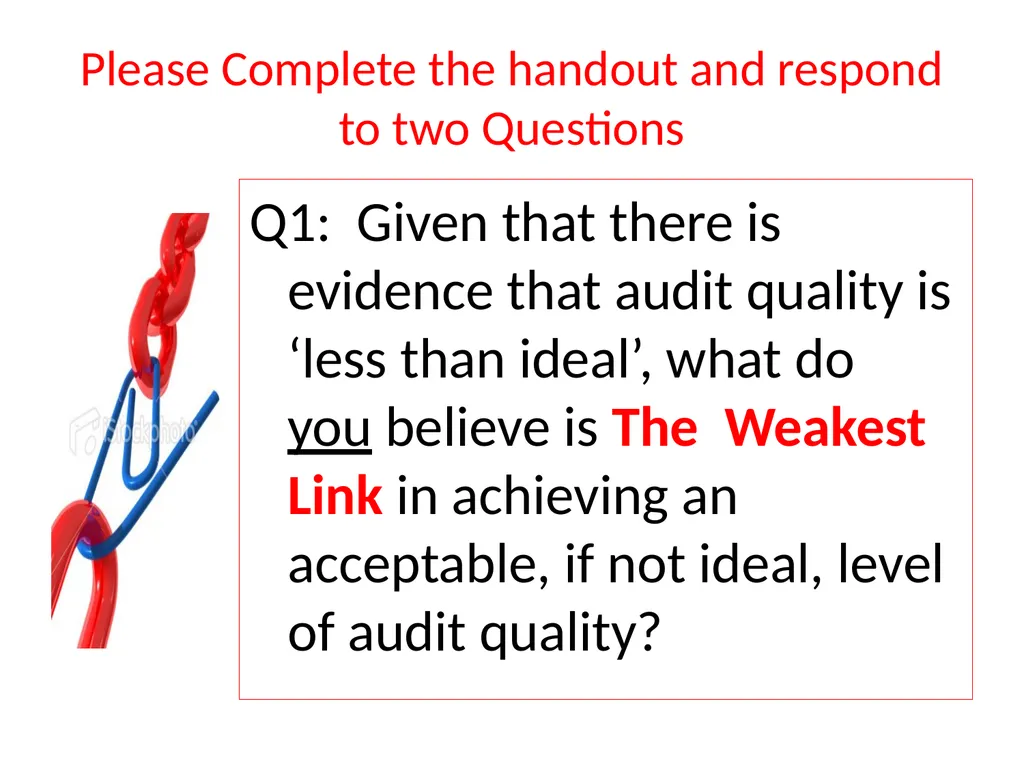
Please Complete the handout and respond to two Questions Q1: Given that there is evidence that audit quality is ‘less than ideal’, what do you believe is The Weakest Link in achieving an acceptable, if not ideal, level of audit quality?<br>
06
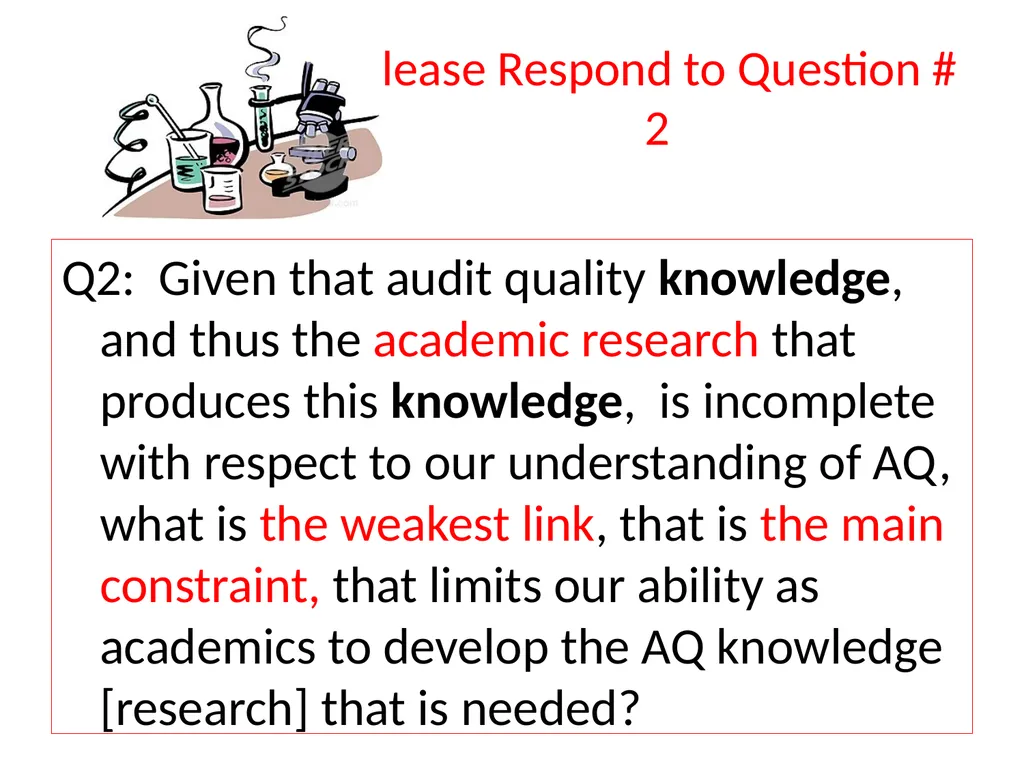
Please Respond to Question # 2 Q2: Given that audit quality knowledge, and thus the academic research that produces this knowledge, is incomplete with respect to our understanding of AQ, what is the weakest link, that is the main constraint, that limits our ability as academics to develop the AQ knowledge [research] that is needed?<br>
07
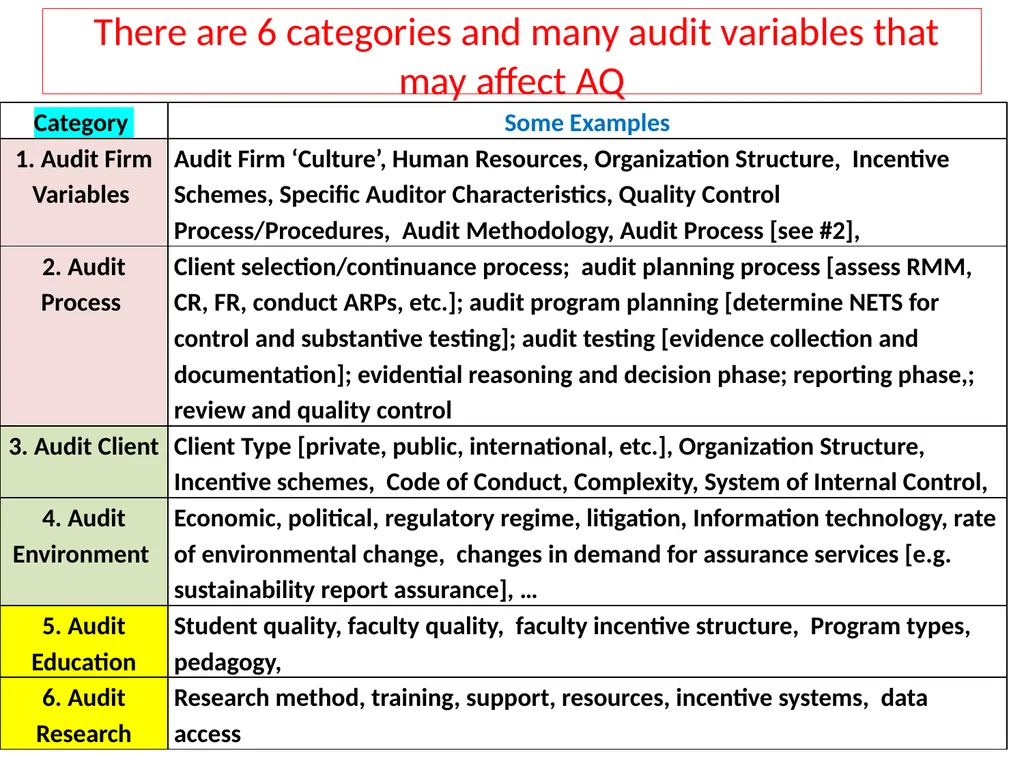
There are 6 categories and many audit variables that may affect AQ<br>
08
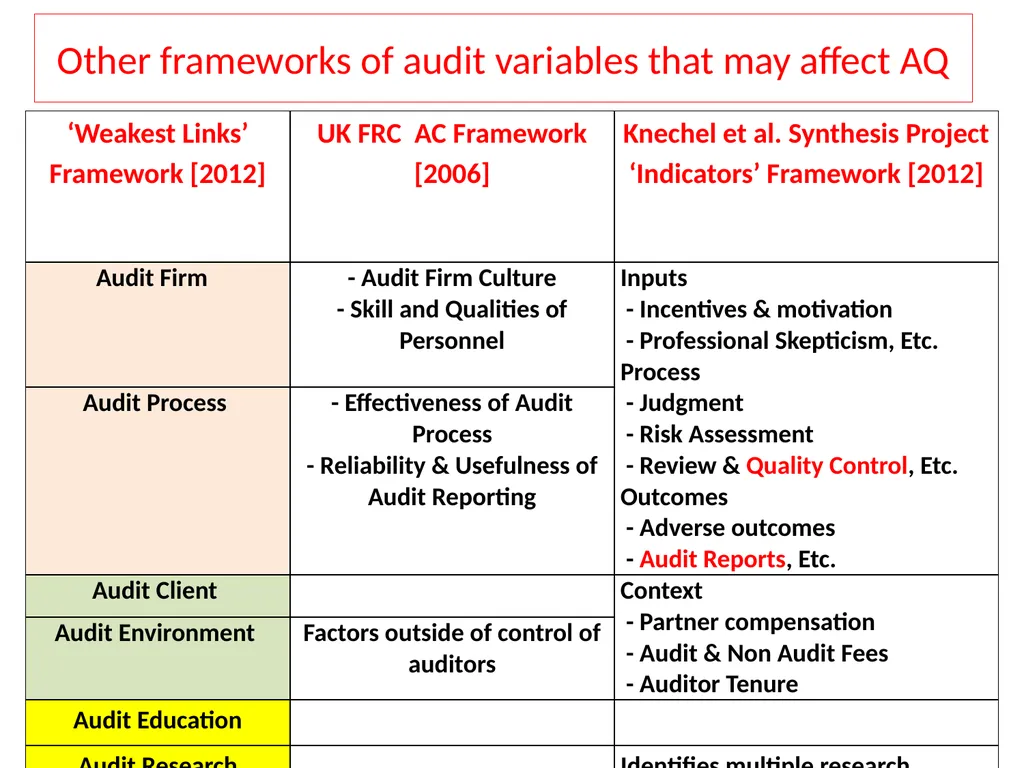
Other frameworks of audit variables that may affect AQ<br>
09
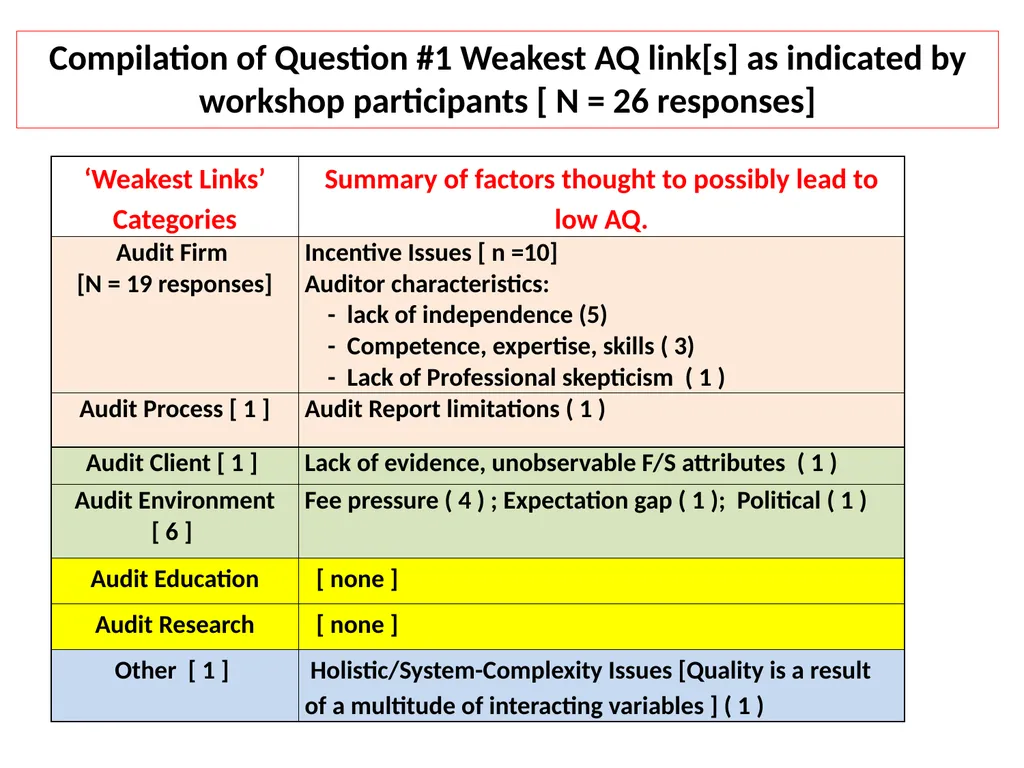
Compilation of Question #1 Weakest AQ link[s] as indicated by workshop participants [ N = 26 responses]<br>
10
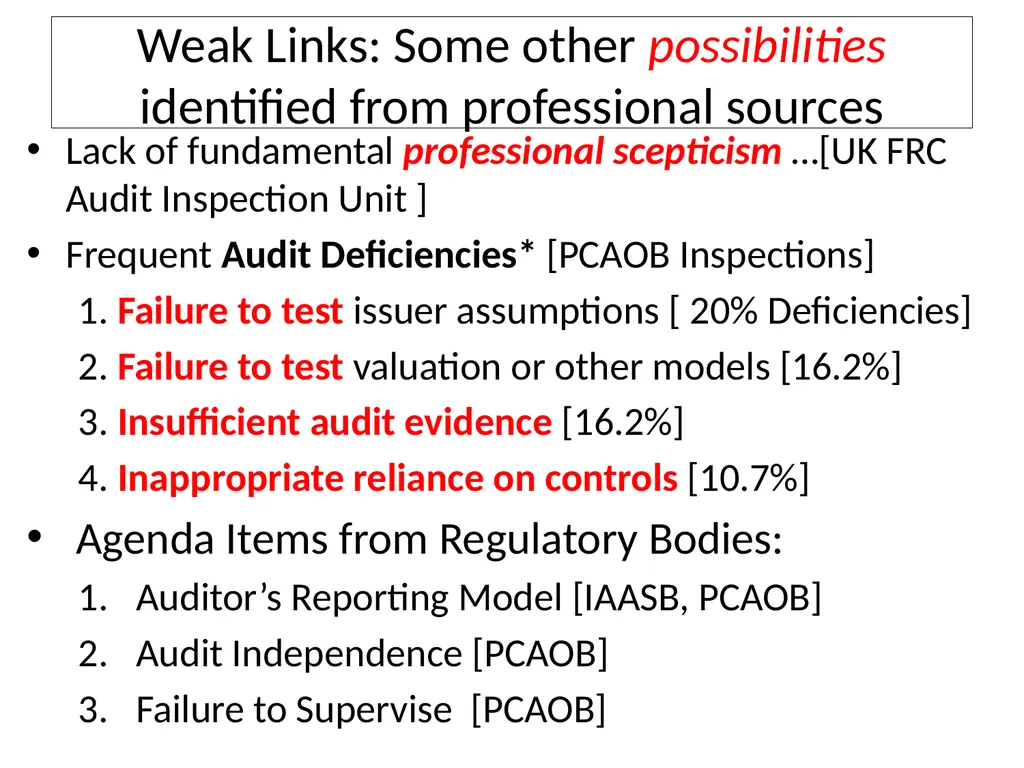
Weak Links: Some other possibilities identified from professional sources Lack of fundamental professional scepticism …[UK FRC Audit Inspection Unit ]
Frequent Audit Deficiencies* [PCAOB Inspections]
1. Failure to test issuer assumptions [ 20% Deficiencies]
2. Failure to test valuation or other models [16.2%]
3. Insufficient audit evidence [16.2%]
4. Inappropriate reliance on controls [10.7%]
Agenda Items from Regulatory Bodies:
Auditor’s Reporting Model [IAASB, PCAOB]
Audit Independence [PCAOB]
Failure to Supervise [PCAOB]<br>
Frequent Audit Deficiencies* [PCAOB Inspections]
1. Failure to test issuer assumptions [ 20% Deficiencies]
2. Failure to test valuation or other models [16.2%]
3. Insufficient audit evidence [16.2%]
4. Inappropriate reliance on controls [10.7%]
Agenda Items from Regulatory Bodies:
Auditor’s Reporting Model [IAASB, PCAOB]
Audit Independence [PCAOB]
Failure to Supervise [PCAOB]<br>
11
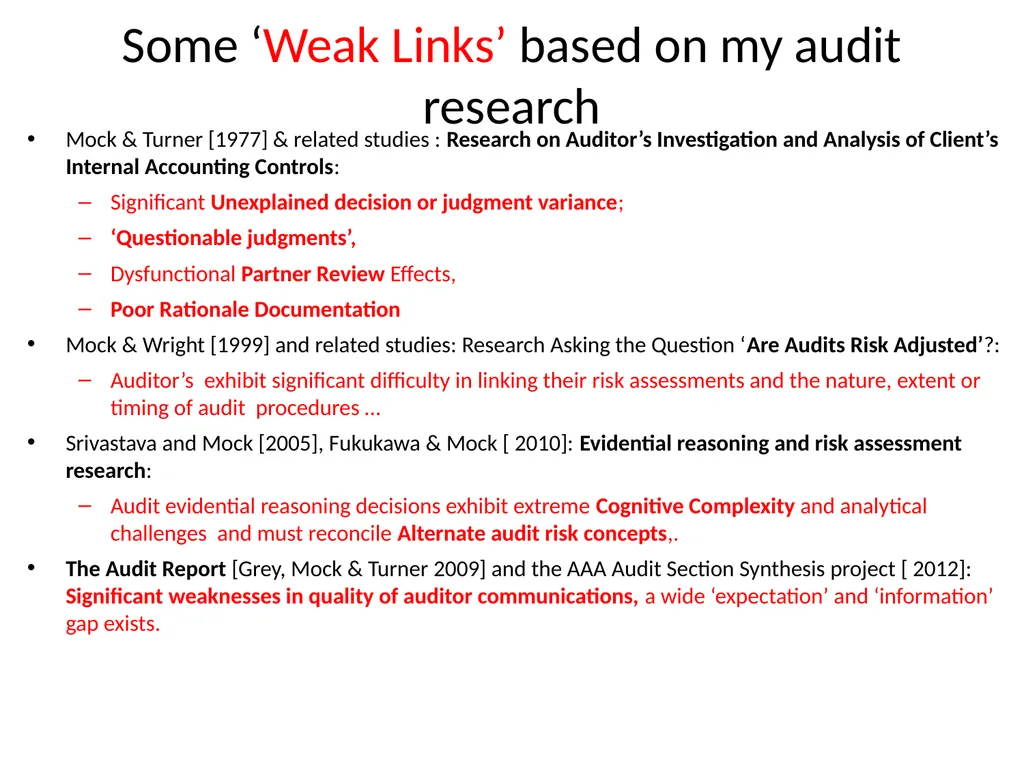
Some ‘Weak Links’ based on my audit research Mock & Turner [1977] & related studies : Research on Auditor’s Investigation and Analysis of Client’s Internal Accounting Controls:
Significant Unexplained decision or judgment variance;
‘Questionable judgments’,
Dysfunctional Partner Review Effects,
Poor Rationale Documentation
Mock & Wright [1999] and related studies: Research Asking the Question ‘Are Audits Risk Adjusted’?:
Auditor’s exhibit significant difficulty in linking their risk assessments and the nature, extent or timing of audit procedures …
Srivastava and Mock [2005], Fukukawa & Mock [ 2010]: Evidential reasoning and risk assessment research:
Audit evidential reasoning decisions exhibit extreme Cognitive Complexity and analytical challenges and must reconcile Alternate audit risk concepts,.
The Audit Report [Grey, Mock & Turner 2009] and the AAA Audit Section Synthesis project [ 2012]: Significant weaknesses in quality of auditor communications, a wide ‘expectation’ and ‘information’ gap exists.<br>
Significant Unexplained decision or judgment variance;
‘Questionable judgments’,
Dysfunctional Partner Review Effects,
Poor Rationale Documentation
Mock & Wright [1999] and related studies: Research Asking the Question ‘Are Audits Risk Adjusted’?:
Auditor’s exhibit significant difficulty in linking their risk assessments and the nature, extent or timing of audit procedures …
Srivastava and Mock [2005], Fukukawa & Mock [ 2010]: Evidential reasoning and risk assessment research:
Audit evidential reasoning decisions exhibit extreme Cognitive Complexity and analytical challenges and must reconcile Alternate audit risk concepts,.
The Audit Report [Grey, Mock & Turner 2009] and the AAA Audit Section Synthesis project [ 2012]: Significant weaknesses in quality of auditor communications, a wide ‘expectation’ and ‘information’ gap exists.<br>
12
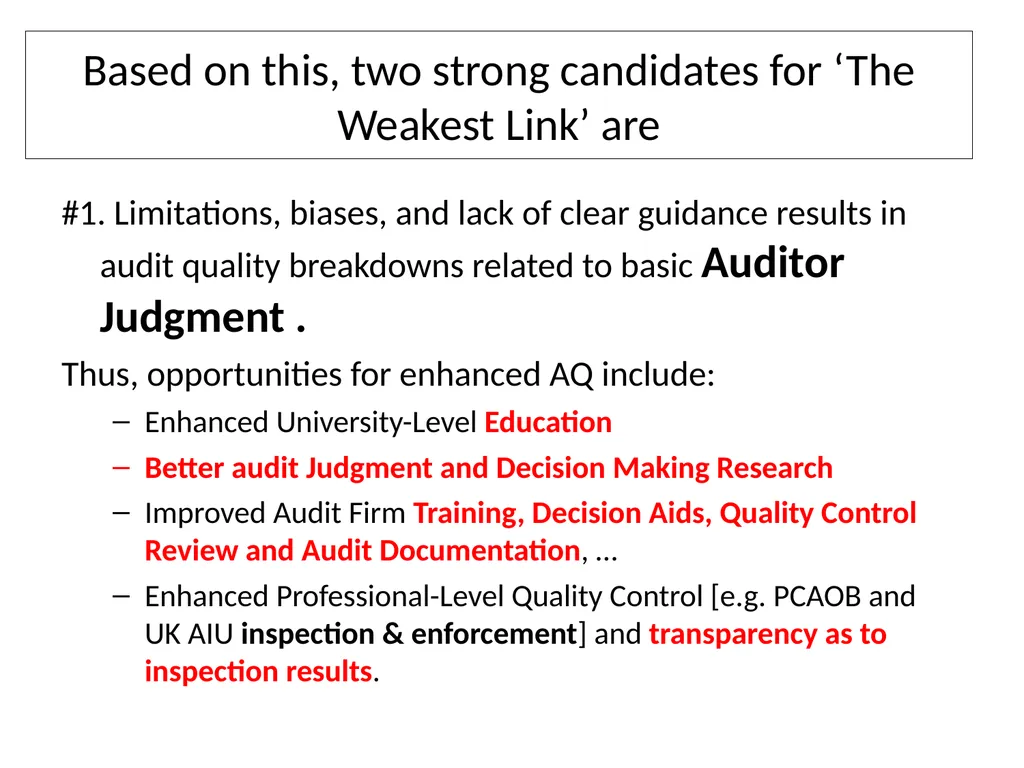
Based on this, two strong candidates for ‘The Weakest Link’ are #1. Limitations, biases, and lack of clear guidance results in audit quality breakdowns related to basic Auditor Judgment .
Thus, opportunities for enhanced AQ include:
Enhanced University-Level Education
Better audit Judgment and Decision Making Research
Improved Audit Firm Training, Decision Aids, Quality Control Review and Audit Documentation, …
Enhanced Professional-Level Quality Control [e.g. PCAOB and UK AIU inspection & enforcement] and transparency as to inspection results.<br>
Thus, opportunities for enhanced AQ include:
Enhanced University-Level Education
Better audit Judgment and Decision Making Research
Improved Audit Firm Training, Decision Aids, Quality Control Review and Audit Documentation, …
Enhanced Professional-Level Quality Control [e.g. PCAOB and UK AIU inspection & enforcement] and transparency as to inspection results.<br>
13
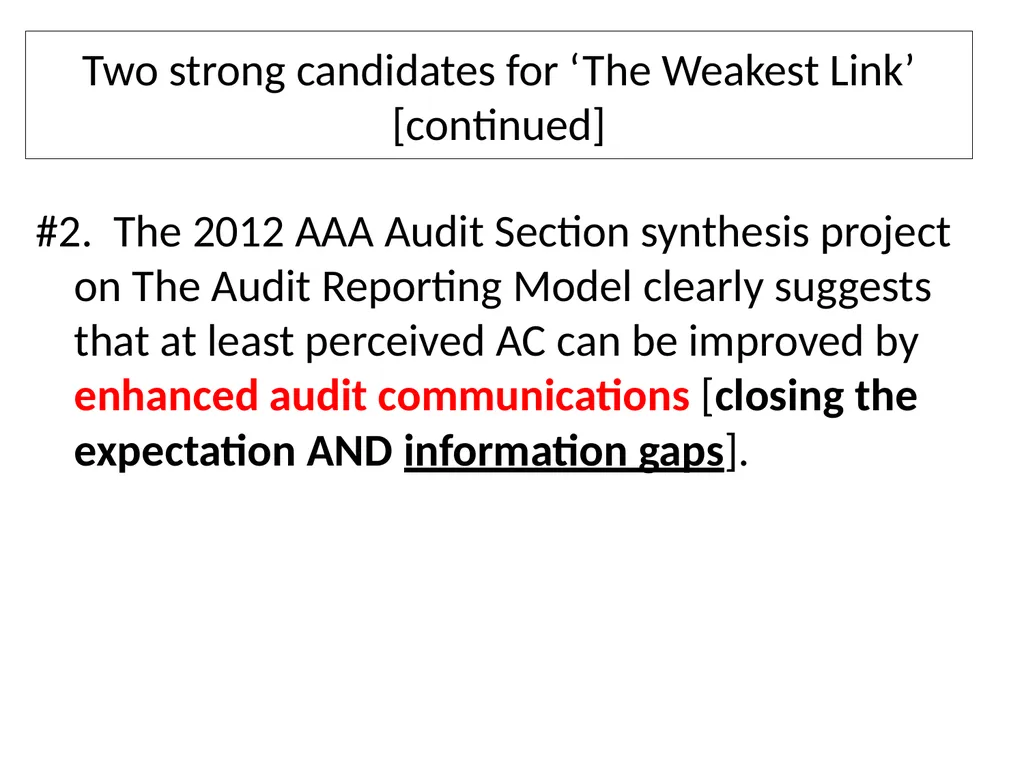
#2. The 2012 AAA Audit Section synthesis project on The Audit Reporting Model clearly suggests that at least perceived AC can be improved by enhanced audit communications [closing the expectation AND information gaps]. Two strong candidates for ‘The Weakest Link’
[continued]<br>
14
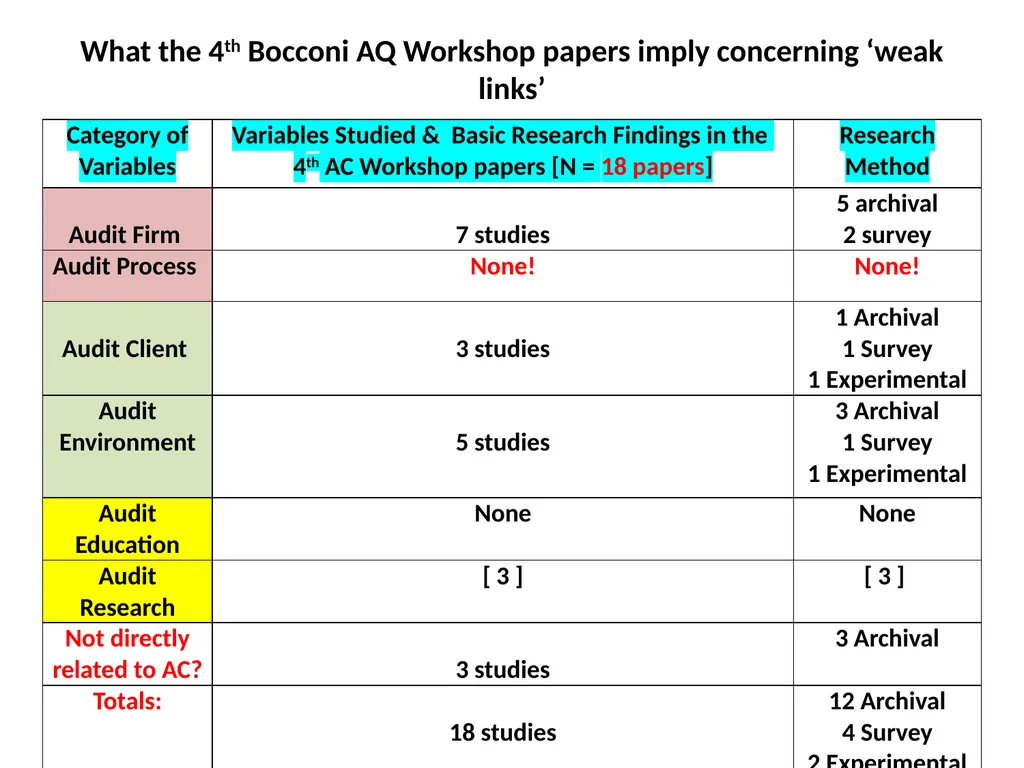
What the 4th Bocconi AQ Workshop papers imply concerning ‘weak links’<br>
15
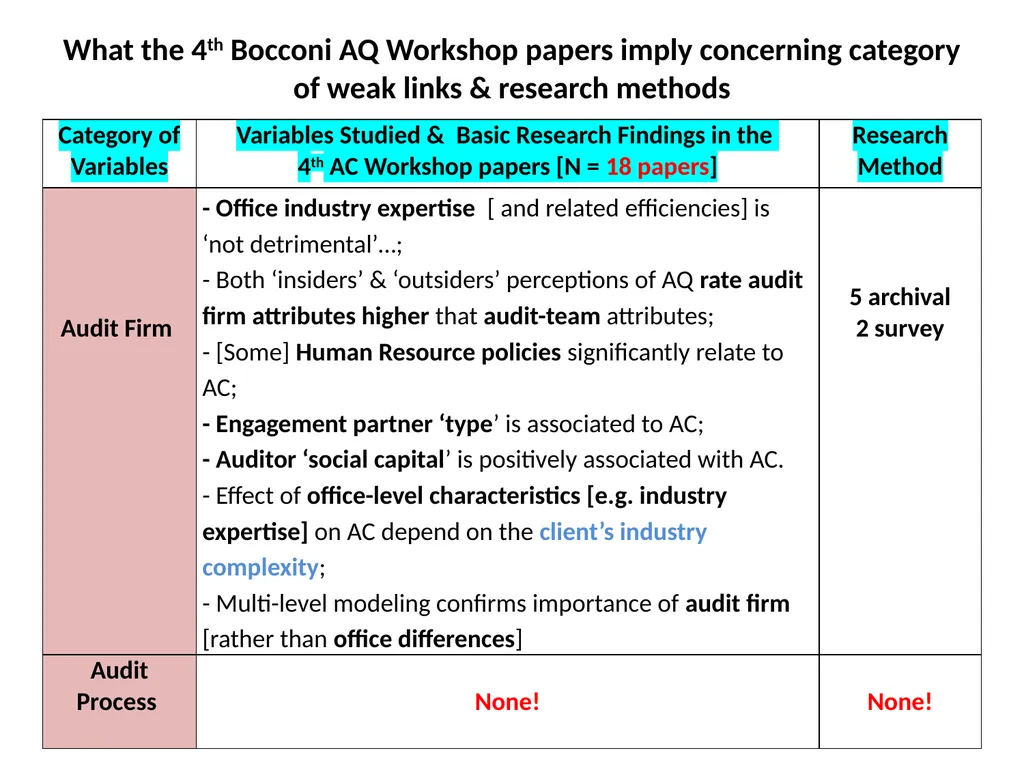
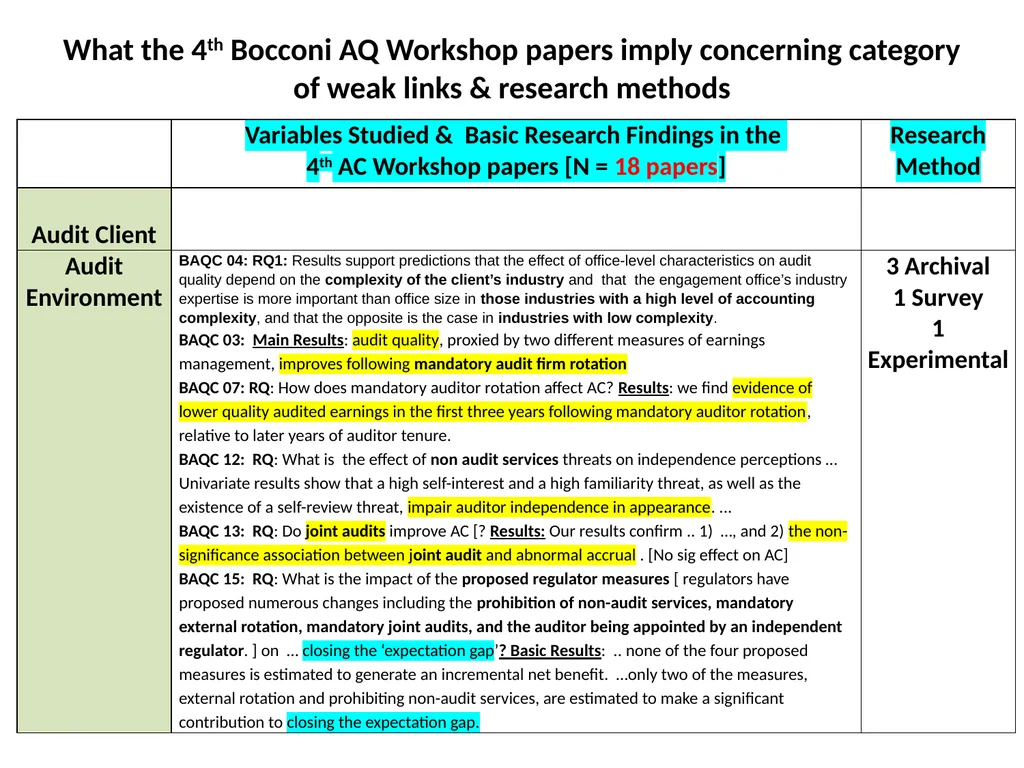
What the 4th Bocconi AQ Workshop papers imply concerning category of weak links & research methods<br>
16
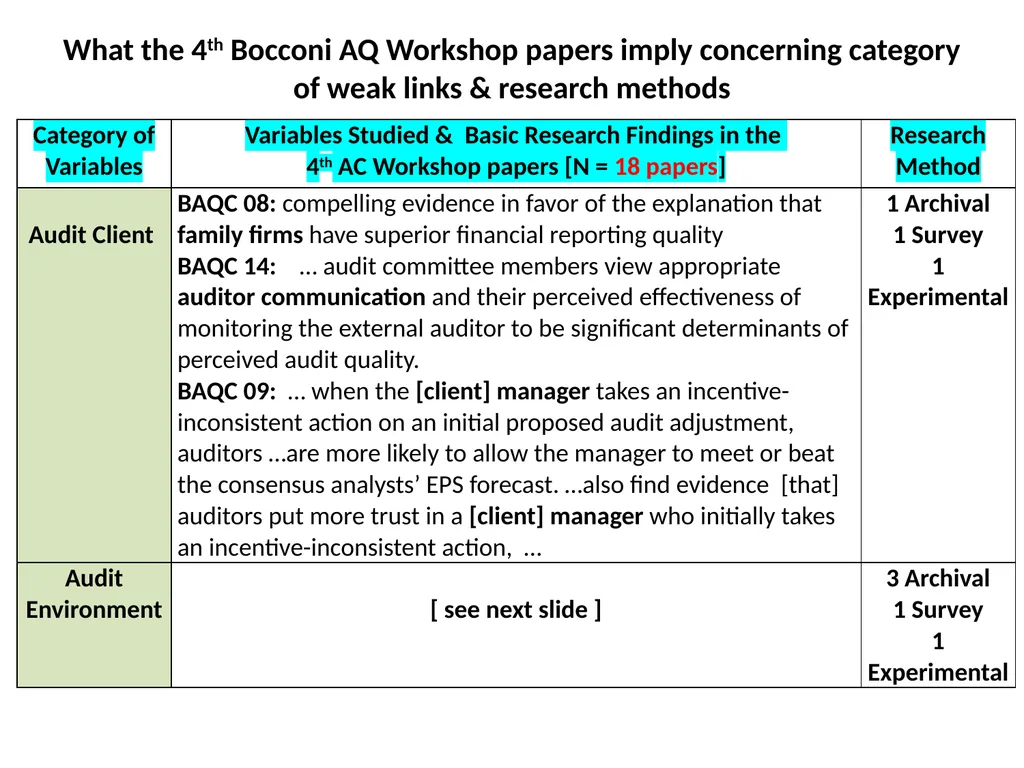
What the 4th Bocconi AQ Workshop papers imply concerning category of weak links & research methods<br>
17
What the 4th Bocconi AQ Workshop papers imply concerning category of weak links & research methods<br>
18
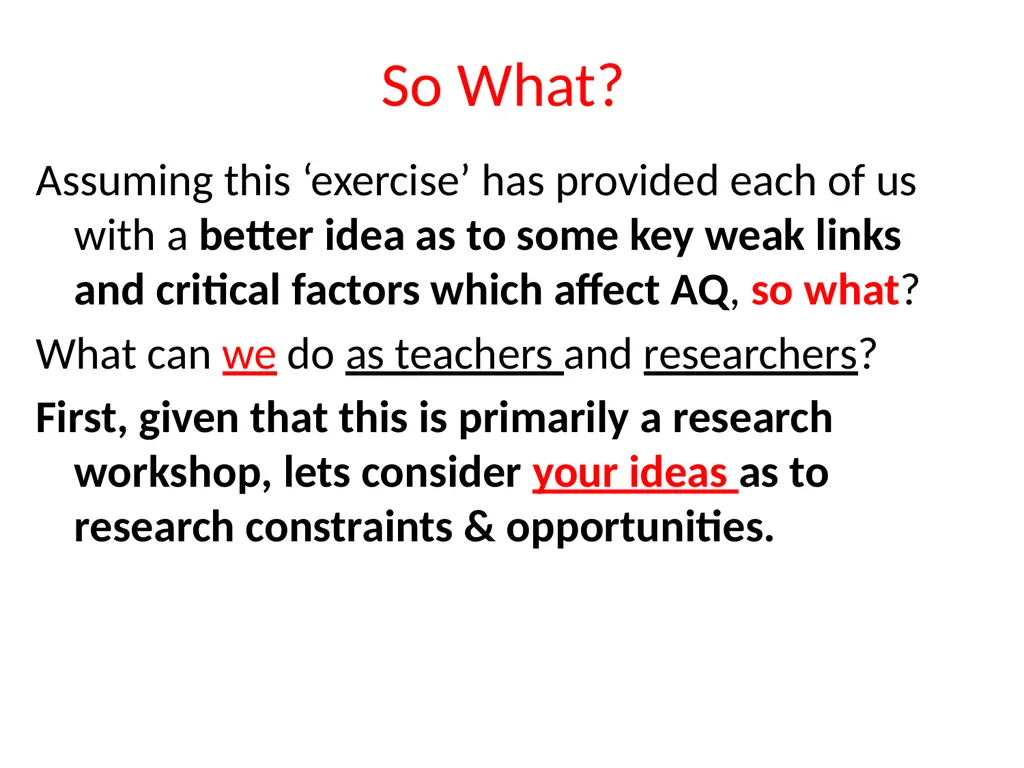
So What? Assuming this ‘exercise’ has provided each of us with a better idea as to some key weak links and critical factors which affect AQ, so what?
What can we do as teachers and researchers?
First, given that this is primarily a research workshop, lets consider your ideas as to research constraints & opportunities.<br>
What can we do as teachers and researchers?
First, given that this is primarily a research workshop, lets consider your ideas as to research constraints & opportunities.<br>
19
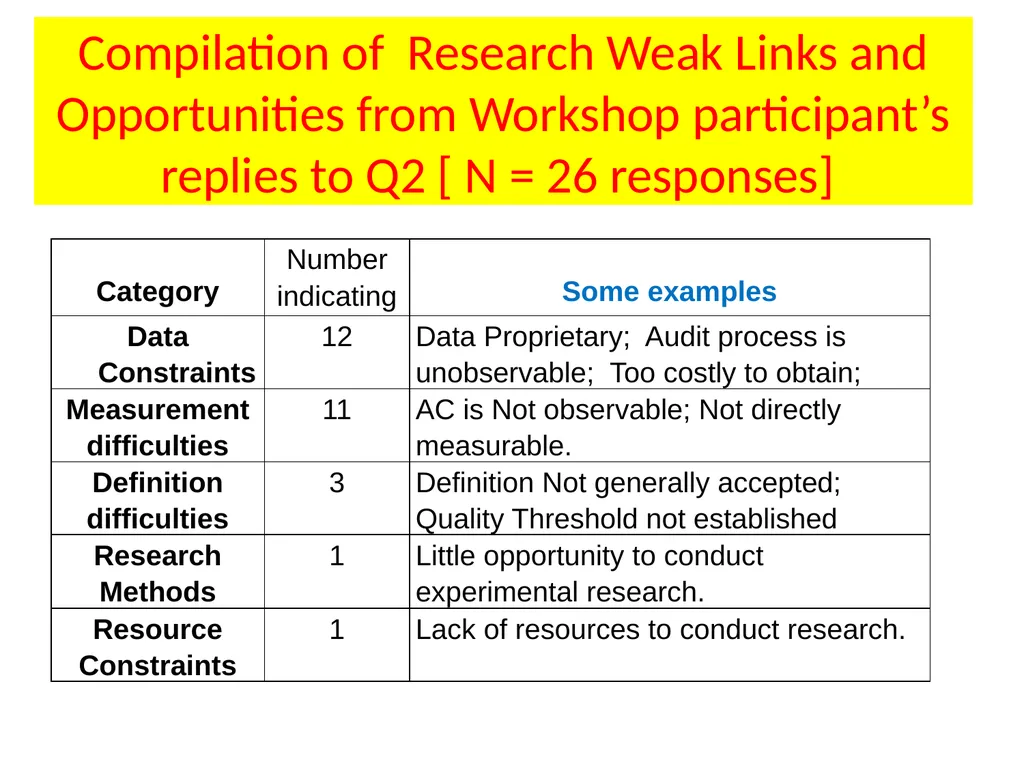
Compilation of Research Weak Links and Opportunities from Workshop participant’s replies to Q2 [ N = 26 responses]<br>
20
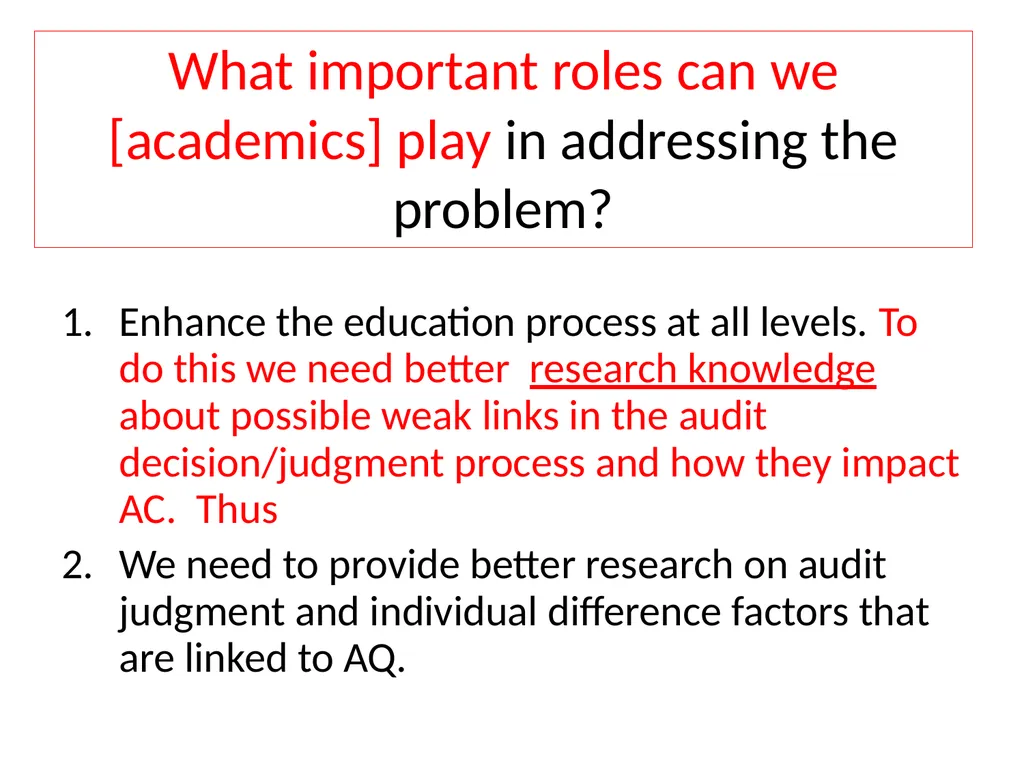
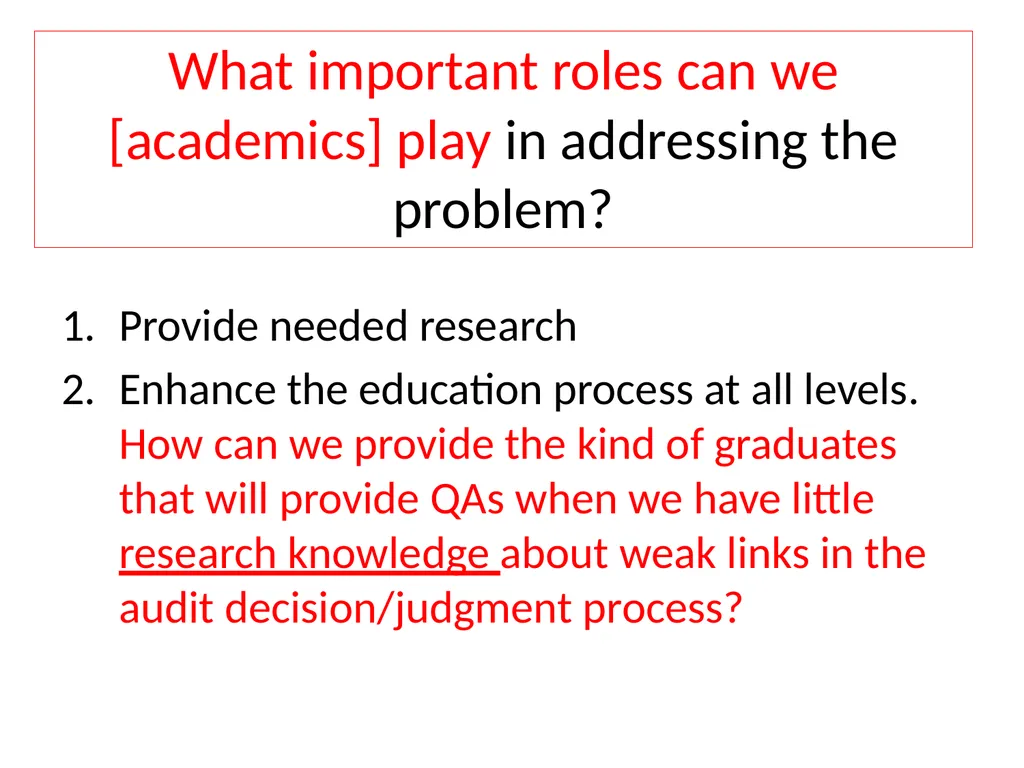
What important roles can we [academics] play in addressing the problem? Enhance the education process at all levels. To do this we need better research knowledge about possible weak links in the audit decision/judgment process and how they impact AC. Thus
We need to provide better research on audit judgment and individual difference factors that are linked to AQ.<br>
We need to provide better research on audit judgment and individual difference factors that are linked to AQ.<br>
21
What important roles can we [academics] play in addressing the problem? Provide needed research
Enhance the education process at all levels. How can we provide the kind of graduates that will provide QAs when we have little research knowledge about weak links in the audit decision/judgment process?<br>
Enhance the education process at all levels. How can we provide the kind of graduates that will provide QAs when we have little research knowledge about weak links in the audit decision/judgment process?<br>
22
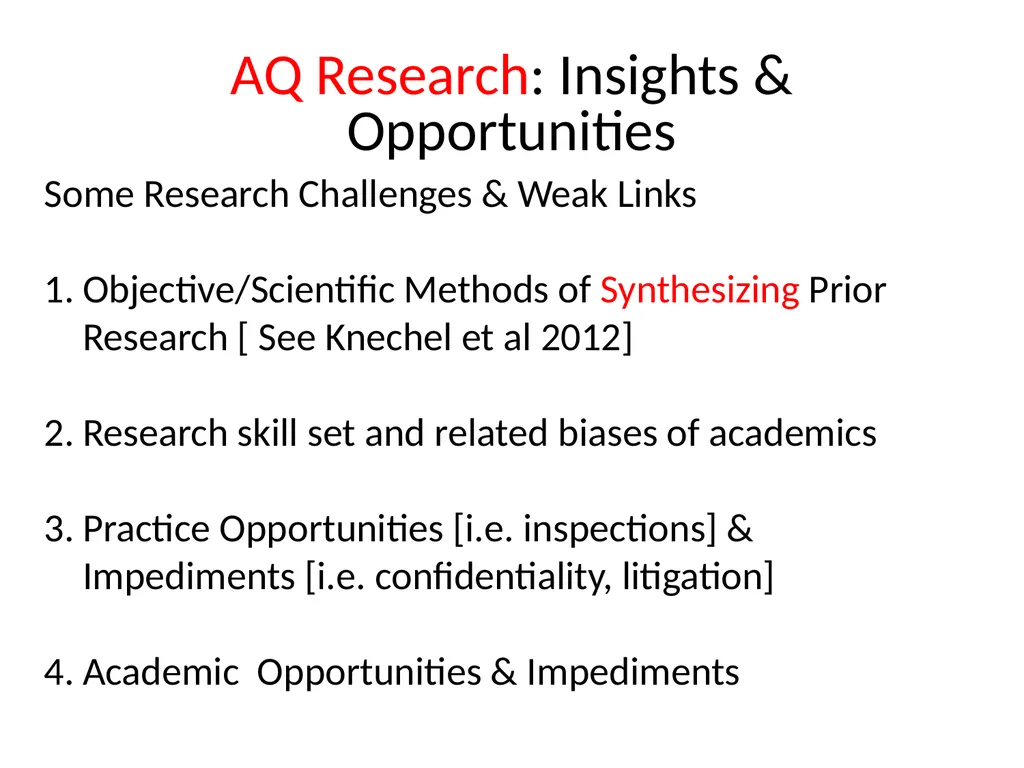
AQ Research: Insights & Opportunities Some Research Challenges & Weak Links
Objective/Scientific Methods of Synthesizing Prior Research [ See Knechel et al 2012]
Research skill set and related biases of academics
Practice Opportunities [i.e. inspections] & Impediments [i.e. confidentiality, litigation]
Academic Opportunities & Impediments<br>
Objective/Scientific Methods of Synthesizing Prior Research [ See Knechel et al 2012]
Research skill set and related biases of academics
Practice Opportunities [i.e. inspections] & Impediments [i.e. confidentiality, litigation]
Academic Opportunities & Impediments<br>
23
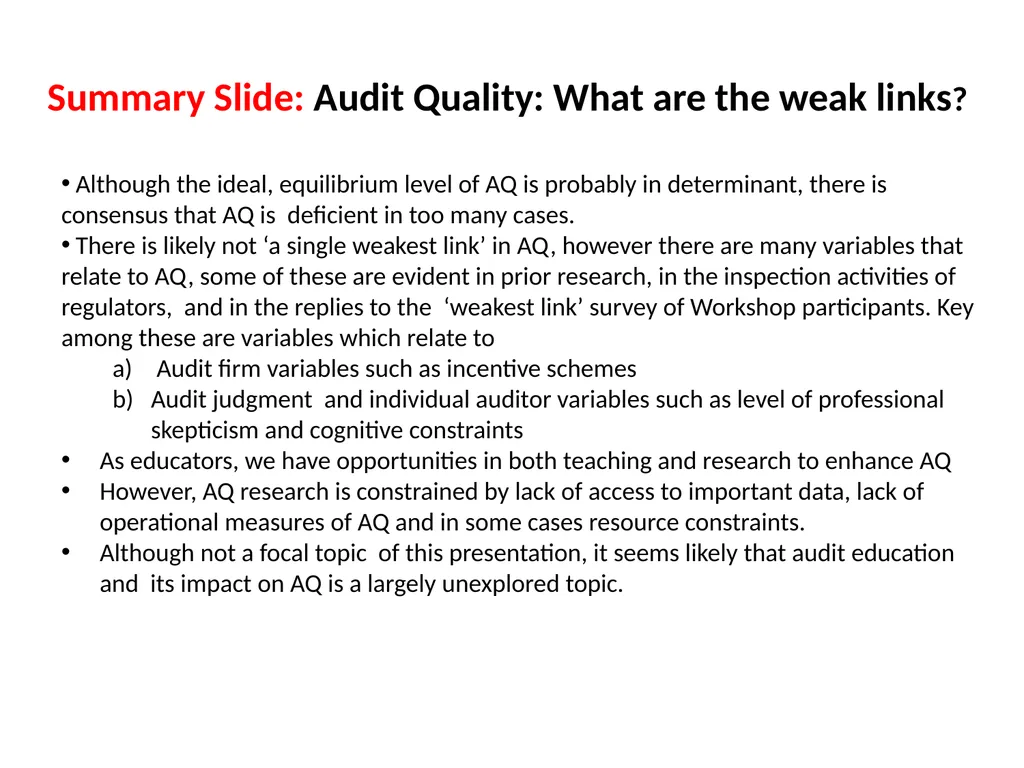
Summary Slide: Audit Quality: What are the weak links? Although the ideal, equilibrium level of AQ is probably in determinant, there is consensus that AQ is deficient in too many cases.
There is likely not ‘a single weakest link’ in AQ, however there are many variables that relate to AQ, some of these are evident in prior research, in the inspection activities of regulators, and in the replies to the ‘weakest link’ survey of Workshop participants. Key among these are variables which relate to
Audit firm variables such as incentive schemes
Audit judgment and individual auditor variables such as level of professional skepticism and cognitive constraints
As educators, we have opportunities in both teaching and research to enhance AQ
However, AQ research is constrained by lack of access to important data, lack of operational measures of AQ and in some cases resource constraints.
Although not a focal topic of this presentation, it seems likely that audit education and its impact on AQ is a largely unexplored topic.<br>
There is likely not ‘a single weakest link’ in AQ, however there are many variables that relate to AQ, some of these are evident in prior research, in the inspection activities of regulators, and in the replies to the ‘weakest link’ survey of Workshop participants. Key among these are variables which relate to
Audit firm variables such as incentive schemes
Audit judgment and individual auditor variables such as level of professional skepticism and cognitive constraints
As educators, we have opportunities in both teaching and research to enhance AQ
However, AQ research is constrained by lack of access to important data, lack of operational measures of AQ and in some cases resource constraints.
Although not a focal topic of this presentation, it seems likely that audit education and its impact on AQ is a largely unexplored topic.<br>
24
Questions, Comments, Suggestions?
tmock@ucr.edu<br>
25
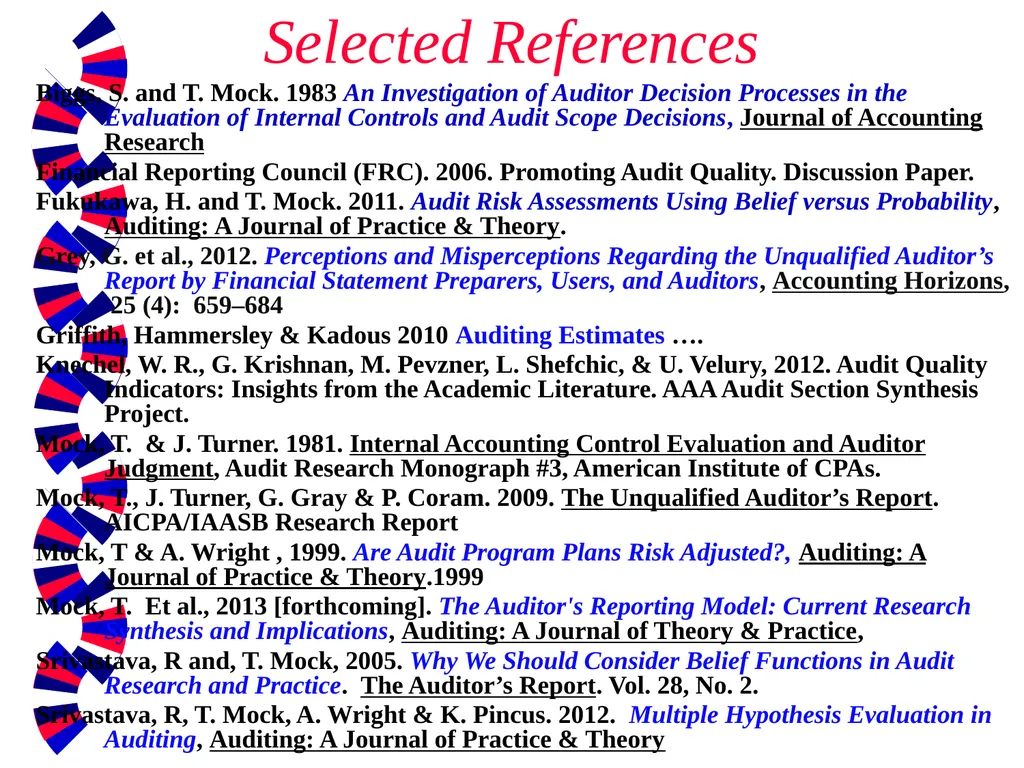
Selected References Biggs, S. and T. Mock. 1983 An Investigation of Auditor Decision Processes in the Evaluation of Internal Controls and Audit Scope Decisions, Journal of Accounting Research
Financial Reporting Council (FRC). 2006. Promoting Audit Quality. Discussion Paper.
Fukukawa, H. and T. Mock. 2011. Audit Risk Assessments Using Belief versus Probability, Auditing: A Journal of Practice & Theory.
Grey, G. et al., 2012. Perceptions and Misperceptions Regarding the Unqualified Auditor’s Report by Financial Statement Preparers, Users, and Auditors, Accounting Horizons, 25 (4): 659–684
Griffith, Hammersley & Kadous 2010 Auditing Estimates ….
Knechel, W. R., G. Krishnan, M. Pevzner, L. Shefchic, & U. Velury, 2012. Audit Quality Indicators: Insights from the Academic Literature. AAA Audit Section Synthesis Project.
Mock, T. & J. Turner. 1981. Internal Accounting Control Evaluation and Auditor Judgment, Audit Research Monograph #3, American Institute of CPAs.
Mock, T., J. Turner, G. Gray & P. Coram. 2009. The Unqualified Auditor’s Report. AICPA/IAASB Research Report
Mock, T & A. Wright , 1999. Are Audit Program Plans Risk Adjusted?, Auditing: A Journal of Practice & Theory.1999
Mock, T. Et al., 2013 [forthcoming]. The Auditor's Reporting Model: Current Research Synthesis and Implications, Auditing: A Journal of Theory & Practice,
Srivastava, R and, T. Mock, 2005. Why We Should Consider Belief Functions in Audit Research and Practice. The Auditor’s Report. Vol. 28, No. 2.
Srivastava, R, T. Mock, A. Wright & K. Pincus. 2012. Multiple Hypothesis Evaluation in Auditing, Auditing: A Journal of Practice & Theory<br>
Financial Reporting Council (FRC). 2006. Promoting Audit Quality. Discussion Paper.
Fukukawa, H. and T. Mock. 2011. Audit Risk Assessments Using Belief versus Probability, Auditing: A Journal of Practice & Theory.
Grey, G. et al., 2012. Perceptions and Misperceptions Regarding the Unqualified Auditor’s Report by Financial Statement Preparers, Users, and Auditors, Accounting Horizons, 25 (4): 659–684
Griffith, Hammersley & Kadous 2010 Auditing Estimates ….
Knechel, W. R., G. Krishnan, M. Pevzner, L. Shefchic, & U. Velury, 2012. Audit Quality Indicators: Insights from the Academic Literature. AAA Audit Section Synthesis Project.
Mock, T. & J. Turner. 1981. Internal Accounting Control Evaluation and Auditor Judgment, Audit Research Monograph #3, American Institute of CPAs.
Mock, T., J. Turner, G. Gray & P. Coram. 2009. The Unqualified Auditor’s Report. AICPA/IAASB Research Report
Mock, T & A. Wright , 1999. Are Audit Program Plans Risk Adjusted?, Auditing: A Journal of Practice & Theory.1999
Mock, T. Et al., 2013 [forthcoming]. The Auditor's Reporting Model: Current Research Synthesis and Implications, Auditing: A Journal of Theory & Practice,
Srivastava, R and, T. Mock, 2005. Why We Should Consider Belief Functions in Audit Research and Practice. The Auditor’s Report. Vol. 28, No. 2.
Srivastava, R, T. Mock, A. Wright & K. Pincus. 2012. Multiple Hypothesis Evaluation in Auditing, Auditing: A Journal of Practice & Theory<br>