
AUDITING STANDARDS APPLICABLE FOR PRIVATE
MY
Published · 60 slides · 0 views

1 / 1




Description
AUDITING STANDARDS APPLICABLE FOR PRIVATE COMPANIES By K P Srinivas, FCA Partner Varma Varma Chartered Accountants ICAI, BANGALORE 22nd MAY, 2019 SEC 143(9) AND143(10) OF COMPANIES ACT, 2013 Sec 143(9) -Every auditor shall comply with the
Related Topics
Share
Embed code
Download this presentation From Below
"AUDITING STANDARDS APPLICABLE FOR PRIVATE" is the property of its rightful owner. Permission is granted to download and print the materials on this website for personal, non-commercial use only, and to display it on your personal computer provided you do not modify the materials and that you retain all copyright notices contained in the materials. By downloading content from our website, you accept the terms of this agreement.
Presentation Transcript
01
AUDITING STANDARDS APPLICABLE FOR PRIVATE COMPANIES
By
K P Srinivas, FCA
Partner
Varma & Varma
Chartered Accountants ICAI, BANGALORE 22nd MAY, 2019<br>
02
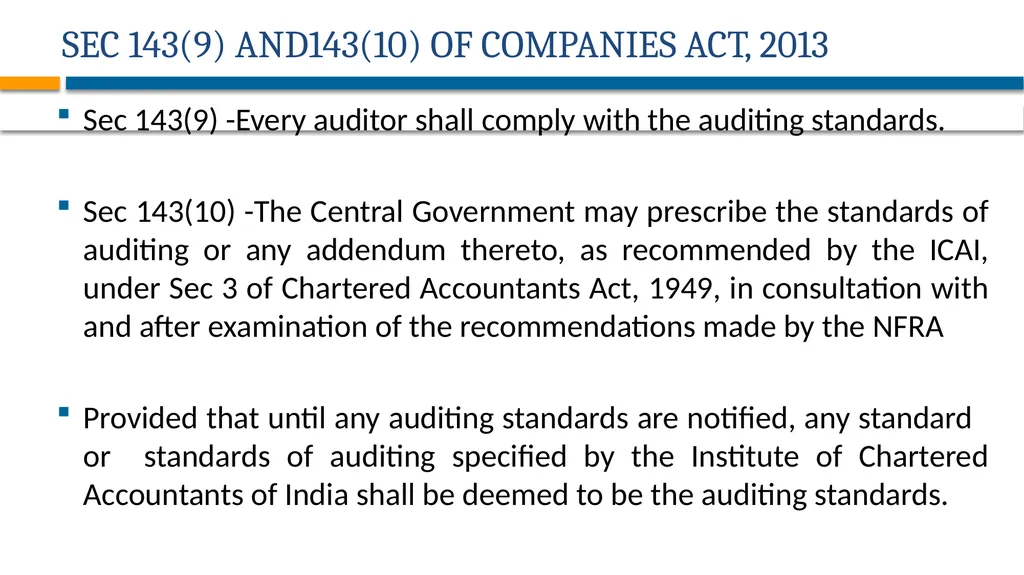
SEC 143(9) AND143(10) OF COMPANIES ACT, 2013 Sec 143(9) -Every auditor shall comply with the auditing standards.
Sec 143(10) -The Central Government may prescribe the standards of auditing or any addendum thereto, as recommended by the ICAI, under Sec 3 of Chartered Accountants Act, 1949, in consultation with and after examination of the recommendations made by the NFRA
Provided that until any auditing standards are notified, any standard or standards of auditing specified by the Institute of Chartered Accountants of India shall be deemed to be the auditing standards. 2<br>
Sec 143(10) -The Central Government may prescribe the standards of auditing or any addendum thereto, as recommended by the ICAI, under Sec 3 of Chartered Accountants Act, 1949, in consultation with and after examination of the recommendations made by the NFRA
Provided that until any auditing standards are notified, any standard or standards of auditing specified by the Institute of Chartered Accountants of India shall be deemed to be the auditing standards. 2<br>
03
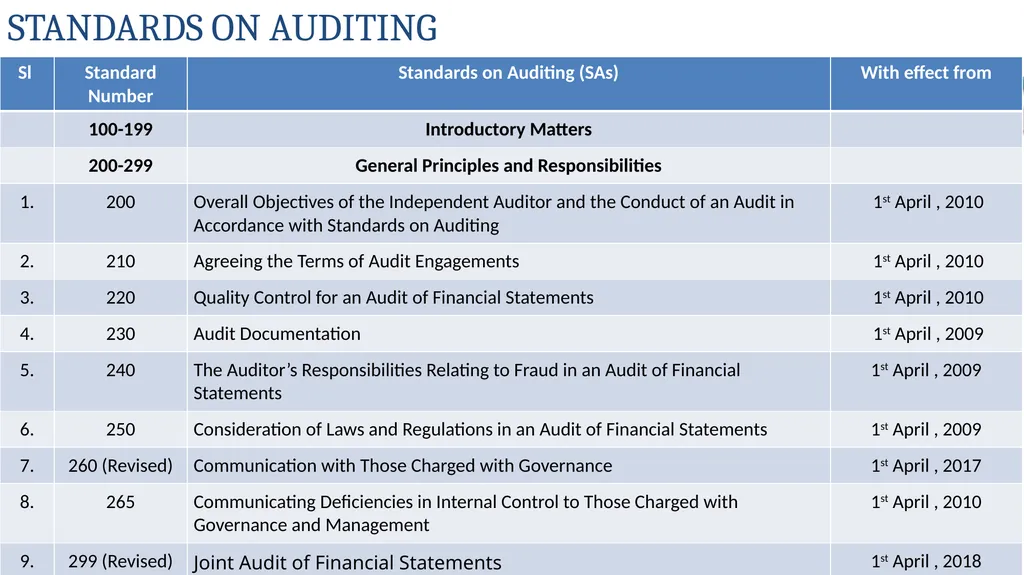
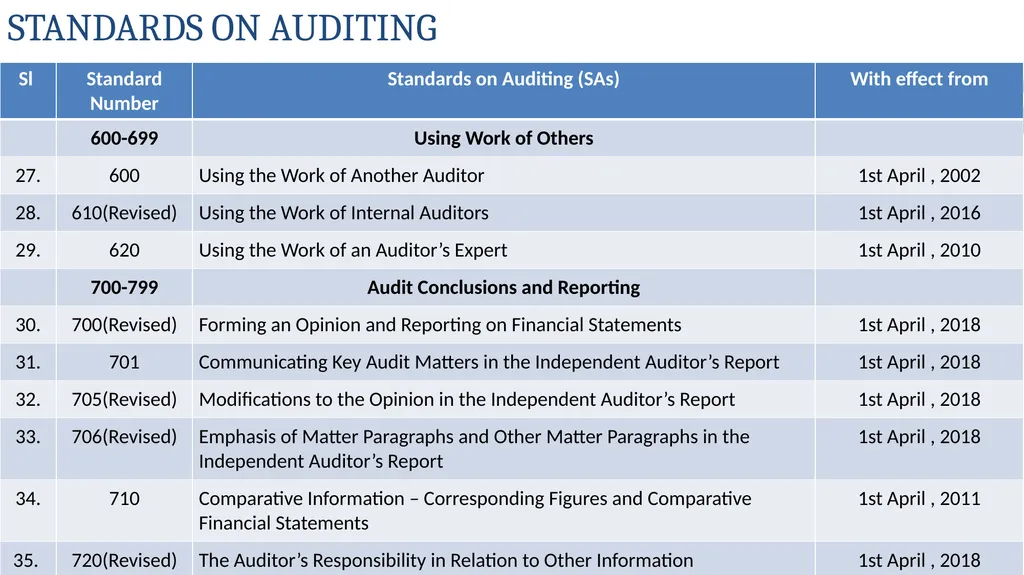
STANDARDS ON AUDITING<br>
04
STANDARDS ON AUDITING<br>
05
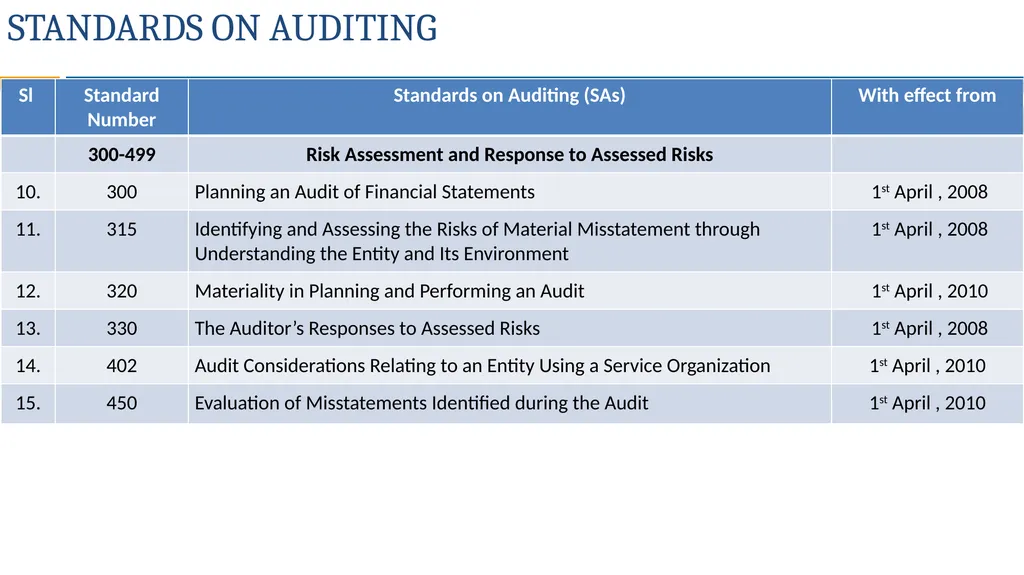
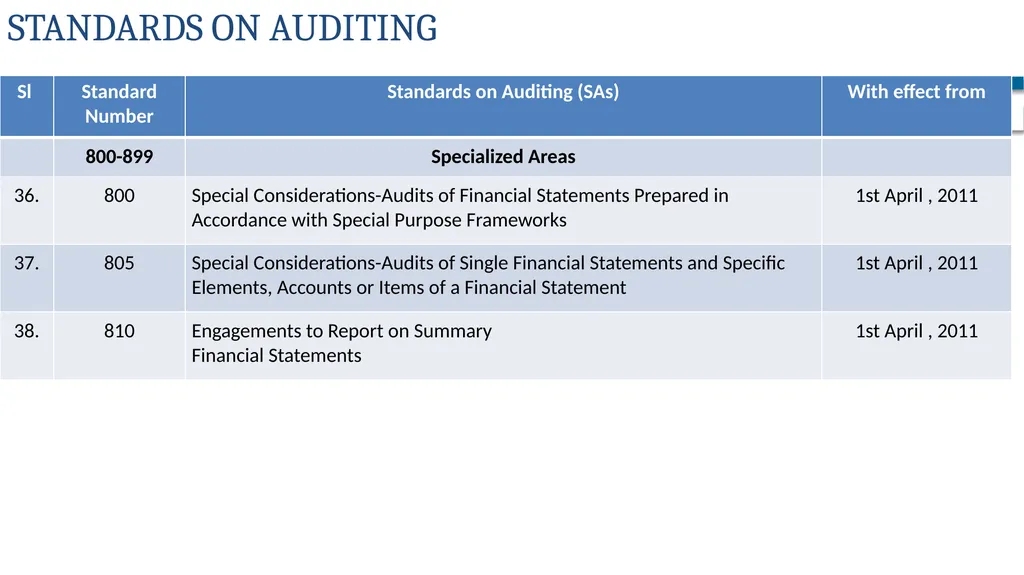
STANDARDS ON AUDITING<br>
06
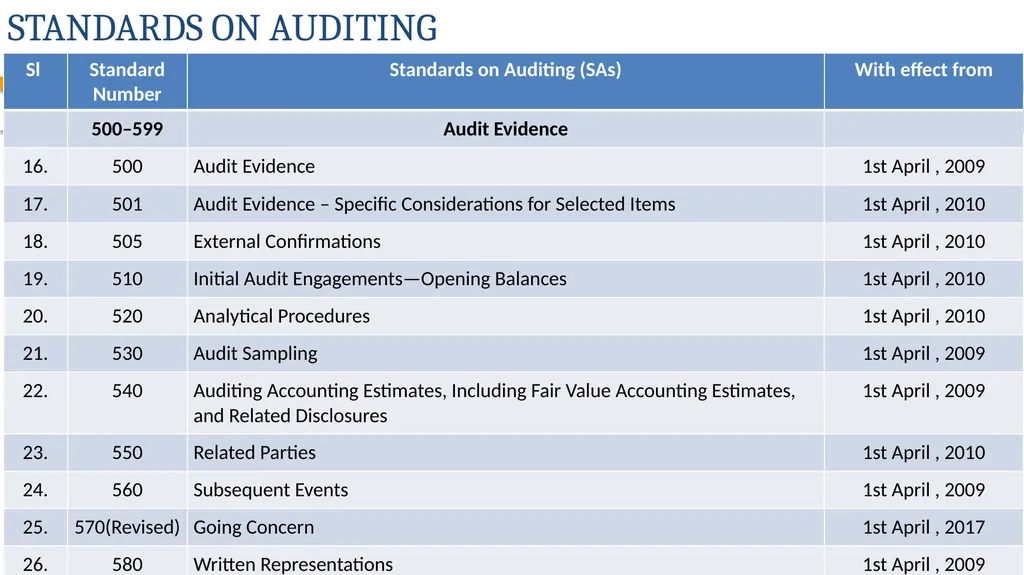
STANDARDS ON AUDITING<br>
07
STANDARDS ON AUDITING<br>
08
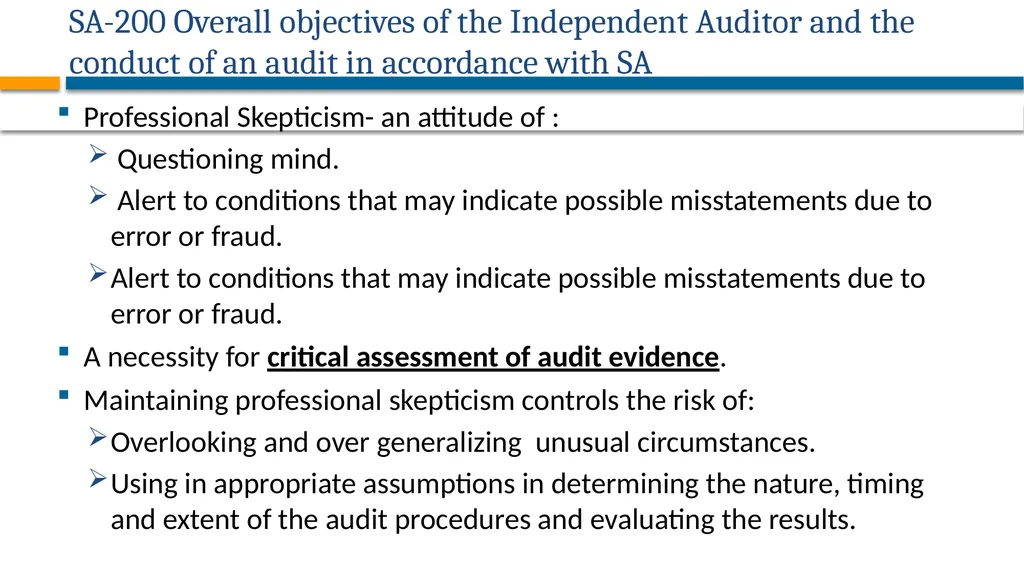
SA-200 Overall objectives of the Independent Auditor and the conduct of an audit in accordance with SA Professional Skepticism- an attitude of :
Questioning mind.
Alert to conditions that may indicate possible misstatements due to error or fraud.
Alert to conditions that may indicate possible misstatements due to error or fraud.
A necessity for critical assessment of audit evidence.
Maintaining professional skepticism controls the risk of:
Overlooking and over generalizing unusual circumstances.
Using in appropriate assumptions in determining the nature, timing and extent of the audit procedures and evaluating the results.<br>
Questioning mind.
Alert to conditions that may indicate possible misstatements due to error or fraud.
Alert to conditions that may indicate possible misstatements due to error or fraud.
A necessity for critical assessment of audit evidence.
Maintaining professional skepticism controls the risk of:
Overlooking and over generalizing unusual circumstances.
Using in appropriate assumptions in determining the nature, timing and extent of the audit procedures and evaluating the results.<br>
09
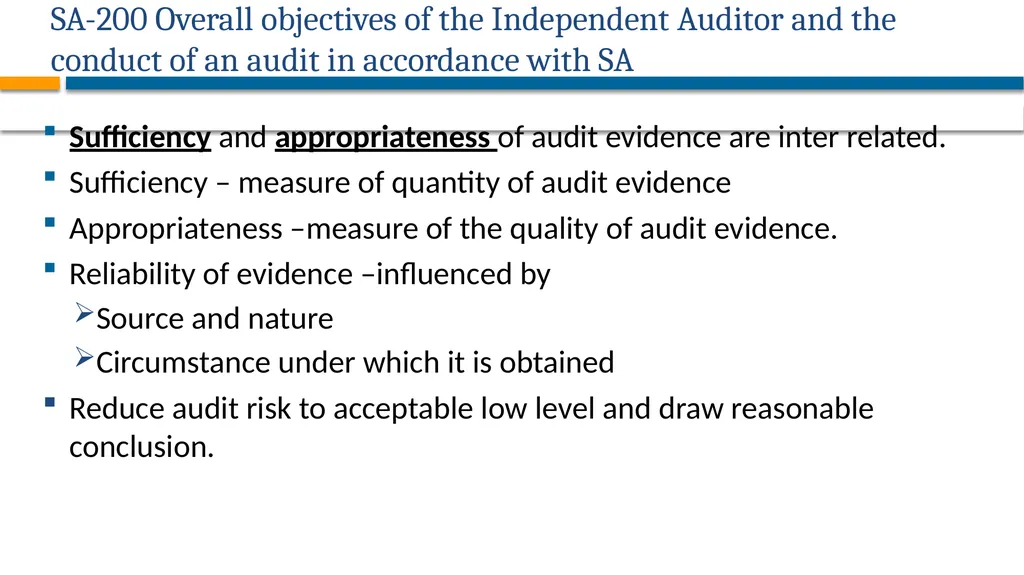
SA-200 Overall objectives of the Independent Auditor and the conduct of an audit in accordance with SA Sufficiency and appropriateness of audit evidence are inter related.
Sufficiency – measure of quantity of audit evidence
Appropriateness –measure of the quality of audit evidence.
Reliability of evidence –influenced by
Source and nature
Circumstance under which it is obtained
Reduce audit risk to acceptable low level and draw reasonable conclusion. 9<br>
Sufficiency – measure of quantity of audit evidence
Appropriateness –measure of the quality of audit evidence.
Reliability of evidence –influenced by
Source and nature
Circumstance under which it is obtained
Reduce audit risk to acceptable low level and draw reasonable conclusion. 9<br>
10
SA-210 Agreeing the terms of Audit Engagement Engagement letter (E L) before the commencement of the audit
E L – cover both the responsibilities of the auditor and the management.
Contents of audit engagement letter:
The objective and scope of the audit of the Financial statements:
The responsibilities of the auditor
The responsibilities of management
Identification of the applicable financial reporting framework
Reference to the expected form and content of any report to be issued by the auditor and a statement there may be circumstances in which a report may differ from its expected form 10<br>
E L – cover both the responsibilities of the auditor and the management.
Contents of audit engagement letter:
The objective and scope of the audit of the Financial statements:
The responsibilities of the auditor
The responsibilities of management
Identification of the applicable financial reporting framework
Reference to the expected form and content of any report to be issued by the auditor and a statement there may be circumstances in which a report may differ from its expected form 10<br>
11
SA-230 Audit Documentation Wrong assumption that documentation means taking everything that allows him to derive audit conclusions.
Examples of over documentation:-
Full documents relating to all Sales
Full documents relating to all purchases
Taking entire dump of data
Normally, superseded documents shall not be assembled in the audit work papers. Only the final draft to be placed for documentation purpose. 11<br>
Examples of over documentation:-
Full documents relating to all Sales
Full documents relating to all purchases
Taking entire dump of data
Normally, superseded documents shall not be assembled in the audit work papers. Only the final draft to be placed for documentation purpose. 11<br>
12
SA-230 Audit Documentation Examples of Documentation issues:-
Handwritten notes and observations
Areas of significant matters arising out of audit not recorded.
Not maintaining documentary record to show the control activities.
Failure to dispose off internal audit report observations.
No records of work allocation maintained.
Lack of adequate documentation for points of audit report.
No evidence to suffice involvement of engagement partner in the audit. 12<br>
Handwritten notes and observations
Areas of significant matters arising out of audit not recorded.
Not maintaining documentary record to show the control activities.
Failure to dispose off internal audit report observations.
No records of work allocation maintained.
Lack of adequate documentation for points of audit report.
No evidence to suffice involvement of engagement partner in the audit. 12<br>
13
SA-230 Audit Documentation Examples of Documentation issues:-
Having documentation for certain areas and not having for others although both the works are similar.
Not having and keeping quality control for engagements.
Lack of basis of important items of Financial statements.
Correlating planning, execution and conclusion seamlessly.
Inconsistency between CARO and the financial statements
Not following points stated in SQC Manual of the firm.
No adequate documentation regarding declaration of independence by the audit team. 13<br>
Having documentation for certain areas and not having for others although both the works are similar.
Not having and keeping quality control for engagements.
Lack of basis of important items of Financial statements.
Correlating planning, execution and conclusion seamlessly.
Inconsistency between CARO and the financial statements
Not following points stated in SQC Manual of the firm.
No adequate documentation regarding declaration of independence by the audit team. 13<br>
14
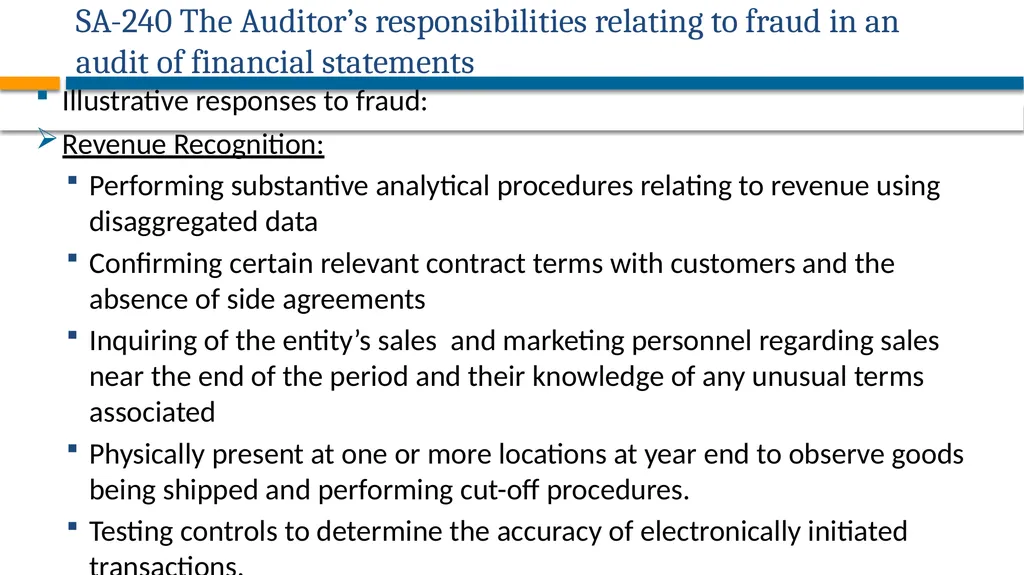
SA-240 The Auditor’s responsibilities relating to fraud in an audit of financial statements Illustrative responses to fraud:
Revenue Recognition:
Performing substantive analytical procedures relating to revenue using disaggregated data
Confirming certain relevant contract terms with customers and the absence of side agreements
Inquiring of the entity’s sales and marketing personnel regarding sales near the end of the period and their knowledge of any unusual terms associated
Physically present at one or more locations at year end to observe goods being shipped and performing cut-off procedures.
Testing controls to determine the accuracy of electronically initiated transactions. 14<br>
Revenue Recognition:
Performing substantive analytical procedures relating to revenue using disaggregated data
Confirming certain relevant contract terms with customers and the absence of side agreements
Inquiring of the entity’s sales and marketing personnel regarding sales near the end of the period and their knowledge of any unusual terms associated
Physically present at one or more locations at year end to observe goods being shipped and performing cut-off procedures.
Testing controls to determine the accuracy of electronically initiated transactions. 14<br>
15
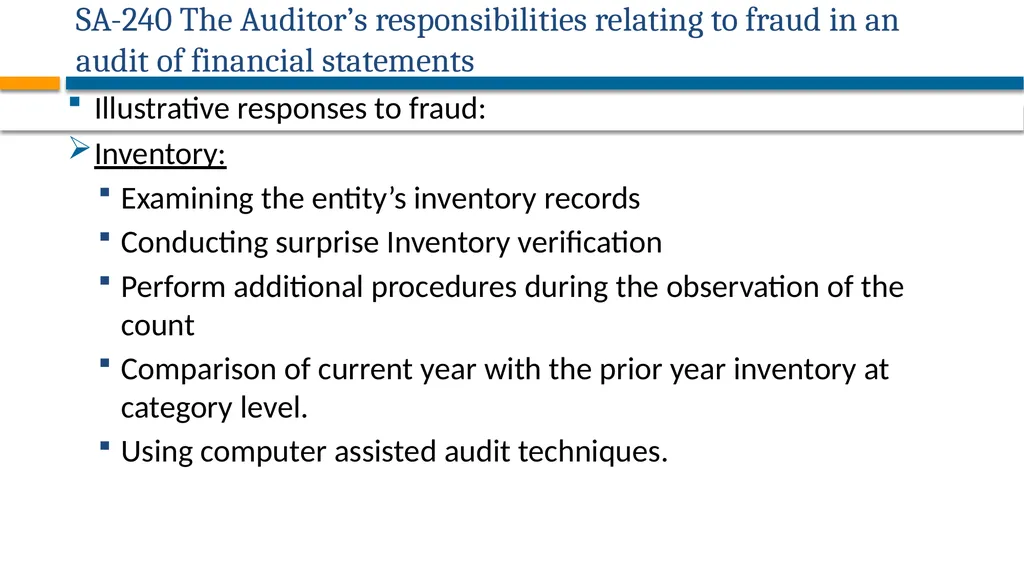
SA-240 The Auditor’s responsibilities relating to fraud in an audit of financial statements Illustrative responses to fraud:
Inventory:
Examining the entity’s inventory records
Conducting surprise Inventory verification
Perform additional procedures during the observation of the count
Comparison of current year with the prior year inventory at category level.
Using computer assisted audit techniques. 15<br>
Inventory:
Examining the entity’s inventory records
Conducting surprise Inventory verification
Perform additional procedures during the observation of the count
Comparison of current year with the prior year inventory at category level.
Using computer assisted audit techniques. 15<br>
16
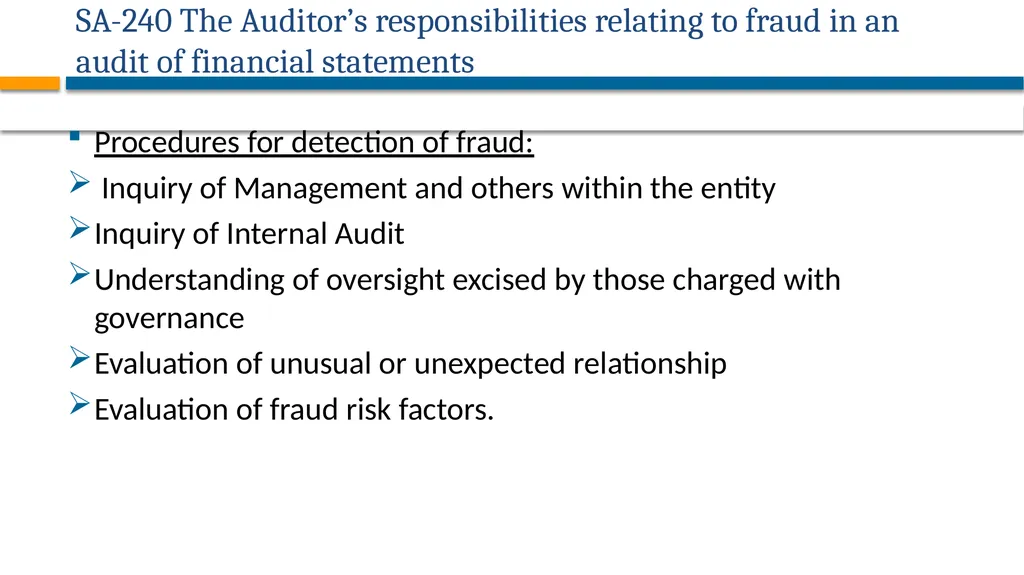
SA-240 The Auditor’s responsibilities relating to fraud in an audit of financial statements Procedures for detection of fraud:
Inquiry of Management and others within the entity
Inquiry of Internal Audit
Understanding of oversight excised by those charged with governance
Evaluation of unusual or unexpected relationship
Evaluation of fraud risk factors. 16<br>
Inquiry of Management and others within the entity
Inquiry of Internal Audit
Understanding of oversight excised by those charged with governance
Evaluation of unusual or unexpected relationship
Evaluation of fraud risk factors. 16<br>
17
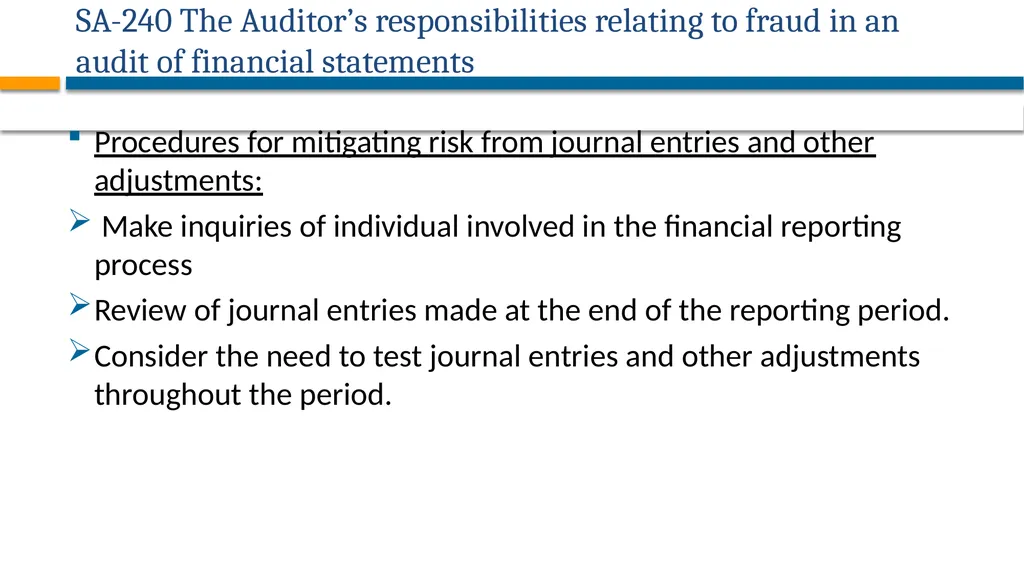
SA-240 The Auditor’s responsibilities relating to fraud in an audit of financial statements Procedures for mitigating risk from journal entries and other adjustments:
Make inquiries of individual involved in the financial reporting process
Review of journal entries made at the end of the reporting period.
Consider the need to test journal entries and other adjustments throughout the period. 17<br>
Make inquiries of individual involved in the financial reporting process
Review of journal entries made at the end of the reporting period.
Consider the need to test journal entries and other adjustments throughout the period. 17<br>
18
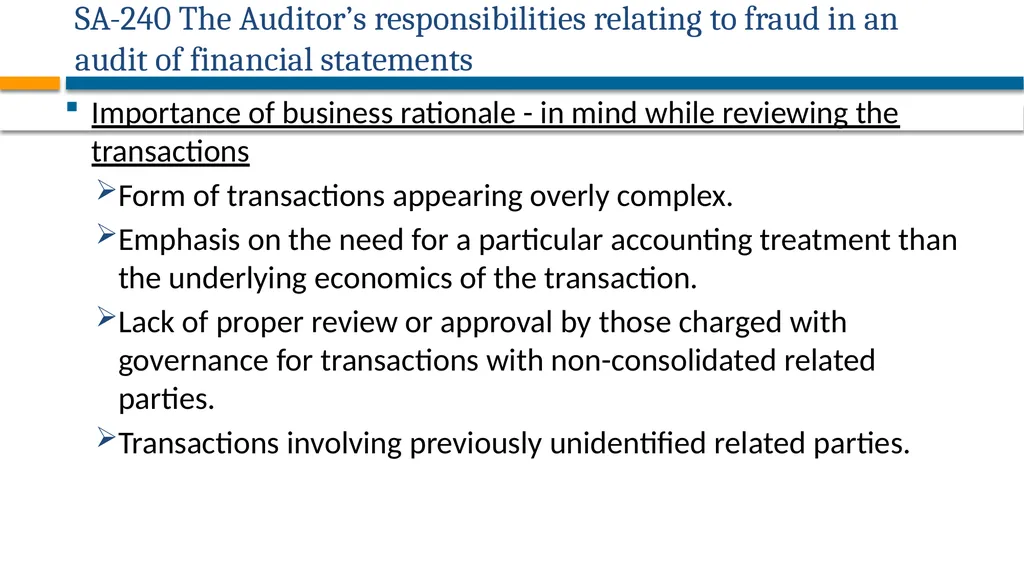
SA-240 The Auditor’s responsibilities relating to fraud in an audit of financial statements Importance of business rationale - in mind while reviewing the transactions
Form of transactions appearing overly complex.
Emphasis on the need for a particular accounting treatment than the underlying economics of the transaction.
Lack of proper review or approval by those charged with governance for transactions with non-consolidated related parties.
Transactions involving previously unidentified related parties. 18<br>
Form of transactions appearing overly complex.
Emphasis on the need for a particular accounting treatment than the underlying economics of the transaction.
Lack of proper review or approval by those charged with governance for transactions with non-consolidated related parties.
Transactions involving previously unidentified related parties. 18<br>
19
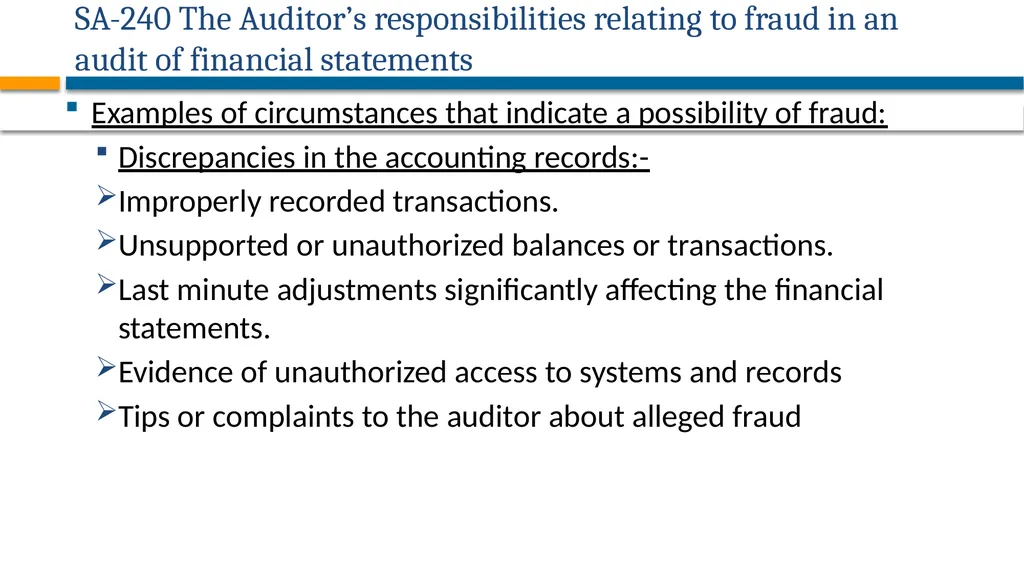
SA-240 The Auditor’s responsibilities relating to fraud in an audit of financial statements Examples of circumstances that indicate a possibility of fraud:
Discrepancies in the accounting records:-
Improperly recorded transactions.
Unsupported or unauthorized balances or transactions.
Last minute adjustments significantly affecting the financial statements.
Evidence of unauthorized access to systems and records
Tips or complaints to the auditor about alleged fraud 19<br>
Discrepancies in the accounting records:-
Improperly recorded transactions.
Unsupported or unauthorized balances or transactions.
Last minute adjustments significantly affecting the financial statements.
Evidence of unauthorized access to systems and records
Tips or complaints to the auditor about alleged fraud 19<br>
20
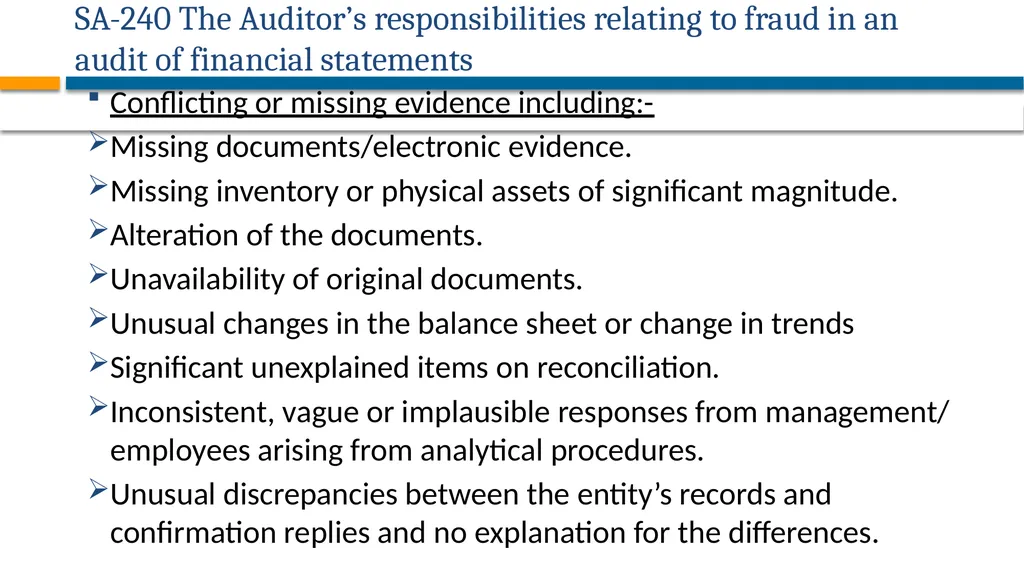
SA-240 The Auditor’s responsibilities relating to fraud in an audit of financial statements Conflicting or missing evidence including:-
Missing documents/electronic evidence.
Missing inventory or physical assets of significant magnitude.
Alteration of the documents.
Unavailability of original documents.
Unusual changes in the balance sheet or change in trends
Significant unexplained items on reconciliation.
Inconsistent, vague or implausible responses from management/ employees arising from analytical procedures.
Unusual discrepancies between the entity’s records and confirmation replies and no explanation for the differences. 20<br>
Missing documents/electronic evidence.
Missing inventory or physical assets of significant magnitude.
Alteration of the documents.
Unavailability of original documents.
Unusual changes in the balance sheet or change in trends
Significant unexplained items on reconciliation.
Inconsistent, vague or implausible responses from management/ employees arising from analytical procedures.
Unusual discrepancies between the entity’s records and confirmation replies and no explanation for the differences. 20<br>
21
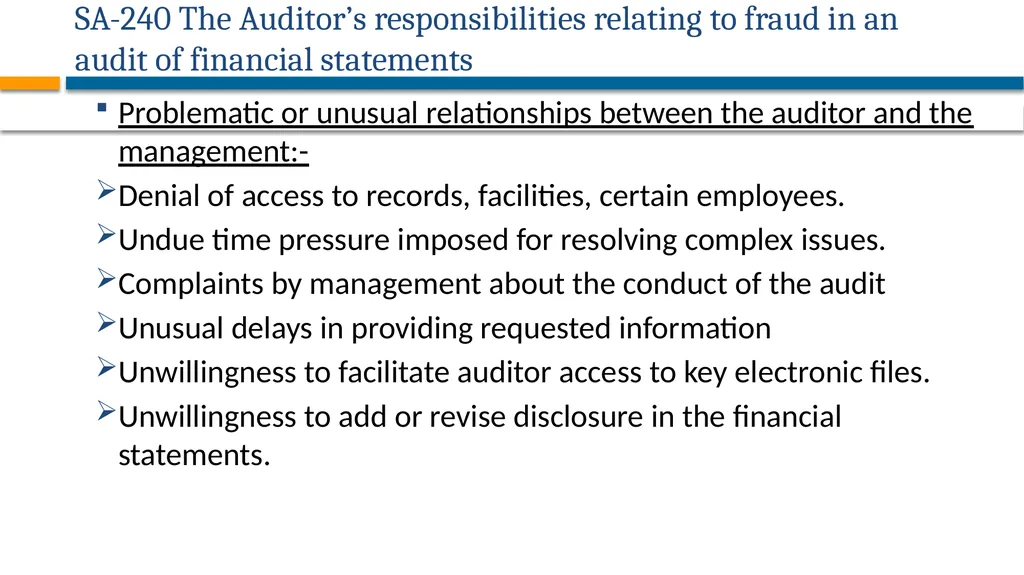
SA-240 The Auditor’s responsibilities relating to fraud in an audit of financial statements Problematic or unusual relationships between the auditor and the management:-
Denial of access to records, facilities, certain employees.
Undue time pressure imposed for resolving complex issues.
Complaints by management about the conduct of the audit
Unusual delays in providing requested information
Unwillingness to facilitate auditor access to key electronic files.
Unwillingness to add or revise disclosure in the financial statements. 21<br>
Denial of access to records, facilities, certain employees.
Undue time pressure imposed for resolving complex issues.
Complaints by management about the conduct of the audit
Unusual delays in providing requested information
Unwillingness to facilitate auditor access to key electronic files.
Unwillingness to add or revise disclosure in the financial statements. 21<br>
22
SA-240 The Auditor’s responsibilities relating to fraud in an audit of financial statements Other matters:-
Accounting policies appear to be at variance with industry norms.
Frequent changes in accounting estimates.
Tolerance of violations of the entity’s code of conduct.
Denial of access to records, facilities, certain employees. 22<br>
Accounting policies appear to be at variance with industry norms.
Frequent changes in accounting estimates.
Tolerance of violations of the entity’s code of conduct.
Denial of access to records, facilities, certain employees. 22<br>
23
SA-250 Considerations of Laws and Regulations in an audit of Financial statements Auditor’s responsibility with regards to compliance with laws and regulation:-
Ensure that non-compliance of laws and regulations shall not result in material misstatement
Detect non-compliances even if immaterial which may affect other aspects of audit such as integrity of management / employees.
Legal determination of non compliance which is beyond the auditor’s professional competence.
Report in accordance with specific statutory requirements. 23<br>
Ensure that non-compliance of laws and regulations shall not result in material misstatement
Detect non-compliances even if immaterial which may affect other aspects of audit such as integrity of management / employees.
Legal determination of non compliance which is beyond the auditor’s professional competence.
Report in accordance with specific statutory requirements. 23<br>
24
SA-250 Considerations of Laws and Regulations in an audit of Financial statements Procedure to identify non compliance:-
Inquiries from management and those charged with governance.
Reading minutes
Inquiries with internal and external legal counsel
Substantive test on classes of transactions, account balances and disclosures.
Inspecting correspondence , if any, with relevant licensing and regulatory authorities. 24<br>
Inquiries from management and those charged with governance.
Reading minutes
Inquiries with internal and external legal counsel
Substantive test on classes of transactions, account balances and disclosures.
Inspecting correspondence , if any, with relevant licensing and regulatory authorities. 24<br>
25
SA-250 Considerations of Laws and Regulations in an audit of Financial statements Indicative matters for non compliance:-
Investigations by regulatory organizations and government departments or payment of fines/ penalties.
Payments for unspecified services or loans to consultants, related parties, employees or government employees.
Purchasing at prices significantly above or below market price
Unusual payments towards legal and retainership fees.
Unusual transactions with companies registered in tax havens.
Payments without proper FEMA documentation
Adverse media comment. 25<br>
Investigations by regulatory organizations and government departments or payment of fines/ penalties.
Payments for unspecified services or loans to consultants, related parties, employees or government employees.
Purchasing at prices significantly above or below market price
Unusual payments towards legal and retainership fees.
Unusual transactions with companies registered in tax havens.
Payments without proper FEMA documentation
Adverse media comment. 25<br>
26
SA-260 Communication with those charged with
Governance (Revised) Importance of communication between the auditor and those charged with governance:-
To understand matters related to the audit in context and developing a constructive working relationship.
For obtaining information related to the audit from those charged with governance.
Assisting those charged with governance in fulfilling their responsibility to oversee the financial reporting process. 26<br>
To understand matters related to the audit in context and developing a constructive working relationship.
For obtaining information related to the audit from those charged with governance.
Assisting those charged with governance in fulfilling their responsibility to oversee the financial reporting process. 26<br>
27
SA-260 Communication with those charged with
Governance (Revised) Objectives of the auditor under this SA:-
Communicate the responsibilities to those charged with governance in relation to the financial statement audit;
To obtain from those charged with governance, information relevant to the audit;
To provide those charged with governance with timely observations arising from the audit that are significant and relevant to their responsibility to oversee the financial reporting process; and
To promote effective two-way communication between the auditor and those charged with governance. 27<br>
Communicate the responsibilities to those charged with governance in relation to the financial statement audit;
To obtain from those charged with governance, information relevant to the audit;
To provide those charged with governance with timely observations arising from the audit that are significant and relevant to their responsibility to oversee the financial reporting process; and
To promote effective two-way communication between the auditor and those charged with governance. 27<br>
28
SA-260 Communication with those charged with Governance (Revised) Matters to be communicated to those charged with governance:-
The auditor’s responsibilities in relation to the financial statement audit.
Planned scope and timing of the audit.
Auditor’s approach to internal control relevant to the audit.
The application of the concept of materiality in the context of an audit.
Nature and extent of specialized skill or knowledge need to perform the audit.
Auditor’s independence. 28<br>
The auditor’s responsibilities in relation to the financial statement audit.
Planned scope and timing of the audit.
Auditor’s approach to internal control relevant to the audit.
The application of the concept of materiality in the context of an audit.
Nature and extent of specialized skill or knowledge need to perform the audit.
Auditor’s independence. 28<br>
29
SA-260 Communication with those charged with Governance (Revised) Auditor’s responsibilities that shall be communicated to those charged with governance:-
Responsible for forming and expressing an opinion on the financial statements.
Audit of the financial statements does not relieve management or those charged with governance of their responsibilities. 29<br>
Responsible for forming and expressing an opinion on the financial statements.
Audit of the financial statements does not relieve management or those charged with governance of their responsibilities. 29<br>
30
SA-260 Communication with those charged with Governance (Revised) Matters relating to planning that shall be discussed with those charged with governance:-
How the external and internal auditor can work together in a constructive and complementary manner
The appropriate person(s) with whom the auditor shall communicate.
The allocation of responsibilities between those charged with governance and management.
The entity’s objectives and strategies, and the related business risks which may result in material misstatements. 30<br>
How the external and internal auditor can work together in a constructive and complementary manner
The appropriate person(s) with whom the auditor shall communicate.
The allocation of responsibilities between those charged with governance and management.
The entity’s objectives and strategies, and the related business risks which may result in material misstatements. 30<br>
31
SA-260 Communication with those charged with Governance (Revised) Matters relating to planning that shall be discussed with those charged with governance:-
The actions of those charged with governance in response to developments in accounting standards,
The responses of those charged with governance to previous communications with the auditor. 31<br>
The actions of those charged with governance in response to developments in accounting standards,
The responses of those charged with governance to previous communications with the auditor. 31<br>
32
SA-260 Communication with those charged with Governances (Revised) Documentation requirements under the SA:-
Audit documentation of the matters communicated orally.
When and to whom the matter was communicated.
Retaining a copy of the communication as a part of audit documentation. 32<br>
Audit documentation of the matters communicated orally.
When and to whom the matter was communicated.
Retaining a copy of the communication as a part of audit documentation. 32<br>
33
QRB Reports The Report highlights the key findings observed in the audit quality reviews conducted, the approach for review, overall trend, expectations and other focus areas in respect of various areas.
Key findings are reported as under ;
Standards on Auditing
Accounting Standards
Other Relevant Laws and Regulations including CARO. 33<br>
Key findings are reported as under ;
Standards on Auditing
Accounting Standards
Other Relevant Laws and Regulations including CARO. 33<br>
34
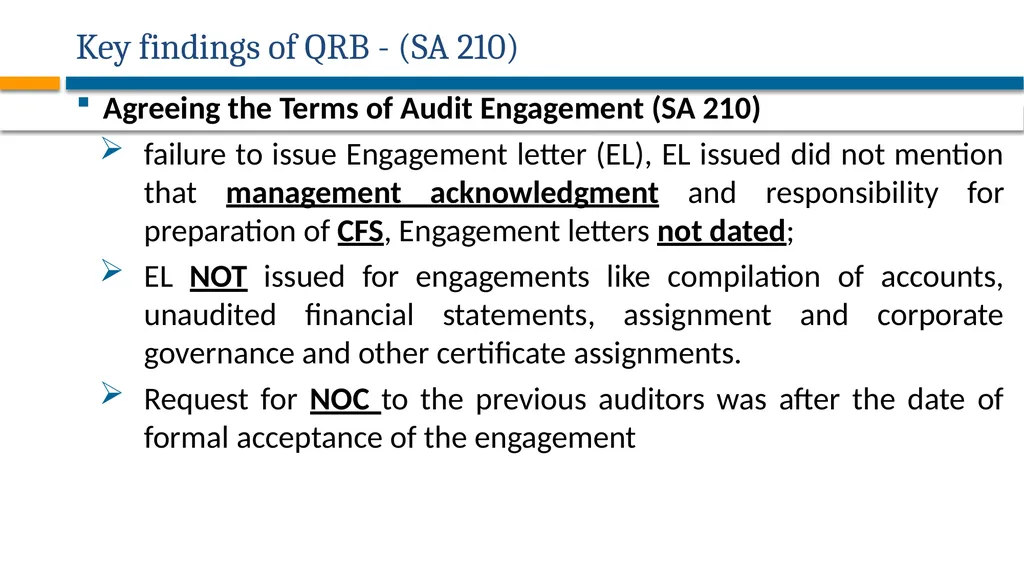
Key findings of QRB - (SA 210) Agreeing the Terms of Audit Engagement (SA 210)
failure to issue Engagement letter (EL), EL issued did not mention that management acknowledgment and responsibility for preparation of CFS, Engagement letters not dated;
EL NOT issued for engagements like compilation of accounts, unaudited financial statements, assignment and corporate governance and other certificate assignments.
Request for NOC to the previous auditors was after the date of formal acceptance of the engagement 34<br>
failure to issue Engagement letter (EL), EL issued did not mention that management acknowledgment and responsibility for preparation of CFS, Engagement letters not dated;
EL NOT issued for engagements like compilation of accounts, unaudited financial statements, assignment and corporate governance and other certificate assignments.
Request for NOC to the previous auditors was after the date of formal acceptance of the engagement 34<br>
35
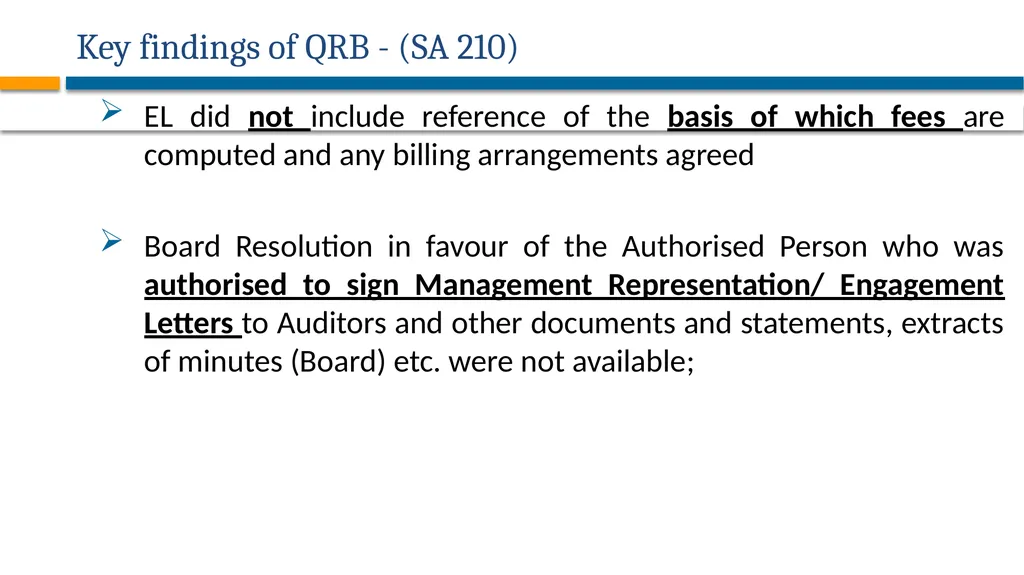
EL did not include reference of the basis of which fees are computed and any billing arrangements agreed
Board Resolution in favour of the Authorised Person who was authorised to sign Management Representation/ Engagement Letters to Auditors and other documents and statements, extracts of minutes (Board) etc. were not available; Key findings of QRB - (SA 210) 35<br>
Board Resolution in favour of the Authorised Person who was authorised to sign Management Representation/ Engagement Letters to Auditors and other documents and statements, extracts of minutes (Board) etc. were not available; Key findings of QRB - (SA 210) 35<br>
36
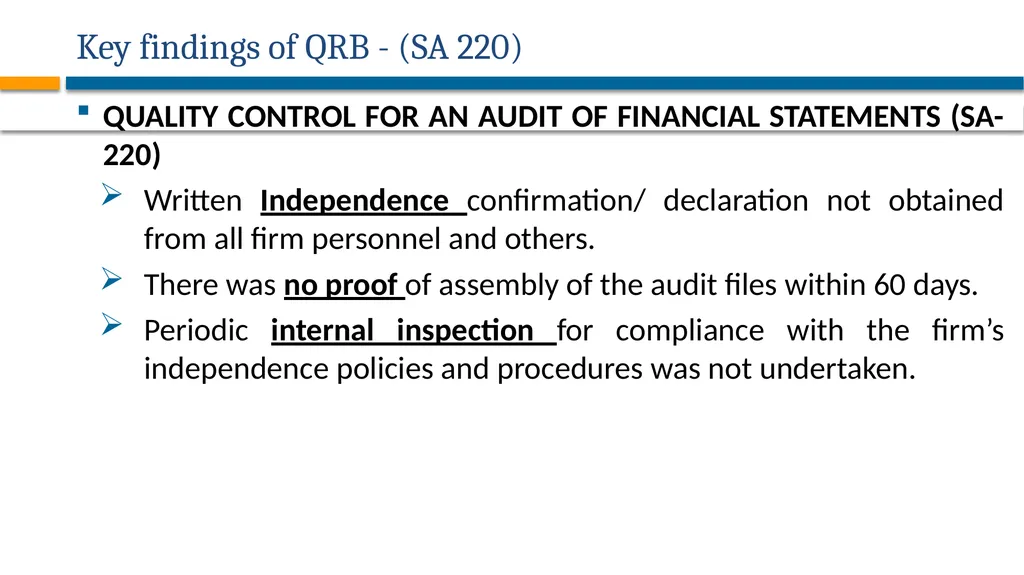
QUALITY CONTROL FOR AN AUDIT OF FINANCIAL STATEMENTS (SA- 220)
Written Independence confirmation/ declaration not obtained from all firm personnel and others.
There was no proof of assembly of the audit files within 60 days.
Periodic internal inspection for compliance with the firm’s independence policies and procedures was not undertaken. Key findings of QRB - (SA 220) 36<br>
Written Independence confirmation/ declaration not obtained from all firm personnel and others.
There was no proof of assembly of the audit files within 60 days.
Periodic internal inspection for compliance with the firm’s independence policies and procedures was not undertaken. Key findings of QRB - (SA 220) 36<br>
37
Minutes of the planning meetings of the partners and qualified staff/ assistants were not maintained.
Policies and procedures in accepting prospective client and assessing engagement risk not documented. Key findings of QRB - (SA 220) 37<br>
Policies and procedures in accepting prospective client and assessing engagement risk not documented. Key findings of QRB - (SA 220) 37<br>
38
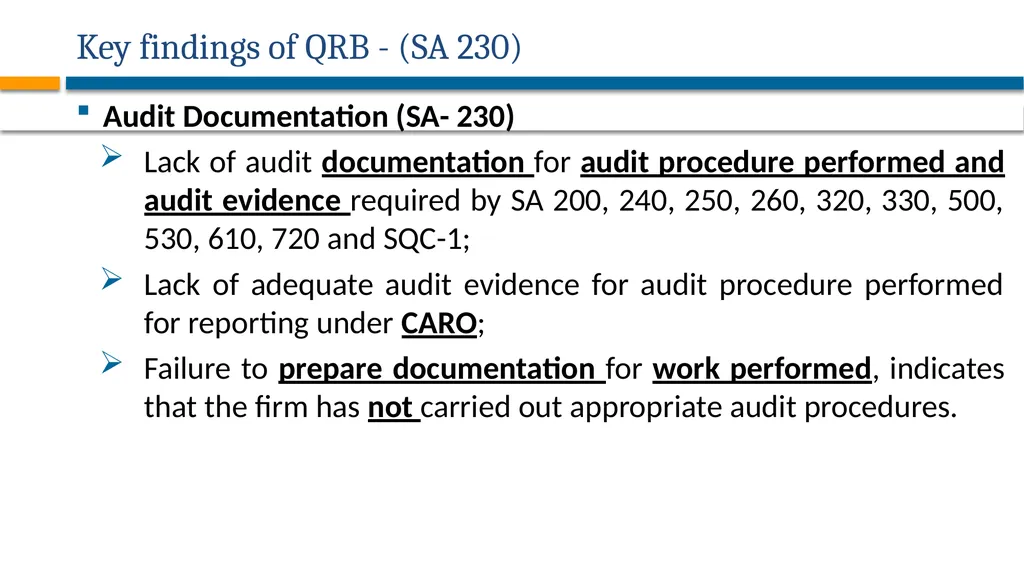
Audit Documentation (SA- 230)
Lack of audit documentation for audit procedure performed and audit evidence required by SA 200, 240, 250, 260, 320, 330, 500, 530, 610, 720 and SQC-1;
Lack of adequate audit evidence for audit procedure performed for reporting under CARO;
Failure to prepare documentation for work performed, indicates that the firm has not carried out appropriate audit procedures. Key findings of QRB - (SA 230) 38<br>
Lack of audit documentation for audit procedure performed and audit evidence required by SA 200, 240, 250, 260, 320, 330, 500, 530, 610, 720 and SQC-1;
Lack of adequate audit evidence for audit procedure performed for reporting under CARO;
Failure to prepare documentation for work performed, indicates that the firm has not carried out appropriate audit procedures. Key findings of QRB - (SA 230) 38<br>
39
No evidence of review of audit work papers by way of sign-off by the Engagement Partner on manual print outs maintained in the physical working paper file;
Time sheets of assistants and conclusion of the observations noted were not signed by the Audit assistants, Partner in Charge, Signing Partner
Lack of adequate audit evidence for audit procedure performed for reporting under CARO;
Work papers (WP) and quantitative reconciliation of stock records were not tied up with the financial statements. Key findings of QRB - (SA 230) 39<br>
Time sheets of assistants and conclusion of the observations noted were not signed by the Audit assistants, Partner in Charge, Signing Partner
Lack of adequate audit evidence for audit procedure performed for reporting under CARO;
Work papers (WP) and quantitative reconciliation of stock records were not tied up with the financial statements. Key findings of QRB - (SA 230) 39<br>
40
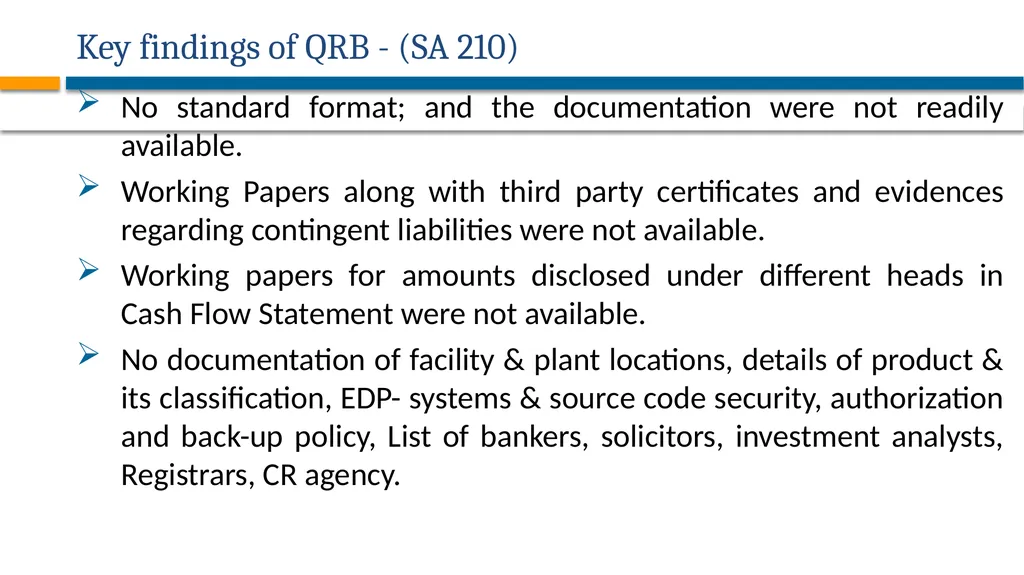
No standard format; and the documentation were not readily available.
Working Papers along with third party certificates and evidences regarding contingent liabilities were not available.
Working papers for amounts disclosed under different heads in Cash Flow Statement were not available.
No documentation of facility & plant locations, details of product & its classification, EDP- systems & source code security, authorization and back-up policy, List of bankers, solicitors, investment analysts, Registrars, CR agency. Key findings of QRB - (SA 210) 40<br>
Working Papers along with third party certificates and evidences regarding contingent liabilities were not available.
Working papers for amounts disclosed under different heads in Cash Flow Statement were not available.
No documentation of facility & plant locations, details of product & its classification, EDP- systems & source code security, authorization and back-up policy, List of bankers, solicitors, investment analysts, Registrars, CR agency. Key findings of QRB - (SA 210) 40<br>
41
WP’s for borrowings taken and repaid during the year, legal and inter-company confirmations were not available.
Documentation file did not contain work sheet showing how net realizable value had been arrived at and also comparison of NRV vs. Cost.
Not having sufficient documents regarding the design and implementation of the maintenance of internal control. Key findings of QRB - (SA 210) 41<br>
Documentation file did not contain work sheet showing how net realizable value had been arrived at and also comparison of NRV vs. Cost.
Not having sufficient documents regarding the design and implementation of the maintenance of internal control. Key findings of QRB - (SA 210) 41<br>
42
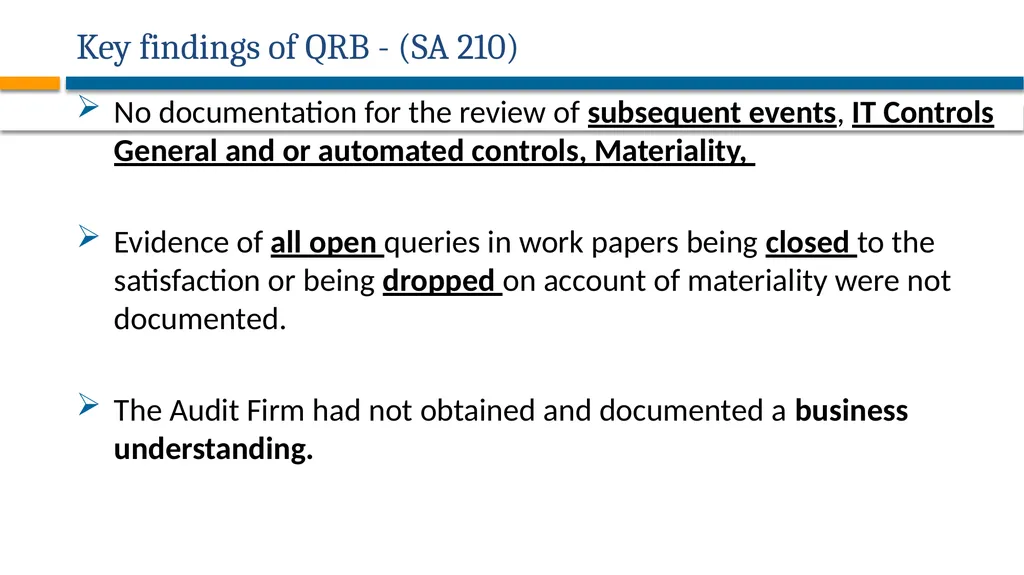
No documentation for the review of subsequent events, IT Controls General and or automated controls, Materiality,
Evidence of all open queries in work papers being closed to the satisfaction or being dropped on account of materiality were not documented.
The Audit Firm had not obtained and documented a business understanding. Key findings of QRB - (SA 210) 42<br>
Evidence of all open queries in work papers being closed to the satisfaction or being dropped on account of materiality were not documented.
The Audit Firm had not obtained and documented a business understanding. Key findings of QRB - (SA 210) 42<br>
43
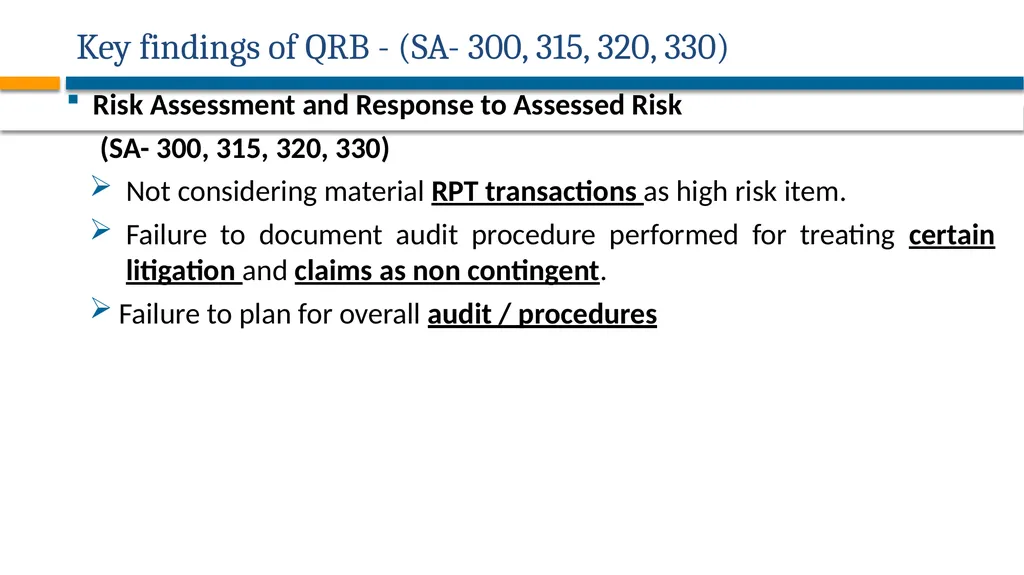
Risk Assessment and Response to Assessed Risk
(SA- 300, 315, 320, 330)
Not considering material RPT transactions as high risk item.
Failure to document audit procedure performed for treating certain litigation and claims as non contingent.
Failure to plan for overall audit / procedures Key findings of QRB - (SA- 300, 315, 320, 330) 43<br>
(SA- 300, 315, 320, 330)
Not considering material RPT transactions as high risk item.
Failure to document audit procedure performed for treating certain litigation and claims as non contingent.
Failure to plan for overall audit / procedures Key findings of QRB - (SA- 300, 315, 320, 330) 43<br>
44
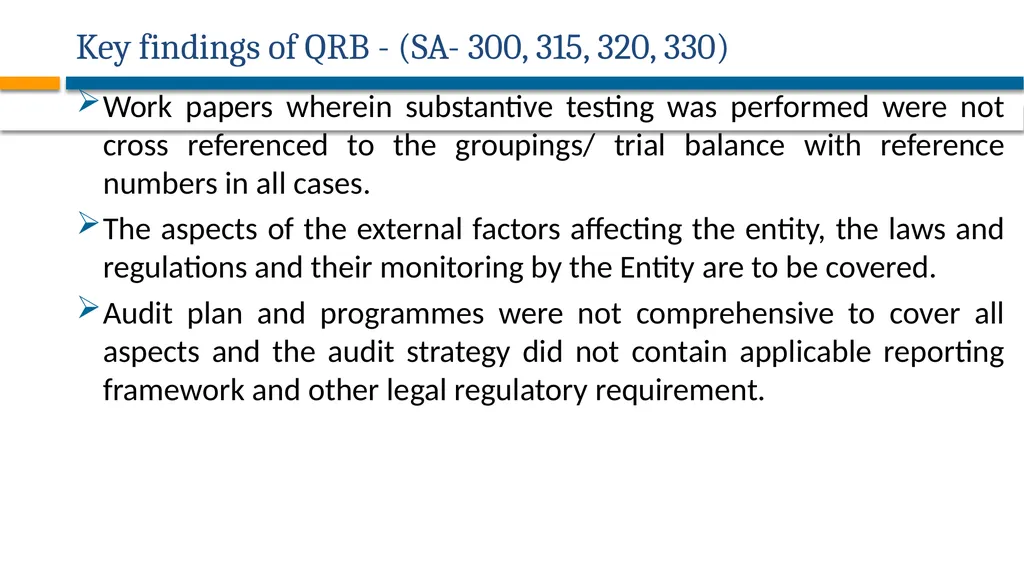
Key findings of QRB - (SA- 300, 315, 320, 330) Work papers wherein substantive testing was performed were not cross referenced to the groupings/ trial balance with reference numbers in all cases.
The aspects of the external factors affecting the entity, the laws and regulations and their monitoring by the Entity are to be covered.
Audit plan and programmes were not comprehensive to cover all aspects and the audit strategy did not contain applicable reporting framework and other legal regulatory requirement. 44<br>
The aspects of the external factors affecting the entity, the laws and regulations and their monitoring by the Entity are to be covered.
Audit plan and programmes were not comprehensive to cover all aspects and the audit strategy did not contain applicable reporting framework and other legal regulatory requirement. 44<br>
45
Key findings of QRB (SA- 500, 501, 505, 520, 530, 550 and 580) Audit Evidence and related standards (SA- 500, 501, 505, 520, 530, 550 and 580)
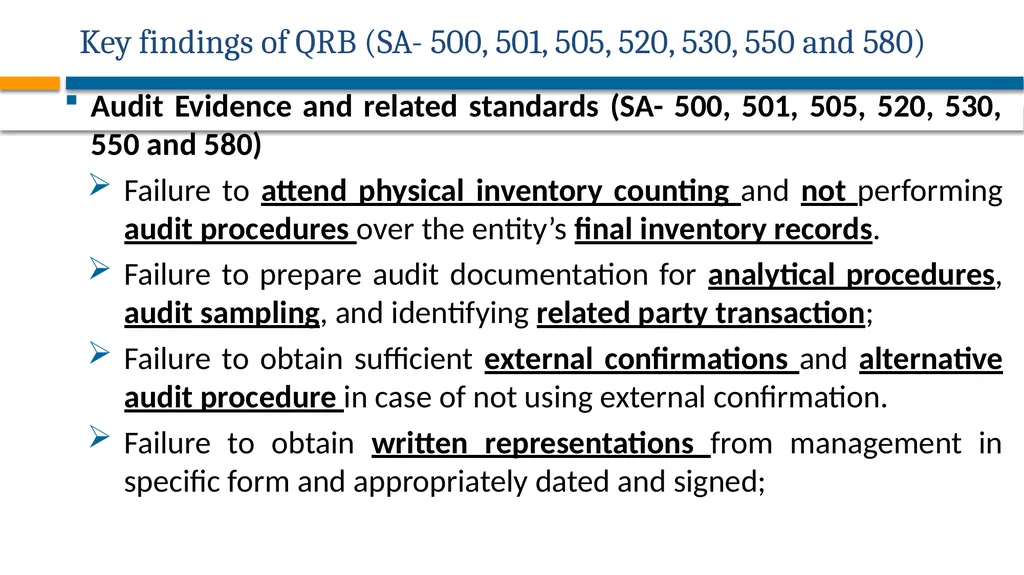
Failure to attend physical inventory counting and not performing audit procedures over the entity’s final inventory records.
Failure to prepare audit documentation for analytical procedures, audit sampling, and identifying related party transaction;
Failure to obtain sufficient external confirmations and alternative audit procedure in case of not using external confirmation.
Failure to obtain written representations from management in specific form and appropriately dated and signed; 45<br>
Failure to attend physical inventory counting and not performing audit procedures over the entity’s final inventory records.
Failure to prepare audit documentation for analytical procedures, audit sampling, and identifying related party transaction;
Failure to obtain sufficient external confirmations and alternative audit procedure in case of not using external confirmation.
Failure to obtain written representations from management in specific form and appropriately dated and signed; 45<br>
46
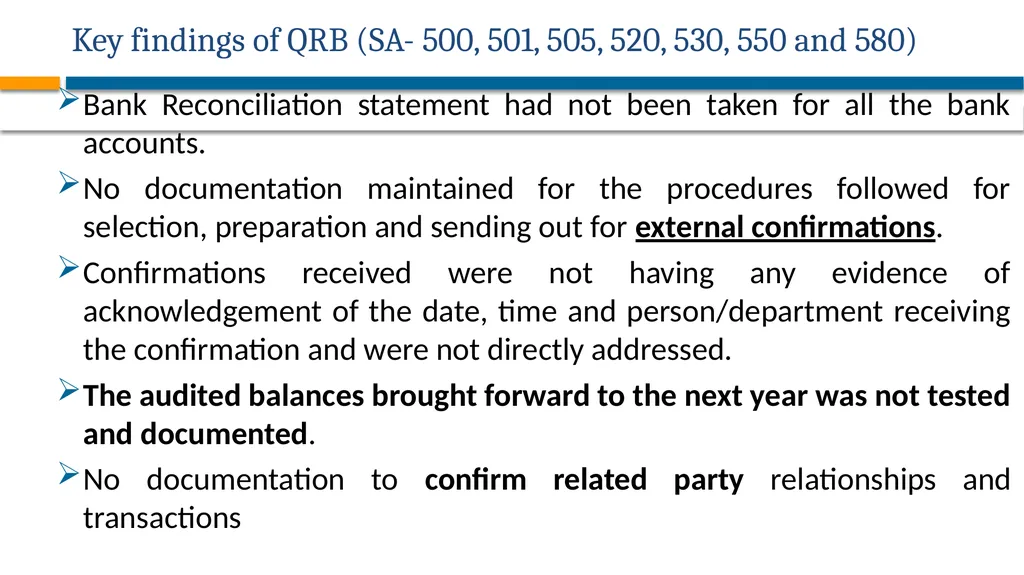
Key findings of QRB (SA- 500, 501, 505, 520, 530, 550 and 580) Bank Reconciliation statement had not been taken for all the bank accounts.
No documentation maintained for the procedures followed for selection, preparation and sending out for external confirmations.
Confirmations received were not having any evidence of acknowledgement of the date, time and person/department receiving the confirmation and were not directly addressed.
The audited balances brought forward to the next year was not tested and documented.
No documentation to confirm related party relationships and transactions 46<br>
No documentation maintained for the procedures followed for selection, preparation and sending out for external confirmations.
Confirmations received were not having any evidence of acknowledgement of the date, time and person/department receiving the confirmation and were not directly addressed.
The audited balances brought forward to the next year was not tested and documented.
No documentation to confirm related party relationships and transactions 46<br>
47
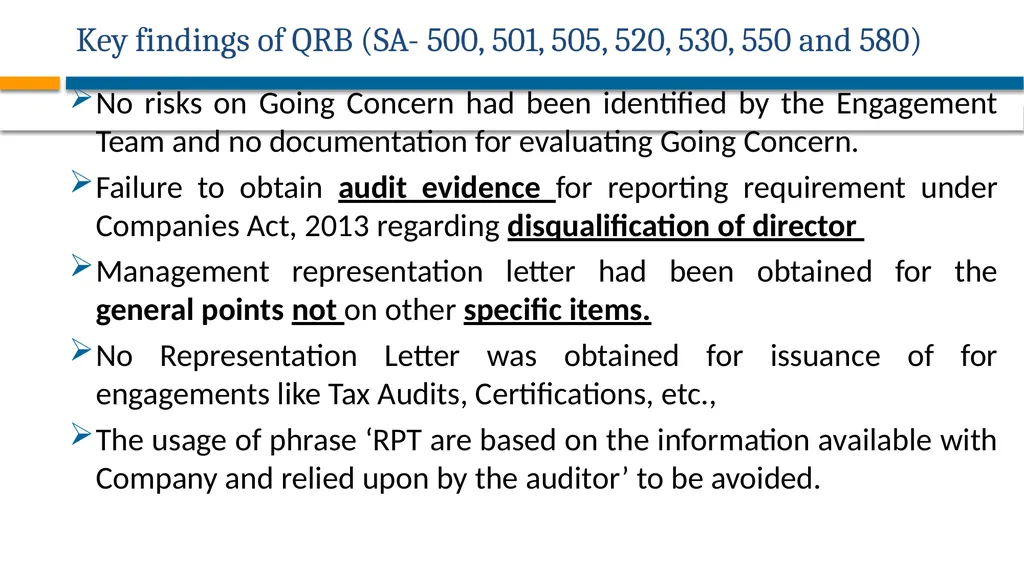
Key findings of QRB (SA- 500, 501, 505, 520, 530, 550 and 580) No risks on Going Concern had been identified by the Engagement Team and no documentation for evaluating Going Concern.
Failure to obtain audit evidence for reporting requirement under Companies Act, 2013 regarding disqualification of director
Management representation letter had been obtained for the general points not on other specific items.
No Representation Letter was obtained for issuance of for engagements like Tax Audits, Certifications, etc.,
The usage of phrase ‘RPT are based on the information available with Company and relied upon by the auditor’ to be avoided. 47<br>
Failure to obtain audit evidence for reporting requirement under Companies Act, 2013 regarding disqualification of director
Management representation letter had been obtained for the general points not on other specific items.
No Representation Letter was obtained for issuance of for engagements like Tax Audits, Certifications, etc.,
The usage of phrase ‘RPT are based on the information available with Company and relied upon by the auditor’ to be avoided. 47<br>
48
Key findings of QRB (SA- 600,610 and 620) USING THE WORK OF OTHERS (SA- 600,610 & 620)
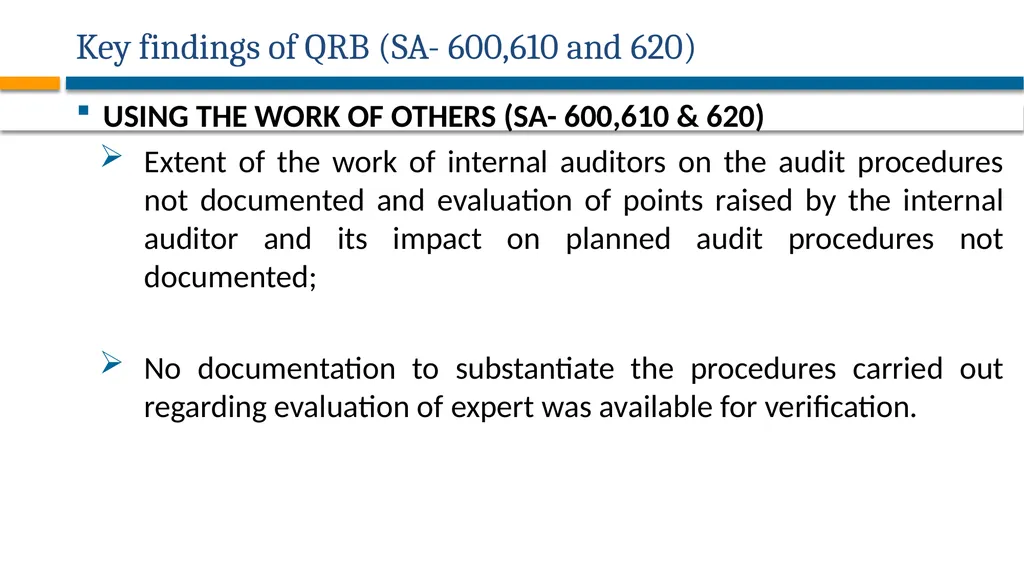
Extent of the work of internal auditors on the audit procedures not documented and evaluation of points raised by the internal auditor and its impact on planned audit procedures not documented;
No documentation to substantiate the procedures carried out regarding evaluation of expert was available for verification. 48<br>
Extent of the work of internal auditors on the audit procedures not documented and evaluation of points raised by the internal auditor and its impact on planned audit procedures not documented;
No documentation to substantiate the procedures carried out regarding evaluation of expert was available for verification. 48<br>
49
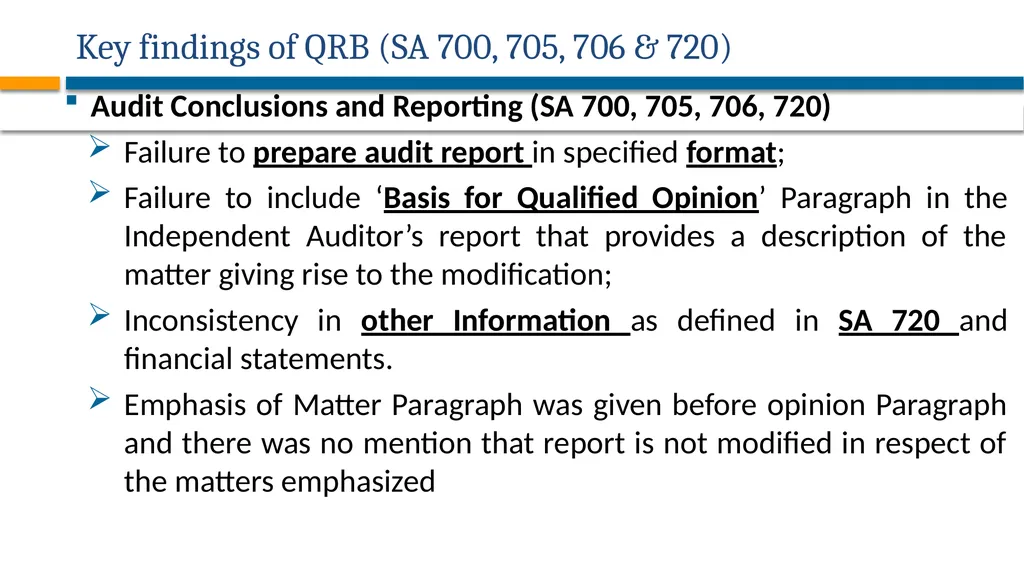
Key findings of QRB (SA 700, 705, 706 & 720) Audit Conclusions and Reporting (SA 700, 705, 706, 720)
Failure to prepare audit report in specified format;
Failure to include ‘Basis for Qualified Opinion’ Paragraph in the Independent Auditor’s report that provides a description of the matter giving rise to the modification;
Inconsistency in other Information as defined in SA 720 and financial statements.
Emphasis of Matter Paragraph was given before opinion Paragraph and there was no mention that report is not modified in respect of the matters emphasized 49<br>
Failure to prepare audit report in specified format;
Failure to include ‘Basis for Qualified Opinion’ Paragraph in the Independent Auditor’s report that provides a description of the matter giving rise to the modification;
Inconsistency in other Information as defined in SA 720 and financial statements.
Emphasis of Matter Paragraph was given before opinion Paragraph and there was no mention that report is not modified in respect of the matters emphasized 49<br>
50
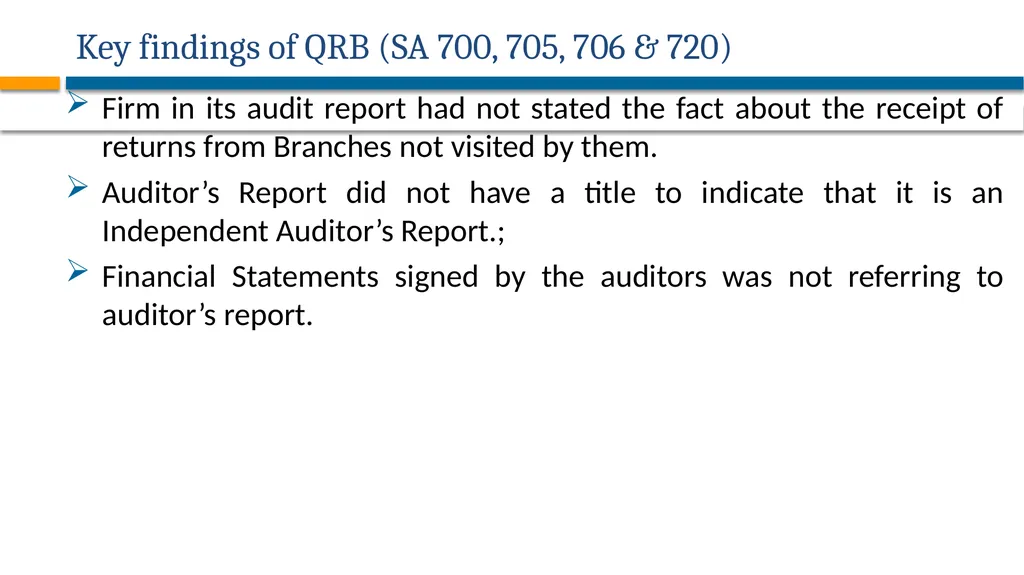
Key findings of QRB (SA 700, 705, 706 & 720) Firm in its audit report had not stated the fact about the receipt of returns from Branches not visited by them.
Auditor’s Report did not have a title to indicate that it is an Independent Auditor’s Report.;
Financial Statements signed by the auditors was not referring to auditor’s report. 50<br>
Auditor’s Report did not have a title to indicate that it is an Independent Auditor’s Report.;
Financial Statements signed by the auditors was not referring to auditor’s report. 50<br>
51
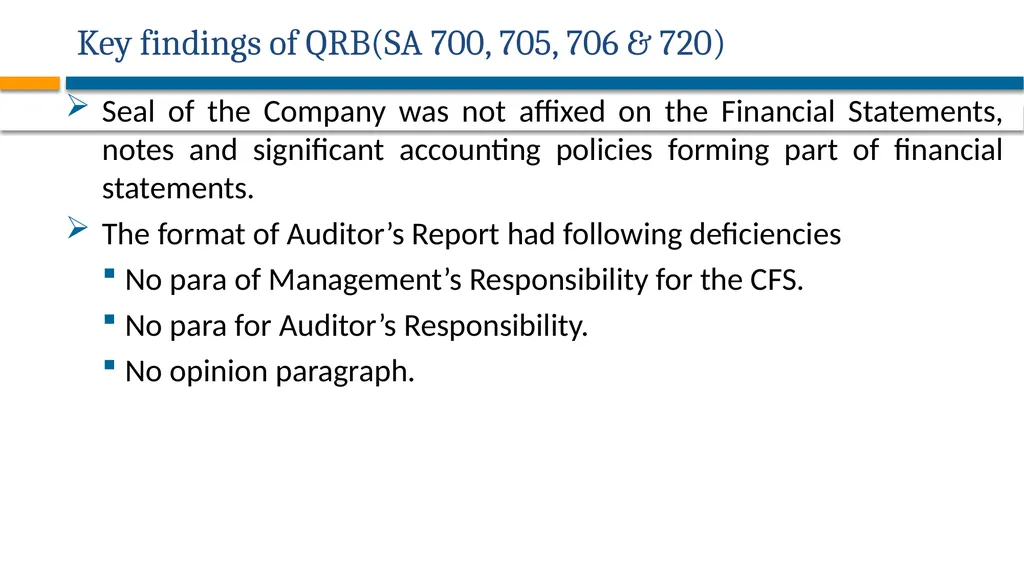
Key findings of QRB(SA 700, 705, 706 & 720) Seal of the Company was not affixed on the Financial Statements, notes and significant accounting policies forming part of financial statements.
The format of Auditor’s Report had following deficiencies
No para of Management’s Responsibility for the CFS.
No para for Auditor’s Responsibility.
No opinion paragraph. 51<br>
The format of Auditor’s Report had following deficiencies
No para of Management’s Responsibility for the CFS.
No para for Auditor’s Responsibility.
No opinion paragraph. 51<br>
52
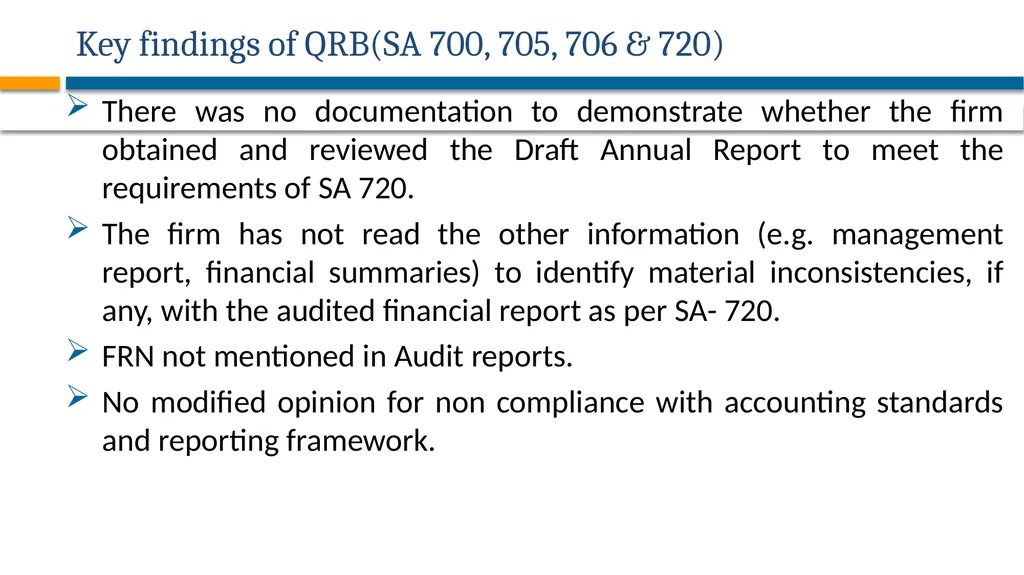
Key findings of QRB(SA 700, 705, 706 & 720) There was no documentation to demonstrate whether the firm obtained and reviewed the Draft Annual Report to meet the requirements of SA 720.
The firm has not read the other information (e.g. management report, financial summaries) to identify material inconsistencies, if any, with the audited financial report as per SA- 720.
FRN not mentioned in Audit reports.
No modified opinion for non compliance with accounting standards and reporting framework. 52<br>
The firm has not read the other information (e.g. management report, financial summaries) to identify material inconsistencies, if any, with the audited financial report as per SA- 720.
FRN not mentioned in Audit reports.
No modified opinion for non compliance with accounting standards and reporting framework. 52<br>
53
Key findings of QRB (SA 700, 705, 706 & 720) Report was titled “Auditors Report” instead of “ Independent Auditors Report”.
Cash flow statement wherever applicable is not referred to as a part of Financial Statements in introductory paragraph.
Financial statements, significant Accounting Policies and Notes are seen given in letter head of the Auditor.
Place of signature in Auditors report is different from that of the financial statements.
In case of modified opinion, heading should be modified / adverse / disclaimer as the case may be, not just ‘Opinion’. 53<br>
Cash flow statement wherever applicable is not referred to as a part of Financial Statements in introductory paragraph.
Financial statements, significant Accounting Policies and Notes are seen given in letter head of the Auditor.
Place of signature in Auditors report is different from that of the financial statements.
In case of modified opinion, heading should be modified / adverse / disclaimer as the case may be, not just ‘Opinion’. 53<br>
54
Key findings of QRB(SA 700, 705, 706 & 720) Report should be signed by the auditor in his personal name and there should be mention of M.No, Firm Name and FRN.
In Annual Report phrase “ Accounting Standards issued by ICAI” seen used for Companies instead of “Notified under Companies Rules”. 54<br>
In Annual Report phrase “ Accounting Standards issued by ICAI” seen used for Companies instead of “Notified under Companies Rules”. 54<br>
55
Key findings of QRB(SQC-1) The training programs predominantly covered the technical/regulatory updates and not the ethical aspects.
Firm had not obtained written confirmations on independence from the members of engagement team.
No conflict checking system to identify and manage potential conflicts relating to business or financial relationships. 55<br>
Firm had not obtained written confirmations on independence from the members of engagement team.
No conflict checking system to identify and manage potential conflicts relating to business or financial relationships. 55<br>
56
Key findings of FRRB Auditors have signed the Financial Statements before the Directors.
Auditors Report was not addressed to anyone.
Membership Numbers not mentioned in Auditors Report and it’s Annexures and in Financial Statements.
In case of Qualified opinions the quantification of possible effect was not made.
In Auditors report, omitted to state as to whether the financial statements are in conformity with the GAAP. 56<br>
Auditors Report was not addressed to anyone.
Membership Numbers not mentioned in Auditors Report and it’s Annexures and in Financial Statements.
In case of Qualified opinions the quantification of possible effect was not made.
In Auditors report, omitted to state as to whether the financial statements are in conformity with the GAAP. 56<br>
57
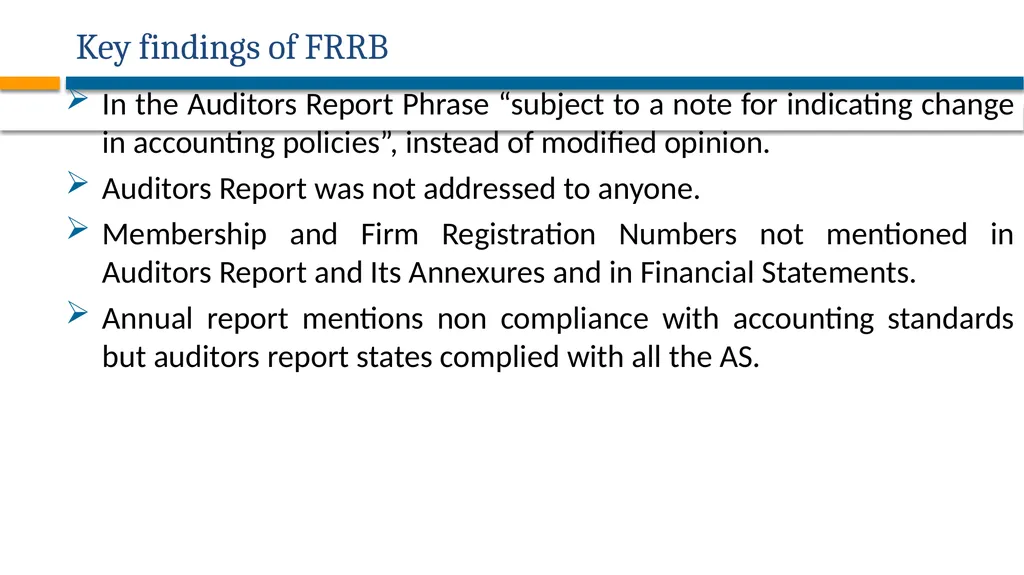
Key findings of FRRB In the Auditors Report Phrase “subject to a note for indicating change in accounting policies”, instead of modified opinion.
Auditors Report was not addressed to anyone.
Membership and Firm Registration Numbers not mentioned in Auditors Report and Its Annexures and in Financial Statements.
Annual report mentions non compliance with accounting standards but auditors report states complied with all the AS. 57<br>
Auditors Report was not addressed to anyone.
Membership and Firm Registration Numbers not mentioned in Auditors Report and Its Annexures and in Financial Statements.
Annual report mentions non compliance with accounting standards but auditors report states complied with all the AS. 57<br>
58
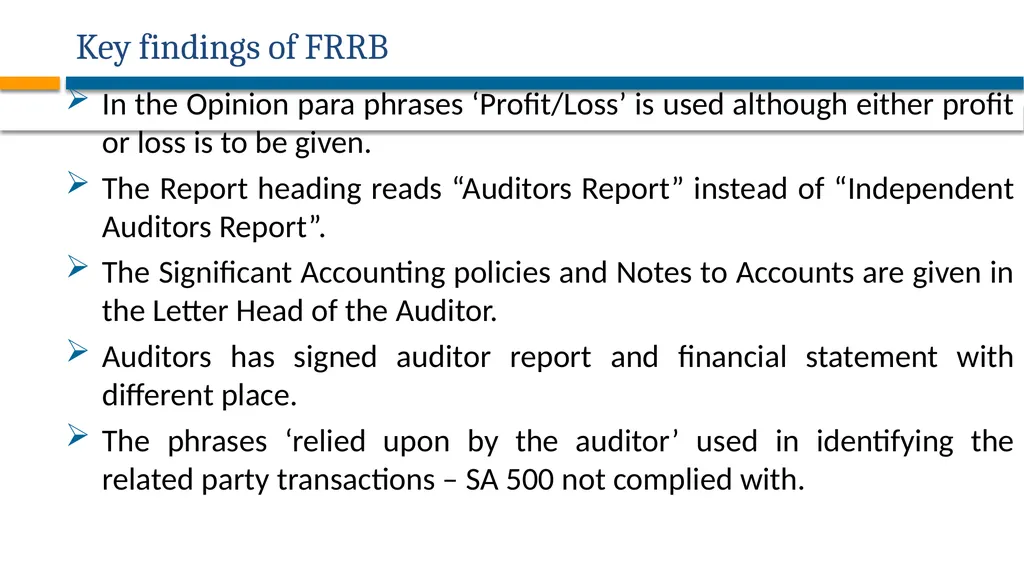
Key findings of FRRB In the Opinion para phrases ‘Profit/Loss’ is used although either profit or loss is to be given.
The Report heading reads “Auditors Report” instead of “Independent Auditors Report”.
The Significant Accounting policies and Notes to Accounts are given in the Letter Head of the Auditor.
Auditors has signed auditor report and financial statement with different place.
The phrases ‘relied upon by the auditor’ used in identifying the related party transactions – SA 500 not complied with. 58<br>
The Report heading reads “Auditors Report” instead of “Independent Auditors Report”.
The Significant Accounting policies and Notes to Accounts are given in the Letter Head of the Auditor.
Auditors has signed auditor report and financial statement with different place.
The phrases ‘relied upon by the auditor’ used in identifying the related party transactions – SA 500 not complied with. 58<br>
59
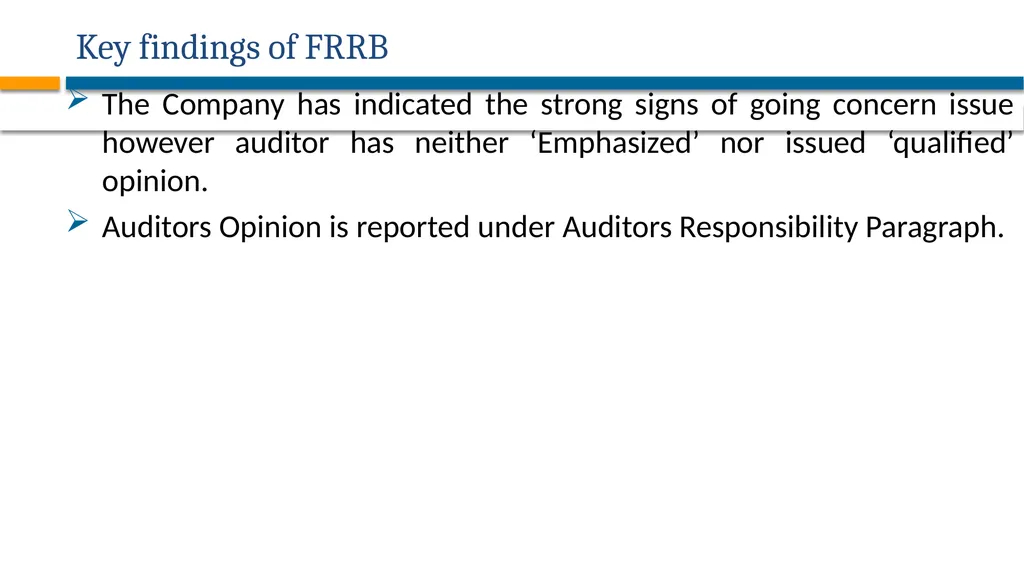
Key findings of FRRB The Company has indicated the strong signs of going concern issue however auditor has neither ‘Emphasized’ nor issued ‘qualified’ opinion.
Auditors Opinion is reported under Auditors Responsibility Paragraph. 59<br>
Auditors Opinion is reported under Auditors Responsibility Paragraph. 59<br>
60
Questions ? 60<br>