
Auditory-Verbal Therapy Shelley Chesney, M.S.,
PT
Published · 53 slides · 0 views

1 / 1




Description
Auditory-Verbal Therapy Shelley Chesney, M.S., CCC-SLP LSLS Cert AVT The Craziest Language Well begin with a box and the plural is boxes; But the plural of ox should be oxen not oxes. Then one fowl is a goose, but two are called geese. Yet
Related Topics
Share
Embed code
Download this presentation From Below
"Auditory-Verbal Therapy Shelley Chesney, M.S.," is the property of its rightful owner. Permission is granted to download and print the materials on this website for personal, non-commercial use only, and to display it on your personal computer provided you do not modify the materials and that you retain all copyright notices contained in the materials. By downloading content from our website, you accept the terms of this agreement.
Presentation Transcript
01
Auditory-Verbal Therapy Shelley Chesney, M.S., CCC-SLP
LSLS Cert AVT<br>
LSLS Cert AVT<br>
02
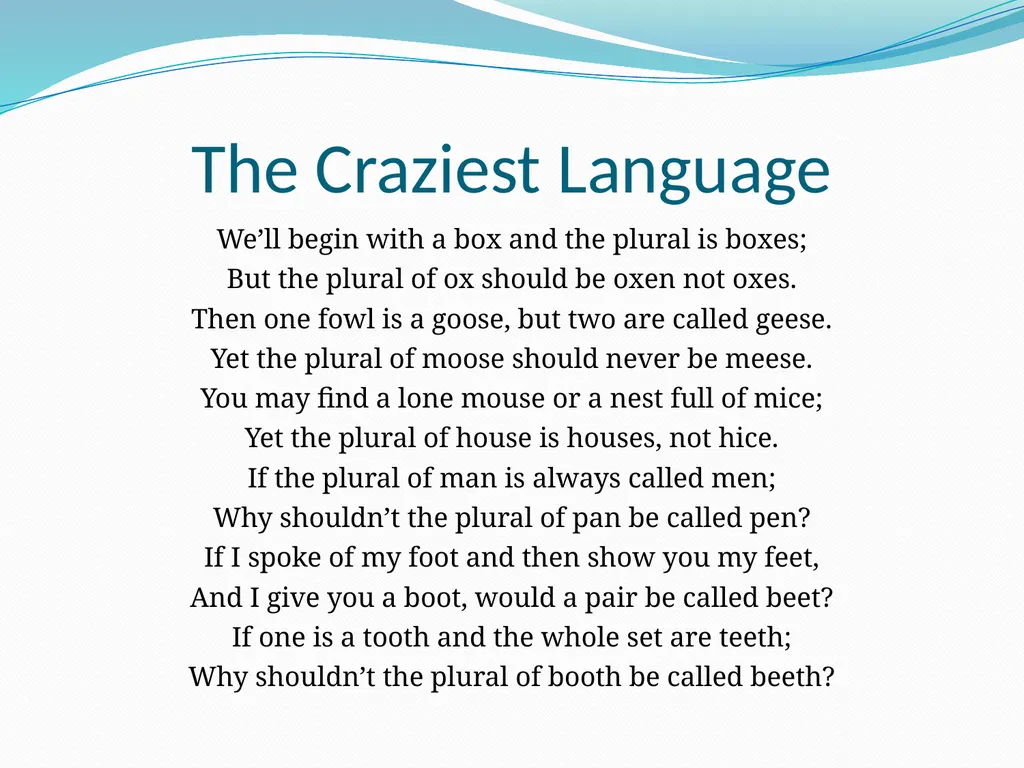
The Craziest Language We’ll begin with a box and the plural is boxes;
But the plural of ox should be oxen not oxes.
Then one fowl is a goose, but two are called geese.
Yet the plural of moose should never be meese.
You may find a lone mouse or a nest full of mice;
Yet the plural of house is houses, not hice.
If the plural of man is always called men;
Why shouldn’t the plural of pan be called pen?
If I spoke of my foot and then show you my feet,
And I give you a boot, would a pair be called beet?
If one is a tooth and the whole set are teeth;
Why shouldn’t the plural of booth be called beeth?<br>
03
Then one may be that, and three would be those,
Yet hat in the plural would never be hose,
And the plural of cat is cats, not cose.
We speak of a brother and also of brethren,
But though we say mother, we never say methren.
Then the masculine pronouns are he, his and him,
But imagine the feminine, she, shis and shim.
So English I fancy you will agree,
Is the craziest language you ever did see.
Author Unknown<br>
04
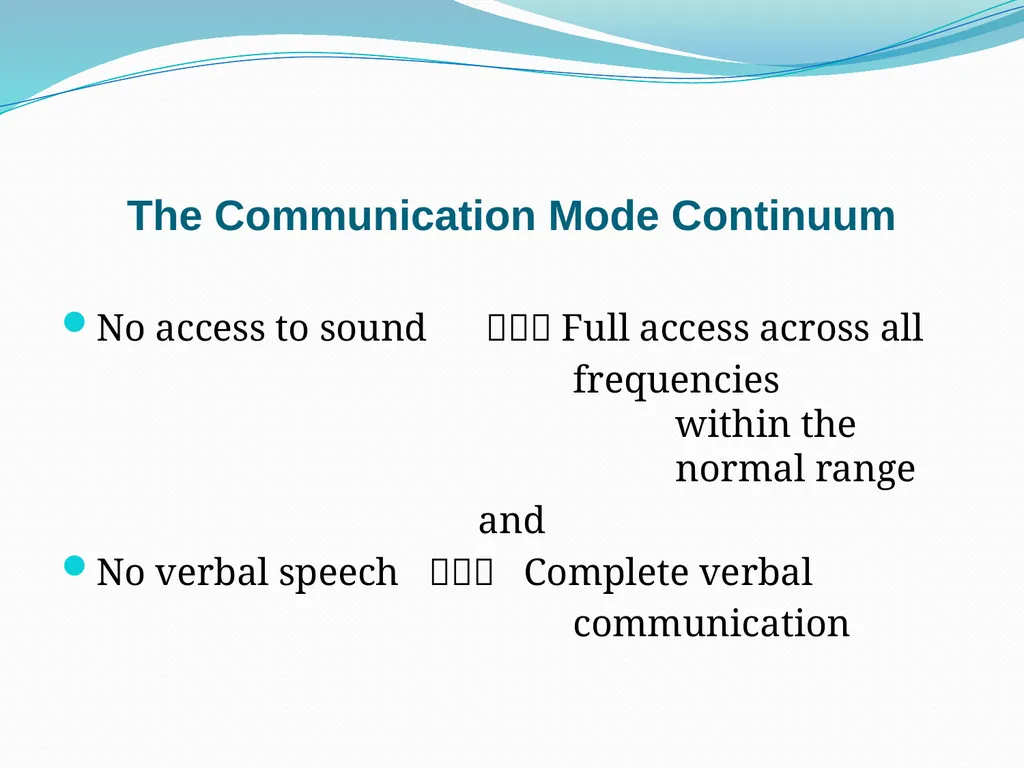
The Communication Mode Continuum No access to sound Full access across all
frequencies within the normal range
and
No verbal speech Complete verbal
communication<br>
frequencies within the normal range
and
No verbal speech Complete verbal
communication<br>
05
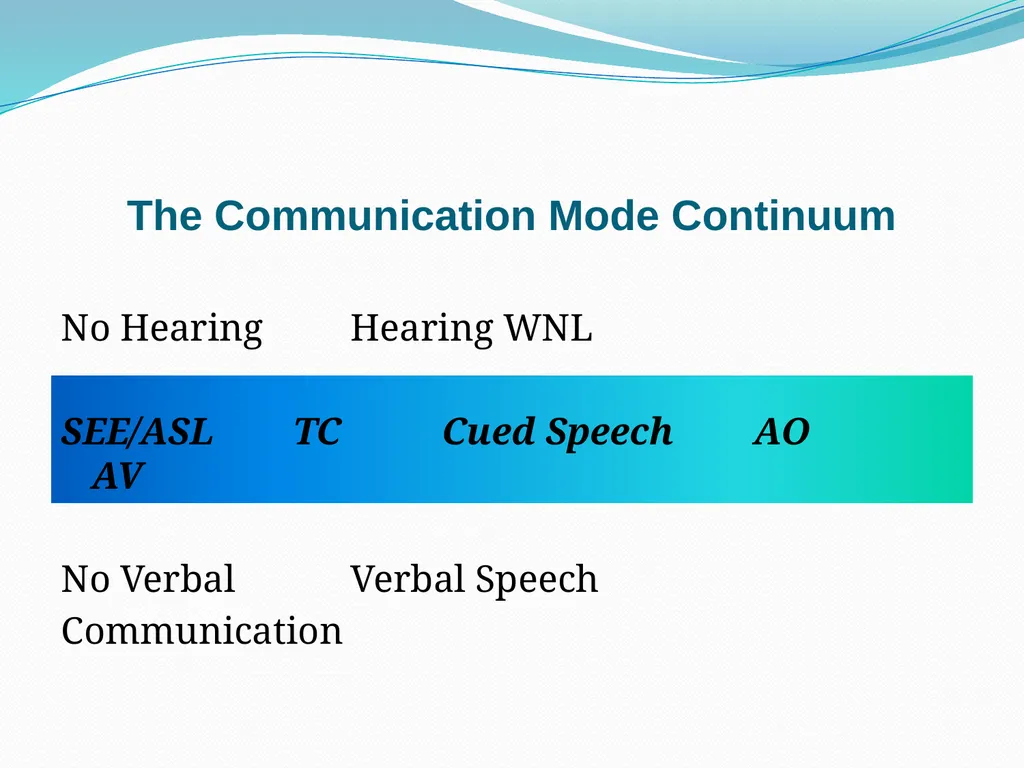
No Hearing Hearing WNL
SEE/ASL TC Cued Speech AO AV
No Verbal Verbal Speech
Communication The Communication Mode Continuum<br>
SEE/ASL TC Cued Speech AO AV
No Verbal Verbal Speech
Communication The Communication Mode Continuum<br>
06
The Communication Mode Continuum SIGN LANGUAGE:
ASL
Signed English
SEE<br>
ASL
Signed English
SEE<br>
07
The Communication Mode Continuum TOTAL COMMUNICATION –
Signs
Speech
Written<br>
Signs
Speech
Written<br>
08
The Communication Mode Continuum CUED SPEECH
8 hand shapes
4 locations around the face
Words are cued in syllables
Cued Speech is for children who are in an oral environment since one must speak and cue at the same time for the cues to be meaningful.<br>
8 hand shapes
4 locations around the face
Words are cued in syllables
Cued Speech is for children who are in an oral environment since one must speak and cue at the same time for the cues to be meaningful.<br>
09
The Communication Mode Continuum AUDITORY ORAL
Required amplification via hearing aids, CIs, FM systems, etc..
Strong emphasis on lip reading
Natural gestures allowed
Strong focus on auditory training
Allows a lot of visual support<br>
Required amplification via hearing aids, CIs, FM systems, etc..
Strong emphasis on lip reading
Natural gestures allowed
Strong focus on auditory training
Allows a lot of visual support<br>
10
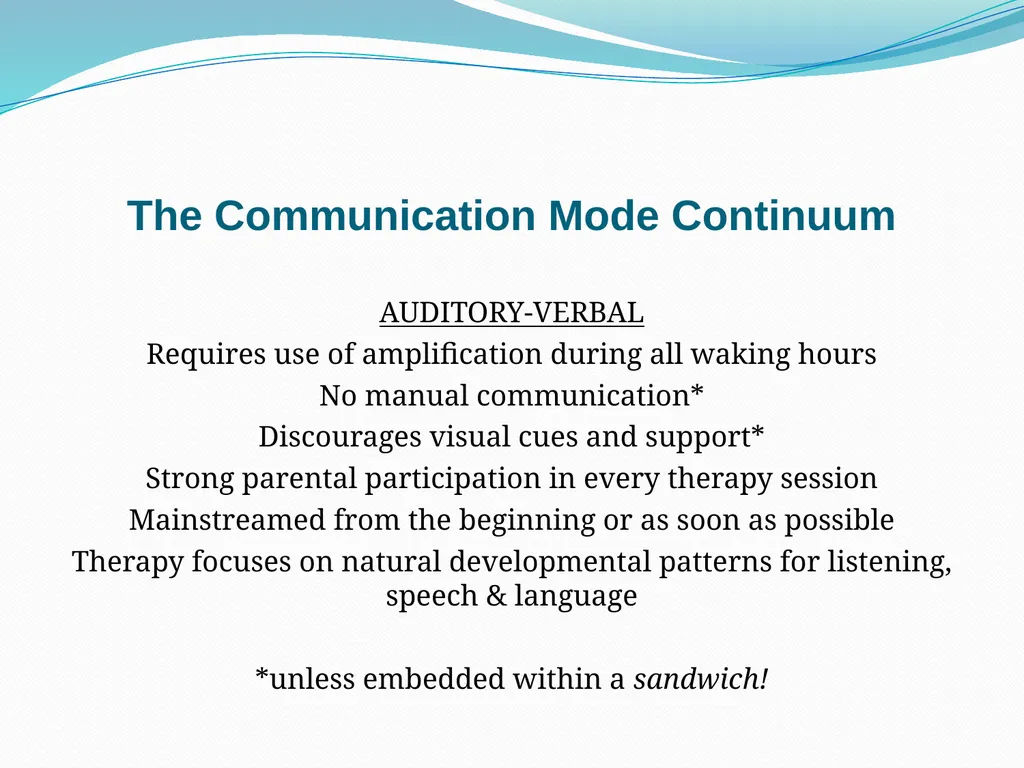
The Communication Mode Continuum AUDITORY-VERBAL
Requires use of amplification during all waking hours
No manual communication*
Discourages visual cues and support*
Strong parental participation in every therapy session
Mainstreamed from the beginning or as soon as possible
Therapy focuses on natural developmental patterns for listening, speech & language
*unless embedded within a sandwich!<br>
11
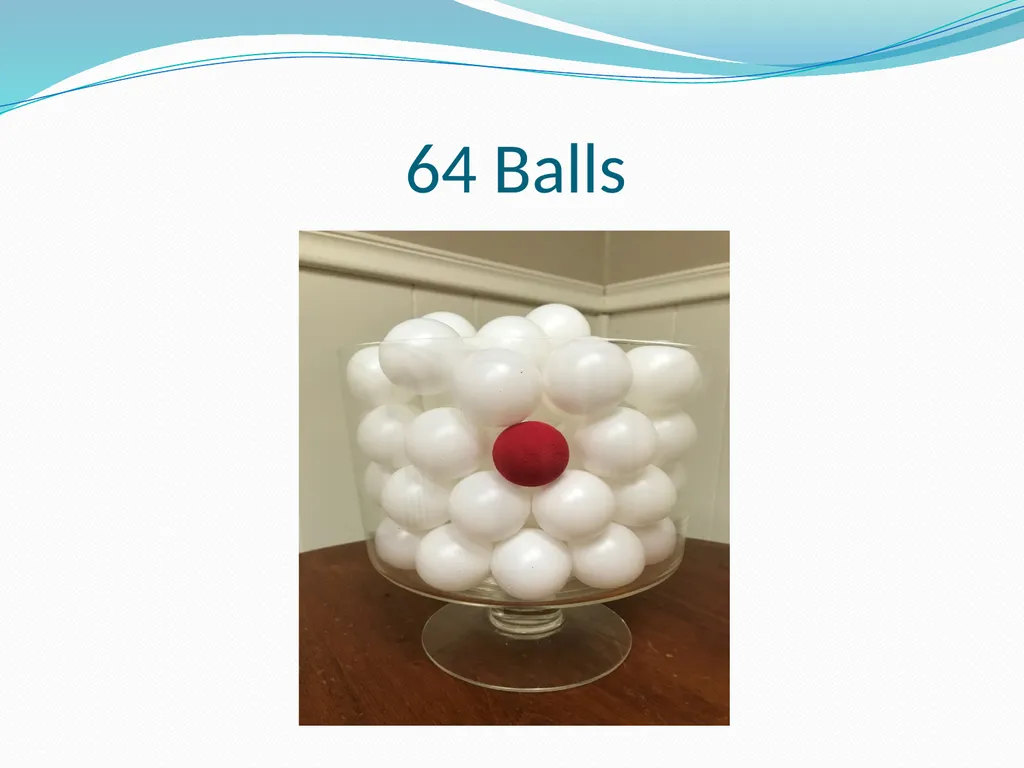
64 Balls<br>
12
Guiding Principles of
Auditory-Verbal Therapy 1. Promote early diagnosis of hearing loss in newborns, infants, toddlers, and young children, followed by immediate audiologic management and Auditory-Verbal therapy.
2. Recommend immediate assessment and use of appropriate, state-of-the-art hearing technology to obtain maximum benefits of auditory stimulation.
3. Guide and coach parents to help their child use hearing as the primary sensory modality in developing listening and spoken language.<br>
2. Recommend immediate assessment and use of appropriate, state-of-the-art hearing technology to obtain maximum benefits of auditory stimulation.
3. Guide and coach parents to help their child use hearing as the primary sensory modality in developing listening and spoken language.<br>
13
Guiding Principles of
Auditory-Verbal Therapy 4. Guide and coach parents¹ to become the primary facilitators of their child's listening and spoken language development through active consistent participation in individualized Auditory-Verbal therapy.
5. Guide and coach parents¹ to create environments that support listening for the acquisition of spoken language throughout the child's daily activities.
6. Guide and coach parents¹ to help their child integrate listening and spoken language into all aspects of the child's life.<br>
5. Guide and coach parents¹ to create environments that support listening for the acquisition of spoken language throughout the child's daily activities.
6. Guide and coach parents¹ to help their child integrate listening and spoken language into all aspects of the child's life.<br>
14
Guiding Principles of
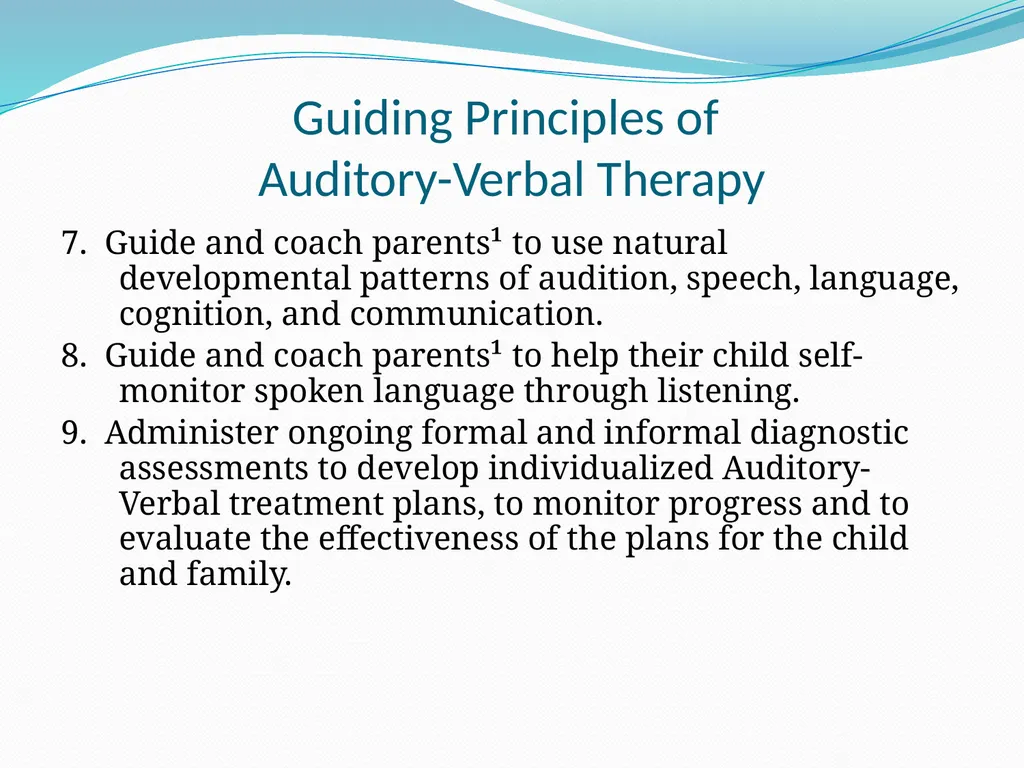
Auditory-Verbal Therapy 7. Guide and coach parents¹ to use natural developmental patterns of audition, speech, language, cognition, and communication.
8. Guide and coach parents¹ to help their child self-monitor spoken language through listening.
9. Administer ongoing formal and informal diagnostic assessments to develop individualized Auditory-Verbal treatment plans, to monitor progress and to evaluate the effectiveness of the plans for the child and family.<br>
15
Guiding Principles of
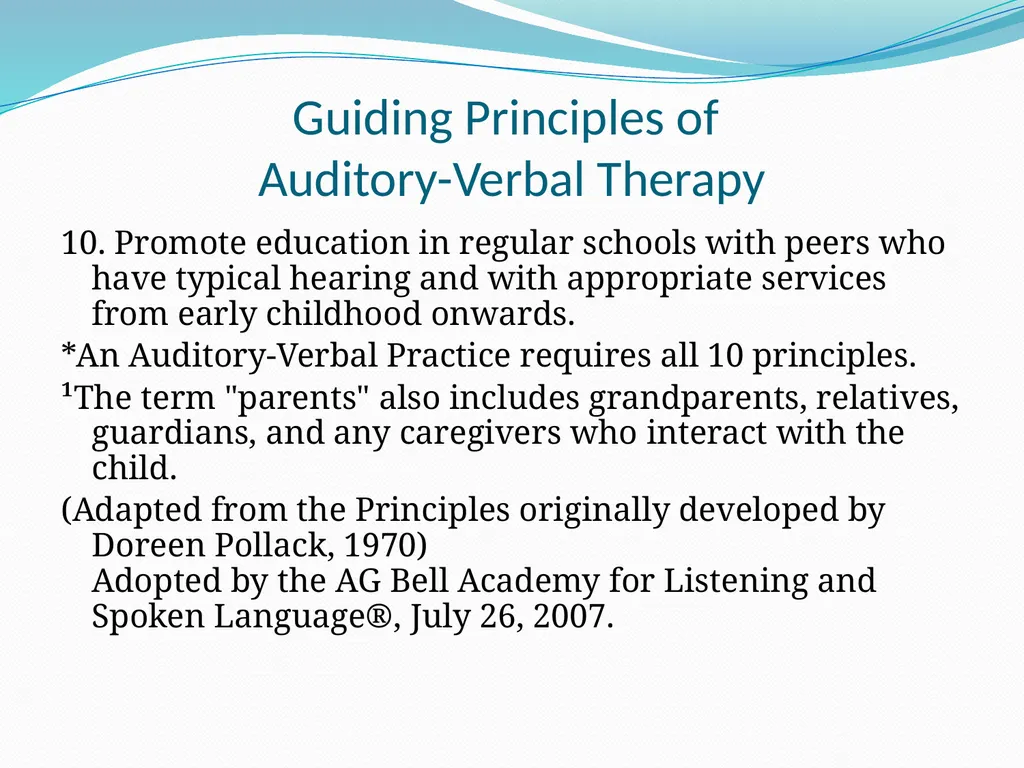
Auditory-Verbal Therapy 10. Promote education in regular schools with peers who have typical hearing and with appropriate services from early childhood onwards.
*An Auditory-Verbal Practice requires all 10 principles.
¹The term "parents" also includes grandparents, relatives, guardians, and any caregivers who interact with the child.
(Adapted from the Principles originally developed by Doreen Pollack, 1970) Adopted by the AG Bell Academy for Listening and Spoken Language®, July 26, 2007.<br>
16
Evaluation Why? What’s the point?
What to evaluate?<br>
What to evaluate?<br>
17
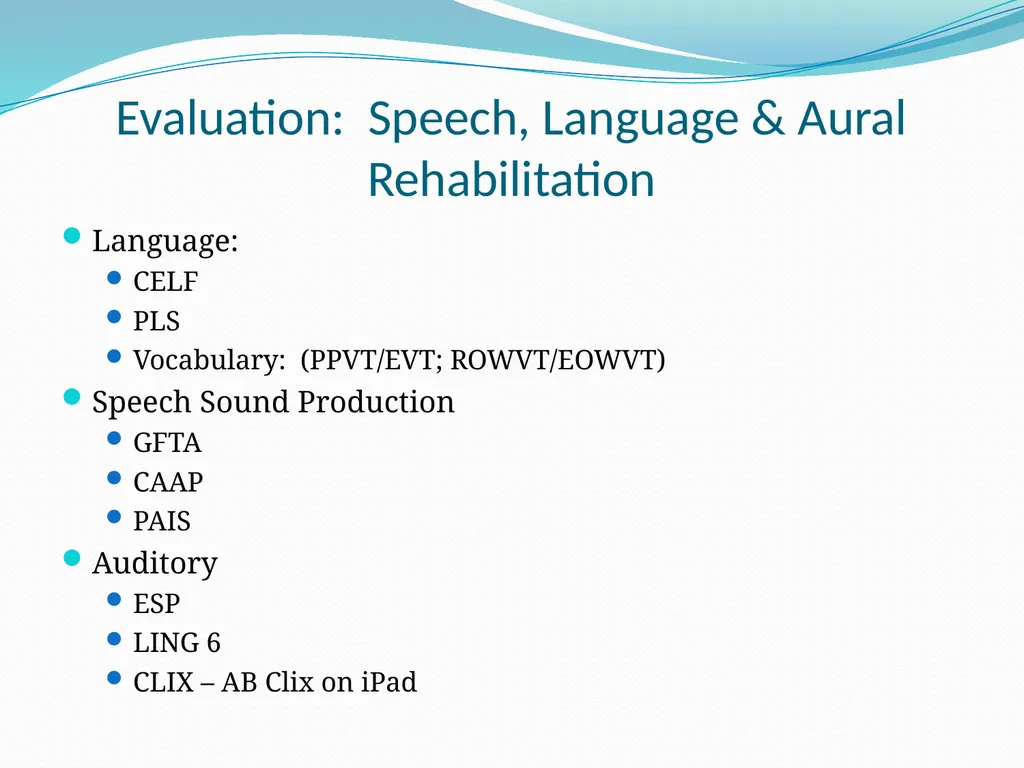
Evaluation: Speech, Language & Aural Rehabilitation Language:
CELF
PLS
Vocabulary: (PPVT/EVT; ROWVT/EOWVT)
Speech Sound Production
GFTA
CAAP
PAIS
Auditory
ESP
LING 6
CLIX – AB Clix on iPad<br>
CELF
PLS
Vocabulary: (PPVT/EVT; ROWVT/EOWVT)
Speech Sound Production
GFTA
CAAP
PAIS
Auditory
ESP
LING 6
CLIX – AB Clix on iPad<br>
18
Evaluation: Audiogram Unaided? Aided?
Pieces & Parts.
Application<br>
Pieces & Parts.
Application<br>
19
Evaluation: Done. Now what? Standard Scores & Age Equivalencies
Writing Goals<br>
Writing Goals<br>
20
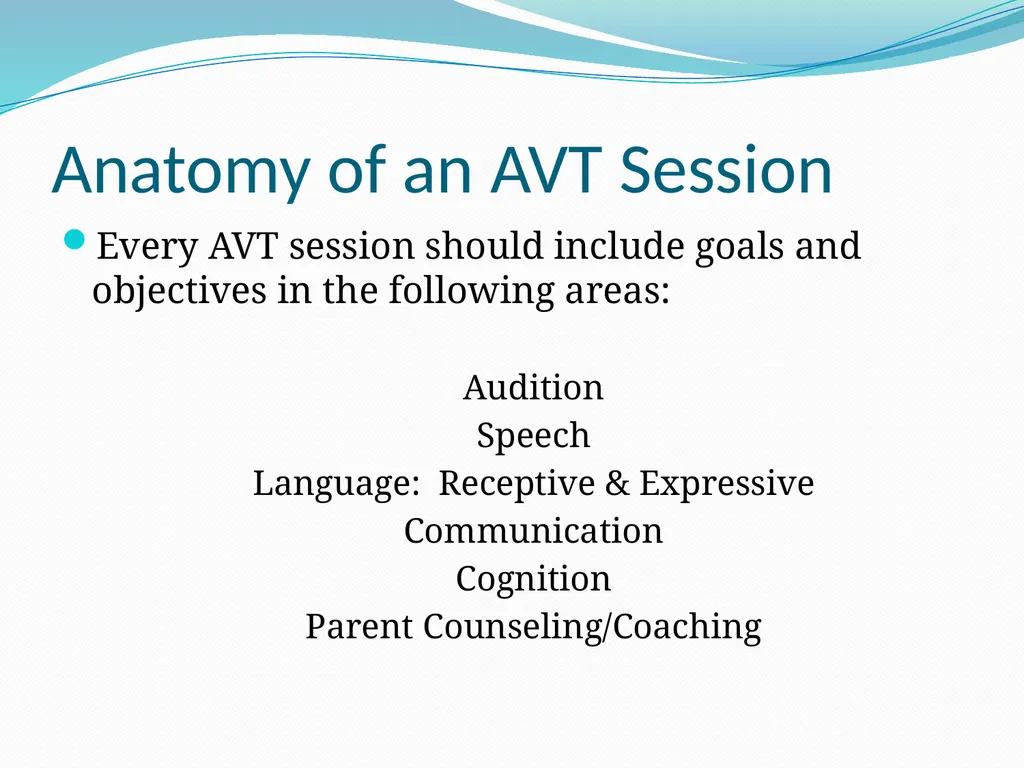
Anatomy of an AVT Session Every AVT session should include goals and objectives in the following areas:
Audition
Speech
Language: Receptive & Expressive
Communication
Cognition
Parent Counseling/Coaching<br>
Audition
Speech
Language: Receptive & Expressive
Communication
Cognition
Parent Counseling/Coaching<br>
21
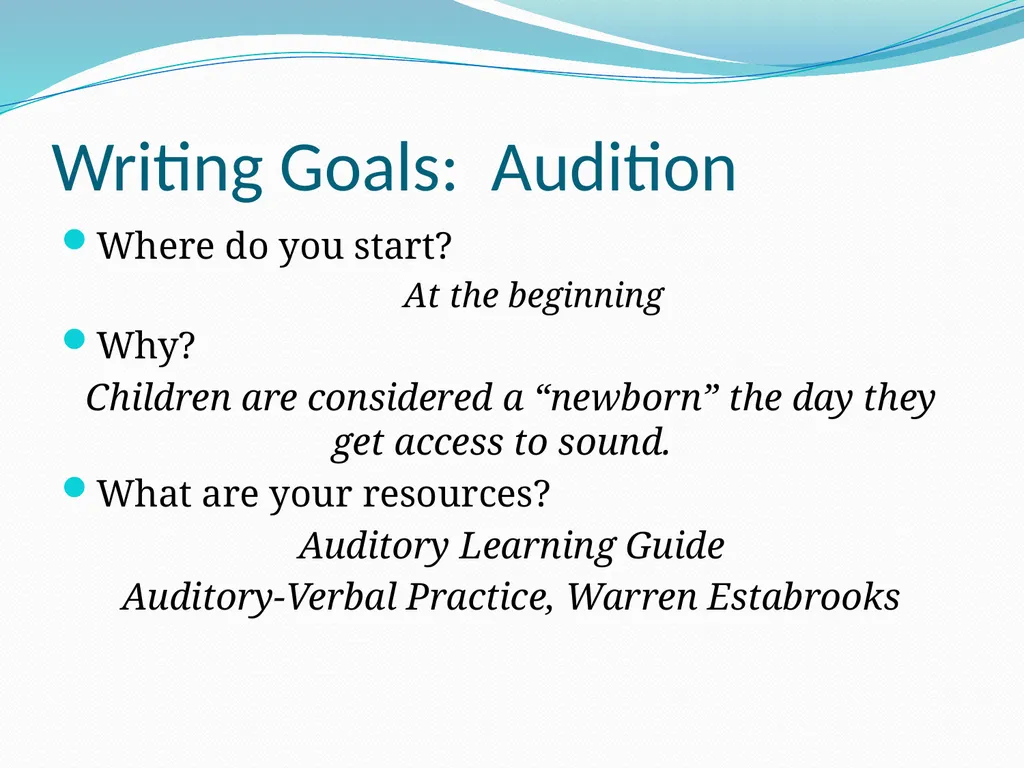
Writing Goals: Audition Where do you start?
At the beginning
Why?
Children are considered a “newborn” the day they get access to sound.
What are your resources?
Auditory Learning Guide
Auditory-Verbal Practice, Warren Estabrooks<br>
At the beginning
Why?
Children are considered a “newborn” the day they get access to sound.
What are your resources?
Auditory Learning Guide
Auditory-Verbal Practice, Warren Estabrooks<br>
22
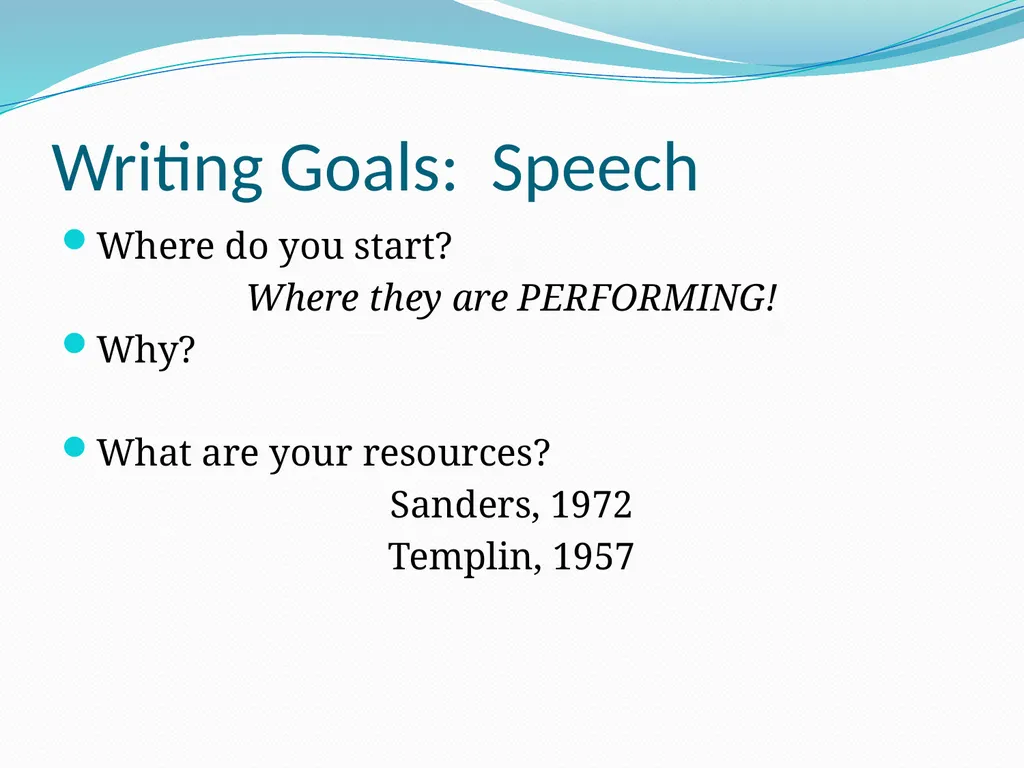
Writing Goals: Speech Where do you start?
Where they are PERFORMING!
Why?
What are your resources?
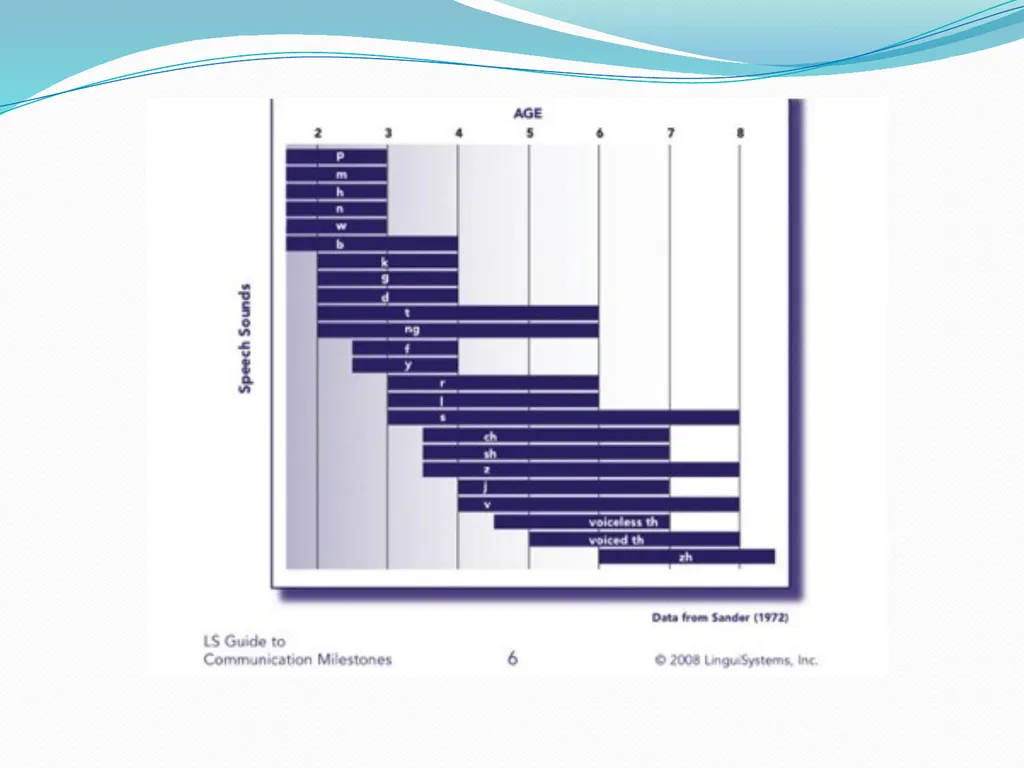
Sanders, 1972
Templin, 1957<br>
Where they are PERFORMING!
Why?
What are your resources?
Sanders, 1972
Templin, 1957<br>
23
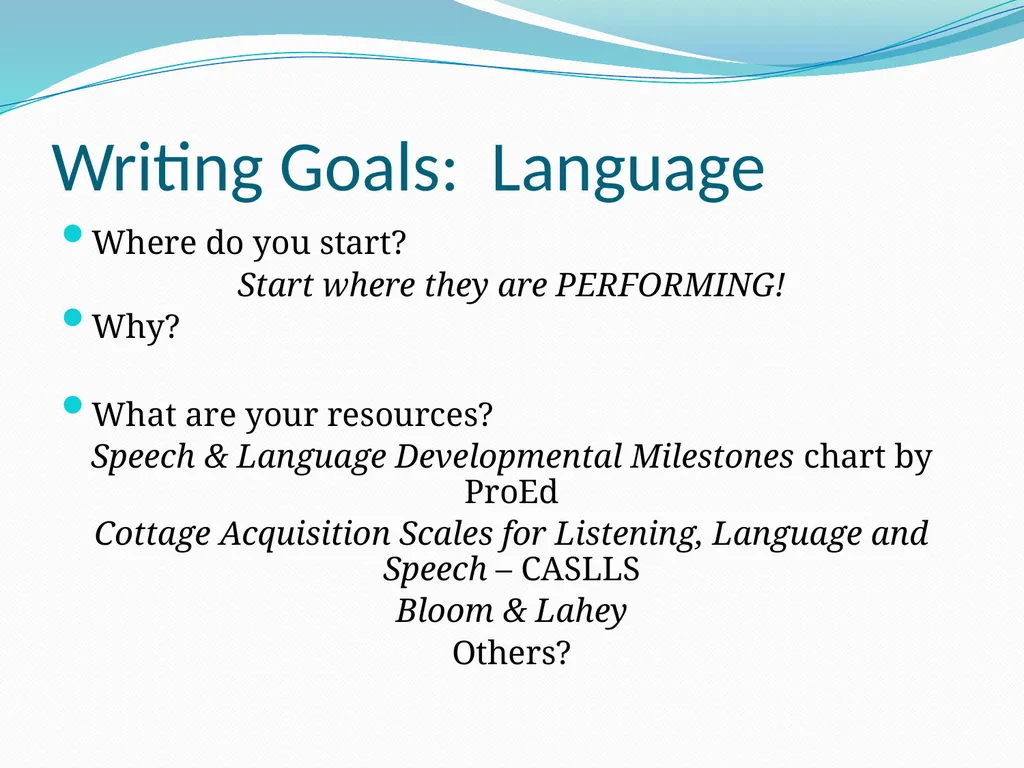
Writing Goals: Language Where do you start?
Start where they are PERFORMING!
Why?
What are your resources?
Speech & Language Developmental Milestones chart by ProEd
Cottage Acquisition Scales for Listening, Language and Speech – CASLLS
Bloom & Lahey
Others?<br>
Start where they are PERFORMING!
Why?
What are your resources?
Speech & Language Developmental Milestones chart by ProEd
Cottage Acquisition Scales for Listening, Language and Speech – CASLLS
Bloom & Lahey
Others?<br>
24
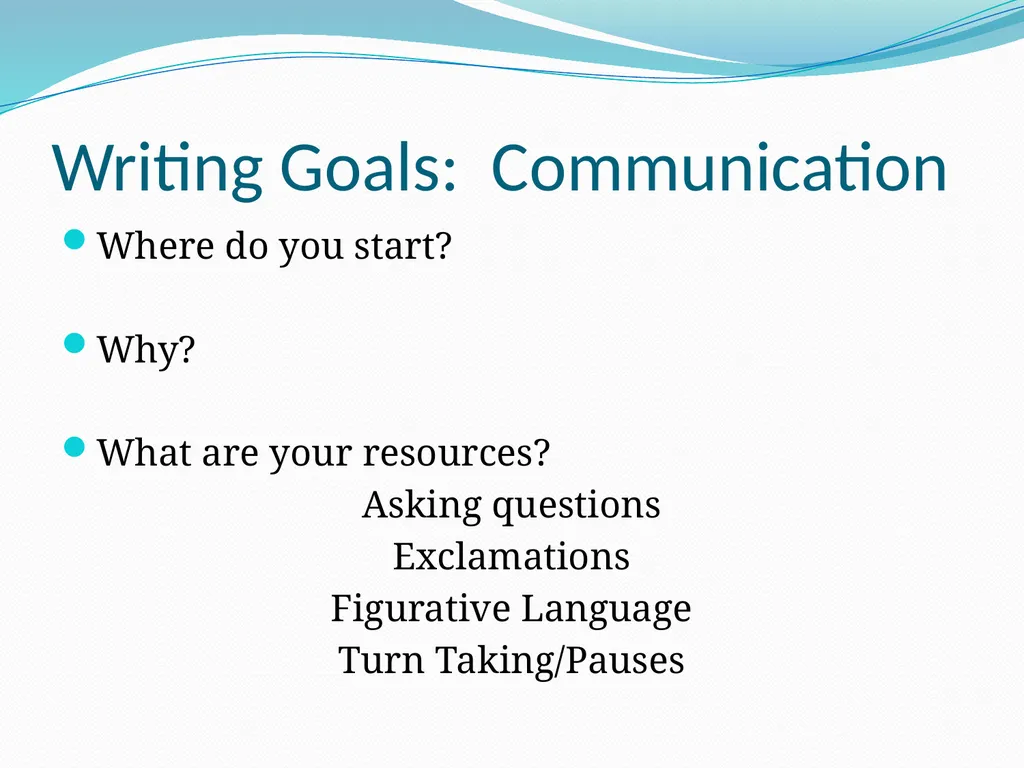
Writing Goals: Communication Where do you start?
Why?
What are your resources?
Asking questions
Exclamations
Figurative Language
Turn Taking/Pauses<br>
Why?
What are your resources?
Asking questions
Exclamations
Figurative Language
Turn Taking/Pauses<br>
25
Writing Goals: Cognition Where do you start?
Why?
What are your resources?
CASLLS<br>
Why?
What are your resources?
CASLLS<br>
26
Writing Goals: Parent Counseling/Coaching Where do you start?
Why?
What are your resources?
Guiding Principles of AVT
Biological process of hearing
Type, Degree & Configuration of Hearing Loss
Pieces & Parts of an audiogram
Cochlear Implants vs Hearing Aids
Modes of Communication
AUDITORY LEARNING GUIDE
Developmental Milestones<br>
Why?
What are your resources?
Guiding Principles of AVT
Biological process of hearing
Type, Degree & Configuration of Hearing Loss
Pieces & Parts of an audiogram
Cochlear Implants vs Hearing Aids
Modes of Communication
AUDITORY LEARNING GUIDE
Developmental Milestones<br>
27
Auditory-Verbal Modules Hearing & Hearing Technology
Auditory Functioning
Spoken Language Communication
Child Development
Parent Guidance, Education & Support
History, Philosophy & Professional Issues
Education
Emergent Literacy
Last, but not least…..<br>
Auditory Functioning
Spoken Language Communication
Child Development
Parent Guidance, Education & Support
History, Philosophy & Professional Issues
Education
Emergent Literacy
Last, but not least…..<br>
28
Auditory-Verbal
Techniques & Strategies The following techniques & strategies will help you direct your student to utilize LISTENING through their cochlear implant to develop their speech and language skills with efficiency!
NOTE: There is a required minimum of 40 Hours of instruction by a LSLS Cert AVT in AV Techniques & Procedures for those seeking certification. This is what moves the needle forward to listening and spoken language for our children with cochlear implants!
The following mnemonics were cleverly crafted by Kathryn Wilson, M.A., CCC-SLP, LSLS Cert. AVT<br>
29
Auditory-Verbal
Techniques & Strategies The most misunderstood of all AV techniques and strategies is…….
THE HANDCUE
Signals the child to listen
Used to encourage imitation
Can also use toys, pictures or objects
Used to prevent lip reading
DO NOT USE if the child is not looking at you!
Ensure that you are not distorting your voice, but just occluding the visual of your mouth. In other words, don’t put your hand over your mouth so that you distort the sound of your voice. Hold your hand out and away from your mouth so that your voice has room to travel around your hand.<br>
30
Where do I sit?? Behind the child?
In front of the child?
Beside the child?
On top of the child? (Only if they are misbehaving!!)
Best position is slightly behind and to the side, in good range of the device microphone, while the child is looking at the materials you are discussing and not your face.<br>
In front of the child?
Beside the child?
On top of the child? (Only if they are misbehaving!!)
Best position is slightly behind and to the side, in good range of the device microphone, while the child is looking at the materials you are discussing and not your face.<br>
31
Wait. You must give the child plenty of time to process what he is hearing and then respond, so waiting in silence provides him time to do this.
With very young children you can wait as much as 45 seconds! Try it now. This will seem like an eternity but to the new listener it is a great gift!
Pay attention to their behavioral cues to know when to move on. You will be able to tell if they are “thinking” or checked out!<br>
With very young children you can wait as much as 45 seconds! Try it now. This will seem like an eternity but to the new listener it is a great gift!
Pay attention to their behavioral cues to know when to move on. You will be able to tell if they are “thinking” or checked out!<br>
32
Tell & Show, not Show & Tell Any time you are presenting new information or information you want the student to listen to and respond, always talk about the item BEFORE you show him the item.
EX: If you are working on Learning to Listen sounds, hide the toy in a container that the child cannot see into, like a coffee can. Barely open the lid so that only you can see what is inside and say, “Oh I see a cow! The cow says mooooooooo.” Use the can as your “handcue” to block your mouth so that the child is not reading your lips. Hold the can toward the child and see if he will say “mooooooo” as well. Eventually open the can and let him play with the cow only AFTER you have said “moooooo” a couple of times.<br>
EX: If you are working on Learning to Listen sounds, hide the toy in a container that the child cannot see into, like a coffee can. Barely open the lid so that only you can see what is inside and say, “Oh I see a cow! The cow says mooooooooo.” Use the can as your “handcue” to block your mouth so that the child is not reading your lips. Hold the can toward the child and see if he will say “mooooooo” as well. Eventually open the can and let him play with the cow only AFTER you have said “moooooo” a couple of times.<br>
33
Tell & Show, not Show & Tell, continued Ex: If you are reading a picture book, read the page BEFORE you turn it around and show the picture to your student.
Tell & THEN show.
Think about the math flash cards concept. A flash card will only say 3 X 5. Not 3 X 5 = 15. If the answer is always there, then it will take longer and it will be harder for them to memorize their math facts. Forcing the student to think about and mentally visualize what he hears will enhance their auditory memory.<br>
34
The Expectant Look. Lean forward, eyebrows up, looking straight at the child. Look a the student with this expectant look to cue him to respond.
Ex: Say, “Jack and Jill went up the (insert expectant look here)?” This cues the student that they are supposed to finish your sentence.<br>
Ex: Say, “Jack and Jill went up the (insert expectant look here)?” This cues the student that they are supposed to finish your sentence.<br>
35
Give the child a CHOICE Ex: You have 4 Learning to Listen toys on the table. “Which one says moooooo?” If the student does not respond, you can ask “Is it the cow or the duck?” instead of just giving him the answer.<br>
36
Auditory-Visual-Auditory Sandwich Sometimes the student NEEDS visual support via lip reading or even signs. If this is the case, sandwich that visual cue between two auditory presentations.
If you need to provide a visual cues, ALWAYS ALWAYS ALWAYS follow it with “Ok, now listen to that word again. I said (insert handcue to cover your mouth) mama’s shoes.”
If you want the student to respond to what he hears, then the last presentation has to be auditory only.<br>
If you need to provide a visual cues, ALWAYS ALWAYS ALWAYS follow it with “Ok, now listen to that word again. I said (insert handcue to cover your mouth) mama’s shoes.”
If you want the student to respond to what he hears, then the last presentation has to be auditory only.<br>
37
“What did you hear?” When as child says “huh?” or “what?” do not automatically repeat yourself. Instead, ask “What did you hear me say?” That way you can find out what part of the message he missed and repair just that part.
It also forces him to think about what he heard and process as much of it as possible in order to repeat it back to you.
It gives the child practice at asking for clarification.<br>
It also forces him to think about what he heard and process as much of it as possible in order to repeat it back to you.
It gives the child practice at asking for clarification.<br>
38
POINT to your ear When you hear something
When you want them to listen.
For our new listeners, they have likely never had any experience with sound, so all they have to related to this new auditory signal are their other 4 senses. They can’t be sure if they felt something, or saw something, but when you point to your ear and say “I heard that!” you are teaching and directing them that this new device is providing them with sound.<br>
39
Be an ENVIRONMENTalist This is where you want to take inventory and manipulate your classroom so that you are providing the best acoustical environment for your students with cochlear implants.
Take a listening walk around your classroom. Stand or sit in various places that your students sit, close your eyes and just listen. What kind of background noises do you hear that you can eliminate?
The air conditioner? Can you turn it off during lecture/teaching and back on during independent work? If not, be sure to seat your student with a CI as far away from it as possible.
The overhead projector fan? Again, move your student away from the white noise of the fan. Be sure to turn it off when not in use.
Background music? Not during teaching time!
Is your room echo-y? Can you add some textiles, like an area rug, curtains, canvas posters on the walls around your room to absorb the sound waves?<br>
40
We are all MODELS!! If you want your student to speak with clarity and good grammar, you must provide a perfect model for him to imitate.<br>
41
TEACH, don’t test Any time a student misses something, stop right then and teach the concept again.
Don’t just mark it on your tally sheet as “–” and go on. Stop and Teach!<br>
Don’t just mark it on your tally sheet as “–” and go on. Stop and Teach!<br>
42
PRE-TEACHing is NOT cheating!! There are 2 people involved in pre-teaching: the teacher & the parent.
The teacher’s responsibilities:
Provide the parent with a text book to keep at home.
Provide the parent with the next chapter that will be taught in class approximately 1-2 days prior.
The parent’s responsibilities:
Review the chapter with the child a day or two before they start.
Read the chapter title & subheadings.
Read the captions below the pictures &/or graphics
Read the bold vocabulary words. Can read the definitions too if you want.
Read the questions at the end of the chapter.
That is all. They do NOT spend time reading the whole chapter. This is about exposing them to new vocabulary so that the student has enough of an idea about what the teacher will be talking about so that he can participate in the discussion more effectively.<br>
43
Acoustic Highlighting Verbally stress different parts of a message with your voice by saying it a little louder, or drawing it out a little longer, or changing your pitch just a little.
You can stress a phoneme, syllable, word, or entire phrase
Whisper. Say the words “cat” and “cap”. Now say them again, but whisper them. What happens to the ending sounds /t/ and /p/ when you whisper them vs when you say them out loud? They’re more pronounced, aren’t they? That’s because when you whisper, you remove the energy of the vowel, which in turn, increases the energy of the other sounds in the word, thus highlighting those ending sounds that your student is having a hard time with!
SING what you say<br>
44
Role Reversal. Let the child be the teacher for a little bit and ask you questions or provide you with things to listen to.<br>
45
Slooooooowwwww Down. Give the student time to process what you are saying by slowing down your own rate just a little.
Keep your words connected. Don’t slow down so much that you start to sound like a robot.<br>
Keep your words connected. Don’t slow down so much that you start to sound like a robot.<br>
46
Delayed Imitation Let’s say you are trying to teach your student to appropriately answer questions. You ask, “What color is this apple?” He responds with “Apple!” Instead of correcting him and giving him the answer, turn to his neighbor and ask “What color is this apple?” and he says “red!” You, “That’s right!” Then turn back to your student with a CI and ask again “What color is this apple?” He will (hopefully) then respond with “Red!” SUCCESS!<br>
47
Get a little CLOSER You can increase the loudness of your voice, not by speaking louder, but by getting closer to your student. This maintains proper prosody, as the louder you get, the more distorted your prosody becomes.<br>
48
A Final Note about Certification Master’s Degree in Audiology, SLP or Deaf Ed
Valid License to practice Audiology, SLP or Deaf Ed
At least 80 hours in post-graduate study in Strategies for Listening & Spoken Language Development within the past 3 years
40 hours minimum in AV Techniques & Procedures
10 hours minimumof structured observations of at least 2 different LSLS Cert AVTs
30 hours maximum in Related Areas (Listed on AV Modules Slide)<br>
49
900 Clock Hours providing AV Therapy within the past 3 years
750 in Direct Therapy
150 hours maximum in Related Activities (Assessments, Parent Conferences, School In-Services, etc.)
Self Written Description of your Professional Experience in AV Practice within the past 3 years
Signed Commitment to the “Principles of AV Therapy”
18 Hours of Supervised Direct Therapy by a LSLS Cert AVT over a 3 year period
3 Parent Letters of Recommendation
PASS THE TEST!<br>
50
Contact Information Shelley Chesney, M.S., CCC-SLP
LSLS Cert AVT
Chesney Center Therapies, LLC
5422 Superior Dr., Ste B
Baton Rouge, LA 70816
(225) 302-5030
Fax (225) 372-2604
shelley.chesney@chesneycentertherapies.com<br>
LSLS Cert AVT
Chesney Center Therapies, LLC
5422 Superior Dr., Ste B
Baton Rouge, LA 70816
(225) 302-5030
Fax (225) 372-2604
shelley.chesney@chesneycentertherapies.com<br>