
Autism Spectrum Disorders: A Guide for Law
PC
Published · 25 slides · 0 views
1 / 1
Description
Autism Spectrum Disorders: A Guide for Law Enforcement The Arc of Adams County Is an independent advocacy organization supporting and assisting people with intellectual and developmental disabilities (IDD) and their families.
Related Topics
Share
Embed code
Download this presentation From Below
"Autism Spectrum Disorders: A Guide for Law" is the property of its rightful owner. Permission is granted to download and print the materials on this website for personal, non-commercial use only, and to display it on your personal computer provided you do not modify the materials and that you retain all copyright notices contained in the materials. By downloading content from our website, you accept the terms of this agreement.
Presentation Transcript
01
Autism Spectrum Disorders: A Guide for Law Enforcement<br>
02
The Arc of Adams County Is an independent advocacy organization supporting and assisting people with intellectual and developmental disabilities (I/DD) and their families.
Intellectual/developmental disabilities are characterized by IQ and/or adaptive skills of 70 or below which occur before the age of 22.
We offer a variety of supports such as: information and referral, technical assistance, training, individual advocacy, policy and legislative advocacy.<br>
Intellectual/developmental disabilities are characterized by IQ and/or adaptive skills of 70 or below which occur before the age of 22.
We offer a variety of supports such as: information and referral, technical assistance, training, individual advocacy, policy and legislative advocacy.<br>
03
Why learn about Autism? Because Autism is one of the fastest growing developmental disability diagnoses, the likelihood of law enforcement personnel coming into contact with an individual with Autism is high. 2008: 1 in 150. 2018: 1 in 50 or so.<br>
04
What is Autism? Autism spectrum disorder is a developmental disorder.
Although autism can be diagnosed at any age, it is said to be a “developmental disorder” because symptoms generally appear in the first two years of life.
The three major areas of deficits are typically social, communication and behavioral challenges.<br>
Although autism can be diagnosed at any age, it is said to be a “developmental disorder” because symptoms generally appear in the first two years of life.
The three major areas of deficits are typically social, communication and behavioral challenges.<br>
05
What is Autism? The term “spectrum” refers to the wide range of symptoms, skills and levels of functioning that can occur in people with Autism. Some children and adults with Autism are fully able to perform all activities of daily living while others require substantial support to perform basic activities.<br>
06
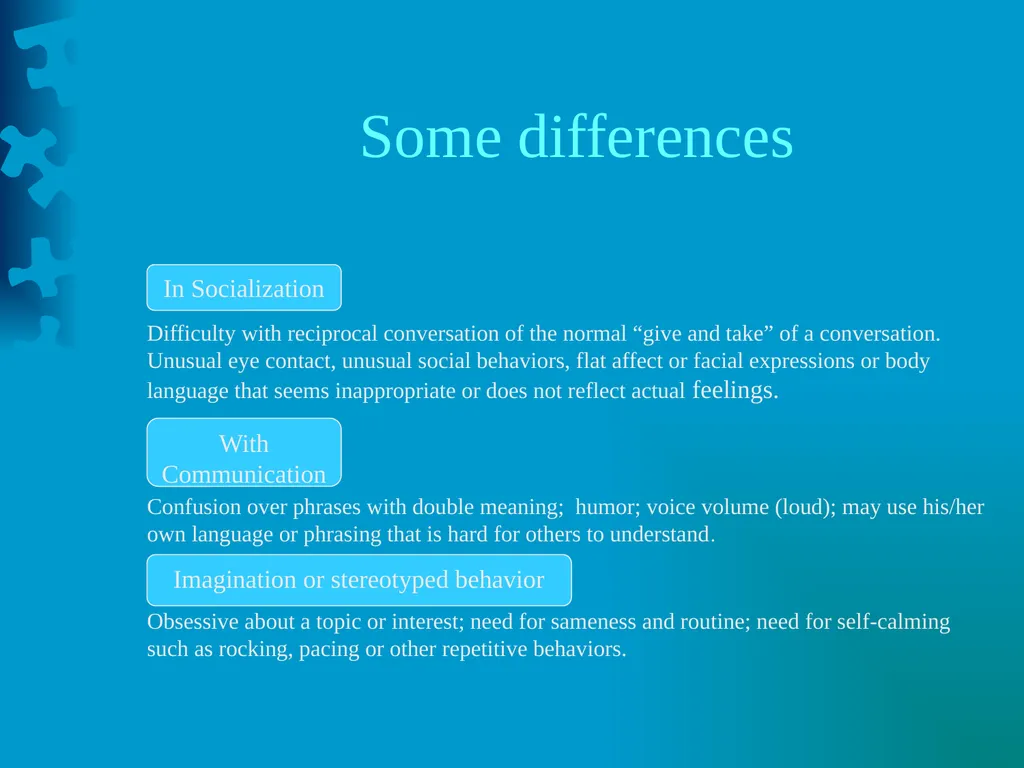
Some differences Difficulty with reciprocal conversation of the normal “give and take” of a conversation. Unusual eye contact, unusual social behaviors, flat affect or facial expressions or body language that seems inappropriate or does not reflect actual feelings.
Confusion over phrases with double meaning; humor; voice volume (loud); may use his/her own language or phrasing that is hard for others to understand.
Obsessive about a topic or interest; need for sameness and routine; need for self-calming such as rocking, pacing or other repetitive behaviors. In Socialization With Communication Imagination or stereotyped behavior<br>
07
Why is it important to know about individuals with Autism Criminal Justice Involvement
Individuals with Autism may be involved in the criminal justice system as victims, witnesses or offender
The lack of social communications skills puts individuals with Autism at a higher risk of becoming victims of crimes rather than becoming perpetrators of crimes
Calls for incidents may include injuries to a person with Autism<br>
08
Why is it important to know about individuals with Autism? Misinterpretation
Emergency calls for someone acting odd, argumentative, or psychotic may actually be an overreaction or misunderstanding by someone who does not understand Autism
Locks on bars, windows or doors of a home may have been installed for the safety of the person with Autism<br>
Emergency calls for someone acting odd, argumentative, or psychotic may actually be an overreaction or misunderstanding by someone who does not understand Autism
Locks on bars, windows or doors of a home may have been installed for the safety of the person with Autism<br>
09
Why is it important to know about individuals with Autism? Behavior Escalation
Calls may be received to assist with family situations where emotional or physical behavior of the person with Autism has escalated beyond the ability of the caregiver or family member to manage.<br>
Calls may be received to assist with family situations where emotional or physical behavior of the person with Autism has escalated beyond the ability of the caregiver or family member to manage.<br>
10
Why is it important to know about individuals with Autism? Victimization
Rates of victimization for people with Autism are more than 10 times as high for sexual assault and more than 12 times as high for robbery.
Individuals with Autism are vulnerable to manipulation by others because of their lack of understanding of another person’s motives
There is no evidence of an association between Autism and criminal offending. In fact, due to the rigid way many people with Autism keep to rules and regulations, they are usually more law-abiding than the general population.<br>
11
What kind of calls might be expected? Runaways, missing person
Inappropriate clothing for the weather
Physical or out of control behavior
Loitering, conflicts in stores or other public places because of misinterpretation of behaviors
Sexually inappropriate behavior due to puberty or lack of social skills
Self-injury<br>
Inappropriate clothing for the weather
Physical or out of control behavior
Loitering, conflicts in stores or other public places because of misinterpretation of behaviors
Sexually inappropriate behavior due to puberty or lack of social skills
Self-injury<br>
12
Things to watch for when arriving on scene An individual with Autism may:
respond in monotone, have a flat or unusual affect, or conversational oddities
appear rude or aggressive
echo or repeat words or phrases
not be able to change a subject he/she is “stuck” on; even if asked/prompted to do so
not recognize personal space
be unable to focus
calm his/her self by doing things like rocking, pacing, flapping hands<br>
13
Keep in mind An individual with Autism may become fixated on one object, such as your badge, as a means of self-calming
An individual with Autism may accept a suggestion of blame with understanding.
Allow self-calming activities such as rocking, twirling or pacing to continue while remaining attentive and patient<br>
An individual with Autism may accept a suggestion of blame with understanding.
Allow self-calming activities such as rocking, twirling or pacing to continue while remaining attentive and patient<br>
14
Keep in Mind Individuals with Autism have many wonderful qualities that can aid in assisting in a situation. It will be most useful if responders interpret responses to questions as strengths rather than challenges or problems. Typically, individuals with Autism:
Are genuine, not manipulative
Have a unique sense of humor
Are honest
Are concrete thinkers
Are intelligent
Have an excellent memory
Have attention to detail
Can be very focused if not over-stimulated<br>
Are genuine, not manipulative
Have a unique sense of humor
Are honest
Are concrete thinkers
Are intelligent
Have an excellent memory
Have attention to detail
Can be very focused if not over-stimulated<br>
15
Important Reminders An individual may not have been officially diagnosed with Autism
Family, friends or acquaintances may not be aware that the individual has Autism
Individuals with Autism may also have psychiatric conditions
The most important factor are the social and communication challenges related to Autism. These factors influence all interactions<br>
Family, friends or acquaintances may not be aware that the individual has Autism
Individuals with Autism may also have psychiatric conditions
The most important factor are the social and communication challenges related to Autism. These factors influence all interactions<br>
16
Communication difficulties prevent individuals with Autism from understanding much of another’s body language. Since 93% of all communication is body language (facial, spacing, gestures, tones, emphasis, etc. ) and 7% of all communication is what is said, individuals with Autism simply may not understand what is happening or how to respond.<br>
17
Tips for Responding If dealing with a child/adolescent, talk to the parent first. Ask the parent if the child/adolescent is able to communicate verbally. If not, ask the parent to provide any assistive devices that will help in communication, or ask about any thing that would help calm the individual. (Adults who have Autism may also use a communication device.)
If possible do not overwhelm the person with several people at once, have one officer approach if the situation is safe.
Turn off lights and sirens<br>
If possible do not overwhelm the person with several people at once, have one officer approach if the situation is safe.
Turn off lights and sirens<br>
18
Tips for Responding Use a calm, non-threatening manner when approaching
Tell the person what you will be doing ahead of time
Be aware that individuals with Autism may have slower processing so may need more time to think and respond
This is also true of individuals with higher functioning Autism who may be extremely bright and capable. Do not be misled that these individuals “should” be able to respond in a normal manner because they have a big vocabulary or appear very smart. Give time to process and respond.<br>
19
Tips for Responding Give clear directions in a measured tone without a loud voice. Stand slightly to the side rather than directly facing individual as this may appear confrontational to the person
Avoid humor, sarcasm, idioms or irony
Ask short, simple questions
Keep in mind the person may be echoing what you say
An individual with Autism may interpret annoyance, irritation or frustration as anger and respond negatively
If the person is fixated on a particular topic, attempt to redirect
Move to a different place away from other people<br>
20
Tips for Responding The individual may lack coordination and may take more time to perform certain requests
The individual may not be able to generalize
Transitions are difficult and aggressive behavior could occur if transitions are forced
Take time to explain calmly what the individual can expect and be prepared to repeat several times if necessary<br>
The individual may not be able to generalize
Transitions are difficult and aggressive behavior could occur if transitions are forced
Take time to explain calmly what the individual can expect and be prepared to repeat several times if necessary<br>
21
Tips for Responding Be aware that reasoning with the individual with Autism most likely will not be effective because he/she is unable to immediately change behavior or thinking
Do not engage in argumentative conversation as the individual will most likely not back down
Remember that actions such as pacing, hand flapping, hopping, chewing, twirling or rocking are necessary self-calming behaviors for the individual. Allow the individual to self-calm before trying to redirect<br>
22
Tips for Responding Assess if the situation is a result of criminal behavior or if it is the result of behaviors and misunderstanding stemming from the disability
Recognize that the individual is vulnerable and may have been put in a situation where they have been victimized due to their lack of understanding, communication and social skills
Be aware that individuals with Autism may not view their behavior as being “wrong” or unjustified; and he/she may admit to an offense without having intent<br>
23
Thank You We greatly appreciate all that law enforcement and other first responders do for the citizens of Adams County. And we appreciate that this includes learning more about individuals in this community who have Autism.<br>
24
The Arc of Adams County Kari Easterly and Linda Gleason – Advocates
641 E. 112th Avenue
Northglenn, CO 80233
303-428-0310<br>
641 E. 112th Avenue
Northglenn, CO 80233
303-428-0310<br>